SHARE Knowledge Hub
Bulk storage and tank farm safety
Bulk storage and tank farm safety is the process safety management of large hazardous inventories stored in fixed or transportable tanks, especially flammable liquids, fuels, solvents, chemicals and other dangerous substances. The topic covers tank design, layout, separation, overfill prevention, bunding, venting, floating roofs, transfer control, ignition control, inspection, maintenance, emergency response, environmental protection and escalation between tanks. In Great Britain, DSEAR and COMAH are central legal frameworks for many higher-hazard sites, while environmental permitting and oil storage routes differ between England, Wales and Scotland; Northern Ireland has its own HSENI/DAERA routes and parallel COMAH, DSEAR and oil storage regulations. A strong tank farm does not rely on one alarm, one operator or one inspection; it uses independent layers of protection, verified operating limits, competent people, maintained equipment, clear emergency decisions and evidence that safety-critical barriers are healthy today.
Understanding Bulk storage and tank farm safety
Bulk storage safety means keeping the stored substance within a verified operating envelope and preventing a release from becoming a fire, explosion, harmful exposure or environmental incident.
Why this matters at work
Record the inventory assumptions, classification evidence, calculations, exclusions, reviewer and change triggers. Reassess before changing products, capacity, processes, boundaries or operating arrangements. Transport and pipeline exclusions have qualifications, particularly where activities occur at an existing establishment; do not apply a general slogan. Give contractors the operator's verified scope decision and relevant controls rather than expecting them to invent a tier for each job. COMAH status does not remove other fire, workplace, pressure, environmental or permission requirements. The assessment should identify responsibilities and unresolved conditions explicitly and retain the evidence supporting the current conclusion.
Check the actual environmental authorisation and every relevant condition before discharge; appearance alone cannot establish that retained liquid is lawful to release. Record safe activation points, confirmation of state, restrictions, suspended permits and handover information. A suspended task's isolation remains part of the operational picture and restart needs the specified revalidation. If assumptions conflict or protection is unavailable, hold affected work for competent resolution. After completion, verify restoration of drainage and protective functions and retain the evidence. A nominal bund volume, general binding rule summary or completed test ticket cannot answer the combined risk and permission decision.
How organisations manage this in practice
Primary containment, secondary containment and wider site containment perform different functions. A nominal bund capacity does not establish available firewater capacity, structural suitability, closed drainage or control of spread beyond the site. Consider the actual inventory, vessel type, fire and release scenarios, topography and response capability. A shared bund or fire area may expose several tanks and critical cables to the same event. Record normal and emergency drainage states, authority to change them, safe activation points and how the required condition is confirmed. Test relevant actions safely and correct defects. Contaminated retained liquid needs a lawful recovery and waste route; opening a drain because visible fire has ended can create another incident. Environmental requirements differ by nation and authorisation, so confirm the actual permission and conditions. Do not adopt a universal foam rate, firewater volume or alarm allowance from a teaching example. Competent engineering and environmental review must resolve the product, installation, response and legal basis before the credited containment can be relied on.
Identify the safeguards needed for this receipt and evidence of their present condition, including instruments, configuration, transfer control and handback after testing. Coordinate operator, driver, contractor and incoming shift responsibilities and define who can hold the transfer and obtain technical support. Record restrictions and stop conditions rather than relying on a generic score or a supplier's maintenance visit. Include simultaneous sampling, hot work, drainage and instrument work that can change conditions. GB and NI legal routes and actual site authorisations remain separate. The guide cannot approve a fill level, valve sequence or restart for an unspecified installation.
Start with the product, receiving vessel, connected system and transfer activity. Confirm usable receiving capacity against approved operating levels, expansion, roof movement and response margins. Normal fill, high alarm, high-high shutdown, rated capacity and physical overfill level are different quantities. A gauge reading is not automatically an independent shutdown, and routinely using an alarm as the normal stopping point consumes protective margin.
Tank farms hold large hazardous inventories, so overfill, loss of containment, vapour cloud formation, ignition, bund failure, tank fire, floating-roof failure, corrosion, wrong routing or delayed isolation can escalate beyond the immediate work area. Control depends on knowing the credible scenario, maintaining independent barriers, proving alarms and trips work, keeping bunds and drainage effective, controlling ignition sources, inspecting tanks and pipework, and rehearsing emergency response against realistic escalation.
How can I practise this topic in 3D?
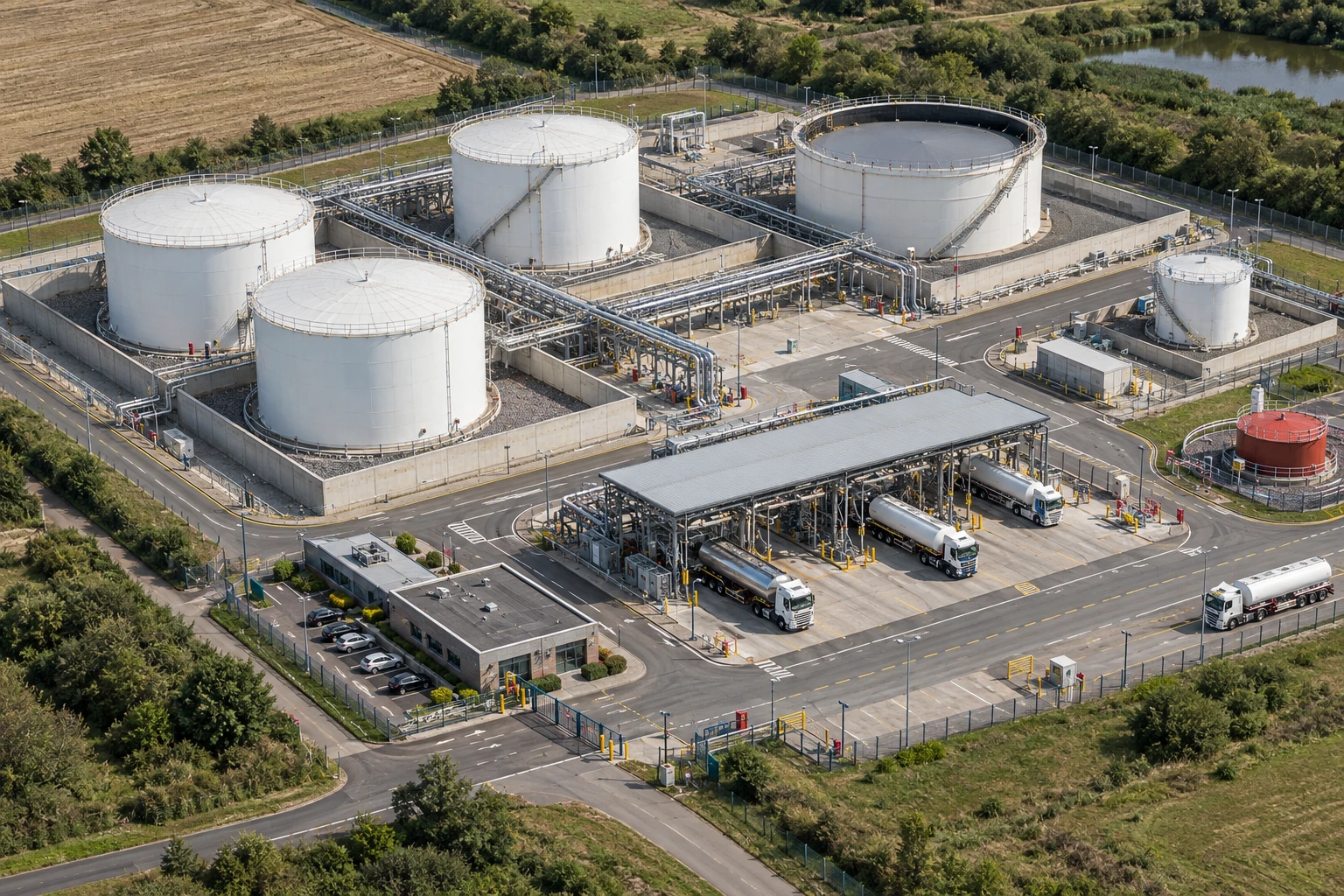

The pipeline receipt has no positively verified destination
All related inspection points 13 across 1 location
Crown Fuels terminal 13 inspection points
Practice in the SHAREhub environment. Browser practice is separate from workplace competence and formal learning records.
Resolve the receiving-tank and barrier questions before flow
Receipt release needs the actual receiving tank, product, usable capacity and verified route. A normal gauge does not establish that independent overfill protection is available. An overdue test is an uncertainty requiring the site impairment decision, not proof of either health or failure.
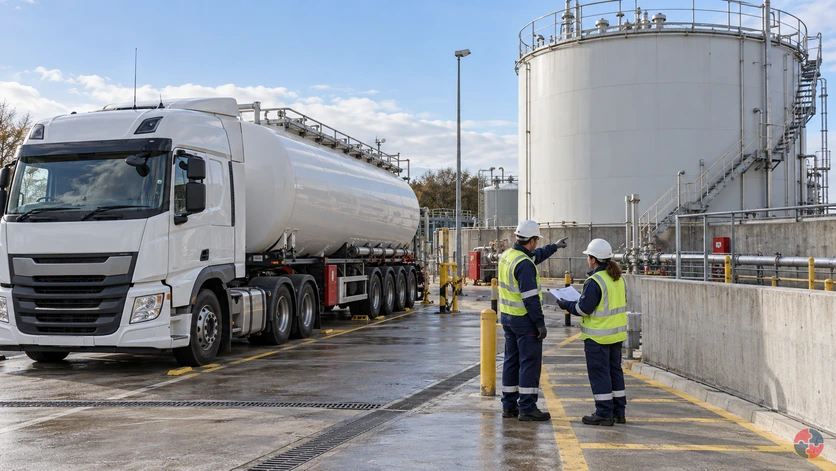
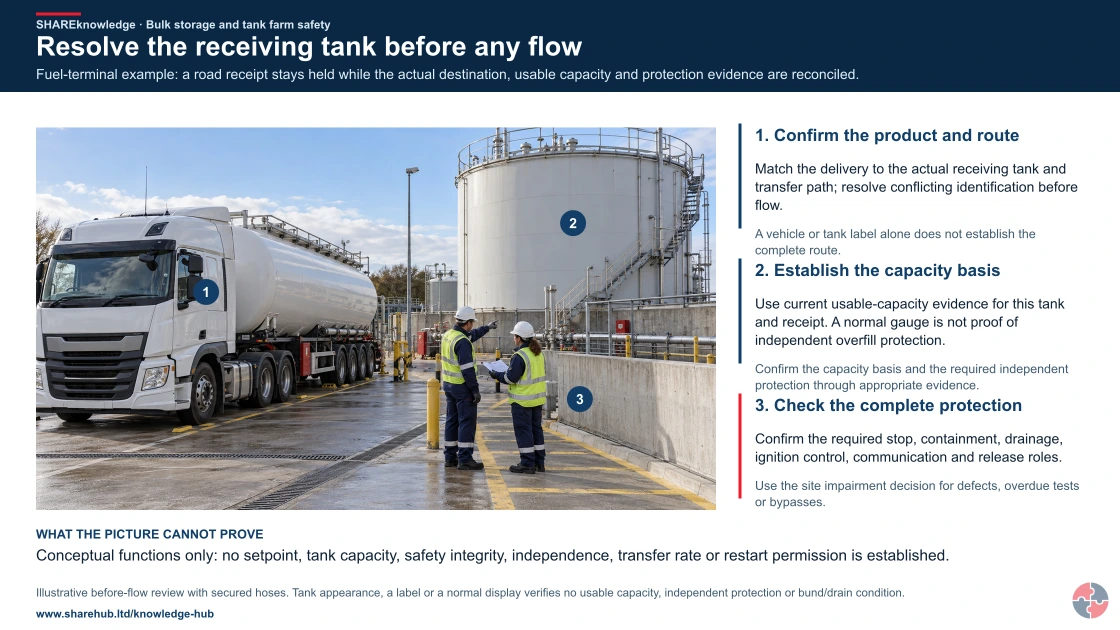
Resolve the receiving tank before any flow
Full written explanation
Fuel-terminal example: a road receipt stays held while the actual destination, usable capacity and protection evidence are reconciled.
- Confirm the product and route. Match the delivery to the actual receiving tank and transfer path; resolve conflicting identification before flow.
- Establish the capacity basis. Use current usable-capacity evidence for this tank and receipt. A normal gauge is not proof of independent overfill protection.
- Check the complete protection. Confirm the required stop, containment, drainage, ignition control, communication and release roles.
Change the pathway
- Use the actual destination. A vehicle or tank label alone does not establish the complete route.
- Keep indication separate. Confirm the capacity basis and the required independent protection through appropriate evidence.
- Resolve impairments. Use the site impairment decision for defects, overdue tests or bypasses.
Evidence check: Conceptual functions only: no setpoint, tank capacity, safety integrity, independence, transfer rate or restart permission is established.
Full abnormal-transfer and emergency-response context
Primary references: HSE: storage of flammable liquids in tanks (HSG176) · HSE: large-tank overfill safety alert
Open the complete HD image (new tab)Download image
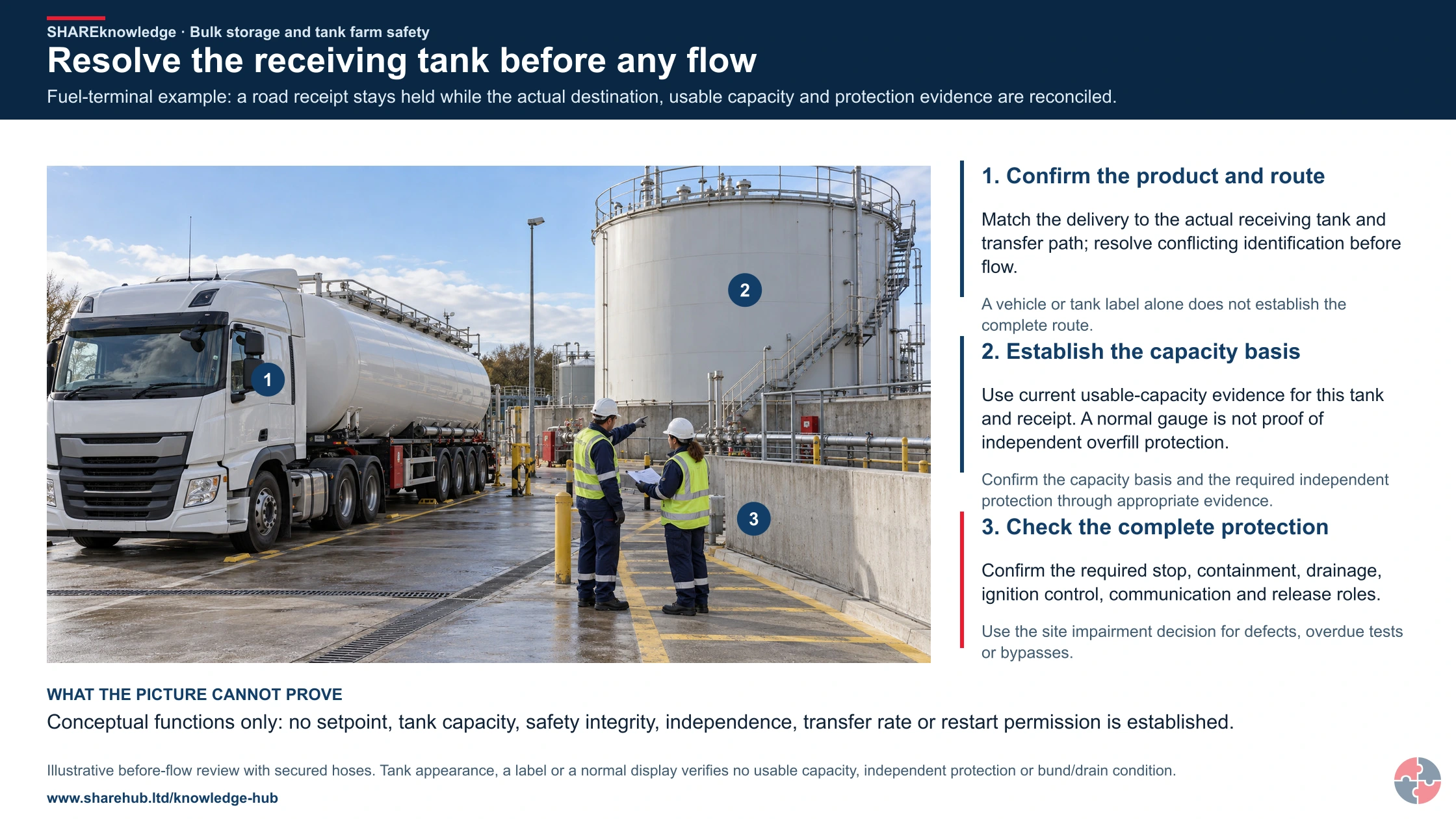
Full abnormal-transfer and emergency-response context
Primary references: HSE: storage of flammable liquids in tanks (HSG176) · HSE: large-tank overfill safety alert
Best-practice guide: Bulk storage and tank farm safety
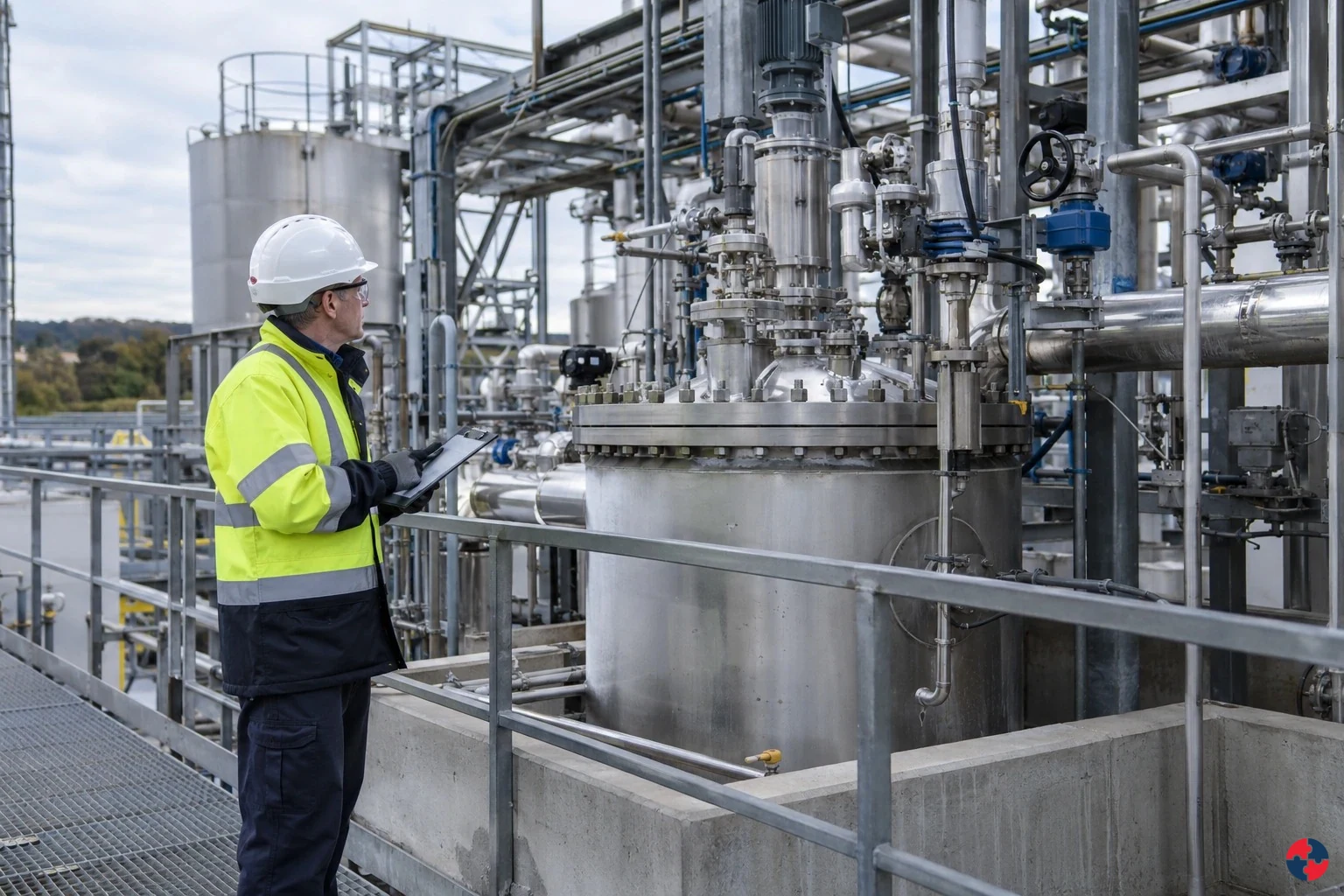
Resolve the receiving-tank and barrier questions before flow
Receipt release needs the actual receiving tank, product, usable capacity and verified route. A normal gauge does not establish that independent overfill protection is available. Bulk storage and tank farm safety is the process safety management of large hazardous inventories stored in fixed or transportable tanks, especially flammable liquids, fuels, solvents, chemicals and other dangerous substances.
Turn bulk storage and tank farm safety knowledge into a decision
Bulk storage and tank farm safety is the process safety management of large hazardous inventories stored in fixed or transportable tanks, especially flammable liquids, fuels, solvents, chemicals and other dangerous substances. The topic covers tank design, layout, separation, overfill prevention, bunding, venting, floating roofs, transfer control, ignition control, inspection, maintenance, emergency response, environmental protection and escalation between tanks. Keep test result, impairment, transfer authorisation, lineup and hand-back.
Night fuel receipt with overdue high-level-trip proof
Treat overdue proof as unresolved protection status rather than proof the device has failed or is healthy. Engineering checks sensing, logic, power and final stop action, common dependencies and test/bypass configuration. Start only after the competent owner demonstrates the required protection in its operating configuration and records acceptance under site rules.
From receipt error to loss of containment
The receipt must match the actual tank, product, route and capacity basis. Required overfill protection is not proved by a level display or a bund. Resolve impairment and independence questions before relying on the barrier chain.
Choose controls for bulk storage and tank farm safety
Elimination: Avoid an unnecessary bulk receipt or reduce the inventory by direct supply where the process and supply resilience allow; compare transport frequency and total risk, not just tank volume. Substitution: Assess a less flammable liquid or lower-volatility grade only if process quality, materials, storage and downstream hazards remain acceptable. Engineering: Specify independent high-level trip separate from routine level indication, suitable venting and intact bund/drain barriers for the receiving tank and transfer rate. Administrative: Use positive tank/product/route checks, controlled transfer authorisation, shift communication and a recorded impairment/deferral process. PPE: Select chemical and fire exposure PPE for defined sampling or response tasks with fit, compatibility and replacement checks; it cannot protect people from a vapour-cloud explosion. Read the full control table for qualifications, ownership and verification. Use the actual task and applicable jurisdiction; existing technical approval remains unchanged.
Use the full bulk storage and tank farm safety lesson
Use the full topic for the decision points, practical examples, detailed control tables and source scope. HSE guidance applies to Great Britain; use HSENI for the Northern Ireland route and the source’s stated jurisdiction. A simplified guide does not change the page’s technical-review or approval status.

Read all six steps as text
1. Resolve the receiving-tank and barrier questions before flow
Receipt release needs the actual receiving tank, product, usable capacity and verified route.
- Avoid / redesign: Avoid an unnecessary bulk receipt or reduce the inventory by direct supply where the process and supply resilience allow; compare transport frequency and total risk, not just tank volume.
- Control the task: Specify independent high-level trip separate from routine level indication, suitable venting and intact bund/drain barriers for the receiving tank and transfer rate.
- Verify before release: Process engineer documents inventory and scenario reduction; stop design approval if off-site or transfer risk is merely displaced.
Receipt release needs the actual receiving tank, product, usable capacity and verified route. A normal gauge does not establish that independent overfill protection is available. Bulk storage and tank farm safety is the process safety management of large hazardous inventories stored in fixed or transportable tanks, especially flammable liquids, fuels, solvents, chemicals and other dangerous substances.
Apply it: Which part of this plan would you check at the workface before authorising the task?
2. Turn bulk storage and tank farm safety knowledge into a decision
Use the evidence to improve the actual work arrangement.
- Change at source: Avoid an unnecessary bulk receipt or reduce the inventory by direct supply where the process and supply resilience allow; compare transport frequency and total risk, not just tank volume.
- Make it observable: Process engineer documents inventory and scenario reduction; stop design approval if off-site or transfer risk is merely displaced.
- Keep useful evidence: Keep test result, impairment, transfer authorisation, lineup and hand-back.
Bulk storage and tank farm safety is the process safety management of large hazardous inventories stored in fixed or transportable tanks, especially flammable liquids, fuels, solvents, chemicals and other dangerous substances. The topic covers tank design, layout, separation, overfill prevention, bunding, venting, floating roofs, transfer control, ignition control, inspection, maintenance, emergency response, environmental protection and escalation between tanks. Keep test result, impairment, transfer authorisation, lineup and hand-back.
Apply it: What evidence would show that the change improves this task, rather than only completing a record?
3. Night fuel receipt with overdue high-level-trip proof
Example: a practical application of the existing topic lesson.
- Setting: A road tanker is due at a depot tank.
- Act: Hold unloading, verify product, receiving tank, ullage and all required protection status; quarantine the transfer route if the independent trip is unavailable.
- Hold / review: Do not begin a high-rate transfer on the gauge alone, an untested trip, unknown tank capacity or an unresolved bypass.
Treat overdue proof as unresolved protection status rather than proof the device has failed or is healthy. Engineering checks sensing, logic, power and final stop action, common dependencies and test/bypass configuration. Start only after the competent owner demonstrates the required protection in its operating configuration and records acceptance under site rules.
Apply it: At which point would you hold this example, and what evidence would allow it to proceed?
4. From receipt error to loss of containment
Trace the actual receiving tank and the required final stop function.
- Threat: Wrong destination, uncertain capacity or failed receipt controls can create an overfill demand.
- Preventive function: Verify sensing, logic/power and final stop, including configuration, proof-test scope and common dependencies. Normal indication is separate.
- Consequences and mitigation: A release may spread, ignite or affect the environment. Bunds, drainage, ignition control and response have distinct functions and limits.
The receipt must match the actual tank, product, route and capacity basis. Required overfill protection is not proved by a level display or a bund. Resolve impairment and independence questions before relying on the barrier chain.
Apply it: Which required function stops the receipt, and what current evidence shows the whole chain is available?
5. Choose controls for bulk storage and tank farm safety
Start with the stronger practicable options and verify their effect.
- Elimination: Avoid an unnecessary bulk receipt or reduce the inventory by direct supply where the process and supply resilience allow; compare transport frequency and total risk, not just tank volume.
- Substitution: Assess a less flammable liquid or lower-volatility grade only if process quality, materials, storage and downstream hazards remain acceptable.
- Engineering: Specify independent high-level trip separate from routine level indication, suitable venting and intact bund/drain barriers for the receiving tank and transfer rate.
- Administrative: Use positive tank/product/route checks, controlled transfer authorisation, shift communication and a recorded impairment/deferral process.
- PPE: Select chemical and fire exposure PPE for defined sampling or response tasks with fit, compatibility and replacement checks; it cannot protect people from a vapour-cloud explosion.
Elimination: Avoid an unnecessary bulk receipt or reduce the inventory by direct supply where the process and supply resilience allow; compare transport frequency and total risk, not just tank volume. Substitution: Assess a less flammable liquid or lower-volatility grade only if process quality, materials, storage and downstream hazards remain acceptable. Engineering: Specify independent high-level trip separate from routine level indication, suitable venting and intact bund/drain barriers for the receiving tank and transfer rate. Administrative: Use positive tank/product/route checks, controlled transfer authorisation, shift communication and a recorded impairment/deferral process. PPE: Select chemical and fire exposure PPE for defined sampling or response tasks with fit, compatibility and replacement checks; it cannot protect people from a vapour-cloud explosion. Read the full control table for qualifications, ownership and verification. Use the actual task and applicable jurisdiction; existing technical approval remains unchanged.
Apply it: Which stronger option can be used here, and who will verify it before accepting the remaining risk?
6. Use the full bulk storage and tank farm safety lesson
Follow the official sources below and retain the task-specific evidence.
- Official guidance: HSE HSG176 storage of flammable liquids in tanks
- Official guidance: HSE large-tank overfill safety alert
- Task decision: Keep test result, impairment, transfer authorisation, lineup and hand-back.
Use the full topic for the decision points, practical examples, detailed control tables and source scope. HSE guidance applies to Great Britain; use HSENI for the Northern Ireland route and the source’s stated jurisdiction. A simplified guide does not change the page’s technical-review or approval status.
Apply it: Which official source and full-topic section will you use to resolve the next decision?
Keep containment, drainage, firewater and environmental assumptions with the task. Rainfall, penetrations and escape pathways can change the decision. Connect the receipt evidence to the existing bulk-storage audit, while retaining the technical authority for any unavailable protection.
A night delivery arrives with an overdue protection test
Illustrative example. The tank gauge appears normal, but the independent overfill safeguard lacks current representative proof evidence.
Decision. Hold flow under the site impairment arrangements while the competent authorities resolve protection availability and receipt conditions.
Evidence to check. Check product/tank, usable ullage, verified line-up, safeguard evidence, communications and emergency-stop readiness.
Hold or escalation point. No release from the gauge, historic successful deliveries or a generic bund percentage.
Follow-up. The operating owner records accepted protection/containment evidence and consistent shift handover before receipt.
Trace the receipt from product to final stop
Start with the actual receiving tank, product, route and available capacity. Then follow the required protection through sensing, logic/power and final action; a normal level display cannot prove that chain.
Trace the required stop, not just the level display
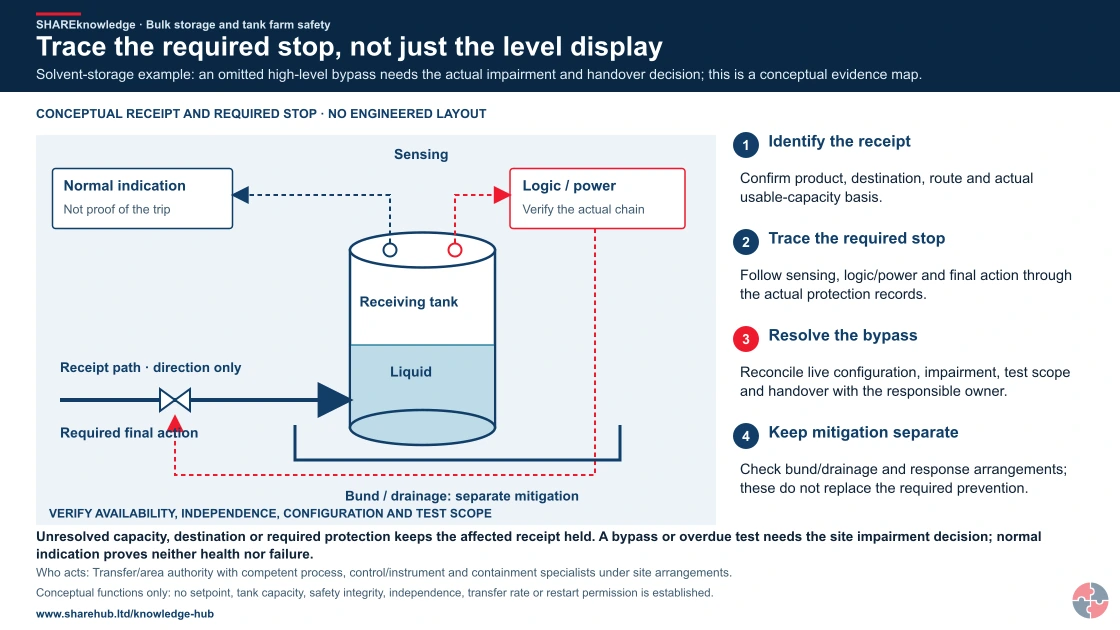
Full written explanation
Solvent-storage example: an omitted high-level bypass needs the actual impairment and handover decision; this is a conceptual evidence map.
- Identify the receipt. Confirm product, destination, route and actual usable-capacity basis.
- Trace the required stop. Follow sensing, logic/power and final action through the actual protection records.
- Resolve the bypass. Reconcile live configuration, impairment, test scope and handover with the responsible owner.
- Keep mitigation separate. Check bund/drainage and response arrangements; these do not replace the required prevention.
When the evidence does not fit: Unresolved capacity, destination or required protection keeps the affected receipt held. A bypass or overdue test needs the site impairment decision; normal indication proves neither health nor failure.
Who acts: Transfer/area authority with competent process, control/instrument and containment specialists under site arrangements.
Changed workplace
Fuel terminal: Reconcile the complete receipt before flow; identify the real tank and current available capacity.
Solvent installation: A bypass omitted from handover changes the evidence; resolve the actual protective-function status.
Evidence check: Conceptual functions only: no setpoint, tank capacity, safety integrity, independence, transfer rate or restart permission is established.
Full abnormal-transfer and emergency-response context
Primary references: HSE: storage of flammable liquids in tanks (HSG176) · HSE: large-tank overfill safety alert
Open the complete HD image (new tab)Download image
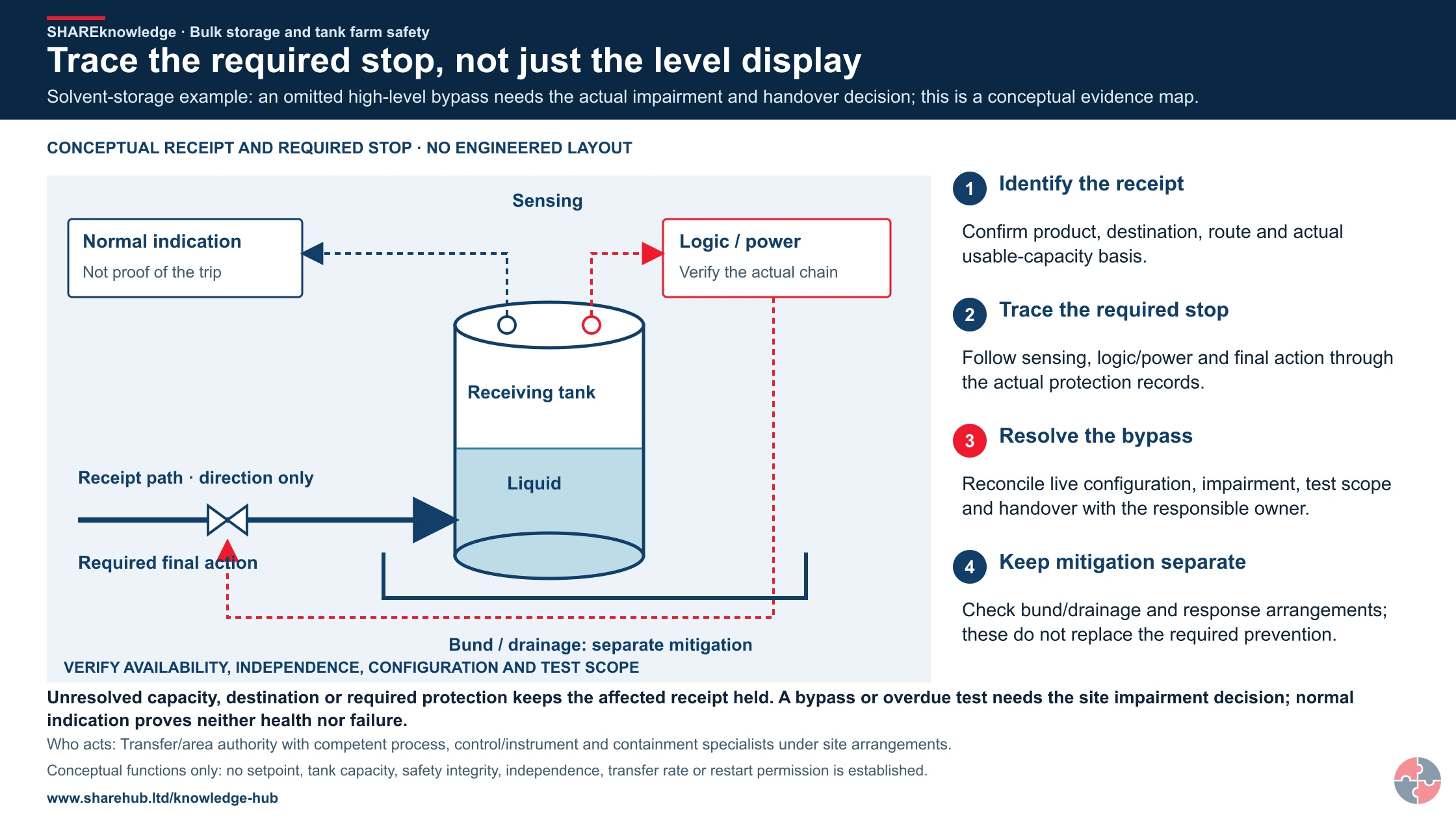
Full abnormal-transfer and emergency-response context
Primary references: HSE: storage of flammable liquids in tanks (HSG176) · HSE: large-tank overfill safety alert
- Product / route / receiving tank
- Sensor → logic/power → final stop
- Separate indication + mitigation
Read the labels in the full-size drawing
- Vapour
- Liquid
- Product / route /
- capacity
- Sensing / logic /
- power
- FINAL STOP
- Normal indication is separate
- Bund / drainage / ignition: mitigation
| Entry question | Evidence to locate | Hold if unresolved |
|---|---|---|
| Correct receipt | Product, tank identity, route and actual capacity basis. | A display or label conflicts with the confirmed destination or current capacity. |
| Required protection | Sensor, logic/power and final stop for the receiving tank and transfer. | Availability, independence, configuration or test scope cannot be demonstrated. |
| Mitigation | Bund/drainage status, ignition controls and the assessed response arrangements. | An impairment changes the assessed scenario and lacks an authorised arrangement. |
| Current release | Transfer owner, communication, proof/configuration status and live impairment record. | A checklist is complete but the physical/evidence question remains open. |
The model is a conceptual locator, not proof of capacity, safety integrity or compliance. Keep normal indication, required overfill protection and post-release mitigation separate. Use site rules for a held or impaired receipt.
What are the key facts about bulk storage and tank farm safety?
The key facts are that large inventories, routine transfers and degraded barriers can create major accident scenarios.
Inventory drives consequence
A small loss of control can release enough material to create fire, explosion, toxic, environmental or off-site consequences.
Overfill is a critical scenario
Tank overfill can produce vapour, liquid spread, bund loading, ignition and escalation if independent protection fails.
Containment is layered
Primary tanks, pipework, valves, secondary bunds, drainage and emergency response all form part of containment.
Ignition control is essential
Flammable vapour needs only an effective ignition source, so hazardous area classification, static control and hot work control matter.
Inspection prevents surprise failure
Corrosion, settlement, roof defects, blocked vents and poor repairs can weaken tanks before visible failure.
Emergency response must be realistic
Tank farm emergencies require foam, cooling, isolation, drainage, evacuation, responder safety and environmental planning.
What is bulk storage and tank farm safety?
Bulk storage and tank farm safety is the controlled storage and transfer of large quantities of hazardous liquids or substances. See HSE HSG176 storage of flammable liquids in tanks
A tank farm is not just a collection of tanks. It is a connected process system with inventories, pumps, valves, vents, drains, bunds, instrumentation, electrical equipment, vehicles, people, procedures and emergency controls. A failure in one part can place demand on several others very quickly.
The main danger with routine storage is familiarity. Operators may fill tanks every day without incident, but the risk changes when a gauge sticks, a high-level switch is impaired, a tank has less spare capacity than expected, a valve line-up is wrong, vapour accumulates, a bund drain is open, or an ignition source is present.
A competent site therefore manages the tank farm as a major accident hazard system. It knows what is stored, how much, under what conditions, what could go wrong, what barriers prevent the event, what mitigates it, and what evidence proves those barriers are functioning.
Hazardous inventory. The substance, quantity and condition stored. Tank list, SDS, process safety information and COMAH/DSEAR data.
Primary containment. Tanks, pipework, pumps, valves and fittings that hold material. Inspection records, design basis and repair history.
Secondary containment. Bunds, kerbs, drainage and interceptors that limit spread. Bund inspections, capacity checks and drain controls.
Overfill prevention. Measures that stop filling before dangerous loss of containment. Alarm/trip tests, proof tests and operating procedures.
Emergency mitigation. Response that limits consequences after loss of control. Emergency plans, foam/cooling checks and exercise learning.
What hazards are created by bulk storage tanks?
Bulk storage tanks can create fire, explosion, toxic exposure, environmental release, structural failure and escalation hazards. See HSE HSG176 storage of flammable liquids in tanks
The hazard is not just the chemical name. The same liquid can behave differently depending on flash point, vapour pressure, temperature, fill rate, tank geometry, ventilation, containment, weather, drainage, contamination and ignition sources. Large inventory also means that a slow release can still become a major event if it is not detected or isolated.
Flammable liquids can produce vapours that travel, collect in low areas or form large clouds under some conditions. Toxic or corrosive substances may require additional exposure and emergency controls. Environmentally harmful liquids can spread through drains, soil and watercourses if secondary and tertiary containment fail.
Tank farms also create hazards during maintenance: hot work, confined spaces, sludge, residues, pyrophoric deposits, vapours, cleaning, isolation and simultaneous operations.
Pool fire. Released flammable liquid ignites and burns in a bund, tank top or transfer area. Containment, ignition control, foam, drainage and emergency response.
Vapour cloud explosion. Large flammable vapour cloud forms and ignites after dispersal. Overfill prevention, detection, separation and ignition control.
Tank fire. Floating roof, rim seal, vent, lightning or hot work event ignites vapour. Roof/seal inspection, earthing, fire protection and lightning protection.
Environmental release. Liquid or contaminated firewater escapes bunds or drains. Bunds, valves, interceptors, tertiary containment and emergency drainage.
Structural failure. Corrosion, settlement, brittle fracture or overpressure causes tank failure. Integrity management, inspection, design review and repair control.
Toxic exposure. Toxic vapour, mist or liquid exposes workers/responders/public. COSHH, detection, exclusion zones, RPE and emergency planning.
Which credible major accident scenarios should a tank farm consider?
A tank farm should identify credible scenarios from filling, storage, transfer, maintenance, external events and emergency response. See HSE COMAH guidance
A credible scenario is not a prediction that something will happen; it is a realistic way the system could lose control. Good hazard identification includes normal operation, abnormal operation, start-up, shutdown, maintenance, modification, weather events, vehicle impact, utility loss, human error and failure of protective systems.
The scenario should be written in a way that points to barriers. For example, “tank overfills during night transfer, petrol forms a vapour cloud and ignites off site” immediately raises questions about tank capacity confirmation, independent high-level protection, alarm response, transfer supervision, vapour behaviour, ignition control and emergency response.
Tank overfill. Wrong tank, gauge failure, no ullage check, alarm/trip failure or poor handover. Independent overfill protection, transfer procedure, capacity check and supervision.
Bund fire. Leak into bund, open drain, ignition source, delayed isolation. Bund condition, drain valves, detection, ignition control and foam response.
Floating roof failure. Roof sinking, seal damage, blocked drains, heavy rain, poor inspection. Roof inspection, drainage, seal checks and emergency response.
Pipework or hose failure. Corrosion, impact, wrong hose, coupling failure, pressure surge. Inspection, compatibility, pressure control, isolation and transfer checks.
Tank structural failure. Corrosion, settlement, brittle fracture, poor repair or change of service. Integrity programme, fitness-for-service and MOC.
Escalation between tanks. Fire impingement, radiant heat, poor separation, inadequate cooling. Layout, separation, water cooling, foam and emergency planning.
How should tank design and layout reduce risk?
Design and layout should reduce the likelihood of release and limit escalation if release occurs. See HSE HSG176 storage of flammable liquids in tanks
Tank layout is a major accident barrier. Separation distances, access, road tanker areas, rail loading, bund arrangement, drainage, firefighting access, emergency isolation, hazardous areas and neighbouring hazards all affect whether a release remains local or escalates.
Design should consider contents, capacity, tank material, foundation, venting, corrosion protection, insulation, connections, overfill protection, access for inspection, earthing, lightning, fire protection, emergency response and future maintenance. Tanks should be suitable for the actual substance and conditions, not simply reused because they are available.
Change of service is a common trap. A tank designed for one liquid may not be suitable for another with different flash point, vapour pressure, density, corrosivity, temperature, compatibility or static behaviour.
Separation and spacing. Reduces fire spread, heat exposure and off-site impact. Layout drawings and HSG176/design review.
Tank suitability. Ensures materials, fittings and design match the stored substance. Design basis and change-of-service assessment.
Access and egress. Allows operation, inspection, maintenance and emergency response. Site layout and emergency access review.
Drainage design. Prevents uncontrolled release to drains or watercourses. Drainage plans, interceptor checks and valve status.
Hazardous area classification. Controls ignition sources in vapour-risk areas. DSEAR assessment and equipment register.
Maintainability. Allows inspection and repair without unsafe improvisation. Inspection access plan and maintenance strategy.
How should overfill prevention be managed?
Overfill prevention should use reliable level information, defined operating limits and independent protection for high-consequence tanks. See HSE Buncefield incident resources
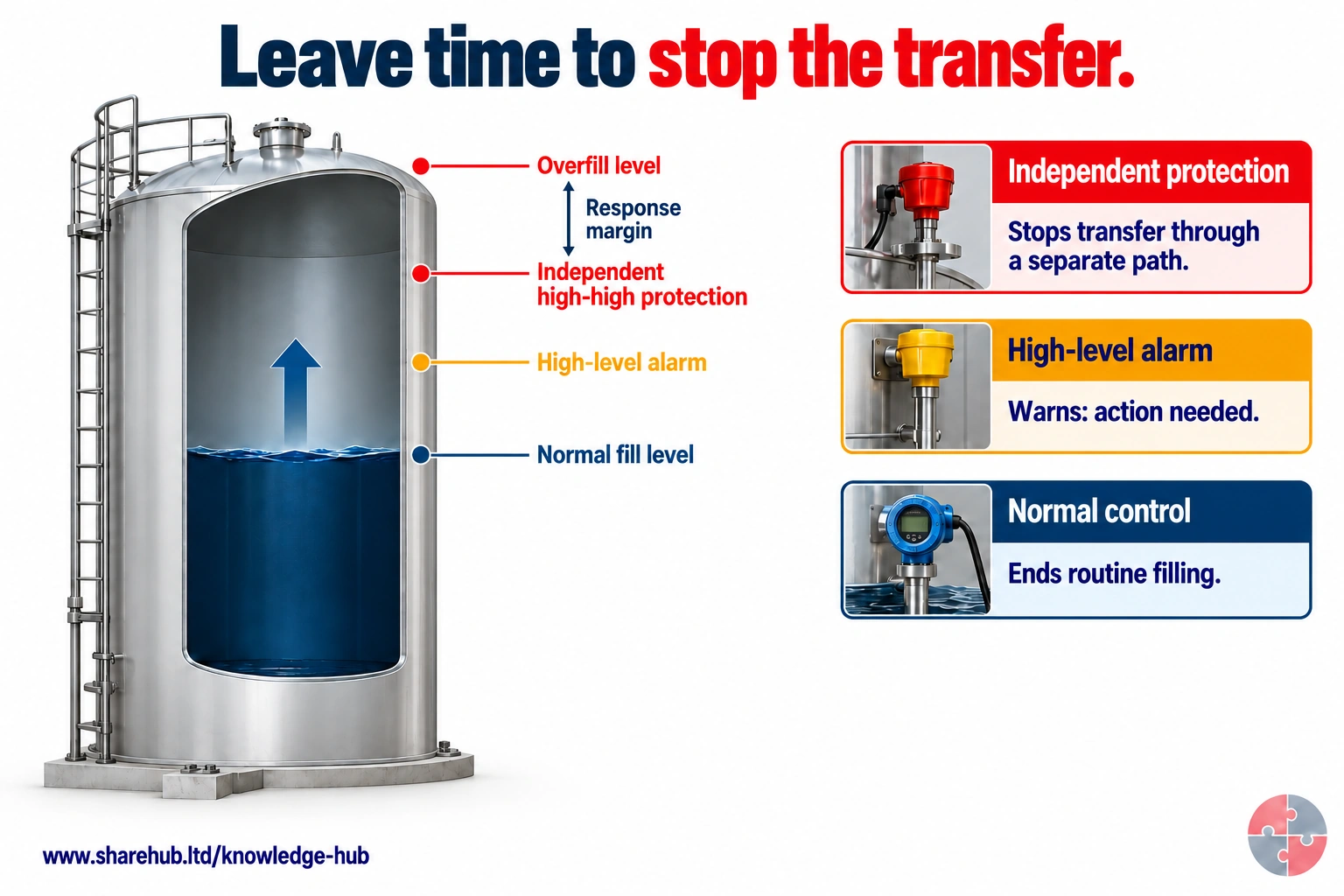
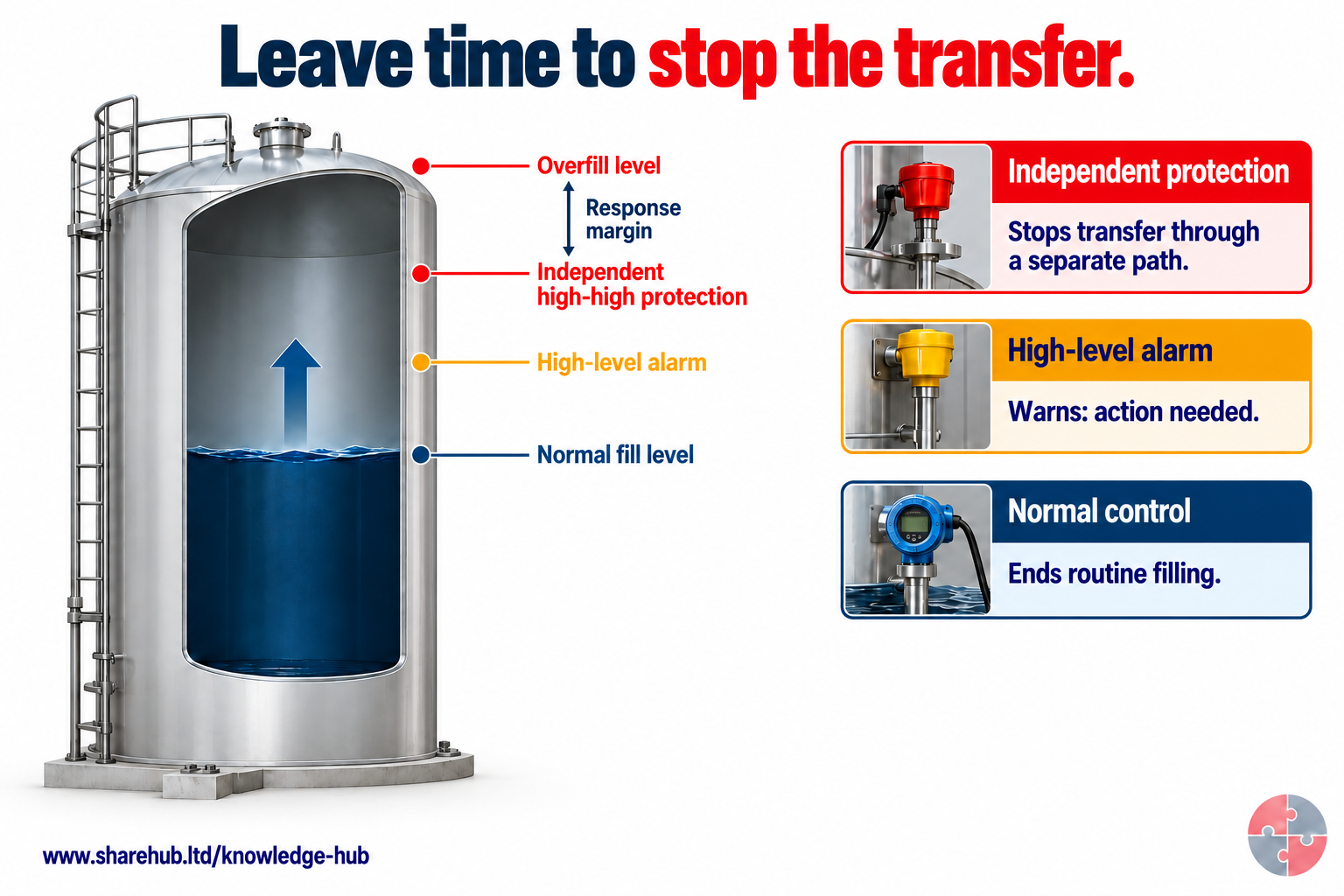
The illustrated arrangement ends routine filling below the high-level warning, with independent high-high protection below the overfill level. Here the independent function automatically stops the transfer through a separate path; the alarm prompts action and is not the normal filling control. The vertical gaps represent time and capacity available for response, not standard setpoint spacing.
Why is the response margin needed?
Detection, operator or automatic response, valve/pump action and any continuing inflow take time. The assessed margin must prevent loss of containment or tank damage before incoming flow stops.
Illustrative relative levels only. Actual alarm/trip functions, rated capacity, setpoints and margins depend on tank geometry, maximum credible transfer rate, thermal expansion and the verified complete system. The picture does not assign requirements to every tank.
Source guidance: HSE HSG176
Overfill prevention starts before the pump starts. The operator should know the receiving tank, current level, safe filling limit, expected transfer volume, flow rate, source of material, route, valve line-up, alarm response and emergency stop method. If any of that information is uncertain, the transfer should not be treated as routine.
Normal level gauging is not enough for high-consequence overfill scenarios. Buncefield learning drove attention to independent automatic overfill prevention systems, proof testing and independence from the tank gauging system. The key question is whether the protection would actually stop flow before dangerous loss of containment if the normal system failed.
Alarm response must also be designed. An alarm that nobody hears, understands, trusts or has time to act on is not a strong barrier. It needs a clear set point, priority, response time, trained people and evidence from drills or tests.
Tank capacity check. Confirms the tank has enough ullage for the planned transfer. Pre-transfer checklist and independent verification where required.
Level gauging. Shows normal operating level. Calibration, maintenance and operator checks.
High-level alarm. Warns before a dangerous level is reached. Alarm test, response procedure and alarm rationalisation.
Independent high-high protection. Stops or prevents filling if normal controls fail. Proof testing, independence check and SIL/functional safety records where relevant.
Transfer supervision. Detects abnormal rate, unexpected level change or communication failure. Operator rounds, logs and handover.
Emergency shutdown/isolation. Stops incoming flow quickly. ESD test, valve proof test and drill evidence.
How should bunding, drainage and containment be managed?
Bunds and drainage should contain foreseeable releases and prevent uncontrolled environmental spread. See HSE HSG176 storage of flammable liquids in tanks
Secondary containment is often treated as passive, but passive does not mean maintenance-free. A bund with cracks, poor joints, open drains, vegetation, penetrations, insufficient capacity or blocked access may fail just when it is needed. Firewater can also challenge containment because response activity can create large contaminated volumes.
The bund arrangement should be compatible with the stored substance and credible release. Operators must know the approved rainwater-removal arrangement, how contaminated water is retained and who can authorise lawful discharge. Check whether applicable oil-storage rules prohibit a drain-down opening: a generic drain-valve routine cannot override that requirement. Where an engineered drain is permitted, verify its normal secured state and control every temporary opening.
Bunds also affect escalation. A bund full of flammable liquid can become a large pool fire, exposing adjacent tanks and structures. Design, capacity, subdivision, drainage, foam application and emergency access all matter.
Bund capacity. Contains credible tank or pipework release. Capacity calculations and inspection.
Bund integrity. Prevents leakage through cracks, joints or penetrations. Condition inspection and repair records.
Drain control. Prevents liquid escaping through open drains. Drain valve checks and authorisation process.
Rainwater management. Keeps capacity available without uncontrolled discharge. Routine checks and discharge records.
Firewater planning. Accounts for contaminated firefighting water. Emergency drainage plan and exercises.
Tertiary containment. Limits off-site or environmental spread if bund fails. Site drainage maps and pollution response plan.
How should vents and floating roofs be controlled?
Vents and floating roofs should control pressure, vapour and rainwater while preventing ignition and loss of containment. See HSE HSG176 storage of flammable liquids in tanks
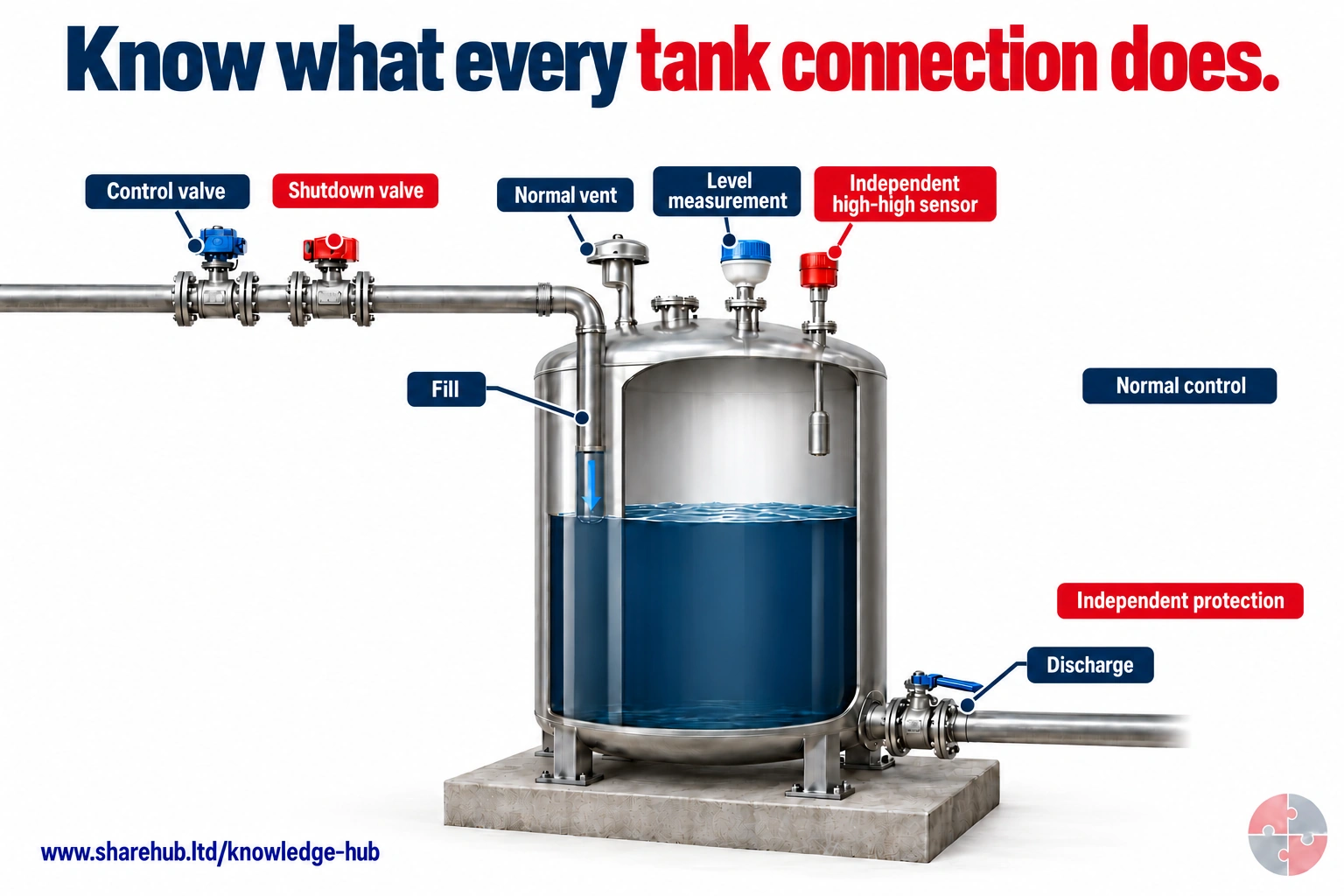
The labels distinguish fill/discharge, normal venting, routine level measurement and a separate high-high sensor. In this example the protective function must detect the high-high condition and bring about the required stop through its independent path. Separately drawn devices alone do not demonstrate independence or an effective protective system.
Why is a separate high-high sensor alone insufficient evidence of overfill protection?
It is only the sensing element. The required independence, logic, final shutdown or diversion action, response time and verification of the complete protective function must also be established.
Conceptual connection/function plate, not a complete safety instrumented system or tank installation. Normal and emergency pressure/vacuum relief, vent sizing, containment, protective architecture and testing require competent design for the actual tank and substance.
Source guidance: HSE HSG176
Atmospheric tanks still need venting. Normal breathing, filling, emptying, temperature change and emergency conditions can create pressure or vacuum. Blocked vents, undersized vents, flame-arrester problems or incorrect fittings can damage tanks or release vapour unsafely.
Floating roofs reduce vapour space but introduce their own failure modes: roof sinking, seal damage, pontoon leaks, blocked drains, rim seal fires, lightning vulnerability and inspection access. These are safety-critical where the contents are flammable.
Inspection should focus on the roof, seals, drains, legs, pontoons, vents, emergency relief, corrosion, settlement and any change that affects vapour control.
Normal vents. Pressure/vacuum damage or uncontrolled vapour release. Sizing, inspection and blockage checks.
Emergency vents. Tank failure during fire exposure or abnormal pressure. Design basis and maintenance.
Flame arresters. Blocked flow or ineffective flame protection. Inspection and cleaning schedule.
Floating roof seals. Vapour release and rim seal fire. Seal inspection and repair.
Roof drains. Roof loading, sinking or contamination. Drain inspection and rainfall checks.
Lightning/earthing. Ignition of vapour at tank roof or fittings. Earthing/bonding inspections and lightning protection checks.
How should loading, unloading and transfer operations be controlled?
Transfer operations should verify substance, route, receiving capacity, connection, supervision and emergency isolation before flow starts. See HSE HSG176 storage of flammable liquids in tanks
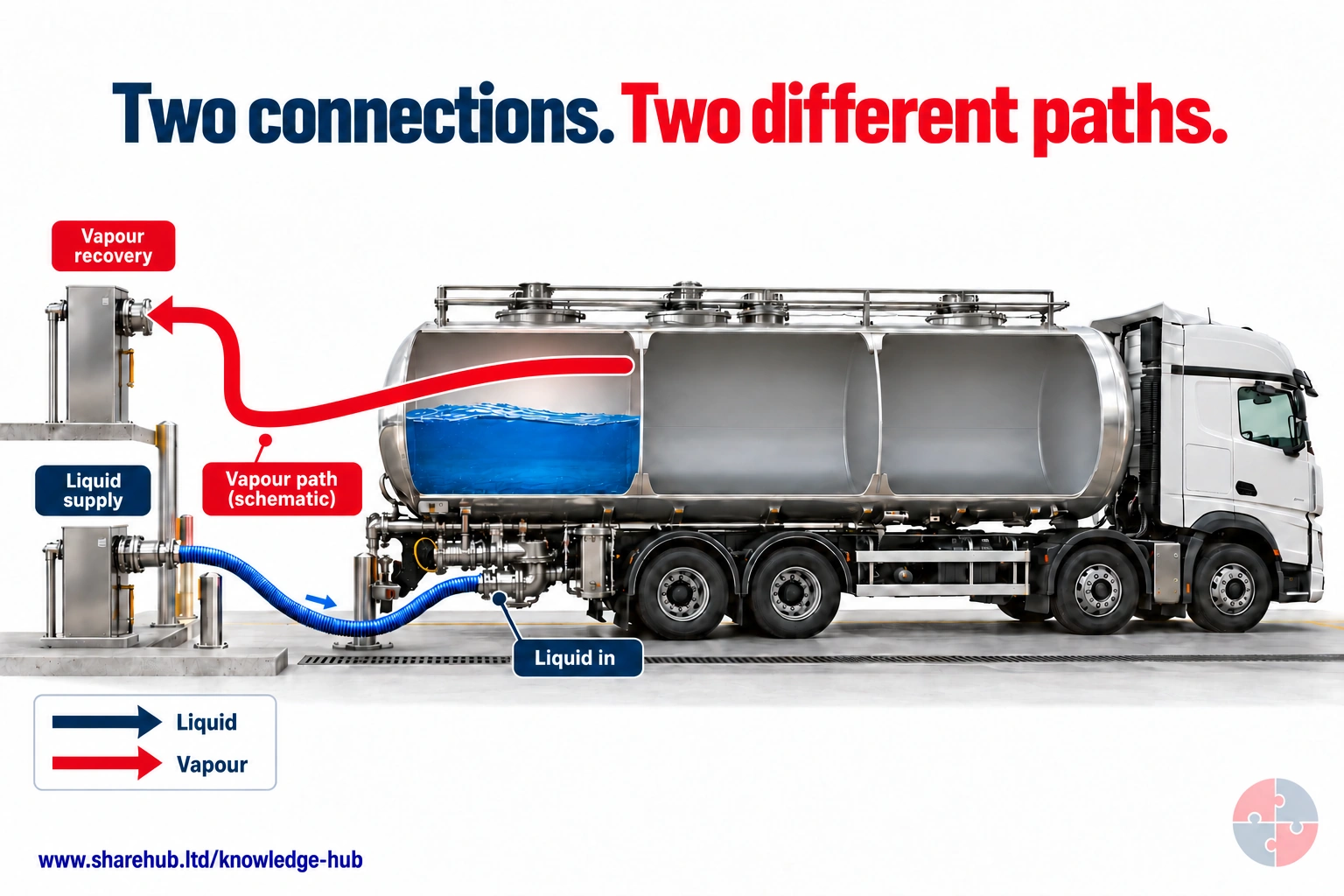
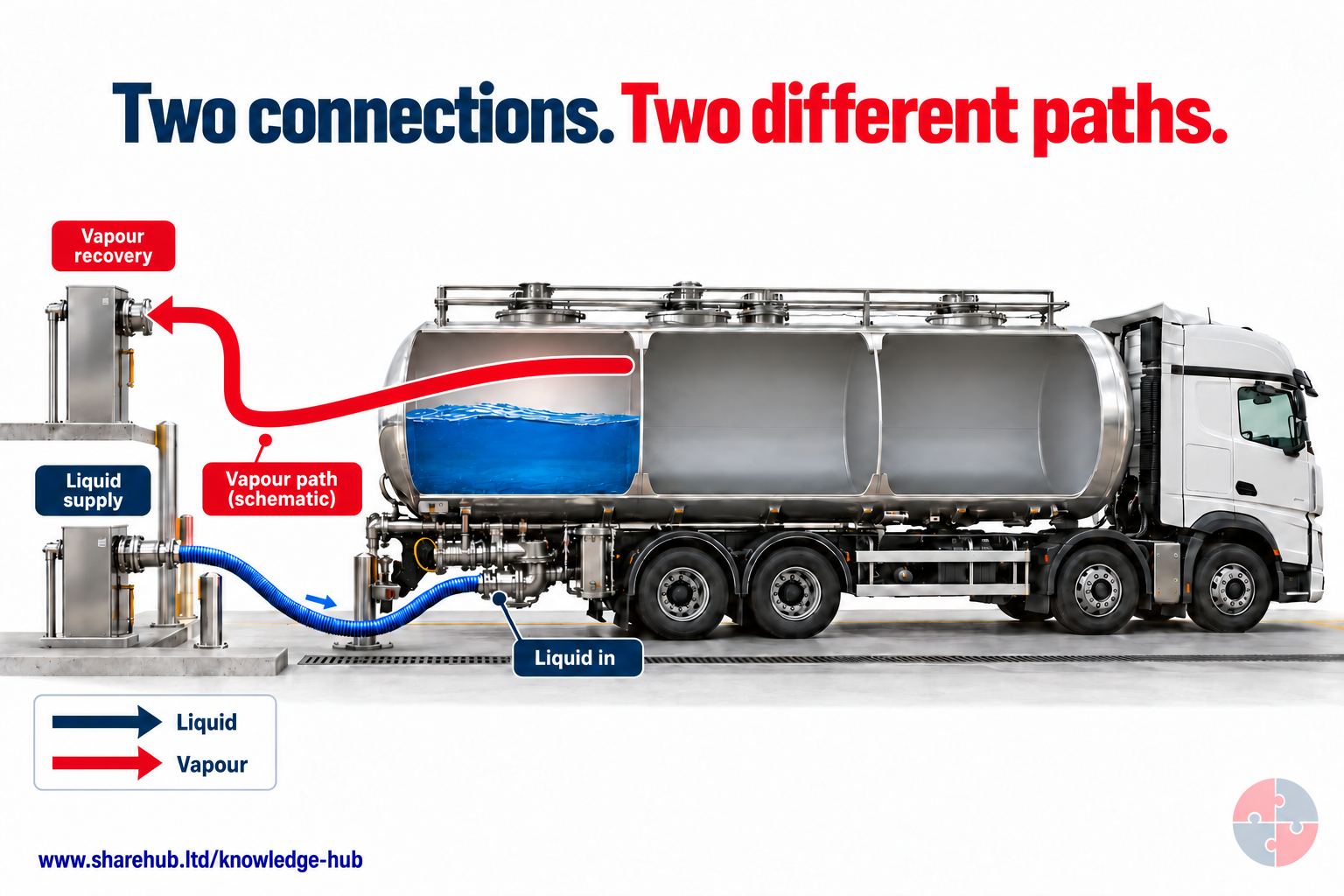
Liquid enters a bottom loading connection and displaces vapour from the loaded compartment. The red overlay starts in the vapour space and leads to recovery, opposite the liquid transfer direction. It is a conceptual route: the drawing does not show the tanker’s actual internal manifold, vapour coupling or every compartment connection.
What happens if the vapour-return path is unavailable?
The planned closed transfer arrangement is incomplete; resolve the condition under the loading procedure before transfer.
Schematic flow paths only, not a pipework or loading procedure. Each loaded compartment requires the designed vapour route; actual couplings, interlocks, earthing, overfill protection, recovery capacity and pressure/vacuum controls belong to the site-specific system.
Source guidance: HSE HSG176
Tank transfer is where many tank farm incidents begin. The task can involve road tankers, rail tankers, ships, pipelines, pumps, flexible hoses, couplings, manifolds, shared routes and changing shift ownership. The risk is not only a leak; it is wrong tank, wrong product, overfill, static ignition, hose failure, incompatible mixing or delayed isolation.
A good transfer procedure is usable at the point of work. It defines who authorises transfer, who checks line-up, how ullage is confirmed, what communication is required, what happens if an alarm sounds, how flow is stopped, and what handover is needed if transfer spans shifts.
Where drivers or contractors are involved, site rules must be clear. A contractor should not be expected to infer a site's tank farm hazards from a generic induction.
Substance verification. Confirm identity, compatibility and receiving tank. Delivery note, SDS and tank label.
Line-up. Verify valves, hoses, pumps and route before transfer. Line-up checklist and independent check.
Capacity. Confirm safe ullage against planned volume. Tank level record and safe fill limit.
Connection. Use compatible, inspected hoses and couplings. Hose register and pre-use checks.
Supervision. Monitor level, flow, alarms and abnormal conditions. Transfer log and operator rounds.
Handover. Communicate live transfers across shift changes. Shift log and permit/transfer status.
What if the transfer indications do not agree?
A discrepancy between expected transfer, tank level and observed flow is a reason to investigate the receiving route and instrumentation through the assessed procedure. Do not average inconsistent indications, assume that the more convenient one is correct or extend the planned transfer because the normal gauge appears unchanged. Identify who can stop the incoming flow safely and who has authority to resolve the uncertainty.
For an illustrative tanker receipt, the operator notices that the receiving-tank indication does not match the expected transfer trend. Follow the site’s validated stopping and isolation arrangement, communicate with the driver and keep the affected transfer held while competent personnel establish the actual tank, route, receiving capacity and instrument condition. Check whether other connected operations share the uncertainty or protection. Restart requires an authorised decision based on restored, verified conditions and a revised transfer plan where necessary; the next shift must receive the held status and unresolved facts, not simply an unfinished delivery quantity.
Guidance and scope: Original SHARE transfer-discrepancy example applying HSE GB flammable-liquid storage and overfill guidance. Actual stopping sequence, response margin and restart evidence are plant-specific; no universal discrepancy tolerance or trip set point is supplied. HSE HSG176 storage of flammable liquids in tanks HSE large-tank safety alert
How should ignition sources be controlled around tank farms?
Ignition control should combine hazardous area classification, equipment selection, hot work control, static control and supervision. See HSE HSG176 storage of flammable liquids in tanks
Flammable liquid storage creates vapour hazards that may not be visible. Ignition control therefore begins with understanding where vapours could arise during normal and abnormal operation: vents, bunds, drains, sampling points, loading arms, tanker connections, floating roof seals, spills and maintenance work.
DSEAR requires assessment of dangerous substances and explosive atmospheres. Hazardous area classification should influence electrical equipment, portable devices, vehicles, tools, lightning protection, earthing, bonding, smoking controls and hot work permits.
Hot work on or near tanks, drums, vents or contaminated areas is particularly hazardous because residues and vapours can remain after draining. Gas testing, isolation, cleaning, competence and permit-to-work controls must be robust.
Electrical equipment. Select equipment suitable for hazardous zones. DSEAR zoning and equipment register.
Static electricity. Bonding, earthing and suitable transfer rates. Continuity tests and procedure.
Hot work. Permit, isolation, cleaning, gas testing and fire watch. Permit records and gas test logs.
Vehicles. Control vehicle access and engine use near hazardous areas. Traffic plan and site rules.
Portable devices. Control phones, radios, tools and temporary equipment. Permit and inspection records.
Lightning. Protect exposed tanks and floating roofs. Lightning protection inspection.
How should tank integrity and maintenance be assured?
Tank integrity should be managed through a risk-based inspection, maintenance, repair and change-control programme. See HSE HSG176 storage of flammable liquids in tanks
Mechanical integrity is a core barrier. Tanks can degrade through internal corrosion, external corrosion, corrosion under insulation, settlement, foundation movement, roof damage, seal failure, nozzle stress, brittle fracture, fatigue, erosion, microbial corrosion, previous poor repair or change of service.
Inspection should be planned by competent people using the tank's contents, age, construction, inspection history, degradation mechanisms and consequence of failure. Deferrals and temporary repairs need risk assessment, expiry dates and authority.
A strong tank integrity system links inspection findings to decisions: keep in service, repair, reduce operating limit, increase monitoring, change inspection interval, decommission or replace. It also keeps corporate memory, so future managers understand why decisions were made.
Tank register. Identity, contents, design, capacity and safety-critical status. Controlled tank inventory.
Inspection plan. Internal/external condition, corrosion, settlement, roof and fittings. Risk-based inspection schedule.
Thickness/corrosion monitoring. Wall, floor, roof and pipework degradation. Inspection reports and trends.
Repair control. Ensures repairs restore integrity and are suitable. Repair procedure, QA and competent sign-off.
Change of service review. Checks new contents or conditions are compatible. MOC and design review.
Backlog review. Prioritises overdue safety-critical maintenance. Backlog dashboard and risk-ranked deferrals.
Which barriers prevent and mitigate tank farm major accidents?
Tank farm barriers should be mapped as prevention, detection, control, mitigation and assurance layers. See HSE Buncefield incident resources
Barrier thinking prevents over-reliance on one measure. A level gauge prevents nothing if nobody checks it. An alarm is weak if response time is unclear. A bund mitigates a release but does not prevent overfill. A foam system mitigates fire but depends on availability, access, people and water supply.
Each barrier should have a performance standard: what it must do, how quickly, under what conditions, with what reliability and how it is tested. The owner should know when the barrier is impaired and who can authorise continued operation.
Prevention. Tank design, safe fill limits, line-up, transfer procedures and MOC. Are limits known and followed?
Detection. Level alarms, gas detection, CCTV, operator rounds and leak detection. Are alarms tested and acted on?
Control. Independent trips, ESD, isolation valves, flow control and shutdown logic. Will flow stop before loss of containment?
Mitigation. Bunds, foam, cooling, drainage, emergency isolation and evacuation. Can consequences be limited under credible conditions?
Emergency response. Incident command, mutual aid, responder information and drills. Have realistic scenarios been exercised?
Assurance. Proof testing, audits, inspections, KPIs and management review. Does leadership see barrier health, not just injury statistics?
How can ERICPD be applied to bulk storage and tank farms?
ERICPD helps prioritise stronger risk reduction before relying on procedural discipline or PPE. See HSE HSG176 storage of flammable liquids in tanks
The best risk reduction is often achieved before a tank is built or a transfer starts: reduce inventory, store a less hazardous substance, separate tanks, design safer layouts, remove ignition sources and automate critical protection. PPE has a place, especially for chemical exposure and emergency response, but it cannot control a vapour cloud explosion or tank rupture by itself.
ERICPD is especially useful when reviewing old sites because it forces the question: are we accepting inherited risk because it is familiar, or have we considered practicable improvement?
Eliminate. Remove the hazardous storage or process where practicable. Use direct supply or smaller inventory instead of large tank storage.
Reduce. Reduce inventory, fill rate, pressure, temperature or hazard. Lower stockholding or switch to higher flashpoint material.
Isolate. Separate people, tanks and ignition sources from hazards. Separation distances, remote operation and exclusion zones.
Control. Use engineered and procedural controls. Independent overfill protection, bunds, vents, alarms and transfer procedures.
PPE. Protect people during sampling, maintenance and emergency tasks. Chemical PPE, flame-resistant clothing and RPE where assessed.
Discipline. Maintain competence, permits, inspections and rules. Training, supervision, audit and action close-out.
How should emergency response be planned for tank farms?
Emergency response should be based on credible tank farm scenarios, not generic fire drills. See HSE COMAH 2015 duties by tier
Tank farm emergencies can require decisions about evacuation, shelter, foam, cooling, isolation, ignition control, environmental containment, mutual aid, public communication and responder safety. A plan that only says “raise alarm and evacuate” is not enough for high-hazard storage.
The emergency plan should consider tank fire, bund fire, vapour cloud, toxic release, overfill, road tanker incident, loss of containment to drainage, escalation between tanks and firewater management. It should include information for emergency services on substances, inventories, layout, isolation points, foam stocks, water supplies and hazards.
Exercises should test decisions, not just attendance. Useful drills ask: who has authority to isolate, when do we evacuate, what if foam is delayed, how do we contain firewater, how do we protect responders, and how do we communicate with neighbours or regulators?
Scenario plan. Specific scenarios for overfill, fire, vapour cloud and environmental release. Emergency plan and scenario register.
Incident command. Clear roles, authority and escalation. Command structure and exercise records.
Foam and water. Suitable supplies, compatibility and deployment routes. Foam stock checks and water supply testing.
Isolation. Known valves, ESD points and remote actions. Isolation maps and drills.
Environmental response. Firewater, drains, interceptors and pollution prevention. Drainage plan and spill response records.
Learning. Exercises produce actions that are tracked and verified. Exercise report and action close-out.
Which legal duties apply to bulk storage and tank farms?
Bulk storage duties come from health and safety, DSEAR, COMAH, petroleum, environmental and transport law depending on the site, and COSHH where hazardous substances expose people to health risk.
The exact legal duties depend on the substance, quantity, location, use, pressure, environmental pathway and whether the establishment meets COMAH thresholds. DSEAR will commonly apply where dangerous substances create fire or explosion risk. COMAH applies to qualifying establishments and requires major accident prevention and consequence limitation.
Tank farm operators should maintain a legal applicability register and ensure assessments are kept up to date when substance, inventory, layout, equipment, transfer route or ownership changes.
| Duty or regulation | Jurisdiction | How it applies | Practical evidence |
|---|---|---|---|
| Health and Safety at Work etc. Act 1974 | Great Britain | General duties to protect employees and others affected by tank farm operations. | Risk assessments, safe systems, training and supervision. |
| Management of Health and Safety at Work Regulations 1999 | Great Britain | Requires risk assessment, arrangements, competent assistance and coordination. | Tank farm risk register and management arrangements. |
| Dangerous Substances and Explosive Atmospheres Regulations 2002 | Great Britain | Requires assessment and control of fire and explosion risk from dangerous substances. | DSEAR assessment, zoning and ignition controls. |
| Control of Major Accident Hazards Regulations 2015 | Great Britain | Applies only when dangerous-substance thresholds are met. Lower tier: MAPP. Upper tier: safety report and internal emergency plan. | MAPP, safety report, emergency plan and COMAH inspections. |
| Petroleum (Consolidation) Regulations 2014 | Great Britain | Applies to petrol dispensing workplaces and specified non-workplace petrol storage; do not treat it as a universal wholesale tank-farm rule. | Certificates, storage controls and emergency arrangements. |
| Control of Pollution (Oil Storage) (England) Regulations 2001 | England | Check the exact territorial rule and exclusions before applying this oil-storage instrument. Onward-distribution depots can be excluded in England/Wales; NI 2010 rules exclude COMAH-regulated premises. | Oil storage assessment and bund/drainage checks. |
| Carriage of Dangerous Goods and Use of Transportable Pressure Equipment Regulations 2009 | Great Britain | Relevant to road/rail tanker loading, unloading and transport interfaces. | Loading procedures, DGSA advice and driver controls. |
| Electricity at Work Regulations 1989 | Great Britain | Applies to electrical systems, hazardous area equipment and maintenance. | Inspection, EX equipment register and electrical maintenance. |
| Control of Pollution (Oil Storage) (Wales) Regulations 2016 | Wales | Check the exact territorial rule and exclusions before applying this oil-storage instrument. Onward-distribution depots can be excluded in England/Wales; NI 2010 rules exclude COMAH-regulated premises. | Welsh oil storage assessment, secondary containment and inspection evidence. |
| Environmental Authorisations (Scotland) Regulations 2018 (current oil-storage route) | Scotland | Scottish oil storage is assessed under the current EASR framework, including the applicable general binding rule or permit; the former 2006 instrument is revoked. | SEPA applicability check, secondary containment and oil storage controls. |
| Dangerous Substances and Explosive Atmospheres Regulations (Northern Ireland) 2003 | Northern Ireland | Northern Ireland DSEAR route for fire and explosion risks from dangerous substances. | NI DSEAR assessment, hazardous area classification and ignition controls. |
| Control of Major Accident Hazards Regulations (Northern Ireland) 2015 | Northern Ireland | Applies only when dangerous-substance thresholds are met. Lower tier: MAPP. Upper tier: safety report and internal emergency plan. | HSENI/NIEA notification, major accident prevention and emergency planning evidence. |
| Control of Pollution (Oil Storage) Regulations (Northern Ireland) 2010 | Northern Ireland | Check the exact territorial rule and exclusions before applying this oil-storage instrument. Onward-distribution depots can be excluded in England/Wales; NI 2010 rules exclude COMAH-regulated premises. | DAERA/NIEA oil storage compliance evidence and containment checks. |
| Health and Safety at Work (Northern Ireland) Order 1978 | Northern Ireland | General duty for safe tank operations. | NI risk and supervision record. |
| Management of Health and Safety at Work Regulations (Northern Ireland) 2000 | Northern Ireland | Assess and arrange major hazards. | NI risk and competence record. |
| Control of Substances Hazardous to Health Regulations 2002 | Great Britain | Hazardous-substance storage, transfer, sampling or spills may expose workers; assess and control that health route separately from DSEAR. | Check the substance, task, exposure route and current local applicability. |
| Control of Substances Hazardous to Health Regulations (Northern Ireland) 2003 | Northern Ireland | Apply the separate NI COSHH instrument where tank contents create occupational health exposure. | Check the substance, task, exposure route and current local applicability. |
HSG176 is scoped to flammable liquids in tanks at or near atmospheric pressure; COMAH upper-tier documents are not universal tank-farm duties. Northern Ireland has its own COMAH and DSEAR instruments. The specific oil-storage environmental regulations have exclusions, including some distribution depots in England/Wales and COMAH premises in NI; assess other pollution duties even when an exclusion applies.
When do UK jurisdiction differences matter for tank farms?
Jurisdiction differences matter most for environmental regulation, oil storage rules and Northern Ireland legal routes.
Most practical tank farm controls are the same wherever the site is: prevent overfill, contain releases, control ignition, maintain tanks and pipework, inspect bunds, train people, plan for emergencies and verify safety-critical barriers. The credible major accident scenarios do not change because a tank is in a different nation.
The legal and regulator route can still change. In Great Britain, DSEAR and COMAH are central frameworks for dangerous substances and major accident hazards, while COMAH competent authority arrangements involve HSE with the relevant environmental regulator. Oil storage and pollution-prevention requirements are also administered through nation-specific environmental routes. Northern Ireland has its own DSEAR, COMAH and oil storage regulations, with HSENI and DAERA/NIEA roles.
A multi-site operator should not duplicate pages of legal text into every procedure, but it should maintain a live applicability matrix showing country, substance, quantity, COMAH tier, DSEAR status, environmental regulator, permit/authorisation route, emergency planning interface and inspection contact.
England. Environment Agency oil storage and environmental permitting route, with HSE/EA COMAH competent authority for qualifying establishments. COMAH threshold, DSEAR assessment, oil storage rules, environmental permits, drainage/firewater controls and petroleum authority requirements.
Wales. Natural Resources Wales and Welsh oil storage requirements, with HSE/NRW COMAH competent authority for qualifying establishments. Welsh oil storage requirements, NRW interface, COMAH status, DSEAR assessment, emergency planning and off-site environmental pathways.
Scotland. SEPA authorisation and oil storage rules, with HSE/SEPA COMAH competent authority for qualifying establishments. SEPA oil storage/authorisation route, bunding, controlled activities, COMAH status and Scottish emergency planning interfaces.
Northern Ireland. HSENI and DAERA/NIEA routes, including Northern Ireland DSEAR, COMAH and oil storage regulations. NI-specific regulations, HSENI/NIEA COMAH route, DAERA public information, oil storage compliance and fire/emergency interfaces.
Cross-border estates. Corporate standards may be common, but legal applicability and regulator engagement must be local. Maintain a legal register, regulator contacts, evidence map and review trigger for jurisdiction-specific changes.
How should tank farm risks be recorded in a major accident hazard register?
A tank farm register should connect each credible scenario to barriers, owners, inspection evidence and impairment rules. See HSE COMAH guidance
A useful register does not just list “fire” or “spillage”. It describes the scenario clearly enough for someone to test the controls. For example: petrol tank overfills during transfer, vapour cloud forms in still weather, ignition occurs near an unclassified electrical source and blast affects neighbouring buildings.
The register should identify preventive barriers, detection barriers, control barriers, mitigation barriers, degradation factors, safety-critical tasks, emergency assumptions and evidence. It should also say what happens when a barrier is unavailable, bypassed, overdue or unreliable.
| Field | What to record | Example |
|---|---|---|
| Scenario | Specific loss-of-control event. | Tank overfill during night transfer. See HSE COMAH guidance |
| Hazardous inventory | Substance, quantity and condition. | Petrol in above-ground atmospheric tank. See HSE COMAH guidance |
| Top event | Point where control is lost. | Loss of containment from tank vent/roof. See HSE COMAH guidance |
| Consequences | Fire, explosion, toxic or environmental outcome. | Vapour cloud explosion and bund fire. See HSE COMAH guidance |
| Barriers | Prevent, detect, control and mitigate. | Capacity check, HH trip, bund, foam and ESD. See HSE COMAH guidance |
| Assurance | Evidence that barriers are healthy. | Proof tests, inspections, drills and audits. See HSE COMAH guidance |
| Impairment rule | What happens if barrier is degraded. | Stop transfer or use temporary independent supervision. See HSE COMAH guidance |
Worked example to download. Compare the separately identified bulk-terminal example in the Crownway Fuels legal and permissions register (XLSX) and Crownway Fuels organisational risk register (XLSX). Use the worked rows to connect scenarios, controls, owners, evidence and unresolved permissions. The illustrative lower-tier scenario is separate from the forecourts; it does not determine the status of another site. Run the discussion using the Risk register workshop guide (DOCX). These worked examples cover ten English forecourts, head-office/mobile support and a separately labelled illustrative bulk terminal. Use the blank sheets for your own organisation, checking its activities, jurisdiction and controls.
How could Crownway Fuels Ltd manage bulk storage and tank farm safety?
Crownway Fuels Ltd would manage bulk-storage risk by linking each credible loss-of-containment scenario to maintained safeguards, accountable owners and operating restrictions.
Crownway Fuels Ltd · practical example
Keep tank integrity and protective barriers visible in one decision
The key lesson Storage capacity is not the same as demonstrated fitness for service or available protection against an overfill or release.
The situation: A tank inspection identifies a defect while a separate protection check remains unresolved. The storage plan still shows available capacity. Crownway would reconcile the technical findings and operating status before planning the next receipt.
Why this matters: A tank-farm incident can affect adjacent equipment, people and the environment, making weak individual barriers important to the wider site.
How Crownway Fuels Ltd would manage it
- Identify the affected scenario — Site Manager. Confirm which tank, product and operation the findings affect. Review the relevant risk assessment and connections to containment, transfer, overfill and emergency arrangements.
- Resolve technical condition — Maintenance Coordinator. Obtain competent interpretation of inspection and protective-function evidence. Record the defect, uncertainty and technical requirements rather than summarising the asset as generally serviceable.
- Set the operating restriction — Authorised operating authority. Decide the permitted status using the necessary technical advice and site procedures. Communicate affected receipts, transfers or access restrictions to operators and planners.
- Deliver the corrective work — Operations Director. Provide the resources and appropriate specialist work to restore the required condition. Consider other tanks or common maintenance weaknesses where the findings indicate a wider issue.
- Verify the barrier set — Site Manager. Obtain the required acceptance evidence for integrity and protective functions before lifting restrictions. Update records and brief the crew on the accepted condition and continuing limitations.
When the conditions change
- Recognise the trigger
- A tank defect or important safeguard is unresolved.
- Make the immediate decision
- Keep the affected tank receipt or transfer restricted while integrity or necessary protection cannot be demonstrated.
- Verify the next step
- The authorised operating authority accepts the tank-specific integrity and protective-function evidence; the Site Manager updates its operating status and briefs planners and operators before lifting restrictions.
What good looks like
Asset condition, protection status and the operating plan tell the same story. An unresolved barrier appears in a management decision and field restriction rather than disappearing inside a maintenance backlog.
Evidence to look for: Tank assessment, inspection findings, protective-function records, operating restriction, corrective work and competent acceptance.
Common mistake to avoid: Treating empty space in a tank as evidence that receiving more fuel is safe.
Apply this to your work: Would your available-capacity report show a tank whose protection cannot be demonstrated?
Guidance behind the management approach: HSE HSG176: storage of flammable liquids in tanks. Use the topic's legal and technical guidance for the applicable work and location.
Crownway Fuels Ltd
a fuel storage and distribution business operating bulk liquid fuel tanks, road tanker loading bays and a small process utilities area
Crownway starts with a tank farm major accident hazard register rather than a generic fire risk assessment. Each tank has a profile: product, capacity, flash point, safe fill limit, venting, bund, drainage, overfill protection, inspection interval, transfer routes, connected pumps, isolation valves, electrical zoning and emergency response assumptions.
Before each transfer, operators use a controlled transfer checklist. They verify receiving tank, ullage, product compatibility, line-up, hose/coupling condition, earthing/bonding, communications, alarms in service, emergency stop route and whether any simultaneous work could increase risk. Transfers spanning a shift handover require a formal status handover and supervisor acceptance.
Crownway treats independent overfill protection, bund integrity, foam readiness, tank inspection and emergency isolation as safety-critical barriers. Each barrier has an owner, performance standard, test frequency, impairment rule and management review metric. If a high-high level trip is overdue or a bund drain cannot be confirmed closed, the affected transfer is paused or a risk-reviewed temporary control is approved by the technical authority.
The site uses three levels of assurance. Operators complete field checks; supervisors and HSSE advisers sample procedure quality, action closure and alarm response; and an annual independent tank farm audit reviews DSEAR, COMAH applicability, inspection history, overfill proof testing, maintenance deferrals, emergency exercise learning, contractor control and management of change. Findings are risk-ranked and tracked to verified close-out.
Assess. Identifies credible overfill, fire, explosion, toxic and environmental scenarios. Major accident hazard register and DSEAR assessment.
Analyse. Maps barriers and checks independence, reliability and degradation. Bowties, LOPA/overfill studies and proof-test records.
Train. Assesses operators and supervisors on transfer, alarm response, emergency stop and abnormal conditions. Competence matrix and practical assessment.
Implement. Uses safe fill limits, independent trips, bund controls, transfer checklists and ignition controls. Procedures, permits, field checks and equipment records.
Check. Verifies tanks, bunds, drains, vents, roofs, alarms, ESD, foam and inspections. Barrier dashboard and inspection records.
Learn. Uses HSE Buncefield learning, explicitly illustrative scenario exercises, near misses and overfill alarms to improve controls. Learning reviews and revised standards.
Improve. Funds upgrades, repairs, automation or layout improvements when risk evidence justifies it. Management review decisions and capital action tracker.
How does this topic align with ISO 45001?
Use these examples to connect the relevant clauses to your own occupational health and safety management system. For each clause, identify the person responsible, the control in use and the evidence that it works.
Scroll across the table to read all four columns.
| ISO 45001 clause | How it applies | What to put in place | How to verify it works |
|---|---|---|---|
| 8.1.1 Operational planning and control | Decisions to accept a delivery depend on the availability of the receiving tank and its safeguards as well as the capacity shown by the stock system. | Set the checks and authority for taking a tank out of service and bringing it back. Before release, confirm that the physical condition and required safeguards are acceptable. Tell planners and transfer operators which tanks are restricted. | Trace a tank restriction through the defect record, handover and delivery instructions. Check that the release decision records acceptable tank condition and results of the required safeguard checks. |
| 9.1.1 Monitoring and evaluating performance | Performance monitoring can show whether critical safeguards such as overfill protection remain available and whether defects are being managed. | Assign responsibility for reviewing safeguard test status, failures and overdue work. Define how an unresolved result is escalated and translated into an operating decision. | Sample a safeguard with an overdue or failed test and compare the maintenance record with the restrictions used by the receiving team and the subsequent verified test outcome. |
| 10.2 Incidents and corrective action | An unexpected transfer, near miss or failed protection check can reveal weaknesses across procedures, maintenance and shift communication. | Respond to the immediate condition, involve relevant workers in finding what allowed it and review where the same weakness could exist. Assign corrective actions and check their effectiveness in later transfers or tests. | Follow one event from immediate action to the later effectiveness check. Look for evidence that comparable tanks or transfers were reviewed where the cause could recur. |
Selected applications of ISO 45001:2018 with Amendment 1:2024. Use the current standard for a full assessment and check the legal duties that apply to the work and location.
ISO 45001:2018 · 2024 climate action amendment · ISO 45002 implementation guidance · ISO technical committee clause FAQ
What should a bulk-storage and tank-farm review inspect?
Inspect the tank, roof fittings, transfer system, containment and protection functions as connected groups. Treat the depot layout and inventory as an illustrative proposal requiring its own basis.
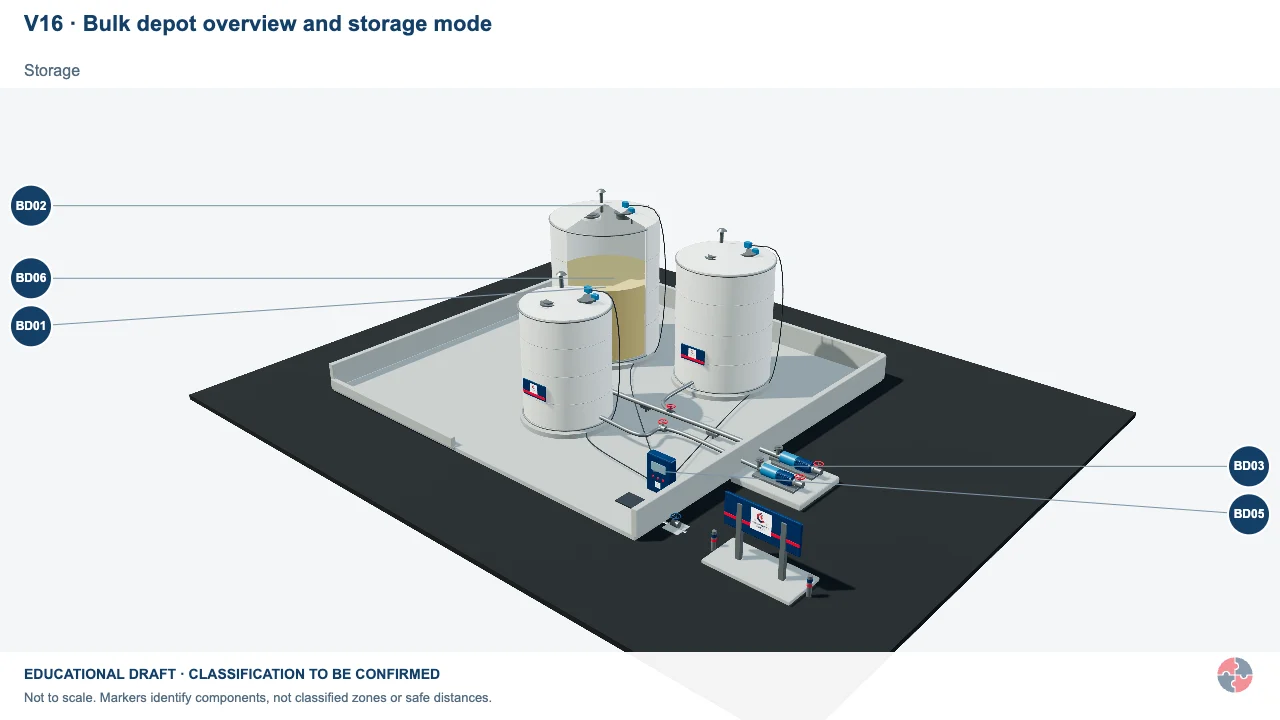
Bulk depot overview and storage mode
Explore the bulk depot system and compare selectable Zone 0, Zone 1 and Zone 2 teaching volumes around its petrol example.
Activity focus: Use cutaway for the internal vapour spaces, then compare the rounded vent, pump and mode-dependent connection envelopes.
Conceptual depot overview. Use the connected receipt diagram to locate tank identity, route, sensing, logic/power and final stop; verify the real installation, configuration and proof evidence independently.
Educational illustration, not to scale. Coloured zones are teaching examples, not a site-specific hazardous-area classification.
What training is useful for bulk storage and tank farm safety?
Training should cover tank farm hazards, safety-critical tasks, transfer control, emergency response and barrier assurance.
General awareness should explain why tank farms are different from ordinary storage: large inventory, vapour behaviour, ignition, escalation, environmental harm and emergency response complexity. People who enter the area need basic site rules, alarms, exclusion zones, ignition controls and reporting expectations.
Role-specific training must be practical. Operators need tank levels, transfer procedure, abnormal conditions, alarms, ESD and handover. Maintenance teams need isolation, permits, tank entry, hot work, residues, vents, roofs and safety-critical equipment. Supervisors need authorisation, simultaneous operations, impairment decisions and escalation.
Managers and technical authorities need barrier health, COMAH/DSEAR expectations, major accident learning, risk acceptance and assurance.
Competence means a person can carry out the actual task safely, recognise a changed condition and respond correctly. Attendance alone is insufficient. The matrix makes assessment, ownership, records and reassessment explicit.
| Role | Required learning | How competence is assessed | Assessor or owner | Record | Reassess when |
|---|---|---|---|---|---|
| Transfer operator | Identify tank, product, ullage, route, alarms and stop point | Perform observed pre-transfer check and simulated high-level alarm response | Transfer supervisor | Observed checklist and drill | Product, tank or protection changes |
| Maintenance/EC&I | Proof-test independent overfill and record impairment | Witness trip test and common-cause review | Competent engineer | Test sheet and impairment log | Repair, bypass or interval change |
| Manager | Decide COMAH scope, emergency resources and restart authority | Challenge an overdue critical test and failed bund scenario | Process safety lead | Risk and restart decision | Inventory, layout or law changes |
| Adviser | Evaluate scenario barriers and GB/NI route | Review evidence against HSG176 and national law | Independent process safety reviewer | Applicability and source review | Substance or standard changes |
How does bulk storage and tank farm safety support NEBOSH PSM study?
It supports NEBOSH PSM learning by connecting hazardous inventory, credible scenarios, barriers and major accident learning.
A strong exam or study answer should start with the credible major accident scenario: overfill, loss of containment, vapour cloud, tank fire, bund fire, toxic release or escalation. It should then identify barriers that prevent, detect, control and mitigate the scenario.
For NEBOSH Process Safety Management, learners should be able to explain tank design, overfill prevention, bunds, vents, floating roofs, inspection, transfer control and escalation between tanks. They should also be able to use Buncefield as a practical example of how overfill protection, alarm response, instrumentation and hazard understanding can fail.
A higher-scoring answer links technical controls to management: competence, maintenance, inspection, permit-to-work, management of change, emergency arrangements, audit and leadership review.
Hazardous inventory. Substance properties, quantity and storage conditions. Explain why petrol storage can create vapour cloud explosion risk.
Overfill prevention. Safe fill, gauging, alarms, independent trips and proof testing. Identify Buncefield-style barrier failures.
Containment. Primary, secondary and tertiary containment. Explain bund and drainage role during release/firewater.
Ignition control. DSEAR zoning, EX equipment, static and hot work. Control ignition around vents/loading areas.
Emergency planning. Tank fire, foam, cooling, evacuation and pollution response. Build scenario-based drills.
Assurance. Evidence that barriers are healthy. Audit inspection, maintenance, alarm and exercise records.
How can management systems strengthen tank farm safety?
Management systems turn tank farm controls into owned, tested, reviewed and improved barriers.
A management system should define the tank farm risk register, safety-critical equipment, operating limits, inspection regime, competence requirements, transfer authorisation, permit controls, emergency plans, management of change, contractor controls and action governance.
A voluntary management framework is not process-safety-specific, but its management stages can help structure ownership, competence, operational control, monitoring and continual improvement when they are applied to real tank farm barriers.
The practical management cycle is to assign owners, provide resources and competence, verify controls or workload changes, investigate failure and improve. ISO certification alone does not prove the task is safe.
Which major accidents show why tank farm barriers matter?
HSE’s Buncefield learning shows how overfill, vapour formation, ignition and weak barrier assurance can create major explosions; use that evidence to challenge the actual transfer and containment arrangement.
Major tank farm accidents are valuable because they show how ordinary transfers can interact with weak design, instrumentation, supervision, hazard understanding and emergency response. They also show that loss of containment from atmospheric storage can produce blast and off-site effects, not just local spillage.
Use the events below to challenge local arrangements. The question is not whether the site looks exactly the same; it is whether comparable weak signals, degraded barriers or assumptions exist.
Buncefield Oil Storage Depot, UK, 11 December 2005. A tank overfilled during a fuel transfer, a large vapour cloud formed and explosions/fire caused extensive damage and over 40 injuries. Overfill prevention must be independent, proof tested, understood and supported by transfer control and emergency planning.
HSE COMAH large tanks safety alert. HSE alerted operators to critical installation, testing and locking issues with certain level switches following Buncefield learning. A protection device can appear tested but be unavailable in real demand if installation and test procedures are weak.
Illustrative terminal escalation challenge grounded in HSE learning. For a terminal transfer, challenge what happens if filling continues, vapour escapes and ignition occurs beyond the tank. Overfill protection, transfer supervision, vapour recognition and safe emergency isolation need distinct evidence. This is a local scenario exercise, not a claim about an unverified overseas investigation.
What are the warning signs that tank farm safety is not controlled?
Warning signs include unreliable level systems, poor transfer discipline, weak bund management, overdue inspections and superficial emergency drills.
Weak signals often appear before major events: nuisance alarms, operators bypassing steps, uncertain ullage, unclear valve status, rainwater in bunds, open drains, temporary repairs, late inspections, corroded supports, roof defects, poor housekeeping at loading bays and emergency exercises that do not test real decisions.
Each warning sign should be linked to harm. An open bund drain can turn a contained release into an environmental incident. An overdue high-high trip test can remove the last protection before overfill. A poor handover can leave a live transfer unmanaged.
High-level alarms are nuisance or ignored. Operators may not respond when a real overfill begins. Alarm review, training and response-time verification.
Independent trip test overdue. Last layer may fail on demand. Stop or restrict transfer until protection is verified.
Bund drain left open. Released liquid or firewater can escape containment. Drain lock/check regime and supervision.
Tank inspection deferred. Corrosion or settlement may progress to failure. Risk-ranked deferral review and engineer approval.
Transfer checks copied. Wrong tank, route or volume may not be caught. Field verification and supervisor sampling.
Emergency drill is generic. Teams may fail when foam, cooling, isolation or evacuation decisions are needed. Scenario-based exercises and action close-out.
Where does HSG176 apply and when does COMAH change duties?
HSE HSG176 addresses flammable liquids in fixed tanks operating at or near atmospheric pressure; it may also inform some portable or skid-mounted vessels above 1,000 litres. It is not a design code for every chemical or pressurised vessel. Check substance, vessel, pressure, inventory and location first. See HSE HSG176 storage of flammable liquids in tanks
COMAH duties depend on qualifying dangerous-substance thresholds. A lower-tier operator needs a major accident prevention policy; a safety report and internal emergency plan are upper-tier requirements. Other fire, environmental and general duties may still apply below COMAH thresholds.
What must be true before a flammable-liquid transfer starts?
Confirm the receiving tank and product, usable capacity and safe operating limit, route lineup, level indication, alarm and independent overfill protection status, communication, transfer rate and emergency stop. An operator must know who may authorise start and who can halt transfer. See HSE HSG176 storage of flammable liquids in tanks
If level measurement and independent protection share a failure mode or a protection proof test is overdue, do not treat a healthy-looking display as proof. Restrict or stop transfer until a competent barrier owner verifies the required function or a formally assessed bounded alternative.
What does a bund prove after a release?
A bund is a secondary containment barrier, not permission to overfill a tank. Check the site-specific capacity basis, integrity, penetrations, drain valve position, rainfall management, material compatibility and whether a spill can bypass containment or spread between tanks. See HSE HSG176 storage of flammable liquids in tanks
Do not assume a single generic percentage is sufficient for every installation or substance. A competent engineer must check the applicable environmental and fire-safety basis, local authority requirements and emergency scenario.
How do decisions work on a real shift?
These examples show prerequisites, controls, stop conditions, decision owner, hand-back and evidence. Adapt them to the actual site, person and jurisdiction. See HSE HSG176 storage of flammable liquids in tanks
Night fuel receipt with overdue high-level-trip proof
Task material and setting: A road tanker is due at a depot tank. The independent high-level trip proof test is overdue and the gauge appears normal.
People and prerequisites: The receiving operator, tanker driver, terminal duty holder and EC&I owner need the product/tank identity, verified usable ullage, route drawing, trip test/configuration record, impairment rule, communication and emergency-stop arrangements.
Before: Hold unloading, verify product, receiving tank, ullage and all required protection status; quarantine the transfer route if the independent trip is unavailable.
During: Treat overdue proof as unresolved protection status rather than proof the device has failed or is healthy. Engineering checks sensing, logic, power and final stop action, common dependencies and test/bypass configuration. Operations confirms actual capacity, transfer limit, communication and emergency stop before any authorised restart.
Hold or stop: Do not begin a high-rate transfer on the gauge alone, an untested trip, unknown tank capacity or an unresolved bypass.
Decision owner: The terminal manager owns risk acceptance; the EC&I barrier owner proves the trip; the transfer supervisor controls the operation.
Completion and hand back: Start only after the competent owner demonstrates the required protection in its operating configuration and records acceptance under site rules. Confirm bypass/test states, capacity and lineup, brief the driver and receiving shift, and define who stops transfer if conditions change.
Evidence: Keep test result, impairment, transfer authorisation, lineup and hand-back.
Changed conditions: Reassess when the task, people, asset, work design, evidence or legal scope changes.
Source scope: HSE HSG176 and Buncefield/level-switch learning are GB technical guidance, not a universal impaired-transfer permission. Apply NI DSEAR/COMAH and the actual product/site requirements separately.
Bund drain left open during a storm
Task material and setting: Rainwater removal leaves a bund drain open. A tank valve then leaks flammable liquid toward a surface-water route.
People and prerequisites: The incident controller and engineering/environmental owners need substance hazards, bund/drain layout, safe isolation points, off-site drainage routes, emergency contacts and the lawful containment/discharge design basis.
Before: Stop transfer, keep people clear of vapour and isolate the source remotely if safe; close the drain only under a safe emergency plan.
During: Emergency command checks vapour/ignition risks, safe access, the route toward watercourses and possible contaminated firewater. Keep staff outside the release area; responders and competent owners decide safe remote isolation and containment. Make required environmental notifications through the applicable national route.
Hold or stop: Do not send staff into a vapour area or resume operation while drain integrity, leak source or emergency route is uncertain.
Decision owner: Incident commander owns immediate response; engineering repairs; the duty holder owns restart and external reporting.
Completion and hand back: Hand back after source repair and verification of bund integrity, drain/penetration configuration and usable containment against the applicable design and legal basis. Record any polluted-water handling, outstanding environmental action and authorised restart; add the secured drain state and temporary-opening checks to the operating method.
Evidence: Keep event timeline, photos, drain status, repair and exercise/action records.
Changed conditions: Reassess when the task, people, asset, work design, evidence or legal scope changes.
Source scope: The open drain is a failure scenario, not approval for a drain-down opening. England/Wales government oil guidance has specific scope; NI and Scotland environmental routes differ. Do not approach vapour to obtain records or photos.
How can the hierarchy of controls prevent tank-farm releases, fires and explosions?
ERICPD (Eliminate, Reduce including substitution, Isolate, Control, PPE, Discipline) and HSE’s five-level hierarchy (elimination, substitution, engineering, administrative, PPE) guide related but non-identical choices. Start at source; consider feasibility and any risk shifted elsewhere. Discipline means maintaining, supervising and learning from controls, not blaming workers. See HSE hierarchy; HSE five-level hierarchy of control
How can the ERICPD hierarchy of controls prevent tank-farm releases, fires and explosions?

| Five-level choice | ERICPD map | Task-specific intervention and feasibility | Owner, check, failure and stop |
|---|---|---|---|
| Elimination | Eliminate | Avoid an unnecessary bulk receipt or reduce the inventory by direct supply where the process and supply resilience allow; compare transport frequency and total risk, not just tank volume. | Process engineer documents inventory and scenario reduction; stop design approval if off-site or transfer risk is merely displaced. See HSE HSG176 storage of flammable liquids in tanks |
| Substitution | Reduce / substitute | Assess a less flammable liquid or lower-volatility grade only if process quality, materials, storage and downstream hazards remain acceptable. | Process owner tests compatibility and records change approval; stop if vapour, seal or product effects are unknown. See HSE HSG176 storage of flammable liquids in tanks |
| Engineering | Isolate / Control | Specify independent high-level trip separate from routine level indication, suitable venting and intact bund/drain barriers for the receiving tank and transfer rate. | EC&I engineer proof-tests trip and common-cause independence; maintenance inspects bund and vent. Hold transfer on failed, bypassed or unproven function. See HSE HSG176 storage of flammable liquids in tanks; HSE Buncefield incident resources |
| Administrative | Control / Discipline | Use positive tank/product/route checks, controlled transfer authorisation, shift communication and a recorded impairment/deferral process. | Transfer supervisor witnesses lineup and level trend; stop on wrong tank, communication loss or missing authorisation. See HSE HSG176 storage of flammable liquids in tanks |
| PPE | PPE | Select chemical and fire exposure PPE for defined sampling or response tasks with fit, compatibility and replacement checks; it cannot protect people from a vapour-cloud explosion. | Supervisor verifies task PPE and keeps non-responders away; stop exposure when vapour or splash risk exceeds the assessed method. See HSE HSG176 storage of flammable liquids in tanks |
How can the ISO 45001 hierarchy of controls prevent tank-farm releases, fires and explosions?

| Five-level choice | ERICPD map | Task-specific intervention and feasibility | Owner, check, failure and stop |
|---|---|---|---|
| Elimination | Eliminate | Avoid an unnecessary bulk receipt or reduce the inventory by direct supply where the process and supply resilience allow; compare transport frequency and total risk, not just tank volume. | Process engineer documents inventory and scenario reduction; stop design approval if off-site or transfer risk is merely displaced. See HSE HSG176 storage of flammable liquids in tanks |
| Substitution | Reduce / substitute | Assess a less flammable liquid or lower-volatility grade only if process quality, materials, storage and downstream hazards remain acceptable. | Process owner tests compatibility and records change approval; stop if vapour, seal or product effects are unknown. See HSE HSG176 storage of flammable liquids in tanks |
| Engineering | Isolate / Control | Specify independent high-level trip separate from routine level indication, suitable venting and intact bund/drain barriers for the receiving tank and transfer rate. | EC&I engineer proof-tests trip and common-cause independence; maintenance inspects bund and vent. Hold transfer on failed, bypassed or unproven function. See HSE HSG176 storage of flammable liquids in tanks; HSE Buncefield incident resources |
| Administrative | Control / Discipline | Use positive tank/product/route checks, controlled transfer authorisation, shift communication and a recorded impairment/deferral process. | Transfer supervisor witnesses lineup and level trend; stop on wrong tank, communication loss or missing authorisation. See HSE HSG176 storage of flammable liquids in tanks |
| PPE | PPE | Select chemical and fire exposure PPE for defined sampling or response tasks with fit, compatibility and replacement checks; it cannot protect people from a vapour-cloud explosion. | Supervisor verifies task PPE and keeps non-responders away; stop exposure when vapour or splash risk exceeds the assessed method. See HSE HSG176 storage of flammable liquids in tanks |
How does the hierarchy apply to each material harm route?
Each route below maps all five HSE levels to ERICPD, records where a stronger control may not be feasible, and states who checks failure and when the task must stop. It supplements the general task hierarchy above; site conditions and the affected people still govern the final control choice.
| Material hazard | Five levels and ERICPD for this route | Higher-order feasibility and decision | Owner, effectiveness check and stop trigger |
|---|---|---|---|
| Tank corrosion or loss of containment | Eliminate/ERICPD eliminate: remove redundant inventory or tank; substitute/reduce: use a less hazardous compatible material where process permits; engineering/isolate: compatible tank, corrosion protection, inspection and secondary containment; administrative/control and discipline: integrity plan, limits and defect closeout; PPE: exposure-specific residual protection, never a leak barrier. | Inventory elimination may be infeasible for supply; the integrity engineer must justify material and inspection interval against substance, failure mode and environment. | Integrity owner verifies thickness/leak trends and containment condition; stop filling or isolate on unexplained loss, failed inspection or containment breach. See HSE HSG176 storage of flammable liquids in tanks |
| Vapour ignition and explosion | Eliminate: avoid flammable inventory or ignition-generating task where practicable; substitute/reduce: lower-volatility product if the process permits; engineering/isolate: closed transfer, ventilation, hazardous-area equipment and isolation; administrative/control and discipline: DSEAR assessment, permit, bonding checks and maintenance; PPE: task-assessed residual protection, not explosion prevention. | A petrol or solvent service may require the substance; engineering barriers then need a hazardous-area design and proof of condition, not a permit alone. | DSEAR owner checks classification, equipment and transfer bonds; stop on vapour alarm, failed ventilation, unknown source or ignition-control breach. See HSE HSG176 storage of flammable liquids in tanks; Dangerous Substances and Explosive Atmospheres Regulations (Northern Ireland) 2003 |
| Toxic release or inhalation | Eliminate: remove unnecessary toxic inventory or operation; substitute/reduce: less hazardous compatible substance; engineering/isolate: closed system, local extraction or segregated transfer; administrative/control and discipline: exposure assessment, response plan and maintenance; PPE: selected respiratory/skin protection for residual or emergency task. | Substitution can change process or fire risk and needs change control; a respirator cannot replace a failed closed-transfer barrier. | Process/occupational-health owner checks containment, detector and exposure evidence; stop on unknown release, failed extraction or unverified respiratory protection. See HSE COSHH exposure control; HSE COMAH guidance |
| Intrusive maintenance or tank entry | Eliminate: inspect or clean remotely without entry; substitute/reduce: external method where it gives reliable results; engineering/isolate: drain, purge, lock off and verify all feeds/energy; administrative/control and discipline: confined-space assessment, permit, atmosphere testing and rescue readiness; PPE: specified residual respiratory/fall protection. | Entry may remain necessary for a defined inspection; the permit is valid only after physical isolation and competent rescue arrangements. | Maintenance and entry supervisors verify isolations and atmosphere at the required intervals; stop on changed atmosphere, broken isolation, missing attendant or rescue gap. See HSE confined spaces guidance; HSE HSG176 storage of flammable liquids in tanks |
| Overfill and escalation between tanks | Eliminate: avoid unnecessary transfer or excessive inventory; substitute/reduce: lower-consequence substance or rate where feasible; engineering/isolate: verified independent high-level trip, safe routing and bund separation; administrative/control and discipline: lineup, ullage, proof tests and emergency drill; PPE: residual emergency protection only. | Supply may require transfer; independent protection and separation are therefore critical, and an operator gauge cannot substitute for the failed trip. | Transfer supervisor and barrier owner check trip test, route and containment; stop on bypass, overdue proof test, uncertain capacity or loss of communication. See HSE HSG176 storage of flammable liquids in tanks; HSE Buncefield incident resources |
What does official guidance add to this decision?
Assign and verify independent overfill, containment, inspection and emergency barriers against the actual tank and substance.
Use the current HSE large-tank safety alert and the jurisdiction-specific duties listed on this page to verify the actual task and controls.
If a contract or competent design specifies a published technical standard, obtain authorised access to its current text and check its exact scope and edition. Apply the standard only within its stated scope; this guidance does not reproduce its clauses.
What do the acronyms and key terms mean?
Acronyms help readers follow process safety, fire, explosion and tank-integrity guidance.
| Acronym or term | Meaning | Why it matters |
|---|---|---|
| COMAH | Control of Major Accident Hazards Regulations | Major accident hazard framework for qualifying establishments. |
| DSEAR | Dangerous Substances and Explosive Atmospheres Regulations | Fire and explosion risk assessment framework. |
| ESD | Emergency Shutdown | Stops or isolates flow during abnormal or emergency conditions. |
| EX | Explosion protected | Equipment suitable for explosive atmospheres where assessed. |
| HH | High-high | Critical alarm/trip level used in overfill prevention. |
| HSG | Health and Safety Guidance | HSE guidance series, including HSG176. |
| LOPA | Layers of Protection Analysis | Method for assessing independent protection layers. |
| MOC | Management of Change | Controls modifications to tanks, substances, procedures or organisation. |
| PPE | Personal Protective Equipment | Last-line protection for contact, splash and fire tasks. |
| SCE | Safety-Critical Equipment | Equipment whose failure could cause or worsen a major accident. |
| SIL | Safety Integrity Level | Functional safety reliability target for instrumented protection. |
| VCE | Vapour Cloud Explosion | Explosion after flammable vapour cloud formation and ignition. |
Explore the Crownway Fuels hierarchy
Open the tank integrity and overfill branch. Follow it into the procedures, checks and records that support it.
Choose a document to see why it is used, who owns it, which duties it supports and what evidence it should produce. Switch to Text hierarchy for a list of expandable branches.
Fictional Crownway Fuels examples for English forecourts, with a separate illustrative bulk terminal. Check site applicability, permissions and actual controls before adapting any document for use.
Loading the Crownway register…
Which Crownway Fuels documents support this topic?
Open an editable document, read the preview, or find its place in the Crownway hierarchy. 24 resources relate to this page.
Fictional Crownway Fuels examples for English forecourts, with a separate illustrative bulk terminal. Check site applicability, permissions and actual controls before adapting any document for use.
Bulk fuel receipt loading and internal transfer policy (8)
- Bulk fuel receipt loading and internal transfer policy (CWF-POL-TRANSFER · Completed fictional example)
Set company expectations, responsibilities and resources for bulk fuel receipt loading and internal transfer.
Read preview · Download DOCX · Show in hierarchy - Bulk fuel receipt loading and internal transfer procedure (CWF-PRO-TRANSFER · Completed fictional example)
Explain who does what, in what sequence, the control rationale, evidence, escalation and safe restart conditions.
Read preview · Download DOCX · Show in hierarchy - Bulk receipt loading and transfer assessment (CWF-RA-TRANSFER-01 · Blank editable master)
Provide the site/task-specific bulk receipt loading and transfer assessment and retain its controlled output.
Read preview · Download DOCX · Show in hierarchy - Transfer authorisation and valve line up check (CWF-CHK-TRANSFER-01 · Blank editable master)
Provide the site/task-specific transfer authorisation and valve line up check and retain its controlled output.
Read preview · Download DOCX · Download PDF · Show in hierarchy - Road tanker loading and drive away prevention check (CWF-CHK-TRANSFER-02 · Blank editable master)
Provide the site/task-specific road tanker loading and drive away prevention check and retain its controlled output.
Read preview · Download DOCX · Download PDF · Show in hierarchy - Transfer monitoring and shift handover log (CWF-FRM-TRANSFER-01 · Blank editable master)
Provide the site/task-specific transfer monitoring and shift handover log and retain its controlled output.
Read preview · Download DOCX · Show in hierarchy - Alarm trip bypass and override authorisation (CWF-FRM-TRANSFER-02 · Blank editable master)
Provide the site/task-specific alarm trip bypass and override authorisation and retain its controlled output.
Read preview · Download DOCX · Show in hierarchy - Abnormal transfer safe shutdown and restart check (CWF-CHK-TRANSFER-03 · Blank editable master)
Provide the site/task-specific abnormal transfer safe shutdown and restart check and retain its controlled output.
Read preview · Download DOCX · Download PDF · Show in hierarchy
Tank integrity overfill prevention and containment policy (8)
- Tank integrity overfill prevention and containment policy (CWF-POL-TANK · Completed fictional example)
Set company expectations, responsibilities and resources for tank integrity overfill prevention and containment.
Read preview · Download DOCX · Show in hierarchy - Tank integrity overfill prevention and containment procedure (CWF-PRO-TANK · Completed fictional example)
Explain who does what, in what sequence, the control rationale, evidence, escalation and safe restart conditions.
Read preview · Download DOCX · Show in hierarchy - Tank pipework and containment asset register (CWF-REG-TANK-01 · Blank register with separate fictional worked entries)
Provide the site/task-specific tank pipework and containment asset register and retain its controlled output.
Read preview · Download XLSX · Show in hierarchy - Tank integrity inspection and examination plan (CWF-PLN-TANK-01 · Completed fictional example)
Provide the site/task-specific tank integrity inspection and examination plan and retain its controlled output.
Read preview · Download DOCX · Show in hierarchy - Overfill alarm and independent trip proof test (CWF-CHK-TANK-01 · Blank editable master)
Provide the site/task-specific overfill alarm and independent trip proof test and retain its controlled output.
Read preview · Download DOCX · Download PDF · Show in hierarchy - Bund drainage valve and containment inspection (CWF-CHK-TANK-02 · Blank editable master)
Provide the site/task-specific bund drainage valve and containment inspection and retain its controlled output.
Read preview · Download DOCX · Download PDF · Show in hierarchy - Firewater and environmental containment assessment (CWF-RA-TANK-01 · Blank editable master)
Provide the site/task-specific firewater and environmental containment assessment and retain its controlled output.
Read preview · Download DOCX · Show in hierarchy - Integrity defect fitness for service and repair decision (CWF-FRM-TANK-01 · Blank editable master)
Provide the site/task-specific integrity defect fitness for service and repair decision and retain its controlled output.
Read preview · Download DOCX · Show in hierarchy
Wetstock reconciliation and leak detection policy (7)
- Wetstock reconciliation and leak detection policy (CWF-POL-WET · Completed fictional example)
Set company expectations, responsibilities and resources for wetstock reconciliation and leak detection.
Read preview · Download DOCX · Show in hierarchy - Wetstock reconciliation and leak detection procedure (CWF-PRO-WET · Completed fictional example)
Explain who does what, in what sequence, the control rationale, evidence, escalation and safe restart conditions.
Read preview · Download DOCX · Show in hierarchy - Wetstock reconciliation and investigation plan (CWF-PLN-WET-01 · Completed fictional example)
Provide the site/task-specific wetstock reconciliation and investigation plan and retain its controlled output.
Read preview · Download DOCX · Show in hierarchy - Daily wetstock balance and exception log (CWF-FRM-WET-01 · Blank editable master)
Provide the site/task-specific daily wetstock balance and exception log and retain its controlled output.
Read preview · Download DOCX · Show in hierarchy - Tank and line leak detection functional check (CWF-CHK-WET-01 · Blank editable master)
Provide the site/task-specific tank and line leak detection functional check and retain its controlled output.
Read preview · Download DOCX · Download PDF · Show in hierarchy - Suspected leak investigation and tank isolation record (CWF-FRM-WET-02 · Blank editable master)
Provide the site/task-specific suspected leak investigation and tank isolation record and retain its controlled output.
Read preview · Download DOCX · Show in hierarchy - Underground tank and pipework monitoring history (CWF-REG-WET-01 · Blank register with separate fictional worked entries)
Provide the site/task-specific underground tank and pipework monitoring history and retain its controlled output.
Read preview · Download XLSX · Show in hierarchy
Worked example for the illustrative bulk terminal (1)
- Fuel terminal major accident prevention policy (CWF-MAPP-TERM-01 · Completed fictional example)
Shows the terminal’s policy, responsibilities and arrangements for major accident prevention.
Read preview · Download DOCX · Download PDF · Show related branch