
SHARE Knowledge Hub
How should contractors and supply chains be managed safely?
Define the job and hazards before tender, select capability for the actual task, exchange site and contractor risks, coordinate interfaces, supervise the work and verify safe hand-back. Outsourcing does not remove the client or host’s own duties; a generic certificate or RAMS pack is not the control.
Understanding How should contractors and supply chains be managed safely?
Define the job and hazards before tender, select capability for the actual task, exchange site and contractor risks, coordinate interfaces, supervise the work and verify safe hand-back. Outsourcing does not remove the client or host’s own duties; a generic certificate or RAMS pack is not the control.
Why this matters at work
Define the work, boundaries, hazards, deliverables and performance needed before asking for a price. Include information the supplier needs about the site, equipment, people and interfaces, and identify technical capability that the customer must retain. Consider occupational-health exposure, public risk, complexity, novelty and the consequence of defective work or products. Selection effort should match risk rather than giving every purchase the same large questionnaire.
Use the actual change-control and procurement arrangements, involving the asset owner and necessary specialists. Record the proposed change, evidence, limitations, decision and required tests or updated records. Check whether instructions, maintenance intervals, spares or competence need revision. Do not let a purchasing substitution silently become a plant modification. Communicate restrictions and verify the completed work before authorised restart. This example provides no approval or equivalence claim for a real manufacturer’s component; the real specification and evidence remain essential.
How organisations manage this in practice
Check the supplier’s ability to deliver the specific task safely: relevant experience, competent people, suitable equipment, supervision, planning, health controls and emergency arrangements. Review the quality and relevance of evidence rather than its volume. Ask how defects, changes, subcontractors and completed work are managed. For safety-critical supplies, trace specification, authenticity, compatibility and verification through appropriate technical expertise. A company badge cannot establish that a particular component is suitable.
Make the contracting chain visible for the work that matters to safety. Agree who assesses lower-tier competence, supplies site information, supervises and reports changes. Check the actual people and equipment arriving and prevent unreviewed substitutions. Combine the host’s site knowledge with each contractor’s method and hazards. Review interactions such as hot work near flammable releases, lifting over access routes and excavation near services before authorising work.
Define handback evidence before work begins so it reflects the real safety function. It may include inspection and test results, as-built information, remaining defects, operating restrictions, maintenance needs and removal or transfer of temporary controls. Confirm who verifies technical completion and who separately accepts the asset for operation. A completion invoice or a contractor’s assurance is insufficient where a critical barrier requires demonstrable performance.
How can I practise this topic in 3D?


A card is accepted as the whole competence check
All related inspection points 1 across 1 location
Construction site 1 inspection point
Practice in the SHAREhub environment. Browser practice is separate from workplace competence and formal learning records.
Use lifecycle gates when approved work changes
An approved-supplier record establishes a scope of capability; it does not authorise any job the company is offered. Follow the lifecycle from selection and information exchange through mobilisation, site-specific method and permits, coordination, monitoring and hand-back. The host and contractor retain their respective responsibilities.
Best-practice guide: Contractor and Supply Chain Health and Safety Management
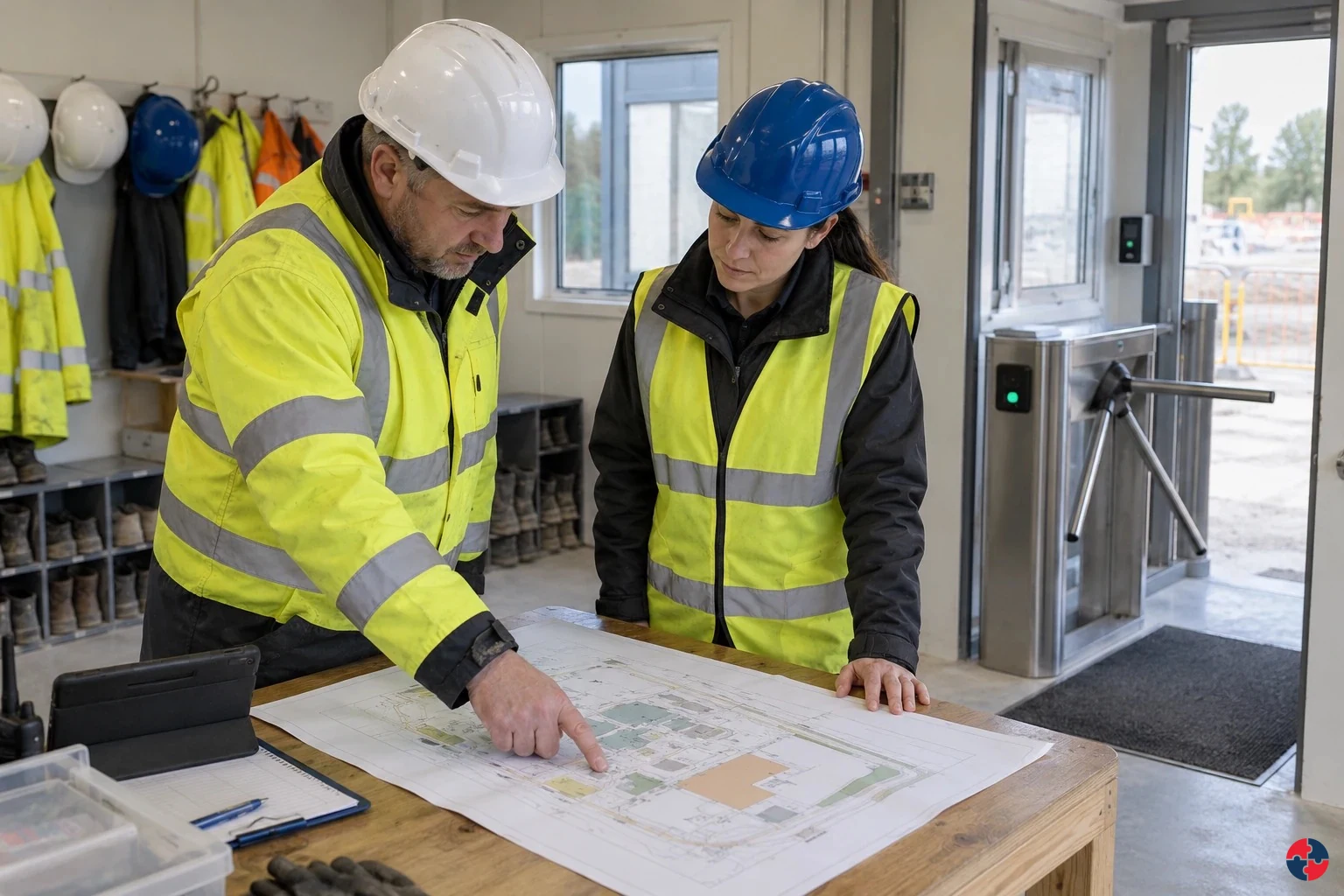
Use lifecycle gates when approved work changes
An approved-supplier record establishes a scope of capability; it does not authorise any job the company is offered. Follow the lifecycle from selection and information exchange through mobilisation, site-specific method and permits, coordination, monitoring and hand-back. Define the job and hazards before tender, select capability for the actual task, exchange site and contractor risks, coordinate interfaces, supervise the work and verify safe hand-back.
Turn contractor and supply chain health and safety management knowledge into a decision
Define the job and hazards before tender, select capability for the actual task, exchange site and contractor risks, coordinate interfaces, supervise the work and verify safe hand-back. Outsourcing does not remove the client or host’s own duties; a generic certificate or RAMS pack is not the control. Approved contractor matrix and competence evidence.
the site team contractor control system
Risk-based approval: Approves contractors by work type and risk level. Evidence / response: Approved contractor matrix and competence evidence. Procurement controls: Tender packs state health, safety, welfare and supervision expectations. Evidence / response: Prequalification and tender review.
Contractor management warning signs
Unknown people on site: Subcontracting or access control has failed. Generic RAMS: The contractor has not understood the task or site. Permits copied forward: Controls may not match current conditions.
Choose controls for contractor and supply chain health and safety management
Eliminate: Remote camera/clean-in-place if safe and effective. Substitute: Lower inventory and safer cleaning method after compatibility check. Engineering: Lock feeds/agitation, verify zero energy, ventilate/test atmosphere, enable retrieval. Administrative: Task permit, site induction, entrant count, standby and rescue drill. PPE: Suitable residual task equipment for trained people. Read the full control table for qualifications, ownership and verification. Use the actual task and applicable jurisdiction; existing technical approval remains unchanged.
Use the full contractor and supply chain health and safety management lesson
Use the full topic for the decision points, practical examples, detailed control tables and source scope. HSE guidance applies to Great Britain; use HSENI for the Northern Ireland route and the source’s stated jurisdiction. A simplified guide does not change the page’s technical-review or approval status.

Read all six steps as text
1. Use lifecycle gates when approved work changes
An approved-supplier record establishes a scope of capability; it does not authorise any job the company is offered.
- Avoid / redesign: Remote camera/clean-in-place if safe and effective.
- Control the task: Lock feeds/agitation, verify zero energy, ventilate/test atmosphere, enable retrieval.
- Verify before release: Host planner records option; hold entry if safe remote inspection is adequate.
An approved-supplier record establishes a scope of capability; it does not authorise any job the company is offered. Follow the lifecycle from selection and information exchange through mobilisation, site-specific method and permits, coordination, monitoring and hand-back. Define the job and hazards before tender, select capability for the actual task, exchange site and contractor risks, coordinate interfaces, supervise the work and verify safe hand-back.
Apply it: Which part of this plan would you check at the workface before authorising the task?
2. Turn contractor and supply chain health and safety management knowledge into a decision
Use the evidence to improve the actual work arrangement.
- Change at source: Remote camera/clean-in-place if safe and effective.
- Make it observable: Host planner records option; hold entry if safe remote inspection is adequate.
- Keep useful evidence: Approved contractor matrix and competence evidence.
Define the job and hazards before tender, select capability for the actual task, exchange site and contractor risks, coordinate interfaces, supervise the work and verify safe hand-back. Outsourcing does not remove the client or host’s own duties; a generic certificate or RAMS pack is not the control. Approved contractor matrix and competence evidence.
Apply it: What evidence would show that the change improves this task, rather than only completing a record?
3. the site team contractor control system
Example: a practical application of the existing topic lesson.
- Risk-based approval: Approves contractors by work type and risk level.
- Procurement controls: Tender packs state health, safety, welfare and supervision expectations.
- Pre-start planning: Client and contractor exchange site and task hazards.
Risk-based approval: Approves contractors by work type and risk level. Evidence / response: Approved contractor matrix and competence evidence. Procurement controls: Tender packs state health, safety, welfare and supervision expectations. Evidence / response: Prequalification and tender review.
Apply it: At which point would you hold this example, and what evidence would allow it to proceed?
4. Contractor management warning signs
Connect the task, the route to the person and the control that can fail.
- Unknown people on site: Subcontracting or access control has failed.
- Generic RAMS: The contractor has not understood the task or site.
- Permits copied forward: Controls may not match current conditions.
Unknown people on site: Subcontracting or access control has failed. Generic RAMS: The contractor has not understood the task or site. Permits copied forward: Controls may not match current conditions.
Apply it: Who could be exposed, including other trades, cleaners, maintainers and people nearby?
5. Choose controls for contractor and supply chain health and safety management
Start with the stronger practicable options and verify their effect.
- Eliminate: Remote camera/clean-in-place if safe and effective.
- Substitute: Lower inventory and safer cleaning method after compatibility check.
- Engineering: Lock feeds/agitation, verify zero energy, ventilate/test atmosphere, enable retrieval.
- Administrative: Task permit, site induction, entrant count, standby and rescue drill.
- PPE: Suitable residual task equipment for trained people.
Eliminate: Remote camera/clean-in-place if safe and effective. Substitute: Lower inventory and safer cleaning method after compatibility check. Engineering: Lock feeds/agitation, verify zero energy, ventilate/test atmosphere, enable retrieval. Administrative: Task permit, site induction, entrant count, standby and rescue drill. PPE: Suitable residual task equipment for trained people. Read the full control table for qualifications, ownership and verification. Use the actual task and applicable jurisdiction; existing technical approval remains unchanged.
Apply it: Which stronger option can be used here, and who will verify it before accepting the remaining risk?
6. Use the full contractor and supply chain health and safety management lesson
Follow the official sources below and retain the task-specific evidence.
- Official guidance: HSE HSG159 Managing contractors
- Official guidance: HSE L101 safe work in confined spaces
- Task decision: Approved contractor matrix and competence evidence.
Use the full topic for the decision points, practical examples, detailed control tables and source scope. HSE guidance applies to Great Britain; use HSENI for the Northern Ireland route and the source’s stated jurisdiction. A simplified guide does not change the page’s technical-review or approval status.
Apply it: Which official source and full-topic section will you use to resolve the next decision?
A decorator approved for low-risk internal work may arrive to find the job now includes high-level access or intrusive work near live services. Procurement status cannot release that change. The job owner checks relevant competence and introduced hazards, revises the method and supervision, and only then reauthorises the scope. Use the process-industry guide where barrier and hazardous-plant interfaces demand its specialist detail.
BuildOut: approved decorating expands to hazardous access
Illustrative example. A approved contractor is asked after arrival to reach a new area requiring a different access method.
Decision. The host job owner stops the extra scope and agrees competent assessment, suitable equipment and site-specific controls with the contractor supervisor.
Evidence to check. Approval limits, changed scope, actual site information, capability, method, permits and interface-supervision arrangements.
Hold or escalation point. No changed work based only on the approved-supplier badge or signed contract.
Follow-up. Verify hand-back and feed the change into procurement scope categories and future pre-start information.
Carry risk information through the contract lifecycle
Scope, capability, shared hazards, site method, monitored work and hand-back are connected decisions. A change of scope or subcontractor can reopen an earlier gate.

A supplier approval does not authorise the racking repair
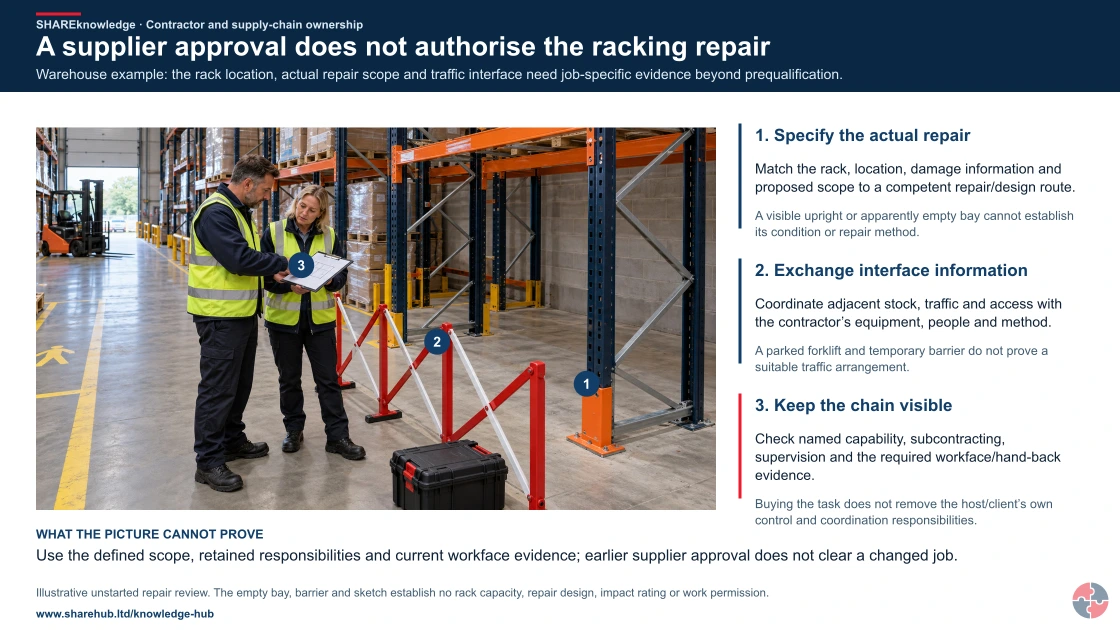
Full written explanation
Warehouse example: the rack location, actual repair scope and traffic interface need job-specific evidence beyond prequalification.
- Specify the actual repair. Match the rack, location, damage information and proposed scope to a competent repair/design route.
- Exchange interface information. Coordinate adjacent stock, traffic and access with the contractor’s equipment, people and method.
- Keep the chain visible. Check named capability, subcontracting, supervision and the required workface/hand-back evidence.
Change the pathway
- Use competent technical evidence. A visible upright or apparently empty bay cannot establish its condition or repair method.
- Check the complete work area. A parked forklift and temporary barrier do not prove a suitable traffic arrangement.
- Retain host responsibilities. Buying the task does not remove the host/client’s own control and coordination responsibilities.
Evidence check: Use the defined scope, retained responsibilities and current workface evidence; earlier supplier approval does not clear a changed job.
Complete procurement, retained duties and supply-chain example
Primary references: HSE HSG159: scope and coordination (GB) · HSE: contractorisation and retained host knowledge (GB)
Open the complete HD image (new tab)Download image
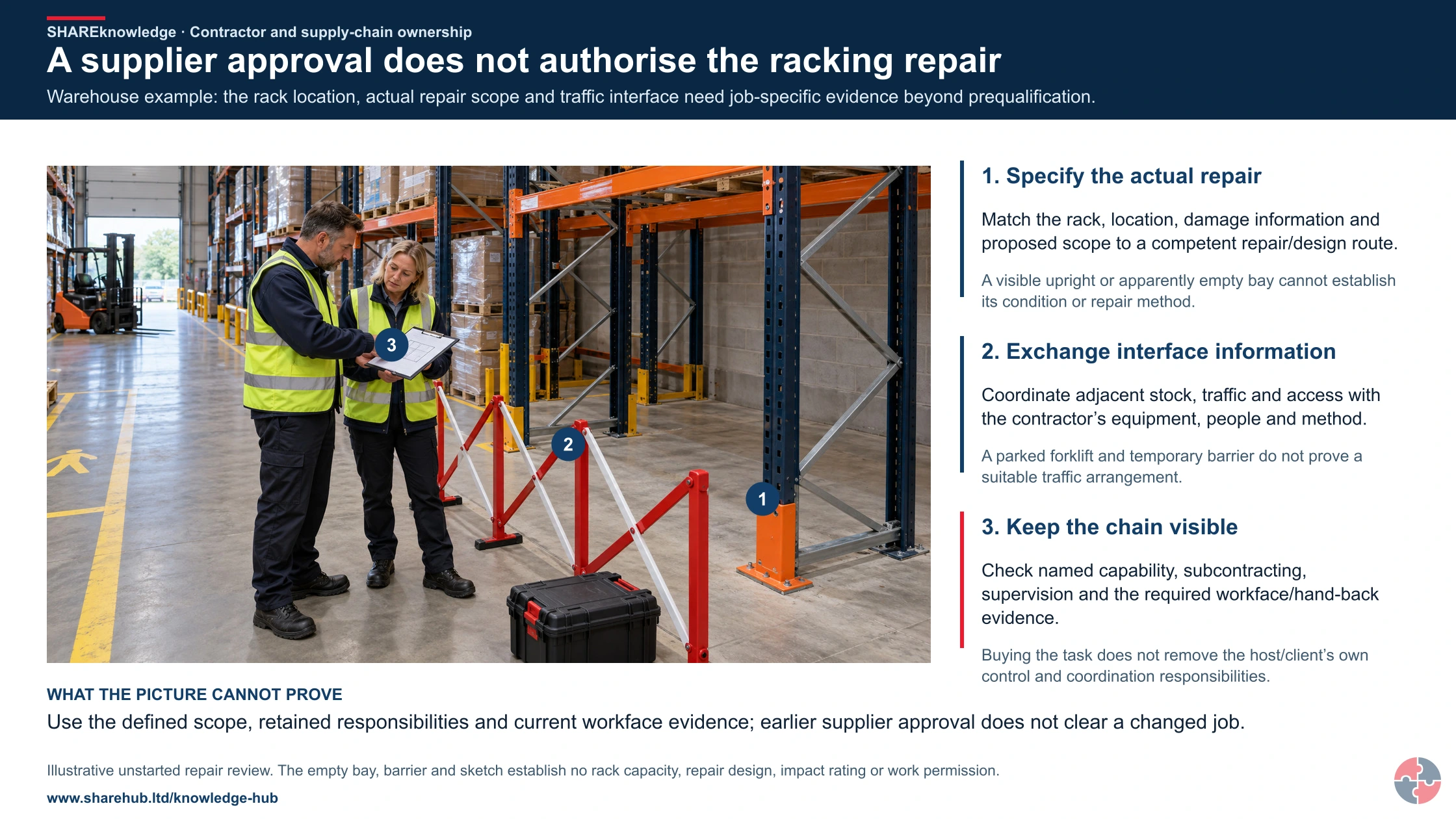
Complete procurement, retained duties and supply-chain example
Primary references: HSE HSG159: scope and coordination (GB) · HSE: contractorisation and retained host knowledge (GB)

Before appointment
Define the job and check capability evidence relevant to it, including supply-chain arrangements.
Before and during work
Exchange site and introduced hazards; agree responsibilities, method and change reporting. Monitor the actual work.
Hand-back and change
Verify safe hand-back and record acceptance. Changed work or subcontracting returns to the appropriate review point.
A procurement checklist does not transfer away retained duties or approve a site-specific method by itself.
What are the key points about contractor and supply-chain management?
The key points are that contractor risk is an interface risk, procurement is a control, and monitoring must continue until the work is safely completed.
Contractors often bring specialist competence, but they may not know the host site, hidden services, process hazards, traffic routes, emergency arrangements, permit rules, welfare limitations, language issues or the informal pressures that shape day-to-day work. The host organisation may know the site, but not the contractor’s tools, sequencing or specialist hazards. Good management closes that gap.
The strongest systems treat contractor control as a lifecycle. A poor system starts at induction; a good system starts at work definition and procurement. The client defines the work and hazards, checks competence, exchanges information, agrees controls, coordinates with other work, supervises the job, manages changes and reviews performance before the contractor is used again.
| Point | Why it matters | Evidence |
|---|---|---|
| Duty cannot be outsourced | Commercial contracts do not remove legal duties. | Clear roles, client oversight and interface controls. |
| Procurement is a safety control | Poor selection creates risk before work starts. | Prequalification, competence checks and approval criteria. |
| Information must flow both ways | The client knows the site; the contractor knows the task. | Pre-start meetings, hazard information and RAMS review. |
| Control is task-specific | Generic RAMS rarely control real work. | Site-specific method, briefings and permits. |
| Monitoring is active | Induction alone does not prove safe performance. | Supervisor checks, audits and action close-out. |
| Review drives improvement | Future appointments should reflect actual performance. | Post-job review and approved-list updates. |
What is contractor and supply-chain health and safety management?
Contractor management is the organised control of external work so that the client, contractor and any subcontractors understand and manage their shared risks.
The term covers more than construction. It includes maintenance contractors, cleaners, security providers, facilities contractors, consultants, agency labour, specialist engineers, drivers, asbestos contractors, scaffolders, lifting contractors, laboratory specialists, event suppliers and emergency repair teams. It also includes the chain beneath the main contractor, where standards can weaken if work is passed down without proper assurance.
The core question is simple: who controls which risk? The client or host controls the premises, site rules, existing hazards, emergency arrangements and overall coordination. The contractor controls its task competence, people, equipment, work method and direct supervision. Both need to cooperate where their activities overlap.
| Area | What it includes | Common weakness |
|---|---|---|
| Work definition | Scope, location, timing, hazards, interfaces and expected output. | Unclear scope creates informal work changes. |
| Selection | Competence, experience, resources and task-specific capability. | Lowest-price selection without risk weighting. |
| Planning | RAMS, permits, emergency arrangements, welfare and sequencing. | Paperwork reviewed away from the workface. |
| Coordination | Other contractors, operations, public interface and site controls. | Simultaneous operations not managed. |
| Monitoring | Supervision, inspection, intervention and action close-out. | Client assumes contractor supervision is enough. |
| Review | Performance, incidents, learning and future approval. | No post-job review or approved-list discipline. |
What is the contractor control sequence?
Plan the job, choose capability, coordinate before entry, supervise the actual work, and verify hand-back and learning.
The HSE HSG159 guide starts before procurement. For vessel maintenance, specify what plant can be isolated and what unknowns need survey; select a contractor able to demonstrate the exact task, supervision and emergency method. Exchange host hazards and the contractor’s introduced hazards, including subcontractors. At the workface, check isolation, permit, people, boundary and control state. On completion, inspect and test safeguards and record who accepts hand-back. The host retains knowledge of its plant and must challenge work that does not match its safe system.
How should procurement and prequalification control contractor risk?
Procurement should test whether a contractor can do the specific work safely, not merely whether they can submit generic certificates.
Prequalification should be proportionate to the work. A low-risk office supplier may need basic checks. A contractor working at height, entering confined spaces, removing asbestos, isolating electrical systems, carrying out hot work, operating lifting equipment or working on process plant needs much deeper evidence. Procurement should involve competent technical and safety review where the risk is significant.
Price pressure can create safety risk when contractors under-resource supervision, use less competent labour, bring unsuitable equipment or compress the programme. Tender documents should define health and safety standards clearly so bidders price the work safely and cannot win by omitting controls.
| Check | What to look for | Weak evidence |
|---|---|---|
| Task experience | Similar work, references and sector familiarity. | Generic company profile. |
| Competence | Named competent people, certificates, supervision and refresher training. | Training certificates unrelated to the task. |
| Resources | Enough people, time, tools, equipment and supervision. | Programme assumes unrealistic productivity. |
| Health and safety system | Risk assessment, incidents, audits, emergency and subcontractor controls. | Policy only, with no implementation evidence. |
| Insurance and licences | Employers' liability, public liability and licences where relevant. | Expired or unsuitable cover. |
| Subcontracting plan | Who may subcontract, how approval works and how standards cascade. | Unknown lower-tier subcontractors. |
How should contractor competence be checked?
Contractor competence should be checked against the actual task, risk level, environment and supervision arrangements.
Competence is not a single certificate. It is the combination of skills, knowledge, experience, training, supervision, equipment, resources and organisational capability needed to complete the work safely. The check should ask whether the contractor understands the hazards they bring and the hazards they will meet on the client site.
Where the work is safety-critical, the client should know which individuals will attend, what authorisations they hold, who supervises them, what equipment they bring, whether medical or fitness requirements apply, and how competence is maintained. This matters for confined spaces, electrical work, lifting, work at height, asbestos, hot work, pressure systems and process plant.
| Competence area | Evidence | Practical test |
|---|---|---|
| Organisation capability | Management system, supervision, resources and relevant experience. | Can they explain how they control this specific job? |
| Individual competence | Training, qualifications, authorisations and experience. | Are the named workers competent for the task? |
| Supervisor competence | Supervisor training and span of control. | Who stops unsafe work and who signs off changes? |
| Equipment competence | Inspection, maintenance, statutory thorough examination where needed. | Is equipment suitable and in date? |
| Emergency competence | Rescue, first aid, spill, fire or isolation response where relevant. | Can the contractor respond before external help arrives? |
| Subcontractor competence | Selection and monitoring arrangements for lower tiers. | Can the main contractor prove subcontractor control? |
What information must be exchanged before work starts?
The client and contractor must exchange enough information for both parties to understand site hazards, task hazards, interfaces and emergency arrangements.
Information exchange should be two-way. The host should provide existing hazards such as asbestos, fragile roofs, buried services, traffic routes, process hazards, isolation requirements, fire arrangements, welfare, restricted areas and emergency rules. The contractor should provide task hazards, equipment, substances, sequencing, people, supervision and any new risks introduced by the work.
A common failure is assuming the contractor will work out the site risks or that the client can approve a method without understanding the work. The pre-start meeting is where assumptions should be exposed. It should be close enough to the work to be practical, but early enough to change the plan.
| Information | Client provides | Contractor provides |
|---|---|---|
| Scope and boundaries | Where, when and what is permitted. | Task sequence and work limits. |
| Existing hazards | Asbestos, services, traffic, process, fire and access hazards. | Questions and controls needed for those hazards. |
| Introduced hazards | Site constraints and affected operations. | Tools, substances, plant, energy and work methods. |
| Emergency arrangements | Alarms, evacuation, first aid, rescue and contacts. | Task-specific emergency and rescue arrangements. |
| Coordination needs | Other work, permits, restrictions and occupancy. | Interface risks and required isolations. |
| Evidence | Site rules, drawings, registers and permits. | RAMS, certificates and inspection records. |
How can the hierarchy of controls reduce contractor and supply-chain health and safety risks?
Use them to coordinate and authorise a verified method; neither document proves the isolation, barrier or competence is effective.
For vessel entry, consult HSE L101 in GB or the HSENI ACOP in NI; first ask if remote inspection eliminates entry. Reduce stored material and energy, positively isolate feed and agitation, test and ventilate the atmosphere, and provide a rehearsed rescue. The permit names the boundary, tests, entrant, standby, owner and expiry. PPE or breathing apparatus is only a residual layer with specialist capability. This ERICPD/five-level sequence must be checked physically: the host engineer verifies zero energy and the contractor supervisor checks atmosphere and people. Stop for an ambiguous line, failed lock, changed reading or missing rescuer; restart requires new checks and authorisation.
On a small screen, scroll this table sideways to read all columns.
How can the ERICPD hierarchy of controls reduce contractor and supply-chain health and safety risks?

| Five-level / ERICPD | Control and feasibility | Owner, check, failure and stop |
|---|---|---|
| Eliminate / eliminate | Remote camera/clean-in-place if safe and effective. | Host planner records option; hold entry if safe remote inspection is adequate. |
| Substitute / reduce | Lower inventory and safer cleaning method after compatibility check. | Host engineer approves; stop if the cleaning method creates an unassessed exposure. |
| Engineering / isolate and control | Lock feeds/agitation, verify zero energy, ventilate/test atmosphere, enable retrieval. | Host engineer and contractor lead sign tests; stop on leak or alarm. |
| Administrative / discipline | Task permit, site induction, entrant count, standby and rescue drill. | Permit issuer samples work; withdraw on lost control. |
| PPE / PPE | Suitable residual task equipment for trained people. | Rescue lead checks; stop entry if isolation or rescue capability fails. |
How can the ISO 45001 hierarchy of controls reduce contractor and supply-chain health and safety risks?

| Five-level / ERICPD | Control and feasibility | Owner, check, failure and stop |
|---|---|---|
| Eliminate / eliminate | Remote camera/clean-in-place if safe and effective. | Host planner records option; hold entry if safe remote inspection is adequate. |
| Substitute / reduce | Lower inventory and safer cleaning method after compatibility check. | Host engineer approves; stop if the cleaning method creates an unassessed exposure. |
| Engineering / isolate and control | Lock feeds/agitation, verify zero energy, ventilate/test atmosphere, enable retrieval. | Host engineer and contractor lead sign tests; stop on leak or alarm. |
| Administrative / discipline | Task permit, site induction, entrant count, standby and rescue drill. | Permit issuer samples work; withdraw on lost control. |
| PPE / PPE | Suitable residual task equipment for trained people. | Rescue lead checks; stop entry if isolation or rescue capability fails. |
HSE’s five-level hierarchy is the GB general framework: elimination, substitution, engineering, administrative controls and PPE. ERICPD is complementary. Apply it to the material hazard in the example, with physical acceptance checks separate from instruction, consultation or permit completion.
For the contracted vessel inspection, the host and contractor assess the actual contents, residues, connected lines, geometry and introduced work hazards before specifying equipment. GB L101 supports representative atmosphere checks and suitable isolation, ventilation and rescue. The equipment owner records ventilation acceptance with a clean-air intake/safe discharge and detector response/calibration; allow sample transit time. Maintain this equipment and verify isolation and control state before entry. Use continuous monitoring where forced ventilation or work changes conditions. Unsafe readings, failed isolation/ventilation/contact or lost rescue readiness require withdrawal. Correct the cause, recheck controls and atmosphere, and renew entry authority; never add oxygen to refresh air. Host hand-back checks must also verify reinstated safeguards before plant restart.
How should contractor coordination and communication work?
Coordination should make sure contractors, hosts and other work groups understand who is doing what, where, when and under which controls.
Contractor incidents often occur at interfaces: a delivery enters a pedestrian area, a cleaning contractor works below maintenance work, a hot-work contractor is unaware of flammable storage, an excavation team finds an unknown service, or two contractors rely on each other for isolations. Coordination should make these overlaps visible before the work starts.
Communication must be practical and repeated. Pre-start meetings, daily coordination meetings, shift handovers, permit boards, exclusion zone briefings and supervisor walkdowns all have a role. The method should fit the risk and the pace of change.
| Interface | Control | Evidence |
|---|---|---|
| Simultaneous operations | Plan work sequence and separation. | Daily coordination record. |
| Shared access routes | Manage vehicles, pedestrians and deliveries. | Traffic plan and route briefing. |
| Energy isolation | Define who isolates, verifies and hands back. | Isolation certificate and permit. |
| Hot work and fire risk | Control combustibles, ignition and fire watch. | Hot-work permit and post-work check. |
| Occupied premises | Protect workers, public, visitors and service users. | Communication plan and barriers. |
| Shift handover | Transfer status, hazards, permits and changes. | Handover log. |
How should contractor work be monitored?
Contractor monitoring should be risk-based, active and focused on whether controls are working at the point of work.
Monitoring does not mean standing over competent contractors all day. It means setting the level of oversight based on risk, complexity, contractor performance and site consequence. A new contractor doing high-risk work on a major hazard site needs closer monitoring than a proven low-risk supplier doing routine work.
Checks should look at real work: are the right people present, do they understand the controls, is the equipment suitable, are permits live, are exclusion zones maintained, are welfare arrangements adequate, and are changes being escalated? Findings should be recorded, prioritised and closed, not just noted.
| Level | Example activity | Top tip |
|---|---|---|
| Frontline supervision | Supervisor checks task controls, permits and behaviours. | Use short, specific checks that produce clear yes/no evidence. |
| Second-line HSSE review | Adviser samples RAMS, permits, inductions, inspections and action quality. | Focus on quality of findings and whether actions are verifiable. |
| Third-line audit | Internal or external audit of contractor management system. | Sample procurement, competence, workface evidence and performance review. |
| Contract review | Post-job review with contractor and client owner. | Use the outcome to update approved lists and future controls. |
How should subcontracting and supply-chain assurance be controlled?
Supply-chain assurance should prevent standards weakening as work is passed from the main contractor to lower-tier subcontractors.
The client should know whether subcontracting is allowed, who approves it, what standards apply and how the main contractor verifies competence and control. Hidden subcontracting is a serious warning sign because the people on site may not have been assessed, briefed or authorised against the original risk.
Supply-chain management also links to corporate responsibility. Organisations increasingly need to know whether suppliers manage health, safety, welfare, labour standards, environmental risk and ethical risks properly. For high-risk work, assurance should reach beyond the first-tier contractor.
| Risk | Control | Evidence |
|---|---|---|
| Unknown lower tiers | Require approval before subcontracting. | Subcontractor register. |
| Standards diluted | Apply client standards through the contract chain. | Contract clauses and audit records. |
| Competence assumed | Check lower-tier competence and supervision. | Training matrix and authorisations. |
| Poor welfare | Set welfare requirements before mobilisation. | Welfare inspection and worker feedback. |
| Modern slavery or labour exploitation risk | Use proportionate labour and ethics checks. | Supplier due diligence and escalation route. |
| Weak performance learning | Feed incidents and defects into future procurement. | Scorecards and approved-list review. |
How should welfare and health risks be managed for contractors?
Contractor management should include welfare, health protection and occupational health risks, not only immediate safety hazards.
Contractors can be exposed to dust, asbestos, welding fume, noise, vibration, solvents, manual handling, fatigue, stress, welfare failures and poor working conditions. The host may control facilities, site rules and existing hazards, while the contractor controls tools, substances and direct supervision. Both sides need to coordinate health controls.
For construction work, welfare should be available from the start and maintained. For hazardous substances or health risks, the client should check whether the contractor’s controls are suitable for the site and whether health surveillance or exposure records are needed.
| Issue | Control | Evidence |
|---|---|---|
| Welfare | Provide toilets, washing, drinking water, rest and changing facilities where required. | Welfare plan and inspection. |
| Dust and fumes | Use elimination, suppression, extraction and RPE where needed. | COSHH assessment and control checks. |
| Asbestos | Provide asbestos information and use competent/licensed contractors where required. | Survey, register and plan of work. |
| Noise and vibration | Plan exposure control and equipment selection. | Exposure assessment and health surveillance where needed. |
| Fatigue and working time | Control long hours, night work and travel risk. | Programme, shift plan and supervision. |
| Worker engagement | Consult contractors on welfare and task conditions. | Feedback log and actions. |
How should contractor work be handed back and reviewed?
Handback and review confirm that work is complete, hazards are controlled, systems are safe to return and learning is captured.
Many contractor failures happen at the end of the job: guards are not replaced, isolations are removed incorrectly, temporary openings remain, alarms are left impaired, waste is left behind, drawings are not updated or latent defects are introduced. Handback should be formal where the work affects plant, services, structure, fire protection or process safety.
Post-job review should ask whether the contractor performed safely, whether the scope was realistic, whether client information was accurate, whether monitoring was adequate and whether the contractor remains approved. Lessons should feed into procurement, planning and future RAMS review.
| Stage | Question | Evidence |
|---|---|---|
| Work completion | Is the work complete and area safe? | Completion check and photographs. |
| Reinstatement | Are guards, covers, isolations, fire systems and barriers restored? | Permit close-out and acceptance. |
| Defects | Are outstanding defects risk assessed and owned? | Defects log and temporary controls. |
| Documentation | Are drawings, certificates and records updated? | O&M information and certificates. |
| Performance | Did the contractor meet safety expectations? | Scorecard and review minutes. |
| Learning | What should change next time? | Lessons learned and approved-list update. |
Which duties apply to host, contractor and project?
Each organisation retains duties for people and work it controls; construction adds separate GB CDM 2015 or NI CDM 2016 roles.
HSE GB contractor guidance identifies planning, capability, induction, supervision and coordination on construction projects. HSENI CDM 2016 sets the local construction route. For industrial maintenance outside CDM, HSE HSG159 and HSENI contractor guidance explain host/contractor planning and communication. Determine the actual work, site, employees and specialist rules; a contract clause cannot transfer a statutory duty away.
On a small screen, scroll this table sideways to read all columns.
| Location | Official route | Control evidence |
|---|---|---|
| Great Britain | HSE contractor guidance and CDM 2015 if construction. | Selection, interface, induction, permit and hand-back. |
| Northern Ireland | HSENI contractor guidance and CDM (NI) 2016 if construction. | NI selection, interface, induction, permit and hand-back. |
HSG159’s second edition was published in 2011 for chemical-industry employers, with wider use as practical contractor guidance. Its older legal references are not a current construction-law checklist: use the GB2015 or NI2016 CDM route for construction. GB confined-space L101 is the 2014 third edition; the HSENI-listed ACOP was first published in 1999 and contains historical cross-law references. Verify current local law and task requirements.
How could BuildOut Ltd manage contractors and its supply chain?

BuildOut Ltd would select contractors for the defined work, coordinate their interfaces and accept hand-back only when the actual condition and outstanding restrictions are understood.
BuildOut Ltd · practical example
Keep control when a specialist subcontractor changes
The key lesson Supplier approval concerns capability; control of the live job also requires a defined scope, coordination, supervision and an accepted hand-back.
The situation: During a client's planned shutdown, BuildOut coordinates a plant-room refurbishment. A subcontractor proposes using a different electrical specialist and changing the work sequence. Approval of the original supplier does not settle these new competence and work-boundary questions.
Why this matters: The new specialist changes more than a name on an order. It can alter competence, supervision, sequencing and the information needed by the client and other trades.
How BuildOut Ltd would manage it
- Define the package — Project Manager. Agree the scope, exclusions, host responsibilities and hand-back requirements with the client and contractor. Identify the mechanical, electrical and other work that could affect the same equipment or area.
- Check the changed supply chain — Plant and Procurement Coordinator. Obtain task-relevant capability and supervision evidence for the proposed specialist. The Project Manager resolves the changed appointment with the appropriate client and technical authorities before that work is allocated.
- Coordinate the workface — Site Manager. Exchange information about existing and introduced hazards. Agree access, sequencing, adjacent work, supervision and the required host work-control arrangements; subcontracting does not remove BuildOut's own responsibilities.
- Hold and review change — Site Manager. Keep the changed activity on hold while its method, competence or interface controls are unresolved. Confirm that any required permits and isolation arrangements are dealt with by the authorised people for that system.
- Accept the actual hand-back — Project Manager. Review completion and test evidence with the relevant competent people and the client. Record defects and restrictions, communicate the accepted condition to operations and use the job review in future appointments.
When the conditions change
- Recognise the trigger
- The proposed specialist, method or physical work boundary changes.
- Make the immediate decision
- The Site Manager holds the affected changed activity while the Project Manager and appropriate technical or host authorities resolve the relevant review.
- Verify the next step
- The changed package, people and work controls are accepted for the actual job, communicated to affected parties and verified at the workface.
What good looks like
The people on site match the approved work package, each interface has a clear owner, and the receiving manager can explain what has been returned to service and what remains restricted.
Evidence to look for: Defined scope, contractor and lower-tier checks, coordination record, current work controls, signed hand-back and unresolved-defect record.
Common mistake to avoid: Assuming the main contractor’s approved-supplier status automatically covers an unreviewed lower-tier specialist or different work scope.
Apply this to your work: If a contractor changes a person, method or work boundary tomorrow, who reopens the relevant review?
Guidance behind the management approach: HSE HSG159: managing contractors. Use the topic's legal and technical guidance for the applicable work and location.
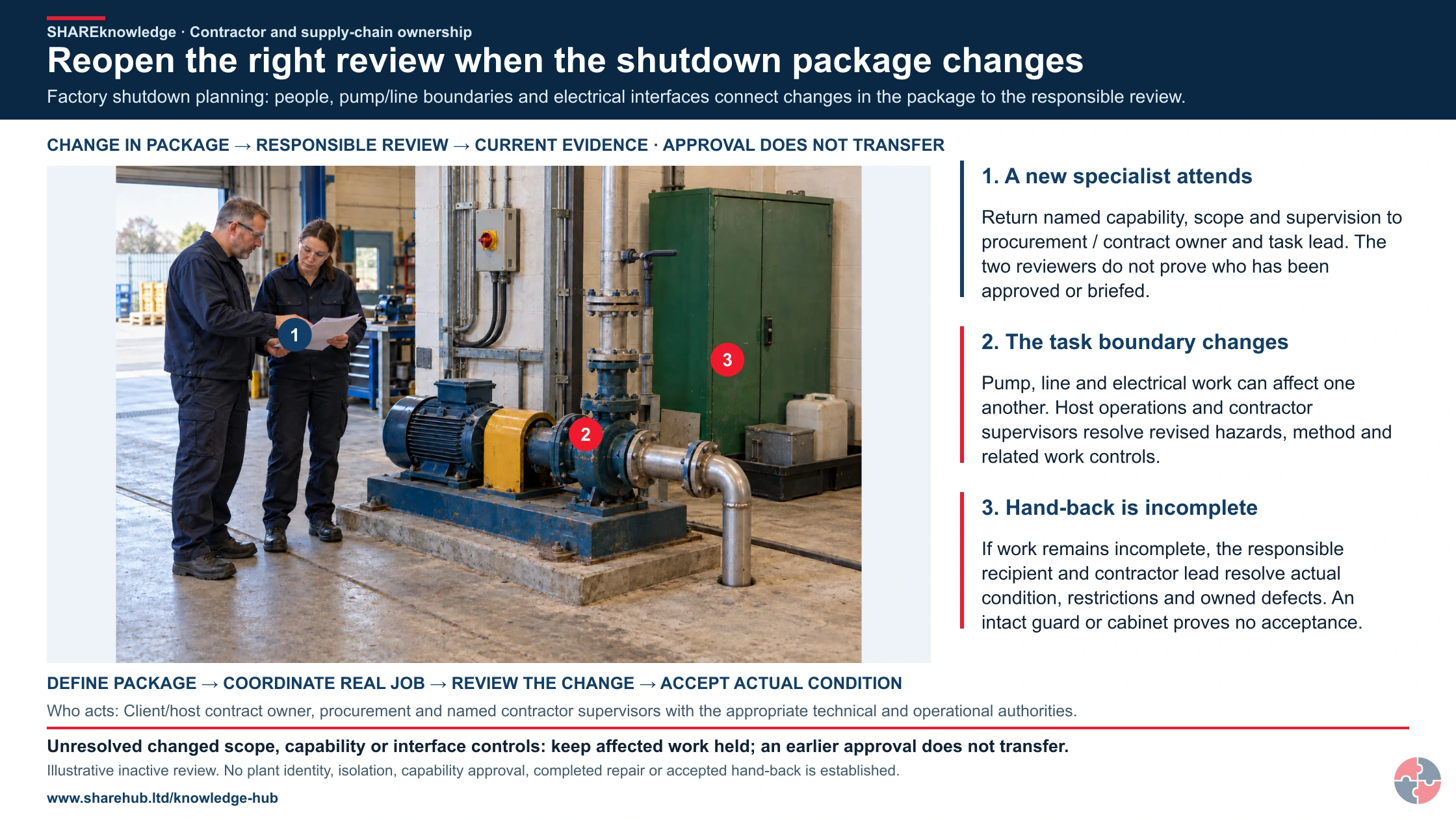
Reopen the right review when the shutdown package changes
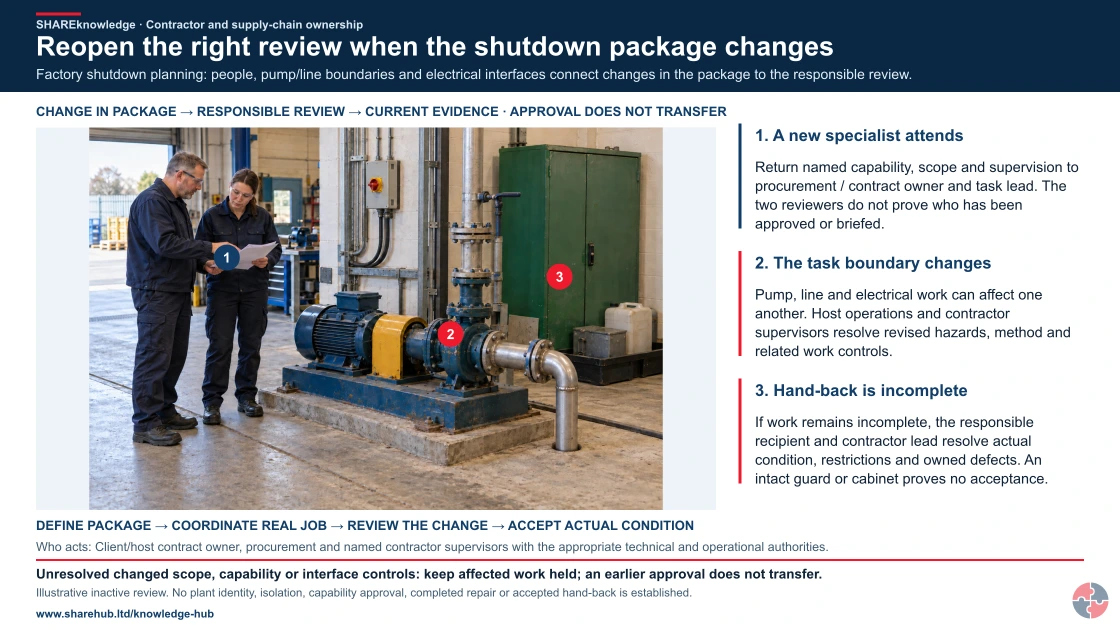
Full written explanation
A realistic factory maintenance review makes the shutdown interfaces visible together: two reviewers with an inert task paper beside an intact pump/motor coupling guard, connected pipework/valve, electrical isolator and cabinet. Three new native markers connect a proposed specialist/capability change, the physical pump-line-electrical work boundary, and incomplete hand-back evidence to the appropriate responsible review. The change scenarios are questions to resolve, not claims that these pictured people are new subcontractors or that the pictured plant has a defect. The complete original three-row package-change, responsible-review and current-evidence matrix remains unchanged in the written alternative and SVG description. A native lifecycle relationship follows package definition, live-job coordination, review of change and acceptance of actual condition. The exact accepted source is meaningfully reused because the mechanical, process and electrical interfaces show how one work package can affect another; it is not used as a decorative contractor meeting. Nobody is working on the pump or opening the cabinet. An intact guard, valve position, isolator appearance or paper establishes no asset identity, safe energy/pressure state, capability approval, competent method, completed repair or accepted hand-back. Original procurement, lower-tier visibility, retained host duties, supervision, source jurisdictions and complete workface/hand-back controls remain unchanged. No isolation, repair, testing or release procedure is introduced.
Factory shutdown planning: people, pump/line boundaries and electrical interfaces connect changes in the package to the responsible review.
- Define the package. Specify task and scope limits with the relevant capability and supply-chain requirements.
- Coordinate the real job. Exchange host and introduced hazards; agree work boundaries, related activities and supervision.
- Review the change. Return a new subcontractor, method or interface to the appropriate responsible approval and work-control review.
- Accept actual condition. Verify hand-back, record restrictions and feed performance into future appointment and scope decisions.
When the evidence does not fit: Keep the affected task held while changed scope, subcontractor capability or interface controls remain unresolved. Do not transfer an earlier approval to a different job.
Who acts: Client/host contract owner, procurement and named contractor supervisors with the appropriate technical and operational authorities.
Changed workplace
Warehouse racking: Separate supplier approval from the exact rack repair, traffic controls and accepted return.
Factory shutdown: Coordinate several contractors and reopen the relevant gate after a scope or subcontractor change.
| CHANGE IN THE PACKAGE | RESPONSIBLE REVIEW | CURRENT EVIDENCE TO RESOLVE |
|---|---|---|
| A new specialist subcontractor attends | Procurement / contract owner and task lead | Scope approval, named capability and supervision |
| The task or plant boundary changes | Host operations and contractor supervisors | Revised hazards, method and related work controls |
| Work remains incomplete at hand-back | Responsible recipient and contractor lead | Actual condition, restrictions and owned defects |
Evidence check: Use the defined scope, retained responsibilities and current workface evidence; earlier supplier approval does not clear a changed job.
Complete procurement, retained duties and supply-chain example
Primary references: HSE HSG159: scope and coordination (GB) · HSE: contractorisation and retained host knowledge (GB)
Open the complete HD image (new tab)Download image
Complete procurement, retained duties and supply-chain example
Primary references: HSE HSG159: scope and coordination (GB) · HSE: contractorisation and retained host knowledge (GB)
BuildOut Ltd
BuildOut Ltd is a construction and refurbishment contractor used by SHARE to show how contractor control works across projects, subcontractors and changing sites.
BuildOut separates contractor approval from job authorisation. A subcontractor may be approved for low-risk decorating but not for roof work, asbestos work, lifting operations or confined-space entry. Procurement uses a task-risk matrix so higher-risk packages trigger deeper competence checks, named supervisor review, evidence of equipment inspection, insurance, training and previous performance. Any subcontracting below the appointed contractor needs written approval and visibility on the project supply-chain register.
Before work starts, the project manager issues pre-construction information, site rules, welfare details, asbestos information, traffic arrangements and known service information. The subcontractor submits task-specific RAMS and identifies introduced hazards such as hot work, dust, plant movement or temporary works. The site manager, temporary works coordinator and HSSE adviser review the plan where relevant and agree hold points, permits, exclusion zones and handback requirements.
On site, BuildOut uses induction, daily coordination briefings, permit boards and supervisor checks. First-line supervisors complete short workface checks against critical controls. Second-line HSSE advisers sample RAMS quality, permit close-out, welfare and contractor engagement. Third-line audits review procurement evidence, subcontractor approval, incident trends and whether lessons are changing future tender packs. Poor performance affects the approved supplier status, not just the current job.
Learning is built into close-out. The contractor review captures safety performance, quality of supervision, responsiveness to defects, worker feedback, incidents, near misses, welfare issues and whether the original scope was realistic. Repeated dust-control failures, poor RAMS, missed inductions or unauthorised subcontracting trigger improvement actions, extra monitoring or removal from the approved list.
| System element | How BuildOut applies it | Evidence |
|---|---|---|
| Risk-based approval | Approves contractors by work type and risk level. | Approved contractor matrix and competence evidence. |
| Procurement controls | Tender packs state health, safety, welfare and supervision expectations. | Prequalification and tender review. |
| Pre-start planning | Client and contractor exchange site and task hazards. | Pre-start minutes and approved RAMS. |
| Permit and induction control | High-risk tasks use permits and all workers complete induction. | Permit register and induction records. |
| Monitoring | Supervisors, HSSE and audits sample real work. | Inspection findings and action close-out. |
| Supply-chain review | Performance affects future work and approval. | Scorecards and approved-list decisions. |
How does this topic align with ISO 45001?
Use these examples to connect the relevant clauses to your own occupational health and safety management system. For each clause, identify the person responsible, the control in use and the evidence that it works.
Scroll across the table to read all four columns.
| ISO 45001 clause | How it applies | What to put in place | How to verify it works |
|---|---|---|---|
| 8.1.4.1 Procurement controls | Procurement influences whether the work, equipment and services can meet the safety requirements of the job. | Build plant-room constraints and hand-back requirements into the scope of work. Check that hired equipment and ordered services meet those requirements before accepting them. | The order, technical specification and receipt check agree. Records show how a mismatch was resolved before the item or service was used. |
| 8.1.4.2 Contractor coordination and control | Contractor controls cover the risks each party brings to the others, including the effect on people near the work. | Agree safety selection criteria and coordinate the host’s, contractor’s and specialist’s work boundaries, sequence and interfaces. Review the revised package when a new electrical specialist is proposed. | Check the actual specialist against the selection criteria and the shared controls at the workface. A hand-back record shows who accepted the work and resolved any remaining defects. |
| 8.1.4.3 Control of outsourced processes | When another organisation delivers a function or process on the business’s behalf, the business sets how much control it needs and how it will exercise that control. | If the client outsources continuing plant maintenance, agree safety responsibilities, access to inspection and defect information, escalation and how it will check the service. | Review sampled maintenance visits and overdue defects against the agreement. Check that the client receives defect information and can require timely action. |
Selected applications of ISO 45001:2018 with Amendment 1:2024. Use the current standard for a full assessment and check the legal duties that apply to the work and location.
ISO 45001:2018 · 2024 climate action amendment · ISO 45002 implementation guidance · ISO technical committee clause FAQ
What should each role learn and demonstrate?
Learning must match the decisions people make, from recognising danger to checking that controls work.
Briefings should tell people how to act, but attendance alone does not show competence. Assess the real decision or task, record who assessed it and revisit after a material change, failed control or incident. A local authorisation is task-specific; no universal external certificate is implied.
On a small screen, scroll this table sideways to read all columns.
| Role and learning | Demonstration and assessor | Record and reassessment trigger |
|---|---|---|
| Buyer/client | Specify hazards and assess task capability; safety lead checks tender evidence. | Selection decision; reassess after scope change. |
| Host supervisor | Verify site briefing, isolation and permit; plant engineer assesses. | Workface check; repeat after barrier failure. |
| Contractor supervisor | Demonstrate method and subcontractor control; host lead observes. | Observation and roster; repeat after team change. |
| Hand-back owner | Test restored safeguards and close permits; engineer witnesses. | Acceptance record; repeat after defect. |
How does this topic support NEBOSH Diploma study?
For advanced safety study, contractor and supply-chain management calls for lifecycle, legal, competence and assurance reasoning.
A practice answer can explain contractor selection, supply-chain governance, procurement, prequalification, competence, coordination, CDM interfaces, communication, induction, permit systems, supervision, monitoring and review. Strong answers show who controls which risk and what evidence proves the control is working.
Scenario-based answers should avoid saying simply 'check RAMS'. They should identify client and contractor responsibilities, missing information, high-risk interfaces, competence gaps, monitoring arrangements, permit needs, welfare and how future procurement will learn from performance.
| Study point | What to know | How to apply it |
|---|---|---|
| Client and contractor responsibilities | Duties are shared according to control, work and premises. | Map who owns each risk. |
| Procurement and competence | Selection is a safety control. | Specify task-relevant evidence. |
| Coordination and communication | Interface risks need active planning. | Use pre-start and daily coordination. |
| Induction and permits | Access and high-risk work need formal control. | Match permits to task hazards. |
| Monitoring and review | Controls must be checked and lessons retained. | Use inspection, audit and scorecard evidence. |
| Supply-chain assurance | Lower tiers can weaken controls. | Require visibility and approval of subcontractors. |
How can a management system sustain effective decisions?
Give each hazard or support route an owner, a control, a check and a response to failure.
Join procurement, competent selection, interface information, point-of-work checks, subcontractor control, permit closure and hand-back with named owners. An owner should sample actual work and corrective actions, not accept a policy or certificate as evidence that the controls work.
The free GB regulator guide HSE Managing for health and safety (HSG65) explains a plan–do–check–act approach: assign controls and owners, involve workers, check work as done, and correct failures. For Northern Ireland, use HSENI risk assessment guidance for the local duty. A certificate alone does not demonstrate that a control works.
What warning signs show contractor management is failing?
Warning signs include unknown subcontractors, generic RAMS, weak induction, uncontrolled interfaces, poor supervision and repeated contractor defects.
Contractor drift often starts quietly. A familiar contractor sends a different team, a subcontractor arrives unannounced, a permit is copied forward, a supervisor assumes the contractor knows the site, or the contractor starts an extra task because it seems minor. Each of these weakens the link between plan and reality.
The consequence can be immediate injury, fire, explosion, service strike, fall from height, asbestos disturbance, welfare failure, public harm or latent defects left behind for someone else. Warning signs should trigger active intervention, not a note for the next review meeting.
| Warning sign | What it suggests | Response |
|---|---|---|
| Unknown people on site | Subcontracting or access control has failed. | Stop work, verify approval and update register. |
| Generic RAMS | The contractor has not understood the task or site. | Reject and require task-specific planning. |
| Permits copied forward | Controls may not match current conditions. | Reissue after field verification. |
| Poor welfare | Planning and supervision are weak. | Correct welfare and review contractor management. |
| Interfaces not discussed | Other work may create new risk. | Hold coordination meeting and revise sequence. |
| Repeated minor defects | Contractor culture or supervision may be poor. | Escalate, monitor more closely and review approval. |
| Handback rushed | Latent defects may remain. | Use formal acceptance and close-out checks. |
What acronyms are used on this contractor management page?
Acronyms should be explained so contractor controls remain accessible.
| Acronym | Meaning | Why it matters |
|---|---|---|
| CDM | Construction (Design and Management) | Main construction dutyholder regulations. |
| CPP | Construction phase plan | Project plan for construction work. |
| CSR | Corporate social responsibility | Links supply-chain assurance to wider ethical and business expectations. |
| HSSE | Health, safety, security and environment | Common function overseeing contractor risk. |
| MEWP | Mobile elevating work platform | Common contractor access equipment. |
| PQQ | Pre-qualification questionnaire | Procurement tool for contractor checks. |
| PTW | Permit to work | Formal authorisation for high-risk work. |
| RAMS | Risk assessment and method statement | Task planning documents. |
| SKEB | Skills, knowledge, experience and behaviours | Competence language used in building safety contexts. |
Which BuildOut documents support this topic?
Download individual editable BuildOut documents for this topic. Procedures and plans contain completed arrangements; forms, checklists, assessments, RAMS and permits are blank masters. Registers include separate worked examples.
| Document | Purpose and content | Editable download |
|---|---|---|
| Contractor selection, onboarding and coordination procedure BOUK-PRO-SUB · Completed worked example · v1.0 | Evaluate capability, agree responsibilities and RAMS, monitor performance and change subcontractors safely. | Download DOCX Read preview |
| Contractor prequalification and capability review BOUK-CHK-SUB-01 · Blank editable master · v1.0 | Assess competence, resources, previous performance and scope-specific controls. | Download DOCX Read preview |
| Subcontractor scope and safety-interface agreement BOUK-FRM-SUB-01 · Blank editable master · v1.0 | Define supplied information, shared facilities, supervision and emergency responsibilities. | Download DOCX Read preview |
| Supplier and hired-equipment acceptance checklist BOUK-CHK-SUB-02 · Blank editable master · v1.0 | Verify specifications, operating instructions, inspection evidence and support. | Download DOCX Read preview |
| Contractor performance and escalation review BOUK-FRM-SUB-02 · Blank editable master · v1.0 | Record performance, recurring concerns and corrective actions. | Download DOCX Read preview |
| Material/product substitution safety review BOUK-CHK-SUB-03 · Blank editable master · v1.0 | Check changed hazards, installation method and compatibility before substitution. | Download DOCX Read preview |
Review and adapt the documents for your organisation, activities and jurisdiction before approval and issue. Open the SHAREms management-system hierarchy to find each document under its parent policy.
Which Crownway Fuels documents support this topic?
Open an editable document, read the preview, or find its place in the Crownway hierarchy. 6 resources relate to this page.
Fictional Crownway Fuels examples for English forecourts, with a separate illustrative bulk terminal. Check site applicability, permissions and actual controls before adapting any document for use.
Procurement and supplier assurance policy (6)
- Procurement and supplier assurance policy (CWF-POL-PROC · Completed fictional example)
Set company expectations, responsibilities and resources for procurement and supplier assurance.
Read preview · Download DOCX · Show in hierarchy - Procurement and supplier assurance procedure (CWF-PRO-PROC · Completed fictional example)
Explain who does what, in what sequence, the control rationale, evidence, escalation and safe restart conditions.
Read preview · Download DOCX · Show in hierarchy - Safety critical purchase and technical specification review (CWF-CHK-PROC-01 · Blank editable master)
Provide the site/task-specific safety critical purchase and technical specification review and retain its controlled output.
Read preview · Download DOCX · Download PDF · Show in hierarchy - Approved safety critical suppliers and spares register (CWF-REG-PROC-01 · Blank register with separate fictional worked entries)
Provide the site/task-specific approved safety critical suppliers and spares register and retain its controlled output.
Read preview · Download XLSX · Show in hierarchy - Incoming equipment and material acceptance check (CWF-CHK-PROC-02 · Blank editable master)
Provide the site/task-specific incoming equipment and material acceptance check and retain its controlled output.
Read preview · Download DOCX · Download PDF · Show in hierarchy - Supplier defect recall and substitution decision (CWF-FRM-PROC-01 · Blank editable master)
Provide the site/task-specific supplier defect recall and substitution decision and retain its controlled output.
Read preview · Download DOCX · Show in hierarchy