SHARE Knowledge Hub
Management of workplace change
Workplace change can weaken controls designed for the previous equipment, staffing, layout or process. People planning and approving a change need to identify affected tasks, consult those exposed, revise controls and confirm the new arrangements work.
Owner: SHARE Knowledge Hub editorial team.
Understanding Management of workplace change
Workplace change means a planned or unplanned alteration to premises, people, process, equipment, substance, layout or way of working that may change exposure to harm. It includes construction inside an operating workplace, replacement machinery, changed shifts, outsourcing, temporary routes and emergency repairs. The task is to control both the transition and the eventual new state.
Why this matters at work
Record scope, location, affected activities, start and end dates, other concurrent works, owner and likely harm. Route to specialist assessment when the general review finds asbestos, structural, process, fire, electrical, lifting, occupational health or public-exposure concerns.
When a procedure change is a response to an incident, verify that it addresses the underlying cause. Engineering a safer layout or reducing exposure may be more reliable than adding another warning or read-and-sign step.
How organisations manage this in practice
Consult while practical options remain open, then show how concerns influenced the design. Attendance at a final briefing does not demonstrate that the proposed arrangements work. HSE distinguishes consulting the general risk-assessment process from formal consultation before every task-specific assessment. Workers need an opportunity to influence practical decisions before introduction. Apply the actual NI representation route for NI workplaces. HSE states that employers must consult their workforce on changes that may substantially affect health and safety, including new procedures, work, equipment, premises and shift patterns. The applicable consultation route depends on representation arrangements; consultation is more than announcement after the decision. Ask the people who do the work about traffic desire lines, access, cleaning, alarms, peak workload and likely workarounds. Include agency, shift and contractor perspectives as appropriate. Provide information early enough to influence layout, sequence and controls. Record the issues raised, the response and unresolved disagreement. Make information accessible across language, literacy and disability needs; diagrams, walk-throughs and demonstrations can be more effective than a long email.
A practical framework has intake, screening, scope definition, hazard and people review, control design, authorisation, implementation, pre-use verification, handover, monitoring and close-out. These are decision gates, not a fixed page count or a promise that every change needs the same committee.
Compare real operation with the assumptions made during design. Include busy periods and different shifts, and check whether corrective actions survive normal work pressures. Examine near misses, complaints, route choice, equipment defects, exposure, overtime, training gaps and emergency drills. Compare findings with the change assessment's assumptions and the promised controls. Observe different shifts and peak activity, not only the opening day. Ask workers, cleaners, maintainers and contractors what is harder. A temporary barrier may be moved for deliveries or a new process may create more dust at full production than at trial. Respond to evidence of failure with immediate restriction where needed, a revised assessment and an owned corrective action. Check the correction in use. Use the review to improve future change screening and project specifications. HSE guidance calls for review when controls may no longer be effective, when workplace changes create new risks, or after worker concerns and accidents. Record significant findings and updates but focus on effective protection in practice.
Recheck capability when engineering cover is reduced
Warehouse production may continue while engineering cover falls and contractors enter. Workload, emergency capability and access can change even without a new machine.

Map the change
Identify affected tasks, shifts, contractors, access and emergency arrangements.
Resolve capability gaps
Provide appropriate competent cover and coordination or restrict/defer affected work where needed.
Check the transition
Brief affected people, verify the real arrangement and review early feedback and unintended effects.
A revised organisation chart alone cannot demonstrate that necessary cover remains available.
How can I practise this topic in 3D?


A relocated haul road defeats several plans
All related inspection points 1 across 1 location
Construction site 1 inspection point
Practice in the SHAREhub environment. Browser practice is separate from workplace competence and formal learning records.
Why does workplace change create health and safety risk?
Change can remove, weaken or overload controls that were designed for the previous workplace, staffing, equipment or process.
Contractor transfer and equipment control


Read the complete visual as text
- Transfer actual information: Exchange scope, host hazards, introduced risks, equipment state, service identity and emergency constraints.
- Name the controlling roles: Separate premises, work method, equipment, timing and supervision responsibilities; coordinate shared interfaces.
- Verify the receiving state: Repair completion or contract closure is not safe-use acceptance. Test affected functions, provide as-built information and brief users before named hand-back.
Best-practice guide: Management of workplace change
Why does workplace change create health and safety risk?
Change can remove, weaken or overload controls that were designed for the previous workplace, staffing, equipment or process. Workplace change can weaken controls designed for the previous equipment, staffing, layout or process.
Turn management of workplace change knowledge into a decision
Workplace change can weaken controls designed for the previous equipment, staffing, layout or process. People planning and approving a change need to identify affected tasks, consult those exposed, revise controls and confirm the new arrangements work. Define stop points and escalation support.
Night shift and outsourced maintenance change scenario
Reduced engineering presence: Operators may intervene beyond competence. Evidence / response: Define stop points and escalation support. Contractor maintenance: Site knowledge and interface risks increase. Evidence / response: Induction, permits, supervision and handback.
Where does workplace change management fail?
It fails when change is treated as an administrative project instead of a live risk-control issue.
Choose controls for management of workplace change
Eliminate: The change owner evaluates unloading in a separate area so vehicles do not pass through the picking work. Reduce: Operations compares delivery arrangements or handling equipment with lower risk for the actual load, space and route; phasing tasks may reduce overlap but is an administrative measure. Isolate: Facilities specifies suitable physical segregation and controlled crossing points for the assessed traffic and pedestrian flows. Control: Operations coordinates delivery timing, routes, vehicle checks, staffing, supervision, competence and shift handovers. PPE: Select visibility and other residual protection for the actual task and lighting. Read the full control table for qualifications, ownership and verification. Use the actual task and applicable jurisdiction; existing technical approval remains unchanged.
Use the full management of workplace change lesson
Use the full topic for the decision points, practical examples, detailed control tables and source scope. HSE guidance applies to Great Britain; use HSENI for the Northern Ireland route and the source’s stated jurisdiction. A simplified guide does not change the page’s technical-review or approval status.

Read all six steps as text
1. Why does workplace change create health and safety risk?
Change can remove, weaken or overload controls that were designed for the previous workplace, staffing, equipment or process.
- Avoid / redesign: The change owner evaluates unloading in a separate area so vehicles do not pass through the picking work.
- Control the task: Facilities specifies suitable physical segregation and controlled crossing points for the assessed traffic and pedestrian flows.
- Verify before release: Walk the complete future route and test that goods, pedestrians and emergency access do not recreate the overlap elsewhere.
Change can remove, weaken or overload controls that were designed for the previous workplace, staffing, equipment or process. Workplace change can weaken controls designed for the previous equipment, staffing, layout or process.
Apply it: Which part of this plan would you check at the workface before authorising the task?
2. Turn management of workplace change knowledge into a decision
Use the evidence to improve the actual work arrangement.
- Change at source: The change owner evaluates unloading in a separate area so vehicles do not pass through the picking work.
- Make it observable: Walk the complete future route and test that goods, pedestrians and emergency access do not recreate the overlap elsewhere.
- Keep useful evidence: Define stop points and escalation support.
Workplace change can weaken controls designed for the previous equipment, staffing, layout or process. People planning and approving a change need to identify affected tasks, consult those exposed, revise controls and confirm the new arrangements work. Define stop points and escalation support.
Apply it: What evidence would show that the change improves this task, rather than only completing a record?
3. Night shift and outsourced maintenance change scenario
Example: a practical application of the existing topic lesson.
- Reduced engineering presence: Operators may intervene beyond competence.
- Contractor maintenance: Site knowledge and interface risks increase.
- Night supervision: Decision authority may be unclear.
Reduced engineering presence: Operators may intervene beyond competence. Evidence / response: Define stop points and escalation support. Contractor maintenance: Site knowledge and interface risks increase. Evidence / response: Induction, permits, supervision and handback.
Apply it: At which point would you hold this example, and what evidence would allow it to proceed?
4. Where does workplace change management fail?
Connect the task, the route to the person and the control that can fail.
- Source / exposure: It fails when change is treated as an administrative project instead of a live risk-control issue.
- Possible consequence: Warning signs include risk assessments not updated, old procedures still in use, supervisors uncertain about authority, contractors unclear on site rules, emergency arrangements unchanged, training delivered after go-live and temporary controls with no expiry.
It fails when change is treated as an administrative project instead of a live risk-control issue.
Apply it: Who could be exposed, including other trades, cleaners, maintainers and people nearby?
5. Choose controls for management of workplace change
Start with the stronger practicable options and verify their effect.
- Eliminate: The change owner evaluates unloading in a separate area so vehicles do not pass through the picking work.
- Reduce: Operations compares delivery arrangements or handling equipment with lower risk for the actual load, space and route; phasing tasks may reduce overlap but is an administrative measure.
- Isolate: Facilities specifies suitable physical segregation and controlled crossing points for the assessed traffic and pedestrian flows.
- Control: Operations coordinates delivery timing, routes, vehicle checks, staffing, supervision, competence and shift handovers.
- PPE: Select visibility and other residual protection for the actual task and lighting.
Eliminate: The change owner evaluates unloading in a separate area so vehicles do not pass through the picking work. Reduce: Operations compares delivery arrangements or handling equipment with lower risk for the actual load, space and route; phasing tasks may reduce overlap but is an administrative measure. Isolate: Facilities specifies suitable physical segregation and controlled crossing points for the assessed traffic and pedestrian flows. Control: Operations coordinates delivery timing, routes, vehicle checks, staffing, supervision, competence and shift handovers. PPE: Select visibility and other residual protection for the actual task and lighting. Read the full control table for qualifications, ownership and verification. Use the actual task and applicable jurisdiction; existing technical approval remains unchanged.
Apply it: Which stronger option can be used here, and who will verify it before accepting the remaining risk?
6. Use the full management of workplace change lesson
Follow the official sources below and retain the task-specific evidence.
- Official guidance: HSE managing risks and risk assessment at work
- Official guidance: HSE organisational change and major accident hazards
- Task decision: Define stop points and escalation support.
Use the full topic for the decision points, practical examples, detailed control tables and source scope. HSE guidance applies to Great Britain; use HSENI for the Northern Ireland route and the source’s stated jurisdiction. A simplified guide does not change the page’s technical-review or approval status.
Apply it: Which official source and full-topic section will you use to resolve the next decision?
Workplace change is not just a project-management issue. A change to layout, equipment, software, staffing, shifts, roles, contractors, maintenance, storage, production rate, competence, supervision, welfare, emergency arrangements or organisational structure can alter risk controls in ways that are not obvious at approval stage. Sources: HSE managing risks and risk assessment at work; HSE organisational change and major accident hazards
HSE warns that organisational changes are often not analysed with the same rigour as plant or process changes, even though they can affect hazard control. Reductions in staff, outsourcing, contractorisation, combining departments or changing responsibilities can remove knowledge, weaken supervision, overload workers and create unclear ownership. Sources: HSE managing risks and risk assessment at work; HSE organisational change and major accident hazards
A good change process asks what controls the current arrangement relies on, how the change affects them, what temporary arrangements are needed, who approves the change, how people are briefed and what evidence will prove the change is safe after implementation. Sources: HSE managing risks and risk assessment at work; HSE organisational change and major accident hazards
| Change type | Possible health and safety effect | Control question |
|---|---|---|
| Equipment or process change | New hazards, altered guarding, energy, emissions or operating limits. | Has technical risk assessment and commissioning been completed?Sources: HSE managing risks and risk assessment at work; HSE organisational change and major accident hazards |
| Layout or premises change | Traffic routes, escape, welfare, ergonomics or fire controls may change. | Have workplace, fire and transport controls been reviewed?Sources: HSE managing risks and risk assessment at work; HSE organisational change and major accident hazards |
| Staffing or shift change | Fatigue, supervision, competence and workload may alter. | Can the new staffing model control the same risks?Sources: HSE managing risks and risk assessment at work; HSE organisational change and major accident hazards |
| Role or responsibility change | Control ownership may become unclear. | Are decision rights, escalation and handover documented?Sources: HSE managing risks and risk assessment at work; HSE organisational change and major accident hazards |
| Outsourcing/contractors | Knowledge and interface risks may increase. | Has contractor competence, coordination and supervision been reviewed?Sources: HSE managing risks and risk assessment at work; HSE organisational change and major accident hazards |
| Temporary arrangements | Short-term workarounds become normal. | Are temporary controls authorised, time-limited and monitored?Sources: HSE managing risks and risk assessment at work; HSE organisational change and major accident hazards |
| Organisational restructuring | Communication, learning and assurance may weaken. | Are worker consultation and control assurance built in?Sources: HSE managing risks and risk assessment at work; HSE organisational change and major accident hazards |
What should a management of change process include?
It should screen proposed changes, assess affected controls, approve the change, brief people, implement safely and review after use.
Workplace change: screen the actual difference
2 linked parts. Follow the question numbers and complete the applicable route.
Part 1 of 2 · Questions 1–3

Continue · Part 2 of 2 · Questions 4–5


Read the complete visual as text
- Start: A new task, layout, machine, substance, contractor, role, shift or temporary arrangement is proposed. Immediate danger follows the local emergency response first.
- Question 1: Is the existing work and control baseline known? Decision owner: Change owner with affected supervisors/workers.
- YES: Describe the proposed difference against the actual existing work and controls. Owner: Change owner with affected supervisors/workers. CONTINUE → QUESTION 2.
- NO • HOLD: Hold implementation while the baseline, affected assets and intended arrangement are established. Owner: Change owner with affected supervisors/workers. HOLD → REPEAT QUESTION 1 AFTER CORRECTION.
- UNKNOWN • HOLD: Hold the affected decision while the owner resolves the missing evidence. Hold implementation while the baseline, affected assets and intended arrangement are established. Owner: Change owner with affected supervisors/workers. HOLD → REPEAT QUESTION 1 AFTER CORRECTION.
- Question 2: Are affected workers, contractors, occupants and adjacent activities identified and consulted? Decision owner: Change owner and relevant duty holders.
- YES: Include exposure, workload, welfare, access and emergency effects in the screen. Owner: Change owner and relevant duty holders. CONTINUE → QUESTION 3.
- NO • HOLD: Hold the affected implementation and consult those who depend on the current controls. Owner: Change owner and relevant duty holders. HOLD → REPEAT QUESTION 2 AFTER CORRECTION.
- UNKNOWN • HOLD: Hold the affected decision while the owner resolves the missing evidence. Hold the affected implementation and consult those who depend on the current controls. Owner: Change owner and relevant duty holders. HOLD → REPEAT QUESTION 2 AFTER CORRECTION.
- Question 3: Could exposure, control, workload, welfare or emergency response change? Decision owner: Competent change assessor and responsible manager.
- YES: Undertake proportionate competent assessment and retain a named change owner. Owner: Competent change assessor and responsible manager. CONTINUE → QUESTION 4.
- NO: Record the reasoned no-risk-change conclusion and confirm the verified existing safe-work route still applies. Owner: Competent change assessor and responsible manager. OUTCOME → RECORD AND HAND OVER.
- UNKNOWN: Hold the affected implementation; assess the uncertain control, work demand or response before deciding. Owner: Competent change assessor and responsible manager. HOLD → REPEAT QUESTION 3 AFTER CORRECTION.
- Question 4: Has the actual construction/equipment or other specialist legal scope been checked for GB or NI? Decision owner: Duty holder with competent legal/technical advice.
- YES: Use the applicable route and identify relevant responsible roles without inventing a duty from the project label. Owner: Duty holder with competent legal/technical advice. CONTINUE → QUESTION 5.
- NO • HOLD: Keep the change held while scope and the correct territorial authority are established. Owner: Duty holder with competent legal/technical advice. HOLD → REPEAT QUESTION 4 AFTER CORRECTION.
- UNKNOWN • HOLD: Hold the affected decision while the owner resolves the missing evidence. Keep the change held while scope and the correct territorial authority are established. Owner: Duty holder with competent legal/technical advice. HOLD → REPEAT QUESTION 4 AFTER CORRECTION.
- Question 5: Are assessment, owners, resources and the next approval/verification hold point defined? Decision owner: Responsible change manager.
- YES: Carry an assessed change into bounded implementation, briefing and later effectiveness review. Owner: Responsible change manager. OUTCOME → RECORD AND HAND OVER.
- NO • HOLD: Hold implementation until controls, competence, temporary arrangements and verification responsibilities are clear. Owner: Responsible change manager. HOLD → REPEAT QUESTION 5 AFTER CORRECTION.
- UNKNOWN • HOLD: Hold the affected decision while the owner resolves the missing evidence. Hold implementation until controls, competence, temporary arrangements and verification responsibilities are clear. Owner: Responsible change manager. HOLD → REPEAT QUESTION 5 AFTER CORRECTION.
- Outcome: Document either the justified existing route or the assessed change, with owner, consultation and next decision gate.
- Stop and escalation boundary: Use the actual workface and applicable GB or NI law. A signed form, permit, course or certificate is not proof of a safe control. No universal staffing ratio, weather, excavation, rescue or temporary-change limit is supplied.
Management of change should be proportionate. A minor office move may need a simple review of DSE, routes and communication. A process plant modification, depot layout change, contractorisation decision or shift restructure may need formal technical review, leadership approval and staged implementation. Sources: HSE organisational change and major accident hazards; HSE HSG65 Managing for health and safety
The key is not bureaucracy; it is control. The process should catch changes before they quietly defeat risk assessments, procedures, competence, emergency plans, maintenance schedules, permits, health surveillance, welfare or supervision. Sources: HSE organisational change and major accident hazards; HSE HSG65 Managing for health and safety
| Stage | Question | Output |
|---|---|---|
| Proposed change | What is changing and why? | Clear scope and owner.Sources: HSE organisational change and major accident hazards; HSE HSG65 Managing for health and safety |
| Risk screen | What hazards, controls, people and legal duties may be affected? | Change risk category.Sources: HSE organisational change and major accident hazards; HSE HSG65 Managing for health and safety |
| Affected-control review | Which safeguards, procedures, permits, competence or emergency arrangements change? | Control impact assessment.Sources: HSE organisational change and major accident hazards; HSE HSG65 Managing for health and safety |
| Competence and staffing review | Do people still have capacity, knowledge and supervision? | Training, staffing and handover plan.Sources: HSE organisational change and major accident hazards; HSE HSG65 Managing for health and safety |
| Interface review | Are contractors, landlords, tenants, emergency services or other teams affected? | Coordination plan.Sources: HSE organisational change and major accident hazards; HSE HSG65 Managing for health and safety |
| Approval | Who has authority to accept residual risk and resources? | Signed approval with conditions.Sources: HSE organisational change and major accident hazards; HSE HSG65 Managing for health and safety |
| Implementation | How will the change be communicated and controlled? | Briefings, permits, commissioning and temporary controls.Sources: HSE organisational change and major accident hazards; HSE HSG65 Managing for health and safety |
| Post-change review | Did controls work as intended? | Review record, action close-out and learning.Sources: HSE organisational change and major accident hazards; HSE HSG65 Managing for health and safety |
How can the hierarchy of controls reduce health and safety risks during workplace change?
Assess the changed harm routes before approving a new layout or shift. Removing an overlap is stronger than asking people to pay closer attention; the future arrangement and the transition both need verification.
Illustrative decision: a warehouse adds night deliveries and reroutes forklifts past a picking area. The change owner involves drivers, pickers, supervisors, facilities and emergency responders before approving the new route.
ERICPD means Eliminate, Reduce (including substitution), Isolate, Control, PPE and Discipline. The five-level hierarchy groups measures as elimination, substitution, engineering controls, administrative controls and PPE. They overlap: isolation is usually an engineering measure; control can include engineered and administrative measures. Discipline means maintaining and checking the controls, supervising the method and learning from defects, rather than blaming someone or accepting weaker protection.
How can the ERICPD hierarchy of controls reduce health and safety risks during workplace change?

| ERICPD and five-level position | Intervention and owner | Verification, failure and stop point |
|---|---|---|
| Eliminate / elimination | The change owner evaluates unloading in a separate area so vehicles do not pass through the picking work. Consult both teams about tasks and access. | Walk the complete future route and test that goods, pedestrians and emergency access do not recreate the overlap elsewhere. An unresolved shared route prevents approval. |
| Reduce / substitution when replacing a hazard; otherwise engineering or administrative risk reduction | Operations compares delivery arrangements or handling equipment with lower risk for the actual load, space and route; phasing tasks may reduce overlap but is an administrative measure. | Document vehicle/load suitability and effects on manual handling, capacity and visibility. Smaller equipment is not safer merely because it is smaller. |
| Isolate / engineering | Facilities specifies suitable physical segregation and controlled crossing points for the assessed traffic and pedestrian flows. Include doors, blind corners, maintenance and escape. | Inspect the installed arrangement under night lighting. Missing segregation or an unassessed crossing requires traffic restriction and competent resolution. |
| Control / administrative | Operations coordinates delivery timing, routes, vehicle checks, staffing, supervision, competence and shift handovers. Workers receive the changed instructions before first use. | Observe the trial under protected conditions, including congestion and abnormal deliveries. Unbriefed workers or inadequate emergency cover hold implementation. |
| PPE / PPE | Select visibility and other residual protection for the actual task and lighting. Managers provide and maintain the assessed equipment. | Check availability, suitability and use; visibility clothing cannot prevent a vehicle entering a pedestrian space. |
| Discipline / sustained engineering and administrative controls | The change owner gathers feedback from every shift and reviews near misses, defects and unauthorised route changes. Supervisors maintain the agreed arrangements. | Record restrictions and named closure. A recurrent overlap, new workload or changed contractor triggers another review rather than routine acceptance. |
How can the ISO 45001 hierarchy of controls reduce health and safety risks during workplace change?

| ERICPD and five-level position | Intervention and owner | Verification, failure and stop point |
|---|---|---|
| Eliminate / elimination | The change owner evaluates unloading in a separate area so vehicles do not pass through the picking work. Consult both teams about tasks and access. | Walk the complete future route and test that goods, pedestrians and emergency access do not recreate the overlap elsewhere. An unresolved shared route prevents approval. |
| Reduce / substitution when replacing a hazard; otherwise engineering or administrative risk reduction | Operations compares delivery arrangements or handling equipment with lower risk for the actual load, space and route; phasing tasks may reduce overlap but is an administrative measure. | Document vehicle/load suitability and effects on manual handling, capacity and visibility. Smaller equipment is not safer merely because it is smaller. |
| Isolate / engineering | Facilities specifies suitable physical segregation and controlled crossing points for the assessed traffic and pedestrian flows. Include doors, blind corners, maintenance and escape. | Inspect the installed arrangement under night lighting. Missing segregation or an unassessed crossing requires traffic restriction and competent resolution. |
| Control / administrative | Operations coordinates delivery timing, routes, vehicle checks, staffing, supervision, competence and shift handovers. Workers receive the changed instructions before first use. | Observe the trial under protected conditions, including congestion and abnormal deliveries. Unbriefed workers or inadequate emergency cover hold implementation. |
| PPE / PPE | Select visibility and other residual protection for the actual task and lighting. Managers provide and maintain the assessed equipment. | Check availability, suitability and use; visibility clothing cannot prevent a vehicle entering a pedestrian space. |
| Discipline / sustained engineering and administrative controls | The change owner gathers feedback from every shift and reviews near misses, defects and unauthorised route changes. Supervisors maintain the agreed arrangements. | Record restrictions and named closure. A recurrent overlap, new workload or changed contractor triggers another review rather than routine acceptance. |
The comparison is an original illustrative application of the general HSE hierarchy, not a machine-specific method, permit or design approval. The employer must choose measures for the actual work and jurisdiction. Apply the separate Northern Ireland legal route where relevant; the local assessment and competent technical decision govern release.
How does workplace change risk transfer across sectors?
The same change screen applies to people, equipment, methods and emergency assumptions, but each sector needs its own harm route and field test.
GB and NI duty routes


Read the complete visual as text
- Identify territory and work: Establish location and whether construction, equipment, substances or organisational arrangements engage specialist requirements.
- Apply the correct law: Use the separate GB or NI general and specific duty route. Construction scope and contractor count determine relevant CDM roles.
- Record and revisit scope: Unclear authority or changed scope holds the affected decision. The reviewed risk, consultation and physical verification govern implementation.
In a warehouse, a revised night delivery route can put pickers in a forklift path. Close the overlap, install segregation, verify the route before first use and stop traffic if a barrier is missing. HSE vehicles and loads: segregation.
In an office, a new shift or outsourcing arrangement can leave lone workers without support. Consult affected staff, check task coverage and escalation, rehearse the new arrangement and pause the change if emergency response cannot be provided. HSE organisational change and major accident hazards and HSE what to consult on during change.
In a construction refurbishment, new sequencing can put contractors and building occupants together. Confirm whether the work is construction under the applicable Great Britain or Northern Ireland Construction (Design and Management) regulations (CDM), separate access and welfare, verify the plan at the workface and stop when an uncontrolled interface appears. Construction (Design and Management) Regulations 2015 and Construction (Design and Management) Regulations (NI) 2016.
How can a night shift and outsourced maintenance change create risk?
A change example shows why staffing, competence, contractors and emergency arrangements must be assessed together.
Staffing change and critical tasks


Read the complete visual as text
- Map the tasks: Name who performs normal work, checks, response, maintenance and emergency functions before and after the change.
- Test capacity and transition cover: Consider absence, simultaneous demands, upset and emergency. Consult workers, transfer knowledge and provide competent cover before go-live.
- A task without an owner blocks change: Retain existing cover or redesign when authority, capacity or competence is missing. Phase implementation and review actual workload.
A manufacturing business introduces a permanent night shift and outsources mechanical maintenance. The change is approved for production reasons. The original risk assessments assumed daytime engineering support, experienced supervisors, easy access to stores, full first-aid cover and managers on site. Sources: HSE organisational change and major accident hazards; HSE organising for safety: contractors
After the change, night operators clear more faults themselves, maintenance contractors arrive with limited site knowledge, permit authorisation is unclear and fatigue increases. A good MOC process would identify these effects before launch, set contractor induction and supervision, clarify isolation authority, review emergency cover, adjust staffing and run a post-change review after the first month. Sources: HSE organisational change and major accident hazards; HSE organising for safety: contractors
| Change effect | Risk created | Management response |
|---|---|---|
| Reduced engineering presence | Operators may intervene beyond competence. | Define stop points and escalation support.Sources: HSE organisational change and major accident hazards; HSE maintenance of work equipment. |
| Contractor maintenance | Site knowledge and interface risks increase. | Induction, permits, supervision and handback.Sources: HSE organising for safety: contractors; HSE maintenance of work equipment. |
| Night supervision | Decision authority may be unclear. | Named responsible person and escalation route.Sources: HSE organisational change and major accident hazards; HSE emergency procedures. |
| Fatigue | Error, reduced vigilance and driving risk increase. | Rota review, breaks and fatigue reporting.Sources: HSE fatigue and shift work; HSE organisational change and major accident hazards. |
| Emergency arrangements | First aid, fire and evacuation cover may differ. | Review emergency plan and drills.Sources: HSE emergency procedures; HSE first-aid arrangements for employers. |
| Post-change learning | Weak signals may be missed after launch. | Review defects, incidents, workload and worker feedback.Sources: HSE HSG65 Managing for health and safety; HSE organisational change and major accident hazards. |
What should the workplace change pathway look like?
A change process should make risk visible before implementation and check whether the new arrangement works after it is live.
Occupied-site construction interface


Read the complete visual as text
- Keep occupation and works coordinated: Identify the applicable construction scope and dutyholders while normal work continues. Map occupants, contractors, deliveries, dust and noise.
- Protect shared routes and systems: Sequence work and provide suitable physical separation. Keep escape, welfare, services and emergency access effective.
- Hold and reopen with evidence: Blocked escape or an unclear isolation interface holds affected work or occupancy. Verify as-built controls and alarm arrangements before reopening.
The pathway is simple to describe but often hard to run well: proposed change, screen for risk, consult affected people, assess affected controls, approve with conditions, communicate, train, implement, verify and review. It should apply to physical change and organisational change. The level of detail should match the risk, not the job title of the person requesting the change. Sources: HSE organisational change and major accident hazards; HSE HSG65 Managing for health and safety
The most dangerous changes are not always labelled as safety projects. A new contractor, reduced maintenance cover, different shift pattern, temporary route, altered store layout or software change can weaken controls that were assumed in risk assessments, emergency plans, permits and supervision arrangements. Sources: HSE organisational change and major accident hazards; HSE HSG65 Managing for health and safety
| Pathway stage | Question to answer | Example evidence |
|---|---|---|
| Proposed change | What is changing, why, where and for how long? | Change request, scope, owner and affected locations.Sources: HSE organisational change and major accident hazards; HSE HSG65 Managing for health and safety |
| Risk screen | Could this affect hazards, controls, people, competence, workload, welfare, fire, emergency or legal duties? | Screening checklist with risk category.Sources: HSE organisational change and major accident hazards; HSE HSG65 Managing for health and safety |
| Consult affected people | Who understands work as done and who will experience the change? | Worker/supervisor consultation notes and concerns log.Sources: HSE organisational change and major accident hazards; HSE HSG65 Managing for health and safety |
| Assess affected controls | Which risk assessments, procedures, permits, training, maintenance, emergency arrangements or inspections need update? | Control impact assessment and action list.Sources: HSE organisational change and major accident hazards; HSE HSG65 Managing for health and safety |
| Approve | Who can accept the residual risk and resource the controls? | Approval with conditions, open-action rules and temporary-control limits.Sources: HSE organisational change and major accident hazards; HSE HSG65 Managing for health and safety |
| Communicate and train | Who needs briefing, instruction, competence check or handover before go-live? | Briefing record, training update and handover evidence.Sources: HSE organisational change and major accident hazards; HSE HSG65 Managing for health and safety |
| Implement | Are temporary arrangements controlled and are critical controls verified before use? | Readiness check, permit/commissioning evidence and supervisor sign-off.Sources: HSE organisational change and major accident hazards; HSE HSG65 Managing for health and safety |
| Verify and review | Did the change work safely in real conditions? | 30/60/90-day review, weak-signal review and closed actions.Sources: HSE organisational change and major accident hazards; HSE HSG65 Managing for health and safety |
How do different workplace changes affect controls?
The same change method should be flexible enough to catch technical, organisational and temporary-control risks.
Three states of workplace change


Read the complete visual as text
- Baseline: Record how work, people, controls, staffing, welfare and emergency arrangements currently operate.
- Transition: Manage temporary routes, concurrent trades, lost protection, workload and knowledge transfer while change happens.
- Future state: Verify the installed controls, competence, capacity and emergency response before go-live; monitor early use and retain reversal or escalation options.
A plant or layout change may affect guarding, access, traffic routes, fire separation, ventilation, lighting or emergency escape. An organisational change may affect supervision, competence, retained knowledge, workload and escalation. A contractor change may introduce interface risks and reduce the client's direct knowledge of how work is done. Sources: HSE managing risks and risk assessment at work; HSE organisational change and major accident hazards
Temporary change needs particular discipline because temporary controls can become the unofficial permanent system. Every temporary arrangement should have an owner, expiry date, review trigger and rule for what happens if the risk increases. Sources: HSE managing risks and risk assessment at work; HSE organisational change and major accident hazards
| Change type | Risk-control concern | Competent management response |
|---|---|---|
| Plant or equipment change | Safeguards, isolation, emissions, maintenance or operating limits may change. | Technical review, commissioning, updated assessment and operator briefing.Sources: HSE managing risks and risk assessment at work; HSE organisational change and major accident hazards |
| Layout change | Traffic, escape, ergonomics, welfare, fire load or storage controls may be affected. | Workplace, fire, transport and manual-handling review.Sources: HSE managing risks and risk assessment at work; HSE organisational change and major accident hazards |
| Temporary change | Interim controls may lack design, training or expiry. | Authorise, time-limit, monitor and review before extension.Sources: HSE managing risks and risk assessment at work; HSE organisational change and major accident hazards |
| Organisational restructuring | Knowledge, supervision and accountability may be lost. | RACI, retained competence plan and worker consultation.Sources: HSE managing risks and risk assessment at work; HSE organisational change and major accident hazards |
| Shift or staffing change | Fatigue, workload, emergency cover and lone working may change. | Rota risk review, cover plan and wellbeing monitoring.Sources: HSE managing risks and risk assessment at work; HSE organisational change and major accident hazards |
| Contractor change | Site knowledge, control ownership and handback may weaken. | Contractor capability review, induction, interface plan and supervision.Sources: HSE managing risks and risk assessment at work; HSE organisational change and major accident hazards |
| Software or digital change | Alarms, work orders, permits or inspection data may be missed or misrouted. | User testing, fallback process and data-integrity check.Sources: HSE managing risks and risk assessment at work; HSE organisational change and major accident hazards |
What makes organisational change different from plant change?
Organisational change can weaken hazard control by changing people, knowledge, supervision and accountability.
Staffing change: map tasks, capacity and emergency cover
2 linked parts. Follow the question numbers and complete the applicable route.
Part 1 of 2 · Questions 1–3

Continue · Part 2 of 2 · Questions 4–6


Read the complete visual as text
- Start: Roles, shifts, staffing levels or an outsourced service are proposed to change.
- Question 1: Are all safety-critical tasks and responsibilities mapped from the old team to the future team? Decision owner: Responsible manager and task owners.
- YES: Name who takes each task and what knowledge must transfer. Owner: Responsible manager and task owners. CONTINUE → QUESTION 2.
- NO • HOLD: Keep existing cover or hold the affected change; resolve unowned tasks and knowledge transfer. Owner: Responsible manager and task owners. HOLD → REPEAT QUESTION 1 AFTER CORRECTION.
- UNKNOWN • HOLD: Hold the affected decision while the owner resolves the missing evidence. Keep existing cover or hold the affected change; resolve unowned tasks and knowledge transfer. Owner: Responsible manager and task owners. HOLD → REPEAT QUESTION 1 AFTER CORRECTION.
- Question 2: Can both transition and future teams manage normal work and absence? Decision owner: Operations/staffing change owner.
- YES: Test workload, supervision and competent cover in both states. Owner: Operations/staffing change owner. CONTINUE → QUESTION 3.
- NO • HOLD: Retain existing cover or redesign/phasing; do not go live with unsupported normal or absence demand. Owner: Operations/staffing change owner. HOLD → REPEAT QUESTION 2 AFTER CORRECTION.
- UNKNOWN • HOLD: Hold the affected decision while the owner resolves the missing evidence. Retain existing cover or redesign/phasing; do not go live with unsupported normal or absence demand. Owner: Operations/staffing change owner. HOLD → REPEAT QUESTION 2 AFTER CORRECTION.
- Question 3: Can the same arrangements manage upset conditions and emergency duties? Decision owner: Operations and emergency/task specialists.
- YES: Retain evidenced cover for non-routine and emergency demand as well as ordinary output. Owner: Operations and emergency/task specialists. CONTINUE → QUESTION 4.
- NO • HOLD: Block the affected change; restore capability and emergency cover or redesign the proposal. Owner: Operations and emergency/task specialists. HOLD → REPEAT QUESTION 3 AFTER CORRECTION.
- UNKNOWN • HOLD: Hold the affected decision while the owner resolves the missing evidence. Block the affected change; restore capability and emergency cover or redesign the proposal. Owner: Operations and emergency/task specialists. HOLD → REPEAT QUESTION 3 AFTER CORRECTION.
- Question 4: Have workers/contractors been consulted and the control assumptions challenged? Decision owner: Change owner with worker representatives.
- YES: Use the consultation to correct hidden work, dependency and workload gaps. Owner: Change owner with worker representatives. CONTINUE → QUESTION 5.
- NO • HOLD: Hold the affected go-live and obtain practical consultation and competent challenge. Owner: Change owner with worker representatives. HOLD → REPEAT QUESTION 4 AFTER CORRECTION.
- UNKNOWN • HOLD: Hold the affected decision while the owner resolves the missing evidence. Hold the affected go-live and obtain practical consultation and competent challenge. Owner: Change owner with worker representatives. HOLD → REPEAT QUESTION 4 AFTER CORRECTION.
- Question 5: Are competence, training, knowledge transfer and experienced support ready? Decision owner: Task owners and operations/training lead.
- YES: Phase the implementation with appropriate supervision. Owner: Task owners and operations/training lead. CONTINUE → QUESTION 6.
- NO • HOLD: Keep existing cover or redesign; complete transfer and training before the critical task moves. Owner: Task owners and operations/training lead. HOLD → REPEAT QUESTION 5 AFTER CORRECTION.
- UNKNOWN • HOLD: Hold the affected decision while the owner resolves the missing evidence. Keep existing cover or redesign; complete transfer and training before the critical task moves. Owner: Task owners and operations/training lead. HOLD → REPEAT QUESTION 5 AFTER CORRECTION.
- Question 6: Are early workload checks, reversal or escalation options and review ownership in place? Decision owner: Responsible receiving manager.
- YES: Decide the supported go-live under the site system; check early workload, control performance and worker feedback. Owner: Responsible receiving manager. OUTCOME → RECORD AND HAND OVER.
- NO • HOLD: Hold or phase the change until monitoring and a usable response to failure exist. Owner: Responsible receiving manager. HOLD → REPEAT QUESTION 6 AFTER CORRECTION.
- UNKNOWN • HOLD: Hold the affected decision while the owner resolves the missing evidence. Hold or phase the change until monitoring and a usable response to failure exist. Owner: Responsible receiving manager. HOLD → REPEAT QUESTION 6 AFTER CORRECTION.
- Outcome: Supported go-live with monitoring, or held/revised staffing plan. Critical tasks require an owner, capability and emergency cover.
- Stop and escalation boundary: Use the actual workface and applicable GB or NI law. A signed form, permit, course or certificate is not proof of a safe control. No universal staffing ratio, weather, excavation, rescue or temporary-change limit is supplied.
Plant and equipment changes are often visible and technical, so organisations may require design review. Organisational change can look administrative, but it may remove experienced people, split teams, change reporting lines, alter workloads, weaken maintenance ownership or reduce the informal knowledge that keeps controls alive. Sources: HSE organisational change and major accident hazards; HSE what to consult on during change
The control question is: who did the safety-critical work before, who will do it now, what knowledge must transfer, what may be lost and how will leaders know the new arrangement is working? Sources: HSE organisational change and major accident hazards; HSE what to consult on during change
| Change | Safety-control concern | Evidence |
|---|---|---|
| Headcount reduction | Supervision, maintenance and emergency cover may be reduced. | Staffing risk assessment and control review.Sources: HSE organisational change and major accident hazards; HSE what to consult on during change |
| Role redesign | Control ownership may be split or lost. | RACI and handover record.Sources: HSE organisational change and major accident hazards; HSE what to consult on during change |
| Outsourcing | Client may lose technical knowledge. | Contractor management and retained competence plan.Sources: HSE organisational change and major accident hazards; HSE what to consult on during change |
| Combining departments | Priorities and reporting lines may conflict. | Governance and escalation route.Sources: HSE organisational change and major accident hazards; HSE what to consult on during change |
| New software | Alarms, work orders or permits may change. | Testing, training and fallback plan.Sources: HSE organisational change and major accident hazards; HSE what to consult on during change |
| Shift pattern change | Fatigue, welfare and communication change. | Rota risk review and worker consultation.Sources: HSE organisational change and major accident hazards; HSE what to consult on during change |
Why do organisations fail to manage change well?
Failures usually come from narrow screening, poor communication, rushed implementation and weak post-change verification.
A change can be approved by one function while its risk is created in another. Procurement changes suppliers, operations changes shifts, facilities changes layout, HR changes roles and maintenance changes contractor strategy. The health and safety effect sits at the interface. Sources: HSE organisational change and major accident hazards; HSE HSG65 Managing for health and safety
Good change management deliberately looks for those interfaces and tests the change after it is live. Sources: HSE organisational change and major accident hazards; HSE HSG65 Managing for health and safety
| Failure pattern | Example | Control |
|---|---|---|
| Narrow scope | Only production benefits assessed. | Risk screen includes health, safety, fire, welfare and competence.Sources: HSE organisational change and major accident hazards; HSE HSG65 Managing for health and safety |
| No worker input | People doing the task know the issue but are not asked. | Consult workers before approval.Sources: HSE organisational change and major accident hazards; HSE HSG65 Managing for health and safety |
| Temporary becomes permanent | Interim layout or staffing lasts months. | Expiry date and review trigger.Sources: HSE organisational change and major accident hazards; HSE HSG65 Managing for health and safety |
| Training after launch | People learn during live operation. | Competence before implementation.Sources: HSE organisational change and major accident hazards; HSE HSG65 Managing for health and safety |
| No post-change review | Weak signals are missed. | 30/60/90-day review and action tracker.Sources: HSE organisational change and major accident hazards; HSE HSG65 Managing for health and safety |
| Unclear authority | No one can stop the new arrangement. | Named change owner and stop criteria.Sources: HSE organisational change and major accident hazards; HSE HSG65 Managing for health and safety |
When should a workplace change stop or escalate?
Escalate when the change affects critical controls, legal duties, competence, staffing, emergency arrangements or worker health and wellbeing.
A change should pause if it is unclear who owns affected controls, what competence is required, how temporary arrangements will be controlled or how the organisation will know the change is safe after implementation. Sources: HSE managing risks and risk assessment at work; HSE organisational change and major accident hazards
Senior management must resource competent resolution where the change affects high-consequence risk, resources or major-accident controls. Unmanaged fatigue or a missing safety-critical control prevents implementation until effective controls resolve it; a senior signature cannot waive the hold. Close safety-critical pre-start actions before implementation; justify any non-critical close-out item with an owner, restriction and due date. Sources: HSE managing risks and risk assessment at work; HSE organisational change and major accident hazards
| Trigger | Immediate action | Approval evidence |
|---|---|---|
| Critical control affected | Pause and review technical basis. | Control impact assessment and owner approval.Sources: HSE managing risks and risk assessment at work; HSE organisational change and major accident hazards |
| Competence or staffing reduced | Review workload, supervision and emergency cover. | Staffing/competence plan.Sources: HSE managing risks and risk assessment at work; HSE organisational change and major accident hazards |
| Contractor or interface added | Coordinate roles, permits and supervision. | Interface plan and induction.Sources: HSE managing risks and risk assessment at work; HSE organisational change and major accident hazards |
| Temporary workaround needed | Set expiry, owner and monitoring. | Temporary control authorisation.Sources: HSE managing risks and risk assessment at work; HSE organisational change and major accident hazards |
| Workers report concerns | Consult, investigate and adapt. | Concern log and response.Sources: HSE managing risks and risk assessment at work; HSE organisational change and major accident hazards |
| Post-change weak signals appear | Review and correct before normalising. | Post-change review and action closure.Sources: HSE managing risks and risk assessment at work; HSE organisational change and major accident hazards |
Where does workplace change management fail?
It fails when change is treated as an administrative project instead of a live risk-control issue.
Warning signs include risk assessments not updated, old procedures still in use, supervisors uncertain about authority, contractors unclear on site rules, emergency arrangements unchanged, training delivered after go-live and temporary controls with no expiry. Sources: HSE HSG65 Managing for health and safety; HSE managing risks and risk assessment at work
The best organisations look for drift after implementation. If the new arrangement only works because experienced people are compensating, the change is not yet controlled. Sources: HSE HSG65 Managing for health and safety; HSE managing risks and risk assessment at work
| Failure or weak practice | How it develops | What good looks like |
|---|---|---|
| No risk screen | Change approved without health and safety review. | Mandatory risk screen for relevant changes.Sources: HSE HSG65 Managing for health and safety; HSE managing risks and risk assessment at work |
| Control owner lost | Old owner leaves or role changes. | RACI and handover.Sources: HSE HSG65 Managing for health and safety; HSE managing risks and risk assessment at work |
| Procedures lag | Work changes but documents and training do not. | Pre-launch document control.Sources: HSE HSG65 Managing for health and safety; HSE managing risks and risk assessment at work |
| Consultation late | Workers told after decisions are fixed. | Early worker involvement.Sources: HSE HSG65 Managing for health and safety; HSE managing risks and risk assessment at work |
| Weak post-change review | Launch is treated as completion. | Scheduled review with evidence.Sources: HSE HSG65 Managing for health and safety; HSE managing risks and risk assessment at work |
| Major risk hidden in minor change | Small software or staffing change affects critical alarm response. | Critical-control impact check.Sources: HSE HSG65 Managing for health and safety; HSE managing risks and risk assessment at work |
What evidence shows workplace change is controlled?
Evidence should show that the change was screened, assessed, approved, communicated, implemented and reviewed against real risk.
Good evidence includes change request, risk screen, affected-control assessment, worker consultation, competence plan, contractor interface review, emergency-plan review, temporary-control approval, go-live checklist, post-change review and action closure. Sources: HSE HSG65 Managing for health and safety; HSE managing risks and risk assessment at work
The evidence should be easy to follow from proposal to outcome. If someone cannot see why the change was accepted and what controls were verified, the change record is weak. Sources: HSE HSG65 Managing for health and safety; HSE managing risks and risk assessment at work
| Evidence item | What it should show | Assurance question |
|---|---|---|
| Change register | Relevant changes are visible before implementation. | Are health and safety effects screened?Sources: HSE HSG65 Managing for health and safety; HSE managing risks and risk assessment at work |
| Affected-control assessment | Critical controls, procedures, competence and emergency arrangements are reviewed. | Does it include indirect effects?Sources: HSE HSG65 Managing for health and safety; HSE managing risks and risk assessment at work |
| Post-change review | The new arrangement is tested against work as done. | Were weak signals and worker feedback reviewed?Sources: HSE HSG65 Managing for health and safety; HSE managing risks and risk assessment at work |
| Risk assessment | Assessment describes the actual work, people affected, credible harm routes, controls and review triggers. | Compare against work as done, not only the written method.Sources: HSE HSG65 Managing for health and safety; HSE managing risks and risk assessment at work |
| Control standard or procedure | The required control is defined in plain operational terms. | Workers and supervisors can explain what must be in place before work starts.Sources: HSE HSG65 Managing for health and safety; HSE managing risks and risk assessment at work |
| Competence and authorisation | People have role-specific training, supervision and authorisation where needed. | Competence is checked through observed practice, not attendance alone.Sources: HSE HSG65 Managing for health and safety; HSE managing risks and risk assessment at work |
| Inspection, monitoring and defects | Checks find defects and defects are risk-ranked, isolated, repaired and closed. | Open defects do not remain invisible in log books.Sources: HSE HSG65 Managing for health and safety; HSE managing risks and risk assessment at work |
| Management review | Actions, incidents, audits, change and weak signals are reviewed by people with authority to act. | Decisions, resources and learning are recorded.Sources: HSE HSG65 Managing for health and safety; HSE managing risks and risk assessment at work |
How should workplace change be assured?
Assurance should test whether the organisation identifies risk before change and learns quickly after implementation.
Urgent or temporary workplace change: evidenced hand-back
2 linked parts. Follow the question numbers and complete the applicable route.
Part 1 of 2 · Questions 1–3

Continue · Part 2 of 2 · Questions 4–6


Read the complete visual as text
- Start: A repair, temporary route or trial is reported complete or reaches its agreed endpoint.
- Question 1: Is there an active release, fire, explosion, exposure or other immediate danger? Decision owner: Person discovering the danger and site emergency lead.
- YES • EMERGENCY: Raise the alarm, warn others, withdraw to safety and follow the local emergency plan now. Do not wait for the change or reporting paperwork. Owner: Person discovering the danger and site emergency lead. STOP / REFER → APPROPRIATE RESPONSE.
- NO: Keep the system in a protected state and examine the affected work decision. Owner: Person discovering the danger and site emergency lead. CONTINUE → QUESTION 2.
- UNKNOWN: Protect people from the possible hazard and obtain the site emergency/competent response from a safe position. Do not enter or restart to find out. Owner: Person discovering the danger and site emergency lead. STOP / REFER → APPROPRIATE RESPONSE.
- Question 2: Does the installed/as-found state match the approved plan? Decision owner: Technical owner and receiving manager.
- YES: Reconcile deviations, temporary items and the defined state being offered back. Owner: Technical owner and receiving manager. CONTINUE → QUESTION 3.
- NO • HOLD: Keep the area/equipment out of affected use; assess and correct the deviation. Owner: Technical owner and receiving manager. HOLD → REPEAT QUESTION 2 AFTER CORRECTION.
- UNKNOWN • HOLD: Hold the affected decision while the owner resolves the missing evidence. Keep the area/equipment out of affected use; assess and correct the deviation. Owner: Technical owner and receiving manager. HOLD → REPEAT QUESTION 2 AFTER CORRECTION.
- Question 3: Are physical controls and affected emergency arrangements tested? Decision owner: Competent technical and emergency owners.
- YES: Retain field tests and practical evidence for the actual state. Owner: Competent technical and emergency owners. CONTINUE → QUESTION 4.
- NO • HOLD: Keep the affected use held; restore and retest controls or redesign the response. Owner: Competent technical and emergency owners. HOLD → REPEAT QUESTION 3 AFTER CORRECTION.
- UNKNOWN • HOLD: Hold the affected decision while the owner resolves the missing evidence. Keep the affected use held; restore and retest controls or redesign the response. Owner: Competent technical and emergency owners. HOLD → REPEAT QUESTION 3 AFTER CORRECTION.
- Question 4: Are affected users briefed and the instructions current? Decision owner: Receiving manager and supervisors.
- YES: Confirm people can use the changed arrangement and raise a concern. Owner: Receiving manager and supervisors. CONTINUE → QUESTION 5.
- NO • HOLD: Keep affected use held until current instructions, briefing and support are ready. Owner: Receiving manager and supervisors. HOLD → REPEAT QUESTION 4 AFTER CORRECTION.
- UNKNOWN • HOLD: Hold the affected decision while the owner resolves the missing evidence. Keep affected use held until current instructions, briefing and support are ready. Owner: Receiving manager and supervisors. HOLD → REPEAT QUESTION 4 AFTER CORRECTION.
- Question 5: Are critical actions closed and residual defects/temporary endpoints explicitly owned? Decision owner: Change owner and receiving manager.
- YES: A temporary extension, if needed, enters a new competent decision rather than a date edit. Owner: Change owner and receiving manager. CONTINUE → QUESTION 6.
- NO • HOLD: Continue the hold with an owner and safe arrangement; resolve critical actions and reassess any proposed extension. Owner: Change owner and receiving manager. HOLD → REPEAT QUESTION 5 AFTER CORRECTION.
- UNKNOWN • HOLD: Hold the affected decision while the owner resolves the missing evidence. Continue the hold with an owner and safe arrangement; resolve critical actions and reassess any proposed extension. Owner: Change owner and receiving manager. HOLD → REPEAT QUESTION 5 AFTER CORRECTION.
- Question 6: Does the named receiving manager accept the evidenced, defined operating state? Decision owner: Named receiving manager.
- YES: Record acceptance, restrictions and early-use monitoring with later review. Owner: Named receiving manager. OUTCOME → RECORD AND HAND OVER.
- NO • HOLD: Keep affected use held and resolve the acceptance/evidence gap; completion paperwork is not hand-back. Owner: Named receiving manager. HOLD → REPEAT QUESTION 6 AFTER CORRECTION.
- UNKNOWN • HOLD: Hold the affected decision while the owner resolves the missing evidence. Keep affected use held and resolve the acceptance/evidence gap; completion paperwork is not hand-back. Owner: Named receiving manager. HOLD → REPEAT QUESTION 6 AFTER CORRECTION.
- Outcome: Record verified hand-back and later review, or the continued hold, owner and safe arrangement.
- Stop and escalation boundary: Use the actual workface and applicable GB or NI law. A signed form, permit, course or certificate is not proof of a safe control. No universal staffing ratio, weather, excavation, rescue or temporary-change limit is supplied.
First-line assurance comes from change owners, supervisors and workers checking readiness. Second-line assurance samples change records, consultation, training, open actions and post-change reviews. Leadership assurance focuses on high-consequence change, resourcing decisions and recurring weak signals. Sources: HSE HSG65 Managing for health and safety; HSE organisational change and major accident hazards
A practical assurance test is to select a recent change and ask: what risk controls changed, who approved it, what was left open and what did the post-change review find? Sources: HSE HSG65 Managing for health and safety; HSE organisational change and major accident hazards
| Level | What to check | What good looks like |
|---|---|---|
| Frontline check | People doing or supervising the work confirm that workplace change controls are present, understood and suitable before work starts. | Work pauses when critical controls are missing, unclear or defeated.Sources: HSE HSG65 Managing for health and safety; HSE organisational change and major accident hazards |
| Manager review | Managers review open actions, repeat defects, competence gaps, inspection findings, incidents and work-as-done feedback. | Resources and deadlines match the risk rather than convenience.Sources: HSE HSG65 Managing for health and safety; HSE organisational change and major accident hazards |
| Competent review | Specialists review technical design, legal interpretation, machinery, engineering, change, contractor or construction complexity. | Advice is recorded, understood and converted into practical controls.Sources: HSE HSG65 Managing for health and safety; HSE organisational change and major accident hazards |
| Leadership assurance | Senior leaders review high-consequence risks, overdue critical actions, audit findings and weak signals. | Governance asks whether controls work, not just whether documents exist.Sources: HSE HSG65 Managing for health and safety; HSE organisational change and major accident hazards |
Which GB and NI duties shape workplace change?
Identify the jurisdiction and actual activity first. General risk-management duties apply, and construction or equipment rules apply only where their scope is met.
Occupied refurbishment: construction route and reopening
2 linked parts. Follow the question numbers and complete the applicable route.
Part 1 of 2 · Questions 1–3

Continue · Part 2 of 2 · Questions 4–6


Read the complete visual as text
- Start: Refurbishment, service work or reconfiguration is proposed while normal work continues.
- Question 1: Does the actual activity meet construction-work scope? Decision owner: Client/change owner with competent construction advice.
- YES: Use the relevant CDM construction route alongside the actual workplace risk controls. Owner: Client/change owner with competent construction advice. CONTINUE → QUESTION 2.
- NO: Continue general workplace assessment and contractor coordination with applicable task law; absence of CDM scope does not remove other duties. Owner: Client/change owner with competent construction advice. OUTCOME → RECORD AND HAND OVER.
- UNKNOWN: Hold mobilisation and obtain a competent activity-scope decision. Owner: Client/change owner with competent construction advice. HOLD → REPEAT QUESTION 1 AFTER CORRECTION.
- Question 2: Which construction jurisdiction applies? Decision owner: Client and competent adviser.
- GREAT BRITAIN: Apply GB CDM 2015 to the actual project and dutyholder arrangements. Owner: Client and competent adviser. CONTINUE → QUESTION 3.
- NORTHERN IRELAND: Apply CDM (NI) 2016 and the NI project/dutyholder route. Owner: Client and competent adviser. CONTINUE → QUESTION 3.
- UNKNOWN: Hold the legal/project conclusion and establish jurisdiction. Owner: Client and competent adviser. HOLD → REPEAT QUESTION 2 AFTER CORRECTION.
- Question 3: Are the relevant duty holders appointed and the occupied-work interfaces coordinated? Decision owner: Client and construction/project coordination owner.
- YES: Agree the responsibilities and controlled plan for construction and continuing normal work. Owner: Client and construction/project coordination owner. CONTINUE → QUESTION 4.
- NO • HOLD: Hold the affected phase until project authority, responsibilities and interface ownership are clear. Owner: Client and construction/project coordination owner. HOLD → REPEAT QUESTION 3 AFTER CORRECTION.
- UNKNOWN • HOLD: Hold the affected decision while the owner resolves the missing evidence. Hold the affected phase until project authority, responsibilities and interface ownership are clear. Owner: Client and construction/project coordination owner. HOLD → REPEAT QUESTION 3 AFTER CORRECTION.
- Question 4: Are occupied areas, routes, dust/noise exposure, welfare and emergency access protected? Decision owner: Project lead and receiving workplace manager.
- YES: Verify separation and communication across occupied and construction areas. Owner: Project lead and receiving workplace manager. CONTINUE → QUESTION 5.
- NO • HOLD: Hold affected work or occupancy; restore separation, routes and welfare or redesign the plan. Owner: Project lead and receiving workplace manager. HOLD → REPEAT QUESTION 4 AFTER CORRECTION.
- UNKNOWN • HOLD: Hold the affected decision while the owner resolves the missing evidence. Hold affected work or occupancy; restore separation, routes and welfare or redesign the plan. Owner: Project lead and receiving workplace manager. HOLD → REPEAT QUESTION 4 AFTER CORRECTION.
- Question 5: Are the transition state, shifts and affected users briefed and supervised? Decision owner: Project coordination owner and shift supervisors.
- YES: Implement the controlled phase and check work as done. Owner: Project coordination owner and shift supervisors. CONTINUE → QUESTION 6.
- NO • HOLD: Hold the affected phase; correct transition controls, briefing and supervision. Owner: Project coordination owner and shift supervisors. HOLD → REPEAT QUESTION 5 AFTER CORRECTION.
- UNKNOWN • HOLD: Hold the affected decision while the owner resolves the missing evidence. Hold the affected phase; correct transition controls, briefing and supervision. Owner: Project coordination owner and shift supervisors. HOLD → REPEAT QUESTION 5 AFTER CORRECTION.
- Question 6: Before reopening, do as-built controls and relevant alarm/emergency checks demonstrate readiness? Decision owner: Named receiving manager with competent technical checks.
- YES: Accept only the verified defined state and monitor early use. Owner: Named receiving manager with competent technical checks. OUTCOME → RECORD AND HAND OVER.
- NO • HOLD: Keep the affected area out of use; correct deviations and retest before acceptance. Owner: Named receiving manager with competent technical checks. HOLD → REPEAT QUESTION 6 AFTER CORRECTION.
- UNKNOWN • HOLD: Hold the affected decision while the owner resolves the missing evidence. Keep the affected area out of use; correct deviations and retest before acceptance. Owner: Named receiving manager with competent technical checks. HOLD → REPEAT QUESTION 6 AFTER CORRECTION.
- Outcome: Controlled phase or redesigned plan, with field evidence, as-built/alarm checks, receiving acceptance and later review.
- Stop and escalation boundary: Use the actual workface and applicable GB or NI law. A signed form, permit, course or certificate is not proof of a safe control. No universal staffing ratio, weather, excavation, rescue or temporary-change limit is supplied.
Great Britain (GB) uses the 1974 Act and 1999 management regulations; Northern Ireland (NI) has the 1978 Order and 2000 management regulations. A GB regulation number is not an NI citation. HSE guidance explains a practical method, while the current amended instrument and the actual work determine the duty. Health and Safety at Work etc. Act 1974, Health and Safety at Work (Northern Ireland) Order 1978, Management of Health and Safety at Work Regulations 1999 and Management of Health and Safety at Work Regulations (NI) 2000.
| Decision | Great Britain | Northern Ireland | Field evidence |
|---|---|---|---|
| General duties | 1974 Act: protect employees and others so far as reasonably practicable. | 1978 Order: separate general duties for employees and others. | Named change owner, people affected and protective decision.Sources: Health and Safety at Work etc. Act 1974; Health and Safety at Work (Northern Ireland) Order 1978 |
| Risk and arrangements | 1999 management regulations: assess, plan, provide competence and review. | 2000 management regulations: corresponding NI route. | Before/after risk screen, competent review, action and post-change check.Sources: Management of Health and Safety at Work Regulations 1999; Management of Health and Safety at Work Regulations (NI) 2000 |
| Construction work | CDM 2015 if the altered work meets the construction definition. | CDM (NI) 2016 if in scope. | Client/contractor roles, plan, welfare and controlled interfaces.Sources: Construction (Design and Management) Regulations 2015; Construction (Design and Management) Regulations (NI) 2016 |
| People and transition | HSE GB guidance says consult on changes substantially affecting health and safety. | Check NI consultation duties and local arrangements; do not reuse GB regulation numbers. | Worker input, role handover, staffing and emergency-cover test.Sources: HSE what to consult on during change; HSE organisational change and major accident hazards |
Consult before decisions are fixed
Before fixing the plan, identify recognised union-appointed representatives and the applicable route for other employees. Record concerns, responses and resulting revisions; circulation of a finished plan is not consultation. NI readers should use HSENI: consultation with employees regulations and guidance and the applicable NI consultation provisions.
Voluntary-standard detail on hold
Specific standard editions, clauses and derived management-system detail are withheld until authorised text, rights and competent technical review are complete. Use applicable law and verified site evidence for current decisions.
For general health and safety management, see HSE managing health and safety.
What training and competence are needed?
Training should help managers, supervisors and workers identify change, screen risk, update controls, communicate clearly and stop implementation where readiness is weak.
Training should be role-based. General awareness creates a baseline, but supervisors, managers, advisers and senior leaders need different levels of decision-making, verification and escalation competence. Sources: HSE organisational change and major accident hazards; HSE what to consult on during change
| Level | Who it is for | What it should cover |
|---|---|---|
| General awareness | All workers who may be affected by the topic. | Plain-English overview of management of workplace change, why it matters, early warning signs, basic reporting routes and where to find support or guidance.Sources: HSE organisational change and major accident hazards; HSE what to consult on during change |
| Task-specific practical training | Workers who carry out the activity or face the exposure. | Real tasks, equipment, decision points, stop triggers, pre-use checks, emergency response and practical scenarios.Sources: HSE organisational change and major accident hazards; HSE what to consult on during change |
| Supervisor and line manager training | People who plan work, allocate staff, check controls or respond to concerns. | How to brief work, verify controls, challenge drift, protect confidentiality where relevant and escalate when conditions change.Sources: HSE organisational change and major accident hazards; HSE what to consult on during change |
| HSE, HR, OH or technical adviser coordination | Advisers who support the system. | Legal boundaries, records, assurance checks, trend review, referral quality, evidence standards and action tracking.Sources: HSE organisational change and major accident hazards; HSE what to consult on during change |
| Specialist competence | Use competent engineering, HSE, HR, occupational health, fire, CDM, process safety, human factors or legal advice where change affects technical controls, staffing, wellbeing or major-risk arrangements. | Competent assessment, technical review, design, inspection, audit, occupational health or engineering support where ordinary management competence is not enough.Sources: HSE organisational change and major accident hazards; HSE what to consult on during change |
How could BuildOut Ltd manage this in practice?

BuildOut Ltd would review how a proposed change affects existing controls before introducing it, then verify the revised arrangement in use.
BuildOut Ltd · practical example
Reassess a site route before bringing in larger deliveries
The key lesson Change management considers what the new arrangement invalidates, not only the benefit that prompted it.
The situation: A supplier proposes larger delivery vehicles to reduce trips. The project already has restricted access beside an occupied building and other trades depend on the same route.
Why this matters: A larger vehicle can alter visibility, swept paths, unloading space, public segregation and emergency access even when the materials stay the same.
How BuildOut Ltd would manage it
- Define what changes — Project Manager. Record vehicle size, delivery frequency, unloading method and affected interfaces. Compare the proposal with the assumptions in the current site plan.
- Consult the users — Site Manager. Involve drivers, workers, the building contact and relevant designers or specialists before fixing the decision. Ask where access or sequencing would become unworkable.
- Revise the arrangements — Project Manager. Coordinate the assessed route, timing, equipment and segregation changes. Identify related emergency, welfare and contractor information that must also be updated.
- Check readiness — Site Manager. Confirm the physical arrangement, competent people and current briefings before accepting the changed delivery. Keep the old controlled arrangement or restrict the task where readiness is incomplete.
- Review the first use — Health and Safety Manager. Observe the changed arrangement and obtain driver and worker feedback. Resolve unexpected conflicts and check whether the intended benefit has created another risk.
When the conditions change
- Recognise the trigger
- The proposed larger vehicle cannot use the existing delivery arrangement safely.
- Make the immediate decision
- The Project Manager does not introduce that vehicle into the unchanged route.
- Verify the next step
- The Site Manager verifies the revised delivery layout, unloading arrangements and affected-party briefings against the change assessment.
What good looks like
The change decision identifies old assumptions, affected people and updated controls. A readiness check precedes use, and the first delivery tests the plan.
Evidence to look for: Change review, consultation, revised site information, readiness acceptance and first-use findings.
Common mistake to avoid: Calling a change minor because its purchase cost is small while ignoring its workface effects.
Apply this to your work: What existing assessment assumes the old equipment, layout or staffing remains unchanged?
Guidance behind the management approach: HSE: consulting on changes affecting health and safety. Use the topic's legal and technical guidance for the applicable work and location.
This manufacturer uses a change register covering equipment, layout, staffing, contractors, procedures and emergency arrangements. Sources: HSE managing risks and risk assessment at work; HSE vehicles and loads: segregation
| Management element | How the business would manage it | Evidence to review |
|---|---|---|
| Screen | Every relevant change is screened for health and safety impact. | Change register.Sources: HSE managing risks and risk assessment at work; HSE vehicles and loads: segregation |
| Assess | Affected controls and people are reviewed. | Control impact assessment.Sources: HSE managing risks and risk assessment at work; HSE vehicles and loads: segregation |
| Approve | Risk decisions are authorised at the right level. | Approval record.Sources: HSE managing risks and risk assessment at work; HSE vehicles and loads: segregation |
| Implement | People are briefed and controls tested. | Readiness checklist.Sources: HSE managing risks and risk assessment at work; HSE vehicles and loads: segregation |
| Review | Weak signals after launch are captured. | Post-change review.Sources: HSE managing risks and risk assessment at work; HSE vehicles and loads: segregation |
What should change management reconsider when fuel equipment moves?
Compare the equipment change with its connected systems and assessment assumptions. Proposed geometry remains subject to verification rather than inheriting the original acceptance.
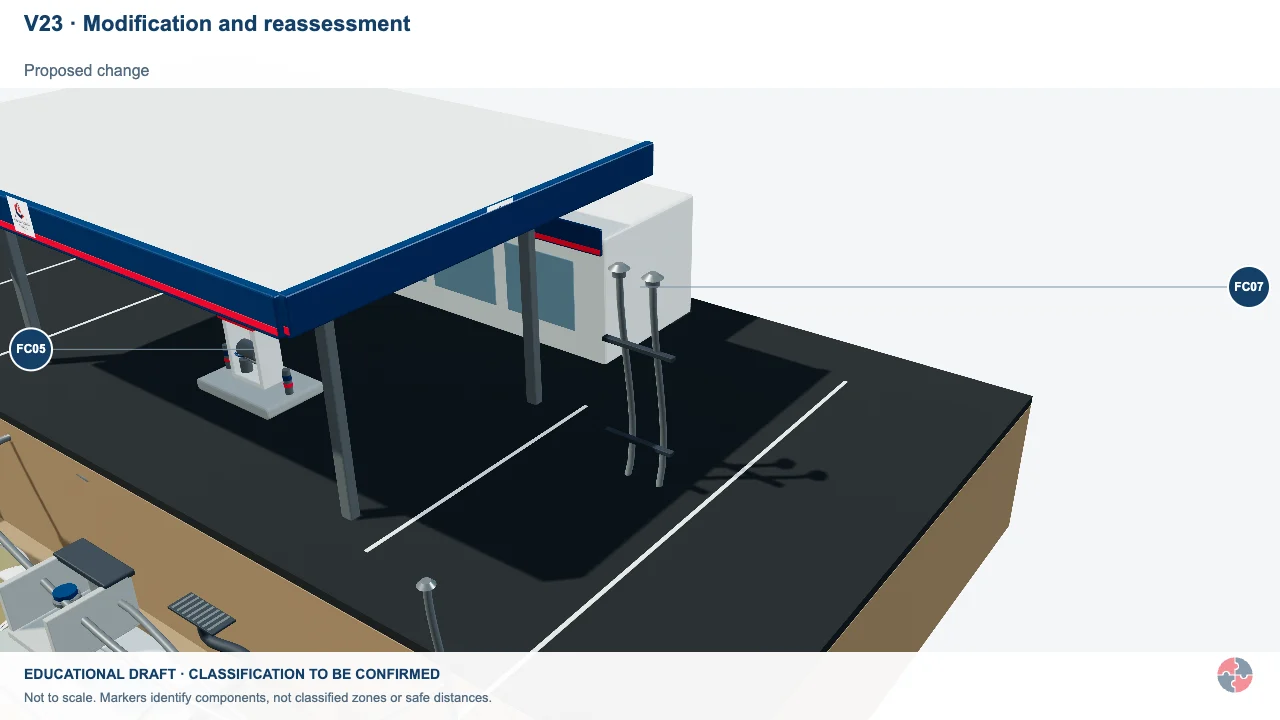
Modification and reassessment
Moving a dispenser or changing a vent can alter interfaces and the assumptions behind existing drawings.
Activity focus: Identify affected classification, equipment, drainage and operating records before accepting the proposed change.
Contextual workplace scene. Use the task, control and evidence checks in this section; appearance alone does not establish safe conditions, individual health or approval.
Educational illustration, not to scale. Coloured zones are teaching examples, not a site-specific hazardous-area classification.
What do the acronyms and key terms mean?
Use these terms to distinguish the law, the change process and the control method.
| Term | Full name | Meaning here |
|---|---|---|
| GB | Great Britain | Legal jurisdiction for the 1974 Act and GB regulations. Health and Safety at Work etc. Act 1974 |
| NI | Northern Ireland | Separate legal jurisdiction and HSENI regulator route. Health and Safety at Work (Northern Ireland) Order 1978 |
| MOC | Management of change | Screen, assess, approve, implement, verify and review a changed state. HSE organisational change and major accident hazards |
| CDM | Construction (Design and Management) | GB 2015 and NI 2016 construction regulations are separate. Construction (Design and Management) Regulations 2015; Construction (Design and Management) Regulations (NI) 2016 |
| PPE | Personal protective equipment | Residual protection after stronger controls. HSE managing risk using PPE |
| RACI | Responsible, Accountable, Consulted, Informed | Optional role-mapping method; does not transfer legal duties. |
| ERICPD | Eliminate, Reduce, Isolate, Control, PPE, Discipline | A control-selection aid; sustain controls through supervision, maintenance and learning. It creates no separate legal duty. |
Which Crownway Fuels documents support this topic?
Open an editable document, read the preview, or find its place in the Crownway hierarchy. 8 resources relate to this page.
Fictional Crownway Fuels examples for English forecourts, with a separate illustrative bulk terminal. Check site applicability, permissions and actual controls before adapting any document for use.
Management of change and project design policy (8)
- Management of change and project design policy (CWF-POL-MOC · Completed fictional example)
Set company expectations, responsibilities and resources for management of change and project design.
Read preview · Download DOCX · Show in hierarchy - Management of change and project design procedure (CWF-PRO-MOC · Completed fictional example)
Explain who does what, in what sequence, the control rationale, evidence, escalation and safe restart conditions.
Read preview · Download DOCX · Show in hierarchy - Technical organisational and temporary change assessment (CWF-FRM-MOC-01 · Blank editable master)
Provide the site/task-specific technical organisational and temporary change assessment and retain its controlled output.
Read preview · Download DOCX · Show in hierarchy - Change actions and temporary change expiry register (CWF-REG-MOC-01 · Blank register with separate fictional worked entries)
Provide the site/task-specific change actions and temporary change expiry register and retain its controlled output.
Read preview · Download XLSX · Show in hierarchy - Design review and hazard study screen (CWF-CHK-MOC-01 · Blank editable master)
Provide the site/task-specific design review and hazard study screen and retain its controlled output.
Read preview · Download DOCX · Download PDF · Show in hierarchy - Construction and maintenance project CDM arrangements (CWF-PLN-MOC-01 · Completed fictional example)
Provide the site/task-specific construction and maintenance project cdm arrangements and retain its controlled output.
Read preview · Download DOCX · Show in hierarchy - Pre startup safety and environmental review (CWF-CHK-MOC-02 · Blank editable master)
Provide the site/task-specific pre startup safety and environmental review and retain its controlled output.
Read preview · Download DOCX · Download PDF · Show in hierarchy - Decommissioning closure and contaminated land review (CWF-FRM-MOC-02 · Blank editable master)
Provide the site/task-specific decommissioning closure and contaminated land review and retain its controlled output.
Read preview · Download DOCX · Show in hierarchy
Unlock another resource
You have used this month’s two free downloads. Publish a post in your own words to unlock one more resource, or choose SHARE Individual for 10 downloads per month.
You decide whether to share. If you do, use the relevant platform disclosure tools and do not make claims you do not genuinely hold.