SHARE Knowledge Hub
Demolition and dismantling safety
Demolition changes a structure’s load paths while workers, neighbours and the public may be close to falling material, unstable parts and hidden services. Safe work starts with competent surveys, a structure-specific method and sequence, controlled exclusion zones and hold points as the building changes. Asbestos and other health hazards must be assessed before disturbance, with GB or Northern Ireland construction duties applied to the site.
Understanding Demolition and dismantling safety
Demolition is a high-consequence construction activity involving the planned dismantling, structural alteration or removal of buildings and structures. It combines foreseeable collapse, falling-material, work-at-height, plant, energy, fire, dust, asbestos, silica, noise, vibration, transport and public-interface hazards. Harm can be immediate and catastrophic or long-latency. Safe work depends on a competent survey, an engineered method and sequence, stable temporary conditions, changing exclusion zones, capable supervision and reliable recovery arrangements.
Why this matters at work
Work at height means work in a place where, without precautions, a person could fall a distance liable to cause personal injury. Collective protection protects more than one person without individual action; personal protection depends on the user. Restraint prevents access to a fall position; fall arrest stops a fall after it begins. A fragile surface cannot safely support foreseeable loads.
Critical controls deserve direct verification: edge protection and rescue, scaffold ties and loading, demolition sequence and stability, plant stand-off, excavation support and inspection, service isolation and dust capture. Define owner, performance standard, check frequency and response to failure. Leading indicators should measure control health, not just attendance or injury absence.
How organisations manage this in practice
Audit should test whether design, planning and field conditions form one coherent system. Sample a significant risk from PCI through design decision, CPP, RAMS, permit, briefing, physical control, inspection and change. Interview workers and observe work across shifts. Volume of paperwork is not evidence of effectiveness.
Close corrective actions only when the physical or systemic risk reduction is verified. Trend repeat defects, unauthorised changes, overdue inspections, weak handovers and worker concerns. Management review should fund redesign where behavioural reminders repeatedly fail.
E allocate competent person; R limit task; I supervised zone; C instruction / demonstration / check; P correct PPE; D Task supervisor verifies instruction / demonstration / check before release and after change; stop, coach and reassess capability.
Verification should follow a control into the field: identify its owner, design or performance requirement, current status, evidence, defect route and restart authority. A scaffold tag, signed RAMS sheet or permit does not alone prove stability, isolation, exposure control or competence. Check whether the physical barrier remains effective after the last removal, weather event, shift change or adjacent task.
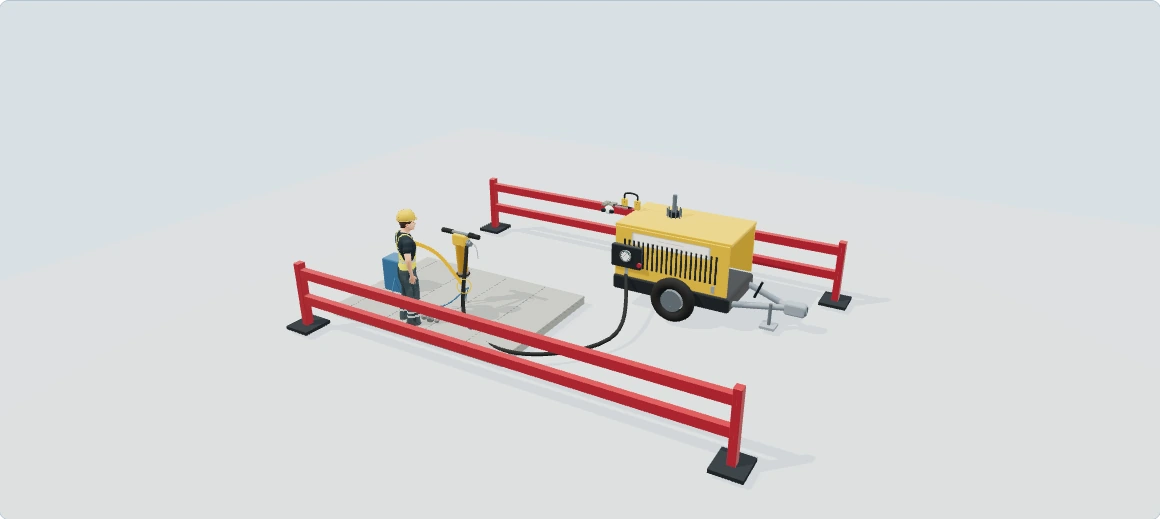

Pneumatic breaking: vibration, stored air and the people nearby
Explore how this equipment can harm its users and other people, then follow the practical measures that interrupt each pathway. This is a hazards and good-practice lesson; the separate checklist remains the pre-use/safety-check activity.
Hazards and good practice: learn what can hurt people during use, change and maintenance. Pre-use and safety checks stay in the separate checklist.
Checksheets and risk assessments
Equipment checksheets
Risk assessment forms
- Hand-arm vibration task/exposure assessment · Word
- Task and personal noise-exposure assessment · Word
Risk assessment examples
Forms and tools
Full written walkthrough — all 8 steps
1. Remove or redesign the breaking task
What is happening: The breaker, hose and compressor form one work system; the tool is shown stationary.
How harm can occur: Breaking can expose the operator to vibration, flying material, dust and high effort.
Best practice to apply: Consider design changes, prefabrication or a suitable mechanised/remote method before selecting a hand-held tool.
Why this works: Removing hand-held breaking can prevent transmission through the hands instead of only rationing exposure.
Vibration at Work · What is hand-arm vibration and whole-body vibration?2. Trace vibration into the hands
What is happening: The handle is the interface where mechanical vibration reaches the user during contact.
How harm can occur: Repeated exposure can damage blood vessels, nerves, muscles and joints; early symptoms may be overlooked.
Best practice to apply: Select a suitable productive lower-vibration method and tool, then assess the actual hand-contact exposure.
Why this works: Lower transmission and shorter productive contact reduce the exposure pathway; the animation is not a vibration measurement.
Vibration at Work · How can hand-arm vibration affect blood flow, sensation and everyday hand function?3. Understand trigger time and the full day
What is happening: Actual contact with a vibrating tool differs from the length of the booking or shift.
How harm can occur: Under-counted bursts and other tools can leave cumulative exposure unmanaged.
Best practice to apply: Observe representative work, include every relevant tool and task, and use suitable data and work-pattern information.
Why this works: A whole-day picture prevents a short-looking individual job concealing a larger combined exposure.
Vibration at Work · How do HAV trigger time and points work?4. Keep the tool working efficiently
What is happening: Bit condition, lubrication, handle isolation and the material affect the effort and time required.
How harm can occur: A blunt bit or defective mounting can increase vibration, force and duration.
Best practice to apply: Maintain the tool and consumables for the material; stop for abnormal vibration and verify repairs before return.
Why this works: An efficient maintained tool avoids prolonged contact and avoids treating job rotation as the main control.
Vibration at Work · What is hand-arm vibration and whole-body vibration?5. Control compressed-air release
What is happening: The hose and coupling contain energy independently of the operator's trigger position.
How harm can occur: A failed connection or released hose can whip, strike or inject material; trapped air may remain after shutdown.
Best practice to apply: Use the specified hose, connections and restraint arrangements; isolate and release stored pressure by the actual procedure before disconnection.
Why this works: Removing the energy before opening the connection addresses the release mechanism directly.
Vibration at Work · How is a defensible vibration assessment made?6. Protect the surrounding work area
What is happening: The compressor and breaking point also affect people who are not holding the tool.
How harm can occur: Noise, exhaust, dust, flying fragments and trailing hoses can harm nearby trades and passers-by.
Best practice to apply: Provide suitable ventilation, source controls, separation, route management and substance-specific precautions.
Why this works: The task boundary must include bystanders and the compressor, not only the tool user's hands.
Vibration at Work · What is hand-arm vibration and whole-body vibration?7. Act on symptoms and changed work
What is happening: Changes in grip, difficulty, numbness or tingling need a response rather than normalisation.
How harm can occur: Continued exposure can worsen injury and make a worker less able to control the task.
Best practice to apply: Report symptoms promptly and use occupational-health and exposure-review arrangements; do not diagnose HAVS from this model.
Why this works: Early reporting can trigger preventive changes before more harm occurs; gloves are not a substitute for vibration control.
Vibration at Work · When is health surveillance needed?8. Separate servicing from production
What is happening: Maintenance can expose stored air, hot parts and components held under load.
How harm can occur: Unexpected operation or energy release can injure the fitter and the next user.
Best practice to apply: Use competent task-specific shutdown, isolation and maintenance; update the equipment/exposure information after material changes.
Why this works: A repair needs a verified return to work, not only a closed defect record.
Vibration at Work · What evidence should management sample?
Illustrative awareness learning. Geometry, colours and movement do not establish safe distances, capacity, exposure, isolation or work permission. Use the actual assessment, equipment information and competent arrangements.
The wider workplace has its own account and subscription access. Exploring this lesson does not grant access, record course completion or authorise work.
UK guidance for further reading
HSE: Pneumatic breakingHow can I practise this topic in 3D?
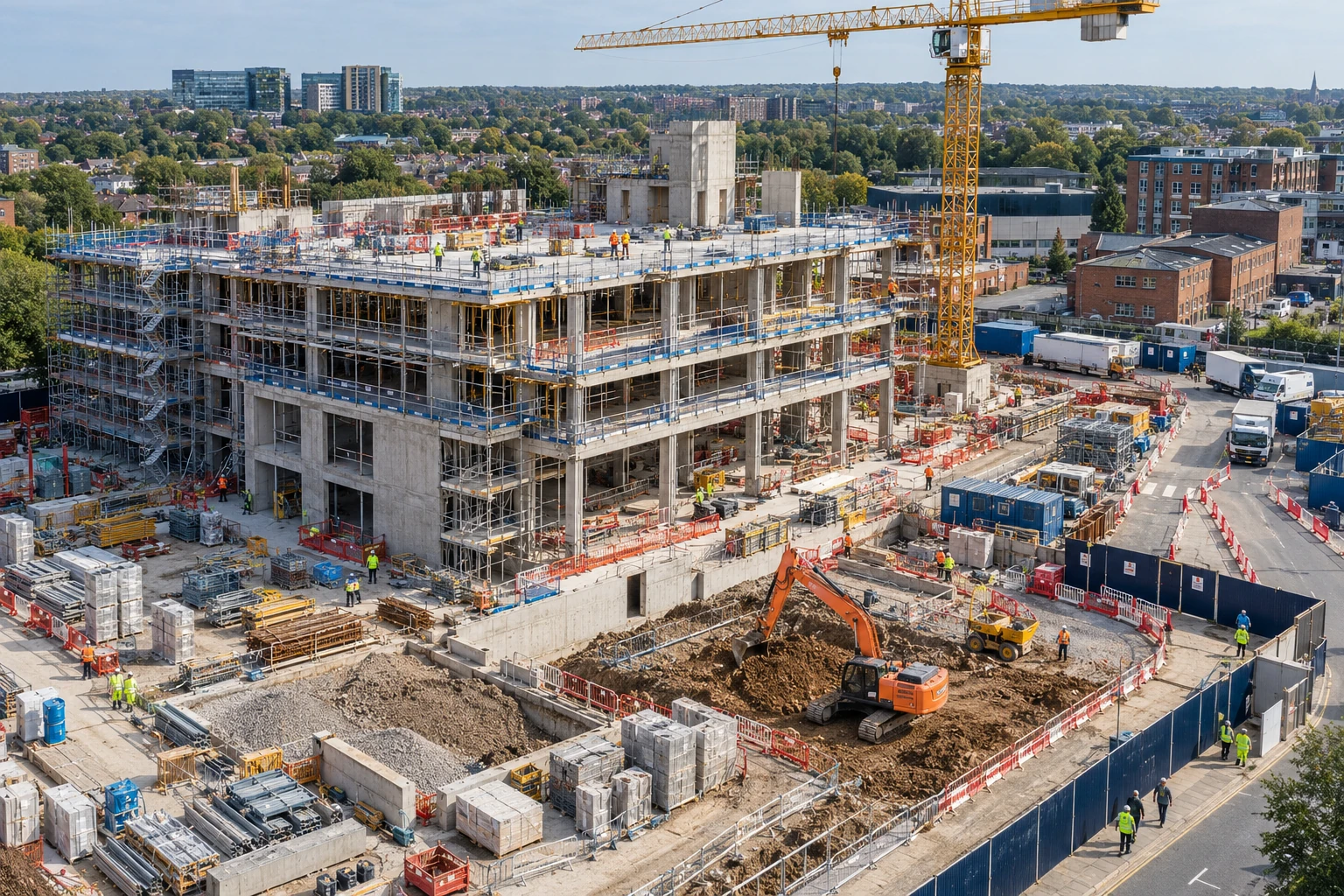
A battered excavation has softened after rain
All related inspection points 3 across 1 location
Construction site 3 inspection points
Practice in the SHAREhub environment. Browser practice is separate from workplace competence and formal learning records.
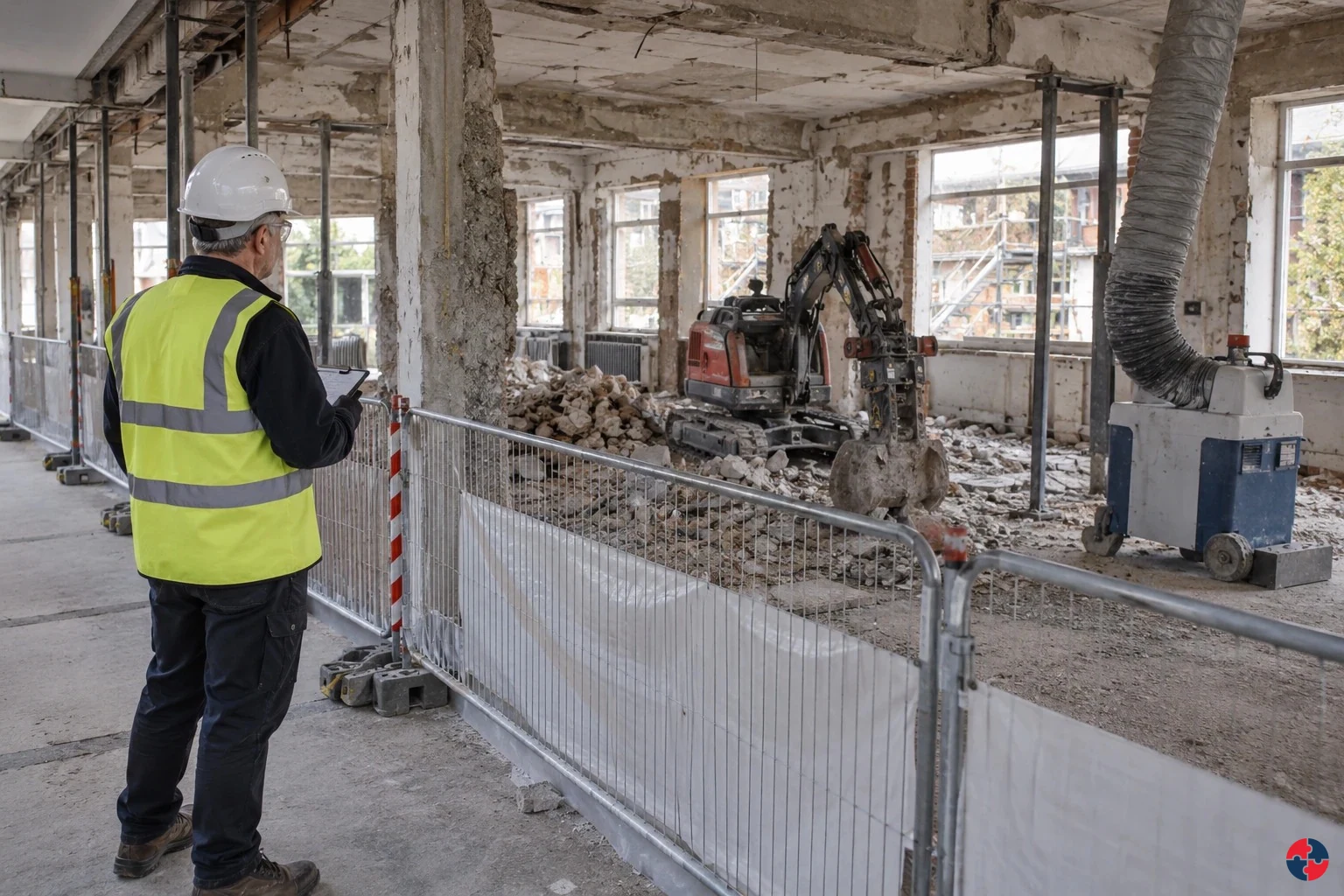
Make demolition pre-start and change holds explicit
Check the structural information, services, health hazards, sequence and public protection before disturbance. An unexpected alteration reopens the competent planning decision; access scaffold is not proof that structural support is adequate.
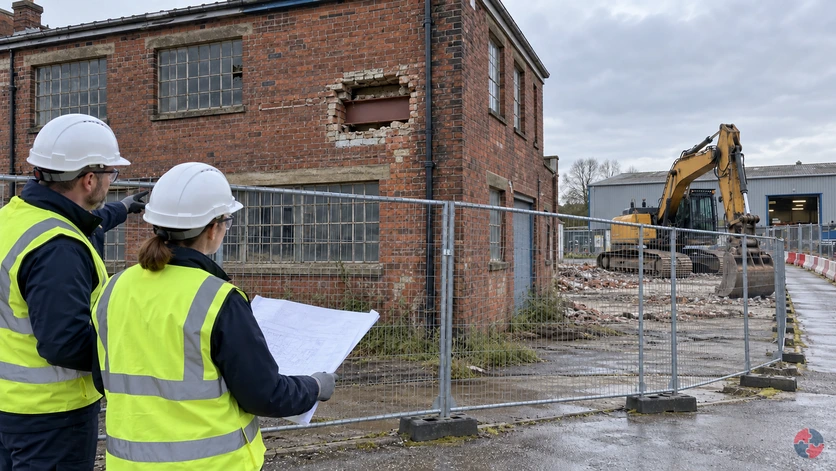
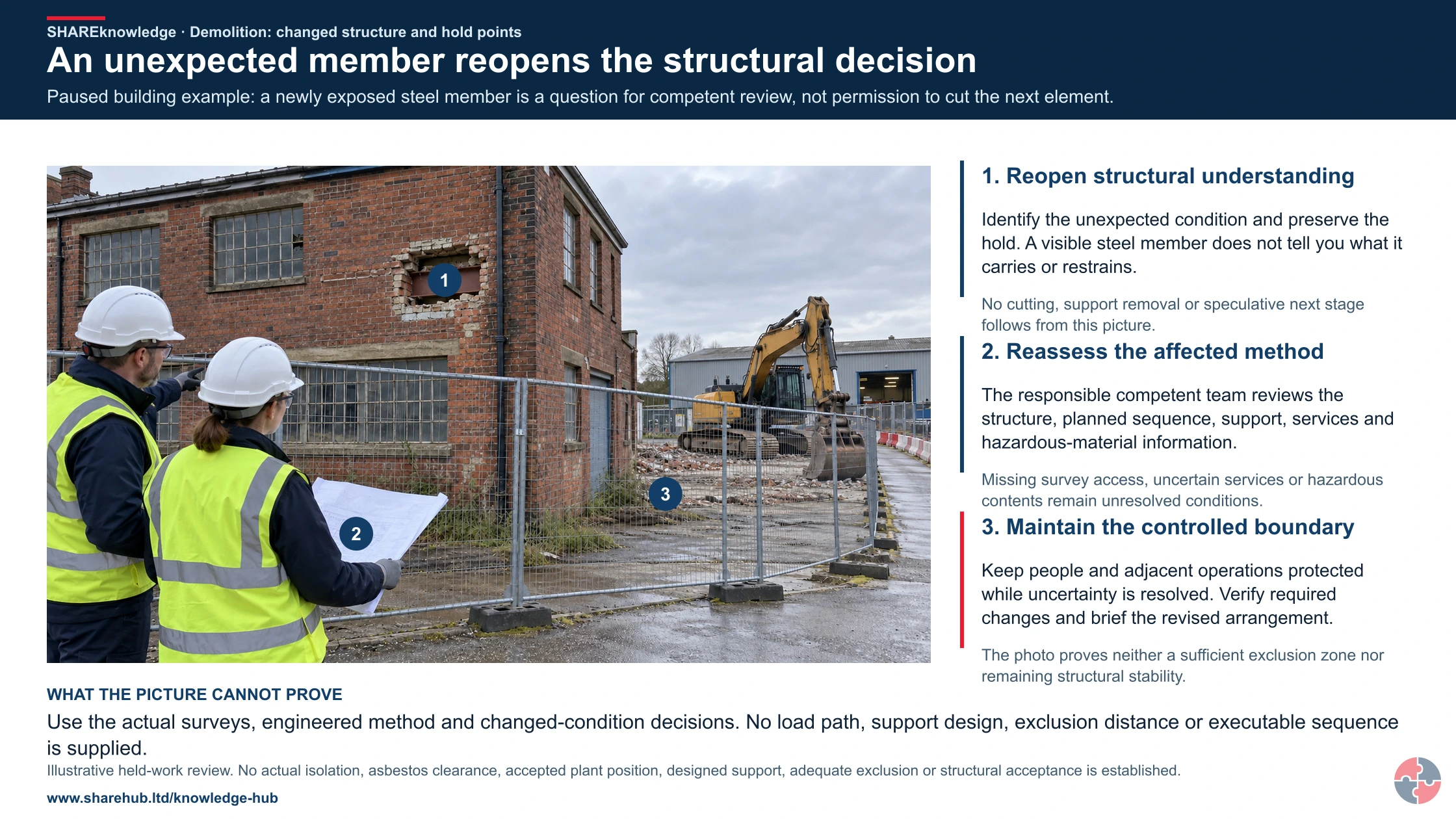
An unexpected member reopens the structural decision
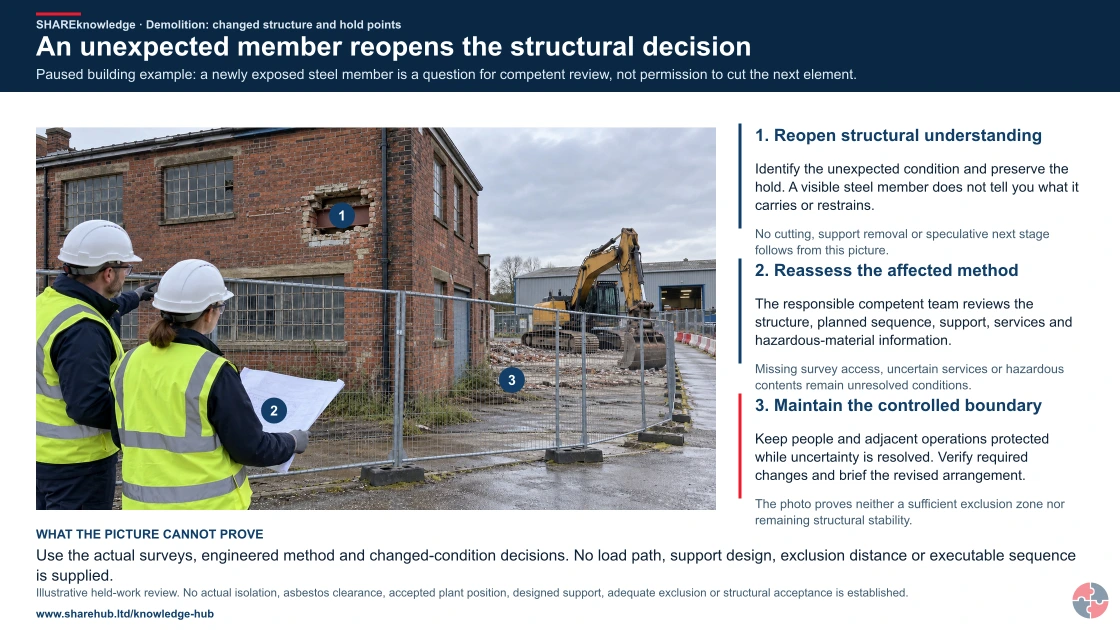
Full written explanation
Paused building example: a newly exposed steel member is a question for competent review, not permission to cut the next element.
- Reopen structural understanding. Identify the unexpected condition and preserve the hold. A visible steel member does not tell you what it carries or restrains.
- Reassess the affected method. The responsible competent team reviews the structure, planned sequence, support, services and hazardous-material information.
- Maintain the controlled boundary. Keep people and adjacent operations protected while uncertainty is resolved. Verify required changes and brief the revised arrangement.
Change the pathway
- Do not remove to investigate. No cutting, support removal or speculative next stage follows from this picture.
- Check limits of the information. Missing survey access, uncertain services or hazardous contents remain unresolved conditions.
- A fence is not an engineered answer. The photo proves neither a sufficient exclusion zone nor remaining structural stability.
Evidence check: Use the actual surveys, engineered method and changed-condition decisions. No load path, support design, exclusion distance or executable sequence is supplied.
Full separate GB/NI demolition and other task-specific duties
Primary references: HSE: structural stability and competent temporary-works decisions (GB) · HSE: demolition planning (GB)
Open the complete HD image (new tab)Download image
Full separate GB/NI demolition and other task-specific duties
Primary references: HSE: structural stability and competent temporary-works decisions (GB) · HSE: demolition planning (GB)
Best-practice guide: Demolition and dismantling safety
Make demolition pre-start and change holds explicit
Check the structural information, services, health hazards, sequence and public protection before disturbance. An unexpected alteration reopens the competent planning decision; access scaffold is not proof that structural support is adequate. Demolition changes a structure’s load paths while workers, neighbours and the public may be close to falling material, unstable parts and hidden services.
Turn demolition and dismantling safety knowledge into a decision
Demolition changes a structure’s load paths while workers, neighbours and the public may be close to falling material, unstable parts and hidden services. Safe work starts with competent surveys, a structure-specific method and sequence, controlled exclusion zones and hold points as the building changes. Keep the structural and asbestos survey versions and limitations, service isolation evidence, engineer design/check record, temporary-works inspection, daily briefing, boundary and dust checks, stopped-work record, changed-sequence approval, waste records and residual-risk hand-back.
Worked example: a changed masonry-wing sequence
During top-down removal, an unexpected steel member appears behind masonry. The machine operator and banksman stop; the supervisor keeps the exclusion zone and records the find. After the stage, the supervisor and engineer check remaining stability and temporary works, remove debris through the planned route and confirm public/occupant protection before reopening access.
Demolition hazard map
Uncontrolled collapse: Structure loses stability or support unexpectedly. Falls and falling objects: People or materials fall from height or through fragile surfaces. Plant and vehicles: Collision, overturn, crush, blind spots or unstable platforms.
Choose controls for demolition and dismantling safety
Eliminate: Retain a sound wall or redesign the extension to avoid dismantling a load-bearing bay when the design outcome allows it. Reduce: Choose a staged dismantling method with smaller elements rather than uncontrolled collapse, after checking temporary loads and plant reach. Isolate: Install designed temporary works and a physical exclusion boundary that separates workers and public from the collapse and falling-material zone. Control: Use the approved plant, service isolations, dust capture and monitored sequence; permits and briefings support, rather than replace, structural controls. PPE: Provide task-specific head, eye, hearing and respiratory protection after dust, falling-object and collapse routes are controlled at source. Read the full control table for qualifications, ownership and verification. Use the actual task and applicable jurisdiction; existing technical approval remains unchanged.
Use the full demolition and dismantling safety lesson
Use the full topic for the decision points, practical examples, detailed control tables and source scope. HSE guidance applies to Great Britain; use HSENI for the Northern Ireland route and the source’s stated jurisdiction. A simplified guide does not change the page’s technical-review or approval status.

Read all six steps as text
1. Make demolition pre-start and change holds explicit
Check the structural information, services, health hazards, sequence and public protection before disturbance.
- Avoid / redesign: Retain a sound wall or redesign the extension to avoid dismantling a load-bearing bay when the design outcome allows it.
- Control the task: Install designed temporary works and a physical exclusion boundary that separates workers and public from the collapse and falling-material zone.
- Verify before release: Client and structural designer confirm feasibility against current survey; do not remove a support simply because the original drawing suggests it is redundant.
Check the structural information, services, health hazards, sequence and public protection before disturbance. An unexpected alteration reopens the competent planning decision; access scaffold is not proof that structural support is adequate. Demolition changes a structure’s load paths while workers, neighbours and the public may be close to falling material, unstable parts and hidden services.
Apply it: Which part of this plan would you check at the workface before authorising the task?
2. Turn demolition and dismantling safety knowledge into a decision
Use the evidence to improve the actual work arrangement.
- Change at source: Retain a sound wall or redesign the extension to avoid dismantling a load-bearing bay when the design outcome allows it.
- Make it observable: Client and structural designer confirm feasibility against current survey; do not remove a support simply because the original drawing suggests it is redundant.
- Keep useful evidence: Keep the structural and asbestos survey versions and limitations, service isolation evidence, engineer design/check record, temporary-works inspection, daily briefing, boundary and dust checks, stopped-work record, changed-sequence approval, waste records and residual-risk hand-back.
Demolition changes a structure’s load paths while workers, neighbours and the public may be close to falling material, unstable parts and hidden services. Safe work starts with competent surveys, a structure-specific method and sequence, controlled exclusion zones and hold points as the building changes. Keep the structural and asbestos survey versions and limitations, service isolation evidence, engineer design/check record, temporary-works inspection, daily briefing, boundary and dust checks, stopped-work record, changed-sequence approval, waste records and residual-risk hand-back.
Apply it: What evidence would show that the change improves this task, rather than only completing a record?
3. Worked example: a changed masonry-wing sequence
Example: a practical application of the existing topic lesson.
- Setting: the site team commissions dismantling of a two-storey masonry wing adjoining an occupied workshop and a public footpath.
- Act: Before soft strip and each structural stage, the team confirms service isolation at the workface, asbestos clearance or a hold for inaccessible areas, load paths, support installation and inspection, plant bearing and reach, debris capacity, weather and barriers.
- Hold / review: Hold for concealed members, unexpected movement or cracking, loss of support, debris overload, service uncertainty, asbestos outside the survey, failed dust control or a breached public boundary.
During top-down removal, an unexpected steel member appears behind masonry. The machine operator and banksman stop; the supervisor keeps the exclusion zone and records the find. After the stage, the supervisor and engineer check remaining stability and temporary works, remove debris through the planned route and confirm public/occupant protection before reopening access.
Apply it: At which point would you hold this example, and what evidence would allow it to proceed?
4. Demolition hazard map
Connect the task, the route to the person and the control that can fail.
- Uncontrolled collapse: Structure loses stability or support unexpectedly.
- Falls and falling objects: People or materials fall from height or through fragile surfaces.
- Plant and vehicles: Collision, overturn, crush, blind spots or unstable platforms.
Uncontrolled collapse: Structure loses stability or support unexpectedly. Falls and falling objects: People or materials fall from height or through fragile surfaces. Plant and vehicles: Collision, overturn, crush, blind spots or unstable platforms.
Apply it: Who could be exposed, including other trades, cleaners, maintainers and people nearby?
5. Choose controls for demolition and dismantling safety
Start with the stronger practicable options and verify their effect.
- Eliminate: Retain a sound wall or redesign the extension to avoid dismantling a load-bearing bay when the design outcome allows it.
- Reduce: Choose a staged dismantling method with smaller elements rather than uncontrolled collapse, after checking temporary loads and plant reach.
- Isolate: Install designed temporary works and a physical exclusion boundary that separates workers and public from the collapse and falling-material zone.
- Control: Use the approved plant, service isolations, dust capture and monitored sequence; permits and briefings support, rather than replace, structural controls.
- PPE: Provide task-specific head, eye, hearing and respiratory protection after dust, falling-object and collapse routes are controlled at source.
Eliminate: Retain a sound wall or redesign the extension to avoid dismantling a load-bearing bay when the design outcome allows it. Reduce: Choose a staged dismantling method with smaller elements rather than uncontrolled collapse, after checking temporary loads and plant reach. Isolate: Install designed temporary works and a physical exclusion boundary that separates workers and public from the collapse and falling-material zone. Control: Use the approved plant, service isolations, dust capture and monitored sequence; permits and briefings support, rather than replace, structural controls. PPE: Provide task-specific head, eye, hearing and respiratory protection after dust, falling-object and collapse routes are controlled at source. Read the full control table for qualifications, ownership and verification. Use the actual task and applicable jurisdiction; existing technical approval remains unchanged.
Apply it: Which stronger option can be used here, and who will verify it before accepting the remaining risk?
6. Use the full demolition and dismantling safety lesson
Follow the official sources below and retain the task-specific evidence.
- Official guidance: Construction (Design and Management) Regulations 2015
- Official guidance: Construction (Design and Management) Regulations (Northern Ireland) 2016
- Task decision: Keep the structural and asbestos survey versions and limitations, service isolation evidence, engineer design/check record, temporary-works inspection, daily briefing, boundary and dust checks, stopped-work record, changed-sequence approval, waste records and residual-risk hand-back.
Use the full topic for the decision points, practical examples, detailed control tables and source scope. HSE guidance applies to Great Britain; use HSENI for the Northern Ireland route and the source’s stated jurisdiction. A simplified guide does not change the page’s technical-review or approval status.
Apply it: Which official source and full-topic section will you use to resolve the next decision?
An undocumented opening appears
Illustrative example. The team discovers a structural alteration absent from the refurbishment information.
Decision. Stop the affected sequence, secure the area and obtain competent review before revising the method.
Evidence to check. Updated structural information, stability arrangements, revised sequence and communicated release decision.
Hold or escalation point. Keep work held while the load path, stability or exclusion arrangements are uncertain.
Follow-up. Update the plan and brief everyone affected before the authorised restart.
Check the changing load path and occupied boundary
A demolition stage can affect adjoining structures, debris loading and public access. A changed condition returns to competent review rather than an assumed next step.
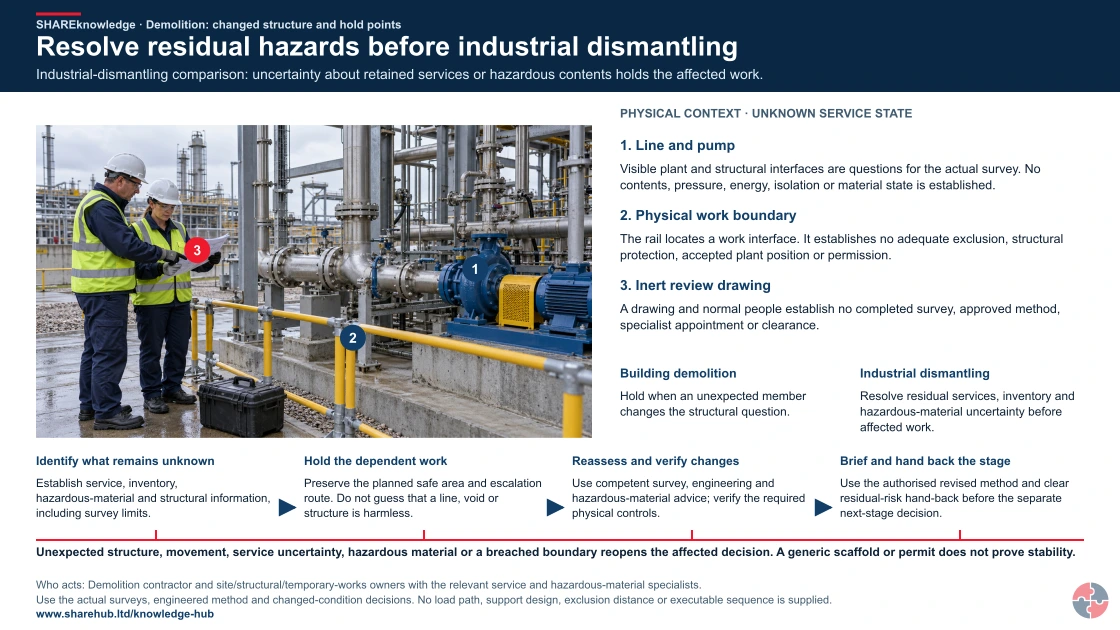
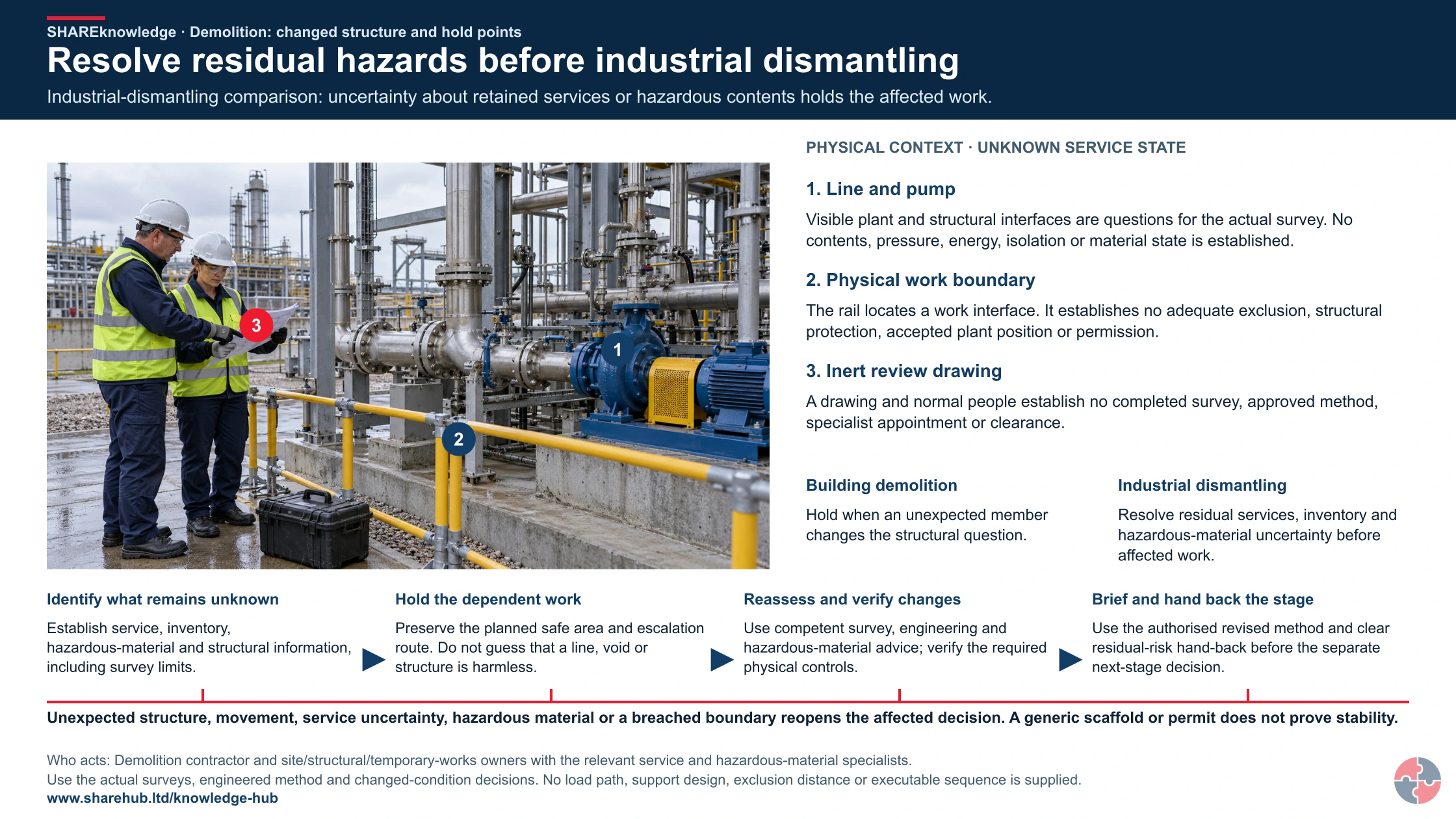
Resolve residual hazards before industrial dismantling
Full written explanation
An illustrative stationary industrial plant workface shows line, pump, flanges and structural interfaces, a physical work boundary and normal uninjured people reviewing an inert drawing outside it. Picture key: 1 identifies the line and pump; 2 identifies the physical work boundary; 3 identifies the inert review drawing. The equipment locates questions about retained services, inventory, hazardous materials and structure; the photograph does not establish that this plant is being dismantled or has been decommissioned. It supplies no contents, residue, pressure, energy, isolation, asbestos, material, flow, valve-state, structural-stability, support, exclusion-adequacy, accepted-plant, PPE, clearance or work-permission finding. The people and papers establish no professional appointment or verified survey or method. A complete single left-to-right native band retains four full source checks and three genuine forward relationships: identify what remains unknown; hold the dependent work; reassess and verify changes; brief and hand back the stage. Their headings are unnumbered and separate from the literal physical picture key. Each check also connects to the common unarrowed unresolved-condition hold; no automatic next-stage clearance follows from a paper, permit, rail or rendered scene. The full hold, responsible roles, evidence limitation and both building-demolition and industrial-dismantling cases accompany the review. No touching, opening, draining, cleaning, testing, sampling, line breaking, hot work, cutting, support removal, dismantling, lifting, dust release, rescue or operating recipe is shown or supplied. Use the actual surveys, engineered method, competent service and hazardous-material advice and changed-condition decisions. No load path, temporary-support design, exclusion distance or executable sequence is supplied. The full topic retains its separate GB and NI demolition, asbestos, hazardous-substance, height, equipment, lifting and other source qualifications, emergency and privacy boundaries.
Industrial-dismantling comparison: uncertainty about retained services or hazardous contents holds the affected work.
- Identify what remains unknown. Establish service, inventory, hazardous-material and structural information, including survey limits.
- Hold the dependent work. Preserve the planned safe area and escalation route. Do not guess that a line, void or structure is harmless.
- Reassess and verify changes. Use competent survey, engineering and hazardous-material advice; verify the required physical controls.
- Brief and hand back the stage. Use the authorised revised method and clear residual-risk hand-back before the separate next-stage decision.
When the evidence does not fit: Unexpected structure, movement, service uncertainty, hazardous material or a breached boundary reopens the affected decision. A generic scaffold or permit does not prove stability.
Who acts: Demolition contractor and site/structural/temporary-works owners with the relevant service and hazardous-material specialists.
Changed workplace
Building demolition: Hold when an unexpected member changes the structural question.
Industrial dismantling: Resolve residual services, inventory and hazardous-material uncertainty before affected work.
Evidence check: Use the actual surveys, engineered method and changed-condition decisions. No load path, support design, exclusion distance or executable sequence is supplied.
Full separate GB/NI demolition and other task-specific duties
Primary references: HSE: structural stability and competent temporary-works decisions (GB) · HSE: demolition planning (GB)
Open the complete HD image (new tab)Download image
Full separate GB/NI demolition and other task-specific duties
Primary references: HSE: structural stability and competent temporary-works decisions (GB) · HSE: demolition planning (GB)

Current information
Use an appropriate current survey and identify uncertain structure, services and adjoining occupation.
Designed controls
Coordinate the designed support, debris/loading controls, exclusion and public boundary for the planned work.
Change gate
Hold affected work after an unexpected condition and obtain the competent reassessment and verified next-stage decision.
The scene is not an executable dismantling sequence or temporary-support design.
What are the key points about demolition safety?
Demolition safety depends on knowing the structure, choosing the right sequence and controlling change as the building becomes less stable.
Plan before breaking
The work should be surveyed, engineered and sequenced before demolition begins.
Structure comes first
Load paths, weaknesses, previous alterations, temporary supports and debris loading must be understood.
Hazardous materials are expected
Asbestos, lead paint, silica, contaminated dust, chemicals, sharps and biological contamination may be hidden.
Services must be proven dead or controlled
Gas, electricity, water, telecoms, drains and buried services need positive identification and isolation.
Public protection is a design issue
Hoarding, exclusion zones, pavement/road interfaces and falling-material controls must reflect the collapse radius and method.
PPE supports the method
Respiratory protection, head protection and other PPE are important, but they do not replace engineering and sequencing.
What is demolition and why is it different from ordinary construction?
Demolition is construction in reverse, but with more uncertainty because the structure and hidden hazards may not behave as expected.
A new structure is built from known design information. Demolition often deals with old drawings, missing records, hidden alterations, unknown load paths, deterioration, fire damage, water ingress, previous structural changes and materials concealed inside walls, floors, roofs or ground. That uncertainty makes survey and assessment critical. Structural-risk guidance: HSE - Structural stability during alteration, demolition and dismantling.
Demolition also changes the risk every day. Removing one wall, floor, beam or roof section can change the stability of the remaining structure. Plant operating on floors can overload them. Debris can build up and add unexpected load. Scaffolds, sheeting and temporary works can become unsafe if they are not adapted as the structure comes down.
A good demolition plan is therefore dynamic. It describes the intended sequence, inspection points, hold points, temporary supports, exclusion zones, public interface, health controls and what must happen if the real structure does not match the assumptions.
| Element | What it means | Why it matters |
|---|---|---|
| Pre-construction information | Known information about the structure, services, hazards and environment. | Allows competent planning instead of discovery by accident. |
| Survey and assessment | Structural, asbestos, services and condition checks before intrusive work. | Identifies hidden hazards and stability risks. |
| Method and sequence | The controlled order of dismantling, support, removal and waste handling. | Prevents uncontrolled collapse and unsafe improvisation. |
| Temporary works | Designed support or protection during demolition. | Keeps remaining structure, plant platforms and public protection stable. |
| Live monitoring | Inspection and supervision as the structure changes. | Confirms assumptions remain valid and triggers stop-work if not. |
How should demolition be planned under CDM?
Demolition should be planned as a construction project with competent duty holders, adequate information and a written safe system of work.
CDM requires construction work, including demolition, to be planned, managed and monitored. The client must make suitable arrangements and provide relevant information. The principal designer and designers must consider risks during the pre-construction phase. The principal contractor must plan, manage, monitor and coordinate the construction phase. Contractors must plan, manage and monitor their own work and cooperate with others. GB and NI CDM project duties: Construction (Design and Management) Regulations 2015; Construction (Design and Management) Regulations (Northern Ireland) 2016.
The construction phase plan should not be a generic folder. It should explain the site-specific management arrangements, traffic routes, welfare, emergency arrangements, public protection, fire precautions, services, asbestos, waste routes, temporary works and high-risk activities.
For demolition, the method statement is often the heart of control. It should be written by competent people, reviewed by those who understand the structure and briefed to the people doing the work.
For Great Britain, HSE’s CDM dutyholder summary links principal designer and principal contractor appointments to projects involving more than one contractor. A single-contractor project still needs a construction phase plan, prepared by the contractor. Do not use a small project or a non-notifiable project as a reason to omit applicable CDM duties. Check the project arrangements before tender and again if another contractor becomes involved. Northern Ireland uses its own CDM 2016 instrument; the GB summary is not NI legal authority.
| Output | What it should cover |
|---|---|
| Pre-construction information | Structure, drawings, previous use, surveys, services, hazardous materials and constraints. |
| Construction phase plan | Site rules, management, welfare, emergency, traffic, fire, public interface and high-risk controls. |
| Demolition method statement | Sequence, plant, temporary works, exclusion zones, services, dust, noise, waste and hold points. |
| Temporary works register | Designs, checks, permits, inspections and modifications for supports, platforms and hoardings. |
| Risk register | Structural collapse, falls, plant, services, asbestos, silica, public interface and environmental releases. |
What surveys and information are needed before demolition?
Demolition should not start until the structure, services and hazardous materials have been competently investigated.
The survey stage should answer what is being demolished, how it is stable now, what has changed over its life, what services are present, what materials are hazardous and how nearby people or structures could be affected. Drawings help, but they are not enough on their own. The real building must be inspected.
Asbestos information is essential before intrusive demolition. A refurbishment and demolition asbestos survey is usually needed for areas that will be disturbed. Other hazards may include lead paint, silica-containing materials, timber treatments, contaminated land, chemicals, bird droppings, sharps, mould and fuel residues. Survey requirements and limitations: HSE refurbishment or demolition asbestos survey; HSENI asbestos surveys.
Service information should be gathered from utility providers, drawings, site scans, trial holes where needed and physical confirmation. A service marked on a drawing is not the same as a service safely isolated.
The client should provide a competent refurbishment or demolition asbestos survey and structural information before work starts. Inaccessible areas and assumptions in a survey are hold points: they must be resolved or managed as presumed hazards before intrusive work. An ordinary management asbestos survey is not a substitute for a demolition survey. GB HSE and NI HSENI give corresponding jurisdictional routes.
| Survey or check | What it should identify | Control outcome |
|---|---|---|
| Structural survey | Load paths, weaknesses, previous alterations, deterioration, party walls and nearby structures. | Safe sequence, temporary works and exclusion zones. |
| Asbestos survey | Asbestos-containing materials likely to be disturbed. | Removal plan, licensed work decision and waste route. |
| Services survey | Electricity, gas, water, telecoms, drainage and buried services. | Isolation, diversion, permits and service strike prevention. |
| Hazardous materials survey | Lead, silica, chemicals, contaminated dust, biological hazards and sharps. | COSHH controls, waste classification and hygiene. |
| Neighbour/interface review | Public roads, rail, water, occupied buildings, schools, hospitals or businesses. | Protection plan, communication and emergency arrangements. |
How should the demolition sequence be controlled?
The sequence should keep the remaining structure stable at every stage and define hold points before risk increases.
The safest demolition method depends on the structure, location and constraints. Options include soft strip, hand demolition, mechanical demolition, high-reach demolition, crane and lifting methods, dismantling, cut-and-lift, remote demolition, top-down methods or explosive demolition in specialist circumstances. Each method creates different hazards.
The sequence should explain what is removed first, what remains to support what, where debris goes, where plant stands, how people are excluded, when temporary works are installed or removed and what inspections are required before moving to the next stage.
If the structure behaves differently from the plan, work should stop. Cracking, movement, unexpected voids, hidden steel, water damage, missing ties or unusual vibration are not minor surprises; they may invalidate the method.
An engineer should connect each cut, lift or machine action to the remaining load path. If concealed steel, altered masonry, unexpected movement, excessive debris load or a changed plant position invalidates the method, workers should withdraw to the planned safe area and hold the next step until the competent method owner has reassessed it.
| Control point | Why it matters |
|---|---|
| Soft strip | Removes non-structural materials while preserving stability and identifying hidden hazards. |
| Top-down or staged demolition | Controls load paths and prevents undermining the remaining structure. |
| Debris management | Prevents overloading floors, scaffolds, platforms or exclusion zones. |
| Plant position | Ensures floors, ground bearing and working platforms can take the load. |
| Hold points | Require competent inspection before moving to a higher-risk stage. |
| Change control | Stops informal changes to sequence, plant, temporary works or exclusion zones. |
How is structural stability managed during demolition?
Structural stability is managed by competent assessment, designed temporary works, controlled loading and inspection as the structure changes.
HSE warns that alteration, demolition and dismantling work must be planned and carried out by competent people to avoid unplanned structural collapse. The assessment should consider age, previous use, construction type, nearby buildings, temporary bracing, cantilevers, hanging floors, reduced footprints and parts critical to stability. Structural-stability planning: HSE - Structural stability during alteration, demolition and dismantling.
Temporary supports, propping, bracing, facade retention, scaffold duties and working platforms should be designed by competent people and installed, inspected, maintained and dismantled in line with the design. Standard scaffolds should not be assumed to restrain a building, and sheeted scaffolds can increase wind loads.
Plant and debris loading are common weak points. A machine operating on a suspended slab, or debris stockpiled on an upper floor, can impose loads the structure was never assessed to take.
| Issue | Good control |
|---|---|
| Unknown load paths | Structural assessment, drawings review, intrusive investigation and engineer input. |
| Temporary support | Designed propping/bracing, checked installation and regular inspections. |
| Scaffold interface | Designed scaffold duty, tie strategy and demolish-and-strike sequence. |
| Plant on structures | Floor capacity assessment, working platform design and exclusion below. |
| Debris loading | Controlled removal, no uncontrolled stockpiling and frequent inspection. |
| Nearby structures | Party wall, vibration, undermining and public interface assessment. |
Which demolition hazards should be actively controlled?
Demolition hazards include collapse, falls, falling objects, plant, services, hazardous materials, dust, fire, noise, vibration and environmental harm.
The hazard list must be specific to the structure and method. A small internal strip-out has different risks from a city-centre high-reach demolition, a bridge dismantling project or a fire-damaged industrial building. The controls should be selected for the actual failure route.
Demolition often combines several hazards at once. Cutting steel at height can involve work at height, hot work, lifting, falling objects, fire, fumes, noise, vibration and collapse potential. Removing old plant can involve lifting, confined spaces, residual chemicals, asbestos gaskets, pressure systems and sharp edges.
Good supervision checks how these hazards interact, not just whether each has a separate risk assessment.
| Hazard | Failure route | Typical controls |
|---|---|---|
| Uncontrolled collapse | Structure loses stability or support unexpectedly. | Survey, sequence, temporary works, exclusion zones and hold points. |
| Falls and falling objects | People or materials fall from height or through fragile surfaces. | Edge protection, access design, drop zones and work-at-height planning. |
| Plant and vehicles | Collision, overturn, crush, blind spots or unstable platforms. | Traffic plan, segregation, banksmen, ground checks and maintenance. |
| Services | Strike or energised service causes fire, explosion, electrocution or flooding. | Utility plans, isolation certificates, CAT/Genny, permits and trial holes. |
| Hazardous materials | Asbestos, silica, lead, chemicals or biological contamination exposure. | Surveys, licensed removal, COSHH, wet methods, LEV/RPE and waste controls. |
| Fire and hot work | Ignition of waste, dust, gas, insulation, timber or residues. | Hot work permit, fire watch, isolation, extinguishers and housekeeping. |
| Public interface | Debris, dust, noise, plant or collapse affects neighbours or highways. | Hoarding, exclusion radius, traffic management and communication. |
How should workers and the public be protected during demolition?
Protection should be designed around the collapse zone, falling-object risk, site access and neighbouring land uses.
Demolition often happens in occupied streets, live industrial sites, schools, hospitals, retail areas or residential neighbourhoods. The public may be close to the work but unaware of the risk. Hoardings, exclusion zones and traffic plans should be based on foreseeable collapse, debris travel, plant slewing, delivery movements and emergency access.
Protecting workers and the public is not just fencing the site. It includes communication, signage, lighting, welfare, visitor control, delivery timing, dust monitoring, noise/vibration management, fire precautions, road closures where needed and arrangements for neighbouring businesses or residents.
In GB HSE demolition guidance, exclusion and debris zones depend on the method, available space and how far debris may travel, and may need to change as work progresses. A scaffold does not itself justify reducing the exclusion zone; using scaffold to support a structure requires a design for that purpose. If the assessed debris zone would extend into an occupied pavement, hold that stage and obtain the competent method/interface decision. A convenient fence line is not evidence that collapse or falling material will remain inside it. This is an illustrative GB planning decision; assess the NI method under the NI duties.
| Interface | Controls |
|---|---|
| Pedestrians | Hoardings, covered walkways, exclusion zones and footpath management. |
| Road users | Traffic management, delivery scheduling, vehicle marshals and road closure approvals where required. |
| Neighbours | Communication, noise/dust/vibration controls and complaint response. |
| Occupied premises | Isolation from work zone, emergency communication and service continuity plans. |
| Site workers | Induction, briefings, safe access, exclusion zones and welfare. |
How should plant, lifting and equipment be managed?
Plant and lifting operations should be selected for the demolition method, ground conditions, structure and exclusion zones.
Demolition plant includes excavators, high-reach machines, skid steers, crushers, MEWPs, cranes, telehandlers, attachments, breakers, shears and grabs. Each item must be suitable for the task, inspected and used by competent operators. The attachment can change the machine's stability, reach, weight and risk profile.
Ground bearing and working platforms are critical. Demolition sites may have voids, basements, cellars, buried tanks, made ground, rubble, ducts or weakened slabs. A machine can become a collapse load if its operating platform has not been assessed.
Lifting operations in demolition may involve cut-and-lift sections, plant removal, steelwork, façade elements or temporary works. These should be planned under LOLER with appropriate lifting plans, exclusion zones and communication.
| Area | Control |
|---|---|
| Machine selection | Match reach, attachment, capacity, guarding and stability to the method. |
| Ground/platform | Assess bearing capacity, voids, basements, edges and working platform design. |
| Operator competence | Use trained, authorised operators briefed on the demolition sequence. |
| Attachments | Check compatibility, inspection, maintenance and operating limits. |
| Lifting | Plan lifts, define exclusion zones, inspect lifting accessories and control communication. |
| Maintenance | Inspect and maintain plant; act on defects before use. |
Which health risks are common in demolition?
Demolition health risks often come from dust, asbestos, lead, noise, vibration, manual handling, contaminated materials and stress from high-risk work.
Health risks can be less visible than falling debris but just as serious. Demolition can release respirable crystalline silica from concrete, brick and mortar; asbestos from older buildings; lead from paint; wood dust; cement dust; diesel exhaust; mould; bird droppings; chemical residues; and contaminated land dust.
Control should prioritise removal of hazardous materials before demolition, wet methods, on-tool extraction, segregation, cleaning, suitable respiratory protective equipment, face-fit testing, welfare and health surveillance where required. Dry sweeping and uncontrolled breaking of dusty materials should be challenged.
Noise and vibration also require planning. Breaking, crushing, cutting and plant operation can expose workers and neighbours. Controls include method selection, low-vibration tools, maintenance, exposure planning, hearing protection zones and monitoring.
| Risk | Controls |
|---|---|
| Asbestos | Competent survey, removal plan, licensed/non-licensed decision, waste controls and clearance where required. |
| Silica and construction dust | Avoid cutting, use wet suppression, extraction, segregation, RPE and cleaning controls. |
| Lead and coatings | Survey, safe removal method, hygiene, exposure monitoring and waste classification. |
| Noise | Low-noise methods, exclusion zones, hearing protection, maintenance and exposure management. |
| Vibration | Method selection, tool choice, exposure limits, rotation and health surveillance where relevant. |
| Manual handling | Mechanical aids, smaller sections, lifting plans, team handling and layout planning. |
What emergency arrangements are needed for demolition?
Emergency arrangements should match collapse, injury, fire, service strike, asbestos release, plant incident and public interface scenarios.
A demolition emergency plan should include collapse rescue constraints, first aid, fire, service strike, structural movement, plant overturn, fall from height, asbestos disturbance, dust release, unexploded ordnance where relevant, evacuation, public protection, emergency services access and communication with neighbours or highways authorities.
The plan should be briefed and exercised. Workers need to know where to muster, when to stop, who has authority, how to report movement or cracking, what to do after service damage and how to prevent well-intended rescue attempts from creating further collapse risk.
| Scenario | Preparedness |
|---|---|
| Structural movement or collapse | Stop work, evacuate, secure zone, call emergency services and obtain structural advice. |
| Service strike | Utility emergency contacts, isolation, exclusion, no ignition sources and emergency briefing. |
| Asbestos disturbance | Stop, isolate, prevent spread, seek competent asbestos advice and record exposure concern. |
| Fire or hot work incident | Fire plan, extinguishers, fire watch, evacuation and emergency access. |
| Plant overturn or collision | Rescue plan, medical response, exclusion and equipment isolation. |
| Public interface incident | Traffic control, communication plan and liaison with authorities. |
How can the hierarchy of controls prevent collapse, exposure and struck-by risks during demolition?
The hierarchy is crucial in demolition because the most serious risks cannot be controlled by PPE. A hard hat does not control structural collapse, a dust mask does not justify uncontrolled silica generation and a hi-vis vest does not segregate plant. The strongest controls are design, method selection, engineered support, isolation, removal of hazardous materials, mechanisation and planned sequencing.
PPE remains important for residual risks, but it should sit inside a controlled system of work.
A shop refurbishment may need selective strip-out around live customers, while an industrial stack removal needs a different collapse zone, wind assessment and engineered method. Both require surveys, service control, public separation and a stop decision if hidden construction differs from the plan.
How can the ERICPD hierarchy of controls prevent collapse, exposure and struck-by risks during demolition?

| Control priority | HSE hierarchy level | Design and use for this task | Owner, verification and stop point |
|---|---|---|---|
| Eliminate | Elimination | Retain a sound wall or redesign the extension to avoid dismantling a load-bearing bay when the design outcome allows it. | Client and structural designer confirm feasibility against current survey; do not remove a support simply because the original drawing suggests it is redundant. Sources: HSE - Structural stability during alteration, demolition and dismantling; Construction (Design and Management) Regulations (Northern Ireland) 2016. |
| Reduce | Substitution and source reduction | Choose a staged dismantling method with smaller elements rather than uncontrolled collapse, after checking temporary loads and plant reach. | Demolition engineer signs the sequence and load case; stop when a concealed steel member changes the assumed load path. Sources: HSE - Structural stability during alteration, demolition and dismantling; Construction (Design and Management) Regulations (Northern Ireland) 2016. |
| Isolate | Engineering separation | Install designed temporary works and a physical exclusion boundary that separates workers and public from the collapse and falling-material zone. | Temporary-works coordinator checks installation and hold points; suspend work on movement, damaged support or breached boundary. Sources: HSE - Structural stability during alteration, demolition and dismantling; Construction (Design and Management) Regulations (Northern Ireland) 2016. |
| Control | Engineering plus administrative | Use the approved plant, service isolations, dust capture and monitored sequence; permits and briefings support, rather than replace, structural controls. | Supervisor checks survey, plant and service evidence before each stage; stop on unknown services, new cracking or poor dust control. Sources: HSE - Structural stability during alteration, demolition and dismantling; Construction (Design and Management) Regulations (Northern Ireland) 2016; HSE - Construction dust; Control of Substances Hazardous to Health Regulations 2002; NI COSHH Regulations 2003. |
| PPE | Residual personal protection | Provide task-specific head, eye, hearing and respiratory protection after dust, falling-object and collapse routes are controlled at source. | Supervisor checks fit and condition; PPE does not authorise entry into an unstable or contaminated zone. Sources: HSE - Structural stability during alteration, demolition and dismantling; Construction (Design and Management) Regulations (Northern Ireland) 2016; HSE - Construction dust; Control of Substances Hazardous to Health Regulations 2002; NI COSHH Regulations 2003. |
| Supervision and review (administrative) | Administrative assurance | Inspect after each structural stage, record deviations and engineer decisions, and hand back only when remaining stability and residual risks are confirmed. | Principal contractor reviews stage records and public protection; unforeseen material or unclosed defect holds the next sequence. Sources: HSE - Structural stability during alteration, demolition and dismantling; Construction (Design and Management) Regulations (Northern Ireland) 2016. |
How can the ISO 45001 hierarchy of controls prevent collapse, exposure and struck-by risks during demolition?

| Control priority | HSE hierarchy level | Design and use for this task | Owner, verification and stop point |
|---|---|---|---|
| Eliminate | Elimination | Retain a sound wall or redesign the extension to avoid dismantling a load-bearing bay when the design outcome allows it. | Client and structural designer confirm feasibility against current survey; do not remove a support simply because the original drawing suggests it is redundant. Sources: HSE - Structural stability during alteration, demolition and dismantling; Construction (Design and Management) Regulations (Northern Ireland) 2016. |
| Reduce | Substitution and source reduction | Choose a staged dismantling method with smaller elements rather than uncontrolled collapse, after checking temporary loads and plant reach. | Demolition engineer signs the sequence and load case; stop when a concealed steel member changes the assumed load path. Sources: HSE - Structural stability during alteration, demolition and dismantling; Construction (Design and Management) Regulations (Northern Ireland) 2016. |
| Isolate | Engineering separation | Install designed temporary works and a physical exclusion boundary that separates workers and public from the collapse and falling-material zone. | Temporary-works coordinator checks installation and hold points; suspend work on movement, damaged support or breached boundary. Sources: HSE - Structural stability during alteration, demolition and dismantling; Construction (Design and Management) Regulations (Northern Ireland) 2016. |
| Control | Engineering plus administrative | Use the approved plant, service isolations, dust capture and monitored sequence; permits and briefings support, rather than replace, structural controls. | Supervisor checks survey, plant and service evidence before each stage; stop on unknown services, new cracking or poor dust control. Sources: HSE - Structural stability during alteration, demolition and dismantling; Construction (Design and Management) Regulations (Northern Ireland) 2016; HSE - Construction dust; Control of Substances Hazardous to Health Regulations 2002; NI COSHH Regulations 2003. |
| PPE | Residual personal protection | Provide task-specific head, eye, hearing and respiratory protection after dust, falling-object and collapse routes are controlled at source. | Supervisor checks fit and condition; PPE does not authorise entry into an unstable or contaminated zone. Sources: HSE - Structural stability during alteration, demolition and dismantling; Construction (Design and Management) Regulations (Northern Ireland) 2016; HSE - Construction dust; Control of Substances Hazardous to Health Regulations 2002; NI COSHH Regulations 2003. |
| Supervision and review (administrative) | Administrative assurance | Inspect after each structural stage, record deviations and engineer decisions, and hand back only when remaining stability and residual risks are confirmed. | Principal contractor reviews stage records and public protection; unforeseen material or unclosed defect holds the next sequence. Sources: HSE - Structural stability during alteration, demolition and dismantling; Construction (Design and Management) Regulations (Northern Ireland) 2016. |
Which UK legal duties apply to demolition?
GB CDM 2015 and NI CDM 2016 each require demolition arrangements to be planned and recorded; other task-specific duties also differ.
CDM regulation 20 specifically addresses demolition and dismantling, requiring planning and carrying out work to prevent danger or, where this is not practicable, reduce danger. In Great Britain, CDM 2015 regulation 19 covers structural stability and regulation 21 covers explosives where that specialist method is relevant. In Northern Ireland, CDM 2016 regulations 19 and 20 cover stability and demolition, while regulation 21 concerns excavations. General health and safety law, asbestos, COSHH, work at height, PUWER, LOLER, noise, vibration, RIDDOR and waste/environmental requirements may all apply. GB/NI demolition duties: CDM 2015 regulation 20 - demolition or dismantling; Construction (Design and Management) Regulations (Northern Ireland) 2016.
Great Britain and Northern Ireland have separate construction regulations and enforcing authorities. HSE is the main GB regulator for construction health and safety; HSENI covers Northern Ireland. Local authorities, building control, highways authorities and environmental regulators may also be involved depending on the site.
In Great Britain, CDM 2015 regulations 19 and 20 address structural stability and demolition arrangements. Northern Ireland’s CDM 2016 has corresponding regulations 19 and 20; it is not governed by the GB instrument. Asbestos, dust, height, equipment and lifting duties also have NI instruments. Environmental and local authority requirements need a site-specific check; the method must be written and reviewed by competent people for the real structure.
| Duty or regulation | When it applies | Evidence |
|---|---|---|
| CDM 2015 regulation 20 - demolition or dismantling | Demolition and dismantling work in Great Britain. | Written arrangements, method statement, sequence, competence and supervision. |
| CDM 2015 regulation 19 - stability of structures | Structural stability during construction work. | Structural assessment, temporary works design and inspections. |
| CDM 2015 regulations | Client, designer, principal designer, principal contractor, contractor and worker duties. | Pre-construction information, CPP, appointments and cooperation records. |
| Control of Asbestos Regulations 2012 | Asbestos-containing materials may be disturbed. | Survey, plan of work, licensed/non-licensed assessment and waste records. |
| COSHH Regulations 2002 | Dust, fumes, lead, chemicals, biological contamination and other hazardous substances. | COSHH assessment, controls, monitoring, health surveillance and RPE evidence. |
| Work at Height Regulations 2005 | Falls, fragile surfaces, edge work and access. | Work-at-height assessment, edge protection, scaffold inspections and MEWP controls. |
| PUWER 1998 | Plant, attachments, tools and equipment. | Suitability, inspection, maintenance and operator competence. |
| LOLER 1998 | Lifting operations and lifting equipment. | Lift plan, thorough examination, accessories and appointed persons. |
| CDM Regulations (Northern Ireland) 2016 | Construction projects in Northern Ireland. | Equivalent NI duty holder arrangements and project records. |
| Control of Asbestos Regulations (Northern Ireland) 2012 | NI asbestos disturbance and removal. | Competent survey, risk assessment, licensed-work decision and controls. |
| Control of Substances Hazardous to Health Regulations (Northern Ireland) 2003 | NI demolition dust and other health-hazardous exposures. | Exposure assessment, source control and monitoring where needed. |
| Work at Height Regulations (Northern Ireland) 2005 | NI fall risk during demolition. | Avoid height where feasible and control remaining work. |
| Provision and Use of Work Equipment Regulations (Northern Ireland) 1999 | NI demolition plant and tools. | Suitability, maintenance, inspection and competent use. |
| Lifting Operations and Lifting Equipment Regulations (Northern Ireland) 1999 | NI lifting and dismantling. | Competent lift plan, equipment checks and safe operation. |
What should the demolition risk register include?
The register should identify credible demolition events, critical controls, owners and verification evidence.
The register should distinguish collapse, falling debris, asbestos or silica exposure, service strike and public harm rather than combining them as “demolition”. For each scenario, state the structural or exposure mechanism, the engineered or physical barrier, its owner, the check before the next stage and the exact stop condition. A survey with an inaccessible area, missing support inspection or a barrier that no longer contains debris is an open critical-control defect. The site manager must prevent the next stage until the competent owner resolves it.
| Scenario | Controls | Evidence |
|---|---|---|
| Unplanned collapse | Structural survey, engineered sequence, temporary works, exclusion zones and hold points. | Survey, calculations, method statement, inspections and supervisor sign-off. |
| Asbestos exposure | R&D survey, asbestos removal plan, licensed contractor where required and clearance/waste records. | Survey, plan of work, air monitoring/clearance and consignment notes. |
| Service strike | Utility records, isolation certificates, scan, trial holes and permit to dig. | HSG47 checks, permits, photographs and isolation records. |
| Plant collision or overturn | Traffic plan, ground assessment, segregated routes and plant inspections. | Traffic plan, platform assessment, daily checks and observation records. |
| Dust exposure | Wet methods, extraction, segregation, RPE and cleaning. | COSHH assessment, face-fit records, monitoring and inspections. |
| Public harm | Hoarding, exclusion radius, traffic management and communication. | Plan, permits, inspections and neighbour/highway liaison. |
How could BuildOut Ltd manage demolition?

BuildOut Ltd would base demolition on competent information about the structure and its surroundings, then control the sequence and any change before work continues.
BuildOut Ltd · practical example
Change the demolition plan when the structure is not as expected
The key lesson Demolition planning depends on the actual structure and a competent sequence; a method for another building cannot settle it.
The situation: During preparatory work, a specialist finds that a supposedly non-structural wall differs from the survey information. The programme allows little spare time, but BuildOut would hold the affected operation until its structural role is resolved.
Why this matters: Removing one element can affect the stability of parts being retained, adjacent buildings and people outside the work area.
How BuildOut Ltd would manage it
- Establish the information needs — Project Manager. Obtain relevant structural, service and hazardous-material information with the client and designers. Resolve applicable notices and approvals for the project's location separately from the work-method decision.
- Commission the competent method — Project Manager. Use appropriate demolition and structural expertise to establish the sequence, temporary support and exclusion requirements. Identify assumptions and the findings that must return to the designer.
- Control the unexpected finding — Site Manager. Secure the affected area and stop dependent activities when the wall differs from the plan. Tell adjacent trades and the client; do not test its significance by removing part of it.
- Revise and coordinate — Site Manager. Obtain the competent assessment and revised design or method. Reconcile access, plant, public boundaries, dust and material-removal arrangements with the revised sequence.
- Check the next stage — Trade Supervisor. Brief the team on the revised limits and ensure required precautions are in place. Escalate further discrepancies and record the actual condition passed to the next work stage.
When the conditions change
- Recognise the trigger
- The structure, services or materials differ from the assessed information.
- Make the immediate decision
- Hold wall removal and any operation depending on its stability while the unexpected construction remains unassessed.
- Verify the next step
- The competent structural and demolition reviewers issue the required revised design or sequence; the Site Manager confirms supports, exclusions and crew briefing before the next stage.
What good looks like
Workers know the approved sequence and can identify a finding that requires referral. Technical uncertainty is visible, and no demolition stage proceeds merely to protect the programme.
Evidence to look for: Survey and design information, assessed sequence, temporary-works decisions, exclusions, change instruction and stage checks.
Common mistake to avoid: Assuming a small removal is harmless because the main demolition has not started.
Apply this to your work: Which assumption in your demolition method would require work to stop if disproved?
Guidance behind the management approach: HSE: demolition. Use the topic's legal and technical guidance for the applicable work and location.
BuildOut Ltd
BuildOut Ltd is a construction and property services business used by SHARE to show how demolition controls work across refurbishment, strip-out, partial demolition and contractor-led projects.
BuildOut would start before appointment. It would define the demolition scope, gather pre-construction information, commission structural and asbestos surveys, identify buried and live services, check planning or local authority constraints and prequalify demolition contractors for competence, insurance, plant, supervision, asbestos interface, waste management and previous performance.
The construction phase plan and demolition method statement would be reviewed together. The method would explain the sequence, temporary works, plant standing positions, exclusion zones, traffic management, emergency arrangements, dust/noise/vibration controls, fire precautions, waste routes and inspection hold points. Where the work could affect structural stability, a competent engineer and temporary works process would be used.
During work, supervisors would verify that the method is followed, services remain isolated, exclusion zones are respected, dust controls work, plant checks are complete, debris is not overloading floors and any unexpected structural condition triggers stop-work. HSE checks would test the quality of briefings, inspections, permits and action close-out.
Learning would feed back into procurement, design and planning. If an audit finds repeated weak isolation records or poor dust control, BuildOut would update contractor standards, training and project readiness checks rather than treating the issue as a one-off.
Worked example: a changed masonry-wing sequence
Task material and setting: BuildOut commissions dismantling of a two-storey masonry wing adjoining an occupied workshop and a public footpath. The structure has an undocumented alteration and a narrow debris zone. Workers, workshop occupants and passers-by could be struck by unstable fabric or falling materials; dust and possible asbestos create separate health routes.
People and prerequisites: The client provides pre-construction information, a competent structural survey and a refurbishment/demolition asbestos survey with its access limitations. A demolition engineer and contractor develop a written sequence and temporary-support design. The principal contractor coordinates isolation, public boundary, adjacent operations and emergency access. The site manager owns each daily hold point, with the engineer deciding structural departures from the method.
Before: Before soft strip and each structural stage, the team confirms service isolation at the workface, asbestos clearance or a hold for inaccessible areas, load paths, support installation and inspection, plant bearing and reach, debris capacity, weather and barriers. The method identifies where people may stand, what can be removed next and what movement or loading would stop work. The supervisor briefs the sequence in terms operatives can use, not just a drawing.
During: During top-down removal, an unexpected steel member appears behind masonry. The machine operator and banksman stop; the supervisor keeps the exclusion zone and records the find. The engineer assesses whether the steel carries or restrains load, whether temporary works must change and whether debris or machine position has altered the remaining structure. Only an authorised revised sequence is briefed and released; no one cuts the steel to “see what happens”.
Hold or stop: Hold for concealed members, unexpected movement or cracking, loss of support, debris overload, service uncertainty, asbestos outside the survey, failed dust control or a breached public boundary. If collapse risk changes, withdraw to the planned safe area and call the competent structural/emergency route. A standard scaffold is not assumed to restrain the structure or shrink the debris zone.
Completion and hand back: After the stage, the supervisor and engineer check remaining stability and temporary works, remove debris through the planned route and confirm public/occupant protection before reopening access. The next trade receives a hand-back stating residual supports, live services, incomplete survey areas and restricted zones. The client and principal contractor keep the revised method with the project information.
Evidence: Keep the structural and asbestos survey versions and limitations, service isolation evidence, engineer design/check record, temporary-works inspection, daily briefing, boundary and dust checks, stopped-work record, changed-sequence approval, waste records and residual-risk hand-back. An audit samples the workface against these records rather than relying on a signed method statement alone.
Changed conditions and related decisions
A high-reach method may be unsuitable where the public boundary cannot contain a foreseeable collapse or debris arc; the engineer should compare an alternative such as controlled top-down work against the real space and load path. Strong wind, an occupied neighbour or newly exposed asbestos can also change the method. These are reasons to hold and revise, not merely add PPE.
| Area | How BuildOut manages it | Evidence and improvement |
|---|---|---|
| Prequalification | Checks demolition contractor competence, plant, supervision, asbestos capability and previous enforcement history. | Approved contractor file, interview notes and competence evidence. |
| Planning | Uses surveys, structural input and CDM arrangements to create a site-specific method. | CPP, method statement, surveys, drawings and temporary works register. |
| Implementation | Briefs sequence, exclusion zones, services, plant, dust controls and emergency arrangements. | Briefing records, permits, daily inspections and photographs. |
| Assurance | Uses first-line supervisor checks, second-line HSE inspections and specialist engineer reviews. | Inspection reports, hold-point sign-offs and action close-out. |
| Learning | Reviews incidents, near misses, audit findings and contractor performance. | Lessons learned, revised standards and management review. |
What training and competence are needed for demolition?
Competence should match the role, method, structure, plant, health risks and level of supervision required.
General induction should explain the demolition method, site rules, exclusion zones, services, asbestos controls, plant interface, dust controls, emergency arrangements and stop-work triggers. Operatives need task-specific competence for the tools, plant, access, cutting, lifting, waste handling or hazardous materials they work with.
Supervisors need enough competence to understand the sequence, recognise structural warning signs, control exclusion zones, check method compliance and stop work when assumptions change. Managers need competence in CDM duty holder control, contractor assurance, temporary works, public protection and health risk management.
Specialist competence may be needed from structural engineers, temporary works designers/coordinators, asbestos contractors, lifting planners, utility specialists, fire risk assessors, occupational hygienists and environmental specialists.
Competence must be shown in a realistic task or decision, assessed by someone competent, recorded with its scope, and reassessed after material change, a failed control, incident or extended time away from the activity. Attendance alone does not authorise specialist work.
| Role | Learning to test | Competence demonstration | Assessor and record | Reassessment trigger |
|---|---|---|---|---|
| New/nearby worker | Exclusion zones, dust, services and stop signals | Identify boundary and report a changed condition | Site supervisor; induction record | Moved zone or changed method |
| Demolition operative | Sequence, plant, temporary works and asbestos interface | Practical observation on the actual method | Competent supervisor; task authorisation | New structure, plant or near miss |
| Specialist engineer/TWC | Load paths, support and hold points | Design/check record and field verification | Independent competent checker; design file | Concealed element or movement |
| Supervisor/principal contractor | Coordinate trades, inspect and stop/restart | Run a changed-sequence scenario and document hold | Project lead; daily records | Survey gap or sequence change |
| Client/designer | Supply structure and survey information early | Review procurement and design decisions | Competent adviser; pre-construction file | New information or appointment |
How should the controls be managed and reviewed?
Assign owners to the significant risks, put the chosen controls into the work plan, check that they work in practice and change them when conditions or evidence change.
HSE describes this as a continuing plan, do, check and act process. For demolition, record who checks the controls, what evidence shows they are working, and which failure stops the work or triggers review. A formal management system is a choice, not a substitute for the applicable legal duties. Read HSE management guidance.
What warning signs show demolition is not controlled?
Warning signs appear when the method is generic, surveys are missing or site conditions are changing without review.
The method statement could apply to any building
A generic method will not control the real structure, services, neighbours or sequence.
No structural assessment is available
The team may not understand load paths, weaknesses, temporary supports or collapse risk.
Asbestos or service information is assumed
Demolition can expose people to asbestos or live utilities if records are not verified.
Debris builds up on floors
Uncontrolled loading can trigger collapse or plant instability.
Exclusion zones are moved informally
People may enter collapse or falling-object zones without reassessment.
Plant works near edges or voids
Ground or floor capacity may not support the machine.
Dust is visible beyond the work area
COSHH controls may be failing and respiratory exposure may be uncontrolled.
Unexpected cracking or movement is normalised
Structural warning signs should trigger stop-work and competent review.
What do the acronyms and key terms mean?
These acronyms are common in demolition and construction safety.
| Term | Full form or definition | Meaning here |
|---|---|---|
| ACM | Asbestos-containing material | Material containing asbestos; survey limitations must be resolved before disturbance. |
| CAR | Control of Asbestos Regulations | Asbestos work duties under separate GB and NI instruments. |
| CDM | Construction (Design and Management) | Construction project roles and demolition planning under GB 2015 or NI 2016 law. |
| CPP | Construction phase plan | Project plan that coordinates work as the demolition phase changes. |
| COSHH | Control of Substances Hazardous to Health | GB or NI control of hazardous dust and other exposures. |
| HSE | Health and Safety Executive | Great Britain construction regulator; HSENI is the NI counterpart. |
| LOLER | Lifting Operations and Lifting Equipment Regulations | Lifting plans and equipment duties under the applicable jurisdiction. |
| PUWER | Provision and Use of Work Equipment Regulations | Work-equipment suitability and inspection duties under the applicable jurisdiction. |
| RPE | Respiratory protective equipment | Residual inhalation protection selected for the exposure and wearer. |
| TWC | Temporary works coordinator | Temporary works coordinator; role scope depends on the project arrangements. |
| Hold point | Planned pause for review | Do not remove the next element until the named competent person releases the stage. |
Which BuildOut documents support this topic?
Download individual editable BuildOut documents for this topic. Procedures and plans contain completed arrangements; forms, checklists, assessments, RAMS and permits are blank masters. Registers include separate worked examples.
| Document | Purpose and content | Editable download |
|---|---|---|
| Demolition survey, sequence and exclusion procedure BOUK-PRO-DEM · Completed worked example · v1.0 | Obtain engineering/asbestos/service information, agree written arrangements and supervise sequence. | Download DOCX Read preview |
| Demolition / dismantling written arrangements BOUK-PLN-DEM-01 · Completed worked example · v1.0 | Set competent method, sequence, stability, exclusion, services, dust and emergency controls. | Download DOCX Read preview |
| Pre-demolition survey and services-isolation checklist BOUK-CHK-DEM-01 · Blank editable master · v1.0 | Verify structural, asbestos, hazardous materials and utility information before release. | Download DOCX Read preview |
| Structural alteration and temporary-support RAMS BOUK-RAMS-DEM-01 · Blank editable master · v1.0 | Control staged openings, propping, load paths and interface hold points. | Download DOCX Read preview |
| Demolition exclusion and stability inspection BOUK-CHK-DEM-02 · Blank editable master · v1.0 | Check boundaries, changing stability, debris and unplanned exposures. | Download DOCX Read preview |
| Demolition hold-point release and change record BOUK-FRM-DEM-01 · Blank editable master · v1.0 | Record engineer approval and re-assessment of unexpected conditions. | Download DOCX Read preview |
| Soft strip and internal dismantling RAMS BOUK-RAMS-DEM-02 · Blank editable master · v1.0 | Asbestos/service checks, stability, dust, sharps, handling and waste routes. | Download DOCX Read preview |
Review and adapt the documents for your organisation, activities and jurisdiction before approval and issue. Open the SHAREms management-system hierarchy to find each document under its parent policy.