SHARE Knowledge Hub
UK Legal Framework
Workplace health and safety law defines who must prevent work-related harm, how risks must be controlled and how failures may be enforced. Great Britain and Northern Ireland have separate primary instruments and some different regulations, so the work location, activity and dutyholder determine the applicable rule. A legal reference becomes useful when it leads to a practical control, a named owner and evidence that the control works.
Understanding UK Legal Framework
Workplace health and safety law defines who must prevent work-related harm, how risks must be controlled and how failures may be enforced. Great Britain and Northern Ireland have separate primary instruments and some different regulations, so the work location, activity and dutyholder determine the applicable rule. A legal reference becomes useful when it leads to a practical control, a named owner and evidence that the control works.
Why this matters at work
Investigations should separate outcome severity from control failure. Identify the duty, protected people, hazard, foreseeable risk, actual controls and reasonably practicable measures. Near misses and dangerous conditions can reveal the same breach pathway as a fatal event. Management should not wait for injury before correcting a known defect, and should not downgrade a significant breach because the immediate consequence happened to be minor.
Procurement teams should assess enforcement history proportionately. A notice or conviction may reveal serious weakness, but age, relevance, corrective action, recurrence and current controls matter. Blanket exclusion can be unfair or commercially poor; ignoring repeated similar breaches is equally weak. Require evidence that actions were completed and verified, and monitor the contractor in the actual work rather than relying only on a questionnaire.
How organisations manage this in practice
Operationally, the dutyholder needs contemporaneous evidence of risk-control decisions. A reconstructed argument after an incident is weaker than records showing options, recognised good practice, competent input, implementation and monitoring. Do not design records only for defence: the same evidence should improve prevention. Where a control was rejected, state the actual reasoning and revisit it when cost, technology, exposure or information changes.
Uncertainty and potential multiple fatalities strengthen the case for precaution. An ALARP demonstration should be proportionate to the risk and decision. It should define the system and assumptions, identify hazards and options, show implemented controls, explain rejected measures, address lifecycle and abnormal conditions and be independently reviewed where consequence or novelty justifies it.
An investigation should learn how barriers failed across design, procurement, staffing, supervision, maintenance, change and emergency arrangements. Record facts before conclusions. Protect CCTV, digital logs, permits, equipment state and witness availability. Do not clean, repair or restart until necessary evidence is preserved, unless action is essential to rescue or control danger; document any unavoidable change and why it occurred.
Which law applies to this workplace?
For England, Scotland and Wales, begin with the Health and Safety at Work etc. Act 1974 and applicable GB regulations. Northern Ireland has the Health and Safety at Work (Northern Ireland) Order 1978 and separate regulations; similar names do not guarantee identical requirements. Sources: Health and Safety at Work etc. Act 1974, Health and Safety at Work (Northern Ireland) Order 1978.
Identify where the work takes place, who controls it and which activity is involved. HSE and local authorities divide much workplace enforcement in GB; HSENI and district councils have NI roles. Specialist activities may have a different enforcing authority. Scotland shares the general GB workplace framework but has a distinct prosecution system.
Read the provision with its definitions, extent, exceptions and commencement date. On legislation.gov.uk, distinguish the original text from the latest available revised version and check outstanding changes. A proposed amendment, a guidance update and an amendment already in force are different things. Pause a safety-critical legal conclusion if these cannot be resolved.
How do law, ACOPs, guidance and company rules differ?
Applicable legislation creates duties. An Approved Code of Practice gives a recognised compliance route with special evidential status. Ordinary guidance, voluntary standards and local rules help decisions but have different legal status. Sources: HSE explains, HSENI’s approval list.
HSE explains that an alternative to an ACOP may comply with the law. If a prosecution for breach of a duty proves failure to follow a relevant ACOP provision, the dutyholder must show legal compliance by another means. Departure alone is not an offence. For NI, check HSENI’s approval list for the particular code and edition.
| Material | Status | Practical use |
|---|---|---|
| Act, Order or regulation | Law where it applies. | Identify who must do what, where, and under which conditions. Source: Health and Safety at Work etc. Act 1974, Health and Safety at Work (Northern Ireland) Order 1978 |
| Approved Code of Practice | Practical advice with special legal status. | Use the relevant provisions or demonstrate legal compliance by another method; verify NI approval. Source: HSE explains, HSENI’s approval list |
| Regulator guidance | Generally advice, unless specifically made compulsory. | Match the guidance to the hazard and the real task. Source: HSE’s risk-control steps, HSENI |
| ISO 45001 | A voluntary occupational health and safety management-system standard; certification does not establish legal compliance. | Check whether this voluntary management approach suits the organisation. Verify each applicable legal duty and site control separately. Source: HSE ISO 45001 guidance |
| Company instruction or SHARE recommendation | Local requirement or good practice, as labelled. | Apply the local method without presenting its extra controls as universal law. Source: HSG65 |
Instructions from a manufacturer matter to safe selection and use. A local procedure cannot make unsuitable equipment safe or override an applicable legal requirement. If the procedure, the product instructions and the assessment conflict, hold the task and involve the responsible technical and safety leads.
How does a duty become a practical control?
Observe the real task, establish the applicable duty, prevent exposure where possible, and verify the chosen safeguards. Risk assessment is the reasoning behind the control, not simply the form on which it is recorded. Sources: HSE’s risk-control steps, HSENI.
Best-practice guide: UK Legal Framework

How does a duty become a practical control?
Observe the real task, establish the applicable duty, prevent exposure where possible, and verify the chosen safeguards. Risk assessment is the reasoning behind the control, not simply the form on which it is recorded. Workplace health and safety law defines who must prevent work-related harm, how risks must be controlled and how failures may be enforced.
Make a legal duty observable at the workface
A duty becomes useful when the work arrangement controls the actual risk. A completed form or visible lock alone does not prove that all relevant energy is controlled or that a safeguard works. The pump example’s independent verifier is a local arrangement, not a universal statutory job title.
Pump-maintenance safeguard example
The engineering lead investigates access, job planning and contractor instructions. Restore or redesign the safeguard and safe access with the manufacturer or a competent designer where needed. This example’s local rule requires competent verification independent of the repair; it is not a universal statutory role.
Great Britain and Northern Ireland
For England, Scotland and Wales, begin with the Health and Safety at Work etc. Act 1974 and applicable GB regulations. Northern Ireland has the Health and Safety at Work (Northern Ireland) Order 1978 and separate regulations; similar names do not guarantee identical requirements.
Law, ACOP, guidance, standard and local rule
Keep source status distinct from the ERICPD and ESEAP control frameworks. An alternative to an ACOP may be used, but the dutyholder must be able to show compliance with the law. Check the actual provision, current edition and jurisdiction.
Use the full UK legal framework lesson
Use the full topic for the decision points, practical examples, detailed control tables and source scope. HSE guidance applies to Great Britain; use HSENI for the Northern Ireland route and the source’s stated jurisdiction. A simplified guide does not change the page’s technical-review or approval status.

Read all six steps as text
1. How does a duty become a practical control?
Observe the real task, establish the applicable duty, prevent exposure where possible, and verify the chosen safeguards.
- Applicable duty: Establish the location, activity, equipment and dutyholder before choosing the relevant provision.
- Practical safeguard: Prevent access to dangerous movement and control all relevant energy through the task-specific safe method.
- Owner and evidence: Name the responsible people and verify the required safety function before authorised hand-back.
Observe the real task, establish the applicable duty, prevent exposure where possible, and verify the chosen safeguards. Risk assessment is the reasoning behind the control, not simply the form on which it is recorded. Workplace health and safety law defines who must prevent work-related harm, how risks must be controlled and how failures may be enforced.
Apply it: Which safeguard prevents contact, who verifies it, and what actual result supports hand-back?
2. Make a legal duty observable at the workface
Use the evidence to improve the actual work arrangement.
- Action: Restore or redesign the pump guard and the safe access method with competent input.
- Owner: Identify who controls the work, who repairs, who verifies and who accepts operational hand-back.
- Evidence: Retain the isolation scope, safeguard test result, unresolved limitations and separate reporting decision.
A duty becomes useful when the work arrangement controls the actual risk. A completed form or visible lock alone does not prove that all relevant energy is controlled or that a safeguard works. The pump example’s independent verifier is a local arrangement, not a universal statutory job title.
Apply it: What evidence would show that the change improves this task, rather than only completing a record?
3. Pump-maintenance safeguard example
Example: a practical application of the existing topic lesson.
- Setting: At a GB fuel-transfer bay, a technician finds a coupling-guard interlock bypassed.
- Act: Stop the task and prevent access to dangerous movement; establish the complete energy-control boundary.
- Hold: No restart while movement is accessible, isolation uncertain, testing fails or authority is unclear.
The engineering lead investigates access, job planning and contractor instructions. Restore or redesign the safeguard and safe access with the manufacturer or a competent designer where needed. This example’s local rule requires competent verification independent of the repair; it is not a universal statutory role.
Apply it: At which point would you hold this example, and what evidence would allow it to proceed?
4. Great Britain and Northern Ireland
Place, activity and dutyholder determine the applicable legal route.
- Great Britain: Health and Safety at Work etc. Act 1974 and applicable GB regulations.
- Northern Ireland: Health and Safety at Work (Northern Ireland) Order 1978 and separate regulations. Similar titles do not prove identical provisions.
For England, Scotland and Wales, begin with the Health and Safety at Work etc. Act 1974 and applicable GB regulations. Northern Ireland has the Health and Safety at Work (Northern Ireland) Order 1978 and separate regulations; similar names do not guarantee identical requirements.
Apply it: Where is the work, which activity is involved, and which current provision applies?
5. Law, ACOP, guidance, standard and local rule
These categories describe legal status; they are not a ranking of control effectiveness.
- Act, Order or regulation: A legal requirement where it applies to the activity and dutyholder.
- Approved Code of Practice: Practical advice with special legal status; check applicability and the relevant GB or NI approval.
- Regulator guidance: Generally non-compulsory advice unless specifically stated otherwise.
- ISO 45001: A voluntary management-system standard; certification does not establish legal compliance.
- Local instruction: A company requirement or recommendation, clearly labelled and consistent with applicable law.
Keep source status distinct from the ERICPD and ESEAP control frameworks. An alternative to an ACOP may be used, but the dutyholder must be able to show compliance with the law. Check the actual provision, current edition and jurisdiction.
Apply it: Which category supports the statement, and what does it require for this actual work?
6. Use the full UK legal framework lesson
Follow the official sources below and retain the task-specific evidence.
- Official guidance: HSE’s risk-control steps
- Official guidance: HSENI’s explanation of reasonable practicability
- Task decision: Keep the incident facts, equipment and jurisdiction check, revised assessment and work method, isolation and engineering test records, modification approval where relevant, briefing evidence, separate RIDDOR decision and signed hand-back.
Use the full topic for the decision points, practical examples, detailed control tables and source scope. HSE guidance applies to Great Britain; use HSENI for the Northern Ireland route and the source’s stated jurisdiction. A simplified guide does not change the page’s technical-review or approval status.
Apply it: Which official source and full-topic section will you use to resolve the next decision?
Start with how harm could occur and who may be affected, including nearby workers, contractors and the public. Consider normal operation, cleaning, maintenance, foreseeable faults and changes in materials or surroundings. Consult the people doing the job: a workable control must survive the pressures and conditions of a real shift.
Apply the hierarchy to the hazard. First remove the need for the hazardous activity where possible, then consider a safer material or process. Use engineering measures to separate people from the hazard, supported by work organisation, competent people and supervision. Select personal protective equipment for remaining exposure where needed; it cannot replace a missing machine guard. For maintenance, redesign access or provide safe isolation instead of accepting routine entry into dangerous movement.
Read the duty words. “Suitable and sufficient” means adequate for the actual risks and decisions. Where a duty is qualified by “so far as is reasonably practicable”, risk reduction is required unless the sacrifice in money, time and trouble would be grossly disproportionate to the risk. Relevant good practice is the starting point. This is not a simple equal cost-benefit calculation or a budget exemption. An absolute duty or one using different wording needs its own legal test; do not invent a universal numerical ratio.
See HSE’s risk-control steps and HSENI’s explanation of reasonable practicability. For a high-consequence departure from established good practice, obtain competent technical and legal advice before authorising the change.
Before work: the supervisor confirms the method, people, information and safeguards. During work: workers report defects and the supervisor checks that conditions still match the assessment. After work: the responsible person verifies the safe condition and hand-back. Stop for an unidentified substance, bypassed safeguard, changed contractor interface or uncertainty about safe isolation. A proposed restart needs evidence that the risk is controlled.
Worked example to download. For a worked example of recording applicability, practical requirements, owners and evidence, download the Crownway Fuels legal and permissions register (XLSX). It separates legal requirements from permissions decisions and includes blank sheets. Check the current official sources linked in the workbook; an example entry does not establish permission or compliance. Run the discussion using the Risk register workshop guide (DOCX). These worked examples cover ten English forecourts, head-office/mobile support and a separately labelled illustrative bulk terminal. Use the blank sheets for your own organisation, checking its activities, jurisdiction and controls.
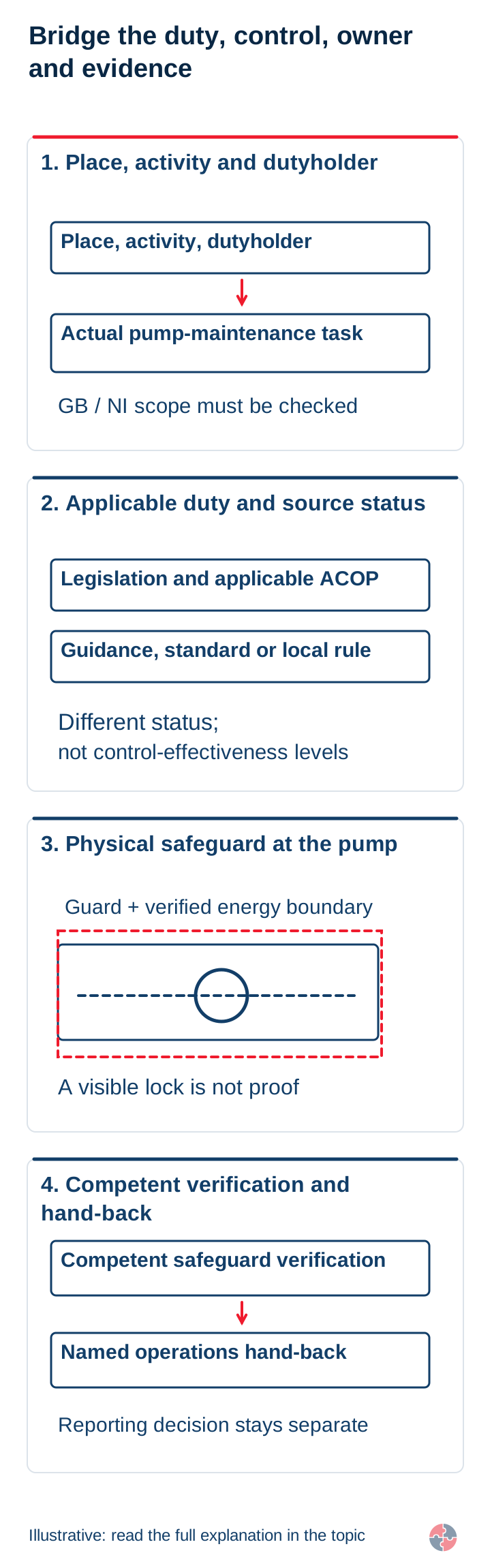
Bridge the duty, control, owner and evidence
Legal status and control effectiveness answer different questions. Establish the workplace, activity and dutyholder, then translate the applicable duty into a practical safeguard and evidence of its performance.
Open full-size diagram · Open stacked diagram · Download PNG · Download PDF
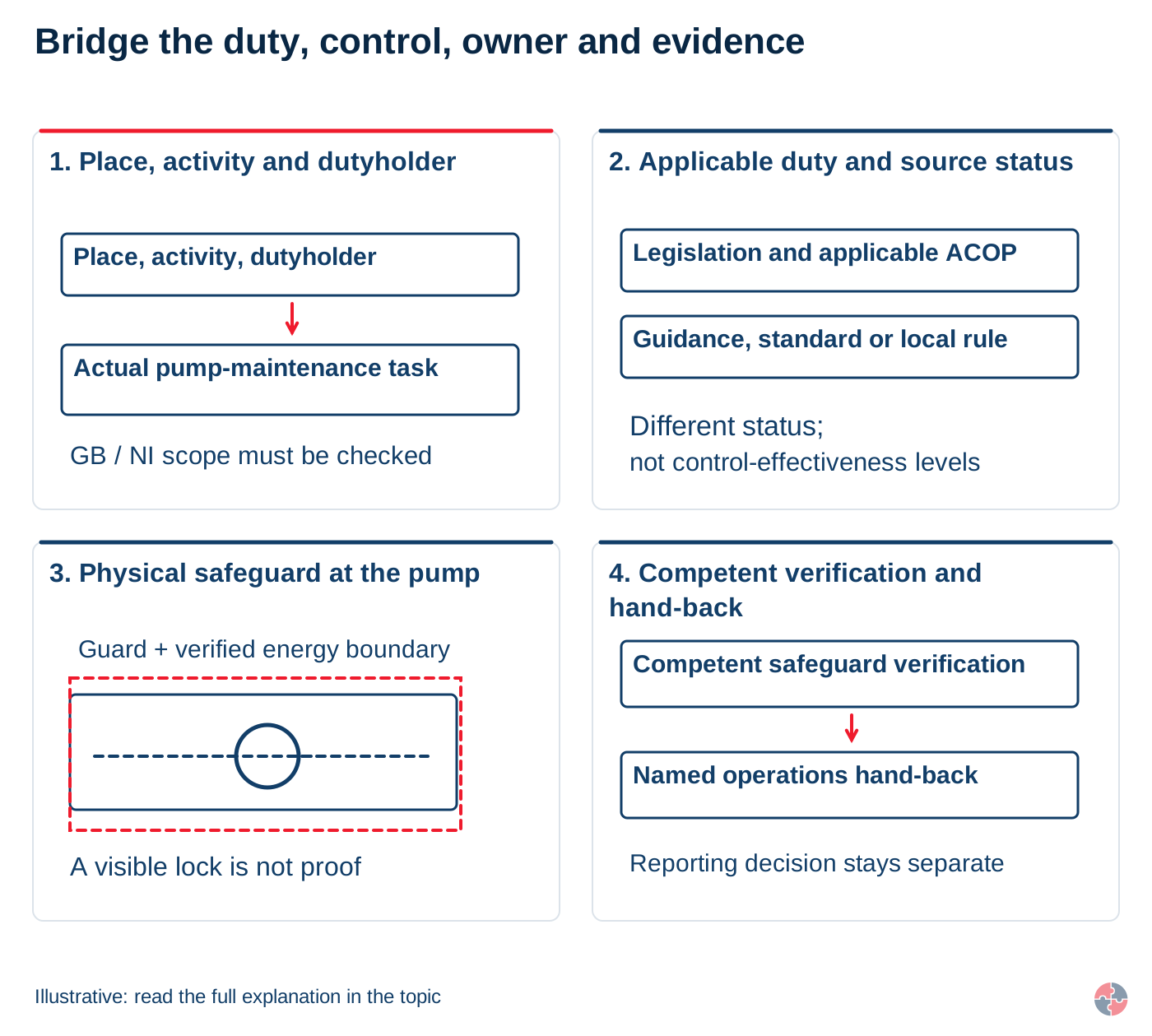
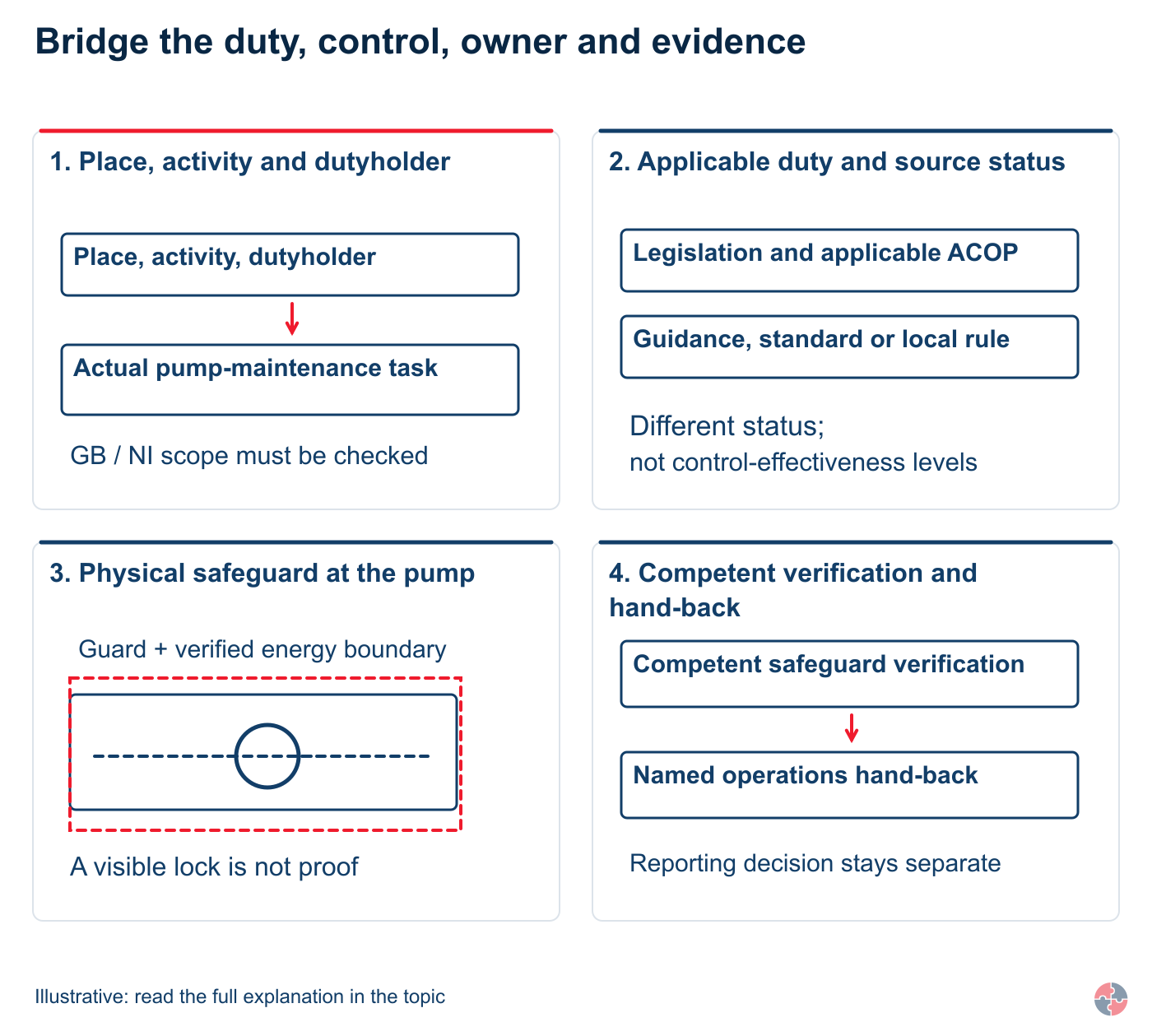
Establish scope
Identify the location, actual activity, equipment and people holding duties. Great Britain and Northern Ireland use separate instruments; similar names do not establish identical requirements.
Keep legal categories distinct
Legislation, an applicable ACOP, regulator guidance, a voluntary standard and a company instruction have different status. They are not levels in a hazard-control hierarchy. Use the legal-status comparison below.
Translate the duty
For the retained pump example, prevent access to dangerous movement and plan competent work. Identify all relevant electrical, pressure, stored and other energy through the task-specific isolation method. A visible lock is not proof of the safe state.
Name responsibility
Identify who controls the work, who completes the repair, who verifies required safeguards and who accepts operational hand-back. The existing example’s independent verification requirement is a local arrangement, not a universal statutory job title.
Verify the actual function
Restore required guards and safeguards and verify the specified safety function through the approved method before release. Resolve a failed test, uncertain energy state or unclear authority before restart.
Keep reporting separate
The reporting owner checks work connection, category, location and the relevant reporting/recording rules. Retain the existing calendar assumptions and serious-category checks; a reporting decision never authorises restart.
The legal-source comparison in the guide distinguishes law, ACOP, guidance, standard and local rules. It does not rank their effectiveness as safeguards. Keep the existing GB/NI reporting calendar and its serious-category checks separate from the restart decision.
Use the current applicable law and competent task evidence. This bridge does not decide legal liability, a reporting category or permission to restart.
When are more specific regulations or product rules needed?
Use the task, equipment, substance and location to select additional legal routes. Buying a product and using it at work are separate decisions: conformity marking does not demonstrate that this installation or task is safe. Sources: PUWER, COSHH.
Place. Activity. Dutyholder. Duty.


Read the complete visual as text
- Identify the workplace: Establish the actual GB or NI location, task, people and controller before copying a legal-register entry.
- Keep territorial law separate: GB uses the 1974 Act and relevant GB regulations; NI uses the 1978 Order and its own regulations. Reporting thresholds and regulator routes also differ.
- Verify the control: A correct legal reference is only part of the decision. Assign the practical control and owner, verify effectiveness and review change.
The following GB examples show how a scope question changes the evidence needed. For a NI site, identify the corresponding NI instrument through HSENI and legislation.gov.uk before adopting a GB citation. This is a starting map, not an exhaustive register.
| GB route | Scope question | What to verify |
|---|---|---|
| PUWER | Is this work equipment within the regulations? | Suitability, guarding, isolation, maintenance, relevant inspections and adequate training. Source: PUWER |
| DSEAR | Do dangerous substances create the relevant safety risks? | Prevention and mitigation for fire, explosion and relevant pressurised-gas or metal-corrosion hazards; do not assume every substance is in scope. Source: DSEAR |
| COSHH | Could a substance harm health through the work? | Exposure assessment and effective controls, including task changes and people exposed. Source: COSHH |
| CDM 2015 | Is the activity construction work? | Appropriate dutyholders, planning, coordination and construction-phase arrangements. Source: CDM 2015 |
| COMAH 2015 | Do the dangerous-substance inventory and aggregation rules meet a threshold? | A documented scope and tier decision. Selling or storing fuel alone does not answer it. Source: COMAH 2015 |
Product-supply boundary: a purchaser should check the applicable market, product regime, conformity documents, instructions and obvious defects. GB and NI market rules can differ. HSE’s buying-new-machinery page warns that older leaflet text on UKCA and CE marking has changed; follow its current government links for the actual product and market. Do not treat a mark as permission to bypass guarding, skip installation checks or use machinery beyond its instructions.
Changed conditions: a replacement chemical, newly imported machine, changed capacity or contractor modification can alter the legal scope as well as the risk. If identity, documentation or intended use is unclear, hold acceptance or work until the supplier and competent advisers resolve it. Record the decision and revise the method before briefing users.
How do both control hierarchies shape a real legal duty?
A general duty becomes useful when a named person tests a source control against the real pump or substance task, then verifies the residual safeguards.
HSE’s five-level hierarchy separates elimination, substitution, engineering control, administrative control and PPE. ERICPD adds explicit isolation and discipline; its Control stage contains both physical and administrative measures. These frameworks guide choice and checking, but neither is a separate legal permission. Each case starts with a higher-order option and states why residual controls are still needed.
How can the hierarchy of controls guide workplace precautions under UK health and safety law?
Great Britain example: For a bypassed pump guard, remove the need for access where feasible; if opening is necessary, prove isolation and guard function before release.
This worked legal example uses GB instruments and HSE guidance. For a Northern Ireland task, check the separate NI general-duty Order and task-specific NI regulations before deciding the control or claiming compliance.
Source route: PUWER, HSE’s risk-control steps. The sequence below is a task example, not an automatic permission to work.
Eliminate — ERICPD Eliminate; five-level elimination. The maintenance manager first asks the designer whether inspection can use a fixed external condition sensor or a sight point outside the moving-part envelope. If the diagnostic can be done there, remove the access step from the job plan. The engineer proves the reading identifies the fault under normal and abnormal conditions; if the diagnostic is inconclusive, stop rather than reopen the guard. See PUWER.
Substitute or reduce — ERICPD Reduce; five-level substitution. Where physical inspection is needed, compare a replaceable cassette or off-line bench test with reaching into the installed pump. The engineer checks that the alternate assembly and test reproduce the fault without creating a new electrical or pressure risk; record why it is feasible or why the plant-specific fault cannot be diagnosed off-line. See PUWER.
Engineering separation — ERICPD Isolate and physical Control; five-level engineering. If the cover must be removed, a competent maintainer identifies and locks each electrical and stored-pressure source, verifies the work point safe, and uses a correctly designed fixed or interlocked guard on return. The supervisor witnesses the isolation and guard functional test. Unexpected movement, pressure or failed interlock holds the pump out of service. See HSE’s risk-control steps.
Administrative control — ERICPD Control and Discipline; five-level administrative. A task brief names the isolation points, authorised maintainer, exclusion boundary and hand-back owner. The manager checks the live workface and change log rather than accepting a signed permit alone. A contractor or altered fault symptom restarts the assessment. See PUWER.
PPE — ERICPD PPE; five-level PPE. Task-assessed eye and hand protection may reduce residual splash or sharp-edge injury after energy isolation; the supervisor checks fit, compatibility and condition, replaces damaged items, and does not treat PPE as protection from an unguarded rotating shaft. Stop if the specified protection is unavailable. See HSE: managing risk using PPE.
ERICPD Discipline. The engineering lead reviews bypass events, maintains interlocks and checks that a sampled repair has a recorded isolation, functional test and authorised restart. Repeated bypasses trigger redesign, not worker blame. See PUWER.
How can the ERICPD hierarchy of controls guide workplace precautions under UK health and safety law?
Hierarchy correction, 19 October 2026: use the corrected task text and control panels below. The overview and stage artwork has been updated locally to match the corrected task text. Rendered and release verification remains pending: physical protection belongs under Engineering, procedures under Administrative, and a reduced quantity, rate or footprint is not by itself Substitution. Discipline means response practice, handover, maintenance and defect learning. Read the full task before applying any example.

| ERICPD control level | Topic-specific example | Source and full task context |
|---|---|---|
| Eliminate | Eliminate — ERICPD Eliminate; five-level elimination. The maintenance manager first asks the designer whether inspection can use a fixed external condition sensor or a sight point outside the moving-part envelope. If the diagnostic can be done there, remove the access step from the job plan. The engineer proves the reading identifies the fault under normal and abnormal conditions; if the diagnostic is inconclusive, stop rather than reopen the guard. See PUWER. | Read the full task example, checks and stop points on this page. NI general-duty Order · PUWER · HSE’s risk-control steps · HSE: managing risk using PPE |
| Reduce | Substitute or reduce — ERICPD Reduce; five-level substitution. Where physical inspection is needed, compare a replaceable cassette or off-line bench test with reaching into the installed pump. The engineer checks that the alternate assembly and test reproduce the fault without creating a new electrical or pressure risk; record why it is feasible or why the plant-specific fault cannot be diagnosed off-line. See PUWER. | Read the full task example, checks and stop points on this page. NI general-duty Order · PUWER · HSE’s risk-control steps · HSE: managing risk using PPE |
| Isolate / Control | Engineering separation — ERICPD Isolate and physical Control; five-level engineering. If the cover must be removed, a competent maintainer identifies and locks each electrical and stored-pressure source, verifies the work point safe, and uses a correctly designed fixed or interlocked guard on return. The supervisor witnesses the isolation and guard functional test. Unexpected movement, pressure or failed interlock holds the pump out of service. See HSE’s risk-control steps. | Read the full task example, checks and stop points on this page. NI general-duty Order · PUWER · HSE’s risk-control steps · HSE: managing risk using PPE |
| Control | Administrative control — ERICPD Control and Discipline; five-level administrative. A task brief names the isolation points, authorised maintainer, exclusion boundary and hand-back owner. The manager checks the live workface and change log rather than accepting a signed permit alone. A contractor or altered fault symptom restarts the assessment. See PUWER. | Read the full task example, checks and stop points on this page. NI general-duty Order · PUWER · HSE’s risk-control steps · HSE: managing risk using PPE |
| PPE | PPE — ERICPD PPE; five-level PPE. Task-assessed eye and hand protection may reduce residual splash or sharp-edge injury after energy isolation; the supervisor checks fit, compatibility and condition, replaces damaged items, and does not treat PPE as protection from an unguarded rotating shaft. Stop if the specified protection is unavailable. See HSE: managing risk using PPE. | Read the full task example, checks and stop points on this page. NI general-duty Order · PUWER · HSE’s risk-control steps · HSE: managing risk using PPE |
| Discipline | ERICPD Discipline. The engineering lead reviews bypass events, maintains interlocks and checks that a sampled repair has a recorded isolation, functional test and authorised restart. Repeated bypasses trigger redesign, not worker blame. See PUWER. | Read the full task example, checks and stop points on this page. NI general-duty Order · PUWER · HSE’s risk-control steps · HSE: managing risk using PPE |
How can the ISO 45001 hierarchy of controls guide workplace precautions under UK health and safety law?

| ERICPD control level | Topic-specific example | Source and full task context |
|---|---|---|
| Eliminate | Eliminate — ERICPD Eliminate; five-level elimination. The maintenance manager first asks the designer whether inspection can use a fixed external condition sensor or a sight point outside the moving-part envelope. If the diagnostic can be done there, remove the access step from the job plan. The engineer proves the reading identifies the fault under normal and abnormal conditions; if the diagnostic is inconclusive, stop rather than reopen the guard. See PUWER. | Read the full task example, checks and stop points on this page. NI general-duty Order · PUWER · HSE’s risk-control steps · HSE: managing risk using PPE |
| Reduce | Substitute or reduce — ERICPD Reduce; five-level substitution. Where physical inspection is needed, compare a replaceable cassette or off-line bench test with reaching into the installed pump. The engineer checks that the alternate assembly and test reproduce the fault without creating a new electrical or pressure risk; record why it is feasible or why the plant-specific fault cannot be diagnosed off-line. See PUWER. | Read the full task example, checks and stop points on this page. NI general-duty Order · PUWER · HSE’s risk-control steps · HSE: managing risk using PPE |
| Isolate / Control | Engineering separation — ERICPD Isolate and physical Control; five-level engineering. If the cover must be removed, a competent maintainer identifies and locks each electrical and stored-pressure source, verifies the work point safe, and uses a correctly designed fixed or interlocked guard on return. The supervisor witnesses the isolation and guard functional test. Unexpected movement, pressure or failed interlock holds the pump out of service. See HSE’s risk-control steps. | Read the full task example, checks and stop points on this page. NI general-duty Order · PUWER · HSE’s risk-control steps · HSE: managing risk using PPE |
| Control / Discipline | Administrative control — ERICPD Control and Discipline; five-level administrative. A task brief names the isolation points, authorised maintainer, exclusion boundary and hand-back owner. The manager checks the live workface and change log rather than accepting a signed permit alone. A contractor or altered fault symptom restarts the assessment. See PUWER. | Read the full task example, checks and stop points on this page. NI general-duty Order · PUWER · HSE’s risk-control steps · HSE: managing risk using PPE |
| PPE | PPE — ERICPD PPE; five-level PPE. Task-assessed eye and hand protection may reduce residual splash or sharp-edge injury after energy isolation; the supervisor checks fit, compatibility and condition, replaces damaged items, and does not treat PPE as protection from an unguarded rotating shaft. Stop if the specified protection is unavailable. See HSE: managing risk using PPE. | Read the full task example, checks and stop points on this page. NI general-duty Order · PUWER · HSE’s risk-control steps · HSE: managing risk using PPE |
Solvent cleaning of the same pump: substance route and substitution decision
Great Britain example: For pump cleaning, first test whether the solvent task can be removed or a compatible safer method substituted; containment and ventilation then govern the residual exposure.
This worked legal example uses GB instruments and HSE guidance. For a Northern Ireland task, check the separate NI general-duty Order and task-specific NI regulations before deciding the control or claiming compliance.
Source route: COSHH, DSEAR, HSE’s risk-control steps. The sequence below is a task example, not an automatic permission to work.
Eliminate — ERICPD Eliminate; five-level elimination. The planner asks whether a sealed replaceable part can avoid on-site solvent cleaning altogether. Procurement checks material compatibility and the engineer confirms that no cleaning residue is needed for the pump duty. If inspection reveals an unanticipated deposit, hold the work and reassess. See COSHH.
Substitute or reduce — ERICPD Reduce; five-level substitution. If cleaning remains necessary, assess a less hazardous compatible detergent and minimum quantity against the contaminant and manufacturer instructions. A trial must demonstrate cleaning quality without corrosion or new disposal exposure; reject substitution if compatibility is unproved. See COSHH.
Engineering separation — ERICPD Isolate and physical Control; five-level engineering. Use a closed cleaning station or local extraction selected for the actual vapour and ignition risk, with the pump isolated from energy. A competent engineer checks airflow or containment at commissioning and before use and maintains the system. Odour, leakage, failed extraction or an ignition-source discrepancy stops cleaning. See DSEAR, HSE’s risk-control steps.
Administrative control — ERICPD Control and Discipline; five-level administrative. The COSHH and, where relevant, DSEAR assessment specifies transfer quantity, container closure, waste route and exclusion of bystanders. The supervisor verifies labels, instructions and exposure controls at the workface; a different solvent or task location requires a new check. See COSHH.
PPE — ERICPD PPE; five-level PPE. Select splash protection and chemical-resistant gloves against the actual product and breakthrough information; check size, seal, damage and replacement interval from supplier data. They protect only residual contact and do not replace containment or ventilation. See HSE: managing risk using PPE.
ERICPD Discipline. The manager trends spills and failed extraction checks, repairs the physical controls, and confirms changed products are screened before purchase. A briefing alone cannot close a failed containment action. See COSHH.
How should a bypassed safeguard be handled?
Stop unsafe access, establish a safe isolated condition and address why the safeguard was defeated. Restart depends on verified protection and an authorised hand-back, not a reminder to be more careful. Sources: PUWER.
Hold the pump. Verify the safeguard.


Read the complete visual as text
- Safeguard defect: A bypassed or failed safeguard holds the transfer pump. The coupling remains covered and the equipment out of use; the drawing does not demonstrate how to defeat a device.
- Competent correction: Identify all electrical, mechanical and process energy and use the approved isolation method. A visible lock alone does not prove every source is safe.
- Evidence before release: The example company chooses an independent competent repair check as its own assurance rule. Test the affected function and obtain named hand-back; do not present independence here as a universal statutory rule.
Crownway pump maintenance example
Task material and setting: At Crownway Fuels Ltd’s GB fuel-transfer bay, a technician services a transfer pump and finds the coupling-guard interlock bypassed. The objective is a safe, maintainable pump returned to service. Potential fuel vapour, vehicle movements, connected pipework and stored energy are part of the assessment.
People and prerequisites: The technician, pump operator, contractor supervisor, engineer and nearby drivers may be affected. The supervisor needs the equipment identity, current instructions, isolation plan, permit arrangements where required by the assessed method, and people competent for their assigned maintenance and testing tasks.
Before: Stop the task and prevent access to the dangerous movement. Authorised competent people isolate and verify the relevant electrical, mechanical and process energy under the site method. Account for people, protect adjacent operations, assess injury or exposure, and record the condition safely without recreating the hazard.
During: The engineering lead establishes why the bypass was used, including access, job planning and contractor instructions. Restore or redesign the safeguard and safe access method with the manufacturer or a competent designer where needed. Manage fuel and ignition hazards and use a planned protected testing method; do not improvise live access to demonstrate the fault.
Hold or stop: No restart while dangerous movement remains accessible, isolation is uncertain, the safeguard test fails or authority is unclear. An undocumented modification needs technical approval. A fuel leak or unsafe atmosphere triggers the site emergency arrangements and withdrawal to safety, not an improvised repair.
Completion and hand-back: Crownway’s example local rule requires a competent person independent of the repair to verify the safety function. The authorised manager checks that the guard and isolation arrangements work, tools and people are clear, affected workers and contractors are briefed, and the operator accepts hand-back. Independence is a company assurance choice here, not a universal legal formula.
Evidence: Keep the incident facts, equipment and jurisdiction check, revised assessment and work method, isolation and engineering test records, modification approval where relevant, briefing evidence, separate RIDDOR decision and signed hand-back. Assign any wider corrective actions and verify their closure.
Variations: routine operation still needs working safeguards and a clear defect route. A non-routine test or altered guard needs a revised method before it starts. At a NI site, establish the NI work-equipment and dangerous-substance requirements rather than relabelling the GB assessment. An unexplained fluid, unreadable pump identity or unknown modification is a hold point for the engineering lead.
The example applies HSE work-equipment principles and investigation guidance. The exact isolation, repair and test procedure must come from the assessed system and relevant instructions.
When is an event reportable under RIDDOR?
First protect people and make the situation safe. Then the responsible reporting owner checks work connection, jurisdiction and the exact injury, disease or dangerous-occurrence category. Incapacity thresholds and deadlines differ between GB and NI. Sources: HSE reporting times, NI regulation 3.
Four calendar days: separate reporting routes


Read the complete visual as text
- Example assumptions: A work-related injury, without a specified/major injury or another immediately reportable category. Thursday is the accident day and is not counted; normal duties are not possible Friday through Monday; full duties resume Tuesday.
- Great Britain: Four calendar days exceed the over-three-day recording threshold but do not exceed the over-seven-day reporting threshold for this assumed category.
- Northern Ireland: Four calendar days exceed the NI over-three-day injury reporting threshold. Check serious categories promptly before applying a day count; attendance on light duties is not automatic recovery.
RIDDOR means the Reporting of Injuries, Diseases and Dangerous Occurrences Regulations. A near miss is reportable only if it fits a listed dangerous occurrence; a bypass by itself is not automatically reportable. Ill-health categories have their own conditions. Use HSE’s GB categories or HSENI’s NI route and the applicable instrument.
| Jurisdiction | Work-related injury incapacity | Action and timing |
|---|---|---|
| Great Britain | More than seven consecutive days unable to perform normal work. | Report within 15 days of the accident. More than three consecutive days has a separate recording requirement, even if this reporting threshold is not reached. Source: HSE reporting times, RIDDOR 2013 |
| Northern Ireland | More than three consecutive days unable to perform normal work. | Report as soon as practicable and in any event within 10 days of the accident under NI regulation 3(2). Source: NI regulation 3, RIDDOR (Northern Ireland) 1997 |
For both calculations, exclude the day of the accident and count consecutive calendar days, including weekends, rest days and holidays. Attendance on light duties may still count if the normal range of work cannot be done. These deadlines are not waiting periods for death, GB specified injury or NI major injury, or a listed dangerous occurrence: their notification requirements are prompt, with separate report rules. Check HSE reporting times and NI regulation 3 immediately for those events.
A calendar-day decision example
A worker with a work-related injury on Thursday cannot do normal duties on Friday, Saturday, Sunday or Monday, and resumes the full job on Tuesday. Assume it is not a GB specified injury, NI major injury or another immediately reportable category. The count is four days, not two working days. In GB, this meets the over-three-day recording requirement but not the over-seven-day reporting threshold. In NI, it meets the over-three-day reporting threshold; the report is due as soon as practicable and within 10 days of the accident. Review the decision if incapacity continues or the injury category changes.
Record the facts, category considered, count, responsible person, reporting decision and any report reference. Investigate a significant event even when it is not reportable. Keep medical details and personal records accessible only to those with a legitimate role. A RIDDOR report and a decision about legal liability are separate.
What happens after a serious event or an inspector’s notice?
Care, immediate risk control, regulatory reporting, internal learning and possible legal proceedings are distinct routes. Start the necessary actions in parallel; do not wait for a court decision before correcting an unsafe condition.
Separate decisions after an event
Open the original full route diagrams and downloads
2 linked parts. Follow the question numbers and complete the applicable route.
Part 1 of 2 · Questions 1–3

Continue · Part 2 of 2 · Questions 4–5


Read the complete route in numbered text
Reading order only: follow the actual yes/no/unknown branches and holds stated in each explanation. Moving to the next explanation does not authorise the next work activity.
- Start: Use the actual task and current evidence. Serious immediate danger takes the appropriate emergency route first.
- Question 1: Protect, obtain care and secure the risk Decision owner: Employer or controlling manager with competent task/legal advice.
- ACTION: Use the appropriate emergency/first-aid route. Reporting never authorises restart. Owner: Employer or controlling manager with competent task/legal advice. CONTINUE → QUESTION 2.
- Question 2: Preserve facts safely and identify reporting owner Decision owner: Employer or controlling manager with competent task/legal advice.
- ACTION: Do not recreate the dangerous condition or remain exposed to collect evidence. Owner: Employer or controlling manager with competent task/legal advice. CONTINUE → QUESTION 3.
- Question 3: Does the event meet a reportable category in the actual GB or NI jurisdiction? Decision owner: Employer or controlling manager with competent task/legal advice.
- YES: Apply the correct category timing and regulator route promptly. Owner: Employer or controlling manager with competent task/legal advice. CONTINUE → QUESTION 4.
- NO: Record the category reasoning; investigation and work-control duties still apply. Owner: Employer or controlling manager with competent task/legal advice. CONTINUE → QUESTION 4.
- UNCERTAIN: Seek prompt competent reporting advice; do not delay a notification that is due. Owner: Employer or controlling manager with competent task/legal advice. CONTINUE → QUESTION 4.
- Question 4: Maintain parallel follow-up routes Decision owner: Employer or controlling manager with competent task/legal advice.
- ACTION: Investigate and correct the control, support affected people and handle regulatory notice/civil-claim questions through their separate advice routes. Owner: Employer or controlling manager with competent task/legal advice. CONTINUE → QUESTION 5.
- Question 5: Is protection verified and hand-back authorised? Decision owner: Employer or controlling manager with competent task/legal advice.
- YES: Release through local arrangements and track remaining actions. Owner: Employer or controlling manager with competent task/legal advice. OUTCOME → RECORD AND HAND OVER.
- NO / UNKNOWN — HOLD: Keep the work held until physical correction and authority are evidenced. Owner: Employer or controlling manager with competent task/legal advice. HOLD → REPEAT QUESTION 5 AFTER CORRECTION.
- Outcome: Record the stated outcome, evidence and receiving authority. A hold has no automatic restart; the relevant check must be satisfied after competent correction.
- Stop and escalation boundary: This learning route supplies no design value, operating setting, clinical diagnosis or site permission. The actual procedure, jurisdiction and competent local authority govern.
At the scene: call the local emergency response where needed, obtain appropriate first aid and prevent further exposure. Only competent authorised people should make plant safe. Preserve evidence so far as compatible with rescue and safety; do not recreate the dangerous condition for photographs or testing. Support affected people and give clear, factual communications.
Regulatory and criminal route: an enforcing authority considers statutory compliance and may investigate, advise, serve a notice or pursue the applicable prosecution route. A safety offence can concern the risk created even if no one was hurt. In Scotland, HSE reports investigated offences to the Procurator Fiscal, who decides prosecution. In NI, check HSENI’s enforcement guidance and the relevant prosecution arrangements.
Civil route: an injured person may seek compensation through an appropriate claim. The regulator does not award compensation: HSE explains the separate GB civil route. A claim can arise without prosecution, and settlement does not establish criminal guilt. The facts, applicable jurisdiction, cause of harm and relevant time limits need qualified advice; neither liability nor insurance cover follows automatically from a simple diagram.
Internal learning: examine the immediate failure and the planning, maintenance, supervision or organisational decisions behind it. Include workers and contractor interfaces. Repairing the guard may be urgent, but preventing recurrence can also require safer access, better scheduling and clearer authority. HSE’s investigation guidance supports looking beyond the immediate failure; verify that the revised control works.
For notices, HSE distinguishes an improvement notice concerning a contravention from a prohibition notice addressing risk of serious personal injury. Prohibition does not require proof of a contravention and may take effect immediately or later, as specified. Read the activity, terms and dates on the actual notice; secure the risk, identify a responsible manager and obtain prompt competent advice on compliance and any appeal. Do not assume an appeal permits work to continue.
Sources: GB enforcement, NI enforcement, civil compensation and investigation practice.
How should Crownway manage duties and assure its controls?

Crownway Fuels Ltd would identify which duties apply to a planned change, distinguish law from guidance and turn those duties into owned operating arrangements.
Crownway Fuels Ltd · practical example
Turn a proposed fuel-site change into a legal applicability check
The key lesson A legal register is useful when it connects an applicable duty to the activity, responsible person and current evidence.
The situation: Crownway proposes altering a delivery area at an English fuel site. A contractor offers a standard design pack and an older company checklist.
Why this matters: A familiar design or supplier assurance does not settle all occupational, fire, petroleum and environmental requirements for that location.
How Crownway Fuels Ltd would manage it
- Describe the change — Site Manager. Set out the actual fuel, equipment, traffic, contractors and people affected. Identify the location and existing permissions rather than copying another site description.
- Check applicable duties — Health and Safety Lead. Use current authoritative sources and competent specialist input to identify relevant requirements and enforcing bodies. Keep English and Great Britain scope distinct from other UK jurisdictions.
- Separate authority levels — Health and Safety Lead. Explain which provisions are law, which ACOP advice is relevant and which guidance supports the proposed approach. Record the justification for any alternative method.
- Allocate delivery — Operations Director. Assign the necessary design, permission, consultation, competence and assurance actions, including who must accept each item before the change can be used.
- Verify the conditions — Area Operations Manager. Check that required evidence and operating arrangements exist for this site. Keep unresolved permissions or safeguards visible and review the register when scope changes.
When the conditions change
- Recognise the trigger
- The delivery-area review leaves an applicable permission or compliance condition unresolved.
- Make the immediate decision
- Do not introduce the change whose legal or operating conditions remain unconfirmed.
- Verify the next step
- The authorised manager checks the applicability record, required permissions and technical acceptance for this English site.
What good looks like
A manager can trace each significant duty to a real control and evidence, and explain why the chosen source applies to this work.
Evidence to look for: Applicability review, current source links, competent advice, permissions and assigned compliance actions.
Common mistake to avoid: Calling all guidance law, or treating a certificate as proof of compliance with every applicable duty.
Apply this to your work: Does your register show how a requirement is met, or only list its title?
Guidance behind the management approach: HSE: legal status of guidance and ACOPs. Use the topic's legal and technical guidance for the applicable work and location.
Crownway’s manager maps site activities, equipment, substances, people affected and jurisdiction. The fuel inventory is checked before deciding whether COMAH applies. The register links the current provision and source to the relevant risk assessment, safeguard, maintenance or test record, competence and reporting route. A legal reference without an operational link is unfinished work.
| Risk or change | Owner and control | Evidence and escalation |
|---|---|---|
| Pump access during maintenance | Engineering lead: effective guarding, safe isolation and maintainable access. | Functional tests and observed work. Hold equipment after a failed safeguard or unexplained bypass. Source: PUWER |
| Contractor or process change | Site manager: coordinated method, shared hazards and a clear hand-back. | Approved change assessment and briefing. Stop if the work or interface differs from the plan. Source: CDM 2015, HSG65 |
| Injury or dangerous occurrence | Reporting owner: jurisdiction and category decision. | Facts, day count, decision and report reference. Escalate serious categories promptly. Source: HSE reporting times, NI regulation 3 |
| Legal or guidance update | Legal-register owner: check extent, commencement and operational effect. | Revised controls and communication, with verification before the change is closed. Source: HSE: the law on managing health and safety, HSENI |
| Repeated defects or overdue actions | Senior manager: resources and verified corrective action. | Trend and site samples; reopen actions where the workaround persists. Source: HSG65 |
Leadership checks: compare the assessment with the equipment and the shift. Ask a worker to explain and demonstrate the control safely. Sample non-routine work, overdue defects, changed equipment and previous corrective actions. Repeated bypasses, copied GB wording in a NI procedure, missing ownership or a certificate used instead of a safeguard are warning signs.
Review after a significant change, incident, failed control or relevant legal update. Set planned review arrangements according to risk and the applicable requirement; this guide does not invent an annual legal-register audit, fixed training expiry or universal inspection interval. Board reporting should explain unresolved critical controls and the action needed to close them.
What competence and management standards help?
Match competence to the decision and task. A worker, supervisor, engineer and reporting owner need different knowledge and authority; attendance at one generic legal-awareness session cannot prove all of them competent. Sources: GB Management Regulations, NI Management Regulations.
Workers need understandable information about the hazard, the method and how to report or stop an unsafe task. Supervisors need to recognise changed conditions and check controls. Engineers and maintainers need the relevant equipment knowledge and safe testing skills. Reporting owners need to apply the actual GB or NI criteria. Legal interpretation, disputed notices and civil claims need suitably qualified advice.
Check performance through relevant supervision, observation or scenarios, and address gaps before assigning safety-critical work. Update information and training when equipment, work, law or incident learning changes. Do not invent a universal certificate expiry or assume every task requires the same formal course. Competence requirements must follow the actual duty and risk.
HSG65 offers the Plan, Do, Check, Act approach: plan controls and resources, implement them, check performance and act on what is found. HSE describes ISO 45001 as a voluntary occupational health and safety management standard. It can organise responsibilities and improvement, but certification is not proof that each legal duty is met. Assess whether adoption suits the organisation; no particular standard edition or clause is claimed here. Sources: HSE management systems, HSE ISO 45001 guidance.
These are role-specific learning and assurance examples, not a universal course or certificate schedule. The applicable duty, equipment, task and observed performance determine the actual instruction and supervision needed.
| Role | Learning to test | Who checks and how | Record and reassessment trigger |
|---|---|---|---|
| New starter or nearby worker | Recognise the actual hazard, safeguard, emergency signal and stop route. Awareness does not authorise maintenance. | Supervisor asks the person to identify a local unsafe condition and response. | Induction or briefing record; revisit after a changed task, incident or failed understanding. Source: Management of Health and Safety at Work Regulations 1999, Management of Health and Safety at Work Regulations (Northern Ireland) 2000 |
| Operator or user | Apply normal and abnormal limits, guarding or exposure controls, defect reporting and safe shutdown. | Task supervisor observes a practical task and a fault scenario on the actual equipment. | Task instruction and assessment; reassess after equipment or method change, repeat error or long absence where relevant. Source: PUWER |
| Maintainer or specialist | Identify all energy sources, isolate, test, repair and hand back within a defined scope of authority. | Technical lead assesses observed isolation and protected functional testing. | Authorisation scope, assessment and test record; reassess after modification, incident or observed gap. Source: PUWER, COSHH |
| Supervisor or permit issuer | Coordinate contractors, changed conditions, holds, escalation and restart decisions. | Manager samples a real permit, site walk and challenge of an unsafe method. | Decision and observation record; revisit when conditions, legal scope or controls change. Source: HSG65 |
| Manager, purchaser or designer | Select suitable equipment and controls, resource corrective action and check legal applicability. | Competent adviser challenges a procurement or risk-reduction decision and its evidence. | Specification, risk decision and action closure; review after product, process or law change. Source: HSE’s buying-new-machinery page, HSG65 |
| Safety adviser, legal specialist or auditor | Distinguish GB/NI law, ACOPs, guidance and standards; sample control effectiveness. | Appropriate technical or legal authority checks source use and a field audit trail. | Source decision and audit findings; update for changed law, guidance or failed barrier. Source: HSG65 |
Which official links establish the duty?
Use the applicable legislation and regulator material for the work location and activity. The links below explain the legal route, reporting decision and control expectations discussed above.
From task to effective control
Open the original full route diagrams and downloads
2 linked parts. Follow the question numbers and complete the applicable route.
Part 1 of 2 · Questions 1–3

Continue · Part 2 of 2 · Questions 4–5


Source basis: GB enforcement · HSENI’s explanation of reasonable practicability · HSE distinguishes · HSE explains the separate GB civil route · investigation guidance · HSE: Crown Office and Procurator Fiscal Service · PUWER · DSEAR · COSHH · CDM 2015 · COMAH 2015 · HSE’s buying-new-machinery page · HSE’s risk-control steps · Management of Health and Safety at Work Regulations 1999 · Management of Health and Safety at Work Regulations (Northern Ireland) 2000 · HSENI · Health and Safety at Work etc. Act 1974 · Health and Safety at Work (Northern Ireland) Order 1978 · HSE explains · HSENI’s approval list · HSE’s GB categories · HSENI’s NI route · HSE reporting times · NI regulation 3 · HSG65 · HSE ISO 45001 guidance · HSE: the law on managing health and safety · RIDDOR 2013 · RIDDOR (Northern Ireland) 1997 · HSE management systems · HSE on proportionate risk control · HSE’s five-level hierarchy.
Read the complete route in numbered text
Reading order only: follow the actual yes/no/unknown branches and holds stated in each explanation. Moving to the next explanation does not authorise the next work activity.
- Start: Use the actual task and current evidence. Serious immediate danger takes the appropriate emergency route first.
- Question 1: Are location, activity and dutyholder clear? Decision owner: Employer or controlling manager with competent task/legal advice.
- YES: The named evidence is confirmed. Continue the next applicable check. Owner: Employer or controlling manager with competent task/legal advice. CONTINUE → QUESTION 2.
- NO / UNKNOWN — HOLD: Hold the legal conclusion and obtain competent GB or NI scope advice. Owner: Employer or controlling manager with competent task/legal advice. HOLD → REPEAT QUESTION 1 AFTER CORRECTION.
- Question 2: Are current provisions and activity-specific scope resolved? Decision owner: Employer or controlling manager with competent task/legal advice.
- YES: The named evidence is confirmed. Continue the next applicable check. Owner: Employer or controlling manager with competent task/legal advice. CONTINUE → QUESTION 3.
- NO / UNKNOWN — HOLD: Return to competent advice; do not copy an inapplicable legal-register entry. Owner: Employer or controlling manager with competent task/legal advice. HOLD → REPEAT QUESTION 2 AFTER CORRECTION.
- Question 3: Identify the harm path and preventive controls Decision owner: Employer or controlling manager with competent task/legal advice.
- ACTION: Use applicable approved codes, guidance and actual instructions; name the practical control and accountable owner. Owner: Employer or controlling manager with competent task/legal advice. CONTINUE → QUESTION 4.
- Question 4: Are controls effective for the actual conditions? Decision owner: Employer or controlling manager with competent task/legal advice.
- YES: The named evidence is confirmed. Continue the next applicable check. Owner: Employer or controlling manager with competent task/legal advice. CONTINUE → QUESTION 5.
- NO / UNKNOWN — HOLD: Hold affected work and redesign or repair; competent verification resolves the gap. Owner: Employer or controlling manager with competent task/legal advice. HOLD → REPEAT QUESTION 4 AFTER CORRECTION.
- Question 5: Is the named owner ready to verify, brief and review the method? Decision owner: Employer or controlling manager with competent task/legal advice.
- YES: Brief people, retain evidence and review after change under the actual local system. Owner: Employer or controlling manager with competent task/legal advice. OUTCOME → RECORD AND HAND OVER.
- NO / UNKNOWN — HOLD: Keep release held until authority, method and evidence transfer are complete. Owner: Employer or controlling manager with competent task/legal advice. HOLD → REPEAT QUESTION 5 AFTER CORRECTION.
- Outcome: Record the stated outcome, evidence and receiving authority. A hold has no automatic restart; the relevant check must be satisfied after competent correction.
- Stop and escalation boundary: This learning route supplies no design value, operating setting, clinical diagnosis or site permission. The actual procedure, jurisdiction and competent local authority govern.
For a case-specific decision, read the provision with its definitions, extent, commencement and any outstanding amendments. Approved codes and guidance help apply a duty but have different legal status. Older HSG65 and HSG245 publications remain useful for management and investigation; current law governs duties and reporting.
| Authority | Direct linked source | Jurisdiction | Claim or decision supported |
|---|---|---|---|
| legislation.gov.uk | Health and Safety at Work etc. Act 1974 — 1974, as amended | Great Britain | GB primary duties; inspect the relevant provision and current amendments. |
| legislation.gov.uk | Management of Health and Safety at Work Regulations 1999 — 1999, as amended | Great Britain | GB risk assessment and preventive arrangements. |
| legislation.gov.uk | Health and Safety at Work (Northern Ireland) Order 1978 — 1978, as amended | Northern Ireland | NI general workplace duties. |
| legislation.gov.uk | Management of Health and Safety at Work Regulations (Northern Ireland) 2000 — 2000, as amended | Northern Ireland | NI risk assessment and preventive arrangements. |
| HSENI | HSENI — Live guidance | Northern Ireland | NI legal starting points and regulator route. |
| HSE | HSE explains — Live guidance | Great Britain | Distinguishes noncompulsory guidance from an ACOP with special legal status. |
| HSENI | HSENI’s approval list — Live list | Northern Ireland | Check NI approval rather than assuming a GB ACOP applies. |
| HSE | HSE’s risk-control steps — Live guidance | Great Britain | GB risk assessment process and record threshold. |
| HSENI | HSENI’s explanation of reasonable practicability — Live guidance | Northern Ireland | NI ACOP status and proportionate enforcement context. |
| HSE | PUWER — Live guidance | Great Britain | GB equipment suitability, guarding, isolation, maintenance and training. |
| HSE | DSEAR — 2024-10-14 | Great Britain | GB dangerous-substance safety scope, including fire, explosion, pressurised gases and metal corrosion. |
| HSE | COSHH — Date not shown | Great Britain | GB hazardous-health exposure scope and employer action. |
| HSE | CDM 2015 — 2023-03-16 | Great Britain | GB construction dutyholder and project scope. |
| HSE | COMAH 2015 — Live guidance | Great Britain | GB scope depends on dangerous-substance inventory and thresholds. |
| HSE | HSE’s buying-new-machinery page — 2020 leaflet; current page warns marking text is under review | Great Britain | Purchasing and supply checks; follow current market-specific marking guidance. |
| HSE | investigation guidance — 2004 | Great Britain | Investigation and corrective actions; use current RIDDOR sources for reporting. |
| HSE | HSE’s GB categories — 2026-05-21 | Great Britain | GB RIDDOR categories; not all near misses or injuries are reportable. |
| HSENI | HSENI’s NI route — Live guidance | Northern Ireland | NI RIDDOR 1997 reporting route, including over-three-day injuries. |
| HSE | HSE reporting times — Live guidance; date not shown | Great Britain | Prompt notification and category-specific reporting deadlines. |
| legislation.gov.uk | NI regulation 3 — 1997, as amended | Northern Ireland | NI notification/reporting provision; check current effects and accident-specific facts. |
| HSE | HSE distinguishes — Live operational guidance | Great Britain | Improvement and prohibition notice distinction; case specifics need advice. |
| HSE | GB enforcement — Live guidance | Great Britain | HSE and local-authority enforcement; Scottish prosecution differs. |
| HSE | civil compensation — Live guidance | Great Britain | Civil compensation route is separate from regulator enforcement. |
| HSE | HSG65 — Third edition 2013 | Great Britain | Plan, Do, Check, Act; management guidance, not a substitute for current law. |
| HSE | ISO 45001 — Live guidance; date not shown | Great Britain | Management-system scope and certification limits, not clause-level authority. |
| HSE | HSE: the law on managing health and safety — Live guidance | Great Britain | GB duties and management arrangements; not a substitute for statute. |
| legislation.gov.uk | RIDDOR 2013 — 2013, as amended | Great Britain | GB reporting law; check schedule and current text. |
| legislation.gov.uk | RIDDOR (Northern Ireland) 1997 — 1997, as amended | Northern Ireland | Separate NI reporting law. |
| HSE | HSE: managing for health and safety — Live guidance | Great Britain | Management-system approach; formal certification is not a general legal requirement. |
| HSE | HSE on proportionate risk control — Live school-sector guidance; checked 2026-09-25 | Great Britain | Explains the gross-disproportion principle in a school risk-control example; apply the actual duty and facts. |
| HSE | HSE: managing risk using PPE — Live guidance; checked 2026-09-26 | Great Britain | Five-level hierarchy and PPE as a residual control after elimination, substitution and engineering separation. |
| HSE | HSE: Crown Office and Procurator Fiscal Service | Great Britain — Scotland | Scotland-specific route: HSE reports investigated offences to the Procurator Fiscal; the fiscal decides prosecution. |
Which acronyms and terms matter?
Expand a term before using it to make a legal decision. Similar labels can conceal different GB and Northern Ireland duties.
In particular, RIDDOR and work-equipment labels need the actual jurisdiction and instrument. The table gives a reading aid, not a substitute for the provision and its scope.
| Letters or term | Full name | Meaning here |
|---|---|---|
| HSWA | Health and Safety at Work etc. Act 1974 | GB general-duty Act; NI has its own 1978 Order. |
| ACOP | Approved Code of Practice | Approved practical advice with special evidential status; verify NI approval. |
| HSE | Health and Safety Executive | GB workplace regulator; activity can affect the enforcing authority. |
| HSENI | Health and Safety Executive for Northern Ireland | NI workplace regulator; some work is enforced by district councils. |
| RIDDOR | Reporting of Injuries, Diseases and Dangerous Occurrences Regulations | Incident-reporting law; GB and NI categories and routes differ. |
| PUWER | Provision and Use of Work Equipment Regulations | Rules for suitable, maintained and safe work equipment; check jurisdiction. |
| COMAH | Control of Major Accident Hazards | Applies only where dangerous-substance inventory and threshold rules bring a site in scope. |
| SFARP | So far as is reasonably practicable | A duty qualification that requires a risk-and-sacrifice judgement in its legal context. |
| Dutyholder | Person or organisation with a legal duty | Identify the relevant employer, controller, designer or other dutyholder for the activity. |
Which BuildOut documents support this topic?
Download individual editable BuildOut documents for this topic. Procedures and plans contain completed arrangements; forms, checklists, assessments, RAMS and permits are blank masters. Registers include separate worked examples.
| Document | Purpose and content | Editable download |
|---|---|---|
| Governance, document change and review procedure BOUK-PRO-GOV · Completed worked example · v1.0 | Approve documents, assign owners, control versions and evaluate management performance. | Download DOCX Read preview |
| Legal and other requirements register BOUK-REG-GOV-01 · Blank register with separate worked entries · v1.1 | A detailed GB construction legal baseline with 142 requirement entries, environmental permits and consents, national overlays and eight completed decisions, plus a blank live register. | Download XLSX Read preview |
| Document and records control register BOUK-REG-GOV-02 · Blank register with separate worked entries · v1.0 | Control IDs, revisions, approvals, access, retention and withdrawn copies. | Download XLSX Read preview |
| Annual health and safety objectives and resources plan BOUK-PLN-GOV-01 · Completed worked example · v1.0 | Set measurable objectives, owners and resources based on risks and performance. | Download DOCX Read preview |
| Management review and improvement decision record BOUK-FRM-GOV-01 · Blank editable master · v1.0 | Record review inputs, decisions, resources, actions and follow-up. | Download DOCX Read preview |
| Management-of-change assessment BOUK-FRM-GOV-02 · Blank editable master · v1.0 | Assess new work, equipment, workforce or sequencing before approval. | Download DOCX Read preview |
| Dutyholder and responsibility appointment record BOUK-FRM-GOV-03 · Blank editable master · v1.0 | Make role, competence, authority, interfaces and acceptance explicit. | Download DOCX Read preview |
| Employers liability insurance and statutory information register BOUK-REG-GOV-03 · Blank register with separate worked entries · v1.0 | Track insurance cover/certificate accessibility and required health and safety information for employees. | Download XLSX Read preview |
Review and adapt the documents for your organisation, activities and jurisdiction before approval and issue. Open the SHAREms management-system hierarchy to find each document under its parent policy.
Which Crownway Fuels documents support this topic?
Open an editable document, read the preview, or find its place in the Crownway hierarchy. 8 resources relate to this page.
Fictional Crownway Fuels examples for English forecourts, with a separate illustrative bulk terminal. Check site applicability, permissions and actual controls before adapting any document for use.
Site inventory and regulatory applicability policy (8)
- Site inventory and regulatory applicability policy (CWF-POL-SCOPE · Completed fictional example)
Set company expectations, responsibilities and resources for site inventory and regulatory applicability.
Read preview · Download DOCX · Show in hierarchy - Site inventory and regulatory applicability procedure (CWF-PRO-SCOPE · Completed fictional example)
Explain who does what, in what sequence, the control rationale, evidence, escalation and safe restart conditions.
Read preview · Download DOCX · Show in hierarchy - Site and establishment applicability register (CWF-REG-SCOPE-01 · Blank register with separate fictional worked entries)
Provide the site/task-specific site and establishment applicability register and retain its controlled output.
Read preview · Download XLSX · Show in hierarchy - Dangerous substances inventory and safety data register (CWF-REG-SCOPE-02 · Blank register with separate fictional worked entries)
Provide the site/task-specific dangerous substances inventory and safety data register and retain its controlled output.
Read preview · Download XLSX · Show in hierarchy - COMAH threshold and aggregation assessment (CWF-RA-SCOPE-01 · Blank editable master)
Provide the site/task-specific comah threshold and aggregation assessment and retain its controlled output.
Read preview · Download DOCX · Show in hierarchy - Forecourt petroleum certificate and permitted activity screen (CWF-CHK-SCOPE-01 · Blank editable master)
Provide the site/task-specific forecourt petroleum certificate and permitted activity screen and retain its controlled output.
Read preview · Download DOCX · Download PDF · Show in hierarchy - Regulatory notification and consent change decision (CWF-FRM-SCOPE-01 · Blank editable master)
Provide the site/task-specific regulatory notification and consent change decision and retain its controlled output.
Read preview · Download DOCX · Show in hierarchy - Site layout drainage receptors and emergency access plan (CWF-PLN-SCOPE-01 · Completed fictional example)
Provide the site/task-specific site layout drainage receptors and emergency access plan and retain its controlled output.
Read preview · Download DOCX · Show in hierarchy
Unlock another resource
You have used this month’s two free downloads. Publish a post in your own words to unlock one more resource, or choose SHARE Individual for 10 downloads per month.
You decide whether to share. If you do, use the relevant platform disclosure tools and do not make claims you do not genuinely hold.