SHARE Knowledge Hub
Risk Assessment of Flammable or Explosive Atmospheres
A Dangerous Substances and Explosive Atmospheres Regulations (DSEAR) assessment asks how a dangerous substance could be released, form a fire or explosive atmosphere, meet ignition, harm people and spread through connected spaces. It then prioritises elimination and release prevention, suitable equipment and ignition control, mitigation, emergency arrangements and verified maintenance. Hazardous-area zoning is one output where needed, not the whole assessment.
Understanding Risk Assessment of Flammable or Explosive Atmospheres
Classify places where explosive atmospheres may occur so ignition controls and equipment are proportionate.
Why this matters at work
Unsafe shortcut: using flammable, combustible, explosive and hazardous interchangeably. Escalate when terminology changes applicability, equipment selection, zoning or control priority. Treat common-cause failure, utility loss, bypass, impaired ventilation, alarm failure and delayed human response as explicit challenges to the control set.
Consider eliminating decanting, using a safer product or moving to an engineered, assessed transfer arrangement. Obtain competent advice on any hazardous-area classification and equipment suitability; do not invent a fixed separation distance from this example. Define spill response, container closure, waste handling, access control and emergency action. Verify controls under normal and foreseeable failure conditions and update instructions and training. Record the technical basis and restrictions before reopening. A product SDS or equipment marking alone does not demonstrate that this combined workplace arrangement is safe.
How organisations manage this in practice
Apply elimination and reduction at source, prevention of hazardous atmosphere, ignition control and mitigation with suitable emergency arrangements. Record the material data and their limitations, operating assumptions and control verification. A substance's flash point or lower flammable limit is not a universal safe-work permission. Competence must match the process, including dust testing, hazardous-area classification or reactive chemistry where needed. Keep the assessment live when material, scale, ventilation, equipment or operating mode changes and restrict work where a critical assumption cannot be substantiated.
Unsafe shortcut: treating DSEAR as a paperwork exercise or limiting it to rooms already labelled hazardous. Escalate when a dangerous substance, affected person, process state or shared interface is outside the defined assessment. Stop, isolate or impose proportionate interim controls where an immediate serious risk remains. Another competent reviewer should be able to reconstruct the substance, scenario, assumptions, people, controls, dependencies, residual risk and decision.
Make emergency arrangements realistic for the substances, quantities, people and foreseeable failures, including contractors, maintenance and out-of-hours work. Coordinate with relevant dutyholders and emergency services where required, and test communication, isolation and evacuation arrangements proportionately. Record responsibilities, restrictions, training and review after incidents or significant change. Do not permit rescue or spill response beyond the team's assessed competence and equipment. A general fire drill or extinguisher check does not demonstrate explosion prevention, while a zoning drawing does not demonstrate adequate escape or emergency coordination.
Follow a release into connected spaces
A release may affect more than the cabinet or point of use. Substance and conditions determine behaviour; a conceptual pathway is not hazardous-area classification.

Identify the release point
Use actual substance, process and containment evidence, including credible abnormal conditions.
Follow openings and connections
Consider drains, lower rooms and other connected spaces without assuming every vapour behaves identically.
Assess prevention and protection
Check closure, capture, safe discharge, ignition control and other people exposed with competent assessors.
Hold incomplete evidence
Keep uncertain release, ventilation or ignition conditions on the competent review route. The sketch gives no zone radius, ventilation rate or equipment code.
Read the complete task-specific control examples
ERICPD is a planning cross-map: Discipline verifies and sustains every control. ESEAP compares effectiveness. A label does not authorise the task; retain the owner, evidence and stop or change decision.
Risk Assessment of Flammable or Explosive Atmospheres · ERICPD
- Eliminate
- Use a non-solvent cleaning method and prefilled water-based paint where the coating specification permits; a compatibility trial must confirm product performance.
- Reduce
- Where solvent is required, choose a lower-volatility suitable product and minimum day quantity; check SDS flash point and process compatibility before change.
- Isolate
- Fit a closed, compatible transfer pump and sealed container in a segregated decanting bay; prevent vapour travel to floor drains and chargers.
- Control
- Provide extraction designed for the identified vapour release, suitable electrical equipment and hot-work exclusion; set permit only for residual non-routine work.
- PPE
- Choose chemical-resistant gloves and eye protection from the liquid SDS for splash/skin risk; RPE only if a competent exposure assessment requires it.
- Discipline
- Brief the exact transfer method, maintain pumps/extraction, remove contaminated wipes in lidded metal waste, and rehearse spill/fire response.
Risk Assessment of Flammable or Explosive Atmospheres · ESEAP
- Elimination
- Use a non-solvent cleaning method and prefilled water-based paint where the coating specification permits; a compatibility trial must confirm product performance. HSE DSEAR
- Substitution
- Where solvent is required, choose a lower-volatility suitable product and minimum day quantity; check SDS flash point and process compatibility before change. HSE DSEAR
- Engineering controls
- Fit a closed, compatible transfer pump and sealed container in a segregated decanting bay; prevent vapour travel to floor drains and chargers. HSE DSEAR Provide extraction designed for the identified vapour release and suitable electrical equipment, with proved performance and fault response. HSE DSEAR
- Administrative controls
- Apply the permit, hot-work and operating rules, inspection and maintenance arrangements; retain competent verification and stop on failed extraction/equipment. HSE DSEAR Brief the exact transfer method, maintain pumps/extraction, remove contaminated wipes in lidded metal waste, and rehearse spill/fire response. HSE DSEAR
- PPE
- Choose chemical-resistant gloves and eye protection from the liquid SDS for splash/skin risk; RPE only if a competent exposure assessment requires it. HSE DSEAR
What is a risk assessment of flammable or explosive atmospheres?
A DSEAR risk assessment identifies the dangerous substance, credible release and explosive-atmosphere formation, ignition sources, people and connected spaces, then selects prevention, mitigation, emergency controls and evidence. Zoning is only one possible output; GB DSEAR 2002 and NI DSEAR 2003 are separate legal routes.
DSEAR: follow the credible release to the people at risk


Read the complete visual as text
- 1. SUBSTANCE AND PROCESS: Competent assessor identifies the actual dangerous substance, current SDS, quantity, properties and storage/use conditions. Use the separate GB or NI DSEAR route.
- 2. CREDIBLE RELEASE: Map leaks, open transfer, cleaning, sampling, spills, maintenance and foreseeable abnormal events. Inventory alone does not show how a release forms.
- 3. ATMOSPHERE AND CONNECTED SPACE: Assess whether gas, vapour, mist or dust could form an ignitable atmosphere, including drains, openings and low points. The image gives no concentration or zone radius.
- 4. IGNITION AND ESCALATION: Consider static, electrical equipment, chargers, hot work, hot surfaces and mechanical sources; identify exposed people and how fire or explosion could spread.
- 5. PREVENT, CONTROL AND MITIGATE: Eliminate/substitute where practicable; reduce inventory, contain and control releases, prevent atmosphere formation and ignition, then provide appropriate mitigation and emergency arrangements.
- 6. VERIFY THE ASSESSMENT BASIS: Keep release assumptions, ventilation/equipment evidence, any competent zoning rationale, operating checks and management-of-change review. COSHH or RAMS contribute but do not replace DSEAR.
Best-practice guide: Risk Assessment of Flammable or Explosive Atmospheres

What is a risk assessment of flammable or explosive atmospheres?
A DSEAR risk assessment identifies the dangerous substance, credible release and explosive-atmosphere formation, ignition sources, people and connected spaces, then selects prevention, mitigation, emergency controls and evidence. Zoning is only one possible output; GB DSEAR 2002 and NI DSEAR 2003 are separate legal routes. A Dangerous Substances and Explosive Atmospheres Regulations (DSEAR) assessment asks how a dangerous substance could be released, form a fire or explosive atmosphere, meet ignition, harm people and spread through connected spaces.
Turn risk assessment of flammable or explosive atmospheres knowledge into a decision
A Dangerous Substances and Explosive Atmospheres Regulations (DSEAR) assessment asks how a dangerous substance could be released, form a fire or explosive atmosphere, meet ignition, harm people and spread through connected spaces. It then prioritises elimination and release prevention, suitable equipment and ignition control, mitigation, emergency arrangements and verified maintenance. Keep substance data, release scenarios, zoning rationale if needed, checks, defects and restart decision.
Solvent transfer near a drain
Check bonding, containment, ventilation and equipment suitability during normal transfer and cleaning. Contain and clear the area under the emergency plan; verify controls and reassess the transfer before restart.
Where do flammable atmosphere assessments commonly fail?
They fail when the assessment names the substance but misses the release, ignition, ventilation and evidence chain.
Choose controls for the actual task
Eliminate: Use a non-solvent cleaning method and prefilled water-based paint where the coating specification permits; a compatibility trial must confirm product performance. Reduce, including substitution: Where solvent is required, choose a lower-volatility suitable product and minimum day quantity; check SDS flash point and process compatibility before change. Isolate: Fit a closed, compatible transfer pump and sealed container in a segregated decanting bay; prevent vapour travel to floor drains and chargers. Control: Provide extraction designed for the identified vapour release, suitable electrical equipment and hot-work exclusion; set permit only for residual non-routine work. PPE: Choose chemical-resistant gloves and eye protection from the liquid SDS for splash/skin risk; RPE only if a competent exposure assessment requires it. Read the full control table for qualifications, ownership and verification. Use the actual task and applicable jurisdiction; existing technical approval remains unchanged.
Use the full risk assessment of flammable or explosive atmospheres lesson
Use the full topic for the decision points, practical examples, detailed control tables and source scope. HSE guidance applies to Great Britain; use HSENI for the Northern Ireland route and the source’s stated jurisdiction. A simplified guide does not change the page’s technical-review or approval status.

Read all six steps as text
1. What is a risk assessment of flammable or explosive atmospheres?
A DSEAR risk assessment identifies the dangerous substance, credible release and explosive-atmosphere formation, ignition sources, people and connected spaces, then selects prevention, mitigation, emergency controls and evidence.
- Avoid / redesign: Use a non-solvent cleaning method and prefilled water-based paint where the coating specification permits; a compatibility trial must confirm product performance.
- Control the task: Fit a closed, compatible transfer pump and sealed container in a segregated decanting bay; prevent vapour travel to floor drains and chargers.
- Verify before release: Process owner approves trial and inventory change; confirm no open solvent stage remains.
A DSEAR risk assessment identifies the dangerous substance, credible release and explosive-atmosphere formation, ignition sources, people and connected spaces, then selects prevention, mitigation, emergency controls and evidence. Zoning is only one possible output; GB DSEAR 2002 and NI DSEAR 2003 are separate legal routes. A Dangerous Substances and Explosive Atmospheres Regulations (DSEAR) assessment asks how a dangerous substance could be released, form a fire or explosive atmosphere, meet ignition, harm people and spread through connected spaces.
Apply it: Which part of this plan would you check at the workface before authorising the task?
2. Turn risk assessment of flammable or explosive atmospheres knowledge into a decision
Use the evidence to improve the actual work arrangement.
- Change at source: Use a non-solvent cleaning method and prefilled water-based paint where the coating specification permits; a compatibility trial must confirm product performance.
- Make it observable: Process owner approves trial and inventory change; confirm no open solvent stage remains.
- Keep useful evidence: Keep substance data, release scenarios, zoning rationale if needed, checks, defects and restart decision.
A Dangerous Substances and Explosive Atmospheres Regulations (DSEAR) assessment asks how a dangerous substance could be released, form a fire or explosive atmosphere, meet ignition, harm people and spread through connected spaces. It then prioritises elimination and release prevention, suitable equipment and ignition control, mitigation, emergency arrangements and verified maintenance. Keep substance data, release scenarios, zoning rationale if needed, checks, defects and restart decision.
Apply it: What evidence would show that the change improves this task, rather than only completing a record?
3. Solvent transfer near a drain
Example: a practical application of the existing topic lesson.
- Setting: A workshop transfers flammable solvent from drums beside a floor drain and a battery charging area.
- Act: Seek non-flammable substitution or closed transfer, remove incompatible ignition and protect the drain pathway.
- Hold / review: Stop if vapour escape, bonding failure, ignition source or unknown drain connection occurs.
Check bonding, containment, ventilation and equipment suitability during normal transfer and cleaning. Contain and clear the area under the emergency plan; verify controls and reassess the transfer before restart.
Apply it: At which point would you hold this example, and what evidence would allow it to proceed?
4. Where do flammable atmosphere assessments commonly fail?
Connect the task, the route to the person and the control that can fail.
- Source / exposure: They fail when the assessment names the substance but misses the release, ignition, ventilation and evidence chain.
- Possible consequence: Weak DSEAR assessments often focus on a chemical label and forget the work.
- Control failure: The real risk may appear during decanting, cleaning, sampling, maintenance, waste handling, empty-container cutting, temporary storage or contractor work.
They fail when the assessment names the substance but misses the release, ignition, ventilation and evidence chain.
Apply it: Who could be exposed, including other trades, cleaners, maintainers and people nearby?
5. Choose controls for the actual task
Control summary. Read the complete task-specific controls and checks in the linked topic.
- Elimination: Use a non-solvent cleaning method and prefilled water-based paint where the coating specification permits; a compatibility trial must confirm product performance. HSE DSEAR
- Substitution: Where solvent is required, choose a lower-volatility suitable product and minimum day quantity; check SDS flash point and process compatibility before change. HSE DSEAR
- Engineering controls: Fit a closed, compatible transfer pump and sealed container in a segregated decanting bay; prevent vapour travel to floor drains and chargers.
- Administrative controls: Apply the permit, hot-work and operating rules, inspection and maintenance arrangements; retain competent verification and stop on failed extraction/equipment.
- PPE: Choose chemical-resistant gloves and eye protection from the liquid SDS for splash/skin risk; RPE only if a competent exposure assessment requires it. HSE DSEAR
Eliminate: Use a non-solvent cleaning method and prefilled water-based paint where the coating specification permits; a compatibility trial must confirm product performance. Reduce, including substitution: Where solvent is required, choose a lower-volatility suitable product and minimum day quantity; check SDS flash point and process compatibility before change. Isolate: Fit a closed, compatible transfer pump and sealed container in a segregated decanting bay; prevent vapour travel to floor drains and chargers. Control: Provide extraction designed for the identified vapour release, suitable electrical equipment and hot-work exclusion; set permit only for residual non-routine work. PPE: Choose chemical-resistant gloves and eye protection from the liquid SDS for splash/skin risk; RPE only if a competent exposure assessment requires it. Read the full control table for qualifications, ownership and verification. Use the actual task and applicable jurisdiction; existing technical approval remains unchanged.
Apply it: Which stronger option can be used here, and who will verify it before accepting the remaining risk?
6. Use the full risk assessment of flammable or explosive atmospheres lesson
Follow the official sources below and retain the task-specific evidence.
- Official guidance: GB DSEAR 2002
- Official guidance: NI DSEAR 2003
- Task decision: Keep uncertain release, ventilation or ignition conditions on the competent review route. The sketch gives no zone radius, ventilation rate or equipment code.
Use the full topic for the decision points, practical examples, detailed control tables and source scope. HSE guidance applies to Great Britain; use HSENI for the Northern Ireland route and the source’s stated jurisdiction. A simplified guide does not change the page’s technical-review or approval status.
Apply it: Which official source and full-topic section will you use to resolve the next decision?
Start with the dangerous-substance inventory and safety data sheet (SDS), then examine the actual release, ignition and consequences. Risk assessments and method statements (RAMS) for the task and a Control of Substances Hazardous to Health (COSHH) assessment may contribute evidence but do not replace the explosive-atmosphere decision. Where applicable, select equipment using the relevant explosive-atmosphere equipment (ATEX) classification and manage changed plant or materials through management of change (MOC). The worked control example uses ERICPD (Eliminate, Reduce including substitution, Isolate, Control, Personal Protective Equipment, Discipline), where PPE means personal protective equipment alongside HSE’s five-level hierarchy; the frameworks are related, not identical. HSE DSEAR guidance explains the assessment and prevention duties.
A flammable or explosive atmosphere risk assessment starts with the dangerous substance, but it does not stop at the label. The assessor needs to understand physical properties such as flash point, vapour pressure, vapour density, lower explosive limit (LEL), upper explosive limit (UEL), dust explosibility and autoignition temperature, then test how the substance is stored, transferred, heated, sprayed, cleaned, dried, charged, mixed, vented or released.
The purpose is to prevent fires and explosions by removing the dangerous substance where possible, reducing quantity, preventing releases, controlling releases at source, stopping explosive atmosphere formation, removing ignition sources, separating incompatible materials and preparing proportionate emergency arrangements.
| Assessment block | What it means | Practical question |
|---|---|---|
| Dangerous substance | Flammable gas, vapour, mist, dust, pressure hazard, corrosive-to-metal risk or energetic reaction potential. | What dangerous substances are present, produced or liable to be present? |
| Release scenario | Normal, abnormal and foreseeable releases including leaks, spills, venting, cleaning, sampling and maintenance. | How could the substance leave containment or become dispersed? |
| Explosive atmosphere | Gas, vapour, mist or dust cloud within ignitable limits. | Could the mixture reach an ignitable concentration and for how long? |
| Ignition source | Hot work, static, electrical equipment, hot surfaces, friction, mechanical sparks, vehicles or lightning. | What could ignite the atmosphere and how is it controlled? |
| Consequences | Flash fire, pool fire, jet fire, dust explosion, VCE, overpressure, burns or escalation. | Who or what could be affected if ignition occurs? |
| Controls and mitigation | Elimination, substitution, ventilation, zoning, ATEX equipment, earthing, housekeeping, detection, relief and emergency planning. | What prevents the event and what limits consequences? |
| Evidence | Assessment, drawings, ventilation checks, equipment registers, permits, inspections, training and MOC. | How do we prove the controls remain effective? |
Trace the harm, not just the zone. A flammable vapour release can ignite and expose people to flame, radiant heat and pressure; flying fragments or structural failure may extend injury beyond the release point. In an enclosure, an explosion can also displace breathable air; do not use that possibility as a universal outcome for every small outdoor release. A combustible dust cloud can flash or explode, and settled dust can feed secondary propagation. The assessor records who could be harmed, how release reaches ignition, confinement and connected spaces, then selects prevention, mitigation, evacuation and rescue arrangements. HSE DSEAR guidance gives the GB safety scope; HSENI approves L138 for NI use under the separate NI regulations.
How should the assessment be structured?
A competent assessor should test substance properties and quantity, normal and abnormal releases, ventilation, ignition sources, connected drains or rooms, exposed people and consequences. Prevent or contain release first, then assess zoning and suitable equipment where required, mitigation and emergency arrangements; verify controls before work.
A strong DSEAR assessment is scenario-led. For example, 'petrol is present' is too broad. A better scenario is: petrol vapour could be released during tanker unloading, collect in a low point or drain, and ignite from a vehicle, static discharge or unauthorised hot work. That wording points directly to controls.
Vapour cloud explosion (VCE) and dust-cloud harm require different release evidence. For extraction, thorough examination and test (TExT) applies where local exhaust ventilation duties require it. Area classification is part of the logic where explosive atmospheres may occur and special precautions are needed. It should not be a paperwork drawing exercise detached from real release points, ventilation, equipment maintenance or task control.
| Step | Question | Output |
|---|---|---|
| Identify substances | Which gases, vapours, mists, liquids, dusts or energetic substances are present? | Dangerous substance inventory and SDS/technical data. |
| Understand properties | What are the ignition, volatility, density, dust and reactivity properties? | Hazard property table and key assumptions. |
| Map release points | Where could releases occur in normal, abnormal or maintenance conditions? | Release source map and credible scenarios. |
| Assess atmosphere formation | Could an ignitable cloud form, travel, accumulate or enter connected spaces? | Ventilation, drainage, enclosure and zoning decision. |
| Control ignition | What ignition sources exist and how are they excluded or controlled? | Ignition register, ATEX equipment, bonding, permits and hot-surface controls. |
| Mitigate consequences | What limits harm if prevention fails? | Emergency plan, detection, isolation, relief, separation and evacuation controls. |
| Verify and review | How are assumptions and controls checked over time? | Inspection, maintenance, TExT, gas tests, MOC and audit evidence. |
How can the hierarchy of controls turn explosive-atmosphere assessments into effective safeguards?
A worked example shows how a small routine task can become a DSEAR issue when vapour, ventilation and ignition are considered together.
Solvent workshop: assess storage, transfer, use and connected spaces


Read the complete visual as text
- 1. ACTUAL WORKSHOP: Solvent-based paints and thinners are stored, decanted and used to wipe parts while battery tools charge nearby. A floor drain connects to a lower plant area.
- 2. STORAGE AND TRANSFER: Check minimum inventory, suitable storage and closed or controlled decanting. The assessor specifies ventilation, spill containment and bonding where relevant to the actual substance and process.
- 3. USE AND IGNITION: Separate the assessed task from chargers and hot work; check the permit boundaries and suitable equipment. Do not substitute a general “keep away from ignition” statement for the actual controls.
- 4. VENTILATION AND VAPOUR TRAVEL: Assess vapour generation and accumulation, the drain route and low-level spaces. An open door is not evidence that ventilation matches the release.
- 5. WASTE AND ABNORMAL CONDITIONS: Manage contaminated wipes and waste through the assessed lidded-container and removal arrangement. Stop on vapour escape, bonding failure, uncontrolled ignition or an unknown drain connection.
- 6. COMPETENT REVIEW AND HANDBACK: Assessor checks whether zoning or special equipment is needed; engineering and supervisor retain inspection, ventilation and permit evidence. Reassess after failure or change before the responsible owner’s restart decision.
How can the ERICPD hierarchy of controls turn explosive-atmosphere assessments into effective safeguards?

| ERICPD level | Five-level match | Exact intervention and feasibility | Harm interruption and residual limit | Owner, evidence, failure and stop point |
|---|---|---|---|---|
| Eliminate | Elimination | Use a non-solvent cleaning method and prefilled water-based paint where the coating specification permits; a compatibility trial must confirm product performance. HSE DSEAR | Removes decanting vapour; if specification requires solvent, record why elimination is infeasible. | Process owner approves trial and inventory change; confirm no open solvent stage remains. Stop if unassessed solvent returns. |
| Reduce, including substitution | Substitution | Where solvent is required, choose a lower-volatility suitable product and minimum day quantity; check SDS flash point and process compatibility before change. HSE DSEAR | Reduces vapour source but does not remove ignition risk; substitution can introduce new health or process hazards. | Competent DSEAR assessor records choice, SDS and release scenario; stop if identity/compatibility is unknown. |
| Isolate | Engineering controls | Fit a closed, compatible transfer pump and sealed container in a segregated decanting bay; prevent vapour travel to floor drains and chargers. HSE DSEAR | Contains release and separates vapour from ignition and connected spaces; a marked line alone is not isolation. | Engineering commissions seals, bonding where relevant and bay separation; inspect leaks each use, quarantine failed pump. |
| Control | Engineering then administrative | Provide extraction designed for the identified vapour release, suitable electrical equipment and hot-work exclusion; set permit only for residual non-routine work. HSE DSEAR | Extraction and ignition control reduce chance of a flammable mixture meeting a source; a permit does not replace failed ventilation. | Engineer records airflow/design basis and periodic test; supervisor checks extraction/ignition exclusion before transfer. Stop if airflow or gas readings conflict. |
| PPE | PPE | Choose chemical-resistant gloves and eye protection from the liquid SDS for splash/skin risk; RPE only if a competent exposure assessment requires it. HSE DSEAR | PPE limits personal contact but cannot prevent a room explosion; fit, compatibility and replacement matter for separate exposure route. | Supervisor checks specified glove, eye protection and replacement; never continue when release/ignition controls fail because PPE is worn. |
| Discipline | Administrative assurance | Brief the exact transfer method, maintain pumps/extraction, remove contaminated wipes in lidded metal waste, and rehearse spill/fire response. HSE DSEAR | Sustains stronger controls; instruction cannot compensate for open pouring beside chargers. | Supervisor observes work and closes defects; reassess after substance/process change. Stop transfer on leak, failed extraction or unknown release. |
How can the ISO 45001 hierarchy of controls turn explosive-atmosphere assessments into effective safeguards?

| ERICPD level | Five-level match | Exact intervention and feasibility | Harm interruption and residual limit | Owner, evidence, failure and stop point |
|---|---|---|---|---|
| Eliminate | Elimination | Use a non-solvent cleaning method and prefilled water-based paint where the coating specification permits; a compatibility trial must confirm product performance. HSE DSEAR | Removes decanting vapour; if specification requires solvent, record why elimination is infeasible. | Process owner approves trial and inventory change; confirm no open solvent stage remains. Stop if unassessed solvent returns. |
| Reduce, including substitution | Substitution | Where solvent is required, choose a lower-volatility suitable product and minimum day quantity; check SDS flash point and process compatibility before change. HSE DSEAR | Reduces vapour source but does not remove ignition risk; substitution can introduce new health or process hazards. | Competent DSEAR assessor records choice, SDS and release scenario; stop if identity/compatibility is unknown. |
| Isolate | Engineering controls | Fit a closed, compatible transfer pump and sealed container in a segregated decanting bay; prevent vapour travel to floor drains and chargers. HSE DSEAR | Contains release and separates vapour from ignition and connected spaces; a marked line alone is not isolation. | Engineering commissions seals, bonding where relevant and bay separation; inspect leaks each use, quarantine failed pump. |
| Engineering controls | Engineering controls. Installed physical safeguard; instructions and proof arrangements sustain it. | Provide extraction designed for the identified vapour release and suitable electrical equipment, with proved performance and fault response. HSE DSEAR | Extraction and ignition control reduce chance of a flammable mixture meeting a source; a permit does not replace failed ventilation. | Engineer records airflow/design basis and periodic test; supervisor checks extraction/ignition exclusion before transfer. Stop if airflow or gas readings conflict. |
| Administrative controls | Administrative controls. Work organisation, operating limits and verification arrangements. | Apply the permit, hot-work and operating rules, inspection and maintenance arrangements; retain competent verification and stop on failed extraction/equipment. HSE DSEAR | Extraction and ignition control reduce chance of a flammable mixture meeting a source; a permit does not replace failed ventilation. | Engineer records airflow/design basis and periodic test; supervisor checks extraction/ignition exclusion before transfer. Stop if airflow or gas readings conflict. |
| PPE | PPE | Choose chemical-resistant gloves and eye protection from the liquid SDS for splash/skin risk; RPE only if a competent exposure assessment requires it. HSE DSEAR | PPE limits personal contact but cannot prevent a room explosion; fit, compatibility and replacement matter for separate exposure route. | Supervisor checks specified glove, eye protection and replacement; never continue when release/ignition controls fail because PPE is worn. |
| Discipline | Administrative assurance | Brief the exact transfer method, maintain pumps/extraction, remove contaminated wipes in lidded metal waste, and rehearse spill/fire response. HSE DSEAR | Sustains stronger controls; instruction cannot compensate for open pouring beside chargers. | Supervisor observes work and closes defects; reassess after substance/process change. Stop transfer on leak, failed extraction or unknown release. |
For solvent decanting, use the HSE DSEAR control guidance, the HSE five-level hierarchy and, for Northern Ireland, the HSENI-approved L138 route. ERICPD and the five-level hierarchy are related teaching prompts, not identical law. Confirm the actual liquid, quantity, release point, extraction and ignition sources before selecting the control.
A maintenance workshop stores solvent-based paint, decants thinners, wipes parts and charges battery tools nearby. The weak assessment lists 'flammable liquids' and says 'keep away from ignition'. It misses vapour density, open decanting, poor ventilation, contaminated wipes, static, chargers and a floor drain leading to a lower plant area.
The stronger assessment separates bulk storage, decanting, use, waste and emergency conditions. It reduces quantity, uses closed containers, improves ventilation, segregates chargers, controls hot work, manages rags and waste, checks whether zoning or special equipment is needed, and briefs workers on spill and ignition control.
| Work stage | Weak assessment | Stronger assessment |
|---|---|---|
| Storage | Paints and thinners stored together in general cupboard. | Flammable cabinet, minimum quantities, segregation and inventory control. |
| Decanting | Open pouring on a bench. | Closed or controlled decanting, ventilation, bonding if relevant and spill tray. |
| Use | Solvent wipe-down near chargers and hot work bay. | Task area separated from ignition sources with clear permit controls. |
| Waste | Contaminated wipes left in open bin. | Lidded metal waste container, removal frequency and fire-load control. |
| Ventilation | Assumed adequate because door is open. | Ventilation reviewed for vapour generation and accumulation points. |
| Connected spaces | Drain and low-level void ignored. | Vapour travel and low-point accumulation considered. |
| Evidence | Assessment filed. | Inventory, inspection, training, ventilation check, permit and MOC records held. |
Solvent transfer near a drain
Task, material and setting: A workshop transfers flammable solvent from drums beside a floor drain and a battery charging area.
People and prerequisites: A competent DSEAR assessor checks flashpoint, quantity, ventilation, drain connection, people and ignition; supervisor coordinates operators and contractors.
Before: Seek non-flammable substitution or closed transfer, remove incompatible ignition and protect the drain pathway.
During: Check bonding, containment, ventilation and equipment suitability during normal transfer and cleaning.
Hold or stop: Stop if vapour escape, bonding failure, ignition source or unknown drain connection occurs.
Completion and hand back: Contain and clear the area under the emergency plan; verify controls and reassess the transfer before restart.
Evidence: Keep substance data, release scenarios, zoning rationale if needed, checks, defects and restart decision.
Combustible dust at a collector
Task, material and setting: Fine combustible dust accumulates in a process collector and during filter change.
People and prerequisites: Competent assessor considers dust properties, normal and abnormal release, connected ductwork and occupied rooms.
Before: Reduce dust formation, maintain containment and extraction, isolate propagation and control ignition and housekeeping.
During: Engineering checks filters, seals, differential pressure and approved cleaning method.
Hold or stop: Stop if dust escapes, protection is bypassed or collector maintenance differs from the assessment.
Completion and hand back: Inspect before hand-back, test protective systems and update the scenario after any failure.
Evidence: Keep dust test data, task assessment, maintenance, protection testing and worker briefing.
For combustible dust, Zone 20 means a dust cloud is present continuously, for long periods or frequently; Zone 21 means it is likely in normal operation occasionally; Zone 22 means it is not likely in normal operation and, if it occurs, is short-lived. A competent assessor must test release frequency, dust layers and resuspension, extraction and housekeeping before choosing equipment. HSE dust-zone definitions explain the labels; a zone number alone does not establish safe operation.
A small laboratory task is not automatically unzoned. A no-zone conclusion requires documented substance quantity and properties, credible spills and abnormal release, fume-cupboard performance, ignition control and a competent assessment of whether an explosive atmosphere may occur in quantities requiring special precautions. Reassess if the method, quantity, extraction or room changes.
How should hazardous area zones be understood?
Zones describe the likelihood and duration of an explosive atmosphere, not the seriousness of the consequence. If material identity or extraction performance is unknown, stop the task and defer any no-zone decision until a competent assessor verifies release, ventilation and ignition assumptions.
A common learner mistake is to treat zoning as the whole assessment. Zone 0, 1 and 2 describe the presence of an explosive gas, vapour or mist atmosphere over time. Dust zones use a similar concept but need dust-specific assessment. The consequence, exposure of people, ignition controls and emergency arrangements still need to be considered.
Zoning should be based on release sources, ventilation, containment, operational discipline and maintenance. A beautiful zone drawing is weak evidence if release points have changed, ventilation has failed, or equipment in the area is not suitable.
| Zone concept | Plain meaning | Common workplace example |
|---|---|---|
| Zone 0 | Explosive gas/vapour atmosphere present continuously, for long periods or frequently. | Inside a tank or vessel containing flammable vapour. HSE technical guidance |
| Zone 1 | Explosive atmosphere likely in normal operation occasionally. | Around a regular solvent transfer or vent point where release can occur. HSE technical guidance |
| Zone 2 | Explosive atmosphere not likely in normal operation, and short-lived if it occurs. | Around a flange, connection or secondary release point. HSE technical guidance |
| Dust cloud risk | Combustible dust dispersed in air at an explosive concentration. | Flour, wood dust, sugar, powders or metal dust released during conveying or cleaning. HSE technical guidance |
| Layered dust | Settled dust can be disturbed into a cloud or insulate hot surfaces. | Dust on beams, equipment, cable trays or ledges in a production area. HSE technical guidance |
| No zone decision | A documented competent assessment may conclude an area is non-hazardous where explosive atmospheres are not expected in quantities requiring special precautions to protect workers; assess actual quantity, extent, frequency and ventilation. | Small laboratory use under effective fume-cupboard control. HSE technical guidance |
Use the hazardous-place test
A hazardous place is assessed by whether an explosive atmosphere may occur in quantities requiring special precautions to protect workers. The competent assessor documents quantity, frequency, extent and ventilation rather than requiring absolute absence of every possible mixture. Include relevant abnormal releases in zoning; catastrophic vessel or line failure belongs in the wider hazard/risk assessment rather than the area-classification study alone. A small laboratory task remains conditional on its actual substance, quantity, release and control evidence.
The battery example concerns vented lead-acid charging: gas release can rise near full charge, and a spark in a poorly ventilated enclosure can ignite the hydrogen mixture. Valve-regulated batteries are less likely to release hydrogen but still need a task-specific assessment; do not generalise this mechanism to every battery chemistry. HSE INDG139 supports this distinction.
What workplace examples should assessors recognise?
DSEAR assessment applies beyond chemical plants. Liquefied petroleum gas (LPG) is one gas example; process safety information (PSI) helps assess more complex plant. Vented lead-acid battery charging can release hydrogen, but not every charging bay is automatically a zone: identify battery chemistry, venting, release and ventilation before a competent zoning decision. Storage, maintenance, labs, food dust and construction also need scenario-specific assessment.
The best assessments are grounded in real work. Assessors should walk the site, watch transfers, ask workers how spills are handled, inspect waste routes, check vents and drains, and challenge assumptions about 'small quantities' or 'short duration'.
A sector example should always link the substance, release route, ignition source and evidence. That is what turns a topic page into a useful decision tool.
| Scenario | Typical failure route | Control focus |
|---|---|---|
| LPG cylinder cage | Leaking cylinder valve and ignition from vehicle, smoking or poor separation. | Outdoor ventilation, upright secure cylinders, segregation, inspection and emergency isolation. |
| Spray booth or accident repair centre | Solvent vapour from spraying or cleaning with poor extraction or ignition-rated equipment gap. | Booth airflow, clearance time, ATEX equipment, permits and maintenance. |
| Flour or wood dust extraction | Dust accumulation, blocked extraction or spark entering collector. | Housekeeping, extraction integrity, explosion relief/isolation and ignition control. |
| Vented lead-acid battery charging area | Hydrogen and oxygen release near the end of charge, damaged charger or poor ventilation; acid mist is a separate health and corrosion hazard. | Ventilation, charger condition, separation, signage and inspection. |
| Aerosol warehouse | Fire exposes aerosol cans causing rupture and flammable propellant release. | Storage limits, segregation, fire detection, ventilation and emergency planning. |
| Laboratory solvent use | Open pouring or spill creates local vapour cloud near electrical equipment. | Small quantities, fume cupboard, ignition control, spill response and training. |
| Hot work near drains | Single gas test passes but vapour returns from drain or residue. | Isolation, cleaning, repeat testing, drain control and fire watch. |
What should a DSEAR evidence pack contain?
The evidence pack should prove the assessment assumptions, controls, equipment and emergency arrangements remain current.
DSEAR evidence is often scattered across SDS files, drawings, permits, inspection sheets, electrical records, training logs and maintenance systems. A good evidence pack brings those records together so an assessor, auditor or regulator can see the logic.
For higher-hazard sites, the evidence pack should also link into process safety information, MOC, barrier assurance and emergency response exercises.
For a solvent decanting task, the record should join the substance properties to the release scenario, ventilation basis, ignition-source inventory, area classification where needed, equipment suitability, emergency response and the person authorised to release work. The checker should compare the actual container, transfer method and ventilation with the assessment before use; a changed solvent or failed extraction invalidates that match. HSE DSEAR guidance and area-classification guidance support this evidence chain.
| Evidence item | What it proves | Review trigger |
|---|---|---|
| Dangerous substance inventory | What substances are present, where, how much and under what conditions. | New substance, quantity change or storage change. |
| Hazard properties | Flash point, vapour density, LEL/UEL, dust explosibility, autoignition and incompatibility data. | New SDS, process temperature change or formulation change. |
| Release scenario register | Normal and abnormal release points have been identified. | New equipment, maintenance change, incident or leak. |
| Hazardous area drawing | Zone decisions and special equipment needs are documented. | Ventilation, layout, process or equipment change. |
| Ignition-source register | Electrical, static, hot work, mechanical and vehicle ignition sources are controlled. | New ignition source or permit failure. |
| Inspection and maintenance records | Controls remain in efficient state, working order and good repair. | Defect, overdue task or repeated failure. |
| Emergency and drill evidence | People know what to do during release, fire, alarm or evacuation. | Incident, drill learning or site change. |
Why is DSEAR not just zoning?
Zoning helps select precautions for explosive atmospheres, but DSEAR is a full risk-management process covering releases, ignition, consequences, controls and evidence.
A site can have a zone drawing and still have poor DSEAR control. Zoning does not prove that releases are prevented, drains are isolated, ventilation is effective, dust is cleaned, static is controlled, hot work is managed, emergency response is tested or changes are reviewed.
Teach the assessment as a chain: substance -> release -> atmosphere -> ignition -> consequence -> control -> evidence. If any link is missing, the assessment may look technically impressive but fail as a management tool.
| Assessment prompt | Why it matters | Evidence to seek |
|---|---|---|
| What could release? | The release route drives the scenario, not just the substance name. | Transfer observation, leak history, vents, drains, sampling and maintenance plans. |
| Where could vapour, mist or dust collect? | Heavier-than-air vapours, enclosed spaces and layered dust can move risk away from the source. | Ventilation checks, low-point inspection, drainage drawings and housekeeping evidence. |
| What could ignite it? | Ignition may come from routine electrical equipment, static, vehicles, hot surfaces or non-routine hot work. | Ignition-source register, ATEX equipment list, permits, bonding and earthing records. |
| What makes the consequence worse? | Congestion, confinement, quantity, nearby people and escalation can change severity. | Layout drawings, occupancy, bunds, separation, emergency plans and fire modelling where needed. |
| What proves controls still work? | DSEAR control is a live barrier set, not a one-off report. | Inspection, maintenance, defect close-out, training, drills and MOC records. |
| What changed since the last assessment? | Small layout, material or work-method changes can invalidate assumptions. | MOC log, new SDS, plant changes, incident records and contractor work review. |
When is a DSEAR assessment needed instead of ordinary RAMS?
A DSEAR assessment is needed when a dangerous substance could create fire, explosion or similar energetic-event risk.
RAMS may describe how a job is done, but DSEAR asks whether a dangerous substance could create a fire or explosion hazard and what controls are required. A permit, method statement or COSHH assessment may support DSEAR, but it does not automatically replace it.
Stop and escalate where the task introduces flammable vapours, gases, mists, combustible dust, incompatible mixing, pressure hazards, hot work on contaminated equipment, battery charging, fuel transfer, unknown residues or work in a classified area.
| Question | If yes | Likely action |
|---|---|---|
| Is a dangerous substance present or liable to be present? | DSEAR may apply. | Identify properties, quantities and task conditions. |
| Could gas, vapour, mist or dust form an ignitable atmosphere? | Explosion risk needs assessment. | Assess release, ventilation, zoning and ignition sources. |
| Could hot work, electrical equipment, static or vehicles ignite it? | Ignition control is critical. | Use permit control, equipment selection, bonding, segregation and supervision. |
| Could consequences harm workers or others? | Mitigation and emergency planning are needed. | Review detection, isolation, evacuation, firefighting and communication. |
| Are controls dependent on behaviour only? | Control may be weak. | Improve engineering, separation, design or automatic safeguards. |
| Has something changed? | Old assessment may be invalid. | Use MOC and reassess before work continues. |
Where do flammable atmosphere assessments commonly fail?
They fail when the assessment names the substance but misses the release, ignition, ventilation and evidence chain.
Weak DSEAR assessments often focus on a chemical label and forget the work. The real risk may appear during decanting, cleaning, sampling, maintenance, waste handling, empty-container cutting, temporary storage or contractor work.
Another common failure is treating zoning as permanent truth. Zones depend on releases, ventilation and operating conditions; if those change, the drawing and controls may be wrong.
| Failure or weak practice | How it develops | What good looks like |
|---|---|---|
| SDS-only assessment | Hazard phrases copied but task release not analysed. | Walk the work and describe credible release scenarios. |
| Ventilation assumption | Door or fan assumed to control vapour. | Verify airflow, capture, make-up air and accumulation points. |
| Ignition-source blind spot | Chargers, vehicles, static or hot surfaces not considered. | Maintain an ignition-source register and permit controls. |
| Dust housekeeping failure | Layered dust allowed to accumulate. | Set cleaning standards, inspection frequencies and dust-control ownership. |
| No MOC link | Layout, storage or process change not reassessed. | Trigger review before change goes live. |
| Emergency gap | People know the substance but not the release response. | Brief alarm, isolation, evacuation, spill and fire response. |
What evidence should flammable atmosphere risk assessment hold?
Evidence should show the assessment logic, control basis, field verification and review triggers.
A DSEAR evidence pack should be practical enough for a supervisor and detailed enough for an auditor. It needs to show why controls were selected, how they are checked, and how changes are captured.
The best evidence is not a folder of certificates alone. It is a live picture of whether the dangerous substance, equipment, people and work conditions remain inside the assessed envelope.
| Evidence item | What it should show | Assurance question |
|---|---|---|
| Risk assessment or technical assessment | Scope, hazards, affected people, controls, residual risk, owners and review triggers. | Does it match the work as done? |
| Action tracker | Actions, owners, dates, priority, temporary controls and close-out evidence. | Are high-risk actions verified, not merely marked complete? |
| Training and briefing records | Who was briefed, on what, when and how understanding was checked. | Can workers explain the controls in practice? |
| Inspection and monitoring records | Planned checks, defects, findings, trends and corrective action. | Are checks sampling critical controls? |
| Incident and near-miss learning | Events, weak signals, investigations and improvement actions. | Are repeated signals driving system change? |
| Management review | Trend, assurance confidence, resources and decisions. | Are leaders seeing the right risk picture? |
| Hazardous area classification | Release sources, zones, extents and equipment implications. | Does the drawing match the current process and ventilation? |
| Ignition control evidence | Hot work permits, ATEX equipment, bonding, earthing, charger controls and static precautions. | Are ignition sources controlled in normal and temporary work? |
| Emergency drill record | Response to release, alarm, evacuation, isolation and fire scenario. | Did the drill test the DSEAR scenario? |
Connect design evidence with operating assurance
Use the later assurance section to check that the assessment’s release, extraction and ignition assumptions remain true in use. Record changes and unresolved evidence once, link them to the responsible owner and retain the hold until the required proof is accepted. DSEAR also addresses certain pressure and metal-corrosion hazards; this page concentrates on flammable or explosive atmospheres.
Use ERICPD (Eliminate, Reduce including substitution, Isolate, Control, Personal Protective Equipment, Discipline) as a decision prompt: eliminate or reduce dangerous inventory and releases; isolate or contain the process; control ignition and ventilation; protect against consequences; and define disciplined operating and emergency arrangements. The competent DSEAR assessor owns the scenario and zoning basis; engineering owns extraction, bonding and equipment integrity; the supervisor checks the live controls before each affected job. Field evidence includes airflow and inspection records, leak checks, housekeeping, permit boundaries and worker observations. Stop transfers or hot work when the substance is unidentified, extraction is unavailable, gas testing conflicts with site conditions or ignition control cannot be shown effective. Escalate any conflicting source or changed process for reassessment under the applicable GB or NI DSEAR route.
How should DSEAR controls be assured?
Assurance should sample the live barriers: release prevention, ventilation, ignition control, housekeeping, permits, competence and emergency readiness.
DSEAR assurance: evidence before the affected job
2 linked parts. Follow the question numbers and complete the applicable route.
Part 1 of 2 · Questions 1–3

Continue · Part 2 of 2 · Questions 4–6


Read the complete visual as text
- Start: Use the existing applicable GB or NI DSEAR assessment for the actual transfer or hot-work job. For an active release or fire, protect people under the emergency plan immediately.
- Question 1: Are the substance identity, quantity, location and assessment assumptions current for this job? Decision owner: Supervisor and competent DSEAR assessor.
- YES: Use the current scenario, including normal transfer and foreseeable non-routine conditions. Owner: Supervisor and competent DSEAR assessor. CONTINUE → QUESTION 2.
- NO: Hold the affected transfer or hot work; identify unapproved material or excess inventory and obtain competent reassessment. Owner: Supervisor and competent DSEAR assessor. HOLD → REPEAT QUESTION 1 AFTER CORRECTION.
- UNKNOWN: Keep the task held until reliable substance and process information establishes the applicable scenario. Owner: Supervisor and competent DSEAR assessor. HOLD → REPEAT QUESTION 1 AFTER CORRECTION.
- Question 2: Can release controls, connected drains and containment be shown effective? Decision owner: Supervisor with engineering and assessor.
- YES: Check the corresponding ventilation assumptions and current condition. Owner: Supervisor with engineering and assessor. CONTINUE → QUESTION 3.
- NO: Stop the affected transfer, use the assessed incident arrangements and have engineering correct the release-control defect before reassessment. Owner: Supervisor with engineering and assessor. HOLD → REPEAT QUESTION 2 AFTER CORRECTION.
- UNKNOWN: Hold transfer; establish the unknown drain connection or containment condition with competent assessment before repeating this check. Owner: Supervisor with engineering and assessor. HOLD → REPEAT QUESTION 2 AFTER CORRECTION.
- Question 3: Is required ventilation available and consistent with the assessed release and field evidence? Decision owner: Engineering verifies; supervisor checks the live task.
- YES: Retain the ventilation evidence and check ignition controls for the actual area and task. Owner: Engineering verifies; supervisor checks the live task. CONTINUE → QUESTION 4.
- NO: Stop affected transfers or hot work; repair and verify the required extraction. A permit cannot replace failed ventilation. Owner: Engineering verifies; supervisor checks the live task. HOLD → REPEAT QUESTION 3 AFTER CORRECTION.
- UNKNOWN / CONFLICTING: Hold work and escalate conflicting airflow, gas-test or site evidence to the competent assessor and engineering. Owner: Engineering verifies; supervisor checks the live task. HOLD → REPEAT QUESTION 3 AFTER CORRECTION.
- Question 4: Are the assessed ignition controls and equipment suitability effective for the real work? Decision owner: Supervisor, engineering and permit owner.
- YES: Check waste, deposits and emergency readiness without assuming these are covered by equipment marking. Owner: Supervisor, engineering and permit owner. CONTINUE → QUESTION 5.
- NO: Stop affected transfers or hot work; remove uncontrolled chargers or other ignition sources through the assessed safe arrangement and correct the defect. Owner: Supervisor, engineering and permit owner. HOLD → REPEAT QUESTION 4 AFTER CORRECTION.
- UNKNOWN: Hold the affected activity; have competent engineering/assessment advice resolve equipment or ignition suitability. Owner: Supervisor, engineering and permit owner. HOLD → REPEAT QUESTION 4 AFTER CORRECTION.
- Question 5: Are housekeeping, waste and emergency arrangements available as assessed? Decision owner: Supervisor and responsible site manager.
- YES: Confirm that no material, plant or temporary change has bypassed reassessment. Owner: Supervisor and responsible site manager. CONTINUE → QUESTION 6.
- NO: Hold the affected work and restore the assessed housekeeping, waste or emergency arrangements; verify the correction. Owner: Supervisor and responsible site manager. HOLD → REPEAT QUESTION 5 AFTER CORRECTION.
- UNKNOWN: Resolve missing field evidence and response ownership before the affected job continues. Owner: Supervisor and responsible site manager. HOLD → REPEAT QUESTION 5 AFTER CORRECTION.
- Question 6: Has a changed substance, process, temporary arrangement or failed barrier invalidated the assessment? Decision owner: Competent DSEAR assessor and management-of-change owner.
- YES: Hold the affected change and reassess the release, ignition and protection basis before a new job decision. Owner: Competent DSEAR assessor and management-of-change owner. HOLD → REPEAT QUESTION 1 AFTER CORRECTION.
- NO: Responsible job owner records the current control evidence and task decision, with live stop triggers and later inspection. Owner: Competent DSEAR assessor and management-of-change owner. OUTCOME → RECORD AND HAND OVER.
- UNKNOWN: Treat the assessment basis as unresolved; hold the affected task and establish the change history with the assessor. Owner: Competent DSEAR assessor and management-of-change owner. HOLD → REPEAT QUESTION 1 AFTER CORRECTION.
- Outcome: Record the job decision, control checks, defects and management-of-change review. Verification supports the duty holder’s decision; the image does not authorise work.
- Stop and escalation boundary: No set points, zone distances, SIL claims, rescue sequence or automatic restart are supplied. A failed barrier stays held until the relevant owner corrects and verifies it; recheck the assessment after change.
Assurance should not just ask whether a DSEAR assessment exists. It should check whether the people doing the work understand the controls, whether equipment remains suitable, whether defects are closed and whether the assessment assumptions still hold.
For process sites, assurance should connect DSEAR to barrier management, process safety information, MOC and operational discipline.
| Assurance check | What good looks like | Escalate if |
|---|---|---|
| Substance inventory | Quantities, locations and SDS are current. | Unapproved substances or excess stock appear. |
| Release controls | Transfers, vents, drains and sampling points are controlled. | Leaks, open containers or poor decanting are observed. |
| Ventilation | Extraction and natural/mechanical ventilation match assumptions. | Fans, dampers or filters are defective. |
| Ignition control | Equipment, static, hot work and vehicle controls are working. | Uncontrolled chargers, hot work or non-rated tools enter area. |
| Housekeeping | Combustible dust and waste are controlled. | Dust layers, rag bins or flammable waste build up. |
| MOC | Changes trigger DSEAR review. | Temporary change bypasses assessment. |
Which Great Britain and Northern Ireland duties apply?
Great Britain uses the Dangerous Substances and Explosive Atmospheres Regulations 2002; Northern Ireland uses the separate Dangerous Substances and Explosive Atmospheres Regulations (Northern Ireland) 2003. Select the instrument for the site, assess release and ignition, control the risk, classify hazardous areas where required and maintain emergency arrangements.
Select the legal route for where the work takes place. Regulator guidance explains practice but does not replace legislation or competent advice.
| Issue | Primary route | Decision and evidence |
|---|---|---|
| Great Britain: dangerous substances | GB DSEAR 2002; HSE DSEAR detail | Assess material, release, ignition, consequences and affected people; eliminate or reduce risk, mitigate, plan and verify. |
| Northern Ireland: dangerous substances | NI DSEAR 2003 | Use NI statutory duties for risk assessment, controls, hazardous-area classification and training. |
| GB technical zoning; NI-approved L138 | HSE hazardous-area guidance; HSENI L138 for NI | A competent assessor considers frequency and duration of release, connected spaces and electrical and non-electrical ignition; check guidance scope before applying. |
How should the work be managed and checked?
Use an accountable plan, practical controls, worker input and checks that show whether the controls work in real tasks.
HSE’s Plan, Do, Check, Act approach connects the risk decision to implementation, monitoring and improvement. For this topic, the duty holder should name a control owner, define the evidence that the control is effective, and change the work if that evidence fails. A management-system label or certificate is not proof that an individual exposure or task is safe. HSE managing health and safety
| Official guidance | Practical decision | Boundary |
|---|---|---|
| HSE Plan, Do, Check, Act | Assign the risk owner, implement the chosen control and review field evidence after change or failure. | This guidance does not replace the applicable GB or NI law, task assessment or named specialist decision. |
What training and competence are needed?
Match practice and assessment to the person’s decision: workers recognise concerns; managers act on controls; specialists advise within their discipline; leaders verify outcomes.
Use observed scenarios, identify the assessor and record what was demonstrated. Reassess after a changed task, failure or new legal or technical information; do not invent a universal certificate expiry.
A user should identify a leak, ignition source or failed extraction and demonstrate the stop route. A supervisor should verify the actual transfer arrangement against the authorised assessment; an electrical or process specialist should justify equipment and zone assumptions within their scope. The assessor should record the demonstration and limitations, while the manager checks that design and maintenance actions are funded. Reassess after a substance, process, ventilation or equipment change; a DSEAR briefing alone is not competence.
| Role | Practice and assessment | Assessor | Demonstrated evidence and record | Reassessment trigger |
|---|---|---|---|---|
| Worker and contractor | Identify liquids, vapours, gases or dusts and stop on an unexpected release or ignition source. | Supervisor | Identify a liquid/release and an unexpected ignition source in the actual bay; record assessor, observation and stop decision. | Changed substance, release, control fault or missed stop. |
| Supervisor and permit owner | Demonstrate pre-start checks, coordination, stop decision and emergency response on the actual task. | Competent DSEAR assessor | Demonstrate pre-start checks, isolation/permit boundary and release response; record assessor, task scenario and correction. | Non-routine task, extraction defect, near miss or changed permit. |
| DSEAR/area-classification specialist | Explain material properties, release likelihood, zoning and suitable equipment using current data. | Senior DSEAR specialist | Explain material data, release frequency, zoning limits and suitable equipment; retain calculation, assumptions and peer review. | Changed material, ventilation, layout or conflicting evidence. |
| Maintenance and engineering | Verify containment, ventilation, bonding, protective systems and defect closure. | Engineering lead | Show pump, extraction, bonding and equipment test under expected operation; retain commissioning and inspection results. | Failed test, maintenance change, equipment replacement or leak. |
| Leader and auditor | Check severe scenarios, resources and independent evidence that barriers survive non-routine work. | Technical director or audit lead | Challenge severe scenario, owner, barrier evidence and unresolved defects; retain sampled decision and follow-up. | Repeat release, overdue action, new process or ineffective barrier. |
How could Crownway Fuels Ltd manage this in practice?

Crownway would manage flammable atmosphere risk through DSEAR assessment, release control, ignition control, permits, maintenance, emergency drills and leadership review.
A fuels business must manage petrol, diesel, LPG, vapour recovery, tanker unloading, bunds, drains, pumps, electrical equipment, contractors and hot work. Crownway would treat DSEAR as a live barrier system rather than a one-off assessment.
| Management element | How the business would manage it | Evidence to review |
|---|---|---|
| Inventory | Maintain substance and location inventory. | Dangerous substance register. |
| Assess | Describe release and ignition scenarios. | DSEAR assessment and zone drawing. |
| Control | Apply ventilation, separation, bonding and permit controls. | Barrier verification. |
| Maintain | Inspect equipment, vents, detectors and earthing. | Maintenance records. |
| Review | Update after change, leak, incident or audit finding. | MOC and review log. |
What should a fuel-site explosive-atmosphere assessment examine?
Use the perspective, plan and section views to identify the source and the assumptions a competent assessor would need. No class or extent has been assigned to these educational scenes.
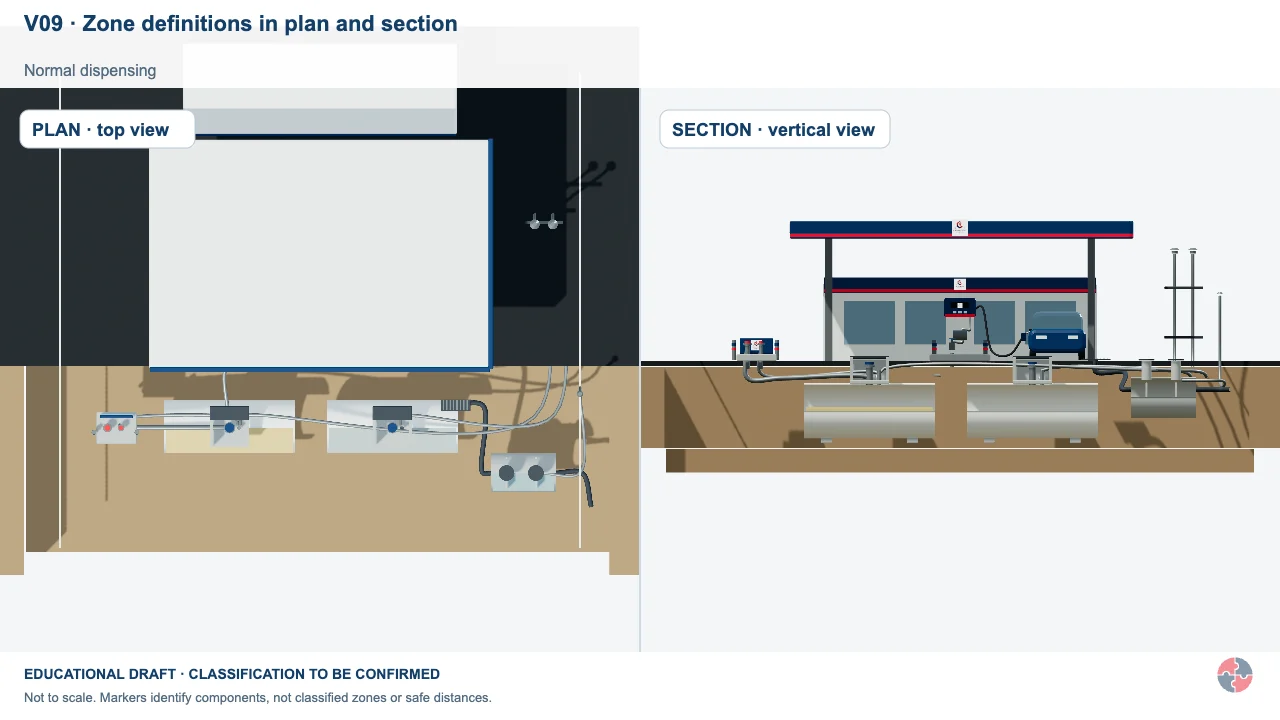

Zone definitions in plan and section
Explore gas/vapour Zone 0, Zone 1 and Zone 2 in three dimensions using the selectable petrol/air teaching overlays.
Activity focus: Select each zone, show all three, then compare perspective, plan and section.
Contextual illustration. The image alone does not establish equipment state, effective controls, individual health or authorisation; use the task-specific checks and competent evidence.
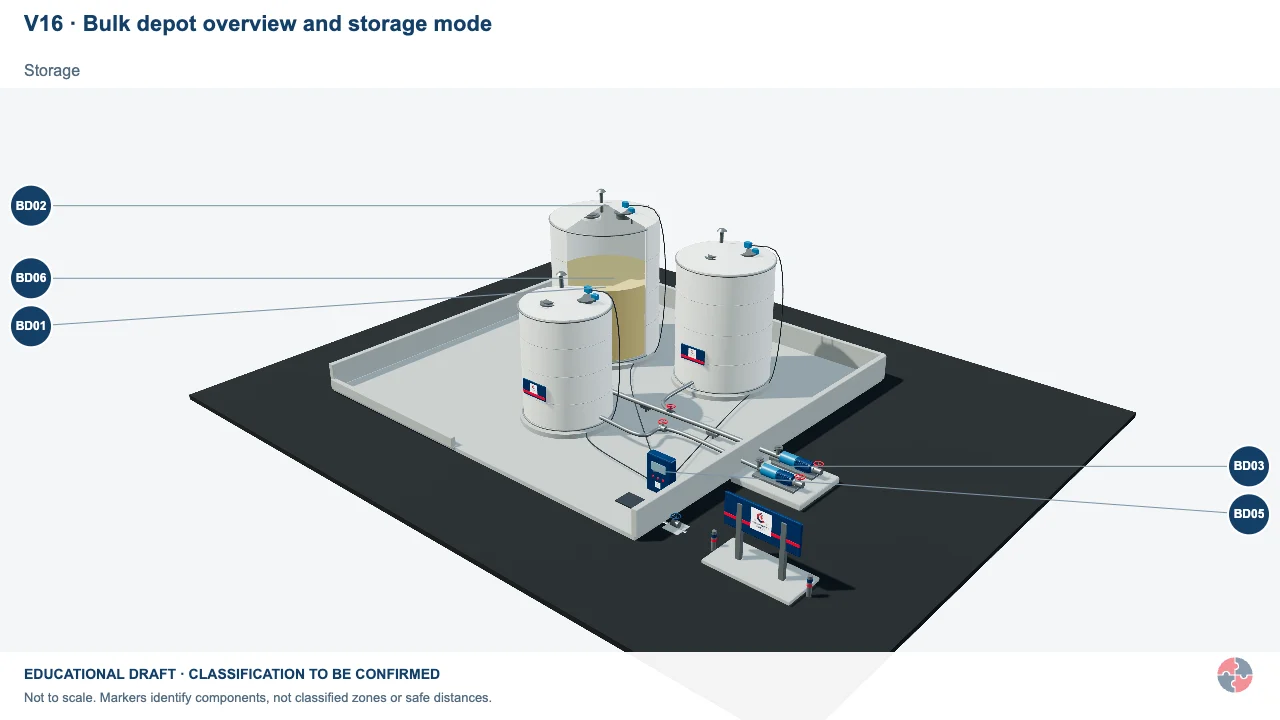
Bulk depot overview and storage mode
Explore the bulk depot system and compare selectable Zone 0, Zone 1 and Zone 2 teaching volumes around its petrol example.
Activity focus: Use cutaway for the internal vapour spaces, then compare the rounded vent, pump and mode-dependent connection envelopes.
Contextual illustration. The image alone does not establish equipment state, effective controls, individual health or authorisation; use the task-specific checks and competent evidence.
Educational illustration, not to scale. Coloured zones are teaching examples, not a site-specific hazardous-area classification.
What do the acronyms and key terms mean?
Use these terms to explain a work decision, not as proof that a control is effective.
| Term | Expansion | Meaning for this topic |
|---|---|---|
| DSEAR | Dangerous Substances and Explosive Atmospheres Regulations | GB 2002 and NI 2003 instruments are separate. |
| SDS | Safety data sheet | Hazard input; not a site-specific release assessment. |
| LFL | Lower flammable limit | Concentration below which flame propagation is not sustained under defined conditions. |
| Hazardous area | Place requiring special precautions due to possible explosive atmosphere | Classify only after analysing release and controls. |
| Ignition source | Energy able to ignite the atmosphere | Include electrical, mechanical, static and hot surfaces. |
| LEL | Lower explosive limit | Approximate lower concentration for flame propagation under defined test conditions; not proof of workplace safety. |
| UEL | Upper explosive limit | Approximate upper concentration boundary; dilution or air ingress can move a mixture through the flammable range. |
| ATEX | Equipment and workplace explosive-atmosphere framework | Check equipment suitability for the assessed zone; do not infer zone from a product label. |
| MOC | Management of change | Reassess substances, releases, ventilation, zoning and equipment after change. |
| RAMS | Risk assessments and method statements | Task method records do not replace the DSEAR substance and atmosphere assessment. |
| COSHH | Control of Substances Hazardous to Health | Health-exposure route, distinct from DSEAR fire and explosion safety. |
| VCE | Vapour cloud explosion | Ignition of a flammable vapour cloud; assess release, travel, ignition and confinement. |
| TExT | Thorough examination and test | For local exhaust ventilation where applicable; confirm the specific control and legal test route. |
| LPG | Liquefied petroleum gas | Flammable gas example requiring release, storage and ignition assessment. |
| HSE hierarchy | Elimination, substitution, engineering controls, administrative controls, then PPE | A source-first order for choosing workplace controls; keep higher-order measures ahead of instructions or PPE. |
| PSI | Process safety information | Substance, plant and operating information that supports a defensible scenario. |
| PSM | Process safety management | Framework for managing major process hazards and barriers; not a certificate of safe plant. |
| ERICPD | Eliminate, Reduce, Isolate, Control, Personal Protective Equipment, Discipline | Compare source removal and substitution with engineered separation before work rules or PPE; Discipline means checking that stronger controls keep working. |
Which Crownway Fuels documents support this topic?
Open an editable document, read the preview, or find its place in the Crownway hierarchy. 18 resources relate to this page.
Fictional Crownway Fuels examples for English forecourts, with a separate illustrative bulk terminal. Check site applicability, permissions and actual controls before adapting any document for use.
Dangerous substances and explosive atmospheres policy (8)
- Dangerous substances and explosive atmospheres policy (CWF-POL-DSEAR · Completed fictional example)
Set company expectations, responsibilities and resources for dangerous substances and explosive atmospheres.
Read preview · Download DOCX · Show in hierarchy - Dangerous substances and explosive atmospheres procedure (CWF-PRO-DSEAR · Completed fictional example)
Explain who does what, in what sequence, the control rationale, evidence, escalation and safe restart conditions.
Read preview · Download DOCX · Show in hierarchy - Site specific DSEAR assessment (CWF-RA-DSEAR-01 · Blank editable master)
Provide the site/task-specific site specific dsear assessment and retain its controlled output.
Read preview · Download DOCX · Show in hierarchy - Hazardous area classification drawings and basis (CWF-PLN-DSEAR-01 · Completed fictional example)
Provide the site/task-specific hazardous area classification drawings and basis and retain its controlled output.
Read preview · Download DOCX · Show in hierarchy - Explosion protection measures and verification register (CWF-REG-DSEAR-01 · Blank register with separate fictional worked entries)
Provide the site/task-specific explosion protection measures and verification register and retain its controlled output.
Read preview · Download XLSX · Show in hierarchy - Hazardous area ignition source control check (CWF-CHK-DSEAR-01 · Blank editable master)
Provide the site/task-specific hazardous area ignition source control check and retain its controlled output.
Read preview · Download DOCX · Download PDF · Show in hierarchy - DSEAR assessment change and review record (CWF-FRM-DSEAR-01 · Blank editable master)
Provide the site/task-specific dsear assessment change and review record and retain its controlled output.
Read preview · Download DOCX · Show in hierarchy - Dangerous substance storage compatibility check (CWF-CHK-DSEAR-02 · Blank editable master)
Provide the site/task-specific dangerous substance storage compatibility check and retain its controlled output.
Read preview · Download DOCX · Download PDF · Show in hierarchy
Ten fictional petrol-station DSEAR assessments (10)
- Crownway Alder Road DSEAR assessment (CWF-DSEAR-FS-01 · Completed fictional example)
Worked assessment covering forecourt activities, dangerous substances and controls.
Read preview · Download DOCX · Download PDF · Show related branch - Crownway Birch Cross DSEAR assessment (CWF-DSEAR-FS-02 · Completed fictional example)
Worked assessment covering forecourt activities, dangerous substances and controls.
Read preview · Download DOCX · Download PDF · Show related branch - Crownway Cedar Vale DSEAR assessment (CWF-DSEAR-FS-03 · Completed fictional example)
Worked assessment covering forecourt activities, dangerous substances and controls.
Read preview · Download DOCX · Download PDF · Show related branch - Crownway Elm Park DSEAR assessment (CWF-DSEAR-FS-04 · Completed fictional example)
Worked assessment covering forecourt activities, dangerous substances and controls.
Read preview · Download DOCX · Download PDF · Show related branch - Crownway Hazel Hill DSEAR assessment (CWF-DSEAR-FS-05 · Completed fictional example)
Worked assessment covering forecourt activities, dangerous substances and controls.
Read preview · Download DOCX · Download PDF · Show related branch - Crownway Willow Gate DSEAR assessment (CWF-DSEAR-FS-06 · Completed fictional example)
Worked assessment covering forecourt activities, dangerous substances and controls.
Read preview · Download DOCX · Download PDF · Show related branch - Crownway Northway Services DSEAR assessment (CWF-DSEAR-FS-07 · Completed fictional example)
Worked assessment covering forecourt activities, dangerous substances and controls.
Read preview · Download DOCX · Download PDF · Show related branch - Crownway Eastgate Travel Stop DSEAR assessment (CWF-DSEAR-FS-08 · Completed fictional example)
Worked assessment covering forecourt activities, dangerous substances and controls.
Read preview · Download DOCX · Download PDF · Show related branch - Crownway Westmere Services DSEAR assessment (CWF-DSEAR-FS-09 · Completed fictional example)
Worked assessment covering forecourt activities, dangerous substances and controls.
Read preview · Download DOCX · Download PDF · Show related branch - Crownway Southbank Travel Stop DSEAR assessment (CWF-DSEAR-FS-10 · Completed fictional example)
Worked assessment covering forecourt activities, dangerous substances and controls.
Read preview · Download DOCX · Download PDF · Show related branch
Unlock another resource
You have used this month’s two free downloads. Publish a post in your own words to unlock one more resource, or choose SHARE Individual for 10 downloads per month.
You decide whether to share. If you do, use the relevant platform disclosure tools and do not make claims you do not genuinely hold.