SHARE Knowledge Hub
Simultaneous Operations and Interface Risk
Simultaneous operations, often shortened to SIMOPS, occur when two or more activities happen at the same time in a way that can interact, interfere or change risk. The critical point is that each task may look safe in isolation, but the combination can defeat controls. Hot work near a flammable transfer, lifting over a live process line, pressure testing during maintenance, excavation beside deliveries, scaffold erection beside vehicle routes or software testing during operations can create a risk that no single work party owns unless the organisation deliberately coordinates it. A strong SIMOPS system uses planning, permit coordination, area ownership, interface maps, shift handover, stop-work authority and assurance so separate safe jobs do not combine into an unsafe system.
Understanding Simultaneous Operations and Interface Risk
Simultaneous operations, often shortened to SIMOPS, occur when two or more activities happen at the same time in a way that can interact, interfere or change risk. The critical point is that each task may look safe in isolation, but the combination can defeat controls. Hot work near a flammable transfer, lifting over a live process line, pressure testing during maintenance, excavation beside deliveries, scaffold erection beside vehicle routes or software testing during operations can create a risk that no single work party owns unless the organisation deliberately coordinates it. A strong SIMOPS system uses planning, permit coordination, area ownership, interface maps, shift handover, stop-work authority and assurance so separate safe jobs do not combine into an unsafe system.
Why this matters at work
At an outage start, the site manager assesses actual high consequence decisions, shared isolations and field checking demand. Stagger starts when capacity is inadequate. Link supporting isolation certificates and task information, identify authorisation roles, and tell affected teams about restrictions. Sample a busy period by tracing a live permit from the register to field controls and worker understanding. Count quality and unresolved interfaces, rather than rewarding rapid paper issue. Role titles may vary; responsibilities and authority must be clear.
Make the practical stop route usable by any affected worker: bring the task to its planned safe state if possible without further exposure, notify the coordinator and all dependent teams, and preserve necessary restrictions. For live danger use the emergency arrangements immediately. Do not wait for a meeting, copied permit or matrix recolouring to establish actual control.
How organisations manage this in practice
The project and operating authorities agree system by system control transfer, physical boundaries, new energy/inventory state, permitted work and unresolved items. Treat first energisation, flushing, pressure testing and control cause/effect testing as changes that can affect others. Stop incompatible jobs, verify people and plant readiness, then release each bounded stage with current drawings and communications.
The outgoing team updates actual live/suspended work, shared isolations, tests, impairments, abnormal trends, restrictions and next decisions before transfer. The incoming team checks critical items against plant, field, permits and responsible people. Include contractor and specialist authorities. If accounts conflict, maintain restrictions and resolve one verified state before accepting control. Attendance or a log signature does not establish understanding.
A useful local register records task/permit identifiers, employer and supervisor, equipment and location, operating mode, time window, live or suspended state, shared isolation/utility, affected people, emergency dependency, conditions, stop triggers and next owner. The coordinator checks field changes against this view before issue and after any alteration. An unlisted cleaning, delivery or alarm test can be as consequential as a formally permitted job.
Map the shared release and ignition pathway
Two individually planned jobs may create a new hazard together. Map the line-opening task, proposed hot work, ventilation and escape interfaces, then resequence before relying on extra paperwork.

Job A and Job B
Identify the actual boundaries, substances, energy, work windows and people for both jobs. Do not assess each permit as if the other activity did not exist.
Shared pathway
Consider release and ignition routes, intakes, adjacent spaces, access and escape. The plan gives no safe radius or validated dispersion boundary.
Resequence first
Consider avoiding the overlap or changing the method before accepting concurrent work. Check that the revised timing does not transfer risk into handover or restoration.
Area authority
Use the designated coordinating authority, combined work map and linked control arrangements. Reconcile inventory, isolation, impairment and permit evidence.
Change: hold affected jobs
A changed task, release, weather/ventilation condition or uncertainty can require both affected jobs to stop. Make the common stop rule understood across teams.
Restore together
Reconcile work completion, isolations, protective functions and handover before the authorised return to service. Closing two forms does not prove the interfaces are resolved.
Read the complete controls: ERICPD planning prompts
Discipline verifies and sustains all the controls; it is not a separate substitute for them.
| Prompt or level | Complete task-specific example |
|---|---|
| Eliminate | Reschedule work to remove the simultaneous exposure. |
| Reduce | Assess a suitable cold method instead of hot work. |
| Isolate | Prove isolation, contain material and establish effective separation. |
| Control | Coordinate linked permits and changing conditions with both crews. |
| PPE | PPE cannot compensate for an unresolved release and ignition interaction. |
| Discipline | Maintain handover and verify restoration before releasing both jobs. Read the accompanying source table for the framework distinctions. |
Read the complete controls: ESEAP effectiveness order
Compare stronger feasible controls while preserving the actual task, checks and release requirements.
| Prompt or level | Complete task-specific example |
|---|---|
| Elimination | Reschedule work to remove the simultaneous exposure. |
| Substitution | Assess a suitable cold method instead of hot work. |
| Engineering controls | Prove isolation, contain material and establish effective separation. |
| Administrative controls | Coordinate linked permits and changing conditions with both crews. Maintain handover and verify restoration before releasing both jobs. |
| PPE | PPE cannot compensate for an unresolved release and ignition interaction. Read the accompanying source table for the framework distinctions. |
No live hot work beside an uncontrolled release is shown as acceptable. Use the actual process and task-specific authorisation.
How can I practise this topic in 3D?
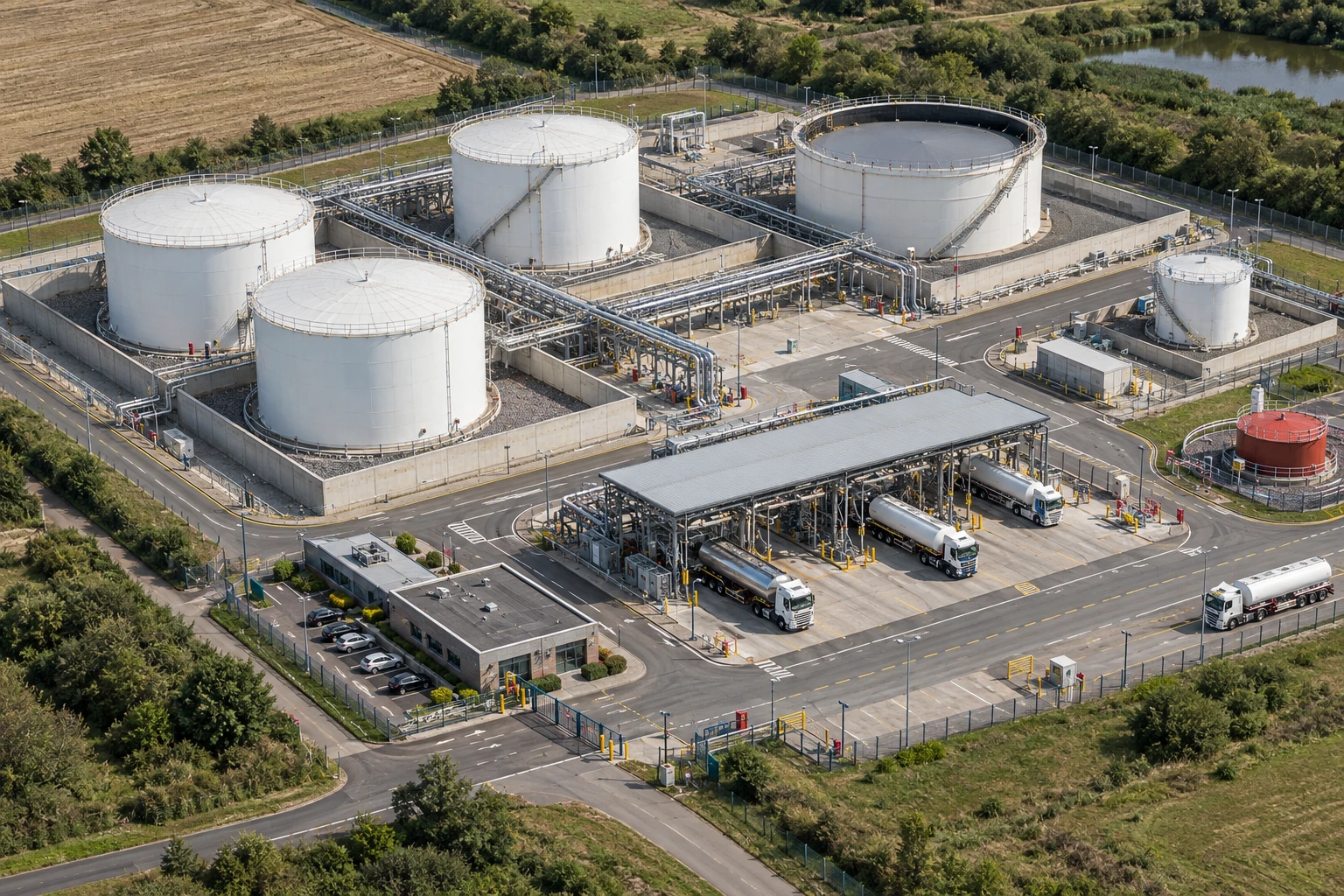

A specialist contractor arrives without interface planning
All related inspection points 6 across 1 location
Crown Fuels terminal 6 inspection points
Practice in the SHAREhub environment. Browser practice is separate from workplace competence and formal learning records.
What are simultaneous operations and interface risks?
Simultaneous operations (SIMOPS) become hazardous when separately planned tasks interact in time or space: one activity can defeat another team’s isolation, access, ventilation or emergency route. Give a named local owner sight of the combined work and authority to hold or sequence tasks when controls conflict.
Best-practice guide: Simultaneous Operations and Interface Risk
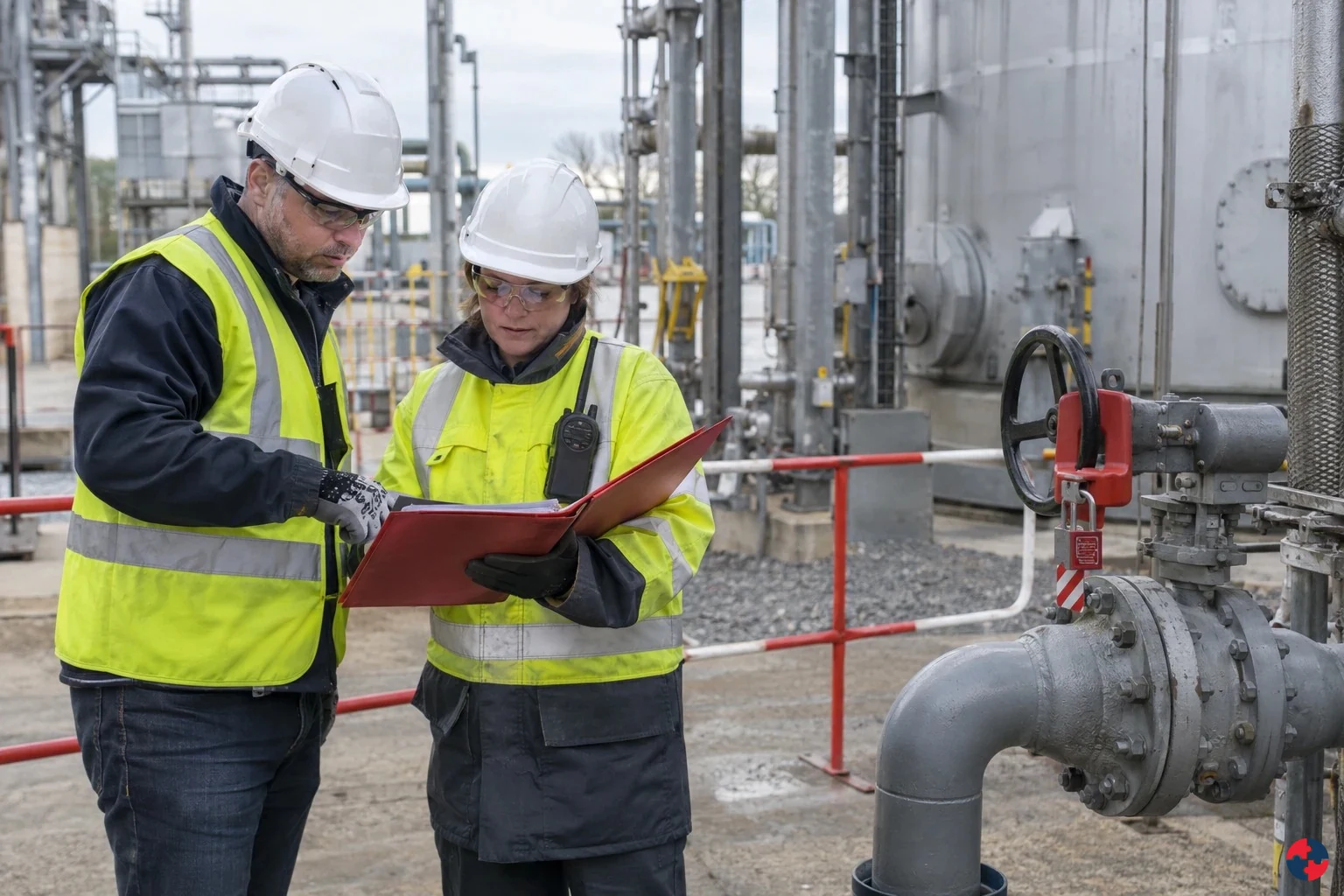
What are simultaneous operations and interface risks?
Simultaneous operations (SIMOPS) become hazardous when separately planned tasks interact in time or space: one activity can defeat another team’s isolation, access, ventilation or emergency route. Give a named local owner sight of the combined work and authority to hold or sequence tasks when controls conflict. Simultaneous operations, often shortened to SIMOPS, occur when two or more activities happen at the same time in a way that can interact, interfere or change risk.
Turn simultaneous operations and interface risk knowledge into a decision
Simultaneous operations, often shortened to SIMOPS, occur when two or more activities happen at the same time in a way that can interact, interfere or change risk. The critical point is that each task may look safe in isolation, but the combination can defeat controls. Keep the combined work map, linked permits, isolation test, shift handover, stop decisions and signed hand-back.
Coordinate hot work and line opening at a process site
Each supervisor briefs the other crew, checks boundary and isolation status and updates the live board when work changes. Close permits only after both crews and operations verify restoration, tests and removal of temporary controls.
Where does SIMOPS control commonly fail?
Failure usually comes from silo planning, too many live permits, weak handover, unclear area ownership or schedule pressure.
Choose controls for simultaneous operations and interface risk
Eliminate: Reschedule work to remove the simultaneous exposure. Reduce: Assess a suitable cold method instead of hot work. Isolate: Prove isolation, contain material and establish effective separation. Control: Coordinate linked permits and changing conditions with both crews. PPE: PPE cannot compensate for an unresolved release and ignition interaction. Read the full control table for qualifications, ownership and verification. Use the actual task and applicable jurisdiction; existing technical approval remains unchanged.
Use the full simultaneous operations and interface risk lesson
Use the full topic for the decision points, practical examples, detailed control tables and source scope. HSE guidance applies to Great Britain; use HSENI for the Northern Ireland route and the source’s stated jurisdiction. A simplified guide does not change the page’s technical-review or approval status.

Read all six steps as text
1. What are simultaneous operations and interface risks?
Simultaneous operations (SIMOPS) become hazardous when separately planned tasks interact in time or space: one activity can defeat another team’s isolation, access, ventilation or emergency route.
- Avoid / redesign: Reschedule work to remove the simultaneous exposure.
- Control the task: Prove isolation, contain material and establish effective separation.
- Verify before release: Read the full task example, checks and stop points on this page.
Simultaneous operations (SIMOPS) become hazardous when separately planned tasks interact in time or space: one activity can defeat another team’s isolation, access, ventilation or emergency route. Give a named local owner sight of the combined work and authority to hold or sequence tasks when controls conflict. Simultaneous operations, often shortened to SIMOPS, occur when two or more activities happen at the same time in a way that can interact, interfere or change risk.
Apply it: Which part of this plan would you check at the workface before authorising the task?
2. Turn simultaneous operations and interface risk knowledge into a decision
Use the evidence to improve the actual work arrangement.
- Change at source: Reschedule work to remove the simultaneous exposure.
- Make it observable: Read the full task example, checks and stop points on this page.
- Keep useful evidence: Keep the combined work map, linked permits, isolation test, shift handover, stop decisions and signed hand-back.
Simultaneous operations, often shortened to SIMOPS, occur when two or more activities happen at the same time in a way that can interact, interfere or change risk. The critical point is that each task may look safe in isolation, but the combination can defeat controls. Keep the combined work map, linked permits, isolation test, shift handover, stop decisions and signed hand-back.
Apply it: What evidence would show that the change improves this task, rather than only completing a record?
3. Coordinate hot work and line opening at a process site
Example: a practical application of the existing topic lesson.
- Setting: A contractor opens a line for maintenance while another crew plans welding nearby; operators and emergency responders may also enter the area.
- Act: The area authority maps work windows, checks inventory and isolation, links permits, separates crews and confirms rescue and egress routes.
- Hold / review: Stop both affected jobs for a leak, failed isolation, changed scope, overlapping exclusion zones or a blocked escape route.
Each supervisor briefs the other crew, checks boundary and isolation status and updates the live board when work changes. Close permits only after both crews and operations verify restoration, tests and removal of temporary controls.
Apply it: At which point would you hold this example, and what evidence would allow it to proceed?
4. Where does SIMOPS control commonly fail?
Connect the task, the route to the person and the control that can fail.
- Source / exposure: Failure usually comes from silo planning, too many live permits, weak handover, unclear area ownership or schedule pressure.
- Possible consequence: HSE permit guidance identifies weak communication, isolation and handover as permit-system hazards.
- Control failure: Each person may follow their own procedure, but the system does not show the combined state.
Failure usually comes from silo planning, too many live permits, weak handover, unclear area ownership or schedule pressure.
Apply it: Who could be exposed, including other trades, cleaners, maintainers and people nearby?
5. Choose controls for simultaneous operations and interface risk
Start with the stronger practicable options and verify their effect.
- Eliminate: Reschedule work to remove the simultaneous exposure.
- Reduce: Assess a suitable cold method instead of hot work.
- Isolate: Prove isolation, contain material and establish effective separation.
- Control: Coordinate linked permits and changing conditions with both crews.
- PPE: PPE cannot compensate for an unresolved release and ignition interaction.
Eliminate: Reschedule work to remove the simultaneous exposure. Reduce: Assess a suitable cold method instead of hot work. Isolate: Prove isolation, contain material and establish effective separation. Control: Coordinate linked permits and changing conditions with both crews. PPE: PPE cannot compensate for an unresolved release and ignition interaction. Read the full control table for qualifications, ownership and verification. Use the actual task and applicable jurisdiction; existing technical approval remains unchanged.
Apply it: Which stronger option can be used here, and who will verify it before accepting the remaining risk?
6. Use the full simultaneous operations and interface risk lesson
Follow the official sources below and retain the task-specific evidence.
- Official guidance: HSE permit guidance
- Official guidance: HSE hierarchy of controls
- Task decision: Keep the combined work map, linked permits, isolation test, shift handover, stop decisions and signed hand-back.
Use the full topic for the decision points, practical examples, detailed control tables and source scope. HSE guidance applies to Great Britain; use HSENI for the Northern Ireland route and the source’s stated jurisdiction. A simplified guide does not change the page’s technical-review or approval status.
Apply it: Which official source and full-topic section will you use to resolve the next decision?
HSE permit guidance explains how linked permits, isolation and handover should support the combined work plan.
The basic SIMOPS lesson is that risk belongs to the system, not only to individual tasks. A hot-work permit may be sound, and a tanker transfer may be sound, but if they occur close together the ignition and vapour release scenarios interact. A scaffold may be erected safely, and a forklift route may be controlled, but together they may block escape, sightlines or emergency access.
Interface risk is especially important during shutdowns, turnarounds, projects, construction, maintenance, live operations, contractor work and abnormal plant states. These are periods where the organisation may have more people on site, more permits open, more temporary controls, more handovers and more schedule pressure.
Good SIMOPS control gives one person or team enough visibility and authority to coordinate the area. It should show who owns the plant state, what work is live, what controls could be affected, what must not happen at the same time and what stops the work.
| Concept | Meaning | Practical consequence |
|---|---|---|
| Simultaneous operations | Two or more activities occur at the same time where they may interact. | Assess combined risk, not only individual permits. |
| Interface risk | Risk created at the boundary between teams, tasks, plant areas, contractors or phases. | Clarify ownership, communication and control handover. |
| Area authority | Person or role controlling the work area and plant state. | Needs visibility of all permits and operations. |
| Permit clash | One permit undermines another permit's assumptions or controls. | Use permit board, clash review and sequencing. |
| Plant state | Actual operating, isolated, drained, live, bypassed, open or temporary condition. | Confirm before work starts and at handover. |
| Weak signal | Small sign that the interface is not controlled. | Treat confusion, blocked routes and conflicting instructions as early warnings. |
Area authority is the local title used in this page’s examples. HSE requires clear responsibilities and linked work communication; the organisation decides the title, boundaries and delegated authority. HSE roles and permit interfaces.
How should SIMOPS be controlled through the work lifecycle?
SIMOPS control should identify possible interactions before work starts, coordinate live work and verify safe handback.
HSG250 calls for special attention to combined operations and contractor interfaces.
A SIMOPS review should happen early enough to change the plan. If the first clash review happens when workers are waiting at the job, the organisation has already lost many control options. Planning should identify overlapping activities, plant status, contractors, isolations, emergency routes, ignition sources, lifting zones, vehicle routes, alarms, testing and temporary systems.
During work, the system needs live coordination. Permits, shift logs, control-room status, site maps, contractor plans and supervisor briefings should describe the current plant and work state. At handback, the organisation must confirm that temporary arrangements, tools, isolations, guards, barriers, drains, blinds, alarms and people are addressed before normal operation resumes.
| Lifecycle stage | Control question | Evidence |
|---|---|---|
| Identify | What activities could overlap and interact? | SIMOPS register, project plan and work schedule. |
| Screen | Could one job affect another job's controls, escape, access, ignition, isolation or plant state? | Interface risk screen or permit clash review. |
| Plan | Can work be separated, sequenced, isolated, supervised or redesigned? | SIMOPS plan, area map and control standard. |
| Authorise | Who has authority to approve, hold, suspend or cancel work? | Permit approval, area authority and escalation route. |
| Coordinate | Are live permits, operations and changes visible to everyone who needs them? | Permit board, shift handover and briefing records. |
| Monitor | Have conditions changed during the shift? | Supervisor rounds, control-room log and weak-signal reports. |
| Handback | Is the area or plant safe to return to normal state? | Close-out, reinstatement and readiness confirmation. |
The lifecycle table is an illustrative local implementation of combined-operation planning and hand-back. Direct coordination context.
How can two safe jobs combine into one unsafe situation?
A worked fuel-terminal example shows how separate permits can interact and defeat fire, isolation and emergency controls.
Coordinate hot work and line opening at a process site
Task material and setting: A contractor opens a line for maintenance while another crew plans welding nearby; operators and emergency responders may also enter the area.
People and prerequisites: The operations area authority owns the combined plan; contractor supervisors, permit issuer and isolating authority confirm their boundaries before either crew starts.
Before: The area authority maps work windows, checks inventory and isolation, links permits, separates crews and confirms rescue and egress routes.
During: Each supervisor briefs the other crew, checks boundary and isolation status and updates the live board when work changes.
Hold or stop: Stop both affected jobs for a leak, failed isolation, changed scope, overlapping exclusion zones or a blocked escape route.
Completion and hand back: Close permits only after both crews and operations verify restoration, tests and removal of temporary controls.
Evidence: Keep the combined work map, linked permits, isolation test, shift handover, stop decisions and signed hand-back.
A fuel terminal plans routine tanker loading, valve maintenance on a nearby line, scaffold erection beside a pump house and hot work in a workshop at the edge of the operating area. Each job has a separate assessment. The loading operation controls overfill and earthing. The maintenance permit controls isolation. The scaffold permit controls work at height. The hot-work permit controls ignition in its immediate area.
The combined picture is different. The scaffold blocks emergency access. Maintenance creates a temporary drain route. The hot-work boundary is close to vapour movement from a changed wind direction. A tanker delay pushes loading into the same time window as the maintenance handover. A strong SIMOPS review would sequence the work, define exclusion zones, check drains and vapour routes, coordinate permits, confirm emergency access and give the area authority a clear stop rule.
| Interaction | Weak control | Stronger SIMOPS control |
|---|---|---|
| Loading and hot work | Permits assessed separately. | Combined ignition/release review, separation or time sequencing. |
| Maintenance and tanker movement | Vehicle route crosses maintenance exclusion. | Route plan, barrier, banksman and permit hold point. |
| Scaffold and emergency access | Scaffold placed where convenient. | Emergency route protected and temporary layout approved. |
| Drain/vent route | Temporary drain assumed safe. | Drain isolation, spill control and vapour path checked. |
| Shift handover | Each team briefs only its own work. | Area handover covers all live work and plant state. |
| Schedule pressure | Work continues because all permits are signed. | Area authority can suspend work when combined risk changes. |
The terminal table illustrates interactions to assess. Its route, drain and exclusion choices require competent local verification; HSG250 supports combined-operation coordination, not approval of this scenario. Direct coordination context.
What should a SIMOPS risk matrix or map show?
A SIMOPS map should show activities, locations, timings, controls, owners and interaction rules.
HSG250 explains why the interaction between operations must be assessed, as well as each task in isolation.
A good SIMOPS matrix is not just a colourful schedule. It is a risk-control tool that makes interactions visible. It should help an area authority see which jobs can run together, which need sequencing and which must stop if another activity starts.
The matrix should be used with field verification. A map that shows no clash is useless if the scaffold, hose route, crane radius, isolation boundary or emergency access is different on site.
| Field | Why it matters | Example |
|---|---|---|
| Activity | Defines what work is actually being done. | Hot work, line break, lifting, transfer, testing or scaffold. |
| Location | Shows physical overlap and access conflict. | Pump bay, loading rack, control room or roof area. |
| Time window | Identifies simultaneous or sequential work. | Day shift, night shift, permit validity and handover. |
| Hazard interaction | Shows how tasks can combine. | Ignition near vapour, lift over live line, blocked escape. |
| Critical controls | Identifies controls that must remain healthy. | Isolation, gas testing, barriers, ESD access, fire watch. |
| Owner | Prevents gaps between teams. | Area authority, permit issuer, contractor supervisor. |
| Stop rule | Defines when work must pause. | Gas alarm, route blocked, plant state changed, permit conflict. |
These map fields are local design prompts. HSE supports communicating relevant controls and linking interdependent permits; it does not prescribe this exact matrix. Direct coordination context.
Three-job decision: line opening versus hot work — PROHIBITED overlap while a credible flammable release path exists; area authority holds both pending verified safe sequencing. Line opening versus lift/access occupation — CONDITIONAL only after the isolation boundary and protected emergency access are verified. Hot work versus lift/access occupation — HOLD if the lift obstructs escape or the watch/check locations. Record each job’s live/suspended status, shared route/isolation, decision owner and recheck event. A remote job can still remove the shared emergency route; a coloured matrix cell is never permission.
How should permits and SIMOPS be connected?
Permits should communicate live work, plant state and interactions, not just authorise isolated tasks.
HSE permit guidance calls for linked permits when separate jobs affect one another.
HSE emphasises that a permit does not make a job safe by itself. It is a communication and coordination tool. For SIMOPS, that means permit issuers and area authorities must see related permits and consider simultaneous tasks and interdependent activities.
A permit board, electronic permit view or control-room display should show live, suspended and closed work clearly. It should also show isolations, bypasses, alarms, emergency restrictions and handover notes that could affect other work.
| Permit element | SIMOPS question | Evidence |
|---|---|---|
| Scope | Could this job affect another task or operation? | Job boundary and clash review. HSE |
| Isolation | Does isolation change plant state for others? | Isolation certificate and area briefing. HSE |
| Gas testing | Could atmosphere change due to another job? | Test frequency and monitoring logic. HSE |
| Fire watch | Could another operation introduce fuel or vapour? | Area review and stop rule. HSE |
| Shift extension | Will work continue into a new shift or different operation? | Revalidation and handover. HSE |
| Close-out | Is the area safe for other work or normal operation? | Handback and reinstatement evidence. HSE |
What should a live SIMOPS board show?
A live SIMOPS board should make the current work picture visible enough for an area owner to spot clashes and stop work.
HSE permit guidance covers communication and handover as the work changes.
A SIMOPS board can be physical, electronic or part of a permit system, but it must show more than permit numbers. It should tell the area authority what is happening now, what plant state is assumed, which isolations and impairments are live, where people are working, which emergency routes must stay clear and what conditions would force work to pause.
The board should be reviewed at shift start, after plant-state changes, when a new permit is requested, when emergency controls are impaired and during handover. If the board is out of date, the work picture is out of control.
| Board field | What it should show | Stop or escalation trigger |
|---|---|---|
| Active and suspended permits | Permit number, job scope, location, performing authority and expiry. | Permit scope overlaps with another job or is not revalidated. |
| Plant state | Running, shutdown, depressurised, isolated, bypassed, under test or ready for restart. | Plant state differs from the permit assumption. |
| Isolations and line breaks | Isolation certificates, lock boxes, blinds/spades, drains, vents and break points. | Isolation boundary unclear or affected by another task. |
| Alarms, trips and impairments | Bypassed alarms, inhibited trips, failed gas detection or fire-system impairment. | Safety-critical impairment conflicts with work or occupancy. |
| Area owner | Named person with authority to sequence, suspend or stop work. | No single person has the whole work picture. |
| Emergency routes and muster | Escape routes, access roads, fire points, hydrants and muster areas. | Route blocked by scaffold, lift, vehicle, hose or excavation. |
| Conflicts and hold points | Known clashes, sequence rules and jobs that cannot run together. | New job introduces ignition, load, pressure, access or communication conflict. |
The board fields are examples for making the live work visible, selected against the site’s actual hazards and permit system. Direct coordination context.
A suspended line-opening job can retain live isolations and constrain a nearby job or shared emergency route. Keep its status and linked isolation on the board; revalidation or reissue requires the defined authority and evidence before restart. Pausing work does not release the isolation.
Who owns SIMOPS control?
SIMOPS needs clear accountability because interface risk often sits between normal job owners.
The GB Management Regulations require employers sharing a workplace to cooperate and coordinate; the area-authority title is a local management choice.
SIMOPS fails when everyone owns a slice but no one owns the whole picture. The performing authority may understand their task, the operator may understand the plant, the contractor may understand their method and the project planner may understand the schedule, but the interaction still needs a single coordination process.
Accountability should make authority explicit. The person expected to coordinate SIMOPS must be able to delay, sequence, suspend or stop work where the combined risk is not controlled.
| Role | Responsibility | Good evidence |
|---|---|---|
| Area authority | Maintains visibility of plant state and live work in the area. | Permit board, SIMOPS map and workface checks. |
| Permit issuer | Checks job scope, controls, interactions and authorisation. | Permit cross-reference and verification record. |
| Performing authority | Confirms workforce, method and stop conditions. | Acceptance, briefing and worksite inspection. |
| Operations/control room | Controls plant status, alarms, bypasses and operational changes. | Shift log and plant-state communication. |
| Contractor supervisor | Manages contractor team and interfaces. | Induction, RAMS, permit compliance and communication. |
| HSE/process safety adviser | Samples system quality and major accident barrier impact. | Audit, weak-signal review and action close-out. |
| Senior manager | Resolves schedule/resource conflict and risk acceptance. | Escalation decisions and management review. |
These role titles and records are an illustrative allocation. The law requires employers to cooperate and coordinate; it does not prescribe every title in the table. Direct coordination context.
What does major accident learning teach about SIMOPS?
Major accidents show that permit status, plant state, communication and interface control can be fatal weak points.
HSG250 describes combined operations as an interface needing special attention.
The lesson from major accidents is not that one person forgot one thing. It is that information, assumptions and authority can become fragmented across shifts, teams and work packages. Maintenance status, isolation quality, operating condition and emergency command need to be clear before work continues.
For learners, SIMOPS is a practical example of organisational failure: the system creates a situation where people act locally rationally but the combined risk becomes unacceptable.
| Learning point | How it appears | Control implication |
|---|---|---|
| Permit status unclear | One shift does not know which equipment is under maintenance. | Live permit board and robust handover. |
| Isolation assumption | Plant believed isolated but energy or inventory remains. | Independent verification and isolation records. |
| Emergency command conflict | Multiple teams unsure who is in control. | Defined command and escalation route. |
| Schedule pressure | Work continues despite changing conditions. | Stop-work authority and senior support. |
| Control degradation | Bypasses or impairments accepted during busy periods. | Impairment register and operating restrictions. |
| Contractor interface | Contractor work affects process controls or escape. | Bridging arrangements and site supervision. |
The table draws general organisational lessons from permit guidance; it is not a finding attributed to a named accident investigation. Direct coordination context.
How does SIMOPS apply outside process plants?
Construction, refurbishment, logistics, utilities and events can all create interface risk where work overlaps.
The GB Management Regulations require coordination across employers; agree local roles for shared work areas.
SIMOPS is not only a refinery or offshore concept. A construction project can have lifting, excavation, hot works, temporary electrics, deliveries, scaffold alterations, public access and emergency-route changes happening together. A facilities team can have cleaners, contractors, deliveries and public users sharing the same building.
The language may change, but the control logic is the same: map overlapping work, identify interactions, assign area ownership, sequence work, brief the people affected and stop when conditions change.
| Setting | SIMOPS conflict | Control |
|---|---|---|
| Construction site | Crane lift over excavation team. | Lift exclusion, sequence change and supervisor coordination. |
| Refurbishment | Hot work while fire stopping is incomplete. | Fire plan review, permit hold point and temporary precautions. |
| Warehouse | Maintenance MEWP in live forklift aisle. | Route closure, barriers and traffic plan. |
| Hospital/leisure premises | Contractor work blocks escape route during public use. | Phasing, temporary route and responsible-person approval. |
| Utilities street works | Excavation, traffic, lifting and public interface overlap. | Permit, traffic management and site supervisor control. |
| Event venue | Build, deliveries, public arrival and emergency access conflict. | Event control room, zone map and stop triggers. |
The sector table illustrates coordination decisions. Lifting, traffic, fire and street-work controls require their own competent assessment and applicable duties; the general coordination law alone does not specify these methods. Direct coordination context.
Transfer the terminal example to a public leisure building: a contractor’s lift or temporary work area may conflict with deliveries, public access or escape. The building manager and contractor supervisor agree work windows and physical boundaries, check the actual routes and stop the affected activity when the agreed boundary fails. A process plant also requires current inventory, isolation and operating status. The common lesson is ownership of combined work; the site-specific controls must be selected separately. HSE coordination and work boundaries.
How can the hierarchy of controls prevent conflicting activities and simultaneous-operation risks?
Remove or reduce the hazard before relying on procedures or personal protection.
For simultaneous operations and interface risk, assess the actual task and first look for a way to remove the hazard. Where that is not possible, consider a safer substitute, engineered separation and then clear work procedures. PPE protects against remaining exposure; it does not make an uncontrolled task safe. HSE hierarchy of controls
The selected measures need a named owner, a usable stop point and a check that they still work when the task or conditions change. In Northern Ireland, verify the separate legal route and site instructions.
For hot work beside line opening, remove the simultaneous exposure by rescheduling one job where practicable. Consider a suitable cold method, prove isolation and contain hazardous material, then establish effective separation and linked permits. PPE and a signed permit cannot compensate for an unresolved release-and-ignition interaction. The locally assigned area owner holds both jobs when the combined conditions change and verifies restoration with both crews. ERICPD (Eliminate, Reduce, Isolate, Control, PPE, Discipline) is a teaching prompt; Discipline means supervision, handover and continued verification. HSE permit coordination; HSE isolation and reinstatement.
How can the ERICPD hierarchy of controls prevent conflicting activities and simultaneous-operation risks?

| ERICPD control level | Topic-specific example | Source and full task context |
|---|---|---|
| Eliminate | Reschedule work to remove the simultaneous exposure. | Read the full task example, checks and stop points on this page. HSE hierarchy of controls · HSE permit coordination · HSE isolation and reinstatement |
| Reduce | Assess a suitable cold method instead of hot work. | Read the full task example, checks and stop points on this page. HSE hierarchy of controls · HSE permit coordination · HSE isolation and reinstatement |
| Isolate | Prove isolation, contain material and establish effective separation. | Read the full task example, checks and stop points on this page. HSE hierarchy of controls · HSE permit coordination · HSE isolation and reinstatement |
| Control | Coordinate linked permits and changing conditions with both crews. | Read the full task example, checks and stop points on this page. HSE hierarchy of controls · HSE permit coordination · HSE isolation and reinstatement |
| PPE | PPE cannot compensate for an unresolved release and ignition interaction. | Read the full task example, checks and stop points on this page. HSE hierarchy of controls · HSE permit coordination · HSE isolation and reinstatement |
| Discipline | Maintain handover and verify restoration before releasing both jobs. | Read the full task example, checks and stop points on this page. HSE hierarchy of controls · HSE permit coordination · HSE isolation and reinstatement |
How can the ISO 45001 hierarchy of controls prevent conflicting activities and simultaneous-operation risks?

| Five-level control stage(s) | Topic-specific example | Source and full task context |
|---|---|---|
| Elimination | Reschedule work to remove the simultaneous exposure. | Read the full task example, checks and stop points on this page. HSE hierarchy of controls · HSE permit coordination · HSE isolation and reinstatement |
| Substitution | Assess a suitable cold method instead of hot work. | Read the full task example, checks and stop points on this page. HSE hierarchy of controls · HSE permit coordination · HSE isolation and reinstatement |
| Engineering controls | Prove isolation, contain material and establish effective separation. | Read the full task example, checks and stop points on this page. HSE hierarchy of controls · HSE permit coordination · HSE isolation and reinstatement |
| Administrative controls | Coordinate linked permits and changing conditions with both crews. | Read the full task example, checks and stop points on this page. HSE hierarchy of controls · HSE permit coordination · HSE isolation and reinstatement |
| PPE | PPE cannot compensate for an unresolved release and ignition interaction. | Read the full task example, checks and stop points on this page. HSE hierarchy of controls · HSE permit coordination · HSE isolation and reinstatement |
| Administrative controls | Maintain handover and verify restoration before releasing both jobs. | Read the full task example, checks and stop points on this page. HSE hierarchy of controls · HSE permit coordination · HSE isolation and reinstatement |
When should SIMOPS trigger stop work or escalation?
Stop or escalate for unassessed or uncontrolled interactions, conflicting controls, or departure from agreed combined-work conditions, plant state is unclear, permits conflict, emergency controls are compromised or the area authority lacks visibility.
HSE permit guidance supports holding work when the agreed conditions no longer describe the site.
The most important SIMOPS control is permission to stop. If the work no longer matches the plan, if a second task changes the risk, if emergency access is blocked or if the permit board is unclear, continuing because each individual permit is signed is poor risk management.
Escalation should reach someone with authority over the combined work, not only the local task: area authority, operations manager, project manager, permit controller, asset owner, principal contractor or senior leader.
| Trigger | Why it matters | Action |
|---|---|---|
| Two permits affect the same area or system | Controls may interact or conflict. | Complete clash review before work continues. HSE |
| Plant state unclear | Work may be done on live, energised or hazardous equipment. | Stop and verify isolation/status. HSE |
| Emergency route or equipment blocked | Mitigation and escape are compromised. | Restore access or suspend work. HSE |
| Gas alarm, spill, fire alarm or abnormal operation occurs | Assumptions behind permits may no longer be valid. | Suspend affected work and reassess. HSE |
| Shift handover incomplete | Incoming team may not understand live risks. | Revalidate permits and handover plant state. HSE |
| Contractor work moves location | Permit boundary no longer matches work. | Stop, review and reissue or amend authorisation. HSE |
Where does SIMOPS control commonly fail?
Failure usually comes from silo planning, too many live permits, weak handover, unclear area ownership or schedule pressure.
HSE permit guidance identifies weak communication, isolation and handover as permit-system hazards.
SIMOPS failures are often organisational. Each person may follow their own procedure, but the system does not show the combined state. This is why permit boards, area walkdowns, coordination meetings and shift handovers need to describe real work, not just list documents.
A strong review asks: what changed today, who else is working nearby, what control could they defeat, what emergency route could be lost, and who has authority to pause the conflict?
| Failure or weak practice | How it develops | What good looks like |
|---|---|---|
| Siloed permits | Each team reviews only its own job. | Area-level clash review across all live work. HSE |
| Weak handover | Status passed verbally and incompletely. | Written plus verbal handover with incoming confirmation. HSE |
| Permit overload | Authorisers issue too many permits at shift start. | Workload planning and additional competent authorisation. HSE |
| Unclear plant state | Bypasses, isolations or drains not visible. | Plant-state log and physical verification. HSE |
| Emergency access lost | Scaffold, hoses or vehicles block route. | Emergency route checks and layout control. HSE |
| Contractor interface weak | Contractor changes work sequence without area approval. | Supervisor coordination and permit revalidation. HSE |
| Schedule pressure | Clashes accepted to save time. | Senior support for sequencing and stop-work decisions. HSE |
What evidence shows SIMOPS and interface risk are controlled?
Evidence should prove that overlapping work is visible, assessed, coordinated, authorised, monitored and safely handed back.
HSG65 frames evidence around planned controls, implementation, checking and review.
SIMOPS evidence should be live enough to manage the job. A plan from last week may be useful, but the actual test is whether today's permits, plant state, workforce, emergency routes and controls match the plan.
For high-hazard sites, SIMOPS evidence should connect to major accident barriers, process safety indicators, MOC, impairment controls and leadership review.
| Evidence item | What it should show | Assurance question |
|---|---|---|
| Risk assessment or technical assessment | Scope, task, people exposed, route of exposure, existing controls, further controls, owner and review trigger. | Does it match the real work, location, materials, people and abnormal conditions? |
| Action tracker | Action, owner, priority, due date, interim control and close-out evidence. | Are serious-risk actions verified at the workplace before closure? |
| Training and briefing records | Who was trained, what they were trained on, how competence was checked and when refresh is due. | Can people explain the health risk, controls and stop triggers? |
| Inspection and maintenance records | Checks on isolations, permits, access barriers, alarms and other critical interface controls. | Are defects corrected before exposure or interface risk continues? |
| Monitoring and surveillance records | Atmosphere or plant-state monitoring, impaired-barrier status and competent interpretation where relevant. | Are results linked back to control review and work design? |
| Incident, near-miss and concern records | Permit clashes, unexpected releases, blocked routes, failed isolation or other interface weak signals. | Are early warnings investigated before an interacting task causes harm? |
| Management review | Trends, resources, assurance confidence, overdue actions and decisions. | Are leaders reviewing control effectiveness rather than activity counts alone? |
| SIMOPS register or map | Live and planned activities, locations, timings, owners and interactions. | Does it reflect the current workface? |
| Permit board or e-permit view | Live, suspended and closed permits, isolations and handover notes. | Can area authority see conflicts quickly? |
| Plant-state log | Operating, isolated, drained, bypassed, temporary or abnormal status. | Does handover include safety-critical status? |
| Interface meeting record | Decisions on sequencing, segregation and stop triggers. | Were affected teams represented? |
The table gives illustrative management records and checks. Select the programme and evidence for the actual work; a general source does not prescribe every record, role or business arrangement. Direct management or programme context.
How should SIMOPS be assured?
Assurance should test whether the organisation can see and control the combined risk of live work.
HSG65 supports checking whether arrangements work in practice and responding to findings.
First-line assurance is the area authority and supervisors checking real work against the live plan. Second-line assurance samples permits, handovers, interface meetings and field conditions. Third-line or specialist assurance tests whether the system would prevent a major accident during busy shutdown or project conditions.
Good assurance includes stress testing: pick a live permit and ask what other work could affect it, who owns the area, what would stop the job and how handback will be verified.
| Assurance layer | What to test | Example question |
|---|---|---|
| First line | Live work, plant state, access, permits and stop triggers. | Could any work nearby defeat this job's controls? |
| Second line | Permit quality, interface reviews and handover evidence. | Do live permits match the workface and each other? |
| Third line | System design under shutdown/project pressure. | Would the system notice a major permit clash early? |
| Control room/operations | Alarms, bypasses, process state and abnormal conditions. | Are operational changes communicated to work parties? |
| Leadership review | Permit defects, clashes, weak signals and overdue actions. | Are schedule conflicts being escalated and resolved? |
The table gives illustrative management records and checks. Select the programme and evidence for the actual work; a general source does not prescribe every record, role or business arrangement. Direct management or programme context.
Which duties and guidance apply in Great Britain and Northern Ireland?
For work involving several employers, agree who coordinates the shared work and has authority to resolve conflicts before work. GB and Northern Ireland have separate general and management instruments; a permit is a communication and control tool, not an automatic legal clearance or proof that the work is safe.
Select the row for the task and location, and verify materials, people and controls before work.
| Jurisdiction | Route | Direct sources | Decision supported |
|---|---|---|---|
| Great Britain | General duties and coordination | Health and Safety at Work etc. Act 1974; Management of Health and Safety at Work Regulations 1999 | Assess combined risk and coordinate affected employers. |
| Northern Ireland | Separate NI duties and coordination | Health and Safety at Work (Northern Ireland) Order 1978; Management of Health and Safety at Work Regulations (Northern Ireland) 2000 | Use NI instruments and assign an interface owner. |
| Great Britain guidance | Permit interface | Permit-to-work systems; HSG250 Guidance on permit-to-work systems | Link interdependent permits and verify the live work area. |
| Great Britain guidance | Physical isolation | HSG253 The safe isolation of plant and equipment; Permit-to-work systems | Prove isolation before simultaneous work; control hand-back. |
How should management check this work?
Use a defined plan, carry out the controls, check performance and correct what does not work.
For simultaneous operations and interface risk, assign a competent owner to set the work controls, check their use and review them after change, failure or new evidence. HSE managing health and safety
A management-system label or certificate is not approval of a site limit, procedure or individual work decision. Apply GB and NI duties to the correct location.
What should each role learn and demonstrate?
Competence is shown by choosing and checking a control on a real task, recognising failure and acting before harm continues.
HSE supports the control principle. A competent assessor should observe practical performance and revisit it after a relevant change.
| Role | Learning | Demonstration | Assessor record | Reassess when |
|---|---|---|---|---|
| Area authority | Map simultaneous jobs, hazards and boundaries. | Resolve a hot-work/line-opening clash and stop work. | Observed coordination exercise. | At site or activity change. |
| Permit issuer | Link permits and verify isolation and handover. | Reject an unlinked permit. | Permit sample and field check. | At system change. |
| Contractor supervisor | Brief crew and cross-check other work. | Explain shared zone and escalation. | Toolbox observation. | Each new interface. |
| Operator | Know plant state and isolation owner. | Identify an unexpected release or restoration risk. | Shift handover record. | At plant change. |
| Safety adviser | Challenge major-hazard combinations. | Test whether controls survive a changed schedule. | Scenario review. | After near miss. |
How could Crownway Fuels Ltd manage this in practice?

Crownway Fuels Ltd can manage SIMOPS by treating forecourt, depot and terminal maintenance as area-controlled work where deliveries, contractors, hot work, isolation, excavation and public interface are coordinated together.
HSE permit guidance provides a basis for linking permits and checking work in the field.
Fuel environments make SIMOPS especially important because ignition, vapour, vehicle movement, public access and emergency access can interact quickly.
| Management element | How the business would manage it | Evidence to review |
|---|---|---|
| Fuel delivery and maintenance | Do not allow maintenance that conflicts with tanker unloading. | Delivery schedule, permit board and area authority approval. |
| Hot work | Control ignition sources against vapour and drain routes. | DSEAR review, gas test and fire watch. |
| Excavation | Coordinate buried services, vehicle routes and public exclusion. | Permit to dig and traffic plan. |
| Contractors | Brief interface risks and stop triggers. | Induction, RAMS and live permit audit. |
| Handover | Pass plant and work status clearly between shifts. | Shift log and revalidation. |
The table gives illustrative management records and checks. Select the programme and evidence for the actual work; a general source does not prescribe every record, role or business arrangement. Direct management or programme context.
How do fuel deliveries illustrate simultaneous-operations interfaces?
Compare the delivery or transfer state with normal use. Customer access, vehicles and other work need a reviewed arrangement; the scene does not imply they may always continue together.
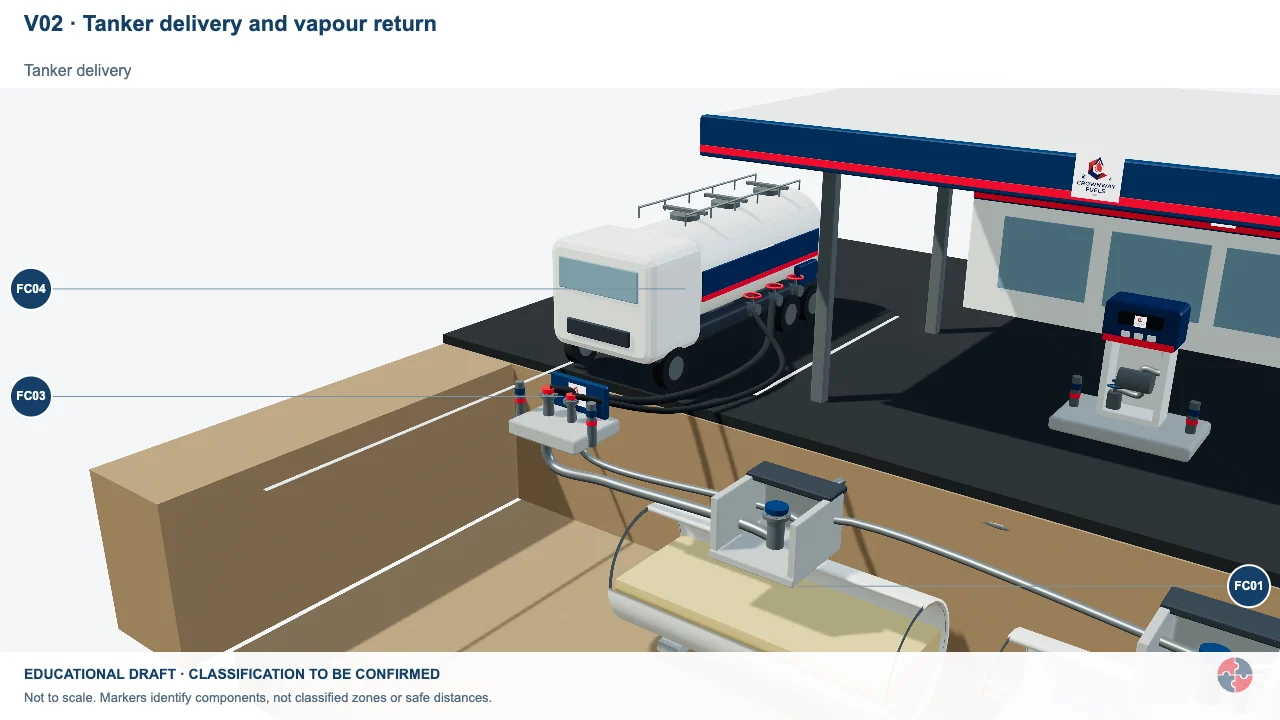
Tanker delivery and vapour return
During the proposed tanker delivery, product enters the receiving tank and displaced vapour returns to the tanker by a separate path. The delivery-hose teaching envelope follows the connected hose route.
Activity focus: Trace the tanker connection, product hose and receiving fill before following the Stage 1b vapour-return path. Inspect the whole delivery working area, including nearby traffic, dispensers and drainage.
Contextual workplace scene. Use the task, control and evidence checks in this section; appearance alone does not establish safe conditions, individual health or approval.
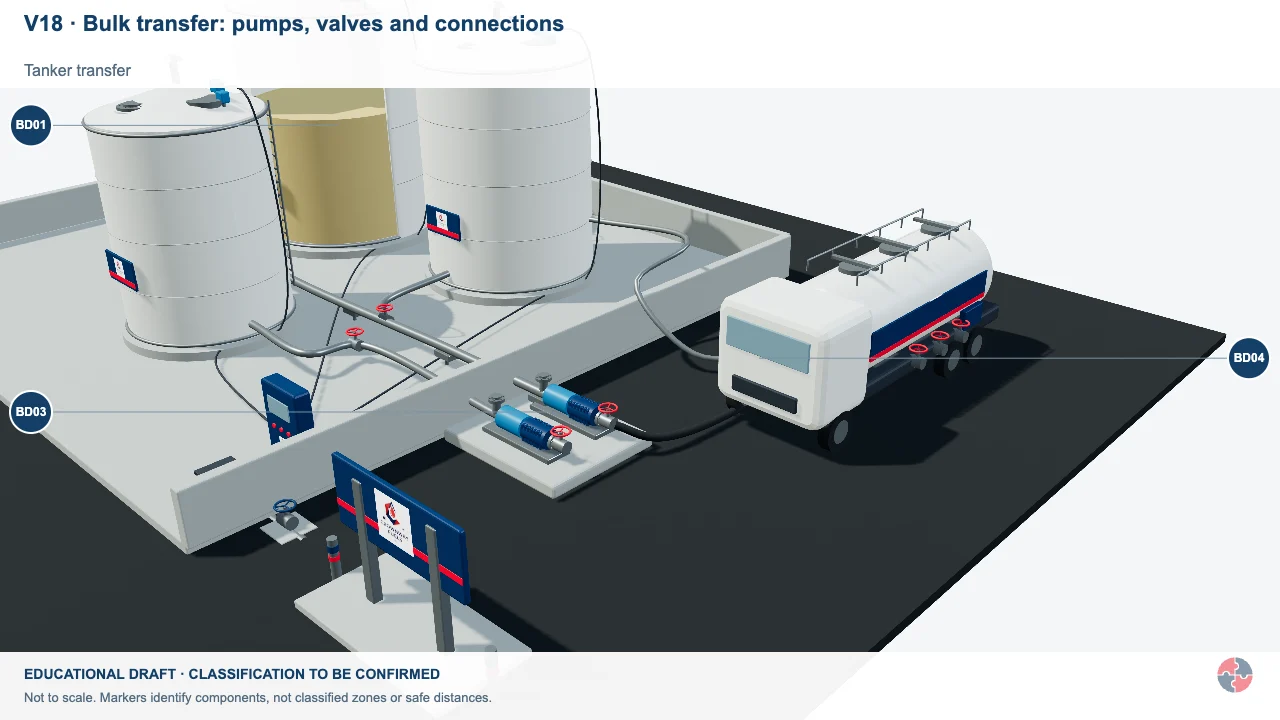
Tanker loading: liquid out, vapour back
Follow petrol from bulk storage into the tanker and the separate displaced-vapour route from the tanker to the terminal VRU.
Activity focus: Distinguish the product line, vapour collection line and tanker-loading protective controls.
Contextual workplace scene. Use the task, control and evidence checks in this section; appearance alone does not establish safe conditions, individual health or approval.
Educational illustration, not to scale. Coloured zones are teaching examples, not a site-specific hazardous-area classification.
What do the acronyms and key terms mean?
These terms clarify the hazard, control and responsibility boundary.
| Term | Meaning | Plain-English use |
|---|---|---|
| SIMOPS | Simultaneous operations | Two or more tasks whose interfaces can change risk. |
| PTW | Permit to work | Controlled communication and authorisation for specified high-risk work. |
| Area authority | Person controlling a defined area | Owns the combined work picture and hold/release decisions. |
| Isolation | Physical separation from hazardous energy or material | Must be designed, applied, tested and handed back. |
| Interface | Shared boundary between work scopes | Includes time, space, equipment, access and emergency response. |
| ERICPD | Eliminate, Reduce, Isolate, Control, PPE, Discipline | Teaching prompt; Discipline means sustaining controls through supervision, maintenance and learning. |
Which BuildOut documents support this topic?
Download individual editable BuildOut documents for this topic. Procedures and plans contain completed arrangements; forms, checklists, assessments, RAMS and permits are blank masters. Registers include separate worked examples.
| Document | Purpose and content | Editable download |
|---|---|---|
| Specialist-work screening and escalation procedure BOUK-PRO-SPEC · Completed worked example · v1.0 | Determine legal triggers and specialist appointments before bidding, mobilisation or scope change. | Download DOCX Read preview |
| Specialist regime and client-site applicability screen BOUK-CHK-SPEC-01 · Blank editable master · v1.0 | Screen for COMAH/client emergency rules, dangerous-goods transport, explosives, pressure systems, lead and ionising radiation. | Download DOCX Read preview |
| Specialist contractor and interface control plan BOUK-PLN-SPEC-01 · Completed worked example · v1.0 | Require competent specialists, permits, design approvals and client/operator coordination. | Download DOCX Read preview |
| Lead and contaminated-coating work assessment BOUK-RA-SPEC-01 · Blank editable master · v1.0 | Assess lead exposure and the need for specialist controls, monitoring and medical surveillance. | Download DOCX Read preview |
| Pressure-system written-scheme and examination evidence index BOUK-REG-SPEC-01 · Blank register with separate worked entries · v1.0 | Verify system scope, competent advice and examinations where the regime applies. | Download XLSX Read preview |
| Dangerous-goods movement and storage interface check BOUK-CHK-SPEC-02 · Blank editable master · v1.0 | Screen classification, quantities, exemptions, packaging and competent transport arrangements. | Download DOCX Read preview |
| Specialist-work authorisation and hold-point record BOUK-FRM-SPEC-01 · Blank editable master · v1.0 | Record evidence that relevant permits, competent appointments and prerequisites exist. | Download DOCX Read preview |
| Artificial optical radiation and EMF screening assessment BOUK-RA-SPEC-02 · Blank editable master · v1.0 | Screen exposure sources and determine competent assessment and additional controls. | Download DOCX Read preview |
| Compressed-air, diving, rail, highways and specialist-site scope screen BOUK-CHK-SPEC-03 · Blank editable master · v1.0 | Identify activities needing additional legal mapping, specialist competence and authorisations before acceptance. | Download DOCX Read preview |
Review and adapt the documents for your organisation, activities and jurisdiction before approval and issue. Open the SHAREms management-system hierarchy to find each document under its parent policy.
Additional resources
Future resource access details will appear here when confirmed; no download or sharing action is required on this page.