SHARE Knowledge Hub
Batch reactor safety
Batch reactor safety controls chemical reactions carried out in discrete charges or stages within a vessel. Charge order, material identity, cooling and agitation can change heat generation and pressure; loss of control may cause toxic release, fire, explosion or injury. A batch should proceed only within a validated reaction basis with functioning safeguards and authorised hold-point decisions.
Understanding Batch reactor safety
Batch reactor safety controls chemical reactions carried out in discrete charges or stages within a vessel. Charge order, material identity, cooling and agitation can change heat generation and pressure; loss of control may cause toxic release, fire, explosion or injury. A batch should proceed only within a validated reaction basis with functioning safeguards and authorised hold-point decisions.
Why this matters at work
Keep a controlled process basis: identities and specifications of materials, thermochemistry, reaction kinetics where needed, decomposition and gas generation, incompatibilities, heat capacity, safe temperature and pressure envelope, addition limits, hold times and consequences of utility or agitation failure.
Determine whether the uncertainty affects the current batch, other stored recycle or earlier operations. Follow the site's controlled sampling, quarantine, escalation and change arrangements. The responsible process team should decide the safe disposition and any additional evidence, with the actual chemistry and consequences in view. Retain the result, decision basis, material identity and handover restrictions. Historical incidents can illustrate why contamination matters but cannot supply this process's safe concentration, pressure or response. Check whether the wider system reliably prevents charging before the required release and verify any correction in practice, including busy shifts and interrupted production.
How organisations manage this in practice
Identify the specific runaway or overpressure scenarios for which protection is credited. The review should explain reaction kinetics, heat and gas generation, sizing assumptions and the state of the inlet, device and discharge path. Confirm that isolation, blockage or changes in configuration cannot invalidate the design basis. If a catchpot, scrubber or containment system is part of the response, its capacity and readiness belong in the same scenario. This is specialist design work. Operators need clear protection status, operating limits, stop conditions and approved responses rather than instructions to calculate a venting solution during an upset. Link inspection and maintenance evidence to the credited function and resolve faults or bypasses before relying on the protection. Consider common dependencies such as power or cooling and verify the destination of released material. A fitted relief device or recent service invoice does not establish that the actual reaction and disposal conditions are covered. Keep unresolved assumptions visible to the person deciding readiness and prevent unsupported operation.
A chemical blender receives a revised supplier specification. The batch supervisor holds the change for a competent compatibility and process review. Materials stay identified and segregated. The shift team checks the approved instructions and authorisation before accepting the revised job.
Ask the competent assessment team which foreseeable deviations were tested, what kinetic and gas-generation evidence supports the operating limits, and where uncertainty remains. Include raw materials, intermediates, products and recycled streams where relevant. Document why the selected test programme is adequate for the complexity and consequences. Translate conclusions into usable limits, alarms, interlocks and approved abnormal responses. Do not invent a generic temperature margin, doubling rule or maximum batch size from this guidance. When the batch, equipment, feed quality or hold conditions differ from the assessed basis, resolve the change before operation rather than treating the old report as blanket approval.
A small change in charge order, contamination, addition rate, cooling, agitation, hold time, sampling or recipe can change the basis of safety. The critical question is whether the site understands the credible runaway, overpressure, toxic release, fire or explosion scenario, and whether the barriers that prevent it are proven healthy before the batch starts.
What makes a batch reactor hazardous?
A batch reactor brings materials and energy together in a changing sequence. Safe operation depends on knowing the chemistry, the worst credible deviation, the safe operating envelope and the controls that still work when the batch is abnormal.
Heat from an exothermic reaction may be generated faster than it can be removed. Temperature can then increase reaction rate, produce gas or pressure and challenge the vessel, seal, vent or relief system. Wrong material, contamination, an altered addition order, cooling or agitation failure and a delayed response can all change the hazard. A reactor is not made safe by a recipe alone; the reaction and credible upsets need a technical basis of safety. HSE reaction testing and HSG143 set out that approach.
These are process safety hazards: they may cause loss of containment, toxic exposure, fire, explosion or environmental harm. Routine injury statistics do not demonstrate that a high-consequence reactor barrier is healthy. Site chemists and engineers must establish actual limits, relief design and emergency actions from test data and the installed plant.
How can a reactor event injure or make people ill?
Heat, pressure and hazardous material become a health threat when a reaction escapes control or containment. Hot liquid or vapour can contact skin and eyes or be breathed in; blast, fire and flying parts can injure people beyond the vessel.
Severity depends on the actual substances, inventory, reaction rate, pressure, enclosure, ventilation, location of people and how quickly protective systems act. Acute burns, airway injury, poisoning or blast trauma are credible in relevant scenarios. Longer-term illness is substance-specific and must be established from the actual exposure assessment; this page does not assign a generic chronic condition to every reactor.
| Task and route to person | Likely harm | Warning and stop point |
|---|---|---|
| Charging or reacting with wrong material or residue; heat and gas overwhelm containment, and hot material or vapour reaches nearby people | Chemical or thermal burns to skin and eyes, inhalation injury or acute poisoning depending on material | Unknown identity, incompatible residue or unexpected temperature or pressure rise: hold addition and escalate |
| Cooling or agitation fails; runaway pressure challenges seals, vessel and relief path, with possible blast or fire spread | Burns, blunt or penetrating trauma, hearing injury or fatal harm from blast, fragments and fire | Loss of utility, rapid trend, alarm or impaired protection: stop affected step and follow validated abnormal or emergency route |
| Sampling or maintenance opens a pressurised or reactive system; liquid, vapour or gas reaches worker breathing zone, skin or eyes | Acute chemical burn, scald or inhalation injury; substance-specific longer-term harm needs separate assessment | Unknown contents, failed isolation, unexpected pressure, heat or release: do not open, withdraw and use site response |
HSE reaction testing and plant-design guidance explain the thermal and pressure mechanism. The actual chemical safety data and site hazard study decide toxicity and any longer-term health route; alarms and symptoms are not a substitute for a process hold. HSE reaction hazard guidance.
What must be clear before a batch starts?
For the actual reaction, vessel and batch stage, confirm a validated reaction basis, approved material and charge order, stage-specific operating limits, and the current state of cooling, agitation and safeguards, including alarms, trips and relief before releasing work. Hold the affected charge or operation for an unknown material, failed cooling or agitation, abnormal trend, exceeded limit or impaired safeguard; use the validated site response and escalate. A competent technical authority must assess the deviation and authorise any changed basis or restart before the batch proceeds.
Release or hold the next batch stage
2 linked parts. Follow the question numbers and complete the applicable route.
Part 1 of 2 · Questions 1–3

Continue · Part 2 of 2 · Questions 4–5


Read the complete visual as text
- Start: A planned batch or semi-batch charge is ready for its release decision.
- Question 1: Are the approved recipe and current reaction basis available? Decision owner: Operations owner and competent technical authority.
- YES: Use the approved basis for the actual proposed batch. Owner: Operations owner and competent technical authority. CONTINUE → QUESTION 2.
- NO / UNKNOWN: Hold and obtain competent review of the reaction basis. Owner: Operations owner and competent technical authority. HOLD → REPEAT QUESTION 1 AFTER CORRECTION.
- Question 2: Are material identity, grade, quantity and route verified? Decision owner: Operator and supervisor.
- YES: Confirm actual material and line-up against the approved batch sheet. Owner: Operator and supervisor. CONTINUE → QUESTION 3.
- NO / UNKNOWN: Hold and verify material, route and line-up before charging. Owner: Operator and supervisor. HOLD → REPEAT QUESTION 1 AFTER CORRECTION.
- Question 3: Are cooling, agitation, instruments, relief and people available? Decision owner: Supervisor with engineering and technical authority.
- YES: Use current condition, test and configuration evidence. Owner: Supervisor with engineering and technical authority. CONTINUE → QUESTION 4.
- NO / UNKNOWN: Hold for barrier restoration or a formal competent risk decision under site rules. Owner: Supervisor with engineering and technical authority. HOLD → REPEAT QUESTION 1 AFTER CORRECTION.
- Question 4: Is any deviation, change or previous-batch residue unresolved? Decision owner: Supervisor and process technical authority.
- YES / UNKNOWN: Hold for investigation and management of change; no informal exception releases the batch. Owner: Supervisor and process technical authority. HOLD → REPEAT QUESTION 1 AFTER CORRECTION.
- NO: The authorised owner may release only the assessed first step under the site procedure. Owner: Supervisor and process technical authority. CONTINUE → QUESTION 5.
- Question 5: At the required hold point, are measured conditions accepted? Decision owner: Operator and authorised release owner.
- YES: Continue only to the next approved stage, with its required checks. Owner: Operator and authorised release owner. OUTCOME → RECORD AND HAND OVER.
- NO / UNKNOWN: Stop the affected step and follow the abnormal-operation route. Owner: Operator and authorised release owner. STOP / REFER → APPROPRIATE RESPONSE.
- Outcome: A recorded release covers the assessed stage, not every later stage or a restart after loss of control.
- Stop and escalation boundary: Every hold returns to the initial basis check only after its evidence is resolved and defined authority records release. Emergency signs trigger the site emergency plan. A batch sheet is evidence only when the actual condition is verified.
The operator and supervisor confirm material identity and grade, quantity and charge order, vessel cleanliness, valve and hose line-up, cooling and agitation availability, instrument status, relief route, hold-point checks, staffing and emergency communication. A competent technical authority resolves uncertainty; a production deadline does not.
| Signal | Immediate action | Decision owner |
|---|---|---|
| Wrong, unknown or out-of-specification material | Do not charge. Quarantine the material and verify compatibility and recipe impact. | Supervisor and process chemist or technical authority |
| Cooling, agitation, alarm, trip or relief impairment | Hold the batch or use a formally assessed safe state. Do not substitute operator vigilance for an unassessed safeguard. | Operations owner with competent engineer |
| Temperature, pressure or composition outside the approved envelope | Stop the affected step, use the validated abnormal-operation procedure and escalate. Do not improvise a quench or restart. | Operator and supervisor; emergency controller if escalation develops |
| Release, fire, severe pressure rise or other emergency | Raise the alarm, withdraw and follow the site emergency plan; call external responders through the plan. | Incident controller and emergency services |
How can I practise this topic in 3D?

Training reactor: cooling loss is mistaken for a slow temperature rise
All related inspection points 1 across 1 location
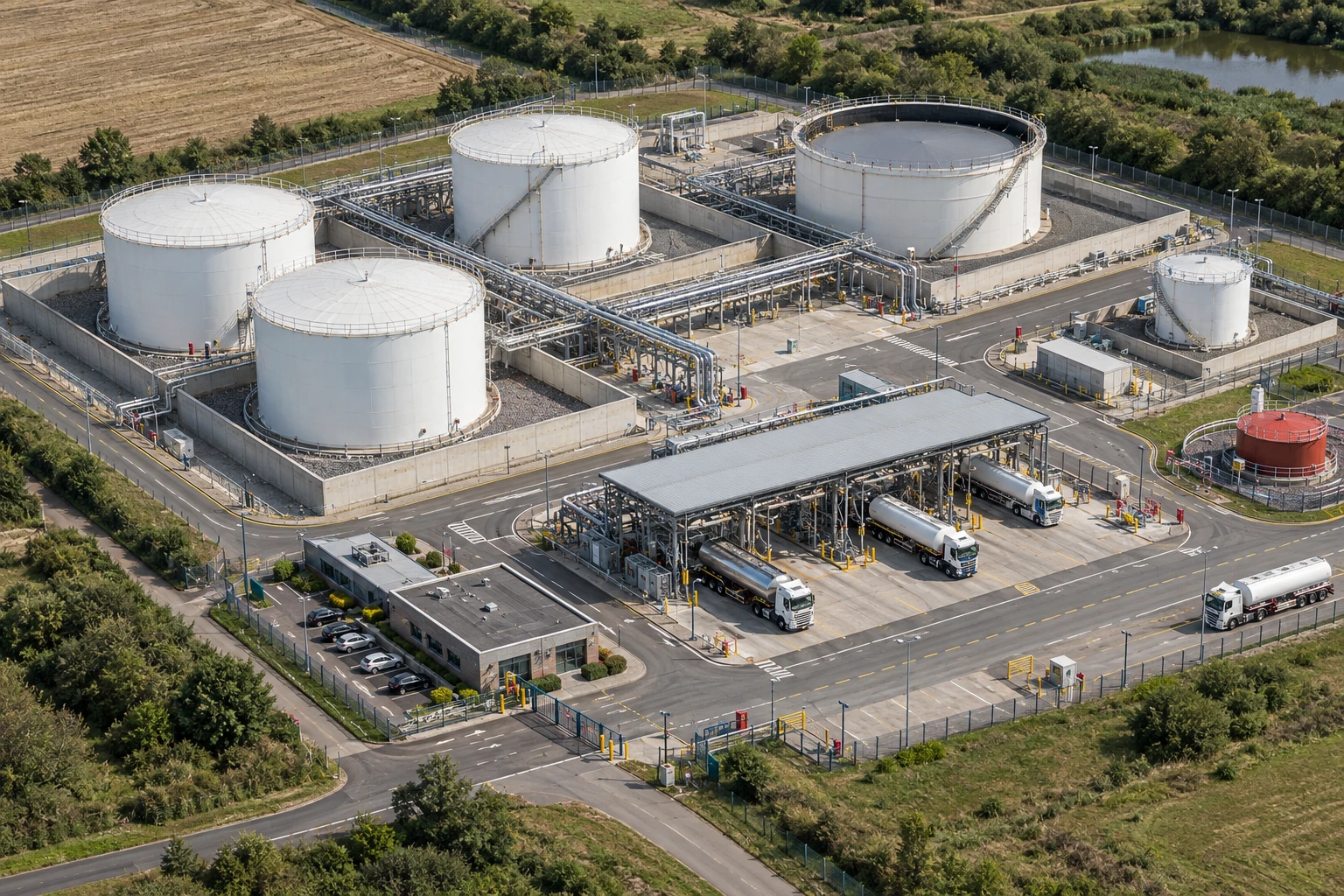
Crown Fuels terminal 1 inspection point
Practice in the SHAREhub environment. Browser practice is separate from workplace competence and formal learning records.
Release the current batch stage from evidence
A batch-release decision belongs to the actual reaction stage and validated basis of safety. Confirm recipe version, materials, charge order and the required cooling/agitation/protection evidence. A previously successful batch cannot establish the safety of an abnormal one.
Best-practice guide: Batch reactor safety
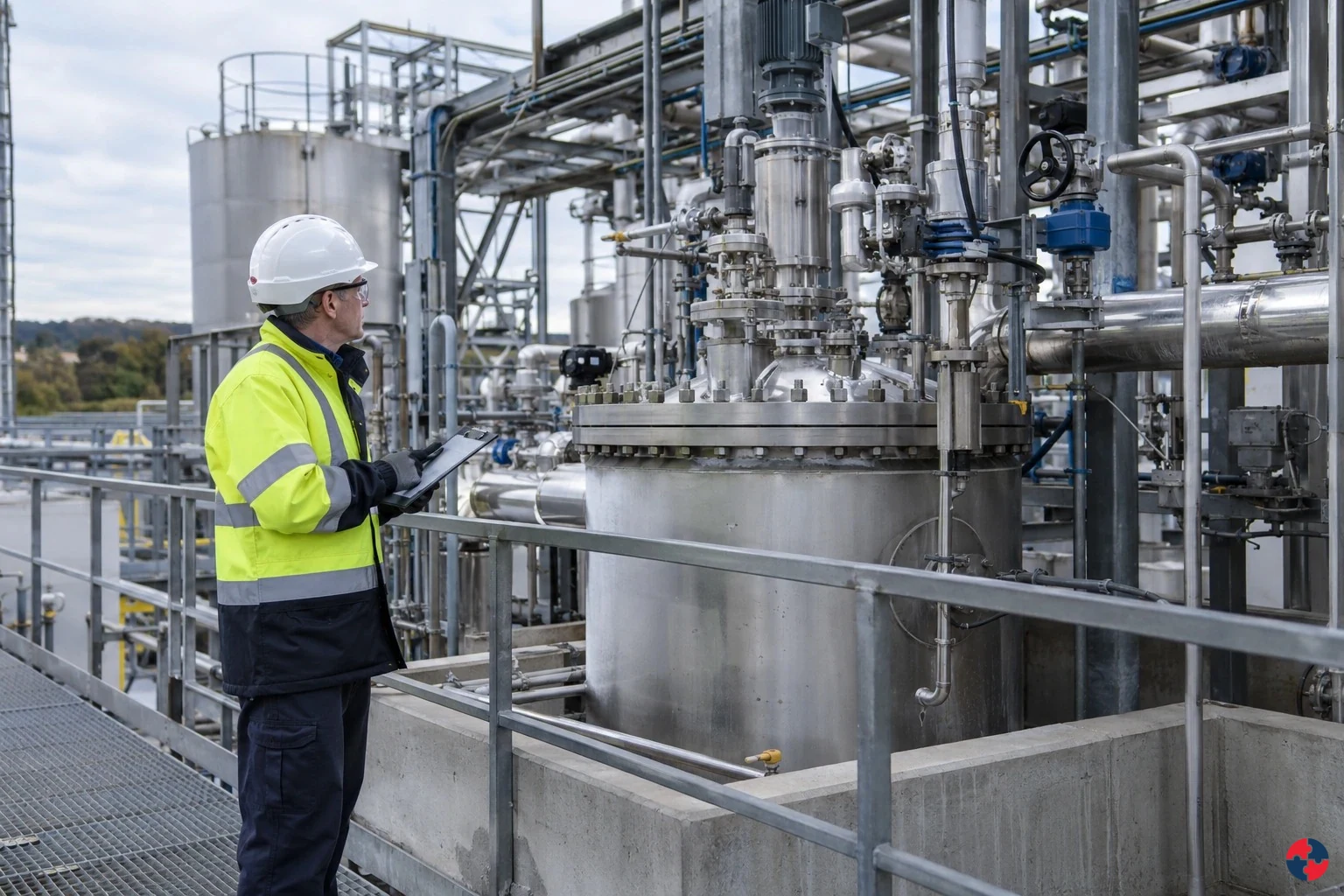
Release the current batch stage from evidence
A batch-release decision belongs to the actual reaction stage and validated basis of safety. Confirm recipe version, materials, charge order and the required cooling/agitation/protection evidence. Batch reactor safety controls chemical reactions carried out in discrete charges or stages within a vessel.
Turn batch reactor safety knowledge into a decision
Batch reactor safety controls chemical reactions carried out in discrete charges or stages within a vessel. Charge order, material identity, cooling and agitation can change heat generation and pressure; loss of control may cause toxic release, fire, explosion or injury. Keep controlled recipe/version, reaction basis, material and line-up checks, utility and safeguard status, actual trends, hold releases, samples, deviations, technical decisions and transfer/next-batch handover.
A routine charge with a cooling alarm
Follow the approved sequence and measure actual addition, temperature, pressure and agitation status at the specified hold points. If a sample is required, use the validated sampling method and release decision. Confirm reaction completion and downstream readiness against the approved acceptance criteria before transfer.
Batch reactor harm mechanisms
Exposure route 1: Charging or reacting with wrong material or residue; heat and gas overwhelm containment, and hot material or vapour reaches nearby people Chemical or thermal burns to skin and eyes, inhalation injury or acute poisoning depending on material Exposure route 2: Cooling or agitation fails; runaway pressure challenges seals, vessel and relief path, with possible blast or fire spread Burns, blunt or penetrating trauma, hearing injury or fatal harm from blast, fragments and fire Exposure route 3: Sampling or maintenance opens a pressurised or reactive system; liquid, vapour or gas reaches worker breathing zone, skin or eyes Acute chemical burn, scald or inhalation injury; substance-specific longer-term harm needs separate assessment
Charging, reaction, cooling, mixing and relief demand belong to the current batch stage. A component in a process scene does not prove availability, independence or capacity for that stage.
Choose controls for batch reactor safety
Elimination: Use a validated non-reactive route or suitable supplied intermediate where it removes the hazardous reaction step. Substitution: Evaluate less energetic chemistry or formulation using reaction testing; do not assume dilution or a smaller batch is inherently safe. Engineering controls: Use closed charging and segregate people from credible release and relief paths. Engineering controls: Prove cooling, agitation, feed permissives and required protective functions against the reaction-hazard study. Administrative controls: Verify reagent identity and charge order; define addition holds and control-room actions for cooling loss or abnormal temperature. Read the full control table for qualifications, ownership and verification. Use the actual task and applicable jurisdiction; existing technical approval remains unchanged.
Use the full batch reactor safety lesson
Use the full topic for the decision points, practical examples, detailed control tables and source scope. HSE guidance applies to Great Britain; use HSENI for the Northern Ireland route and the source’s stated jurisdiction. A simplified guide does not change the page’s technical-review or approval status.

Read all six steps as text
1. Release the current batch stage from evidence
A batch-release decision belongs to the actual reaction stage and validated basis of safety.
- Avoid / redesign: Use a validated non-reactive route or suitable supplied intermediate where it removes the hazardous reaction step.
- Control the task: Use closed charging and segregate people from credible release and relief paths.
- Verify before release: If the hazardous step remains, retain a task assessment and select the stronger feasible remaining controls.
A batch-release decision belongs to the actual reaction stage and validated basis of safety. Confirm recipe version, materials, charge order and the required cooling/agitation/protection evidence. Batch reactor safety controls chemical reactions carried out in discrete charges or stages within a vessel.
Apply it: Which part of this plan would you check at the workface before authorising the task?
2. Turn batch reactor safety knowledge into a decision
Use the evidence to improve the actual work arrangement.
- Change at source: Use a validated non-reactive route or suitable supplied intermediate where it removes the hazardous reaction step.
- Make it observable: If the hazardous step remains, retain a task assessment and select the stronger feasible remaining controls.
- Keep useful evidence: Keep controlled recipe/version, reaction basis, material and line-up checks, utility and safeguard status, actual trends, hold releases, samples, deviations, technical decisions and transfer/next-batch handover.
Batch reactor safety controls chemical reactions carried out in discrete charges or stages within a vessel. Charge order, material identity, cooling and agitation can change heat generation and pressure; loss of control may cause toxic release, fire, explosion or injury. Keep controlled recipe/version, reaction basis, material and line-up checks, utility and safeguard status, actual trends, hold releases, samples, deviations, technical decisions and transfer/next-batch handover.
Apply it: What evidence would show that the change improves this task, rather than only completing a record?
3. A routine charge with a cooling alarm
Example: a practical application of the existing topic lesson.
- Setting: Run an approved semi-batch reaction in an enclosed chemical plant, adding a verified reagent to a cooled, agitated vessel and transferring the finished batch to a designated receiver.
- Act: The operator and supervisor verify material identity and grade, previous-batch residue, line-up, equipment condition and safety critical utilities.
- Hold / review: Hold for unknown material, altered grade, missing or discrepant test result, failed cooling, loss of agitation, unsafe trend, bypassed trip, blocked relief path or conditions outside the envelope.
Follow the approved sequence and measure actual addition, temperature, pressure and agitation status at the specified hold points. If a sample is required, use the validated sampling method and release decision. Confirm reaction completion and downstream readiness against the approved acceptance criteria before transfer.
Apply it: At which point would you hold this example, and what evidence would allow it to proceed?
4. Batch reactor harm mechanisms
Connect the task, the route to the person and the control that can fail.
- Exposure route 1: Charging or reacting with wrong material or residue; heat and gas overwhelm containment, and hot material or vapour reaches nearby people Chemical or thermal burns to skin and eyes, inhalation injury or acute poisoning depending on material
- Exposure route 2: Cooling or agitation fails; runaway pressure challenges seals, vessel and relief path, with possible blast or fire spread Burns, blunt or penetrating trauma, hearing injury or fatal harm from blast, fragments and fire
- Exposure route 3: Sampling or maintenance opens a pressurised or reactive system; liquid, vapour or gas reaches worker breathing zone, skin or eyes Acute chemical burn, scald or inhalation injury; substance-specific longer-term harm needs separate assessment
Exposure route 1: Charging or reacting with wrong material or residue; heat and gas overwhelm containment, and hot material or vapour reaches nearby people Chemical or thermal burns to skin and eyes, inhalation injury or acute poisoning depending on material Exposure route 2: Cooling or agitation fails; runaway pressure challenges seals, vessel and relief path, with possible blast or fire spread Burns, blunt or penetrating trauma, hearing injury or fatal harm from blast, fragments and fire Exposure route 3: Sampling or maintenance opens a pressurised or reactive system; liquid, vapour or gas reaches worker breathing zone, skin or eyes Acute chemical burn, scald or inhalation injury; substance-specific longer-term harm needs separate assessment
Apply it: Who could be exposed, including other trades, cleaners, maintainers and people nearby?
5. Choose controls for batch reactor safety
Start with the stronger practicable options and verify their effect.
- Elimination: Use a validated non-reactive route or suitable supplied intermediate where it removes the hazardous reaction step.
- Substitution: Evaluate less energetic chemistry or formulation using reaction testing; do not assume dilution or a smaller batch is inherently safe.
- Engineering controls: Use closed charging and segregate people from credible release and relief paths.
- Engineering controls: Prove cooling, agitation, feed permissives and required protective functions against the reaction-hazard study.
- Administrative controls: Verify reagent identity and charge order; define addition holds and control-room actions for cooling loss or abnormal temperature.
Elimination: Use a validated non-reactive route or suitable supplied intermediate where it removes the hazardous reaction step. Substitution: Evaluate less energetic chemistry or formulation using reaction testing; do not assume dilution or a smaller batch is inherently safe. Engineering controls: Use closed charging and segregate people from credible release and relief paths. Engineering controls: Prove cooling, agitation, feed permissives and required protective functions against the reaction-hazard study. Administrative controls: Verify reagent identity and charge order; define addition holds and control-room actions for cooling loss or abnormal temperature. Read the full control table for qualifications, ownership and verification. Use the actual task and applicable jurisdiction; existing technical approval remains unchanged.
Apply it: Which stronger option can be used here, and who will verify it before accepting the remaining risk?
6. Use the full batch reactor safety lesson
Follow the official sources below and retain the task-specific evidence.
- Official guidance: HSE: Reaction and product testing
- Official guidance: HSE: Operating procedures
- Task decision: Keep controlled recipe/version, reaction basis, material and line-up checks, utility and safeguard status, actual trends, hold releases, samples, deviations, technical decisions and transfer/next-batch handover.
Use the full topic for the decision points, practical examples, detailed control tables and source scope. HSE guidance applies to Great Britain; use HSENI for the Northern Ireland route and the source’s stated jurisdiction. A simplified guide does not change the page’s technical-review or approval status.
Apply it: Which official source and full-topic section will you use to resolve the next decision?
Record the source of limits rather than invent a generic temperature, quench or restart instruction. Sampling and intrusive maintenance need their own isolation evidence and hand-back. Loss of cooling or agitation must follow the approved abnormal-batch route and competent technical authority.
Cooling evidence is lost during the batch
Illustrative example. An operator receives a cooling alarm while a reaction is under way; the normal display does not establish heat-removal capacity.
Decision. Apply the validated abnormal-batch hold/escalation arrangements for the current stage; preserve plant and chemistry facts for the technical authority.
Evidence to check. Retain recipe, charge history, measured trends, alarm state, cooling/agitation evidence and independent protection status.
Hold or escalation point. No generic quench or agitation restart is authorised by this teaching record.
Follow-up. Technical and operating authorities document the disposition and verified conditions before any subsequent stage or hand-back.
Trace the utility behind each safeguard
Different boxes on a control drawing may depend on the same electricity, cooling supply, sensor or final action. Identify these dependencies in the validated reaction basis before releasing the current stage.
Trace the charge, heat balance and shared utilities
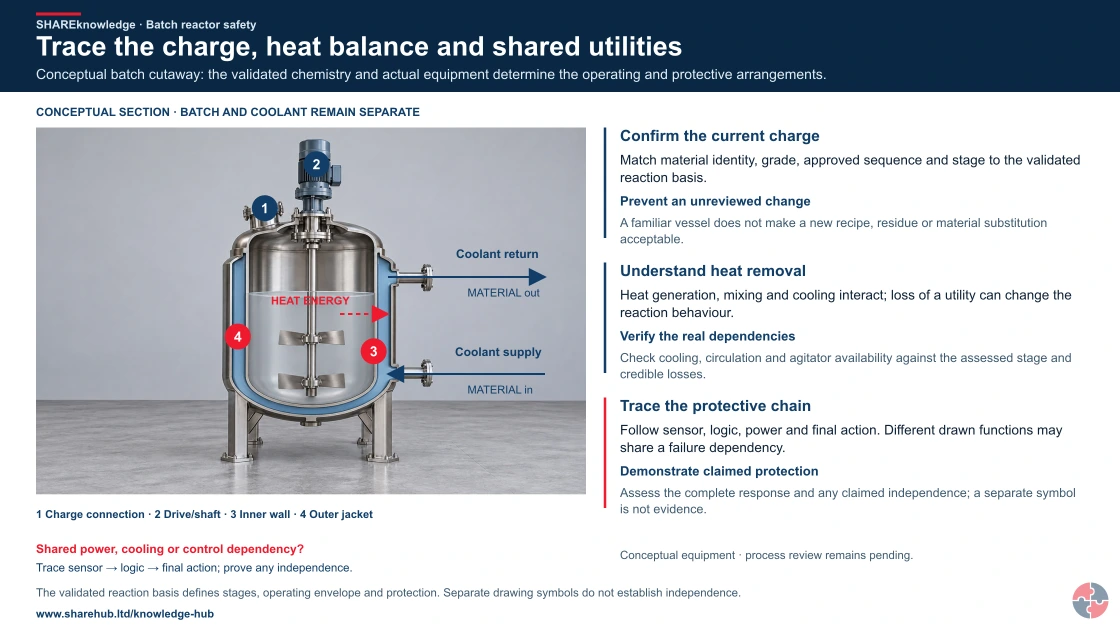
Full written explanation
An illustrative stationary stainless batch-reactor section shows a contained neutral batch, continuous inner vessel wall, distinct outer cooling jacket, shaft/drive and closed charge connection. One literal picture key identifies 1 charge connection, 2 drive/shaft, 3 inner vessel wall and 4 outer jacket. The lower right coolant supply and upper right return connect to the jacket only. Solid material-flow arrows enter the lower jacket connection and leave the upper connection. A separate dashed red heat-energy arrow crosses outward from the batch through the vessel wall and ends in the jacket; it is neither a coolant path into the batch nor a process-material outlet. Coolant supply is a material-flow arrow into the outer cooling jacket; the return arrow carries coolant out of the jacket. The separate dashed heat-removal arrow shows energy moving outward from the contained batch through the vessel wall towards the coolant. It is not a process-material outlet or a coolant connection into the reacting batch. The arrows supply no temperature, flow rate, operating procedure or proof of adequate heat-removal capacity. Charge identity, heat/mixing and complete protective-chain questions remain distinct, with their matched controls. Shared power, cooling or control is a dependency question; trace sensor to logic to final action and establish any claimed independence from actual evidence. The section is conceptual and unscaled, supplies no operating state, procedure, capacity, safe thickness or protection credit. Named process review remains pending.
Conceptual batch cutaway: the validated chemistry and actual equipment determine the operating and protective arrangements.
- Confirm the current charge. Match material identity, grade, approved sequence and stage to the validated reaction basis.
- Understand heat removal. Heat generation, mixing and cooling interact; loss of a utility can change the reaction behaviour.
- Trace the protective chain. Follow sensor, logic, power and final action. Different drawn functions may share a failure dependency.
Change the pathway
- Prevent an unreviewed change. A familiar vessel does not make a new recipe, residue or material substitution acceptable.
- Verify the real dependencies. Check cooling, circulation and agitator availability against the assessed stage and credible losses.
- Demonstrate claimed protection. Assess the complete response and any claimed independence; a separate symbol is not evidence.
Evidence check: The validated reaction basis defines stages, operating envelope and protection. Separate drawing symbols do not establish independence.
Primary references: HSE: reaction/product testing · HSE: designing and operating safe chemical reaction processes (HSG143)
Open the complete HD image (new tab)Download image
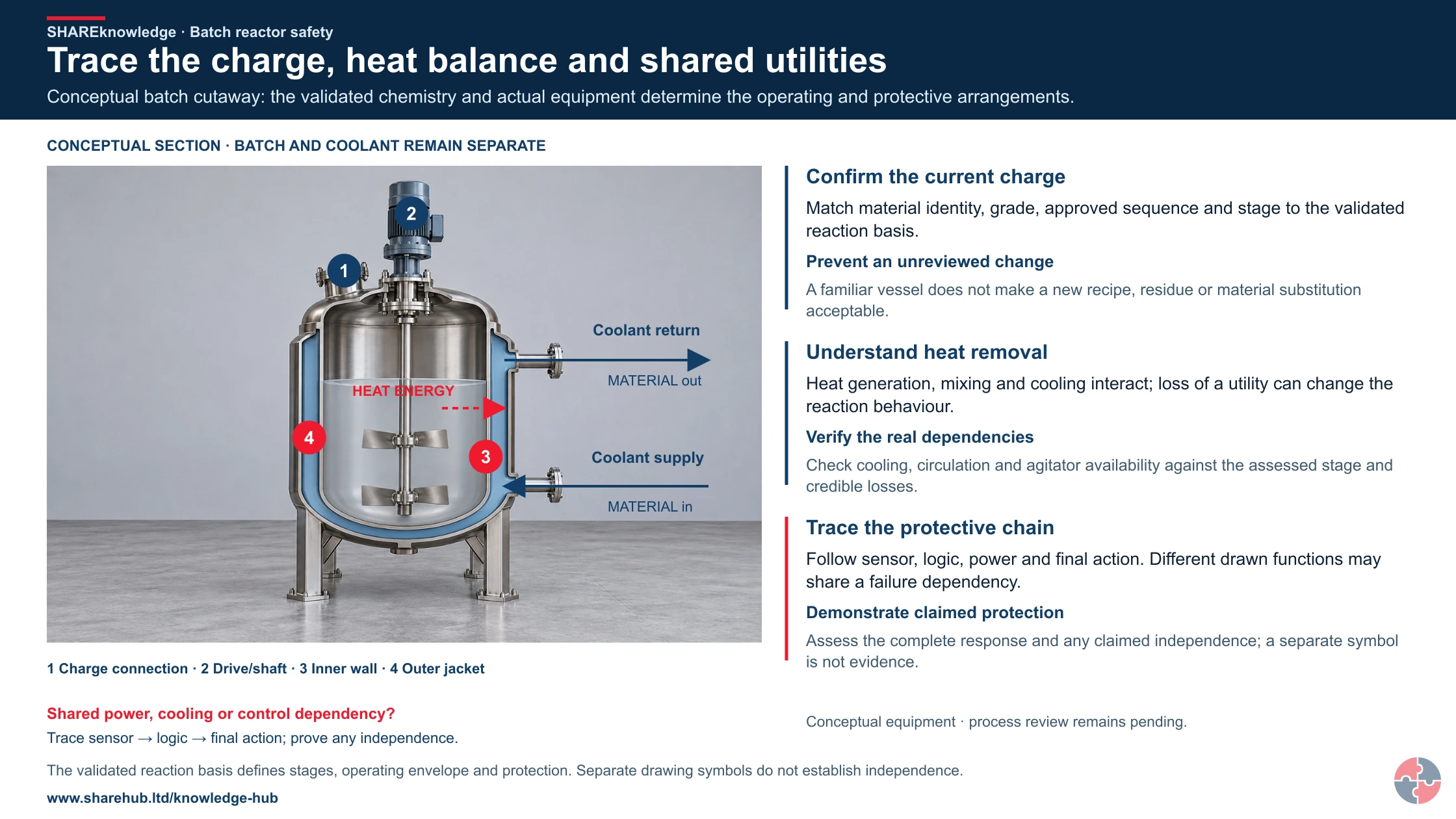
Primary references: HSE: reaction/product testing · HSE: designing and operating safe chemical reaction processes (HSG143)

- Heat removal
- Mixing
- Feed / protective function
Read the labels in the full-size drawing
- Vapour
- Liquid
- SHARED UTILITY
- Heat removal / mixing
- Protection dependency?
- Sensor / logic / final action
- Trace a common loss; prove any independence
| Function | Dependency to trace | Evidence question |
|---|---|---|
| Heat removal | Cooling utility, circulation and heat-transfer path | What happens to heat generation and removal if the shared supply is lost? |
| Mixing | Agitator drive and its power/control supply | Can loss of mixing change heat transfer, accumulation or reaction behaviour? |
| Feed permissive | Sensor, logic, power and final element | Does the assessed hold stop the relevant addition in the actual failure state? |
| Protective function | Its full sensing-to-final-action chain | Is any claimed independence demonstrated for the common failure being considered? |
The diagram is a dependency question, not an operating response. No trip setting, emergency recipe, valve position or independent protection credit is supplied. Hold and escalate unresolved stage or protection evidence through the site’s authorised process.
How is the safe operating envelope established?
Reaction hazard testing and process design define conditions within which the batch can be controlled, and identify what happens if cooling, agitation, dosing, containment or utilities fail.
Assess the intended reaction and credible side reactions, decomposition, contamination, delayed accumulation and scale effects. Screening and, where required, representative calorimetry inform heat and gas generation, time available to act and the design of control, relief and containment. Translate the study into approved temperatures, pressure, addition rate, composition and hold-time limits for the specific plant. HSE warns that literature and calculations alone do not replace chemical hazard testing. HSE reaction/product testing.
Check that sensors show operators the variables they need, alarms and trips act at justified points, and relief or other protective measures are designed for credible scenarios and discharge safely. No generic limit or vent size can be supplied for a different chemistry or vessel.
How should materials and charge order be controlled?
Verify the material, quantity, route, sequence and permitted rate before opening a charging path. A familiar label, previous batch or non-return valve is not enough to rule out wrong material or backflow.
Use approved identification, segregation, receiving and transfer controls appropriate to the chemistry. Confirm hose and valve line-up, residual contents and vessel state; use independent checking where the hazard study requires it. A change in supplier, grade, catalyst, solvent, pack or cleaning method may change reaction kinetics. Hold when identity or compatibility cannot be proved. HSE raw-material guidance addresses contaminants and wrong-material paths.
In an HSE 1992 polymerisation case, styrene backflow through an open valve and failed non-return valve affected the next batch, which then ran away. The lesson is to verify carry-over and backflow barriers between batches, not to assume the previous run ended cleanly. HSE incident account.
How do hold points guide a batch?
Hold points are deliberate pauses tied to a defined condition or approval; work must not pass one until the required evidence shows the next step is within the assessed envelope.
Every batch stage needs its own verified condition


Read the complete visual as text
- Check identity and the current recipe
- Verify cooling, mixing and protection
- Release only the assessed next stage
- The photograph supplies topic context; the worked situations and diagrams are illustrative learning examples, not evidence of an inspected workplace.
Follow the batch from charge to a defined hand-back


Read the complete visual as text
- 1. VERIFY THE BASIS: Confirm the approved recipe, current reaction data, materials and equipment state.
- 2. CHARGE: Check identity, grade, quantity, route and previous-batch residue before the authorised addition.
- 3. REACT AND MONITOR: Follow the controlled sequence; measure actual temperature, pressure, addition and agitation at specified hold points.
- 4. HOLD AND SAMPLE: Use the validated sampling method and acceptance decision; a required result must be available and accepted.
- 5. TRANSFER: Confirm reaction completion and downstream readiness against the approved criteria.
- 6. HAND OVER: Leave vessel, lines and controls in a defined state; record deviations, current stage and whether a further batch remains held.
Use a controlled batch sheet that states the current recipe version, sequence, measured condition, acceptance limit, person authorised to release and action if outside the limit. Confirm sampling method, test status, agitation, cooling, heating and addition readiness before each relevant step. Record actual values and deviations, not just a tick. Shift handover must identify a partially complete batch, pending samples, overrides and time-dependent chemistry.
| Stage | Critical question | Evidence before progression |
|---|---|---|
| Charge | Are identity, quantity, order, route and residues verified? | Material and line-up check |
| Heat and react | Are agitation, cooling, addition and monitoring within the approved envelope? | Trends, utility and instrument status |
| Sample and hold | Is the sample representative and safe to obtain; is the result accepted? | Sampling control and release decision |
| Finish and transfer | Is the reaction complete enough for the next step; are downstream conditions suitable? | Batch result, transfer approval and handover |
Can a sampling hold safely last longer?
A hold is a defined process state, not permission to leave a batch indefinitely. If a laboratory result is delayed, establish what the reaction assessment says about the material remaining in the vessel, the allowable duration and the agitation, temperature monitoring and utilities required throughout that state. A steady displayed temperature alone does not demonstrate that a longer hold or later restart is safe.
For an illustrative overnight delay, the outgoing operator identifies the actual batch stage, last addition, trends, pending sample and current safeguards. The authorised technical owner checks the assessed hold and restart conditions before deciding what can continue. If the permitted conditions or duration cannot be established, escalate through the validated abnormal-operation procedure; do not improvise heating, further addition, quenching or transfer. The incoming shift must receive the actual condition and unresolved decision, with clear responsibility for monitoring and technical contact.
Guidance and scope: Original SHARE process variation applying HSE GB technical guidance; it supplies no reaction-specific limits or emergency recipe. At an NI site, the technical principles require local validation and the separate NI legal route already set out below. HSE reaction testing HSE: Operating procedures
Why are agitation, cooling and utility status critical?
Mixing and heat removal affect how fast a reaction proceeds. Their failure can create local accumulation, reduced heat transfer or a delayed reaction when mixing resumes.
Cooling loss and mixing loss can change the reaction


Read the complete visual as text
- COOLING: Reduced heat removal can let temperature and reaction rate rise. The safe response comes from the validated site sequence.
- MIXING: Lost agitation can change heat transfer or leave local accumulation and stratified material. Restarting mixing can itself create a vigorous reaction.
- SHARED UTILITIES: Power, cooling or instrument-air failure can affect several claimed barriers together. Check common-cause exposure.
- RESPONSE: Hold or stop the affected step and escalate under the site abnormal/emergency route. Do not improvise a quench or restart.
- Two sealed schematic reactors show the approved operating state and an abnormal cooling or agitation state with feed held.
- Heat generation can exceed removal. Follow the validated site response; no universal valve, restart or quench method is shown.
The hazard study should test loss of agitator, cooling supply, power, instrument air and control-system failure, including common-cause loss. Define alarms, diagnostics, safe response and independent protection where required. If mixing fails, do not simply restart it: stratified material may react vigorously on remixing. If cooling fails, stop addition or follow the site-specific validated sequence, escalate and apply the emergency plan if conditions worsen. HSE plant-design guidance and HSE control-system guidance explain these mechanisms.
How should sampling and intrusive work be managed?
Treat sampling, cleaning and maintenance as contact with live process hazards unless the site has demonstrated a safe route. A permit and an isolation certificate support a verified system; neither makes the vessel safe by itself.
Before work, establish pressure, temperature, contents, residual reaction potential, connected sources, drains, vents and the destination for any release. Use the site-specific sample point and isolation standard; verify the isolation, depressurisation and condition at the point of work as required. Coordinate operations, contractors and simultaneous work; explain what changes would cancel the permit. During work, monitor for changing condition and stop for uncertainty. Hand back only after equipment, guards, instruments and isolations are reinstated and tested for the intended restart. HSG253 and HSE permit principles provide the boundary.
What protects people if control is lost?
Preventive controls keep the reaction within its safe envelope; independent protective systems detect, stop or limit a deviation; relief, containment and emergency arrangements reduce consequences if prevention fails.
Interrupt the scenario before relying on survival


Read the complete visual as text
- REMOVE OR REDUCE: Consider eliminating the hazardous step or using a safer validated process; changes require a revised reaction basis.
- KEEP CONTROL: Material checks, controlled feed, measured limits, cooling and mixing maintain the assessed envelope.
- PROTECT INDEPENDENTLY: Trace required alarms, trips and final stop functions through their actual dependencies and test evidence.
- LIMIT CONSEQUENCES: Designed relief/discharge, containment and emergency arrangements address failure consequences; they do not prove prevention is adequate.
Link each credible initiating event to the actual safeguards it demands: material verification, measured limits, cooling and mixing, alarms and trips, shutdown, emergency cooling or quench where designed, relief and safe discharge, containment, detection and evacuation. Test the independence and common-cause exposure of claimed layers. A relief valve setting, rated vessel or operator response alone does not prove that a runaway scenario is controlled. The site engineer must show the scenario-specific design and current test evidence.
| Function | What can weaken it | Evidence to examine |
|---|---|---|
| Prevent wrong or excessive charge | Misidentification, valve line-up, unapproved recipe | Material, route and batch-release records See HSE HSG143: Designing and operating safe chemical reaction processes |
| Detect and stop deviation | Bad instrument, bypass, alarm overload, common utility failure | Calibration, proof tests, bypass review and response drill See HSE HSG143: Designing and operating safe chemical reaction processes |
| Limit pressure or release | Wrong relief basis, blocked path, seal failure, unsafe discharge | Design basis, inspection, discharge and containment verification See HSE HSG143: Designing and operating safe chemical reaction processes |
| Protect people in escalation | Delayed alarm, inaccessible controls, unclear evacuation | Scenario exercise and corrective-action closure See HSE HSG143: Designing and operating safe chemical reaction processes |
How can the hierarchy of controls prevent batch-reactor loss of control and harmful releases?
Plan controls from source removal and reduction through isolation and engineered protection, then use PPE and reliable work discipline for residual risk. No lower level makes an unassessed runaway or release acceptable.
The six ERICPD prompts on this page are an editorial planning aid, not a statute. HSE places elimination and substitution ahead of engineering, administrative measures and personal protection. Here, “discipline” means checking that agreed controls work in practice, not blaming workers. A competent assessment must test feasibility and new hazards for the actual reactor.
Choose the activity
How can the ERICPD hierarchy of controls reduce risks while charging a cooling-dependent batch?

| Control level | Control for this activity | Owner and verification | Stop / restart decision |
|---|---|---|---|
| Eliminate | Use a validated non-reactive route or suitable supplied intermediate where it removes the hazardous reaction step. | Process owner verifies that the revised workflow achieves the required output and the hazardous step is genuinely removed. | If the hazardous step remains, retain a task assessment and select the stronger feasible remaining controls. |
| Reduce, including substitution | Evaluate less energetic chemistry or formulation using reaction testing; do not assume dilution or a smaller batch is inherently safe. | Process/technical owner validates the alternative, its compatibility and any new risks before adoption. | Reject the alternative if suitability is unproved or its new hazards are unresolved. |
| Isolate | Use closed charging and segregate people from credible release and relief paths. | Supervisor verifies the task boundaries and that the separation or isolation protects affected people and connected work. | Hold or stop for cooling or agitation loss, wrong charge, abnormal temperature or unavailable safeguard. |
| Control: physical safeguards | Prove cooling, agitation, feed permissives and required protective functions against the reaction-hazard study. | Competent equipment/process owner checks reagent identity, cooling flow, agitation, feed isolation and protective functions. | Hold or stop for cooling or agitation loss, wrong charge, abnormal temperature or unavailable safeguard. |
| Control: work method and response | Verify reagent identity and charge order; define addition holds and control-room actions for cooling loss or abnormal temperature. | Supervisor confirms the limits, response, communication and restart authority with the people doing this activity. | Stop if the agreed method, communication, competent cover or task limits cannot be maintained. |
| PPE | Select chemical splash and other assessed protection for normal residual tasks; PPE cannot protect someone from an uncontrolled runaway. | Assessor confirms whether PPE is needed and checks selection, condition, compatibility and any required face-fit evidence. | Do not rely on unsuitable or defective protection, or use PPE to continue after an essential source control fails. |
| Discipline | Hold restart after an excursion until process engineering explains the batch condition and authorises the next step. | Release only after process owner approves batch disposition and tested safeguards. Retain the checks and unresolved restrictions at handover. | Keep the activity on hold while defects or required reinstatement evidence remain unresolved. |
How can the ISO 45001 hierarchy of controls reduce risks while charging a cooling-dependent batch?

| Control level | Control for this activity | Owner and verification | Stop / restart decision |
|---|---|---|---|
| Elimination | Use a validated non-reactive route or suitable supplied intermediate where it removes the hazardous reaction step. | Process owner verifies that the revised workflow achieves the required output and the hazardous step is genuinely removed. | If the hazardous step remains, retain a task assessment and select the stronger feasible remaining controls. |
| Substitution | Evaluate less energetic chemistry or formulation using reaction testing; do not assume dilution or a smaller batch is inherently safe. | Process/technical owner validates the alternative, its compatibility and any new risks before adoption. | Reject the alternative if suitability is unproved or its new hazards are unresolved. |
| Engineering controls | Use closed charging and segregate people from credible release and relief paths. | Supervisor verifies the task boundaries and that the separation or isolation protects affected people and connected work. | Hold or stop for cooling or agitation loss, wrong charge, abnormal temperature or unavailable safeguard. |
| Engineering controls | Prove cooling, agitation, feed permissives and required protective functions against the reaction-hazard study. | Competent equipment/process owner checks reagent identity, cooling flow, agitation, feed isolation and protective functions. | Hold or stop for cooling or agitation loss, wrong charge, abnormal temperature or unavailable safeguard. |
| Administrative controls | Verify reagent identity and charge order; define addition holds and control-room actions for cooling loss or abnormal temperature. | Supervisor confirms the limits, response, communication and restart authority with the people doing this activity. | Stop if the agreed method, communication, competent cover or task limits cannot be maintained. |
| PPE | Select chemical splash and other assessed protection for normal residual tasks; PPE cannot protect someone from an uncontrolled runaway. | Assessor confirms whether PPE is needed and checks selection, condition, compatibility and any required face-fit evidence. | Do not rely on unsuitable or defective protection, or use PPE to continue after an essential source control fails. |
| Administrative controls | Hold restart after an excursion until process engineering explains the batch condition and authorises the next step. | Release only after process owner approves batch disposition and tested safeguards. Retain the checks and unresolved restrictions at handover. | Keep the activity on hold while defects or required reinstatement evidence remain unresolved. |
How can the ERICPD hierarchy of controls reduce risks while replacing a reactor sampling valve?

| Control level | Control for this activity | Owner and verification | Stop / restart decision |
|---|---|---|---|
| Eliminate | Use a suitable external diagnostic or redesigned sampling arrangement if it removes the intrusive valve task. | Operations and maintenance confirm which fault can be established externally and whether valve removal is genuinely avoided; do not infer pressure or contents from a stopped pump. | If the hazardous step remains, retain a task assessment and select the stronger feasible remaining controls. |
| Reduce, including substitution | Use an approved closed sampling system or safely removable module to reduce open access. This is an engineering change; it does not make an unisolated valve safe to remove. | Process engineer confirms closed-system compatibility, safe disconnection, contamination control and the isolation still required for module exchange. | Reject the alternative if suitability is unproved or its new hazards are unresolved. |
| Isolate | Isolate connected feeds and energy sources, remove hazardous contents and verify the defined safe state before breaking containment. | Supervisor verifies the task boundaries and that the separation or isolation protects affected people and connected work. | Hold or stop for unknown contents, pressure, passing isolation or an unapproved change in work scope. |
| Control: physical safeguards | Provide suitable drainage, containment, local extraction and support for the valve and connected pipework. | Competent equipment/process owner checks line identity, isolation points, residual pressure, residue and containment. | Hold or stop for unknown contents, pressure, passing isolation or an unapproved change in work scope. |
| Control: work method and response | Agree the permit, contamination checks, line identification and hand-back with operations and contractors. | Supervisor confirms the limits, response, communication and restart authority with the people doing this activity. | Stop if the agreed method, communication, competent cover or task limits cannot be maintained. |
| PPE | Specify chemical PPE and any RPE from the actual residue and task assessment; a respirator does not authorise opening an unverified line. | Assessor confirms whether PPE is needed and checks selection, condition, compatibility and any required face-fit evidence. | Do not rely on unsuitable or defective protection, or use PPE to continue after an essential source control fails. |
| Discipline | Check assembly, leak testing and restoration of sampling protection before returning the reactor to service. | Release only after operations accepts the leak test and restored sampling arrangement. Retain the checks and unresolved restrictions at handover. | Keep the activity on hold while defects or required reinstatement evidence remain unresolved. |
How can the ISO 45001 hierarchy of controls reduce risks while replacing a reactor sampling valve?

| Control level | Control for this activity | Owner and verification | Stop / restart decision |
|---|---|---|---|
| Elimination | Use a suitable external diagnostic or redesigned sampling arrangement if it removes the intrusive valve task. | Operations and maintenance confirm which fault can be established externally and whether valve removal is genuinely avoided; do not infer pressure or contents from a stopped pump. | If the hazardous step remains, retain a task assessment and select the stronger feasible remaining controls. |
| Engineering controls | Use an approved closed sampling system or safely removable module to reduce open access. This is an engineering change; it does not make an unisolated valve safe to remove. | Process engineer confirms closed-system compatibility, safe disconnection, contamination control and the isolation still required for module exchange. | Reject the alternative if suitability is unproved or its new hazards are unresolved. |
| Engineering controls | Isolate connected feeds and energy sources, remove hazardous contents and verify the defined safe state before breaking containment. | Supervisor verifies the task boundaries and that the separation or isolation protects affected people and connected work. | Hold or stop for unknown contents, pressure, passing isolation or an unapproved change in work scope. |
| Engineering controls | Provide suitable drainage, containment, local extraction and support for the valve and connected pipework. | Competent equipment/process owner checks line identity, isolation points, residual pressure, residue and containment. | Hold or stop for unknown contents, pressure, passing isolation or an unapproved change in work scope. |
| Administrative controls | Agree the permit, contamination checks, line identification and hand-back with operations and contractors. | Supervisor confirms the limits, response, communication and restart authority with the people doing this activity. | Stop if the agreed method, communication, competent cover or task limits cannot be maintained. |
| PPE | Specify chemical PPE and any RPE from the actual residue and task assessment; a respirator does not authorise opening an unverified line. | Assessor confirms whether PPE is needed and checks selection, condition, compatibility and any required face-fit evidence. | Do not rely on unsuitable or defective protection, or use PPE to continue after an essential source control fails. |
| Administrative controls | Check assembly, leak testing and restoration of sampling protection before returning the reactor to service. | Release only after operations accepts the leak test and restored sampling arrangement. Retain the checks and unresolved restrictions at handover. | Keep the activity on hold while defects or required reinstatement evidence remain unresolved. |
A control can create a new hazard: substituting chemistry may alter kinetics, enclosure can complicate access, and automation may share a power supply with the process control system. Reassess those effects before crediting the control as independent. PPE and rule-following are additional safeguards, not the primary runaway design.
Where do reactor decisions transfer across sectors?
Batch chemistry occurs in several specialist sectors, but the strongest control still depends on the actual reaction and equipment. Carry the hazard study, hold decision and barrier evidence into each setting.
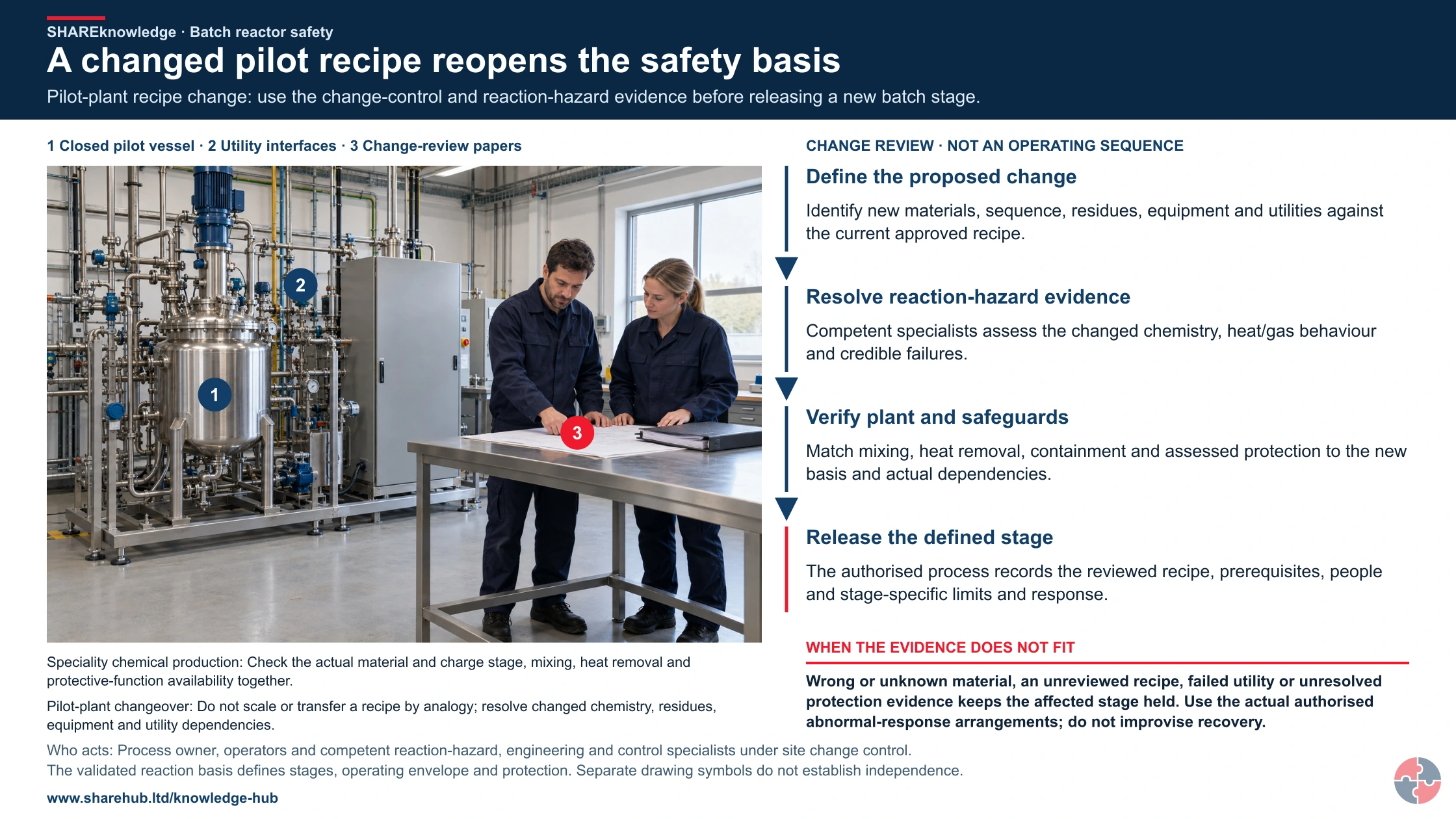
A changed pilot recipe reopens the safety basis
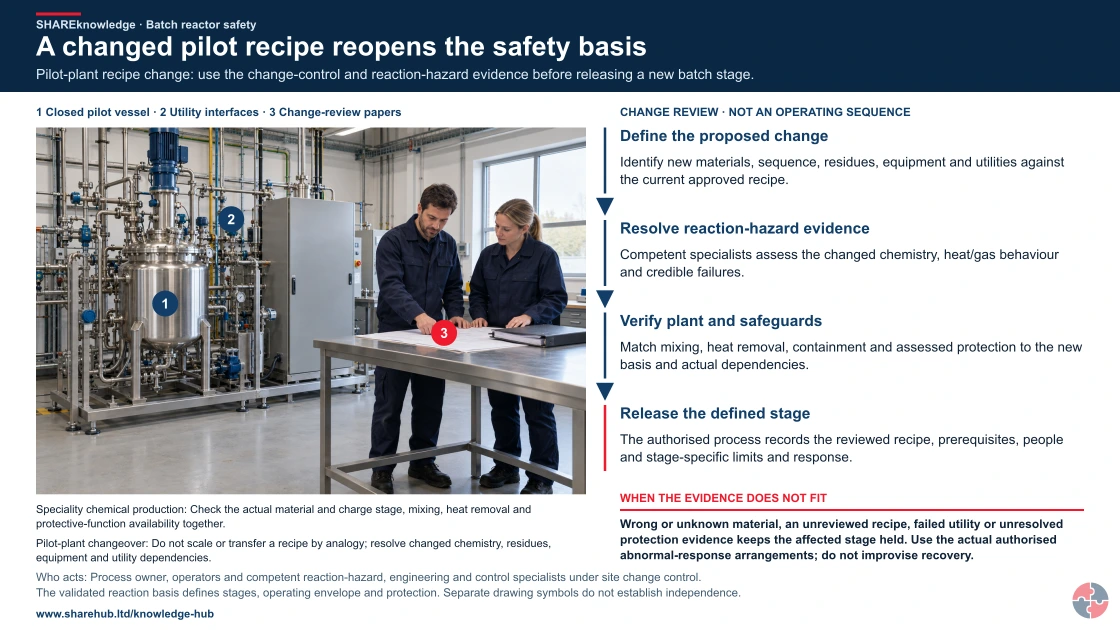
Full written explanation
An illustrative small UK pilot-plant workface shows a closed stationary compact reactor/skid and normal colleagues reviewing inert change papers beside the equipment. One literal picture key identifies 1 closed pilot vessel, 2 visible utility interfaces and 3 change-review papers. These features are evidence questions; appearance or papers establish no material identity, accepted recipe, utility availability, control performance, independence, technical authority or work permission. Four ordered change-review checks follow: Define the proposed change: Identify new materials, sequence, residues, equipment and utilities against the current approved recipe. Resolve reaction-hazard evidence: Competent specialists assess the changed chemistry, heat/gas behaviour and credible failures. Verify plant and safeguards: Match mixing, heat removal, containment and assessed protection to the new basis and actual dependencies. Release the defined stage: The authorised process records the reviewed recipe, prerequisites, people and stage-specific limits and response. The arrows connect review checks, not a charging, heating, mixing or valve sequence. A changed or missing basis reopens the affected decision; release covers the defined assessed stage only. Wrong or unknown material, an unreviewed recipe, failed utility or unresolved protection evidence keeps the affected stage held. Use the actual authorised abnormal-response arrangements; do not improvise recovery. Who acts: Process owner, operators and competent reaction-hazard, engineering and control specialists under site change control. The validated reaction basis defines stages, operating envelope and protection. Separate drawing symbols do not establish independence. Speciality chemical production: Check the actual material and charge stage, mixing, heat removal and protective-function availability together. Pilot-plant changeover: Do not scale or transfer a recipe by analogy; resolve changed chemistry, residues, equipment and utility dependencies. The actual site abnormal-response and emergency routes are independent of routine paperwork. No operating values, recipe, protection design, clinical response or recovery method is supplied. Named process review remains pending.
Pilot-plant recipe change: use the change-control and reaction-hazard evidence before releasing a new batch stage.
- Define the proposed change. Identify new materials, sequence, residues, equipment and utilities against the current approved recipe.
- Resolve reaction-hazard evidence. Competent specialists assess the changed chemistry, heat/gas behaviour and credible failures.
- Verify plant and safeguards. Match mixing, heat removal, containment and assessed protection to the new basis and actual dependencies.
- Release the defined stage. The authorised process records the reviewed recipe, prerequisites, people and stage-specific limits and response.
When the evidence does not fit: Wrong or unknown material, an unreviewed recipe, failed utility or unresolved protection evidence keeps the affected stage held. Use the actual authorised abnormal-response arrangements; do not improvise recovery.
Who acts: Process owner, operators and competent reaction-hazard, engineering and control specialists under site change control.
Changed workplace
Speciality chemical production: Check the actual material and charge stage, mixing, heat removal and protective-function availability together.
Pilot-plant changeover: Do not scale or transfer a recipe by analogy; resolve changed chemistry, residues, equipment and utility dependencies.
Evidence check: The validated reaction basis defines stages, operating envelope and protection. Separate drawing symbols do not establish independence.
Primary references: HSE: reaction/product testing · HSE: designing and operating safe chemical reaction processes (HSG143)
Open the complete HD image (new tab)Download image
Primary references: HSE: reaction/product testing · HSE: designing and operating safe chemical reaction processes (HSG143)
| Sector, task and people | Mechanism and harm | Strongest controls and stop check |
|---|---|---|
| Chemical manufacturing: operator charges an exothermic specialty-chemical batch; nearby workers may be exposed | Cooling or addition failure can cause runaway, hot or toxic release, burns, inhalation injury or blast trauma | Eliminate or reduce hazardous step where feasible; verified chemistry, closed reactor, engineered cooling and protection. Hold for wrong grade, failed cooling or limit exceedance. |
| Pharmaceutical fine-chemical production: chemist and operator transfer a changed solvent or catalyst into a semi-batch process | Changed kinetics or residual contamination can accelerate heat and pressure rise; hot solvent or vapour can burn or expose people | Substitute only after testing; isolate charge, verify cleaning and material identity, use approved recipe/MOC. Hold for unreviewed change or residue. |
| Waste treatment: technician conducts an assessed batch neutralisation of mixed incoming material | Unknown composition or incompatible feed can generate heat or gas and release corrosive mist; eyes, skin and airways may be harmed | Avoid incompatible mixing, characterise feed, limit inventory, contain and monitor the process. Stop for unknown composition, rising temperature or failed extraction/containment. |
Construction, hospitality and logistics generally encounter hazardous substances through storage, transport, cleaning or use rather than operating a batch reaction vessel. Their real controls belong on those task pages; calling them reactor sectors would mislead readers. For every sector above, PPE and training support but cannot replace the validated chemistry and engineered basis.
What must happen after a recipe change or abnormal batch?
Screen material, recipe, equipment, software, staffing and utility changes before use; investigate a deviation before repeating the batch if it could affect the basis of safety.
Abnormal batch or intrusive work: separate the releases
2 linked parts. Follow the question numbers and complete the applicable route.
Part 1 of 2 · Questions 1–3

Continue · Part 2 of 2 · Questions 4–5


Read the complete visual as text
- Start: An abnormal batch, failed safeguard or sampling-valve defect is reported.
- Question 1: Is there a release, fire or escalating process condition? Decision owner: Operator and site incident command.
- YES: Raise the alarm, withdraw and follow the site emergency plan. Owner: Operator and site incident command. STOP / REFER → APPROPRIATE RESPONSE.
- NO: Hold affected operation and preserve evidence. Owner: Operator and site incident command. CONTINUE → QUESTION 2.
- UNKNOWN: Protect people and use the site abnormal/emergency assessment route; do not approach to diagnose it. Owner: Operator and site incident command. STOP / REFER → APPROPRIATE RESPONSE.
- Question 2: Is intrusive work required? Decision owner: Operations owner and competent maintenance authority.
- YES: A separate contents, isolation, permit and contractor-interface check is required. Owner: Operations owner and competent maintenance authority. CONTINUE → QUESTION 3.
- NO: Investigate the cause and actual barrier status before considering restart. Owner: Operations owner and competent maintenance authority. CONTINUE → QUESTION 4.
- UNKNOWN: Keep operation held; the operations and maintenance authorities define the required investigation or intrusive scope. Owner: Operations owner and competent maintenance authority. HOLD → REPEAT QUESTION 2 AFTER CORRECTION.
- Question 3: Are contents, isolation, permit interfaces and safe state verified? Decision owner: Authorised isolator, permit issuer and work owner.
- YES: Authorise only the defined work under the site procedure and monitor for change. Owner: Authorised isolator, permit issuer and work owner. CONTINUE → QUESTION 4.
- NO / UNKNOWN: Do not open equipment; obtain competent isolation review. Owner: Authorised isolator, permit issuer and work owner. HOLD → REPEAT QUESTION 3 AFTER CORRECTION.
- Question 4: Are cause, repair, reinstatement and required tests complete? Decision owner: Engineering and operations owner.
- YES: Review the restored configuration and revised safety basis. Owner: Engineering and operations owner. CONTINUE → QUESTION 5.
- NO / UNKNOWN: Keep the reactor on hold and resolve the outstanding cause or restoration evidence. Owner: Engineering and operations owner. HOLD → REPEAT QUESTION 4 AFTER CORRECTION.
- Question 5: Has technical authority approved the revised basis and restart? Decision owner: Defined process technical and operations authority.
- YES: Document hand-back and release under the site procedure. Owner: Defined process technical and operations authority. OUTCOME → RECORD AND HAND OVER.
- NO / UNKNOWN: Do not restart; retain the defined hold and resolve the approval/evidence gap. Owner: Defined process technical and operations authority. HOLD → REPEAT QUESTION 5 AFTER CORRECTION.
- Outcome: A maintenance hand-back and an operational restart are distinct controlled decisions.
- Stop and escalation boundary: Unexpected pressure, heat, liquid or vapour during work triggers the site abnormal/emergency route. This map does not specify which valve to operate or how to quench. A signed permit or closed valve alone does not prove isolation.
Management of change (MOC) should identify the affected chemistry and safeguards, technical review, authorisation, updated limits and procedures, operator briefing and close-out. Temporary hoses, bypassed trips and altered cleaning can be as important as a formal new recipe. After an abnormal batch, compare trends and records with the approved envelope; preserve samples and evidence as appropriate, identify the cause and test barrier effectiveness. A batch-to-batch handover must explicitly say whether the next charge is held, released or requires technical authority.
Hold and quarantine off-spec, recovered or returned material before it enters another batch. Its composition, inhibitors, contaminants and thermal history may be uncertain, so the process chemist or other authorised technical owner must reassess the reaction basis, compatibility, sampling and safeguards before any rework or reuse. A production target or an unchanged recipe name is not approval to charge it.
The 1976 Seveso event involved interruption with no agitation or cooling and an unsafe operating sequence; the learning is to test hold-time, shutdown and restart assumptions. HSE Seveso account.
How do these decisions work in real operations?
Two examples show how a batch starts, pauses and hands back: one controls the reaction sequence; the other controls intrusive work after an abnormal batch.
A verified batch pathway


Read the complete visual as text
- Verify materials
- Release charge
- Monitor reaction
- Hold for result
- Approve transfer
- Each step needs the site basis of safety
- Five illustrative stages separate verification, closed charging, reaction monitoring, closed sampling with a hold, and designated transfer. Release conditions come from the validated site basis, not the picture. The equipment is conceptual: no recipe, valve sequence, setpoint or restart method is supplied; process review remains pending.
Each is an illustrative decision model. Actual chemistry, plant design, limits, isolation method, competent authority and emergency plan must come from the site.
A routine charge with a cooling alarm
Task material and setting: Run an approved semi-batch reaction in an enclosed chemical plant, adding a verified reagent to a cooled, agitated vessel and transferring the finished batch to a designated receiver. This is an illustrative learning scenario, not a recipe or site method.
People and prerequisites: Operators, a supervisor, process chemist and engineer are affected; nearby workers could be harmed by a release. Current reaction data, approved batch sheet, operating envelope, compatible materials, relief basis, alarms, cooling, mixing and emergency plan must be available and understood.
Before: The operator and supervisor verify material identity and grade, previous-batch residue, line-up, equipment condition and safety critical utilities. They check the required hold points and instrument status, including any bypass or maintenance impairment. A technical authority resolves deviations before charge release.
During: Follow the approved sequence and measure actual addition, temperature, pressure and agitation status at the specified hold points. If a sample is required, use the validated sampling method and release decision. Handover names the current stage and any time-dependent condition.
Hold or stop: Hold for unknown material, altered grade, missing or discrepant test result, failed cooling, loss of agitation, unsafe trend, bypassed trip, blocked relief path or conditions outside the envelope. Stop the affected step and use the site abnormal-operation or emergency procedure; do not improvise a quench or restart.
Completion and hand back: Confirm reaction completion and downstream readiness against the approved acceptance criteria before transfer. Leave the reactor, connected lines and control system in a defined state. The supervisor records whether the next batch is released or held for deviation review.
Evidence: Keep controlled recipe/version, reaction basis, material and line-up checks, utility and safeguard status, actual trends, hold releases, samples, deviations, technical decisions and transfer/next-batch handover.
Cooling loss during a reagent addition
Task, material and setting: During an approved semi-batch addition, cooling flow falls and reactor temperature begins to move toward the site-defined hold limit. This example describes the decision chain only; actual limits, response timing and emergency treatment must come from the validated reaction study and installed plant.
People and prerequisites: The operator, supervisor and process technical authority know the current batch stage, material already charged, credible remaining heat and gas generation, available cooling, agitation, protective functions, relief route and emergency plan. Current proof-test and impairment status must be visible before the batch starts.
Before: Confirm that the cooling indication, high-temperature alarm, automatic addition stop or trip and any emergency cooling or quench are defined by the site basis of safety. Check whether claimed layers share the same sensor, controller, power, cooling utility, valve or operator action. A common dependency cannot be counted twice as independent protection. Use HSE HSG143 and HSE control-system guidance to test the plant-specific basis.
During: At the defined trigger, stop or isolate the addition through the validated system, maintain or restore the controls that the study requires, raise the site alarm and monitor the specified variables from a safe place. Record actual trends, alarm and trip sequence, valve response, utility state and operator actions. Use only the approved abnormal-operation or emergency instruction; do not invent a quench, vent path or manual override.
Hold or stop: Keep the batch and next charge on hold for an unsafe trend, missing reaction data, failed or bypassed trip, overdue proof test, shared-utility failure, uncertain material inventory, blocked relief route or unexplained difference between instruments. Escalate through the emergency plan if the validated safe envelope or response capability is lost.
Completion and hand-back: A competent process technical authority classifies the deviation, reconciles the material and energy state, confirms whether sampling or intrusive work is safe, identifies failed barriers and approves the recovery plan. Maintenance restores and tests equipment under the isolation/permit system. Operations restart only against written acceptance criteria after required changes, proof tests and emergency readiness are verified.
Evidence: Keep the batch version and stage, reaction-basis reference, actual temperature/pressure/addition trends, alarms and trips, proof-test and bypass status, common-dependency review, operator log, deviation investigation, isolation/permit and maintenance test, technical decision, corrective-action closure and signed restart release.
Non-routine sampling-valve maintenance
Task material and setting: A contractor maintains a reactor sampling valve after an abnormal batch. The vessel and connected lines may retain hot reactive material, pressure and hazardous vapour; production wants the next batch quickly.
People and prerequisites: Operations, maintenance, the contractor, permit issuer and isolation authority agree the exact work boundary. They need current contents and chemistry, isolation drawing, residual-energy assessment, suitable permit, competence, communication and emergency arrangements.
Before: Hold the batch and investigate the abnormal record. Plan the isolation to the installed plant and verify valve identity, connected sources, pressure, temperature and safe draining/venting route. Agree the permit, simultaneous-work interface and test of isolation at the point of work. The contractor must understand what condition cancels the permit.
During: Maintain the isolation and communication. If unexpected liquid, vapour, heat or pressure appears, stop, withdraw and call the site response route. Do not treat a signed permit or a closed valve as proof of safe condition. Record any changed scope for reauthorisation.
Hold or stop: Do not open the system if contents, isolation identity, zero-energy evidence, work scope or emergency route is uncertain. Stop for a leak, unexpected pressure, incompatible residue, failed control or concurrent work that affects the isolation. Escalate before anyone restores service.
Completion and hand back: Account for tools and people, inspect and test the repaired valve, remove isolations through the approved sequence, restore instruments and safeguards, close the permit and hand the verified plant state to operations. Restart only after the abnormal-batch cause and control changes receive competent approval.
Evidence: Retain the abnormal-batch review, isolation plan and verification, permit/contractor interface, defect and repair record, test and reinstatement evidence, authority decision and revised batch release.
When conditions differ
Start-up after agitator failure: do not simply resume; assess accumulated material and remixing risk. Unknown residue or raw-material grade: hold the next charge until identified and the compatibility assessment is updated. Alarm or cooling impairment: reassess the combined barrier loss before operation. Release or fire: withdraw, raise the alarm and follow the site emergency plan without improvised intervention.
Which legal route applies in Great Britain?
Great Britain has general workplace duties and hazard-specific regulations. COMAH 2015 adds major-accident duties only where its establishment and dangerous-substance tests are met; a reactor alone does not make a site COMAH.
Check the actual process, inventory, location and current amended law. The Health and Safety at Work etc. Act 1974 and Management Regulations underpin prevention and risk assessment; COSHH, DSEAR, pressure-system and other rules may apply according to the substances and equipment. For a COMAH establishment, follow the current GB COMAH tier and operator duties. The technical controls described here remain useful outside COMAH, but their legal route must not be assumed. HSE COMAH guidance.
Which legal route applies in Northern Ireland?
Northern Ireland has a separate general health-and-safety regime and its own COMAH Regulations 2015. Verify NI applicability, threshold, current amendments and the relevant HSENI/NI Environment Agency route.
The Health and Safety at Work (Northern Ireland) Order 1978 and NI-specific management, hazardous-substance, explosive-atmosphere and pressure-system requirements may be relevant. HSENI describes COMAH as applying above the defined dangerous-substance thresholds, with additional controls at top tier and a joint competent authority. Do not copy GB regulation numbers or a GB-only interpretation into an NI assessment. HSENI COMAH and NI 2015 instrument give the starting route. Check the applicable current text and site circumstances before relying on a legal conclusion.
What competence and communication are needed?
People must be able to perform the safety-critical decisions in their role, recognise a changed condition and know who can hold or release a batch or restart the plant.
Train and assess operators on the actual reaction, limits, trends and abnormal actions; supervisors on release and escalation; chemists and engineers on hazard data and design basis; maintainers and contractors on isolation, permits and reinstatement. Verify understanding through observed tasks and realistic scenarios, not attendance alone. Keep approved instructions usable at the point of work and pass incomplete batches, overrides, changes and impairments across shifts.
| Role | Learning and practice | Competence demonstration | Assessor, record and reassessment trigger |
|---|---|---|---|
| Nearby staff and new starters | Recognise alarms, restricted areas, release warnings and emergency instructions; do not intervene in the process. | Explain alarm meaning, evacuation and reporting in a scenario. | Area supervisor records induction; refresh after changed alarm or emergency arrangements. |
| Operators and charge technicians | Use the approved recipe, identity checks, charge order, operating envelope, trends and hold points on the actual reactor. | Observed charge and abnormal-condition exercise, including a correct stop rather than improvisation. | Operations assessor records task authorisation; reassess after recipe, equipment, limit or incident change. |
| Supervisors and shift leads | Check pre-start evidence, deviations, incomplete batches, impairment, handover and restart authority. | Challenge a failed safeguard and document hold, escalation and authorised release. | Operations manager samples hold and handover records after abnormal batch or changed condition. |
| Chemists and process engineers | Interpret reaction tests, heat and gas hazards, scale-up limits and the protection design basis within specialist competence. | Defend a documented hazard-study and change decision with assumptions and independent challenge. | Technical authority retains study and approval; review after material, scale, equipment or evidence change. |
| Maintainers, samplers and contractors | Use isolation, permit, intrusive-work controls, reinstatement and contamination boundaries for the real equipment. | Observed isolation or sampling task and hand-back to a safe plant state. | Permit issuer and technical owner record authorisation; reassess after configuration, method or failure change. |
| Managers, purchasers and auditors | Understand risk ownership, competent resourcing, barrier evidence, procurement constraints and escalation of overdue actions. | Trace one credible scenario through safeguards, tests, impairments, actions and emergency readiness. | Senior process-safety owner records assurance and closes gaps; revisit after major change or adverse indicators. |
Attendance is not authorisation to charge, release or restart a batch. A practical assessment must match the reaction, vessel and local basis of safety; no universal certificate period is implied.
How can leaders tell whether barriers still work?
Sample real batches and current barrier evidence: tests, deviations, overrides, maintenance, action closure and emergency learning. Counts of completed forms or low injury rates do not establish process safety.
Use HSG254 to select a small set of indicators tied to the scenarios that matter: for example, overdue proof tests on protective trips, unresolved cooling defects, repeat deviations, bypass age, failed hold-point checks and verified closure of corrective actions. These are example measures for a site to define, not universal statutory targets. Review together with actual incidents and near misses. Investigate a weak signal that repeats across batches or shifts.
What belongs in the risk register?
Record the credible initiating event, potential loss of containment or runaway, exposed people and environment, preventive and mitigative barriers, owner, current impairment, action, authority for risk acceptance and review trigger. Check that every credited barrier is present and independently effective for the scenario.
| Scenario | Claimed safeguard | Evidence and review trigger |
|---|---|---|
| Cooling loss during addition | Feed stop and independent high-temperature protection | Current proof test, utility history and alarm response; hold on impairment |
| Wrong material or carry-over | Identity, route and cleaning verification | Material and line-up records; investigate discrepancy before next batch |
| Intrusive sample after abnormal batch | Isolation, permit and tested safe condition | Verified isolation and hand-back; stop for unknown residue or pressure |
How could Riverside Leisure Ltd use this lesson?

Riverside Leisure Ltd is SHARE’s worked example business. Its pool-chemical operations do not become a batch reactor merely because chemicals are present; the useful lesson is to define credible mixing and release scenarios before selecting controls.
If Riverside considers an on-site treatment or dosing change, the responsible manager first establishes the actual chemistry, equipment and legal route with a competent specialist. The team controls delivery identity, incompatible contact, transfer line-up and emergency arrangements, while maintaining any process-specific controls. A reactor project would need its own hazard study, design basis, operating envelope, commissioning and specialist approval before use. This is an illustrative company pathway, not a generic approval for any chemical process.
Which national legal route governs this decision?
Use the rule for the place and the actual activity. These rows identify the topic-specific work-risk route; existing legal sections explain other relevant instruments.
| Direct authority | Jurisdiction | Application to this topic | Practical evidence |
|---|---|---|---|
| Control of Substances Hazardous to Health Regulations 2002 | Great Britain | Control harmful-substance releases where the charged materials present exposure. | Applicability, task assessment, control owner and review record. |
| Control of Substances Hazardous to Health Regulations (NI) 2003 | Northern Ireland | Apply the NI COSHH instrument to the same exposure route. | Applicability, task assessment, control owner and review record. |
| Dangerous Substances and Explosive Atmospheres Regulations 2002 | Great Britain | Assess fire or explosion from dangerous substances where applicable. | Applicability, task assessment, control owner and review record. |
| Dangerous Substances and Explosive Atmospheres Regulations (NI) 2003 | Northern Ireland | Use the separate NI dangerous-substances regulations. | Applicability, task assessment, control owner and review record. |
How should the selected controls be checked in practice?
For each controllable work hazard, the five HSE levels and ERICPD guide a specific decision. A stronger measure is assessed for feasibility before reliance on procedures or personal protection; the owner checks whether it works and stops the task on failure. HSE examples are GB regulator guidance applied as technical principles in NI, not NI law; use the separate NI legal map. See HSE five-level hierarchy of control; HSE five-level hierarchy of control
What does official guidance add to this decision?
Base control and protective-system decisions on the reaction hazard study, independent safeguards, proof and change control; a management certificate cannot supply the plant-specific design.
Use the current HSE control-system technical measures and the jurisdiction-specific duties listed on this page to verify the actual task and controls.
If a contract or competent design specifies a published technical standard, obtain authorised access to its current text and check its exact scope and edition. Apply the standard only within its stated scope; this guidance does not reproduce its clauses.
What do the acronyms and key terms mean?
These terms are used throughout the topic; the meaning of an assessment or control still depends on the actual work and jurisdiction.
| Term | Full form | Meaning here |
|---|---|---|
| COMAH | Control of Major Accident Hazards | A major-accident regulatory regime for establishments that meet its scope tests. |
| MOC | Management of change | Formal review of a change to materials, recipe, plant, limits, people or safeguards before release. |
| COSHH | Control of Substances Hazardous to Health | The workplace rules for controlling health risks from hazardous substances where applicable. |
| DSEAR | Dangerous Substances and Explosive Atmospheres Regulations | The workplace rules for dangerous substances and explosive-atmosphere risks where applicable. |
| PPE | Personal protective equipment | A last-line personal safeguard that cannot replace a sound reaction and containment design. |
| ERICPD | Eliminate, Reduce, Isolate, Control, Personal protective equipment, Discipline | A practical control-planning sequence, not a separate legal test. |