SHARE Knowledge Hub
Jet Fires and Pool Fires
Jet fires are ignited pressurised releases; pool fires burn fuel collected on a surface. Prevent loss of containment and ignition, verify the barriers that limit escalation, and withdraw under the site emergency plan when a release or fire is suspected.
Understanding Jet Fires and Pool Fires
Jet fires are ignited pressurised releases; pool fires burn fuel collected on a surface. Prevent loss of containment and ignition, verify the barriers that limit escalation, and withdraw under the site emergency plan when a release or fire is suspected.
Why this matters at work
Direct flame can ignite clothing and cause deep burns. Thermal radiation can injure skin without flame contact and make escape routes unusable; exposure depends on intensity and time, shielding, clothing and movement. Smoke, soot and combustion products can irritate or injure the airway, reduce visibility and cause disorientation. An explosion, vessel rupture or structural failure may add trauma or entrapment. These mechanisms should be described explicitly, not compressed into "fire risk".
Health effects may include burns, inhalation injury, respiratory distress, eye injury, heat stress and psychological harm after an incident. The hazard extends to contractors, visitors, neighbouring workplaces, firefighters and the public. People may be unable to use the route assumed by the evacuation plan because radiant heat or smoke blocks it. Avoid relying on proximity or a fixed standoff distance without scenario evidence.
How organisations manage this in practice
A business can demonstrate fulfilment with an accurate dangerous-substance inventory, process and premises fire assessments, sound equipment design, inspection and maintenance, controlled transfers and hot work, emergency arrangements, competent roles and evidence that barriers work. Review the assessment after a leak, change in fuel, layout, throughput or ignition source. A near miss showing that a hose can fail or a drain can carry fuel is a reason to act even when no fire occurred.
During an incident, incident command must balance isolation, fire control, rescue and possible escalation. An unignited release can become more dangerous if an established flame is put out before fuel is controlled; equally, leaving a fire burning can expose a vessel. This is why tactical instructions cannot be reduced to a one-line rule for employees or an AI response.
Track defects through to repair. Small weeps, repeated seal failures, odour complaints and temporary clamps can be leading indicators of loss of containment. Review whether a leak could spray onto a hot surface or collect beneath a tank. Maintenance and turnaround work can introduce wrong gaskets, blind errors or reopened drains; reinstatement checks should prove the as-left configuration.
How can I practise this topic in 3D?
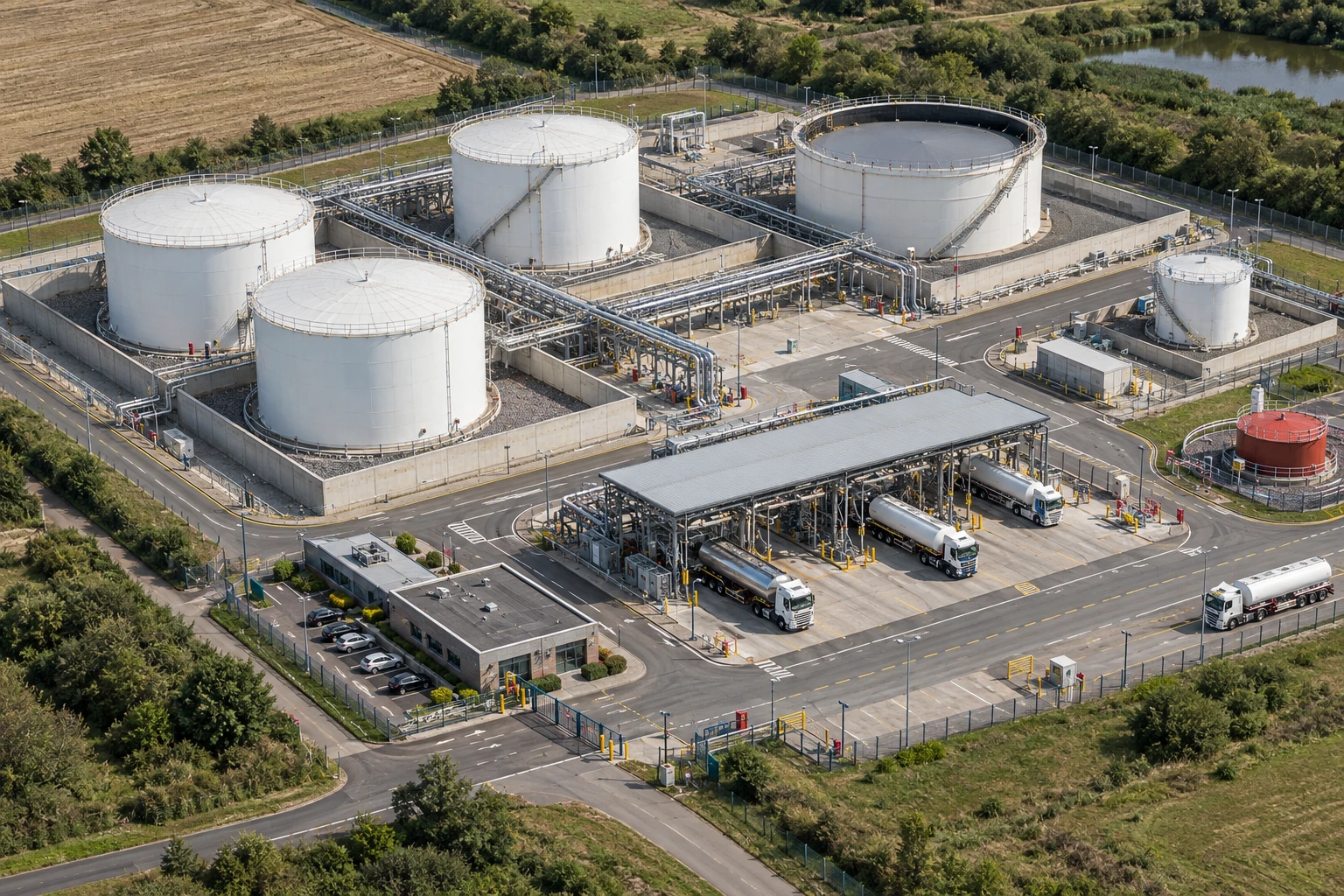

Temporary storage would obstruct tank fire protection
All related inspection points 4 across 1 location
Crown Fuels terminal 4 inspection points
Practice in the SHAREhub environment. Browser practice is separate from workplace competence and formal learning records.
What are the key facts about jet fires and pool fires?
The key learning point is that the same flammable substance can create very different fire scenarios depending on release pressure, phase, location, containment and ignition.
Best-practice guide: Jet Fires and Pool Fires
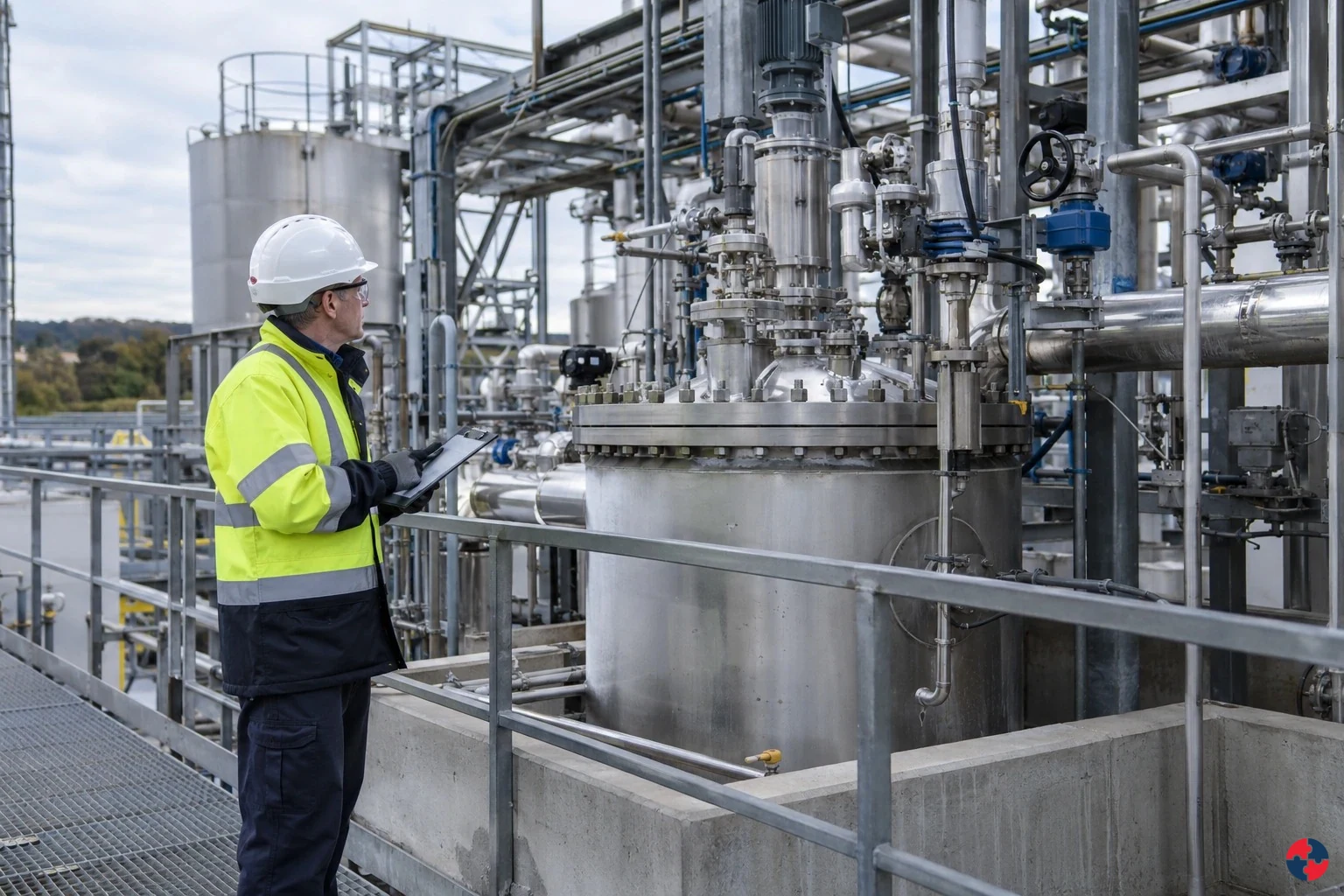
What are the key facts about jet fires and pool fires?
The key learning point is that the same flammable substance can create very different fire scenarios depending on release pressure, phase, location, containment and ignition. Jet fires are ignited pressurised releases; pool fires burn fuel collected on a surface.
Turn jet fires and pool fires knowledge into a decision
Jet fires are ignited pressurised releases; pool fires burn fuel collected on a surface. Prevent loss of containment and ignition, verify the barriers that limit escalation, and withdraw under the site emergency plan when a release or fire is suspected. Delivery identity and quantity, pre-transfer checks, defects and corrective actions, contractor coordination, any stop or alarm and the final hand-back record.
Petrol transfer at the process operator
The responsible operator and driver monitor the transfer in accordance with the procedure. Stop for a leak, unexpected level or pressure, an alarm, loss of communications or an intrusion into the controlled area. Stop the transfer by the approved sequence; isolate, make the connection safe and disconnect only as the procedure permits.
Warning signs and actions
No credible fire scenario register: Fire risk is being treated generically. Bund valves left open: Pool fire and environmental controls may fail. Fire/gas alarms without action logic: Detection may not lead to timely response.
Choose controls for jet fires and pool fires
Elimination: At design or modification stage, remove a pressurised LPG transfer or redundant dead leg where the duty can be met without it; remove the connected inventory before intrusive work under an approved isolation plan. Substitution: Substitute the existing transfer duty with a demonstrably less hazardous process or supply arrangement where feasible; compare the replacement process and its new hazards through competent change assessment. Smaller inventories or lower pressure within the same process are minimisation, not by themselves substitution; keep those reduction options in the assessment. Engineering controls: Use compatible pipework and mechanical integrity controls; keep vulnerable people and plant outside the predicted flame and radiation footprint. Administrative controls: Set an operating envelope, line-up verification, permit and simultaneous-operations rules for transfers and maintenance; define who confirms pressure, inventory and valve status before work. PPE: For normal work outside the predicted flame area, select clothing, gloves, eye protection and respiratory protection only for the remaining task exposures and emergency withdrawal needs after assessment. Read the full control table for qualifications, ownership and verification. Use the actual task and applicable jurisdiction; existing technical approval remains unchanged.
Use the full jet fires and pool fires lesson
Use the full topic for the decision points, practical examples, detailed control tables and source scope. HSE guidance applies to Great Britain; use HSENI for the Northern Ireland route and the source’s stated jurisdiction. A simplified guide does not change the page’s technical-review or approval status.

Read all six steps as text
1. What are the key facts about jet fires and pool fires?
The key learning point is that the same flammable substance can create very different fire scenarios depending on release pressure, phase, location, containment and ignition.
- Avoid / redesign: At design or modification stage, remove a pressurised LPG transfer or redundant dead leg where the duty can be met without it; remove the connected inventory before intrusive work under an approved isolation plan.
- Control the task: Use compatible pipework and mechanical integrity controls; keep vulnerable people and plant outside the predicted flame and radiation footprint.
- Verify before release: Hold or stop for unverified isolation, residual pressure or impaired protection.
The key learning point is that the same flammable substance can create very different fire scenarios depending on release pressure, phase, location, containment and ignition. Jet fires are ignited pressurised releases; pool fires burn fuel collected on a surface.
Apply it: Which part of this plan would you check at the workface before authorising the task?
2. Turn jet fires and pool fires knowledge into a decision
Use the evidence to improve the actual work arrangement.
- Change at source: At design or modification stage, remove a pressurised LPG transfer or redundant dead leg where the duty can be met without it; remove the connected inventory before intrusive work under an approved isolation plan.
- Make it observable: Hold or stop for unverified isolation, residual pressure or impaired protection.
- Keep useful evidence: Delivery identity and quantity, pre-transfer checks, defects and corrective actions, contractor coordination, any stop or alarm and the final hand-back record.
Jet fires are ignited pressurised releases; pool fires burn fuel collected on a surface. Prevent loss of containment and ignition, verify the barriers that limit escalation, and withdraw under the site emergency plan when a release or fire is suspected. Delivery identity and quantity, pre-transfer checks, defects and corrective actions, contractor coordination, any stop or alarm and the final hand-back record.
Apply it: What evidence would show that the change improves this task, rather than only completing a record?
3. Petrol transfer at the process operator
Example: a practical application of the existing topic lesson.
- Setting: the process operator plans a petrol road-tanker transfer to a fixed tank in an outdoor bunded depot.
- Act: Check the transfer connection and hose against the specified service, inspect for defects, verify tank capacity and overfill arrangements, containment and drain status, emergency shutdown availability, escape and communications.
- Hold / review: Hold for unknown product, damaged hose, blocked containment, unavailable protection or conflicting work.
The responsible operator and driver monitor the transfer in accordance with the procedure. Stop for a leak, unexpected level or pressure, an alarm, loss of communications or an intrusion into the controlled area. Stop the transfer by the approved sequence; isolate, make the connection safe and disconnect only as the procedure permits.
Apply it: At which point would you hold this example, and what evidence would allow it to proceed?
4. Warning signs and actions
Connect the task, the route to the person and the control that can fail.
- No credible fire scenario register: Fire risk is being treated generically.
- Bund valves left open: Pool fire and environmental controls may fail.
- Fire/gas alarms without action logic: Detection may not lead to timely response.
No credible fire scenario register: Fire risk is being treated generically. Bund valves left open: Pool fire and environmental controls may fail. Fire/gas alarms without action logic: Detection may not lead to timely response.
Apply it: Who could be exposed, including other trades, cleaners, maintainers and people nearby?
5. Choose controls for jet fires and pool fires
Start with the stronger practicable options and verify their effect.
- Elimination: At design or modification stage, remove a pressurised LPG transfer or redundant dead leg where the duty can be met without it; remove the connected inventory before intrusive work under an approved isolation plan.
- Substitution: Evaluate a process or supply arrangement with lower stored pressure or smaller connected inventory, with a full review of flow, temperature, material compatibility and new hazards.
- Engineering controls: Use compatible pipework and mechanical integrity controls; keep vulnerable people and plant outside the predicted flame and radiation footprint.
- Administrative controls: Set an operating envelope, line-up verification, permit and simultaneous-operations rules for transfers and maintenance; define who confirms pressure, inventory and valve status before work.
- PPE: For normal work outside the predicted flame area, select clothing, gloves, eye protection and respiratory protection only for the remaining task exposures and emergency withdrawal needs after assessment.
Elimination: At design or modification stage, remove a pressurised LPG transfer or redundant dead leg where the duty can be met without it; remove the connected inventory before intrusive work under an approved isolation plan. Substitution: Substitute the existing transfer duty with a demonstrably less hazardous process or supply arrangement where feasible; compare the replacement process and its new hazards through competent change assessment. Smaller inventories or lower pressure within the same process are minimisation, not by themselves substitution; keep those reduction options in the assessment. Engineering controls: Use compatible pipework and mechanical integrity controls; keep vulnerable people and plant outside the predicted flame and radiation footprint. Administrative controls: Set an operating envelope, line-up verification, permit and simultaneous-operations rules for transfers and maintenance; define who confirms pressure, inventory and valve status before work. PPE: For normal work outside the predicted flame area, select clothing, gloves, eye protection and respiratory protection only for the remaining task exposures and emergency withdrawal needs after assessment. Read the full control table for qualifications, ownership and verification. Use the actual task and applicable jurisdiction; existing technical approval remains unchanged.
Apply it: Which stronger option can be used here, and who will verify it before accepting the remaining risk?
6. Use the full jet fires and pool fires lesson
Follow the official sources below and retain the task-specific evidence.
- Official guidance: HSE HSG176, second edition 2015
- Official guidance: HSE: dangerous substances and explosive atmospheres
- Task decision: Delivery identity and quantity, pre-transfer checks, defects and corrective actions, contractor coordination, any stop or alarm and the final hand-back record.
Use the full topic for the decision points, practical examples, detailed control tables and source scope. HSE guidance applies to Great Britain; use HSENI for the Northern Ireland route and the source’s stated jurisdiction. A simplified guide does not change the page’s technical-review or approval status.
Apply it: Which official source and full-topic section will you use to resolve the next decision?
Jet fires are directional
A pressurised release can produce a long, forceful flame that impinges on equipment and structures.
Pool fires are sustained
A liquid pool can burn for as long as fuel remains, drainage spreads it or isolation fails.
Thermal radiation drives harm
People, structures, supports, vessels and emergency teams can be exposed to damaging heat flux.
Escalation is the process safety concern
Fire can weaken vessels, pipework, supports, cables, seals and isolation systems.
Barriers must work as a chain
Prevention, detection, isolation, depressurisation, fire protection, drainage and response all interact.
Evidence matters
The site should prove it understands credible scenarios and maintains the barriers relied on.
What are jet fires and pool fires in plain English?
A jet fire is like a blowtorch fed by plant inventory; a pool fire is like a burning surface of fuel that can heat everything around it.
The plain-English distinction helps learners. A jet fire normally needs pressure: gas, vapour or flashing liquid escapes through a hole, flange, valve, hose, instrument fitting or failed pipe and ignites. The flame direction follows the release path, so the hazard may be concentrated on a vessel shell, pipe rack, structural steel, cable tray, access route or nearby plant. HSE DSEAR guidance (GB) explains why flammable-substance fire and explosion pathways must be assessed.
A pool fire needs liquid fuel to collect and burn. The fuel may come from a tank overfill, pump seal leak, road tanker release, pipe failure, drain backflow, bund failure or spill during transfer. The flame may be lower than a jet fire, but it can last longer, heat large surfaces and spread through drains, trenches, bunds or low points.
| Scenario | Simple description | Typical workplace picture |
|---|---|---|
| Jet fire | A pressurised ignited release forming a directional flame. | LPG leak from pipework ignites and impinges on adjacent equipment. |
| Pool fire | A flammable liquid pool burns across a surface. | Petrol or solvent spill burns inside a bund or across a loading bay. |
| Flash fire | A vapour cloud ignites and burns rapidly without major overpressure. | Vapour from a spill reaches an ignition source and flashes back. |
| Vapour cloud explosion | A flammable cloud ignites in congested or confined conditions and creates damaging overpressure. | Delayed ignition in a congested process area. |
| Fireball | Immediate ignition of a large pressurised flammable release can create intense short-duration radiation. | Vessel or pipeline failure involving flammable gas or flashing liquid. |
A pressurised liquid spray can also form a jet fire; the two categories can coexist when part of a release pools. Flames, hot surfaces and heat radiation cause burns, while smoke or released substances can harm breathing. Later effects depend on the substance and exposure: use its safety data sheet and occupational-health advice rather than assuming that surviving the fire rules out harm.
How do jet fires and pool fires differ?
The difference matters because the controls, modelling assumptions, emergency response and escalation routes are not the same.
A jet fire is dominated by release pressure, hole size, phase, direction, flame length, momentum and isolation time. A pool fire is dominated by liquid release rate, drainage, bunding, pool size, surface area, fuel properties, ventilation and firewater management. Both can expose people and equipment to thermal radiation, but the geometry of the flame and the duration of exposure often differ.
For a process safety management (PSM) learner, this comparison is not academic. It shapes what should be inspected: pressure systems, emergency isolation valves and flange management for jet fires; bunds, drains, overfill prevention, transfer control and spill response for pool fires.
| Feature | Jet fire | Pool fire |
|---|---|---|
| Typical source | Pressurised gas, vapour or flashing liquid release. | Liquid release that collects on a surface. |
| Flame shape | Directional flame with high momentum. | Broader surface flame shaped by pool area. |
| Main escalation concern | Flame impingement on vessels, pipework, supports and cables. | Sustained thermal radiation to adjacent plant, structures and escape routes. |
| Key prevention controls | Mechanical integrity, pressure containment, isolation, leak detection and permit control. | Tank integrity, transfer control, overfill prevention, bunds, drains and spill control. |
| Mitigation controls | Fire/gas detection, emergency shutdown, depressurisation, deluge or passive fire protection. | Fuel-compatible, engineered extinguishing systems; separately, exposure cooling where assessed; firewater containment and separation. |
| Weak evidence | No credible release cases, no isolation timing or no impingement review. | No pool size assumptions, no drainage plan or no firewater/run-off plan. |
Extinguishment, fire control and exposure cooling are different duties. The substance, application method and competent response design determine suitable media; water is not interchangeable with a compatible extinguishing system for petrol or other low-flash-point liquids. This comparison does not prescribe a firefighting technique. Read HSE fire-protection guidance.
How does a release become an escalating fire?
Follow the fuel from its source to the place where it can burn, then identify what that fire could disable.
For a pressurised line, the path is loss of containment, ignition, a directional flame and possible failure of an exposed vessel or support. For a liquid transfer, it is release, spread or pooling, vapour ignition and heating of neighbouring plant. A single event may follow both paths. HSE fire-protection guidance (GB) provides the active and passive barrier context for this sequence.
Walk the scenario backwards: prevent the release, remove ignition opportunities, detect a loss, limit continuing fuel and protect escape and essential plant. A barrier that depends on someone reaching a valve beside the predicted fire is not a credible remote-isolation arrangement.
Two release paths and their barrier checks
- Pressurised release → jet.
1. Verify containment and connected inventory.
2. Detect release and use designed remote fuel isolation.
3. If ignited, the directional flame may impinge on supports or vessels; assess jet exposure and escalation protection. - Liquid spread → pool.
1. Verify tank capacity, hose and transfer controls.
2. Limit spread with assessed containment and drainage arrangements.
3. If ignited, the pool heats neighbouring plant; assess compatible extinguishing systems, separate exposure cooling and firewater containment.
Failed-isolation branch: continuing fuel can sustain either fire and escalate to connected equipment. Raise the alarm, withdraw and report from safety; the incident command uses the assessed plan and assigned remote actions. A flame going out is not proof that fuel is isolated. These are schematic paths with no scale, exclusion distance or manual firefighting instruction.

How do release and ignition conditions change the scenario?
The same leak can produce no fire, a flash fire, a jet fire, a pool fire or an explosion depending on timing and conditions.
Immediate ignition tends to produce a local fire close to the release. Delayed ignition gives flammable material time to travel, collect or mix with air. That can create a vapour cloud, expose remote ignition sources, send flame back to the release and make emergency response more difficult. HSE DSEAR guidance (GB) covers flammable atmospheres and ignition-source control.
Ignition sources include hot work, static electricity, vehicles, electrical equipment, hot surfaces, lightning, portable devices, friction, mechanical impact and process equipment. Dangerous Substances and Explosive Atmospheres Regulations (DSEAR) thinking requires the site to ask where the flammable atmosphere could form and which ignition sources must be eliminated, controlled or proven suitable.
| Factor | Why it matters | Example |
|---|---|---|
| Pressure | Higher pressure can create longer jet flames and faster release rates. | Pressurised LPG pipe leak. |
| Phase | Gas, vapour, liquid or flashing liquid behave differently. | Flashing liquid forms vapour plus liquid rain-out. |
| Hole direction | Jet direction controls flame impingement target. | Side hole aims flame at adjacent pipe rack. |
| Ignition timing | Immediate ignition differs from delayed ignition. | Delayed vapour ignition after travel to drain or vehicle. |
| Congestion | Congested plant can raise explosion potential before or during fire. | Pipe rack, pumps and structures in process area. |
| Drainage path | Liquid can travel to low points, interceptors or sumps. | Pool fire spreads through an open drain. |
Why does thermal radiation matter?
Thermal radiation is one major input to assessing harm to people, escalation to plant and response locations; it does not alone establish a safe distance.
Thermal radiation from jet fires and pool fires can burn people, make escape routes unusable, weaken steel, damage gaskets and seals, impair instrumentation, fail cables and prevent manual emergency actions. Direct flame contact and convective heating also matter, particularly for jet-fire impingement. A radiation contour alone cannot demonstrate the survival of engulfed equipment; assess the relevant heat-transfer mechanisms, exposure duration, protection and failure mode, together with smoke, explosion, projectiles and escape conditions. Duration matters: a short intense exposure may injure people, while a lower but sustained exposure can weaken a vessel or support over time.
Specialist modelling may be needed for major hazard sites, but managers and learners should still understand the practical controls: reduce inventory, prevent release, isolate quickly, increase separation, protect exposed equipment, cool or shield vulnerable targets and keep emergency teams out of untenable conditions. See HSE active and passive fire-protection guidance (GB) for exposure-protection choices.
| Target exposed | Potential consequence | Control or evidence |
|---|---|---|
| People | Burn injury, blocked escape or untenable muster route. | Escape route review, drills, alarms and emergency response plan. (see HSE emergency response) |
| Vessels and tanks | Heating, pressure rise, rupture or escalation. | Fireproofing, deluge, depressurisation and emergency isolation. (see HSE fire protection) |
| Pipework and supports | Loss of containment, collapse or domino effects. | Layout review, passive protection and inspection. (see HSE fire protection) |
| Cables and controls | Loss of shutdown, detection or communications. | Fire-rated routing, segregation and tested cause/effect logic. (see HSE fire protection) |
| Emergency teams | Unsafe manual intervention or firefighting exposure. | Pre-plans, withdrawal criteria, fixed systems and command decisions. (see HSE emergency response) |
No generic safe distance: heat flux is commonly expressed in kW/m², but harm also depends on exposure duration and shielding. Do not choose a muster point, PPE or firefighting position from a single heat-flux figure or this page. The competent fire/process engineer must establish scenario-specific criteria, assumptions and margins. HSE RR1196 Radiation calculations for fireball and jet fire models explains why model choice and inputs matter.
How can jet fires and pool fires escalate?
Escalation happens when the first fire damages other barriers, inventories or safety-critical systems.
Major accident learning repeatedly shows that the first release is often not the only event. A pool fire can heat a nearby vessel. A jet fire can impinge on a valve, pipe support or cable tray. Firewater can spread contamination. Smoke can block access. Emergency isolation can fail if power, air, hydraulics or people cannot reach the right place. HSE fire-protection guidance (GB) explains how protection is selected for exposed plant.
A robust site asks what can be lost in a fire: containment, structural support, instrumentation, emergency shutdown, firewater, communications, access, muster, command and firefighting water. The best emergency plan starts with that loss-of-barrier question.
| Escalation route | What can happen | Barrier to verify |
|---|---|---|
| Flame impingement | Jet flame heats vessel, pipe or support. | Impingement study, isolation time, deluge/PFP and inspection. |
| Bund/drain spread | Pool fire grows or reaches new area. | Bund capacity, drain isolation and spill response. |
| Cable/instrument damage | Detection, ESD or communication fails. | Fire-rated routes, segregation and testing. |
| Emergency access lost | Responders cannot reach valves or monitors. | Remote isolation, fixed systems and safe response locations. |
| Firewater overload | Contaminated run-off leaves site or overwhelms containment. | Firewater management and environmental emergency plan. |
| Domino effects | Adjacent inventory fails and feeds a larger event. | Layout, separation, protection and major accident scenario review. |
How can the hierarchy of controls prevent flammable releases and reduce jet-fire and pool-fire risk?
Good control is barrier-led: prevent release, prevent ignition, detect early, isolate inventory, protect exposed plant and respond safely.
The barrier set should be specific to the credible scenario. For a pressurised liquefied petroleum gas (LPG) jet fire, engineered fuel isolation may be critical, with depressurisation only where the design, assessment and authorised response provide for it. For a petrol tank bund pool fire, overfill prevention, bund condition, foam capability, firewater and drainage isolation may be more important.
The table gives illustrative ownership and hold decisions. The actual site must assign accountable people, define each barrier’s performance standard and record what happens when a relied-on barrier is impaired.
| Barrier type | How it interrupts harm | Evidence it works | Owner and checker | Failure or stop decision |
|---|---|---|---|---|
| Prevention | Avoid loss of containment. | Mechanical integrity, inspection, flange management and corrosion controls. | Asset integrity lead; operations supervisor checks release readiness. | Leak, overdue critical inspection or failed integrity test: hold the affected transfer or operation until assessed and repaired. |
| Ignition control | Prevent ignition of flammable atmosphere. | DSEAR assessment, zoning, hot-work control and equipment suitability. | Area owner and permit issuer; supervisor checks the worksite. | Uncontrolled hot work or unsuitable electrical equipment: stop the task and remove the ignition source only as a safe, assigned action. If release or fire is suspected, raise the alarm and withdraw under the emergency plan; do not enter a release zone to reach equipment. (see HSE DSEAR) |
| Detection | Detect gas, flame, heat, pressure change or loss of containment. | Detector mapping, testing and alarm response logic. | Instrumentation owner; control-room supervisor checks alarms. | Detector or alarm unavailable where credited: record impairment and hold the affected operation unless a competent assessment approves an alternative. (see HSE leak and gas detection) |
| Isolation | Stop or limit fuel feeding the fire. | ESD valves, remote isolation, proof testing and closure-time evidence. | Operations owner and maintenance lead; permit issuer checks isolation. | Valve fails proof test or isolation status is uncertain: stop transfer or line-breaking until isolation is demonstrated. (see HSE emergency isolation) |
| Depressurisation | Reduce pressure and inventory available to a jet fire. | Blowdown philosophy, proof tests and flare/vent capacity review. | Process engineer and operations manager; technical authority checks design basis. | Blowdown function or vent capacity not demonstrated: do not credit it in the scenario; hold work that depends on it. (see HSE emergency isolation) |
| Fire protection | Control heat exposure and escalation. | Deluge, monitors, foam, passive fire protection and maintenance records. | Fire-system owner and technical authority; operations checks impairments. | Deluge, foam or passive protection impaired where credited: implement an approved impairment decision and hold exposed work if protection is insufficient. (see HSE fire protection) |
| Emergency response | Protect people, environment and assets. | Pre-plans, drills, command structure and firewater/run-off controls. | Emergency-plan owner and incident commander; drill lead checks readiness. | Alarm route, evacuation path or response capability unavailable: withdraw and reassess the affected activity. (see HSE emergency response) |
Apply the hierarchy before buying protection. First ask whether the hazardous inventory, transfer or pressure can be eliminated or reduced safely, or a less hazardous process substituted. Then design containment, separation, ignition control and suitable automatic or remote protective functions. Procedures, permits and PPE support those measures; flame-resistant clothing does not make entry into a jet or pool fire safe.
A useful planning lens is Eliminate, Reduce (including substitution), Isolate, Control, personal protective equipment (PPE) and Discipline (ERICPD). For a proposed transfer, first ask whether it can be avoided, whether the inventory or pressure can be reduced without creating another hazard, and whether people and vulnerable plant can be separated from a credible release. These are design and operating decisions for competent owners, not a licence to change the system informally.
Where fuel remains, containment, leak detection, remote isolation, depressurisation where appropriate, drainage, passive or active fire protection and an effective emergency plan interrupt different parts of the harm chain. The site should assign an owner and test for each critical barrier. PPE and training help people carry out approved tasks and withdraw safely; they cannot compensate for a failed isolation or justify entering an active fire. “Discipline” means maintaining the agreed controls and learning from impairments, not blaming the person who reports one.
Selection decision: a supplier offers a coating supported only by a pool-fire test for a valve assembly exposed in the assessment to a pressurised jet. The purchaser holds approval. The technical authority asks for performance evidence that represents the relevant exposure, substrate, geometry, thickness, fixings, duration, environmental durability and installation method. HSE active and passive fire-protection guidance calls for tests that replicate the likely fire conditions and for inspection of the installed system; a single test result is not universal approval.
The following two scenarios use the HSE five-level hierarchy and an ERICPD planning check. The six-letter check draws attention to reduction, physical isolation and maintaining the chosen controls; it does not elevate PPE or supervision above prevention. Each row is a design or site decision to test against the real installation.
Pressurised LPG line: five worked control levels
Assume a pressurised LPG line runs beside a valve support and a worker route. A small leak can become a sustained, directional flame after ignition; people face burns and smoke while flame impingement can disable the support and enlarge the release. The first decisions therefore concern whether the line is needed, how much fuel it contains and whether separation and remote shutdown still work when the worker route is untenable.
Choose the activity
How can the ERICPD hierarchy of controls prevent LPG releases and jet fires during valve replacement?

| Control level | Control for this activity | Owner and verification | Stop / restart decision |
|---|---|---|---|
| Eliminate | At design or modification stage, remove a pressurised LPG transfer or redundant dead leg where the duty can be met without it; remove the connected inventory before intrusive work under an approved isolation plan. This removes the release point rather than relying on flame protection. | Process owner records the alternative duty and line list; engineering checks all connected sources. If the line or inventory remains, keep the jet scenario in the assessment. Basis: HSE DSEAR guidance supports this control choice. | Hold or stop for unverified isolation, residual pressure or impaired protection. Restart only after operations and the technical owner accept safe reinstatement. |
| Reduce | Evaluate a process or supply arrangement with lower stored pressure or smaller connected inventory, with a full review of flow, temperature, material compatibility and new hazards. Do not simply change gas or pressure on an existing design. Segregated smaller inventories can reduce the fuel available after isolation. | Process engineer signs the change assessment and design basis; asset owner confirms drawings, relief and operating envelope. Hold if the replacement creates an unassessed release or ignition route. Basis: HSE DSEAR guidance supports this control choice. | Hold or stop for unverified isolation, residual pressure or impaired protection. Restart only after operations and the technical owner accept safe reinstatement. |
| Isolate / Control | Use compatible pipework and mechanical integrity controls; keep vulnerable people and plant outside the predicted flame and radiation footprint. Place gas/flame detection and emergency shutdown valves so a confirmed signal or safe remote command can isolate the fuel; prove closure time and, if credited, blowdown capacity. Protect exposed supports or valves with suitable jet-rated passive protection or engineered cooling. | Asset-integrity and instrumentation owners retain inspection, detector mapping, proof-test and impairment records. A leak, uncertain isolation, failed shutdown or unprotected critical exposure stops the affected transfer. Basis: HSE fire-protection guidance supports this control choice.HSE emergency-isolation guidance | Hold or stop for unverified isolation, residual pressure or impaired protection. Restart only after operations and the technical owner accept safe reinstatement. |
| Control / Discipline | Set an operating envelope, line-up verification, permit and simultaneous-operations rules for transfers and maintenance; define who confirms pressure, inventory and valve status before work. Drill alarm, remote isolation and withdrawal decisions. Record temporary impairments with compensating measures and an expiry, never an open-ended waiver. | Shift supervisor checks line-up and impairment log; permit issuer checks isolation at the job. Stop on conflicting permits, unexplained pressure, detector bypass or an escape route inside the predicted fire zone. Basis: HSE DSEAR guidance supports this control choice.HSE emergency-isolation guidance | Hold or stop for unverified isolation, residual pressure or impaired protection. Restart only after operations and the technical owner accept safe reinstatement. |
| PPE | For normal work outside the predicted flame area, select clothing, gloves, eye protection and respiratory protection only for the remaining task exposures and emergency withdrawal needs after assessment. PPE does not permit approaching a jet flame or standing in a high-radiation zone. Firefighting requires a separate trained response capability. | Supervisor checks task-specific issue, fit, condition and training. Missing PPE holds the task; no PPE selection overrides a failed shutdown or unsafe egress. Basis: HSE PPE hierarchy supports this control choice. | Hold or stop for unverified isolation, residual pressure or impaired protection. Restart only after operations and the technical owner accept safe reinstatement. |
How can the ISO 45001 hierarchy of controls prevent LPG releases and jet fires during valve replacement?

| Control level | Control for this activity | Owner and verification | Stop / restart decision |
|---|---|---|---|
| Elimination | At design or modification stage, remove a pressurised LPG transfer or redundant dead leg where the duty can be met without it; remove the connected inventory before intrusive work under an approved isolation plan. This removes the release point rather than relying on flame protection. | Process owner records the alternative duty and line list; engineering checks all connected sources. If the line or inventory remains, keep the jet scenario in the assessment. Basis: HSE DSEAR guidance supports this control choice. | Hold or stop for unverified isolation, residual pressure or impaired protection. Restart only after operations and the technical owner accept safe reinstatement. |
| Substitution | Substitute the existing transfer duty with a demonstrably less hazardous process or supply arrangement where feasible; compare the replacement process and its new hazards through competent change assessment. Smaller inventories or lower pressure within the same process are minimisation, not by themselves substitution; keep those reduction options in the assessment. | Process engineer signs the change assessment and design basis; asset owner confirms drawings, relief and operating envelope. Hold if the replacement creates an unassessed release or ignition route. Basis: HSE DSEAR guidance supports this control choice. | Hold or stop for unverified isolation, residual pressure or impaired protection. Restart only after operations and the technical owner accept safe reinstatement. |
| Engineering controls | Use compatible pipework and mechanical integrity controls; keep vulnerable people and plant outside the predicted flame and radiation footprint. Place gas/flame detection and emergency shutdown valves so a confirmed signal or safe remote command can isolate the fuel; prove closure time and, if credited, blowdown capacity. Protect exposed supports or valves with suitable jet-rated passive protection or engineered cooling. | Asset-integrity and instrumentation owners retain inspection, detector mapping, proof-test and impairment records. A leak, uncertain isolation, failed shutdown or unprotected critical exposure stops the affected transfer. Basis: HSE fire-protection guidance supports this control choice.HSE emergency-isolation guidance | Hold or stop for unverified isolation, residual pressure or impaired protection. Restart only after operations and the technical owner accept safe reinstatement. |
| Administrative controls | Set an operating envelope, line-up verification, permit and simultaneous-operations rules for transfers and maintenance; define who confirms pressure, inventory and valve status before work. Drill alarm, remote isolation and withdrawal decisions. Record temporary impairments with compensating measures and an expiry, never an open-ended waiver. | Shift supervisor checks line-up and impairment log; permit issuer checks isolation at the job. Stop on conflicting permits, unexplained pressure, detector bypass or an escape route inside the predicted fire zone. Basis: HSE DSEAR guidance supports this control choice.HSE emergency-isolation guidance | Hold or stop for unverified isolation, residual pressure or impaired protection. Restart only after operations and the technical owner accept safe reinstatement. |
| PPE | For normal work outside the predicted flame area, select clothing, gloves, eye protection and respiratory protection only for the remaining task exposures and emergency withdrawal needs after assessment. PPE does not permit approaching a jet flame or standing in a high-radiation zone. Firefighting requires a separate trained response capability. | Supervisor checks task-specific issue, fit, condition and training. Missing PPE holds the task; no PPE selection overrides a failed shutdown or unsafe egress. Basis: HSE PPE hierarchy supports this control choice. | Hold or stop for unverified isolation, residual pressure or impaired protection. Restart only after operations and the technical owner accept safe reinstatement. |
How can the ERICPD hierarchy of controls prevent petrol releases and pool fires during tank transfer?

| Control level | Control for this activity | Owner and verification | Stop / restart decision |
|---|---|---|---|
| Eliminate | Avoid a petrol transfer or on-site flammable-liquid stock where a different layout, just-in-time supply or off-site processing removes that need; design out unnecessary open drains and low points where spilled fuel could collect. Empty and clean equipment before approved intrusive work. | Project and operations owners document whether the hazardous inventory and transfer are genuinely removed. If fuel still reaches a bund or drain, retain the pool-fire scenario. Basis: HSE HSG176 supports this control choice. | Hold or stop for leak, failed safeguard, insufficient capacity or lost communication. Restart only after receiving operator accepts the transfer and restored secure connections. |
| Reduce | Where the function allows, assess a less flammable liquid or a smaller batch/transfer rate against product, process and environmental needs. A higher-flash-point product is not automatically safe at elevated process temperature; confirm actual operating conditions and new incompatibilities. | Process engineer approves the material and temperature envelope; procurement verifies specification. Hold the change if the replacement’s flammability or spill behaviour is unknown. Basis: HSE DSEAR guidance supports this control choice. | Hold or stop for leak, failed safeguard, insufficient capacity or lost communication. Restart only after receiving operator accepts the transfer and restored secure connections. |
| Isolate / Control | Use overfill prevention independent of routine level indication, sound transfer hoses and couplings, secondary containment sized for the credible spill, and controlled drainage that cannot carry fuel to another hazard. Separate vulnerable equipment, protect supports and escape routes, and provide appropriately designed detection, foam/firewater and remote transfer shutdown where the scenario credits them. | Tank/transfer owners keep overfill proof tests, bund integrity checks, drain-valve positions and fire-system availability. Stop transfer for failed overfill protection, damaged containment or unverified drainage state. Basis: HSE HSG176 supports this control choice. | Hold or stop for leak, failed safeguard, insufficient capacity or lost communication. Restart only after receiving operator accepts the transfer and restored secure connections. |
| Control / Discipline | Use a pre-transfer route and capacity check, connection verification, supervised start/stop, ignition-source controls and a spill response plan. Coordinate hot work and vehicle movements; specify who closes drains, summons the response team and controls contaminated run-off. Drill a loss-of-containment handover. | Transfer supervisor signs the pre-start check and shift handover; emergency-plan owner records exercises. Hold for unknown receiving capacity, blocked egress, uncontained spill or unavailable credited response. Basis: HSE DSEAR guidance supports this control choice. | Hold or stop for leak, failed safeguard, insufficient capacity or lost communication. Restart only after receiving operator accepts the transfer and restored secure connections. |
| PPE | Use task-suitable splash and chemical protection for connecting or cleaning equipment, and protective clothing where residual heat exposure has been assessed. These items reduce injury during normal tasks or safe withdrawal; they do not control a spreading pool, replace foam or justify entry into a burning bund. | Supervisor checks compatibility, fit and condition. Stop the connection or clean-up if PPE is unsuitable; withdraw on release or fire and use the emergency plan. Basis: HSE PPE hierarchy supports this control choice. | Hold or stop for leak, failed safeguard, insufficient capacity or lost communication. Restart only after receiving operator accepts the transfer and restored secure connections. |
How can the ISO 45001 hierarchy of controls prevent petrol releases and pool fires during tank transfer?

| Control level | Control for this activity | Owner and verification | Stop / restart decision |
|---|---|---|---|
| Elimination | Avoid a petrol transfer or on-site flammable-liquid stock where a different layout, just-in-time supply or off-site processing removes that need; design out unnecessary open drains and low points where spilled fuel could collect. Empty and clean equipment before approved intrusive work. | Project and operations owners document whether the hazardous inventory and transfer are genuinely removed. If fuel still reaches a bund or drain, retain the pool-fire scenario. Basis: HSE HSG176 supports this control choice. | Hold or stop for leak, failed safeguard, insufficient capacity or lost communication. Restart only after receiving operator accepts the transfer and restored secure connections. |
| Substitution | Where the function allows, assess a less flammable liquid or a smaller batch/transfer rate against product, process and environmental needs. A higher-flash-point product is not automatically safe at elevated process temperature; confirm actual operating conditions and new incompatibilities. | Process engineer approves the material and temperature envelope; procurement verifies specification. Hold the change if the replacement’s flammability or spill behaviour is unknown. Basis: HSE DSEAR guidance supports this control choice. | Hold or stop for leak, failed safeguard, insufficient capacity or lost communication. Restart only after receiving operator accepts the transfer and restored secure connections. |
| Engineering controls | Use overfill prevention independent of routine level indication, sound transfer hoses and couplings, secondary containment sized for the credible spill, and controlled drainage that cannot carry fuel to another hazard. Separate vulnerable equipment, protect supports and escape routes, and provide appropriately designed detection, foam/firewater and remote transfer shutdown where the scenario credits them. | Tank/transfer owners keep overfill proof tests, bund integrity checks, drain-valve positions and fire-system availability. Stop transfer for failed overfill protection, damaged containment or unverified drainage state. Basis: HSE HSG176 supports this control choice. | Hold or stop for leak, failed safeguard, insufficient capacity or lost communication. Restart only after receiving operator accepts the transfer and restored secure connections. |
| Administrative controls | Use a pre-transfer route and capacity check, connection verification, supervised start/stop, ignition-source controls and a spill response plan. Coordinate hot work and vehicle movements; specify who closes drains, summons the response team and controls contaminated run-off. Drill a loss-of-containment handover. | Transfer supervisor signs the pre-start check and shift handover; emergency-plan owner records exercises. Hold for unknown receiving capacity, blocked egress, uncontained spill or unavailable credited response. Basis: HSE DSEAR guidance supports this control choice. | Hold or stop for leak, failed safeguard, insufficient capacity or lost communication. Restart only after receiving operator accepts the transfer and restored secure connections. |
| PPE | Use task-suitable splash and chemical protection for connecting or cleaning equipment, and protective clothing where residual heat exposure has been assessed. These items reduce injury during normal tasks or safe withdrawal; they do not control a spreading pool, replace foam or justify entry into a burning bund. | Supervisor checks compatibility, fit and condition. Stop the connection or clean-up if PPE is unsuitable; withdraw on release or fire and use the emergency plan. Basis: HSE PPE hierarchy supports this control choice. | Hold or stop for leak, failed safeguard, insufficient capacity or lost communication. Restart only after receiving operator accepts the transfer and restored secure connections. |
Petrol transfer and bund: five worked control levels
Assume petrol is transferred to a tank inside a bund. An overfill or failed hose can spread liquid into a pool; vapour ignition produces flame and radiant heat, while open drainage may carry fuel away from the intended containment. The strongest choices change the need for transfer, stock and spill path before relying on a response crew. A smaller batch only helps if it does not increase connection frequency enough to create another release risk.
How do drainage and containment affect pool fire risk?
Pool fire size is often controlled by where liquid can travel and how quickly it is contained.
A small leak on paper can become a large fire if liquid spreads across a concrete yard, enters an open drain, flows to a low point or bypasses bunding. Drainage design, bund integrity, kerbs, isolation valves, interceptors, sumps and firewater routes can therefore be major accident barriers. HSE HSG176 (GB) covers flammable-liquid storage, containment and drainage.
Managers should challenge whether drains are normally open, whether people know how to isolate them, whether bund valves are left open, whether firewater can be retained, and whether emergency teams understand the environmental consequences of firefighting water.
| Control | Good practice question | Failure scenario |
|---|---|---|
| Bunds | Is capacity, condition and valve position checked? | Bund valve left open during tank leak. (see HSE HSG176) |
| Drain isolation | Can drains be closed quickly and safely? | Burning liquid travels to interceptor or public drain. (see HSE HSG176) |
| Surface grading | Does the yard slope towards safe containment? | Fuel flows under vehicles or towards building. (see HSE HSG176) |
| Spill response | Are kits, foam, absorbents and competent responders available? | Untrained response spreads fuel. (see HSE HSG176) |
| Firewater containment | Can run-off be retained and managed? | Contaminated water leaves site. (see HSE HSG176) |
| Housekeeping | Are combustibles, pallets and waste kept away? | Secondary fuel load increases fire growth. (see HSE HSG176) |
What should a worker do when a leak or fire is suspected?
Raise the alarm, withdraw by the planned safe route and follow the site emergency arrangements. Do not approach a release or fire to identify the fuel or operate a local valve.
Warn others without entering danger, contact the site emergency control or emergency services as the plan directs, and report the location, observed signs and any missing people from a safe place. Only perform a remote shutdown action if it is assigned, understood and safe from your position. Do not attempt rescue or firefighting beyond your training and the site plan. HSE DSEAR guidance (GB) includes emergency arrangements for dangerous substances.
An incident commander and trained responders decide tactics using the actual substance, continuing fuel supply, exposed equipment, smoke, changing wind and available protection. Extinguishing a flame does not prove that the release has stopped: unburned fuel may still accumulate and ignite. A process-fire response must therefore address fuel control and escalation, not just visible flames.
Pre-plan a response for loss of water or power, failed isolation, obstructed escape, contractor accountability and contaminated run-off. Re-entry, inspection and restart require authorised assessment; an alarm reset or apparent absence of flame is not a hand-back.
How does portable-extinguisher recognition support this topic?
Identify the fuel and additional electrical hazard, read the actual extinguisher label and follow the site fire plan. Raise the alarm and protect escape first; only trained, authorised people should consider a small initial fire within their safe response limits.
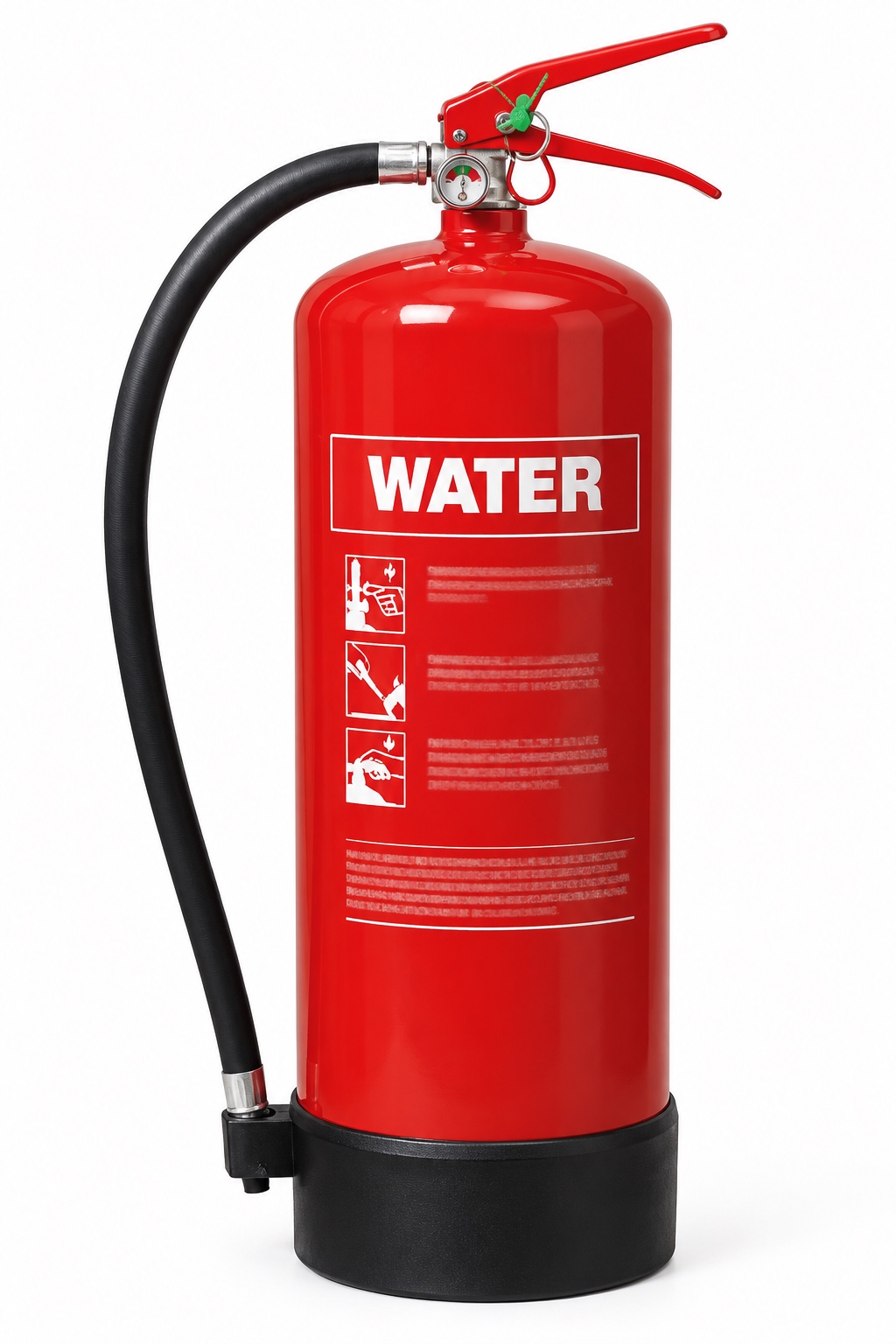

Recognise the pin, seal, pressure gauge and agent marking.
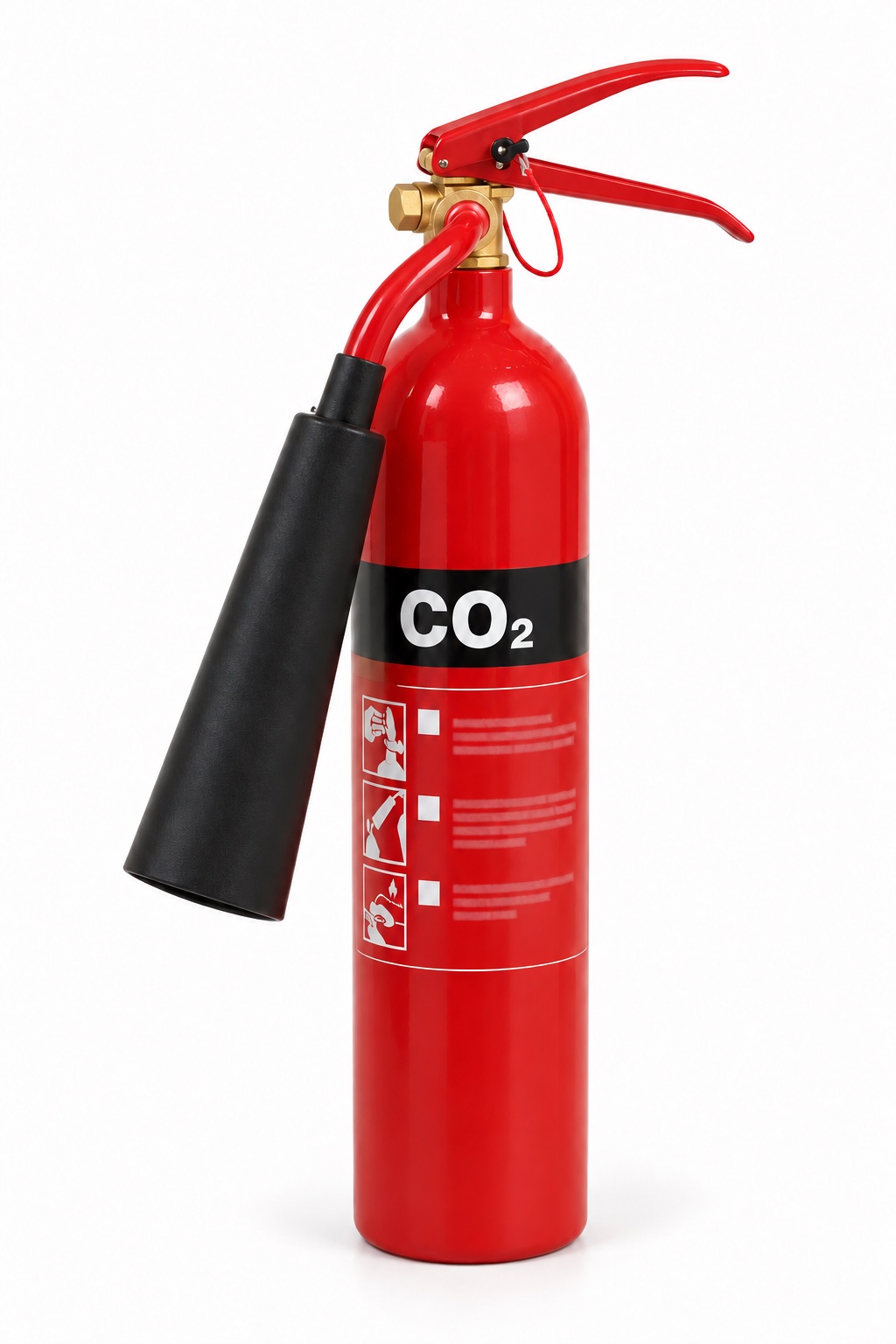
A different cylinder and discharge arrangement; cold and atmosphere hazards still matter.
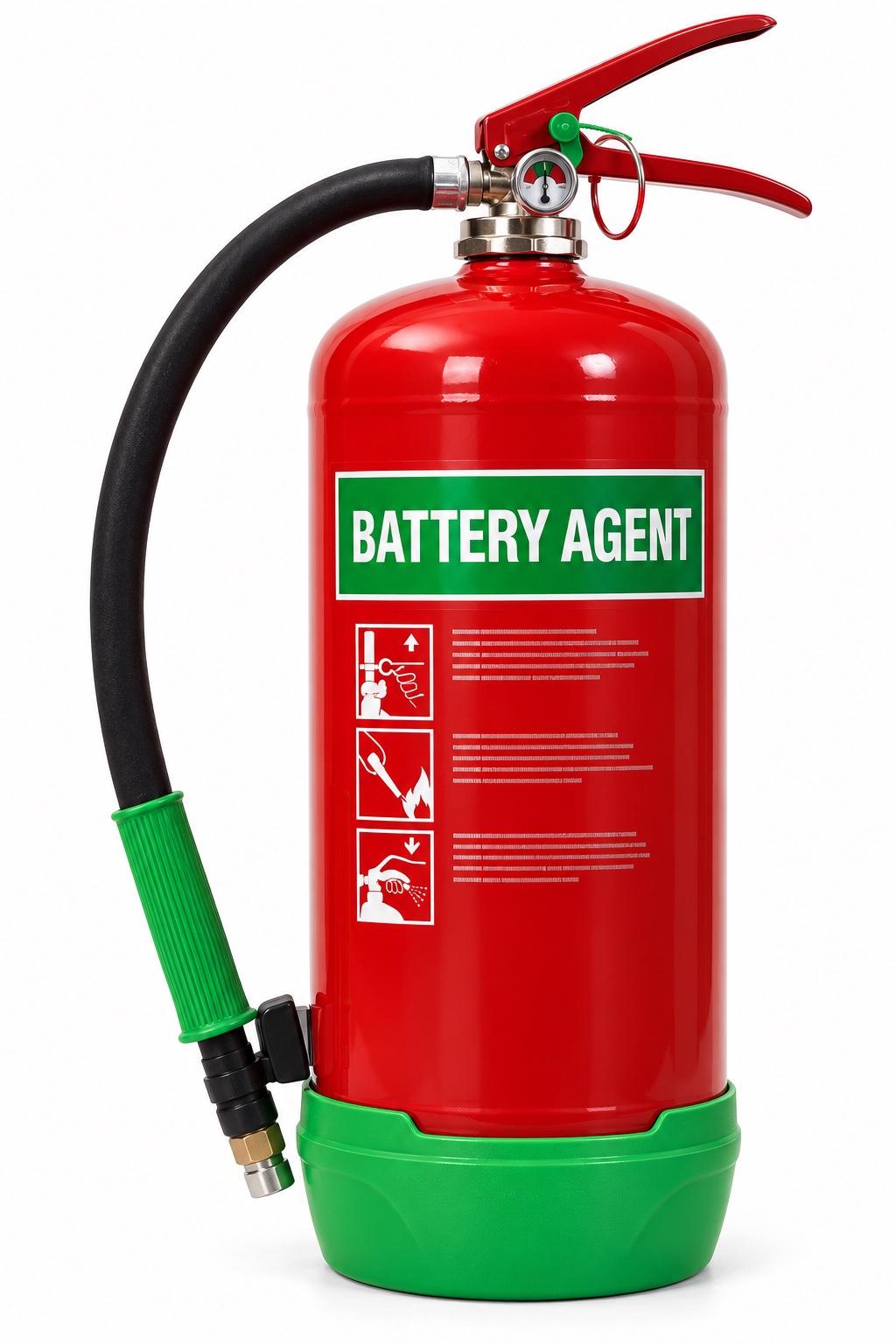
The named product and battery scope matter; green is not a universal Class L colour code.
Raise the alarm, follow the site’s evacuation plan and arrange the emergency call to 999. Only consider a small fire in its earliest stage if you are trained, authorised, have the correct equipment and a clear escape behind you. Smoke, spreading fire, uncertainty or an unsafe approach mean withdraw. Never delay escape to fetch an extinguisher.
How do the controls work during a transfer and a repair?
Use these worked examples to test the decision sequence. They illustrate control decisions; the actual task requires the site assessment, approved procedure and competent people.
Petrol transfer at Crownway Fuels Ltd
Task material and setting: Crownway Fuels Ltd plans a petrol road-tanker transfer to a fixed tank in an outdoor bunded depot. The desired outcome is a contained transfer with the correct inventory and a safe hand-back.
People and prerequisites: The operator, driver, nearby workers and maintenance contractor may be affected. The supervisor confirms product and receiving-tank identity, available capacity, the agreed delivery procedure and competence of both parties. Local DSEAR arrangements and emergency responsibilities are understood.
Before: Check the transfer connection and hose against the specified service, inspect for defects, verify tank capacity and overfill arrangements, containment and drain status, emergency shutdown availability, escape and communications. Coordinate nearby contractor work and ignition controls. Do not commence while critical checks remain unverified.
During: The responsible operator and driver monitor the transfer in accordance with the procedure. Stop for a leak, unexpected level or pressure, an alarm, loss of communications or an intrusion into the controlled area. Do not move into vapour to find a leak.
Hold or stop: Hold for unknown product, damaged hose, blocked containment, unavailable protection or conflicting work. The supervisor resolves the immediate issue; a changed product, layout or barrier basis needs competent technical review before approval. A suspected uncontrolled release or fire activates the emergency plan and withdrawal.
Completion and hand back: Stop the transfer by the approved sequence; isolate, make the connection safe and disconnect only as the procedure permits. Reconcile the received quantity, check for leaks and restore the agreed valve and drain state. The supervisor accepts any defects or restrictions before the area returns to use.
Evidence: Delivery identity and quantity, pre-transfer checks, defects and corrective actions, contractor coordination, any stop or alarm and the final hand-back record.
Contractor valve replacement on LPG pipework
Task material and setting: A contractor must replace a suspect valve on pressurised LPG pipework in an outdoor process area. The aim is a correctly isolated repair and verified reinstatement without a flammable release.
People and prerequisites: Operations, contractor maintainers and adjacent workers agree the work boundary. An authorised isolation planner, competent maintainers and an operations hand-back owner are identified; drawings, product data and the site isolation standard are available.
Before: Identify the exact line and all connected inventory. Use a competent, site-specific isolation plan, permit and verification of the required safe condition. Coordinate adjacent operations and any impaired gas detection or protection. Gas testing, where specified, supplements verified isolation; a single reading does not prove that energy and material are controlled.
During: Maintain the agreed isolation boundary and check changed conditions and simultaneous work. If a leak, alarm or discrepancy occurs, stop, withdraw and activate the applicable response. Never tighten or dismantle an unknown pressurised connection to investigate it.
Hold or stop: Unclear line identity, inability to prove isolation, unexpected pressure or substance, damaged protection, an alarm or unsafe access requires a hold. Operations and the technical authority resolve the cause; a suspected fire or uncontrolled release requires the emergency plan, not a permit amendment at the scene.
Completion and hand back: The competent team verifies installation and specified tests, accounts for tools and people, reinstates protective systems and updates the isolation/permit status. The authorised operations owner approves the controlled return to service and monitors for defects.
Evidence: Isolation plan and verification, permit and coordination, component identity and compatibility, installation/test results, protection restoration and signed hand-back.
Changed conditions: heavy rainfall reducing available containment, a delivery of an unfamiliar blend, a temporary detector impairment or adjacent hot work all require reassessment before continuing. A replacement hose of the same diameter is not automatically compatible: verify substance, pressure, temperature, connections and the manufacturer’s specified service.
Transfer between the two cases: the petrol supervisor checks where liquid can spread, while the LPG isolation owner checks where pressure can feed a directional flame. In both cases an apparently minor component substitution — a hose, valve, detector or protective coating — needs service compatibility and the credited barrier function checked against the actual scenario before use. A passed paperwork check is not the hand-back: operations must observe the final configuration and know what remains restricted. HSE HSG176 covers liquid storage and transfer; HSE HSG253 supports the isolation decision.
What evidence shows jet and pool fire risk is managed?
Evidence should prove the site understands credible fire scenarios and maintains the barriers that prevent, detect, control and mitigate them.
A credible assurance trail links each release scenario to the specific device or arrangement relied on: inspection and leak testing for containment, proof tests for detection and isolation, drainage inspection for liquid spread, and emergency exercises for response. An overdue test or temporary bypass changes the risk decision; it should not disappear inside a generic action list. HSE COMAH guidance (GB) explains the major-accident assurance route where a site is in scope.
For an LPG transfer, compare the detector proof-test result with the shutdown cause-and-effect record, valve closure test, current isolation status and a field walkdown. If one credited link is unavailable, the operations owner holds the transfer while the technical authority assesses the whole release scenario; a passed test of a different device does not restore that missing link. For a petrol tank, compare the overfill check with bund condition, drain position and the response plan before accepting a receipt.
| Evidence | What it should show | Quality check |
|---|---|---|
| Scenario register | A documented set of release, ignition and escalation scenarios exists for review. | Does it include release source, ignition and escalation target? |
| DSEAR assessment | Hazardous-area and ignition decisions have been recorded for the assessed plant and work. | Is it current and linked to operations and maintenance? |
| Mechanical integrity records | Inspection and repair activity has been recorded for containment components. | Are defects risk-ranked and closed? |
| Fire/gas detection tests | Specified detector and alarm functions passed recorded tests under the test conditions. | Do field coverage, cause-and-effect and response times still match the scenario? |
| Isolation/depressurisation tests | The credited shutdown or depressurisation functions passed specified proof tests. | Did the tested valve and utility function as installed, and are impairments open? |
| Fire protection records | Inspection and tests record the condition of credited active and passive fire protection. | Are impairments controlled? |
| Emergency exercise records | The team rehearsed the selected response scenario and recorded observed gaps. | Do drills test realistic jet/pool fire scenarios? |
Give each material fire scenario a risk-register owner, exposed receptors, preventive and mitigating barriers, performance criteria and evidence of current condition. The test is whether those barriers remain credible together today, including common utilities and maintenance impairments. Set inspection and test intervals from the applicable design basis, manufacturer instructions, legal scheme and risk; this page supplies no universal frequency.
Which requirements apply in Great Britain and Northern Ireland?
Great Britain and Northern Ireland have separate DSEAR and Control of Major Accident Hazards (COMAH) instruments. Establish the workplace jurisdiction and substance inventory before deciding which duties apply.
These legal routes support release prevention, assessment and emergency arrangements. COMAH does not apply to every workplace with fuel; its scope and inventory rules must be checked.
| Legal route | What the duty changes | Verification boundary |
|---|---|---|
| Great Britain — DSEAR 2002 | Assess dangerous-substance risks; eliminate or reduce them and provide appropriate controls and emergency arrangements. | Read with HSE DSEAR guidance. This is workplace-use law. |
| Northern Ireland — DSEAR Northern Ireland 2003 | Use the NI instrument for NI workplaces; do not cite the GB 2002 regulations as NI law. | Verify amendments and application through HSENI subordinate legislation register. |
| Great Britain — COMAH 2015 | Additional prevention and mitigation duties where the dangerous-substance inventory and establishment meet COMAH criteria. | Lower and upper tier duties differ; use HSE COMAH 2015 guidance. |
| Northern Ireland — COMAH Northern Ireland 2015 | Apply the NI COMAH regime when its scope and thresholds are met. | Use HSENI COMAH guidance and the competent authority for current applicability and emergency planning. |
In Great Britain, the general framework includes Health and Safety at Work etc Act 1974 and Management of Health and Safety at Work Regulations 1999. PUWER 1998, Pressure Systems Safety Regulations 2000 and COSHH 2002 may apply according to the equipment, pressure system and health exposures. For Northern Ireland, use HSENI and the corresponding NI instruments to verify those duties; GB titles alone are not an NI compliance assessment.
Supply and use are different: conformity marking and product declarations do not prove that a hose, detector or protective system is suitable for the actual substance, zone, pressure or fire exposure. Procurement must verify the current supply regime for the market and the manufacturer’s intended use, alongside the workplace assessment.
General fire precautions and environmental obligations also require the relevant national and local routes. The practical examples and recommended records on this page are SHARE guidance, not additional statutory rules.
How could Crownway Fuels Ltd manage this in practice?
Crownway Fuels Ltd would manage jet fires and pool fires as credible major accident scenarios with named barriers and tested evidence.
Crownway Fuels Ltd is a fuel storage and distribution business with tanks, LPG cylinders, road tanker loading, pumps, pipework, drains, bunds and contractor maintenance. It uses scenario-based process safety reviews to make sure that fires are not treated as generic emergency events but as specific loss-of-containment pathways.
| Management element | How the business would manage it | Evidence to review |
|---|---|---|
| Assessing | Crownway builds a scenario register for LPG jet fires, petrol pool fires, tank bund fires, loading bay spills and hot-work ignition routes. | Scenario register, DSEAR assessment and layout review. |
| Analysing | Engineers review release size, pressure, drainage, thermal radiation, flame impingement, escalation targets and emergency isolation timing. | Technical review, bow-tie/barrier analysis and action tracker. |
| Implementing | The site maintains ESD valves, gas detection, bunds, drain isolation, foam systems, firefighting water and hot-work controls. | Inspection plans, proof tests, impairment log and permit audits. |
| Training | Operators practise alarm response, remote isolation, drain closure, muster, withdrawal and fire service liaison using realistic scenarios. | Scenario drills, competence records and debrief actions. |
| Checking | First-line checks cover valve status, bund valves, drains and alarms; second-line assurance samples DSEAR, permits and fire protection; third-line reviews model assumptions and major accident barriers. | Assurance schedule and closed findings. |
| Learning | Any leak, detector alarm, hot-work deviation, blocked drain or impaired deluge system triggers review of the relevant scenario and barrier health. | Incident learning, management review and updated standards. |
For example, Crownway’s local rule is to hold a planned transfer when its credited emergency-isolation function is unavailable until the authorised manager and technical authority have resolved the risk. That is an illustrative company decision rule, not a generic statutory shutdown trigger or permission to substitute unverified compensating measures.
How should pool-fire or jet-fire scenarios be separated from ATEX zoning?
Use the selected release location as context only. Fire behaviour, release conditions and consequences need a separately reviewed basis; a zone boundary is not a fire footprint.
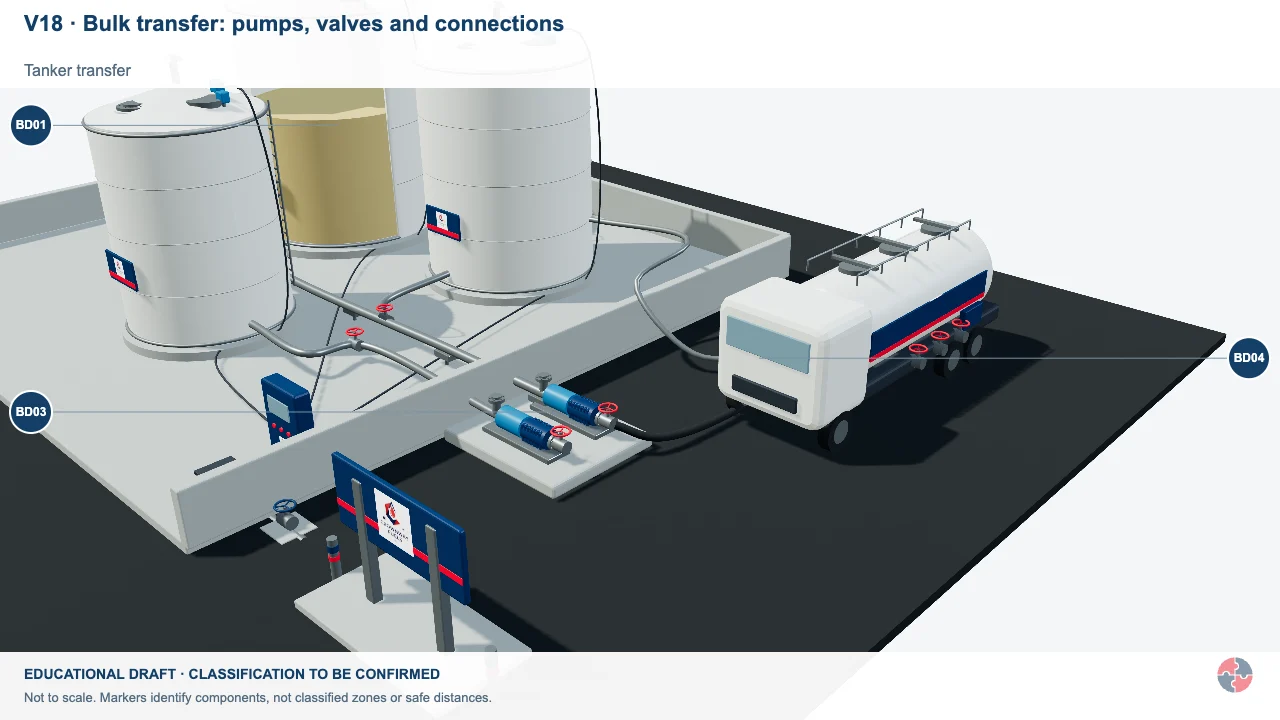
Tanker loading: liquid out, vapour back
Follow petrol from bulk storage into the tanker and the separate displaced-vapour route from the tanker to the terminal VRU.
Activity focus: Distinguish the product line, vapour collection line and tanker-loading protective controls.
Educational illustration, not to scale. Coloured zones are teaching examples, not a site-specific hazardous-area classification.
Separate reviewed consequence scenario required; classified areas do not predict pool/jet-fire consequences.
Who needs to be able to make which decisions?
Competence should match the person’s task and authority: recognising an alarm, approving an isolation and designing fire protection require different capabilities.
Assessment should match the job. A worker can demonstrate recognition of a leak and the correct alarm route; a maintainer must demonstrate isolation and prove-zero on the actual system; a supervisor must rehearse a changed-condition hold and hand-back. Engineering specialists need to explain the design basis and limits of fire protection, and managers need to challenge overdue barrier actions.
Workers and contractors need substance awareness, warning signs, the agreed task controls, alarm and withdrawal routes and a clear way to stop work. Supervisors need to verify prerequisites, coordinate interfaces and recognise when a change exceeds their authority.
Maintainers and purchasers need the equipment specification, compatibility evidence, installation limits and hand-back requirements. Technical authorities assess release scenarios, protection performance and design assumptions. Managers and auditors test whether impaired barriers are identified, decisions resourced and corrective actions effective.
Use observed task performance, realistic drills and targeted reassessment after change or poor performance. This topic does not establish a universal certificate expiry or refresher interval; set the arrangements from the legal duties, task risk, manufacturer information and demonstrated competence.
| Role | Learning and demonstration | Assessor and record | Reassessment trigger |
|---|---|---|---|
| Nearby workers and contractors | Recognise leak, alarm and safe withdrawal; practise the reporting route. | Supervisor observes a scenario drill and records the response. | Changed alarm, route or failed drill. |
| Operators | Show transfer checks, warning signs, isolation limits and stop decisions on the actual plant. | Authorising supervisor signs a task observation and scope of authorisation. | Changed plant, procedure, leak or unsafe observation. |
| Maintainers and permit issuers | Demonstrate isolation, prove-zero, permit hold and controlled hand-back. | Competent technical lead reviews the practical assessment and permit record. | Equipment change, failed isolation, incident or long gap in practice. |
| Supervisors and emergency coordinators | Test impaired-barrier decisions, escalation, evacuation and contractor interfaces in exercises. | Manager reviews exercise outcome, holds and corrective actions. | Scenario change, exercise gap or barrier impairment. |
| Managers, designers and purchasers | Challenge fire scenarios, protection specification, resources and barrier assurance. | Technical authority records design review and management decision. | New inventory, altered layout, changed standard or poor assurance. |
| Specialists and auditors | Check scenario assumptions, fire-protection evidence and control effectiveness. | Peer technical review and audit trail show competence within scope. | New method, standard, finding or source conflict. |
How can a learner check their understanding?
Explain one credible release, the people or plant exposed and the control that interrupts each step; then name the evidence that proves the control works.
Try an LPG valve leak and a petrol loading spill. Explain why remote isolation matters in the first and why spreading liquid, overfill controls and drain status matter in the second. Add what changes when an alarm fails or a contractor blocks the escape route. If the answer is only “use an extinguisher”, revisit the release and escalation sections.
How should fire-barrier assurance be managed?
Assign each credible release and fire scenario to an owner, with evidence that prevention, detection, isolation and protection are available together when the activity starts.
For a pressurised LPG line, compare the release scenario with the detector coverage, shutdown cause-and-effect, valve closure and protection checks. For a petrol transfer, compare the overfill safeguard, bund and drain condition, ignition controls and response arrangements. A missing critical link means the relevant operation is held for a competent decision. HSE leak and gas detection guidance and HSE HSG176 support these separate checks.
For a protective coating or fixed fire system, the technical authority checks the specified fire exposure, likely duration, actual substrate and geometry, installation, inspection and credible damage. A pool-fire test alone does not show performance for a directional jet. HSE active and passive fire-protection guidance calls for supplier or manufacturer evidence against tests reflecting the workplace fire conditions, plus maintenance of installed protection.
Site management should record impairments, decide which operation must stop, assign restoration and verify the barrier in the field before release. A register or certificate is a starting record, not proof that the combined safeguards work today. HSE fire-protection guidance supports checking installation and ongoing condition.
What warning signs show jet or pool fire risk is weak?
Warning signs usually appear as degraded barriers, unclear ownership or scenarios that exist only in reports.
A passing valve, unexplained gas alarm or blocked drain is a barrier warning, even when no fire has occurred. The shift supervisor should make the area safe, record the impairment and keep the affected operation on hold until the technical owner has assessed the scenario and authorised a controlled restart. HSE DSEAR guidance (GB) is the regulatory route for checking these fire and explosion controls.
A repeated gas-detector fault is different from a one-off nuisance alarm only after the instrumentation owner has checked the event history, coverage and cause. A drain found open after a delivery exposes a separate liquid-spread route. The shift supervisor records both as barrier impairments, stops the affected activity and asks the relevant owner to demonstrate restoration before a controlled restart; a general reminder cannot establish that either barrier works.
| Warning sign | What it suggests | Action |
|---|---|---|
| No credible fire scenario register | Fire risk is being treated generically. | Build scenario-based reviews for jet, pool, flash fire and explosion. |
| Bund valves left open | Pool fire and environmental controls may fail. | Inspect valve status and train operators. |
| Fire/gas alarms without action logic | Detection may not lead to timely response. | Define and drill alarm response. |
| Impaired deluge or foam not escalated | Mitigation barrier is unavailable. | Use impairment procedure and compensating controls. |
| Hot work near drains or flammable residues | Ignition control is weak. | Stop and reassess permit, isolation and gas testing. |
| No withdrawal criteria | Emergency teams may be overexposed. | Set thermal radiation and escalation decision points. |
What do the acronyms and key terms mean?
These terms identify the controls, decisions and records discussed above.
| Acronym | Meaning | Plain-English use |
|---|---|---|
| DSEAR | Dangerous Substances and Explosive Atmospheres Regulations | Separate GB 2002 and NI 2003 workplace regulations. |
| COMAH | Control of Major Accident Hazards | Separate GB and NI 2015 regimes for qualifying establishments. |
| ESD | Emergency Shutdown | System used to place plant in a safer state during abnormal events. |
| PFP | Passive Fire Protection | Fire-resistant protection used to delay heat damage. |
| LEL | Lower Explosive Limit | Lowest concentration at which a flammable vapour/gas mixture can ignite. |
| PSM | Process Safety Management | Management of major accident hazards and critical barriers. |
| ERICPD | Eliminate, Reduce, Isolate, Control, Personal protective equipment, Discipline | Teaching hierarchy for choosing stronger fire-risk controls before reliance on people. |
| PPE | Personal protective equipment | Residual personal protection; it does not replace containment or make fire entry safe. |
| LPG | Liquefied petroleum gas | Pressurised flammable fuel whose release may create a jet-fire scenario. |
Unlock another resource
You have used this month’s two free downloads. Publish a post in your own words to unlock one more resource, or choose SHARE Individual for 10 downloads per month.
You decide whether to share. If you do, use the relevant platform disclosure tools and do not make claims you do not genuinely hold.