SHARE Knowledge Hub
Active fire protection
Active fire protection detects, warns, controls or suppresses fire using systems such as alarms, sprinklers, deluge, foam and firewater. Choose each system for a credible fire scenario, keep its supply and controls available, stop or restrict affected work when a critical barrier is impaired, and verify restoration before restart. General fire-safety and dangerous-substance duties differ across Great Britain and Northern Ireland.
Understanding Active fire protection
Active fire protection is not synonymous with all fire precautions. An active system changes state or requires an action: a detector signals, a valve opens, a pump starts, an alarm warns, a damper moves or an extinguishing agent discharges. Passive measures such as fire-resisting construction, fire doors, protected structural steel and separation normally provide their function without activation. Both can be safety-critical and should be designed as a coordinated protection strategy.
Why this matters at work
Severity depends on fuel properties and quantity, release rate, ventilation, confinement, congestion, oxygen, ignition timing, fire duration, building geometry, occupancy and vulnerability. A small fire in an open area and the same heat-release rate in a sleeping-risk premises, basement, spray booth or congested process module do not present the same life risk. The assessment must also consider disabled people, lone workers, visitors, contractors, young persons and anyone nearby who may be affected.
Inspection finds visible condition; functional testing demonstrates operation; proof testing seeks hidden dangerous failures; servicing restores condition; and integrated testing proves interfaces. These are different claims. A detector clean-and-check does not prove alarm audibility, and a pump start does not prove system flow. Tests should be representative while controlling hazards such as unintended discharge, water damage, alarm disruption and exposure to pressurised systems.
How organisations manage this in practice
Start with the fire scenarios and the premises or process fire strategy: what can burn, how fire could develop, who is exposed and which functions are needed to warn, protect escape, control fire or limit escalation. Detection, alarm and suppression are different functions and must suit the actual hazard, occupancy and operating conditions. Do not select a system solely because it is familiar or installed next door. Competent design should establish coverage, performance, dependencies and interfaces, including power, water, detection, isolation, smoke control and passive protection. Consider maintenance and testing access, impairment, simultaneous demand and foreseeable changes to storage or use. Active protection complements prevention, escape and passive measures; it cannot compensate automatically for an avoidable release or blocked exit. Record the design basis and acceptance evidence and keep it aligned with the current risk assessment. System settings, capacities and test intervals require the applicable standards, manufacturer information and competent site assessment; this answer supplies no universal design values.
Smoke control may use natural vents, mechanical extract, pressure differential or automatic opening devices. The system should be designed for the building and fire strategy; uncontrolled changes to doors, partitions, controls or ventilation can undermine it. Fire curtains and shutters require safe deployment logic, obstruction control and arrangements that do not trap people.
Management of change should screen alterations to process inventory, stock, racking, partitions, ceilings, ventilation, software, occupancy, staffing, access, drainage, utilities and maintenance. Temporary change needs the same discipline. After change, update risk assessments, drawings, maintenance, emergency plans and training, then test affected functions. Contractor handover should identify every isolation and temporary device.
Where does active fire protection guidance apply?
Use this guide to understand fire protection decisions, but use the actual site assessment, design basis and correct GB or NI law before relying on a system.
It covers ordinary non-domestic premises and higher-hazard work with flammable liquids, gases, dusts or other dangerous substances. A system may protect life, property, emergency access or major-accident escalation; those are different duties. This page is not a fire-engineering calculation, a product approval or an instruction for untrained people to fight fires. The applicable law depends on England and Wales, Scotland or Northern Ireland and on whether general fire, process, construction, offshore or COMAH duties apply.
For a real system decision, check the current site design basis, manufacturer instructions and applicable regulator guidance. Historical technical examples cannot establish today’s legal duty or system performance.
How can I practise this topic in 3D?

A rim-fire scenario is treated as an ordinary small fire
All related inspection points 6 across 1 location
Crown Fuels terminal 6 inspection points
Practice in the SHAREhub environment. Browser practice is separate from workplace competence and formal learning records.
Choose the fire duty and manage lost protection
Identify the credited duty before judging the condition of a pump, alarm, foam system or water supply. A component running is not the same as the required system performance. Premises life-safety arrangements and process protection may interface, but their scenarios and responsible decisions must remain explicit.
Best-practice guide: Active fire protection
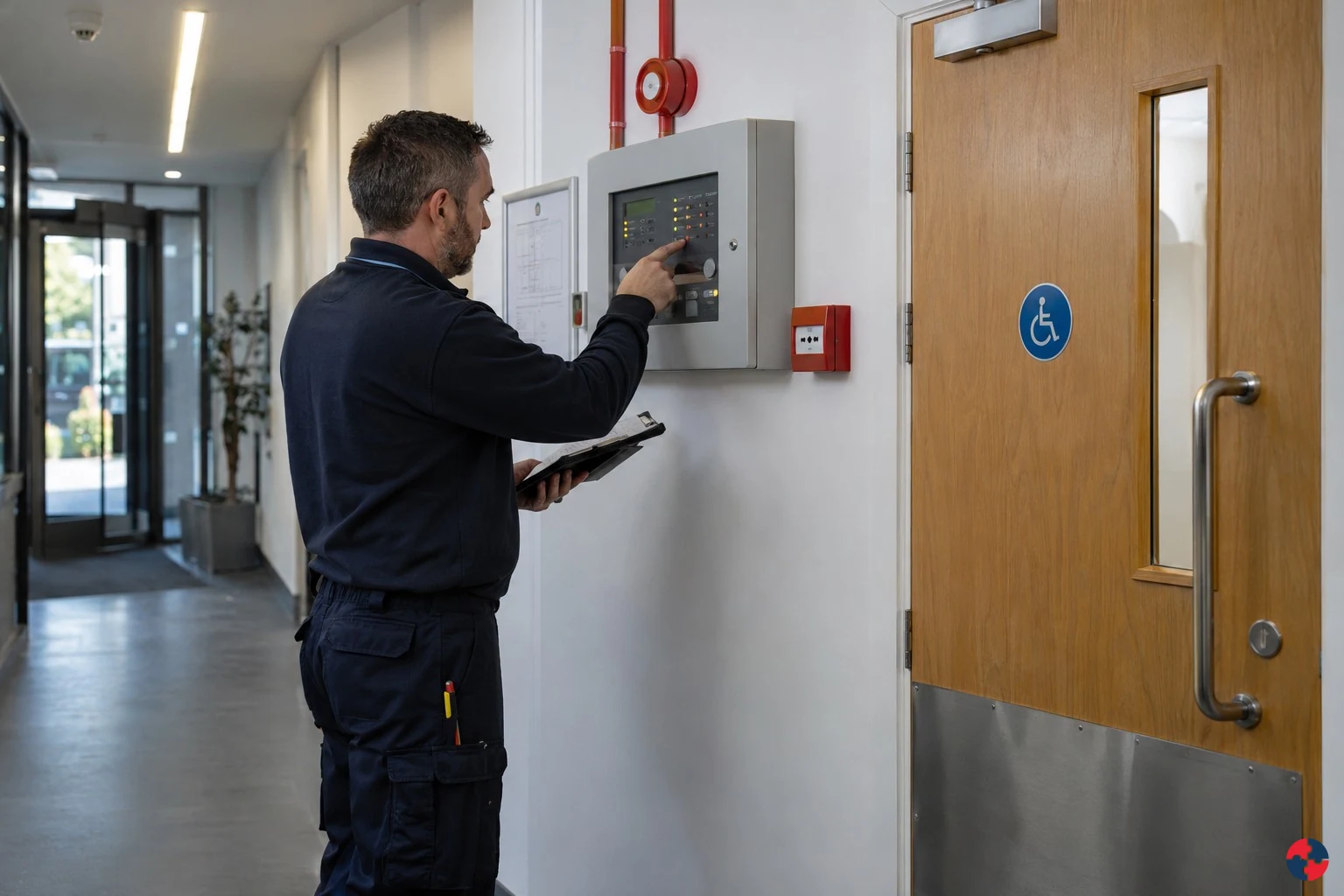
Choose the fire duty and manage lost protection
Identify the credited duty before judging the condition of a pump, alarm, foam system or water supply. A component running is not the same as the required system performance. Active fire protection detects, warns, controls or suppresses fire using systems such as alarms, sprinklers, deluge, foam and firewater.
Turn active fire protection knowledge into a decision
Active fire protection detects, warns, controls or suppresses fire using systems such as alarms, sprinklers, deluge, foam and firewater. Choose each system for a credible fire scenario, keep its supply and controls available, stop or restrict affected work when a critical barrier is impaired, and verify restoration before restart. Change assessment, manufacturer evidence, commissioning result and approved transfer release.
New solvent and uncertain foam suitability
Hold the change while a competent team checks whether the system and response plan still meet the credible fire duty. After approved changes and functional verification, update drawings, labels, training and emergency-service information.
Task-to-harm pathways and stop triggers
Tank or bund transfer: flammable liquid: A leak forms a pool or vapour; ignition sends flame, radiant heat and smoke toward people and adjacent tanks. Pressurised gas/process line: Escaping gas may ignite as a jet fire; heat can impinge on vessels, supports or escape routes. Manufacturing dust process: A combustible dust cloud ignites; pressure and flame may disturb settled dust and propagate.
Choose controls for active fire protection
Eliminate: Avoid the flammable transfer or redesign the operation so the dangerous inventory is not needed. Reduce: Use a less flammable material where technically suitable; minimise inventory and transfer duration. Isolate: Separate tanks, transfer points and occupied routes; maintain suitable containment and remote isolation. Control: Engineered leak/fire detection, shutdown and a scenario-matched, reliable foam or cooling system control or limit the event. PPE: Only trained responders use specified protective equipment within the assessed emergency role; it limits some personal exposure. Read the full control table for qualifications, ownership and verification. Use the actual task and applicable jurisdiction; existing technical approval remains unchanged.
Use the full active fire protection lesson
Use the full topic for the decision points, practical examples, detailed control tables and source scope. HSE guidance applies to Great Britain; use HSENI for the Northern Ireland route and the source’s stated jurisdiction. A simplified guide does not change the page’s technical-review or approval status.
Read all six steps as text
1. Choose the fire duty and manage lost protection
Identify the credited duty before judging the condition of a pump, alarm, foam system or water supply.
- Avoid / redesign: Avoid the flammable transfer or redesign the operation so the dangerous inventory is not needed.
- Control the task: Separate tanks, transfer points and occupied routes; maintain suitable containment and remote isolation.
- Verify before release: Elimination may be impossible for the intended product; a replacement process must be assessed for new hazards.
Identify the credited duty before judging the condition of a pump, alarm, foam system or water supply. A component running is not the same as the required system performance. Active fire protection detects, warns, controls or suppresses fire using systems such as alarms, sprinklers, deluge, foam and firewater.
Apply it: Which part of this plan would you check at the workface before authorising the task?
2. Turn active fire protection knowledge into a decision
Use the evidence to improve the actual work arrangement.
- Change at source: Avoid the flammable transfer or redesign the operation so the dangerous inventory is not needed.
- Make it observable: Elimination may be impossible for the intended product; a replacement process must be assessed for new hazards.
- Keep useful evidence: Change assessment, manufacturer evidence, commissioning result and approved transfer release.
Active fire protection detects, warns, controls or suppresses fire using systems such as alarms, sprinklers, deluge, foam and firewater. Choose each system for a credible fire scenario, keep its supply and controls available, stop or restrict affected work when a critical barrier is impaired, and verify restoration before restart. Change assessment, manufacturer evidence, commissioning result and approved transfer release.
Apply it: What evidence would show that the change improves this task, rather than only completing a record?
3. New solvent and uncertain foam suitability
Example: a practical application of the existing topic lesson.
- Setting: A planned tank transfer introduces a polar solvent to a protected bund; the outcome is to avoid assuming the existing hydrocarbon foam will work.
- Act: Verify the fuel identity and SDS, tank and bund scenario, foam concentrate approval, proportioner, application route, stock condition and runoff plan.
- Hold / review: Unknown fuel, obsolete foam approval, unverified mixing or no runoff route means no transfer on the assumption that any foam is suitable.
Hold the change while a competent team checks whether the system and response plan still meet the credible fire duty. After approved changes and functional verification, update drawings, labels, training and emergency-service information.
Apply it: At which point would you hold this example, and what evidence would allow it to proceed?
4. Task-to-harm pathways and stop triggers
Connect the task, the route to the person and the control that can fail.
- Tank or bund transfer: flammable liquid: A leak forms a pool or vapour; ignition sends flame, radiant heat and smoke toward people and adjacent tanks.
- Pressurised gas/process line: Escaping gas may ignite as a jet fire; heat can impinge on vessels, supports or escape routes.
- Manufacturing dust process: A combustible dust cloud ignites; pressure and flame may disturb settled dust and propagate.
Tank or bund transfer: flammable liquid: A leak forms a pool or vapour; ignition sends flame, radiant heat and smoke toward people and adjacent tanks. Pressurised gas/process line: Escaping gas may ignite as a jet fire; heat can impinge on vessels, supports or escape routes. Manufacturing dust process: A combustible dust cloud ignites; pressure and flame may disturb settled dust and propagate.
Apply it: Who could be exposed, including other trades, cleaners, maintainers and people nearby?
5. Choose controls for active fire protection
Start with the stronger practicable options and verify their effect.
- Eliminate: Avoid the flammable transfer or redesign the operation so the dangerous inventory is not needed.
- Reduce: Use a less flammable material where technically suitable; minimise inventory and transfer duration.
- Isolate: Separate tanks, transfer points and occupied routes; maintain suitable containment and remote isolation.
- Control: Engineered leak/fire detection, shutdown and a scenario-matched, reliable foam or cooling system control or limit the event.
- PPE: Only trained responders use specified protective equipment within the assessed emergency role; it limits some personal exposure.
Eliminate: Avoid the flammable transfer or redesign the operation so the dangerous inventory is not needed. Reduce: Use a less flammable material where technically suitable; minimise inventory and transfer duration. Isolate: Separate tanks, transfer points and occupied routes; maintain suitable containment and remote isolation. Control: Engineered leak/fire detection, shutdown and a scenario-matched, reliable foam or cooling system control or limit the event. PPE: Only trained responders use specified protective equipment within the assessed emergency role; it limits some personal exposure. Read the full control table for qualifications, ownership and verification. Use the actual task and applicable jurisdiction; existing technical approval remains unchanged.
Apply it: Which stronger option can be used here, and who will verify it before accepting the remaining risk?
6. Use the full active fire protection lesson
Follow the official sources below and retain the task-specific evidence.
- Official guidance: HSE Active/passive fire protection (Undated technical measures page; older references)
- Official guidance: HSE Introduction to fire safety (Live HSE page)
- Task decision: Change assessment, manufacturer evidence, commissioning result and approved transfer release.
Use the full topic for the decision points, practical examples, detailed control tables and source scope. HSE guidance applies to Great Britain; use HSENI for the Northern Ireland route and the source’s stated jurisdiction. A simplified guide does not change the page’s technical-review or approval status.
Apply it: Which official source and full-topic section will you use to resolve the next decision?
Manage an impairment as a time-bounded operating decision. Record affected activities, temporary restrictions, approvals and the evidence needed to restore the original function. A fire watch, normal display or pump start does not by itself replace the lost duty.
The pump starts but the duty is unproven
Illustrative example. A fuel-loading site completes pump maintenance, but only a start test is available for the credited firewater function.
Decision. Keep the relevant restrictions until the technical authority establishes and verifies the required performance and dependencies.
Evidence to check. Link the affected scenario to water supply, delivery, simultaneous demand and the approved test evidence.
Hold or escalation point. No blanket restoration from pump operation or a temporary fire watch.
Follow-up. The operations owner records representative restoration proof and closes the impairment with affected shifts informed.
Who must act when a fire protection barrier changes?
Everyone should report a fault or blocked fire route; the named dutyholder or technical authority decides whether work may continue and who can restore the system.
| Role | Decision and action | Evidence or escalation |
|---|---|---|
| Workers and visitors | Follow the alarm and evacuation plan; report leaks, blocked devices or unusual panel signals. Do not bypass or test a fire system casually. | Give location, system and observed condition to the supervisor or control room. |
| Operators and supervisors | Check barrier status before hazardous work, restrict affected operations after failure and communicate limits across shifts. | Record interim controls, decision owner and permit or restart hold. |
| Contractors and hosts | Agree which alarms, sprinklers, hydrants or valves work may affect; coordinate isolation and hand-back. | Use a controlled impairment or permit record and witnessed restoration. |
| Engineers and maintainers | Use the design basis and current instructions to diagnose, test, repair and validate performance. | Retain as-found and as-left results, deviations and technical approval. |
| Purchasers and managers | Specify the hazard and performance duty, check supplier evidence and resource maintenance, spares and emergency readiness. | Escalate overdue safety-critical defects and document risk-acceptance authority. |
| Fire leads, auditors and responders | Test the scenario, warning, access, communications, water and runoff assumptions, including degraded conditions. | Feed drill or audit findings into the barrier register and verified action closure. |
What is active fire protection?
Active fire protection is the fire detection, alarm, suppression, control and firefighting equipment that must operate when a fire occurs.
Active fire protection differs from general fire precautions because it usually has a defined job to do during a fire. It may warn people to escape, raise an alarm in the control room, cool a vessel exposed to flame, apply foam to a tank fire, suppress a warehouse fire, provide hydrant water for firefighting or flood an enclosure with a specialist agent.
In a simple workplace, active fire protection may mean a fire alarm system, emergency lighting and portable extinguishers. In process safety, it can be much more demanding: firewater tanks, diesel pumps, ring mains, hydrants, fixed foam pourers, water spray, deluge systems, monitors, detector logic, emergency shutdown interfaces, fireproof cabling, backup utilities and arrangements with the emergency services.
The key idea is performance. A system is not adequate because it exists on a drawing or appears on an asset list. It must be suitable for the fire scenario, available when required, maintained, tested, accessible, understood by responders and protected from common-cause failure such as loss of power, freezing, closed valves, poor water supply or simultaneous demand.
A practical way to understand the topic is to ask what the system has to achieve in the first few minutes of a fire. For an office, that may be warning, evacuation and first-aid firefighting only if safe. For a workshop, it may include stopping a small fire spreading to gas cylinders, oils or stored materials. For a fuel terminal, chemical site or high-risk construction project, active fire protection may need to cool vessels, apply foam, protect escape routes, prevent domino escalation, support the fire and rescue service and contain contaminated firewater.
How is ordinary workplace active fire protection different from DSEAR, COMAH and process safety fire protection?
Ordinary workplace fire protection is usually focused on warning, escape and limited firefighting, while higher-risk fire protection is designed against credible fire and explosion scenarios.
Most workplaces need active fire protection that supports life safety: detection, alarm, emergency lighting, extinguishers, clear routes, staff awareness and arrangements for calling the fire and rescue service. The fire-risk assessment asks whether people can be warned quickly, escape safely and avoid being trapped by smoke, flame or locked routes. In lower-risk premises, the system may be relatively simple, but it still needs routine checks, competent maintenance and action when defects appear.
Higher-risk environments need a different level of thinking. Where dangerous substances, flammable liquids, gases, vapours, combustible dusts, high fire loads or major accident hazards are present, active fire protection becomes part of the control strategy for fire, explosion, escalation and environmental harm. The assessment needs to consider release scenarios, ignition, flame impingement, thermal radiation, vapour cloud explosion, bund fires, tank fires, warehouse fires, contaminated runoff and responder access.
This distinction matters because it stops overcomplicating simple premises while also preventing high-hazard sites from relying on basic fire precautions. A small office does not need a COMAH-style firewater strategy. A fuel storage site should not rely on portable extinguishers and a generic evacuation plan as if it were a small office. The level of detail, testing, competence and assurance must match the risk.
| Setting | Typical active fire protection focus | What good management looks like |
|---|---|---|
| Ordinary workplace premises | Detection, alarm, emergency lighting, portable extinguishers, call points and evacuation support. | Fire-risk assessment, alarm checks at the approved system and site intervals, extinguisher inspection, defect repair, staff awareness and evacuation drills. |
| Workshops and construction areas | Alarms, extinguishers, fire points, temporary alarms, hot work controls and protection of cylinders, fuels and combustible materials. | Task risk assessment, temporary fire plan, hot work permit, housekeeping, supervisor checks, contractor control and emergency arrangements. |
| DSEAR workplaces | Control of fire and explosion risks from dangerous substances such as vapours, gases, dusts and flammable liquids. | DSEAR assessment, hazardous area information, ignition control, suitable equipment, emergency procedures and checks that controls remain effective. |
| COMAH or major hazard sites | Scenario-based systems such as firewater, deluge, foam, hydrants, monitors, detection, shutdown interface and responder support. | Safety-critical performance standards, barrier registers, impairment control, emergency exercises, maintenance evidence and independent assurance. |
| Process safety operations below COMAH threshold | Fire protection linked to credible loss of containment, escalation and emergency response even where COMAH does not apply. | Scenario register, DSEAR/fire-risk integration, system testing, training, incident learning and management review. |
Why does active fire protection matter?
Active fire protection matters because it is often the barrier that stops a small fire becoming a major accident.
Fire scenarios escalate quickly. A small release can ignite as a pool fire, jet fire, flash fire or vapour cloud explosion. Thermal radiation can damage neighbouring equipment, cause vessel failure, weaken steel, block escape routes or make emergency access impossible. Where flammable liquids, gases, combustible dusts or reactive materials are present, fire protection must be linked to the credible scenario rather than treated as generic equipment.
Active systems are especially important where people rely on time: time to detect, alarm, evacuate, isolate, cool, suppress, account for people and hand over to emergency responders. If alarms are slow, pumps fail, foam is unavailable, hydrants are obstructed or deluge valves are isolated, that time disappears.
Fire protection can also protect the environment and the wider community. Firewater runoff, contaminated foam, smoke, explosions and off-site evacuation can become major consequences in their own right. Good emergency planning therefore considers suppression media, containment, drainage, bunds, isolation valves, environmental receptors and communication with external responders.
A fire can cause immediate burns, smoke exposure or blast injury; the severity depends on fuel, release, ventilation, confinement, distance, occupancy and escape conditions. Some smoke or chemical exposures may have later health effects, but these depend on the actual material and dose. Active protection buys time or limits escalation only if it is suitable for this scenario and available on demand.
How can the hierarchy of controls reduce fire risk before relying on active fire protection?
A fuel or combustible material can escape, ignite and send flame, heat, smoke or pressure toward people and adjacent plant. Prevent the release or ignition first; where a credible fire remains, specify protection that detects it, warns people and limits its spread or exposure.
Active systems mitigate a fire; they do not make a leaking transfer, uncontrolled hot work or unsafe building acceptable. The real outcome depends on the fuel, release, confinement, people present and time to escape. An impaired alarm, pump, foam system or sprinkler removes a credited layer precisely when it may be needed.
How can fire and failed protection harm people?
At a fuel or flammable-liquid store, a detector and suppression system are only part of the barrier chain. First reduce or remove unnecessary inventory and ignition sources; a safer product or process may be a substitution where its own hazards have been assessed. A suitable compartment, separation distance, protected cable route, detection, alarm and fixed suppression are engineering measures selected against the actual fire scenario. The fire engineer and responsible site owner record the design basis, occupancy, credible loss of power or water, acceptance test and interface with evacuation. ERICPD Eliminate/Reduce describe source decisions; Isolate and Control cover physical separation and active barriers. An alarm cannot replace a fire-rated boundary that the scenario requires.
Impairment permits, inspection schedules, training and temporary cover are administrative controls. Firefighter PPE is not an occupant-protection strategy. ERICPD Discipline is the continuing test that detectors, doors, pumps, valves and emergency interfaces still operate together, with defects assigned and learned from. If a fire door cannot close, a detector is isolated, suppression supply is unavailable or the actual inventory exceeds the approved basis, the responsible person stops the affected operation or applies a competent temporary protection plan before restart. A test certificate for one component alone does not prove that the whole site scenario is protected.
| Task and source | Route to person or plant | Plausible harm and changing conditions | Early sign; stop or escalate |
|---|---|---|---|
| Tank or bund transfer: flammable liquid | A leak forms a pool or vapour; ignition sends flame, radiant heat and smoke toward people and adjacent tanks. | Burns or smoke injury may be severe; inventory, ventilation, weather, separation and occupied areas change the consequence. | Leak, wrong fuel, failed isolation or uncertain foam duty: stop transfer, make safe and use the emergency plan. |
| Pressurised gas/process line | Escaping gas may ignite as a jet fire; heat can impinge on vessels, supports or escape routes. | Burns and escalation to vessel failure are possible; pressure, flame direction and response time matter. | Gas alarm, leak, impaired deluge or blocked exit: isolate remotely where designed and evacuate/escalate. |
| Manufacturing dust process | A combustible dust cloud ignites; pressure and flame may disturb settled dust and propagate. | Blast trauma, burns and smoke exposure are possible; confinement, dust layers and ignition source matter. | Abnormal dust release, failed extraction or disabled suppression: stop and obtain competent assessment. |
| Warehouse or occupied building | Stored combustibles ignite; delayed alarm or ineffective sprinkler lets flame and smoke reach occupants and block escape. | Burns, smoke inhalation and evacuation injury are possible; storage arrangement, occupancy and escape time matter. | Disabled alarm, closed sprinkler valve, blocked sprinkler pattern or exit: restrict the affected area and restore protection. |
For the tank-transfer scenario, the ERICPD framework provides six planning levels. HSE's general hierarchy groups elimination, substitution, engineering, administration and PPE. In this application, physical isolation and source control precede emergency PPE and procedural discipline. ERICPD is guidance, not a statute; a fire system is a mitigative control, not a replacement for prevention.
ERICPD applied to a flammable-liquid transfer and fire
How can the ERICPD hierarchy of controls reduce fire risk before relying on active fire protection?

| Level | Concrete control and break in the chain | Owner and evidence | Failure or limit |
|---|---|---|---|
| Eliminate | Avoid the flammable transfer or redesign the operation so the dangerous inventory is not needed. This removes the fuel/release scenario where feasible. | Process owner and engineer document the viable process choice and residual hazards. | Elimination may be impossible for the intended product; a replacement process must be assessed for new hazards. |
| Reduce / substitute | Use a less flammable material where technically suitable; minimise inventory and transfer duration. This reduces the fuel available and possible fire size. | Process/technical lead verifies product suitability and revised assessment. | A substitute may introduce toxicity, incompatibility or different firefighting needs; do not assume lower flashpoint risk alone settles safety. |
| Isolate | Separate tanks, transfer points and occupied routes; maintain suitable containment and remote isolation. This reduces exposure and domino escalation. | Engineering and operations check layout, isolation proof and containment condition. | Bunds or distance cannot substitute for leak prevention; layout changes may block responder access or runoff routes. |
| Control | Engineered leak/fire detection, shutdown and a scenario-matched, reliable foam or cooling system control or limit the event. Permits and impairment rules keep these barriers available. | Fire engineer sets the duty; maintainer records flow, delivery and functional evidence; operator checks current status. | Wrong foam, closed valve, failed pump, common water demand or disabled detector defeats protection; stop/restrict affected work. |
| PPE | Only trained responders use specified protective equipment within the assessed emergency role; it limits some personal exposure. | Incident commander checks training, equipment and responder plan. | PPE does not stop a tank fire, overpressure or missing escape route; staff must not approach an unknown fire. |
| Discipline | Use clear instructions, handovers, competence checks, change control, testing and witnessed hand-back to keep the agreed system working. | Operations owner reviews impairment log, tests, exercises and field performance. | A signed form without delivered system performance is not closure; repeat faults require root-cause review. |
How can the ISO 45001 hierarchy of controls reduce fire risk before relying on active fire protection?

| ESEAP control level | Concrete control and break in the chain | Owner and evidence | Failure or limit |
|---|---|---|---|
| Elimination | Avoid the flammable transfer or redesign the operation so the dangerous inventory is not needed. This removes the fuel/release scenario where feasible. | Process owner and engineer document the viable process choice and residual hazards. | Elimination may be impossible for the intended product; a replacement process must be assessed for new hazards. |
| Substitution / Administrative controls | Use a less flammable material where technically suitable; minimise inventory and transfer duration. This reduces the fuel available and possible fire size. | Process/technical lead verifies product suitability and revised assessment. | A substitute may introduce toxicity, incompatibility or different firefighting needs; do not assume lower flashpoint risk alone settles safety. |
| Engineering controls | Separate tanks, transfer points and occupied routes; maintain suitable containment and remote isolation. This reduces exposure and domino escalation. | Engineering and operations check layout, isolation proof and containment condition. | Bunds or distance cannot substitute for leak prevention; layout changes may block responder access or runoff routes. |
| Engineering controls / Administrative controls | Engineered leak/fire detection, shutdown and a scenario-matched, reliable foam or cooling system control or limit the event. Permits and impairment rules keep these barriers available. | Fire engineer sets the duty; maintainer records flow, delivery and functional evidence; operator checks current status. | Wrong foam, closed valve, failed pump, common water demand or disabled detector defeats protection; stop/restrict affected work. |
| PPE | Only trained responders use specified protective equipment within the assessed emergency role; it limits some personal exposure. | Incident commander checks training, equipment and responder plan. | PPE does not stop a tank fire, overpressure or missing escape route; staff must not approach an unknown fire. |
| Administrative controls | Use clear instructions, handovers, competence checks, change control, testing and witnessed hand-back to keep the agreed system working. | Operations owner reviews impairment log, tests, exercises and field performance. | A signed form without delivered system performance is not closure; repeat faults require root-cause review. |
Apply the same reasoning to each sector's actual fuel, occupants, system design and changing work. A construction impairment and a warehouse stock change need different decisions even if both have sprinklers.
How does the decision transfer across sectors?
| Sector, task and people | Mechanism and plausible harm | Strongest feasible controls and residual safeguards | Check or stop point |
|---|---|---|---|
| Manufacturing: combustible-dust process; operators and maintainers | Dust cloud ignition can create flame and overpressure, with burns or blast injury. | Contain/extract dust and control ignition; maintain suitable detection, isolation or suppression and trained response. | Stop for failed extraction or suppression, unexpected dust accumulation or unassessed process change. |
| Construction: hot work during refurbishment; trades and occupants | Sparks can ignite concealed or stored combustibles while a detector or sprinkler is offline, causing fire and smoke injury. | Remove combustibles, isolate the task and use a permit; maintain alarms/sprinklers or approved restrictions and competent fire watch only where suitable. | Hold work for unapproved impairment, unknown voids or incomplete system hand-back. |
| Hospitality: kitchen cooking and extraction; staff and guests | Oil or grease ignition can spread through equipment or extract duct, causing burns and smoke exposure. | Control oil/grease and ignition, maintain extraction and scenario-matched suppression/alarms, keep exits clear. | Stop cooking for failed suppression or alarm where it is a credited control; follow site emergency plan. |
| Logistics: high-bay warehouse; pickers, drivers and responders | Changed stock or rack height can defeat sprinkler coverage; fire and smoke spread before evacuation. | Limit fire load and ignition, review storage geometry with a competent designer, maintain sprinkler supply and access. | Hold the new layout when its storage hazard or sprinkler design basis is unknown; verify before release. |
Water and foam may also carry hazardous material into drains or create contaminated runoff. Confirm containment, media compatibility and responder safety in the site emergency plan; an apparently stronger suppression choice can introduce a new environmental or operational hazard.
How do fire protection decisions change in real work?
Use the credible fire scenario and the current barrier state to decide whether to start, stop, restrict or hand back work.
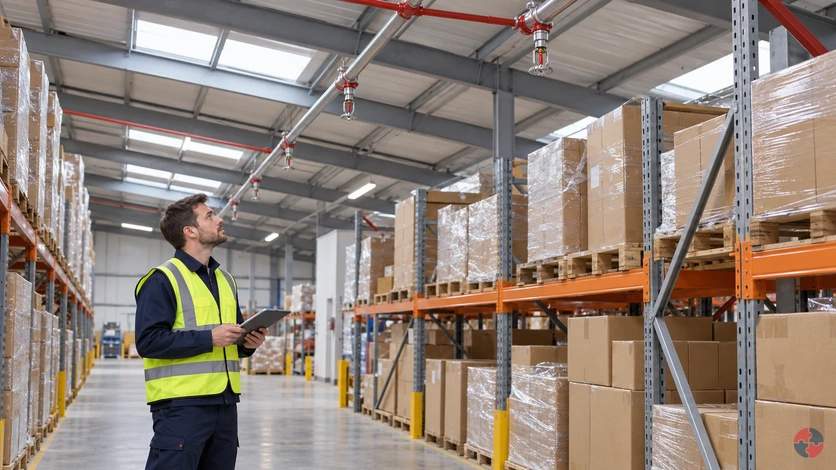
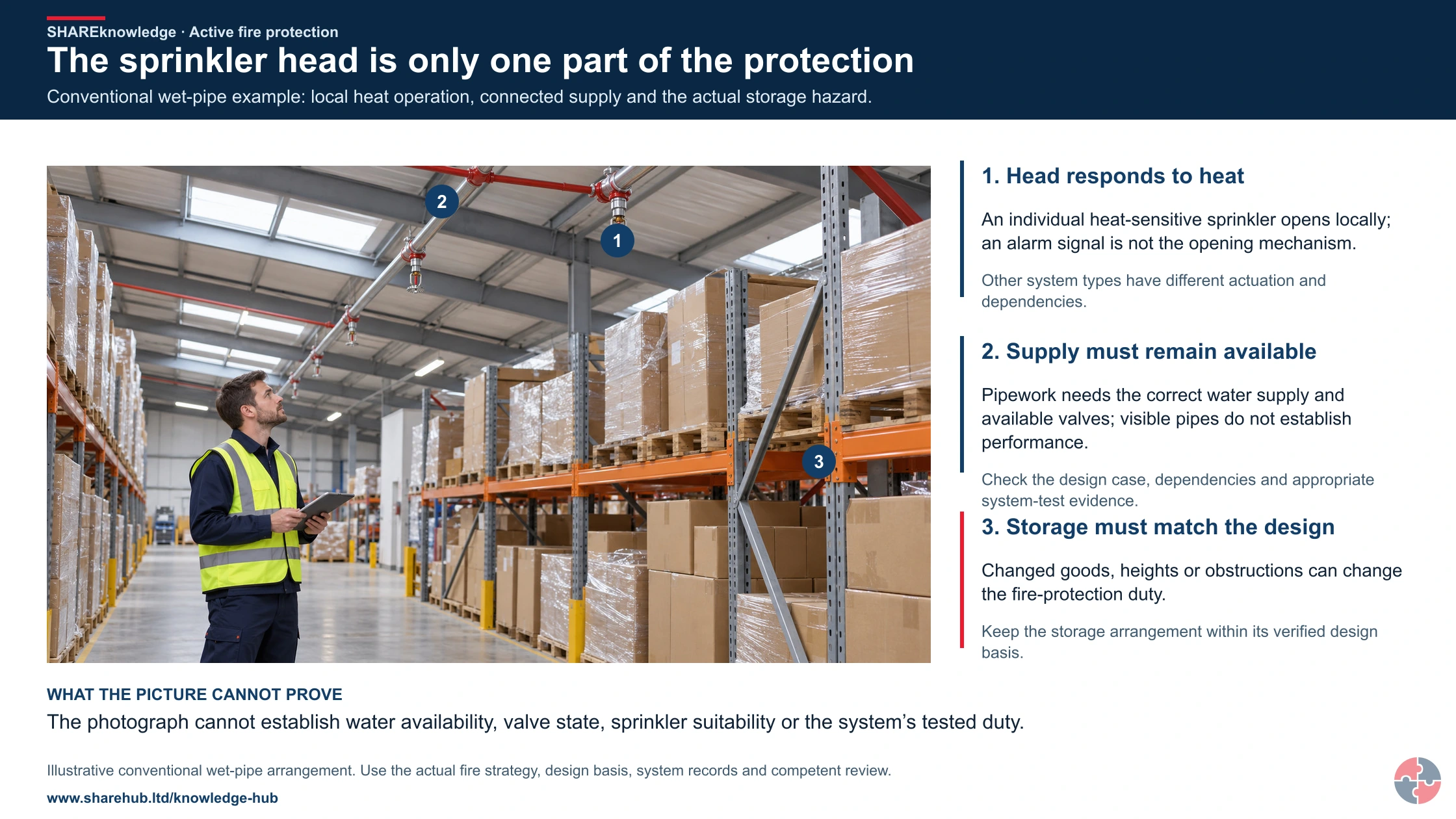
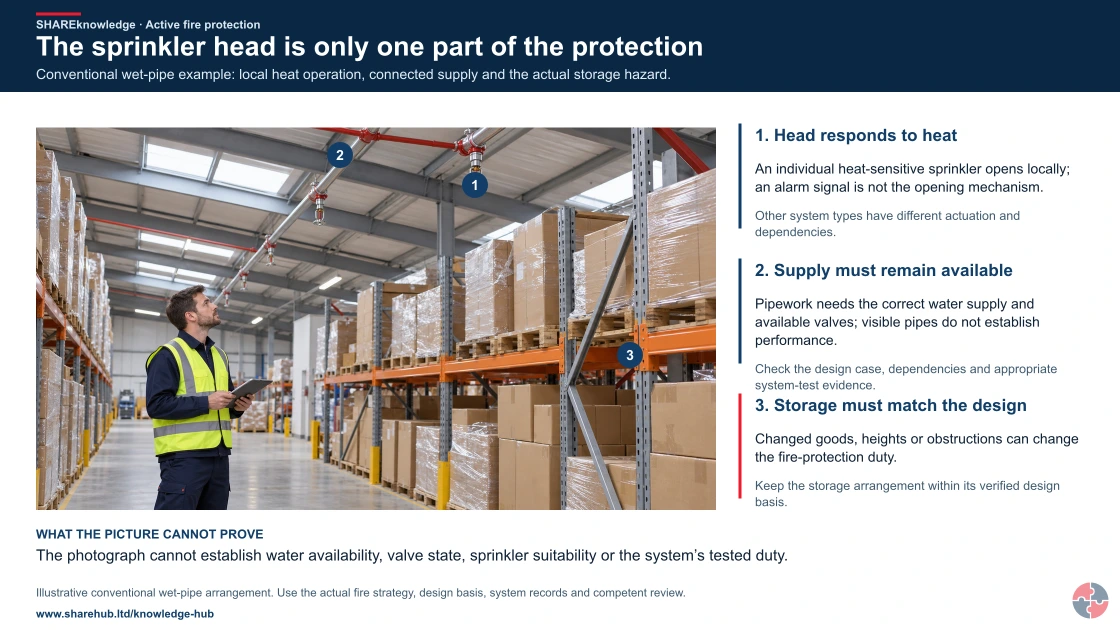
The sprinkler head is only one part of the protection
Full written explanation
Conventional wet-pipe example: local heat operation, connected supply and the actual storage hazard.
- Head responds to heat. An individual heat-sensitive sprinkler opens locally; an alarm signal is not the opening mechanism.
- Supply must remain available. Pipework needs the correct water supply and available valves; visible pipes do not establish performance.
- Storage must match the design. Changed goods, heights or obstructions can change the fire-protection duty.
Change the pathway
- Know the system. Other system types have different actuation and dependencies.
- Verify the whole supply. Check the design case, dependencies and appropriate system-test evidence.
- Review the changed hazard. Keep the storage arrangement within its verified design basis.
Evidence check: The photograph cannot establish water availability, valve state, sprinkler suitability or the system’s tested duty.
Primary references: HSE active/passive fire protection — system duty, secure supply and maintenance; older technical references · HSE work process fire safety — Great Britain process-fire context
Open the complete HD image (new tab)Download image
Primary references: HSE active/passive fire protection — system duty, secure supply and maintenance; older technical references · HSE work process fire safety — Great Britain process-fire context
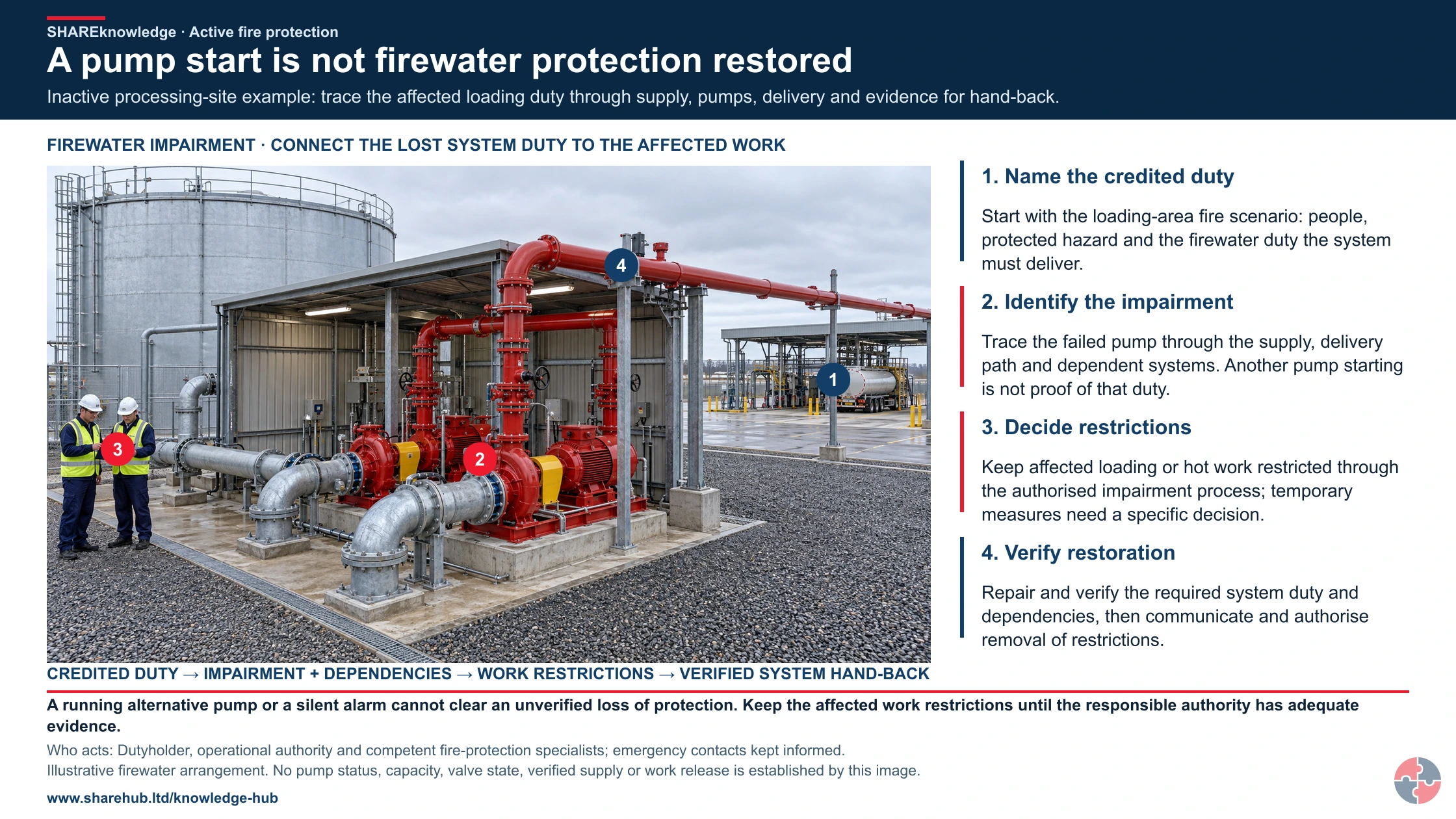
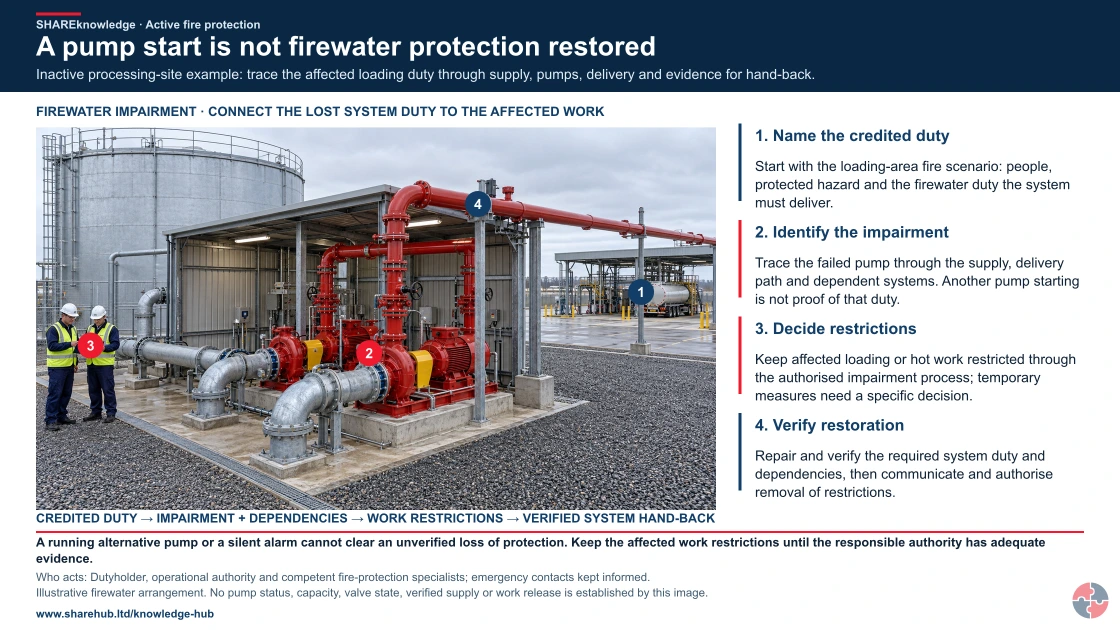
A pump start is not firewater protection restored
Full written explanation
A detailed realistic HD processing-site scene connects a large water store, two enclosed firewater pump trains, their common delivery pipework and a distant inactive tanker-loading area. Four numbered native explanations connect the protected loading-area fire scenario to identifying the impairment and its supply, delivery and system dependencies; retaining affected-work restrictions through the authorised impairment process; and verifying the required system duty before communicated, authorised hand-back. The people are clear of intact equipment and review inert paperwork. No control is operated and no readable gauge, test result or pump state is supplied. The image does not identify a confirmed failed pump or prove the water inventory, hydraulic arrangement, required delivery, redundancy, valve state, design suitability or operating permission. It illustrates why another pump starting, a normal display, a component repair or a temporary fire watch cannot automatically restore an unverified fire-protection duty. The complete original four checks, time-bounded restrictions, roles, hold, warehouse-storage comparison and processing-site maintenance case remain in the written alternative and original topic. The already-HD conventional wet-pipe warehouse pathway and its original/private imagery are retained exactly; its heat-actuation explanation is not replaced by a generic alarm-opening claim. HSE process-fire technical context is for Great Britain; the current topic retains its separate jurisdiction and local-duty checks.
Inactive processing-site example: trace the affected loading duty through supply, pumps, delivery and evidence for hand-back.
- Name the credited duty. Identify the protected hazard, people and the fire scenario the system must address.
- Identify the impairment. Map the failed component to dependent systems, supply, actuation and response arrangements.
- Decide restrictions. Use the authorised impairment process; temporary measures need a scenario-specific decision.
- Verify restoration. Repair and test the required system duty; communicate and authorise removal of restrictions.
When the evidence does not fit: A running alternative pump or a silent alarm cannot clear an unverified loss of protection. Keep the affected work restrictions until the responsible authority has adequate evidence.
Who acts: Dutyholder, operational authority and competent fire-protection specialists; emergency contacts kept informed.
Changed workplace
Warehouse storage change: Check the actual goods and layout against the sprinkler design before accepting the new arrangement.
Processing-site maintenance: Identify the lost firewater duty and affected work; a component repair alone is not system hand-back.
Evidence check: The photograph cannot establish water availability, valve state, sprinkler suitability or the system’s tested duty.
Primary references: HSE active/passive fire protection — system duty, secure supply and maintenance; older technical references · HSE work process fire safety — Great Britain process-fire context
Open the complete HD image (new tab)Download image
Primary references: HSE active/passive fire protection — system duty, secure supply and maintenance; older technical references · HSE work process fire safety — Great Britain process-fire context
These are teaching examples, not site procedures or generic technical limits. A safety-critical impairment requires an authorised, scenario-specific decision; temporary measures do not automatically replace the original barrier. HSE sources in these UK teaching examples describe GB law or technical practice, not Northern Ireland law; use the paired NI source and local duties before applying an example in NI.
1. New solvent and uncertain foam suitability
Task material and setting: A planned tank transfer introduces a polar solvent to a protected bund; the outcome is to avoid assuming the existing hydrocarbon foam will work.
People and prerequisites: Transfer workers, nearby staff, responders and neighbours may be affected; engineering, fire protection and chemical specialists need the actual product data.
Before: Verify the fuel identity and SDS, tank and bund scenario, foam concentrate approval, proportioner, application route, stock condition and runoff plan.
During: Hold the change while a competent team checks whether the system and response plan still meet the credible fire duty.
Hold or stop: Unknown fuel, obsolete foam approval, unverified mixing or no runoff route means no transfer on the assumption that any foam is suitable.
Completion and hand back: After approved changes and functional verification, update drawings, labels, training and emergency-service information.
Evidence: Change assessment, manufacturer evidence, commissioning result and approved transfer release.
2. Failed pump before a high-risk shift
Task material and setting: A standby fire pump fails a start check before several road tankers arrive; the outcome is to prevent an unexamined reduction in response capacity.
People and prerequisites: Drivers, loading teams, emergency crews and neighbouring sites may be affected; a competent engineer must determine what demand remains supportable.
Before: Identify all systems fed by the pump and the credible simultaneous demand; alert operations and the incident command contact.
During: Suspend affected loading or hot work while technical and operational authorities consider reduced inventory, alternate supply or other temporary measures.
Hold or stop: Do not restart because another pump starts if the required flow, pressure or resilience under the design case is unknown.
Completion and hand back: Repair, test at the required duty and remove temporary restrictions only on signed authority.
Evidence: Failure, dependent systems, risk decision, repair, retest and communications.
Short variations: A routine firewater check uses the site test standard and holds loading if a credited pump or valve fails. Hot work that disables a detector requires an approved impairment, work restriction and witnessed restoration. A warehouse storage change can make sprinkler coverage unsuitable, so competent review precedes the changed layout. During an alarm or fire, protect people, follow the emergency plan and tell responders which systems are impaired; do not improvise firefighting to compensate.
What active fire protection systems should be considered?
The right system depends on the fuel, scenario, site layout, inventory, exposure, people at risk and emergency strategy.
Worked selection check: if a new polar solvent is introduced to a tank bund, do not infer that the existing hydrocarbon foam is compatible from its label or the presence of a foam tank. A competent reviewer must check the actual solvent, concentrate approval, proportioner, application method, duration, water supply and runoff plan before the transfer is accepted. The same system may be unsuitable for a different fuel or protected geometry.
There is no universal active fire protection package. Water may cool steel and extinguish ordinary combustibles but may spread some flammable liquid fires if used incorrectly. Foam may be essential for hydrocarbon pool fires but must be compatible with the fuel, application method, storage conditions and environmental constraints. Gaseous systems may protect electrical rooms but can be dangerous if occupancy controls are poor.
Selection should start with the fire-risk assessment, DSEAR assessment, process hazard analysis and emergency plan. The question is not simply what equipment is common in the industry, but what system is required to meet the performance needed for the credible scenario: extinguish, control, cool, prevent escalation, protect escape, protect responders or protect safety-critical equipment.
The choice of system should also consider how a fire will be discovered and who is expected to act. A remote tank compound may need flame detection, automatic deluge or monitors because a person may not be present when a release ignites. A workshop may rely on staff discovering a small fire quickly, but only if alarm, training, extinguisher type, escape and supervision are suitable. A warehouse may need sprinklers not because staff will fight the fire, but because early automatic control can prevent rapid spread before external responders arrive.
Systems should never be selected in isolation. Detection without alarm response is weak. Foam without reliable water and proportioning is weak. A hydrant network without access, maps, pressure, flow and responder familiarisation is weak. Good design joins the system, people, procedures, testing, emergency plan and management review into one dependable arrangement.
| System type | Typical use | Selection questions |
|---|---|---|
| Automatic fire detection | Buildings, plant rooms, warehouses, process areas and occupied buildings. | What must be detected, how fast, where does the alarm go and what action follows? |
| Gas or flame detection | Flammable gas, vapour or high-hazard process areas. | What release scenarios are credible, what coverage is needed and what trips or alarms follow? |
| Sprinkler system | Warehouses, buildings, storage and some process areas. | Is the hazard category correct, is water demand available and are storage arrangements within design assumptions? |
| Deluge or fixed spray | Process equipment, LPG vessels, loading bays and exposure protection. | What equipment must be cooled, at what rate, for how long and with what water reliability? |
| Foam system | Flammable liquid tanks, bunds, loading areas and spill scenarios. | Is the foam compatible, available, tested and deliverable to the fire surface? |
| Fire monitors | Tank farms, loading areas, jetties and external firefighting. | Can monitors reach the target safely, with enough flow and pressure under emergency conditions? |
| Portable extinguishers and hose reels | Initial response to small, suitable fires by trained people. | Are people trained, is escape protected and is the fire small enough for first-aid firefighting? |
Which extinguisher matches the fire, and what parts should I recognise?
Identify the fuel and additional electrical hazard, read the actual extinguisher label and follow the site fire plan. Raise the alarm and protect escape first; only trained, authorised people should consider a small initial fire within their safe response limits.
Fire classes and fire extinguishersFire classes · agent types · dangerous mismatches
 Recognise the fuel. Read the extinguisher. Protect your escape.
UK awareness reference for common and specialist portable extinguisher families. Actual ratings, exclusions and manufacturer instructions govern each unit. Reading this guide is not practical training or permission to fight a fire. Fixed systems, hose reels and specialist industrial firefighting require their own assessed arrangements.
What is burning? Understand the fire classes
Class L is the 2026 addition to the classification standard. Existing extinguisher labels and product test claims vary; a new class name does not certify every battery product.
Extinguisher types: uses and dangers
These are typical applications, not universal permissions. Check the label on the actual unit. Images are AI-generated photorealistic teaching illustrations inspired by the referenced equipment; they are not photographs or certified product labels. Use Inspect the parts to explore the hardware. Band, nozzle and label details vary.
| Type and recognition | Typical rating and use | Wrong use: what can go wrong? |
|---|---|---|
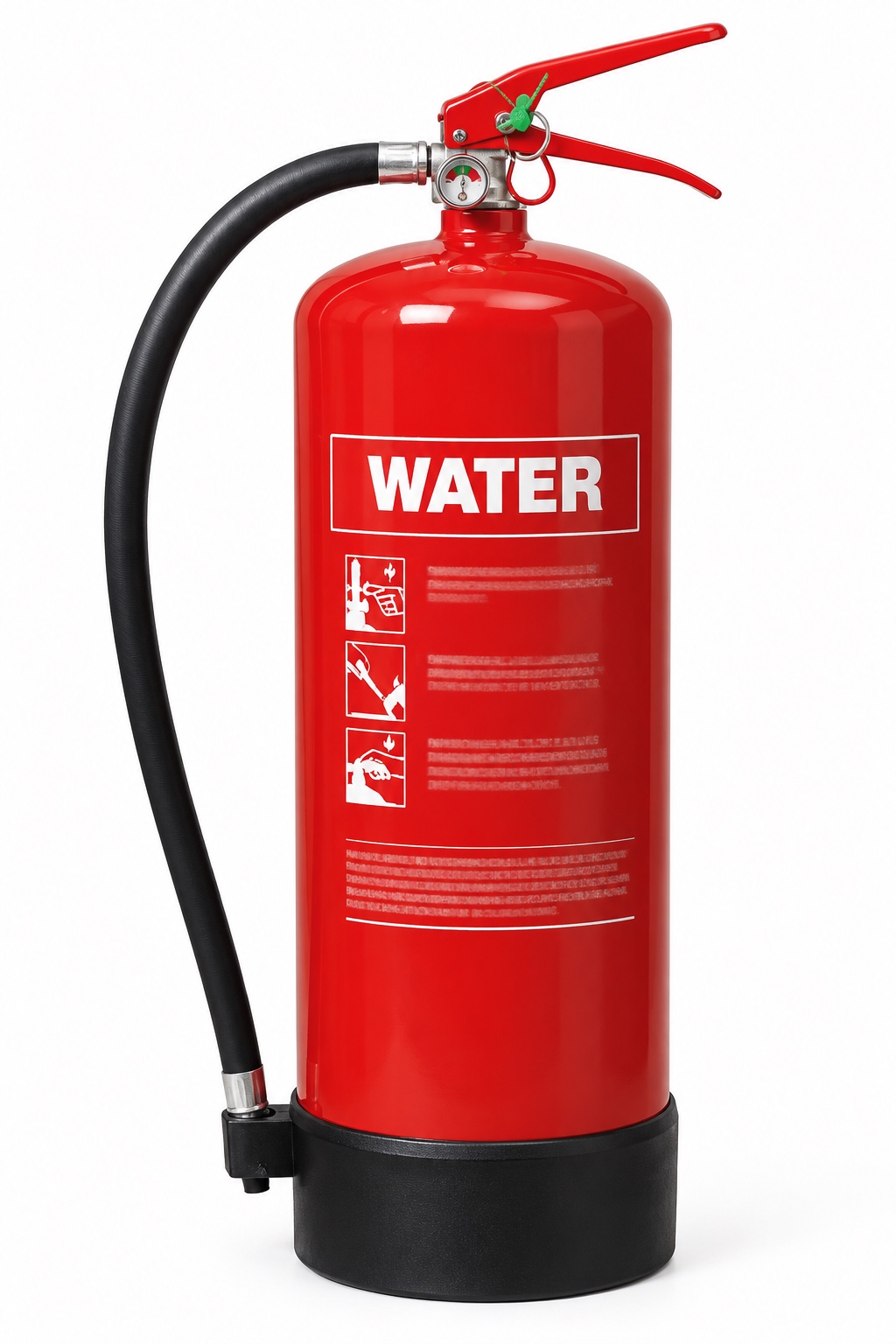  | Normally A Cools burning solid material such as paper, wood or fabric. | Check the limitation Ordinary water is unsuitable for live electrical equipment, flammable-liquid pools, cooking oil and reactive metals: shock, spreading fuel or violent reaction can result. |
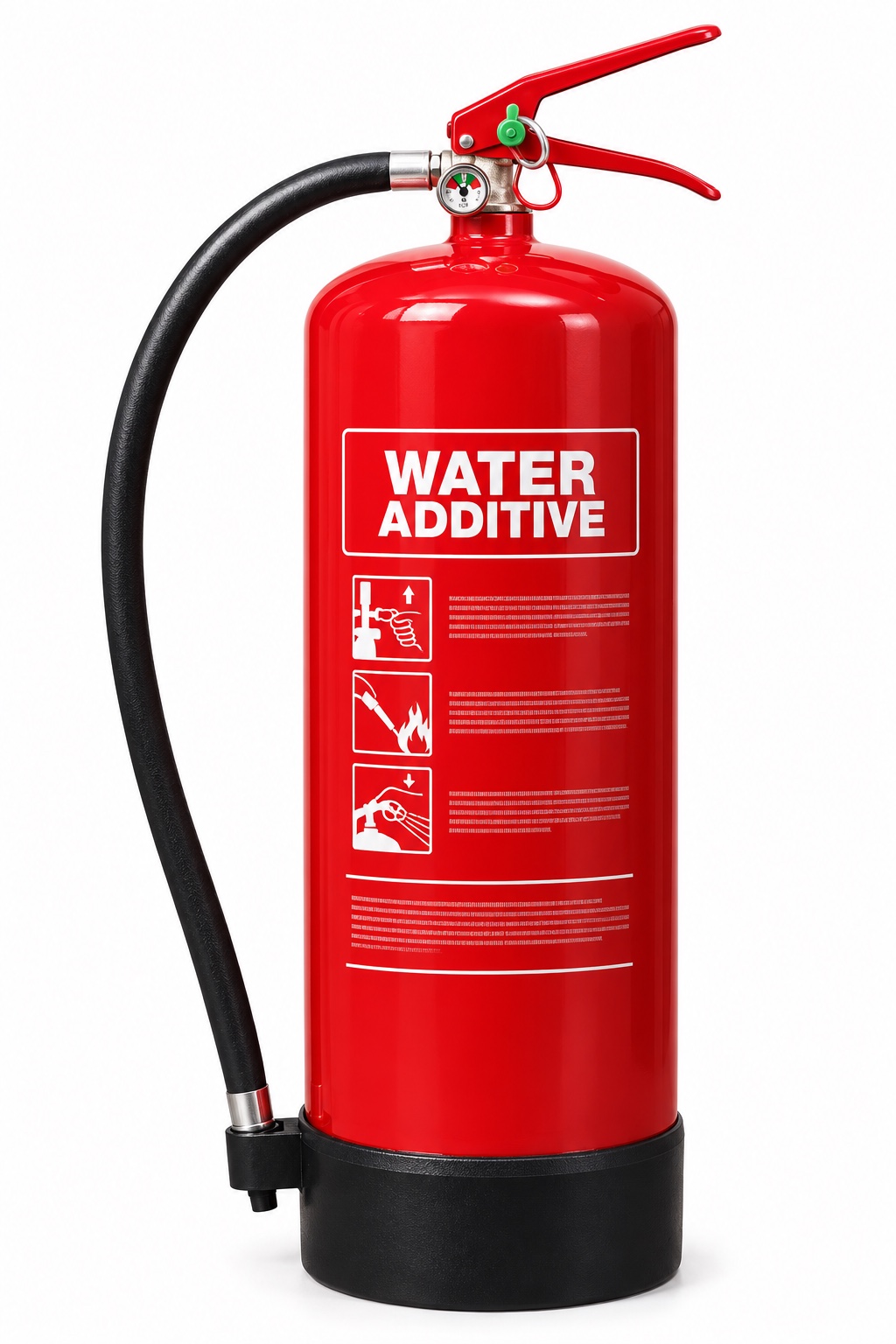 | A; B only if explicitly rated Improved wetting or spray performance can help on the hazards stated on that model’s label. | Check the limitation An additive does not make every water extinguisher safe for electricity, oils or reactive chemicals. Check the specific exclusions. |
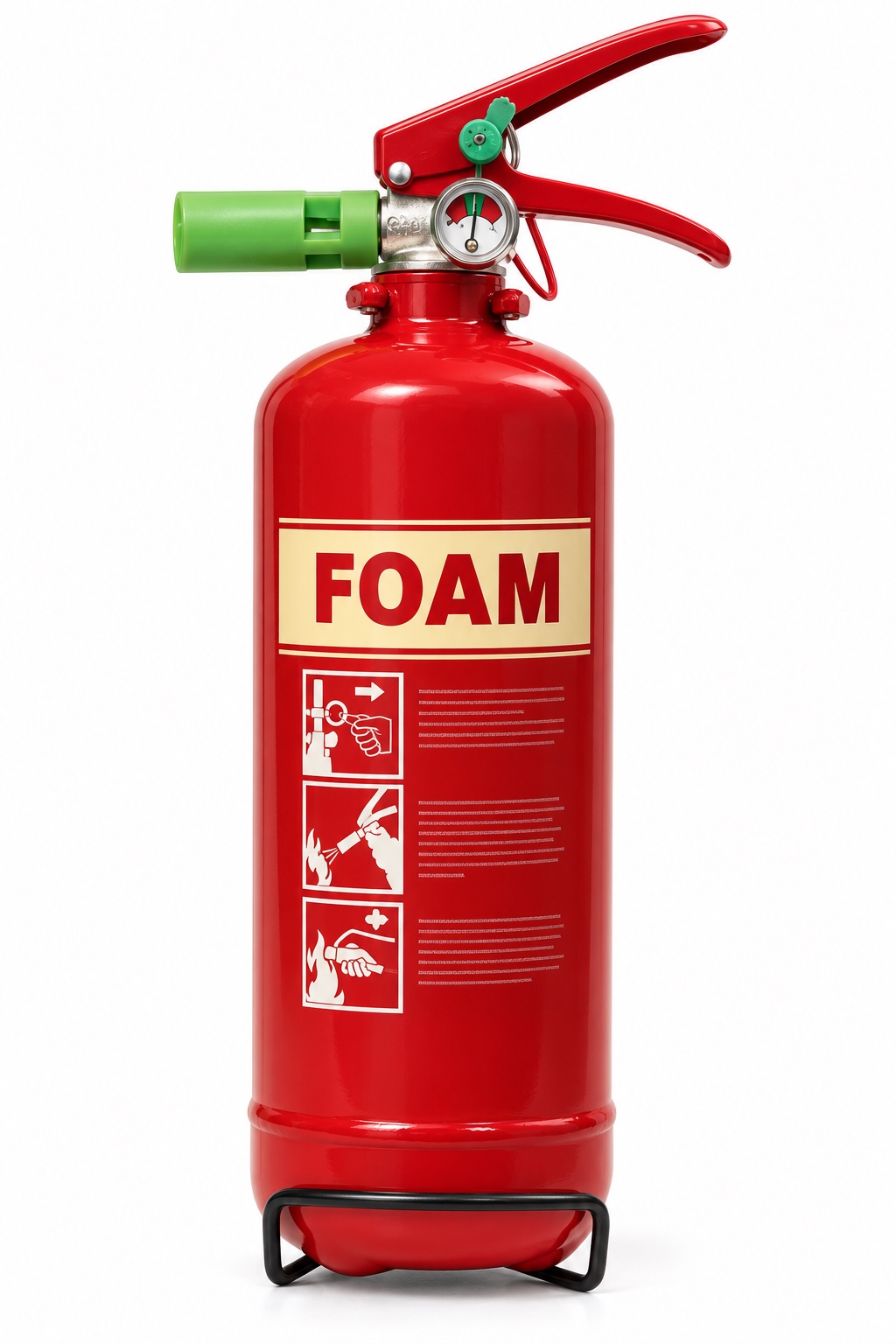 | Commonly A and B Cools and forms a surface blanket on suitable liquid fires. The agent must suit the actual fuel; some alcohols need alcohol-resistant foam. | Check the limitation Ordinary foam is not a general answer for live electricity, cooking oil or metal fires. Unsuitable foam may break down on a solvent; a jet can spread fuel. Free-flowing fuel needs specialist response. |
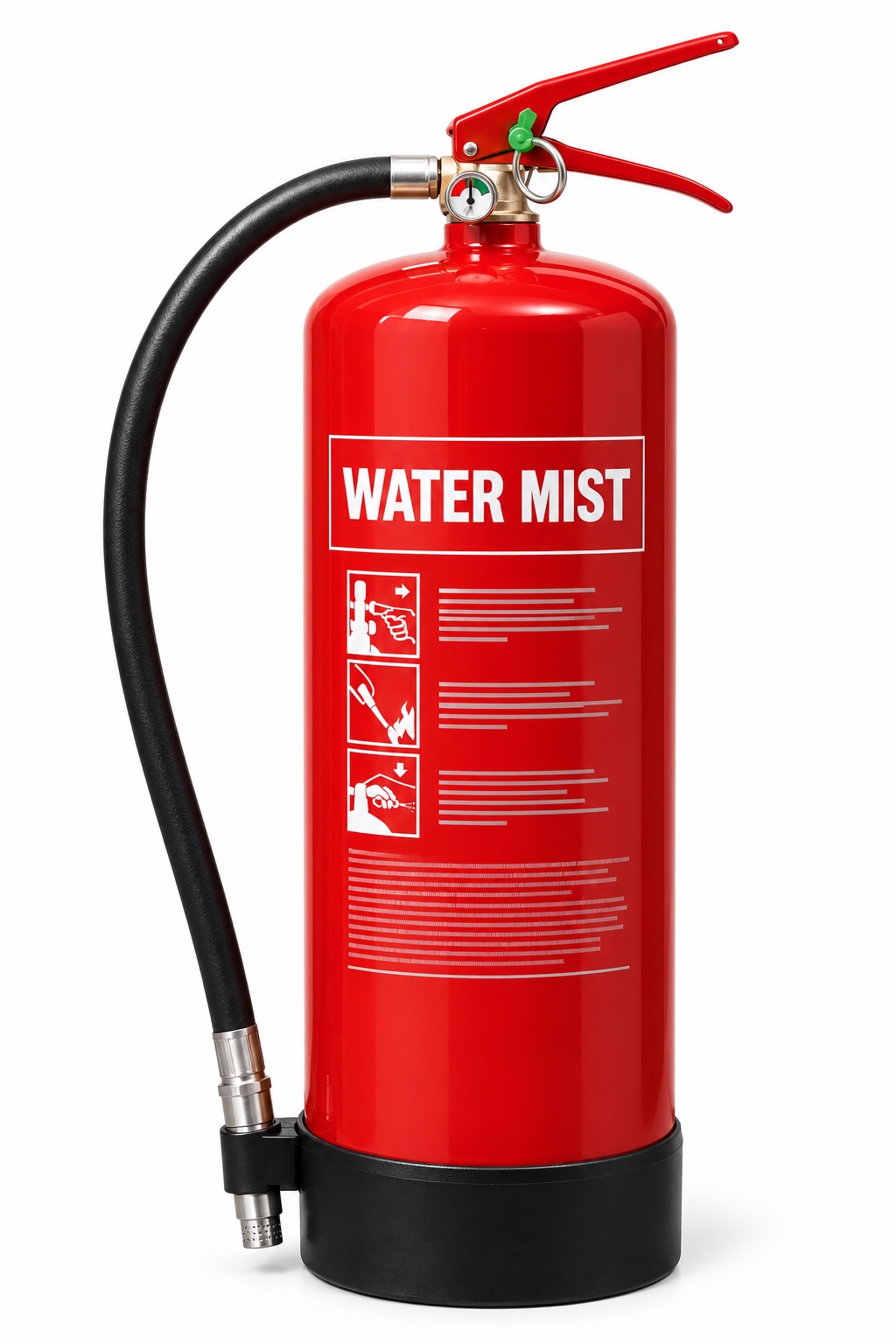 | Model-specific; commonly A, some F Fine droplets absorb heat. Some products have additional ratings or tested electrical suitability, with stated voltage and distance conditions. | Check the limitation ‘Mist’ is not universal approval. Use only the classes and electrical conditions actually declared for that model; do not assume it covers metals, liquids or batteries. |
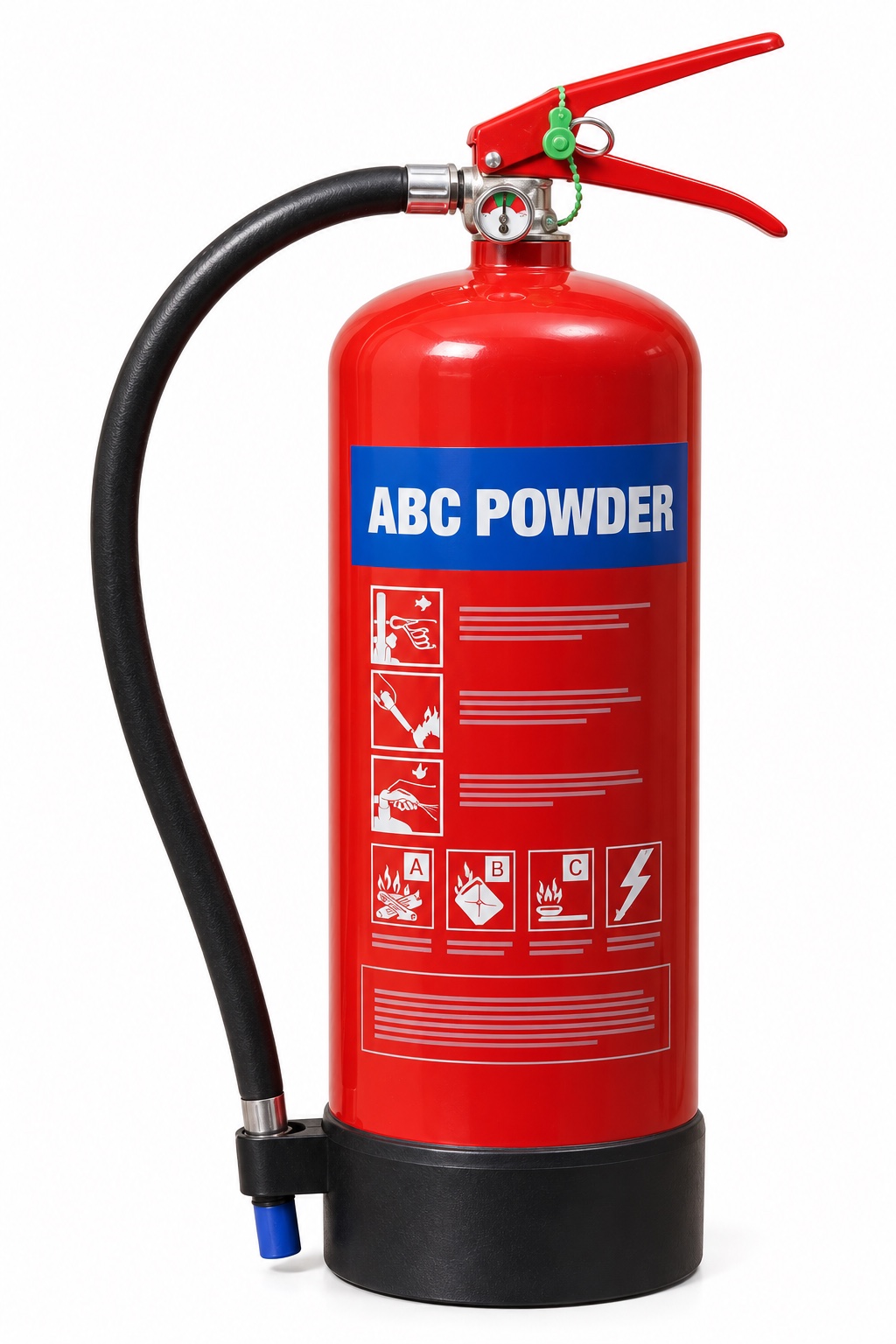 | A, B and C if marked Interrupts flame chemistry; multipurpose powder also acts on Class A material. A C marking does not authorise tackling a gas leak. | Check the limitation Powder can obscure escape and impair breathing; it is not generally recommended indoors. Limited cooling allows reignition. It is not metal-specific D powder or a substitute for F-rated cooking-oil equipment. |
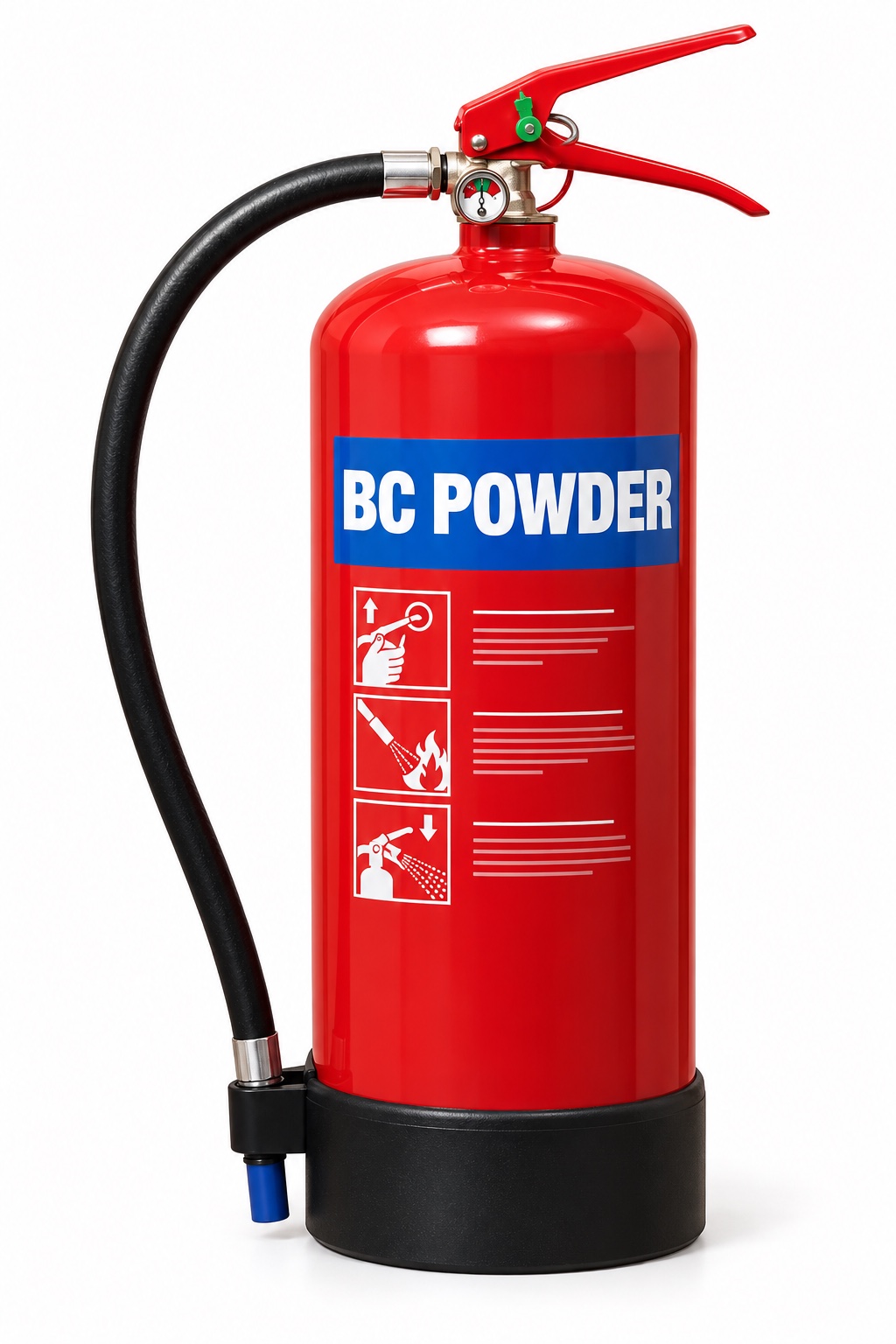 | B and C if marked; not A Selected for particular liquid or gas hazards under the assessed plan. Electrical use must follow the actual unit’s instructions. | Check the limitation Do not assume all blue powder extinguishers protect wood or paper. It has the visibility, breathing and reignition limitations of powder; it does not provide Class D or F protection. |
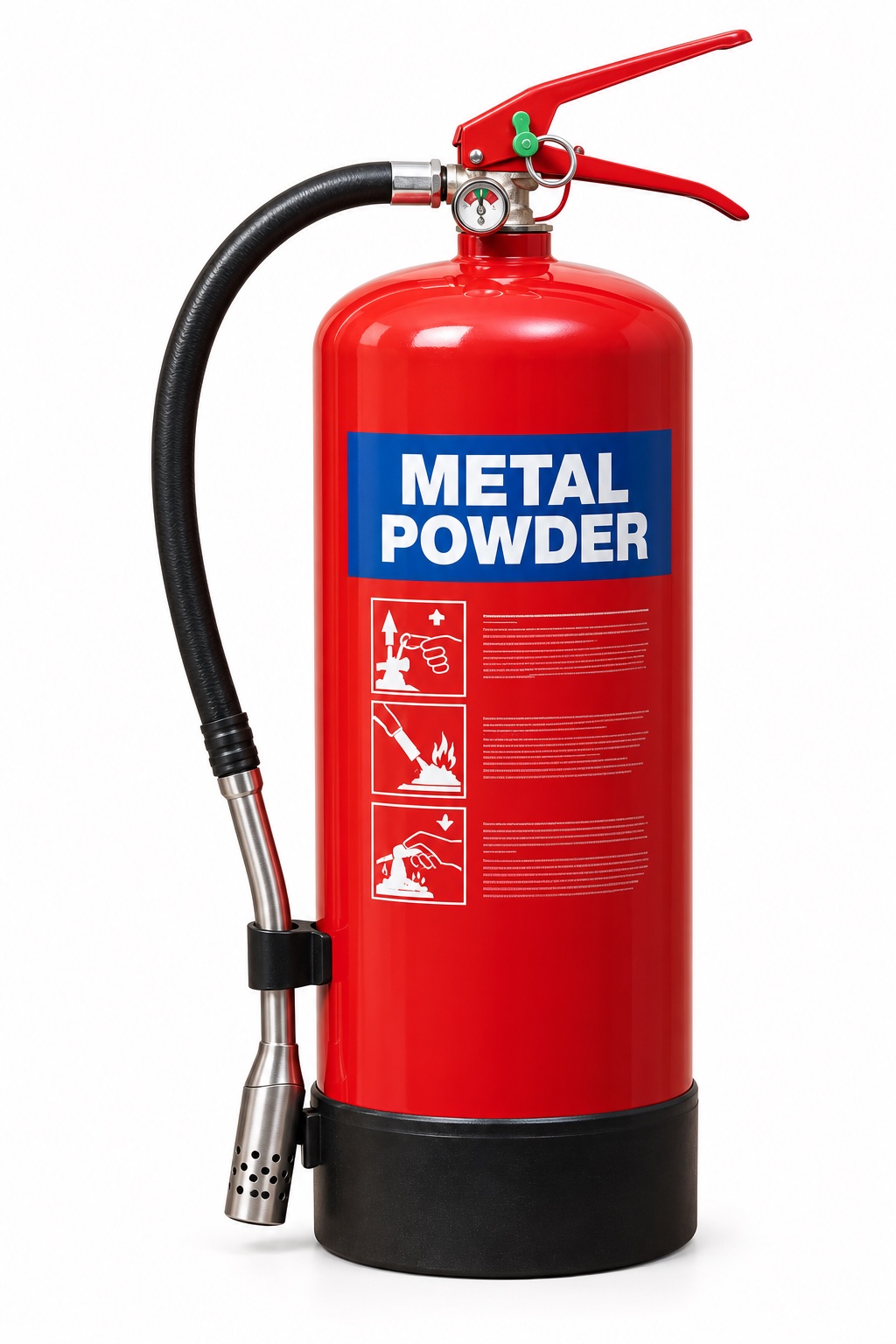 | D, for the specified metal A specialist powder can isolate or absorb heat from a compatible burning metal. Selection requires knowledge of the metal and its form. | Check the limitation The wrong powder can fail or react. Water, foam and CO₂ can be dangerous on certain burning metals. A powder suitable for magnesium is not automatically suitable for metallic lithium. |
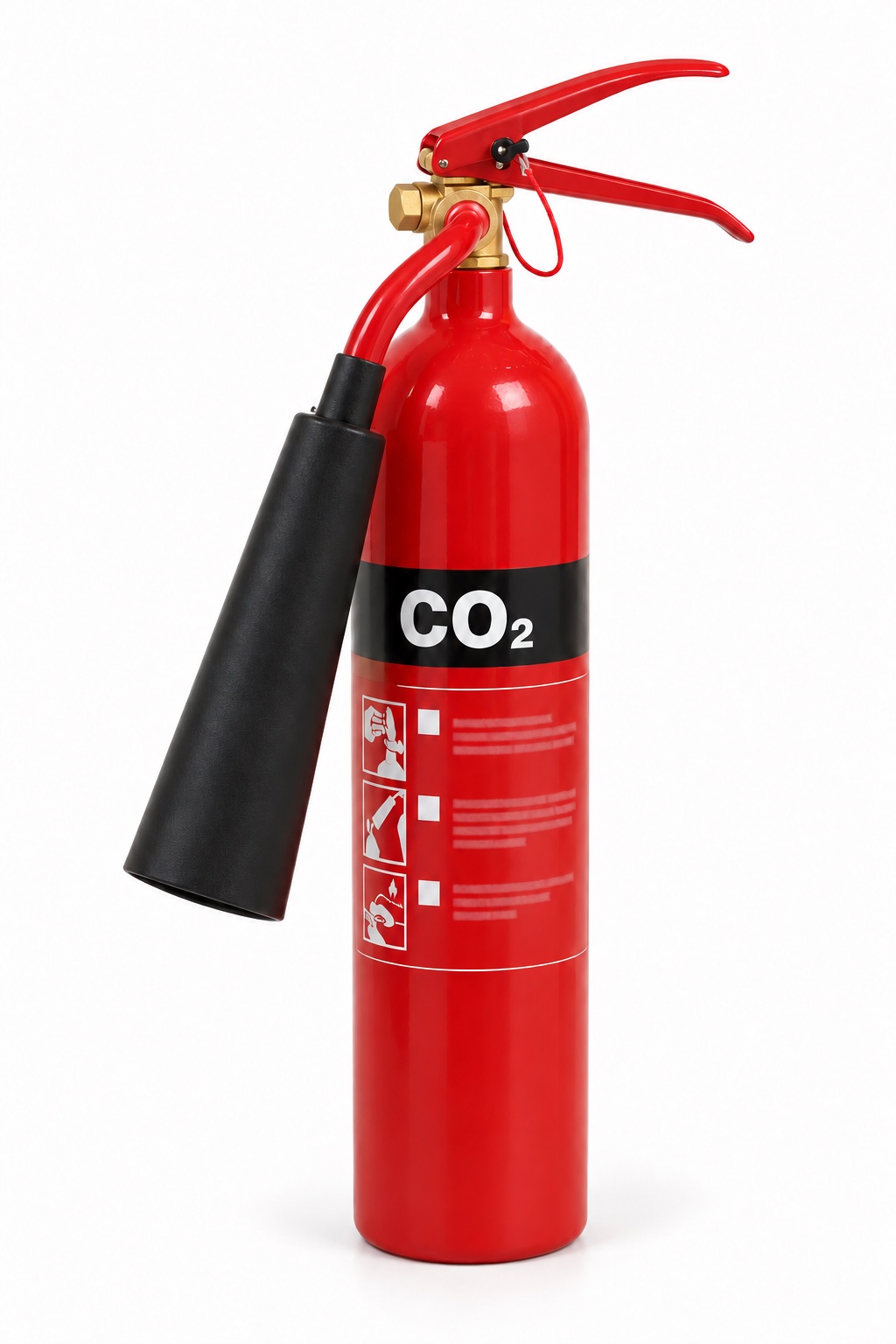 | B; electrical use as instructed Displaces the atmosphere around a small flame and leaves no powder residue. Often selected around electrical equipment. | Check the limitation Poor cooling means reignition is possible. CO₂ can create a dangerous atmosphere in enclosed spaces; discharge can cause frostbite. Hold only the designated insulated parts. Not a cooking-oil or metal-fire substitute. |
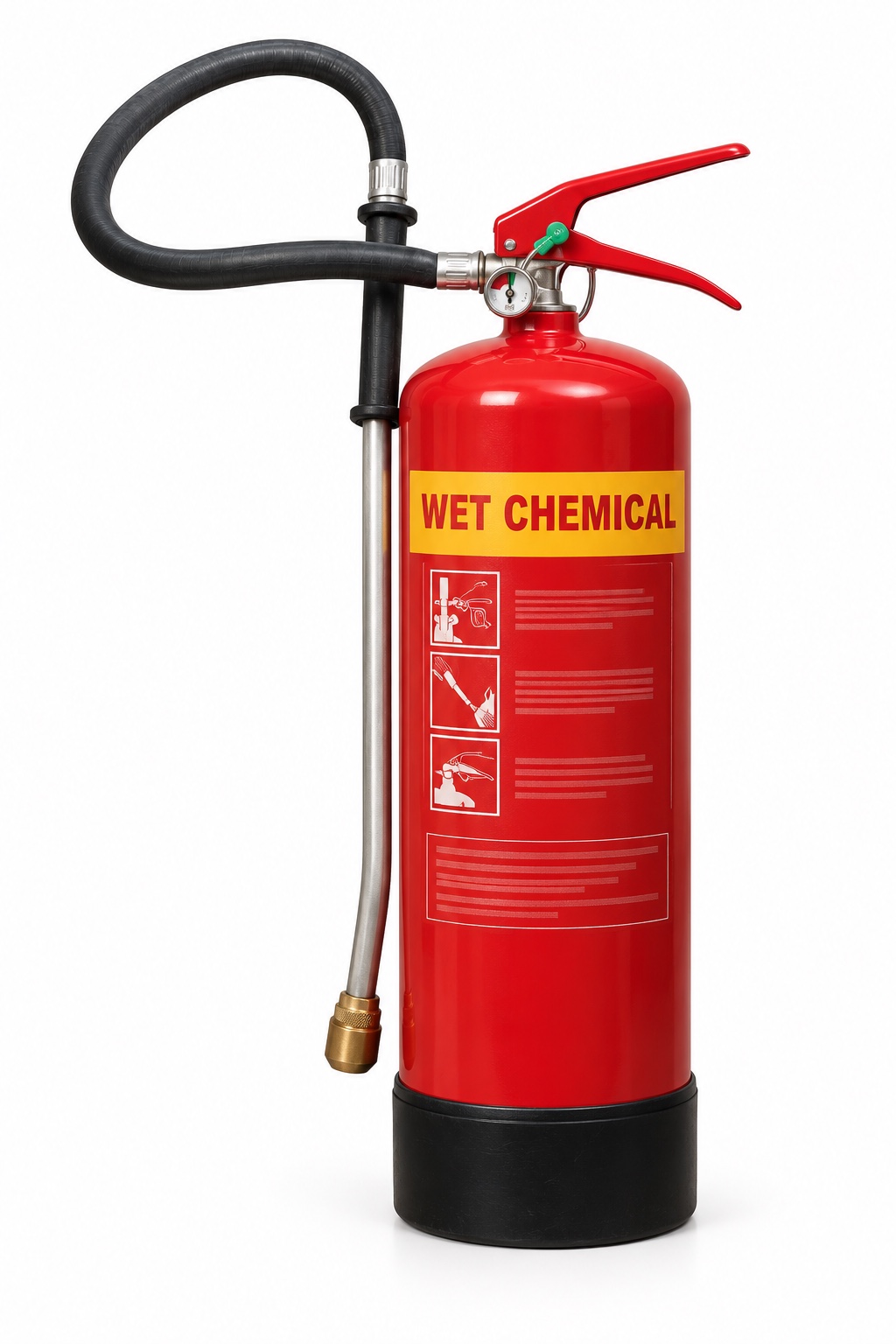 | F; often A if marked Cools cooking oil and creates a protective surface layer through reaction with the fat. Use only within the actual unit’s rating and instructions. | Check the limitation Do not mistake it for a general liquid-fire or electrical extinguisher. Incorrect application or moving the fryer can splash hot oil; apparent flame-out does not establish safe temperature. |
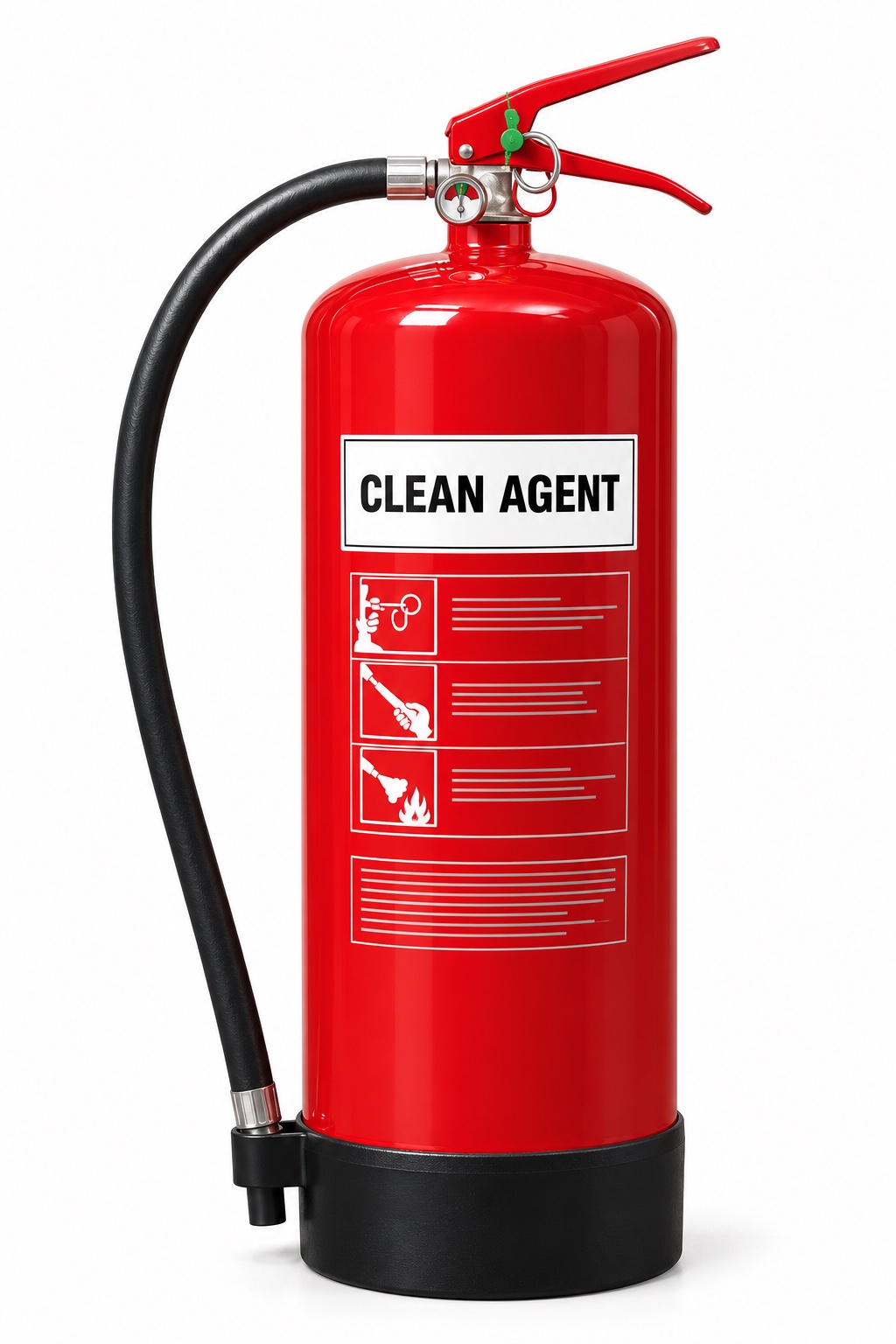 | Product- and jurisdiction-specific Specialist low-residue agents may protect sensitive equipment. Confirm the UK-approved application and the manufacturer’s limits. | Check the limitation Low residue does not mean safe to breathe. Do not copy a US A:B:C rating as UK gas-fire approval. Legacy halon is restricted to permitted critical uses and applicable deadlines. |
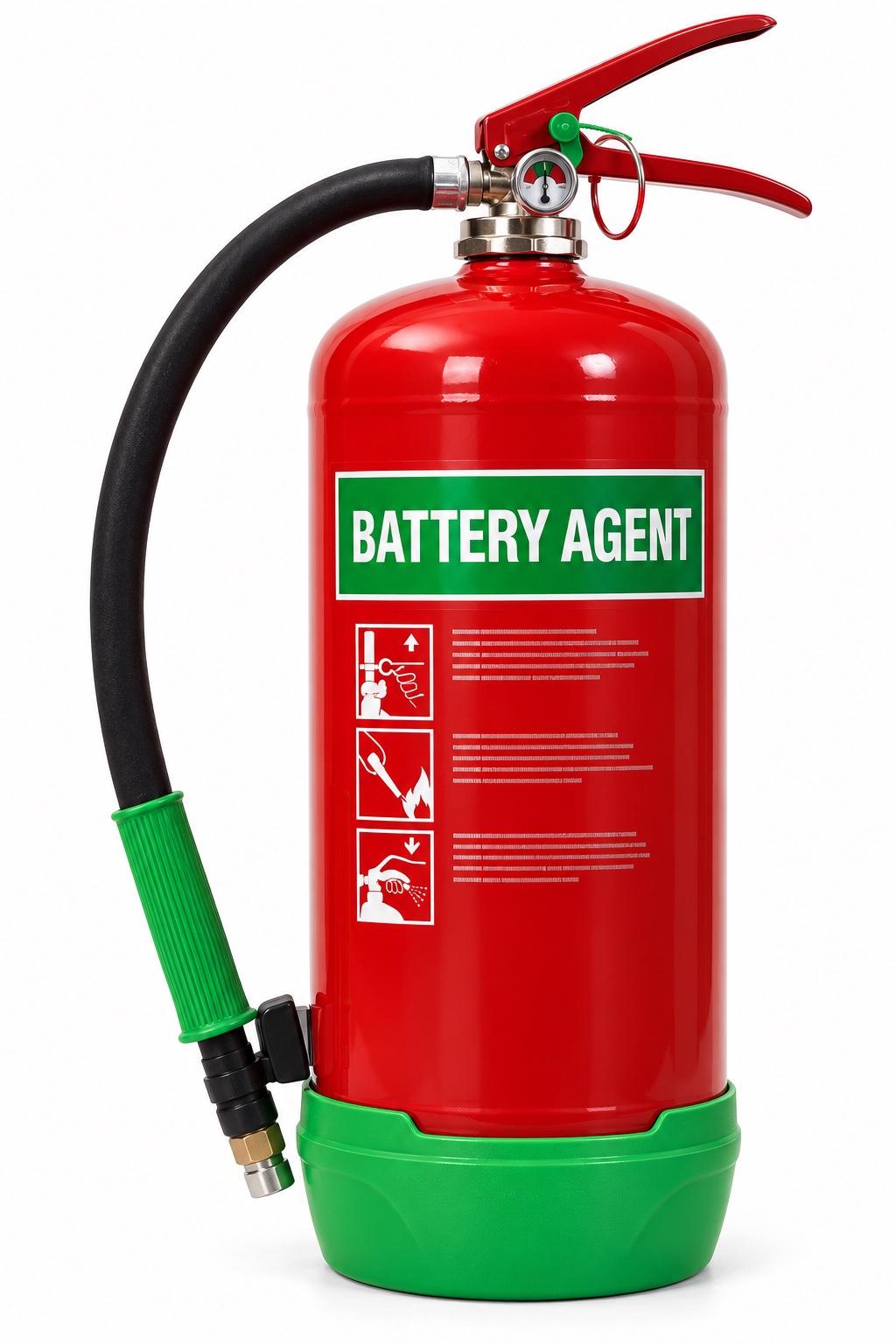 | Check independent scope and instructions Some products use water-based cooling or specialist media such as aqueous vermiculite for specified battery scenarios. Selection depends on chemistry, capacity and location. | Check the limitation A ‘lithium’ label is not proof it will stop thermal runaway in a large pack. Flame suppression may not prevent reignition or gas release. Do not approach, carry or submerge a failing battery as a learner exercise. |
Lithium-ion product example · Firechief 6 L Lith-Ex
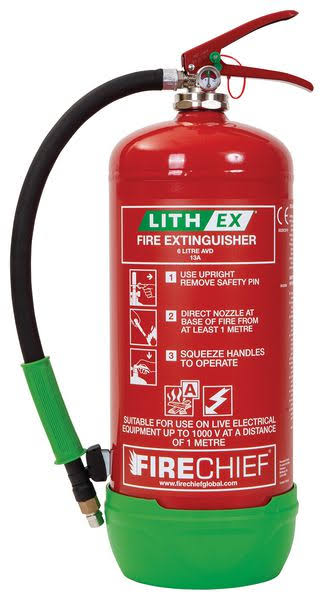
A named product example helps connect the generic table to an actual unit. Confirm the exact product before using its claims.
- Agent and intended application
- The linked Seton example uses aqueous vermiculite dispersion (AVD) for specified lithium-ion battery fire applications. Water content cools; the dispersed mineral helps form a barrier. This is not generic Class D metal-fire powder.
- Read the actual rating
- Seton lists a 6 L product with a 13A rating. That A rating describes its solid-material test performance; it does not, by itself, certify a universal Class L battery capability.
- Match the exact model and generation
- The manufacturer’s current 6 L G2 page identifies FLE6X and different discharge details from the retailer’s older listing. Do not mix their time, range or pressure values. Match the delivered label, product sheet and manual.
- Check the battery scope
- Confirm the allowed battery chemistry, energy capacity, state and scenario with the current manufacturer information and competent fire assessment. A large EV or energy-storage pack cannot be treated as a small-device fire.
- Electrical conditions are product-specific
- The supplied product label includes a voltage and minimum-distance condition. Do not transfer that condition to another battery extinguisher or infer that it makes an unsafe electrical approach acceptable.
- After the flame disappears
- Heat, off-gas and reignition can remain. Follow the planned withdrawal, exclusion and fire-service response; do not pick up, submerge or return a failed battery to charging.
Seton · supplied 6 L Lith-Ex example ↗
Firechief · current 6 L G2 model information ↗
Read the actual label
Read the agent, fire-class letters, performance rating, electrical warnings, operating instructions and service condition. Numbers such as 13A or 55B describe standardised test performance, not a safe room size or permission to tackle that amount of fire. Colour is a clue; the actual label and assessed plan decide suitability.
Spot the dangerous assumption
Pause at each question, then open the explanation. These are unscored learning prompts alongside the course assessment.
Keep prevention, alarms, compartmentation and escape effective. Report a missing, obstructed, damaged or discharged extinguisher; do not return a partly used unit to service. Competent selection, maintenance and practical training belong in the fire arrangements.
What should the active fire protection design basis include?
The design basis should explain which fire scenarios the system is intended to control and what performance is required.
Match the protection to its duty

Read this visual as text
- DESIGN DUTY: Name the fire scenario, protected area, demand and required performance.
- SYSTEM PATH: Include supply, pumps, valves, distribution, detection and dependencies.
- ACTUAL PROOF: Verify delivery and response at relevant points; distinguish routine indication checks from performance tests.
Match the fire scenario to the intended system duty and the measured acceptance evidence. Extinguishment, control and exposure protection are different objectives; the picture does not establish system performance.
Select a Fire Protection Duty
Two linked parts · 6 questions. Open Part 2 to complete the route.

Continue to questions 4–6 · Part 2 of 2

Read this visual as text
- Start: A site is choosing or changing an active system for a credible fire scenario.
- Question 1: Are the fire scenario, exposed people and protected geometry defined? Decision owner: Fire protection lead / operational dutyholder.
- YES: The required evidence or condition is confirmed. CONTINUE → QUESTION 2.
- NO / UNKNOWN — HOLD: Hold system selection and obtain a competent scenario assessment. HOLD → REPEAT QUESTION 1 AFTER CORRECTION.
- Question 2: Can prevention remove or reduce this scenario? Decision owner: Fire protection lead / operational dutyholder.
- Yes: Prioritise prevention and reassess the remaining protection duty. CONTINUE → QUESTION 3.
- No: Document the remaining scenario and mitigation need. CONTINUE → QUESTION 3.
- Unknown: Resolve prevention options before treating a device as the answer. HOLD → OWNER RESOLVES BEFORE RESUMING.
- Question 3: What duty must the system perform? Decision owner: Fire protection lead / operational dutyholder.
- Warning: Define detection, alarm and evacuation interfaces. CONTINUE → QUESTION 4.
- Control / suppression: Define fuel compatibility, coverage, supply and required response. CONTINUE → QUESTION 4.
- Exposure cooling: Define the threatened equipment, water delivery and dependencies. CONTINUE → QUESTION 4.
- UNKNOWN / NONE FITS: Keep affected work or the decision held. The named owner resolves the facts; immediate protection takes priority. HOLD → OWNER RESOLVES BEFORE RESUMING.
- Question 4: Are fuel properties, system standard and manufacturer evidence suitable? Decision owner: Fire protection lead / operational dutyholder.
- YES: The required evidence or condition is confirmed. CONTINUE → QUESTION 5.
- NO / UNKNOWN — HOLD: Do not procure by familiarity or product mark alone. HOLD → REPEAT QUESTION 4 AFTER CORRECTION.
- Question 5: Are utilities, backup, emergency interfaces and commissioning planned? Decision owner: Fire protection lead / operational dutyholder.
- YES: The required evidence or condition is confirmed. CONTINUE → QUESTION 6.
- NO / UNKNOWN — HOLD: Resolve dependencies and identify how performance will be demonstrated. HOLD → REPEAT QUESTION 5 AFTER CORRECTION.
- Question 6: Approve the design basis Decision owner: Fire protection lead / operational dutyholder.
- ACTION: Record the competent design decision, owner, limits and commissioning acceptance route. OUTCOME → RECORD AND HAND OVER.
- Outcome: Approved design basis with owner and commissioning route, or a documented hold for missing evidence.
- Stop and escalation boundary: Do not procure a familiar device as a generic answer or infer suitability from a product mark alone.
A fire protection system can only be assured if its purpose is known. For example, a deluge system may be designed to cool an LPG vessel exposed to a pool fire, a foam system may be designed to control a tank fire, and a sprinkler system may be designed for a particular storage arrangement. If the process, inventory, storage height, rack layout, foam type, bund arrangement or emergency strategy changes, the design basis may no longer be valid.
The design basis should be controlled information. It should include drawings, calculations, standards, design assumptions, protected equipment, demand cases, water supply, foam demand, duration, power supplies, valve positions, alarm logic, testing requirements and impairment rules. Operators, engineers and emergency teams do not need every calculation, but they do need to know the system’s purpose and limits.
A competent design review should trace one credible fire from initiating release through ignition, detection, isolation, suppression or cooling, evacuation and environmental containment. Check common-cause demands such as loss of power or water, concurrent system use and access by responders. A drawing alone does not show delivered performance.
Why is firewater reliability critical?
Firewater reliability is critical because several active fire protection systems may depend on the same supply during the same emergency.
A pump start does not prove delivery

Read this visual as text
- A start indication does not establish that sufficient firewater reaches the required protected point. Check the source, pump, valves, distribution and delivery against the actual design basis.
- SOURCE AVAILABLE
- PATH VERIFIED
- DELIVERY DEMONSTRATED
Illustrative firewater equipment. A pump start is not proof of delivery: the source, power, valve line-up, route, endpoint duty and credited backup require the relevant design and test evidence.
A firewater system includes more than a tank and pump. It may include water sources, suction arrangements, diesel and electric pumps, jockey pumps, pump houses, ring mains, sectional valves, hydrants, monitors, deluge valves, strainers, foam proportioners, test lines, standby power, fuel supplies and winterisation. A single closed valve, failed diesel start, blocked strainer or empty foam tank can defeat several downstream systems.
A no-flow pump start test may show that a pump starts, but not that water reaches the protected point at the required flow and pressure under credible simultaneous demand. The current design basis, manufacturer instructions and competent test plan determine what functional and flow evidence is needed. Check valves, hydrants, backup sources, alarms and known impairments as part of that assurance.
Sites also need to think about demand conflict. If sprinklers, monitors, deluge systems and emergency responders all draw from the same firewater network, the design must show that the system will not be starved during the credible scenario.
| Firewater element | What can fail | Assurance evidence |
|---|---|---|
| Water source | Insufficient volume, poor replenishment, frozen supply or contaminated suction. | Tank level checks, capacity review, refill arrangements and inspection records. |
| Fire pumps | Failure to start, low flow, low pressure, fuel issue or maintenance defect. | Start tests, flow tests, maintenance records, fuel checks and defect close-out. |
| Ring main and valves | Closed sectional valves, leaks, corrosion, pressure loss or poor labelling. | Valve line walks, lock/seal status, pressure tests and drawings. |
| Hydrants and monitors | Obstruction, damage, poor access, low pressure or poor reach. | Hydrant tests, monitor range checks, access inspections and responder drills. |
| Deluge and spray systems | Blocked nozzles, failed deluge valve, inadequate coverage or disabled actuation. | Functional tests, nozzle inspection, coverage checks and impairment records. |
| Common-cause dependencies | Power loss, flood, fire in pump house, cyber/control failure or multiple simultaneous demands. | Scenario testing, backup power checks, emergency exercises and design review. |
Follow firewater to the protected point
Illustrative system map: source → pump and power → valve and main → delivery point → runoff arrangements. The actual design basis determines the required flow, pressure, duration, coverage and any simultaneous demands. A pump-running indication demonstrates only one part of that path.
Source and backup
Confirm the available supply and the reliability of any credited backup against the assessed fire duty. Identify a common failure that could disable both.
Pump, valves and delivery path
Verify the documented configuration and the condition of the route serving the protected point. A closed valve, obstruction, unavailable power supply or damaged main can prevent delivery.
Protected point
Demonstrate the specified delivery and coverage at the required endpoints under the relevant test conditions. Record results against the approved acceptance criteria, not only “pump started”.
Runoff and impaired protection
Connect the test and emergency arrangements to the site’s runoff controls. Record unavailable protection, affected operations, compensatory arrangements and the person authorised to accept restoration.
| Element | A failure to challenge | Record to check |
|---|---|---|
| Source / pump / backup | The source cannot sustain the credited duty or a shared failure removes the backup. | Design demand, test conditions and evidence of supply and backup performance. |
| Valves / main / endpoint | An upstream indication looks normal but the required delivery point is unavailable. | Verified line-up and relevant endpoint test results, with system identity and limitations. |
| Acceptance and hand-back | A repair is recorded while a credited function remains untested. | Competent test evidence, unresolved impairments and authorised acceptance for the defined operating scope. |
If the required protection cannot be demonstrated, apply the impairment arrangements. This learning map supplies no universal operating values or permission to alter the system.
What should be checked for foam and specialist suppression agents?
Foam and specialist agents must be compatible, available, deliverable and environmentally managed.
The older HSE technical page mentions halons, legacy foam types and old standards. That wording is not approval to buy or deploy those agents today. Confirm current product, legal and environmental requirements, manufacturer compatibility and disposal arrangements; never substitute foam or change the mix without competent system review.
Foam is not simply a stock item. It must be suitable for the fuel, application method, storage conditions and fire scenario. The wrong foam, degraded foam concentrate, poor proportioning, blocked delivery path or inadequate application rate can make the system ineffective. Environmental issues also matter, especially where foam or firewater runoff could contaminate drains, surface water or groundwater.
For flammable liquid storage, foam arrangements should be linked to tank and bund scenarios, escalation potential, access, responder tactics and runoff containment. Where older foam stocks are being replaced, the site should manage compatibility, disposal, training, test methods and emergency-service interface.
| Check area | What to verify | Why it matters |
|---|---|---|
| Foam compatibility | Foam type suits the fuel, application method and fire scenario. | Wrong foam can fail to suppress vapours or seal the burning surface. |
| Foam quantity and condition | Sufficient concentrate is available, within its verified usable life, stored correctly and sampled where required. | Degraded or insufficient foam may fail during a prolonged incident. |
| Proportioning | System mixes foam concentrate and water at the intended concentration. | Incorrect proportioning can make the foam ineffective. |
| Delivery route | Foam pourers, monitors, lines, valves and nozzles are clear and operable. | Foam must reach the fire surface under emergency conditions. |
| Environmental control | Runoff containment, drainage isolation and disposal arrangements are planned. | Firefighting can create pollution if contaminated water and foam escape. |
| Responder interface | On-site and external responders know the foam strategy and limitations. | Avoids conflicting tactics and delays during escalation. |
What are the before, during and after hold points?
Check the design duty and current condition before work; respond to degradation while work is underway; prove restoration before hand-back.
| Stage | Action | Stop or hold | Evidence |
|---|---|---|---|
| Before design or purchase | Name the fire scenario, people, fuel, system duty, design standard, water or agent supply and environmental route. | Unknown fuel, protected geometry or required duty: obtain competent design advice. | Assessment, design basis and approved specification. |
| Before a job or shift | Check current panel, valves, pump, water, foam, access, isolation and impairment status against the local standard. | Critical barrier unavailable or uncertain: restrict dependent work and escalate. | Check result, asset ID, defect and decision owner. |
| During operation or maintenance | Watch for alarms, leaks, low pressure, blocked hydrants, system isolation or changed fire load; coordinate contractor work. | Unexpected impairment, uncontrolled ignition source or conflicting instructions: stop affected task. | Control-room log, permit, interim controls and notifications. |
| After repair or change | Reinstate configuration and test the safety function at a suitable level, including alarm and response interfaces. | Do not remove the impairment tag on a visual check or reset alone. | As-left results, technical acceptance and hand-back. |
| After incident or exercise | Capture barrier demand, response, runoff and weak signals; resource and verify corrections. | Repeated defects or unclosed critical actions require management escalation. | Exercise or incident report and effectiveness review. |
How should fire protection impairment be controlled?
Impairment control prevents a degraded fire protection system being treated as if it were still fully available.
Manage a Fire System Impairment
Two linked parts · 7 questions. Open Part 2 to complete the route.

Continue to questions 5–7 · Part 2 of 2

Read this visual as text
- Start: An alarm, sprinkler, deluge, pump, foam or hydrant is unavailable or degraded.
- Question 1: Are the lost functions, protected scenarios and affected work identified? Decision owner: Fire protection lead / operational dutyholder.
- YES: The required evidence or condition is confirmed. CONTINUE → QUESTION 2.
- NO / UNKNOWN — HOLD: Treat an unknown protection extent as unverified and escalate. HOLD → REPEAT QUESTION 1 AFTER CORRECTION.
- Question 2: Are people or responders at risk now? Decision owner: Fire protection lead / operational dutyholder.
- YES — STOP / REFER: Use the emergency plan and stop or reduce dependent activities. STOP / REFER → APPROPRIATE RESPONSE.
- NO: No such warning is identified; continue the remaining checks. CONTINUE → QUESTION 3.
- UNKNOWN — PROTECT FIRST: Protect people and hold the affected work. Obtain the responsible specialist’s assessment; do not assume the warning is absent. HOLD → OWNER RESOLVES BEFORE RESUMING.
- Question 3: Have the control room, dutyholder and affected shifts been informed? Decision owner: Fire protection lead / operational dutyholder.
- YES: The required evidence or condition is confirmed. CONTINUE → QUESTION 4.
- NO / UNKNOWN — HOLD: Communicate restrictions and prevent a silent shift handover. HOLD → REPEAT QUESTION 3 AFTER CORRECTION.
- Question 4: Is any proposed temporary protection demonstrated and authorised? Decision owner: Fire protection lead / operational dutyholder.
- YES: The required evidence or condition is confirmed. CONTINUE → QUESTION 5.
- NO / UNKNOWN — HOLD: Keep dependent work held; a fire watch does not automatically replace an automatic system. HOLD → REPEAT QUESTION 4 AFTER CORRECTION.
- Question 5: Are repair, limits, review time and restoration tests agreed? Decision owner: Fire protection lead / operational dutyholder.
- YES: The required evidence or condition is confirmed. CONTINUE → QUESTION 6.
- NO / UNKNOWN — HOLD: Assign competent repair and a named impairment owner. HOLD → REPEAT QUESTION 5 AFTER CORRECTION.
- Question 6: Has the required protection function passed its restoration test? Decision owner: Fire protection lead / operational dutyholder.
- YES: The required evidence or condition is confirmed. CONTINUE → QUESTION 7.
- NO / UNKNOWN — HOLD: Keep the impairment and restrictions open; diagnose and retest. HOLD → REPEAT QUESTION 6 AFTER CORRECTION.
- Question 7: Close the impairment formally Decision owner: Fire protection lead / operational dutyholder.
- ACTION: Record technical acceptance, operational hand-back and removal of every temporary restriction. OUTCOME → RECORD AND HAND OVER.
- Outcome: Work held, restricted under approved conditions, or restored with recorded technical and operational hand-back.
- Stop and escalation boundary: No informal isolation, silent shift handover or assumption that a fire watch replaces an automatic system.
A fire watch or temporary extinguisher does not automatically replace automatic detection, a sprinkler supply, deluge or exposure cooling. State exactly which scenario is no longer protected, what work must stop, who accepts residual risk, how people are informed and what test will end the impairment.
Impairment means a system is unavailable, partly unavailable or below its required performance. Examples include an isolated sprinkler zone, a disabled fire alarm detector, a drained fire main, a failed pump, out-of-service hydrants, foam concentrate unavailable, blocked access or maintenance work affecting a protected area.
The danger is normalisation. A short impairment can become accepted, a temporary isolation can be forgotten, or production can continue while a safety-critical mitigative barrier is unavailable. Impairments should therefore be risk assessed, authorised, time limited, communicated and compensated by temporary measures such as fire watch, reduced inventory, stopped hot work, standby resources or temporary detection.
The decision to continue operation during impairment should be made at the right level. Where the system protects a major accident scenario, the decision may need senior technical or operational approval, not only local maintenance sign-off.
Check combined impairments. A live firewater fault, disabled detection loop, unavailable foam stock or blocked responder access may affect the same scenario together. Before extending an impairment or changing plant, inventory, occupancy or work, reassess the combined loss of protection, renew the named approval and operating limits, and tell every affected shift and responder contact. Restore each dependent function and verify the complete barrier before closing the hold.
| Impairment control | What good looks like | Evidence |
|---|---|---|
| Identification | Any unavailable or degraded fire protection system is formally identified. | Impairment log, tag, alarm isolation record or defect report. |
| Risk assessment | The credible fire scenario and compensating measures are reviewed before continuing work. | Impairment risk assessment and temporary control plan. |
| Authorisation | The right level of management accepts the temporary risk. | Approval record with expiry date and operating limits. |
| Communication | Operators, maintenance, security, emergency team and affected contractors know the impairment. | Shift handover, permit notes, control-room log and emergency-team briefing. |
| Compensating measures | Extra fire watch, reduced inventory, stopped hot work, temporary equipment or restricted operations are applied. | Temporary control records and supervision checks. |
| Restoration and close-out | System is reinstated, tested and formally handed back. | Test record, close-out note and update to impairment register. |
How should active fire protection be inspected, tested and maintained?
Inspection and testing should prove the system remains capable of meeting its design duty.
Prove Firewater Readiness
Two linked parts · 6 questions. Open Part 2 to complete the route.

Continue to questions 4–6 · Part 2 of 2

Read this visual as text
- Start: A fire pump starts but the site needs assurance at the remote protected point.
- Question 1: Is the current required demand and approved test method known? Decision owner: Fire protection lead / operational dutyholder.
- YES: The required evidence or condition is confirmed. CONTINUE → QUESTION 2.
- NO / UNKNOWN — HOLD: Obtain the design basis; do not invent a universal interval or test value. HOLD → REPEAT QUESTION 1 AFTER CORRECTION.
- Question 2: Are source, backup, valves, alarms and distribution available? Decision owner: Fire protection lead / operational dutyholder.
- YES: The required evidence or condition is confirmed. CONTINUE → QUESTION 3.
- NO / UNKNOWN — HOLD: Hold dependent readiness claims until the full supply path is verified. HOLD → REPEAT QUESTION 2 AFTER CORRECTION.
- Question 3: Does the test demonstrate delivery at relevant protected points and loads? Decision owner: Fire protection lead / operational dutyholder.
- YES: The required evidence or condition is confirmed. CONTINUE → QUESTION 4.
- NO / UNKNOWN — HOLD: A no-flow start only proves the tested start function; arrange the required performance test. HOLD → REPEAT QUESTION 3 AFTER CORRECTION.
- Question 4: Are readings, duration, conditions and instruments traceable? Decision owner: Fire protection lead / operational dutyholder.
- YES: The required evidence or condition is confirmed. CONTINUE → QUESTION 5.
- NO / UNKNOWN — HOLD: Resolve uncertainty before claiming design-duty performance. HOLD → REPEAT QUESTION 4 AFTER CORRECTION.
- Question 5: Does demonstrated performance meet the approved duty? Decision owner: Fire protection lead / operational dutyholder.
- Yes: Record as-left performance and obtain operational acceptance. CONTINUE → QUESTION 6.
- No / uncertain: Open or retain the impairment, restrict dependent work, diagnose and retest. HOLD → OWNER RESOLVES BEFORE RESUMING.
- Question 6: Release or retain the hold Decision owner: Fire protection lead / operational dutyholder.
- ACTION: Record verifier, evidence, restrictions and the next applicable check. OUTCOME → RECORD AND HAND OVER.
- Outcome: Verified as-left performance and released operation, or open impairment with controlled restrictions.
- Stop and escalation boundary: Never state a universal test interval or treat a no-flow start as proof of required flow, pressure and duration.
Set inspection and test intervals from the current system standard, design and manufacturer instructions, risk assessment and any applicable approval or insurance conditions. This page sets no weekly pump-test rule or universal certificate period. Distinguish a pump start result from evidence of required flow, pressure, duration and simultaneous demand.
Testing should be more than a calendar habit. It should test the safety-critical function that matters. For a pump, that may include starting reliability and flow/pressure performance. For a deluge system, it may include actuation, valve operation, nozzle condition and water distribution. For detection, it may include coverage, alarm transmission, cause-and-effect logic and response actions.
Records should be useful to decision-makers. A pass/fail tick is weaker than a record showing the test condition, result, standard, deficiency, risk significance, action owner and verification. Overdue tests, repeated faults and temporary repairs should be visible to leaders who can resource correction.
Testing itself can create risk. Wet tests, foam tests, detector isolations, alarm testing, pump tests and system drain-down can affect operations, people and the environment. The work should be planned, communicated and restored properly.
| Test or inspection | What it should prove | Common weakness |
|---|---|---|
| Alarm and detection test | Detectors, call points, panels, sounders, beacons and alarm routing operate correctly. | Testing devices without checking the required response or cause-and-effect. |
| Fire pump test | Pumps start reliably and deliver required flow and pressure. | Only proving the pump turns over, not that it meets demand. |
| Deluge or sprinkler inspection | Valves, nozzles, heads, pipework and coverage remain available. | Blocked nozzles, closed valves, corrosion or storage changes overlooked. |
| Foam system test | Foam concentrate, proportioning, delivery path and stock level remain suitable. | Foam age, compatibility or proportioning not checked. |
| Hydrant and monitor test | Access, pressure, flow, reach and operability are adequate. | Hydrants obstructed or monitors cannot reach credible targets. |
| Emergency exercise | People can interpret alarms, command response, operate systems and coordinate with external responders. | Drills only test evacuation and miss firewater, foam and impairment assumptions. |
How should active fire protection connect to emergency response?
Active fire protection only works as a barrier if emergency responders understand how to use it and what it can and cannot do.
Respond to Fire and Runoff
Two linked parts · 6 questions. Open Part 2 to complete the route.

Continue to questions 4–6 · Part 2 of 2

Read this visual as text
- Start: A fire or credible fire alarm occurs at a dangerous-substance work area.
- Question 1: Warn, evacuate and call for help Decision owner: Fire protection lead / operational dutyholder.
- ACTION: Activate the site emergency plan and emergency services; account for people. CONTINUE → QUESTION 2.
- Question 2: Are missing people, fuel and impaired systems communicated to incident command? Decision owner: Fire protection lead / operational dutyholder.
- YES: The required evidence or condition is confirmed. CONTINUE → QUESTION 3.
- NO / UNKNOWN — HOLD: Provide known facts and uncertainty without sending untrained people into danger. HOLD → REPEAT QUESTION 2 AFTER CORRECTION.
- Question 3: Are responders trained, authorised and able to approach safely? Decision owner: Fire protection lead / operational dutyholder.
- YES: The required evidence or condition is confirmed. CONTINUE → QUESTION 4.
- NO / UNKNOWN — HOLD: Keep people out of smoke, release and unknown conditions. HOLD → REPEAT QUESTION 3 AFTER CORRECTION.
- Question 4: Is the proposed fuel isolation or extinguishing action suitable? Decision owner: Fire protection lead / operational dutyholder.
- YES: The required evidence or condition is confirmed. CONTINUE → QUESTION 5.
- NO / UNKNOWN — HOLD: Do not operate an unverified valve or use an incompatible agent. HOLD → REPEAT QUESTION 4 AFTER CORRECTION.
- Question 5: Is any runoff control safe and coordinated with incident command? Decision owner: Fire protection lead / operational dutyholder.
- YES: The required evidence or condition is confirmed. CONTINUE → QUESTION 6.
- NO / UNKNOWN — HOLD: Prioritise people; use the authorised environmental response arrangements. HOLD → REPEAT QUESTION 5 AFTER CORRECTION.
- Question 6: Are access, system condition and recovery evidence accepted before restart? Decision owner: Fire protection lead / operational dutyholder.
- YES: The required evidence or condition is confirmed. OUTCOME → RECORD AND HAND OVER.
- NO / UNKNOWN — HOLD: Keep the area closed for competent inspection and a formal recovery decision. HOLD → REPEAT QUESTION 6 AFTER CORRECTION.
- Outcome: Incident command controls the scene; recovery waits for safe access, system checks, environmental action and a formal restart decision.
- Stop and escalation boundary: Do not send an untrained person into smoke, use an unverified agent or operate a valve that creates a new exposure.
Raise the alarm, call emergency services, evacuate and account for people in line with the site plan. Only trained, authorised people should operate firefighting equipment when it is safe; nobody should enter smoke or fire to retrieve an asset. Give responders the current inventory, system impairments, water and foam limitations, isolation points and runoff route.
The emergency plan should be built around credible scenarios, not a generic fire drill. For a tank farm, it may include tank overfill, bund fire, pump seal fire, road tanker loading fire, vapour cloud explosion or firewater runoff. For a warehouse, it may include packaged dangerous substances, sprinkler activation, smoke spread, runoff and firefighter access. For a construction project, it may include temporary fire loads before permanent protection is complete.
Incident commanders need practical information: what is burning, what is threatened, which systems are available, which are impaired, what isolation is possible, where hydrants and monitors are, whether foam is needed, how runoff is contained and who has authority to shut down or evacuate. That information should be rehearsed before the incident.
Exercises should test uncertainty. A useful scenario may include a failed fire pump, blocked hydrant access, missing person, impaired detection loop, poor radio coverage, weather change, simultaneous medical emergency or concern about contaminated runoff. Learning should be tracked to verified close-out.
During an alarm or fire, the first decision is to protect people and use the site emergency plan. Only trained and authorised responders should use firefighting systems within their assessed role; people should not approach an unknown fire to compensate for a failed fixed system. Record impairments and changes so the incident commander and fire service know what protection is available.
What do Buncefield and Piper Alpha teach about fire protection?
Major-accident learning is that even strong mitigation cannot rescue weak prevention, but emergency systems still need to be available and integrated when prevention fails.
At Buncefield in 2005, tank overfill led to a major explosion and prolonged fire. The HSE learning route points to credible severe scenarios, protected emergency resources, containment and coordination, alongside prevention of releases. Piper Alpha is an offshore case in which connected inventories, permits, isolation, communication and emergency arrangements need to be understood together. These events are not design templates for every site; use them to test whether local scenario assumptions and barriers survive a bad day.
Which fire protection duties apply in England, Wales, Scotland and Northern Ireland?
General fire-safety law is devolved, while dangerous-substance and major-accident law has separate GB and NI instruments; apply only the regimes that fit the premises and activity.
In England and Wales, use the Regulatory Reform (Fire Safety) Order 2005 for relevant general fire precautions. In Scotland, use the Fire (Scotland) Act 2005 and the Fire Safety (Scotland) Regulations 2006, supported by Scottish Fire and Rescue Service guidance. In Northern Ireland, use the Fire and Rescue Services (NI) Order 2006 and Fire Safety Regulations (NI) 2010. These are not interchangeable labels. For dangerous substances at work, Great Britain has DSEAR 2002 and Northern Ireland has DSEAR (NI) 2003. GB COMAH 2015 and NI COMAH 2015 apply only where the establishment meets their scope and thresholds. General employer duties also differ: GB Health and Safety at Work etc. Act 1974 versus NI Health and Safety at Work Order 1978.
Fire-safety and process-fire enforcement can involve different authorities. Check the actual premises and sector, including construction or offshore work. A fire-system product declaration, marking or certificate does not settle the separate workplace duty to assess and maintain the protection. Conversely, this page does not prescribe a conformity mark, fixed test interval, firefighting medium or system for every site.
| Location and activity | Relevant route | Operational meaning |
|---|---|---|
| England and Wales: general premises fire | Regulatory Reform (Fire Safety) Order 2005 and current government guidance. | Responsible person assesses the premises and maintains appropriate general fire precautions. Official source |
| Scotland: general premises fire | Fire (Scotland) Act 2005 and Fire Safety (Scotland) Regulations 2006. | Use the Scottish dutyholder and assessment route, not the England/Wales Order. Official source |
| Northern Ireland: general premises fire | Fire and Rescue Services (NI) Order 2006 and Fire Safety Regulations (NI) 2010. | Use NIFRS guidance and the NI assessment and training route. Official source |
| Great Britain: dangerous substances | DSEAR 2002; COMAH 2015 only if in scope; GB general employer duties. | Control process fire/explosion risk and prove any credited mitigative fire barrier works. Official source |
| Northern Ireland: dangerous substances | DSEAR (NI) 2003; COMAH (NI) 2015 only if in scope; NI general employer duties. | Use NI instruments and HSENI guidance; do not cite GB DSEAR as NI law. Official source |
| Construction, offshore or unusual premises | Additional sector and location rules may apply. | Use the sector guidance to identify further duties, then verify the actual GB or NI instrument, project phase and local emergency interface before selecting or impairing a system; the cited construction and offshore sources here are context, not a universal legal rule. Official source |
What should the active fire protection barrier register include?
The register should link each credible fire scenario to the active systems, owners, tests, impairments and emergency assumptions that keep the barrier reliable.
A fire protection register should not be only an asset list. It should show why each system exists, which scenario it protects against, what performance is required, who owns it, how often it is inspected and tested, what happens if it is impaired and what evidence proves it is healthy.
For process safety, the register should connect active fire protection to other barriers: prevention of loss of containment, gas and flame detection, isolation, ignition control, drainage, passive fire protection, emergency response and environmental controls. This helps leaders see whether the site is relying too heavily on one weak or impaired layer.
A concise barrier record connects each credible fire scenario to the required system duty, owner, design basis, as-found test evidence, current impairment, temporary restriction, restoration authority and emergency interface. Check it after a fuel, layout, occupancy or storage change; a completed register is not proof that water or agent reaches the protected point.
How could Crownway Fuels Ltd manage active fire protection?

Crownway Fuels Ltd would manage active fire protection as a safety-critical barrier system for fuel storage, transfer, loading and emergency response.
Crownway holds tanker loading and hot work when credited firewater or foam is unverified. A named technical authority checks the credible demand and restoration evidence, and the operations manager records the decision to resume; a completed impairment form by itself is not a return-to-service test.
Crownway Fuels Ltd fuel terminal example
Crownway Fuels Ltd is a fuel storage and distribution business. Its credible scenarios include tanker loading fires, bund fires, pump seal fires, tank overfill, vapour cloud formation, ignition in a pumphouse, firewater runoff and escalation from one installation to another. Active fire protection is therefore not treated as a facilities item; it is part of the site’s major accident prevention and mitigation strategy.
The company links every active fire protection system to the risk register. The fire pumps, hydrants, monitors, foam stock, detection loops, alarm panels, emergency shutdown interfaces and drainage isolation points each have an owner, test regime, impairment rule and emergency-response interface. Where a system is impaired, Crownway reviews whether loading, hot work, maintenance or tank transfers can continue.
Assurance is layered. First-line checks confirm valves are open, hydrants accessible, foam stock present, alarms healthy and fire points unobstructed. Second-line HSSE and engineering checks review records, trends, impairments, maintenance backlog and drills. Third-line independent assurance uses specialist fire, DSEAR, COMAH or insurance engineers to test whether the design basis and live evidence match the site’s credible scenarios.
For Crownway Fuels, a pump defect during tanker loading is a barrier failure, not a maintenance statistic. Operations must stop or restrict the loading scenario, communicate the impairment and obtain the authorised site decision. Restoration requires a competent functional test at the required duty and a recorded hand-back before the original activity resumes.
How should active fire protection relate to a specific fuel-site scenario?
Identify what protection is intended to detect, control or limit before discussing its evidence. This document does not invent an active system or establish its availability.
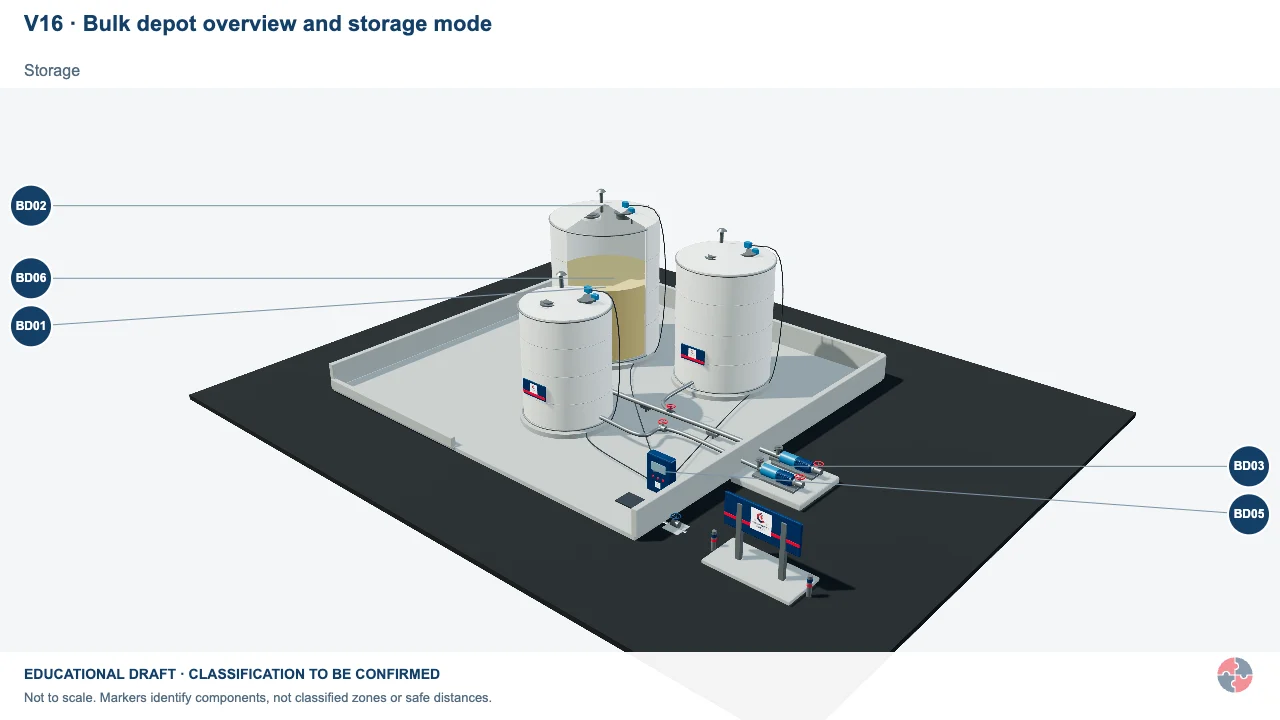
Bulk depot overview and storage mode
Explore the bulk depot system and compare selectable Zone 0, Zone 1 and Zone 2 teaching volumes around its petrol example.
Activity focus: Use cutaway for the internal vapour spaces, then compare the rounded vent, pump and mode-dependent connection envelopes.
Educational illustration, not to scale. Coloured zones are teaching examples, not a site-specific hazardous-area classification.
Active fire protection only where a reviewed scenario includes it; no invented firewater/foam layout.
What training is needed for active fire protection?
Training should match the role people play in prevention, detection, system operation, impairment control and emergency response.
Give people the information and practice their role requires. No universal external AFP certificate is asserted here; specialist design, commissioning, testing and emergency duties require demonstrable competence and any applicable local authorisation. A short briefing or video cannot qualify someone to fight a fire or restore a safety-critical system.
Training should not only tell people where extinguishers are. Operators need to understand alarms, firewater, foam, emergency shutdown, hydrants, impairment rules and escalation triggers. Maintenance teams need to know how work can disable protection and how to restore systems. Managers need to understand risk acceptance when protection is impaired. Emergency teams need realistic drills.
Training should include limitations. People should know when not to fight a fire, when to evacuate, what foam or water cannot do, how smoke and vapour can behave, where runoff goes and how to communicate with incident command.
| Role and learning | Practice on the actual task | Competence evidence and record | Assessor and reassessment trigger |
|---|---|---|---|
| All occupants and contractors: recognise warning and escape | Follow the actual alarm, accessible escape and muster route; report a blocked or failed warning without attempting untrained firefighting. | Observed induction scenario and drill participation with correction of missed actions. | Area supervisor checks at entry and after alarm or layout changes. |
| Operators: respond to an impaired barrier | Identify the unavailable pump, alarm, deluge or foam function; hold dependent work and escalate under the site impairment procedure. | Observed scenario, authorisation record and correct stop or restriction decision. | Shift supervisor and fire-system owner check after an impairment or changed plant. |
| Maintainers and contractors: isolate, test and hand back | Show safe isolation, permit, controlled test and restoration of alarms, valves, supplies and interfaces. | Practical observation, test result, defect closure and signed handback. | Competent system owner checks before independent work and after a test failure or modification. |
| Designers and technical authorities: confirm scenario duty | Explain credible fire cases, water demand, media compatibility, availability and change control using the approved design basis. | Peer-reviewed design, commissioning or change record tied to performance criteria. | Competent fire or process engineer checks on scenario, fuel or standard change. |
| Emergency team and incident command: work within capability | Drill alarm interpretation, evacuation, responder liaison and decisions when firewater or access fails. | Observed exercise, communication record, learning actions and retest. | Incident commander and competent response lead check after a drill or event. |
Record the demonstrated decision, assessor, limits of authority and action needed. Reassess after a changed task, equipment, policy or incident; this guide does not invent a universal certificate or fixed refresher interval.
How can ISO-style management clauses support active fire protection?
ISO-style clauses help connect active fire protection to risk assessment, competence, operational control, emergency planning, monitoring and improvement.
ISO 45001 is a voluntary management-system framework, not a GB or NI fire-law shortcut. A certificate does not prove that a specific pump, foam system, alarm cause-and-effect or evacuation interface will work in a credible fire.
Active fire protection is not a single compliance item. It requires competent people, controlled information, operational discipline, maintenance, management of change, emergency preparedness and leadership review. An ISO-style management-system lens can help a business avoid treating it as a collection of disconnected assets.
Use the current licensed ISO 45001 edition for formal clause mapping. For day-to-day assurance, test the named controls and the evidence that they work in real conditions.
ISO 45001 can structure ownership, change control, performance evaluation and corrective action, but it is voluntary and does not choose a firewater flow, foam agent or legal duty. The engineering design basis and applicable GB or NI law still control those decisions.
Which standards can help specify and test the right system?
Use the current standard for the actual system and hazard, but do not treat a standard or certificate as proof that a site-specific fire scenario is controlled.
| Standard or framework | Useful scope | Boundary for a decision |
|---|---|---|
| BS EN 12845:2015+A1:2019 | Design, installation and maintenance of fixed sprinkler systems; confirm the current licensed edition and exact scope before use. | Not a deluge, water-spray or foam design standard. Verify the edition when work is approved. |
| BS EN 13565-2:2018 | Fixed foam system design, installation, testing and maintenance. | Fuel, foam, components and application method still need competent compatibility evidence. |
| BS 5839-1:2025 | Non-domestic building fire detection and alarm design and maintenance. | Does not establish a complete process gas/flame-detection or shutdown design. |
| ISO 45001:2018 | Organisational risk, competence, emergency preparedness, monitoring and improvement. | Voluntary management framework, not a substitute for law or fire-engineering verification. |
How does active fire protection support NEBOSH Process Safety Management study?
Active fire protection supports process safety study by linking hazardous inventories, credible fire scenarios, barriers and emergency response.
For process safety study, the important point is that active fire protection is a mitigative barrier. It does not usually prevent the original loss of containment, but it can detect, control, suppress or limit the consequences. A good answer therefore starts with the scenario: what is burning, what could escalate, who is exposed, which systems are relied on and what evidence proves they will work.
Strong study answers should explain specific controls rather than use phrases such as “provide fire protection”. Explain the system: foam for flammable liquid, deluge for exposure cooling, sprinklers for storage, hydrants and monitors for firefighting, detection and alarms for response, and impairment controls for temporary unavailability. Then explain testing, competence and emergency interface.
What are the warning signs that active fire protection is not being managed well?
Warning signs include impaired systems, weak testing, poor design-basis knowledge, blocked access and actions closed without proof of restored protection.
Fire protection weakness often appears as quiet drift rather than obvious failure. A pump starts but has not been flow tested. Foam stock exists but is not compatible. A hydrant is present but blocked by storage. A sprinkler system is installed but storage has changed beyond design assumptions. A deluge valve is isolated for maintenance and nobody has authority to decide whether production should stop.
These signs matter because active fire protection is rarely demanded. A system can look reassuring for years and only reveal its weakness during the emergency. The organisation therefore needs active monitoring before the demand, not hope during the demand.
Treat repeated pump-start faults, unexplained valve changes, obstructed hydrants, foam stock uncertainty, blocked sprinklers, nuisance alarm overrides and incomplete contractor hand-backs as signs that the credited barrier may fail on demand. Escalate against the actual fire scenario rather than waiting for a fire or a favourable dashboard.
Standards named on this page are background context. Confirm the current edition, scope and exact requirements from an authorised copy before applying them. The open official sources below support the specific public-law and regulator guidance claims they are cited for.
What do the acronyms and key terms mean?
The main terms should be defined because fire protection combines general fire safety, engineering and process safety language.
| Acronym or term | What it means | Why it matters |
|---|---|---|
| AFP | Active fire protection. | Systems that detect, alarm, control, suppress or limit a fire after it starts. |
| PFP | Passive fire protection. | Fire-resisting construction, coatings, separation or barriers that do not need activation. |
| DSEAR | Dangerous Substances and Explosive Atmospheres Regulations. | Core GB regulation for fire and explosion risks from dangerous substances. |
| COMAH | Control of Major Accident Hazards Regulations. | Applies to qualifying major hazard establishments. |
| BLEVE | Boiling liquid expanding vapour explosion. | Major escalation scenario for heated pressure vessels containing liquefied gases. |
| VCE | Vapour cloud explosion. | Explosion following ignition of a flammable vapour cloud. |
| ESD | Emergency shutdown. | System or action that isolates or shuts down plant to limit escalation. |
| LEV | Local exhaust ventilation. | Can be relevant to fire prevention where vapours, fumes or combustible dusts are controlled at source. |
| SCE | Safety critical equipment. | Equipment whose failure could cause or fail to mitigate a major accident. |