SHARE Knowledge Hub
Guards and Machinery Interlocks
Machinery guards physically separate people from dangerous moving parts, while interlocks prevent or stop hazardous movement when access opens. They protect operators, cleaners and maintainers from entanglement, crushing, cutting and unexpected start during use and intervention. The safeguard must suit the machine and task, and maintenance needs assessed isolation even when a machine has stopped.
Understanding Guards and Machinery Interlocks
Machinery guarding and interlocks are safeguards designed to prevent people reaching dangerous parts of work equipment, or to stop dangerous movement before a person reaches the danger zone. HSE explains that fixed guarding will normally be used, while routine access may require interlocked guards and, where needed, guard locking. Safeguarding is a system comprising risk assessment, design, controls, installation, operation, adjustment, maintenance, inspection, supervision and response to failure.
Why this matters at work
Dangerous parts can include rotating shafts, rollers, belts, pulleys, gears, chains, blades, cutters, nip points, presses, dies, moving tooling, conveyors, robots, powered doors, lifting mechanisms, automated cells and mechanisms that start unexpectedly. Other machinery hazards include ejection of material, rupture, falling parts, high or low temperatures, electrical energy, hydraulic and pneumatic energy, gravity, stored energy, noise, dust, fumes and process substances. A guard review must not focus narrowly on the most visible moving part.
Risk assessment should consider normal operation, start-up, shutdown, loading, unloading, cleaning, adjustment, setting, tool change, jam clearing, fault-finding, maintenance, testing, access, power loss, restart, foreseeable misuse, who can approach and the environment. It should identify people beyond the operator: cleaners, setters, maintenance teams, contractors, supervisors, visitors, customers and people passing adjacent to a line or cell.
How organisations manage this in practice
Safeguarding depends on how the machine starts, stops, resets and restarts. HSE requires appropriately identified controls for starting, stopping and controlling work equipment, and safe control systems. Safeguard design must consider foreseeable modes such as automatic cycling, manual intervention, set-up, cleaning, power restoration, control fault, emergency stop reset, remote operation and integrated-line restart. The location and authority of controls should not expose people who cannot see or communicate with the danger zone.
Modern machinery may have programmable controllers, safety-related control systems, remote diagnostics, networked interfaces, upstream/downstream signals, automated recovery and links to other plant or information systems. HSE's buying-new-machinery guidance specifically asks whether data or control connections have suitable technical and procedural measures, and change-management procedures, to protect functions critical to health and safety. A guarding decision must consider the whole connected system, not only the local panel.
Define competent roles and safe methods for testing so that verification does not expose people to the hazard. Record relevant inspection results where required, identify defects clearly and keep unsafe equipment out of use. After repair or modification, verify the required functions and update information before a separately authorised return. User pre-use checks and specialist safety-function validation are different activities. Review repeat defects and interventions with workers, and check similar machinery. A successful start-stop cycle, a service label or a signed maintenance ticket cannot by itself demonstrate adequate stopping, isolation, fault response or protection against foreseeable defeat in the actual installed arrangement.
Guard response and safe intervention are different questions
An interlocked guard can be part of a safeguarding function. It does not automatically isolate every energy source or authorise a person to intervene.
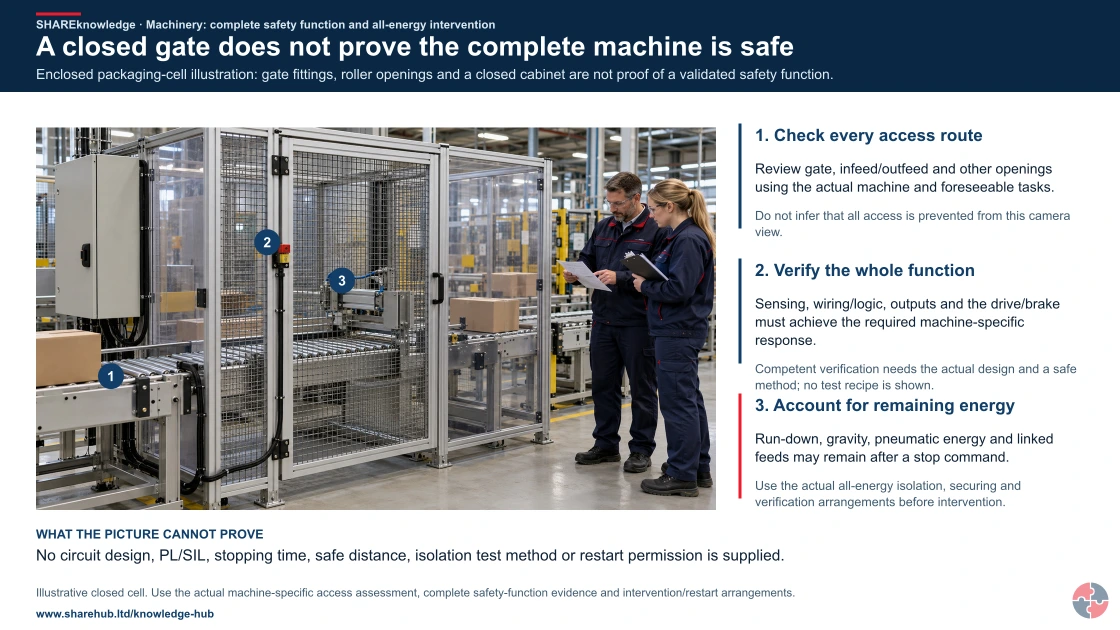
A closed gate does not prove the complete machine is safe
Full written explanation
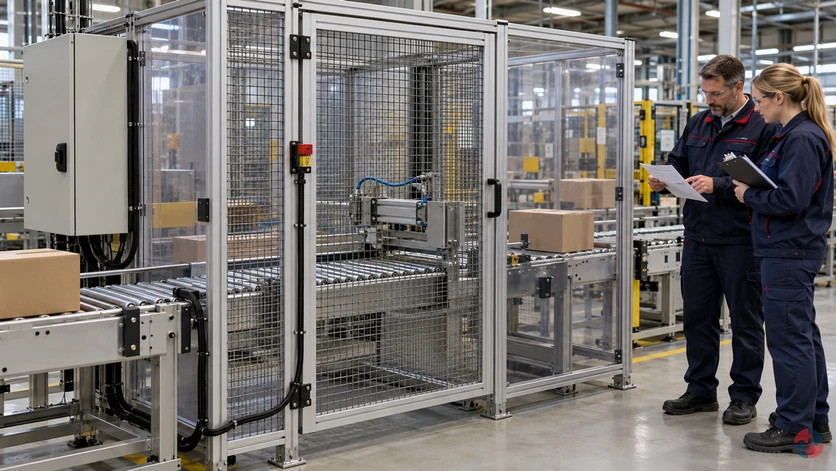
A new realistic UK packaging-cell illustration shows two people outside a closed mesh gate, an enclosed roller transfer, visible blue pneumatic lines and a closed electrical cabinet. Three numbered questions locate access and all openings, the complete protective-function path and continuing or stored energy. The gate-edge fittings are visible hardware only: the picture does not identify a certified interlock architecture or validate its response. The infeed and outfeed openings need actual access assessment. Neither a closed guard nor an emergency stop establishes all-energy isolation. A second native schematic distinguishes the complete sensing-to-danger function from machine-specific intervention and a deliberate separate restart/hand-back. The existing enclosed press scene remains a useful second machine context without proof of function.
Enclosed packaging-cell illustration: gate fittings, roller openings and a closed cabinet are not proof of a validated safety function.
- Check every access route. Review gate, infeed/outfeed and other openings using the actual machine and foreseeable tasks.
- Verify the whole function. Sensing, wiring/logic, outputs and the drive/brake must achieve the required machine-specific response.
- Account for remaining energy. Run-down, gravity, pneumatic energy and linked feeds may remain after a stop command.
Change the pathway
- A barrier is not every side. Do not infer that all access is prevented from this camera view.
- No bypass or reach-in test. Competent verification needs the actual design and a safe method; no test recipe is shown.
- Intervention is a separate plan. Use the actual all-energy isolation, securing and verification arrangements before intervention.
Evidence check: No circuit design, PL/SIL, stopping time, safe distance, isolation test method or restart permission is supplied.
Keep guard repair, full-function verification and all-energy intervention distinct
Primary references: HSE machinery risk and safeguards · HSE competent maintenance and energy
Open the complete HD image (new tab)Download image
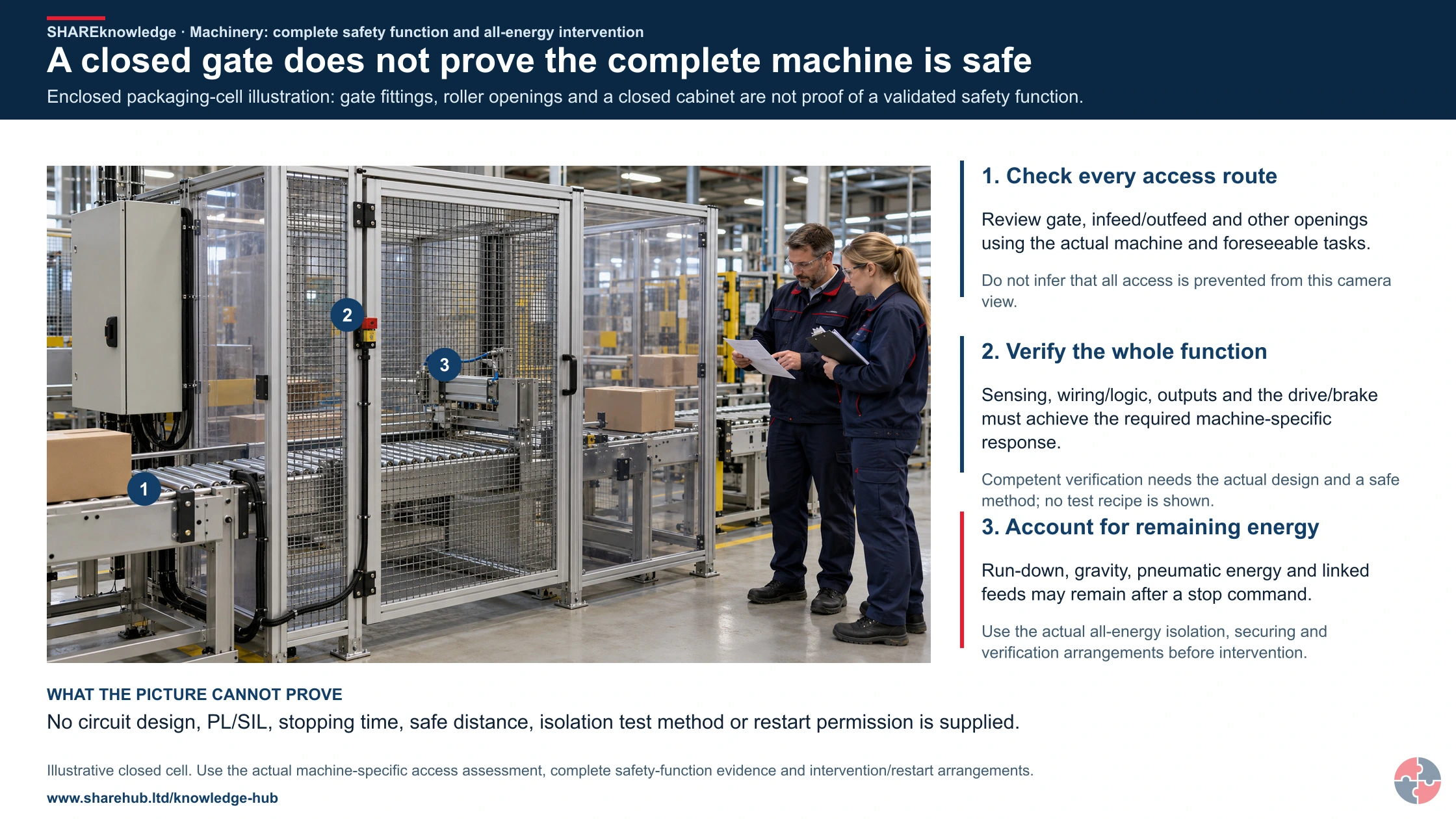
Keep guard repair, full-function verification and all-energy intervention distinct
Primary references: HSE machinery risk and safeguards · HSE competent maintenance and energy

Trace the safety function
Identify guard sensing, safety logic, outputs, drive or brake response and linked equipment.
Consider continuing danger
Stored energy, run-down or linked feeds may remain; guard locking and other safeguards depend on the actual assessed design.
Plan intervention separately
Use the actual all-energy isolation and securing method, competent verification and authorised access arrangements.
Control restart
Keep the affected task held if evidence is missing. Testing permission and named return to production are separate decisions; no bypass, timing or distance is supplied.
Read the complete task-specific control examples
ERICPD is a planning cross-map: Discipline verifies and sustains every control. ESEAP compares effectiveness. A label does not authorise the task; retain the owner, evidence and stop or change decision.
Guards and Machinery Interlocks · ERICPD
- Eliminate
- Design a feed, discharge or blockage-removal route that does not require reaching into the danger zone; remove an unnecessary powered step where feasible.
- Reduce
- Redesign the process to reduce hazardous force, movement or the need for close manual handling; choose a safer process where practical.
- Isolate
- Fit robust fixed guards or an assessed interlocked movable guard with locking if danger persists after stop.
- Control
- Engineering: specify and validate the sensor-to-stop safety function and secure energy isolation for interventions.
- PPE
- PPE limits injury from remaining exposure; it cannot block a nip.
- Discipline
- Train each role, supervise interventions, act on bypass reports, perform checks and maintain stop authority so higher controls keep working.
Guards and Machinery Interlocks · ESEAP
- Elimination
- Design out an unnecessary powered step or the need to reach into a danger zone for the task.
- Substitution
- Replace the remaining operation or equipment with a suitable less hazardous process. Reducing force alone is not automatically substitution.
- Engineering controls
- Fixed or interlocked separation, suitable guard locking, the complete sensor–logic–output–drive/brake–stop safety function, and engineered energy-control provisions provide physical protection.
- Administrative controls
- Authorise tasks; coordinate workers, linked plant and contractors; plan isolation, competence, inspection scheduling, change management and hand-back.
- PPE
- Use suitable protection only for assessed residual hazards; it cannot prevent access to a dangerous nip.
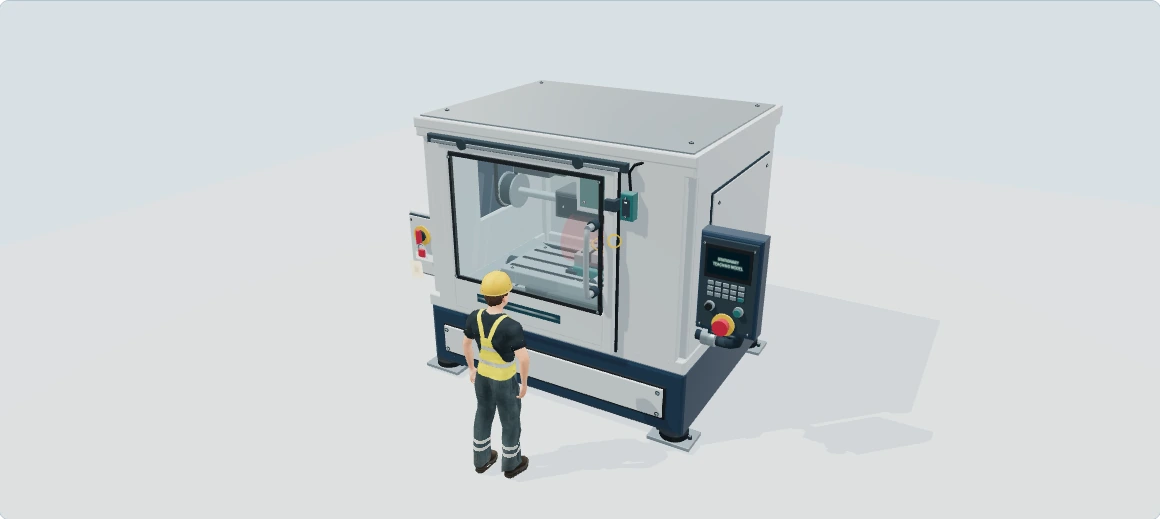

Machinery guarding: trace the energy to the harm
Explore the working zone, guards, interlock, transmission, controls and energy isolator. Compare production work, cleaning and maintenance without treating a stopped machine as safely isolated.
Checksheets and risk assessments
Risk assessment forms
Risk assessment examples
Forms and tools
Full written walkthrough — all 8 steps
1. Identify the dangerous movement
What is happening: The cutaway exposes the workholding and cutter so you can inspect where contact could occur. It does not open or enable the real machine.
How harm can occur: A cutter can sever tissue; rotating parts can wind in hair or clothing; moving workholding can crush a hand.
Best practice to apply: Identify the task, all exposed people and the machinery’s intended operating limits. Keep the actual danger zone inaccessible.
2. Inspect the enclosure and access
What is happening: Inspect the enclosure, viewing panel and access edges. The visual cutaway changes only the drawing.
How harm can occur: A missing, damaged or unsuitable guard may allow reach into dangerous movement or fail to contain an ejected item.
Best practice to apply: Check the actual guard, fixing, condition and suitability. Do not infer reach distances or containment performance from this model.
3. Understand an interlock’s role
What is happening: The access interlock is a separate protective function. Its presence does not establish the reliability or stopping performance of the actual system.
How harm can occur: Defeating an interlock can permit access while hazardous movement is possible. Run-down may continue after a stop request.
Best practice to apply: Verify required protective functions through competent assessment and maintenance. Do not bypass them or use the cutaway as a working configuration.
4. Find the transmission hazards
What is happening: Inspect the drive and the cover around it. Dangerous movement can exist beyond the obvious working point.
How harm can occur: Belts, pulleys and rotating shafts can entangle, draw in or trap people during production or servicing.
Best practice to apply: Keep appropriate transmission guarding in place. Plan access and maintenance with the equipment information and actual energy sources.
5. Separate control stops from isolation
What is happening: The control panel and emergency stop act through control functions. The energy isolator is physically separate.
How harm can occur: A stopped display may conceal live energy or allow an unexpected restart; an emergency stop does not remove every energy source.
Best practice to apply: Use the required stop arrangements for operation and the actual safe isolation procedure for intrusive access.
6. Control hazardous energy for access
What is happening: Locate the separate isolator and the points where electrical, pneumatic, hydraulic, gravitational or mechanical energy may remain.
How harm can occur: Unexpected energisation, stored pressure or a falling component can cause shock, crushing or impact.
Best practice to apply: Identify, isolate, secure and verify the relevant energies using competent task-specific arrangements. The pictured lock is not proof that a machine is safe.
7. Plan cleaning and material handling
What is happening: Consider how material is loaded, held, removed and cleaned without bringing a person into danger.
How harm can occur: An inadequately held item can be ejected; reaching to clear swarf or a blockage can expose hands and clothing.
Best practice to apply: Use suitable workholding and handling methods. Stop and follow the safe system when a blockage or abnormal condition occurs.
8. Protect the people around the machine
What is happening: The operator’s work position and surrounding access affect people other than the person at the controls.
How harm can occur: Visitors, cleaners and nearby trades may enter a danger area or be struck by an ejected item.
Best practice to apply: Check layout, access, instruction, competence and supervision. Review the machine after changes and before returning it to service.
Illustrative awareness learning. The model does not design equipment, authorise work, verify safe conditions or complete a real inspection.
The wider workplace has its own account and subscription access. Exploring this lesson does not grant access, record course completion or authorise work.
How can I practise this topic in 3D?

Kitchen gas ventilation interlock is defeated
Mixer guard defeated during scraping
Exposed conveyor nip point
All related inspection points 13 across 4 locations
Riverside Leisure 6 inspection points
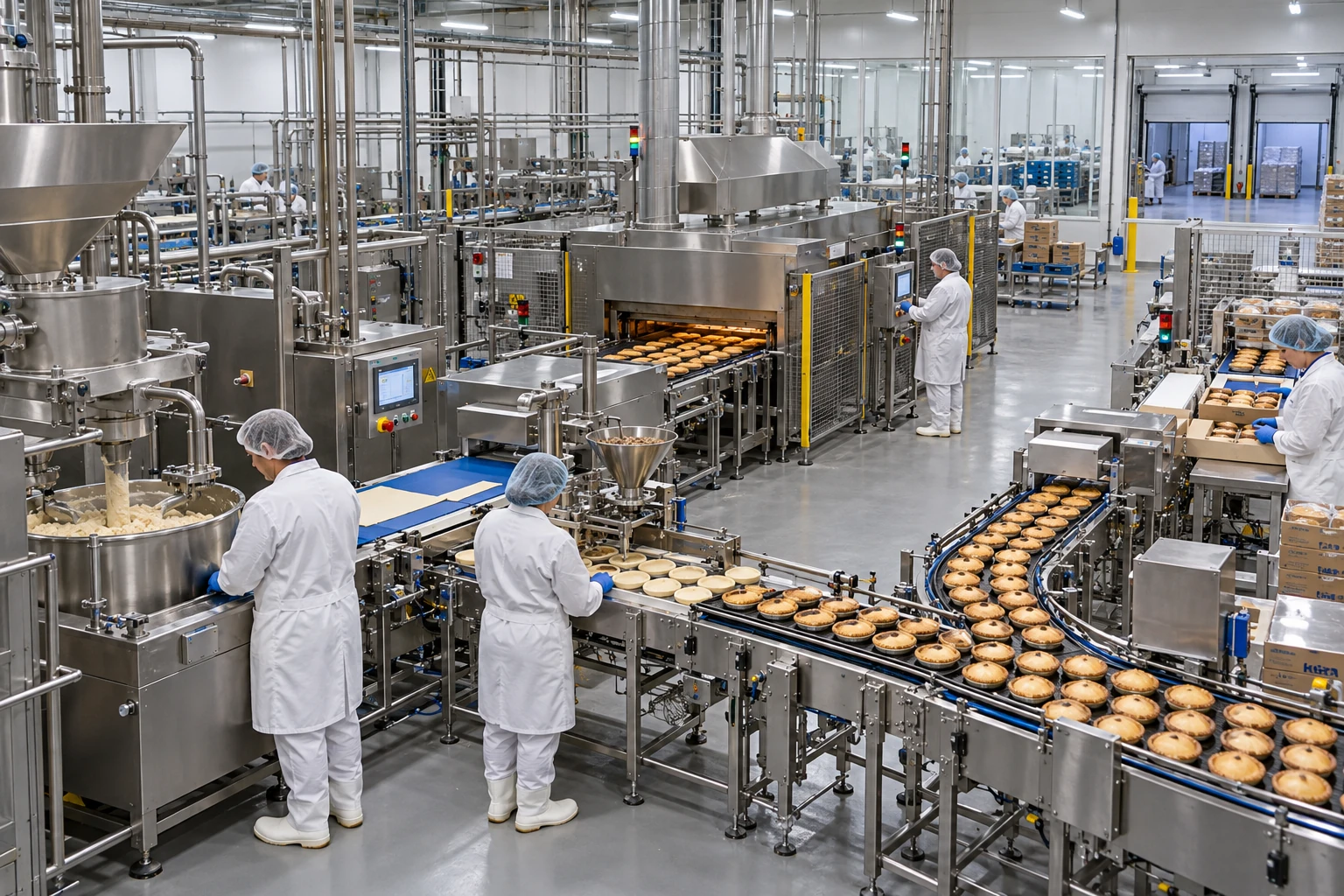
From flour to chilled despatch 3 inspection points
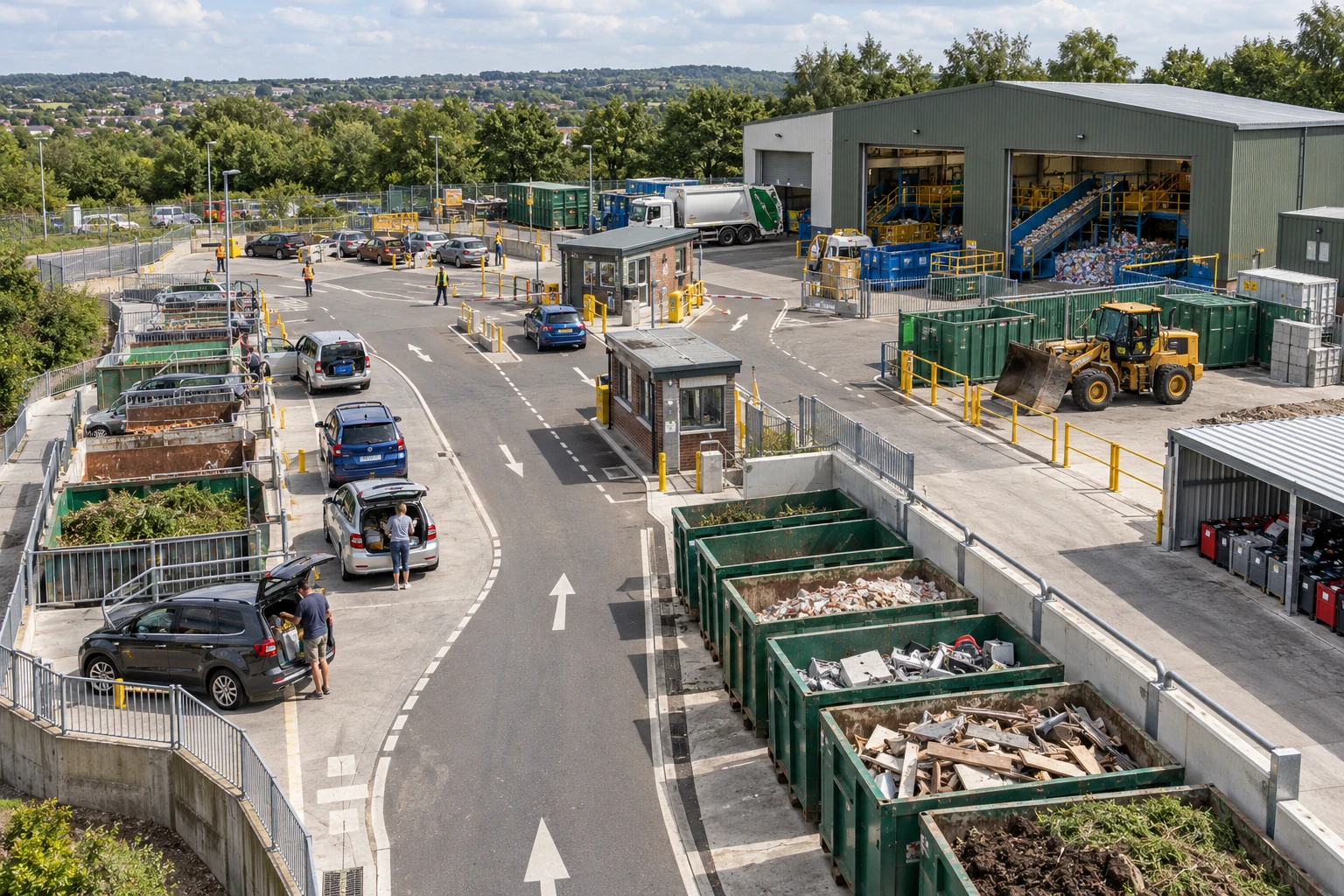
Recover materials. Protect people. 2 inspection points
Aerosystems Engineering 2 inspection points
Practice in the SHAREhub environment. Browser practice is separate from workplace competence and formal learning records.
What do guards and machinery interlocks do?
A guard blocks access to dangerous machine parts. An interlock connects a movable guard to a safety function so dangerous operation is prevented or stopped when access opens; it must act before a person can reach the danger.
Best-practice guide: Guards and Machinery Interlocks
What do guards and machinery interlocks do?
A guard blocks access to dangerous machine parts. An interlock connects a movable guard to a safety function so dangerous operation is prevented or stopped when access opens; it must act before a person can reach the danger. Machinery guards physically separate people from dangerous moving parts, while interlocks prevent or stop hazardous movement when access opens.
Turn guards and machinery interlocks knowledge into a decision
Machinery guards physically separate people from dangerous moving parts, while interlocks prevent or stop hazardous movement when access opens. They protect operators, cleaners and maintainers from entanglement, crushing, cutting and unexpected start during use and intervention. Record the fault, work authorisation, isolation/control record, repair, safeguard test, updated instructions where needed, names and decision to release the conveyor.
Packaging conveyor blockage and interlock defect
Competent workers verify the safe state, clear the blockage by the approved method, and assess the gate trip. No one reaches into the nip to test it; if an unexpected feed or pressure source appears, they withdraw and revise the plan. Repair and validate the safeguard; account for both workers and tools; refit guards; restore energy through the authorised process; verify deliberate restart and tell operators what changed.
Machinery harm mechanisms and stop signs
Feeding rollers or conveyors: An in-running nip draws clothing, hair or a hand into moving surfaces; crush injury, fracture, degloving or amputation can follow. Power press, mixer or driven gate: A moving part closes against another surface or unexpectedly restarts; crushing, shearing or entrapment may cause major injury or death. Saw, cutter or ejected workpiece: Contact cuts or severs tissue; fragments can penetrate an eye or strike a person.
Choose controls for the actual task
Eliminate: Design a feed, discharge or blockage-removal route that does not require reaching into the danger zone; remove an unnecessary powered step where feasible. Reduce or substitute: Redesign the process to reduce hazardous force, movement or the need for close manual handling; choose a safer process where practical. Isolate: Fit robust fixed guards or an assessed interlocked movable guard with locking if danger persists after stop. Control: Engineering: specify and validate the sensor-to-stop safety function and secure energy isolation for interventions. PPE: Use suitable eye or face protection for assessed residual ejection and other task-specific exposure after guarding. Read the full control table for qualifications, ownership and verification. Use the actual task and applicable jurisdiction; existing technical approval remains unchanged.
Use the full guards and machinery interlocks lesson
Use the full topic for the decision points, practical examples, detailed control tables and source scope. HSE guidance applies to Great Britain; use HSENI for the Northern Ireland route and the source’s stated jurisdiction. A simplified guide does not change the page’s technical-review or approval status.

Read all six steps as text
1. What do guards and machinery interlocks do?
A guard blocks access to dangerous machine parts.
- Avoid / redesign: Design a feed, discharge or blockage-removal route that does not require reaching into the danger zone; remove an unnecessary powered step where feasible.
- Control the task: Fit robust fixed guards or an assessed interlocked movable guard with locking if danger persists after stop.
- Verify before release: Elimination: remove manual access to dangerous motion by redesign.
A guard blocks access to dangerous machine parts. An interlock connects a movable guard to a safety function so dangerous operation is prevented or stopped when access opens; it must act before a person can reach the danger. Machinery guards physically separate people from dangerous moving parts, while interlocks prevent or stop hazardous movement when access opens.
Apply it: Which part of this plan would you check at the workface before authorising the task?
2. Turn guards and machinery interlocks knowledge into a decision
Use the evidence to improve the actual work arrangement.
- Change at source: Design a feed, discharge or blockage-removal route that does not require reaching into the danger zone; remove an unnecessary powered step where feasible.
- Make it observable: Elimination: remove manual access to dangerous motion by redesign.
- Keep useful evidence: Record the fault, work authorisation, isolation/control record, repair, safeguard test, updated instructions where needed, names and decision to release the conveyor.
Machinery guards physically separate people from dangerous moving parts, while interlocks prevent or stop hazardous movement when access opens. They protect operators, cleaners and maintainers from entanglement, crushing, cutting and unexpected start during use and intervention. Record the fault, work authorisation, isolation/control record, repair, safeguard test, updated instructions where needed, names and decision to release the conveyor.
Apply it: What evidence would show that the change improves this task, rather than only completing a record?
3. Packaging conveyor blockage and interlock defect
Example: a practical application of the existing topic lesson.
- Setting: Cartons jam at a packaging transfer point.
- Act: Stop and hold production, keep others clear and reject the tape holding the side gate.
- Hold / review: Hold the line: do not start or reach in while the interlock is defeated, the drive can coast into reach, the linked feed remains energised, the air pressure is uncertain, or the task differs from the agreed method.
Competent workers verify the safe state, clear the blockage by the approved method, and assess the gate trip. No one reaches into the nip to test it; if an unexpected feed or pressure source appears, they withdraw and revise the plan. Repair and validate the safeguard; account for both workers and tools; refit guards; restore energy through the authorised process; verify deliberate restart and tell operators what changed.
Apply it: At which point would you hold this example, and what evidence would allow it to proceed?
4. Machinery harm mechanisms and stop signs
Connect the task, the route to the person and the control that can fail.
- Feeding rollers or conveyors: An in-running nip draws clothing, hair or a hand into moving surfaces; crush injury, fracture, degloving or amputation can follow.
- Power press, mixer or driven gate: A moving part closes against another surface or unexpectedly restarts; crushing, shearing or entrapment may cause major injury or death.
- Saw, cutter or ejected workpiece: Contact cuts or severs tissue; fragments can penetrate an eye or strike a person.
Feeding rollers or conveyors: An in-running nip draws clothing, hair or a hand into moving surfaces; crush injury, fracture, degloving or amputation can follow. Power press, mixer or driven gate: A moving part closes against another surface or unexpectedly restarts; crushing, shearing or entrapment may cause major injury or death. Saw, cutter or ejected workpiece: Contact cuts or severs tissue; fragments can penetrate an eye or strike a person.
Apply it: Who could be exposed, including other trades, cleaners, maintainers and people nearby?
5. Choose controls for the actual task
Control summary. Read the complete task-specific controls and checks in the linked topic.
- Elimination: Design out an unnecessary powered step or the need to reach into a danger zone for the task.
- Substitution: Replace the remaining operation or equipment with a suitable less hazardous process. Reducing force alone is not automatically substitution.
- Engineering controls: Fixed or interlocked separation, suitable guard locking, the complete sensor–logic–output–drive/brake–stop safety function, and engineered energy-control provisions provide physical protection.
- Administrative controls: Authorise tasks; coordinate workers, linked plant and contractors; plan isolation, competence, inspection scheduling, change management and hand-back.
- PPE: Use suitable protection only for assessed residual hazards; it cannot prevent access to a dangerous nip.
Eliminate: Design a feed, discharge or blockage-removal route that does not require reaching into the danger zone; remove an unnecessary powered step where feasible. Reduce or substitute: Redesign the process to reduce hazardous force, movement or the need for close manual handling; choose a safer process where practical. Isolate: Fit robust fixed guards or an assessed interlocked movable guard with locking if danger persists after stop. Control: Engineering: specify and validate the sensor-to-stop safety function and secure energy isolation for interventions. PPE: Use suitable eye or face protection for assessed residual ejection and other task-specific exposure after guarding. Read the full control table for qualifications, ownership and verification. Use the actual task and applicable jurisdiction; existing technical approval remains unchanged.
Apply it: Which stronger option can be used here, and who will verify it before accepting the remaining risk?
6. Use the full guards and machinery interlocks lesson
Follow the official sources below and retain the task-specific evidence.
- Official guidance: HSE Introduction to machinery safety
- Official guidance: HSE L22 Safe use of work equipment
- Task decision: Keep the affected task held if evidence is missing. Testing permission and named return to production are separate decisions; no bypass, timing or distance is supplied.
Use the full topic for the decision points, practical examples, detailed control tables and source scope. HSE guidance applies to Great Britain; use HSENI for the Northern Ireland route and the source’s stated jurisdiction. A simplified guide does not change the page’s technical-review or approval status.
Apply it: Which official source and full-topic section will you use to resolve the next decision?
The danger may be a conveyor nip, rotating shaft, blade, powered ram or moving part hidden by a cover. It includes reaching through, over, under or around a guard and entering an enclosure. Ejected material and stored electrical, pneumatic, hydraulic or gravitational energy may create further hazards. Safeguarding must cover normal use and foreseeable cleaning, setting, blockage clearing and repair.
An emergency stop helps respond after a problem is recognised; it does not prevent access and is not a replacement for a guard. A closed interlocked gate is not an energy isolator for maintenance. HSE sets out these distinctions in its machinery overview and PUWER ACOP.
When must people stop using a machine?
Stop and keep the machine out of service when a required guard is missing or damaged, an open guard permits access to a dangerous condition, or a safeguard fails its intended function; an interlock is defeated or suspected of defeat; dangerous movement remains reachable; or isolation cannot be confirmed for an intervention. Tell the supervisor and keep others clear. A designed movable guard may open during intended safe access, but hazardous operation must remain prevented throughout that access.
Do not reach past a guard, use a spare actuator or magnet, wedge a gate, reset a fault repeatedly, or ask a colleague to watch the hazard while production continues. A fault report needs the machine identity, affected safeguard, condition found, people exposed and immediate isolation or access control. Where an injury has occurred, use the site emergency plan and obtain urgent medical help; do not move machinery or attempt a rescue unless the planned safe method and competent responders make it safe.
Only a competent authorised person may assess, repair and verify the safeguard. Restart needs a clear hand-back to the machine owner, including the original protective function and any changed operating method. HSE Introduction to machinery safety; HSE Maintenance of work equipment.
Where can machinery catch or strike a person?
Look beyond the visible cutting point: in-running nips, rotating shafts, belts, gears, rollers, moving rams, gravity-fed parts, access hatches and ejected product can injure during use or intervention.
A glove or sleeve can be drawn into a roller; a hand can be crushed by a closing ram; a conveyor can pull someone into a nip after a blockage is disturbed. Slow movement is not automatically safe, and stopping a motor does not necessarily remove stored energy or prevent coasting. Map every access route and task, including workers, contractors, cleaners and people near the machine.
Use the machine instructions, installation layout, incident history and worker experience to identify foreseeable tasks. Ask what is exposed while a cover is open, whether a person can remain inside when a gate closes, whether a second person can restart the machine, and whether a jam changes the energy state. HSE Introduction to machinery safety; HSE L22 Safe use of work equipment.
How does an unguarded machine injure people?
Hazardous motion reaches a person when a hand, clothing or body can enter a nip, cutting path, closing gap or moving enclosure before the machine reaches a safe state. The immediate harm can be entanglement, crushing, amputation, laceration or impact; survivors may have lasting disability.
A rotating roller grips clothing or a hand and draws the limb into a narrowing gap. A ram or gate closes on a person and compresses tissue against a fixed surface. A blade cuts on contact; a broken tool or workpiece can strike the eye or body. Unexpected restart or stored pressure can create the same contact while someone is clearing a jam. Speed, mass, force, coast-down time, reach distance, poor visibility, bypassed guards and linked equipment change the chance and severity. HSE Introduction to machinery safety; HSE hierarchy of controls.
| Task or exposure | Route and likely harm | Early sign and stop point |
|---|---|---|
| Feeding rollers or conveyors | An in-running nip draws clothing, hair or a hand into moving surfaces; crush injury, fracture, degloving or amputation can follow. | Guard gap, reachable nip, loose clothing near motion or repeated snagging: stop use and prevent access. |
| Power press, mixer or driven gate | A moving part closes against another surface or unexpectedly restarts; crushing, shearing or entrapment may cause major injury or death. | Gate can open while motion remains, unexpected reset, person able to remain inside or changed stopping time: hold use. |
| Saw, cutter or ejected workpiece | Contact cuts or severs tissue; fragments can penetrate an eye or strike a person. | Missing blade guard, damaged enclosure, altered feed or unexpected ejection: stop and investigate. |
| Jam clearing or maintenance | Stored pneumatic, hydraulic or gravitational energy or linked machinery moves after a motor stop; hands or whole body can be trapped. | Unknown energy state, no personal control of isolation, coasting or a changed jam: withdraw and seek competent help. |
These are primarily acute injury mechanisms. Long-term loss of function or disability can follow severe injury; this page does not imply a separate chronic exposure limit for guarding. Machine-specific injury patterns still require the actual risk assessment. HSE explains the machine hazard and safeguard route in Official guidance.
How does PUWER choose the first safeguarding measure?
Prevent access with a fixed guard where practicable. If fixed guarding cannot fully protect the task, use another guard or protective device such as an interlocked guard; then protection appliances such as jigs or push sticks where needed. Information, instruction, training and supervision address remaining risk.
This is the Regulation 11 sequence for dangerous parts, not a menu in which an emergency stop or warning sign can replace a feasible guard. Reduce the need to enter the danger zone by design: change feed or discharge, remove jam causes, provide tools and safe adjustment routes. The remaining safeguard must fit actual access frequency, foreseeable misuse and the hazard stopping behaviour. HSE L22 Safe use of work equipment; HSE PUWER overview.
| Situation | Design and management decision |
|---|---|
| No routine access to dangerous parts | Prefer a securely fixed guard that prevents reaching the hazard; a competent designer checks openings, strength, access and fasteners. Sources: HSE L22 Safe use of work equipment; HSE Introduction to machinery safety. |
| Routine access for loading, adjustment or cleaning | Assess a movable interlocked guard or suitable protective device. Verify hazardous motion stops before a person reaches it and cannot restart unexpectedly. Sources: HSE L22 Safe use of work equipment; HSE Introduction to machinery safety. |
| Coast-down or stored movement after stop | Assess guard locking or another engineered measure that keeps access closed until danger has ceased. Verify actual whole-system stopping behaviour. Sources: HSE L22 Safe use of work equipment; HSE Introduction to machinery safety. |
| Some process hazard remains exposed | Use suitable jigs, holders or other protection plus task instruction and supervision. Do not treat PPE or a warning sign as primary guarding. Sources: HSE L22 Safe use of work equipment; HSE Introduction to machinery safety. |
How can the hierarchy of controls prevent machinery access before relying on guards and interlocks?
Start by removing the need to reach dangerous motion, then reduce energy or exposure and isolate people with engineered safeguarding. Use safe controls, suitable PPE for remaining hazards, and reliable instruction and checking as supporting layers. None of the lower levels makes a reachable nip acceptable.
ERICPD means Eliminate, Reduce or substitute, Isolate, Control, Personal Protective Equipment and Discipline. The six planning stages are an editorial aid, not a separate statute. HSE describes a similar hierarchy and PUWER Regulation 11 has its own mandatory safeguarding order. In this table, “Control” includes engineered safety functions and planned work arrangements, while “Discipline” means follow-through on an agreed system rather than blame. HSE hierarchy of controls; HSE L22 Safe use of work equipment.
The HSE five-level hierarchy is elimination, substitution, engineering controls, administrative controls and PPE. ERICPD overlaps but separately names Reduce, Isolate and Discipline; its Discipline stage sustains safeguards through maintenance and supervision, rather than blaming a worker. The two are planning lenses, while the applicable GB or NI work-equipment rules supply the duty. For a conveyor, eliminate routine reach-in by redesigned feed or clearing access if practicable. If the process needs access, substitute a lower-risk method and engineer fixed or interlocked separation; a procedure or emergency stop cannot replace a feasible guard. Validate the complete stop function and isolation before release.
How can the ERICPD hierarchy of controls prevent machinery access before relying on guards and interlocks?

Use the five-level table to distinguish physical engineering controls from administrative arrangements. Read the illustration alongside this explanation.
| ERICPD level | Control and harm-chain break | Owner, check and failure sign | HSE five-level position |
|---|---|---|---|
| Eliminate | Design a feed, discharge or blockage-removal route that does not require reaching into the danger zone; remove an unnecessary powered step where feasible. No contact route remains for that task. Sources: HSE Introduction to machinery safety; HSE L22 Safe use of work equipment. | Designer and buyer observe real operating and clearing tasks before acceptance. If a predictable jam still needs a hand inside, the exposure was not eliminated. | Elimination: remove manual access to dangerous motion by redesign. |
| Reduce or substitute | Redesign the process to reduce hazardous force, movement or the need for close manual handling; choose a safer process where practical. Confirm residual movement remains controlled. Sources: HSE Introduction to machinery safety; HSE L22 Safe use of work equipment. | Engineering lead measures actual behaviour and reviews new hazards. “Slow” or “low force” alone is not proof of safety; unexpected movement or access still needs guarding. | Substitution: lower-risk process, feed or movement; low speed alone needs proof. |
| Isolate | Fit robust fixed guards or an assessed interlocked movable guard with locking if danger persists after stop. Physical separation or timely stop breaks contact with motion. Sources: HSE Introduction to machinery safety; HSE L22 Safe use of work equipment; HSE L22 machinery safeguards. | Competent designer specifies, maintainer checks condition, owner samples real access. Reach-through/over gaps, defeated actuator, damaged barrier or access before coast-down means hold use. | Engineering: fixed/interlocked separation and secure isolation. |
| Control | Engineering: specify and validate the sensor-to-stop safety function and secure energy isolation for interventions. Administrative: schedule work, coordinate people, control changes and hand-back. Sources: HSE Maintenance of work equipment; HSE L22 Safe use of work equipment. | Controls engineer validates; supervisor checks authorised method and defect closure. Interlock is not isolation; failed stop, unknown stored energy or unvalidated modification stops work. | Engineering safety function first, then administrative authorisation and change control. |
| PPE | Use suitable eye or face protection for assessed residual ejection and other task-specific exposure after guarding. PPE limits injury from remaining exposure; it cannot block a nip. Sources: HSE Managing risk using PPE; HSENI Personal protective equipment. | Supervisor checks selection, fit, condition and compatibility with machine instructions. Loose gloves or clothing can increase entanglement; never use PPE to justify access to motion. | PPE for residual ejection or handling hazards, never a reachable nip. |
| Discipline | Train each role, supervise interventions, act on bypass reports, perform checks and maintain stop authority so higher controls keep working. Sources: HSE Inspection of work equipment; HSE L22 Safe use of work equipment. | Manager reviews observations, defects, near misses and repeated resets. Training or a sign alone cannot replace a practicable guard; repeated bypass calls for design review. | Administrative sustainment: inspection, training, maintenance and no-defeat culture. |
How can the five-level hierarchy of controls prevent machinery access before relying on guards and interlocks?

Use the five-level table to distinguish physical engineering controls from administrative arrangements. Read the illustration alongside this explanation.
| Control level | Topic-specific control | Owner, check and hold point | Sources and full task context |
|---|---|---|---|
| Elimination | Design out an unnecessary powered step or the need to reach into a danger zone for the task. | Designer and task owner verify that the contact route is removed, including foreseeable cleaning and jams. | HSE Introduction to machinery safety · HSE L22 Safe use of work equipment · HSE L22 machinery safeguards · HSE Maintenance of work equipment · HSE Managing risk using PPE · HSENI Personal protective equipment · HSE Inspection of work equipment |
| Substitution | Replace the remaining operation or equipment with a suitable less hazardous process. Reducing force alone is not automatically substitution. | Designer and competent assessor verify the replacement and any new hazards. | HSE Introduction to machinery safety · HSE L22 Safe use of work equipment · HSE L22 machinery safeguards · HSE Maintenance of work equipment · HSE Managing risk using PPE · HSENI Personal protective equipment · HSE Inspection of work equipment |
| Engineering controls | Fixed or interlocked separation, suitable guard locking, the complete sensor–logic–output–drive/brake–stop safety function, and engineered energy-control provisions provide physical protection. | Competent authorised specialists verify safe access and stopping behaviour using an approved safe test. A door switch is not automatically guard locking or isolation. | HSE Introduction to machinery safety · HSE L22 Safe use of work equipment · HSE L22 machinery safeguards · HSE Maintenance of work equipment · HSE Managing risk using PPE · HSENI Personal protective equipment · HSE Inspection of work equipment |
| Administrative controls | Authorise tasks; coordinate workers, linked plant and contractors; plan isolation, competence, inspection scheduling, change management and hand-back. | Nominated machine-responsible role checks effective personal protection for everyone exposed and evidence before release. | HSE Introduction to machinery safety · HSE L22 Safe use of work equipment · HSE L22 machinery safeguards · HSE Maintenance of work equipment · HSE Managing risk using PPE · HSENI Personal protective equipment · HSE Inspection of work equipment |
| PPE | Use suitable protection only for assessed residual hazards; it cannot prevent access to a dangerous nip. | Supervisor checks compatibility and condition; never accept PPE as a substitute for guarding or isolation. | HSE Introduction to machinery safety · HSE L22 Safe use of work equipment · HSE L22 machinery safeguards · HSE Maintenance of work equipment · HSE Managing risk using PPE · HSENI Personal protective equipment · HSE Inspection of work equipment |
The strongest control can introduce another hazard: an enclosure can trap a person, a guard can obstruct safe cleaning, and reduced speed can encourage unsafe access. Assess those effects with the current machine and verify the complete safety function before release. HSE Introduction to machinery safety; HSE Managing risk using PPE.
What makes a physical guard effective?
A guard must be strong, secure and positioned so a person cannot reach dangerous parts through, over, under or around it. It must not create a new trapping or sharp-edge hazard, and workers need a usable way to do the job without removing it.
A fixed guard normally requires a tool for removal and must be refitted before use. A movable guard may suit needed access but requires an appropriate safety function. Mesh aperture, height, reach distance, transparent-panel strength and fixings are engineering design choices; they cannot be chosen from one universal gap or panel thickness. A competent designer uses the applicable current technical requirements, machine instructions and actual body/access routes. HSE L22 Safe use of work equipment.
Poor visibility, awkward cleaning and long waits are reasons people defeat protection. During the design review, watch operators perform real tasks and redesign inconvenient steps without creating a shortcut to the hazard. A new opening, tool, product or worker group can invalidate an earlier reach assessment. HSE Introduction to machinery safety.
What must an interlocked guard achieve?
Opening the guard must cause the hazardous function it protects to stop or prevent it starting; closing the guard should not by itself restart the machine. If a person could reach dangerous movement before it stops, the design needs an effective way to keep access closed until the danger has ceased.
A door-position switch is one component, not proof of a complete safety function. The sensor, wiring, safety controller, output device, drive, brake and mechanical stopping performance all matter. Some hazards require a locking guard; some enclosures require an escape release and controls that stop a person being trapped. The competent designer determines those requirements for the actual machine and current applicable technical requirements. HSE L22 Safe use of work equipment.
An interlock may be defeated by an easy-to-remove actuator, loose alignment, a magnet, spare key, hidden fault or altered control logic. Repeated nuisance trips or bypasses show a design or work-system problem. Stop and investigate the incentive, including access, cleaning and production pressure, before choosing a tamper measure. HSE Introduction to machinery safety.
How is a safety-related control function proved effective?
Define what the safeguard must prevent, then have a competent person design, validate, test, maintain and control changes to the whole safety function. Performance and test methods depend on the assessed machine and risk; this page does not assign a performance level, stopping distance or test interval.
The specification should cover hazardous motion, access, stopping and reset behaviour, foreseeable faults, stored energy and loss or restoration of power. Check actual stopping behaviour and all accessible sides before hand-back. The HSE L22 PUWER guidance supports the safeguarding decision. Any private technical standard needs an authorised copy and a competent, machine-specific clause review before its content is used here.
How can a jam, clean or repair be handled safely?
Plan the intervention before opening protection. Stop the machine, identify and isolate every relevant energy source, secure against reconnection, verify the safe condition, and prevent other people starting or entering while work continues. Use a separately engineered and authorised mode if movement is genuinely needed.
An interlock or emergency stop alone can leave electrical power, air pressure, hydraulic pressure, gravity or a coasting part available. The competent isolation plan covers linked conveyors and upstream equipment, stored loads, trapped pressure and each person working in the danger area. Do not reach in to pull material while a motor is merely stopped. HSE Maintenance of work equipment; HSE Guarding in quarries.

| Stage | Decision or evidence |
|---|---|
| Before access | Identify machine, task, hazard and authorised workers; agree whether it can be done with guards in place or from outside the danger zone. |
| Secure | Stop, isolate and lock the applicable sources under the site procedure; each exposed worker retains personal control. Release or restrain stored energy by a competent method. |
| Verify | Check the intended safe state by the authorised method, including linked equipment and coasting. If the state is uncertain, hold work and escalate. |
| Perform and change | Use the approved tools and route. If the jam, access or energy state differs from the plan, stop, withdraw and revise the method. |
| Hand back | Account for people and tools; restore guards, remove locks only through the agreed process, function-check protection and authorise restart with affected operators informed. |
How would BuildOut Ltd clear a packaging conveyor blockage?

BuildOut Ltd should stop production, hold the line against restart, identify the blocked conveyor and linked energy, then isolate and verify the safe state before clearing the jam. Repair and validate the gate, account for people and tools, and obtain authorised hand-back before restart.
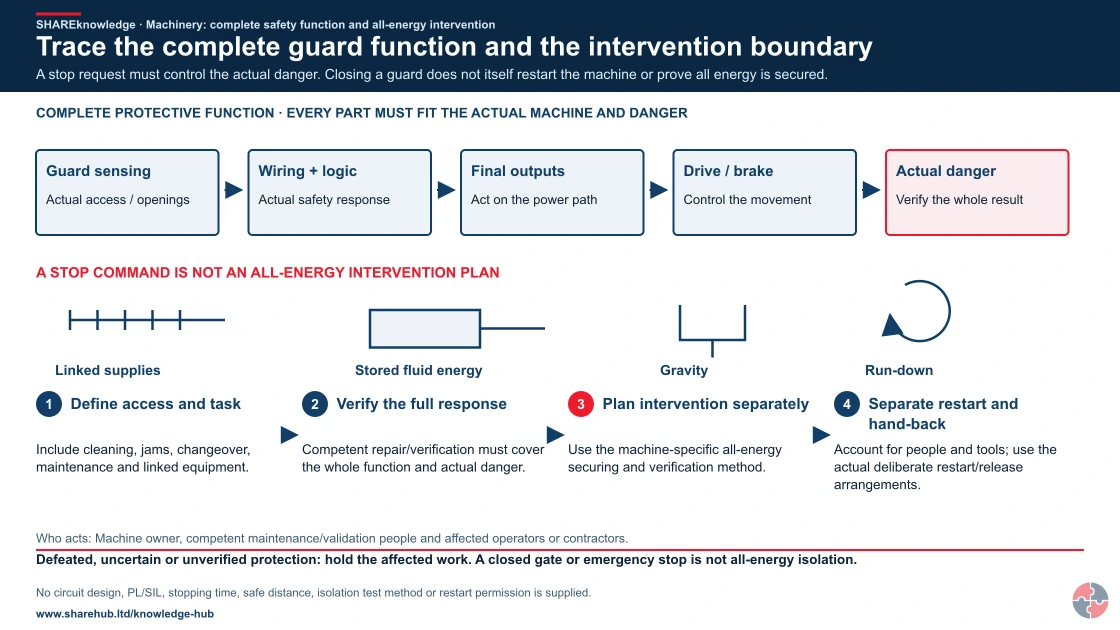
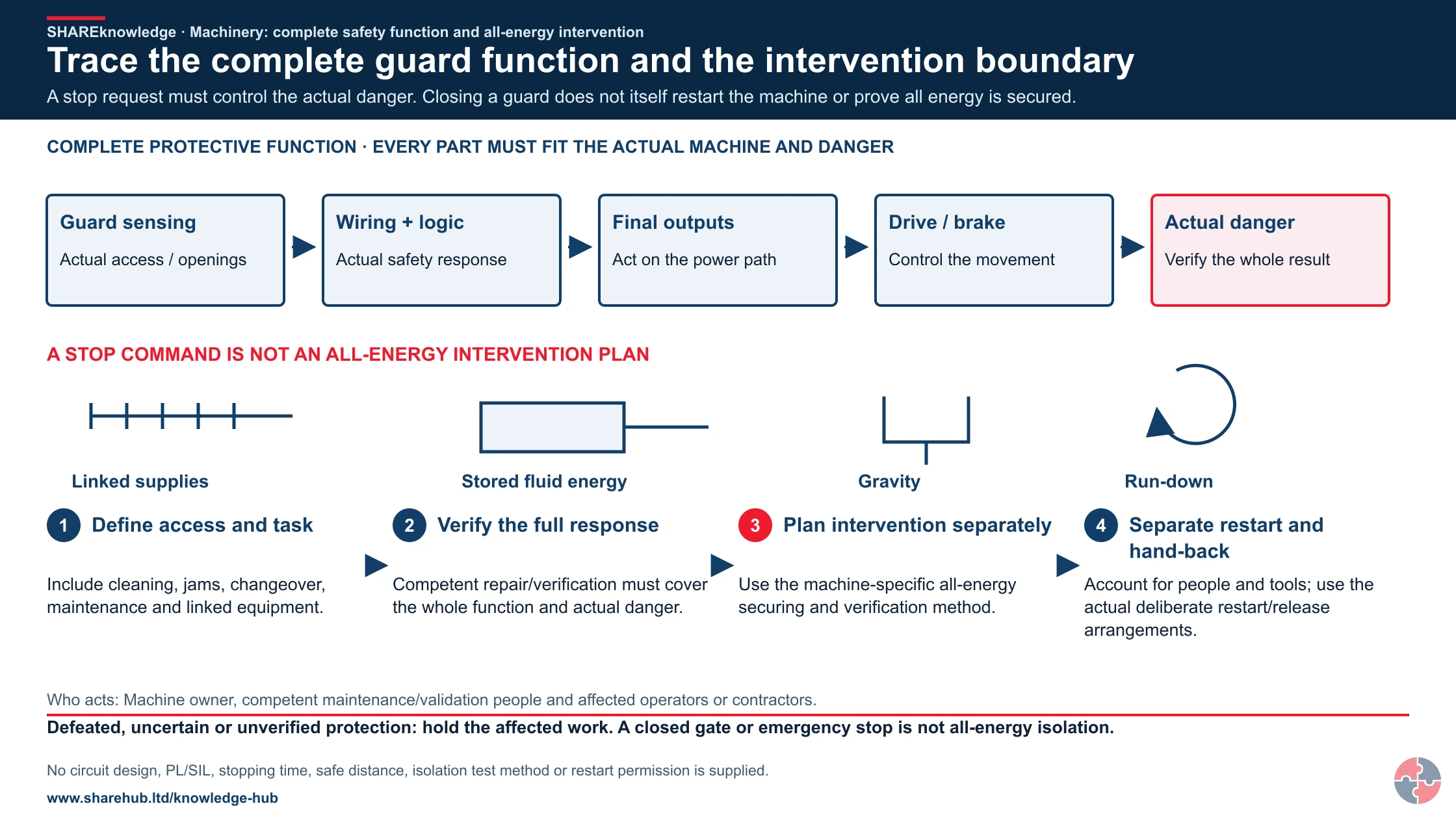
Trace the complete guard function and the intervention boundary
Full written explanation
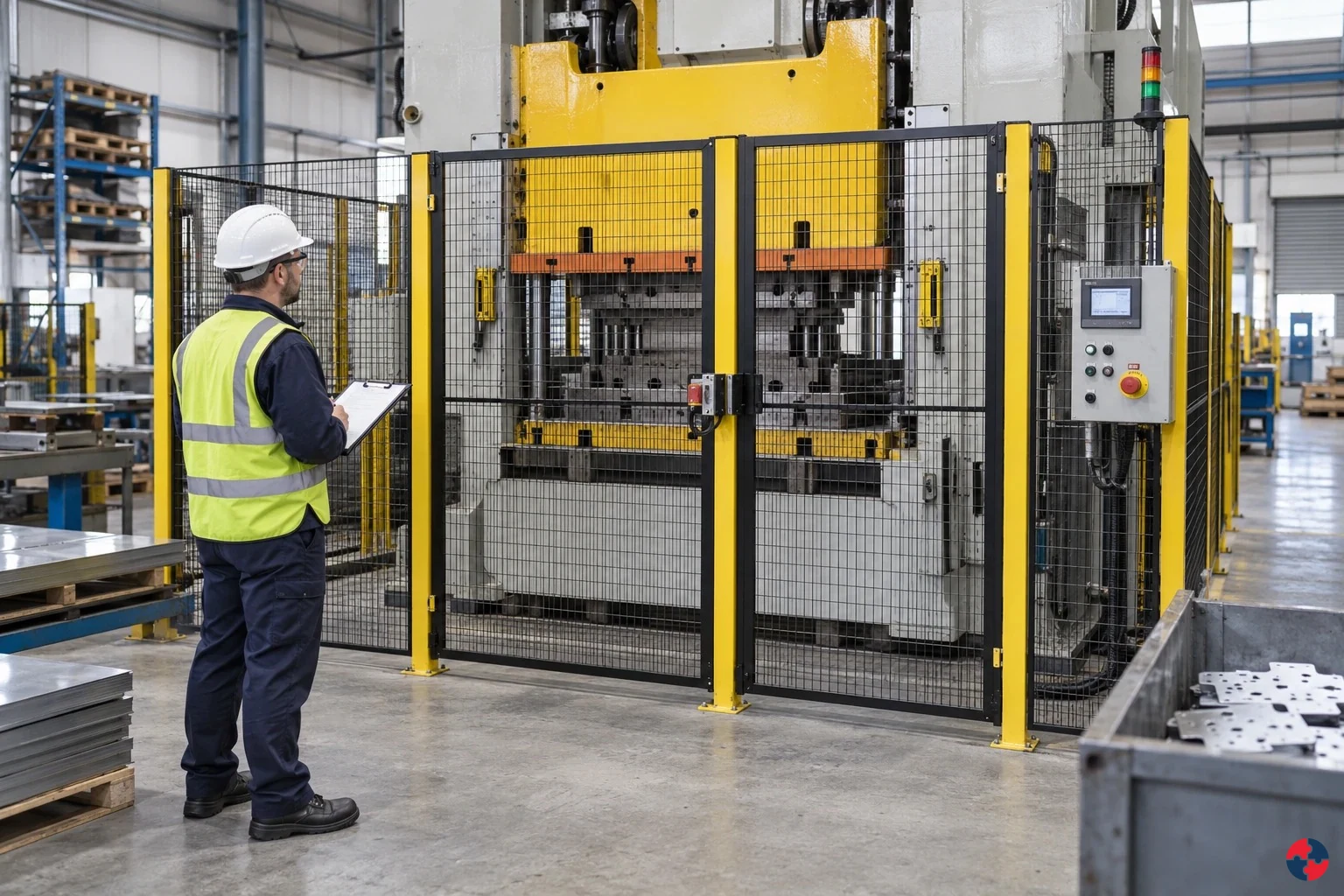
A complete native protective-function schematic connects guard sensing, wiring and safety logic, final outputs, drive or brake response, and the actual dangerous movement. Its separate lower intervention line identifies linked electrical supply, pneumatic or hydraulic energy, gravity and run-down as matters for a machine-specific all-energy plan. The functional schematic is not a particular safety circuit, performance level, stopping time, safe distance or test method. Four stages connect the actual access task, competent repair and full-function verification, all-energy intervention where required, and a deliberate separate restart or hand-back after accounting for people and tools. The existing press photograph shows a different machine context only; appearance does not prove guard strength, interlock function, isolation or validated protection.
A stop request must control the actual danger. Closing a guard does not itself restart the machine or prove all energy is secured.
- Define access and task. Include cleaning, jams, changeover, maintenance and linked equipment.
- Verify the full response. Competent repair/verification must cover the whole function and actual danger.
- Plan intervention separately. Use the machine-specific all-energy securing and verification method.
- Separate restart and hand-back. Account for people and tools; use the actual deliberate restart/release arrangements.
When the evidence does not fit: Defeated, uncertain or unverified protection: hold the affected work. A closed gate or emergency stop is not all-energy isolation.
Who acts: Machine owner, competent maintenance/validation people and affected operators or contractors.
Changed workplace
Defeated packaging-cell guard: Hold access risk and restore/verify the complete protective function; do not demonstrate a bypass.
Refitted workshop guard: Physical refitting alone does not establish function or competent return to service.
Evidence check: No circuit design, PL/SIL, stopping time, safe distance, isolation test method or restart permission is supplied.
Keep guard repair, full-function verification and all-energy intervention distinct
Primary references: HSE machinery risk and safeguards · HSE competent maintenance and energy
Open the complete HD image (new tab)Download image
Keep guard repair, full-function verification and all-energy intervention distinct
Primary references: HSE machinery risk and safeguards · HSE competent maintenance and energy
This SHARE example shows the decision and hand-back, not an approved site isolation or rescue method.
Packaging conveyor blockage and interlock defect
Task material and setting: Cartons jam at a packaging transfer point. The conveyor has a side gate and a pneumatic diverter, with an upstream powered feed. Two workers may enter the danger area.
People and prerequisites: The machine owner identifies affected workers and an authorised maintenance lead. They review instructions, drawings, isolation points, linked equipment, the fault report and the site method before access.
Before: Stop and hold production, keep others clear and reject the tape holding the side gate. Agree how each worker retains personal control of relevant isolation and how the upstream conveyor and stored pneumatic energy are made safe.
During: Competent workers verify the safe state, clear the blockage by the approved method, and assess the gate trip. No one reaches into the nip to test it; if an unexpected feed or pressure source appears, they withdraw and revise the plan.
Hold or stop: Hold the line: do not start or reach in while the interlock is defeated, the drive can coast into reach, the linked feed remains energised, the air pressure is uncertain, or the task differs from the agreed method. Competent workers isolate and verify the safe state before clearing the jam; repair and function-check the gate, account for people and tools, then obtain authorised hand-back before restart.
Completion and hand-back: Repair and validate the safeguard; account for both workers and tools; refit guards; restore energy through the authorised process; verify deliberate restart and tell operators what changed. Keep the line out of service if protection cannot be demonstrated.
Evidence: Record the fault, work authorisation, isolation/control record, repair, safeguard test, updated instructions where needed, names and decision to release the conveyor.
Variation: If the belt continues to coast after a stop, the designer checks whether access needs to remain locked until movement ends. If a person can be enclosed beyond the gate, escape and presence arrangements need a specialist review. A simple timer or another reset button is not automatically sufficient. HSE L22 machinery safeguards.
Hand-back evidence: The record identifies the linked upstream feed, the approved method used to treat stored pneumatic energy and the personal-control arrangement protecting both workers. It records the competent safeguard-test reference, unresolved-defect status and the named release authority and actual release time. A changed jam pattern or reaccumulating energy reopens the hold point. Missing evidence prevents release; this example supplies no generic electrical test, lock-removal or reset method.
How do guarding decisions change across sectors?
The same harm chain appears in different work: a person approaches hazardous movement, a guard or safety function fails to prevent contact, or an intervention exposes stored energy. Choose controls for the actual machine and task rather than copying another sector’s setup.
| Sector, task and harm chain | Strongest control and stop check |
|---|---|
| Manufacturing — setter at a sheet-metal power press. A hand enters closing tooling or stock ejects; crush, amputation or eye injury. | Specify effective guarding or protective devices and power-press-specific examination. Hold use if the safeguard, stop response or records fail. HSE L112. |
| Construction — worker cleaning a site concrete mixer. Drive belts or gears draw clothing in; entanglement and crush injury. | Secure the drive guard and plan shutdown, isolation and competent maintenance. Stop if the guard is missing or cleaning reaches moving parts. |
| Hospitality — kitchen worker feeding or cleaning a commercial slicer. A moving blade cuts fingers; laceration or amputation. | Use the blade guard and safe feed; isolate for cleaning under the manufacturer method. Hold for a damaged guard or unknown cleaning route. |
| Logistics — parcel-sortation technician clearing a jam. A conveyor nip draws in a hand or a diverter traps a person. | Guard nips, assess interlocked access, secure linked energy and verify repair before hand-back. Stop on bypass, coast-down or uncertain isolation. |
For each transfer, the machine owner first identifies the person’s route to the danger area during normal use, setting, cleaning and repair. An authorised maintainer or designer then checks the actual guard, stopping behaviour, linked energy and intervention method against that machine’s instructions. The supervisor holds use when a guard is missing or a stop function is uncertain; after repair, the owner records the functional check and authorises hand-back. A new product, tool, speed, access pattern or repeated jam triggers reassessment rather than copying a control from another machine.
These examples transfer the decision, not a universal guard design. A concrete mixer, food slicer, press and sorting line need their own manufacturer instructions, reach and stopping assessment. Construction and hospitality examples are general machinery applications of the governing UK SHARE source and HSE guidance; they are not claims about a particular model. HSE Introduction to machinery safety; HSE hierarchy of controls.
What should be checked when buying or modifying machinery?
Specify foreseeable operation, cleaning, setting and maintenance before ordering. Ask the supplier how guarding and isolation work in those modes, verify the applicable market conformity route and instructions, then inspect and accept the complete installed machine or line before use.
For new GB machinery, current HSE guidance recognises UKCA or CE marking, a Declaration of Conformity and English instructions. The retained INDG271 PDF contains an expired CE cutoff; HSE itself warns against using that marking text. Northern Ireland has a separate CE or CE-and-UKNI route depending on conformity assessment. Product marking is not proof that an installation or later modification is safe. HSE Buying new machinery / INDG271 notice; GOV.UK product marking by sector; GOV.UK placing CE or CE and UKNI products in Northern Ireland.
Hold acceptance until the supplier and site team resolve access, stop time, control integration, linked equipment, isolation, faults, cleaning and residual risks. Adding a conveyor, moving a fence, changing a brake or rewriting PLC logic can alter the safety function. Commissioning and hand-back need competent validation, updated drawings/instructions, tests and operator briefing. If the change is substantial, obtain specialist advice on any new product-supply obligations.
How should safeguards be checked over their working life?
Operators should identify obvious defects before use; competent people should inspect and test safety-critical features at intervals set by risk, conditions, manufacturer instructions and any equipment-specific law. A reported fault or modification calls for review before reuse.
A user can see a missing, loose or damaged guard, an obstructed gate, altered switch, unlabelled isolator or unsafe restart. They must report it and stop use, not dismantle the safety function. Competent checks may cover fixings, alignment, release mechanisms, protective-device response, whole-machine stopping performance and stored-energy controls. Record the machine, safeguard, result, defect, action owner and verified closure. HSE Inspection of work equipment; HSE Maintenance of work equipment.
PUWER regulation 6 inspection applies in defined circumstances such as installation-dependent safety and deterioration; do not infer one universal annual interlock certificate. Power presses have additional specific examination and inspection duties, for which L112 is the specialist route. A machine register helps manage assurance but the Word document’s two-year register review interval is not a general legal requirement. HSE L112 Safe use of power presses; HSENI PUWER in Northern Ireland.
Who decides, checks and stops machinery work?
The machine owner must make safe equipment and working methods available; operators and setters follow the authorised method and report defects; engineers verify safety functions; supervisors prevent unsafe restart and make hand-back decisions visible.
Operators and cleaners: know guard locations, permitted adjustments, jam route, stop triggers and whom to call. Maintainers and controls engineers: work within competence, use the agreed isolation and validation methods, and document changes. Supervisors: see real interventions, remove pressure to bypass controls, hold use after defects and confirm that training fits the exact task. Purchasers and managers: specify suitable equipment and budget for maintainable safeguarding. HSE PUWER overview; HSE Introduction to machinery safety.
Provide adequate information, instruction and training for each role and changed condition. There is no universal course or refresher expiry for all guarding tasks; use task risk, observed performance, machine instructions and any sector-specific requirement. Training never authorises defeating protection. A contractor’s specialist work still requires coordination with the machine owner and a clear hand-back.
Awareness, task authorisation and specialist machinery competence are different. Check practical decisions on the actual machine, including a defect, a jam and an unexpected restart; keep the authorisation and defect record with the machine. Changes to guarding, controls, software, staffing or work sequence call for reassessment before the task is repeated.
| Role | Learning and demonstration | Assessor, record and reassessment |
|---|---|---|
| Nearby staff and new starters | Recognise dangerous movement, missing guards, alarms and reporting route; show the stop-and-keep-clear response. | Supervisor checks understanding and induction record; repeat after layout or emergency-plan change. |
| Operators, setters and cleaners | Demonstrate permitted loading, cleaning, checks and jam escalation on the actual machine; know that a stopped motor is not isolation. | Supervisor observes a task and records authorisation; reassess after equipment, mode, task or performance change. |
| Maintainers and controls engineers | Show task-specific isolation, safe-state verification, fault diagnosis, repair and safety-function validation within their competence. | Machine owner checks qualification, work scope and test/hand-back record; reassess after controls or energy changes. |
| Supervisors and contractor coordinators | Challenge a bypass or unsafe method, coordinate people and linked equipment, hold the machine, and decide when evidence supports release. | Manager samples real interventions, holds and defect closure; reassess after incidents or weak observations. |
| Managers, purchasers and safety specialists | Specify maintainable safeguarding, supplier acceptance, legal scope, change control and assurance sampling. | Accountable manager checks specifications, risk decisions, validation and corrective-action evidence; update when law, machine or risk changes. |
“Machine owner” means the organisation’s nominated responsible role for the equipment and task, rather than necessarily the legal owner of hired plant. Coordinate group isolation, contractors and shift handover so everyone exposed retains effective personal protection. A handover or shared lock is not, by itself, evidence that every person is protected.
Which GB and Northern Ireland duties apply?
Great Britain uses the Provision and Use of Work Equipment Regulations 1998; Northern Ireland uses its 1999 PUWER Regulations. Both require suitable, maintained work equipment and effective protection against dangerous parts, with scoped duties on inspection, controls, isolation, information and training.
Great Britain: Regulation 11 requires effective measures preventing access to dangerous parts or stopping their movement before entry into the danger zone. Regulations 5, 6, 18, 19 and 22 address maintenance, inspection, control systems, isolation and safe maintenance. HSE L22 provides an Approved Code of Practice and guidance with special legal status; an equally effective alternative can meet the law. Provision and Use of Work Equipment Regulations 1998; HSE L22 Safe use of work equipment.
Northern Ireland: Apply the Provision and Use of Work Equipment Regulations (Northern Ireland) 1999 and HSENI guidance. HSENI lists HSE L22 and power-press L112 as approved for use in NI. The legislation website flags some effects not yet applied to its consolidated text, so named legal review is needed for exact current wording in a disputed case. Provision and Use of Work Equipment Regulations (Northern Ireland) 1999; HSENI PUWER in Northern Ireland.
Product supply and specialist equipment: GB and NI machinery placing-on-market rules differ and can change; apply the current government route for the market. Power presses have particular safeguarding examination duties. A product mark and an emergency stop do not discharge the employer’s ongoing PUWER duty to keep the installed machine safe. GOV.UK product marking by sector; GOV.UK placing CE or CE and UKNI products in Northern Ireland; HSE L112 Safe use of power presses.
What evidence should a manager ask to see?
A useful record connects each machine and task to its hazard, installed safeguard, safety-function specification, inspection and defect history, intervention method, training and authorised restart. The physical machine must match the record.
Start with an asset and guarding map: machine identity, layout, access points, linked equipment, isolation points and current instructions. Keep design and commissioning evidence for safety functions; document modifications, competent validation and updated operating methods. Record reported bypasses and near misses as design and supervision signals, not only disciplinary events. HSE Introduction to machinery safety; HSE Inspection of work equipment.
Sample the reality: watch a routine clean and a jam response; compare the stated lock-off with the actual isolator and everyone exposed; check that defects were repaired rather than repeatedly reset. Ask a competent authorised person to demonstrate or document the approved safeguard test using a planned method that prevents exposure. Review whether access remains prevented until danger has ceased. Never challenge a guard, reach in or defeat a device to test it. A SHARE assurance table may assign owners and closure dates, but no generic register template proves legal compliance on its own.
Which guarding acronyms and terms matter?
Use plain words so workers understand each control’s job and its limit.
| Acronym or term | Full expansion | Meaning at work |
|---|---|---|
| PUWER | Provision and Use of Work Equipment Regulations | The GB 1998 and NI 1999 work-equipment rules; specify the jurisdiction. |
| ACOP | Approved Code of Practice | Regulator-approved practical guidance with special legal status. |
| PPE | Personal protective equipment | Only residual protection; it cannot make a reachable machine part safe. |
| LOTO | Lockout and tagout | A site energy-control term; use the equipment-specific authorised isolation method. |
| Interlock | — | Protective function linked to a movable guard and machine controls. |
| Guard locking | — | Keeps a guard closed until danger has ceased where the assessed design requires it. |
| Safety function | — | The complete protective response from sensing through logic to machine stopping. |
Which BuildOut documents support this topic?
Download individual editable BuildOut documents for this topic. Procedures and plans contain completed arrangements; forms, checklists, assessments, RAMS and permits are blank masters. Registers include separate worked examples.
| Document | Purpose and content | Editable download |
|---|---|---|
| Plant acceptance, use, maintenance and isolation procedure BOUK-PRO-PLANT · Completed worked example · v1.0 | Check equipment before use, maintain protective devices and quarantine unsafe plant. | Download DOCX Read preview |
| Plant, tools and maintenance register BOUK-REG-PLANT-01 · Blank register with separate worked entries · v1.0 | Track asset ownership, suitability, inspections, servicing and defects. | Download XLSX Read preview |
| Plant and powered-tool pre-use inspection BOUK-CHK-PLANT-01 · Blank editable master · v1.0 | Identify damage, failed guards, interlocks, leaks and unsafe attachments. | Download DOCX Read preview |
| Machine guarding and entanglement assessment BOUK-RA-PLANT-01 · Blank editable master · v1.0 | Assess access to moving parts and select protective measures. | Download DOCX Read preview |
| Plant maintenance and stored-energy isolation RAMS BOUK-RAMS-PLANT-01 · Blank editable master · v1.0 | Control electrical, hydraulic, pneumatic, gravity and thermal energy. | Download DOCX Read preview |
| Defect, quarantine and return-to-service record BOUK-FRM-PLANT-01 · Blank editable master · v1.0 | Prevent unsafe reuse until competent repair and verification. | Download DOCX Read preview |
| Carpentry, joinery and timber-frame installation RAMS BOUK-RAMS-PLANT-02 · Blank editable master · v1.0 | Guarded cutting, wood dust, nail guns, handling, support and access. | Download DOCX Read preview |
| Pressure testing and commissioning RAMS BOUK-RAMS-PLANT-03 · Blank editable master · v1.0 | Stored energy, safe test boundaries, rated components and controlled depressurisation. | Download DOCX Read preview |
Review and adapt the documents for your organisation, activities and jurisdiction before approval and issue. Open the SHAREms management-system hierarchy to find each document under its parent policy.
Unlock another resource
You have used this month’s two free downloads. Publish a post in your own words to unlock one more resource, or choose SHARE Individual for 10 downloads per month.
You decide whether to share. If you do, use the relevant platform disclosure tools and do not make claims you do not genuinely hold.