SHARE Knowledge Hub
Machinery hazards
Machinery can injure through moving parts, ejected material, stored energy and vehicle movement; it can also expose people to noise, vibration, dust or fumes. Assess the actual machine and each task throughout its life before choosing controls.
Owner: SHARE Knowledge Hub editorial team.
Understanding Machinery hazards
Machinery hazards are mechanisms by which a machine, its energy, materials or emissions can harm people.
Why this matters at work
Stop the system safely, summon emergency help and prevent further exposure. Avoid improvising rescue that exposes another person to stored energy or unexpected movement. Follow the site emergency method with competent responders. Preserve the scene and relevant control information when safe, investigate causes and require verified safeguards and authorisation before restart rather than simply resetting the fault. A machinery emergency can leave a person trapped, injured or exposed to continuing pressure, heat or movement. Provide accessible stop controls where needed, but plan what remains hazardous after activation. Do not assume an emergency stop isolates electrical energy or supports a raised ram. Define who calls emergency services, secures energy, controls bystanders and supplies technical machine information. Rescue of a trapped person may need specialist judgement; releasing a component or re-energising the machine can worsen injury. Keep access routes clear, first-aid arrangements suitable and emergency information available across shifts. For pressurised machinery, be alert to injection injuries that can look deceptively small.
A roller nip can damage nerves, tendons and bone as it draws in a hand; an entanglement can pull in the whole person. Cutting, ejection, crushing, heat and electricity can cause severe wounds, limb loss, eye injury, burns or death. The credible severity should guide prevention even when access lasts only seconds. Pressure-fluid injection can cause deep tissue injury through a small skin opening and needs immediate professional medical care; do not wait for visible deterioration.
How organisations manage this in practice
Reinstating the machine is a separate authorised decision. Establish what failed and why the exposure was possible, including design, modification, maintenance, training and production pressure. Use the HSE investigation sequence to organise evidence, analysis, controls and an implemented action plan. Verify repair and the affected safety functions, isolation and reconnection, then test the actual task before release. A reset, a replacement component or an incident report alone is insufficient evidence that the risk is controlled.
A person's return to work needs its own plan. Keep contact focused on wellbeing and safe return; obtain professional advice on functional restrictions or fitness when needed. Agree feasible changes such as task allocation, hours, equipment or assistance, and review their effects on other workers and the machine assessment. Maintain clinical confidentiality. Review the arrangements with the worker after return rather than assuming medical discharge demonstrates fitness for every machine task. HSE return-to-work guidance supports the general management method; NI employment and equality law must be checked through its own route.
Maintenance keeps guards, brakes, sensors, cables, restraints and extraction effective. Set risk-based inspection and testing from the actual equipment, environment, use and failure history. PUWER requires equipment to be kept in an efficient state, efficient order and good repair, with inspection where deterioration can create risk.
What counts as a machinery hazard?
Machinery can injure through moving parts, ejected material, stored energy and movement through a workplace. It can also cause illness through noise, vibration, dust, fumes, heat or poor task design. Assess the actual machine in every operating and intervention state.
A person may be drawn into a roller, entangled in a shaft, cut at a tool, crushed between a moving part and a frame, or struck by a failed component or workpiece. A stopped machine can still contain pressure, gravity, heat, an energized circuit or a coasting tool. The same conveyor or saw has different exposure during normal feeding, setup, cleaning, a blockage and maintenance. HSE Introduction to machinery safety explains common harm mechanisms.
Identify the danger zone, everyone who could enter it, how access occurs and what would make a safeguard fail. Include cleaners, contractors, bystanders, customers and people working on linked machinery. A risk assessment must follow the task, not just the machine name.
Name the mechanism before selecting the safeguard
Rotation can catch or entangle, an in-running nip can draw a person in, and a closing gap can crush. Installation, cleaning, jam clearance and maintenance can expose different parts of the same machine.

Recognise the movement
Trace the actual moving parts and possible access for the whole task, including foreseeable interference.
Prevent access and release
Match guarding or other suitable protective measures to the mechanism; assess stored energy and unexpected movement separately.
Stop and escalate
Hold an unguarded, failed or uncertain condition for competent correction and verification. Do not reach into a hazard to establish why it stopped.
No generic safe gap, stopping distance or bypass method is given.
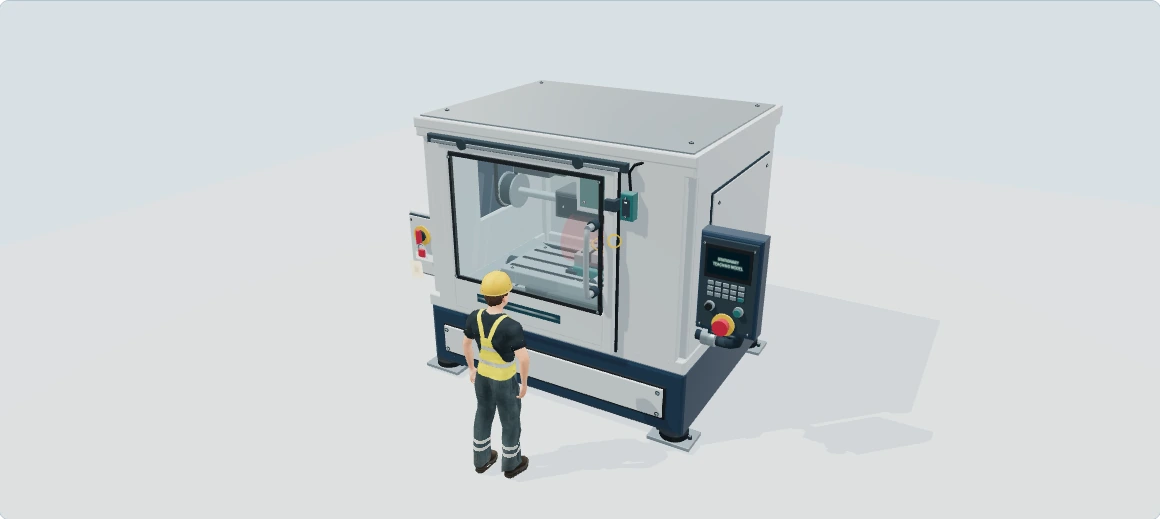

Machinery guarding: trace the energy to the harm
Explore the working zone, guards, interlock, transmission, controls and energy isolator. Compare production work, cleaning and maintenance without treating a stopped machine as safely isolated.
Checksheets and risk assessments
Risk assessment forms
Risk assessment examples
Forms and tools
Full written walkthrough — all 8 steps
1. Identify the dangerous movement
What is happening: The cutaway exposes the workholding and cutter so you can inspect where contact could occur. It does not open or enable the real machine.
How harm can occur: A cutter can sever tissue; rotating parts can wind in hair or clothing; moving workholding can crush a hand.
Best practice to apply: Identify the task, all exposed people and the machinery’s intended operating limits. Keep the actual danger zone inaccessible.
2. Inspect the enclosure and access
What is happening: Inspect the enclosure, viewing panel and access edges. The visual cutaway changes only the drawing.
How harm can occur: A missing, damaged or unsuitable guard may allow reach into dangerous movement or fail to contain an ejected item.
Best practice to apply: Check the actual guard, fixing, condition and suitability. Do not infer reach distances or containment performance from this model.
3. Understand an interlock’s role
What is happening: The access interlock is a separate protective function. Its presence does not establish the reliability or stopping performance of the actual system.
How harm can occur: Defeating an interlock can permit access while hazardous movement is possible. Run-down may continue after a stop request.
Best practice to apply: Verify required protective functions through competent assessment and maintenance. Do not bypass them or use the cutaway as a working configuration.
4. Find the transmission hazards
What is happening: Inspect the drive and the cover around it. Dangerous movement can exist beyond the obvious working point.
How harm can occur: Belts, pulleys and rotating shafts can entangle, draw in or trap people during production or servicing.
Best practice to apply: Keep appropriate transmission guarding in place. Plan access and maintenance with the equipment information and actual energy sources.
5. Separate control stops from isolation
What is happening: The control panel and emergency stop act through control functions. The energy isolator is physically separate.
How harm can occur: A stopped display may conceal live energy or allow an unexpected restart; an emergency stop does not remove every energy source.
Best practice to apply: Use the required stop arrangements for operation and the actual safe isolation procedure for intrusive access.
6. Control hazardous energy for access
What is happening: Locate the separate isolator and the points where electrical, pneumatic, hydraulic, gravitational or mechanical energy may remain.
How harm can occur: Unexpected energisation, stored pressure or a falling component can cause shock, crushing or impact.
Best practice to apply: Identify, isolate, secure and verify the relevant energies using competent task-specific arrangements. The pictured lock is not proof that a machine is safe.
7. Plan cleaning and material handling
What is happening: Consider how material is loaded, held, removed and cleaned without bringing a person into danger.
How harm can occur: An inadequately held item can be ejected; reaching to clear swarf or a blockage can expose hands and clothing.
Best practice to apply: Use suitable workholding and handling methods. Stop and follow the safe system when a blockage or abnormal condition occurs.
8. Protect the people around the machine
What is happening: The operator’s work position and surrounding access affect people other than the person at the controls.
How harm can occur: Visitors, cleaners and nearby trades may enter a danger area or be struck by an ejected item.
Best practice to apply: Check layout, access, instruction, competence and supervision. Review the machine after changes and before returning it to service.
Illustrative awareness learning. The model does not design equipment, authorise work, verify safe conditions or complete a real inspection.
The wider workplace has its own account and subscription access. Exploring this lesson does not grant access, record course completion or authorise work.
How can I practise this topic in 3D?
Powered torque tools and reaction forces
All related inspection points 1 across 1 location
Aerosystems Engineering 1 inspection point
Practice in the SHAREhub environment. Browser practice is separate from workplace competence and formal learning records.
Which mechanical mechanisms should you look for?
Look at the point of operation, drive and transmission parts, material paths, moving structures and unexpected movement. Trace where a hand, body or bystander could meet the hazard.
2 related visuals
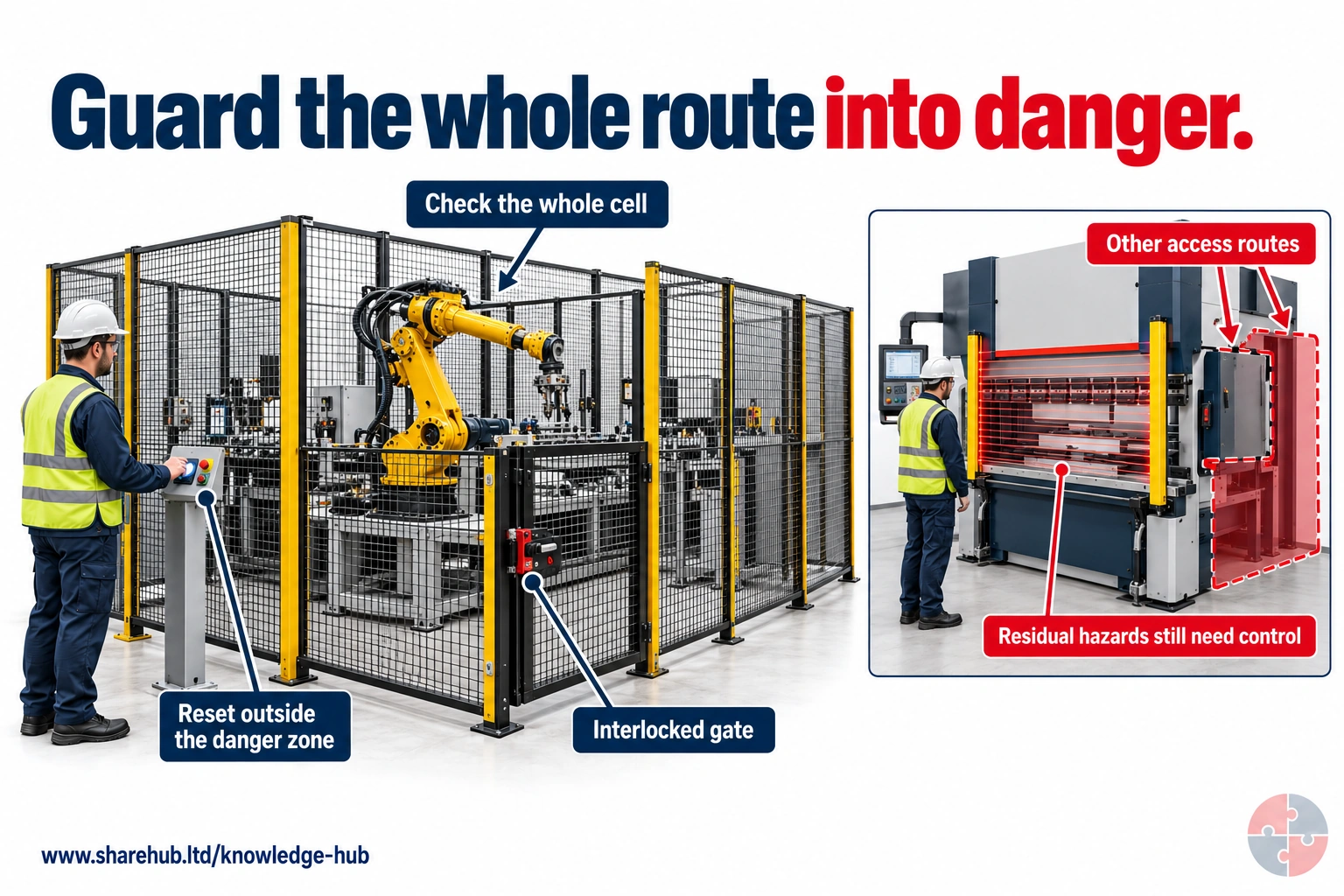
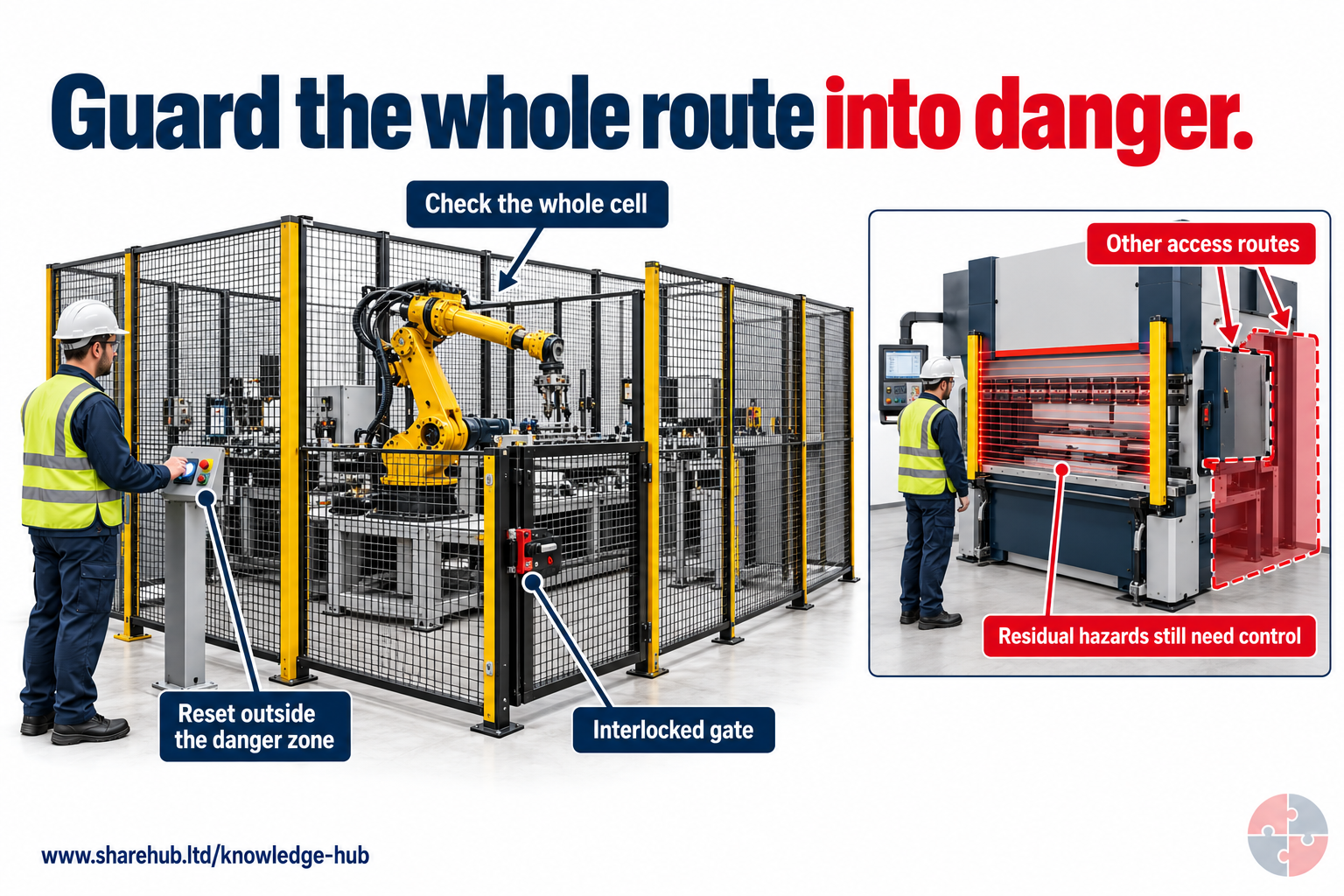
Perimeter guarding, access control, reset visibility and presence sensing must address all routes to the hazard and residual risks.
Why is a front light curtain not the whole guarding solution?
It may leave side or rear access and does not control every hazard, such as ejected material or stored energy.
Illustrative systems, not a validated safety design; stopping performance and required distances need competent determination.
Source guidance: HSE guidance · HSE guidance
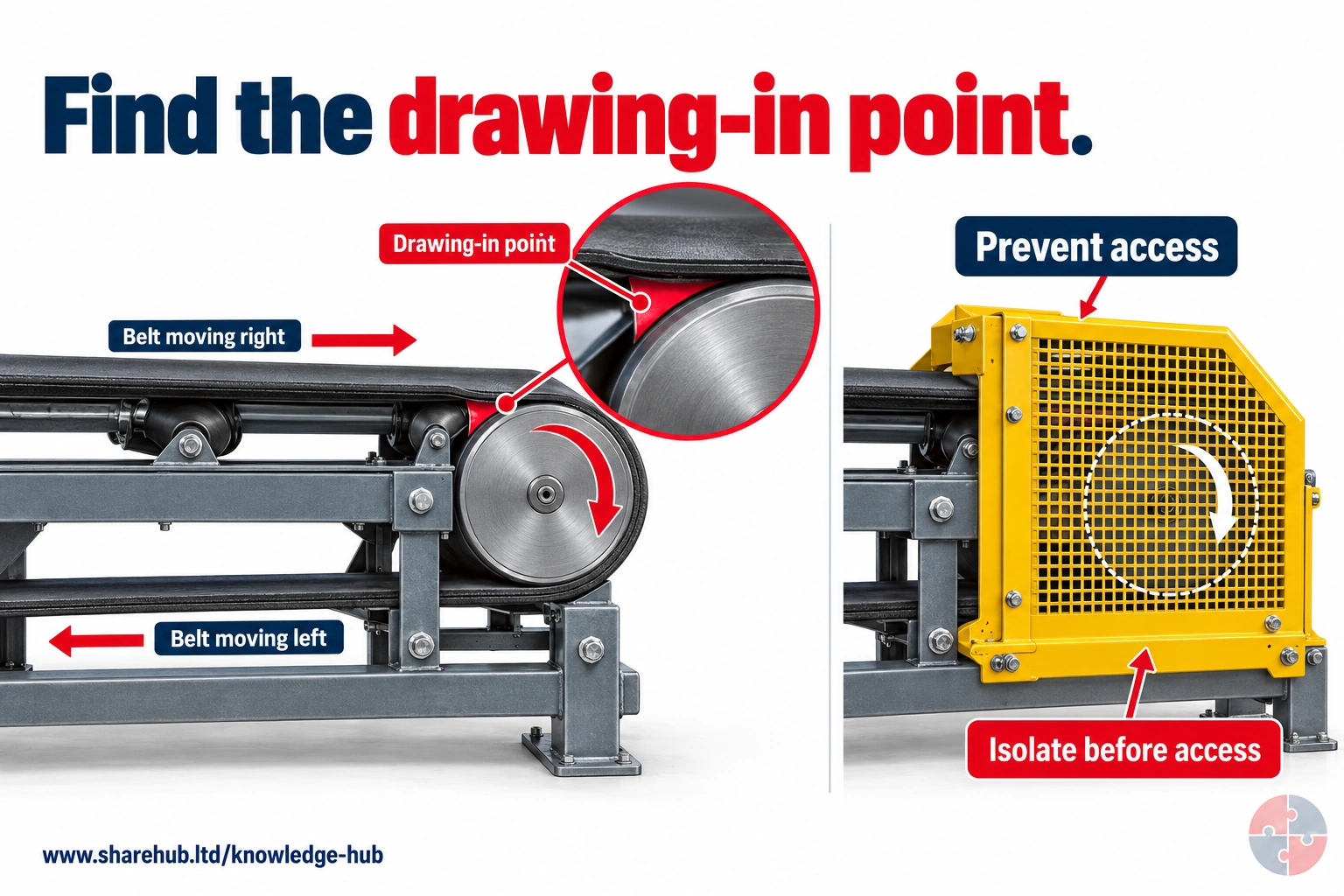
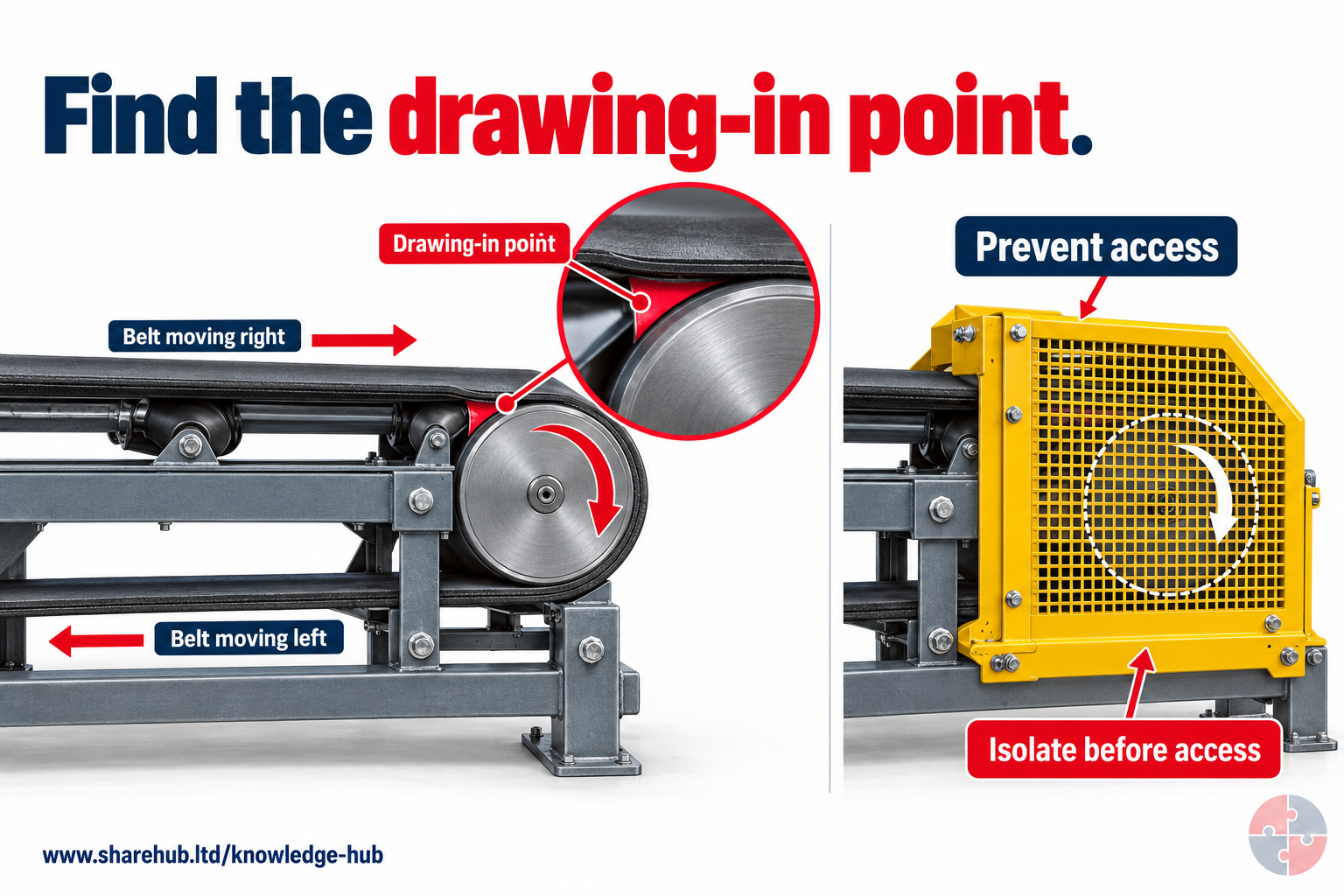
The pictured end pulley has an in-running nip where the upper belt converges with the pulley; the rotation and belt-direction arrows agree. The guarded view demonstrates local prevention of access. The historical HSE circular discusses conveyor idler nips, while current machinery guidance supports the broader safeguarding principle: examine every reachable nip and maintenance route.
Does a guarded upper belt prove every nip is inaccessible?
No. Examine reachable return rollers, idlers, loading areas and maintenance access as well.
End-pulley teaching example informed by historical idler-nip guidance; mesh openings, guard extent, safe reach distances and isolation arrangements require competent current design validation.
Source guidance: HSE guidance · HSE guidance
| Mechanism | Example | What to check |
|---|---|---|
| Drawing in or entanglement | Roller nip, belt drive or rotating shaft catches clothing or a limb. | Can someone reach the nip from above, below, behind or through an opening? |
| Cutting, shearing or crushing | Blade, ram, closing gate or moving machine meets a person or fixed surface. | Where can the person be trapped during a cycle or unintended movement? |
| Ejection or impact | Tool fragment, chip, workpiece, stone or failed component leaves the machine. | Is the person protected from the full flight path and foreseeable failure? |
| Stored or residual energy | Coasting tool, pressure, spring, suspended part or charged circuit acts after stop. | What must be isolated, supported, cooled or dissipated before access? |
Do not treat a visible emergency stop, guard or conformity mark as proof that every access and failure route has been controlled. Record the mechanism, task, credible event and exposed people before choosing measures.
How does the machine harm a person?
Trace the source through a contact, impact or inhalation route to the body. A jam, missing guard, altered machine or nearby person can turn a controlled task into an acute injury; repeated dust or noise exposure can cause illness over time.
| Task and exposure route | Plausible harm | Early warning | Stop or escalate |
|---|---|---|---|
| Clearing a conveyor nip: hand or clothing enters rotating rollers. | Rapid drawing-in can crush tissue, fracture bone or amputate a finger or arm. | Guard absent, gap altered, repeated jam or unexpected feed. | Stop use; no access until isolation and competent correction. |
| Operating a saw or cutter: blade or ejected stock reaches the operator. | Cut, puncture, eye injury or serious impact injury. | Damaged blade, poor workholding, changed stop behaviour. | Hold the machine and have tooling and safeguard assessed. |
| Reversing mobile plant: machine reaches a pedestrian or overturns. | Crushing, fracture or fatal injury. | People entering route, poor visibility, unstable ground or attachment. | Stop movement; re-establish segregation and suitability. |
| Wood machining: airborne dust is inhaled repeatedly. | Occupational asthma; hardwood dust can also cause nasal cancer over long exposure. | Visible dust, failed extraction or respiratory symptoms. | Stop dusty work when extraction is ineffective; assess exposure and health route. |
| Noisy machinery: sound reaches workers repeatedly. | Permanent hearing damage, sometimes tinnitus. | Rising noise, lost enclosure or difficulty hearing normal speech. | Investigate the source and assess noise; do not rely on earplugs alone. |
These outcomes depend on energy, access, duration, material and proximity. The table is a prompt for assessment, not a prediction of an individual injury. HSE lung disease: higher-risk jobs and industries and HSE Choosing quieter equipment explain the longer-latency routes.
What other exposures can machinery create?
Machine risk includes harmful emissions and the surrounding workplace, not only contact with moving parts. Control each exposure by its own assessment and source-specific measures.
Check noise at the real duty cycle, hand-arm or whole-body vibration where relevant, airborne dust and fumes, hot or cold surfaces, electricity, manual handling, access and slips around the installation. Extraction, enclosure, quiet or low-vibration equipment, maintenance, suitable electrical protection and task redesign may be required. Personal protective equipment (PPE) can address residual exposure but cannot substitute for guarding dangerous parts.
The material matters: wood dust, metal swarf, aerosols, abrasive fragments, waste and packaging create different health, fire and ejection risks. Identify any specialist regime, such as lifting, pressure or electrical safety, rather than applying generic machinery advice to it. HSE Introduction to machinery safety is the starting route; use the relevant specialist HSE guidance for the identified substance or equipment.
Check exposure before harm appears
Absence of visible dust, symptoms or loudness complaints does not prove adequate control. Report damaged extraction, poor capture or changed work to the supervisor; a competent assessor checks extraction performance and exposure, with confidential occupational-health referral where indicated. Do not wait for illness. See HSE: wood dust.
When do machinery risks change across its life?
Risk changes when machinery is selected, installed, used, cleaned, maintained, modified or removed. Specify and check the real work at each handover.
| Stage | Critical decision | Evidence to retain |
|---|---|---|
| Specify and buy | Can the machine perform the task with practical safe access, maintenance and waste removal? | Task specification, supply documentation, residual risks and acceptance criteria. |
| Install and commission | Do utilities, stability, connected equipment and surroundings create new hazards? | Installation checks, baseline safety-function results and named release. |
| Operate and intervene | Are safeguards effective in production and during setup, clearing and cleaning? | Machine-specific instructions, competence, defect and isolation route. |
| Maintain and modify | Will repair, software, tooling, layout or a linked line change risk? | Change assessment, updated instructions, competent validation and hand-back. |
| Decommission | Can remaining energy, sharp edges, lifting and waste harm dismantlers? | Isolation, dismantling plan and disposal or resale decision. |
A supplier declaration is part of acceptance, but it does not decide whether the installed machine suits the workplace. For a significant modification or own-use assembly, obtain competent product-supply advice as well as assessing safe use. GOV.UK Machinery supply guidance for Great Britain and GOV.UK Machinery supply guidance for Northern Ireland describe the separate supply routes.
How should a machinery hazard be controlled?
Remove the need for exposure first. Where dangerous parts remain, select suitable guarding or protective devices for every access state, then support these with isolation, procedures, information, training and supervision.
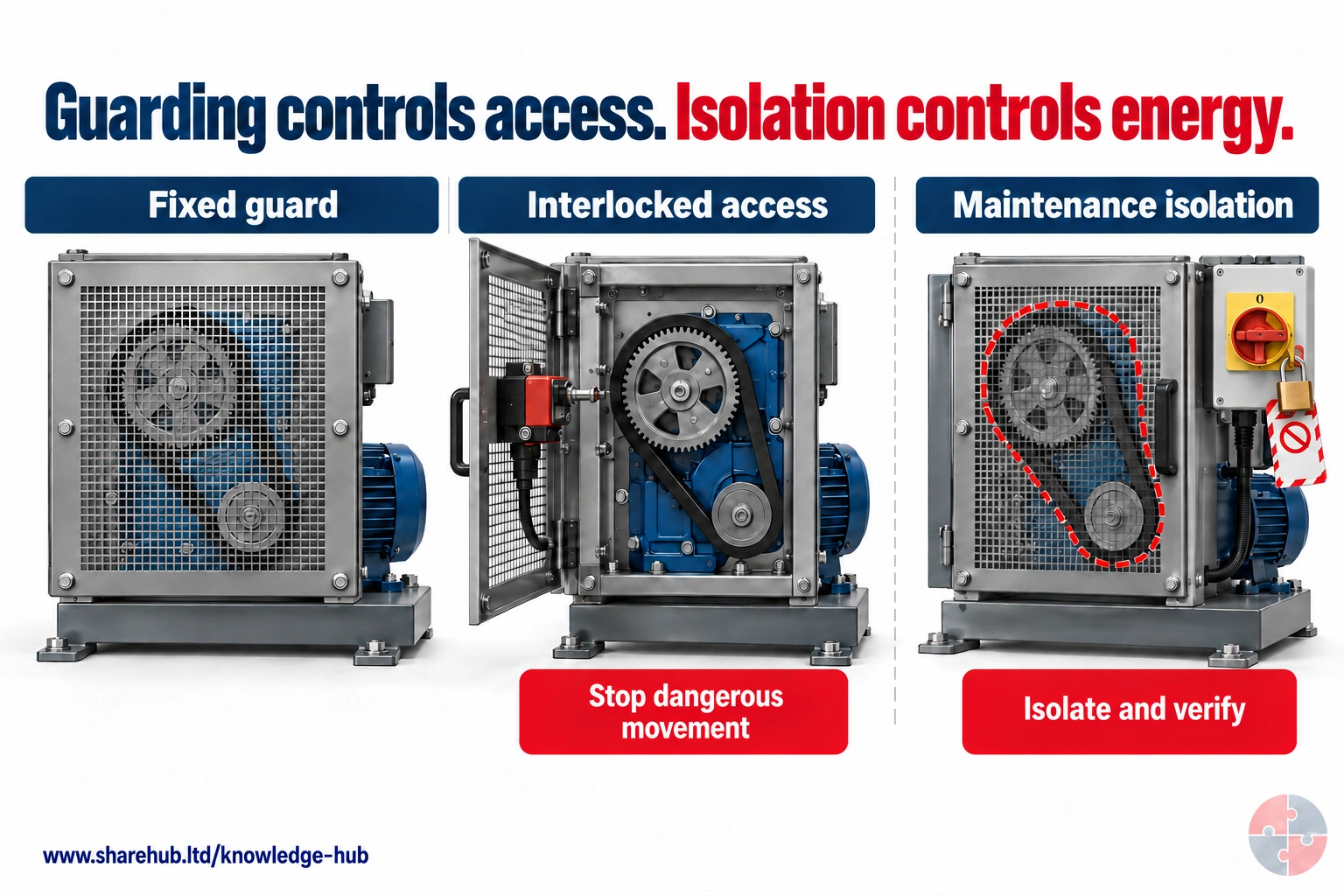
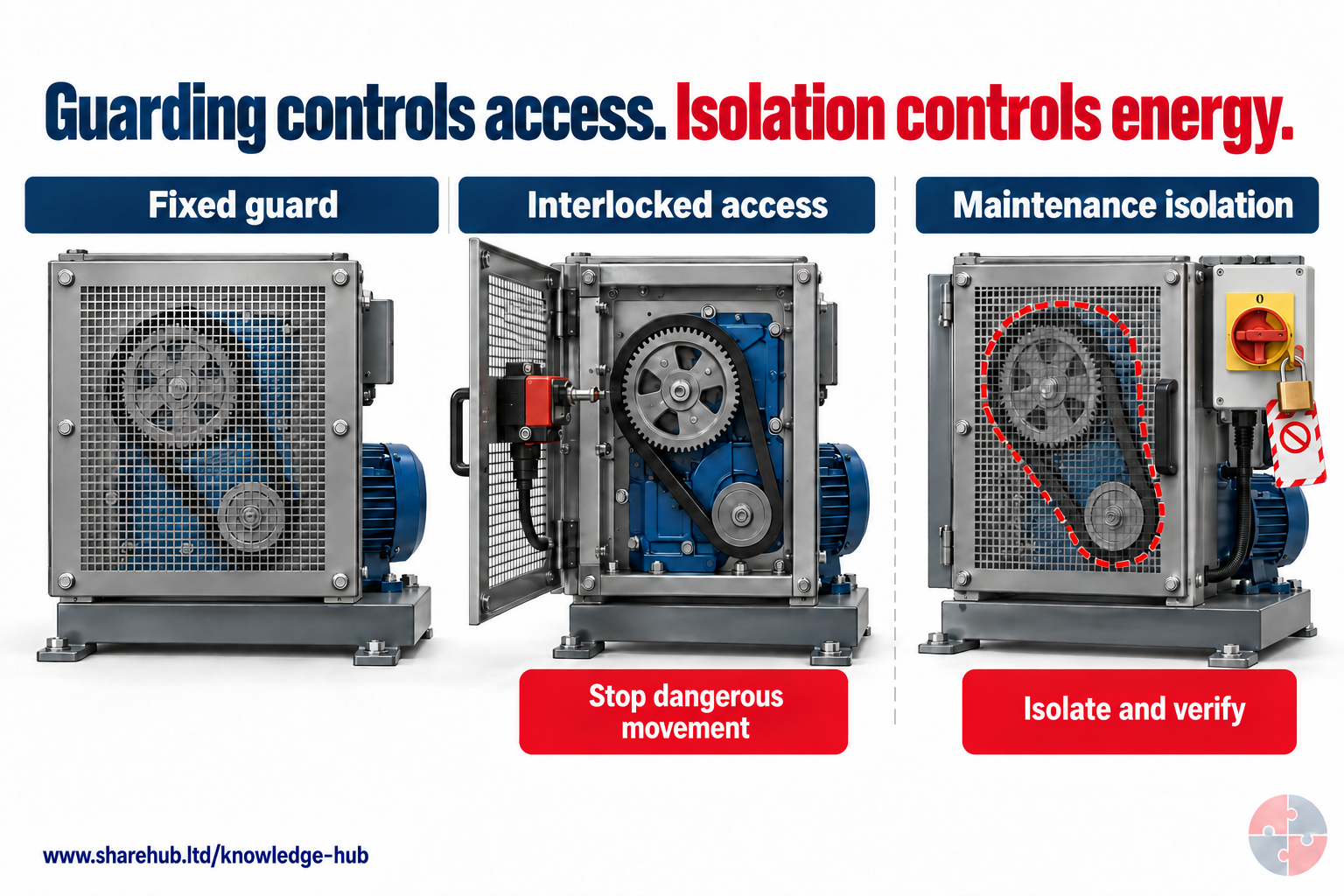
Guards restrict access during use. Maintenance can require secured isolation and verification of all relevant energy sources.
Does opening an interlocked guard establish a safe maintenance isolation?
No. It may stop movement but does not establish all energy has been isolated and made safe.
Principles only; no validated machine safety circuit or task-specific isolation procedure is supplied.
Source guidance: HSE guidance · HSE guidance
Design out a reach into the danger zone, move adjustment points outside an enclosure and choose a feeding method that keeps people clear. Use fixed enclosing guards where practicable. Where access is needed, a competent engineer selects and validates interlocked guards, guard locking or other protective devices for the hazard and stopping behaviour. A device that stops motion is not a physical barrier against ejected parts. See the Machinery control measures page for the detailed selection hierarchy.
Before intervention, use the machine-specific method to isolate all relevant energy, prevent reconnection and control residual energy. A stop command or open guard alone is not secure isolation. Do not bypass a safeguard because it interrupts production; investigate why the task and protection conflict. HSE L22 Safe use of work equipment and HSE Maintenance of work equipment support these distinctions.
How can the hierarchy of controls reduce entanglement, crushing and cutting risks from machinery?
Start with the harm mechanism and the task. Remove avoidable powered access or change the material, process or feed where practicable; then use engineered separation or protection. Instructions, supervision and PPE deal with remaining risk and cannot make an exposed roller, blade or ram safe by themselves.
For a jammed bag at a conveyor transfer, redesign the feed or transfer if recurrent jams drive intervention. Guard the in-running nip and other reachable parts; where access is necessary, use a suitable validated protective arrangement. Define the authorised stop, secure isolation and hand-back for jam clearance. Review dust, noise and ejection separately because a nip guard alone does not control them. Compare the selected measures with actual operation, cleaning, setup, maintenance and foreseeable misuse. GB PUWER guidance gives an order for protecting dangerous parts; HSENI identifies the corresponding NI work-equipment route. No generic hierarchy sets a machine-specific stopping distance or permits bypass.
ERICPD means Eliminate, Reduce (including substitution), Isolate, Control, PPE and Discipline. The five-level hierarchy groups measures as elimination, substitution, engineering controls, administrative controls and PPE. They overlap: isolation is usually an engineering measure; control can include engineered and administrative measures. Discipline means maintaining and checking the controls, supervising the method and learning from defects, rather than blaming someone or accepting weaker protection.
How can the ERICPD hierarchy of controls reduce entanglement, crushing and cutting risks from machinery?

| ERICPD and five-level position | Intervention and owner | Verification, failure and stop point |
|---|---|---|
| Eliminate / elimination | Redesign the bag feed or conveyor transfer where recurrent jams require dangerous intervention. | Observe the whole material route and abnormal work safely; reduced jams do not prove the remaining nip is safeguarded. |
| Reduce / substitution when replacing a hazard; otherwise engineering or administrative risk reduction | Compare a technically suitable alternative material, process or feed arrangement that reduces the assessed harm route. | Assess new hazards, actual performance and transferred intervention. A slower machine or smaller load is not automatically safe. |
| Isolate / engineering | Use suitable guarding and protective functions through the relevant PUWER order and competent machine assessment. | Validate actual access, stopping/run-down, foreseeable faults and restart. Unknown safeguard performance, bypass or a defect holds the affected task; no generic distance or performance level is supplied. |
| Control / engineering and administrative | Provide the authorised safe task method, separate secure isolation/stored-energy arrangements for intervention, competent roles and defect escalation. | An emergency stop or interlock is not secure isolation. Verify the actual method and handback through authorised competent people; this example supplies no isolation procedure. |
| PPE / PPE | Select appropriate residual eye, hearing, foot or other protection for assessed hazards, considering entanglement risk. | Verify suitability and use. PPE cannot prevent contact with a moving nip/blade or contain an uncontrolled load; gloves are not assumed safe near rotating parts. |
| Discipline / sustained engineering and administrative controls | Managers maintain protective functions and competence, prevent unsupported bypass and review defects or changed tasks. | Retain original maintenance/inspection and restoration evidence. Production success or an absence of accidents does not prove safeguard effectiveness. |
How can the ISO 45001 hierarchy of controls reduce entanglement, crushing and cutting risks from machinery?

| ERICPD and five-level position | Intervention and owner | Verification, failure and stop point |
|---|---|---|
| Eliminate / elimination | Redesign the bag feed or conveyor transfer where recurrent jams require dangerous intervention. | Observe the whole material route and abnormal work safely; reduced jams do not prove the remaining nip is safeguarded. |
| Reduce / substitution when replacing a hazard; otherwise engineering or administrative risk reduction | Compare a technically suitable alternative material, process or feed arrangement that reduces the assessed harm route. | Assess new hazards, actual performance and transferred intervention. A slower machine or smaller load is not automatically safe. |
| Isolate / engineering | Use suitable guarding and protective functions through the relevant PUWER order and competent machine assessment. | Validate actual access, stopping/run-down, foreseeable faults and restart. Unknown safeguard performance, bypass or a defect holds the affected task; no generic distance or performance level is supplied. |
| Control / engineering and administrative | Provide the authorised safe task method, separate secure isolation/stored-energy arrangements for intervention, competent roles and defect escalation. | An emergency stop or interlock is not secure isolation. Verify the actual method and handback through authorised competent people; this example supplies no isolation procedure. |
| PPE / PPE | Select appropriate residual eye, hearing, foot or other protection for assessed hazards, considering entanglement risk. | Verify suitability and use. PPE cannot prevent contact with a moving nip/blade or contain an uncontrolled load; gloves are not assumed safe near rotating parts. |
| Discipline / sustained engineering and administrative controls | Managers maintain protective functions and competence, prevent unsupported bypass and review defects or changed tasks. | Retain original maintenance/inspection and restoration evidence. Production success or an absence of accidents does not prove safeguard effectiveness. |
The comparison is an original illustrative application of the general HSE hierarchy, not a machine-specific method, permit or design approval. The employer must choose measures for the actual work and jurisdiction. Apply the separate Northern Ireland legal route where relevant; the local assessment and competent technical decision govern release.
What changes when the machine moves through the workplace?
Mobile machinery adds collision, overturn, trapping and struck-by risk. Plan the route, separate people, match the machine and attachment to the ground and task, and control unintended movement.
For a forklift, dumper, telehandler, tractor or ride-on machine, assess pedestrian routes, reversing, visibility, gradients, ground conditions, loads, attachments, stability and the operator’s ability to stop safely. Do not rely on a banksman or alarm as a substitute for a workable traffic layout. Seat restraints and rollover protection require equipment-specific assessment. HSE Mobile work equipment explains extra mobile-equipment duties.
Agricultural and horticultural machines may also have power take-offs (PTOs), blades, balers and feeders. Plan a safe stop before approaching a blockage or raised implement; control hydraulics and gravity before maintenance. On construction sites, segregate routes and restrict public access. HSE Mobile machinery in agriculture and HSE Construction traffic management give sector routes.
How do machinery hazards differ by sector?
The legal approach remains risk-based, but the exposed people, material and operating environment differ. Match the assessment to the actual machine and place.
| Setting | Distinct exposure | Decision to make |
|---|---|---|
| Manufacturing | Guarded production line, tooling change and connected conveyors. | Assess every mode and coordinated isolation of linked machines. |
| Woodworking or horticulture | Fast blade, thrown material, dust or rotating garden equipment. | Choose machine-specific guarding, work-holding and emission control. |
| Retail or warehouse | Customers or pickers near compactors, cutters or moving equipment. | Separate public access; control cleaning and jam clearance. |
| Farm | power take-off (PTO), baler, mower, feeder or mobile tractor. | Prevent entanglement and stop before intervention; assess ground and traffic. |
| Construction | Dumper, telehandler, saw or site plant beside other trades. | Plan traffic and interfaces; control cutting and lifting hazards. |
Specialist machines such as power presses, guillotines, lifting and pressure equipment have additional equipment-specific requirements. Use their current regulator guidance and competent advice. The generic examples here are prompts, not an approval checklist.
Does this approach transfer to other sectors?
Yes. The strongest feasible control changes with the machine and people exposed; every sector still needs a clear stop point and evidence that the control works.
| Task and people | Mechanism and outcome | Strongest controls and residual safeguards | Check or stop |
|---|---|---|---|
| Manufacturing: operator feeds stock into a powered cutter; setter cleans it. | Blade or ejected stock reaches hand or eye; cuts, amputation or eye injury. | Design safe feed and enclose danger; validate access and use secure isolation for tool change. Eye protection addresses residual particles only. | Stop for missing guard, altered stopping or unstable workholding. |
| Construction: dumper passes trades and visitors on a changing site. | Vehicle strikes or crushes a pedestrian; fracture or fatal injury. | Reduce vehicle movements and segregate routes; assess ground, visibility and attachments. Competent operation and marshaling support the layout. | Stop if pedestrians enter route or ground and visibility differ from plan. |
| Hospitality: kitchen worker uses a powered food slicer, then cleans it. | Blade reaches fingers; cut or amputation. | Choose suitable guarded machine and use the designed feed and holder. Isolate for cleaning by the approved method; train for this machine. | Stop for damaged guard or pressure to wipe a running blade. |
| Logistics: picker clears a bag jam on a conveyor beside forklifts. | Roller draws in arm; moving vehicle strikes helper. | Prevent recurring jams, guard nip and close the vehicle route before authorised isolated intervention. Restore and test before hand-back. | Hold for unknown energy, failed guard or uncontrolled traffic. |
| Agriculture: worker approaches a blocked baler or PTO drive. | Rotating drive entangles clothing; serious crush or amputation injury. | Prevent access through guarding and task design; follow machine-specific safe stop and secure energy before clearance. | Hold if drive, hydraulics or raised part can still move. |
Hospitality is included because powered slicers and mixers create real machinery exposure; the same approach applies without treating an industrial conveyor as a kitchen appliance. Drone work is covered separately because aviation permission is an additional decision.
What about a drone used for work?
Use current government guidance and competent advice for this activity. This guide does not provide a detailed legal, operational or clinical method.
The general work-risk review process is described by HSE managing health and safety. This link is not evidence for the withheld topic detail.
Use the aviation authority route
For current aviation requirements use CAA: drones and remotely piloted aircraft. This machinery guide does not provide a drone operating method or establish permission to fly; the specialist aviation detail remains on hold.
What should workers and supervisors check before use?
Confirm the machine is right for the job, complete and stable, with effective safeguards, a safe work area and an authorised user. Stop for a defect or changed task and keep the machine unavailable until competent release.
Use the manufacturer and local task instructions to check guards, controls, workholding, extraction, material path and the condition of power, hoses and tools. Check the position of others and whether the work area is clear. Functional checks must be done from a protected position; never put a body part into danger to prove that a guard or sensor works.
A supervisor must act on unusual noise, repeated jams, altered stopping, bypassed devices, damaged cables, leaks or uncertain isolation. Records should identify the machine, fault, restriction, owner, repair and release. HSE Inspection of work equipment explains when formal inspection is needed; not every simple pre-use visual check needs an individual record.
How could a warehouse jam expose people to several machinery hazards?

A torn bag at a conveyor transfer creates an in-running nip, stored-energy and traffic problem. Treat it as a planned intervention, not a quick production adjustment.
BuildOut warehouse conveyor and forklift interface
Task material and setting: BuildOut Ltd, an example company, uses a powered bagging conveyor beside a forklift route in a warehouse. Bags of building material pass a transfer roller; a torn bag jams the transfer. The task is to clear the jam without exposing a worker to the nip or a moving forklift.
People and prerequisites: The operator, maintenance technician, forklift driver, supervisor and nearby picker are affected. The supervisor needs the machine ID, current guarding and isolation instructions, a protected pedestrian route and a competent technician for access.
Before: The operator stops and reports the jam from outside the guard. The supervisor keeps the conveyor out of use and separates the pedestrian and forklift area. The technician identifies connected feeds, electrical and pneumatic energy and material that could fall, then follows the approved isolation and verification method before access.
During: Only the authorised technician enters the specified area using the planned tools. A guard or sensor is not defeated for a production shortcut. Any unknown energy, damaged roller or changed material means hold and reassess.
Hold or stop: Hold for a missing safeguard, uncertain isolation, moving plant close to the intervention, unexpected motion or anyone unaccounted for. A trapped-person emergency requires the site rescue plan and emergency help, not an improvised powered reversal.
Completion and hand back: Remove tools and waste, account for people, restore guards and verify affected safety functions using a protected test. Agree a controlled restart with the supervisor and re-open the traffic route only when safe.
Evidence: Keep the defect and isolation record, technical repair and safety-function results, traffic restriction and named release. Investigate repeat jams as a design or maintenance problem.
Which legal routes apply in Great Britain and Northern Ireland?
In Great Britain, the Provision and Use of Work Equipment Regulations (PUWER) 1998 govern safe workplace use of work equipment; Northern Ireland has its own PUWER 1999 instrument. Product-supply duties and aviation rules for drones are separate questions.
The GB and NI PUWER routes address suitability, maintenance, inspection where necessary, information, instruction, training and protection from dangerous machinery. Check the instrument for the workplace and any equipment-specific duties. HSE PUWER overview and HSENI PUWER 1999 are regulator starting points; PUWER 1998 legislation and PUWER NI 1999 legislation identify the separate instruments. Use the current amended instrument for the workplace concerned.
Buying a marked machine does not discharge the workplace assessment. Use the correct GB or NI supply guidance for the date, market and role, then assess the installed use. A drone flight must additionally follow the current CAA aviation route. Do not treat this page as a complete legal approval for a specific machine or operation.
What competence does each role need?
Give people instruction and training for the equipment, task and risks they actually control. An operator, supervisor and maintainer need different knowledge and authority; a generic induction or machine mark does not establish task competence.
Operator: demonstrate the authorised operating and pre-use checks, correct guard and feed use, safe stopping, defect reporting and the boundary beyond which a jam, adjustment or fault goes to an authorised person. Supervisor: understand the task assessment, who may use or intervene on the machine, inspection and maintenance status, and how to withdraw equipment and control a handover. Maintainer or engineer: have the technical competence for the assigned repair, isolation, stored energy, protective-function test and release; electrical work needs appropriate electrical competence.
Train again when equipment, materials, tooling, software, layout, operating mode or the task changes enough to alter risk. Check understanding through observed work and keep proportionate evidence of machine-specific authorisation, instruction, supervision and any specialist validation. HSE allows suitable in-house training where the organisation has the required competence; a course certificate alone does not prove safe performance on this installation.
How can managers tell whether controls still work?
Follow each significant hazard to an installed control, a responsible owner and evidence of performance. Review the machine in its intervention states as well as production.
A useful register names the machine and task, people exposed, credible mechanism, required safeguard, isolation boundary, inspection and maintenance owner, defect status and release criteria. Inspect after relevant installation or reassembly and after an exceptional event that may compromise safety, as the applicable PUWER route requires. Set routine frequency from risk and deterioration, not a universal interval.
Walk the actual job with operators and cleaners. Ask how they clear jams, why devices trip, whether access is awkward and whether changes have created new nips or traffic conflicts. Investigate warning signs before they become injuries. Keep evidence of fixes and a named decision to release. HSE Inspection of work equipment and HSE Maintenance of work equipment explain the practical basis.
Voluntary-standard detail on hold
Specific standard editions, clauses and derived management-system detail are withheld until authorised text, rights and competent technical review are complete. Use applicable law and verified site evidence for current decisions.
For general health and safety management, see HSE managing health and safety.
When must work stop?
Stop and keep the machine unavailable when a safeguard is missing, defeated, damaged or unreliable; movement or restart is unexpected; or the planned task no longer matches the assessed method. Do not reach in to investigate a jam from an operating position.
The operator uses the specified safe stop, warns affected people and reports the machine and fault. The supervisor prevents reuse and arranges competent assessment. For cleaning, adjustment or repair that exposes dangerous parts, the authorised person follows the machine-specific isolation method, controls stored energy and verifies a safe state before access. If the energy boundary or a linked machine is unknown, the intervention remains on hold.
Release only after the defect and its cause are addressed, guards restored, necessary inspection or protected functional test completed, people and tools accounted for, and an authorised hand-back recorded. Recurrent jams, nuisance trips or changed stopping behaviour call for investigation rather than bypass.
What do the acronyms and key terms mean?
The terms below distinguish workplace-use law, aviation rules and physical hazards.
| Term | Full name | Meaning here |
|---|---|---|
| PUWER | Provision and Use of Work Equipment Regulations | GB and NI have separate workplace-use instruments. |
| HSE | Health and Safety Executive | GB regulator source for machinery guidance. |
| HSENI | Health and Safety Executive for Northern Ireland | NI regulator source for work-equipment guidance. |
| CAA | Civil Aviation Authority | UK aviation regulator for workplace drone flights. |
| PPE | Personal protective equipment | Residual protection, not a substitute for guarding. |
| PTO | Power take-off | Tractor-driven rotating shaft needing effective guarding. |
| GB | Great Britain | England, Scotland and Wales route. |
| NI | Northern Ireland | Separate workplace-use and machinery-supply route. |
| In-running nip | Not an acronym | Point where moving surfaces can draw in a limb or clothing. |
| Residual energy | Not an acronym | Pressure, gravity or other energy that can act after a stop. |
| CE | European conformity marking | Product-supply conformity mark; check installed safety separately. GOV.UK Machinery supply guidance for Great Britain |
| UKCA | UK Conformity Assessed marking | Applicable GB product-supply mark in some routes. GOV.UK Machinery supply guidance for Great Britain |
| UKNI | UK Northern Ireland marking | Used with CE in the relevant NI conformity route. GOV.UK Machinery supply guidance for Northern Ireland |
| ERICPD | Eliminate, Reduce, Isolate, Control, PPE, Discipline | An original control-selection aid used in this lesson; sustain the chosen protection through supervision, maintenance and learning. It creates no separate legal duty. |
Unlock another resource
You have used this month’s two free downloads. Publish a post in your own words to unlock one more resource, or choose SHARE Individual for 10 downloads per month.
You decide whether to share. If you do, use the relevant platform disclosure tools and do not make claims you do not genuinely hold.