SHARE Knowledge Hub
Five Whys for Incident Investigation
Five Whys helps investigators test what allowed an incident or control failure, but a chain is not proof. Verify each answer, branch when causes interact, choose stronger controls and check them in real work. Keep statutory reporting separate and use the correct Great Britain or Northern Ireland route.
Understanding Five Whys for Incident Investigation
Five Whys helps investigators test what allowed an incident or control failure, but a chain is not proof. Verify each answer, branch when causes interact, choose stronger controls and check them in real work. Keep statutory reporting separate and use the correct Great Britain or Northern Ireland route.
Why this matters at work
Branch when more than one credible condition contributed, when causes interact, or when separate pathways explain occurrence and severity. A vehicle incident may involve layout, visibility, scheduling, route information and supervision. Forcing all those conditions into one line can suggest a false sequence. A timeline, fishbone or barrier review may better organise the wider system before selected branches are examined in depth. Stop a branch that is irrelevant, disproved or unsupported, recording why. Refer technical failures, complex processes and high-consequence uncertainties to suitable specialists. Do not continue asking why until speculation sounds persuasive. Shared conditions should be shown once with clear links rather than counted as multiple independent causes. Keep immediate protection in place while questions remain open. Final findings should explain what the evidence establishes and what remains unknown, with an owner for further work. A method is useful only if it helps choose effective controls; completion of a diagram is not evidence that the hazard has been resolved.
Treat culture as a prompt for observable evidence: conflicting instructions, ignored defect reports, resource decisions, repeated workarounds or incentives that affected a specified barrier. Interview people openly and preserve contrary evidence. Do not assume lack of a signature proves no briefing occurred, or that a signature proves understanding. Set a stopping point when further claims cannot be established and identify the next inquiry. Keep conduct questions separate from fair prevention-focused analysis. The resulting finding should name a change the organisation can implement and verify, not attach blame to a worker or use a vague root-cause label to avoid difficult design or management decisions.
How organisations manage this in practice
Map every final finding to a control purpose and an accountable owner with authority and resources. Prefer suitable changes to design, layout, containment, maintenance or planning before relying on reminders. Training and supervision can support those changes but do not replace physical protection. State interim measures, target dates, dependencies and evidence needed for technical acceptance or completion.
Worker health information requires actual lawful basis and special-category condition, necessary purpose, limited access, security and appropriate retention. Signature or interview participation is not automatic freely given employment consent. ICO guidance is under review after DUAA; clinical referral consent and work controls remain separate.
Map each supported finding to a specific control change, owner and acceptance criterion. Completion is separate from effectiveness. Verify safely under relevant conditions and check extent elsewhere; reopen, correct and safely retest failed protection rather than close from attendance or email delivery.
Let contradictory evidence change the branch instead of preserving a neat story
The conveyor-jam teaching chain is a set of hypotheses. Suppose the first explanation is “the worker had not been trained”, but records and demonstration establish relevant training. Reject that unsupported answer; investigate the recurring jam, access design, isolation method, production demands and previous defect response rather than using the fifth box to reach a predetermined blame conclusion.
Best-practice guide: Five Whys for Incident Investigation
Let contradictory evidence change the branch instead of preserving a neat story
The conveyor-jam teaching chain is a set of hypotheses. Suppose the first explanation is “the worker had not been trained”, but records and demonstration establish relevant training. Five Whys helps investigators test what allowed an incident or control failure, but a chain is not proof.
Turn five whys for incident investigation knowledge into a decision
Five Whys helps investigators test what allowed an incident or control failure, but a chain is not proof. Verify each answer, branch when causes interact, choose stronger controls and check them in real work. Injury and incident record, machine state, photographs.
One conveyor jam, competing explanations
Setting: A packing line has a recurring jam during an identified task. The area is protected through the assessed arrangements. Act: Test maintenance, access and work-demand explanations against records and observations, including evidence against each claim. Hold / review: Keep uncertain causal links and unsafe intervention held; do not switch to another event or stop automatically at five questions.
Five Whys warning signs
The chain starts with blame: The investigation begins from a conclusion. Every answer is opinion: The chain cannot be defended. There is only one line for a complex event: Interactions are hidden.
Choose controls for the actual task
Elimination: Remove pedestrian movement from the vehicle zone through a redesigned delivery route. Substitution: Use forward-only access or smaller delivery vehicles where geometry allows. Engineering: Install robust vehicle-pedestrian separation and controlled crossings. Administrative: Use booked deliveries, approved temporary route changes and contractor briefings. PPE: Use visibility clothing for residual exposure, never as a substitute for separation. Read the full control table for qualifications, ownership and verification. Use the actual task and applicable jurisdiction; existing technical approval remains unchanged.
Use the full five whys for incident investigation lesson
Use the full topic for the decision points, practical examples, detailed control tables and source scope. HSE guidance applies to Great Britain; use HSENI for the Northern Ireland route and the source’s stated jurisdiction. A simplified guide does not change the page’s technical-review or approval status.

Read all six steps as text
1. Let contradictory evidence change the branch instead of preserving a neat story
The conveyor-jam teaching chain is a set of hypotheses.
- Avoid / redesign: Remove pedestrian movement from the vehicle zone through a redesigned delivery route.
- Control the task: Install robust vehicle-pedestrian separation and controlled crossings.
- Verify before release: People still cross the reversing path: reject layout.
The conveyor-jam teaching chain is a set of hypotheses. Suppose the first explanation is “the worker had not been trained”, but records and demonstration establish relevant training. Five Whys helps investigators test what allowed an incident or control failure, but a chain is not proof.
Apply it: Which part of this plan would you check at the workface before authorising the task?
2. Turn five whys for incident investigation knowledge into a decision
Use the evidence to improve the actual work arrangement.
- Change at source: Remove pedestrian movement from the vehicle zone through a redesigned delivery route.
- Make it observable: People still cross the reversing path: reject layout.
- Keep useful evidence: Injury and incident record, machine state, photographs.
Five Whys helps investigators test what allowed an incident or control failure, but a chain is not proof. Verify each answer, branch when causes interact, choose stronger controls and check them in real work. Injury and incident record, machine state, photographs.
Apply it: What evidence would show that the change improves this task, rather than only completing a record?
3. One conveyor jam, competing explanations
Example: a practical application of the existing topic lesson.
- Setting: A packing line has a recurring jam during an identified task. The area is protected through the assessed arrangements.
- Act: Test maintenance, access and work-demand explanations against records and observations, including evidence against each claim.
- Hold / review: Keep uncertain causal links and unsafe intervention held; do not switch to another event or stop automatically at five questions.
Setting: A packing line has a recurring jam during an identified task. The area is protected through the assessed arrangements. Act: Test maintenance, access and work-demand explanations against records and observations, including evidence against each claim. Hold / review: Keep uncertain causal links and unsafe intervention held; do not switch to another event or stop automatically at five questions.
Apply it: At which point would you hold this example, and what evidence would allow it to proceed?
4. Five Whys warning signs
Connect the task, the route to the person and the control that can fail.
- The chain starts with blame: The investigation begins from a conclusion.
- Every answer is opinion: The chain cannot be defended.
- There is only one line for a complex event: Interactions are hidden.
The chain starts with blame: The investigation begins from a conclusion. Every answer is opinion: The chain cannot be defended. There is only one line for a complex event: Interactions are hidden.
Apply it: Who could be exposed, including other trades, cleaners, maintainers and people nearby?
5. Choose controls for the actual task
Control summary. Read the complete task-specific controls and checks in the linked topic.
- Elimination: Remove pedestrian movement from the vehicle zone through a redesigned delivery route.
- Substitution: Use forward-only access or smaller delivery vehicles where geometry allows.
- Engineering controls: Install robust vehicle-pedestrian separation and controlled crossings.
- Administrative controls: Use booked deliveries, approved temporary route changes and contractor briefings.
- PPE: Use visibility clothing for residual exposure, never as a substitute for separation.
Elimination: Remove pedestrian movement from the vehicle zone through a redesigned delivery route. Substitution: Use forward-only access or smaller delivery vehicles where geometry allows. Engineering: Install robust vehicle-pedestrian separation and controlled crossings. Administrative: Use booked deliveries, approved temporary route changes and contractor briefings. PPE: Use visibility clothing for residual exposure, never as a substitute for separation. Read the full control table for qualifications, ownership and verification. Use the actual task and applicable jurisdiction; existing technical approval remains unchanged.
Apply it: Which stronger option can be used here, and who will verify it before accepting the remaining risk?
6. Use the full five whys for incident investigation lesson
Follow the official sources below and retain the task-specific evidence.
- Official guidance: HSG245
- Official guidance: HSE human-factors guidance
- Task decision: Match the corrective action to the supported control gap, with an owner and real-task test. Avoid a single blame-based root or an arbitrary five-question stopping rule.
Use the full topic for the decision points, practical examples, detailed control tables and source scope. HSE guidance applies to Great Britain; use HSENI for the Northern Ireland route and the source’s stated jurisdiction. A simplified guide does not change the page’s technical-review or approval status.
Apply it: Which official source and full-topic section will you use to resolve the next decision?
A useful causal map can have fewer or more than five questions and more than one branch. Record the evidence for each link, the remaining uncertainty and what would disprove it. Choose upstream actions such as eliminating the recurring intervention or making safe isolation practical, then verify effectiveness at the workface. Retraining may support a control change, but it is not an adequate automatic ending to every chain.
The conveyor records contradict the first answer
Illustrative example. A hand-injury investigation initially blames missing training during jam clearance, but the evidence shows training was delivered and understood.
Decision. The team revises the branch to examine recurring jams, access, isolation and operational pressure.
Evidence to check. Machine condition, jam history, energy-isolation evidence, observation, accounts and training demonstration.
Hold or escalation point. Do not keep a disproved answer because it completes a five-step narrative.
Follow-up. Assign an upstream design or maintenance action and field-test that the hazardous intervention is no longer required.
Test each causal step instead of forcing five answers
Use one defined event throughout the chain. A why question needs a supported explanation, and the evidence may branch or stop short of five levels.
Define the jam event
Record the actual conveyor task, event and protected state; do not switch unnoticed to a different transport example.
Explain rather than instruct
A statement such as follow the procedure is an action, not evidence explaining why the event occurred.
Check competing paths
Compare maintenance, access and work-demand evidence; record contradictions and the observation still needed.
Verify the action
Match the corrective action to the supported control gap, with an owner and real-task test. Avoid a single blame-based root or an arbitrary five-question stopping rule.
Read the complete task-specific control examples
ERICPD is a planning cross-map: Discipline verifies and sustains every control. ESEAP compares effectiveness. A label does not authorise the task; retain the owner, evidence and stop or change decision.
Five Whys for Incident Investigation · ERICPD
- Eliminate
- Remove pedestrian movement from the vehicle zone through a redesigned delivery route.
- Reduce
- Use forward-only access or smaller delivery vehicles where geometry allows.
- Isolate
- Install robust vehicle-pedestrian separation and controlled crossings.
- Control
- Use booked deliveries, approved temporary route changes and contractor briefings.
- PPE
- Use visibility clothing for residual exposure, never as a substitute for separation.
- Discipline
- Review near-miss trend and field-test the revised traffic plan after changes.
Five Whys for Incident Investigation · ESEAP
- Elimination
- Remove pedestrian movement from the vehicle zone through a redesigned delivery route.
- Substitution
- Use forward-only access or smaller delivery vehicles where geometry allows.
- Engineering controls
- Install robust vehicle-pedestrian separation and controlled crossings.
- Administrative controls
- Use booked deliveries, approved temporary route changes and contractor briefings.
- PPE
- Use visibility clothing for residual exposure, never as a substitute for separation.
What are the key points about Five Whys?
Five Whys is a way to ask what allowed an incident or control failure to occur. A five-question chain is a prompt, not proof: each answer needs evidence, competing explanations and a control decision.
It starts with facts
The first problem statement should describe what happened, where, when and with what consequence or potential consequence.
Five is not a rule
Stop when the team reaches a correctable system weakness, not when it has counted five questions.
Branching is normal
Incidents often involve several causal paths: equipment, work method, supervision, environment, competence, change and organisational pressure.
Human error is not the end point
If a person made an error, the next question is why the task, equipment, information or organisation made that error possible.
Evidence must test each answer
Each why should be supported by records, observations, interviews, measurements or technical assessment.
Actions must strengthen controls
The output should change design, planning, supervision, equipment, maintenance, competence, verification or management arrangements.
HSE HSG245 sets out evidence gathering, analysis, risk-control selection and an action plan; it is a 2004 investigation workbook, not a statutory Five Whys rule.
What is Five Whys in incident investigation?
Five Whys is a causal questioning method used to explore why an incident, near miss or control failure happened.
The investigator starts with a neutral event statement and asks why the event occurred. The answer becomes the basis for the next why. This continues until the team reaches a cause that the organisation can control, correct and verify. The method is attractive because it is easy to understand, but that simplicity can be dangerous if it is used without evidence.
In safety investigations, Five Whys should expose conditions rather than personalities. 'The worker was careless' is not a useful final answer. A stronger answer might be that the procedure conflicted with normal work, the isolation point was not labelled, maintenance records were wrong, supervision did not detect drift or the task was authorised without a hold point.
| Aspect | Good use | Poor use |
|---|---|---|
| Purpose | Move from visible event to correctable system causes. | Find a quick person to blame. |
| Questioning | Ask why a factual condition existed. | Ask why someone lacked common sense. |
| Evidence | Test each answer against records, observations and accounts. | Accept assumptions because they sound plausible. |
| Depth | Continue until the cause is controllable and useful. | Stop after exactly five questions regardless of quality. |
| Output | Verified findings and stronger controls. | A neat chain with weak reminders. |
| Complexity | Branch where several causes contributed. | Force one linear chain for a multi-causal event. |
Where does Five Whys sit in the investigation process?
Five Whys belongs after immediate response and evidence gathering, and before corrective actions are finalised.
HSE's investigation approach is a learning cycle: gather information, analyse information, identify risk control measures, then implement an action plan. Five Whys sits mainly in the analysis stage, but it depends heavily on the quality of information gathered earlier.
If a team starts asking why before it has preserved evidence, interviewed people or checked records, the chain can become a polished story rather than a reliable analysis. Used well, the method helps test the event sequence and identify which controls were missing, weak, defeated or not verified.
| Stage | What happens | Five Whys contribution |
|---|---|---|
| Respond and make safe | Treat casualties, prevent escalation and preserve urgent evidence. | Do not analyse until the immediate risk is controlled. |
| Decide level and team | Set investigation depth based on actual and potential severity. | Use only where the method matches event complexity. |
| Gather information | Collect scene, witness, document, digital and technical evidence. | Create evidence-backed starting points. |
| Build timeline | Describe what happened before, during and after the event. | Check that each why fits the sequence. |
| Analyse causes | Identify immediate, underlying and system causes. | Drill down into selected causal paths. |
| Select actions | Choose stronger controls and assign responsibilities. | Make sure actions address verified causes. |
| Review effectiveness | Check whether the action reduced risk. | Test whether recurrence is less likely. |
When should Five Whys be used?
Five Whys is best for bounded problems where the facts are reasonably clear and one or more causal paths can be tested.
The method is useful for repeated minor events, housekeeping problems, simple equipment defects, near misses, quality issues, procedural failures and focused lines of enquiry within a larger investigation. It is also useful as a teaching tool because it helps learners move beyond immediate causes.
Use it with caution where there is serious harm, major accident potential, technical uncertainty, conflicting accounts, contractor interfaces, fatigue, process safety barriers, design failure, emergency response weakness or possible legal sensitivity. In those cases, Five Whys may still help, but only as one tool among several.
| Situation | How to use it | Watch point |
|---|---|---|
| Simple near miss | Use a short evidence-led chain to identify why the control nearly failed. | Still check potential severity. |
| Repeated minor incidents | Use Five Whys on a representative event and compare with trend data. | Repetition may indicate a system weakness. |
| Toolbox learning | Use it to teach workers how surface causes lead to deeper controls. | Avoid public blame discussions. |
| High-potential event | Use only under competent investigation governance. | Combine with timeline, fishbone and barrier review. |
| Technical failure | Use for management questions but involve technical specialists. | Do not replace engineering analysis. |
| Disciplinary concern | Do not use Five Whys as a disciplinary shortcut. | Separate fair investigation from blame-led assumptions. |
How should Five Whys be completed step by step?
The method should be written as a chain of evidence-tested answers, with branches where several causes are credible.
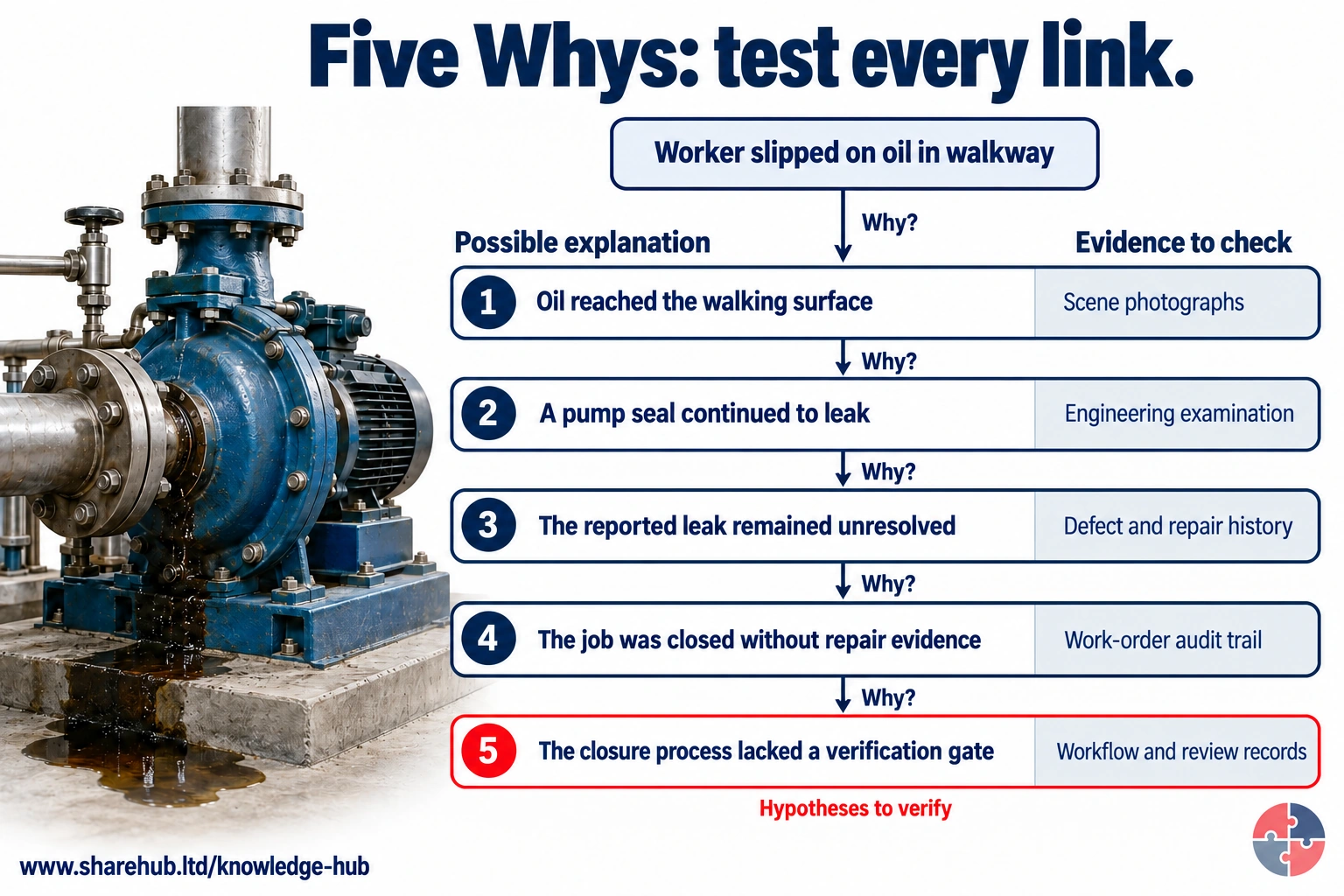
Start with the neutral event, then test why each condition existed. The five answers shown are hypotheses: photographs could support oil on the floor, but they cannot prove why a work order was closed. That deeper link needs the actual repair history and workflow evidence. A plausible sequence becomes an accepted causal finding only when the evidence supports the links and reasonable alternatives have been examined. This branch asks why the release persisted; the initial seal-failure mechanism needs its own engineering enquiry.
How to use the chain
Write one neutral event statement before asking why. Keep the event separate from its explanation: 'Worker slipped on oil in the walkway' describes an event; 'the worker was careless' is a judgement. For every proposed answer, record the supporting source, the limits of that source and what could contradict the answer. Do not turn a question into a finding merely because the next box needs filling.
What this example does and does not establish
This branch explores why a release persisted, not the physical mechanism of initial seal failure. That mechanism needs engineering examination. The enquiry also needs separate branches for containment, pedestrian exposure and detection. If the work-order audit shows the repair was never closed, reject the fourth hypothesis and revise the chain. Five is a familiar prompt, not a stopping rule or a demand to find one root cause.
A useful stopping point
A branch can end when the evidence supports a specific, correctable system weakness and the team can explain how addressing it would reduce recurrence. Check that explanation backwards from the proposed system weakness to the event. Keep unresolved links visible. Escalate complex, high-potential or technically uncertain events to an appropriately competent investigation; this small chain is not a substitute.
Learning check
The photograph shows oil near a pump. Does it prove a maintenance manager closed a defect incorrectly? No. It supports a scene condition only. You need the original work-order history, repair evidence and relevant accounts before drawing a conclusion about closure.
Which link needs evidence beyond the scene photograph?
The links about unresolved repairs, work-order closure and the missing verification gate require records, accounts and workflow checks. A photograph of oil does not establish those management conditions.
Worked example, not findings from a real incident. Five is a prompt rather than a required number; investigate other causal branches and record unknowns.
Source guidance: HSE HSG245 · HSE guidance
Start with a neutral event statement. Good wording describes the event without judgement: 'Worker slipped on oil in workshop bay 2 and fractured wrist', not 'worker was careless'. Then ask why the event happened and write the answer as a condition that can be tested.
Continue only while the answers remain evidence-supported. If the team does not know the answer, mark it as a question and gather more information. If two credible answers exist, branch the chain rather than arguing one away. Stop when the answer is a controllable weakness that can be corrected and checked.
| Step | Instruction | Quality check |
|---|---|---|
| 1. Define the event | Write what happened, where, when and the actual or potential consequence. | Is it neutral and specific? |
| 2. Confirm evidence | Check photographs, statements, task records, permits, maintenance, training and relevant data. | What facts are available and what is missing? |
| 3. Ask the first why | Explain why the event happened in factual terms. | Is the answer supported by evidence? |
| 4. Ask why that condition existed | Move from the immediate event to the work condition behind it. | Is the answer controllable by the organisation? |
| 5. Branch where needed | Create more than one line if equipment, people, environment or management factors interacted. | Are we forcing a single chain? |
| 6. Stop at useful causes | Stop when the team identifies correctable system weaknesses. | Would fixing this make recurrence less likely? |
| 7. Test backwards | Read the chain from final cause back to event. | Does the logic still make sense? |
| 8. Convert to actions | Assign actions, owners, dates and effectiveness checks. | Do actions strengthen controls or merely remind people? |
What evidence standard should each why meet?
For every “why”, record the evidence, its source and what could disprove the explanation. Where several causes interact, branch the chain instead of forcing one path to a preferred answer.
A good answer is specific, testable and connected to the event. It should be possible to say what evidence supports it and what evidence might disprove it. If the answer relies on memory, opinion or assumption, that does not make it useless, but it should be marked as an open line of enquiry.
The evidence standard protects the investigation from hindsight bias. After an incident, the warning signs can look obvious. The job of the investigator is to understand what was known, expected, available and practical at the time.
| Evidence type | Examples | How to use it |
|---|---|---|
| Physical evidence | Scene condition, damaged parts, guards, spills, labels, isolation points and PPE. | Photograph and compare with expected condition. |
| Documentary evidence | Risk assessment, RAMS, permit, inspection, maintenance, training and audit records. | Check whether paperwork matched work-as-done. |
| Digital evidence | CCTV, access logs, telemetry, alarm history, process data and messages. | Use timestamps to test the sequence. |
| People evidence | Witness accounts, worker experience, supervisor explanation and contractor input. | Interview respectfully and test consistency. |
| Context evidence | Workload, staffing, weather, lighting, shift pattern, fatigue, change and time pressure. | Explain why decisions or conditions existed. |
| Technical evidence | Engineering inspection, failure analysis, sampling, exposure results or specialist opinion. | Use when the cause cannot be assessed by generalists. |
When should a Five Whys chain branch?
A Five Whys chain should branch whenever more than one credible condition contributed to the event.
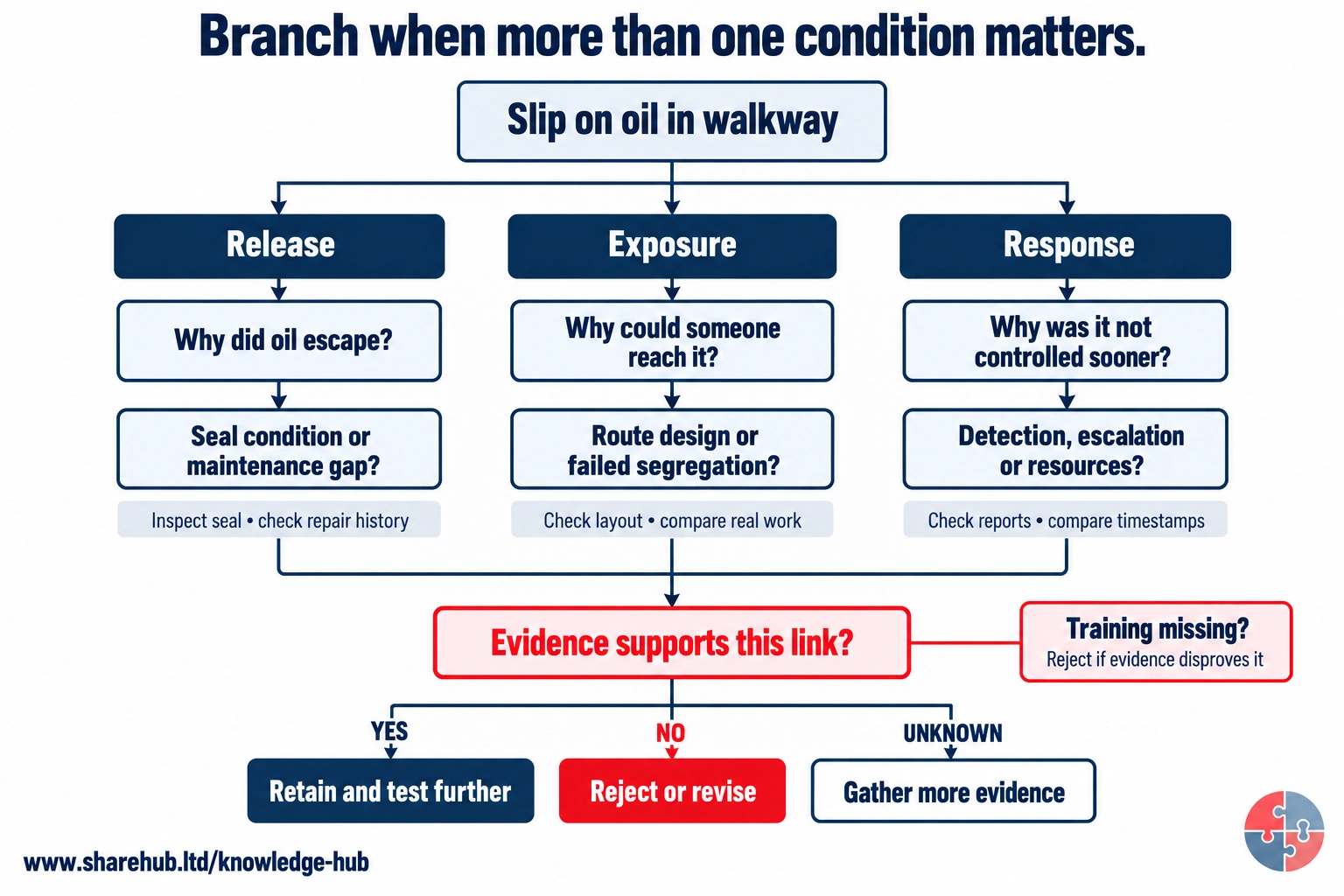
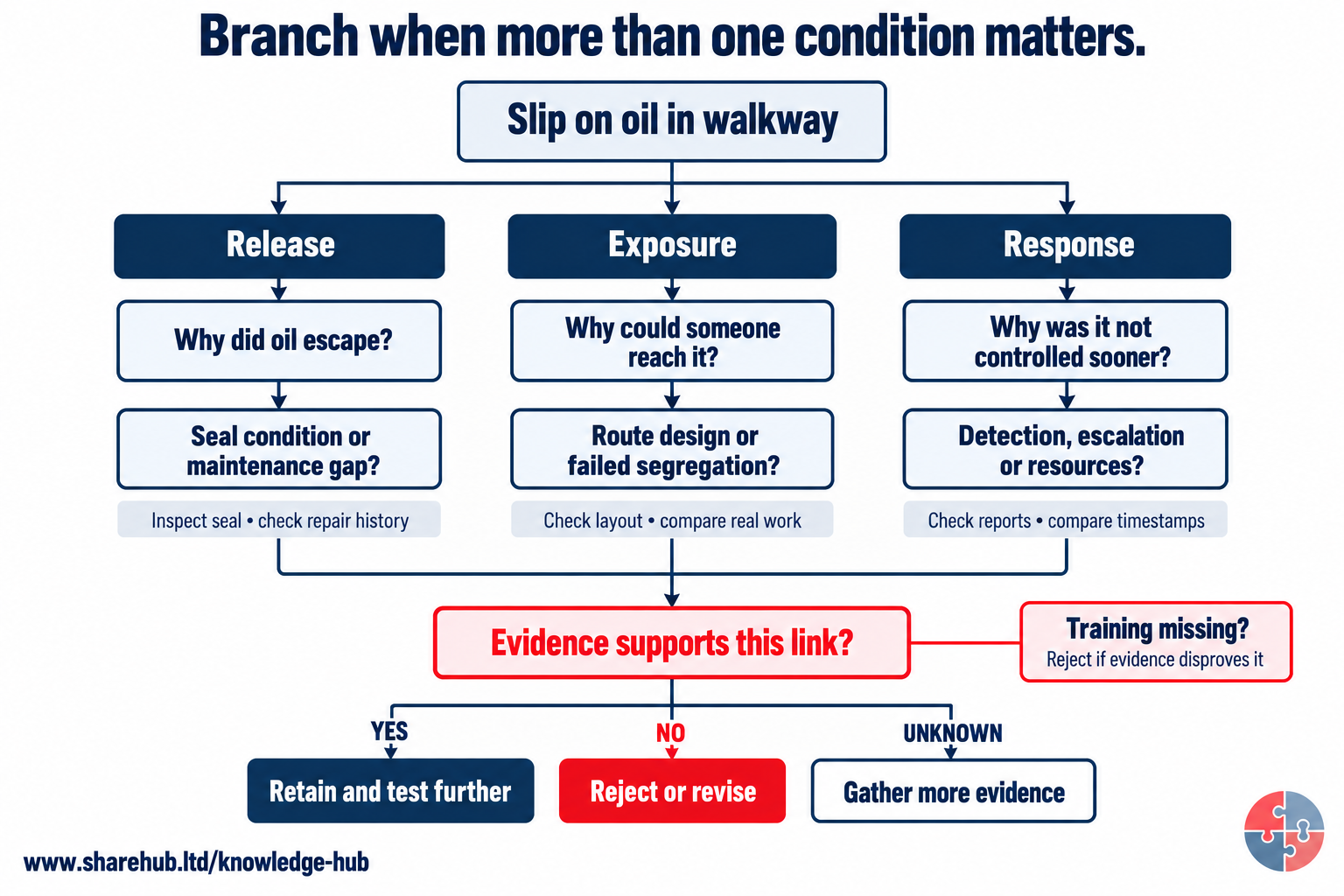
A slip needs both a release and an opportunity for contact; delayed detection or response may contribute too. Explore those paths separately rather than making one explain every condition. Each question is an enquiry, not a finding. Evidence may support, contradict or leave a link unresolved. If relevant training and demonstrated competence are established, reject a missing-training hypothesis and continue examining the conditions that actually fit the evidence.
Why branch?
Release, exposure and response are separate questions. A well-maintained pump can still suffer an unexpected failure; effective containment and route design should limit the resulting exposure. Conversely, a sound spill response does not explain why an avoidable leak recurred. Keep credible pathways separate so that the actions address the combination of conditions rather than one convenient story.
Apply the evidence gate to each link
YES means retain the link with its evidence and confidence limits, then test further. NO means reject or revise it and explain why. UNKNOWN means identify the evidence needed and who will obtain it. A contradictory record is useful: if relevant training and competent performance are established, do not retain a missing-training conclusion. Examine equipment, task demands, information and organisational conditions without assuming those alternatives are already proven.
Use a practical enquiry log
For each branch record the question, proposed explanation, supporting and contradictory evidence, confidence, next enquiry and responsible person. Distinguish an untested possibility from a supported finding in the final report. No voting exercise or neat five-box chain can replace that evidence test.
Learning check
Two witnesses offer different explanations for the same intervention. Keep both accounts and investigate what each person could see, know and recall. Compare available records and technical evidence; do not discard an account simply because it conflicts with the preferred narrative.
What should happen when two credible explanations remain?
Keep separate branches, identify evidence that can distinguish them and show uncertainty. Do not choose a favourite story or force both explanations into one five-box chain.
The branches are examples, not an exhaustive cause taxonomy. Complex, high-potential or technically uncertain events may need a broader causal map and specialist input.
Source guidance: HSE HSG245 · HSE guidance
Many poor Five Whys worksheets fail because they force a single line. A forklift near miss may involve pedestrian route design, reversing visibility, delivery pressure, supervision, driver competence and a temporary storage change. One chain cannot hold that complexity without distorting it.
Branching does not make the method complicated; it makes it honest. Each branch can be short, but it should follow evidence. The final report can then explain how the branches interacted and which controls need strengthening.
| Prompt | Why it matters | Example branch |
|---|---|---|
| Did more than one barrier fail? | Incidents often occur when controls line up badly. | Guard missing, isolation not verified and supervision absent. |
| Did people, plant and process all contribute? | Different cause types need different actions. | Competence, machine design and procedure conflict. |
| Was there recent change? | Change can create hidden mismatches. | Temporary layout, new contractor or altered shift pattern. |
| Were there repeated weak signals? | Previous near misses may show the system already knew. | Defect reports, audit findings or informal workarounds. |
| Was work-as-done different from work-as-imagined? | Procedures may not reflect real constraints. | Task normally requires shortcut to meet production demand. |
| Was the final answer too neat? | Overly simple chains may hide organisational causes. | Final cause is 'carelessness' or 'did not follow procedure'. |
How should immediate, underlying and root causes be separated?
Five Whys should help the team move from what directly happened to why the control system allowed it to happen.
Different organisations use slightly different language, but the investigation purpose is consistent. Immediate causes are closest to the event. Underlying causes explain the unsafe conditions or acts that allowed the event. Root or system causes sit deeper in management arrangements, design, competence, maintenance, planning, procurement, leadership or review.
The chain is useful only when it creates a clear line from event to action. A root cause that nobody can control is too vague. A root cause that points only to an individual's attitude is usually too shallow.
| Cause level | Plain English meaning | Example |
|---|---|---|
| Immediate cause | HSG245 describes the condition or action closest to harm; organisations may use different terminology. | Oil underfoot and the resulting loss of footing are close to the harm; investigate how the leak and failed controls arose. |
| Underlying cause | The unsafe condition or system gap that allowed the immediate cause. | Oil leak had not been identified or contained before work started. |
| Root/system cause | A deeper management weakness from which other failings grew. | Inspection regime did not cover leak-prone equipment and defect escalation was weak. |
| Contributing factor | A condition that increased likelihood or severity. | Lighting made the oil difficult to see. |
| Latent condition | A hidden weakness present before the event. | Maintenance backlog had normalised small leaks. |
| Correctable cause | A cause the organisation can realistically control. | Revise inspection, containment and defect close-out arrangements. |
HSG245 2004 and HSE GB human factors support investigation stages and evidence-led causal analysis. Five Whys chains are illustrative hypotheses, not a mandated method or proof; reporting law is separate.
How should Five Whys handle human error?
A decision or action by a worker may be one fact, but it rarely explains why the work system allowed the hazard. Test task design, equipment, information, staffing, supervision and organisational pressure.
People make decisions inside a work system. They see certain information, use available equipment, manage workload, respond to supervision, follow local norms and adapt to pressure. If an investigation stops at 'the worker forgot', it has usually stopped just when the useful questions begin.
Better questions include: why was the task easy to forget, why was the interface confusing, why was the hold point missing, why did the person feel unable to stop, why had supervision not detected drift and why had previous warnings not led to change?
| Area | Questions to ask | Possible evidence |
|---|---|---|
| Task | Was the task complex, rushed, abnormal, poorly sequenced or hard to perform safely? | Task observation, method statement and worker accounts. |
| Equipment | Was the equipment intuitive, reliable, guarded, labelled and suitable? | Inspection, design information and defect history. |
| Environment | Did noise, heat, lighting, space, weather or congestion influence the event? | Scene photographs and environmental records. |
| Competence | Was competence defined, trained, assessed and refreshed for the actual task? | Training matrix, assessment record and supervisor check. |
| Supervision | Were expectations clear and was work checked at the right points? | Briefings, supervision logs and shift handover. |
| Organisation | Did resources, workload, culture, procurement, maintenance or production pressure shape the conditions? | Management review, audit findings and action trackers. |
Use HSE human-factors guidance to test job, individual and organisational influences without stopping at blame.
What does a good Five Whys example look like?
The conveyor chain below is a set of possible explanations, not a verified finding. Check each step against machine condition, energy-isolation records, work observation, witness accounts and maintenance history before accepting a cause.
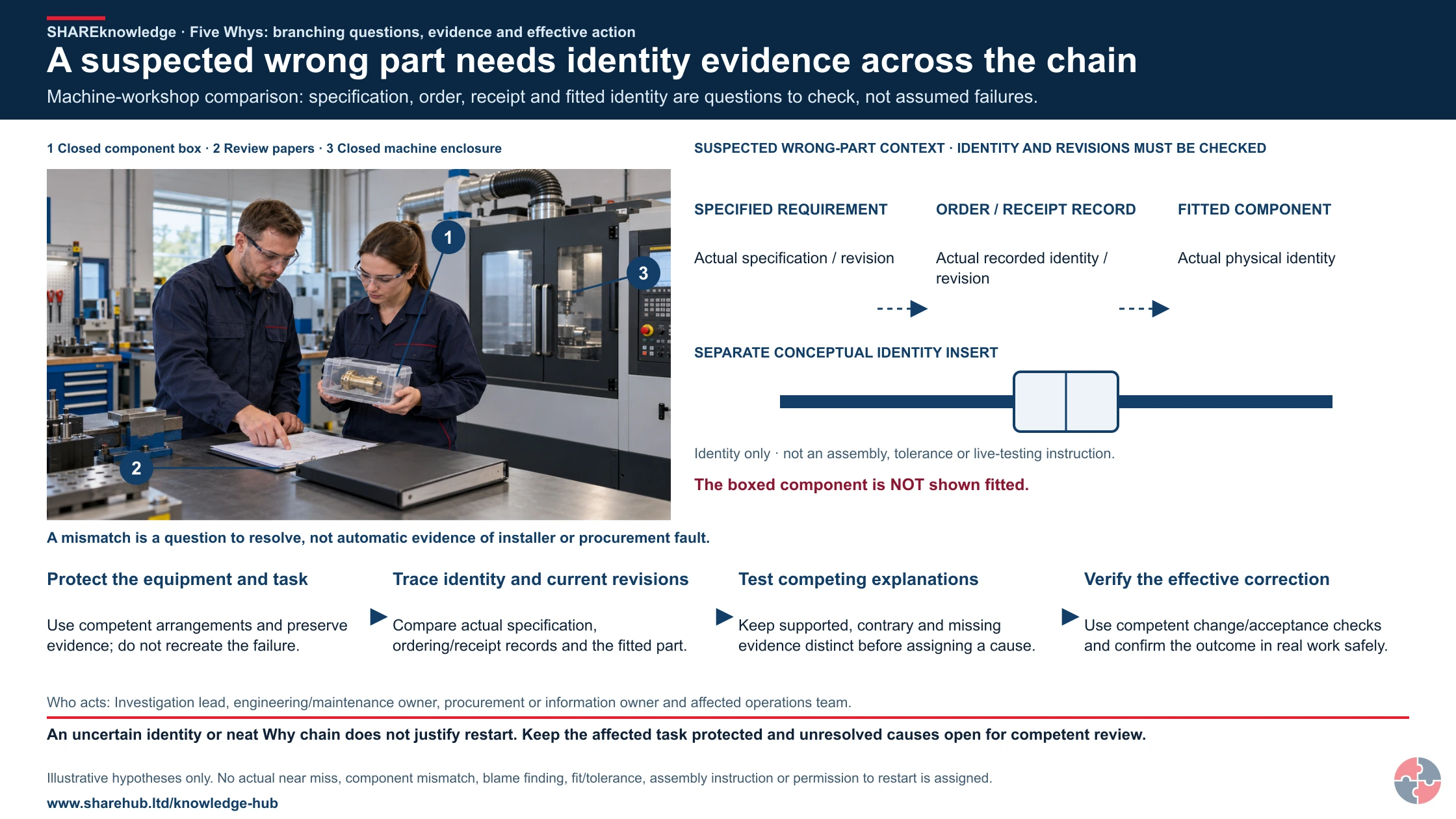
A suspected wrong part needs identity evidence across the chain
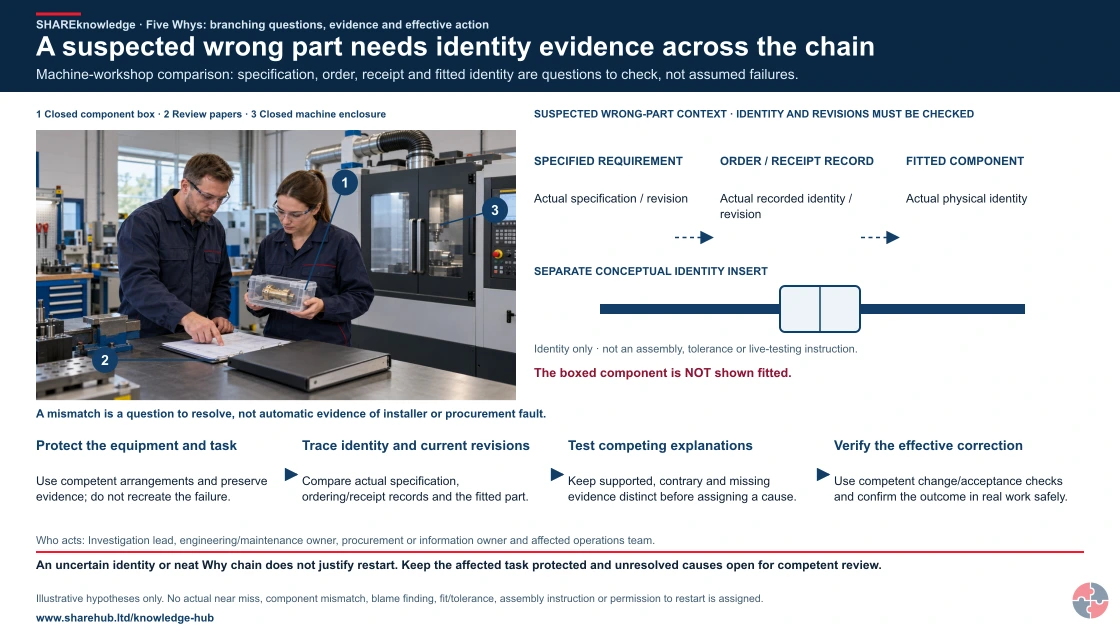
Full written explanation
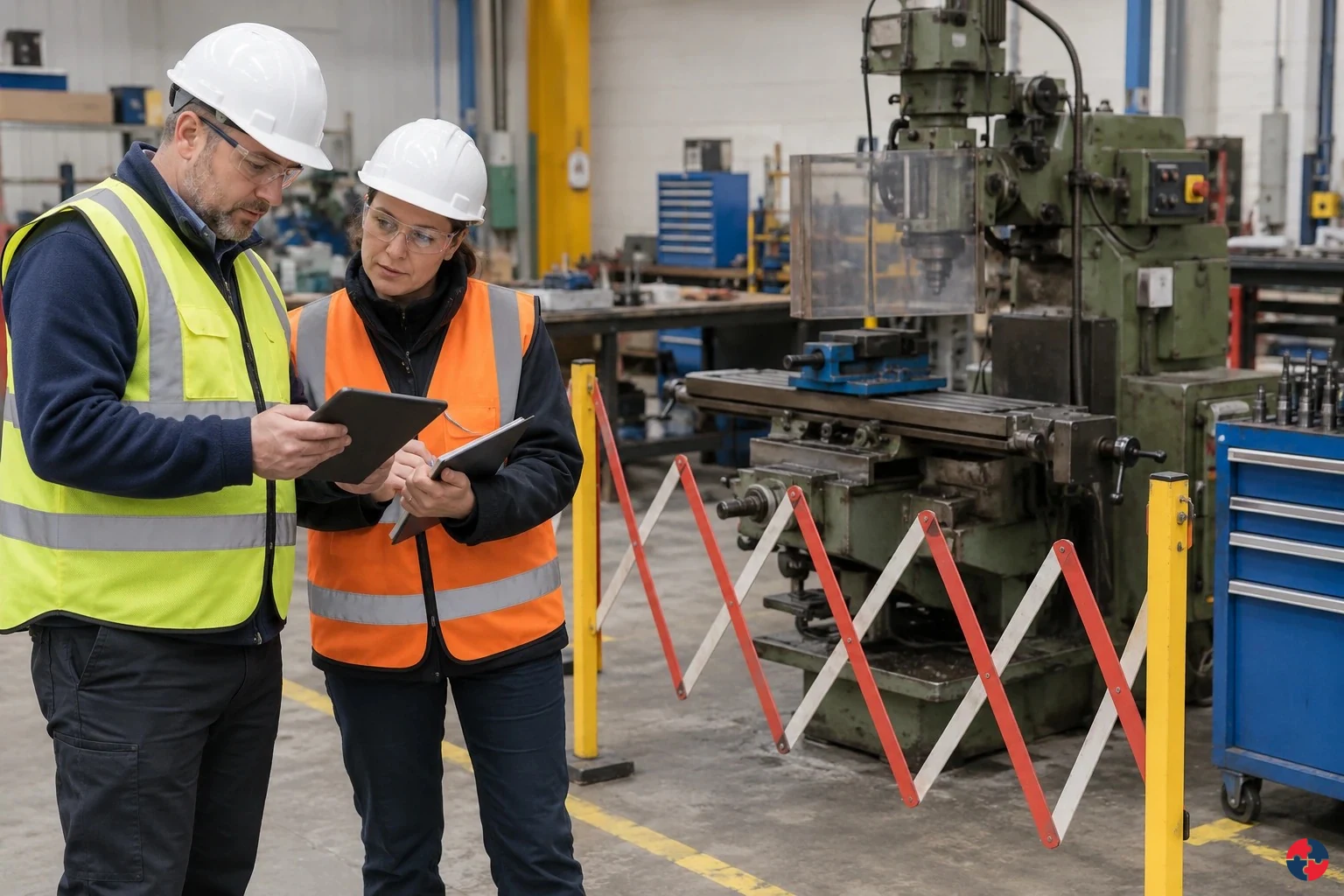
A normal machine-workshop review shows a component inside a closed box, review papers and a closed machine enclosure. Picture key: 1 Closed component box · 2 Review papers · 3 Closed machine enclosure. The boxed component is not shown fitted. Three separate analytical comparisons distinguish the specified requirement and revision, ordering/receipt identity and revision, and the actual fitted component identity. Two dashed conceptual links compare those questions; a separate coupling-and-shaft insert is for identity only, not assembly, tolerance or live testing. The box, machine and records do not establish a match, mismatch, alloy, fit, energy state, fault or permission. Four unnumbered checks protect the task, trace identity and revisions, test competing explanations and verify an effective correction through competent arrangements. Keep uncertainty open; a neat Why chain does not justify restart.
Machine-workshop comparison: specification, order, receipt and fitted identity are questions to check, not assumed failures.
- Protect the equipment and task. Use competent arrangements and preserve evidence; do not recreate the failure.
- Trace identity and current revisions. Compare actual specification, ordering/receipt records and the fitted part.
- Test competing explanations. Keep supported, contrary and missing evidence distinct before assigning a cause.
- Verify the effective correction. Use competent change/acceptance checks and confirm the outcome in real work safely.
When the evidence does not fit: An uncertain identity or neat Why chain does not justify restart. Keep the affected task protected and unresolved causes open for competent review.
Who acts: Investigation lead, engineering/maintenance owner, procurement or information owner and affected operations team.
Changed workplace
Distribution centre: Test interacting physical-route and delivery/change explanations with their sources.
Machine-workshop part identity: Trace specification, records and fitted identity without assuming which organisation failed.
Evidence check: Illustrative hypotheses only. No actual near miss, component mismatch, blame finding, fit/tolerance, assembly instruction or permission to restart is assigned.
Read the evidence-led control hierarchy and retain the current conveyor worked example
Primary references: HSE: HSG245 investigation stages, 2004 · HSE: human factors in investigation · HSE: machinery precautions
Open the complete HD image (new tab)Download image
Read the evidence-led control hierarchy and retain the current conveyor worked example
Primary references: HSE: HSG245 investigation stages, 2004 · HSE: human factors in investigation · HSE: machinery precautions
Consider a worker who cuts their hand while clearing a jam on a powered conveyor. A weak investigation might conclude that the worker failed to follow the procedure. A stronger Five Whys chain tests why the jam had to be cleared manually, why isolation was not used, why supervision did not detect the practice and why previous jam reports had not led to redesign.
The result should be practical. If the chain ends with 'worker did not follow procedure', the action will likely be a reminder. If the chain reaches design, isolation, planning and maintenance weaknesses, the action can reduce risk at source.
| Why level | Hypothesis to test | Action implication | Evidence to check |
|---|---|---|---|
| Event | Worker cut hand while clearing jammed material from powered conveyor. | Make area safe, treat injury and preserve evidence. | Injury and incident record, machine state, photographs. |
| Why 1 | Hand entered nip point while stored energy remained available. | Review guarding, isolation and energy control. | Guard/access condition and isolation test. |
| Why 2 | Jam clearing was routinely done through access panel during production stops. | Observe work-as-done and revise method. | Work observation, production and training records. |
| Why 3 | Procedure required isolation, but production targets and frequent jams encouraged quick clearing. | Address workload, planning and supervisor expectations. | Procedure, shift targets, interviews and supervision records. |
| Why 4 | Frequent jams had been reported but treated as production inconvenience, not a safety design issue. | Review defect escalation and engineering change criteria. | Jam/defect logs and escalation trail. |
| Why 5 | The maintenance and improvement process did not classify repeated jams as a safeguarding concern. | Introduce risk-based escalation for repeated equipment faults. | Maintenance priority and safeguarding review criteria. |
| Possible combined finding if evidence confirms | The injury arose from exposed energy during a normalised workaround, driven by recurring equipment jams and weak escalation. | Engineering review, interlocked access, jam reduction, permit/LOTO verification and action effectiveness checks. | Converging physical and documentary evidence; competing explanations. |
Observe or test tasks only under a safe competent plan. Stop affected machinery work until guarding, isolation and task controls are verified; investigate past records or use controlled simulations instead of recreating an injury mechanism.
How do Five Whys and fishbone analysis work together?
Fishbone analysis widens the investigation; Five Whys drills down into selected causes.
Fishbone analysis is useful when the team needs to map many possible causes across people, plant, method, environment, materials and management system factors. Five Whys is useful when the team wants to examine one branch more deeply.
Used together, they reduce two opposite risks. Five Whys alone can become too narrow. Fishbone alone can become a long list of possibilities without depth. The stronger workflow is to map the landscape, select important branches, drill down, test evidence, then write actions.
| Stage | Tool | Output |
|---|---|---|
| Define event | Both | Neutral problem statement. |
| Map possible causes | Fishbone | Broad categories and possible causal factors. |
| Prioritise branches | Team judgement | Evidence-backed lines needing deeper enquiry. |
| Drill down | Five Whys | Deeper cause chains under selected branches. |
| Test evidence | Both | Confirmed, possible, disproved and open findings. |
| Choose actions | Action review | Corrective actions linked to verified causes. |
How should Five Whys connect to barriers and controls?
Every cause should be connected back to the control that should have prevented, detected or mitigated the event.
Barrier thinking makes Five Whys more useful. Instead of asking only why the event happened, ask which barrier was missing, weak, defeated, bypassed, unavailable, misunderstood or unverified. This keeps the analysis close to risk control.
For higher-risk work, the final output should show whether prevention, detection, control, mitigation, emergency response and assurance arrangements were reliable. If the analysis cannot name the failed control, it may still be too vague.
| Barrier question | What it reveals | Example |
|---|---|---|
| What should have prevented the event? | Missing or weak prevention controls. | Guarding, segregation, isolation, ventilation or planning. |
| What should have detected the problem earlier? | Inspection, monitoring or alarm gaps. | Defect reporting, gas detection, audits or supervision. |
| What should have controlled the situation? | Procedures, permits, competence or engineering controls. | Permit hold point or lock-off check. |
| What should have reduced the consequence? | Emergency response, PPE or mitigation weakness. | First aid, spill kit, fire response or eyewash. |
| How was the barrier assured? | Whether controls were checked, tested and maintained. | Audit, inspection, maintenance or competence verification. |
| Could the same barrier be weak elsewhere? | Extent of condition and wider learning. | Other lines, sites, shifts or contractors. |
How should Five Whys findings become strong corrective actions?
Close an investigation action only after a named owner installs the measure, checks it in real work and tests whether the failure recurs. Training alone is weak when the verified problem is equipment or layout.
The action plan is where investigation quality becomes visible. Weak actions tell people to be careful, repeat training without evidence of a competence gap, or update a procedure nobody uses. Strong actions change the work system: design, engineering controls, access, maintenance, planning, supervision, procurement, competence verification and leadership review.
Actions should also be tested. Completion is not the same as effectiveness. A revised procedure is complete when it is issued; it is effective only when the task is observed, workers understand it and the original weakness has been reduced.
| Action type | Strength | Example |
|---|---|---|
| Eliminate or redesign | Strong | Remove the need to access the danger zone during clearing. |
| Engineering control | Strong | Interlock access panel, improve guarding or redesign equipment to reduce jams. |
| System control | Strong to medium | Introduce risk-based defect escalation and independent isolation verification. |
| Planning and resources | Medium to strong | Allow downtime to clear defects rather than normalising workarounds. |
| Competence and supervision | Medium | Target training and supervisor checks to a verified gap. |
| Procedure update | Medium to weak unless verified | Revise method and check use in real work. |
| Reminder or poster | Weak if used alone | Use only as supporting communication, not the main action for a serious finding. |
How can the hierarchy of controls turn Five Whys findings into effective risk reduction?
Use ERICPD and the HSE five-level hierarchy on the hazard that evidence reveals. The Why chain helps locate a failed barrier; it is not itself a protective measure.
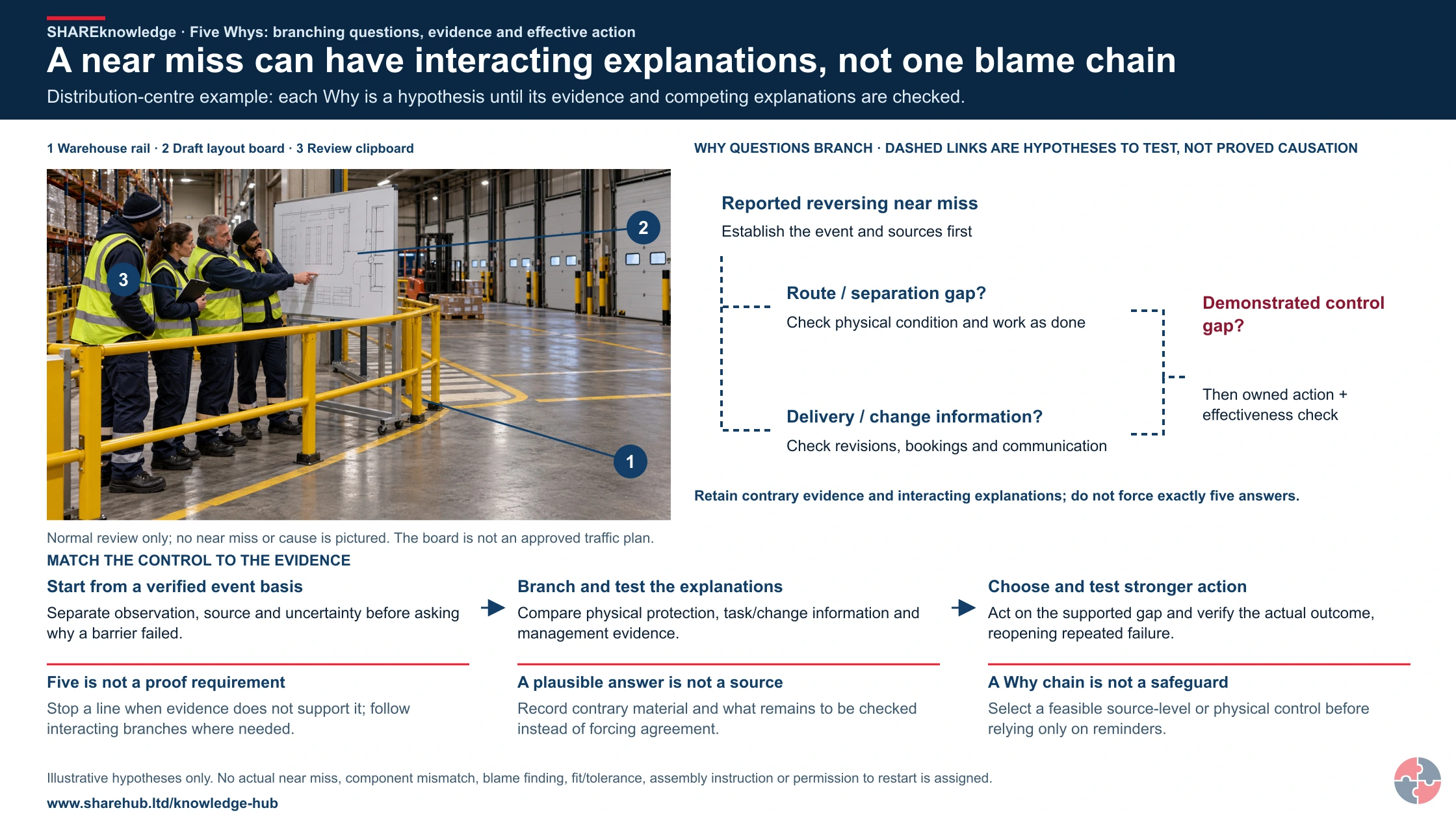
A near miss can have interacting explanations, not one blame chain
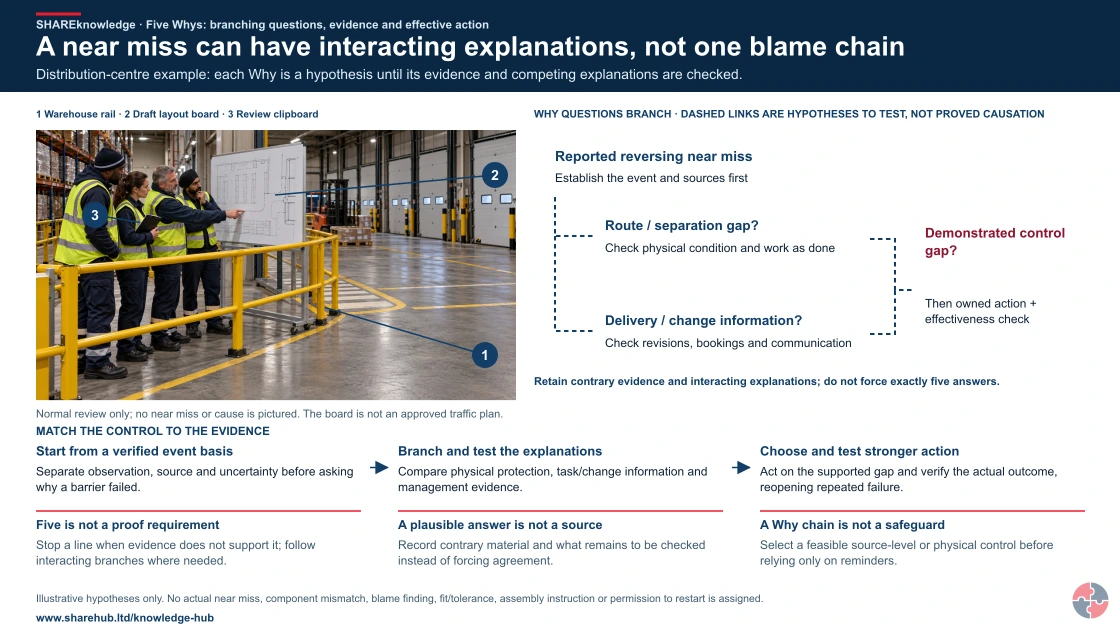
Full written explanation
A normal distribution-warehouse scene provides rail, draft-layout-board and clipboard context beside a separate branching Why enquiry. Picture key: 1 Warehouse rail · 2 Draft layout board · 3 Review clipboard. A reported reversing near miss is the neutral analytical starting point, not a pictured incident. Two independent dashed candidate branches ask about route/separation and actual work conditions, and about delivery/change information, revisions, bookings and communication. Both join a demonstrated-control-gap question before owned action and effectiveness checking. Retain contrary evidence and interacting explanations; exactly five answers are not required. Three complete paired explanations establish the event basis, test branches and choose stronger action. The scene proves no event, cause, safe route, barrier adequacy, role, equipment state or permission.
Distribution-centre example: each Why is a hypothesis until its evidence and competing explanations are checked.
- Start from a verified event basis. Separate observation, source and uncertainty before asking why a barrier failed.
- Branch and test the explanations. Compare physical protection, task/change information and management evidence.
- Choose and test stronger action. Act on the supported gap and verify the actual outcome, reopening repeated failure.
Change the pathway
- Five is not a proof requirement. Stop a line when evidence does not support it; follow interacting branches where needed.
- A plausible answer is not a source. Record contrary material and what remains to be checked instead of forcing agreement.
- A Why chain is not a safeguard. Select a feasible source-level or physical control before relying only on reminders.
Evidence check: Illustrative hypotheses only. No actual near miss, component mismatch, blame finding, fit/tolerance, assembly instruction or permission to restart is assigned.
Read the evidence-led control hierarchy and retain the current conveyor worked example
Primary references: HSE: HSG245 investigation stages, 2004 · HSE: human factors in investigation · HSE: machinery precautions
Open the complete HD image (new tab)Download image
Read the evidence-led control hierarchy and retain the current conveyor worked example
Primary references: HSE: HSG245 investigation stages, 2004 · HSE: human factors in investigation · HSE: machinery precautions
HSG245 2004 and HSE GB human factors support investigation stages and evidence-led causal analysis. Five Whys chains are illustrative hypotheses, not a mandated method or proof; reporting law is separate. GB traffic/DSEAR sources support the respective illustrative control examples.
A delivery change causes a reversing vehicle to pass near a worker. Test the route plan, barriers, booking and supervision before accepting “worker error” as a cause.
A workshop has repeated solvent spills. Test container design, couplings, task timing and maintenance against physical evidence before choosing a corrective measure.
How can the ERICPD hierarchy of controls turn Five Whys findings into effective risk reduction?

| Hazard and harm route | ERICPD → five-level control | Task intervention and feasibility | Owner, test and evidence | Failure and stop decision |
|---|---|---|---|---|
| Vehicle and pedestrian near miss | Eliminate → Elimination | Remove pedestrian movement from the vehicle zone through a redesigned delivery route. Source: official guidance. | Site manager walks peak routes with workers. | People still cross the reversing path: reject layout. |
| Same scenario | Reduce → Substitution | Use forward-only access or smaller delivery vehicles where geometry allows. Source: official guidance. | Logistics lead trials actual vehicles. | New method still creates blind reversing: reject. |
| Same scenario | Isolate → Engineering | Install robust vehicle-pedestrian separation and controlled crossings. Source: official guidance. | Site engineer checks barriers during a live delivery. | Barrier missing or bypassed: stop vehicle movement. |
| Same scenario | Control → Administrative | Use booked deliveries, approved temporary route changes and contractor briefings. Source: official guidance. | Supervisor observes handover and checks plan version. | Unbriefed route change: hold delivery. |
| Same scenario | PPE → PPE | Use visibility clothing for residual exposure, never as a substitute for separation. Source: official guidance. | Supervisor verifies use and records no segregation credit. | Plan depends on clothing alone: reject. |
| Same scenario | Discipline → Administrative assurance | Review near-miss trend and field-test the revised traffic plan after changes. Source: official guidance. | Project owner signs effectiveness check. | Near miss repeats: reopen causes and restrict traffic. |
| Solvent decanting spill | Eliminate → Elimination | Remove open decanting by switching to closed supply where feasible. Source: official guidance. | Process engineer trials actual transfer. | Open pour remains as workaround: reject claim. |
| Same scenario | Reduce → Substitution | Choose a lower-risk material or smaller batch after product assessment. Source: official guidance. | Technical owner checks performance and new hazards. | Substitute creates uncontrolled hazard: reject. |
| Same scenario | Isolate → Engineering | Use compatible closed couplings, containment and ignition separation. Source: official guidance. | Maintenance lead tests installation and leak path. | Leak or failed containment: stop transfer. |
| Same scenario | Control → Administrative | Use pre-use inspection, change approval and trained shutdown/withdrawal. Source: official guidance. | Shift lead observes task and permit. | Procedure differs from real equipment: hold task. |
| Same scenario | PPE → PPE | Select chemical PPE for residual splash using substance data, not as the primary release barrier. Source: official guidance. | Supervisor checks compatibility and fit. | Substance or PPE compatibility unknown: stop. |
| Same scenario | Discipline → Administrative assurance | Trend spills and test whether corrective action prevents recurrence. Source: official guidance. | Investigator reviews field evidence after restart. | Repeat spill: reopen Why chain and halt method. |
How can the ISO 45001 hierarchy of controls turn Five Whys findings into effective risk reduction?

| Hazard and harm route | ERICPD → five-level control | Task intervention and feasibility | Owner, test and evidence | Failure and stop decision |
|---|---|---|---|---|
| Vehicle and pedestrian near miss | Eliminate → Elimination | Remove pedestrian movement from the vehicle zone through a redesigned delivery route. Source: official guidance. | Site manager walks peak routes with workers. | People still cross the reversing path: reject layout. |
| Same scenario | Reduce → Substitution | Use forward-only access or smaller delivery vehicles where geometry allows. Source: official guidance. | Logistics lead trials actual vehicles. | New method still creates blind reversing: reject. |
| Same scenario | Isolate → Engineering | Install robust vehicle-pedestrian separation and controlled crossings. Source: official guidance. | Site engineer checks barriers during a live delivery. | Barrier missing or bypassed: stop vehicle movement. |
| Same scenario | Control → Administrative | Use booked deliveries, approved temporary route changes and contractor briefings. Source: official guidance. | Supervisor observes handover and checks plan version. | Unbriefed route change: hold delivery. |
| Same scenario | PPE → PPE | Use visibility clothing for residual exposure, never as a substitute for separation. Source: official guidance. | Supervisor verifies use and records no segregation credit. | Plan depends on clothing alone: reject. |
| Same scenario | Discipline → Administrative assurance | Review near-miss trend and field-test the revised traffic plan after changes. Source: official guidance. | Project owner signs effectiveness check. | Near miss repeats: reopen causes and restrict traffic. |
| Solvent decanting spill | Eliminate → Elimination | Remove open decanting by switching to closed supply where feasible. Source: official guidance. | Process engineer trials actual transfer. | Open pour remains as workaround: reject claim. |
| Same scenario | Reduce → Substitution | Choose a lower-risk material or smaller batch after product assessment. Source: official guidance. | Technical owner checks performance and new hazards. | Substitute creates uncontrolled hazard: reject. |
| Same scenario | Isolate → Engineering | Use compatible closed couplings, containment and ignition separation. Source: official guidance. | Maintenance lead tests installation and leak path. | Leak or failed containment: stop transfer. |
| Same scenario | Control → Administrative | Use pre-use inspection, change approval and trained shutdown/withdrawal. Source: official guidance. | Shift lead observes task and permit. | Procedure differs from real equipment: hold task. |
| Same scenario | PPE → PPE | Select chemical PPE for residual splash using substance data, not as the primary release barrier. Source: official guidance. | Supervisor checks compatibility and fit. | Substance or PPE compatibility unknown: stop. |
| Same scenario | Discipline → Administrative assurance | Trend spills and test whether corrective action prevents recurrence. Source: official guidance. | Investigator reviews field evidence after restart. | Repeat spill: reopen Why chain and halt method. |
What are the limitations of Five Whys?
A single linear chain can miss parallel failures and time sequence. For complex or high-potential events, use a timeline, fishbone or barrier analysis and specialist evidence alongside Five Whys.
The method can become linear, biased and too shallow. It can also produce different answers depending on who is in the room. A manager may see behaviour; a worker may see poor equipment; an engineer may see design; a safety adviser may see missing assurance. The value comes from testing these perspectives, not choosing the quickest one.
For major injury, major accident potential, process safety, complex technical failure, occupational disease, high-value asset damage or legal sensitivity, Five Whys should be supported by competent investigation governance and other tools.
| Limitation | How it can mislead | Safeguard |
|---|---|---|
| Linear thinking | Forces one chain even where causes interact. | Branch the analysis. |
| Hindsight bias | Makes the event look obvious after it happened. | Ask what was known and available at the time. |
| Blame endpoint | Stops at carelessness or failure to follow rules. | Ask why the behaviour was possible or likely. |
| Weak evidence | Turns guesses into causes. | Mark evidence status and gather missing information. |
| Over-simple actions | Produces retraining and reminders. | Review action strength and effectiveness checks. |
| Wrong tool for complexity | Misses technical, organisational or barrier interactions. | Combine with fishbone, timeline, barrier or technical analysis. |
Which investigation and reporting duties apply by jurisdiction?
Five Whys is not a named legal requirement. GB and Northern Ireland have distinct general work-health and RIDDOR reporting routes; the analysis method does not replace notification or risk control.
HSG245 is 2004 HSE method guidance. Its stages support an evidence-led investigation, but the employer still has to meet the current law that applies at the site.
Screen reportability before deciding the investigation method. GB RIDDOR 2013 and NI RIDDOR 1997 have different thresholds, including over-seven-day GB reporting versus the separate NI over-three-day route. Use HSENI for NI incident reporting.
| Jurisdiction | Duty or regulation | What it means in practice | Evidence to keep |
|---|---|---|---|
| GB | Health and Safety at Work etc. Act 1974 | GB general work-health duties. | Risk control, learning and corrective action. |
| GB | Management Regulations 1999 | GB assessment and preventive arrangements. | Revised risk assessment and control evidence. |
| NI | Health and Safety at Work (NI) Order 1978 | Separate NI work-health framework. | NI risk and corrective-action evidence. |
| NI | NI Management Regulations 2000 | Separate NI assessment and arrangements. | NI revised assessment and control record. |
| GB | RIDDOR 2013 | GB specified reportable events. | GB screening and report reference. |
| NI | RIDDOR (NI) 1997 | Separate NI specified reportable events. | NI screening and report reference. |
| GB | HSG245 investigation workbook | 2004 HSE method guidance, not a statutory Five Whys duty. | Evidence log and action plan. |
Read HSE HSG245 for method and HSE human factors for contributors.
For reporting use GB RIDDOR or HSENI incident reporting and the NI instrument for the actual site.
What should a Five Whys action register include?
The register should connect each verified cause to a control improvement, owner, timescale and effectiveness check.
| Field | Purpose | Example |
|---|---|---|
| Event reference | Links the analysis to the incident or near miss. | INV-2026-021 |
| Problem statement | Defines the event neutrally. | Worker slipped on oil in workshop bay. |
| Cause chain or branch | Shows the evidence-led why sequence. | Leak not detected because inspection route excluded rear of machine. |
| Evidence status | Separates confirmed, possible and open findings. | Confirmed by inspection record and photo. |
| Control weakness | Names the failed or missing control. | Inspection regime and defect escalation. |
| Action | States the practical improvement. | Revise inspection route and add leak-response standard. |
| Owner and due date | Creates accountability. | Workshop manager, 30 September 2026. |
| Effectiveness check | Confirms whether the action works. | Three inspection samples and worker feedback after one month. |
| Wider applicability | Checks whether the weakness exists elsewhere. | Review similar machines across all workshops. |
How could BuildOut Ltd use Five Whys?

BuildOut Ltd would use Five Whys to drill into construction incidents while keeping the investigation evidence-led and practical.
BuildOut Ltd
BuildOut Ltd is a construction and refurbishment contractor used by SHARE to show how investigation topics apply in a practical business context.
A BuildOut labourer trips over temporary lighting cable in a refurbishment corridor and suffers a sprained wrist. The supervisor first makes the area safe, arranges first aid, photographs the cable route, records witness accounts and checks the construction phase plan, site inspection records, temporary electrical plan and contractor handover notes.
The Five Whys chain does not stop at 'worker did not look where they were going'. It asks why the cable was in the walkway, why the temporary lighting route had changed, why the change had not been captured in the permit or daily coordination meeting, why the subcontractor was allowed to alter the route without supervisor approval and why the inspection checklist did not include temporary services crossing pedestrian routes.
BuildOut's actions include using a competent temporary-services plan to remove cables from walking routes, with suitable high-level routing where practicable and without introducing electrical, access or falling-object hazards, adding temporary service routes to the daily coordination board, briefing subcontractors on cable management rules, updating the inspection checklist, and reviewing similar projects. The close-out check includes a site walk with the supervisor, subcontractor and worker representative.
| Management step | How BuildOut applies it | Evidence |
|---|---|---|
| Assess | Classifies the trip by potential harm and checks whether temporary services create wider risks. | Investigation level decision and site photos. |
| Analyse | Uses Five Whys branches for cable route, coordination, subcontractor control and inspection failure. | Evidence-led cause chain. |
| Train | Briefs supervisors on neutral problem statements, branching and evidence status. | Supervisor investigation training record. |
| Implement | Updates temporary services control, coordination board, subcontractor rules and inspection prompts. | Revised site documents and briefing record. |
| Check | Samples inspections and observes cable management during active work. | Inspection record and close-out photos. |
| Learn | Shares learning across similar refurbishments and updates the contractor induction. | Learning bulletin and management review. |
Who needs Five Whys competence, and what proves it?
Test evidence handling, neutral questioning, jurisdiction screening and action effectiveness with a realistic incident, not attendance alone.
| Role | Learning to test | Competence demonstration | Assessor and record | Reassessment trigger |
|---|---|---|---|---|
| Workers and witnesses | Preserve facts and distinguish observation from interpretation. | Describe the timeline and evidence source. | Supervisor records briefing. | Incident or process change. |
| Supervisors | Secure scene and screen GB or NI reportability. | Work through sample report route and evidence capture. | Safety lead reviews decision. | Jurisdiction or threshold change. |
| Investigators | Test each Why and branch where evidence supports multiple causes. | Build a chain with counter-evidence and causal rationale. | Competent investigation lead reviews. | Complex event or new evidence. |
| Technical specialists | Validate engineering or human-factor findings. | Use safe analysis, inspection or controlled tests to validate barrier design; do not recreate exposure to live machinery or other hazardous failure. | Independent authority signs technical finding. | Design or failure mode change. |
| Action owners | Install stronger controls and verify their effect. | Show field test, owner and recurrence review. | Sponsor signs closeout. | Control fails or event recurs. |
How does Five Whys support study and professional development?
Five Whys helps learners explain the movement from immediate causes to underlying and root/system causes.
For practical learning, place Five Whys inside the wider investigation process. Start with evidence gathering, then analyse causes, select controls and review whether actions work. Do not write a generic chain that ends with 'worker error'. Show how work design, supervision, equipment, competence and management arrangements shaped the event.
Scenario-based answers should be specific. In a machinery injury, discuss guarding, isolation, maintenance, jams, supervision and production pressure. In a slip incident, discuss contamination, flooring, cleaning, footwear, lighting, reporting and inspection. In a process safety event, discuss barriers, alarms, procedures, competence, change control and assurance.
| What to know | How to apply it | Common trap |
|---|---|---|
| HSG245 process | Use Five Whys during analysis, after evidence gathering. | Starting with causes before facts. |
| Cause levels | Separate immediate, underlying and root/system causes. | Calling every answer a root cause. |
| Evidence status | Label confirmed, possible, disproved and open answers. | Treating assumptions as facts. |
| Human factors | Explore job, individual and organisational conditions. | Stopping at human error. |
| Action strength | Choose controls that reduce recurrence risk. | Relying on reminders and retraining only. |
How can BS EN ISO 45001 support five whys for incident investigation management?
A voluntary occupational health and safety system can connect evidence-led investigation, verified causes, stronger controls and effectiveness checks without treating a Why chain as proof.
HSE public guidance supports practical management themes in Great Britain. ISO clause mapping, conformity and certification claims remain held for current licensed-text and specialist review; this page does not establish compliance or certification.
What are the warning signs of poor Five Whys analysis?
Poor Five Whys analysis usually sounds neat, quick and certain, but does not improve the work system.
| Warning sign | Why it weakens learning | Better practice |
|---|---|---|
| The chain starts with blame | The investigation begins from a conclusion. | Use a neutral event statement. |
| Every answer is opinion | The chain cannot be defended. | Show evidence or mark as open. |
| There is only one line for a complex event | Interactions are hidden. | Branch the chain. |
| Human error is the final answer | System causes are missed. | Ask why the error was possible. |
| The answer repeats the event | No deeper cause has been found. | Ask what condition allowed it. |
| Actions are reminders | Controls are not strengthened. | Use stronger design, engineering, planning or assurance actions. |
| No effectiveness check exists | Actions can close without reducing risk. | Define field verification or trend review. |
What do the acronyms and key terms mean?
Acronyms should be explained so investigation language remains accessible to workers, supervisors and learners.
| Acronym | Meaning | Plain English use |
|---|---|---|
| HSG245 | HSE guidance on investigating accidents and incidents | Main HSE investigation workbook. |
| HSE | Health and Safety Executive | Great Britain workplace health and safety regulator. |
| RCA | Root Cause Analysis | Structured analysis of deeper causes and system weaknesses. |
| RIDDOR | Reporting of Injuries, Diseases and Dangerous Occurrences Regulations | Statutory reporting regime for specified work-related events. |
| GB | Great Britain | GB RIDDOR 2013 route. |
| NI | Northern Ireland | Separate NI RIDDOR 1997 route. |
| ERICPD | Eliminate, Reduce, Isolate, Control, PPE, Discipline | Control-selection teaching aid applied to verified hazards. |
Reader navigation, terms and proposed documents only; no linked-page evidence, instructional asset or reuse approval is implied.