SHARE Knowledge Hub
Fishbone Analysis for Incident Investigation
A fishbone diagram helps investigators organise possible causes, but only evidence can support a finding. Build a timeline, test hypotheses, select stronger controls and verify them in real work. Keep statutory reporting separate and use the correct Great Britain or Northern Ireland RIDDOR route.
Understanding Fishbone Analysis for Incident Investigation
A fishbone diagram helps investigators organise possible causes, but only evidence can support a finding. Build a timeline, test hypotheses, select stronger controls and verify them in real work. Keep statutory reporting separate and use the correct Great Britain or Northern Ireland RIDDOR route.
Why this matters at work
Use categories that fit the work, such as equipment, methods, environment, people and management. Mark each proposed cause as supported, contradicted or unresolved and identify the evidence needed to test it. Involve workers and appropriate technical specialists. Look for interactions and missing barriers rather than selecting the most convenient branch. HSE investigation guidance supports systematic analysis and action; it does not require a particular diagram or exactly six categories. Keep the diagram connected to the evidence and scope. A technically complex failure may need specialist examination before a causal statement is defensible, and investigation completion is separate from permission to resume work.
Retain original maintenance and controller timestamps, justify alignment and test the causal mechanism through competent safe examination. Revise a theory contradicted by evidence. Keep technical acceptance, operating permission and learning closure separate; unresolved high-consequence uncertainty requires escalation.
How organisations manage this in practice
Describe the actual action and the conditions in which it occurred. Ask how task design, information, access, workload, equipment, supervision, fatigue and normal work practices affected the available choices. Compare the written procedure with work as actually done. A deviation can reveal an impractical procedure, conflicting goals or inadequate resources; it is not by itself an explanation of why the event occurred. Interview people with open questions and distinguish direct observation from later interpretation. Avoid assuming a worker knew information that became clear only after the event. Check relevant training, competence and authority separately, and explore whether previous concerns were raised and acted on. Preserve contradictory accounts without forcing agreement. Confidential health or employment information needs a justified purpose and restricted access. Fair conduct processes may be necessary separately, but must not replace prevention-focused analysis. Final findings should name observable, controllable conditions with an evidence link to the event, rather than an unsupported label such as careless, poor culture or lack of awareness.
Use asset identity, inspection scope, photographs, system logs and competent technical input where relevant. Do not reset, repair or test evidence in ways that obscure the original condition without an appropriate plan and authority. A later successful function test does not prove that a safety device worked during the incident. Mark unresolved causes openly and assign the next investigation step; uncertainty must not be hidden by a tidy diagram. Meanwhile assess whether the hazard remains and apply proportionate protection. Technical diagnosis, organisational cause analysis, reportability and operational release are connected but separate decisions requiring their own evidence and responsible roles.
Workers health information needs an actual lawful basis and special-category condition with purpose, minimisation, limited access, security and appropriate retention. Signature is not automatic freely given employment consent; ICO guidance is under review after Data Use and Access Act. No clinical causation or fitness decision.
Keep a verified branch beside an unresolved branch and a rejected assumption
A fishbone organises possible causes; its branch headings do not establish what happened. Build a factual event timeline, then mark each proposed explanation as supported, unresolved or contradicted. For the pump-motor shock example, a recorded circuit discrepancy may support an isolation-system branch while the reason for a supervisory gap remains open.
Test an assumption such as “no training was given” against the records and work evidence. If it is contradicted, remove that conclusion and investigate why the system still allowed the event despite the training. Connect each accepted cause to a stronger control, a responsible owner and a test during real maintenance. Keep evidence gaps visible instead of completing the diagram by group agreement.
Pump-motor shock: three different evidence states
Illustrative example. An investigation considers circuit identification, supervisor availability and an assumption that the technician was untrained.
Decision. The team verifies the circuit branch, leaves staffing unresolved pending evidence and rejects the no-training claim when records contradict it.
Evidence to check. Isolation records, equipment identity, observed condition, accounts and competence evidence checked against the timeline.
Hold or escalation point. Do not declare a cause from category labels, plausibility or team consensus alone.
Follow-up. Change the verified isolation weakness and observe the next controlled maintenance task before closing the action.
Separate a plausible cause from an evidenced connection
A fishbone diagram organises hypotheses. Its branches are questions to investigate, not proof of root causes or labels for blaming people.
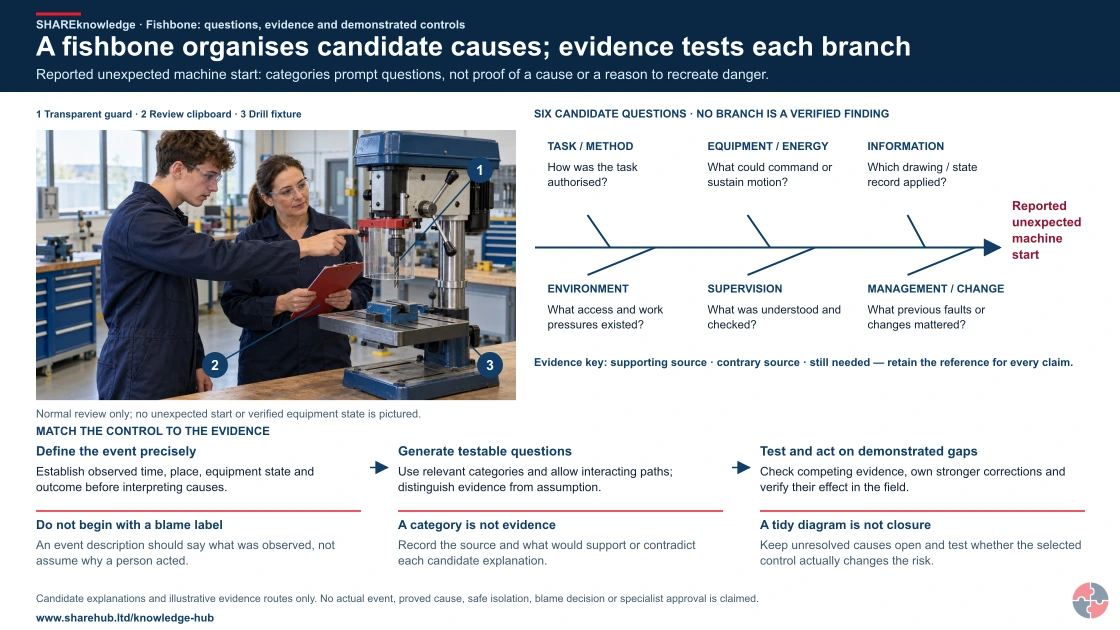
A fishbone organises candidate causes; evidence tests each branch
Full written explanation
A normal workshop scene shows a drill fixture, transparent guard and review clipboard beside a separate analytical fishbone. Picture key: 1 Transparent guard · 2 Review clipboard · 3 Drill fixture. No unexpected start or incident is pictured. One rightward fishbone spine ends at the neutral reported unexpected-machine-start statement; six question branches address task/method, equipment/energy, information, environment, supervision and management/change. None is a verified finding. Supporting sources, contrary sources and material still needed must remain linked to each claim. Three paired explanations define the event, generate testable questions and test demonstrated gaps, with matching limits on blame, categories as evidence and premature closure. The scene establishes no actual cause, equipment state, safe isolation, competence, guard adequacy or permission.
Reported unexpected machine start: categories prompt questions, not proof of a cause or a reason to recreate danger.
- Define the event precisely. Establish observed time, place, equipment state and outcome before interpreting causes.
- Generate testable questions. Use relevant categories and allow interacting paths; distinguish evidence from assumption.
- Test and act on demonstrated gaps. Check competing evidence, own stronger corrections and verify their effect in the field.
Change the pathway
- Do not begin with a blame label. An event description should say what was observed, not assume why a person acted.
- A category is not evidence. Record the source and what would support or contradict each candidate explanation.
- A tidy diagram is not closure. Keep unresolved causes open and test whether the selected control actually changes the risk.
Evidence check: Candidate explanations and illustrative evidence routes only. No actual event, proved cause, safe isolation, blame decision or specialist approval is claimed.
Read the source, supporting/contrary evidence and verified-control explanation
Primary references: HSE: HSG245 investigation stages, 2004 · HSE: human factors in investigation · HSE: safe electrical working scope
Open the complete HD image (new tab)Download image
Read the source, supporting/contrary evidence and verified-control explanation
Primary references: HSE: HSG245 investigation stages, 2004 · HSE: human factors in investigation · HSE: safe electrical working scope

Define the event
Use a specific delivery near miss, its time, place and observed outcome rather than a vague label such as unsafe behaviour.
Branch the questions
Consider task, equipment, environment and management arrangements; allow more than one interacting path.
Tag the evidence
Distinguish supported evidence, unresolved checks and explanations contradicted by evidence. Link each claim to its source.
Act on the demonstrated gap
Assign controls, an owner and a field acceptance test. Keep uncertain causes open; a completed diagram is not an investigation conclusion.
Read the complete task-specific control examples
ERICPD is a planning cross-map: Discipline verifies and sustains every control. ESEAP compares effectiveness. A label does not authorise the task; retain the owner, evidence and stop or change decision.
Fishbone Analysis for Incident Investigation · ERICPD
- Eliminate
- Remove pedestrian movement from the delivery zone through a redesigned route or delivery plan.
- Reduce
- Use a forward-only traffic plan or different delivery method if site geometry allows.
- Isolate
- Install robust physical pedestrian-vehicle segregation and protect crossings.
- Control
- Set booked delivery windows, banksman rules, change approval and contractor briefing.
- PPE
- Use visibility PPE for residual traffic risk; it cannot substitute for separation.
- Discipline
- Review near misses, delivery changes and barrier inspections; investigate repeat failures.
Fishbone Analysis for Incident Investigation · ESEAP
- Elimination
- Remove pedestrian movement from the delivery zone through a redesigned route or delivery plan.
- Substitution
- Use a forward-only traffic plan or different delivery method if site geometry allows.
- Engineering controls
- Install robust physical pedestrian-vehicle segregation and protect crossings.
- Administrative controls
- Set booked delivery windows, banksman rules, change approval and contractor briefing.
- PPE
- Use visibility PPE for residual traffic risk; it cannot substitute for separation.
What are the key points about fishbone analysis?
A fishbone diagram organises hypotheses about an incident; it does not prove a root cause. Preserve facts first, test each branch against evidence, then choose controls and verify that they work.
It is a structure, not a conclusion
A completed diagram is not proof. It is a map of possible and confirmed contributors that need testing.
Start with a neutral event statement
The head of the fishbone should describe what happened, not who is believed to be at fault.
Use categories that fit the incident
Generic categories can help, but workplace investigations usually need management system, contractor, interface and human factors branches.
Separate evidence from opinion
Possible causes should be labelled, tested and either confirmed, disproved or kept open for further enquiry.
Avoid the retraining reflex
Training may be relevant, but weak design, poor equipment, unclear instructions, production pressure or failed supervision may be more important.
Actions must be verified
A good investigation ends with owners, timescales, resources and checks that the action actually reduced risk.
HSE HSG245 sets out evidence gathering, analysis, risk-control selection and an action plan. It is guidance from 2004, not a current reporting law.
What is fishbone analysis in incident investigation?
Fishbone analysis is a visual cause-and-effect method used to organise how several possible contributors may have combined to produce an incident.
The method is sometimes called Ishikawa analysis because it originated in quality improvement, but the thinking is valuable in health and safety because incidents rarely have one neat cause. A person may make an error, but that error may sit inside poor work design, unavailable equipment, weak supervision, time pressure, poor maintenance, unsuitable procedures, contractor interface problems or management system drift.
A fishbone diagram places the event at the head. The main bones hold broad cause categories. The smaller bones hold possible causes, evidence questions and confirmed findings. The diagram helps the team resist the temptation to stop at the first visible act or condition.
| Part | Purpose | Good practice |
|---|---|---|
| Head | Defines the incident, near miss or problem being analysed. | Use a neutral, specific event statement with actual and potential consequence. |
| Backbone | Connects categories to the event. | Keep all branches focused on the same defined event. |
| Main bones | Organise possible causes into categories. | Choose categories that fit the work and incident. |
| Small bones | Show possible causes, deeper questions or evidence lines. | Write causes as controllable conditions, not accusations. |
| Evidence status | Shows whether each cause is confirmed, possible, disproved or still open. | Do not hide uncertainty; investigate it or remove it. |
| Findings and actions | Convert verified causes into improvements. | Link each action to a finding and define an effectiveness check. |
When should fishbone analysis be used?
Fishbone analysis is most useful when an event has several possible contributors and the organisation needs a balanced, evidence-led view.
It can be used for accidents, near misses, dangerous occurrences, quality failures, environmental events, process safety upsets, repeated minor injuries, audit non-conformances and weak signals. The depth should be proportionate to actual and potential harm.
A minor event with low potential may need a compact fishbone discussion. A fatality, major injury, dangerous occurrence, fire, explosion, toxic release, high-potential near miss or repeated pattern needs stronger governance, preserved evidence, competent investigators and management oversight.
| Situation | Why fishbone helps | Depth needed |
|---|---|---|
| Near miss with high potential | Shows how several weak controls nearly aligned into serious harm. | Formal enough to preserve evidence and assign actions. |
| Repeated minor incidents | Prevents normalising weak signals and identifies recurring system weaknesses. | Trend review plus cause analysis. |
| Complex event | Organises people, plant, method, environment, material and management factors without oversimplifying. | Competent multi-disciplinary team. |
| Disagreement about cause | Makes competing theories visible and testable. | Evidence status and open questions. |
| Learning review | Helps workers and managers discuss real work without blame. | Facilitated session with worker input. |
Where does fishbone analysis sit in the investigation process?
Fishbone analysis belongs after immediate response and evidence gathering, and before final findings and corrective actions are approved.
The sequence matters. If the team starts drawing a fishbone before it has evidence, the diagram can become a record of assumptions. If the team waits until the report is finished, it becomes decorative rather than analytical.
A practical investigation first makes the situation safe, preserves evidence, records early accounts, gathers documents and builds a timeline. Fishbone analysis can then help organise the causes behind the timeline. Findings should be tested, converted into controls and reviewed for action effectiveness.
| Stage | What happens | Fishbone contribution |
|---|---|---|
| Immediate response | Treat casualties, make the area safe, preserve life and prevent escalation. | Do not start analysis until emergency needs are controlled. |
| Evidence gathering | Collect photographs, statements, records, permits, training, maintenance, inspection and digital evidence. | Create evidence questions for each branch. |
| Timeline building | Describe what happened before, during and after the event. | Use the timeline to check whether suggested causes fit the facts. |
| Cause analysis | Identify immediate, underlying and system-level contributors. | Organise possible causes and test interactions. |
| Control selection | Choose actions that reduce risk and strengthen barriers. | Avoid actions that do not address verified causes. |
| Action review | Check whether actions were completed and effective. | Close the loop rather than filing the diagram. |
How should a fishbone diagram be built step by step?
A good fishbone diagram starts with the event, adds relevant categories, captures possible causes, tests evidence and ends with verified findings.
| Step | Practical instruction | Quality test |
|---|---|---|
| 1. Define the event | Write a neutral event statement with what happened, where, when and actual/potential consequence. | Would someone unfamiliar with the event understand the problem without seeing blame? |
| 2. Choose categories | Select categories that fit the work and risk, not just a default template. | Do the categories make system factors visible? |
| 3. Add possible causes | Capture possible contributors from evidence, interviews, worker knowledge and technical review. | Is each cause written as a condition or question rather than a judgement? |
| 4. Ask deeper questions | Use Five Whys or barrier questions under important branches. | Does the branch move beyond the immediate event? |
| 5. Test evidence | Mark causes confirmed, possible, disproved or open. | Can each confirmed cause be supported by evidence? |
| 6. Identify interactions | Look for how branches combined, such as poor planning plus unavailable equipment plus time pressure. | Does the analysis explain why the event happened then? |
| 7. Convert to actions | Write actions that address verified findings and can be checked. | Would the action reduce recurrence or only tell people to be careful? |
Which fishbone categories work best for safety investigations?
Safety investigations should use categories that reveal work-system conditions, not only immediate behaviour.
Traditional fishbone categories such as people, machine, method, material, measurement and environment can be helpful, but they can also miss important safety management factors. For health and safety, categories should make visible the things that shape work: design, maintenance, supervision, competence, contractor control, communication, change management, production pressure, procurement and monitoring.
The category names are less important than the questions they prompt. If a category leads only to 'operator error', it is not doing enough work.
| Category | Investigation prompts | Example evidence |
|---|---|---|
| People | Competence, staffing, fatigue, workload, communication, supervision, language, worker involvement and decision making. | Training records, shift pattern, interview notes, competence checks and supervision logs. |
| Plant and equipment | Design, guarding, isolation, maintenance, suitability, alarms, controls, reliability and modification. | Inspection records, maintenance history, photographs, design information and defect reports. |
| Procedures and work method | Risk assessment, method statement, permit-to-work, handover, sequencing and emergency arrangements. | RAMS, permits, procedures, job packs, toolbox talks and handover records. |
| Workplace and environment | Layout, access, lighting, weather, noise, housekeeping, ground conditions, welfare and interfaces. | Site photos, inspection records, environmental data and worker accounts. |
| Materials and substances | Storage, labelling, compatibility, condition, contamination, hazardous properties and waste. | SDS, COSHH assessment, batch records, labels and sampling results. |
| Management system | Leadership, planning, procurement, contractor control, MOC, audit, monitoring, learning, resources and culture. | Policy, audit, inspection, action tracker, management review and change records. |
| External/interface factors | Client requirements, delivery pressure, shared premises, contractor interfaces, public access or regulatory constraints. | Contract documents, interface plans, delivery records and communications. |
What evidence should be tested before causes are accepted?
Mark each proposed cause as fact, supported inference or untested hypothesis; test against time sequence, physical evidence, maintenance records and people who did the work. Disconfirming evidence matters as much as supporting evidence.
Evidence quality is the difference between a useful investigation and a tidy story. Facts are supported by records, observations, measurements, physical evidence or consistent witness information. Inferences may be reasonable, but they should be labelled. Assumptions should either be investigated or removed before the final report.
Good investigations also protect witness confidence. Interviews should explore what the person saw, heard, understood, expected and experienced, not push them towards a preferred theory.
| Evidence type | Examples | How to use it |
|---|---|---|
| Physical evidence | Scene condition, damaged parts, PPE, guards, labels, spill patterns, isolation points and control settings. | Photograph, preserve and compare with expected condition. |
| Documentary evidence | Risk assessments, method statements, permits, maintenance, inspection, training, supervision and audit records. | Check whether the documented system matched the work as done. |
| Digital evidence | CCTV, access logs, telemetry, alarm history, process data, photographs, messages and maintenance systems. | Use time stamps to build or test the timeline. |
| People evidence | Witness accounts, worker experience, supervisor explanation, contractor input and technical specialist views. | Interview respectfully and test consistency against other evidence. |
| Context evidence | Workload, production pressure, staffing, weather, lighting, fatigue, recent change and emergency response context. | Explain why decisions and conditions made sense at the time. |
How should a fishbone session be facilitated?
A good facilitator keeps the discussion neutral, evidence-led, worker-informed and focused on controllable improvements.
Fishbone sessions can go wrong when they become a debate about who was at fault. The facilitator should protect the quality of thinking: separate facts from assumptions, invite quieter voices, challenge unsupported claims, prevent seniority from dominating and keep the group focused on learning.
The best sessions include people who understand the work as imagined and the work as done. That often means involving workers, supervisors, maintenance, engineering, contractors, safety advisers and managers with authority to act.
| Rule | Why it matters | Facilitator prompt |
|---|---|---|
| Start with evidence | Prevents the session becoming speculation. | What evidence supports that branch? |
| Avoid blame language | Keeps focus on work-system conditions. | What made that action likely or reasonable at the time? |
| Use worker knowledge | Reveals informal controls, adaptations and practical barriers. | How is the task normally done on a busy day? |
| Do not fill branches for symmetry | Empty branches are better than invented causes. | Is this category relevant to this event? |
| Keep open questions visible | Prevents uncertainty being hidden as a finding. | What do we still need to check? |
| Test action strength | Avoids weak actions such as reminders where stronger controls are needed. | What would make recurrence less likely without relying only on memory? |
What does a good fishbone analysis look like in practice?
A good fishbone shows how several conditions combined and then turns verified findings into stronger controls.
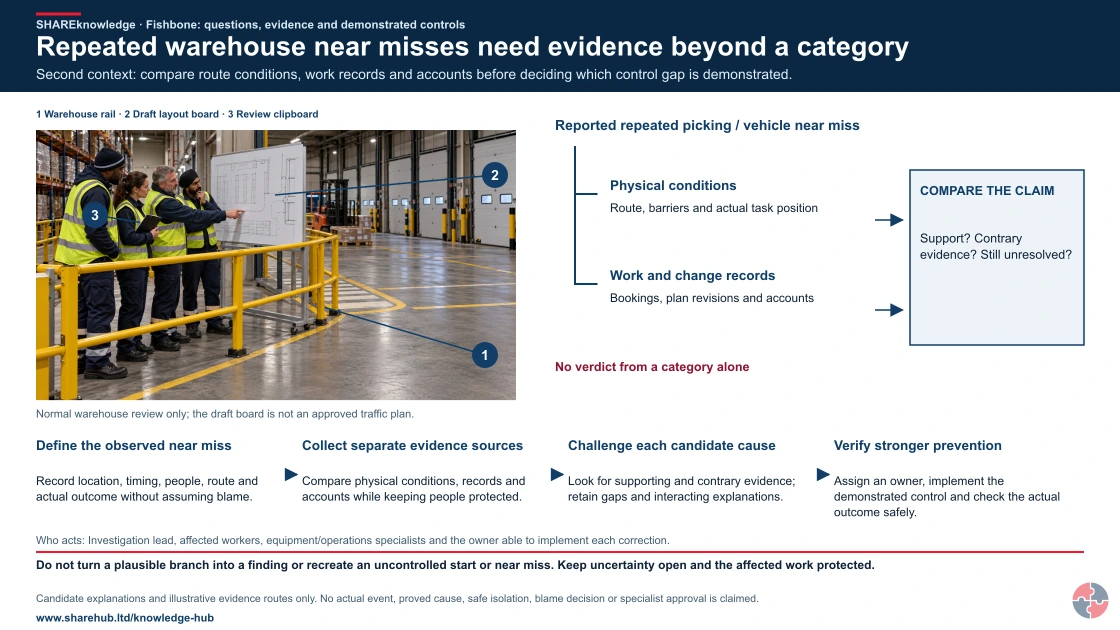
Repeated warehouse near misses need evidence beyond a category
Full written explanation
A normal warehouse review scene shows a rail, draft layout board and clipboard beside a separate evidence comparison. Picture key: 1 Warehouse rail · 2 Draft layout board · 3 Review clipboard. The draft board is not an approved traffic plan. A reported repeated picking/vehicle near miss feeds two distinct evidence lanes: physical conditions, including route, barriers and actual task position; and work/change records, including bookings, plan revisions and accounts. Both enter a comparison that may support, contradict or leave a claim unresolved. No category alone establishes a verdict. Four unnumbered checks define the observed near miss, collect separate evidence, challenge candidate causes and verify stronger prevention. Keep uncertainty open and affected work protected; do not recreate an uncontrolled start or near miss. No pictured person, rail or document proves a cause, role, safety state, clearance or permission.
Second context: compare route conditions, work records and accounts before deciding which control gap is demonstrated.
- Define the observed near miss. Record location, timing, people, route and actual outcome without assuming blame.
- Collect separate evidence sources. Compare physical conditions, records and accounts while keeping people protected.
- Challenge each candidate cause. Look for supporting and contrary evidence; retain gaps and interacting explanations.
- Verify stronger prevention. Assign an owner, implement the demonstrated control and check the actual outcome safely.
When the evidence does not fit: Do not turn a plausible branch into a finding or recreate an uncontrolled start or near miss. Keep uncertainty open and the affected work protected.
Who acts: Investigation lead, affected workers, equipment/operations specialists and the owner able to implement each correction.
Changed workplace
Machine workshop: Use a reported start to generate and test equipment, task and organisational questions.
Warehouse picking: Compare physical and documentary evidence before selecting and testing prevention.
Evidence check: Candidate explanations and illustrative evidence routes only. No actual event, proved cause, safe isolation, blame decision or specialist approval is claimed.
Read the source, supporting/contrary evidence and verified-control explanation
Primary references: HSE: HSG245 investigation stages, 2004 · HSE: human factors in investigation · HSE: safe electrical working scope
Open the complete HD image (new tab)Download image
Read the source, supporting/contrary evidence and verified-control explanation
Primary references: HSE: HSG245 investigation stages, 2004 · HSE: human factors in investigation · HSE: safe electrical working scope
Consider a maintenance technician who receives a minor electric shock while replacing a pump motor during planned maintenance. A weak investigation might stop at 'technician failed to isolate correctly'. A better fishbone tests whether the isolation system, permit, labelling, competence, supervision, equipment condition and previous changes all influenced the event.
The point is not to excuse unsafe behaviour. It is to understand why the system allowed unsafe conditions to exist or go undetected, then improve the system so the next person is not protected only by luck.
| Branch | Example finding | Possible stronger action |
|---|---|---|
| People | Technician believed the local isolator controlled the whole circuit; supervisor was covering two jobs. | Refresh isolation competence and set independent verification for defined electrical tasks. |
| Plant and equipment | Local isolator was poorly labelled and distribution changes were not reflected in the local diagram. | Relabel isolators and verify drawings against site condition. |
| Procedure and method | Permit did not require prove-dead testing for this category of task. | Revise permit and isolation checklist with a hold point. |
| Workplace environment | Line was congested and job was being completed during a tight outage window. | Plan access and realistic outage time before work release. |
| Management system | Previous electrical defects were closed administratively without field verification. | Add field verification to close-out for safety-critical defects. |
| Verified conclusion | The event resulted from weak isolation verification, inaccurate equipment information and production pressure, not a single personal failure. | Combine engineering, procedure, competence and supervision actions with effectiveness checks. |
How should immediate, underlying and root causes be written?
Causal language should explain controllable conditions clearly enough that effective action becomes possible.
Investigations often become confused because terms such as immediate cause, underlying cause and root cause are used loosely. In practice, the language should help the reader understand what directly happened, what allowed it to happen and what management system weakness sat behind it.
Avoid writing causes as moral judgements. 'Worker careless' is weak and difficult to improve. 'Task instructions did not identify the isolation point and no independent verification was required' is a controllable finding.
| Cause type | Plain English meaning | Better wording example |
|---|---|---|
| Immediate cause | The unsafe act, unsafe condition, agent or event closest to the harm. | Hand contacted an energised conductor during motor replacement. |
| Underlying cause | The work condition that allowed the immediate cause to arise. | Isolation checklist did not require prove-dead testing for the task. |
| Root or system cause | The deeper management failure from which other weaknesses grew. | Electrical modification records were not controlled or field-verified after changes. |
| Possible cause | A plausible contributor that needs testing. | Supervisor workload may have reduced pre-job verification; check job allocation records. |
| Hypothesis not supported | Testing has not supported the proposed contributor; retain and investigate any remaining uncertainty. | Training records, interviews and observed relevant task performance did not support a knowledge-gap hypothesis; a current certificate alone does not prove competence. |
| Open question | An important uncertainty still requiring enquiry. | Confirm whether the local isolator had been changed during the previous project. |
How should fishbone findings become effective actions?
Translate verified control failures into named, resourced actions, selecting stronger prevention before procedural reminders. An action closes only after installation, field test and an effectiveness check at the affected task.
A fishbone with weak actions is only a neat diagram. The action plan should show what will change in the workplace, who owns it, when it will happen, what resource is needed and how the organisation will know the risk has reduced.
Strong actions normally change design, equipment, isolation, work planning, access, staffing, supervision, procurement, maintenance, information or verification. Weak actions often rely only on telling people to take more care.
| Action type | Strength | Example |
|---|---|---|
| Eliminate or redesign | Strong | Remove the need for manual intervention near moving machinery. |
| Engineering or physical control | Strong | Install fixed segregation between vehicles and pedestrians. |
| System change | Strong to medium | Add permit hold point, independent verification or change-control trigger. |
| Competence and supervision | Medium | Target training to a proven gap and verify task performance afterwards. |
| Procedure update | Medium to weak unless supported | Revise the procedure and brief workers, then check use in the field. |
| Reminder or poster | Weak if used alone | Only suitable as supporting communication, not the main corrective action for a serious finding. |
How can the hierarchy of controls turn fishbone investigation findings into stronger risk controls?
Apply ERICPD and the five-level hierarchy to the hazard revealed by an investigation, not to the fishbone drawing. Test whether the selected measure removes or contains the exposure in real work.
The scenarios illustrate control selection; actual causal findings and specialist design suitability require evidence and competent review.
At a construction site, a near miss reveals temporary delivery changes, a cone-only walkway and a dirty reversing aid. The diagram prompts investigation; verified traffic exposure drives control.
A workshop decanting station sees several small spills. A fishbone suggests possible container, coupling, maintenance and scheduling contributors; each needs evidence before a finding is accepted.
How can the ERICPD hierarchy of controls turn fishbone investigation findings into stronger risk controls?

| Hazard and harm route | ERICPD → five-level control | Task intervention and feasibility | Owner, test and evidence | Failure and stop decision |
|---|---|---|---|---|
| Telehandler reverses near pedestrian | Eliminate → Elimination | Remove pedestrian movement from the delivery zone through a redesigned route or delivery plan. Source: official guidance. | Site manager tests actual deliveries and foot routes. | People still cross the reversing path: reject the redesign. |
| Same scenario | Reduce → Substitution | Use a forward-only traffic plan or different delivery method if site geometry allows. Source: official guidance. | Logistics lead trials peak deliveries and checks access. | Method recreates blind reversing: reject it. |
| Same scenario | Isolate → Engineering | Install robust physical pedestrian-vehicle segregation and protect crossings. Source: official guidance. | Site engineer inspects barriers and sight lines in operation. | Barrier absent, moved or breached: hold vehicle movement. |
| Same scenario | Control → Administrative | Set booked delivery windows, banksman rules, change approval and contractor briefing. Source: official guidance. | Supervisor observes a live delivery and signs changed layout. | Unbriefed driver or altered route: stop delivery. |
| Same scenario | PPE → PPE | Use visibility PPE for residual traffic risk; it cannot substitute for separation. Source: official guidance. | Supervisor checks suitable wear and takes no credit for it as a barrier. | Plan depends on visibility clothing alone: reject. |
| Same scenario | Discipline → Administrative assurance | Review near misses, delivery changes and barrier inspections; investigate repeat failures. Source: official guidance. | Project lead records effectiveness walk and action closeout. | Near miss repeats after closure: reopen findings and restrict movement. |
| Repeated solvent spills at workshop decanting station | Eliminate → Elimination | Remove open manual decanting by using a sealed delivery method where feasible. Source: official guidance. | Process engineer trials throughput and verifies absence of open transfer. | Manual pour remains as routine workaround: reject claimed elimination. |
| Same scenario | Reduce → Substitution | Choose a lower-risk material or smaller transfer batch after product assessment. Source: official guidance. | Technical owner checks product and spill data. | Substitute introduces another uncontrolled hazard: reject. |
| Same scenario | Isolate → Engineering | Use compatible closed couplings, containment and appropriate isolation to stop a release reaching people or ignition. Source: official guidance. | Maintenance and process leads inspect installed function. | Leak or failed containment: stop transfer. |
| Same scenario | Control → Administrative | Use pre-use checks, clear change approval and a trained transfer sequence with emergency withdrawal. Source: official guidance. | Shift lead observes task and checks permit and records. | Procedure diverges from actual equipment: hold task. |
| Same scenario | PPE → PPE | Select chemical PPE from actual substance data for residual splash, not as the primary release control. Source: official guidance. | Supervisor checks material compatibility and fit. | Unknown substance or incompatible PPE: stop task. |
| Same scenario | Discipline → Administrative assurance | Trend spills, test corrective-action effectiveness and revisit unverified fishbone branches. Source: official guidance. | Investigation owner reviews recurrence and closes only with field evidence. | Spill recurs after action: reopen investigation and halt affected method. |
How can the ISO 45001 hierarchy of controls turn fishbone investigation findings into stronger risk controls?

| Hazard and harm route | ERICPD → five-level control | Task intervention and feasibility | Owner, test and evidence | Failure and stop decision |
|---|---|---|---|---|
| Telehandler reverses near pedestrian | Eliminate → Elimination | Remove pedestrian movement from the delivery zone through a redesigned route or delivery plan. Source: official guidance. | Site manager tests actual deliveries and foot routes. | People still cross the reversing path: reject the redesign. |
| Same scenario | Reduce → Substitution | Use a forward-only traffic plan or different delivery method if site geometry allows. Source: official guidance. | Logistics lead trials peak deliveries and checks access. | Method recreates blind reversing: reject it. |
| Same scenario | Isolate → Engineering | Install robust physical pedestrian-vehicle segregation and protect crossings. Source: official guidance. | Site engineer inspects barriers and sight lines in operation. | Barrier absent, moved or breached: hold vehicle movement. |
| Same scenario | Control → Administrative | Set booked delivery windows, banksman rules, change approval and contractor briefing. Source: official guidance. | Supervisor observes a live delivery and signs changed layout. | Unbriefed driver or altered route: stop delivery. |
| Same scenario | PPE → PPE | Use visibility PPE for residual traffic risk; it cannot substitute for separation. Source: official guidance. | Supervisor checks suitable wear and takes no credit for it as a barrier. | Plan depends on visibility clothing alone: reject. |
| Same scenario | Discipline → Administrative assurance | Review near misses, delivery changes and barrier inspections; investigate repeat failures. Source: official guidance. | Project lead records effectiveness walk and action closeout. | Near miss repeats after closure: reopen findings and restrict movement. |
| Repeated solvent spills at workshop decanting station | Eliminate → Elimination | Remove open manual decanting by using a sealed delivery method where feasible. Source: official guidance. | Process engineer trials throughput and verifies absence of open transfer. | Manual pour remains as routine workaround: reject claimed elimination. |
| Same scenario | Reduce → Substitution | Choose a lower-risk material or smaller transfer batch after product assessment. Source: official guidance. | Technical owner checks product and spill data. | Substitute introduces another uncontrolled hazard: reject. |
| Same scenario | Isolate → Engineering | Use compatible closed couplings, containment and appropriate isolation to stop a release reaching people or ignition. Source: official guidance. | Maintenance and process leads inspect installed function. | Leak or failed containment: stop transfer. |
| Same scenario | Control → Administrative | Use pre-use checks, clear change approval and a trained transfer sequence with emergency withdrawal. Source: official guidance. | Shift lead observes task and checks permit and records. | Procedure diverges from actual equipment: hold task. |
| Same scenario | PPE → PPE | Select chemical PPE from actual substance data for residual splash, not as the primary release control. Source: official guidance. | Supervisor checks material compatibility and fit. | Unknown substance or incompatible PPE: stop task. |
| Same scenario | Discipline → Administrative assurance | Trend spills, test corrective-action effectiveness and revisit unverified fishbone branches. Source: official guidance. | Investigation owner reviews recurrence and closes only with field evidence. | Spill recurs after action: reopen investigation and halt affected method. |
What are the limitations of fishbone analysis?
A fishbone can hide sequence, interactions and uncertainty if branches are treated as a checklist. For complex or high-consequence events, pair it with a timeline, barrier analysis and competent specialist review.
The tool has limits. It can oversimplify timelines, hide interactions, create false certainty and make every branch look equally important. It may also underplay technical engineering issues if the team does not include competent specialists.
Use fishbone alongside timeline analysis, witness interviews, barrier review, task observation, technical assessment and Five Whys where needed. For major accidents, process safety events, structural failures, complex medical issues or legal sensitivity, competent specialist investigation may be necessary.
| Limitation | Why it matters | Safeguard |
|---|---|---|
| Speculation becomes fact | Teams may accept a plausible theory too early. | Use evidence status for every branch. |
| Blame focus | Worker behaviour can dominate while system factors are missed. | Ask what made the behaviour likely. |
| Timeline gets lost | Fishbone categories may hide sequence and timing. | Build and test against a timeline. |
| Weak action planning | The diagram is filed without risk reduction. | Link actions to findings and verify effectiveness. |
| Technical gaps | Specialist failure modes may be missed. | Bring in engineering, occupational health or process safety competence where needed. |
Use HSE human-factors material to test job, individual and organisational influences without stopping at blame.
Which investigation and reporting rules apply by jurisdiction?
Fishbone analysis is a voluntary investigation method, not a named legal duty. GB and NI reporting regimes differ, while risk management and corrective action still require the employer to learn from credible failures.
HSG245 is an HSE investigation workbook from 2004. It remains a useful method source for gathering evidence, analysing causes, identifying controls and action planning, but its edition date must not be presented as current law.
Screen reportability separately from the learning investigation. GB RIDDOR 2013 and NI RIDDOR 1997 are distinct instruments. For example, the GB over-seven-day reporting threshold must not be copied into the NI over-three-day route; check the actual NI rules and regulator guidance.
| Jurisdiction | Duty or regulation | What it means in practice | Evidence to keep |
|---|---|---|---|
| GB | RIDDOR 2013 | GB specified reportable work-related events and thresholds. | GB screening, reference and report date. |
| NI | RIDDOR (NI) 1997 | Separate NI reporting rules and thresholds. | NI screening, reference and report date. |
| GB | Health and Safety at Work etc. Act 1974 | GB general duties to manage work-created risk. | Risk control and corrective-action evidence. |
| GB | Management of Health and Safety at Work Regulations 1999 | GB risk assessment and preventive arrangements. | Revised assessment and implemented controls. |
| NI | Health and Safety at Work (NI) Order 1978 | Separate NI general work-health duties. | NI risk-control and corrective-action evidence. |
| NI | Management of Health and Safety at Work Regulations (NI) 2000 | Separate NI risk-assessment and management route. | NI revised assessment and control record. |
| GB | HSE HSG245 | Investigation method guidance, not a statutory fishbone requirement. | Evidence log, causal test and corrective-action plan. |
Read HSE HSG245 for method, and HSE human factors for performance-influencing conditions.
For notification use GB RIDDOR or HSENI reporting guidance and the NI instrument for the actual jurisdiction.
What should an investigation action register include?
The action register should connect verified causes to corrective actions, owners, deadlines and effectiveness checks.
| Field | Purpose | Example |
|---|---|---|
| Event reference | Links the action to the incident or near miss. | INV-2026-014 |
| Verified finding | Shows which causal factor the action addresses. | Isolation checklist did not match equipment layout. |
| Control weakness | Identifies the failed or missing barrier. | No independent verification for electrical isolation. |
| Action | States the practical change. | Revise checklist and introduce prove-dead hold point. |
| Owner and due date | Creates accountability. | Maintenance manager, 30 September 2026. |
| Interim control | Manages risk before final action is complete. | Stop affected motor-replacement work until a competent person verifies safe isolation and proving dead; record field checks before release. |
| Effectiveness check | Confirms whether the action worked. | Sample five permits and observe two jobs after rollout. |
| Wider applicability | Checks whether the same weakness exists elsewhere. | Review all similar lines and older distribution boards. |
How could BuildOut Ltd use fishbone analysis?

BuildOut Ltd would use fishbone analysis to learn from construction incidents without jumping straight to worker blame.
BuildOut Ltd
BuildOut Ltd is a construction and refurbishment contractor used by SHARE to show how health and safety topics apply in a practical business context.
After a near miss where a reversing telehandler passed close to a pedestrian, BuildOut does not stop at 'pedestrian entered the wrong area'. The site manager secures statements, photographs the traffic route, downloads telehandler checks, reviews the construction phase plan, checks induction records and confirms whether the temporary delivery layout had changed.
The fishbone session includes the site manager, supervisor, telehandler operator, pedestrian worker, logistics lead, subcontractor representative and safety adviser. Branches cover people, plant, traffic route, work method, environment, contractor interface and management system. The team finds that the delivery booking changed, segregation was marked with cones rather than barriers, the reversing camera was dirty, the pedestrian route had been moved without briefing and previous near misses had not been escalated.
Actions are practical and verified: install physical segregation, revise the delivery booking system, add a temporary-change hold point, clean and inspect reversing aids, brief contractors, update the traffic management plan and review near-miss trends weekly until stable. Senior management reviews whether other projects have the same temporary logistics weakness.
| Management step | How BuildOut applies it | Evidence |
|---|---|---|
| Assess | Classifies the near miss by potential severity, not only actual harm. | Investigation level decision. |
| Analyse | Uses fishbone categories to test people, plant, route, method, environment and management system factors. | Completed evidence-led diagram. |
| Train | Briefs supervisors on neutral event statements and evidence status. | Investigator training record. |
| Implement | Converts findings into physical segregation, planning and contractor-control actions. | Action tracker and updated traffic plan. |
| Check | Verifies actions through site inspections and delivery observations. | Inspection records and close-out photographs. |
| Learn | Shares the case across projects and checks for similar temporary layout risks. | Learning bulletin and project review minutes. |
Who needs investigation competence, and how is it tested?
Use a sample incident to assess evidence preservation, neutral causal language, source-scope decisions and verified corrective action, not course attendance alone.
| Role | Learning to test | Competence demonstration | Assessor and record | Reassessment trigger |
|---|---|---|---|---|
| Workers and witnesses | Know how to preserve immediate facts and report without blame. | Describe sequence and show a contemporaneous note. | Supervisor records briefing. | Incident or reporting-process change. |
| Supervisors | Make scene safe, preserve evidence and screen reportability. | Demonstrate evidence handover and GB/NI route decision. | Investigation lead reviews exercise. | Location, threshold or duty change. |
| Investigators | Separate fact, hypothesis and inference; test counter-evidence. | Build timeline and fishbone from sample records. | Competent lead reviews causal justification. | Complex event or method gap. |
| Technical specialists | Test equipment and human-factor findings in high-consequence cases. | Validate the proposed failure through safe analysis or controlled tests; do not recreate exposure to live energy or hazardous substances. | Independent technical authority signs finding. | New evidence or design change. |
| Action owners | Select stronger controls and prove field effectiveness. | Show implementation, observation and recurrence check. | Senior sponsor signs action closure. | Repeated event or failed control. |
How does fishbone analysis support study and professional development?
Fishbone analysis helps learners explain how an organisation moves from incident facts to immediate, underlying and root causes.
Practise explaining the decisions supported by fishbone analysis. Explain that it is used inside an investigation process: gather information, analyse causes, identify risk control measures, implement actions and review effectiveness.
Apply the method to a specific scenario. If the event involves a forklift near miss, discuss traffic routes, visibility, segregation, supervision, training, maintenance, delivery planning and previous near misses. If the event involves a chemical splash, discuss SDS, COSHH assessment, PPE, eye-wash, training, storage, supervision and emergency response.
Professional investigators should also understand the human factors boundary: people rarely fail in a vacuum. Explore job design, equipment, environment, workload, competence, communication and organisational pressures before writing findings.
| What to know | How to apply it | Common exam or workplace trap |
|---|---|---|
| HSG245 stages | Place fishbone inside information gathering, analysis, control selection and action planning. | Starting with causes before facts are known. |
| Cause levels | Separate immediate, underlying and root/system causes. | Calling every cause a root cause. |
| Evidence status | Mark possible, confirmed, disproved and open causes. | Treating opinion as fact. |
| Human factors | Consider job, individual and organisation factors. | Stopping at worker error. |
| Action strength | Select controls that address findings and can be checked. | Writing 'retrain staff' as the only action. |
How can BS EN ISO 45001 support fishbone analysis for incident investigation management?
A voluntary occupational health and safety system can connect incident investigation, verified causes, corrective action and effectiveness checks without treating a diagram as proof of causation.
HSE public guidance supports practical management themes in Great Britain. ISO clause mapping, conformity and certification claims remain held for current licensed-text and specialist review; this page does not establish compliance or certification.
What are the warning signs of poor fishbone analysis?
Poor fishbone analysis usually feels tidy but weak: it names causes without evidence and actions without real control improvement.
| Warning sign | Why it weakens learning | Better practice |
|---|---|---|
| The event statement blames someone | The team starts from a conclusion. | Use neutral wording focused on what happened. |
| Every branch is filled equally | Symmetry may be valued over relevance. | Use only categories that fit the event. |
| No evidence status is shown | Possible causes become facts. | Mark confirmed, possible, disproved and open causes. |
| Worker error is the only finding | Job, equipment and organisation factors are missed. | Ask why the error was possible or likely. |
| Actions are mostly reminders | Risk is not reduced at source. | Use stronger engineering, planning, supervision and system controls. |
| No effectiveness review is planned | Actions may close administratively without reducing risk. | Define field checks, sampling or repeat-trend review. |
What do the acronyms and key terms mean?
Acronyms should be explained so investigation language remains accessible to workers, supervisors and learners.
| Acronym | Meaning | Plain English use |
|---|---|---|
| HSG245 | HSE guidance on investigating accidents and incidents | Main HSE workbook for workplace incident investigation. |
| HSE | Health and Safety Executive | Great Britain workplace health and safety regulator. |
| RIDDOR | Reporting of Injuries, Diseases and Dangerous Occurrences Regulations | GB 2013 and NI 1997 reporting regimes have different thresholds and routes. |
| SDS | Safety Data Sheet | Chemical information source that may be evidence in exposure or chemical incidents. |
| GB | Great Britain | GB RIDDOR 2013 route. |
| NI | Northern Ireland | Separate NI RIDDOR 1997 route. |
| ERICPD | Eliminate, Reduce, Isolate, Control, PPE, Discipline | Control-selection teaching aid, applied to verified hazards. |