SHARE Knowledge Hub
ACOPs, HSGs and INDG
Approved Codes of Practice (ACOPs), Health and Safety Guidance (HSG) books and the Health and Safety Executive (HSE) information document series (INDG) serve different purposes in Great Britain (GB). Start with the applicable law and task, check the current publication and its status, then turn the relevant advice into controls. In Northern Ireland (NI), check the Health and Safety Executive for Northern Ireland (HSENI) approval lists and NI law before using a GB ACOP. HSGs and INDG leaflets are guidance, not a substitute for a risk assessment or safe work.
Understanding ACOPs, HSGs and INDG
Approved Codes of Practice (ACOPs), Health and Safety Guidance (HSG) books and the Health and Safety Executive (HSE) information document series (INDG) serve different purposes in Great Britain (GB). Start with the applicable law and task, check the current publication and its status, then turn the relevant advice into controls. In Northern Ireland (NI), check the Health and Safety Executive for Northern Ireland (HSENI) approval lists and NI law before using a GB ACOP. HSGs and INDG leaflets are guidance, not a substitute for a risk assessment or safe work.
Why this matters at work
Leaders should ask which credible events could cause fatality or serious ill health, what recognised good practice says, which controls are impaired and how the organisation knows. Investment should follow risk rather than the visibility of a topic. When the full solution needs time, set defensible interim restrictions and a restoration plan; do not relabel an unresolved gap as accepted simply because it is expensive.
Active monitoring checks controls before harm occurs. Examples include workplace inspection, observation, maintenance compliance, exposure monitoring, competence sampling and testing of emergency arrangements. The frequency and depth should reflect the risk and rate of change.
How organisations manage this in practice
Connect the control with procurement, maintenance, competence, contractor coordination, supervision and emergency arrangements. Workers should understand the method and be able to use it under real conditions. Verify implementation by observing representative tasks, inspecting physical protection, sampling records and asking users about obstacles and workarounds. Combine active checks with incident and near miss learning. A completed course does not prove task competence and a current procedure does not prove it is workable. Give findings owners and deadlines and check effectiveness after action. Reassess when plant, substances, staffing, work methods or the source changes, and keep enough evidence to explain both the decision and what was actually implemented.
Plan includes leadership commitment, policy, risk profiling and prioritisation. Do includes worker involvement, competence, communication, control of contractors and implementation of precautions. Check includes active monitoring before harm and reactive learning after events. Act includes performance review and learning from evidence.
A small garage or hospitality business can use a proportionate sequence. List the significant activities and people, identify the main law and current HSE starting guidance, walk the workplace with workers, and decide what physical and organisational controls are needed. Assign actions, obtain competent help for vehicle lifts, electricity, gas, asbestos or other technical risks, and keep the records required by law. The owner should see whether controls work during normal and busy periods.
What is the scope and authority of this page?
Use this page to select and apply official safety publications; it does not replace the actual law, current source, manufacturer instructions or competent task assessment.
Workplace risk, not a publication code, drives the decision. First identify Great Britain or Northern Ireland, then the work, people, equipment or substance, binding duty and current official source. If the source gives a general explanation only, obtain the detailed task guidance before authorising high-risk work.
Use the law and an approved Code for its stated jurisdiction and matters; HSGs, INDG leaflets and local procedures are guidance routes with different force. If a source is withdrawn or two sources appear to conflict, pause the affected decision and check the live regulator record.
Select the right source for the actual duty
A useful source register starts with the task and work location. Identify the binding duty, then record whether the supporting publication is an approved Code or ordinary guidance. A publication series or an old identifier does not establish legal status, currentness or Northern Ireland approval.
Keep the exact clause and the resulting workplace decision together. When an alternative method is chosen, record the evidence supporting compliance with the applicable duty. Recheck the record when the law, publication, product or work changes, rather than treating a saved PDF as permanently current.
Guidance incorrectly described as an ACOP
Illustrative example. A refurbishment RAMS cites L153 as an approved Code and uses that description to support a design decision.
Decision. Correct the publication status and test the method against the applicable CDM duties and actual design risks.
Evidence to check. Keep the current law, exact L153 passage, work location and the design decision it informs.
Hold or escalation point. A document label cannot resolve missing design information or prove an NI approval position.
Follow-up. The RAMS owner checks affected source-register entries and briefs the corrected control basis.
What does each role need to do with official guidance?
Workers need usable controls; managers and advisers must establish the applicable source, approve the translation and verify that it works.
| Role | Before and during work | Stop or escalate | Evidence |
|---|---|---|---|
| Worker or contractor | Follow the task control and ask when it conflicts with the work or a source appears wrong. | Stop; tell the supervisor; do not improvise around a hazardous unknown. | Briefing, permit or task record and the raised query. |
| Supervisor | Check the current procedure and that people can apply it to the actual place, plant and change. | Hold the task when the source, material or method is unresolved. | Pre-start check, hold decision and hand-back sign-off. |
| Manager or dutyholder | Provide competent interpretation, resources and approval for departures from an ACOP approach. | Escalate an unproven alternative or a conflict with law. | Register, risk assessment, decision note and action owner. |
| Purchaser or maintainer | Translate the task specification into the correct equipment, product instructions and maintenance standard. | Do not accept an incompatible or undocumented substitute. | Specification, instructions, inspection and change record. |
| Safety adviser or auditor | Verify law, GB/NI scope, current source, ACOP status and effectiveness in real work. | Raise a gap when the source cannot be proved current or a control is absent. | Source register, sampling notes and close-out evidence. |
What is the difference between ACOPs, HSGs and INDG documents?
The main difference is legal status, level of detail and intended audience.
Law, an ACOP and guidance have different roles


Read this visual as text
- LEGISLATION: States the legal duties. Apply the instrument and provisions relevant to the actual work.
- APPROVED CODE: An ACOP has a special legal status for its approved scope. It is not itself the legislation.
- HSG / INDG: Guidance explains ways to manage risk. Check its content and scope rather than assuming that every guide is an ACOP.
Read the legal-status comparison together with the task, jurisdiction, exact title and edition. For Northern Ireland, confirm the relevant legal basis and ACOP approval rather than assuming a GB publication transfers unchanged.
UK health and safety law often states the duty in broad terms, such as controlling risk so far as is reasonably practicable, making a suitable and sufficient risk assessment, providing information and training, maintaining equipment or preventing exposure. Official guidance helps dutyholders understand how those duties can be met in practice.
The important mistake is treating every document as if it has the same force. An ACOP is not the same as a short leaflet. A short leaflet is not enough for a complex high-risk task. A technical HSG may be more useful for designing controls than a general awareness guide. An L-series title is not automatically an ACOP: L153 is guidance for CDM 2015, while L113 includes an ACOP and guidance. A robust management system knows which type of document it is using and why.
| Document type | What it normally means | How it should be used | Common misuse |
|---|---|---|---|
| Legislation | An Act or Regulation that creates a binding legal duty. | Use it to identify who owes the duty, what outcome is required and where the legal requirement sits in the legal register. | Quoting the law without translating it into practical controls, responsibilities and evidence. |
| ACOP | An Approved Code of Practice that gives practical advice on complying with particular legal duties and has special legal status. | Use it as a recognised compliance benchmark when writing procedures, auditing controls or assessing whether an alternative approach is equally effective. | Ignoring the ACOP or treating it as optional guidance without recording how equivalent compliance is achieved. |
| HSG | A Health and Safety Guidance publication that usually gives practical, technical or management guidance on a topic. | Use it for detailed control standards, examples, inspection points, management arrangements and training content. | Using it as a generic tick list without adapting it to the work, people, environment and risk. |
| INDG | An HSE information leaflet or brief guide, usually shorter and written for a broader audience. | Use it for awareness, worker briefings, small-business introductions and simple explanation of duties. | Relying on a brief leaflet as the only source for complex, specialist or high-consequence work. |
| HSE topic webpage | A current web page that explains a topic, signposts duties and links to deeper publications. | Use it as a starting point and route map to the correct guidance, ACOPs, forms or enforcement information. | Stopping at the web page and missing the more detailed publication or legal duty behind it. |
Follow a source into a workplace control
A publication code identifies a source; it does not establish that the source fits the job. Keep the jurisdiction and edition beside the advice so the distinction between law, ACOP and guidance survives a handover.
Identify the task and jurisdiction
Record the location, activity, substance or equipment and who may be exposed. Establish the applicable legislation for Great Britain or Northern Ireland.
Check the exact source
Record its title, publication code, edition or update date, relevant section and URL. For an ACOP, check its approval and scope; use the HSENI list when applying a GB publication in Northern Ireland.
Translate the relevant requirement
Identify the specific duty or control question. An alternative to relevant ACOP provisions must still achieve legal compliance; record the evidence and obtain competent advice where the interpretation is uncertain.
Verify the control in use
Connect the method to the actual equipment and work conditions. Name the person who checks performance, the evidence required and the change that would trigger another review.
| Record field | Example |
|---|---|
| Task and source | Concrete-surface grinding in a GB workplace; HSE construction-dust guidance, “Scabbling or grinding”, control measures section. Retain the page version or date checked in the task record. |
| Control question | Does the chosen on-tool extraction arrangement capture dust from this tool, material and method? Confirm the assessment and manufacturer’s requirements, including any RPE needed for residual exposure. |
| Workface evidence | Check the correct shroud, hose and extractor, their condition and the defined operating indication. Observe the actual method and compare it with the assessed arrangement; apparent cleanliness is not an exposure measurement. |
| Hold and review | Do not continue the exposed task when a required control fails. Reassess tool, material or method changes before release. |
What legal status does an ACOP have?
An approved Code is not an offence-creating regulation, but its relevant provisions have a special evidential status in criminal proceedings.
Apply or Depart from an ACOP
Two linked parts · 6 questions. Open Part 2 to complete the route.

Continue to questions 4–6 · Part 2 of 2


Read this visual as text
- Start: A competent team has identified a relevant approved Code provision.
- Question 1: Is the relevant Code provision and underlying duty identified? Decision owner: Competent task planner / source reviewer.
- YES: The required evidence or condition is confirmed. CONTINUE → QUESTION 2.
- NO / UNKNOWN — HOLD: Confirm applicability before proposing a departure. HOLD → REPEAT QUESTION 1 AFTER CORRECTION.
- Question 2: Can the Code approach be followed? Decision owner: Competent task planner / source reviewer.
- Yes: Translate the relevant method into the task and verify it. CONTINUE → QUESTION 3.
- Alternative proposed: Define the same harm pathways and the proposed equivalent protection. CONTINUE → QUESTION 3.
- Unclear: Obtain competent technical and legal clarification. HOLD → OWNER RESOLVES BEFORE RESUMING.
- Question 3: Does evidence support meeting the underlying duty? Decision owner: Competent task planner / source reviewer.
- YES: The required evidence or condition is confirmed. CONTINUE → QUESTION 4.
- NO / UNKNOWN — HOLD: Keep the alternative unapproved; cost, convenience and supplier claims alone are insufficient. HOLD → REPEAT QUESTION 3 AFTER CORRECTION.
- Question 4: Have uncertainty, foreseeable misuse and real conditions been challenged? Decision owner: Competent task planner / source reviewer.
- YES: The required evidence or condition is confirmed. CONTINUE → QUESTION 5.
- NO / UNKNOWN — HOLD: Test the alternative and resolve the unsupported assumptions. HOLD → REPEAT QUESTION 4 AFTER CORRECTION.
- Question 5: Has the appropriate dutyholder accepted the method and verification plan? Decision owner: Competent task planner / source reviewer.
- YES: The required evidence or condition is confirmed. CONTINUE → QUESTION 6.
- NO / UNKNOWN — HOLD: Record the decision owner, evidence and limits before release. HOLD → REPEAT QUESTION 5 AFTER CORRECTION.
- Question 6: Does field performance or new information undermine the method? Decision owner: Competent task planner / source reviewer.
- YES — STOP / REFER: Protect affected work, reopen the decision and verify a revised control. STOP / REFER → APPROPRIATE RESPONSE.
- NO: No such warning is identified; continue the remaining checks. OUTCOME → RECORD AND HAND OVER.
- UNKNOWN — PROTECT FIRST: Protect people and hold the affected work. Obtain the responsible specialist’s assessment; do not assume the warning is absent. HOLD → OWNER RESOLVES BEFORE RESUMING.
- Outcome: Approved method or evidenced alternative, task control, owner, briefing and effectiveness review recorded.
- Stop and escalation boundary: Do not approve by cost, convenience or supplier claim alone. Escalate unresolved technical or legal uncertainty.
The legal-status distinction is explained by HSE guidance, GB approval power, GB evidential provision, NI approval power, NI evidential provision; apply the provision for the actual jurisdiction and Code.
In Great Britain, HSE-approved Codes under the 1974 Act give practical ways to comply with specified duties. Following the relevant Code is normally enough for those specific matters; another method may be used if the dutyholder can show compliance with the law in another way. Not following a Code is not itself an offence. Under section 17, a relevant failure can be used as evidence in criminal proceedings about the underlying duty.
In Northern Ireland, Articles 18 and 19 of the 1978 Order provide the corresponding approval and evidential route. A GB title does not acquire NI ACOP status merely because its technical advice is useful: verify the HSENI lists and any limitation or associated NI regulation. General HSG and INDG guidance has no ACOP special status, although inspectors may refer to it.
| Source | Legal effect | Practical decision |
|---|---|---|
| Act or regulation | Binding duty in its jurisdiction. | Identify the exact provision and current amended text before designing controls. |
| GB ACOP | Special evidential status under HSWA sections 16 and 17; not itself an offence. | Follow the relevant provision or document how the alternative complies with the law. |
| NI approved ACOP | Special status under Articles 18 and 19 of the NI Order. | Confirm NI approval, scope and NI regulation; do not assume every GB ACOP is approved. |
| HSG, INDG or guidance-only L title | Guidance, not an ACOP simply because HSE published it. | Use the relevant advice and record why the chosen workplace control meets the duty. |
| Company rule or voluntary standard | Can set an internal or contractual standard but is not automatically legislation. | Label its authority and keep the legal baseline visible. |
How should I select a current source for the task?
Name the task and jurisdiction, find the binding duty, verify the individual publication's status and edition, then check whether its advice covers the actual risk.
Select the Right Official Source
Two linked parts · 6 questions. Open Part 2 to complete the route.

Continue to questions 4–6 · Part 2 of 2


Read this visual as text
- Start: A task, equipment, substance or site condition needs a control standard.
- Question 1: Are task, equipment, people and hazard defined? Decision owner: Competent task planner / source reviewer.
- YES: The required evidence or condition is confirmed. CONTINUE → QUESTION 2.
- NO / UNKNOWN — HOLD: Resolve what control question the source must answer. HOLD → REPEAT QUESTION 1 AFTER CORRECTION.
- Question 2: Which jurisdiction governs the work? Decision owner: Competent task planner / source reviewer.
- Great Britain: Identify applicable GB law and current HSE title information. CONTINUE → QUESTION 3.
- Northern Ireland: Identify NI law and verify HSENI approval where ACOP status is claimed. CONTINUE → QUESTION 3.
- Unknown: Hold source reliance until the work location and route are known. HOLD → OWNER RESOLVES BEFORE RESUMING.
- Question 3: Are title identity, edition and live status verified? Decision owner: Competent task planner / source reviewer.
- YES: The required evidence or condition is confirmed. CONTINUE → QUESTION 4.
- NO / UNKNOWN — HOLD: Resolve withdrawal, amendment or conflicting versions against the official source. HOLD → REPEAT QUESTION 3 AFTER CORRECTION.
- Question 4: What is the relevant text? Decision owner: Competent task planner / source reviewer.
- Approved Code: Record the actual approval scope and associated legal duty. CONTINUE → QUESTION 5.
- Guidance: Use as relevant technical advice; do not assign ACOP status. CONTINUE → QUESTION 5.
- Mixed / unclear: Separate Code paragraphs from guidance, or obtain competent clarification. HOLD → OWNER RESOLVES BEFORE RESUMING.
- Question 5: Does the advice cover the actual task and conditions? Decision owner: Competent task planner / source reviewer.
- YES: The required evidence or condition is confirmed. CONTINUE → QUESTION 6.
- NO / UNKNOWN — HOLD: Find applicable specialist information rather than stretching a familiar title. HOLD → REPEAT QUESTION 5 AFTER CORRECTION.
- Question 6: Record and apply Decision owner: Competent task planner / source reviewer.
- ACTION: Record source, edition, jurisdiction and scope; translate it into task controls and verify in use. OUTCOME → RECORD AND HAND OVER.
- Outcome: Source type, edition, jurisdiction, approval scope, duty and task relevance recorded; local assessment can begin.
- Stop and escalation boundary: Stop the source decision for a withdrawn or conflicting title, unknown jurisdiction, or a claim of NI approval that cannot be verified.
Work from the law outward. Check the HSE title page for its Code approval statement, publication date and any later amendment; use HSE topic pages and indexes to discover sources. In Northern Ireland, compare the HSENI NI ACOP list and the list of GB Codes approved for NI use. For example, HSENI currently lists L113 against the Lifting Operations and Lifting Equipment Regulations (Northern Ireland) 1999 and L143 against the Control of Asbestos Regulations (Northern Ireland) 2012. Recheck the live list, edition, associated NI duty and any scope limits for the exact Code before relying on its approval. If a source is withdrawn, a link is broken, or two versions conflict, pause the decision and obtain competent advice.
Record the route you actually verified. Keep the final official destination after any redirect, page title, edition or update, jurisdiction, access date and the claim it informed. A regulator bot challenge, CAPTCHA or rate limit is an automated-access limitation: record it and obtain a later human or permitted check, but do not call the official URL broken or claim that its full content was verified.
| Question | Check | Decision record |
|---|---|---|
| Where and what is the work? | Record GB or NI, task, site, people, equipment, materials and change conditions. | Task and jurisdiction in the assessment. |
| Which duty is binding? | Open the current official Act or regulation for that jurisdiction. | Provision and dutyholder recorded. |
| Is the publication an approved Code? | Read the individual title and approval statement; check HSENI approval for NI. | ACOP, guidance or mixed publication clearly labelled. |
| Is the copy current? | Check edition, amendment, withdrawal and live regulator page. | Source URL, date checked, owner and change trigger. |
| Does it fit the real work? | Compare conditions and manufacturer instructions; check specialist constraints. | Local control, approver, hold point and verification. |
How should a workplace use ACOPs, HSGs and INDG documents?
A workplace should use official guidance as a bridge between legal duties and real work, not as decorative paperwork.
Take the source to the workface


Read this visual as text
- A source becomes useful when its requirements are translated into a task control and checked in use. A publication on a shelf is not evidence that the work is controlled.
- CURRENT SOURCE
- TASK CONTROL
- FIELD VERIFICATION
Illustrative workface briefing. The source-to-control record makes the document title, applicable section, task decision and evidence visible; a tablet or briefing photograph alone does not demonstrate compliance.
The right sequence is simple: identify the activity, identify the law, find the current official guidance, decide what applies to the work, translate it into local arrangements, then check whether those arrangements are working. A small office using display screen equipment will need a different level of detail from a chemical warehouse, construction project, workshop, leisure venue or fuel storage site.
Good use also means controlling document currency. HSE guidance can be amended, withdrawn or replaced. A printed PDF in a folder may no longer be current. The legal register should therefore record the source, version, owner, review date, affected procedures and any decision made where the organisation uses a different but equivalent control method.
| Step | What to do | Output or evidence |
|---|---|---|
| 1. Define the work | Describe the activity, people affected, substances, equipment, environment, contractors and foreseeable abnormal situations. | Scope note, task inventory or risk profile. |
| 2. Identify the duty | Check which Act, Regulation or approved requirement applies before selecting guidance. | Legal register entry linked to the topic or task. |
| 3. Select authoritative guidance | Use HSE topic pages, legal reference lists, ACOPs, HSGs and INDG documents rather than generic search results. | Source list with current URLs and publication references. |
| 4. Interpret relevance | Decide which parts apply, which are not relevant and whether specialist advice is needed. | Competent review note or procedure change record. |
| 5. Translate into controls | Turn guidance into risk assessments, procedures, equipment standards, inspection checks, training and supervision. | Approved procedure, RAMS, checklist, training material or inspection regime. |
| 6. Verify in practice | Check that people, equipment, contractors and records match the intended standard. | Inspection, audit, observation, exposure monitoring or management review evidence. |
| 7. Learn and update | Review after legal change, incidents, near misses, enforcement, audit findings, complaints or new HSE guidance. | Action log, document review and lessons-learned record. |
How does source selection change real workplace decisions?
The right document changes the next safe action only when its status, jurisdiction and task scope are confirmed.
One machine, different source roles
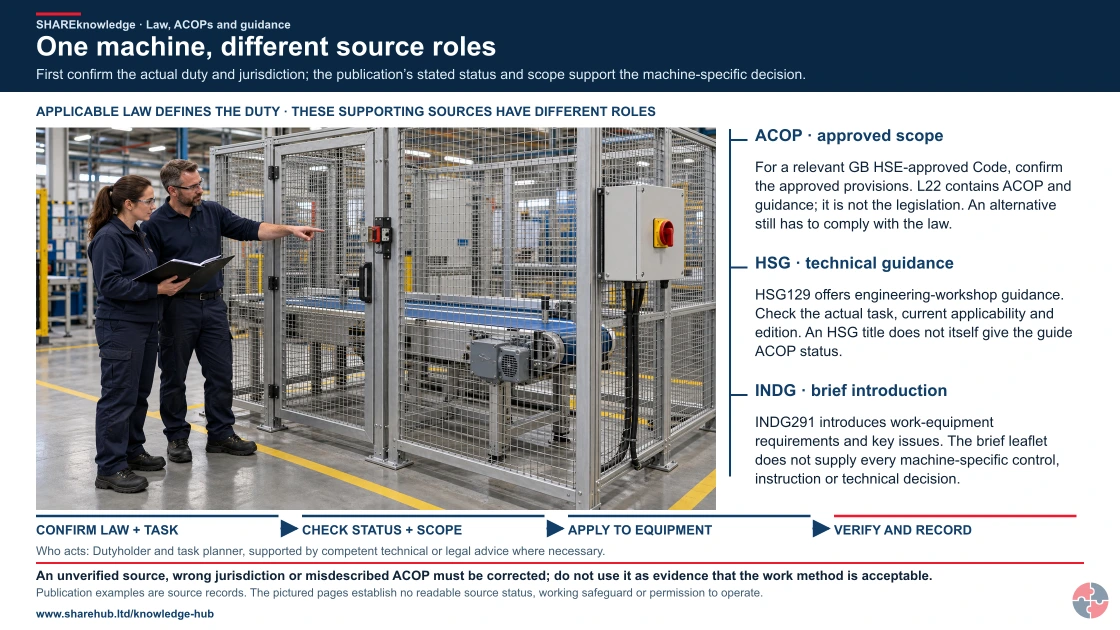
Full written explanation
A realistic HD engineering-workplace scene shows two people comparing a document beside a stationary guarded machine, its access door, interlock and control cabinet. A parallel native comparison identifies three different source roles: an applicable approved Code with its special status for the relevant approved scope, technical HSG guidance, and a brief INDG introduction. Current HSE publication records provide L22, HSG129 and INDG291 as examples; no pictured page is claimed to be a readable or verified copy of those publications. The roles are not stages or an invented legal hierarchy. A separate complete four-part connection below the image runs from confirming the law and task, through source status and scope, to equipment-specific application and recorded verification. The actual machinery duty, operating mode, instructions, approval, jurisdiction and workface evidence still need checking. The closed guard and document do not demonstrate compliance or working safeguards. Applicable legal duty: Confirm the nation, activity and people before selecting the legal route. Relevant supporting material: An ACOP, technical guide and introductory leaflet have different status and scope. Task-specific decision: The responsible person must establish how the actual arrangements meet the applicable duty.
First confirm the actual duty and jurisdiction; the publication’s stated status and scope support the machine-specific decision.
- ACOP · approved scope. For a relevant GB HSE-approved Code, confirm the approved provisions. L22 contains ACOP and guidance; it is not the legislation. An alternative still has to comply with the law.
- HSG · technical guidance. HSG129 offers engineering-workshop guidance. Check the actual task, current applicability and edition. An HSG title does not itself give the guide ACOP status.
- INDG · brief introduction. INDG291 introduces work-equipment requirements and key issues. The brief leaflet does not supply every machine-specific control, instruction or technical decision.
Change the pathway
- ACOP status. A relevant approved Code has special evidential status; confirm its actual approval and jurisdiction.
- HSG technical guidance. Use applicable technical detail, scope and current edition; guidance is not itself an ACOP.
- INDG introduction. Use a concise introduction to find the right issues, not as a complete method for every task.
Evidence check: HSE guidance, an approved Code and law are not interchangeable. Confirm the status of the actual publication.
Follow the complete jurisdiction, source-status, task-control and verification connection
Primary references: HSE legal status of guidance and ACOPs · HSE L22 publication record: ACOP and guidance · HSE HSG129 publication record: engineering workshops · HSE INDG291 publication record: brief work-equipment guide · HSE L-series index: check each publication’s stated status · HSE chasing-concrete task controls
Open the complete HD image (new tab)Download image
Follow the complete jurisdiction, source-status, task-control and verification connection
Primary references: HSE legal status of guidance and ACOPs · HSE L22 publication record: ACOP and guidance · HSE HSG129 publication record: engineering workshops · HSE INDG291 publication record: brief work-equipment guide · HSE L-series index: check each publication’s stated status · HSE chasing-concrete task controls
A contractor’s document label is not its legal status
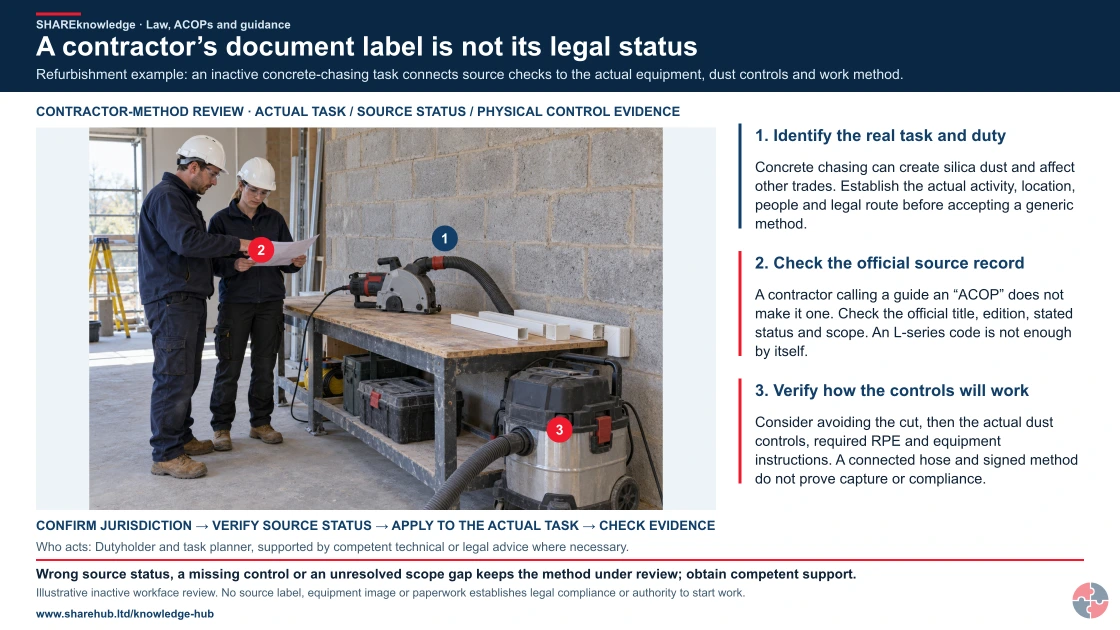
Full written explanation
A realistic HD inactive British refurbishment scene shows an intact masonry wall, guarded wall chaser, connected extraction hose/unit and surface containment option while two professionals review a drawing. Native numbered explanations distinguish identifying the actual task and legal route, verifying the publisher’s stated source status and scope rather than a contractor’s label, and testing how the proposed method addresses avoidance, dust controls, required RPE and machine instructions. The same complete source-to-control reasoning transfers from the engineering example without giving an HSG, INDG, L-series filename or method statement ACOP status. The scene establishes no exposure, capture performance, product rating, legal compliance or work permission. Original GB/NI source checks, relevant Code approval questions, retained reasoning and competent review holds remain in the complete source and written alternative; no NI approval decision or new legal duty is created.
Refurbishment example: an inactive concrete-chasing task connects source checks to the actual equipment, dust controls and work method.
- Confirm the jurisdiction. Identify the actual GB or NI duty and work activity; do not assume one publication settles both.
- Check the document status. Use the publisher’s current title, edition and stated legal status, rather than the filename or a contractor label.
- Apply it to the task. Compare scope, site conditions, equipment instructions and competent technical advice.
- Retain the reasoning. Record the duty, supporting source and actual work evidence; resolve gaps before the responsible release decision.
When the evidence does not fit: An unverified source, wrong jurisdiction or misdescribed ACOP must be corrected; do not use it as evidence that the work method is acceptable.
Who acts: Dutyholder and task planner, supported by competent technical or legal advice where necessary.
Changed workplace
Engineering machinery: Select applicable technical guidance and the machine instructions for the actual operation.
Contractor refurbishment: Check the legal route and source status: a method statement cannot turn ordinary guidance into an ACOP.
Evidence check: HSE guidance, an approved Code and law are not interchangeable. Confirm the status of the actual publication.
Follow the complete jurisdiction, source-status, task-control and verification connection
Primary references: HSE legal status of guidance and ACOPs · HSE L22 publication record: ACOP and guidance · HSE HSG129 publication record: engineering workshops · HSE INDG291 publication record: brief work-equipment guide · HSE L-series index: check each publication’s stated status · HSE chasing-concrete task controls
Open the complete HD image (new tab)Download image
Follow the complete jurisdiction, source-status, task-control and verification connection
Primary references: HSE legal status of guidance and ACOPs · HSE L22 publication record: ACOP and guidance · HSE HSG129 publication record: engineering workshops · HSE INDG291 publication record: brief work-equipment guide · HSE L-series index: check each publication’s stated status · HSE chasing-concrete task controls
These are decision examples, not substitute method statements. Apply the actual regulation, approved Code or guidance and product instructions to the site before release.
Northern Ireland refurbishment with suspect asbestos
Task, material and setting: A contractor is about to disturb old insulation in a Northern Ireland school. Fibres may be released if the material contains asbestos.
People and prerequisites: Contractors, occupants and other site workers may be affected. The facilities manager needs building records, a competent survey and the correct NI asbestos duty before planning disturbance.
Before: The facilities manager checks the survey and work plan. HSENI lists L143 for use with NI asbestos regulations; confirm its current approval and whether the planned work is in scope.
During: The principal contractor briefs the team, controls access and verifies the agreed plan and competence before any disturbance.
Hold or stop: Stop if material identity, survey or competent plan is missing, or if suspect material is damaged. Use the site asbestos response route.
Completion and hand-back: The responsible manager accepts clearance and the controlled area before it reopens.
Evidence: Keep the survey, applicable NI legal route, source edition, competent plan, briefing and clearance or hand-back record.
Contractor cites a non-existent CDM 2015 ACOP
Task, material and setting: A contractor submits RAMS for refurbishment work in Great Britain and calls L153 a CDM 2015 ACOP. Other trades and occupants could be exposed if the proposed sequence is wrong.
People and prerequisites: The principal contractor, supervisor, workers and affected occupants need the actual site method. Confirm the GB Construction (Design and Management) Regulations 2015 and the current L153 guidance.
Before: The principal contractor identifies that L153 is guidance, corrects the citation and checks the task method, interfaces and site information against current duties.
During: The supervisor briefs contractors, checks segregation and observes whether the agreed controls work during the changed task.
Hold or stop: Do not accept the RAMS or start work while the source is misdescribed or the method does not address the actual task and adjacent people.
Completion and hand-back: The principal contractor releases work only after the revised method and coordination are demonstrated, then checks it after change.
Evidence: Retain the corrected source, revised RAMS, briefing, release decision and field-verification record.
| Situation and people | Before and during decision | Hold or stop | Completion and evidence |
|---|---|---|---|
| Routine lifting-equipment planning; operators, slingers and nearby workers | Confirm equipment, load, lifting plan, operator competence and local procedure; L113 is listed by HSENI for the Lifting Operations and Lifting Equipment Regulations (Northern Ireland) 1999. Recheck current approval and scope, then observe the setup before the lift. | Hold the lift if equipment, plan, competent people or exclusion controls are unproven, or the publication is applied outside its scope. | Record the plan, equipment checks, authorisation, source version and supervisor follow-up. |
| Non-routine refurbishment with suspect asbestos; contractors and occupants | Use building information and competent asbestos advice before disturbance; L143 is listed by HSENI for the Control of Asbestos Regulations (Northern Ireland) 2012. Recheck current approval and scope against the NI duty before work. | Stop disturbance if material identity or survey information is missing; use the local asbestos emergency arrangement if material is damaged. | Retain survey, plan, competent approval, briefing and clearance or hand-back evidence. |
| Unknown cleaning chemical delivered to a workshop; purchaser, cleaner and nearby staff | Quarantine pending identification, supplier information, current safety data and the applicable COSHH route; compare ventilation, handling and storage needs. | Do not use or decant an unidentified product or rely on a generic leaflet alone. | Record product identity, supplier instructions, assessment, substitution choice and release approval. |
| Contractor RAMS cites a CDM 2015 ACOP; principal contractor and site team | Check GB CDM 2015 and current L153 guidance or NI law as appropriate; compare the task method and site conditions. | Hold acceptance where the claim of an ACOP is wrong or controls do not address current conditions. | Record corrected source, revised RAMS, coordination briefing and authorised start. |
| New equipment proposed as an alternative to an ACOP method; manager and maintainer | Check the precise approved paragraph, underlying law, manufacturer instructions, relevant performance and competent evidence of alternative compliance. | Do not approve on cost, similarity or supplier claim alone; escalate unresolved equivalence. | Record comparison, approver, risk decision, commissioning and performance review. |
| Incident exposes obsolete guidance during a changed task; all site workers | Protect people and use emergency response first; preserve the old procedure and source record, then assess similar exposed work. | Stop comparable work until interim controls and competent revision are agreed. | Record event, affected documents, worker communication, revised controls and effectiveness check. |
What checks are needed before, during and after applying guidance?
Treat source choice and control translation as hold points, then verify the control where work actually happens.
| Stage | Check | Stop or escalate | Record |
|---|---|---|---|
| Before selection | Confirm work, location, people, law, document type, edition and NI approval if relevant. | Missing identity, obsolete source or wrong jurisdiction. | Source register and task assessment. |
| Before release | Competent owner maps advice to controls, resources, supervision and manufacturer instructions. | Conflict, unproven ACOP alternative or uncontrolled high-risk task. | Approval, procedure and briefing. |
| During work | Supervisor checks conditions, actual behaviour, equipment and changing hazards. | Control not working, unknown substance or unexpected exposure. | Observation, stop decision and corrective action. |
| At hand-back | Confirm defect or source conflict resolved, controls tested, people updated and owner accepts restart. | Unresolved hazard, missing competent sign-off or unverified alternative. | Hand-back and verification record. |
| Later review | Check incidents, audits, source updates and worker feedback for effectiveness. | Repeat failure or withdrawn guidance. | Version history and review action. |
What happens when a source conflict appears during dangerous work or an incident?
Stop the affected work, protect life using local emergency arrangements, and have a competent person resolve the source and control conflict before restart.
Changed Source or Unexpected Hazard
Two linked parts · 6 questions. Open Part 2 to complete the route.

Continue to questions 4–6 · Part 2 of 2


Read this visual as text
- Start: A source is amended or withdrawn, or work reveals a hazard not covered by the current method.
- Question 1: Is anyone in immediate danger? Decision owner: Competent task planner / source reviewer.
- YES — STOP / REFER: Raise the alarm and use local emergency arrangements before reviewing documents. STOP / REFER → APPROPRIATE RESPONSE.
- NO: No such warning is identified; continue the remaining checks. CONTINUE → QUESTION 2.
- UNKNOWN — PROTECT FIRST: Protect people and hold the affected work. Obtain the responsible specialist’s assessment; do not assume the warning is absent. HOLD → OWNER RESOLVES BEFORE RESUMING.
- Question 2: Pause affected work Decision owner: Competent task planner / source reviewer.
- ACTION: Secure the area and identify similar work that may share the outdated assumption. CONTINUE → QUESTION 3.
- Question 3: Is the source or actual hazard change understood? Decision owner: Competent task planner / source reviewer.
- YES: The required evidence or condition is confirmed. CONTINUE → QUESTION 4.
- NO / UNKNOWN — HOLD: Compare controlled versions, equipment information and work conditions. HOLD → REPEAT QUESTION 3 AFTER CORRECTION.
- Question 4: Are interim controls evidenced for the actual risk? Decision owner: Competent task planner / source reviewer.
- YES: The required evidence or condition is confirmed. CONTINUE → QUESTION 5.
- NO / UNKNOWN — HOLD: Keep the affected work stopped; obtain competent technical review. HOLD → REPEAT QUESTION 4 AFTER CORRECTION.
- Question 5: Are procedures, briefings and restart authority updated? Decision owner: Competent task planner / source reviewer.
- YES: The required evidence or condition is confirmed. CONTINUE → QUESTION 6.
- NO / UNKNOWN — HOLD: Complete controlled changes and communicate limits across shifts and contractors. HOLD → REPEAT QUESTION 5 AFTER CORRECTION.
- Question 6: Has effectiveness been checked after the authorised restart? Decision owner: Competent task planner / source reviewer.
- YES: The required evidence or condition is confirmed. OUTCOME → RECORD AND HAND OVER.
- NO / UNKNOWN — HOLD: Reopen weak controls or unsupported source assumptions. HOLD → REPEAT QUESTION 6 AFTER CORRECTION.
- Outcome: People safe, source/version trail retained, procedures and briefings updated, restart authorised, effectiveness scheduled and checked.
- Stop and escalation boundary: Stop for unknown substances, suspected asbestos, contradictory instructions, uncontrolled energy or an unproven ACOP alternative.
A leaflet is not an emergency plan. If there is injury, exposure, release, fire or another immediate danger, raise the alarm, use first aid and emergency services as required, isolate only within competence, and keep people clear. Preserve the task documents, product information and version that workers were actually using. Check the applicable regulator, reporting and sector route separately; an internal source review must not delay emergency care or interfere with external control.
Stop and escalate for an unknown material, suspected asbestos disturbance, incompatible equipment, missing isolation, contradictory instructions, or a withdrawn source. Restart needs a recorded risk decision, effective interim control and authorised hand-back.
How can the hierarchy of controls guide risk controls using ACOPs and HSE guidance?
Guidance only improves safety when it is owned, translated, taught, checked and reviewed.
Many organisations have access to the right HSE documents but still fail to convert them into action. The usual failure is not a lack of documents; it is weak interpretation, poor ownership, outdated procedures, generic training and audits that check whether a file exists instead of whether the control is working.
The control process should be proportionate. A brief INDG may be enough to support a worker awareness briefing, while an ACOP-linked activity may need a controlled procedure, named competent person, audit schedule and formal management review.
Imagine a refurbishment firm choosing how to control concrete-cutting dust. The legal owner first identifies the actual GB or NI duty, then reads the relevant current regulator material for the task rather than treating an INDG leaflet as a law. Avoiding the cut is elimination; using a different construction method is substitution within ERICPD Reduce; on-tool extraction or an assessed wet method is engineering control; an exclusion zone, instruction and supervision are administrative controls; suitable RPE is the residual layer. An ACOP may give an evidential route for its particular regulations, but neither an ACOP nor an HSG/INDG automatically approves a wheel, method or risk assessment. The site manager records the source edition, jurisdiction and the control decision it informed.
The supervisor checks the selected wheel, guard and dust capture before use, observes whether the method works in the actual material, and stops the cut if the capture fails or the method changes. ERICPD Discipline means maintaining the control, reviewing worker feedback and correcting a weak method. The safety adviser samples the work and checks that the legal register still points to the right GB or NI instrument; a source-document update triggers a task review, not an automatic copy-and-paste change to every procedure. The authority of a source and the effectiveness of an installed control are separate questions.
| Control area | Good practice | Evidence to check |
|---|---|---|
| Ownership | Assign an owner for each legal and guidance area, with authority to update procedures and escalate gaps. | Legal register owner, document owner and management review minutes. |
| Document control | Record the source, publication reference, issue date, review date and where the guidance has been applied internally. | Controlled document register and review history. |
| Competent interpretation | Use competent people to decide how guidance applies, especially where work is technical, high-risk or specialist. | Competence records, review notes and sign-off. |
| Procedure translation | Write procedures in workplace language, showing who does what, when, with what equipment and what records. | Procedure, RAMS, permits, checklists and briefing records. |
| Training and briefing | Give different levels of training for workers, supervisors, managers and specialists rather than one generic slide deck. | Training matrix, attendance records, assessment results and supervisor briefings. |
| Assurance | Audit whether the guidance has changed behaviour, controls and evidence, not only whether the guidance is filed. | Audit findings, inspection evidence, action close-out and effectiveness reviews. |
How can the ERICPD hierarchy of controls guide risk controls using ACOPs and HSE guidance?

| ERICPD control level | Topic-specific example | Source and full task context |
|---|---|---|
| Eliminate | Avoid the concrete cut where feasible. | Read the full task example, checks and stop points on this page. |
| Reduce | Use an assessed different construction method. | Read the full task example, checks and stop points on this page. |
| Isolate | Use matched dust capture and protect the occupied area. | Read the full task example, checks and stop points on this page. |
| Control | Set an exclusion zone, instruction and supervision. | Read the full task example, checks and stop points on this page. |
| PPE | Use suitable residual RPE selected for the task. | Read the full task example, checks and stop points on this page. |
| Discipline | Check dust capture, stop on failure and review the method. | Read the full task example, checks and stop points on this page. |
How can the ISO 45001 hierarchy of controls guide risk controls using ACOPs and HSE guidance?

| ERICPD control level | Topic-specific example | Source and full task context |
|---|---|---|
| Eliminate | Avoid the concrete cut where feasible. | Read the full task example, checks and stop points on this page. |
| Reduce | Use an assessed different construction method. | Read the full task example, checks and stop points on this page. |
| Isolate | Use matched dust capture and protect the occupied area. | Read the full task example, checks and stop points on this page. |
| Control | Set an exclusion zone, instruction and supervision. | Read the full task example, checks and stop points on this page. |
| PPE | Use suitable residual RPE selected for the task. | Read the full task example, checks and stop points on this page. |
| Discipline | Check dust capture, stop on failure and review the method. | Read the full task example, checks and stop points on this page. |
What should a legal and guidance register include?
A useful register links law, official guidance, internal controls, ownership and review triggers.
A legal register should be more than a list of Acts and Regulations. It should tell the business what the duty means, which official guidance explains it, which internal documents rely on it and who checks that the arrangements remain current.
For a mature system, the register also links to the risk register. This prevents a gap where the law is known by the safety team but not reflected in procurement, contractor management, training, maintenance, inspection or project planning.
| Register field | What to record | Why it matters |
|---|---|---|
| Legal duty | The Act, Regulation or legal requirement, with a direct legislation link. | Creates traceability from workplace arrangements back to the binding duty. |
| Official guidance | Relevant ACOP, HSG, INDG, HSE topic page or other official source. | Shows which recognised standards were used to interpret the duty. |
| Internal documents affected | Policy, procedure, risk assessment, RAMS, permit, checklist, training module or audit tool. | Prevents official guidance sitting separately from day-to-day control. |
| Owner | The person or role responsible for review and update. | Avoids drift where nobody owns legal and guidance currency. |
| Review trigger | Legal change, guidance update, incident, enforcement, audit finding, new equipment, new substance or work change. | Keeps the register live rather than a once-a-year administrative task. |
| Evidence of application | Training, inspection, maintenance, monitoring, audit and action close-out records. | Shows the duty has been implemented, not just recognised. |
What training is needed to use ACOPs, HSGs and INDG guidance well?
Training should build from general awareness to competent interpretation and management assurance.
Not everyone needs to read an ACOP from cover to cover, but everyone should understand the standard that affects their work. Workers need clear controls and reporting routes. Supervisors need to know what they are checking. Managers need to know how guidance affects resources, procedures and competence. Advisers need enough technical skill to interpret and apply official sources properly.
Training should also explain acronyms. Terms such as ACOP, HSG, INDG, HSE, RAMS and ISO should not be assumed. A short acronym table or plain-English explanation prevents confusion and helps new learners take part in health and safety discussions.
| Role and learning | Practice on the actual task | Competence evidence and record | Assessor and reassessment trigger |
|---|---|---|---|
| Workers and new starters: recognise the rule behind the task | Explain the local control and report when it is absent or unclear. | Observed induction or task briefing with a correct stop/report decision. | Supervisor checks at induction and after a changed task or control. |
| Task users: apply a guidance-based procedure | Demonstrate the actual equipment, limits, emergency action and records. | Practical observation and scoped task authorisation. | Competent task assessor checks before independent use and after process or guidance change. |
| Supervisors and managers: plan and verify work | Select the applicable law and source, brief contractors, observe work and close defects. | Reviewed source-to-control decision, field observation and corrective-action record. | Competent manager or safety adviser checks after law change, weak observation or incident. |
| Specialist advisers: interpret and challenge guidance | Compare law, ACOP, guidance and an alternative control within the actual duty and jurisdiction. | Written interpretation with source edition, limits and peer-reviewed field evidence. | Experienced specialist or legal adviser checks when approval, scope or legal route changes. |
| Procurement and document controllers: keep sources usable | Confirm the current title and approved edition before buying, specifying or replacing a local document. | Controlled source register, supplier specification and withdrawal of superseded copies. | Competent owner checks at procurement and after a regulator update. |
Record the task, demonstrated decision, assessor, limits of authority and any follow-up. Reassess after changed law, process or equipment, a weak field observation or an incident; do not infer a universal certificate or fixed renewal period.
Which Great Britain and Northern Ireland legal routes apply?
Great Britain uses HSWA 1974 sections 16 and 17; Northern Ireland uses Articles 18 and 19 of the 1978 Order, with HSENI approval lists to identify applicable Codes.
GB or NI ACOP Status
Two linked parts · 5 questions. Open Part 2 to complete the route.

Continue to questions 4–5 · Part 2 of 2


Read this visual as text
- Start: A team wants to use an HSE GB Code on a Northern Ireland job.
- Question 1: Is the work location confirmed as Northern Ireland? Decision owner: Competent task planner / source reviewer.
- YES: The required evidence or condition is confirmed. CONTINUE → QUESTION 2.
- NO / UNKNOWN — HOLD: Establish jurisdiction; use the applicable GB route if the work is in GB. HOLD → REPEAT QUESTION 1 AFTER CORRECTION.
- Question 2: Has the exact title and edition been checked against live HSENI lists? Decision owner: Competent task planner / source reviewer.
- YES: The required evidence or condition is confirmed. CONTINUE → QUESTION 3.
- NO / UNKNOWN — HOLD: Do not claim NI ACOP status from an HSE cover or a familiar title. HOLD → REPEAT QUESTION 2 AFTER CORRECTION.
- Question 3: What approval scope is evidenced? Decision owner: Competent task planner / source reviewer.
- Approved and in scope: Apply the approved provisions with the associated NI duties. CONTINUE → QUESTION 4.
- Partly approved: Identify the approved part and exclude unsupported legal-significance claims. CONTINUE → QUESTION 4.
- Not approved / uncertain: Use relevant technical content only with competent NI advice; no NI ACOP claim. STOP / REFER → APPROPRIATE RESPONSE.
- Question 4: Is the associated NI legislation and any separate NI Code identified? Decision owner: Competent task planner / source reviewer.
- YES: The required evidence or condition is confirmed. CONTINUE → QUESTION 5.
- NO / UNKNOWN — HOLD: Resolve the actual instrument and approval limits before reliance. HOLD → REPEAT QUESTION 4 AFTER CORRECTION.
- Question 5: Record the NI decision Decision owner: Competent task planner / source reviewer.
- ACTION: Record title, edition, legal basis, approval scope and task application. OUTCOME → RECORD AND HAND OVER.
- Outcome: NI legal basis, Code title, approval scope, edition and task decision documented.
- Stop and escalation boundary: Pause legal-significance claims until scope and approval are checked. Stop hazardous work if the missing decision affects control adequacy.
The general workplace duties and management regulations also differ by jurisdiction. An HSE publication can offer useful technical advice in NI, but its GB approval statement does not by itself establish NI ACOP status. Check the current NI legislation and HSENI lists, including scope notes. Product-supply rules and manufacturer instructions are a separate question from workplace-use duties; this page does not declare any product compliant.
| Jurisdiction and instrument | What it does | Operational decision |
|---|---|---|
| GB: HSWA 1974 section 16 | Provides for approval, revision and withdrawal of ACOPs. | Check the Code's approval notice and relevant provisions. Official source |
| GB: HSWA 1974 section 17 | Sets the evidential role of relevant Code provisions in criminal proceedings. | Document how an alternative method complies with the underlying law. Official source |
| GB: Management Regulations 1999 | Provide risk assessment, arrangements and training framework. | Translate source advice into assessed task controls and competence. Official source |
| NI: 1978 Order article 18 | Provides NI approval, revision and withdrawal route for Codes. | Check HSENI's NI and approved GB lists, including partial approvals. Official source |
| NI: 1978 Order article 19 | Sets the NI evidential role of approved Codes in criminal proceedings. | Do not cite GB section 17 as the NI legal basis. Official source |
| NI: Management Regulations 2000 | Provide NI risk assessment, arrangements and training framework. | Use the NI legal baseline and a local competent assessment. Official source |
How could BuildOut Ltd manage ACOPs, HSGs and INDG guidance?

BuildOut Ltd manages official guidance as part of its legal register, risk management system, contractor control and training programme.
BuildOut Ltd workplace example
BuildOut Ltd is a construction and refurbishment contractor. It works across changing sites, uses subcontractors, procures work equipment, manages dust, work at height, lifting, temporary works, electrical safety and occupational health risks. That means it cannot rely on memory or informal interpretation of guidance.
The company treats official guidance as controlled business intelligence. The safety manager owns the legal and guidance register, but topic owners sit across operations: plant, procurement, project management, training, contractor management and occupational health. When guidance changes, BuildOut checks which risk assessments, RAMS, permits, inspection sheets, toolbox talks, training modules and audit questions need updating.
| Management area | How BuildOut Ltd manages it | Evidence and improvement loop |
|---|---|---|
| Legal and guidance register | Maintains a register linking each relevant Act, Regulation, ACOP, HSG and INDG to the work activities it affects, such as abrasive wheels, construction dust, work at height, lifting operations and contractor control. | Quarterly review by the safety manager, annual senior management review, update log and action tracker for affected procedures. |
| Risk assessment and RAMS | Uses official guidance to check whether task controls are strong enough, especially where the work involves high-energy equipment, hazardous substances, lifting, temporary works or public interface risk. | RAMS review checklist, supervisor sign-off, pre-start briefing records and post-job feedback. |
| Procurement and equipment standards | Translates HSE guidance into buying rules, such as specifying suitable dust extraction, guarding, lifting accessories, access equipment and manufacturer instructions before equipment is approved for use. | Approved supplier list, equipment specification, inspection records and defect trends. |
| Contractor management | Requires subcontractors to show that their methods reflect current official guidance and that workers are trained, supervised and equipped for the task. | Pre-qualification checks, RAMS review comments, induction records, site inspection findings and non-conformance close-out. |
| Training and competence | Uses INDG documents for awareness, HSG guidance for supervisor training and ACOP expectations for competent-person standards where relevant. | Training matrix, assessment results, competence authorisations and refresher triggers. |
| Auditing and learning | Compares live site practice against selected guidance rather than simply checking that a document exists. Findings feed into management review and future tender planning. | Audit reports, action effectiveness checks, lessons-learned briefings and updates to risk register entries. |
How can ISO 45001 support official guidance management?
ISO 45001 management-system themes can organise the decisions and evidence needed for official guidance management.
The exact current edition and amendments are not verified from an authorised copy on this page. These management-system themes are voluntary unless adopted by contract or organisation policy. They are useful where they add discipline, but should not be forced into every topic. For ACOPs, HSGs and INDG documents, the alignment is genuinely useful because the subject is about legal obligations, documented information, competence, operational control, performance evaluation and improvement.
The table uses management-system themes to organise practical evidence. It does not assert exact ISO clause wording; use the current licensed edition and competent interpretation for a formal audit.
| Management-system theme | How it can support this topic | Practical evidence |
|---|---|---|
| Determination of legal requirements and other requirements | Can help the organisation to determine and have access to applicable legal and other requirements. | Legal and guidance register with direct links, ownership, review dates and affected internal documents. |
| Competence | Can help people to be competent where their work affects health and safety performance. | Training matrix showing awareness, supervisor, manager and specialist competence levels. |
| Awareness | Can help workers to be aware of policy, risks, controls and implications of not conforming. | Worker briefings, toolbox talks and plain-English guidance summaries. |
| Documented information | Can help controlled documents to be available, suitable and protected from unintended use. | Document control system, version history and withdrawal of superseded guidance. |
| Operational planning and control | Can help planned control of processes needed to meet requirements. | Procedures, RAMS, permits, inspection regimes and contractor standards based on current guidance. |
| Monitoring, measurement, analysis and performance evaluation | Can help monitoring and evaluation of health and safety performance. | Audits checking whether guidance-based controls work in practice. |
| Incident, nonconformity and corrective action | Can help action after incidents and nonconformities. | Lessons learned used to update guidance interpretation, risk assessments and training. |
How does this topic support study, competence and professional development?
This topic helps learners move from memorising definitions to explaining how UK health and safety law is applied in practice.
For general health and safety study, learners should be able to distinguish criminal law, regulations, ACOPs, guidance, internal rules and industry standards. They should also be able to explain why an ACOP has more legal significance than a general guidance leaflet and why an employer must still assess the actual workplace risk.
In scenario-based questions, the examiner or assessor may describe a business with outdated procedures, a weak legal register, generic training or poor contractor control. A strong answer explains how official sources should be identified, interpreted, translated into controls, communicated, checked and reviewed.
| Learner should understand | How to apply it in practice | Scenario-based prompt |
|---|---|---|
| Difference between law, ACOP and guidance | Use the correct source for the decision being made. | A manager says an ACOP is optional. Explain what is wrong with that statement. |
| Legal status of an ACOP | Recognise that departure from an ACOP needs an evidenced equivalent approach. | A procedure uses a different method from an ACOP. What evidence would you want to see? |
| Use of HSG and INDG documents | Select detailed HSG guidance for complex decisions and INDG leaflets for awareness or simple briefings. | A supervisor uses a short leaflet as the full procedure for high-risk work. What is missing? |
| Legal register management | Keep duties, guidance, internal procedures and review triggers connected. | An audit finds obsolete guidance in several site files. What system weakness does this indicate? |
| Continuous improvement | Use incidents, inspections, enforcement and guidance changes to update arrangements. | A near miss shows the procedure was based on old guidance. What should happen next? |
What are the warning signs that official guidance is not being managed well?
Weak guidance management usually appears as outdated documents, unclear ownership and controls that do not match current HSE expectations.
The harm is indirect but serious. If a business uses out-of-date or poorly interpreted guidance, people may be trained to the wrong standard, equipment may be bought without the right specification, risk assessments may miss important controls and supervisors may audit the wrong things.
These warning signs should trigger review before an incident, enforcement visit or civil claim exposes the gap.
| Warning sign | How it can cause harm or non-compliance | How it may show up at work |
|---|---|---|
| The legal register only lists legislation | ACOPs and guidance are not translated into practical control standards. | Procedures quote the law but do not explain how the work should be controlled. |
| Guidance links are broken or outdated | People may rely on withdrawn or superseded standards. | Old PDFs in folders, dead web links, no review date or no owner. |
| Generic procedures copy HSE wording | Controls may not fit the actual task, site, equipment or people. | Workers cannot explain what the procedure means for their work. |
| Short leaflets are used for complex decisions | High-risk work may be under-controlled because the deeper ACOP or HSG has not been consulted. | Brief INDG guidance used as the only standard for technical work. |
| No evidence of equivalent compliance | A business may struggle to justify departure from an ACOP if challenged. | Procedures differ from ACOP expectations but no competent review is recorded. |
| Training does not mention source or standard | Workers may learn a rule without understanding when to escalate or report a gap. | Training slides have no source references, review dates or link to the risk assessment. |
Standards named on this page are background context. Confirm the current edition, scope and exact requirements from an authorised copy before applying them. The open official sources below support the specific public-law and regulator guidance claims they are cited for.
What do the acronyms and key terms mean?
The main acronyms should be defined clearly so learners and non-specialists can follow the guidance.
| Acronym or term | What it means | Why it matters |
|---|---|---|
| ACOP | Approved Code of Practice. | A recognised HSE-approved way of complying with certain legal duties, with special legal status. |
| HSG | Health and Safety Guidance. | A common HSE publication series used for practical, technical or management guidance. |
| INDG | HSE information document or leaflet series. | Usually a shorter guide for briefings, awareness and small-business explanation. |
| HSE | Health and Safety Executive. | The regulator for many workplaces in Great Britain and publisher of many official guidance documents. |
| HSWA | Health and Safety at Work etc. Act 1974. | The main Act setting broad health and safety duties and providing for ACOPs. |
| RAMS | Risk assessment and method statement. | A common workplace document used to translate law and guidance into task controls. |
| ISO | International Organization for Standardization. | Produces standards such as ISO 45001 that can support structured management systems. |
Which BuildOut documents support this topic?
Download individual editable BuildOut documents for this topic. Procedures and plans contain completed arrangements; forms, checklists, assessments, RAMS and permits are blank masters. Registers include separate worked examples.
| Document | Purpose and content | Editable download |
|---|---|---|
| Legal and other requirements register BOUK-REG-GOV-01 · Blank register with separate worked entries · v1.1 | A detailed GB construction legal baseline with 142 requirement entries, environmental permits and consents, national overlays and eight completed decisions, plus a blank live register. | Download XLSX Read preview |
Review and adapt the documents for your organisation, activities and jurisdiction before approval and issue. Open the SHAREms management-system hierarchy to find each document under its parent policy.