SHARE Knowledge Hub
Heart Attack Awareness
Recognise a possible heart attack and call 999 promptly; no manager sign-off or diagnosis should delay help. If a person is unresponsive, call 999 and check breathing: absent or abnormal breathing, including gasping, calls for dispatcher-assisted CPR and AED help. With normal breathing, follow dispatcher first-aid/recovery-position advice and monitor. An AED is for suspected cardiac arrest, not for every person with chest pain. Workplace first-aid provision is assessed under different GB and NI regulations.
Understanding Heart Attack Awareness
A heart attack occurs when blood flow to part of the heart muscle is blocked. The affected muscle is deprived of the oxygen it needs and can be damaged. It is a medical emergency that requires treatment in hospital. Workplace awareness helps people recognise a possible emergency and get professional help promptly. It also helps an employer plan how that help will reach someone in the actual place they work.
Why this matters at work
Symptoms can include chest pain that feels tight, crushing or squeezing, pain spreading to an arm, the neck or jaw, shortness of breath, sweating, sickness or indigestion-like discomfort. Someone may become pale, blue or grey, or collapse and stop responding normally. A person’s appearance, age or previous good health cannot establish that the situation is safe. Follow the current NHS emergency advice and the emergency call handler rather than attempting a workplace diagnosis.
Call 999 for the emergency features described in the linked NHS guidance, including tight or squeezing chest pain, spreading chest pain, severe breathing difficulty or a person who has passed out and is not responding normally. Give the precise location and arrange access for the ambulance. Do not drive yourself to hospital. While help is coming, follow the call handler’s instructions, help the person rest and keep checking their response and breathing.
How organisations manage this in practice
An employer’s practical contribution begins before an incident. A first-aid needs assessment considers the work, number of people, shifts, location and access to emergency services. The arrangements need to work during absence, night work, lone working and contractor activity. Staff need to know who takes charge, how to call for help and where equipment is kept. If an automated external defibrillator is provided, it needs accessible placement, maintenance and a clear arrangement for bringing it to the person.
Consider an employee becoming unwell in a workshop behind a locked yard gate. Calling an ambulance is essential, but help can still be delayed if nobody can describe the entrance or release the gate. A rehearsed arrangement allocates these tasks while another person stays with the employee. After an event, the business reviews the response and supports recovery and return to work with appropriate professional advice. It should address relevant work demands and adjustments without assuming that a medical event proves a particular workplace cause.
Use the response branch that fits
Suspected heart attack while responsive: call 999 and rest. Unresponsive: call 999 and check breathing. Normal breathing calls for dispatcher first-aid/recovery-position advice and continuing checks; abnormal breathing or gasping calls for CPR and AED help. Do not add a lay pulse-check or wait for a manager.
What should happen immediately if a heart attack is suspected?
Call 999 promptly for a suspected heart attack. If a person is unresponsive, call 999 and check breathing. Start dispatcher-assisted CPR and use an AED for absent or abnormal breathing, including gasping. With normal breathing, follow dispatcher first-aid/recovery-position guidance and keep checking.
Chest pressure, tightness or squeezing, pain that spreads, breathlessness, sweating or nausea can signal a heart attack; symptoms vary and a colleague must not wait for symptoms to become “severe” or for manager permission. Keep the person at rest, get the workplace first-aider and follow the 999 call handler. Do not ask the person to drive themselves. NHS heart attack
If the person is unresponsive, call 999 as soon as possible and check breathing. If breathing is absent or abnormal, including gasping, the dispatcher can guide CPR; if breathing normally, follow first-aid/recovery-position guidance and monitor. Anyone can switch on and follow an automated external defibrillator (AED); training builds confidence but is not a prerequisite. Use an AED for suspected cardiac arrest, not automatically for a responsive person with chest pain. NHS ambulance-service CPR guidance
| What you see | First action | Boundary | Source |
|---|---|---|---|
| Possible heart-attack symptoms while responsive | Call 999, keep at rest and follow call handler. | Do not diagnose, self-drive or delay for a form. | NHS heart attack |
| Unresponsive person | Call 999 and check breathing. Start dispatcher-assisted CPR if unresponsive and not breathing normally, including gasping. If breathing normally, follow dispatcher first-aid/recovery-position guidance and monitor. | Untrained bystanders can give chest compressions. | NHS ambulance-service CPR guidance |
| Unresponsive, not breathing normally and AED available | Send another person for AED; switch it on and follow prompts. | Anyone can use AED; avoid interrupting compressions. | NHS ambulance-service CPR guidance |
| Workplace response | Direct ambulance to exact location and bring first-aider. | Employer first-aid arrangements support, never delay, emergency call. | HSE first aid at work for employers |
What are the key points for heart attack awareness?
The key points are recognition, early action, first-aid readiness, privacy and supportive recovery.
What are the key points for heart attack awareness? — part 1 of 2


Read the complete visual as text
- The key points are recognition, early action, first-aid readiness,…: The key points are recognition, early action, first-aid readiness, privacy and supportive recovery.
- Know the signs: Chest pressure, breathlessness, sweating, nausea, collapse or pain spreading to other areas should be taken seriously.
- Act first, document later: Forms, HR process and internal reporting follow once people are safe and emergency help has been arranged.
What are the key points for heart attack awareness? — part 2 of 2


Read the complete visual as text
- Plan AED access: AEDs need visible locations, routine checks, confidence-building awareness and emergency-service access.
- Support without blame: Heart health is influenced by many factors, so wellbeing campaigns should be practical, inclusive and non-judgemental.
- Handle recovery carefully: Return-to-work planning should use medical or occupational health advice where needed and avoid unnecessary health data collection.
Know the signs
Chest pressure, breathlessness, sweating, nausea, collapse or pain spreading to other areas should be taken seriously.
Act first, document later
Forms, HR process and internal reporting follow once people are safe and emergency help has been arranged.
Plan AED access
AEDs need visible locations, routine checks, confidence-building awareness and emergency-service access.
Support without blame
Heart health is influenced by many factors, so wellbeing campaigns should be practical, inclusive and non-judgemental.
Handle recovery carefully
Return-to-work planning should use medical or occupational health advice where needed and avoid unnecessary health data collection.
What health boundary should readers understand?
This page gives workplace awareness guidance and is not medical, legal or HR advice for an individual case.
A worker or visitor with possible heart attack symptoms needs emergency or NHS advice, not a workplace diagnosis. Managers should not decide whether symptoms are serious enough based on appearance, age, fitness, role or whether the person has had similar symptoms before. NHS heart attack
After the event, support should be based on functional work needs: phased return, appointment time, fatigue, travel, safety-critical work, emergency arrangements, medication side effects and confidence. Any medical detail should be handled through occupational health, GP or fit-note routes as appropriate.
| Boundary | Good workplace approach | Why it matters |
|---|---|---|
| Medical diagnosis | Use NHS, GP, emergency or occupational health routes. | Prevents unsafe delay and amateur diagnosis. NHS heart attack |
| Lifestyle judgement | Offer supportive wellbeing information without blame. | Heart health is complex and stigma reduces help-seeking. NHS cardiovascular disease |
| Return to work | Base decisions on work demands, restrictions and review dates. | Avoids over-restriction or unsafe assumptions. HSE support sickness absence and return to work |
| Health data | Record only what is needed for safety and support. | Protects confidentiality and trust. ICO workers health information |
| Safety-critical work | Review driving, machinery, lone work, rescue roles and emergency response duties. | Ensures work demands match current capability. HSE support sickness absence and return to work |
What does heart attack awareness mean in the workplace?
Heart attack awareness means recognising possible signs, knowing the response route and building a workplace where people can get help early.
A heart attack happens when blood flow to the heart is blocked. At work, the important point is not to teach colleagues cardiology; it is to make sure symptoms are recognised quickly enough for emergency response to begin. The workplace may be the place where the person first becomes unwell, so first-aid readiness is part of the prevention picture. NHS heart attack
Awareness also covers the longer journey. After a heart attack, someone may return with reduced stamina, anxiety about symptoms, medication changes, medical appointments or temporary restrictions. A good workplace keeps dignity, checks the work demands and reviews support without making the person feel like a risk label.
| Area | What it means | Good example |
|---|---|---|
| Recognition | Workers understand possible warning signs. | A receptionist recognises severe chest tightness in a visitor and calls first aid immediately. NHS heart attack |
| Response | First-aid and emergency routes are clear. | The first-aider knows AED location and who meets the ambulance. HSE first aid at work for employers |
| Preparation | Equipment, training and information are maintained. | AED battery, pads and cabinet access are checked and logged. HSE first aid at work for employers |
| Recovery | Return-to-work support is planned and reviewed. | A phased return reduces physical tasks while stamina improves. HSE support sickness absence and return to work |
| Wellbeing | Prevention messages are supportive. | Campaigns cover smoking cessation signposting, movement, healthy eating and stress management without judgement. NHS cardiovascular disease |
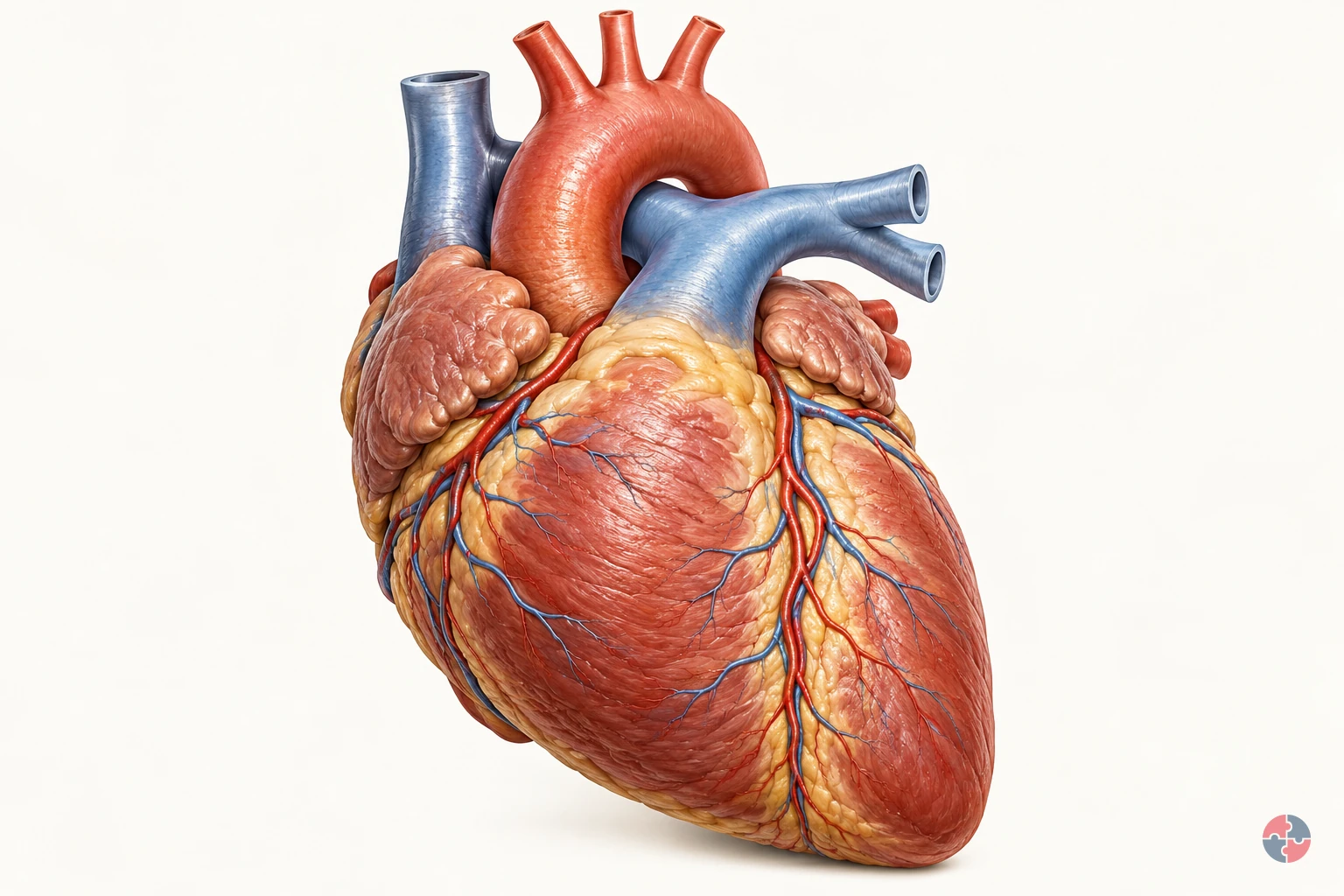

How does the heart circulate blood, and how do coronary disease, heart attack and cardiac arrest differ?
Interactive anatomy · Heart function, coronary supply and emergencies · Updated 2026-10-23
Read all anatomy and process explanations without the viewer
Adult anatomy and emergency recognition, not diagnosis, risk calculation or practical CPR certification. Child resuscitation or congenital-heart treatment Medication selection, dosing or treatment recommendations ECG interpretation, live vital signs or AED shock decisions Personal risk, damage countdown or return-to-work clearance The action panel is available before any model, login or quiz. Cardiovascular disease has many causes and forms; this coronary example covers only its stated mechanism.
Right atrium
Receives blood returning from the body. This upper chamber belongs to the anatomical right side, shown on the viewer’s left. East London NHS Foundation Trust: Physical Health Training — cardiovascular system · University Hospitals Bristol NHS-hosted resource: Understanding the circulatory system — patient/family information
Right ventricle
Pumps blood towards the lungs. Blood moves from this lower chamber into the pulmonary artery. East London NHS Foundation Trust: Physical Health Training — cardiovascular system
Pulmonary artery
Carries blood away from the heart to the lungs. It carries relatively oxygen-poor blood. An artery is defined by direction away from the heart, not by oxygen content. East London NHS Foundation Trust: Physical Health Training — cardiovascular system
Lung exchange
Blood gains oxygen and releases carbon dioxide at the lungs. The lungs bring air close to blood in small vessels while keeping them in separate spaces. Oxygen and carbon dioxide cross thin tissue boundaries in opposite directions. The exchange label connects the respiratory and circulation lessons; it does not show air entering an open vessel or provide a measurement of gas exchange in a person. Frimley Health NHS Foundation Trust: How your lungs work
Pulmonary veins
Return oxygen-rich blood from lungs to the heart. These veins enter the left atrium. Veins return blood towards the heart even when that blood is oxygen-rich. East London NHS Foundation Trust: Physical Health Training — cardiovascular system
Left atrium
Receives blood arriving from the lungs. It passes blood towards the left ventricle through the intervening valve. East London NHS Foundation Trust: Physical Health Training — cardiovascular system · University Hospitals Bristol NHS-hosted resource: Understanding the circulatory system — patient/family information
Left ventricle
Pumps blood into the body’s circulation. Its contraction sends blood through the aortic valve into the aorta. East London NHS Foundation Trust: Physical Health Training — cardiovascular system · University Hospitals Bristol NHS-hosted resource: Understanding the circulatory system — patient/family information
Aorta
The main artery leaving the left ventricle. It leads into the systemic arteries that distribute blood around the body. East London NHS Foundation Trust: Physical Health Training — cardiovascular system
Valves
Help keep blood moving in the intended direction. This overview label represents the heart valves. Separate valve labels require anatomically correct selectable structures. University Hospitals Bristol NHS-hosted resource: Understanding the circulatory system — patient/family information
Body capillaries
Small vessels allow exchange with body tissues. Oxygen and nutrients reach tissues and wastes return to the blood before the venous return journey. University Hospitals Bristol NHS-hosted resource: Understanding the circulatory system — patient/family information
Coronary arteries
Supply the heart muscle itself. Coronary arteries supply the heart muscle itself. Compare this route with blood passing through the chambers: chamber filling is not the same as supplying the myocardium. Keeping these routes distinct helps explain the location of coronary disease. The model identifies the normal supply and does not measure flow, diagnose narrowing or predict an individual’s symptoms. NHS: Coronary heart disease
Myocardium and rhythm
Heart muscle contracts in a coordinated rhythm to pump blood. Myocardium means heart muscle. The short activation cue is biological teaching content, not a live pulse or ECG. St George’s University Hospitals NHS Foundation Trust: Catheter Ablation for SVT — normal heart electrical system
Open the complete process transcript
The process, step by step
Return from the body
Begin at the right atrium, the upper chamber on the heart’s anatomical right side. In this front-facing view it appears on the viewer’s left. Veins return blood from the body towards this chamber, completing the body-circulation route before the journey to the lungs. Follow the direction indicated rather than identifying a vessel by its display colour. The selected label marks the chamber receiving that return; it does not represent a separate store of blood. Trace the connection slowly, then keep the chamber in mind for the next pumping step. East London NHS Foundation Trust: Physical Health Training — cardiovascular system · University Hospitals Bristol NHS-hosted resource: Understanding the circulatory system — patient/family information
What to watch: Find the right-atrium label on the viewer’s left, then identify the return route approaching the upper chamber.
Why it matters: Returning blood must remain connected to the next part of the circulation. Recognising this receiving chamber helps the learner follow one continuous loop rather than treating the lungs and body as disconnected routes.
Explore this step: Trace the return direction and name the receiving chamber before moving to the right-ventricle step.
Pump towards the lungs
Follow the route from the right atrium into the right ventricle, then towards the pulmonary artery. The ventricle is the lower pumping chamber on this side. The pulmonary artery takes blood away from the heart towards the lungs, where gas exchange takes place. Its name follows the direction of travel, even though this blood is relatively low in oxygen. Compare the chamber label with the outgoing vessel label and trace their connection. The route and colours explain the anatomy; they do not show a measured flow or pressure. East London NHS Foundation Trust: Physical Health Training — cardiovascular system
What to watch: Locate the right ventricle below the right atrium and trace the outgoing connection labelled pulmonary artery towards the lungs.
Why it matters: The lung circuit receives blood from the right ventricle. Understanding this connection also shows why “artery” means a vessel leading away from the heart, rather than simply a vessel containing oxygen-rich blood.
Explore this step: Follow the right-ventricle outlet and explain why its outgoing vessel is called an artery.
Exchange gases
At the lungs, air and blood are close together but remain in different spaces. Oxygen passes across thin boundaries from the air sacs into nearby blood, while carbon dioxide passes in the opposite direction towards the air that will be breathed out. Follow the lung-exchange label as the link between the incoming and returning parts of the lung circuit. Air does not travel directly along an open blood vessel. Use the model to explain the direction of exchange; the simplified view does not measure gas levels or a person’s breathing. Frimley Health NHS Foundation Trust: How your lungs work
What to watch: Locate the lung-exchange label between the route arriving from the right heart and the route returning towards the left heart.
Why it matters: Gas exchange connects breathing with the transport work of the circulation. The blood can then carry oxygen onwards; the picture identifies that connection without measuring oxygen delivery or diagnosing a breathing problem.
Explore this step: Explain which gas moves towards the blood and which moves towards the air, keeping the two spaces distinct.
Return from the lungs
Trace the pulmonary veins from the lungs to the left atrium. The blood returning along this route is now relatively rich in oxygen after lung gas exchange. The left atrium is the upper receiving chamber on the heart’s anatomical left side, shown on the viewer’s right in this view. Notice that these oxygen-rich vessels are still called veins: their direction is towards the heart. Compare this return with the body veins in the first step, using direction and connection rather than display colour to identify each route. East London NHS Foundation Trust: Physical Health Training — cardiovascular system
What to watch: Follow the pulmonary-vein labels from the lung return towards the left atrium on the viewer’s right side of the heart.
Why it matters: This connection brings blood back after gas exchange, ready for the next pumping step. Comparing both venous returns reinforces that a vein is defined by movement towards the heart, not by oxygen content.
Explore this step: Compare the pulmonary veins with the body’s returning veins and state the directional feature they share.
Pump towards the body
From the left atrium, follow the connection into the left ventricle and then through its outlet towards the aorta. The left ventricle is the lower chamber that pumps blood into the body circuit. The aorta leads into branching arteries that distribute blood to the body’s tissues. Locate the chamber, outlet and large vessel in that order rather than jumping directly to the whole-body view. These labels describe connected structures and the direction of pumping; the model is not measuring the strength of contraction or the amount of blood delivered. East London NHS Foundation Trust: Physical Health Training — cardiovascular system
What to watch: Locate the left ventricle, its outlet and the aorta, then follow the route towards the body circulation.
Why it matters: The body circuit carries blood onwards from the heart to the tissues. Seeing the chamber and its outlet together connects the pumping action with distribution rather than treating the aorta as an isolated structure.
Explore this step: Trace from the left ventricle to the aorta, then identify where the body-circulation view continues the route.
Exchange and return
In the body’s capillary networks, blood and tissues exchange substances across thin vessel walls. Oxygen and nutrients move towards the tissues, while waste products, including carbon dioxide, move towards the blood for transport away. The vessels then join the returning venous route and bring blood back towards the right atrium. Follow the capillary label and then return to the first chamber label to complete the loop. The enlarged network is a teaching view, not a to-scale picture of every vessel or a measurement of exchange in an individual. University Hospitals Bristol NHS-hosted resource: Understanding the circulatory system — patient/family information
What to watch: Find the body-capillary network and follow its connection towards the returning vein route and the right-atrium label.
Why it matters: Exchange allows transported substances to reach or leave tissues. The return journey is equally necessary to the explanation: blood remains in a connected circulation rather than being used up at the end of an artery.
Explore this step: Trace a complete route from the body capillaries back to the first step, naming the return direction.
Supply the pump itself
Switch to the coronary-supply view and locate the vessels supplying the heart muscle itself. The myocardium is muscle that needs its own blood supply; blood filling a heart chamber is not simply soaking through the wall to feed it. Compare the coronary route with the large chamber-and-vessel loop you have just followed. This distinction helps explain why a problem in a coronary artery concerns supply to the pump’s own tissue. The separate activation cue introduces coordinated function; it is not an ECG, a live pulse or a diagnostic heart-rhythm display. NHS: Coronary heart disease · St George’s University Hospitals NHS Foundation Trust: Catheter Ablation for SVT — normal heart electrical system
What to watch: Locate the coronary-artery labels alongside the myocardium label, comparing this supply with the route through the heart’s chambers.
Why it matters: The heart muscle also depends on a blood supply. Distinguishing coronary supply from chamber filling makes it possible to discuss coronary disease without suggesting that every cardiovascular problem has the same mechanism.
Explore this step: Compare the coronary and chamber views and explain the different function of the route highlighted in each.
Mechanisms and their limits
Coronary narrowing Fatty material in a coronary-artery wall can narrow the space carrying blood to the heart muscle. Coronary disease may occur without obvious symptoms. This is one cardiovascular condition, not the mechanism of every heart or blood-vessel disease. A labelled wall deposit is separate from a chamber. No percentage, symptom threshold or personal risk is calculated. NHS: Coronary heart disease
Heart attack: one common mechanism A blood clot can form where a coronary deposit becomes disrupted, reducing or blocking supply and damaging heart muscle. This is one common heart-attack mechanism. Heart attacks can have different mechanisms. The affected patch is illustrative, not an individual’s scan. A heart attack differs from cardiac arrest, though it can lead to one. No damage countdown, medicine-selection branch or clearance is provided. NHS: Heart attack · Leeds Teaching Hospitals NHS Trust: Understanding coronary angiography and coronary intervention
NHS: heart attack and immediate help
Cardiac arrest: ineffective circulation In cardiac arrest, the heart is not effectively pumping blood around the body. The person is unresponsive and is not breathing normally. Gasping is abnormal breathing. It is a different emergency from a heart attack. They are not inevitable successive stages. Not every arrest is a flatline, and not every rhythm needs a shock. Follow the AED prompts. Do not wait for the model, a pulse search or every textbook sign before calling for help. NHS 111 Wales: Cardiac Arrest
NHS Wales: recognition, 999, CPR and AED
Coronary narrowing — follow the anatomy
Look at: The coronary artery supplying the heart muscle.
What changes: Fatty material builds up in its wall and narrows the route for blood.
Why it matters: The muscle may receive too little oxygen, especially when working harder.
What to do: Address cardiovascular risk factors with healthcare support; chest pain needs appropriate medical help.
Understanding coronary disease during a workplace wellbeing session
A voluntary wellbeing session explains coronary supply without collecting anyone’s symptoms, health records or risk score. Explicit time jump over long-term biological processes: wall deposits do not form during one shift or this 32-second clip. The workplace is the teaching setting, not proof of the disease’s cause. Coronary narrowing is one condition within a broader range of cardiovascular disease.
Identify the heart’s own blood supply The heart muscle receives blood through coronary arteries on its surface. This is separate from blood passing through its chambers to the lungs and body. NHS: Coronary heart disease
Move forward through a long-term process The timeline jumps as fatty deposits may accumulate in a coronary artery wall. Several health and lifestyle factors can contribute; no single task or personal history is inferred. NHS: Coronary heart disease
A narrowed coronary lumen The deposit occupies part of the vessel wall/lumen region and may limit supply to heart muscle. A labelled example is not a percentage narrowing, symptom threshold or diagnosis. NHS: Coronary heart disease
Use appropriate support, not a workplace diagnosis Follow current NHS prevention and clinical advice about personal concerns. Persistent squeezing chest discomfort needs emergency action; do not wait for a wellbeing check or use the diagram to declare fitness. NHS: Coronary heart disease — prevention · NHS: Heart attack
Heart attack: one common mechanism — follow the anatomy
Look at: The blocked coronary artery and the muscle it supplies.
What changes: A clot can obstruct the supply of oxygen-rich blood to heart muscle.
Why it matters: The affected muscle can be damaged even while the heart continues beating.
What to do: Treat suspected heart-attack symptoms as an emergency and call 999.
Persistent squeezing chest discomfort during an office break
A colleague develops persistent squeezing chest discomfort while awake and breathing. The clot-and-supply example is explanatory. Emergency help begins immediately; no part of the 32-second clip is a permitted delay or a heart-muscle damage countdown. This is one common heart-attack mechanism. Symptoms do not establish the precise cause, and a heart attack is not the same as cardiac arrest.
Recognise an emergency in the workplace Stop the activity and call 999 for persistent squeezing chest discomfort. Keep the person supported and follow the call handler; do not wait to confirm a diagnosis from the model. NHS: Heart attack
One possible coronary blockage A separately chosen example shows a blood clot restricting a coronary artery, often associated with a wall deposit. The clip does not prove that this is what is happening to the colleague. NHS: Heart attack · Leeds Teaching Hospitals NHS Trust: Understanding coronary angiography and coronary intervention
Heart muscle can lose its blood supply The labelled muscle region illustrates potential injury when supply is blocked. It is not a scan or a clock predicting the amount of damage, and the heart need not have stopped pumping. NHS: Heart attack · Leeds Teaching Hospitals NHS Trust: Understanding coronary angiography and coronary intervention
Keep emergency support going Stay with the person and monitor responsiveness and breathing while following 999. If they become unresponsive and are not breathing normally, use the separate CPR/AED pathway. No medicine decision or clearance is generated. NHS: Heart attack · NHS 111 Wales: Cardiac Arrest
Cardiac arrest: ineffective circulation — follow the anatomy
Look at: The heart as a pump, and the blood leaving it.
What changes: The heart stops pumping blood effectively; an abnormal rhythm may be involved.
Why it matters: The person becomes unresponsive and is not breathing normally.
What to do: Call 999, start CPR and use an AED as directed; do not wait to identify a rhythm.
A colleague collapses and is only gasping
An adult collapses in a safe workplace area, does not respond and is only taking abnormal gasps. This is an immediate response example, not a countdown or a sequence to watch before acting. Call 999 and start the appropriate CPR/AED response now. Arrest can have several causes and is not the inevitable next stage of narrowing or a heart attack. A bystander does not diagnose an ECG rhythm or decide whether an AED should shock.
Unresponsive with abnormal breathing Call 999 immediately and follow adult CPR directions. Gasping is not normal breathing; do not wait for every possible sign or for the model to finish. NHS 111 Wales: Cardiac Arrest
Effective pumping has failed The selected cardiac-arrest state explains that the heart is not circulating blood effectively. There is no need to identify a cause before starting the emergency response. NHS 111 Wales: Cardiac Arrest
Body and brain supply are threatened The circulation loop changes its labelled supply symbols, not into a required flatline or a graphic brain lesion. This is why rapid help matters; no personal survival score is shown. NHS 111 Wales: Cardiac Arrest
CPR, AED and emergency directions Continue the call-handler-guided response, ask a helper to obtain an available AED and follow its prompts. This lesson introduces recognition; it does not certify hands-on competence or create a shock-selection task. NHS 111 Wales: Cardiac Arrest
Read the practice situations and all answer explanations
CV-Q1: Which route supplies the heart muscle?
Compare the heart chambers with the separate coronary inset.
The coronary arteries. — Correct. CV11 is the heart muscle’s own vessel supply.
Blood soaking through the chamber wall. — The chamber route pumps blood onward. Coronary arteries separately supply the muscle itself.
Air moving through the airway. — The lungs exchange gases with blood. Air does not directly feed the heart muscle through the airway.
NHS: Coronary heart disease · Frimley Health NHS Foundation Trust: How your lungs workCV-Q2: What should you do now?
A colleague is awake with persistent squeezing chest discomfort and sweating.
Call 999 and help them rest comfortably while monitoring. — Yes. Call immediately, help them rest and follow emergency advice. Keep checking responsiveness and breathing.
Drive them to hospital yourself instead of calling. — Call 999. Emergency services can advise and respond; do not delay or make the person drive.
Finish the anatomy activity before getting help. — Stop the activity and call 999. The lesson must never delay emergency help.
NHS: Heart attackCV-Q3: Which response fits this change?
The colleague becomes unresponsive and is only gasping.
Call or update 999, start CPR for abnormal breathing, and get AED help. — Correct. Gasping is abnormal. Call 999 immediately, start CPR and follow the call handler and AED prompts.
Leave them in the recovery position because gasping is normal breathing. — Gasping is not normal breathing. Call or update 999 and start the CPR/AED response; do not leave them.
Spend time searching for a pulse before calling. — Do not delay. For this lay recognition scenario, unresponsiveness and abnormal breathing need immediate 999 and CPR/AED help.
NHS 111 Wales: Cardiac ArrestSources and how the model is made
The opening images are AI-generated anatomical illustrations. The interactive 3D models and labelled SVG diagrams use original procedural artwork. These teaching images are not medical scans or diagnostic tools. Source references support the learner explanations and do not grant artwork rights.
- East London NHS Foundation Trust: Physical Health Training — cardiovascular system — Page 44: chamber connections, pulmonary artery/veins and aorta. Replaces non-NHS anatomy links. No training slides or artwork copied.
- NHS: Coronary heart disease — Separate coronary supply, wall deposits, narrowed supply, variable or absent symptoms. No diagnosis or copied video.
- University Hospitals Bristol NHS-hosted resource: Understanding the circulatory system — patient/family information — Printed pages 36–38: artery/vein direction, capillary exchange, chambers and valves. Resource produced by Heart Research UK; normal anatomy only, no congenital-heart exercise advice or artwork reused.
- NHS: Heart attack — Reviewed 31 March 2026: emergency symptoms, 999, rest/monitoring, clot mechanism and distinction from arrest. No medicine branch.
- NHS 111 Wales: Cardiac Arrest — Unresponsive/abnormal breathing, gasping, immediate 999/CPR/call-handler/AED recognition. Replaces non-NHS emergency link, not a complete practical course.
- Frimley Health NHS Foundation Trust: How your lungs work — Alveolar/capillary gas exchange, oxygen and carbon dioxide. Previously verified for respiratory module; no artwork copied.
- St George’s University Hospitals NHS Foundation Trust: Catheter Ablation for SVT — normal heart electrical system — Page 2 normal coordinated cardiac activation and pumping. Printed review October 2026 requires recheck. No ECG/treatment instruction or credited artwork reused.
- Leeds Teaching Hospitals NHS Trust: Understanding coronary angiography and coronary intervention — One common plaque-disruption and clot mechanism affecting coronary supply. No procedures, treatment regimens or symptom-duration waiting rule transferred.
- NHS: Coronary heart disease — prevention — General activity, diet and smoking-support context, alongside prescribed care; no personal target or guarantee.
- NHS: Cardiovascular disease — CVD is a broad group; the coronary example is not presented as every CVD mechanism.
Which warning signs should people recognise?
Warning signs should be treated as prompts for fast help, not proof of a diagnosis.
The classic image of a heart attack is dramatic chest pain, but real events may present more subtly. Some people describe heaviness, tightness, squeezing, indigestion-like discomfort, breathlessness, nausea, sweating, pain spreading to other areas, unusual fatigue or collapse. NHS heart attack
Workplaces should teach this carefully. The aim is not to make people anxious about every symptom; it is to remove hesitation when symptoms are severe, unusual, worsening or combined. It is safer to call for emergency advice and be wrong than to wait until the person deteriorates.
| Possible sign | Why it matters | Workplace response |
|---|---|---|
| Chest tightness, pressure or squeezing | May indicate reduced blood flow to the heart. | Call 999 promptly for suspected heart attack, stop the task and keep the person resting; summon first aid without delaying the emergency call. NHS heart attack |
| Pain spreading to arm, jaw, neck, back or stomach | May be part of a heart attack presentation. | Call 999 promptly for suspected heart attack and keep the person resting; first-aid help must not delay the call. NHS heart attack |
| Severe breathlessness | May indicate a life-threatening emergency. | Call 999 if severe, gasping or unable to speak normally. NHS heart attack |
| Sweating, nausea, pale or grey appearance | Can appear with serious cardiac symptoms. | Do not dismiss as anxiety, heat or indigestion without medical advice. NHS heart attack |
| Collapse or reduced responsiveness | Could be cardiac arrest or another emergency. | Call 999 and check breathing. If unresponsive and not breathing normally, including gasping, start dispatcher-assisted CPR and use an AED. If breathing normally, follow dispatcher first-aid/recovery-position guidance and monitor. NHS heart attack |
How should first aid and AED arrangements support heart attack awareness?
First-aid arrangements should make it easy to summon help, find equipment and start the right response quickly.
The employer decides first-aid personnel and equipment through a workplace needs assessment; an AED is not universally required by health and safety legislation. If an AED is provided, keep it accessible and checked. In an emergency, its spoken instructions allow use by anyone, including a person without prior AED training. HSE first-aid FAQs on AED provision NHS ambulance-service CPR guidance HSE first aid at work for employers
The first-aid needs assessment should consider workforce size, shift patterns, remote work areas, lone work, public access, higher-risk tasks, travel time for emergency services and whether an AED is provided. If people work across a large site, a single first-aid point may not be enough.
AEDs are designed to guide users, but confidence matters. The location should be visible, access should not depend on one key holder, and checks should confirm battery, pads, cabinet, signage and readiness. First-aiders should know who calls 999, who brings the AED, who meets the ambulance and who manages witnesses or customers.
| Planning issue | Good practice | Evidence |
|---|---|---|
| Needs assessment | Include cardiac events, public access, remote areas and emergency-service response time. | First-aid needs assessment. HSE first aid at work for employers |
| AED location | Place where it can be reached quickly and signpost clearly. | AED map, signage and induction. HSE first-aid FAQs on AED provision |
| AED checks | Check cabinet access, battery, pads, expiry dates and rescue kit. | Weekly or monthly AED checklist. HSE first-aid FAQs on AED provision |
| First-aid cover | Match first-aider numbers to shifts, absence, contractors and public opening hours. | Training matrix and rota. HSE first aid at work for employers |
| Emergency access | Plan who guides ambulance crews and keeps access routes clear. | Emergency procedure and drill learning. HSE first aid at work for employers |
How should workplaces plan for cardiac events?
Planning should connect first aid, emergency communication, public access, worker wellbeing and post-incident learning.
Cardiac events can happen in an office, construction site, leisure centre, depot, vehicle yard or remote work location. Planning should ask what would happen at 7am, during a night shift, in a locked plant room, on a construction floor, at a poolside, in a car park or when the trained first-aider is absent. NHS heart attack
The plan should also consider non-employees. HSE first-aid duties are framed around employees, but good practice is to consider visitors, pupils, customers, contractors and members of the public in the needs assessment. Public-facing businesses should assume they may need to respond to someone who is not on the payroll.
| Prompt | What to decide | Evidence |
|---|---|---|
| Where could it happen? | Map public, remote, high-activity and hard-to-access areas. | Emergency access map. HSE first aid at work for employers |
| Who responds first? | Define first-aider, appointed person, manager and bystander roles. | Emergency role card. HSE first aid at work for employers |
| How is help summoned? | Use radios, phones, alarms or reception route that works across shifts. | Communication test. HSE first aid at work for employers |
| What about visitors? | Include customers, contractors and public events in planning. | First-aid needs assessment. HSE first aid at work for employers |
| What is learned afterwards? | Review response time, equipment access, communication and welfare. | Incident review and action tracker. HSE first aid at work for employers |
How can workplaces support cardiovascular wellbeing without overreaching?
Workplaces can make healthier choices easier, reduce harmful work design and signpost official support without policing private life.
Good cardiovascular wellbeing support is practical. It can include smoke-free support signposting, movement breaks, healthier canteen options, hydration access, stress risk assessment, fatigue control, reasonable shift design and encouragement to use NHS health checks where appropriate. NHS cardiovascular disease
The tone matters. Campaigns that shame people about weight, diet or fitness can backfire and may create distrust. A better approach is to improve the environment: make water easy to access, allow breaks, design realistic activity campaigns, review excessive work pressure and signpost confidential support.
| Work factor | Supportive action | What to avoid |
|---|---|---|
| Sedentary work | Encourage movement breaks and walking meetings where suitable. | Mandatory step competitions that exclude or shame people. NHS cardiovascular disease |
| Stressful work design | Assess demands, control, support, relationships, role and change. | Calling resilience training the only solution. HSE work-related stress guidance |
| Shift work | Review fatigue, meal access, hydration and recovery time. | Treating poor eating as a personal failure only. HSE work-related stress guidance |
| Smoking or alcohol | Signpost confidential support and NHS resources. | Publicly targeting individuals. NHS cardiovascular disease |
| Health checks | Promote voluntary NHS or occupational health routes where appropriate. | Collecting unnecessary personal health data. NHS cardiovascular disease |
How should return to work be managed after a heart attack?
Return to work should be private, planned, evidence-informed and reviewed as recovery changes.
A return-to-work plan should not assume a person is either fully fit or permanently limited. Recovery can involve fatigue, worry, cardiac rehabilitation, medication adjustment, appointments and changes in confidence. The plan should focus on work demands and practical controls. HSE support sickness absence and return to work
Consider commuting, manual handling, heat exposure, lone work, driving, night shifts, emergency response roles, working at height, confined spaces, public-facing pressure and whether the person has easy access to breaks. Use occupational health or fit-note advice where work fitness is uncertain.
| Work issue | Practical question | Possible support |
|---|---|---|
| Physical demand | Is the work too heavy during early recovery? | Temporary lighter duties or pacing. HSE support sickness absence and return to work |
| Hours and fatigue | Are long shifts or nights affecting recovery? | Phased return or adjusted hours. HSE support sickness absence and return to work |
| Safety-critical tasks | Could symptoms or medication affect driving, machinery or lone work? | Fitness-for-task review and restrictions. HSE support sickness absence and return to work |
| Appointments | Does the worker need cardiac rehab or clinical review time? | Flexible appointment support. HSE support sickness absence and return to work |
| Confidence | Is the person anxious about symptoms or response at work? | Private plan, first-aid reassurance and review points. HSE support sickness absence and return to work |
How should heart health information be handled?
Heart health information should be handled confidentially, lawfully and only to the extent needed for safe work and support.
Managers do not need a detailed medical history to support most returns to work. They usually need to know the functional effects, restrictions, review date and whether any emergency information is needed with the worker's knowledge. ICO workers health information
If occupational health is involved, the referral should ask work-focused questions: what tasks are suitable, what adjustments are recommended, what review timing is needed and whether safety-critical duties need temporary restriction. Avoid broad fishing questions or gossip-driven sharing.
| Control | Practical approach | Evidence |
|---|---|---|
| Purpose | Collect health or wellbeing information only where it is needed for heart attack awareness and return-to-work support, safe work, support, legal duties or agreed adjustments. | Avoid curiosity questions or records that do not change the work decision. ICO workers health information |
| Minimum necessary detail | Managers usually need restrictions, adjustments, fitness advice and review dates, not diagnosis or clinical notes. | Keep clinical detail with occupational health or medical professionals. ICO workers health information |
| Transparency | Workers should understand what information is collected, why, who will see it and how long it will be retained. | Use privacy notices, referral information and clear consent routes where applicable. ICO workers health information |
| Access control | Limit access to managers, HR, occupational health or advisers who genuinely need the information. | Store records securely and separate health information from ordinary personnel notes where possible. ICO workers health information |
| Group learning | Use anonymised grouped results where the purpose is to review controls or identify trends. | Do not publish identifiable health information or informal sickness comparisons. ICO workers health information |
Which legal duties apply in Great Britain and Northern Ireland?
Use the legal instrument for the workplace location. General risk assessment, first aid or welfare duties differ in GB and NI even when practical controls look similar.
The rows distinguish law from HSE or HSENI guidance. The site needs its own needs assessment, competent advice, current text and arrangements. A voluntary management standard or a health-awareness page does not confer legal compliance. Management of Health and Safety at Work Regulations 1999 Management of Health and Safety at Work Regulations (NI) 2000
| Decision | Great Britain | Northern Ireland | Operational test |
|---|---|---|---|
| General work-health duties | Health and Safety at Work etc. Act 1974 Health and Safety at Work etc. Act 1974 | Health and Safety at Work (NI) Order 1978 Health and Safety at Work (NI) Order 1978 | Apply the instrument for the actual site; do not transfer a GB duty to NI. |
| First-aid provision for employees | First-Aid Regulations 1981 Health and Safety (First-Aid) Regulations 1981 | First-Aid Regulations (NI) 1982 Health and Safety (First-Aid) Regulations (NI) 1982 | Apply the instrument for the actual site; do not transfer a GB duty to NI. |
| Risk assessment and arrangements | Management Regulations 1999 Management of Health and Safety at Work Regulations 1999 | Management Regulations (NI) 2000 Management of Health and Safety at Work Regulations (NI) 2000 | Apply the instrument for the actual site; do not transfer a GB duty to NI. |
| Disability-related adjustments, where triggered | Equality Act 2010 Equality Act 2010 | Separate NI disability discrimination route Equality Commission NI reasonable adjustments | Apply the instrument for the actual site; do not transfer a GB duty to NI. |
How can the hierarchy of controls reduce workplace risk before relying on a cardiac emergency response?
ERICPD is used here as a planning mnemonic. The linked HSE five-level hierarchy is the official source for the order and relative reliability of controls; the two labels are not identical.
ERICPD and the five-level hierarchy are decision aids, not identical statutes. Test removal, substitution and engineering first; use PPE and supervision for residual risk.
The hierarchy cannot eliminate a person’s underlying cardiovascular condition. It can reduce avoidable work strain and make the emergency response accessible; clinical action remains a separate urgent chain. NHS ambulance-service CPR guidance
ERICPD means Eliminate, Reduce, Isolate, Control, PPE and Discipline. The five-level order is elimination, substitution, engineering controls, administrative controls and PPE. Isolate usually maps to engineering; Discipline sustains a control and does not replace design. HSE five-level hierarchy HSE five-level hierarchy
How can the ERICPD hierarchy of controls reduce workplace risk before relying on a cardiac emergency response?

| ERICPD stage | Five-level mapping | Intervention | Owner and check | Failure / stop |
|---|---|---|---|---|
| Eliminate | Elimination | Do not claim to eliminate all heart attacks; remove avoidable heat or physical strain from the event setup. | Facilities manager verifies setup before opening. | Uncontrolled strain: redesign. NHS ambulance-service CPR guidance |
| Reduce / substitute | Substitution | Use powered moving of heavy event equipment instead of repeated hand carry. | Manager checks real load and new equipment risks. | Unproved change: hold task. NHS ambulance-service CPR guidance |
| Isolate | Engineering | Separate guests from emergency-vehicle access so responders can reach the person. | Duty manager checks route is clear. | Blocked route: clear immediately. NHS ambulance-service CPR guidance |
| Control: physical | Engineering | Keep a needs-assessed AED visible, checked and accessible if one is provided. | Appointed person records device checks. | Failed device: use dispatcher route and obtain another AED. NHS ambulance-service CPR guidance |
| Control: method | Administrative | Train staff to call 999, bring the first-aider, guide responders and avoid delaying emergency help. | Supervisor rehearses event response. | Suspected event: activate immediately. NHS ambulance-service CPR guidance |
| PPE | PPE | PPE does not prevent a cardiac event or replace first aid. | Manager avoids false assurance. | Do not delay help for equipment. NHS ambulance-service CPR guidance |
| Discipline | Sustains controls | Review drills, device checks, access failures and privacy-safe incident learning. | Manager verifies actions closed. | Repeated failure: redesign response. NHS ambulance-service CPR guidance |
How can the ISO 45001 hierarchy of controls reduce workplace risk before relying on a cardiac emergency response?

| ERICPD stage | Five-level mapping | Intervention | Owner and check | Failure / stop |
|---|---|---|---|---|
| Eliminate | Elimination | Do not claim to eliminate all heart attacks; remove avoidable heat or physical strain from the event setup. | Facilities manager verifies setup before opening. | Uncontrolled strain: redesign. NHS ambulance-service CPR guidance |
| Reduce / substitute | Substitution | Use powered moving of heavy event equipment instead of repeated hand carry. | Manager checks real load and new equipment risks. | Unproved change: hold task. NHS ambulance-service CPR guidance |
| Isolate | Engineering | Separate guests from emergency-vehicle access so responders can reach the person. | Duty manager checks route is clear. | Blocked route: clear immediately. NHS ambulance-service CPR guidance |
| Control: physical | Engineering | Keep a needs-assessed AED visible, checked and accessible if one is provided. | Appointed person records device checks. | Failed device: use dispatcher route and obtain another AED. NHS ambulance-service CPR guidance |
| Control: method | Administrative | Train staff to call 999, bring the first-aider, guide responders and avoid delaying emergency help. | Supervisor rehearses event response. | Suspected event: activate immediately. NHS ambulance-service CPR guidance |
| PPE | PPE | PPE does not prevent a cardiac event or replace first aid. | Manager avoids false assurance. | Do not delay help for equipment. NHS ambulance-service CPR guidance |
| Discipline | Sustains controls | Review drills, device checks, access failures and privacy-safe incident learning. | Manager verifies actions closed. | Repeated failure: redesign response. NHS ambulance-service CPR guidance |
How should management verify controls for this task?
How should management verify controls for this task?


Read the complete visual as text
- For a suspected cardiac event during a busy public…: For a suspected cardiac event during a busy public leisure session, the management check should start with a real control decision: Do not claim to eliminate all heart attacks; remove avoidable heat or physical strain from the event setup. Name the person who will test it, keep evidence from the actual work, and reopen the assessment when the failure condition in the hierarchy table occurs. HSE management-system guidance .
- A review should compare the planned control with what…: A review should compare the planned control with what workers and supervisors can use in practice. Record the defect, owner, interim protection, verification and next review trigger so that a policy statement or certificate does not stand in for a working control.
For a suspected cardiac event during a busy public leisure session, the management check should start with a real control decision: Do not claim to eliminate all heart attacks; remove avoidable heat or physical strain from the event setup. Name the person who will test it, keep evidence from the actual work, and reopen the assessment when the failure condition in the hierarchy table occurs. HSE management-system guidance.
A review should compare the planned control with what workers and supervisors can use in practice. Record the defect, owner, interim protection, verification and next review trigger so that a policy statement or certificate does not stand in for a working control.
What evidence shows heart attack awareness is managed well?
Evidence should show the workplace can respond quickly and support recovery fairly.
The best evidence is not a poster on a wall. It is the combination of a current first-aid needs assessment, suitable cover, AED checks, emergency access planning, worker awareness, return-to-work records and learning after real events or drills. NHS heart attack
For public-facing premises, evidence should also cover visitor response. For remote or mobile work, it should show how workers summon help, share locations, access first aid and escalate if alone.
| Evidence | What it can evidence | What to challenge |
|---|---|---|
| First-aid needs assessment | Provision matches risk, numbers, shifts and public access. | Does it include cardiac events and AED consideration? HSE first aid at work for employers |
| AED inspection log | AED is ready, accessible and in date. | Are battery, pads and cabinet checked? HSE first-aid FAQs on AED provision |
| Training matrix | First-aiders and appointed persons are current. | Are absences and shift cover covered? HSE first aid at work for employers |
| Emergency drill or tabletop | People know who does what. | Did the drill test real access routes? HSE first aid at work for employers |
| Return-to-work plan | Support is work-focused and reviewed. | Is confidential health data controlled? HSE support sickness absence and return to work |
| Incident learning record | Actual events improve arrangements. | Were delays, equipment gaps and communication issues fixed? HSE first aid at work for employers |
How could Riverside Leisure Ltd manage this in practice?

Riverside Leisure Ltd would manage heart attack awareness as part of public safety, first aid, member wellbeing and worker support.
Riverside Leisure Ltd worked example — part 1 of 2


Read the complete visual as text
- Assess: How the business would manage it: Riverside reviews first-aid needs for each site, including gym floors, swimming pools, changing areas, cafe space, car parks, events, early starts and late finishes.
- Prepare: How the business would manage it: AEDs are placed where staff can reach them quickly, checked on a planned schedule, signed clearly and included in induction for reception, gym, pool and duty manager teams.
- Train: How the business would manage it: First-aiders complete suitable training; all staff receive short awareness on summoning help, guiding emergency services, privacy and keeping access routes clear.
Riverside Leisure Ltd worked example — part 2 of 2


Read the complete visual as text
- Respond: How the business would manage it: Duty managers use a simple role split: one person calls 999, one brings the AED, one stays with the casualty, one manages customers and one meets the ambulance.
- Support recovery: How the business would manage it: For a worker returning after a cardiac event, Riverside uses fit-note or occupational health advice, reviews duties such as pool rescue, manual handling, lone work and heat exposure, and agrees review dates.
- Learn: How the business would manage it: After drills or real incidents, the team reviews response times, AED access, communication and whether staff felt confident enough to act.
A leisure business has a mixed risk profile: gym users exercising hard, older members attending classes, poolside incidents, busy reception areas, contractors in plant rooms and staff who may be lone-working during quieter periods. Riverside would treat heart attack awareness as a practical emergency response topic, not just a wellbeing campaign. NHS heart attack
| Management element | How the business would manage it | Evidence to review |
|---|---|---|
| Assess | Riverside reviews first-aid needs for each site, including gym floors, swimming pools, changing areas, cafe space, car parks, events, early starts and late finishes. HSE first aid at work for employers | Dated site-and-shift first-aid needs assessment, including remote areas and opening hours. |
| Prepare | AEDs are placed where staff can reach them quickly, checked on a planned schedule, signed clearly and included in induction for reception, gym, pool and duty manager teams. HSE first-aid FAQs on AED provision | Dated AED readiness and access check; responsible owner and defects closed. |
| Train | First-aiders complete suitable training; all staff receive short awareness on summoning help, guiding emergency services, privacy and keeping access routes clear. HSE first aid at work for employers | Observed call/location/access drill with assigned roles and follow-up actions. |
| Respond | Duty managers use a simple role split: one person calls 999, one brings the AED, one stays with the casualty, one manages customers and one meets the ambulance. NHS ambulance-service CPR guidance | Timed example response/drill record: 999 call, exact location, breathing branch and ambulance guide. |
| Support recovery | For a worker returning after a cardiac event, Riverside uses fit-note or occupational health advice, reviews duties such as pool rescue, manual handling, lone work and heat exposure, and agrees review dates. HSE support sickness absence and return to work | Restricted functional adjustment plan, clinical advice route and agreed review date. |
| Learn | After drills or real incidents, the team reviews response times, AED access, communication and whether staff felt confident enough to act. HSE first aid at work for employers | Closed corrective-action record and observed recheck of response/access arrangements. |
What must each role be able to demonstrate?
Test the real decision and stop point at each level; an awareness briefing is not practical authorisation or clinical qualification.
A worker or bystander should recognise the immediate trigger, a supervisor should show the actual task response, a manager should resource and verify arrangements, and specialists should be assessed only within their proper scope. Record who observed the demonstration, what was shown, and what change will trigger reassessment. NHS ambulance-service CPR guidance
| Role | Demonstration | Assessor and record | Reassess when |
|---|---|---|---|
| All staff | Recognise possible symptoms, call 999 and report location. | Supervisor observes a short scenario. | Emergency plan or site changes. NHS heart attack |
| First aider | Provide assessed first aid and support dispatcher advice. | Competent assessor records simulation. | Guidance or certification changes. HSE first aid at work for employers |
| Duty manager | Clear response route, obtain AED and coordinate responders without delaying call. | Manager observes drill and device log. | Event layout or AED changes. NHS ambulance-service CPR guidance |
| HR or return-to-work lead | Use medical or occupational-health advice with private work adjustments. | Senior manager samples restricted record. | Return or condition change. ICO workers health information |
| Auditor | Distinguish GB/NI first-aid law and check real access. | Competent peer tests jurisdiction and drill evidence. | Site jurisdiction changes. HSENI first aid at work |
What do the acronyms and key terms mean?
Acronyms should be understood before they are used in assessments, briefings, audits or learning answers.
Acronyms can exclude newer readers if they are not explained. This section keeps the main terms available at the end of the page so the article stays readable while still supporting learners and audit users.
| Acronym | Meaning | Plain-English use |
|---|---|---|
| AED | Automated external defibrillator | A device that can analyse heart rhythm and deliver a shock where needed. |
| CPR | Cardiopulmonary resuscitation | Chest compressions and rescue breathing route used when someone is not breathing normally. |
| CVD | Cardiovascular disease | Disease affecting the heart or blood vessels. |
| GTN | Glyceryl trinitrate | Medication some people use for angina symptoms. |
| OH | Occupational health | Work-focused health advice from competent health professionals. |
Unlock another resource
You have used this month’s two free downloads. Publish a post in your own words to unlock one more resource, or choose SHARE Individual for 10 downloads per month.
You decide whether to share. If you do, use the relevant platform disclosure tools and do not make claims you do not genuinely hold.