
SHARE Knowledge Hub
How should workplaces support cardiovascular health?
Cardiovascular health concerns the heart and blood vessels. Blood pressure, cholesterol, diabetes, smoking and family history can affect risk, while work hours, stress and hazardous exposures may add strain. A workplace should recognise heart attack and stroke emergencies, control work factors it can change, and support individuals confidentially without turning a wellbeing check into a diagnosis.
Understanding How should workplaces support cardiovascular health?
Cardiovascular health concerns the heart and blood vessels. Blood pressure, cholesterol, diabetes, smoking and family history can affect risk, while work hours, stress and hazardous exposures may add strain. A workplace should recognise heart attack and stroke emergencies, control work factors it can change, and support individuals confidentially without turning a wellbeing check into a diagnosis.
Why this matters at work
Do not merge related but different topics. Cardiovascular health is the prevention and support framework. Occupational cardiovascular disease examines work attribution and specific exposures. Cardiac arrest is an emergency state; heart attack and stroke are medical events; hypertension, cholesterol, atrial fibrillation, diabetes and kidney disease are risk conditions. Stress and fatigue are workplace hazards with broader consequences.
Identify actual substances and conditions, routes, duration, peaks, controls and susceptible work. Use the correct GB or NI substance, lead, fire/explosion and workplace duties and competent occupational hygiene. The detailed carbon-disulphide guide supplies process-specific exposure and surveillance rules; foreign ICSC limits are not UK law. A wellness programme or medical check cannot compensate for uncontrolled exposure.
How organisations manage this in practice
Primary prevention reduces the chance of disease developing. In a workplace this starts with safe work design: reasonable demands and hours, movement, thermal comfort, clean air, smoke-free conditions, welfare and control of hazardous agents. Optional education, healthy food, activity and smoking support can reinforce those conditions.
Tertiary prevention reduces further harm and supports function after diagnosis or an event. It includes adherence to clinical care, cardiac rehabilitation where offered, phased return, task adjustment and emergency planning. Employers should support attendance and implement functional advice without taking over treatment.
Combine environmental and organisational measures with voluntary support and appropriate clinical signposting. Check implementation on all shifts and for disabled, mobile and contractor workers where relevant. Use indicators such as break attainment, movement opportunity, welfare access, exposure controls, appointment support and trust in reporting. Personal health outcomes change for many reasons and small self-selected samples can mislead. Keep individual measurements private. Review whether actions reached the groups facing the greatest barriers and whether they created new workload or access problems. General cardiovascular promotion complements the employer's hazard-control duties and individual clinical care; it does not replace either.
Chest pain, severe breathlessness, collapse, suspected stroke symptoms or a person who is not responding normally need 999 and the site emergency response. Non-urgent concerns about blood pressure, cholesterol, medication or fitness should be discussed with a GP, NHS service or occupational health as appropriate.
Who needs to understand cardiovascular health at work?
Cardiovascular health should be understood by workers, managers, first aiders, HR, wellbeing leads, H&S advisers and occupational health teams.
Workers
Need to understand risk factors, warning signs, NHS signposting and how work can support healthier choices.
Line managers
Need to support work impact, time for appointments, phased return, stress and fatigue controls.
First aiders
Need to recognise heart attack, stroke, collapse and emergency response needs.
HR and wellbeing leads
Need to plan campaigns, confidentiality, adjustments and return-to-work support.
H&S advisers
Need to connect heart health to work design, fatigue, stress, heat and toxic exposures.
Occupational health
Need to advise on fitness, restrictions, adjustments and safety-critical work.
Separate an acute event from the later work-support decision
Choose the route by the problem in front of you. An acute event takes the emergency and first-aid route; a wellbeing enquiry takes voluntary prevention and signposting; a changed ability to perform a task needs an individual safe-work review. Managers should not interpret clinical test results to decide which role a person may perform.

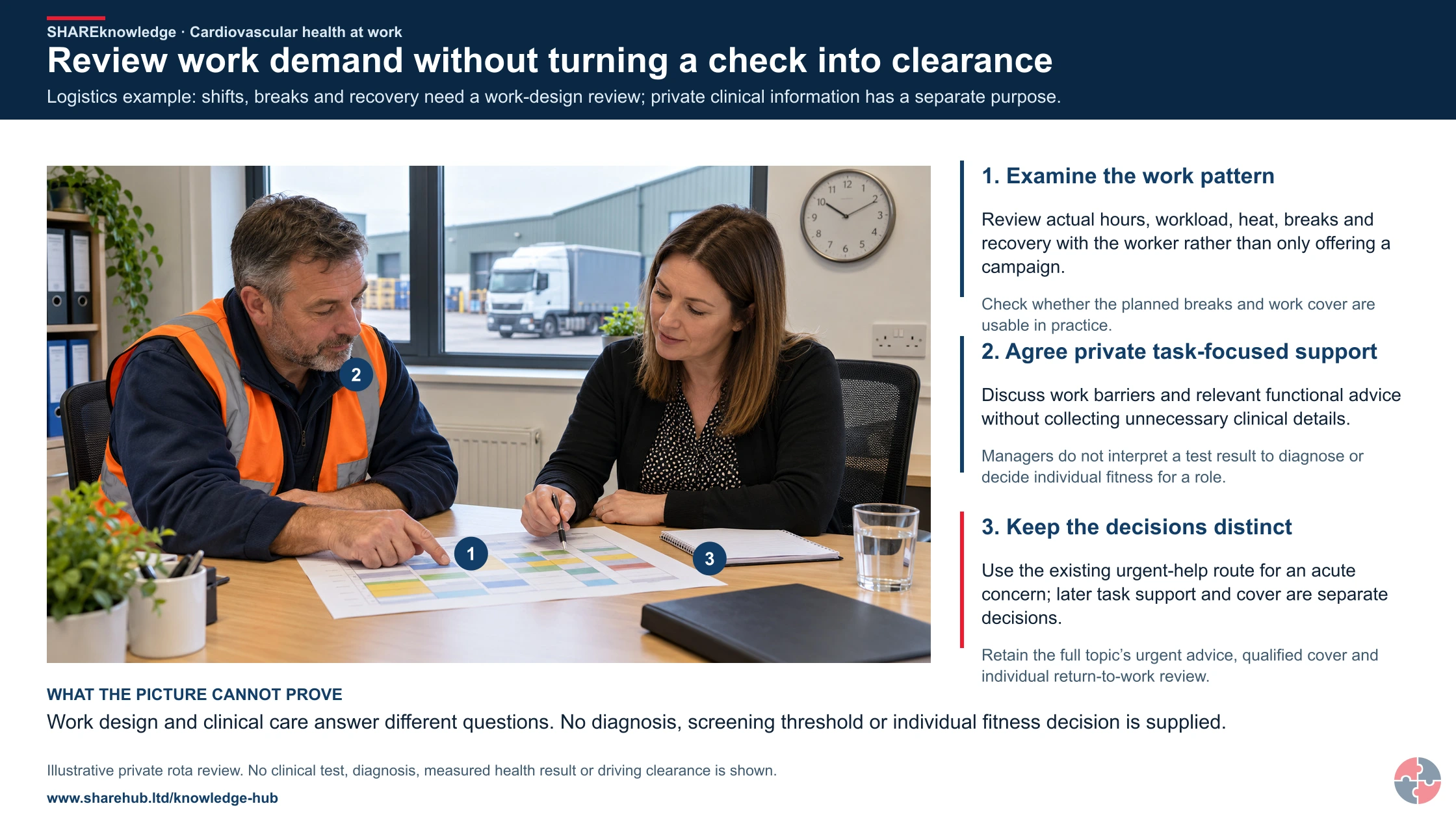
Review work demand without turning a check into clearance
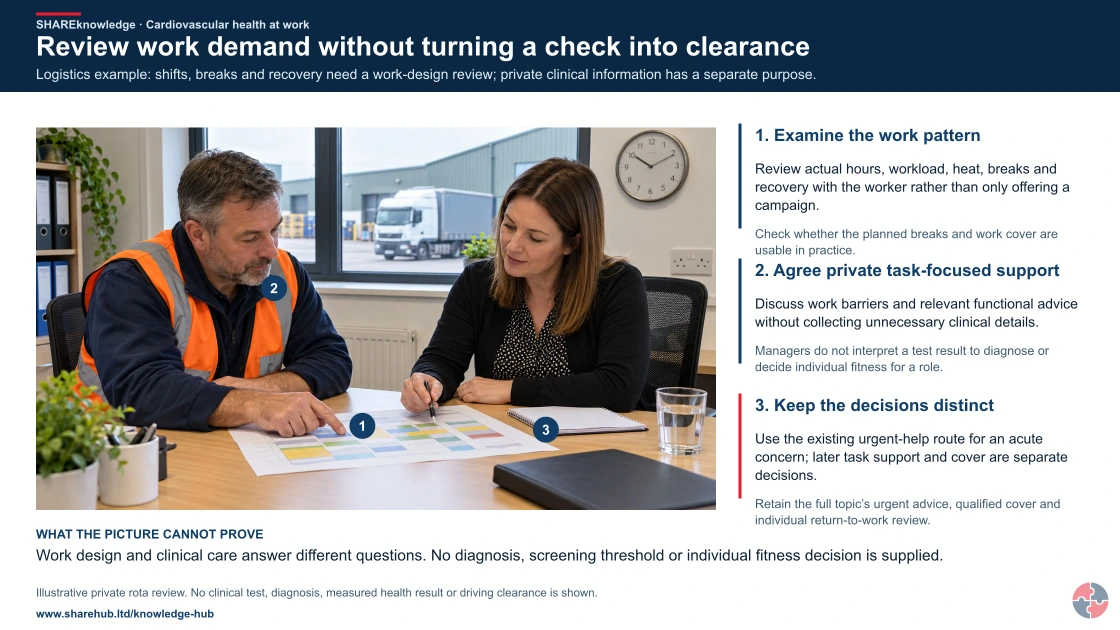
Full written explanation
Logistics example: shifts, breaks and recovery need a work-design review; private clinical information has a separate purpose.
- Examine the work pattern. Review actual hours, workload, heat, breaks and recovery with the worker rather than only offering a campaign.
- Agree private task-focused support. Discuss work barriers and relevant functional advice without collecting unnecessary clinical details.
- Keep the decisions distinct. Use the existing urgent-help route for an acute concern; later task support and cover are separate decisions.
Change the pathway
- A rota alone is not evidence of recovery. Check whether the planned breaks and work cover are usable in practice.
- Screening is not role clearance. Managers do not interpret a test result to diagnose or decide individual fitness for a role.
- Eased symptoms are not a return decision. Retain the full topic’s urgent advice, qualified cover and individual return-to-work review.
Evidence check: Work design and clinical care answer different questions. No diagnosis, screening threshold or individual fitness decision is supplied.
Full prevention, emergency readiness and individual work-support context
Primary references: NHS: cardiovascular disease · HSE: fatigue and work design (GB)
Open the complete HD image (new tab)Download image
Full prevention, emergency readiness and individual work-support context
Primary references: NHS: cardiovascular disease · HSE: fatigue and work design (GB)
After Riverside has dealt with an acute event during a leisure shift, the next water-supervision assignment is a separate decision. The duty manager arranges qualified cover while a private return-to-work plan is agreed. Occupational exposure questions belong in Cardiovascular Disease (Occupational), and cholesterol questions have their own guide, so general wellbeing advice does not obscure either route.
Riverside: first aid is not authorisation to return poolside
Illustrative example. A lifeguard has an acute event during a busy shift; the trained team activates the existing emergency plan.
Decision. The duty manager maintains qualified water cover and later agrees a task-focused support and return plan with the worker.
Evidence to check. First-aid arrangements, pool cover, relevant functional advice and an agreed review point.
Hold or escalation point. Do not return the worker to water supervision merely because immediate symptoms have eased.
Follow-up. Revisit hours, recovery, heat and role demands before the next assignment and after any material change.
Keep circulation teaching separate from urgent recognition
The lungs oxygenate blood, the heart pumps it and the coronary arteries supply the heart muscle. These functions help explain the topic; they do not replace recognition and response.

Normal function
Distinguish blood moving through the heart chambers from the heart muscle’s own coronary blood supply.
Urgent concern
Use the page’s clinically sourced emergency guidance for concerning chest symptoms or an unresponsive person with abnormal breathing; follow emergency-call and AED prompts as applicable.
Planned support
For non-urgent concerns, use appropriate clinical advice and an agreed work-support plan. A symptom gauge or a normal-looking person is not a diagnostic tool.
The anatomy is simplified. Emergency assistance must not wait for completion of an animation or a workplace assessment.
What are the key facts about cardiovascular health?
The key facts are that many cardiovascular risks are preventable or manageable, warning signs need prompt action and workplaces can influence risk.
CVD is a group of conditions
It includes heart and blood-vessel conditions such as coronary heart disease, stroke and peripheral arterial disease.
Risk can be silent
High blood pressure and high cholesterol may have no obvious symptoms.
Warning signs matter
Heart attack, stroke, collapse and severe breathlessness need immediate escalation.
Work design matters
Stress, fatigue, shift work, heat and long hours can affect health and safe performance.
Health checks can help
In England, eligible workers can use the NHS Health Check route; elsewhere, use the relevant NHS service or GP.
Confidentiality is essential
Health information should be private, necessary, proportionate and securely handled.
What is cardiovascular health?
Cardiovascular health is the condition and functioning of the heart, blood vessels and circulation.
Cardiovascular disease is an umbrella term for conditions affecting the heart and blood vessels. NHS examples include coronary heart disease, stroke, peripheral arterial disease and aortic disease. High blood pressure, high cholesterol and diabetes are important risk factors because they can damage blood vessels or increase the chance of blockage over time.
In a workplace, cardiovascular health has three layers. The first is general wellbeing: helping people understand health checks, smoking, activity, diet, alcohol and blood pressure. The second is work design: stress, fatigue, shift work, heat and long hours. The third is individual support: return to work, reasonable adjustments and safe-work decisions after illness.
The employer's role is not to diagnose or police lifestyle. It is to create a healthy work environment, remove harmful work factors, respond properly to warning signs and support workers with dignity.
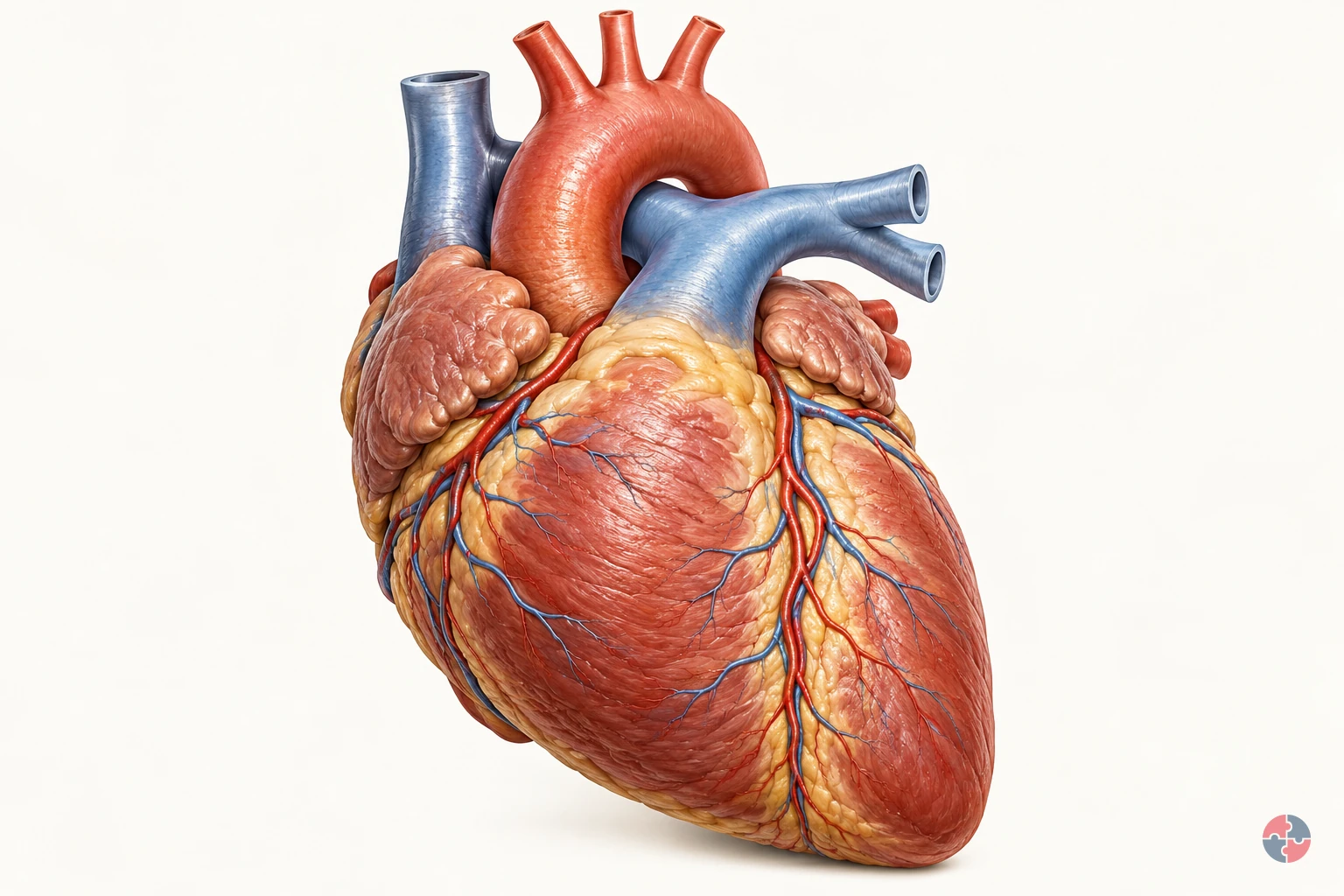

How does the heart circulate blood, and how do coronary disease, heart attack and cardiac arrest differ?
Interactive anatomy · Heart function, coronary supply and emergencies · Updated 2026-10-23
Read all anatomy and process explanations without the viewer
Adult anatomy and emergency recognition, not diagnosis, risk calculation or practical CPR certification. Child resuscitation or congenital-heart treatment Medication selection, dosing or treatment recommendations ECG interpretation, live vital signs or AED shock decisions Personal risk, damage countdown or return-to-work clearance The action panel is available before any model, login or quiz. Cardiovascular disease has many causes and forms; this coronary example covers only its stated mechanism.
Right atrium
Receives blood returning from the body. This upper chamber belongs to the anatomical right side, shown on the viewer’s left. East London NHS Foundation Trust: Physical Health Training — cardiovascular system · University Hospitals Bristol NHS-hosted resource: Understanding the circulatory system — patient/family information
Right ventricle
Pumps blood towards the lungs. Blood moves from this lower chamber into the pulmonary artery. East London NHS Foundation Trust: Physical Health Training — cardiovascular system
Pulmonary artery
Carries blood away from the heart to the lungs. It carries relatively oxygen-poor blood. An artery is defined by direction away from the heart, not by oxygen content. East London NHS Foundation Trust: Physical Health Training — cardiovascular system
Lung exchange
Blood gains oxygen and releases carbon dioxide at the lungs. The lungs bring air close to blood in small vessels while keeping them in separate spaces. Oxygen and carbon dioxide cross thin tissue boundaries in opposite directions. The exchange label connects the respiratory and circulation lessons; it does not show air entering an open vessel or provide a measurement of gas exchange in a person. Frimley Health NHS Foundation Trust: How your lungs work
Pulmonary veins
Return oxygen-rich blood from lungs to the heart. These veins enter the left atrium. Veins return blood towards the heart even when that blood is oxygen-rich. East London NHS Foundation Trust: Physical Health Training — cardiovascular system
Left atrium
Receives blood arriving from the lungs. It passes blood towards the left ventricle through the intervening valve. East London NHS Foundation Trust: Physical Health Training — cardiovascular system · University Hospitals Bristol NHS-hosted resource: Understanding the circulatory system — patient/family information
Left ventricle
Pumps blood into the body’s circulation. Its contraction sends blood through the aortic valve into the aorta. East London NHS Foundation Trust: Physical Health Training — cardiovascular system · University Hospitals Bristol NHS-hosted resource: Understanding the circulatory system — patient/family information
Aorta
The main artery leaving the left ventricle. It leads into the systemic arteries that distribute blood around the body. East London NHS Foundation Trust: Physical Health Training — cardiovascular system
Valves
Help keep blood moving in the intended direction. This overview label represents the heart valves. Separate valve labels require anatomically correct selectable structures. University Hospitals Bristol NHS-hosted resource: Understanding the circulatory system — patient/family information
Body capillaries
Small vessels allow exchange with body tissues. Oxygen and nutrients reach tissues and wastes return to the blood before the venous return journey. University Hospitals Bristol NHS-hosted resource: Understanding the circulatory system — patient/family information
Coronary arteries
Supply the heart muscle itself. Coronary arteries supply the heart muscle itself. Compare this route with blood passing through the chambers: chamber filling is not the same as supplying the myocardium. Keeping these routes distinct helps explain the location of coronary disease. The model identifies the normal supply and does not measure flow, diagnose narrowing or predict an individual’s symptoms. NHS: Coronary heart disease
Myocardium and rhythm
Heart muscle contracts in a coordinated rhythm to pump blood. Myocardium means heart muscle. The short activation cue is biological teaching content, not a live pulse or ECG. St George’s University Hospitals NHS Foundation Trust: Catheter Ablation for SVT — normal heart electrical system
Open the complete process transcript
The process, step by step
Return from the body
Begin at the right atrium, the upper chamber on the heart’s anatomical right side. In this front-facing view it appears on the viewer’s left. Veins return blood from the body towards this chamber, completing the body-circulation route before the journey to the lungs. Follow the direction indicated rather than identifying a vessel by its display colour. The selected label marks the chamber receiving that return; it does not represent a separate store of blood. Trace the connection slowly, then keep the chamber in mind for the next pumping step. East London NHS Foundation Trust: Physical Health Training — cardiovascular system · University Hospitals Bristol NHS-hosted resource: Understanding the circulatory system — patient/family information
What to watch: Find the right-atrium label on the viewer’s left, then identify the return route approaching the upper chamber.
Why it matters: Returning blood must remain connected to the next part of the circulation. Recognising this receiving chamber helps the learner follow one continuous loop rather than treating the lungs and body as disconnected routes.
Explore this step: Trace the return direction and name the receiving chamber before moving to the right-ventricle step.
Pump towards the lungs
Follow the route from the right atrium into the right ventricle, then towards the pulmonary artery. The ventricle is the lower pumping chamber on this side. The pulmonary artery takes blood away from the heart towards the lungs, where gas exchange takes place. Its name follows the direction of travel, even though this blood is relatively low in oxygen. Compare the chamber label with the outgoing vessel label and trace their connection. The route and colours explain the anatomy; they do not show a measured flow or pressure. East London NHS Foundation Trust: Physical Health Training — cardiovascular system
What to watch: Locate the right ventricle below the right atrium and trace the outgoing connection labelled pulmonary artery towards the lungs.
Why it matters: The lung circuit receives blood from the right ventricle. Understanding this connection also shows why “artery” means a vessel leading away from the heart, rather than simply a vessel containing oxygen-rich blood.
Explore this step: Follow the right-ventricle outlet and explain why its outgoing vessel is called an artery.
Exchange gases
At the lungs, air and blood are close together but remain in different spaces. Oxygen passes across thin boundaries from the air sacs into nearby blood, while carbon dioxide passes in the opposite direction towards the air that will be breathed out. Follow the lung-exchange label as the link between the incoming and returning parts of the lung circuit. Air does not travel directly along an open blood vessel. Use the model to explain the direction of exchange; the simplified view does not measure gas levels or a person’s breathing. Frimley Health NHS Foundation Trust: How your lungs work
What to watch: Locate the lung-exchange label between the route arriving from the right heart and the route returning towards the left heart.
Why it matters: Gas exchange connects breathing with the transport work of the circulation. The blood can then carry oxygen onwards; the picture identifies that connection without measuring oxygen delivery or diagnosing a breathing problem.
Explore this step: Explain which gas moves towards the blood and which moves towards the air, keeping the two spaces distinct.
Return from the lungs
Trace the pulmonary veins from the lungs to the left atrium. The blood returning along this route is now relatively rich in oxygen after lung gas exchange. The left atrium is the upper receiving chamber on the heart’s anatomical left side, shown on the viewer’s right in this view. Notice that these oxygen-rich vessels are still called veins: their direction is towards the heart. Compare this return with the body veins in the first step, using direction and connection rather than display colour to identify each route. East London NHS Foundation Trust: Physical Health Training — cardiovascular system
What to watch: Follow the pulmonary-vein labels from the lung return towards the left atrium on the viewer’s right side of the heart.
Why it matters: This connection brings blood back after gas exchange, ready for the next pumping step. Comparing both venous returns reinforces that a vein is defined by movement towards the heart, not by oxygen content.
Explore this step: Compare the pulmonary veins with the body’s returning veins and state the directional feature they share.
Pump towards the body
From the left atrium, follow the connection into the left ventricle and then through its outlet towards the aorta. The left ventricle is the lower chamber that pumps blood into the body circuit. The aorta leads into branching arteries that distribute blood to the body’s tissues. Locate the chamber, outlet and large vessel in that order rather than jumping directly to the whole-body view. These labels describe connected structures and the direction of pumping; the model is not measuring the strength of contraction or the amount of blood delivered. East London NHS Foundation Trust: Physical Health Training — cardiovascular system
What to watch: Locate the left ventricle, its outlet and the aorta, then follow the route towards the body circulation.
Why it matters: The body circuit carries blood onwards from the heart to the tissues. Seeing the chamber and its outlet together connects the pumping action with distribution rather than treating the aorta as an isolated structure.
Explore this step: Trace from the left ventricle to the aorta, then identify where the body-circulation view continues the route.
Exchange and return
In the body’s capillary networks, blood and tissues exchange substances across thin vessel walls. Oxygen and nutrients move towards the tissues, while waste products, including carbon dioxide, move towards the blood for transport away. The vessels then join the returning venous route and bring blood back towards the right atrium. Follow the capillary label and then return to the first chamber label to complete the loop. The enlarged network is a teaching view, not a to-scale picture of every vessel or a measurement of exchange in an individual. University Hospitals Bristol NHS-hosted resource: Understanding the circulatory system — patient/family information
What to watch: Find the body-capillary network and follow its connection towards the returning vein route and the right-atrium label.
Why it matters: Exchange allows transported substances to reach or leave tissues. The return journey is equally necessary to the explanation: blood remains in a connected circulation rather than being used up at the end of an artery.
Explore this step: Trace a complete route from the body capillaries back to the first step, naming the return direction.
Supply the pump itself
Switch to the coronary-supply view and locate the vessels supplying the heart muscle itself. The myocardium is muscle that needs its own blood supply; blood filling a heart chamber is not simply soaking through the wall to feed it. Compare the coronary route with the large chamber-and-vessel loop you have just followed. This distinction helps explain why a problem in a coronary artery concerns supply to the pump’s own tissue. The separate activation cue introduces coordinated function; it is not an ECG, a live pulse or a diagnostic heart-rhythm display. NHS: Coronary heart disease · St George’s University Hospitals NHS Foundation Trust: Catheter Ablation for SVT — normal heart electrical system
What to watch: Locate the coronary-artery labels alongside the myocardium label, comparing this supply with the route through the heart’s chambers.
Why it matters: The heart muscle also depends on a blood supply. Distinguishing coronary supply from chamber filling makes it possible to discuss coronary disease without suggesting that every cardiovascular problem has the same mechanism.
Explore this step: Compare the coronary and chamber views and explain the different function of the route highlighted in each.
Mechanisms and their limits
Coronary narrowing Fatty material in a coronary-artery wall can narrow the space carrying blood to the heart muscle. Coronary disease may occur without obvious symptoms. This is one cardiovascular condition, not the mechanism of every heart or blood-vessel disease. A labelled wall deposit is separate from a chamber. No percentage, symptom threshold or personal risk is calculated. NHS: Coronary heart disease
Heart attack: one common mechanism A blood clot can form where a coronary deposit becomes disrupted, reducing or blocking supply and damaging heart muscle. This is one common heart-attack mechanism. Heart attacks can have different mechanisms. The affected patch is illustrative, not an individual’s scan. A heart attack differs from cardiac arrest, though it can lead to one. No damage countdown, medicine-selection branch or clearance is provided. NHS: Heart attack · Leeds Teaching Hospitals NHS Trust: Understanding coronary angiography and coronary intervention
NHS: heart attack and immediate help
Cardiac arrest: ineffective circulation In cardiac arrest, the heart is not effectively pumping blood around the body. The person is unresponsive and is not breathing normally. Gasping is abnormal breathing. It is a different emergency from a heart attack. They are not inevitable successive stages. Not every arrest is a flatline, and not every rhythm needs a shock. Follow the AED prompts. Do not wait for the model, a pulse search or every textbook sign before calling for help. NHS 111 Wales: Cardiac Arrest
NHS Wales: recognition, 999, CPR and AED
Coronary narrowing — follow the anatomy
Look at: The coronary artery supplying the heart muscle.
What changes: Fatty material builds up in its wall and narrows the route for blood.
Why it matters: The muscle may receive too little oxygen, especially when working harder.
What to do: Address cardiovascular risk factors with healthcare support; chest pain needs appropriate medical help.
Understanding coronary disease during a workplace wellbeing session
A voluntary wellbeing session explains coronary supply without collecting anyone’s symptoms, health records or risk score. Explicit time jump over long-term biological processes: wall deposits do not form during one shift or this 32-second clip. The workplace is the teaching setting, not proof of the disease’s cause. Coronary narrowing is one condition within a broader range of cardiovascular disease.
Identify the heart’s own blood supply The heart muscle receives blood through coronary arteries on its surface. This is separate from blood passing through its chambers to the lungs and body. NHS: Coronary heart disease
Move forward through a long-term process The timeline jumps as fatty deposits may accumulate in a coronary artery wall. Several health and lifestyle factors can contribute; no single task or personal history is inferred. NHS: Coronary heart disease
A narrowed coronary lumen The deposit occupies part of the vessel wall/lumen region and may limit supply to heart muscle. A labelled example is not a percentage narrowing, symptom threshold or diagnosis. NHS: Coronary heart disease
Use appropriate support, not a workplace diagnosis Follow current NHS prevention and clinical advice about personal concerns. Persistent squeezing chest discomfort needs emergency action; do not wait for a wellbeing check or use the diagram to declare fitness. NHS: Coronary heart disease — prevention · NHS: Heart attack
Heart attack: one common mechanism — follow the anatomy
Look at: The blocked coronary artery and the muscle it supplies.
What changes: A clot can obstruct the supply of oxygen-rich blood to heart muscle.
Why it matters: The affected muscle can be damaged even while the heart continues beating.
What to do: Treat suspected heart-attack symptoms as an emergency and call 999.
Persistent squeezing chest discomfort during an office break
A colleague develops persistent squeezing chest discomfort while awake and breathing. The clot-and-supply example is explanatory. Emergency help begins immediately; no part of the 32-second clip is a permitted delay or a heart-muscle damage countdown. This is one common heart-attack mechanism. Symptoms do not establish the precise cause, and a heart attack is not the same as cardiac arrest.
Recognise an emergency in the workplace Stop the activity and call 999 for persistent squeezing chest discomfort. Keep the person supported and follow the call handler; do not wait to confirm a diagnosis from the model. NHS: Heart attack
One possible coronary blockage A separately chosen example shows a blood clot restricting a coronary artery, often associated with a wall deposit. The clip does not prove that this is what is happening to the colleague. NHS: Heart attack · Leeds Teaching Hospitals NHS Trust: Understanding coronary angiography and coronary intervention
Heart muscle can lose its blood supply The labelled muscle region illustrates potential injury when supply is blocked. It is not a scan or a clock predicting the amount of damage, and the heart need not have stopped pumping. NHS: Heart attack · Leeds Teaching Hospitals NHS Trust: Understanding coronary angiography and coronary intervention
Keep emergency support going Stay with the person and monitor responsiveness and breathing while following 999. If they become unresponsive and are not breathing normally, use the separate CPR/AED pathway. No medicine decision or clearance is generated. NHS: Heart attack · NHS 111 Wales: Cardiac Arrest
Cardiac arrest: ineffective circulation — follow the anatomy
Look at: The heart as a pump, and the blood leaving it.
What changes: The heart stops pumping blood effectively; an abnormal rhythm may be involved.
Why it matters: The person becomes unresponsive and is not breathing normally.
What to do: Call 999, start CPR and use an AED as directed; do not wait to identify a rhythm.
A colleague collapses and is only gasping
An adult collapses in a safe workplace area, does not respond and is only taking abnormal gasps. This is an immediate response example, not a countdown or a sequence to watch before acting. Call 999 and start the appropriate CPR/AED response now. Arrest can have several causes and is not the inevitable next stage of narrowing or a heart attack. A bystander does not diagnose an ECG rhythm or decide whether an AED should shock.
Unresponsive with abnormal breathing Call 999 immediately and follow adult CPR directions. Gasping is not normal breathing; do not wait for every possible sign or for the model to finish. NHS 111 Wales: Cardiac Arrest
Effective pumping has failed The selected cardiac-arrest state explains that the heart is not circulating blood effectively. There is no need to identify a cause before starting the emergency response. NHS 111 Wales: Cardiac Arrest
Body and brain supply are threatened The circulation loop changes its labelled supply symbols, not into a required flatline or a graphic brain lesion. This is why rapid help matters; no personal survival score is shown. NHS 111 Wales: Cardiac Arrest
CPR, AED and emergency directions Continue the call-handler-guided response, ask a helper to obtain an available AED and follow its prompts. This lesson introduces recognition; it does not certify hands-on competence or create a shock-selection task. NHS 111 Wales: Cardiac Arrest
Read the practice situations and all answer explanations
CV-Q1: Which route supplies the heart muscle?
Compare the heart chambers with the separate coronary inset.
The coronary arteries. — Correct. CV11 is the heart muscle’s own vessel supply.
Blood soaking through the chamber wall. — The chamber route pumps blood onward. Coronary arteries separately supply the muscle itself.
Air moving through the airway. — The lungs exchange gases with blood. Air does not directly feed the heart muscle through the airway.
NHS: Coronary heart disease · Frimley Health NHS Foundation Trust: How your lungs workCV-Q2: What should you do now?
A colleague is awake with persistent squeezing chest discomfort and sweating.
Call 999 and help them rest comfortably while monitoring. — Yes. Call immediately, help them rest and follow emergency advice. Keep checking responsiveness and breathing.
Drive them to hospital yourself instead of calling. — Call 999. Emergency services can advise and respond; do not delay or make the person drive.
Finish the anatomy activity before getting help. — Stop the activity and call 999. The lesson must never delay emergency help.
NHS: Heart attackCV-Q3: Which response fits this change?
The colleague becomes unresponsive and is only gasping.
Call or update 999, start CPR for abnormal breathing, and get AED help. — Correct. Gasping is abnormal. Call 999 immediately, start CPR and follow the call handler and AED prompts.
Leave them in the recovery position because gasping is normal breathing. — Gasping is not normal breathing. Call or update 999 and start the CPR/AED response; do not leave them.
Spend time searching for a pulse before calling. — Do not delay. For this lay recognition scenario, unresponsiveness and abnormal breathing need immediate 999 and CPR/AED help.
NHS 111 Wales: Cardiac ArrestSources and how the model is made
The opening images are AI-generated anatomical illustrations. The interactive 3D models and labelled SVG diagrams use original procedural artwork. These teaching images are not medical scans or diagnostic tools. Source references support the learner explanations and do not grant artwork rights.
- East London NHS Foundation Trust: Physical Health Training — cardiovascular system — Page 44: chamber connections, pulmonary artery/veins and aorta. Replaces non-NHS anatomy links. No training slides or artwork copied.
- NHS: Coronary heart disease — Separate coronary supply, wall deposits, narrowed supply, variable or absent symptoms. No diagnosis or copied video.
- University Hospitals Bristol NHS-hosted resource: Understanding the circulatory system — patient/family information — Printed pages 36–38: artery/vein direction, capillary exchange, chambers and valves. Resource produced by Heart Research UK; normal anatomy only, no congenital-heart exercise advice or artwork reused.
- NHS: Heart attack — Reviewed 31 March 2026: emergency symptoms, 999, rest/monitoring, clot mechanism and distinction from arrest. No medicine branch.
- NHS 111 Wales: Cardiac Arrest — Unresponsive/abnormal breathing, gasping, immediate 999/CPR/call-handler/AED recognition. Replaces non-NHS emergency link, not a complete practical course.
- Frimley Health NHS Foundation Trust: How your lungs work — Alveolar/capillary gas exchange, oxygen and carbon dioxide. Previously verified for respiratory module; no artwork copied.
- St George’s University Hospitals NHS Foundation Trust: Catheter Ablation for SVT — normal heart electrical system — Page 2 normal coordinated cardiac activation and pumping. Printed review October 2026 requires recheck. No ECG/treatment instruction or credited artwork reused.
- Leeds Teaching Hospitals NHS Trust: Understanding coronary angiography and coronary intervention — One common plaque-disruption and clot mechanism affecting coronary supply. No procedures, treatment regimens or symptom-duration waiting rule transferred.
- NHS: Coronary heart disease — prevention — General activity, diet and smoking-support context, alongside prescribed care; no personal target or guarantee.
- NHS: Cardiovascular disease — CVD is a broad group; the coronary example is not presented as every CVD mechanism.
What cardiovascular risk factors should workplaces understand?
Workplaces should understand both personal risk factors and work factors that can make cardiovascular risk worse.
Many cardiovascular risk factors sit outside direct employer control: age, family history, ethnicity and existing health conditions. Others can be supported by workplace culture, such as smoking cessation, movement, healthier food options, alcohol awareness and time to attend health appointments.
Work factors are often overlooked. Persistent long hours, high demands, low control, poor support, night work, fatigue, heat exposure and toxic exposures such as carbon monoxide can all influence risk or trigger symptoms.
A mature wellbeing programme avoids blame. It gives people practical support while also checking whether the organisation is creating avoidable strain.
| Risk factor | How it affects cardiovascular health | Workplace influence |
|---|---|---|
| High blood pressure | Strains arteries, heart, brain and kidneys. | Support NHS checks and reduce stress/fatigue contributors. |
| High cholesterol | Can contribute to fatty build-up in arteries. | Signpost NHS advice and healthier food culture. |
| Smoking | Major cardiovascular risk factor. | Smoke-free policy and stop-smoking signposting. |
| Physical inactivity | Affects weight, blood pressure and heart fitness. | Movement breaks and active travel encouragement. |
| Stress and poor recovery | May affect blood pressure, sleep and health behaviours. | Workload and stress risk assessment. |
| Shift work and fatigue | Can disrupt sleep, eating and recovery. | Rota design and fatigue management. |
| Carbon monoxide | Reduces oxygen delivery to the heart and brain. | Eliminate indoor combustion and use detectors/ventilation. |
| Heat strain | Increases cardiovascular load. | Heat controls, rest, hydration and pacing. |
Which signs require urgent action?
Call 999 for suspected heart attack or stroke; first aid at work supports the response but does not replace emergency services.
Heart attack may cause pressure or pain in the chest, sometimes spreading to the arm, jaw, neck or back, with breathlessness, sweating or nausea. A stroke may cause a drooping face, arm weakness or speech difficulty: FAST means Face, Arms, Speech, Time to call 999. A person can have symptoms that do not fit a textbook pattern, so do not wait for certainty. Do not ask the person to drive themselves.
The first aider follows their training and the site emergency plan, makes the area safe, calls for help and stays with the person. Where several people are unwell near combustion equipment, consider carbon monoxide or another environmental hazard and move away if safe. After the emergency, review response times, access, staffing and any work exposure, without turning a person’s private diagnosis into a public incident story.
How can workplaces support cardiovascular prevention?
Workplaces can support prevention by making healthy choices easier and reducing work factors that undermine recovery and health.
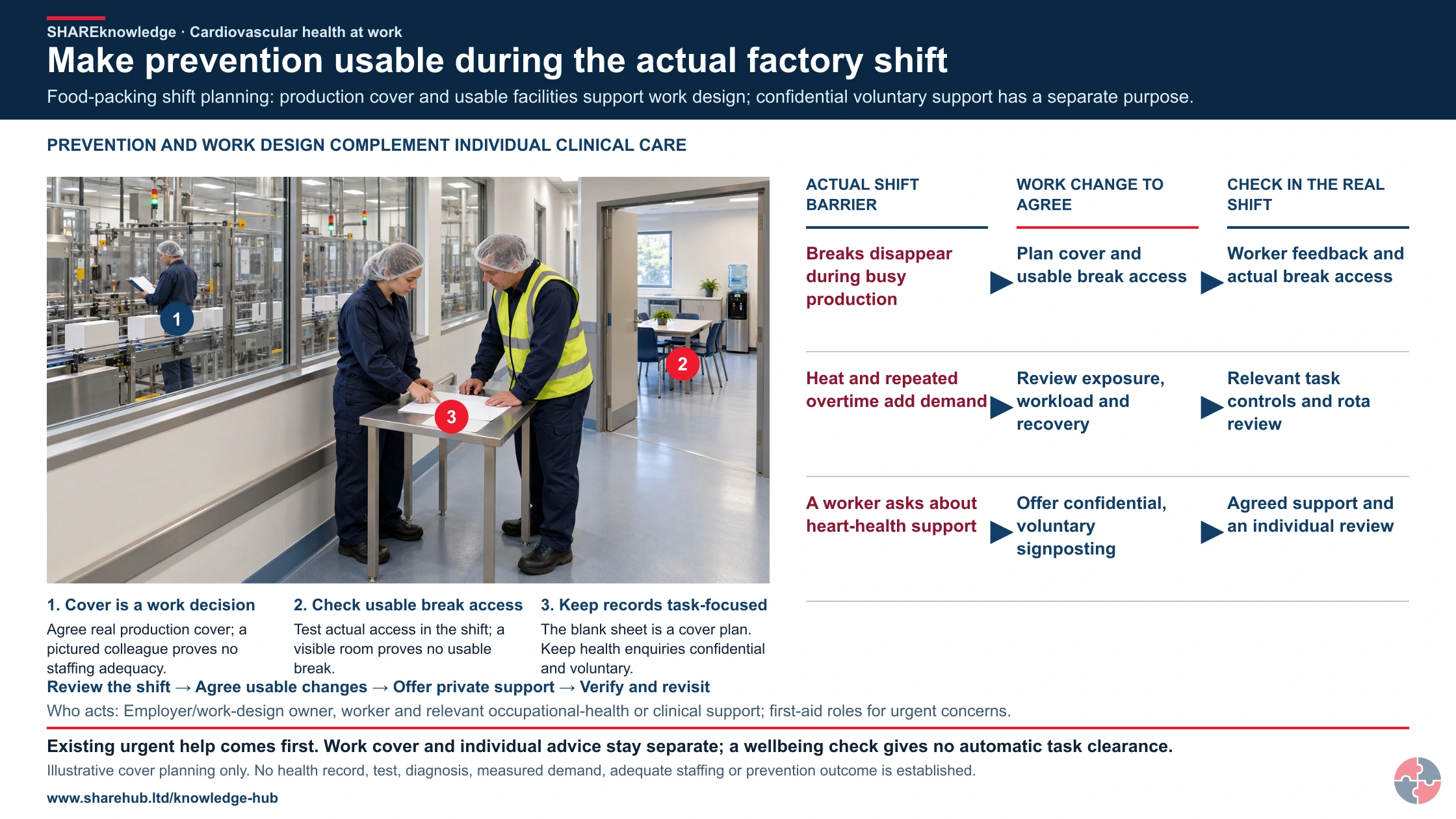
Make prevention usable during the actual factory shift
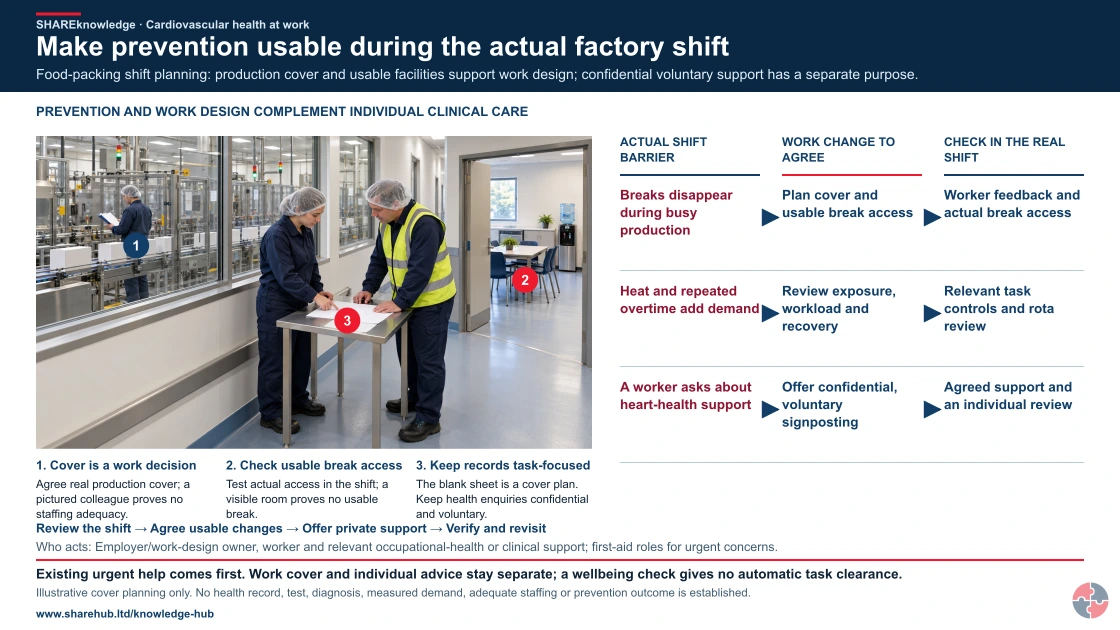
Full written explanation
A food-packing corridor scene connects production cover and usable facilities with work-design decisions. Behind sealed observation glazing, a hygienically dressed colleague stands with a blank clipboard away from enclosed guarded packing machinery and plain sealed cartons. Two alert colleagues on the corridor side discuss a blank work-cover sheet. A separate break-room doorway shows a table, chairs and drinking water outside production. Picture key1 concerns real production cover,2usable break access and3a task-focused work record. A visible colleague does not establish availability or competence to provide relief; a visible room does not establish that a break is usable during the shift. The analytical comparison connects three different conditions with work changes and evidence: missed breaks with cover and actual access, heat/repeated overtime with exposure/workload/recovery review, and a request for heart-health support with confidential voluntary signposting and individual review. The four-stage review/change/support/verification trail is unnumbered. The photograph establishes no measured workload, heat, overtime, health result, adequate staffing or prevention outcome. The blank cover record is distinct from private clinical information. Work design, individual clinical care, urgent help and the separate task/cover decision answer different questions. No new anatomy, harm mechanism, symptom, test, threshold, diagnosis, personal risk, service eligibility, treatment, emergency sequence or fitness clearance is supplied.
Food-packing shift planning: production cover and usable facilities support work design; confidential voluntary support has a separate purpose.
- Review the shift. Check workload, heat, breaks, recovery and relevant occupational exposures.
- Agree usable changes. Provide realistic cover and facilities with named work-design owners.
- Offer private support. Keep voluntary signposting and individual advice separate from intrusive monitoring.
- Verify and revisit. Check whether the changes work and review after changed demands or support needs.
When the evidence does not fit: An acute concern uses emergency arrangements first. Later work assignment needs its own relevant advice, safe cover and review; a wellbeing check is not automatic task clearance.
Who acts: Employer/work-design owner, worker and relevant occupational-health or clinical support; first-aid roles for urgent concerns.
Changed workplace
Logistics work pattern: Review real demand and recovery with the worker; a single result does not establish fitness.
Food-factory prevention: Make breaks, facilities and voluntary signposting accessible while controlling the actual work exposures.
| ACTUAL SHIFT BARRIER | WORK CHANGE TO AGREE | CHECK IN THE REAL SHIFT |
|---|---|---|
| Breaks disappear during busy production | Plan cover and usable break access | Worker feedback and actual break access |
| Heat and repeated overtime add demand | Review exposure, workload and recovery | Relevant task controls and rota review |
| A worker asks about heart-health support | Offer confidential, voluntary signposting | Agreed support and an individual review |
Evidence check: Work design and clinical care answer different questions. No diagnosis, screening threshold or individual fitness decision is supplied.
Full prevention, emergency readiness and individual work-support context
Primary references: NHS: cardiovascular disease · HSE: fatigue and work design (GB)
Open the complete HD image (new tab)Download image
Full prevention, emergency readiness and individual work-support context
Primary references: NHS: cardiovascular disease · HSE: fatigue and work design (GB)
Cardiovascular prevention is strongest when it is practical. Workers are more likely to benefit from wellbeing support if they also have manageable workloads, predictable breaks, reasonable shift patterns, access to water, safe facilities, smoke-free areas and time to attend appointments.
Prevention should not become intrusive monitoring of personal lifestyle. Voluntary health checks, awareness campaigns and signposting can be helpful, but pressure to disclose weight, blood pressure, medication or family history can damage trust.
The organisation should focus on what it controls: work design, exposure, first aid, facilities, working hours, food culture, movement opportunities and supportive management.
| Action | How it helps | Evidence |
|---|---|---|
| NHS Health Check signposting | Encourages eligible people to understand risk. | Campaign record. |
| Movement-friendly work | Reduces sedentary time and supports activity. | Break and meeting design. |
| Stress risk assessment | Controls demands, control, support and change. | HSE Management Standards action plan. |
| Fatigue management | Improves recovery and reduces unsafe performance. | Rota and overtime review. |
| Smoke-free support | Reduces smoking-related risk. | Policy and stop-smoking signposting. |
| Healthy food and hydration | Supports better everyday choices. | Facilities and procurement standards. |
| Exposure control | Prevents CO, exhaust or heat adding strain. | Risk assessments and inspections. |
How does work design affect cardiovascular health?
Work design can create stress and fatigue; heat and carbon monoxide are separate acute hazards. Existing cardiovascular conditions may also affect safe-work decisions.
Good work design is a health control. High demands with little control, poor support, bullying, unclear role expectations or badly managed change can create sustained stress. Long hours and shift work can reduce sleep and recovery. Heat, heavy PPE and physically demanding tasks can increase cardiac workload.
The aim is not to remove all pressure. Work will always have demands. The aim is to keep demands proportionate, give workers enough control and support, design rest and recovery into the system, and avoid normalising chronic overload.
For safety-critical work, cardiovascular health also links to public safety. A sudden event in a driver, plant operator, lifeguard, lone worker or control-room operator can affect many people.
| Work factor | Health or safe-work relevance | Control |
|---|---|---|
| Workload | Sustained overload can increase strain and poor recovery. | Resource planning and demand review. |
| Control | Low control can worsen stress. | Involve workers in planning. |
| Shift pattern | Night work disrupts sleep and routine. | Design rotations and recovery time. |
| Long hours | Extended hours reduce recovery. | Monitor overtime and rest. |
| Heat | Increases cardiovascular load. | Rest, hydration, shade and pacing. |
| Sedentary work | Long sitting may reduce movement. | Breaks and workstation habits. |
| Safety-critical role | Sudden incapacity may have wider consequences. | OH advice and fitness process. |
How should health checks be offered?
Offer signposting and voluntary checks with clear clinical follow-up and privacy; managers should not interpret a worker’s result.
The NHS Health Check is an England programme for eligible adults aged 40–74 without specified pre-existing conditions. Invitation, eligibility and service routes differ in Scotland, Wales and Northern Ireland. Link people to the NHS service for their home nation or GP instead of promising an England check to everyone. A normal result cannot rule out all future disease, and a high reading requires clinical advice, not a workplace label.
An employer may arrange optional blood-pressure or wellbeing events, but should explain the purpose, provider, consent, what data the employer receives and the follow-up route before anyone participates. Aggregate, non-identifying feedback can inform a programme; a manager does not need a list of individual readings. An occupational-health assessment for a particular safety-critical role is a separate, proportionate process with its own purpose and safeguards.
How should the workplace prepare for an acute event?
Assess first-aid needs, train the relevant responders, make emergency contact and equipment accessible, and practise the handover.
A leisure centre, depot or office should consider the people present, shift coverage, lone work, location and response time. First aiders need training appropriate to the identified risks and should know how to call 999, give clear location details, start CPR and use an available automated external defibrillator (AED) within their training and current emergency guidance. The organisation should maintain equipment and access, and arrange cover for absence or closed areas.
For example, if a visitor collapses at a remote sports pitch, the supervisor calls 999, sends a named person to meet the ambulance, and a trained responder retrieves the AED while another makes the area safe. Afterwards, check whether the location, access and staffing delayed care. The example is a planning prompt, not a claim that every site must own an AED.
How should employers support workers with cardiovascular conditions?
Employers should support workers through confidential conversations, reasonable adjustments, occupational health advice and planned return to work.
Many people with cardiovascular conditions work safely and effectively. The manager's task is to understand what the person can do, what work makes harder, what medical or occupational health advice says, and what temporary or longer-term adjustments are reasonable.
Return after heart attack, stroke, surgery or new medication may need phased hours, reduced physical work, changed shifts, breaks, travel adjustments, reduced stressors, avoidance of heat or temporary changes to safety-critical duties.
Support should be documented but not intrusive. Record restrictions, adjustments, owners and review dates. Keep medical detail limited and secure.
| Need | Possible adjustment | Review point |
|---|---|---|
| Reduced stamina | Phased return or reduced hours. | Review after agreed period. |
| Medication effects | Avoid safety-critical work until assessed if alertness is affected. | OH or GP advice. |
| Stress sensitivity | Workload review and clearer priorities. | Stress action plan. |
| Heat intolerance | Cooler tasks, breaks and hydration. | Seasonal review. |
| Driving or plant operation | Fitness assessment where needed. | Role-risk review. |
| Appointments | Flexible time for checks and treatment. | Attendance support review. |
How should cardiovascular health information be kept confidential?
Cardiovascular health information should be processed only where necessary, proportionate, secure and relevant to work support or safety.
Workers do not usually need to disclose full medical details to a line manager. If they ask for support, the discussion should focus on work impact: hours, duties, restrictions, appointments, fatigue, stress, medication effects or access needs.
Occupational health reports should answer work questions without over-sharing clinical information. HR and managers should agree who needs to know what, and why.
Wellbeing campaigns should not collect identifiable health information unless there is a clear need, lawful basis and privacy information.
| Issue | Good practice | Evidence |
|---|---|---|
| Disclosure | Let the worker control what is shared where possible. | Communication agreement. |
| Manager notes | Record work impact and adjustments, not unnecessary diagnosis detail. | Support plan. |
| OH reports | Ask functional questions. | Referral and report. |
| Health checks | Keep results private to the worker or healthcare provider. | Privacy notice. |
| Retention | Keep records only as long as necessary. | Retention schedule. |
Which duties apply in Great Britain and Northern Ireland?
Use the statutory instrument and regulator for the work location, and separate law from guidance.
Cardiovascular wellbeing is not a separate blanket statutory programme. The employer must assess and control health and safety risks created by work, provide suitable first-aid arrangements, and protect worker health data. GB and Northern Ireland use different instruments for general management and working time. Individual disability and employment questions need the applicable local route; a campaign cannot replace control of carbon monoxide, fatigue or work-related stress.
On a small screen, scroll this table sideways to read all columns.
| Decision | Great Britain | Northern Ireland |
|---|---|---|
| Work risk and first aid | GB Health and Safety at Work etc. Act 1974, Management Regulations 1999 and HSE first-aid route. | NI 1978 Order, Management Regulations 2000 and NI first-aid regulations; check HSENI/local law. |
| Hours and work-related stress | GB Working Time Regulations 1998 and HSE stress/fatigue guidance. | Working Time Regulations (Northern Ireland) 2016 and HSENI stress guidance. |
| Private support and health information | GB equality route with Acas guidance; UK data-protection principles. | NI disability/employment route; UK data-protection principles apply. |
How should cardiovascular health be recorded in business plans and risk registers?
Cardiovascular health should be recorded through work factors, first-aid readiness and support routes rather than private diagnosis lists.
The risk register should include work-controlled risks such as fatigue, stress, long hours, carbon monoxide, heat and remote work. The wellbeing plan can include voluntary health promotion and signposting. Individual medical information belongs in confidential support records.
Good records help the organisation see whether the system works: first-aid arrangements are current, AEDs are maintained, shift patterns are reviewed, stress actions close, and workers know how to get support.
| Record | What it should show | Owner |
|---|---|---|
| Wellbeing plan | Heart-health awareness, NHS signposting and campaign timing. | Wellbeing lead. |
| First-aid needs assessment | Cardiac event, stroke and response arrangements. | H&S adviser. |
| Stress risk assessment | Workload and psychosocial controls. | Managers and HR. |
| Fatigue assessment | Hours, shift patterns and recovery. | Operations manager. |
| Individual support plan | Adjustments, restrictions and review dates. | Line manager and HR. |
| Management review | Trends, actions and improvement decisions. | Senior leadership. |
How could Riverside Leisure Ltd support cardiovascular health?

Riverside Leisure Ltd would support cardiovascular health through wellbeing campaigns, first-aid readiness, work-design controls, confidential support and return-to-work planning.
Riverside Leisure Ltd
a leisure, hotel and outdoor activity business with hospitality teams, lifeguards, activity instructors, maintenance workers, grounds staff and shift workers
Riverside starts by identifying where heart-health risk interacts with work. Lifeguards and instructors perform safety-critical work, housekeeping and catering can involve heat and physical demand, reception and events teams can face high workload peaks, and maintenance may encounter carbon monoxide or exhaust risks if equipment is used poorly.
The wellbeing lead runs calm, NHS-aligned campaigns on cardiovascular health, blood pressure, England-only NHS Health Check eligibility and stroke/heart attack awareness. Campaigns are voluntary and do not ask workers to disclose private health data. First aiders refresh CPR and AED arrangements, including drills for poolside, campsite and remote activity areas.
Managers review work design. They check breaks during busy service periods, reduce routine excessive overtime, manage stress actions, and review shift patterns for recovery. Workers returning after a heart attack, stroke or surgery are supported through a private conversation, occupational health advice, phased duties and reviewable restrictions.
Riverside learns from evidence. AED checks, first-aid drills, stress surveys, fatigue reports, absence themes, occupational health advice and worker feedback are reviewed quarterly. Actions are assigned, ranked and closed only when a manager verifies that the change is working.
| Activity | How Riverside manages it | Evidence |
|---|---|---|
| Assess | Identifies heart-health, work design, first-aid and safety-critical role issues. | Wellbeing plan and risk register. |
| Analyse | Reviews shifts, breaks, stress, heat, first-aid cover and OH referrals. | Quarterly health-risk review. |
| Train | Trains first aiders, managers, supervisors and workers at the right depth. | Training matrix and drill records. |
| Implement | Uses NHS signposting, AED checks, stress controls, shift reviews and phased returns. | Campaign, inspection and support records. |
| Check | Verifies AEDs, first-aid cover, break compliance, stress actions and rota quality. | Assurance dashboard. |
| Learn | Uses incidents, near misses, worker feedback and OH trends to improve. | Lessons learned and action tracker. |
| Improve | Updates campaign content, rota rules, manager prompts and emergency plans. | Management review minutes. |
What should each role learn and demonstrate?
Learning must match the decisions people make, from recognising danger to checking that controls work.
Briefings should tell people how to act, but attendance alone does not show competence. Assess the real decision or task, record who assessed it and revisit after a material change, failed control or incident. A local authorisation is task-specific; no universal external certificate is implied.
On a small screen, scroll this table sideways to read all columns.
| Role and learning | Demonstration and assessor | Record and reassessment trigger |
|---|---|---|
| All workers: emergency signs, clinical signposting, privacy and work-factor reporting. | Supervisor tests a short case: call 999 for FAST/chest pain and raise a fatigue or exposure concern. | Briefing and scenario result; revisit when local routes change. |
| First aider or designated responder: site emergency plan, CPR/AED within training, handover. | Qualified trainer assesses practical response and a realistic site exercise. | Training record and drill outcome; reassess to maintain competence and after plan change. |
| Manager: safe cover, private conversation and work adjustment. | HR/OH assessor checks a support plan with functional actions and review date. | Restricted support note; review after role or capacity change. |
| Operations manager: hours, stressors, exposure and first-aid coverage. | Safety lead tests a real roster and coverage gap, then checks corrective action. | Risk review and action close-out; repeat after incident or work redesign. |
| Wellbeing, OH or safety specialist: accurate message and jurisdiction. | Competent peer checks England Health Check scope, emergency advice, privacy and GB/NI duties. | Approved message version and source review; revisit when guidance changes. |
How does cardiovascular health support qualification study and professional development?
Cardiovascular health helps learners connect wellbeing, first aid, work design, stress, fatigue, occupational health and legal duties.
For NEBOSH National General Certificate study, cardiovascular health can support answers on workplace wellbeing, first aid, stress, fatigue, health surveillance, worker consultation and risk assessment. The best answers separate general health promotion from work factors the employer controls.
For Diploma study, the topic can be developed into management-system assurance, occupational disease prevention, shift-work design, psychosocial risk, vulnerable workers, health data and fitness for work.
In scenario questions, include both immediate response and prevention: recognise warning signs, summon help, review first-aid arrangements, then examine work design, exposure and support controls.
How can a management system sustain effective decisions?
Give each hazard or support route an owner, a control, a check and a response to failure.
A useful review looks at first-aid coverage, actual hours, stress actions, safe-work adjustments and worker feedback. Keep individual health records with restricted access while using de-identified trends for work design. An owner should sample actual work and corrective actions, not accept a policy or certificate as evidence that the controls work.
The free GB regulator guide HSE Managing for health and safety (HSG65) explains a plan–do–check–act approach: assign controls and owners, involve workers, check work as done, and correct failures. For Northern Ireland, use HSENI risk assessment guidance for the local duty. A certificate alone does not demonstrate that a control works.
What are the warning signs that cardiovascular health is being managed poorly?
Warning signs include lifestyle-only messaging, weak first-aid readiness, unmanaged fatigue, poor confidentiality and no review of work-related contributors.
A weak programme tells workers to eat better and exercise more while ignoring excessive shifts, cancelled breaks, stressful work design or poor emergency arrangements. That approach feels unfair and misses the employer-controlled risks.
Another warning sign is poor response readiness: first aiders not current, AEDs not checked, workers unsure how to summon help, or managers allowing someone with worrying symptoms to drive themselves home.
Support also fails when health information is mishandled, occupational health advice is ignored or return-to-work restrictions are left vague.
Cardiovascular health FAQs: what do people ask?
People usually ask about risk factors, warning signs, health checks, first aid, work design, return to work and confidentiality.
What is cardiovascular health?
Cardiovascular health is the health of the heart and blood vessels, including risks such as coronary heart disease, stroke, high blood pressure and high cholesterol.
What are common cardiovascular risk factors?
Risk factors include smoking, high blood pressure, high cholesterol, diabetes, inactivity, diet, alcohol, weight, age, ethnicity and family history.
Can work affect cardiovascular health?
Work can create stress and fatigue, while heat and carbon monoxide are distinct acute hazards. Control each hazard and seek clinical or occupational-health advice when a cardiovascular condition affects safe work; these work factors alone do not establish the cause of disease.
What is an NHS Health Check?
In England, it is a free check for eligible adults aged 40 to 74 that assesses heart and blood-vessel risk; other UK nations use their own routes.
What heart attack signs should workplaces recognise?
Signs may include chest pressure or pain, breathlessness, sweating, nausea, pain spreading to arm, neck or jaw, collapse or not responding normally.
What stroke signs should workplaces recognise?
FAST stands for face, arms, speech and time to call 999, with sudden weakness, speech difficulty or face droop needing immediate action.
Should employers run workplace blood pressure checks?
They can, but participation should be voluntary, confidential, competently arranged and linked to NHS or GP advice rather than diagnosis by managers.
How can workplaces support heart health?
They can support breaks, movement, stress control, fatigue management, healthy food choices, smoke-free policies, first aid and time for health appointments.
Can a worker return after a heart attack or stroke?
Many people can return with planning, medical or occupational health advice, phased duties and reviewable adjustments.
What information should managers record?
Managers should record work impact, restrictions, adjustments and review dates, not unnecessary medical detail.
Is cardiovascular health only a wellbeing issue?
No. A worker with a cardiovascular condition may need safe-work adjustments; employers must also control fatigue, stress, heat and toxic exposure as workplace hazards.
What training is useful?
General awareness, first-aid awareness, manager training, occupational health referral training and role-specific fatigue or exposure training are useful.
Which acronyms are useful for cardiovascular health?
Acronyms help readers follow heart-health, emergency, occupational health and support terminology.
| Acronym or term | Meaning | Why it matters |
|---|---|---|
| CVD | Cardiovascular Disease | Group of heart and blood-vessel conditions. |
| CHD | Coronary Heart Disease | Condition where heart blood supply is affected. |
| FAST | Face, Arms, Speech, Time | Simple stroke recognition prompt. |
| AED | Automated External Defibrillator | Device used in some cardiac arrest responses. |
| CPR | Cardiopulmonary Resuscitation | Emergency action for a person not breathing normally. |
| OH | Occupational Health | Work-focused health advice. |
| GP | General Practitioner | Primary medical route for non-emergency health concerns. |
| EAP | Employee Assistance Programme | Confidential support route offered by some employers. |
| TIA | Transient Ischaemic Attack | Stroke-like symptoms that pass but still need medical assessment. |