SHARE Knowledge Hub
Blood pressure and hypertension at work
Blood pressure is the force of blood against artery walls, and hypertension means blood pressure that remains too high over time. High blood pressure often has no obvious symptoms, but it increases the risk of heart attack, stroke, kidney disease and other cardiovascular harm. In the workplace, the role of managers is not to diagnose or treat hypertension; it is to design healthier work, provide first-aid readiness, protect confidentiality, support appointments and recovery, consider reasonable adjustments, and manage safety-critical work fairly where symptoms, medication, fatigue or acute illness may affect safe performance.
Understanding Blood pressure and hypertension at work
Blood pressure is the force of blood against artery walls, and hypertension means blood pressure that remains too high over time. High blood pressure often has no obvious symptoms, but it increases the risk of heart attack, stroke, kidney disease and other cardiovascular harm. In the workplace, the role of managers is not to diagnose or treat hypertension; it is to design healthier work, provide first-aid readiness, protect confidentiality, support appointments and recovery, consider reasonable adjustments, and manage safety-critical work fairly where symptoms, medication, fatigue or acute illness may affect safe performance.
Why this matters at work
Typical failures include diagnosing from one reading, assuming no symptoms means no risk, treating a device result as universal fitness clearance, omitting a referral route, pressuring workers to reveal results and relying on a health event to manage work-stress hazards.
Ask about relevant effects such as dizziness or difficulty performing a safety-critical task, using occupational-health advice where necessary. Driving, machinery, heights or a role with a specific medical standard need the applicable task and sector process rather than a generic wellbeing result. Avoid assuming non-adherence when readings remain high; measurement, treatment barriers or clinical factors may need professional review. Agree proportionate temporary arrangements, ownership and review, sharing only necessary functional information. Keep the clinical record separate from the work plan. GB and NI safety frameworks remain distinct, and practical support should not wait for a manager to assign a diagnosis.
How organisations manage this in practice
Use a competent provider with a clear explanation of the service, measurement conditions, limitations, privacy and follow-up. Participation in a wellbeing event should not become a requirement to disclose readings to line managers or a proxy for job-specific medical assessment. A screening observation may prompt repeat or ambulatory measurements through healthcare; the event itself should not label the person from a single number. Agree in advance how urgent findings and symptoms are escalated, how the worker receives results and how recommended next steps are completed. Managers should support appointments and ask about work needs rather than compile identifiable comparisons between teams. Keep any legally required role assessment separate, using its applicable standard and competent advice. Audit the service's communication and follow-through, not just attendance. Explain that feeling well does not remove the need for recommended review. Retain only information necessary for the event's stated purpose and use appropriate access and retention arrangements rather than treating every wellbeing sheet as an occupational medical record.
Discuss the actual work demands and any functional difficulties or appointment needs. Clarify competing priorities, escalation when workload cannot be completed safely, support for inexperienced staff, relationships and communication during change. Do not frame every concern as a person's inability to cope. Managers need authority and resources to implement the changes they discuss, and the worker's prescriber or pharmacist should address medicine questions. Agree specific adjustments or temporary duties with appropriate occupational-health input, then check that they are available during real shifts. Record owners, restrictions and review triggers while keeping clinical details private. Where a particular role has a medical standard, retain that independent process rather than replacing it with a general wellbeing check. Employment support schemes may be relevant but use the correct GB or NI route and criteria; they are not automatic awards for a diagnosis or substitutes for employer duties. A normal workplace reading cannot authorise every task, and a diagnosis alone cannot determine that someone must stop ordinary work.
Begin with current symptoms, the task and the support needed. Hypertension commonly has no symptoms, so appearance or productivity cannot establish control. The manager can facilitate appointments, consider functional difficulties and improve work arrangements, but diagnosis, investigation and treatment belong to healthcare professionals. One reading does not provide a universal work-fitness decision or occupational limit.
High blood pressure is usually diagnosed and treated through healthcare routes, not by managers. Chest pain, suspected heart attack signs, suspected stroke signs, fainting, severe breathlessness or sudden serious deterioration should be managed through first-aid and emergency arrangements, not an ordinary workplace wellbeing conversation.
Use clinical advice for readings and functional advice for work
A workplace check is a voluntary healthcare opportunity, not an employer pass/fail test. Current NHS information is the appropriate first signpost for checking and follow-up; retain national local-service advice and the existing urgent boundary. Historical England background can remain reference material.
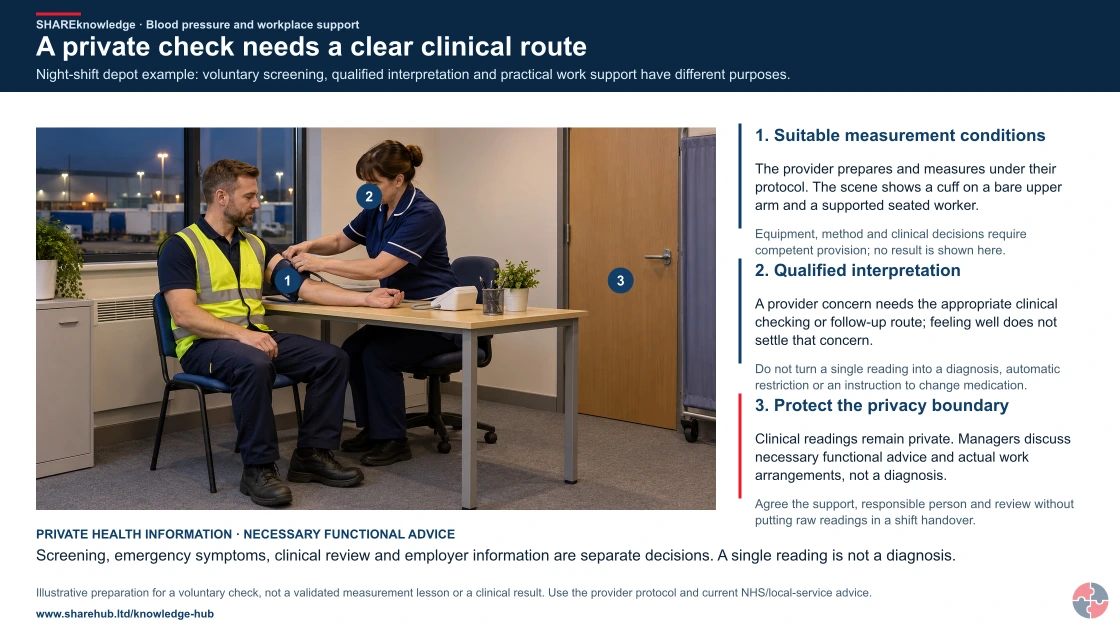
A private check needs a clear clinical route
Full written explanation
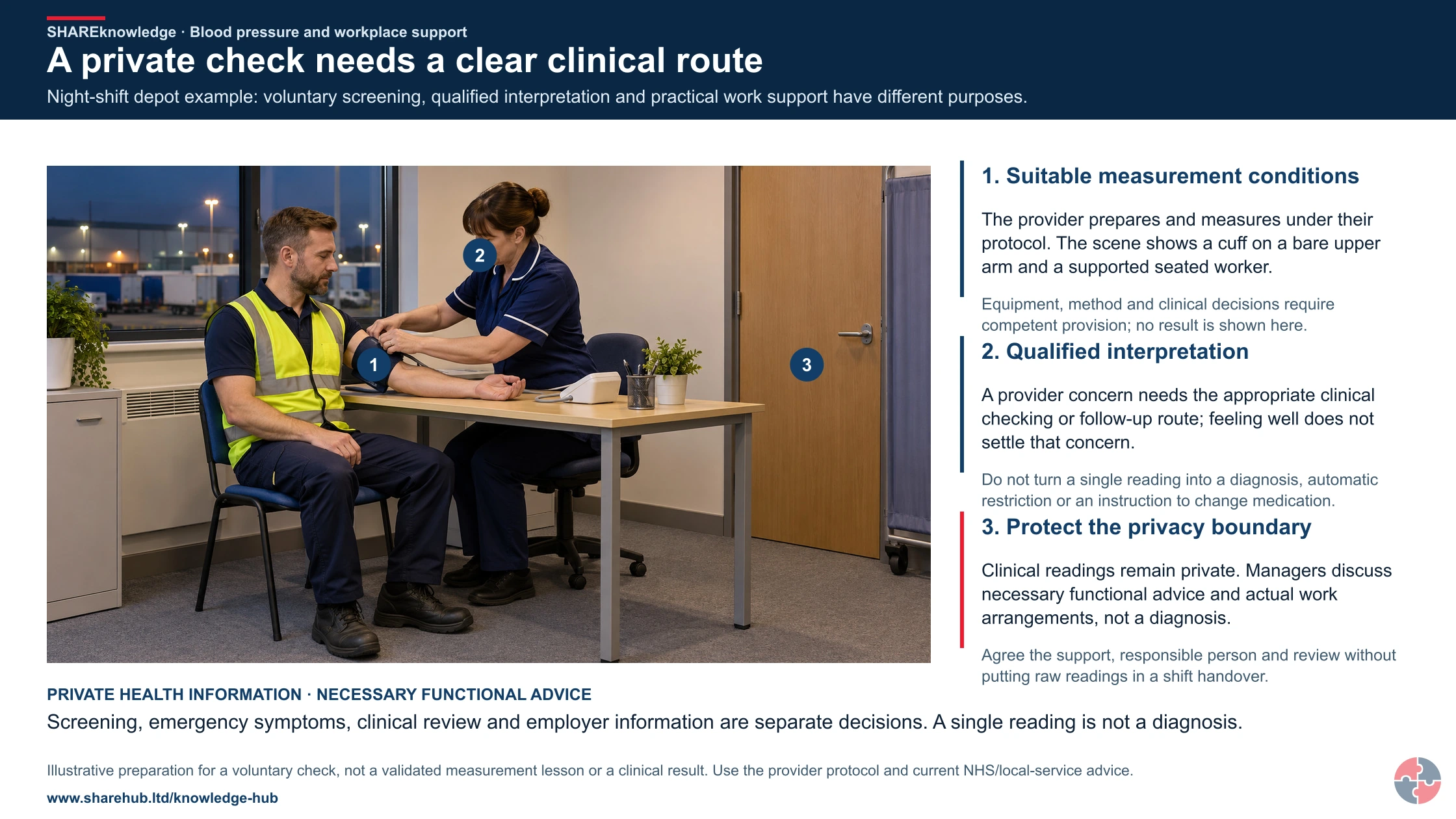
Night-shift depot example: voluntary screening, qualified interpretation and practical work support have different purposes.
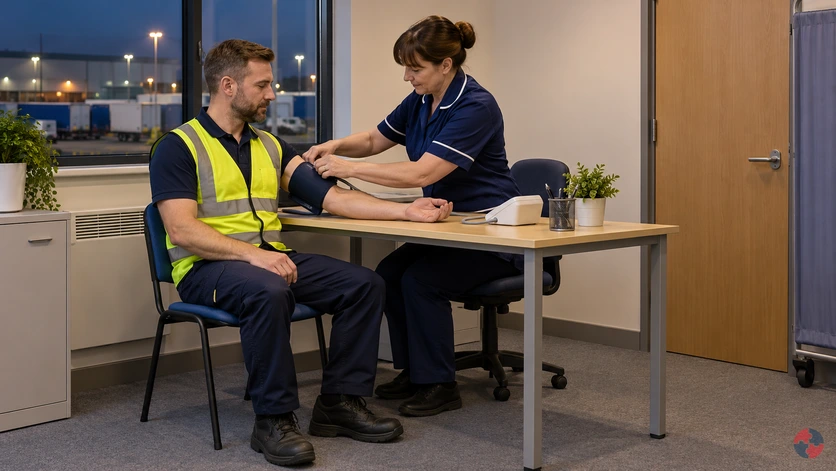
- Suitable measurement conditions. The provider prepares and measures under their protocol. The scene shows a cuff on a bare upper arm and a supported seated worker.
- Qualified interpretation. A provider concern needs the appropriate clinical checking or follow-up route; feeling well does not settle that concern.
- Protect the privacy boundary. Clinical readings remain private. Managers discuss necessary functional advice and actual work arrangements, not a diagnosis.
Change the pathway
- Use the actual provider protocol. Equipment, method and clinical decisions require competent provision; no result is shown here.
- Avoid a one-reading verdict. Do not turn a single reading into a diagnosis, automatic restriction or an instruction to change medication.
- Share only what is needed. Agree the support, responsible person and review without putting raw readings in a shift handover.
Evidence check: Screening, emergency symptoms, clinical review and employer information are separate decisions. A single reading is not a diagnosis.
Full urgent-symptom and emergency-response boundary; retain national local-service advice
Primary references: NHS: blood pressure test · NHS: high blood pressure
Open the complete HD image (new tab)Download image
Full urgent-symptom and emergency-response boundary; retain national local-service advice
Primary references: NHS: blood pressure test · NHS: high blood pressure
Commission a competent provider with a current escalation protocol, private results and a clear referral route. Feeling well does not overrule a provider concern, and a manager should not convert an isolated result into a diagnosis or fitness restriction. Work decisions use actual task demands and qualified functional advice.
The worker feels well but the provider is concerned
Illustrative example. A voluntary workplace check produces a result the provider considers worrying, while the worker reports no symptoms.
Decision. Follow the provider clinical pathway and agree any necessary work support through appropriate qualified advice.
Evidence to check. Check provider competence, method/protocol, referral arrangements and the minimum functional information needed by the manager.
Hold or escalation point. Do not dismiss the provider concern because the worker feels well or publish the reading in the team handover.
Follow-up. Review whether the support/referral process worked without placing clinical results in operational records.
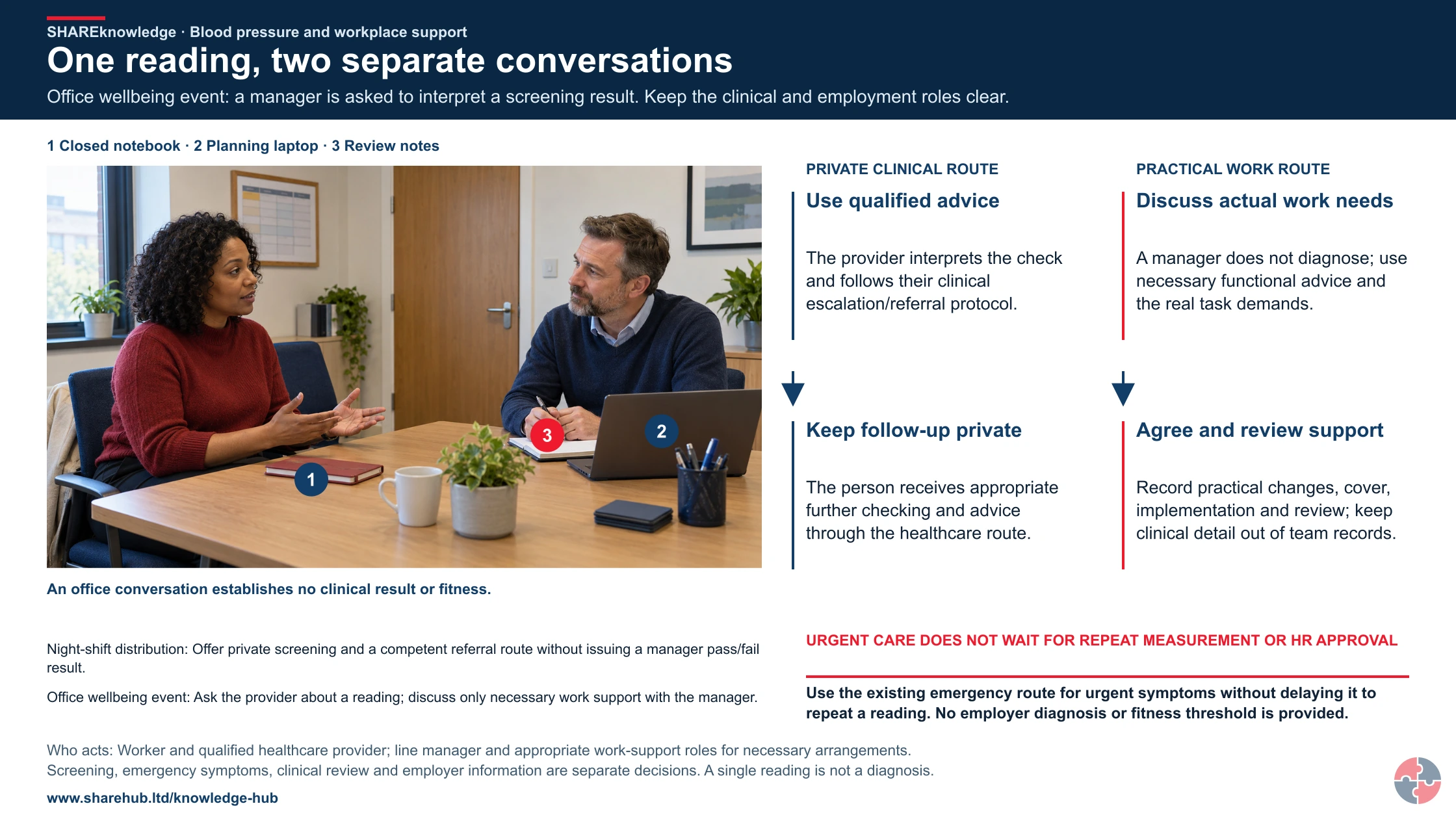
One reading, two separate conversations
A single reading is not a diagnosis. The measurement provider follows the appropriate interpretation and escalation process; a manager discusses practical work arrangements from necessary functional advice.
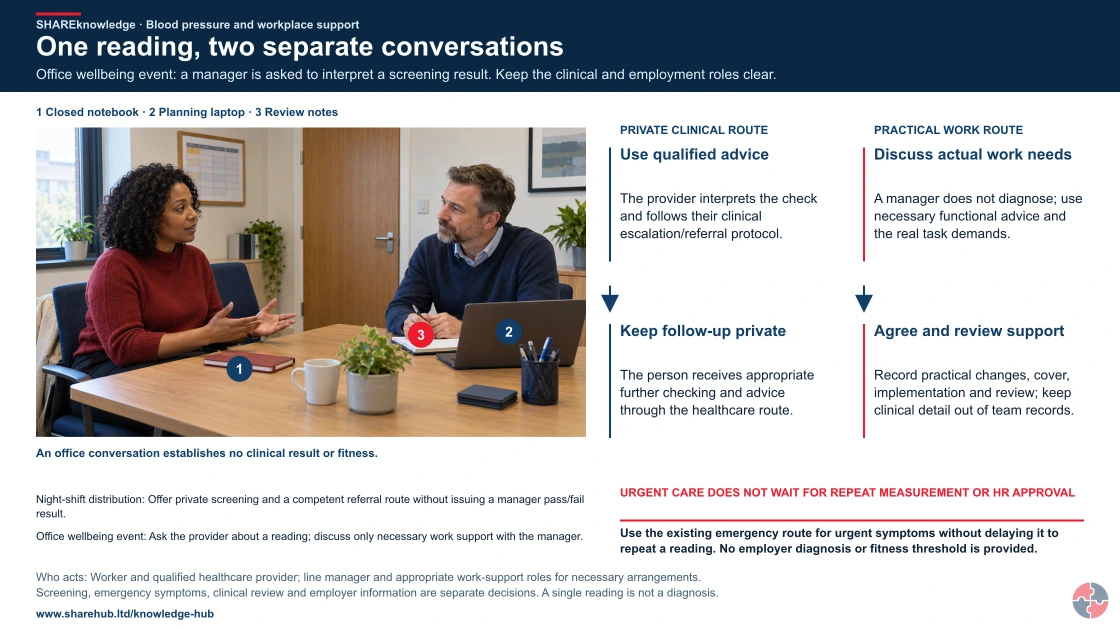
One reading, two separate conversations
Full written explanation
An illustrative UK private-office setting shows two normal adults discussing work, a closed notebook, laptop and inert review notes. One literal picture key identifies 1 closed notebook, 2 planning laptop and 3 review notes. This is practical-support context only: no screening event, healthcare provider, blood-pressure reading, measurement, clinical result or clinical action is pictured. A conversation, normal appearance, closed door or paper record establishes no diagnosis, symptoms, fitness, privacy compliance, consent, entitlement or successful support. Two independent tracks retain the four checks. Private clinical route: Use qualified advice: The provider interprets the check and follows their clinical escalation/referral protocol. Keep follow-up private: The person receives appropriate further checking and advice through the healthcare route. Practical work route: Discuss actual work needs: A manager does not diagnose; use necessary functional advice and the real task demands. Agree and review support: Record practical changes, cover, implementation and review; keep clinical detail out of team records. Only one arrow within each track shows its own order; neither track authorises or clears the other. URGENT CARE DOES NOT WAIT FOR REPEAT MEASUREMENT OR HR APPROVAL. Use the existing emergency route for urgent symptoms without delaying it to repeat a reading. No employer diagnosis or fitness threshold is provided. Who acts: Worker and qualified healthcare provider; line manager and appropriate work-support roles for necessary arrangements. Screening, emergency symptoms, clinical review and employer information are separate decisions. A single reading is not a diagnosis. Night-shift distribution: Offer private screening and a competent referral route without issuing a manager pass/fail result. Office wellbeing event: Ask the provider about a reading; discuss only necessary work support with the manager. Urgent clinical care remains independent of repeat measurements, managers, HR approval, forms and work release. Work notes represent necessary work facts, not clinical readings or private health records. No measurement instruction, clinical threshold, medication or treatment advice is supplied.
Office wellbeing event: a manager is asked to interpret a screening result. Keep the clinical and employment roles clear.
- Use qualified advice. The provider interprets the check and follows their clinical escalation/referral protocol.
- Keep follow-up private. The person receives appropriate further checking and advice through the healthcare route.
- Discuss actual work needs. A manager does not diagnose; use necessary functional advice and the real task demands.
- Agree and review support. Record practical changes, cover, implementation and review; keep clinical detail out of team records.
When the evidence does not fit: Use the existing emergency route for urgent symptoms without delaying it to repeat a reading. No employer diagnosis or fitness threshold is provided.
Who acts: Worker and qualified healthcare provider; line manager and appropriate work-support roles for necessary arrangements.
Changed workplace
Night-shift distribution: Offer private screening and a competent referral route without issuing a manager pass/fail result.
Office wellbeing event: Ask the provider about a reading; discuss only necessary work support with the manager.
Evidence check: Screening, emergency symptoms, clinical review and employer information are separate decisions. A single reading is not a diagnosis.
Full urgent-symptom and emergency-response boundary; retain national local-service advice
Primary references: NHS: blood pressure test · NHS: high blood pressure
Open the complete HD image (new tab)Download image
Full urgent-symptom and emergency-response boundary; retain national local-service advice
Primary references: NHS: blood pressure test · NHS: high blood pressure

- Private measurement / provider
- Necessary functional advice only
- Agreed work support and review
Read the labels in the full-size drawing
- PRIVATE CLINICAL ROUTE
- NECESSARY FUNCTIONAL
- ADVICE
- WORK SUPPORT / REVIEW
- Separate responsibilities; connect necessary evidence
Private clinical lane
A suitable provider measures, interprets and arranges repeat or further assessment under their protocol. The contextual photograph is not a validated measurement lesson.
Practical work lane
Discuss appointments, breaks, actual task demands and any qualified restrictions. Agree adjustments, cover, an implementation owner and a review point.
Information boundary
Share only necessary functional advice for the agreed purpose. A manager does not need unrestricted access to raw readings or a full clinical history.
Unsafe work, concerning symptoms or qualified restrictions follow the existing escalation route. This page supplies no employer diagnosis threshold, automatic fitness verdict or instruction to change medication.
What are the key facts about blood pressure and hypertension?
The key facts are that high blood pressure is common, often silent, clinically managed and relevant to work because it can affect risk, recovery and support needs.
High blood pressure is often silent
People may not know they have it unless their blood pressure is checked.
It is a cardiovascular risk factor
Long-term hypertension can increase the chance of stroke, heart attack and other vascular disease.
Managers should focus on work impact
The workplace role is support, adjustment, first aid and risk management, not clinical judgement.
Privacy is central
Blood pressure results, medication and occupational health advice are worker health information and need careful handling.
Work can help or hinder
Stress, shifts, long hours, heat, fatigue, travel and lack of breaks may make management harder.
Emergency signs need emergency arrangements
Chest pain, stroke signs, collapse or sudden severe deterioration should be routed through first-aid and emergency procedures.
What are blood pressure and hypertension?
Blood pressure is recorded as systolic and diastolic pressure, and hypertension is persistently high blood pressure.
A blood pressure reading has two numbers. The systolic number reflects pressure when the heart pumps blood around the body. The diastolic number reflects pressure when the heart relaxes between beats. A single reading can be affected by stress, activity, caffeine, pain, illness and measurement conditions, so healthcare professionals normally interpret readings in context.
Hypertension matters because persistently high pressure places strain on blood vessels, the heart, the brain and kidneys. Over time it can contribute to cardiovascular disease, stroke, heart attack and kidney problems.
Workplace wellbeing guidance should explain the topic without medicalising ordinary management. A worker may be fully fit with controlled blood pressure, while another person may need support because of appointments, medication effects, fatigue, stress, associated conditions or recovery from an acute event.
Systolic pressure. The top number, measured when the heart pumps. May be discussed in healthcare advice, not interpreted by managers.
Diastolic pressure. The bottom number, measured when the heart relaxes. Part of a reading that should be interpreted through healthcare routes.
Hypertension. Blood pressure that remains too high over time. May affect appointments, fatigue, medication and long-term support.
Cardiovascular disease. Conditions affecting the heart and blood vessels. Relevant to first aid, wellbeing and return-to-work planning.
Functional impact. How health affects what the person can safely and sustainably do. The right focus for workplace decisions.
How should blood pressure readings be understood?
Blood pressure numbers should be interpreted using healthcare guidance, not informal workplace judgement.
Nidirect explains blood pressure as systolic and diastolic numbers, such as 130/80. The workplace should avoid creating its own clinical thresholds, diagnoses or pass/fail rules unless a qualified occupational health or medical process is properly designed for a specific reason.
Where an employer offers workplace health checks, participation should normally be voluntary, results should be private, and workers should be signposted to NHS, GP, pharmacy or other qualified healthcare support where readings are raised or worrying.
A blood pressure campaign can be valuable when it encourages awareness and early checking. It becomes risky if managers receive unnecessary individual health data, use readings for disciplinary decisions or fail to explain how information will be used.
Worker shares a reading. Thank them, ask what support at work would help and signpost to healthcare advice. Trying to interpret or diagnose the reading.
Workplace check campaign. Use voluntary checks, privacy notices and qualified providers. Sending individual results to managers.
Safety-critical concern. Assess functional impact and seek occupational health advice where needed. Making assumptions from a number alone.
Return to work. Use fit note, healthcare advice and functional restrictions. Demanding unnecessary medical details.
Wellbeing trend. Use anonymised aggregate insight where appropriate. Publishing identifiable health information.
For context, the government’s 2017 England Health matters publication describes clinic readings of 140/90 mmHg or higher followed by a daytime ambulatory or home average of 135/85 mmHg or higher. This dated public health explanation is not a current diagnostic protocol, a single home-reading verdict or a workplace exclusion rule. Qualified clinicians should interpret readings using current local guidance.

What do blood pressure numbers mean, and how can persistent high pressure affect the heart and organs?
Interactive anatomy · Blood pressure and possible long-term effects · Updated 2026-10-23
Read all anatomy and process explanations without the viewer
Fixed adult educational content; no user readings, health profiles or medication information. Diagnosis, personalised treatment targets or medication changes Pressure inferred from pulse, anxiety, smartwatch or device measurements Personal cardiovascular risk or time-to-disease calculations Pregnancy, children, frailty and specialist-condition management Reassurance from one reading or symptoms being absent The model does not measure blood pressure or generate a physiological waveform.
Systolic pressure
The first, higher number is pressure when the heart pumps. In the fixed 120/80 mmHg teaching example, 120 is systolic. This example is not a personal treatment target. NHS: Blood pressure test
Diastolic pressure
The second, lower number is pressure between heartbeats. In the fixed example, 80 mmHg is diastolic: pressure during relaxation between beats. NHS: Blood pressure test
Artery wall
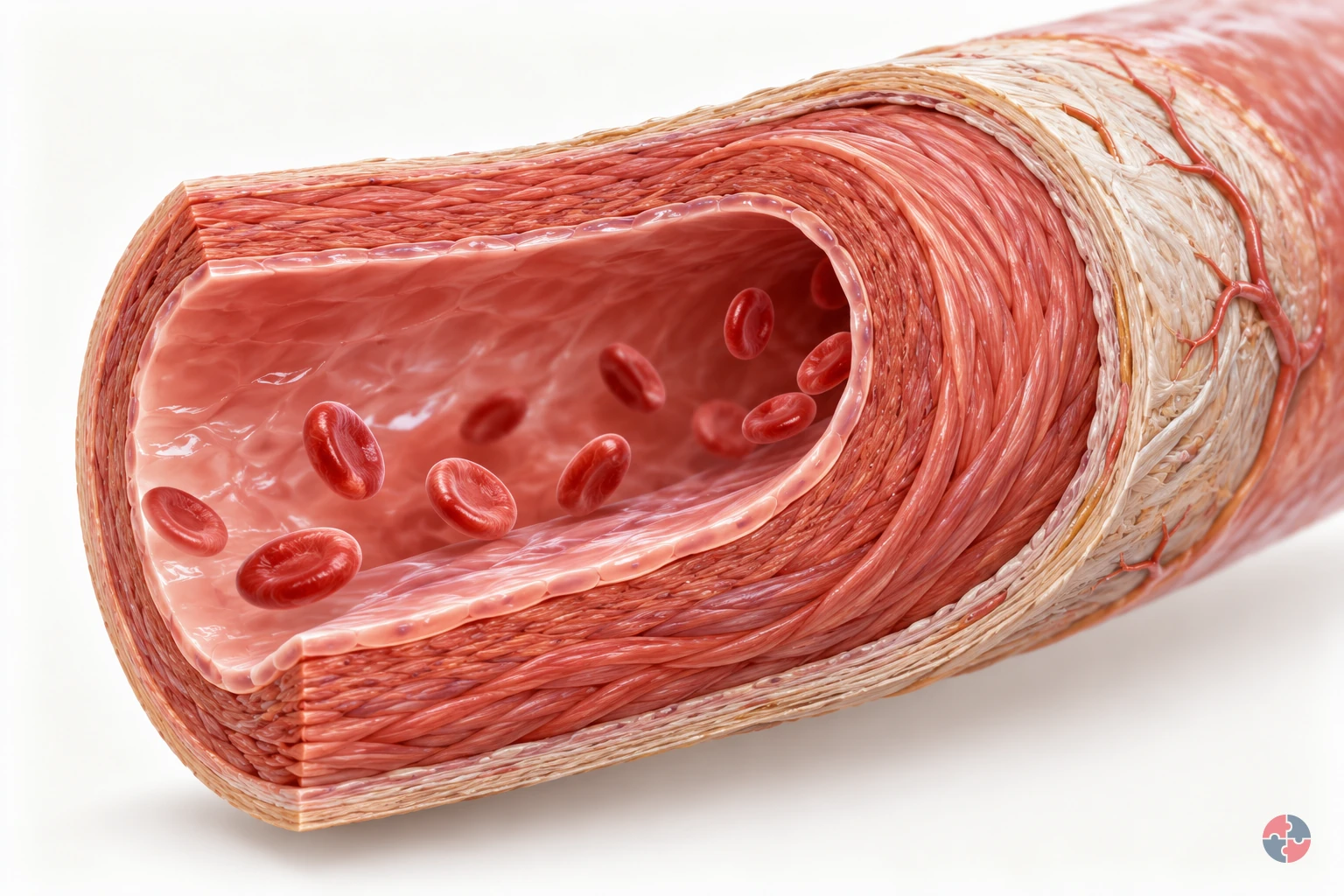
Arterial walls normally stretch as pressure changes. The artery wall surrounds the lumen, the space carrying blood. It accommodates the pressure associated with circulation, and its structure is different from a deposit inside a vessel. The enlarged layers help locate the wall but do not measure its thickness or stiffness. Compare this label with the lumen before reading the pressure-phase explanation. Wye Valley NHS Trust: High blood pressure — cardiac rehabilitation
Vessel lumen
The inside space carries blood. Pressure acts against the surrounding wall. A lumen is not the same structure as a wall deposit or surrounding tissue. Wye Valley NHS Trust: High blood pressure — cardiac rehabilitation · Manchester University NHS Foundation Trust: Blood Vessels
Heart
Persistently raised pressure makes the heart work harder. Heart muscle may thicken or become less efficient over time. This is a possible effect, not an inevitable sequence after one high reading. University Hospitals of Leicester NHS Trust: Hypertension (high blood pressure) · St George’s University Hospitals NHS Foundation Trust: Heart health and cancer treatment — high blood pressure context
Brain circulation
High pressure can increase stroke risk. The map highlights the brain’s blood supply, not a predicted stroke or an individual diagnosis. NHS: High blood pressure
Kidney vessels
High pressure and kidney problems can affect each other. Pressure can strain small kidney vessels. Kidney disease can also raise pressure through fluid and hormonal effects. NHS: Chronic kidney disease · NHS MyHealth London: Kidney Health
Eye circulation
Vessels in the eyes can be affected. The eye card explains a possible effect of persistent high pressure. Selecting it does not imply that the learner has retinal damage. NHS: High blood pressure · University Hospitals of Leicester NHS Trust: Hypertension (high blood pressure)
Cuff measurement
A properly performed check measures blood pressure. A real cuff is used to obtain a blood-pressure reading; this illustrated cuff only displays a fixed teaching example. It receives no device data and cannot tell how the learner’s pressure changes. Feeling well does not reliably establish that pressure is normal. Use the display to understand the two-number format, keeping personal assessment separate. NHS: Blood pressure test · NHS: High blood pressure
Repeated readings
Further readings are normally needed to establish the pattern. A clinician may arrange home, repeated clinic or ambulatory monitoring. Do not diagnose or dismiss a raised value from this animation. NHS: Blood pressure test · NHS: High blood pressure · NHS MyHealth Devon: Hypertension — measurement context and repeat assessment
Open the complete process transcript
The process, step by step
Locate wall and lumen
Start with the artery’s wall and the lumen, the open space inside it that carries blood. Pressure acts against the surrounding wall; the wall and the moving blood are not the same structure. Compare the two labels before moving to the beat-phase example. This enlarged cutaway helps locate the parts being discussed, but its thickness and shape are illustrative. It does not measure stiffness, narrowing or a person’s blood pressure. Following the labels first gives the later pressure numbers a physical context instead of presenting them as unrelated figures. Wye Valley NHS Trust: High blood pressure — cardiac rehabilitation · Manchester University NHS Foundation Trust: Blood Vessels
What to watch: Find the open lumen inside the artery and the surrounding wall, checking the boundary between the two labelled regions.
Why it matters: Blood pressure describes pressure against vessel walls. Locating the wall and lumen helps keep a pressure reading distinct from a picture of narrowing, wall thickness or a deposit inside a vessel.
Explore this step: Select the wall and lumen in turn and describe the different structure identified by each label.
Pressure during pumping
Select the systolic label and relate it to the heart’s pumping phase. Systolic pressure is the higher number in a blood-pressure reading. In this fixed teaching example it is 120 mmHg. The number belongs to the example, rather than being measured from the learner or calculated by the illustration. Read it together with the phase label, then compare it with the between-beats step. The purpose is to connect a familiar written number with the phase it describes, not to set a personal treatment target or interpret an individual result. NHS: Blood pressure test
What to watch: Locate the systolic label and the higher number in the fixed display, relating both to the pumping phase described beside them.
Why it matters: A blood-pressure result describes more than one phase of the heartbeat. Identifying the systolic phase helps the learner understand what the first number represents without using this illustration to judge their own pressure.
Explore this step: Read the systolic label aloud with its unit, then explain which phase of the heartbeat it describes.
Pressure between beats
Now select diastolic pressure and compare it with the pumping phase. Diastolic is the lower number, describing pressure while the heart relaxes between beats. The fixed example shows 80 mmHg. Relaxation between beats is part of the repeating cycle; it does not mean the pressure reading is zero or that the circulation has stopped. Keep the two phase labels in view as you compare them. The illustration provides a way to understand the terms and their order, without measuring a person, setting a target or offering a diagnosis. NHS: Blood pressure test
What to watch: Locate the diastolic label and the lower number, then compare it with the systolic label from the previous step.
Why it matters: The lower number describes a different phase from the higher number. Understanding both prevents “between beats” being mistaken for no pressure and keeps the two-number reading connected to the heartbeat cycle.
Explore this step: Compare both labels and explain why the second number describes a different phase from the first.
Read two numbers
Bring the two labels together in the illustrated cuff display: systolic first and diastolic second, both expressed in millimetres of mercury, written mmHg. The fixed reading is 120/80 mmHg. The slash separates the two pressure values; it is not a division exercise. Follow each number back to its phase label so the display has meaning. This cuff illustration receives no device data and takes no reading. It teaches how a result is written, while interpretation and any personal follow-up remain outside the model. NHS: Blood pressure test
What to watch: Compare the first and second numbers on the illustrated cuff display with their systolic and diastolic labels and the shared unit.
Why it matters: Reading both numbers with the unit preserves their meaning. It avoids treating one isolated number, an illustrated cuff or the appearance of the model as a complete assessment of someone’s blood pressure.
Explore this step: Point to each number, name its phase and read the complete example with the unit mmHg.
Understand context and follow-up
Blood pressure varies, so a reading needs context rather than being judged from this single fixed illustration. A healthcare professional may arrange repeated measurements or monitoring outside the clinic to understand the pattern. Select the repeated-readings label and compare it with the one example shown on the display. The model does not record a diary, analyse a trend or decide which follow-up a person needs. Its role is to explain why a measurement and an interpretation are different things, while the existing professional follow-up guidance remains the next point of reference. NHS: Blood pressure test · NHS: High blood pressure · NHS MyHealth Devon: Hypertension — measurement context and repeat assessment
What to watch: Locate the repeated-readings label and compare it with the single fixed cuff example, noticing the different questions they address.
Why it matters: A fixed teaching example cannot establish a person’s usual pressure. Considering context and follow-up keeps the learning activity separate from diagnosis and avoids either dismissing or diagnosing a raised result from the model.
Explore this step: Explain the difference between recognising the two-number format and assessing a person’s pattern of readings.
Explore possible longer-term effects
Open the organ map and explore the heart, brain, kidney and eye labels one at a time. Persistent high pressure can place strain on vessels and organs and increase the risk of serious health problems. The cards identify possible longer-term effects; they are not inevitable stages after one high reading. Compare each card with the artery-wall view to connect the wider subject with the structure introduced at the start. The model cannot show whether damage is present in any person, and completing the map is not a screening test. NHS: High blood pressure · NHS: Chronic kidney disease · University Hospitals of Leicester NHS Trust: Hypertension (high blood pressure)
What to watch: Select the heart, brain, kidney and eye cards separately, then compare their explanations with the artery-wall label.
Why it matters: The importance of a pressure check is not limited to the number itself. The map explains possible consequences without implying that every organ is affected, that symptoms must be present or that the model can diagnose damage.
Explore this step: Choose two organ cards and explain why the map describes possibilities rather than a diagnosis or inevitable sequence.
Mechanisms and their limits
Vessel effects: persistent stress Persistently raised pressure places extra strain on arteries. They may become less stretchy, stiffer or narrower over time. This wall comparison is different from a separate plaque blocking the lumen. The transition represents a long-term mechanism, not damage predicted from one reading. Do not show a balloon bursting or equate pressure with plaque. No wall-stiffness or personal-risk result is calculated. NHS: High blood pressure · Wye Valley NHS Trust: High blood pressure — cardiac rehabilitation
NHS: high blood pressure and care
Heart effects: more work against pressure Pumping against persistently raised pressure increases the heart’s workload. Heart muscle can become thickened or stiff, with possible effects on pumping. The thicker-muscle still is one possible consequence, not an inevitable stage. A faster pulse does not represent all hypertension. This image cannot establish a person’s heart structure or function. University Hospitals of Leicester NHS Trust: Hypertension (high blood pressure) · St George’s University Hospitals NHS Foundation Trust: Heart health and cancer treatment — high blood pressure context
NHS: pressure risks and management
Organ effects: brain, kidney and eye circulation Persistent high pressure can increase risk to brain circulation and harm kidneys or eye vessels. Kidney disease can itself also raise pressure. These organs have separate explanatory cards. Possible damage is not a prediction about the learner or a time-to-disease calculation. No organ turns black and no graphic bleeding is used. Not everyone with high pressure develops these complications. Personal assessment belongs with healthcare professionals. NHS: High blood pressure · NHS: Chronic kidney disease · University Hospitals of Leicester NHS Trust: Hypertension (high blood pressure) · NHS MyHealth London: Kidney Health
Vessel effects: persistent stress — follow the anatomy
Look at: The wall of the artery, surrounding its open centre.
What changes: Persistently high pressure places extra strain on artery walls.
Why it matters: Vessels can become less flexible; high pressure is not the same thing as a fatty blockage.
What to do: Have blood pressure measured and follow an agreed healthcare plan.
A blood-pressure explanation in a voluntary workplace check
A wellbeing session uses a fixed teaching diagram and directs personal readings to an appropriate healthcare professional. Explicit time jump: persistent raised pressure and later vessel effects are not produced by one busy shift, one reading or 32 seconds of animation. The viewer accepts no readings, calculates no diagnosis and assigns no personal target. Normal pressure variation is different from persistent hypertension.
Understand pressure without entering a reading The fixed systolic/diastolic example explains mmHg. Actual assessment depends on correct measurement, context and repeat readings, not a pulse count or how well someone feels. NHS: Blood pressure test · NHS: High blood pressure
Persistent pressure over a longer period The timeline jumps to a hypothetical period of sustained raised pressure. The wall experiences extra mechanical strain; no worker’s job is labelled as the sole cause. NHS: High blood pressure · Wye Valley NHS Trust: High blood pressure — cardiac rehabilitation
Possible long-term vessel effects The labelled wall comparison illustrates reduced elasticity or altered vessel structure over time. It is separate from a fatty coronary deposit and cannot measure an individual vessel’s condition. Wye Valley NHS Trust: High blood pressure — cardiac rehabilitation
Follow clinical advice and appropriate prevention Use NHS advice about checks and healthy habits, and follow an individual clinician’s plan where prescribed. Do not interpret the workplace animation as diagnosis, medication advice or medical clearance. NHS: Blood pressure test · NHS: High blood pressure
Heart effects: more work against pressure — follow the anatomy
Look at: The muscular wall of the left ventricle.
What changes: The heart must work harder to pump against persistently high pressure.
Why it matters: Over time, the muscle can thicken and become less able to fill or pump effectively.
What to do: Manage blood pressure with healthcare support; this animation cannot assess your heart.
Why persistent high pressure can increase heart workload
A worker receiving routine clinical follow-up uses the educational model to understand the heart’s pumping workload. Explicit time jump over a prolonged period: possible heart changes do not occur between two readings or during this 32-second sequence. The effect is possible, not inevitable. The scene does not diagnose heart enlargement or convert a pressure value into heart size.
Begin with normal pumping and pressure A fixed pressure-cycle illustration shows the heart pushing blood into the arterial system. The numbers are teaching labels and are not collected from the learner. NHS: Blood pressure test
Pumping against persistently raised pressure The timeline jumps to an example of long-standing raised pressure, which adds strain to the heart. This is different from a temporary faster pulse during ordinary activity. NHS: High blood pressure · University Hospitals of Leicester NHS Trust: Hypertension (high blood pressure)
A possible later muscle change The selected heart comparison illustrates possible thickening or enlargement and less efficient function. It does not show inevitable failure, a measured wall thickness or a personal prognosis. University Hospitals of Leicester NHS Trust: Hypertension (high blood pressure) · St George’s University Hospitals NHS Foundation Trust: Heart health and cancer treatment — high blood pressure context
Keep personal follow-up with healthcare professionals Follow appropriate checks and clinical advice rather than using the model to choose treatment. New persistent chest discomfort overrides routine monitoring and needs the emergency response shown outside the activity. NHS: High blood pressure
Organ effects: brain, kidney and eye circulation — follow the anatomy
Look at: The small vessels supplying the brain, kidneys and eyes.
What changes: Long-term high pressure can damage the vessels on which these organs depend.
Why it matters: The risk of stroke, kidney disease and sight problems increases, often without early symptoms.
What to do: Use regular blood-pressure checks and follow clinical advice.
Explaining possible brain, kidney and eye effects
A workplace health-learning session explains why repeated clinical follow-up matters even when someone feels well. Explicit time jump: potential long-term organ effects are not an automatic result of one high reading or a 32-second clip. Organ icons describe risks, not a person’s damaged organs. Kidney disease can both result from and contribute to raised pressure; the viewer cannot determine which applies.
A person can feel well and still need checks High blood pressure usually causes no symptoms. The fixed lesson explains follow-up; it collects no health profile or real reading and does not let an employer diagnose staff. NHS: Blood pressure test · NHS: High blood pressure
Long-standing pressure affects more than one organ The timeline jumps through a hypothetical prolonged period. Blood vessels serving the brain, kidneys and eyes can experience extra strain; this is not a clock predicting when disease will occur. NHS: High blood pressure · University Hospitals of Leicester NHS Trust: Hypertension (high blood pressure)
Different possible organ effects Separate cards identify brain circulation, kidney vessels and eye circulation. Effects are neither inevitable nor diagnosed by the picture; the kidney–pressure relationship can run in both directions. NHS: High blood pressure · NHS: Chronic kidney disease · NHS MyHealth London: Kidney Health
Clinical follow-up remains individual Use proper checks and healthcare advice, including investigation where a clinician recommends it. Follow emergency advice for new warning symptoms; an unchanged icon, absence of symptoms or improved example number is not clearance. NHS: Blood pressure test · NHS: High blood pressure
Read the practice situations and all answer explanations
BP-Q1: What could establish their blood pressure?
A colleague feels well and assumes their pressure is normal.
Arrange an appropriate blood-pressure check. — Correct. High pressure usually has no symptoms. A proper check measures pressure.
Treat the absence of headache as proof. — High blood pressure often causes no symptoms. Feeling well does not establish the reading.
Use their normal pulse as proof. — Pulse counts beats; blood pressure describes pressure in vessels. A normal pulse does not prove normal pressure.
NHS: Blood pressure test · NHS: High blood pressureBP-Q2: Which follow-up is appropriate?
An adult has one elevated clinic reading.
Follow the healthcare professional’s plan for repeat or out-of-office assessment. — Yes. Measurement conditions and follow-up matter. This routine example never means waiting when severe symptoms or urgent clinical concerns are present.
Diagnose hypertension from this animation. — The animation cannot diagnose. More than one reading is normally needed, interpreted in context by a healthcare professional.
Dismiss it because they felt nervous. — Nervousness can affect a reading, but it is not a reason to ignore it. Follow the professional assessment plan.
NHS: Blood pressure test · NHS: High blood pressure · NHS MyHealth Devon: Hypertension — measurement context and repeat assessmentBP-Q3: What takes priority?
During a wellbeing session, someone develops new severe chest discomfort that does not go away.
Call 999 and follow emergency advice. — Correct. New persistent severe chest discomfort needs immediate emergency help.
Keep repeating blood-pressure checks until the number improves. — Do not delay 999 for repeated readings. A changing number cannot clear emergency symptoms.
Finish the learning activity first. — Stop the activity and get emergency help immediately.
NHS: High blood pressureSources and how the model is made
The opening images are AI-generated anatomical illustrations. The interactive 3D models and labelled SVG diagrams use original procedural artwork. These teaching images are not medical scans or diagnostic tools. Source references support the learner explanations and do not grant artwork rights.
- NHS: Blood pressure test — Reviewed November 2025: systolic/diastolic meanings, mmHg, cuff checks, repeat readings, clinic/home context. No personalised target or measurement input.
- NHS: High blood pressure — Often no symptoms, professional follow-up, affected organs, emergency chest symptoms and general care/prevention.
- Wye Valley NHS Trust: High blood pressure — cardiac rehabilitation — Normal arterial stretch and possible stiffness/narrowing with persistent high pressure. Replaces a non-NHS vessel-mechanism link.
- NHS MyHealth Devon: Hypertension — measurement context and repeat assessment — Narrow use for clinic versus home/daytime-average confirmation and variation. Some other treatment/alcohol/severe-threshold text is older and is explicitly not reused; current national NHS sources control advice.
- NHS: Chronic kidney disease — High pressure can strain small kidney vessels and contribute to kidney disease. No staging or treatment simulation.
- University Hospitals of Leicester NHS Trust: Hypertension (high blood pressure) — Long-term pressure load and possible heart, kidney, brain and sight effects; qualitative ventricular hypertrophy context only.
- St George’s University Hospitals NHS Foundation Trust: Heart health and cancer treatment — high blood pressure context — Narrow normal-pressure mechanism point: high blood pressure can cause heart muscle stiffening or thickening over time. No oncology/arrhythmia treatment advice transferred.
- NHS MyHealth London: Kidney Health — Kidney/pressure effects can be bidirectional through fluid and hormonal function. No personal medication or diet recommendation.
- NHS South East Clinical Senate: Blood pressure — Clinical Senate background information — Indexed primary document supports systolic and/or diastolic threshold logic. Direct PDF retrieval failed; recheck at clinical sign-off. No treatment protocol copied.
- Manchester University NHS Foundation Trust: Blood Vessels — Basic vessel structure and lumen/flow context, not pressure diagnosis.
How can hypertension affect health and work?
Hypertension can increase long-term cardiovascular risk and may affect work through symptoms, treatment, fatigue, appointments or related conditions.
Many people with hypertension continue to work normally, especially when the condition is identified and managed. The workplace should therefore avoid stereotypes that treat diagnosis as incapacity.
The practical issue is functional impact. A person may need time for appointments, support with medication side effects, review of safety-critical work during a period of ill health, or temporary changes after a heart attack, stroke, kidney problem or related condition.
Long-term wellbeing is also relevant. Work that makes sleep, recovery, exercise, healthy eating, breaks or stress management difficult can make cardiovascular health harder to manage. A good employer looks at work design as well as individual signposting.
No obvious symptoms. The worker may be unaware of the condition. Promote voluntary checks and NHS signposting.
Appointments. Time needed for GP, nurse, pharmacy, monitoring or tests. Allow reasonable time and plan cover.
Medication effects. Dizziness, fatigue or adjustment period may affect some people. Review tasks and seek occupational health advice if needed.
Stress sensitivity. High workload or conflict may make management harder. Assess work-related stress and workload.
Recovery after acute illness. Stamina, confidence and capacity may fluctuate. Use phased return and review dates.
Safety-critical duties. Symptoms or treatment may affect driving, lone work or hazardous tasks. Assess function and use qualified advice.
What can increase the likelihood of high blood pressure?
Blood pressure risk can be influenced by age, genetics, diet, alcohol, smoking, physical inactivity, sleep, stress and other health conditions.
Risk factors should be discussed without blame. Some factors are personal or genetic. Some relate to wider social circumstances. Some may be influenced by work, such as long hours, shift patterns, fatigue, high sustained demand, limited breaks, heat, sedentary work or restricted access to healthier food and activity.
A workplace cannot control every factor, but it can remove unnecessary barriers to healthier choices. That may include predictable breaks, drinking water, welfare facilities, safer workloads, fatigue management, active travel support, smoke-free support, healthy catering and access to health checks.
Where the workforce includes people in safety-critical, high-stress, isolated, driving, security, construction, manufacturing or emergency response roles, wellbeing design should be practical enough for real shifts rather than written for office-only patterns.
Age and genetics. Not controlled by work. Avoid assumptions and signpost to health checks.
Diet and alcohol. Can be influenced by catering, travel and shift patterns. Healthy options and non-judgemental information.
Smoking. May be linked to stress, breaks and culture. Smoking cessation signposting.
Physical inactivity. May be affected by sedentary roles or long shifts. Movement breaks and active work design.
Stress and sleep. May be affected by workload, conflict, shifts and fatigue. Stress risk assessment and fatigue controls.
Existing conditions. Diabetes, kidney disease and other conditions may interact. Occupational health advice where work impact is unclear.
Which work factors can make blood pressure management harder?
Work factors can make blood pressure management harder when they increase stress, fatigue, heat strain, inactivity or barriers to healthcare.
Work-related stress does not automatically cause every case of hypertension, but sustained high demand, low control, poor support, role conflict, bullying, insecurity, long hours and poor recovery can make cardiovascular wellbeing harder to protect.
Shift work and night work can disturb sleep, eating patterns, medication routines and opportunities for physical activity. Hot environments, heavy physical work, driving pressure, lone work or high-consequence decision-making can also affect how a person manages symptoms or recovery.
The right response is not to remove responsibility from the worker. It is to design work so that health advice can realistically be followed and so that early support is easier than hiding the problem.
High demand. Sustained stress and poor recovery. Workload review and staffing control.
Low control. Less ability to manage breaks, appointments or pacing. More autonomy and planned flexibility.
Shift work. Sleep disruption and medication routine challenges. Fatigue assessment and predictable rota design.
Sedentary work. Limited movement across the day. Movement breaks and workstation planning.
Hot work. Dehydration and physical strain may worsen symptoms. Heat stress controls and welfare provision.
Safety-critical work. Symptoms, medication or fatigue may affect safe performance. Functional assessment and occupational health referral.
What signs should prompt a workplace response?
A workplace response is needed when a person appears unwell, cannot work safely, reports concerning symptoms or needs support to access healthcare.
A workplace check is not a fitness verdict


Read the complete visual as text
- READING: A single reading at a voluntary event does not by itself establish persistent hypertension or a disciplinary conclusion.
- CLINICAL ROUTE: The qualified provider interprets the result, applies its escalation protocol and explains repeat assessment or follow-up, even if the person feels well.
- WORK ROLE: Managers consider symptoms, qualified restrictions and the actual task; they do not diagnose or demand the numerical result.
- SUPPORT: Protect privacy, arrange appointments and review workload, breaks and agreed duties. Update the plan when advice or function changes.
High blood pressure itself often has no obvious symptoms. That means managers should not wait for visible warning signs before promoting health checks, but they should also avoid assuming that headaches, tiredness or stress prove hypertension.
Some symptoms require immediate first-aid and emergency arrangements rather than a management conversation. Suspected heart attack signs can include chest pain or pressure, breathlessness, sweating, nausea or pain spreading to the arm, jaw, neck or back. Suspected stroke signs include face, arm or speech changes.
For less severe but repeated concerns, the manager should hold a private supportive conversation, ask what work is making harder, agree practical support and signpost to GP, NHS, pharmacy or occupational health routes as appropriate.
Chest pain or suspected heart attack signs. Use first-aid and emergency arrangements. Do not route through ordinary HR process.
Face, arm or speech changes. Use emergency arrangements for suspected stroke. Do not wait for a manager review.
Dizziness or fainting at work. Make the person safe, use first aid and review work risk. Do not let them continue hazardous tasks unchecked.
Repeated headaches or blurred vision. Suggest healthcare advice and review work demands if needed. Do not diagnose the cause.
Worker discloses hypertension. Ask about work impact, support and confidentiality. Do not ask for unnecessary clinical detail.
Medication change affects work. Review safety-critical tasks and seek occupational health advice if needed. Do not rely on informal assumptions.
Call 999 for suspected heart attack or FAST stroke signs, including when stroke signs have stopped. Do not wait for a blood-pressure check or allow an unwell person to drive themselves. For recurring symptoms without emergency signs, obtain prompt advice from a GP or the local urgent clinical service; workplace staff should not diagnose the cause.
How should hypertension be considered in safety-critical work?
Safety-critical work should be assessed by function, risk and qualified advice rather than diagnosis alone.
A diagnosis of hypertension does not automatically mean a person cannot do safety-critical work. The relevant questions are whether symptoms, medication effects, fatigue, associated conditions, recovery stage or medical restrictions affect safe performance.
Safety-critical work may include driving, operating plant, working at height, confined spaces, lone work, emergency response, high-hazard maintenance, public safety roles or process control. If the consequence of sudden incapacity or impaired judgement is severe, the assessment should be more formal.
Occupational health input is useful where managers need functional advice. The referral should ask clear work-related questions: what restrictions apply, for how long, what adjustments are recommended, what review date is needed and whether any safety-critical tasks should be temporarily changed.
What task is safety critical?. The risk comes from the task and consequence, not the diagnosis label. Task risk assessment.
What is the functional impact?. Symptoms or medication may affect alertness, balance or stamina. Worker discussion and OH advice.
Is there healthcare advice?. Medical restrictions may need work translation. Fit note or OH report.
Can duties be adjusted?. Temporary changes can protect safety and employment. Adjustment plan and review date.
Who needs to know?. Only practical restrictions may need sharing. Privacy-controlled communication.
How is review managed?. Health and work capacity may change. Agreed review dates.
How should confidentiality and data protection be managed?
Health information about blood pressure or hypertension should be handled as sensitive worker health information with clear purpose, limited access and secure records.
Employers may need some health information to support attendance, adjustments, first aid or safe work, but they should collect the minimum necessary. Managers usually need to know what support or restrictions apply, not detailed readings, medication names or unrelated clinical history.
Workers should be told why information is being collected, who will see it, how it will be used, how long it will be kept and what will happen next. Occupational health reports should focus on functional advice and adjustments unless there is a clear need for more detail.
Confidentiality is also a trust issue. If workers believe health information will be used unfairly, they may avoid checks, delay disclosure or hide symptoms until problems become harder to manage.
Purpose. Only collect information for a clear support, safety or employment reason. Privacy notice and referral reason.
Minimum necessary. Record restrictions and adjustments, not unnecessary diagnosis detail. Manager notes and HR records.
Access control. Limit access to people who need it. Permissions and secure storage.
Transparency. Explain what will be shared and why. Worker communication and consent where relevant.
Retention. Keep records only as long as needed. Retention schedule.
Accuracy. Keep functional advice and review dates up to date. OH updates and review records.
What workplace adjustments may help someone with hypertension?
Adjustments should be based on the person's work impact, medical advice and reviewable support needs.
Adjustments do not need to be dramatic to be useful. Time to attend appointments, predictable breaks, temporary changes to safety-critical duties, workload review, reduced overtime, phased return, shift changes or support with stressors can make treatment and recovery more manageable.
The manager should ask what work is making the condition harder to manage and what support would help. The answer may change over time, especially after a new diagnosis, medication change, hospital treatment, bereavement, stress episode or return from absence.
In Great Britain, the Equality Act 2010 may require reasonable adjustments if the disability test is met. In Northern Ireland, the employment route is the Disability Discrimination Act 1995. Even where a legal disability test is not met, managers can still agree proportionate practical support.
Time for appointments. Monitoring, GP, nurse, pharmacy or tests. Check appointment pattern and cover needs.
Workload review. Stress or excessive demand affects health management. Review demands and recovery.
Break planning. Medication, hydration, food, movement or rest needs. Check whether breaks are actually taken.
Temporary duty change. Symptoms or medication affect hazardous tasks. Set review date and OH input if needed.
Shift review. Sleep disruption or medication timing is a barrier. Review rota and fatigue.
Phased return. After acute illness or longer absence. Increase duties based on recovery.
How can workplaces promote healthier blood pressure?
Workplaces can promote healthier blood pressure by reducing harmful work factors and making healthy choices easier without blaming individuals.
Good wellbeing programmes combine education with work design. Posters about lifestyle are weak if employees cannot take breaks, work excessive overtime, have no access to drinking water or feel unable to attend medical appointments.
Useful initiatives include voluntary blood pressure checks, NHS Health Check signposting, healthy catering, movement opportunities, stress prevention, fatigue management, smoking cessation signposting and alcohol-awareness support.
Campaigns should be inclusive and non-judgemental. They should recognise that income, culture, caring responsibilities, disability, job role and shift pattern affect what is realistic.
Voluntary checks. Help people identify raised blood pressure earlier. Qualified provider and confidential results.
Stress controls. Reduce sustained work pressure and poor recovery. Management Standards approach and action plan.
Movement opportunities. Reduce sedentary work and support general health. Breaks, active meetings and job design.
Healthy food culture. Makes healthier choices easier during shifts. Catering review and accessible drinking water.
Smoking and alcohol signposting. Supports wider cardiovascular risk reduction. Official support routes and non-blame messaging.
NHS Health Check signposting. Connects eligible people to public health checks. Campaign material and privacy boundaries.
What should a workplace blood-pressure event change?
Design an awareness event so a worker can obtain appropriate private advice without being labelled by a line manager. Decide beforehand who provides the service, how concerning findings reach an appropriate clinician and how personal information is handled. Do not put individual readings, medication or attendance beside names on a team performance board. An employer’s general wellbeing report should not become an informal clinical record.
Use worker feedback to examine the work conditions the employer can change: whether breaks are usable, shifts and staffing create persistent pressure, welfare is accessible and appointment arrangements work in practice. For an illustrative shift-based site, offer comparable access to the awareness service across shifts and review barriers to attending or seeking follow-up without demanding personal results. The manager should assess and act on work stressors even when no worker discloses a diagnosis. The event supports awareness; clinical interpretation and fitness advice still belong to the appropriate health professional.
Guidance and scope: Original SHARE event-planning example using UK government privacy principles and HSE GB work-stress guidance. It sets no diagnostic threshold, medical screening requirement or entitlement to a particular adjustment. GOV.UK data protection HSE stress Management Standards
How should first-aid arrangements connect to blood pressure and cardiovascular risk?
First-aid arrangements should cover serious deterioration, suspected heart attack, suspected stroke, collapse and recovery support.
First aid at work is not a blood pressure management system, but it is part of the safety net. Employers should assess first-aid needs, provide suitable first aiders or appointed persons, maintain equipment, communicate arrangements and review after incidents.
First aiders should understand their role boundary. They can respond to illness or injury, call emergency services, use available equipment and record incidents. They should not diagnose hypertension or decide ongoing fitness for work.
Where the workforce has remote sites, lone working, physically demanding work, heat exposure, public-facing roles or older workers, the first-aid needs assessment should reflect foreseeable medical events as well as injuries.
Needs assessment. Matches provision to people, tasks, shifts and location. First-aid needs assessment.
Trained first aiders. Supports response to collapse, chest pain or suspected stroke. Training certificates and rota.
Emergency communication. Ensures help is called quickly. Procedure and displayed information.
Remote/lone work. Controls delay where people work alone. Lone-working plan and escalation.
Incident recording. Captures learning after illness events. First-aid records and review.
Post-event support. Supports return to work and learning. Return-to-work and OH referral process.
Which legal duties apply in Great Britain and Northern Ireland?
The applicable legal route depends on where the work takes place. The duties below are scoped to Great Britain and Northern Ireland; a task assessment and the current instruments determine the actual requirements.
Great Britain
The GB Health and Safety at Work Act and Management Regulations require assessment and control of risks arising from work, including relevant stress, fatigue and safety-critical tasks. First-aid duties are under the GB 1981 Regulations. The Equality Act 2010 may require reasonable adjustments if the disability test is met; a high reading alone is not an automatic legal disability. Health data must have a lawful purpose, limited access and security. Employers manage work, not clinical diagnosis.
Northern Ireland
Use the NI Health and Safety at Work Order and NI Management Regulations for workplace risk, and the NI First-Aid Regulations 1982 for first-aid provision. Disability-related employment duties arise under the NI Disability Discrimination Act 1995, not the GB Equality Act 2010. Keep health information necessary and confidential, and seek qualified clinical advice for diagnosis or fitness.
How could Riverside Leisure Ltd support blood pressure and hypertension at work?

Riverside Leisure Ltd would support blood pressure and hypertension through wellbeing design, confidential support, first-aid readiness and fair work adjustments.
Riverside Leisure Ltd
Riverside Leisure Ltd is used here as a leisure, hospitality and visitor-facing business with pools, gyms, food service, events, shift work, maintenance teams and seasonal workers.
Riverside starts by mapping work factors that can affect cardiovascular wellbeing: long shifts, hot plant rooms, busy public-facing periods, lone closing duties, limited breaks, manual handling, catering options, stress peaks during events and first-aid cover across opening hours.
The wellbeing lead creates a voluntary annual campaign around blood pressure and NHS Health Check signposting. Individual results are not shared with managers. The campaign uses official NHS information, private spaces for checks and clear wording about how personal health data is protected.
Line managers receive training on supportive conversations. They ask about work impact, not diagnosis, and record only necessary adjustments, review dates and restrictions. HR checks the GB Equality Act or NI Disability Discrimination Act route for the actual location and keeps health information secure.
First-aid arrangements are reviewed for poolside areas, gyms, kitchen work, plant rooms, lone work and events. Riverside tests emergency communication, confirms first-aider cover, reviews AED access where provided, and checks that staff know how to respond to suspected heart attack, stroke, collapse or sudden serious illness.
Assurance is active. Riverside reviews absence trends, first-aid incidents, stress risk assessments, shift patterns, adjustment timeliness, worker feedback and action close-out. Learning from incidents or near misses is used to improve rotas, breaks, welfare facilities and manager guidance.
Assess. Reviews stress, fatigue, heat, shift work, welfare, lone work and first-aid needs. Risk assessments and first-aid needs assessment.
Analyse. Looks for patterns in absence, first-aid events, worker feedback and peak workload. Trend review and action plan.
Implement. Provides breaks, welfare, health signposting, confidential support and adjusted duties. Adjustment records and communications.
Train. Trains managers, first aiders and wellbeing leads at different levels. Training matrix and refreshers.
Check. Samples whether breaks, first-aid cover, privacy and adjustments work in practice. Inspection, audit and worker feedback.
Learn and improve. Updates rota design, welfare, campaign material and support routes after feedback. Review minutes and closed actions.
What training is useful for blood pressure and hypertension at work?
Training should help people understand the topic, protect confidentiality, respond to serious illness and manage work support proportionately.
Different groups need different depth. Everyone may benefit from short awareness about blood pressure checks and official signposting. Managers need confidence to hold private conversations and avoid diagnosis. First aiders need current first-aid competence. HR and wellbeing leads need stronger knowledge of privacy, adjustments and referral pathways.
Training should make boundaries explicit: do not diagnose, do not demand unnecessary health details, do not share information widely, and do not ignore safety-critical concerns.
Refresher training should follow incidents, changes in first-aid arrangements, occupational health feedback, poor handling of confidential information, manager uncertainty or new wellbeing campaigns.
Competence means a person can carry out the actual task safely, recognise a changed condition and respond correctly. Attendance alone is insufficient. The matrix makes assessment, ownership, records and reassessment explicit.
| Role | Required learning | How competence is assessed | Assessor or owner | Record | Reassess when |
|---|---|---|---|---|---|
| Workers | Know how to access BP checks, report work impact privately and recognise emergency symptoms. | Scenario signposting and first-aid alarm drill. | Supervisor | Briefing and observed response | After route, role or emergency change. |
| Supervisors | Control work stressors, protect privacy, make temporary functional changes and refer clinical questions. | Case discussion with limited-data handover. | Manager / HR | Case decision and review date | After work or health-impact change. |
| First aiders | Recognise suspected heart attack/stroke and use the local emergency plan. | Current first-aid competence and scenario rehearsal. | First-aid lead | Training and exercise record | At required renewal and after exercise. |
| OH/HR advisers | Separate diagnosis, functional capability, equality test and sensitive data. | Peer review of safety-critical and adjustment case. | Professional lead | Confidential advice and decision record | At referral or role change. |
What professional development helps organisations manage cardiovascular wellbeing?
Useful development includes wellbeing risk management, first-aid needs assessment, work-related stress control, occupational health referral skills and data protection awareness.
Blood pressure and hypertension may appear in health and safety study through broader themes rather than as a standalone technical hazard: worker health, welfare, first aid, work-related stress, shift work, risk assessment, vulnerable workers, absence management and return to work.
A strong learner answer separates health facts from management action. It explains the condition using official health sources, then shows how work design, first aid, confidentiality, equality and occupational health support connect to legal and ethical duties.
For professional development, the most useful courses are practical: mental health and wellbeing awareness, HSE Management Standards for stress, first-aid needs assessment, sickness absence and return-to-work management, occupational health referral writing and worker health data protection.
Wellbeing awareness. All workers and supervisors. Basic understanding and signposting.
Manager support training. Line managers. Conversations, adjustments and review.
Work-related stress training. Managers and H&S advisers. Work design and organisational controls.
First-aid needs assessment. First-aid coordinators and H&S advisers. Emergency readiness.
Occupational health referral skills. HR, managers and H&S advisers. Clear functional questions and useful advice.
Data protection training. HR, OH links and managers handling health information. Privacy, security and lawful processing.
How can management systems strengthen blood pressure and hypertension support?
Management systems help turn wellbeing intentions into planned, confidential, checked and improved arrangements.
A management system should connect blood pressure and hypertension to risk assessment, work-related stress prevention, first-aid needs, health promotion, absence support, return-to-work planning, reasonable adjustments, confidential records and leadership review.
Use the management cycle to assign ownership, assess risks, communicate controls, check competence and performance, and improve when evidence shows a gap.
Good indicators include first-aid coverage, adjustment timeliness, manager training completion, stress action closure, worker feedback, absence trend learning, confidentiality incidents and evidence that work factors have actually changed.
| Management-system stage | How it supports the topic | Practical evidence |
|---|---|---|
| Hazard identification and assessment of risks and opportunities | Supports assessment of stress, fatigue, welfare and safety-critical work factors. | Wellbeing and work-factor risk assessments. |
| Competence | Ensures managers and first aiders are trained for their role boundaries. | Training matrix and assessment records. |
| Communication | Supports clear signposting and confidential communication. | Campaign material and manager scripts. |
| Operational planning and control | Turns support into controlled work changes. | Adjustment plans and rota/workload changes. |
| Emergency preparedness and response | Connects cardiovascular deterioration to first-aid arrangements. | First-aid needs assessment and drill learning. |
| Monitoring, measurement, analysis and performance evaluation | Checks whether wellbeing controls are working. | Trend reviews, feedback and action tracking. |
| Incident, nonconformity and corrective action | Ensures failures in support, privacy or emergency response lead to improvement. | Investigation and corrective action close-out. |
What are the warning signs that blood pressure and hypertension support is not managed well?
Warning signs include poor confidentiality, no first-aid readiness, unsupported work pressure, unsafe assumptions and health checks used without clear boundaries.
Weaknesses often appear in everyday management before they become serious. A worker may be denied appointment flexibility, health information may be shared too widely, managers may confuse diagnosis with capability, or first-aid arrangements may not match the site and shift pattern.
A wellbeing campaign can also fail if it focuses only on personal behaviour while ignoring work stress, fatigue, heat, sedentary work, shift design or staffing pressure. That can make the message feel like blame rather than support.
Each warning sign should lead to practical improvement: retrain managers, tighten privacy, review first aid, reassess stressors, use occupational health properly and check whether agreed adjustments are actually working.
Managers ask for unnecessary readings. Workers may lose trust and hide health needs. Train managers on privacy and functional impact.
No first-aid review for sudden illness. Response may be delayed during serious deterioration. Update first-aid needs assessment.
Stress actions remain open. Work pressure may continue to worsen health. Escalate actions and review workload.
Health checks are not confidential. Sensitive information may be misused or avoided. Use qualified provider and clear privacy notices.
Safety-critical decisions are informal. Either unsafe work continues or unfair exclusion occurs. Use task assessment and OH advice.
Adjustments are agreed but not checked. Support may fail or become outdated. Set owners and review dates.
What does a reading tell a worker and a manager?
Use current NHS high-blood-pressure information for checking and healthcare follow-up, and the relevant local clinical service for your nation. Nidirect provides the NI condition route. A reading needs its clinical context and, where advised, repeat or ambulatory/home assessment; it is not an employer pass/fail test. The dated 2017 England government item remains background, not the primary route for today’s clinical decision.
A worker with a raised or worrying reading should use GP, pharmacy or NHS advice. The employer needs only the functional information necessary to support safe work. A single workplace reading cannot diagnose hypertension or decide fitness for safety-critical work.
Do England blood-pressure thresholds automatically apply in Northern Ireland?
No. The dated England public health context above does not set a Northern Ireland protocol. Northern Ireland’s Department of Health explains that NICE guidance is reviewed locally for applicability. A worker in Northern Ireland should use their local GP or HSC clinical advice for interpretation and follow-up; an employer should not convert a reading into a fitness rule.
When does a concern need urgent help?
Call 999 for suspected heart attack signs, including chest pain that feels tight or squeezing, pain spreading to an arm, neck or jaw, severe breathing difficulty, unusual skin colour or collapse; do not wait for the pain to become crushing. Sudden FAST stroke signs also need 999, even if they resolve. Activate the workplace first-aid plan.
For recurring symptoms without emergency signs, obtain prompt GP or local urgent clinical advice. Do not diagnose the cause at work, delay emergency response to repeat a BP reading, or send an unwell person to drive themselves. Nidirect provides the NI condition information; use the local clinical service elsewhere.
What does official guidance add to this decision?
Improve work demands, control and support where work contributes to stress. A workplace assessment cannot set a blood-pressure target or clinical fitness decision.
Use the current HSE stress Management Standards and the jurisdiction-specific duties listed on this page to verify the actual task and controls.
If a contract or competent design specifies a published technical standard, obtain authorised access to its current text and check its exact scope and edition. Apply the standard only within its stated scope; this guidance does not reproduce its clauses.
How do these decisions work in practice?
These examples show prerequisites, control, stopping, ownership and hand-back. They are illustrations, not instructions for an individual or site.
Keep the result private and the support practical


Read the complete visual as text
- Use a qualified checking service
- Follow its escalation protocol
- Assess the actual work function
- The photograph provides topic context. Raised reading during a voluntary check is an illustrative learning example; the checks below must be adapted to the actual task.
Contextual workplace-clinic photograph. It does not validate cuff selection, positioning or measurement technique; use the qualified provider’s protocol and clinical escalation route.
Raised reading: a confidential support map


Read the complete visual as text
- 1. RECOGNISE THE CONCERN: A worker has a raised reading at an optional event and feels well; avoid drawing a workplace diagnosis.
- 2. QUALIFIED PROVIDER: The qualified provider retains a private results route and an escalation protocol for high or worrying findings.
- 3. PRIVATE CLINICAL ROUTE: The provider explains repeat assessment and clinical follow-up; the manager requests only necessary functional advice.
- 4. ACTUAL WORK DEMANDS: Check actual workload, breaks and safety-critical demands with the worker and qualified advice where needed.
- 5. ESCALATE OR PAUSE: Apply clinical escalation even without symptoms; pause work that is unsafe because of symptoms or qualified restrictions.
- 6. AGREE REVIEW: Record agreed duties, a review date and the confidential communication route; revisit if symptoms or advice change.
Raised reading during a voluntary check
Task material and setting: A leisure-centre employee has a high reading at an optional workplace health event but feels well. The supervisor asks for the number and considers removing them from all duties.
People and prerequisites: The worker, manager and qualified advisers need current work facts, a private support route, competent advice and a clear decision owner.
Before: Use a qualified check provider with a private results route and an escalation protocol for unexpectedly high readings. The provider explains repeat assessment and appropriate clinical follow-up; managers receive only necessary functional advice and assess the actual task.
During: A qualified clinician or OH professional handles interpretation; the manager checks that workload, breaks and any safety-critical tasks can be managed safely.
Hold or stop: The provider must apply its clinical escalation protocol for high or worrying results, including in someone who feels well. Pause a task that is unsafe because of symptoms or qualified restrictions; one reading is not a disciplinary or automatic fitness rule.
Decision owner: The worker chooses clinical follow-up; OH advises on function; the manager owns work controls and privacy.
Completion and hand back: Close when a review date, agreed duties and confidential information route are recorded; update if advice or symptoms change.
Evidence: Record the agreed work restrictions, responsible owner and review date securely. The check provider retains clinical results under its own lawful arrangements; voluntary participation does not itself settle the employer’s data-processing basis.
Changed conditions: Reassess when the task, healthcare advice, work demands or agreed controls change.
Source scope: NI government clinical information is signposting, not employer triage. England numeric source is dated 2017 context. GB and NI work laws remain separate.
Sudden chest pain at a remote site
Task material and setting: A lone maintenance worker phones with persistent tight chest pain, sweating and breathlessness. Their colleague suggests checking blood pressure first.
People and prerequisites: The worker, manager and qualified advisers need current work facts, a private support route, competent advice and a clear decision owner.
Before: Call 999 immediately, activate the remote first-aid plan and guide responders to the location. Do not ask the worker to drive or wait for a BP number.
During: Give the dispatcher the precise site location, access point and callback number; arrange someone to meet responders safely. Follow dispatcher instructions and keep communication open. The supervisor controls hazardous work, access and safe cover, including when phone contact fails.
Hold or stop: Stop the task and treat the suspected heart attack as an emergency; do not resume lone work during the incident.
Decision owner: Emergency services direct clinical care; the site lead owns scene and work arrangements.
Completion and hand back: Resume site work only after the emergency scene is handed back and a competent owner confirms safe staffing and any incident learning.
Evidence: Keep an appropriate incident and first-aid record with restricted medical details.
Changed conditions: Reassess when the task, healthcare advice, work demands or agreed controls change.
Source scope: NI government information supports immediate emergency recognition. The location and access plan is a workplace illustration under the applicable GB or NI first-aid arrangements.
Which national legal route governs this decision?
Use the rule for the place and the actual activity. These rows identify the topic-specific work-risk route; existing legal sections explain other relevant instruments.
| Direct authority | Jurisdiction | Application to this topic | Practical evidence |
|---|---|---|---|
| Health and Safety (First-Aid) Regulations 1981 | Great Britain | GB employers must arrange adequate first aid. | Applicability, task assessment, control owner and review record. |
| Health and Safety (First-Aid) Regulations (Northern Ireland) 1982 | Northern Ireland | NI first-aid duties use the separate NI regulations. | Applicability, task assessment, control owner and review record. |
| Management of Health and Safety at Work Regulations 1999 | Great Britain | Assess the actual safety-critical work and any needed task changes individually in GB. | Applicability, task assessment, control owner and review record. |
| Management of Health and Safety at Work Regulations (Northern Ireland) 2000 | Northern Ireland | NI work-risk assessment uses its separate management regulations. | Applicability, task assessment, control owner and review record. |
How can the hierarchy of controls reduce work factors that can worsen hypertension?
The physical-hazard hierarchy applies only where work creates a controllable exposure. Clinical symptoms, screening access and private support are different decisions; levels that do not fit are marked not applicable, while the owner still checks the response and escalates failure. HSE examples are GB regulator guidance applied as technical principles in NI, not NI law; use the separate NI legal map. See HSE five-level hierarchy of control; HSE five-level hierarchy of control
How can the ERICPD hierarchy of controls reduce work factors that can worsen hypertension?

| Material harm route | Five levels and ERICPD control choice | Higher-order feasibility and risk transfer | Owner, effectiveness check and stop condition |
|---|---|---|---|
| Acute illness during safety-critical work | Elimination / ERICPD Eliminate: Do not continue the hazardous task during acute symptoms; Substitution / Reduce: No hazard substitution: temporary reassignment is an administrative fitness decision; Engineering / Isolate and Control: No engineering control treats hypertension; provide accessible emergency communication as response infrastructure; Administrative / Control and Discipline: Use individual functional assessment and confidential adjustments; call emergency services for red flags; PPE / PPE: PPE does not manage blood pressure. | Diagnosis alone does not define fitness; blanket exclusion can discriminate | Manager and occupational health review task demands; stop work and seek urgent care for stroke or heart-attack signs See nidirect stroke signs |
| Work stress aggravating health risk | Elimination / ERICPD Eliminate: Remove excessive demand and unmanageable hours; Substitution / Reduce: Rebalance work and autonomy; Engineering / Isolate and Control: Redesign workflow, staffing and escalation channels; Administrative / Control and Discipline: Apply stress standards, review workload and confidentiality; PPE / PPE: PPE is inapplicable. | Some demand remains; individual resilience advice cannot replace workload change | Manager checks workload and worker feedback; change plan if sustained overload persists See HSE work-related stress Management Standards |
How can the ISO 45001 hierarchy of controls reduce work factors that can worsen hypertension?

| Material harm route | Five levels and ERICPD control choice | Higher-order feasibility and risk transfer | Owner, effectiveness check and stop condition |
|---|---|---|---|
| Acute illness during safety-critical work | Elimination / ERICPD Eliminate: Do not continue the hazardous task during acute symptoms; Substitution / Reduce: No hazard substitution: temporary reassignment is an administrative fitness decision; Engineering / Isolate and Control: No engineering control treats hypertension; provide accessible emergency communication as response infrastructure; Administrative / Control and Discipline: Use individual functional assessment and confidential adjustments; call emergency services for red flags; PPE / PPE: PPE does not manage blood pressure. | Diagnosis alone does not define fitness; blanket exclusion can discriminate | Manager and occupational health review task demands; stop work and seek urgent care for stroke or heart-attack signs See nidirect stroke signs |
| Work stress aggravating health risk | Elimination / ERICPD Eliminate: Remove excessive demand and unmanageable hours; Substitution / Reduce: Rebalance work and autonomy; Engineering / Isolate and Control: Redesign workflow, staffing and escalation channels; Administrative / Control and Discipline: Apply stress standards, review workload and confidentiality; PPE / PPE: PPE is inapplicable. | Some demand remains; individual resilience advice cannot replace workload change | Manager checks workload and worker feedback; change plan if sustained overload persists See HSE work-related stress Management Standards |
What do the acronyms and key terms mean?
Acronyms should be understood so readers can follow health, workplace and data protection guidance.
| Acronym or term | Meaning | Why it matters |
|---|---|---|
| BP | Blood Pressure | The general term for pressure in the arteries. |
| Hypertension | Persistently high blood pressure | The clinical condition usually managed through healthcare routes. |
| CVD | Cardiovascular Disease | Group of conditions affecting heart and blood vessels. |
| OH | Occupational Health | Specialist work-health advice route. |
| GP | General Practitioner | Primary healthcare contact. |
| EAP | Employee Assistance Programme | Optional support route where provided by an employer. |
| UK GDPR | UK General Data Protection Regulation | Data protection framework for personal data. |
| DPIA | Data Protection Impact Assessment | Assessment for high-risk processing such as some health-data uses. |