
SHARE Knowledge Hub
How can workplaces support cholesterol and heart health?
High cholesterol usually has no symptoms and is assessed through a blood test alongside wider cardiovascular risk. Employers can improve work design, emergency readiness and confidential access to support. Testing, interpretation and treatment belong with qualified healthcare professionals; managers should discuss only relevant work needs and adjustments.
Understanding How can workplaces support cholesterol and heart health?
High cholesterol usually has no symptoms and is assessed through a blood test alongside wider cardiovascular risk. Employers can improve work design, emergency readiness and confidential access to support. Testing, interpretation and treatment belong with qualified healthcare professionals; managers should discuss only relevant work needs and adjustments.
Why this matters at work
Assess hours, consecutive duties, quick returns, overtime, travel and recovery as work risks in their own right. Shift work may affect healthy routines, but it does not prove the cause of one person's cholesterol. Give actions owners, resources and a review date, then verify use across shifts without tracking individual purchases or results. Voluntary clinical signposting can accompany these changes. Any screening event needs competent provision, private communication and follow-up. Measure whether access barriers were removed, rather than ranking the team by weight, lipid values or attendance at a wellbeing activity.
No. Treatment depends on individual clinical risk, benefit, tolerability, previous treatment and the applicable clinical pathway. Tablets and injections can have different indications, and a general document cannot establish eligibility for a named person. Concerns about side effects, interactions or effectiveness should go to the prescriber or pharmacist through the person's care arrangements. A manager should not set doses, switch products or advise abrupt discontinuation.
How organisations manage this in practice
Establish data-controller roles, lawful processing, access, retention and security. Health, medicine, family and genetic information need appropriate safeguards; employment consent is not automatically freely given. Results should be communicated privately through the clinical service, with managers receiving only necessary functional advice. Make participation voluntary and access fair across shifts. The NHS Health Check route described in the guide is an England programme with specific criteria, not an automatic UK-wide entitlement. Evaluate governance and access rather than using named results to judge staff performance or determine who deserves support.
At work, ask only what functional support or safety restriction is needed. Arrange appointment flexibility, suitable medicine routines where relevant and occupational health advice for task concerns, particularly driving or other safety-critical work. Keep medical details confidential. A worker taking a medicine is not automatically unfit, and a worker without medicines is not automatically low risk. Record agreed work measures and review them when circumstances change. General health-promotion messages should support clinical shared decisions rather than promise that lifestyle alone always removes the need for treatment or use medication status as a workplace performance measure.
No. High cholesterol usually has no symptoms and is identified through testing. A person cannot reliably feel their cholesterol value. Age, inherited factors, other conditions and treatment history can matter alongside lifestyle. Familial hypercholesterolaemia can occur despite a healthy diet, activity and no symptoms, so blame-based messages are inaccurate and can deter care. Clinical services determine testing, interpretation and any specialist or family pathway.
Chest pain, severe breathlessness, collapse, suspected stroke symptoms or a person who is not responding normally should be managed through emergency arrangements. Routine concerns about cholesterol, blood pressure, cardiovascular risk, medication, diet, symptoms or fitness should be discussed with NHS, GP, pharmacist or occupational health routes as appropriate. Worker health information must be handled confidentially and only where necessary.
Who needs to understand cholesterol and heart health at work?
Cholesterol and heart health should be understood by workers, managers, HR, wellbeing leads, first aiders, H&S advisers and occupational health teams.
Workers
Need plain-language signposting on cholesterol, heart-health risk, NHS routes and workplace support.
Line managers
Need to respond to work impact, adjustments, appointments and confidential conversations without giving medical advice.
HR and wellbeing leads
Need to plan campaigns, health-check offers, data protection and support pathways.
First aiders
Need to recognise heart attack, stroke, collapse and local emergency response arrangements.
H&S advisers
Need to connect heart health to stress, fatigue, shift work, heat, work design and first-aid readiness.
Occupational health
Need to advise on fitness for work, health information boundaries, adjustments and return-to-work planning.
Choose clinical signposting, work support or emergency response
A voluntary question about cholesterol follows clinical signposting and private support. Sudden chest symptoms follow the existing emergency route. Keeping those decisions separate prevents a wellbeing conversation from delaying help and prevents an employer from treating a blood result as a task-fitness certificate.
Crownway can improve breaks, food access, workload and recovery across shifts without obtaining each worker’s test results. Where an individual asks for work changes, discuss the functional demands and obtain appropriate advice through a confidential route. Apparently healthy appearance, age or a cholesterol number is not a manager’s clearance for driving or other safety-critical work.
Crownway: two enquiries on the same shift
Illustrative example. A worker asks about voluntary cholesterol testing; later a colleague reports sudden chest symptoms.
Decision. The supervisor signposts the first enquiry privately and immediately uses the existing emergency plan for the second.
Evidence to check. Accessible clinical information, emergency contact and first-aid arrangements, and private task-focused support where requested.
Hold or escalation point. Do not delay the acute response for a workplace test or ask managers to interpret a result.
Follow-up. Review whether night workers have the same support and emergency access as the daytime workforce.
Keep clinical results private and work support practical
A cholesterol result belongs within a wider clinical assessment. The employer can improve work arrangements without diagnosing from the result or requesting unrestricted health information.

Clinical results and practical support need separate routes
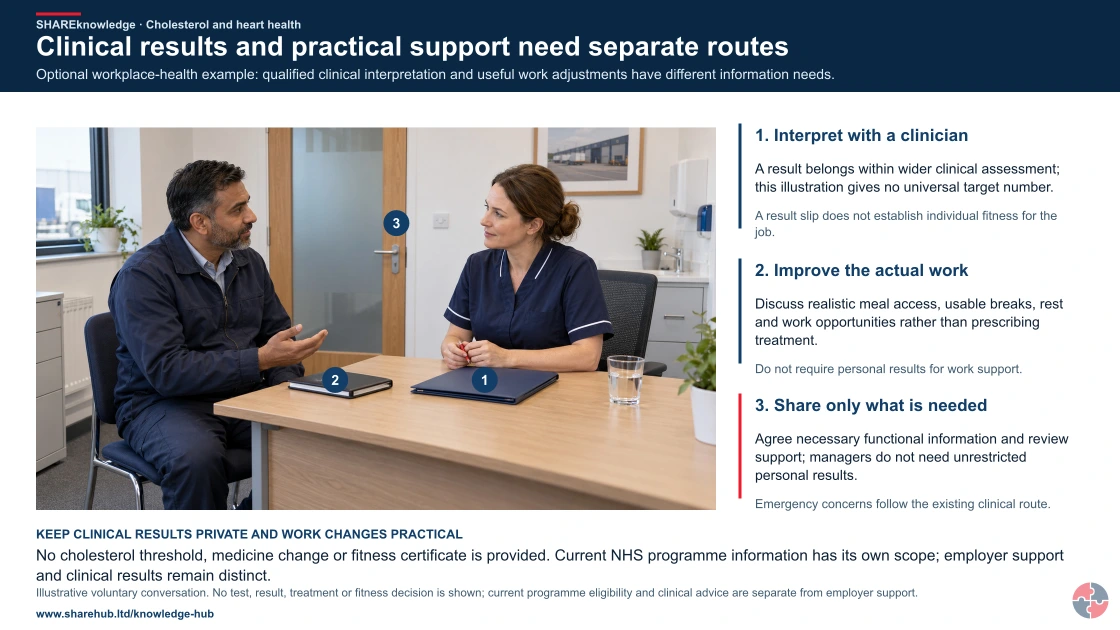
Full written explanation
Optional workplace-health example: qualified clinical interpretation and useful work adjustments have different information needs.
- Interpret with a clinician. A result belongs within wider clinical assessment; this illustration gives no universal target number.
- Improve the actual work. Discuss realistic meal access, usable breaks, rest and work opportunities rather than prescribing treatment.
- Share only what is needed. Agree necessary functional information and review support; managers do not need unrestricted personal results.
Change the pathway
- No employer diagnosis. A result slip does not establish individual fitness for the job.
- Keep participation voluntary. Do not require personal results for work support.
- Keep care and work roles clear. Emergency concerns follow the existing clinical route.
Evidence check: No cholesterol threshold, medicine change or fitness certificate is provided. Current NHS programme information has its own scope; employer support and clinical results remain distinct.
Complete clinical-result, privacy and work-support context
Primary references: NHS: high cholesterol · NHS: current Health Check programme information · HSE: fatigue and shift-work arrangements
Open the complete HD image (new tab)Download image
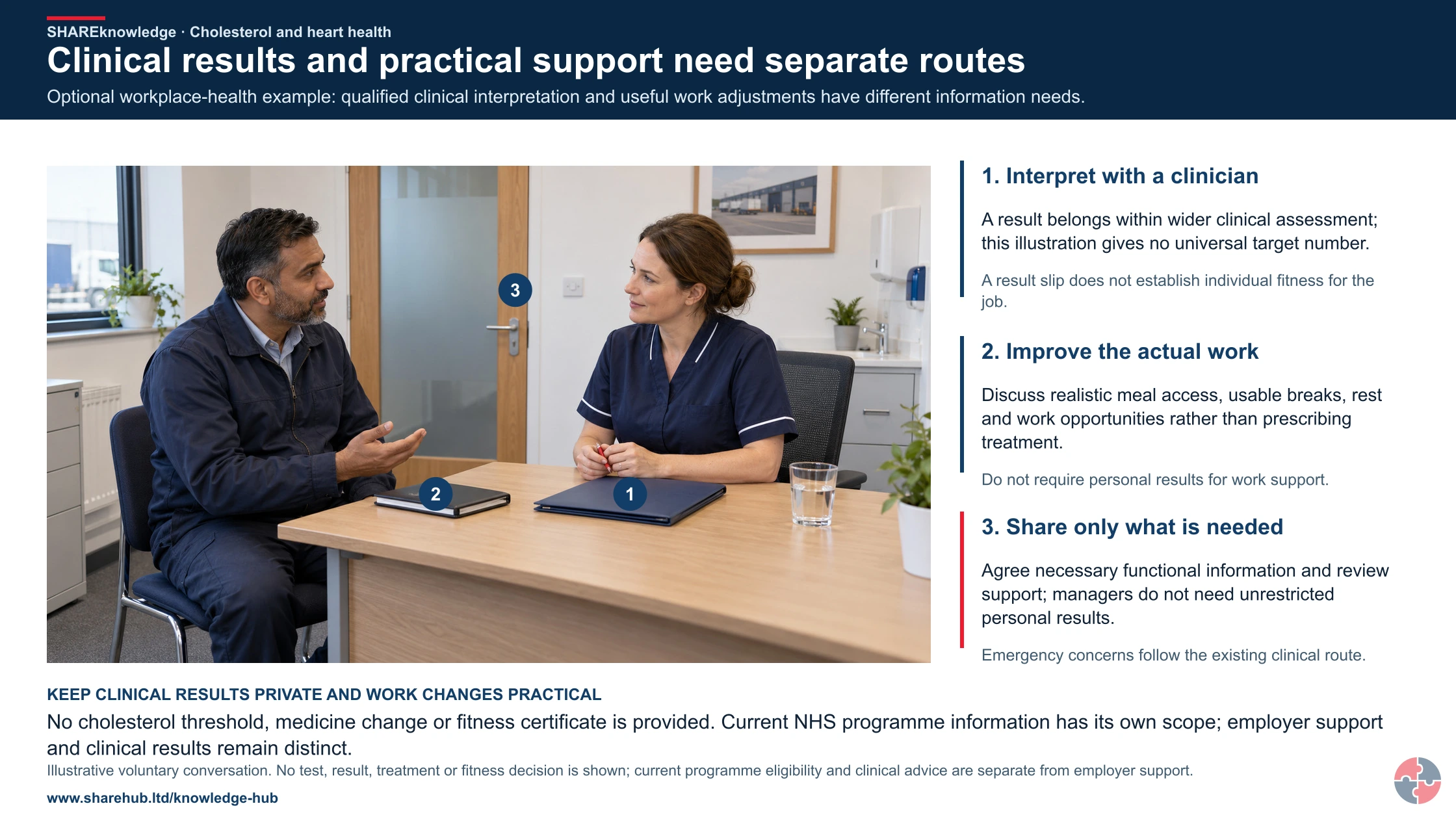
Complete clinical-result, privacy and work-support context
Primary references: NHS: high cholesterol · NHS: current Health Check programme information · HSE: fatigue and shift-work arrangements

Interpret with a clinician
Use qualified advice to understand the result and wider risk; this teaching example gives no universal target number.
Support healthier work
Review realistic shift meal access, rest and activity opportunities with the worker, rather than prescribe an individual treatment.
Protect privacy
Agree necessary functional information and review the support. Keep emergency concerns on the separate clinical route.
A result slip is not an employer fitness decision or an instruction to change medication.
What are the key facts about cholesterol and heart health?
The key facts are that cholesterol risk is often silent, must be understood as part of wider cardiovascular risk and should be managed through qualified health routes.
Cholesterol is not always visible
People can have high cholesterol without symptoms, so testing and NHS or GP advice matter.
The numbers need context
A cholesterol result is interpreted alongside age, blood pressure, smoking, diabetes, family history and other cardiovascular risk factors.
Workplaces should support, not diagnose
Managers should not interpret results, recommend medicines or give diet plans beyond general official signposting.
Work design can help or hinder
Shift work, long hours, missed breaks, stress, fatigue and poor food access can make healthier routines harder.
Confidentiality is central
Health checks and disclosures involve sensitive worker health information and must be handled carefully.
First-aid readiness still matters
Heart attack, stroke, collapse and severe breathlessness need prompt emergency response.
What is cholesterol and why does it matter?
Cholesterol is a fatty substance in the blood that is needed by the body but can contribute to cardiovascular risk when levels and risk profile are unfavourable.
Cholesterol is used by the body to build cells and make hormones, but too much of certain types can contribute to fatty deposits in arteries. Over time this can make arteries narrower or less healthy, increasing the risk of coronary heart disease, heart attack, stroke and other circulatory problems.
The important workplace message is that cholesterol is usually a clinical issue, not something a manager can judge from appearance, weight, age or behaviour. NHS guidance explains that cholesterol is measured by blood test and considered alongside other risk factors. A person may be fit, active and still have a cholesterol issue because genetics and other medical factors can matter.
For employers, the useful role is supportive and preventive: create work that makes healthy routines possible, avoid work factors that increase cardiovascular strain, provide first-aid readiness and signpost people to qualified health advice when they want or need it.
| Aspect | Plain-English explanation | Workplace relevance |
|---|---|---|
| Cholesterol | A fatty substance in blood that the body needs but which can affect artery health. | Useful for awareness campaigns and health-check signposting. |
| High cholesterol | A clinical finding where cholesterol levels may increase cardiovascular risk. | Usually needs NHS, GP, pharmacist or occupational health advice, not manager interpretation. |
| Cardiovascular disease | A group of heart and blood-vessel conditions. | Connects cholesterol to first aid, return to work and work design. |
| Risk assessment | Clinicians assess risk using cholesterol and other factors. | Workplace checks should not pretend to replace clinical risk assessment. |
| Workplace support | Practical conditions that help people attend checks and maintain healthier routines. | Breaks, shift design, food options, stress control and confidentiality. |
What do cholesterol results usually include?
Cholesterol results may include total cholesterol, HDL cholesterol, non-HDL cholesterol and sometimes other lipid measures.
NHS information explains that a cholesterol test may measure total cholesterol, HDL and non-HDL cholesterol. The GP or nurse uses these results with other factors to estimate cardiovascular risk. That is why the same number may mean different things for different people.
A workplace should avoid over-simplified messages such as 'good' and 'bad' cholesterol without context. Those terms can help understanding, but risk assessment belongs with qualified healthcare professionals who can consider blood pressure, diabetes, smoking, family history, age, sex, ethnicity, medication and existing conditions.
The practical takeaway for workers is simple: in England, check NHS Health Check eligibility; in Northern Ireland, ask a GP or nurse about testing, and follow clinical advice, and do not ignore heart or stroke warning signs. The practical takeaway for employers is to support access to that advice and protect confidentiality.
| Measure | What it broadly means | Important caution |
|---|---|---|
| Total cholesterol | The overall amount of cholesterol in the blood. | Not enough on its own to judge personal cardiovascular risk. |
| HDL cholesterol | Often called good cholesterol because it may reduce heart and stroke risk. | Targets vary with personal risk and clinical context. |
| Non-HDL cholesterol | Total cholesterol minus HDL; interpreted alongside other results and personal cardiovascular risk. | Should be interpreted by NHS, GP or competent health professional. |
| LDL cholesterol | Often called bad cholesterol and used in clinical lipid management. | May be included in full lipid profiles and treatment reviews. |
| Triglycerides | Another blood fat that can contribute to cardiovascular risk. | High results may need further clinical review. |
| QRISK | A tool used in healthcare to estimate 10-year cardiovascular risk. | Not something a manager should calculate or apply to employment decisions. |
Use NHS cholesterol-levels guidance for total, HDL, non-HDL and wider-risk interpretation, and NHS blood-fat information for LDL and triglyceride context. These clinical explanations do not set an employment fitness threshold.
How does cholesterol connect to wider heart-health risk?
Cholesterol is one part of cardiovascular risk, alongside blood pressure, smoking, diabetes, weight, activity, age, family history and other factors.
NHS and nidirect advice places a cholesterol result in the context of wider cardiovascular risk. Workplaces should not over-focus on one behaviour or one number; a qualified clinician interprets the full picture.
For example, a night worker may struggle with sleep, meal timing and exercise. A driver may spend long periods sitting and have limited healthy food access. A manager may be under chronic stress and miss appointments. None of those situations means the employer is responsible for a person's cholesterol, but they do show how work can support or undermine heart-health routines.
Heart-health programmes work best when they are practical, non-judgemental and inclusive. They should avoid weight stigma, lifestyle blame or pressure to share personal health results.
| Risk area | Why it matters | Workplace support |
|---|---|---|
| Blood pressure | High blood pressure can strain arteries and the heart. | Encourage NHS checks and manage stress/fatigue contributors. |
| Smoking | Major cardiovascular risk factor. | Smoke-free policy and stop-smoking signposting. |
| Diabetes | Can increase cardiovascular risk. | Support appointments and reasonable adjustments where work is affected. |
| Physical inactivity | Can affect heart health and weight. | Movement breaks, active travel and less sedentary work where possible. |
| Stress and sleep | Can affect health behaviours, recovery and blood pressure. | Stress risk assessment, workload review and fatigue management. |
| Family history and genetics | Some people have inherited cholesterol conditions. | Avoid assumptions and signpost to GP/NHS advice. |
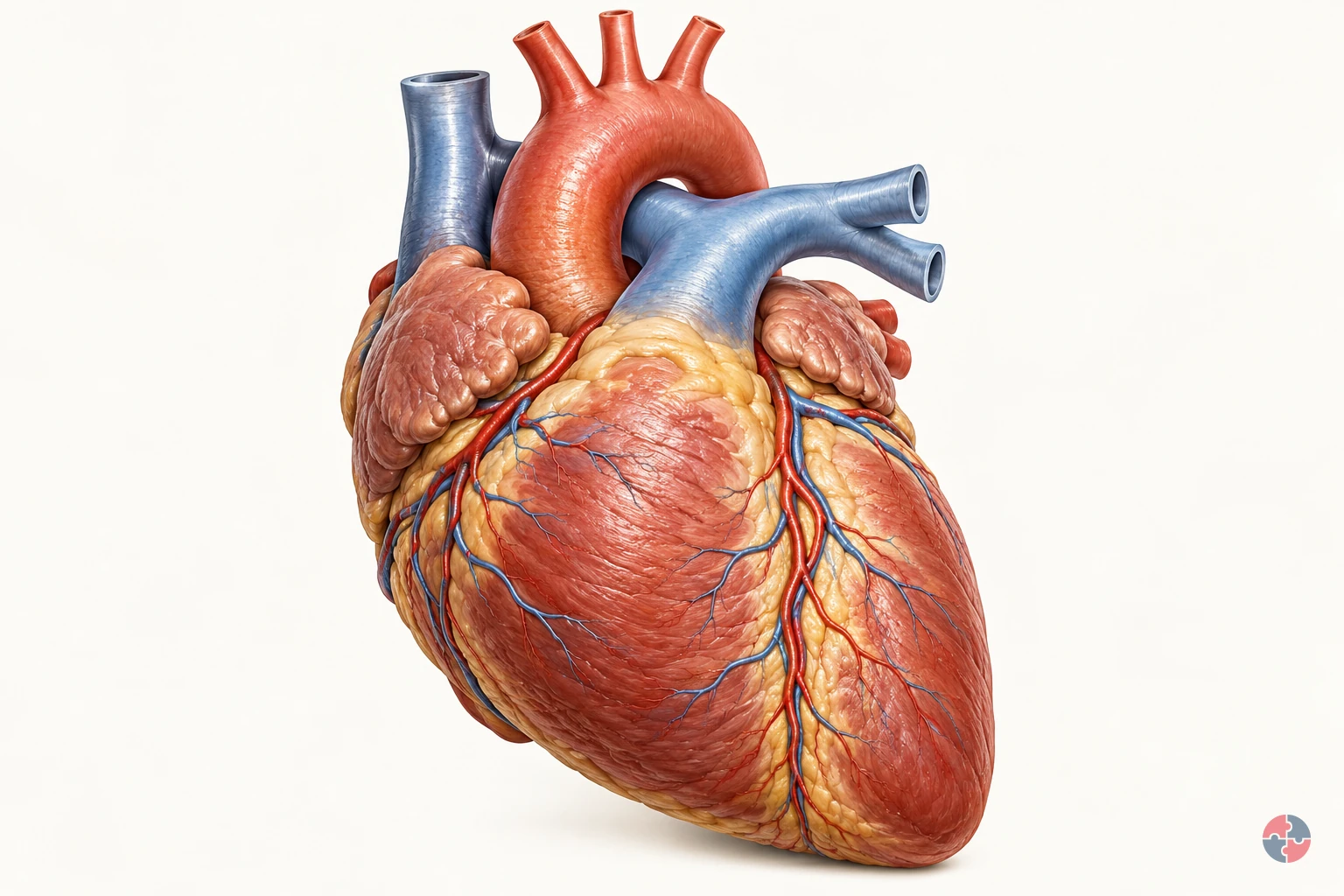

How does the heart circulate blood, and how do coronary disease, heart attack and cardiac arrest differ?
Interactive anatomy · Heart function, coronary supply and emergencies · Updated 2026-10-23
Read all anatomy and process explanations without the viewer
Adult anatomy and emergency recognition, not diagnosis, risk calculation or practical CPR certification. Child resuscitation or congenital-heart treatment Medication selection, dosing or treatment recommendations ECG interpretation, live vital signs or AED shock decisions Personal risk, damage countdown or return-to-work clearance The action panel is available before any model, login or quiz. Cardiovascular disease has many causes and forms; this coronary example covers only its stated mechanism.
Right atrium
Receives blood returning from the body. This upper chamber belongs to the anatomical right side, shown on the viewer’s left. East London NHS Foundation Trust: Physical Health Training — cardiovascular system · University Hospitals Bristol NHS-hosted resource: Understanding the circulatory system — patient/family information
Right ventricle
Pumps blood towards the lungs. Blood moves from this lower chamber into the pulmonary artery. East London NHS Foundation Trust: Physical Health Training — cardiovascular system
Pulmonary artery
Carries blood away from the heart to the lungs. It carries relatively oxygen-poor blood. An artery is defined by direction away from the heart, not by oxygen content. East London NHS Foundation Trust: Physical Health Training — cardiovascular system
Lung exchange
Blood gains oxygen and releases carbon dioxide at the lungs. The lungs bring air close to blood in small vessels while keeping them in separate spaces. Oxygen and carbon dioxide cross thin tissue boundaries in opposite directions. The exchange label connects the respiratory and circulation lessons; it does not show air entering an open vessel or provide a measurement of gas exchange in a person. Frimley Health NHS Foundation Trust: How your lungs work
Pulmonary veins
Return oxygen-rich blood from lungs to the heart. These veins enter the left atrium. Veins return blood towards the heart even when that blood is oxygen-rich. East London NHS Foundation Trust: Physical Health Training — cardiovascular system
Left atrium
Receives blood arriving from the lungs. It passes blood towards the left ventricle through the intervening valve. East London NHS Foundation Trust: Physical Health Training — cardiovascular system · University Hospitals Bristol NHS-hosted resource: Understanding the circulatory system — patient/family information
Left ventricle
Pumps blood into the body’s circulation. Its contraction sends blood through the aortic valve into the aorta. East London NHS Foundation Trust: Physical Health Training — cardiovascular system · University Hospitals Bristol NHS-hosted resource: Understanding the circulatory system — patient/family information
Aorta
The main artery leaving the left ventricle. It leads into the systemic arteries that distribute blood around the body. East London NHS Foundation Trust: Physical Health Training — cardiovascular system
Valves
Help keep blood moving in the intended direction. This overview label represents the heart valves. Separate valve labels require anatomically correct selectable structures. University Hospitals Bristol NHS-hosted resource: Understanding the circulatory system — patient/family information
Body capillaries
Small vessels allow exchange with body tissues. Oxygen and nutrients reach tissues and wastes return to the blood before the venous return journey. University Hospitals Bristol NHS-hosted resource: Understanding the circulatory system — patient/family information
Coronary arteries
Supply the heart muscle itself. Coronary arteries supply the heart muscle itself. Compare this route with blood passing through the chambers: chamber filling is not the same as supplying the myocardium. Keeping these routes distinct helps explain the location of coronary disease. The model identifies the normal supply and does not measure flow, diagnose narrowing or predict an individual’s symptoms. NHS: Coronary heart disease
Myocardium and rhythm
Heart muscle contracts in a coordinated rhythm to pump blood. Myocardium means heart muscle. The short activation cue is biological teaching content, not a live pulse or ECG. St George’s University Hospitals NHS Foundation Trust: Catheter Ablation for SVT — normal heart electrical system
Open the complete process transcript
The process, step by step
Return from the body
Begin at the right atrium, the upper chamber on the heart’s anatomical right side. In this front-facing view it appears on the viewer’s left. Veins return blood from the body towards this chamber, completing the body-circulation route before the journey to the lungs. Follow the direction indicated rather than identifying a vessel by its display colour. The selected label marks the chamber receiving that return; it does not represent a separate store of blood. Trace the connection slowly, then keep the chamber in mind for the next pumping step. East London NHS Foundation Trust: Physical Health Training — cardiovascular system · University Hospitals Bristol NHS-hosted resource: Understanding the circulatory system — patient/family information
What to watch: Find the right-atrium label on the viewer’s left, then identify the return route approaching the upper chamber.
Why it matters: Returning blood must remain connected to the next part of the circulation. Recognising this receiving chamber helps the learner follow one continuous loop rather than treating the lungs and body as disconnected routes.
Explore this step: Trace the return direction and name the receiving chamber before moving to the right-ventricle step.
Pump towards the lungs
Follow the route from the right atrium into the right ventricle, then towards the pulmonary artery. The ventricle is the lower pumping chamber on this side. The pulmonary artery takes blood away from the heart towards the lungs, where gas exchange takes place. Its name follows the direction of travel, even though this blood is relatively low in oxygen. Compare the chamber label with the outgoing vessel label and trace their connection. The route and colours explain the anatomy; they do not show a measured flow or pressure. East London NHS Foundation Trust: Physical Health Training — cardiovascular system
What to watch: Locate the right ventricle below the right atrium and trace the outgoing connection labelled pulmonary artery towards the lungs.
Why it matters: The lung circuit receives blood from the right ventricle. Understanding this connection also shows why “artery” means a vessel leading away from the heart, rather than simply a vessel containing oxygen-rich blood.
Explore this step: Follow the right-ventricle outlet and explain why its outgoing vessel is called an artery.
Exchange gases
At the lungs, air and blood are close together but remain in different spaces. Oxygen passes across thin boundaries from the air sacs into nearby blood, while carbon dioxide passes in the opposite direction towards the air that will be breathed out. Follow the lung-exchange label as the link between the incoming and returning parts of the lung circuit. Air does not travel directly along an open blood vessel. Use the model to explain the direction of exchange; the simplified view does not measure gas levels or a person’s breathing. Frimley Health NHS Foundation Trust: How your lungs work
What to watch: Locate the lung-exchange label between the route arriving from the right heart and the route returning towards the left heart.
Why it matters: Gas exchange connects breathing with the transport work of the circulation. The blood can then carry oxygen onwards; the picture identifies that connection without measuring oxygen delivery or diagnosing a breathing problem.
Explore this step: Explain which gas moves towards the blood and which moves towards the air, keeping the two spaces distinct.
Return from the lungs
Trace the pulmonary veins from the lungs to the left atrium. The blood returning along this route is now relatively rich in oxygen after lung gas exchange. The left atrium is the upper receiving chamber on the heart’s anatomical left side, shown on the viewer’s right in this view. Notice that these oxygen-rich vessels are still called veins: their direction is towards the heart. Compare this return with the body veins in the first step, using direction and connection rather than display colour to identify each route. East London NHS Foundation Trust: Physical Health Training — cardiovascular system
What to watch: Follow the pulmonary-vein labels from the lung return towards the left atrium on the viewer’s right side of the heart.
Why it matters: This connection brings blood back after gas exchange, ready for the next pumping step. Comparing both venous returns reinforces that a vein is defined by movement towards the heart, not by oxygen content.
Explore this step: Compare the pulmonary veins with the body’s returning veins and state the directional feature they share.
Pump towards the body
From the left atrium, follow the connection into the left ventricle and then through its outlet towards the aorta. The left ventricle is the lower chamber that pumps blood into the body circuit. The aorta leads into branching arteries that distribute blood to the body’s tissues. Locate the chamber, outlet and large vessel in that order rather than jumping directly to the whole-body view. These labels describe connected structures and the direction of pumping; the model is not measuring the strength of contraction or the amount of blood delivered. East London NHS Foundation Trust: Physical Health Training — cardiovascular system
What to watch: Locate the left ventricle, its outlet and the aorta, then follow the route towards the body circulation.
Why it matters: The body circuit carries blood onwards from the heart to the tissues. Seeing the chamber and its outlet together connects the pumping action with distribution rather than treating the aorta as an isolated structure.
Explore this step: Trace from the left ventricle to the aorta, then identify where the body-circulation view continues the route.
Exchange and return
In the body’s capillary networks, blood and tissues exchange substances across thin vessel walls. Oxygen and nutrients move towards the tissues, while waste products, including carbon dioxide, move towards the blood for transport away. The vessels then join the returning venous route and bring blood back towards the right atrium. Follow the capillary label and then return to the first chamber label to complete the loop. The enlarged network is a teaching view, not a to-scale picture of every vessel or a measurement of exchange in an individual. University Hospitals Bristol NHS-hosted resource: Understanding the circulatory system — patient/family information
What to watch: Find the body-capillary network and follow its connection towards the returning vein route and the right-atrium label.
Why it matters: Exchange allows transported substances to reach or leave tissues. The return journey is equally necessary to the explanation: blood remains in a connected circulation rather than being used up at the end of an artery.
Explore this step: Trace a complete route from the body capillaries back to the first step, naming the return direction.
Supply the pump itself
Switch to the coronary-supply view and locate the vessels supplying the heart muscle itself. The myocardium is muscle that needs its own blood supply; blood filling a heart chamber is not simply soaking through the wall to feed it. Compare the coronary route with the large chamber-and-vessel loop you have just followed. This distinction helps explain why a problem in a coronary artery concerns supply to the pump’s own tissue. The separate activation cue introduces coordinated function; it is not an ECG, a live pulse or a diagnostic heart-rhythm display. NHS: Coronary heart disease · St George’s University Hospitals NHS Foundation Trust: Catheter Ablation for SVT — normal heart electrical system
What to watch: Locate the coronary-artery labels alongside the myocardium label, comparing this supply with the route through the heart’s chambers.
Why it matters: The heart muscle also depends on a blood supply. Distinguishing coronary supply from chamber filling makes it possible to discuss coronary disease without suggesting that every cardiovascular problem has the same mechanism.
Explore this step: Compare the coronary and chamber views and explain the different function of the route highlighted in each.
Mechanisms and their limits
Coronary narrowing Fatty material in a coronary-artery wall can narrow the space carrying blood to the heart muscle. Coronary disease may occur without obvious symptoms. This is one cardiovascular condition, not the mechanism of every heart or blood-vessel disease. A labelled wall deposit is separate from a chamber. No percentage, symptom threshold or personal risk is calculated. NHS: Coronary heart disease
Coronary narrowing — follow the anatomy
Look at: The coronary artery supplying the heart muscle.
What changes: Fatty material builds up in its wall and narrows the route for blood.
Why it matters: The muscle may receive too little oxygen, especially when working harder.
What to do: Address cardiovascular risk factors with healthcare support; chest pain needs appropriate medical help.
Understanding coronary disease during a workplace wellbeing session
A voluntary wellbeing session explains coronary supply without collecting anyone’s symptoms, health records or risk score. Explicit time jump over long-term biological processes: wall deposits do not form during one shift or this 32-second clip. The workplace is the teaching setting, not proof of the disease’s cause. Coronary narrowing is one condition within a broader range of cardiovascular disease.
Identify the heart’s own blood supply The heart muscle receives blood through coronary arteries on its surface. This is separate from blood passing through its chambers to the lungs and body. NHS: Coronary heart disease
Move forward through a long-term process The timeline jumps as fatty deposits may accumulate in a coronary artery wall. Several health and lifestyle factors can contribute; no single task or personal history is inferred. NHS: Coronary heart disease
A narrowed coronary lumen The deposit occupies part of the vessel wall/lumen region and may limit supply to heart muscle. A labelled example is not a percentage narrowing, symptom threshold or diagnosis. NHS: Coronary heart disease
Use appropriate support, not a workplace diagnosis Follow current NHS prevention and clinical advice about personal concerns. Persistent squeezing chest discomfort needs emergency action; do not wait for a wellbeing check or use the diagram to declare fitness. NHS: Coronary heart disease — prevention · NHS: Heart attack
Read the practice situations and all answer explanations
CV-Q1: Which route supplies the heart muscle?
Compare the heart chambers with the separate coronary inset.
The coronary arteries. — Correct. CV11 is the heart muscle’s own vessel supply.
Blood soaking through the chamber wall. — The chamber route pumps blood onward. Coronary arteries separately supply the muscle itself.
Air moving through the airway. — The lungs exchange gases with blood. Air does not directly feed the heart muscle through the airway.
NHS: Coronary heart disease · Frimley Health NHS Foundation Trust: How your lungs workCV-Q2: What should you do now?
A colleague is awake with persistent squeezing chest discomfort and sweating.
Call 999 and help them rest comfortably while monitoring. — Yes. Call immediately, help them rest and follow emergency advice. Keep checking responsiveness and breathing.
Drive them to hospital yourself instead of calling. — Call 999. Emergency services can advise and respond; do not delay or make the person drive.
Finish the anatomy activity before getting help. — Stop the activity and call 999. The lesson must never delay emergency help.
NHS: Heart attackCV-Q3: Which response fits this change?
The colleague becomes unresponsive and is only gasping.
Call or update 999, start CPR for abnormal breathing, and get AED help. — Correct. Gasping is abnormal. Call 999 immediately, start CPR and follow the call handler and AED prompts.
Leave them in the recovery position because gasping is normal breathing. — Gasping is not normal breathing. Call or update 999 and start the CPR/AED response; do not leave them.
Spend time searching for a pulse before calling. — Do not delay. For this lay recognition scenario, unresponsiveness and abnormal breathing need immediate 999 and CPR/AED help.
NHS 111 Wales: Cardiac ArrestSources and how the model is made
The opening images are AI-generated anatomical illustrations. The interactive 3D models and labelled SVG diagrams use original procedural artwork. These teaching images are not medical scans or diagnostic tools. Source references support the learner explanations and do not grant artwork rights.
- East London NHS Foundation Trust: Physical Health Training — cardiovascular system — Page 44: chamber connections, pulmonary artery/veins and aorta. Replaces non-NHS anatomy links. No training slides or artwork copied.
- NHS: Coronary heart disease — Separate coronary supply, wall deposits, narrowed supply, variable or absent symptoms. No diagnosis or copied video.
- University Hospitals Bristol NHS-hosted resource: Understanding the circulatory system — patient/family information — Printed pages 36–38: artery/vein direction, capillary exchange, chambers and valves. Resource produced by Heart Research UK; normal anatomy only, no congenital-heart exercise advice or artwork reused.
- NHS: Heart attack — Reviewed 31 March 2026: emergency symptoms, 999, rest/monitoring, clot mechanism and distinction from arrest. No medicine branch.
- NHS 111 Wales: Cardiac Arrest — Unresponsive/abnormal breathing, gasping, immediate 999/CPR/call-handler/AED recognition. Replaces non-NHS emergency link, not a complete practical course.
- Frimley Health NHS Foundation Trust: How your lungs work — Alveolar/capillary gas exchange, oxygen and carbon dioxide. Previously verified for respiratory module; no artwork copied.
- St George’s University Hospitals NHS Foundation Trust: Catheter Ablation for SVT — normal heart electrical system — Page 2 normal coordinated cardiac activation and pumping. Printed review October 2026 requires recheck. No ECG/treatment instruction or credited artwork reused.
- Leeds Teaching Hospitals NHS Trust: Understanding coronary angiography and coronary intervention — One common plaque-disruption and clot mechanism affecting coronary supply. No procedures, treatment regimens or symptom-duration waiting rule transferred.
- NHS: Coronary heart disease — prevention — General activity, diet and smoking-support context, alongside prescribed care; no personal target or guarantee.
- NHS: Cardiovascular disease — CVD is a broad group; the coronary example is not presented as every CVD mechanism.
How can work influence cholesterol and heart health?
Work can influence cholesterol and heart health indirectly through work design, stress, fatigue, shift patterns, breaks, facilities and culture.
The employer cannot control a person's genetics, medical treatment or private life. It can control many conditions that make healthy routines easier or harder: whether breaks are real, whether shifts allow recovery, whether workers can access water and food, whether there is time to attend health checks, and whether stress is managed.
Workplaces should be especially careful with safety-critical roles. A worker with chest symptoms, severe breathlessness, dizziness, medication changes or recent heart illness may need occupational health advice before certain tasks such as driving, lone work, work at height, confined space entry, emergency response or heavy physical work.
A good workplace does not turn cholesterol into a disciplinary issue. It uses health promotion, risk assessment, first aid, support plans and occupational health advice to keep people safe and respected.
| Work factor | How it can affect routines | Good practice |
|---|---|---|
| Shift work | Can disrupt sleep, eating patterns, exercise and appointments. | Plan recovery, breaks, food access and fatigue controls. |
| Long hours | Can reduce time for sleep, cooking, activity and healthcare. | Monitor hours and workload. |
| Stress | Can affect sleep, blood pressure, eating, smoking and alcohol use. | Use HSE Management Standards approach. |
| Food environment | Limited healthy options can make choices harder. | Improve canteen, vending and remote-site options where possible. |
| Sedentary work | Long sitting can reduce movement. | Encourage movement breaks and ergonomic job design. |
| Physical strain and heat | Can add load to the cardiovascular system. | Assess fitness-sensitive tasks and control heat strain. |
| Appointment access | Workers may delay checks if time off is hard. | Support reasonable attendance at NHS/GP/OH appointments. |
How should workplaces support cholesterol and heart health?
Workplaces should support cholesterol and heart health through official signposting, healthy work design, first-aid readiness, confidential conversations and reviewable adjustments.
Support should be practical and proportionate. A wellbeing article, poster or toolbox talk can raise awareness, but the stronger work is in the system: shift design, stress control, healthy facilities, first-aid arrangements, occupational health referral routes and management training.
Managers should focus on work impact. Useful questions are: what are you finding difficult at work, is there medical or occupational health advice we should consider, are there tasks that need temporary adjustment, and when should we review? Less useful questions are intrusive questions about test results, medication or diet unless the worker volunteers information and it is necessary for work planning.
Where a worker has known cardiovascular disease or returns after heart illness, the workplace should consider phased return, safety-critical restrictions, driving, exertion, temperature, lone working, stress, fatigue and emergency arrangements.
| Support area | What good support looks like | Boundary |
|---|---|---|
| Health signposting | NHS Health Check, GP, pharmacist, NHS and occupational health routes. | Do not diagnose or interpret results as a manager. |
| Work design | Breaks, workload, shift patterns, fatigue, stress and appointment access. | Focus on employer-controlled factors. |
| Wellbeing campaigns | Plain-language awareness about cholesterol, blood pressure, smoking, activity and food. | Avoid shame, weight stigma or pressure to disclose. |
| First aid | Heart attack, stroke, AED and emergency response arrangements are ready. | Emergency response is not a substitute for prevention. |
| Return to work | Phased duties, review dates and OH advice where needed. | Record capability and adjustments, not unnecessary medical detail. |
| Confidential support | Workers know who to speak to and how health information is protected. | Only collect what is necessary. |
This example applies HSE fatigue guidance and ICO worker-health guidance to work arrangements. It does not claim to lower a worker’s cholesterol or require disclosure of lipid results.
Worked support plan: a night-shift team
| Employer-controlled area | Owner and practical action | Check, failure response and review evidence |
|---|---|---|
| Night-shift work design | Rota owner plans realistic workload, protected breaks and appointment access with the worker. | Supervisor samples whether breaks actually occur and reviews fatigue complaints. Repeated missed breaks or unsafe tiredness trigger an immediate workload/cover review; record the action and check it works. |
| Private support route | Manager agrees functional adjustments and a review date, using occupational-health advice where needed. | HR limits access and records only information needed for work support. Unnecessary health-result requests or inappropriate access are stopped and corrected through the data-protection process. |
| Emergency cover | First-aid lead assesses cover, access and communication for lone and night work. | Test the alarm and responder route on the actual shift. Missing cover or failed access is corrected before relying on the arrangement; retain the drill and reassessment evidence. |
How should cholesterol and heart-health information be handled?
Treat a worker’s results and medical history as confidential health information, sharing only what is necessary for a defined work purpose.
Health data is special-category personal data. The employer needs a lawful basis, an Article 9 condition, transparency, purpose limitation, access controls and proportionate retention; employee consent alone should not be assumed sufficient. A line manager usually needs functional restrictions or agreed adjustments, not cholesterol numbers, medication names or a diagnosis. Occupational health can advise on fitness and adjustments with appropriate boundaries. Do not place individual results in a general risk register or training file.
How do health checks fit into cholesterol and heart health?
Offer confidential signposting, and distinguish England’s NHS Health Check from clinical routes elsewhere.
The NHS Health Check programme in England is for eligible adults aged 40 to 74, usually every five years, with exclusions based on existing conditions or treatment. It should not be described as a Northern Ireland service. In NI, a person can ask their GP or nurse about cholesterol testing and wider risk. An employer may offer a voluntary, competently delivered workplace check, but should not require personal results or turn a screening value into a work fitness decision. A clinician interprets results and any treatment need.
On a small screen, scroll this table sideways to read all columns.
| Route | What it offers | Workplace boundary |
|---|---|---|
| England NHS Health Check | Eligibility-based cardiovascular risk check for ages 40–74. | Signpost; do not assume every worker is eligible. |
| Northern Ireland GP/nurse | Clinical cholesterol and risk assessment through local care. | Signpost; do not promise an England programme. |
| Employer-provided check | Optional check by a qualified provider with confidential results. | Keep individual results with the worker/provider; use only necessary work recommendations. |
What emergency response matters for heart health?
Suspected heart attack, stroke, collapse or severe breathing trouble is an emergency: call 999 immediately.
High cholesterol itself usually has no warning symptoms. Do not confuse long-term risk with an acute event. For chest pain or other symptoms suggesting a heart attack, activate 999, follow the call handler and use the workplace first-aid and defibrillator plan as trained. Do not delay for a manager, a blood test or a workplace wellness appointment. The first-aid lead should check cover and equipment for the site and work pattern in GB or NI.
On a small screen, scroll this table sideways to read all columns.
| Signal | Immediate response | Workplace check |
|---|---|---|
| Suspected heart attack or stroke | Call 999 and follow the call handler. | First-aider and access plan ready. |
| Collapse or severe breathing difficulty | Call 999; begin trained first aid and AED use if indicated. | Check equipment, access and trained cover. |
| After the event | Medical team directs care; employer plans confidential work support. | Review response and work arrangements without demanding diagnosis details. |
NHS stroke advice says to call 999 for suspected stroke, including signs within the last 24 hours that have stopped. First-aid planning follows HSE needs assessment in Great Britain and HSENI first aid in Northern Ireland.
Which duties are relevant to cholesterol and heart health?
Control work-related hazards and provide first aid and privacy safeguards; there is no general employer duty to diagnose or treat cholesterol.
A workplace should assess harmful work demands, fatigue and safety-critical task needs, and maintain first-aid arrangements. In GB, use HSE stress, fatigue and first-aid guidance; in NI, apply HSENI first-aid rules and locally applicable safety duties. Equality or adjustment decisions depend on the individual facts and jurisdiction; high cholesterol alone does not establish disability. Worker health information remains subject to UK data-protection rules. Clinical screening, prescriptions and treatment decisions remain with healthcare professionals.
What should a workplace risk register include for cholesterol and heart health?
The risk register should focus on work-related contributors, emergency readiness and support arrangements, not private medical results.
A useful risk register entry might cover fatigue and shift work, heat exposure, high-stress roles, lone working, safety-critical tasks after illness, first-aid readiness, or occupational health referral routes. It should not list named workers' cholesterol results.
Where individual support is needed, keep it in confidential HR or occupational health records, with only necessary work restrictions or adjustments shared with managers.
| Issue | Work-related risk route | Controls | Evidence to check |
|---|---|---|---|
| Shift work and meal timing | Irregular hours make routine, sleep, food and appointments harder. | Rota planning, breaks, food access and fatigue controls. | Roster review and worker feedback. |
| Stress and high demand | Chronic pressure can undermine heart-health behaviours and recovery. | Stress risk assessment, workload review and manager support. | HSE Management Standards action plan. |
| Safety-critical return to work | Recent heart illness may affect driving, lone work, heights or emergency response. | OH advice, phased return and restrictions. | Return-to-work plan and review dates. |
| First-aid readiness | Delayed response to heart attack, stroke or collapse worsens outcome. | First aiders, AED checks and emergency procedures. | First-aid needs assessment and drills. |
| Health information handling | Poor confidentiality discourages disclosure and support. | Privacy notice, restricted access and manager training. | Record audit and training. |
How could Crownway Fuels Ltd support cholesterol and heart health?

Crownway Fuels Ltd could support cholesterol and heart health by combining wellbeing signposting, shift-work controls, safety-critical role review, first-aid readiness and confidential support.
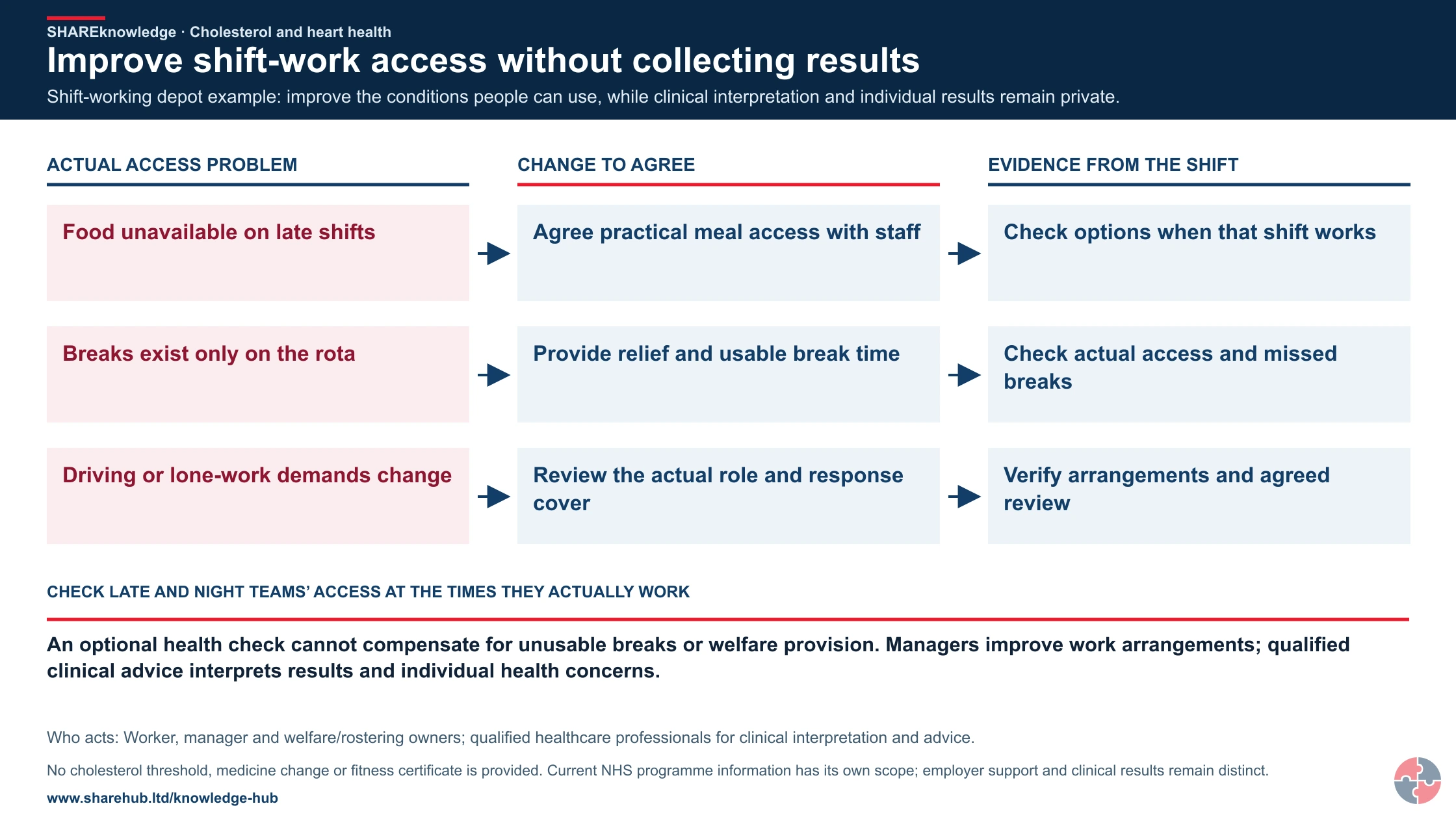
Improve shift-work access without collecting results
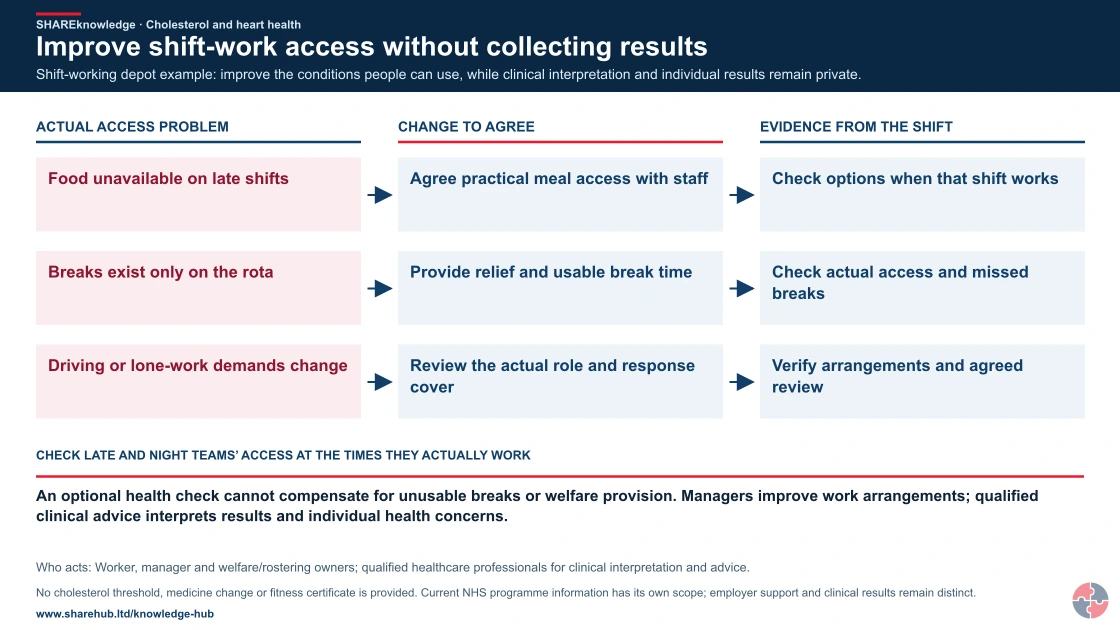
Full written explanation
Shift-working depot example: improve the conditions people can use, while clinical interpretation and individual results remain private.
- Ask about real access. Review meals, facilities, actual breaks, shifts and relevant work demands with the people doing the job.
- Agree practical changes. Provide feasible food access and usable breaks; do not prescribe an individual diet, medicine or treatment.
- Check the actual shift. Verify the arrangement when late and night teams work; a day-shift facility check is not enough.
- Review support privately. Use appropriate functional advice where required and anonymised organisational trends; keep personal results restricted.
When the evidence does not fit: An optional health check cannot compensate for unusable breaks or welfare provision. Managers improve work arrangements; qualified clinical advice interprets results and individual health concerns.
Who acts: Worker, manager and welfare/rostering owners; qualified healthcare professionals for clinical interpretation and advice.
Changed workplace
Optional workplace check: Use current local access/eligibility information and a private clinical route.
Shift-work support: Verify usable meal and break access at the times people actually work.
| Actual pressure | Change to agree | Evidence to review |
|---|---|---|
| Food unavailable on late shifts | Agree practical meal access with staff | Check options when that shift works |
| Breaks exist only on the rota | Provide relief and usable break time | Check actual access and missed breaks |
| Driving or lone-work demands change | Review the actual role and response cover | Verify arrangements and agreed review |
Evidence check: No cholesterol threshold, medicine change or fitness certificate is provided. Current NHS programme information has its own scope; employer support and clinical results remain distinct.
Complete clinical-result, privacy and work-support context
Primary references: NHS: high cholesterol · NHS: current Health Check programme information · HSE: fatigue and shift-work arrangements
Open the complete HD image (new tab)Download image
Complete clinical-result, privacy and work-support context
Primary references: NHS: high cholesterol · NHS: current Health Check programme information · HSE: fatigue and shift-work arrangements
Crownway Fuels Ltd
Crownway Fuels Ltd is used here as an example: a fuel, energy and forecourt business with shift workers, drivers, contractors, public interfaces, lone work and safety-critical operations. Heart-health support must therefore connect wellbeing with operational risk.
Crownway does not ask managers to interpret cholesterol results. Instead, it builds a support system. Workers in England are signposted to NHS Health Check eligibility; workers in Northern Ireland are signposted to GP or nurse testing routes. Both can seek appropriate pharmacist or clinical advice. Wellbeing campaigns explain cholesterol in plain language and connect it to blood pressure, smoking, activity, sleep, stress and shift work.
Operationally, Crownway reviews night shifts, driving schedules, fatigue, welfare facilities and food availability at depots and forecourts. It checks that drivers and lone workers know emergency arrangements, that first aiders are available across shifts, and that return-to-work plans consider safety-critical tasks after heart illness.
The business also treats health information carefully. Occupational health provides functional advice where needed, managers record adjustments and review dates, and senior leaders review anonymised trends rather than personal health results.
| Management area | How Crownway applies the control | Evidence and improvement |
|---|---|---|
| Assessing and analysing | Reviews shift patterns, driver routes, lone work, welfare and stress indicators that can influence heart-health support. | Risk register, fatigue review, stress action plan and workforce feedback. |
| Implementing support | Provides NHS signposting, healthy food options where practicable, break planning, hydration access and appointment flexibility. | Wellbeing plan, welfare checks and manager briefing records. |
| Training and competence | Trains managers on confidential conversations and first aiders on heart attack, stroke and emergency escalation. | Training matrix, first-aid needs assessment and AED inspection records. |
| Occupational health and HR | Uses OH advice for fitness, restrictions, phased return and safety-critical work after heart-related illness. | OH referrals, return-to-work plans and review dates. |
| Oversight and assurance | Reviews anonymised absence themes, fatigue data, first-aid checks, stress actions and wellbeing campaign feedback. | Management review, action tracker and audit findings. |
| Learning and improvement | Updates rosters, welfare provision, training and support routes after incidents, feedback or health trend reviews. | Lessons learned, revised procedures and closed actions. |
What should each role learn and demonstrate?
Learning must match the decisions people make, from recognising danger to checking that controls work.
Briefings should tell people how to act, but attendance alone does not show competence. Assess the real decision or task, record who assessed it and revisit after a material change, failed control or incident. A local authorisation is task-specific; no universal external certificate is implied.
On a small screen, scroll this table sideways to read all columns.
| Role and learning | Demonstration and assessor | Record and reassessment trigger |
|---|---|---|
| Worker: reliable health routes. | Recognise that high cholesterol can be silent and identify NHS/NI clinical signposting. | Briefing feedback; update after clinical guidance changes. |
| Manager: confidential support. | Practise a work-adjustment conversation without requesting test results. | Scenario assessment and restricted record. |
| First aider: acute emergency. | Demonstrate 999, AED and site access plan for a suspected heart attack. | Drill outcome; repeat after staffing change. |
| Safety adviser: work design. | Review fatigue, breaks and stress controls without treating individual screening results as risk-register data. | Control review and follow-up. |
How does cholesterol and heart health support study and professional development?
The topic helps learners connect wellbeing, occupational health, first aid, confidentiality, work design and risk management.
For NEBOSH National General Certificate learners, cholesterol and heart health can support answers on health promotion, work-related stress, fatigue, welfare, first aid, worker consultation and occupational health referral. A strong answer separates personal lifestyle from employer-controlled work factors.
For Diploma learners and professionals, the value is in system design: confidentiality, data protection, health surveillance boundaries, return-to-work planning, safety-critical work and management review of anonymised trends.
Scenario answers should avoid telling managers to give diet advice. A stronger answer would signpost NHS advice, review work patterns, protect health information, involve occupational health where needed and make first-aid arrangements robust.
| Learning context | What to know | Scenario application |
|---|---|---|
| NEBOSH NGC | Wellbeing, first aid, welfare, stress, fatigue and worker support. | Design a heart-health campaign that also checks shift and break arrangements. |
| NEBOSH Diploma | Occupational health management, data protection and return-to-work assurance. | Audit how health checks and OH reports are handled. |
| Manager CPD | Confidential conversations and adjustments. | Worker discloses high cholesterol and anxiety after a health check. |
| First-aid coordinator CPD | Heart attack, stroke and AED readiness. | Review emergency cover for lone and shift workers. |
How can a management system sustain effective decisions?
Give each hazard or support route an owner, a control, a check and a response to failure.
Separate health promotion from employer safety duties. Measure whether first-aid access, fatigue controls and private adjustment routes work, rather than collecting personal cholesterol values. An owner should sample actual work and corrective actions, not accept a policy or certificate as evidence that the controls work.
The free GB regulator guide HSE Managing for health and safety (HSG65) explains a plan–do–check–act approach: assign controls and owners, involve workers, check work as done, and correct failures. For Northern Ireland, use HSENI risk assessment guidance for the local duty. A certificate alone does not demonstrate that a control works.
What are the warning signs that cholesterol and heart health support is weak?
Warning signs include lifestyle blame, poor confidentiality, weak first-aid readiness, unmanaged fatigue and no route to qualified advice.
| Warning sign | How harm or mistrust can develop | Improvement action |
|---|---|---|
| Campaigns blame lifestyle | Workers disengage and employer-controlled factors are ignored. | Use supportive NHS-aligned messaging and review work design. |
| Managers ask for test results | Workers may feel pressured and avoid support. | Train managers on confidentiality and functional information. |
| Health checks are unclear | Workers do not know who sees results or what happens next. | Provide privacy notice and provider information. |
| Shift workers miss breaks | Healthy routines and recovery become harder. | Review rostering, breaks and food access. |
| AED or first-aid cover is weak | Emergency response may be delayed. | Review first-aid needs assessment and checks. |
| OH advice is not reviewed | Restrictions or adjustments become stale or unsafe. | Set review dates and action owners. |
Cholesterol and heart health FAQs: what do people ask?
People usually ask what cholesterol means, whether work can help, how checks should be handled and what managers should avoid.
What is cholesterol?
Cholesterol is a fatty substance in the blood that the body needs, but too much of some types can increase cardiovascular risk.
Why does cholesterol matter for heart health?
High cholesterol can contribute to fatty deposits in arteries, which can increase risk of coronary heart disease, heart attack and stroke.
Can someone feel high cholesterol?
Usually not. High cholesterol often has no symptoms and is normally identified through a blood test or cardiovascular risk check.
What is HDL cholesterol?
HDL is one lipid measure. A clinician interprets it with non-HDL cholesterol and the person’s wider cardiovascular risk; a manager should not interpret a result.
What is non-HDL cholesterol?
Non-HDL cholesterol is total cholesterol minus HDL. A clinician interprets it with other results and the person’s wider cardiovascular risk.
What is an NHS Health Check?
In England, it is a free check for eligible people aged 40 to 74 that considers heart and blood-vessel risk; Northern Ireland uses separate clinical routes.
Should employers test workers' cholesterol?
Workplace health checks can be offered only if voluntary, confidential, competently arranged and linked to appropriate NHS, GP or occupational health advice.
Can work affect cholesterol and heart health?
Work can influence heart health through shift patterns, breaks, stress, fatigue, food environment, movement, sleep disruption and time to access health services.
Should managers give diet or medication advice?
No. Managers should signpost to NHS, GP, pharmacist or occupational health advice and focus on work impact and support.
How should cholesterol information be handled?
It should be treated as worker health information, kept confidential, limited to what is necessary and handled in line with data-protection duties.
What should workplaces do after a heart-related illness?
They should plan return to work around medical or occupational health advice, functional capability, adjustments, safety-critical duties and review dates.
What training is useful?
Useful training includes heart-health awareness, first-aid awareness, manager confidentiality training, occupational health referral training and wellbeing campaign planning.
Which acronyms are useful for cholesterol and heart health?
Acronyms help readers follow clinical, workplace and support terminology without assuming prior knowledge.
| Acronym or term | Meaning | Why it matters |
|---|---|---|
| CVD | Cardiovascular disease | Group of heart and blood-vessel conditions. |
| HDL | High-density lipoprotein | Often called good cholesterol. |
| LDL | Low-density lipoprotein | Often called bad cholesterol in plain-language explanations. |
| Non-HDL | Total cholesterol minus HDL | A useful cholesterol measure explained by NHS. |
| QRISK | Cardiovascular risk assessment tool | Used clinically to estimate CVD risk. |
| GP | General Practitioner | Primary medical route for health concerns. |
| OH | Occupational Health | Work-focused health advice. |
| AED | Automated External Defibrillator | Emergency device relevant to cardiac arrest response. |
| CPR | Cardiopulmonary Resuscitation | Emergency response for someone not breathing normally. |