
SHARE Knowledge Hub
How should confined spaces risk management be organised?
Manage every potentially confined space as a decision system: identify the specified risk, avoid entry where reasonably practicable, verify the safe system and rescue when entry is necessary, and audit the actual controls across sites and contractors. A register or permit alone is not proof of safe entry.
Understanding How should confined spaces risk management be organised?
Manage every potentially confined space as a decision system: identify the specified risk, avoid entry where reasonably practicable, verify the safe system and rescue when entry is necessary, and audit the actual controls across sites and contractors. A register or permit alone is not proof of safe entry.
Why this matters at work
Assign actions that address underlying causes and comparable spaces, with owners, resources and effectiveness checks. Track avoided entries, unresolved critical defects, competence gaps and rescue exercise findings as well as incident totals. Verify physical changes and real work decisions before closure. Maintain country and task distinctions when sharing lessons. Content approval and programme paperwork are separate from an individual entry authorisation; neither an audit score nor this guidance clears hazardous work.
Review the inventory when plant, substances, work methods or organisational control change, and when incidents or inspections reveal omissions. Design out repeated entry where reasonably practicable through remote inspection, cleaning or maintainable equipment. Keep the inventory accessible to planners, contractors and emergency arrangements while protecting sensitive information. A generic entry can provide standards but must not automatically release all work in that location. The responsible team still checks the actual space, activity and current conditions before each authorised entry.
How organisations manage this in practice
A programme controls the whole lifecycle: design and procurement, identification of spaces, avoidance of entry, planning, competence, live work, emergency readiness, handback and learning. Start by identifying where foreseeable work may involve specified risks and who controls those places. Include contractors, unusual tasks and temporary conditions. Keep the inventory useful for planning, but recognise that the actual task can change the classification or hazards. Set clear accountable roles, technical standards and evidence required before work. Resource suitable assessment, isolation, detection, ventilation, supervision and rescue rather than treating the permit as the main barrier. Check that standards work across shifts and absences. Audit decisions and physical controls, then use findings to improve design and maintenance. GB and NI use separate legislation. A complete register or approved template neither proves that an individual entry is necessary nor establishes its safe conditions.
Reconstruct why entry was necessary, how the space and work were classified, what changed and how each preventive and recovery barrier performed. Preserve factual records, permits, atmosphere evidence, equipment information and accounts without coaching witnesses. Examine design, maintenance, staffing, workload, contracting and supervision alongside actions at the scene. Treat apparent success of a rescue as a reason to review readiness, not proof that the original entry controls were adequate.
Define the skills, knowledge and authority needed for planners, entrants, supervisors, isolating roles, atmosphere testers and rescue personnel. Assess actual performance against the relevant equipment and scenarios, including infrequent emergencies. Check team interfaces as well as individual capability. Agree suitable refreshers and practice using risk, complexity, change and evidence of skill decay. Training attendance alone cannot establish readiness to test an atmosphere or extract a casualty. Plan rosters and contingencies so essential competent roles and equipment remain available for the entire entry, including breaks, late finishes and absences. Define when coverage loss suspends work. Keep records of scope, evidence, restrictions, practice and assessment decisions. Review contractor substitutions and changes of rescue provider before deployment. Do not prescribe a universal team size or annual refresher rule; the assessed space, emergency scenarios and applicable specific requirements determine suitable arrangements.
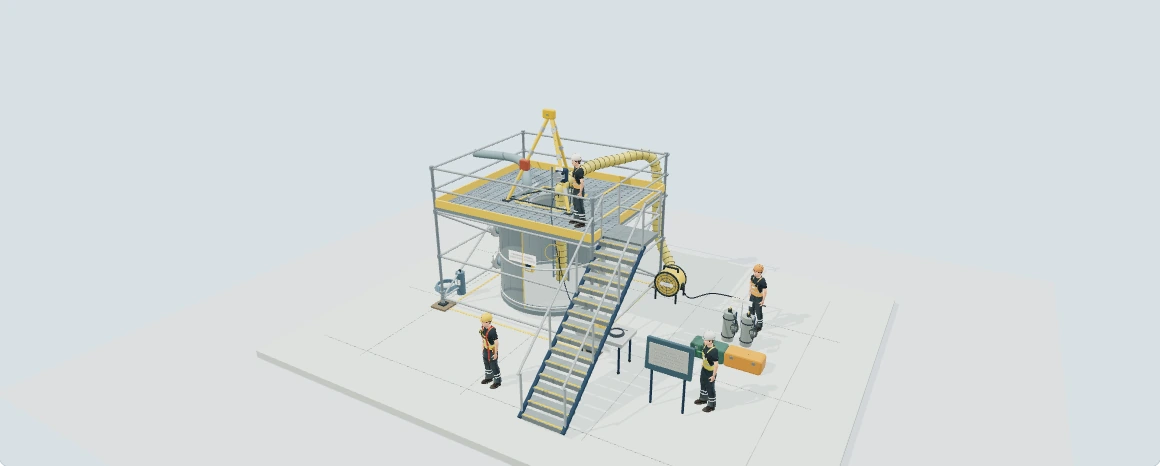

Confined-space tank entry: prepare, monitor and rescue
Follow a fictional tank inspection from avoiding entry through preparation, a supervised entry example and emergency response. Explore the access scaffold, rescue tripod and retrieval line, fresh-air duct, sample probe, personal gas monitor and standby team. Each step explains what the equipment does and what must be verified in the real job.
Checksheets and risk assessments
Risk assessment forms
Risk assessment examples
Forms and tools
Full written walkthrough — all 16 steps
1. First ask: can the task be done outside?
What is happening: A camera, remote inspection or suitable external cleaning may remove the need for anyone to enter. This example considers a tank with previous hydrocarbon service; the internal cutaway is a teaching view, not a second doorway.
How harm can occur: An enclosed space with a foreseeable specified risk can cause fire, explosion, poisoning, loss of consciousness, drowning or asphyxiation. Size alone does not decide whether it is a confined space.
Best practice to apply: Define the task, tank history, residues and connected plant. Avoid entry where reasonably practicable. A competent person develops the safe system and site-specific emergency arrangements before entry is considered.
2. Plan the job, people and permit
What is happening: The supervisor coordinates operations, contractors, the entry team and rescue team. The plan defines the work, duration, tools, exposure controls, access, communications and permit boundaries.
How harm can occur: A change of task, shift or neighbouring operation can defeat an earlier assessment. Hot work, solvents, sludge disturbance and heat can introduce new hazards.
Best practice to apply: Identify named competent roles, suitable entrants and fitness considerations. Decide the permit-to-work requirements, isolation responsibilities, authorised activities and the conditions that suspend work. The model never issues permission.
3. Empty, drain and clean from outside
What is happening: In this fictional preparation stage the tank is emptied, drained and flushed under a planned method before entry. Water is used only if compatible with the previous contents; contaminated washings go to controlled collection.
How harm can occur: Empty does not mean clean: sludge, scale, pockets and connected pipework may retain toxic or flammable material. Cleaning itself can release vapour or create chemical reactions and environmental risks.
Best practice to apply: Before draining or cleaning, establish and verify the isolations required for that preparation stage. Confirm substance compatibility, drainage, safe disposal and effective removal of residues. Do not prescribe a universal flushing time or assume water removes every substance. Reassess if residues remain or will be disturbed.
4. Prove and maintain all isolations
What is happening: Identify every inlet, outlet, bypass, drain, nitrogen and utility connection, plus pumps, agitators and electrical energy. The visible blanks illustrate positive separation; actual isolation must be selected, installed and verified.
How harm can occur: A closed valve may pass. Pressure, gravity inflow, rotating equipment or reconnection can overwhelm someone inside. Temporary preparation hoses can become an overlooked route back into the tank.
Best practice to apply: Use the plant isolation scheme, locks, tags and independent checks where required; establish zero-energy conditions. Control each preparation stage and verify the final entry boundary, including removal/isolation of temporary supplies. See the linked HSG253 lesson.
5. Purging removes a hazard and can create another
What is happening: If a competent hydrocarbon preparation plan requires inert-gas purging, it happens without entrants. Nitrogen can displace flammable vapour, but also displaces oxygen. The stored nitrogen hose is disconnected in the entry example.
How harm can occur: Nitrogen is invisible and can cause rapid unconsciousness without warning. Bringing air into remaining flammable vapour can create an explosive mixture; gases vented outside can also harm the standby team.
Best practice to apply: Use a designed purge and gas-freeing sequence with suitable instruments and controlled discharge. Verify each transition before admitting air. Remove/isolate the nitrogen supply, ventilate with fresh air, and test before considering entry. Never enter to investigate a purge problem.
6. Ventilate with clean fresh air — never oxygen
What is happening: A blower takes uncontaminated outside air through a flexible duct routed through the top manway and down to the lower part of the tank. Air then leaves by the separate outlet. Blue arrows show the intended supply route; amber arrows show the outlet route, not measured gas concentrations.
How harm can occur: Short-circuiting airflow, dead pockets, contaminated intakes or failed fans can leave dangerous conditions. Adding oxygen greatly increases the fire risk. Ventilation does not replace isolation or testing.
Best practice to apply: Select suitable equipment for the assessed atmosphere and ignition risks; position the intake away from exhausts and the discharge away from people and re-entry. Check effective circulation and maintain the required flow throughout work. Keep ducts clear of entry and rescue routes.
7. Sample the atmosphere before anyone enters
What is happening: The tester uses a pump and probe from outside. Sample representative positions, including different heights, the work area and pockets; do not assume gases form neat layers. The model probe and instrument are illustrative.
How harm can occur: One sample at the hatch can miss a dangerous pocket. A blocked tube, wrong sensor, poor calibration or insufficient sample travel time can create false reassurance. Some flammable sensors do not work reliably in low oxygen.
Best practice to apply: Use a competent tester, suitable sensors, current calibration and manufacturer-specified function/bump checks. Check oxygen first, then flammability and relevant toxic contaminants; allow sample transport and instrument response time. Record locations, time and results against the task-specific limits. Normal air is about 20.9% oxygen; departures need investigation, not an automatic green light.
8. Provide safe scaffold access and a clear hatch
What is happening: The access stair, boarded platform, guardrails, toe boards and guarded transfer point give the team a working position at the tank top. The hatch and fixed internal ladder provide the illustrative entry route.
How harm can occur: Falls, dropped tools and a restricted hatch can injure the entrant or prevent casualty recovery. Tank roofs and ordinary guardrails must not be assumed capable of carrying rescue loads.
Best practice to apply: Have competent people design/erect/inspect the access and verify its load paths. Check roof and platform capacity, opening protection, clearances with PPE/BA and a casualty, ladder security and a clear route to ground. The drawn scaffold is not a build specification.
9. Rig the tripod and retrieval equipment
What is happening: The tripod is aligned above the hatch and its feet secured on an engineered supporting arrangement. A personnel retrieval winch/line leads through the head pulley to a compatible harness. A separate fall-protection function is provided where the assessment requires it.
How harm can occur: A normal inertia/fall-arrest reel is not automatically a rescue winch. Incompatible components, inadequate anchors, sharp edges, snags or side loads can defeat recovery. A line is not a guarantee that an unconscious person fits through the hatch.
Best practice to apply: Verify equipment compatibility, ratings, inspections/examinations and pre-use checks; follow the manufacturer’s rescue configuration. Rehearse the actual route with a suitable dummy. Assess entanglement and the need for entry rescue; never improvise by attaching to a guardrail.
10. Fit the entrant’s equipment and escape provision
What is happening: The entrant wears a correctly fitted rescue harness, a personal gas monitor in the breathing zone and suitable PPE. The small escape set is carried where the assessment calls for it. The rescue team’s full breathing apparatus is staged outside.
How harm can occur: A filtering mask does not supply oxygen. An escape set is for leaving a developing emergency, not routine work or re-entry. A gas meter only detects the hazards its sensors are designed for.
Best practice to apply: Check the person is trained and suited to the task; fit and check harness, monitor, communications and escape equipment. Confirm battery, alarms, sensors, cylinders and escape duration for the route. This example assumes a verified breathable atmosphere; work requiring BA needs its own competent plan.
11. Brief the whole team at the entry point
What is happening: The entrant, dedicated standby attendant, supervisor and rescue team agree the job and rehearse the response before the permit is released. The attendant remains outside, maintains an entry log and stays in reliable contact.
How harm can occur: Unclear commands, competing duties or an absent attendant can delay evacuation. Relying solely on calling 999 leaves an incapacitated worker without an immediate suitable rescue arrangement.
Best practice to apply: Point out isolation boundaries, gas-test results, alarm/evacuation triggers, check-in method and backup signal, rescue roles, equipment, casualty route, first aid/AED and emergency rendezvous. Verify responders are ready and enough people are available. Each person repeats their role and stop-work authority.
12. Illustrative entry: maintain all the controls
What is happening: Only at this learning stage does the entrant appear inside, connected to the retrieval line. Assume the actual competent authoriser has verified the safe system. The attendant remains at the hatch; ventilation, an area monitor and the personal monitor remain in use.
How harm can occur: Conditions can deteriorate after a satisfactory pre-entry test. Work can release vapours, consume oxygen or produce heat and fumes; a meter at one location cannot describe every pocket.
Best practice to apply: Maintain the monitoring and communication specified for the work, repeat tests after interruptions/changes, and keep the entry log current. Record real readings; the model shows no invented safe values. Never continue if a critical control is lost.
13. Alarm or loss of a control: stop and get out
What is happening: A gas alarm, failed ventilation, lost communication, unexpected inflow or illness triggers the agreed response. A responsive entrant stops work and leaves immediately using the planned route, using an escape set only as trained and specified.
How harm can occur: Stopping to troubleshoot inside can turn a recoverable problem into a casualty. Silence or a failed instrument is not evidence that the atmosphere is safe.
Best practice to apply: The attendant raises the alarm and starts the site response. Do not silence the alarm and continue or restart from a single better reading. Secure the space and require reassessment, testing and fresh authorisation before any return.
14. Unresponsive entrant: planned non-entry recovery
What is happening: The attendant summons the trained rescue team and emergency services as planned. Where the assessed route and casualty position allow, trained personnel use the prepared system to recover the casualty without another person entering.
How harm can occur: Pulling a trapped casualty, a snagged line or an unplanned angle can cause further injury. An attendant who rushes in may become a second casualty.
Best practice to apply: Use only the practised, compatible recovery method. Keep people outside the hazardous atmosphere. If the route is obstructed or recovery cannot be safely achieved, stop that attempt and use the planned specialist entry-rescue response; do not improvise.
15. Entry rescue requires a protected, trained team
What is happening: Some emergencies need rescuers to enter. The staged full BA, communications, rescue equipment and casualty handling arrangements illustrate preparation for that separate rescue operation.
How harm can occur: A spare mask or escape hood does not make rescue entry safe. The same atmosphere, energy, entrapment or fire that affected the entrant can harm rescuers.
Best practice to apply: Only trained, equipped and properly supported rescuers use the site-specific entry-rescue plan, with suitable BA, control of entry, backup and remaining-air management. Maintain required isolations/plant controls. Emergency-service support complements the arrangements already in place.
16. Receive the casualty, then hand back safely
What is happening: The team moves the casualty to the planned safe area for trained first aid and ambulance handover. After normal work or an incident, account for all people and equipment and close the entry under the agreed handback process.
How harm can occur: A contaminated casualty can expose helpers. Premature reinstatement can trap someone or reintroduce energy; an incident must not be treated as permission to resume.
Best practice to apply: Give responders the tank identity, substances, readings and events. Provide first aid/AED only within training and follow emergency advice. Record the event, inspect affected equipment, review the plan and formally control removal of isolations and return to service.
Awareness example, not an entry permit, engineered rescue design or gas-clearance certificate. Actual entry requires a competent assessment, verified controls and a practised rescue plan for that space. Ventilate with clean fresh air — never oxygen. No entry during nitrogen purging.
The wider workplace has its own account and subscription access. Exploring this lesson does not grant access, record course completion or authorise work.
How can I practise this topic in 3D?
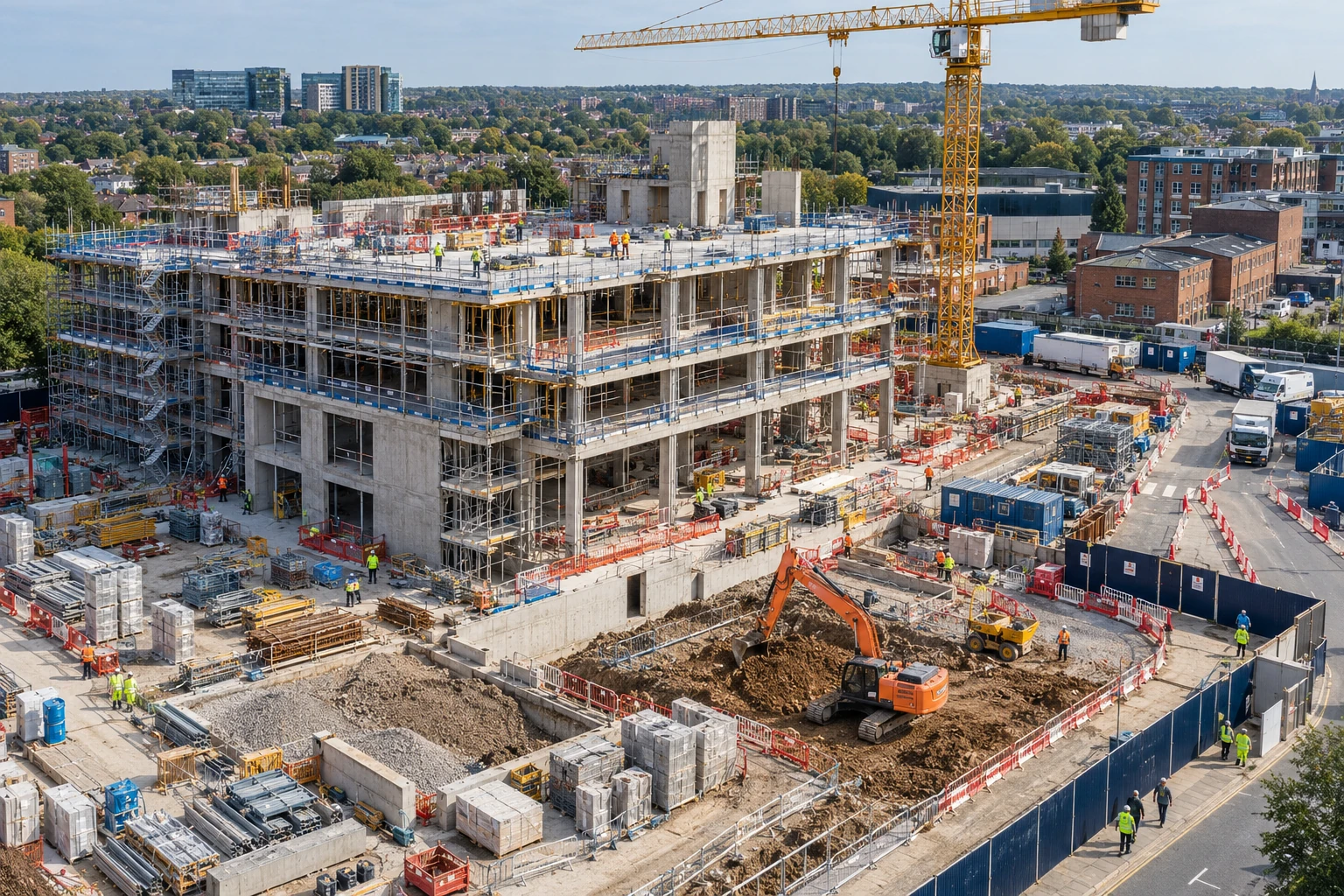
Water and a pump create new excavation risks
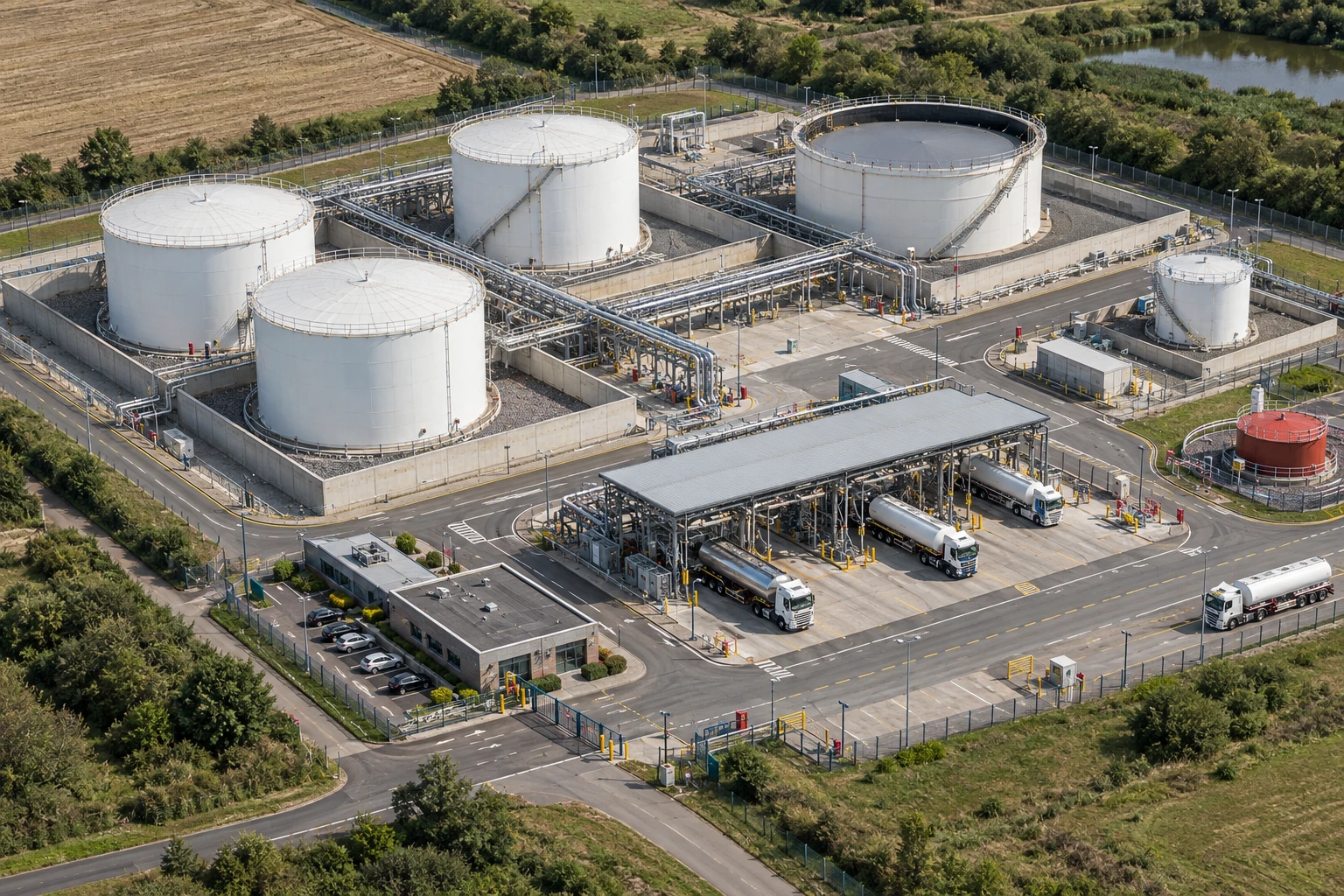
An internal floating deck is mistaken for a gas-free space

Cellar gas leak creates a hidden atmosphere hazard
All related inspection points 14 across 5 locations
Construction site 4 inspection points
Crown Fuels terminal 3 inspection points
Riverside Leisure 2 inspection points
Harvest & winter housing 3 inspection points
From flour to chilled despatch 2 inspection points
Practice in the SHAREhub environment. Browser practice is separate from workplace competence and formal learning records.
Connect the estate register to the exact entry decision
Managers need a route from estate information to the job: identify potential spaces, assess classification and likely tasks, assign a control standard and owner, consider design-out options, then require the exact entry and rescue arrangements to be verified. A register records knowledge; it is not permission to enter.
A changed interceptor layout can invalidate an accepted isolation or rescue method even though the asset number is unchanged. Management of change must reach the register, entry standard, contractor information and rescue assurance before the job. Route an immediate worker entry question to Confined Spaces; use this guide to maintain the system and verify that programme decisions remain effective.
Crownway: a new baffle changes the rescue route
Illustrative example. A interceptor modification adds an internal obstruction, but the old entry pack is still attached to the work order.
Decision. The asset owner holds entry approval and has competent operations, engineering and rescue personnel review the changed geometry and controls.
Evidence to check. Updated asset information, classification, isolation, access and a demonstrated suitable rescue approach.
Hold or escalation point. Register inclusion and an old signed permit cannot release work after an unreviewed change.
Follow-up. Update the controlled pack and brief all affected permit issuers and contractors before the next entry.
Link the space register to a live task decision
A register identifies spaces and responsibilities. It cannot permanently approve every task or every future condition in that space.
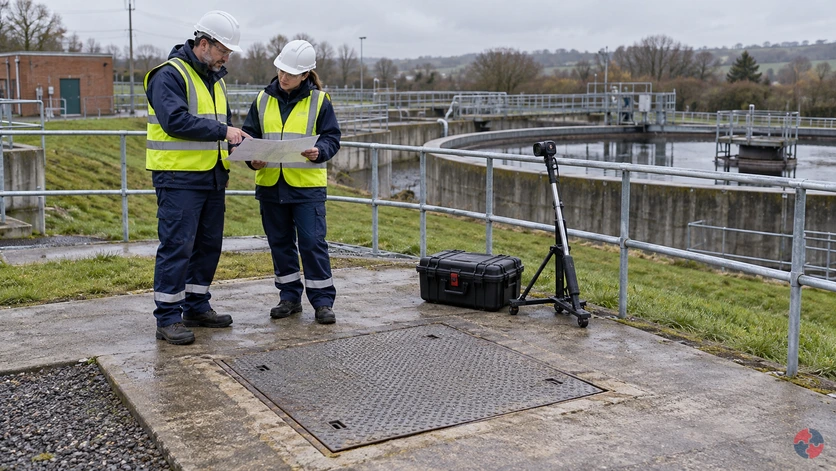
A space register starts the review; it cannot permit entry
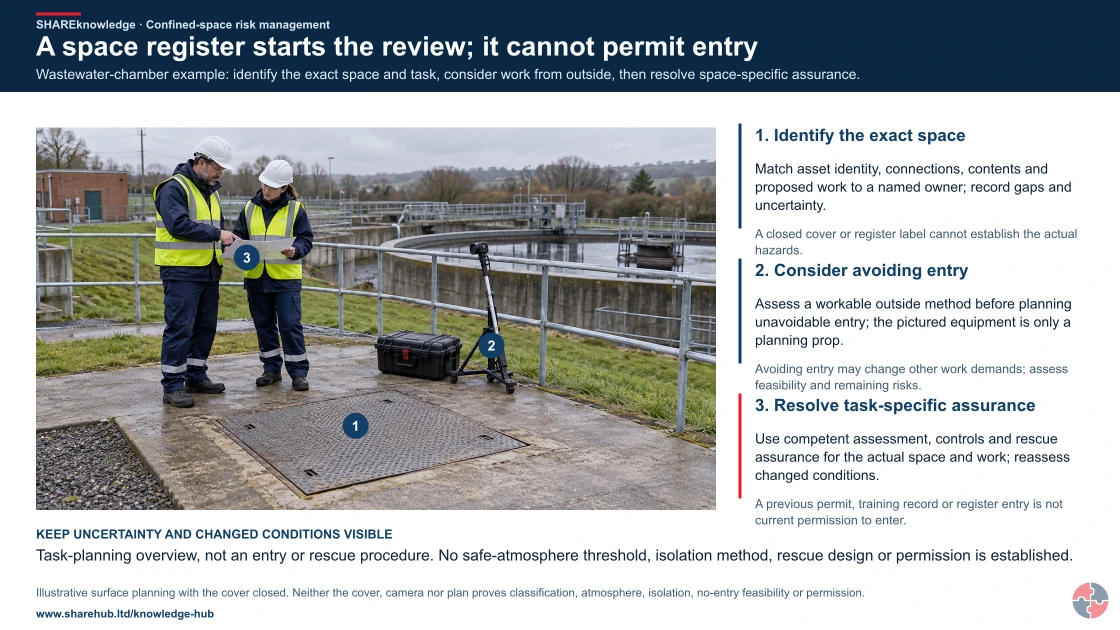
Full written explanation
Wastewater-chamber example: identify the exact space and task, consider work from outside, then resolve space-specific assurance.
- Identify the exact space. Match asset identity, connections, contents and proposed work to a named owner; record gaps and uncertainty.
- Consider avoiding entry. Assess a workable outside method before planning unavoidable entry; the pictured equipment is only a planning prop.
- Resolve task-specific assurance. Use competent assessment, controls and rescue assurance for the actual space and work; reassess changed conditions.
Change the pathway
- Do not classify from appearance. A closed cover or register label cannot establish the actual hazards.
- Check the complete method. Avoiding entry may change other work demands; assess feasibility and remaining risks.
- Do not reuse an old approval. A previous permit, training record or register entry is not current permission to enter.
Evidence check: Task-planning overview, not an entry or rescue procedure. No safe-atmosphere threshold, isolation method, rescue design or permission is established.
Complete space-register, no-entry and changed-condition context
Primary references: HSE: confined spaces introduction (GB) · HSE L101: safe work in confined spaces (GB) · HSE permit-to-work roles, coordination and hand-back
Open the complete HD image (new tab)Download image
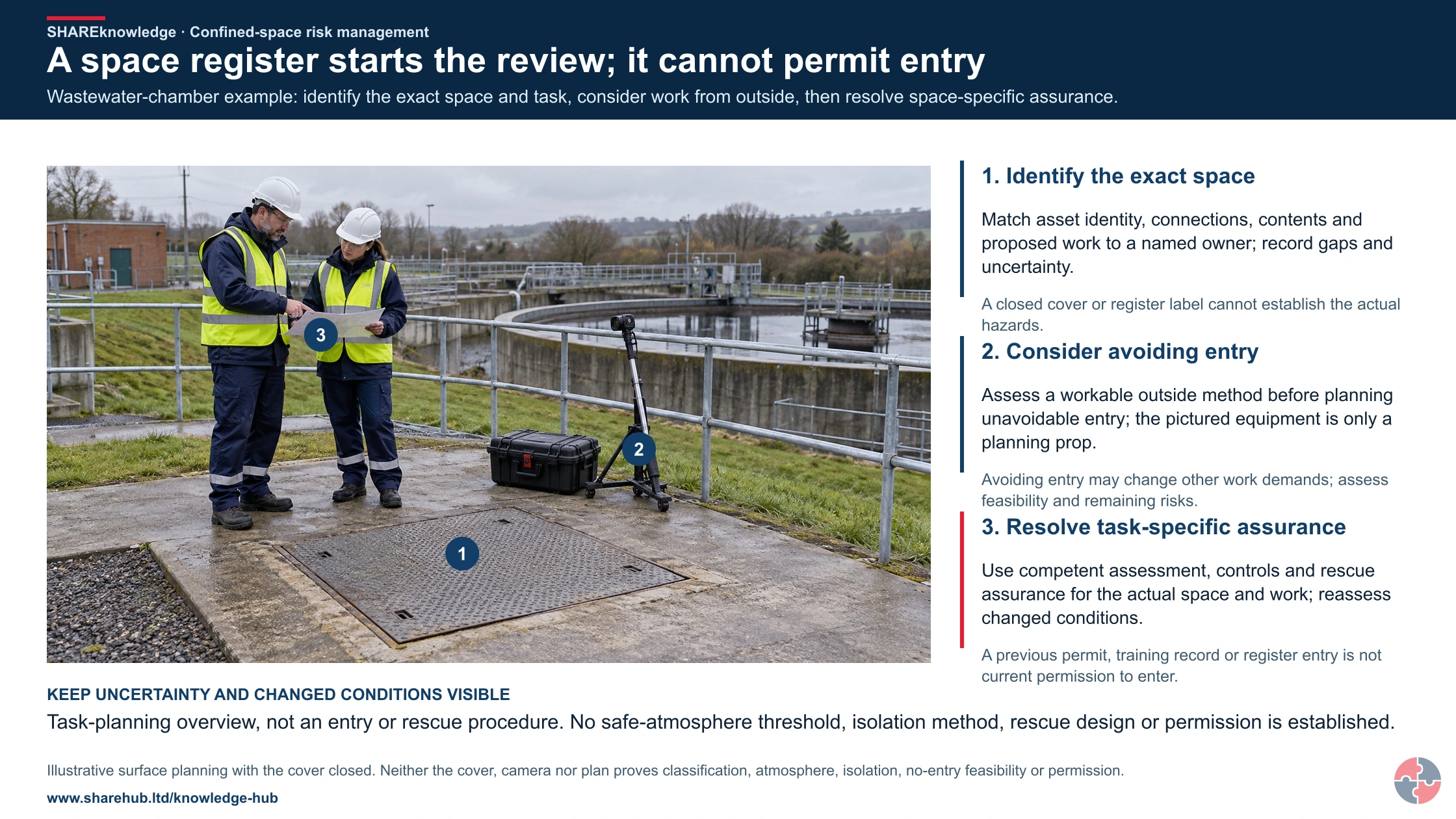
Complete space-register, no-entry and changed-condition context
Primary references: HSE: confined spaces introduction (GB) · HSE L101: safe work in confined spaces (GB) · HSE permit-to-work roles, coordination and hand-back

Identify accurately
Link the correct space, connections, contents and task to a named owner; record gaps and uncertainty.
Avoid and plan
Review work-from-outside options before a competent space-specific plan, including control and rescue assurance.
Reassess change
Altered contents, connections, work or conditions return the task to assessment and verification rather than an old approval label.
A register entry or completed training record is not permission to enter.
What are the key points about confined spaces risk management?
The key points are to govern the whole lifecycle: identify, classify, avoid entry, control unavoidable entry, prepare rescue and verify performance.
The system starts before the job
A good confined-space programme identifies spaces and designs entry out before work orders are raised.
Classification drives control
Different spaces and tasks need different control levels; a low-risk inspection is not the same as hot work inside a vessel.
Permits need governance
A permit is useful only when it confirms real controls at the space and is audited for quality.
Rescue is a capability
Rescue arrangements need people, equipment, access, drills, maintenance and management review.
Contractors need host oversight
Specialist contractors bring competence, but the host still controls site information, interfaces and authorisation.
Assurance must sample work as done
Records, field observations, interviews, drills and incident learning are all needed to prove control.
What does confined spaces risk management mean?
It means controlling confined-space risk as a managed system rather than treating each entry as an isolated permit exercise.
A single confined-space entry may last a few hours, but the management system that controls it starts much earlier. It includes design, procurement, maintenance strategy, asset information, contractor selection, training, permit rules, emergency planning, equipment inspection and review after weak signals.
The strongest systems challenge the need for entry first. If entry is unavoidable, they then make sure that the hazards are understood, the space is prepared, connected systems are isolated, atmospheric hazards are controlled, people are competent, rescue is realistic and supervisors verify conditions in the field.
Confined-space risk management also protects organisational memory. People leave, sites change, plant is modified and contractors rotate. A register, standard and assurance process prevents local knowledge being the only thing standing between routine work and a serious incident.
| Element | Management question | Evidence |
|---|---|---|
| Identify | Which known or foreseeable spaces could become confined spaces? | Register, drawings, inspections and work-order prompts. |
| Classify | What level of risk and control applies? | Classification criteria and entry category. |
| Avoid | Can the work be done without entry? | No-entry review and design actions. |
| Control | What safe system applies when entry is unavoidable? | Risk assessment, permit, isolation and testing records. |
| Recover | Can a casualty be rescued safely and quickly? | Rescue plan, equipment and drill evidence. |
| Assure | How does leadership know the system works? | Audit, observation, indicators and management review. |
How should governance be set for confined spaces?
Governance should define ownership, standards, authority, competence, escalation and review for confined-space work.
Without governance, confined-space controls become local habits. One supervisor may issue robust permits while another accepts a contractor's method without checking the space. One department may maintain gas detectors while another does not know who owns rescue equipment. A clear standard prevents these gaps.
Governance should name the responsible owner, define the confined-space standard, state who can classify spaces, who can authorise entry, who can issue permits, who maintains equipment, who owns rescue capability and what must be reported to senior management.
| Area | What should be defined | Evidence |
|---|---|---|
| Policy and standard | No-entry principle, classification and minimum controls. | Approved confined-space standard. |
| Roles and authority | Who identifies, classifies, permits, tests, supervises and rescues. | Responsibility matrix and authorisation register. |
| Equipment ownership | Who maintains gas detectors, ventilation, BA/RPE and rescue kit. | Inspection and maintenance records. |
| Contractor rules | What must be checked before specialist work starts. | Contractor standard and monitoring process. |
| Escalation | When work must stop or senior approval is needed. | Stop-work triggers and escalation route. |
| Review | How findings, drills and indicators are reviewed. | Management review minutes and action tracker. |
How should a confined-space register be managed?
A confined-space register should identify known spaces, likely hazards, ownership, access restrictions, classification, review dates and links to drawings or work orders.
A register helps planners and supervisors recognise risk before someone reaches the hatch, manhole or pit. It should be accessible to maintenance, operations, facilities, projects and contractors. It should also flag spaces that are not normally confined but can become confined during particular work, such as welding, cleaning, inerting, drying, painting, curing, decomposition or process isolation.
The register must be a live control, not an archive. It should be reviewed after plant change, new survey information, incidents, permit findings, contractor feedback, design modification and changes in use.
| Field | Why it matters | Example |
|---|---|---|
| Unique ID and location | Prevents confusion between similar spaces. | Tank 04, north bund, top manway. |
| Space type | Helps anticipate hazards and access needs. | Sump, vessel, duct, sewer, silo or pit. |
| Potential specified risks | Guides assessment and control. | Low oxygen, H2S, flammable vapour, engulfment. |
| Normal status | Shows whether entry is prohibited, controlled or routine under defined conditions. | No entry without permit and rescue plan. |
| Linked controls | Connects to permits, isolations, drawings and rescue method. | Isolation plan, gas-test plan and rescue sheet. |
| Review trigger | Keeps information current. | MOC, incident, inspection or annual review. |
How should a register identify confined spaces?
Record the enclosure and specified risk for each task and condition; do not classify by room name or difficult access alone.
The HSE L101 ACOP asks whether the place is substantially enclosed and a listed serious risk may arise. These include serious injury from fire or explosion, loss of consciousness from increased body temperature, loss of consciousness or asphyxiation from gas, fume, vapour or lack of oxygen, drowning from rising liquid, and asphyxiation by a free-flowing solid or entrapment by that solid preventing access to breathable air. Difficult rescue is a planning concern, not by itself a legal definition. In the register identify connected plant, residues, work method, changing atmosphere, entry trigger, no-entry alternative and competent owner. Review after process or building change; unlisted spaces still require assessment before entry.
How should drainage work trigger specialist confined-space planning?
Use the chamber and service-damage views to identify interfaces needing assessment, isolation, atmosphere information and emergency planning before the relevant work. Keep the excavation lesson separate from entry authorisation.
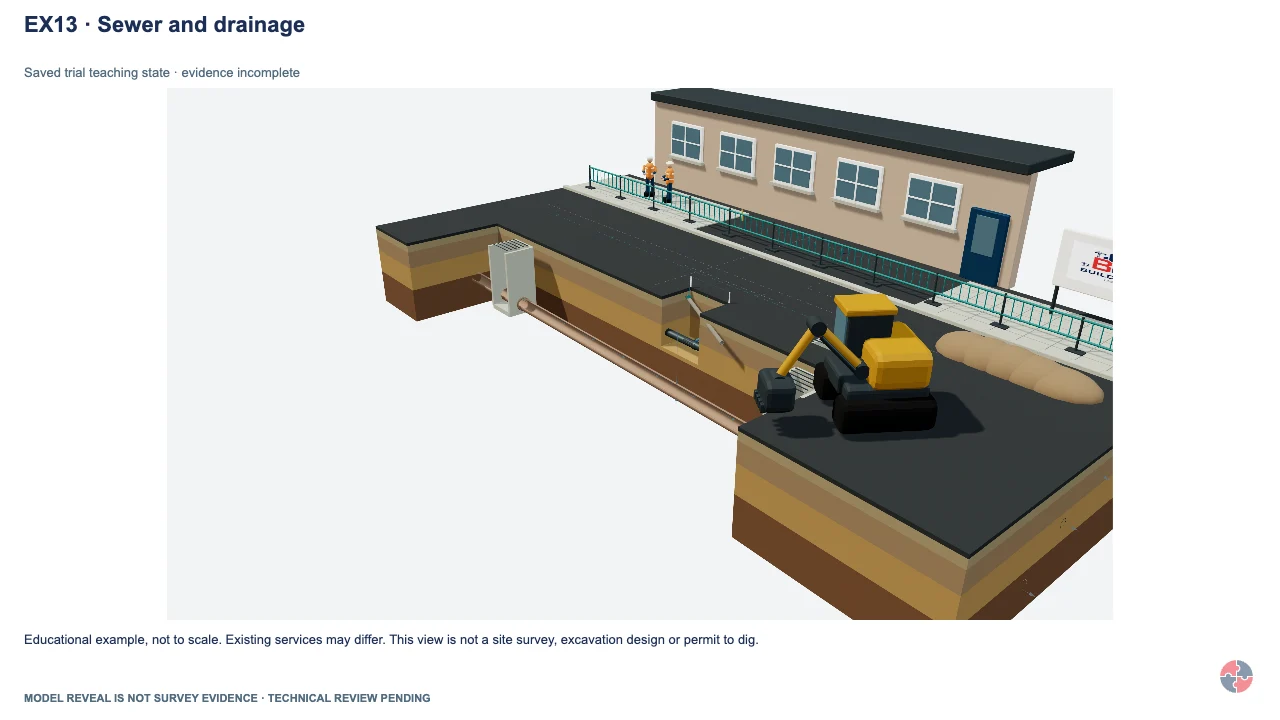
Sewer and drainage
The invert is the inside bottom of the pipe. Cover runs from the surface to the outside top. Chambers may present confined-space risks.
Learning focus: The invert is the inside bottom of the pipe. Cover runs from the surface to the outside top. Chambers may present confined-space risks.
Contextual workplace scene. Use the task, control and evidence checks in this section; appearance alone does not establish safe conditions, individual health or approval.
Educational example, not to scale. Existing services may differ. This view is not a site survey, excavation design or permit to dig.
No learner enters the chamber in this module; specialist assessment and emergency arrangements remain necessary.
Return to the main excavation lesson · Explore the planned Build Out excavation controls
How can the organisation avoid entry?
Make no-entry a design and work-planning decision, with a recorded reason before any permit is considered.
For drain inspection, use a remote camera and external cleaning point if a competent assessment confirms that method is safe. For tanks, provide fixed gauges, sampling points or clean-in-place systems where practicable. Check that pressure, chemical use or jetting does not create a new uncontrolled exposure. The manager signs the selected method; if entry remains necessary, the confined-space lead records why alternatives cannot safely achieve the task. This is the elimination level of the five-level hierarchy and ERICPD, ahead of isolation, engineering, procedures and PPE.
How should risk assessment and planning be governed?
Risk assessment should be task-specific and governed by a standard that requires no-entry review, specified-risk analysis, control selection and rescue planning.
Generic confined-space assessments are weak because the hazard changes with the space, contents, previous contents, task, tools, connected systems, weather, ventilation and people involved. The governance standard should require a fresh or reviewed assessment for each entry or class of repeated entry where conditions are genuinely controlled and equivalent.
Planning should integrate maintenance work orders, process isolation, contractor method statements, permits, gas testing, equipment readiness, emergency response and hand-back. If these elements are managed separately, gaps appear at the interfaces.
| Planning point | What to require | Evidence |
|---|---|---|
| Scope | Exact space, work and duration. | Work order and task risk assessment. |
| No-entry decision | Reasonably practicable alternatives considered. | No-entry review record. |
| Specified risks | Atmosphere, engulfment, drowning, fire, explosion and entrapment considered. | Assessment with hazard basis. |
| Interface | Operations, maintenance, contractors and emergency teams coordinated. | Planning meeting or permit interface. |
| Change | Triggers for reassessment defined. | Stop-work and reassessment criteria. |
| Review | Lessons and weak signals captured after the job. | Post-entry review for higher-risk work. |
How can the hierarchy of controls guide confined-space planning and entry risk reduction?
Specify positive isolation, suitable atmosphere assessment, ventilation, communication, standby and rescue for the actual space and work.
A wet-well cleaning job can expose entrants to inflow, toxic gas, low oxygen and moving pumps. Isolate and lock connected energy and inflow, verify the boundary, test expected gases with a suitable calibrated instrument, ventilate where needed and monitor as conditions may change. The entry supervisor checks permit and people count; the rescue lead checks equipment and a practised retrieval route. If any isolation leaks, readings change, communication fails or rescue cover disappears, withdraw and secure the space. Restart follows a new competent assessment and signed control checks.
On a small screen, scroll this table sideways to read all columns.
How can the ERICPD hierarchy of controls guide confined-space planning and entry risk reduction?

| Five-level / ERICPD | Specific measure | Owner, evidence, failure and stop |
|---|---|---|
| Eliminate / eliminate | Use external camera/jetting if safe and effective. | Planner records alternatives; stop entry if a safe no-entry method can do the task. |
| Substitute / reduce | Use less hazardous cleaning method after checking pressure/chemical effects. | Engineer approves and records trial; hold entry if the trial creates an unassessed exposure. |
| Engineering / isolate and control | Lock pumps/inlets, test zero flow, ventilate, test atmosphere and provide retrieval. | Engineer and tester sign checks; stop on leak, alarm or failed test. |
| Administrative / discipline | Permit, standby, communications, entrant count and rescue drill. | Supervisor checks at entry and change; withdraw on lost link. |
| PPE / PPE | Suitable assessed equipment for residual risk, with trained rescue capability. | Rescue lead verifies; no work if essential equipment or rescue capability fails. |
How can the ISO 45001 hierarchy of controls guide confined-space planning and entry risk reduction?

| Five-level / ERICPD | Specific measure | Owner, evidence, failure and stop |
|---|---|---|
| Eliminate / eliminate | Use external camera/jetting if safe and effective. | Planner records alternatives; stop entry if a safe no-entry method can do the task. |
| Substitute / reduce | Use less hazardous cleaning method after checking pressure/chemical effects. | Engineer approves and records trial; hold entry if the trial creates an unassessed exposure. |
| Engineering / isolate and control | Lock pumps/inlets, test zero flow, ventilate, test atmosphere and provide retrieval. | Engineer and tester sign checks; stop on leak, alarm or failed test. |
| Administrative / discipline | Permit, standby, communications, entrant count and rescue drill. | Supervisor checks at entry and change; withdraw on lost link. |
| PPE / PPE | Suitable assessed equipment for residual risk, with trained rescue capability. | Rescue lead verifies; no work if essential equipment or rescue capability fails. |
HSE’s five-level hierarchy sets out elimination, substitution, engineering, administrative controls and PPE for GB. ERICPD is complementary. Choose measures for the actual task and location, and verify physical control performance separately from briefing or permit completion.
For the wet well, the equipment owner commissions ventilation for the actual volume, geometry, residues and work-generated contaminants, using a clean-air intake and safe discharge. GB L101 supports task-specific checks: verify detector response/calibration and representative sampling, allowing sample-line transit time. Monitor continuously where forced ventilation or the work can change conditions; an oxygen reading alone cannot clear every atmospheric hazard. Record acceptance, maintenance and pre-entry checks for isolation, ventilation, detection, communication and retrieval. The entry supervisor withdraws people on failed controls, unsafe readings or lost rescue readiness; correct the cause and recheck the atmosphere and controls before renewed authorisation. Never use oxygen to refresh the space.
How should permit governance work?
Permit governance should ensure permits are used for the right work, issued by competent people, verified in the field and audited for quality.
A permit system can become a ritual if managers count permits rather than test their quality. Good governance checks whether permits are task-specific, whether isolations and gas tests are real, whether conditions are understood by entrants and attendants, and whether permit extensions or handovers are controlled.
Permit audits should include field observation. A neat permit in an office means little if the rescue kit is missing, gas monitor alarms are ignored, ventilation is poorly positioned or contractors do not understand the stop-work trigger.
| Question | Why it matters | Evidence |
|---|---|---|
| Was a permit required? | Ensures high-risk work is formally controlled. | Permit trigger criteria. |
| Was the space checked? | Prevents office-issued permits. | Field verification and issuer sign-off. |
| Were isolations verified? | Controls incoming energy and substances. | Isolation certificate and checks. |
| Were readings understood? | Prevents false assurance from gas testing. | Tester competence and recorded results. |
| Was handover controlled? | Prevents drift during breaks or shift change. | Permit handover and revalidation. |
| Was hand-back completed? | Prevents unsafe return to service. | Close-out and reinstatement record. |
How should rescue capability be governed?
Rescue capability should be treated as a controlled emergency function with defined people, equipment, maintenance, drills and review.
Rescue arrangements need the same discipline as entry controls. The organisation should know which types of entry require non-entry retrieval, internal rescue, breathing apparatus, specialist contractors, external emergency-service liaison or a combination. The plan should match the geometry of the space and the likely condition of the casualty.
Drills should test credible scenarios, not comfortable ones. A good drill asks whether communications work, whether equipment reaches the casualty, whether the casualty can be extracted through the access point, whether rescuers are protected and whether the response time is realistic.
| Capability | Management requirement | Evidence |
|---|---|---|
| Rescue plan library | Plans matched to space classes and tasks. | Task-specific rescue sheets. |
| People | Competent rescue personnel available during entry. | Training, authorisation and rota. |
| Equipment | Suitable and maintained retrieval, BA/RPE, communication and first-response kit. | Inspection and maintenance records. |
| Drills | Scenario-based practice and debrief. | Drill report and action close-out. |
| External liaison | Emergency services know site access and hazards where relevant. | Emergency plan and liaison notes. |
| Review | Weaknesses escalated and resourced. | Management review and improvement plan. |
How should contractors be managed for confined-space work?
Contractors should be selected for relevant competence, briefed on site-specific hazards, controlled through the host system and monitored during the work.
Confined-space contractor management is a common weak point because the work is often specialist and non-routine. A contractor may understand confined-space entry generally, but they do not automatically understand the host's plant, residues, isolations, operations, emergency arrangements or permit culture.
The host should remain an intelligent customer. It should check competence, agree the method, verify site conditions, control interfaces, confirm rescue arrangements and review performance afterwards. Contractors should not self-authorise entry into host-controlled spaces.
| Stage | Control | Evidence |
|---|---|---|
| Procurement | Select contractors with relevant confined-space competence and rescue capability. | Prequalification and references. |
| Planning | Review RAMS, rescue plan, equipment and interface with operations. | Planning meeting and method review. |
| Induction | Brief site hazards, permits, alarms, welfare and emergency contacts. | Induction and understanding check. |
| Authorisation | Use the host permit and entry control standard. | Permit and isolation records. |
| Monitoring | Observe work and stop deviations. | Supervisor checks and issue log. |
| Review | Record performance and lessons. | Post-job review and action tracker. |
How should confined-space assurance be carried out?
Assurance should test both the paperwork and the real work: registers, permits, equipment, competence, rescue drills and field behaviour.
A mature assurance programme uses layers. Frontline checks confirm the permit pack, equipment and people are ready. Supervisors observe entry controls during work. Health and safety teams audit permits, registers and training. Senior managers review trends and resourcing. Independent or specialist review may be needed for high-risk or complex arrangements.
Assurance should produce useful actions, not just scores. If many permits have missing gas-test detail, the issue may be training, form design, supervision, workload or weak standards. Good assurance identifies the system cause and verifies the fix.
| Layer | What to check | Output |
|---|---|---|
| Frontline verification | Permit conditions, detector check, ventilation, communication and rescue kit. | Binary go/no-go check. |
| Supervisor monitoring | Work matches permit and stop-work triggers are respected. | Observation record and coaching. |
| Second-line audit | Permit quality, register accuracy, training and contractor controls. | Findings, ranked actions and owners. |
| Rescue drill review | Plan works under realistic conditions. | Drill debrief and improvement actions. |
| Management review | Trends, resources, repeated failures and strategic improvements. | Leadership decisions and tracked actions. |
| Specialist review | Complex plant, atmospheres or rescue arrangements. | Technical report and action plan. |
How should management of change protect confined-space controls?
Management of change should review whether modifications, process changes, contractor changes or maintenance methods create new confined-space risks.
Confined-space risk often changes quietly. A new chemical, inerting method, cleaning product, access hatch, drain connection, ventilation arrangement, work method, contractor or production schedule can invalidate old assumptions. Management of change should ask whether the space classification, register, isolation plan, gas-testing method, rescue plan or training need has changed.
Temporary changes are just as important. A breakdown, blockage, abnormal residue, flooding, heatwave, shutdown or rushed maintenance window can turn a familiar entry into a different risk profile.
| Change | Confined-space concern | Action |
|---|---|---|
| Plant modification | New access, connections or residues. | Update register, drawings and controls. |
| Process or substance change | Different gases, vapours or oxygen effects. | Review assessment and gas detection. |
| Maintenance method change | New tools, hot work, solvents or duration. | Reassess entry and permit conditions. |
| Contractor change | Different competence or rescue capability. | Review selection and induction. |
| Emergency or abnormal condition | Unplanned atmosphere, flooding or blockage. | Stop, reassess and escalate. |
| Learning from event | Existing controls may be unreliable. | Revise standard and verify implementation. |
Which indicators should leaders review?
Leaders should review indicators that show whether confined-space controls are reducing entry, controlling live work and improving after weak signals.
Counting the number of entries is not enough. The organisation should know whether entries are being avoided, whether permits are right first time, whether rescue drills work, whether gas-test alarms occur, whether contractors comply and whether actions are closed. Leading indicators help identify drift before an incident.
| Indicator | What it shows | How to use it |
|---|---|---|
| Entries avoided | Whether no-entry thinking is active. | Reward design-out and remote methods. |
| Permit quality findings | Whether permits reflect real controls. | Improve forms, training or supervision. |
| Gas alarms or abnormal readings | Whether atmospheres are changing or poorly predicted. | Review assessment, ventilation and process conditions. |
| Rescue drill actions | Whether rescue plans work. | Resource equipment, access or training improvements. |
| Contractor deviations | Whether host control is effective. | Review procurement and supervision. |
| Overdue actions | Whether management review closes gaps. | Escalate and resource critical actions. |
What should a confined-space risk register include?
A confined-space risk register should identify credible entry scenarios, barriers, owners, assurance evidence and review triggers.
For high-risk sites, the register should not simply list spaces. It should identify credible scenarios: oxygen deficiency during tank entry, hydrogen sulphide in a sump, flammable vapour during cleaning, engulfment in a silo, flooding in a chamber, or failed rescue from a vertical vessel. Each scenario should be linked to barriers and assurance.
| Register field | Why it matters | Example |
|---|---|---|
| Scenario | Defines the credible harm pathway. | Entrant collapses from low oxygen in tank. |
| Preventive barriers | Controls that stop exposure. | No-entry method, isolation, cleaning and ventilation. |
| Detection barriers | Controls that reveal deterioration. | Gas monitor and attendant communication. |
| Mitigation barriers | Controls that limit harm. | Harness, retrieval and rescue team. |
| Owner | Makes control accountable. | Maintenance manager, permit issuer or emergency lead. |
| Assurance evidence | Shows barrier health. | Audit, drill, equipment inspection and permit sampling. |
Which duties apply in GB and NI?
Use the GB 1997 Regulations and HSE L101 in Great Britain; in Northern Ireland use the NI 1999 Regulations and HSENI-approved L101 third edition (2014). Check current amendments and task-specific duties.
HSE GB legislation guidance sets out avoid-entry, safe-system and adequate emergency arrangements before work. NI uses a separate 1999 statutory rule and HSENI approval of L101 for Northern Ireland. A management register and permit must support, not replace, these decisions. A competent adviser should check actual work, contractor roles and current instrument effects.
On a small screen, scroll this table sideways to read all columns.
| Location | Official rule | Management proof |
|---|---|---|
| Great Britain | 1997 Regulations and HSE L101. | No-entry record, safe-system verification and rescue evidence. |
| Northern Ireland | 1999 NI Regulations; HSENI-approved L101 third edition (2014). | NI no-entry, safe-system and emergency assurance. |
HSE lists L101 third edition (2014). HSENI approved it for use with the NI 1999 Regulations and withdrew approval of the first NI edition (1999), both effective 21 March 2022. This changed the ACOP route, not the NI Regulations. Check current amendments and task-specific equipment requirements before live work. The register and permit record must show the actual no-entry, safe-system and rescue decisions.
How could Crownway Fuels Ltd manage confined spaces risk management?

Crownway Fuels Ltd would first seek to avoid confined-space entry and, where entry remains necessary, require a competent task-specific system with effective emergency arrangements.
Crownway Fuels Ltd · practical example
Ask whether tank inspection can be done without entry
The key lesson A confined-space decision concerns enclosure and the foreseeable specified risk, not simply the size of an opening.
The situation: A depot tank needs an internal condition assessment. A contractor proposes entry because it is familiar practice. Crownway would first review whether the required information can be obtained remotely and whether the space and task create specified risks.
Why this matters: Atmospheres and other conditions can change, and an unplanned rescue can place additional people in danger.
How Crownway Fuels Ltd would manage it
- Define the information needed — Maintenance Coordinator. Agree what the inspection must establish with competent technical advisers. Consider remote methods and other ways to obtain the information without anyone entering the space.
- Assess any necessary entry — Competent confined-space adviser. Review the actual space, contents, connected systems, task and foreseeable changes. Establish the applicable GB or NI requirements and the required work and emergency arrangements.
- Check the complete resources — Site Manager. Confirm competent entrants, supervision, communications and assessed rescue provision before considering release. Contacting public emergency services is not the whole rescue arrangement.
- Coordinate and authorise — Authorised entry authority. Use the site's approved entry and permit controls, linked isolations and verification. Ensure the work party understands limits and stop conditions; do not treat one atmosphere reading as permanent clearance.
- Maintain and close control — Shift Supervisor. Keep the authorised conditions and entry status under the agreed monitoring and handover arrangements. Stop on a failed condition and accept closure and reinstatement only through the relevant authorities.
When the conditions change
- Recognise the trigger
- Entry is proposed or an authorised entry condition fails.
- Make the immediate decision
- Do not enter, or continue entry, while any necessary isolation, atmosphere, communication or rescue condition is unresolved.
- Verify the next step
- The authorised entry authority checks the required isolation and atmosphere evidence, competent team, communications and assessed rescue readiness for this space and task before releasing entry.
What good looks like
Entry is avoided where practicable. Necessary entry has a resourced, understood system that remains effective throughout the task, with no expectation of an improvised rescue.
Evidence to look for: Remote-method review, space and task assessment, competent appointments, entry and rescue arrangements, verification and closure records.
Common mistake to avoid: Assuming an open hatch or a previous gas test makes a space safe to enter.
Apply this to your work: What would make entry unnecessary, and who would decide whether the alternative meets the purpose?
Guidance behind the management approach: HSE L101: safe work in confined spaces. Use the topic's legal and technical guidance for the applicable work and location.
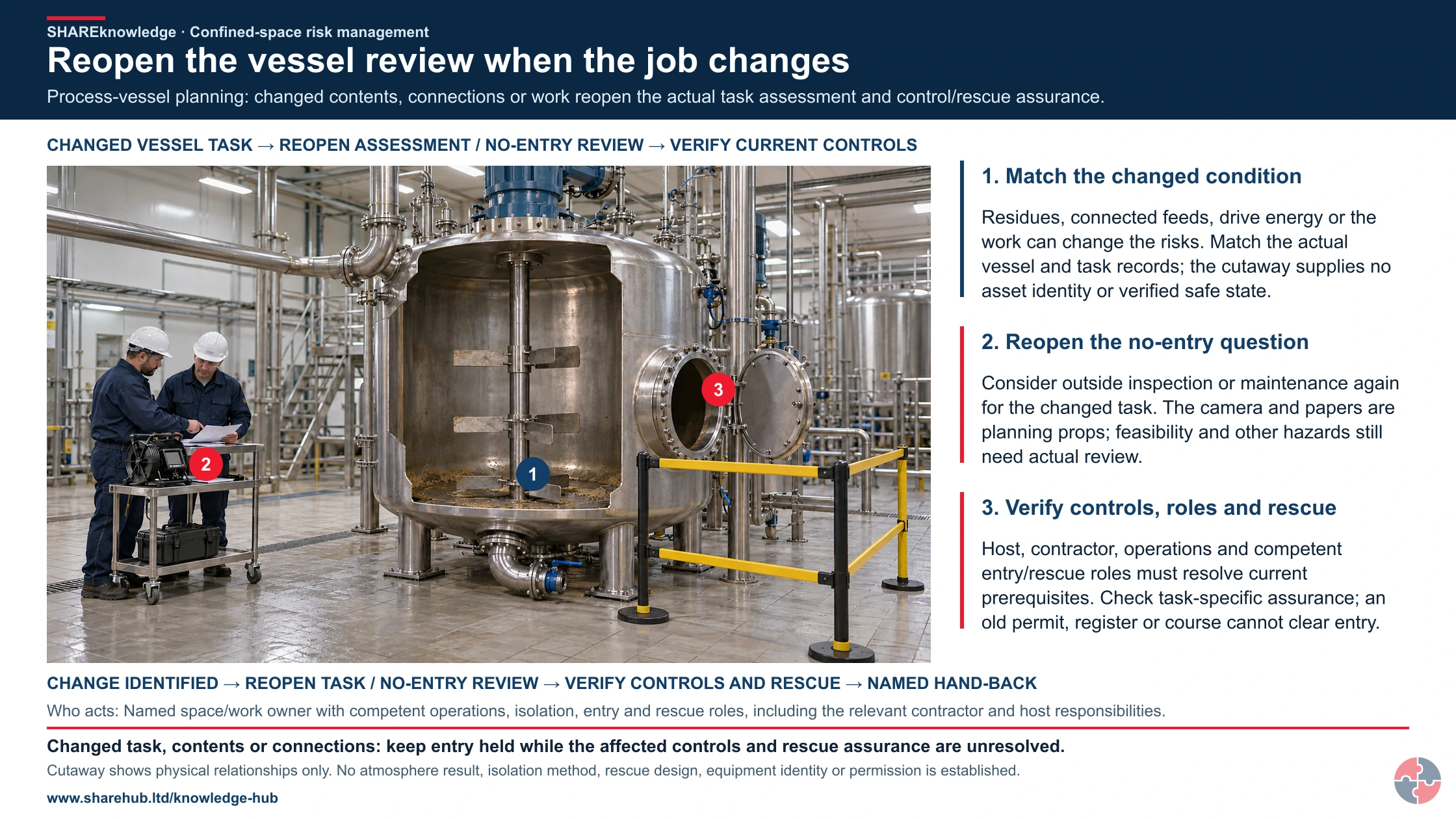
Reopen the vessel review when the job changes
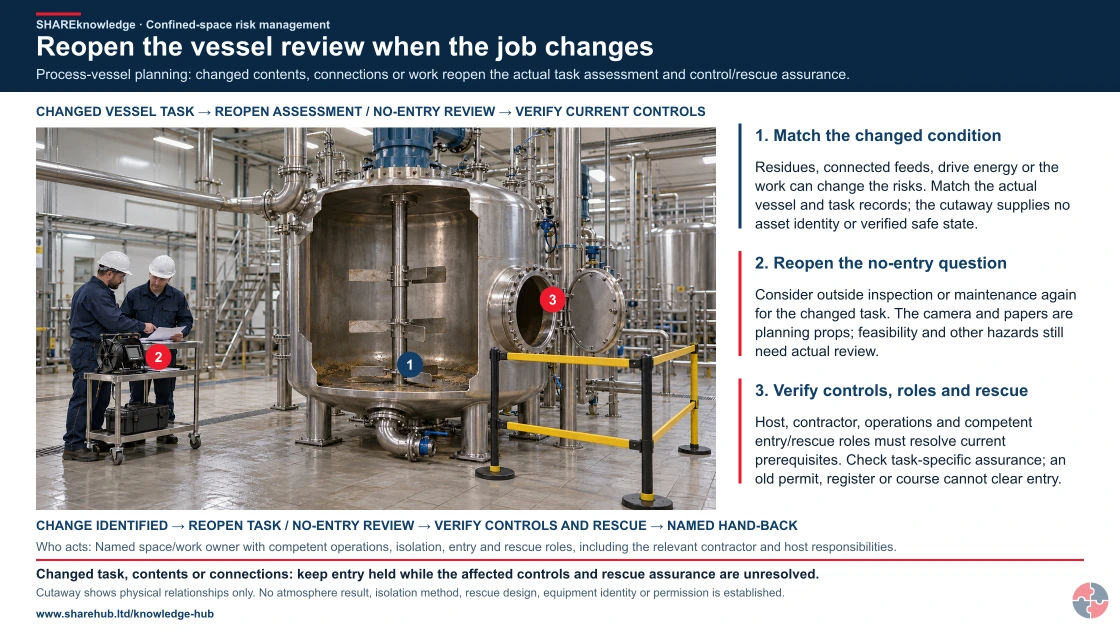
Full written explanation
A realistic process-vessel cutaway places the stationary agitator and drive, residue patch, connected feed/discharge pipes, side manway and outside planners in one view. The same vessel teaching source is used across the linked confined-space lessons so the changed-work decision can be followed through the actual physical relationships. Three new native annotations identify the changed contents/connections/task, the renewed no-entry feasibility question, and current control/role/rescue assurance. A complete native route links a change back to assessment and verification before named hand-back; it is not an entry or rescue sequence. The near shell is removed only for teaching and does not make a practical access route. Nobody is inside, operating, testing, cleaning or rescuing. The depicted camera, open manway, valve positions and task papers establish no asset identity, atmosphere, isolation, workable rescue or entry permission. Host/contractor coordination and the original complete register, work-order, assessment, permit, change and assurance controls remain in the current source. No safe-atmosphere threshold, operating/isolation method or rescue design is introduced.
Process-vessel planning: changed contents, connections or work reopen the actual task assessment and control/rescue assurance.
- Match vessel and task. Identify the correct vessel, contents, connected systems and proposed maintenance; resolve missing or conflicting information.
- Review no-entry options. Consider a suitable outside inspection or maintenance method and assess its feasibility and other hazards.
- Verify the task plan. For unavoidable entry, competent roles resolve the required controls, authorisation and workable rescue assurance for this task.
- Reassess any change. Changed contents, connections, work or conditions reopen assessment and verification; keep entry held if prerequisites are unresolved.
When the evidence does not fit: A register entry or completed course does not permit entry. Missing task, control or rescue assurance keeps the affected entry held; use the site response arrangements and avoid an unplanned rescue entry.
Who acts: Named space/work owner with competent operations, isolation, entry and rescue roles, including the relevant contractor and host responsibilities.
Changed workplace
Wastewater chamber: Start with exact identity and a workable no-entry review; do not infer hazards from the lid.
Process vessel: Contents, connections and maintenance change the live assessment; an old register entry cannot clear the work.
Evidence check: Task-planning overview, not an entry or rescue procedure. No safe-atmosphere threshold, isolation method, rescue design or permission is established.
Complete space-register, no-entry and changed-condition context
Primary references: HSE: confined spaces introduction (GB) · HSE L101: safe work in confined spaces (GB) · HSE permit-to-work roles, coordination and hand-back
Open the complete HD image (new tab)Download image
Complete space-register, no-entry and changed-condition context
Primary references: HSE: confined spaces introduction (GB) · HSE L101: safe work in confined spaces (GB) · HSE permit-to-work roles, coordination and hand-back
Crownway Fuels Ltd
A fuel storage and distribution business with tank farms, tanker loading, interceptors, drainage systems, workshops, contractors, control-room interfaces and emergency arrangements.
Crownway maintains a confined-space register covering tanks, interceptor pits, valve chambers, drains, sumps, bund low points, tanker barrels, workshop pits and service ducts. Each asset has a classification, likely atmosphere, isolation method, rescue approach and owner. The register is linked to maintenance work orders so entry cannot be planned without a no-entry review.
For unavoidable entry, the permit issuer must complete a field walkdown with operations and maintenance. They verify fuel isolation, draining, cleaning, vapour control, gas testing, ventilation, ignition-source control, rescue equipment and contractor briefing. Hot work inside or near a confined space requires additional DSEAR and permit controls.
Crownway's assurance programme samples live permits, detector checks, rescue drills, contractor competence and management of change. If a gas alarm occurs, a permit is suspended, rescue equipment is missing or a contractor changes the method, the event is logged and reviewed by the site risk committee. Actions are tracked until verified, not just assigned.
| Management area | How Crownway applies it | Evidence and improvement |
|---|---|---|
| Assess and classify | Maintains a live register linked to tanks, pits, sumps and drainage assets. | Register, classification and drawings. |
| Design out entry | Uses remote inspection, cleaning methods and maintenance design reviews. | No-entry review and capital improvement log. |
| Control live entry | Uses permits, isolations, gas tests, ventilation and field verification. | Permit pack, gas record and isolation certificate. |
| Manage contractors | Requires specialist competence but retains host authorisation. | Contractor approval, RAMS review and monitoring record. |
| Assure rescue | Tests rescue plans for vertical and restricted access scenarios. | Drill reports, equipment inspections and action close-out. |
| Improve | Reviews gas alarms, permit findings, drills and MOC changes. | Risk committee minutes and verified actions. |
How does this topic align with ISO 45001?
Use these examples to connect the relevant clauses to your own occupational health and safety management system. For each clause, identify the person responsible, the control in use and the evidence that it works.
Scroll across the table to read all four columns.
| ISO 45001 clause | How it applies | What to put in place | How to verify it works |
|---|---|---|---|
| 8.1.2 Hierarchy of controls | Avoiding entry removes the risks associated with having a worker inside the confined space. A tank inspection is a practical example of testing this option before planning entry. | At job planning, check whether inspection can be completed from outside the tank or by remote equipment. Agree the evidence the inspection must produce and establish an approval step for work that still requires entry. | Review a tank inspection brief to see which external methods were considered and whether the selected method delivered the required information. |
| 8.1.1 Operational planning and control | Where entry remains necessary, operational control means confirming the conditions for that entry and knowing when they cease to apply. | Assign an entry authoriser, set checks for the agreed isolation and atmosphere controls and define what changes trigger withdrawal and reassessment. Include contractor coordination and a way to account for everyone inside. | Sample an entry authorisation against the job records and ask the attendant how they would detect and communicate a change requiring withdrawal. |
| 8.2 Emergency preparedness and response | A rescue from inside a tank has to be planned for the actual space, access route and people available. The emergency plan needs to work when the entrant cannot self-rescue. | Assign rescue roles, confirm the means of communication and check that trained people and suitable equipment are available for the planned entry. Exercise a representative scenario and close gaps found during the exercise. | Check the last rescue exercise for the same or a comparable entry. Verify that problems with calling for help, access or casualty recovery were resolved before further affected entry. |
Selected applications of ISO 45001:2018 with Amendment 1:2024. Use the current standard for a full assessment and check the legal duties that apply to the work and location.
ISO 45001:2018 · 2024 climate action amendment · ISO 45002 implementation guidance · ISO technical committee clause FAQ
What should a confined-space risk assessment establish around fuel equipment?
Identify the specific space, remaining contents and connected systems before considering work controls. The illustration deliberately gives no entry, cleaning or rescue procedure.
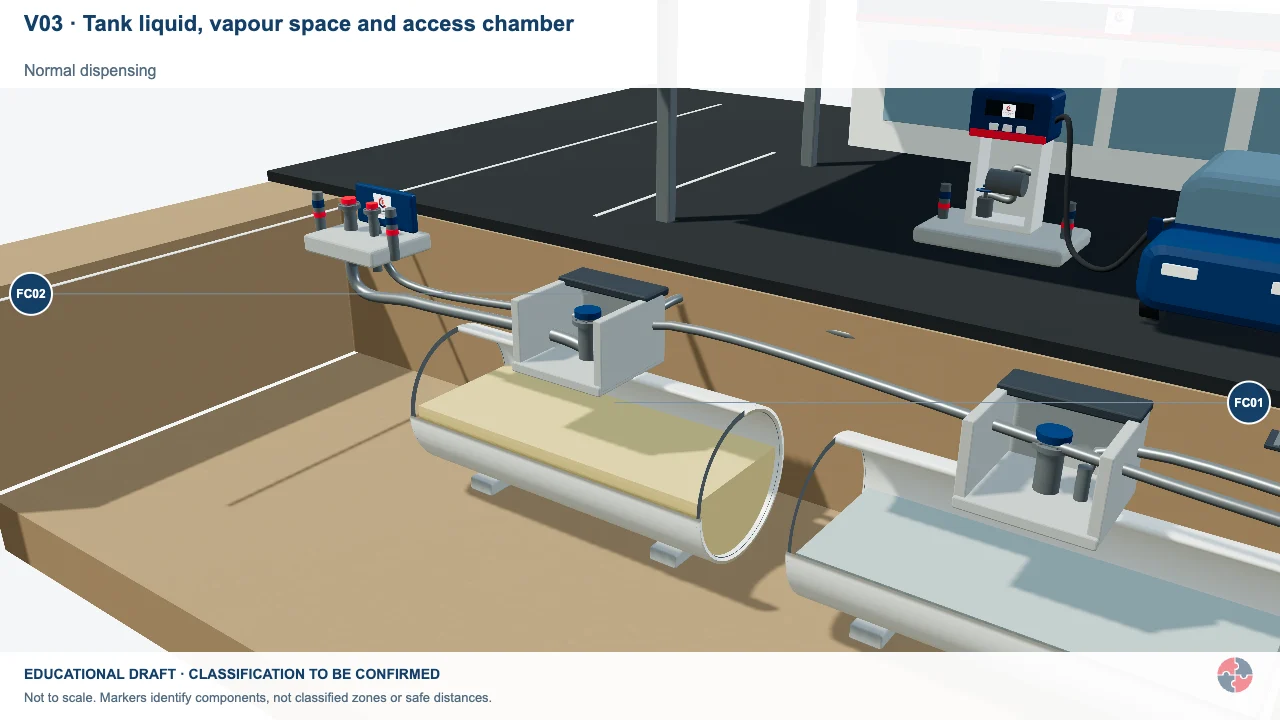
Tank liquid, vapour space and access chamber
The fuel liquid, space above it and surrounding access chamber are separate spaces with different assessment inputs.
Activity focus: Use the section to identify all three; the tank opening is not an access invitation.
Contextual workplace scene. Use the task, control and evidence checks in this section; appearance alone does not establish safe conditions, individual health or approval.
Educational illustration, not to scale. Coloured zones are teaching examples, not a site-specific hazardous-area classification.
What should each role learn and demonstrate?
Learning must match the decisions people make, from recognising danger to checking that controls work.
Briefings should tell people how to act, but attendance alone does not show competence. Assess the real decision or task, record who assessed it and revisit after a material change, failed control or incident. A local authorisation is task-specific; no universal external certificate is implied.
On a small screen, scroll this table sideways to read all columns.
| Role and learning | Demonstration and assessor | Record and reassessment trigger |
|---|---|---|
| Site manager | Audit register against actual spaces and changes; confined-space specialist assesses. | Signed sample; repeat after site change. |
| Entry supervisor | Demonstrate isolation, gas test, communication and withdrawal; specialist assesses. | Permit/observation; reassess after failure. |
| Rescue lead | Drill retrieval and casualty transfer; competent rescue assessor observes. | Drill record; repeat after team/equipment change. |
How can this topic support advanced safety study?
This topic supports advanced safety study by helping learners advise on confined-space hazards, legal duties, control measures and assurance evidence.
Diploma-level answers should move beyond listing hazards. A strong response identifies specified risks, explains no-entry and design-out options, specifies isolation and atmosphere controls, sets permit and supervision standards, defines emergency rescue and identifies evidence that would persuade an auditor or regulator.
Scenario answers should separate immediate action from strategic improvement. If a contractor entered a tank without gas testing, immediate action is to stop work and make the area safe. Strategic improvement may include register review, permit governance, contractor procurement changes, supervisor training, detector management and leadership review.
| Study point | What to explain | How to apply it |
|---|---|---|
| Specified risks | Fire, explosion, toxic atmosphere, low oxygen, drowning, engulfment and entrapment. | Identify the credible harm pathway. |
| Avoiding entry | Legal and hierarchy expectation to avoid entry where practicable. | Propose remote or design-out options. |
| Control measures | Isolation, cleaning, ventilation, testing, permits and supervision. | Match controls to the scenario. |
| Rescue | Emergency arrangements must be planned before entry. | Explain why improvised rescue is unacceptable. |
| Evidence | Registers, permits, gas tests, drills, training and audits. | Show how arrangements are proved and reviewed. |
How can a management system sustain effective decisions?
Give each hazard or support route an owner, a control, a check and a response to failure.
Assign space owners, no-entry decision, isolation, atmospheric test, permit and rescue checks. Audit actual entry and failure response, not paperwork alone. An owner should sample actual work and corrective actions, not accept a policy or certificate as evidence that the controls work.
The free GB regulator guide HSE Managing for health and safety (HSG65) explains a plan–do–check–act approach: assign controls and owners, involve workers, check work as done, and correct failures. For Northern Ireland, use HSENI risk assessment guidance for the local duty. A certificate alone does not demonstrate that a control works.
What warning signs show confined-space risk management is weak?
Warning signs include incomplete registers, normalised entry, poor permit quality, untested rescue plans, weak contractor oversight and no leadership review.
Weak systems often look busy but not controlled. There may be many permits but little challenge to entry. Gas tests may be recorded but detector readiness is not checked. Rescue plans may exist but have never been tested in the actual access arrangement. Contractors may supply paperwork but no one verifies live controls.
| Warning sign | What it suggests | Management response |
|---|---|---|
| Register missing or stale | Spaces may be unknown or misclassified. | Survey, update and assign owners. |
| No-entry review absent | Hierarchy is not being applied. | Introduce design-out review before permits. |
| Permits repeatedly corrected | Permit users may not understand the standard. | Retrain, simplify forms and increase supervision. |
| Rescue drills fail | Emergency arrangements may be unrealistic. | Resource equipment, people and redesign. |
| Contractors self-authorise | Host control is weak. | Reinforce permit and procurement controls. |
| Actions remain overdue | Leadership review is ineffective. | Escalate critical actions and track verification. |
What acronyms are used on this risk management page?
Acronyms should be explained so confined-space governance remains accessible.
| Acronym | Meaning | Why it matters |
|---|---|---|
| ACOP | Approved Code of Practice | Guidance with special legal status. |
| BA | Breathing apparatus | May be needed for rescue or hazardous atmospheres. |
| COSHH | Control of Substances Hazardous to Health | Relevant to toxic gases, vapours, fumes and residues. |
| DN3 | NEBOSH Diploma Unit DN3 | Diploma unit covering workplace safety hazards. |
| DSEAR | Dangerous Substances and Explosive Atmospheres Regulations | Relevant to flammable atmospheres. |
| HSE | Health and Safety Executive | Great Britain regulator; Northern Ireland uses HSENI. |
| LEL | Lower explosive limit | Important for flammable gas and vapour readings. |
| MOC | Management of change | Process for reviewing changes that affect confined-space controls. |
| PTW | Permit to work | Formal control system for high-risk entry. |
| RPE | Respiratory protective equipment | Must be suitable for the atmosphere and task. |