
Plan & record
Confined-space entry and rescue plan
Plan how your team will respond if an entrant cannot get out. Create a company-branded entry and rescue plan, a shift briefing sheet and a drill record.
Work through the steps with the entry supervisor, attendant and rescue lead.
Open the toolBefore anyone enters
What could harm the crew?
- Atmosphere. Oxygen loss or toxic vapour can overcome an entrant or rescuer. Flammable vapour can ignite. Residues and work inside can change a previously tested atmosphere.
- Inflow and stored energy. Liquid or solids can enter through a connection and engulf or drown someone. Moving plant, pressure or gravity can trap or injure them.
- Access and recovery. A medical emergency, fall, obstructed opening or snagged line can prevent escape. Moving a casualty through the hatch or off the platform can injure the casualty and crew.
- Loss of a control. Failed ventilation, monitoring or communication can leave the attendant unaware of danger. An impulsive entry to help can create a second casualty.
What must be in place?
- Decide whether entry is necessary. Check whether the task can reasonably be done from outside. If entry is necessary, record the site-specific assessment, safe system, competent roles and permit arrangements where applicable.
- Verify the space and its controls. Confirm the isolation boundary, atmosphere, monitoring and ventilation against the task. Record checks, withdrawal triggers and who can suspend the work.
- Prove the rescue arrangements. Have a suitable, available team with verified equipment, communications, a practised recovery route, first aid and emergency liaison before entry. Cover foreseeable scenarios and protect the rescuers. Reliance on the emergency services alone is insufficient.
Hold entry if a critical control, competent rescue cover or the casualty route is unverified. The responsible site authority makes the entry decision.
HSE L101 · regulations 4 and 5 (Great Britain)What you can take away
Create a company-branded entry and rescue plan, a shift briefing sheet and a drill record.
- The entry decision, access route, isolations and atmospheric controls.
- Team roles, communications, rescue sequence and contingency.
- Equipment-specific training, drill observations, corrective actions and handover.
How it helps you at work
Use the same plan at the entry point, during a rehearsal and at the competent review. Each action has an owner and a condition for stopping.
Keep it with your own records
Download the editable Word plan or PDF before leaving this page. Plan entries and photographs are held in memory.
How it works — the theory and its limits
Consider how to avoid entry first. Where entry is necessary, the safe system and emergency arrangements must suit this space and task.
Plan for the entrant and the rescuers. Verify the people, equipment, entire casualty route and first-aid arrangements before entry. The public emergency services supplement the planned response.
A completed form is a planning record. Competent verification and the site authorisation process are still required.
Method and guidance
- 1Identify the space and risks
- 2Plan and practise the response
- 3Brief the team and review
Before you use this tool
For competent planning and review against the actual job. HSE L101 applies in Great Britain. Check the applicable legal requirements elsewhere. This record does not issue a permit.
Prepare the entry and rescue plan
Check the hazards and entry requirements before completing this plan.
Work through seven steps with the people responsible for the entry. Add your company logo, mark the real access route and record who will respond if an entrant cannot get out.
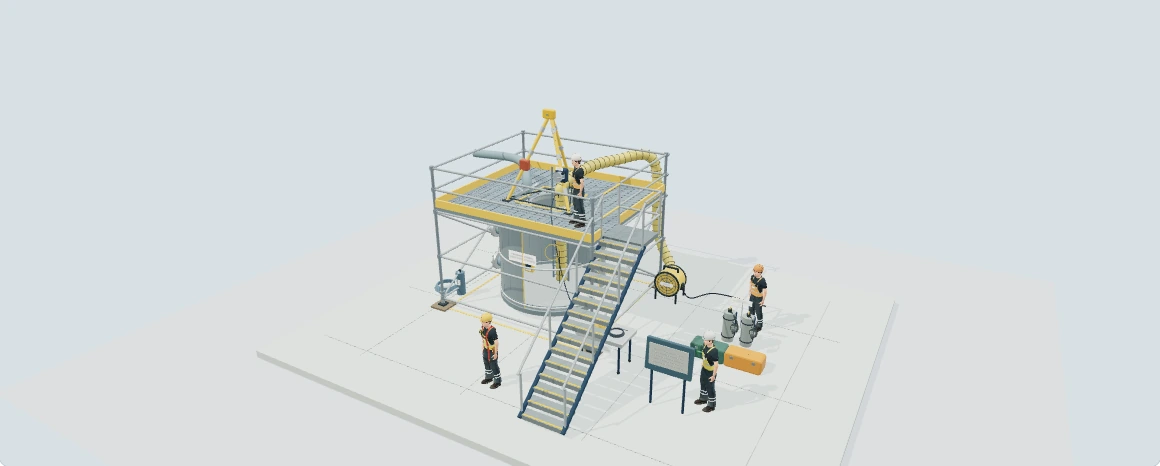
Worked example from the 3D tank
Follow an alarm at the tank-top hatch, an outside recovery decision and a drill finding that holds up entry. The example includes the crew briefing and exercise sheets.
How should the crew train and rehearse?
The entry supervisor and rescue lead should plan a controlled drill with the actual kit intended for the job. Identify the equipment by make, model and asset ID. Check each person can perform their assigned role with that equipment, including communication, non-entry recovery, casualty transfer and handover. Specialist entry rescue needs its own trained, protected team.
Use a safe mock-up and training manikin where appropriate. Record which parts of the route were demonstrated and which were simulated. If a method, team, route or item changes, assess the difference, familiarise the team and repeat the affected part. Assign defects to a named owner and record a witnessed retest.
What still needs attention?
Check every step and its evidence. A completed form is separate from the competent review and authorisation of the work.
Brief the crew and run the drill
These printable sheets use the current plan entries and leave writing space for the shift briefing, equipment checks, observations and follow-up.
Create your rescue plan documents
Both formats contain every entry, sequence step, readiness check, image caption and source link. Incomplete plans are labelled clearly. Word stays editable.
Download a blank template
Use the same structure offline. Complete it for your actual task and get competent review.
Take the next step
Sources, scope and guidance
Use the current guidance for the work and jurisdiction. Source review: 15 November 2026.