SHARE Knowledge Hub
Assessment of health risks from hazardous substances
Assess the real task, not just the product: identify substances used or generated, who can be exposed and by which route, then prevent exposure or select reliable controls and verify they work. A safety data sheet is evidence, not the assessment. Use current EH40 limits for airborne exposure, distinguish exposure monitoring from health surveillance, and stop when the substance, task, control or emergency response is uncertain.
Understanding Assessment of health risks from hazardous substances
Assess the real task, not just the product: identify substances used or generated, who can be exposed and by which route, then prevent exposure or select reliable controls and verify they work. A safety data sheet is evidence, not the assessment. Use current EH40 limits for airborne exposure, distinguish exposure monitoring from health surveillance, and stop when the substance, task, control or emergency response is uncertain.
Why this matters at work
Acute effects occur over a short time and may include irritation, burns, narcosis, poisoning, oxygen displacement or severe respiratory injury. Chronic effects arise after repeated or delayed processes and include asthma, dermatitis, neurotoxicity, organ damage, reproductive harm, pneumoconiosis and cancer. An agent can produce both, and absence of immediate symptoms does not exclude meaningful exposure or later disease.
Hazard is the intrinsic potential to cause harm. Exposure is contact or uptake by inhalation, skin, eyes, ingestion or injection. Risk combines the hazardous effect with the likelihood and magnitude of exposure in the actual task. Dose reflects how much reaches a target over time. A high-hazard sealed material may present low routine exposure, while a modestly classified product sprayed, heated or used repeatedly can create substantial risk.
How organisations manage this in practice
Procedural controls include restricted access, defined quantities, compatible storage, closed-container rules, task sequence, cleaning, inspection, permits, training, supervision, exposure-time limits and emergency action. They support engineering controls and should be designed around realistic behaviour. Job rotation reduces individual dose only in limited circumstances and may expose more people; it does not reduce emission.
Periodic review should be risk-based and detect gradual drift. It is not a legal universal annual rewrite. Compare current work with assumptions and inspect critical controls. Management of change should require COSHH review before approval and commissioning, with procurement, engineering, safety, occupational health and affected workers involved as appropriate.
Identify everyone who may be exposed: operators, cleaners, maintenance, laboratory staff, supervisors, office staff near production, agency workers, contractors, drivers, visitors, customers, waste handlers and neighbours. Include workers entering after the task, because contaminant may remain airborne or on surfaces. Consider young or inexperienced workers, pregnant workers and people with health conditions through competent and confidential processes.
A COSHH assessment should consider what is bought, what is generated by the work, how people can breathe it in, get it on or through the skin, swallow it or receive it through injection, how often exposure occurs, who may be affected and whether the controls actually keep exposure as low as reasonably practicable.
What is the scope and status of this guide?
Use this page to build and challenge a workplace COSHH assessment; it does not approve a substance, prescribe medical care or replace competent occupational hygiene, health or legal judgement.
Great Britain uses COSHH 2002 and Northern Ireland uses COSHH NI 2003. Both routes require assessment and prevention or adequate control, but they are separate legal instruments. EH40/2005 is the publication code for the current list: HSE and HSENI identify the fourth edition, published in January 2020, and HSENI confirms it is approved for use under COSHH NI.
How can I practise this topic in 3D?


Wet cement and unassessed chemicals reach the skin
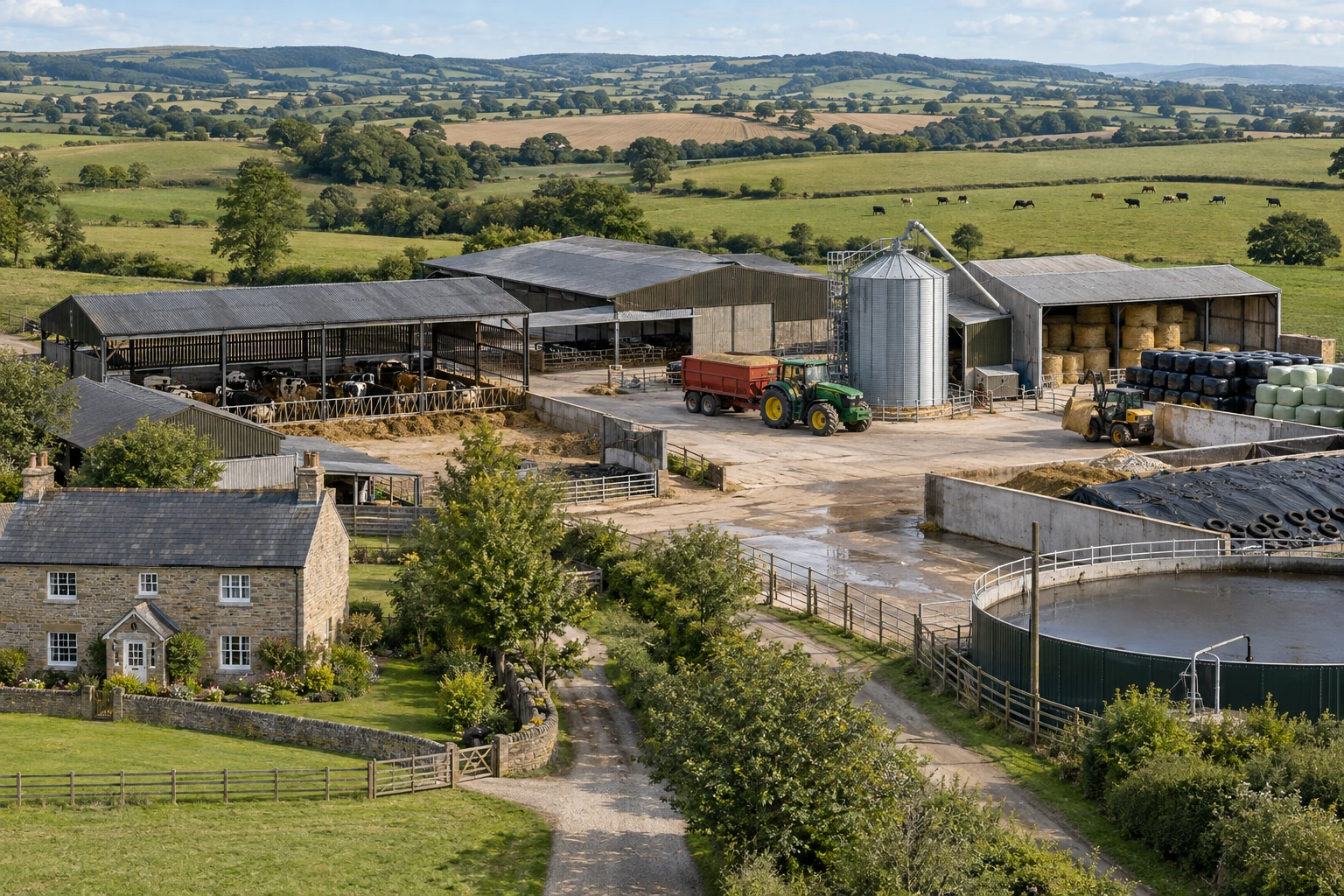
Infection from animal contamination

Clean linen exposed to used linen
All related inspection points 13 across 4 locations
Construction site 2 inspection points
Harvest & winter housing 5 inspection points
A safer place to call home 5 inspection points
Recover materials. Protect people. 1 inspection point
Practice in the SHAREhub environment. Browser practice is separate from workplace competence and formal learning records.
Assess the task beyond the supplier SDS
List what the work generates as well as what purchasing buys. A supplier SDS supports product understanding but does not describe every task exposure; welding fume and cutting dust still need assessment. Consider routes, duration, location, people and foreseeable control failures.
Best-practice guide: Assessment of health risks from hazardous substances
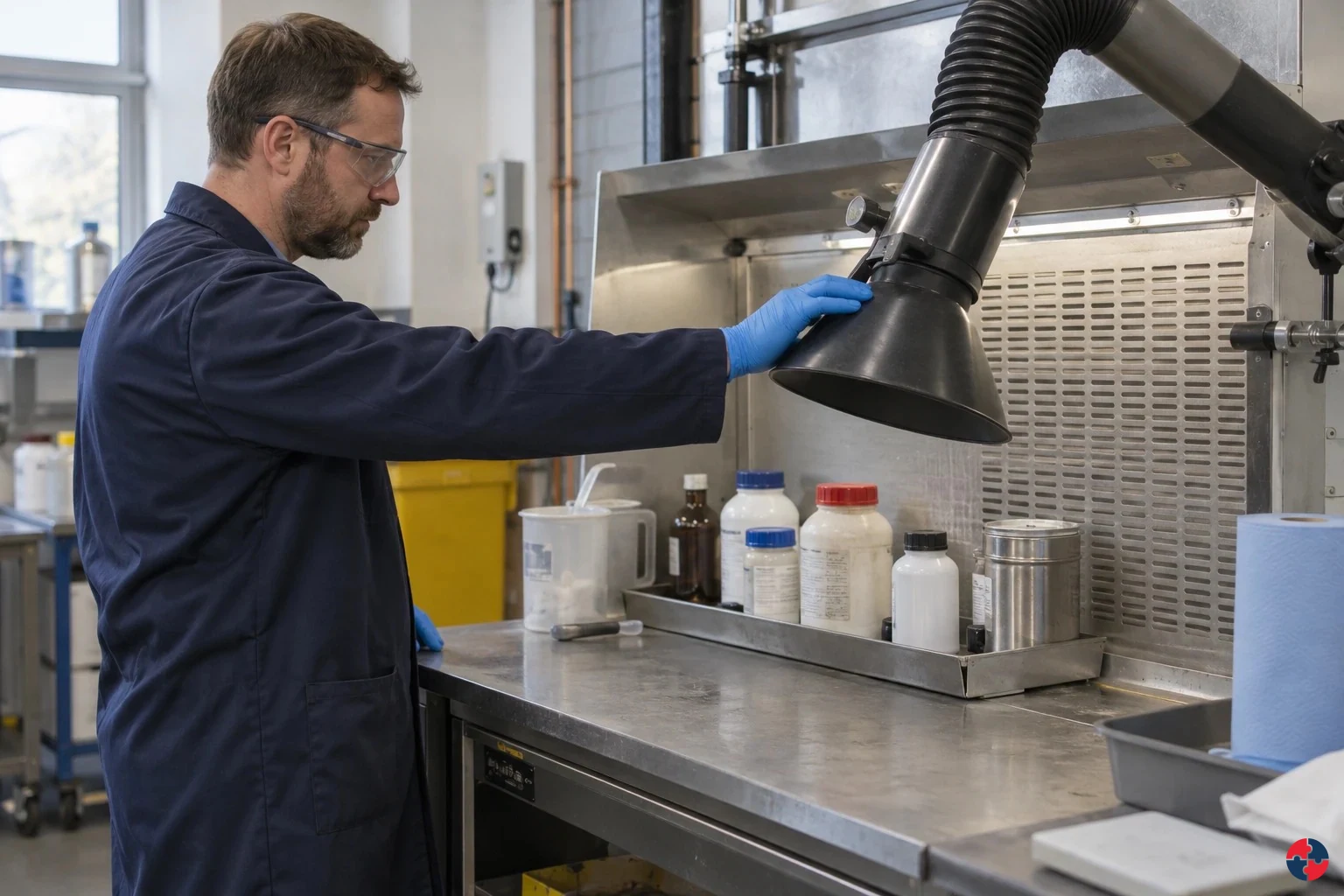
Assess the task beyond the supplier SDS
List what the work generates as well as what purchasing buys. A supplier SDS supports product understanding but does not describe every task exposure; welding fume and cutting dust still need assessment. Assess the real task, not just the product: identify substances used or generated, who can be exposed and by which route, then prevent exposure or select reliable controls and verify they work.
Turn assessment of health risks from hazardous substances knowledge into a decision
Assess the real task, not just the product: identify substances used or generated, who can be exposed and by which route, then prevent exposure or select reliable controls and verify they work. A safety data sheet is evidence, not the assessment. Product ID, SDS version, task assessment, briefing and closed defect.
Cleaner changed from spray to controlled wipe
Use the small quantity and method assessed; avoid spraying into the breathing zone and remove contaminated cloths to the agreed waste route. Clean the area, remove waste, wash hands, close any incident or product mismatch and restock only the approved product.
Health effects to consider in COSHH assessment
Irritation: Skin, eyes, nose, throat or lungs irritated by vapours, dusts, acids or alkalis. Corrosion or burns: Acids, caustics and corrosive products. Sensitisation: Isocyanates, epoxy resins, flour dust, wood dust, some biocides.
Choose controls for assessment of health risks from hazardous substances
Eliminate: Remove the hazardous substance or process, such as buying pre-cut materials or avoiding solvent cleaning. Reduce: Use smaller quantities, lower concentration, less dusty forms, lower temperature or shorter exposure time. Isolate: Use closed systems, enclosure, segregation, restricted access and sealed transfer. Control: Use LEV, ventilation, wet methods, safe handling, hygiene, storage separation and spill procedures. PPE: Use suitable gloves, eye protection, coveralls and RPE where exposure remains. Read the full control table for qualifications, ownership and verification. Use the actual task and applicable jurisdiction; existing technical approval remains unchanged.
Use the full assessment of health risks from hazardous substances lesson
Use the full topic for the decision points, practical examples, detailed control tables and source scope. HSE guidance applies to Great Britain; use HSENI for the Northern Ireland route and the source’s stated jurisdiction. A simplified guide does not change the page’s technical-review or approval status.

Read all six steps as text
1. Assess the task beyond the supplier SDS
List what the work generates as well as what purchasing buys.
- Avoid / redesign: Remove the hazardous substance or process, such as buying pre-cut materials or avoiding solvent cleaning.
- Control the task: Use closed systems, enclosure, segregation, restricted access and sealed transfer.
- Verify before release: Design/procurement review and substitution decision record.
List what the work generates as well as what purchasing buys. A supplier SDS supports product understanding but does not describe every task exposure; welding fume and cutting dust still need assessment. Assess the real task, not just the product: identify substances used or generated, who can be exposed and by which route, then prevent exposure or select reliable controls and verify they work.
Apply it: Which part of this plan would you check at the workface before authorising the task?
2. Turn assessment of health risks from hazardous substances knowledge into a decision
Use the evidence to improve the actual work arrangement.
- Change at source: Remove the hazardous substance or process, such as buying pre-cut materials or avoiding solvent cleaning.
- Make it observable: Design/procurement review and substitution decision record.
- Keep useful evidence: Product ID, SDS version, task assessment, briefing and closed defect.
Assess the real task, not just the product: identify substances used or generated, who can be exposed and by which route, then prevent exposure or select reliable controls and verify they work. A safety data sheet is evidence, not the assessment. Product ID, SDS version, task assessment, briefing and closed defect.
Apply it: What evidence would show that the change improves this task, rather than only completing a record?
3. Cleaner changed from spray to controlled wipe
Example: a practical application of the existing topic lesson.
- Setting: the process operator uses a water-based cleaner on control-room desks; the outcome is to avoid unnecessary mist and skin contact.
- Act: Check whether cleaning is needed, choose a lower-hazard product and pre-dosed wipe or controlled cloth, brief hygiene and spill steps, and keep food and drink away.
- Hold / review: Wrong product, decanted unlabelled bottle, eye/skin symptoms or unexpected strong vapour: stop, isolate the item and obtain competent advice.
Use the small quantity and method assessed; avoid spraying into the breathing zone and remove contaminated cloths to the agreed waste route. Clean the area, remove waste, wash hands, close any incident or product mismatch and restock only the approved product.
Apply it: At which point would you hold this example, and what evidence would allow it to proceed?
4. Health effects to consider in COSHH assessment
Connect the task, the route to the person and the control that can fail.
- Irritation: Skin, eyes, nose, throat or lungs irritated by vapours, dusts, acids or alkalis.
- Corrosion or burns: Acids, caustics and corrosive products.
- Sensitisation: Isocyanates, epoxy resins, flour dust, wood dust, some biocides.
Irritation: Skin, eyes, nose, throat or lungs irritated by vapours, dusts, acids or alkalis. Corrosion or burns: Acids, caustics and corrosive products. Sensitisation: Isocyanates, epoxy resins, flour dust, wood dust, some biocides.
Apply it: Who could be exposed, including other trades, cleaners, maintainers and people nearby?
5. Choose controls for assessment of health risks from hazardous substances
Start with the stronger practicable options and verify their effect.
- Eliminate: Remove the hazardous substance or process, such as buying pre-cut materials or avoiding solvent cleaning.
- Reduce: Use smaller quantities, lower concentration, less dusty forms, lower temperature or shorter exposure time.
- Isolate: Use closed systems, enclosure, segregation, restricted access and sealed transfer.
- Control: Use LEV, ventilation, wet methods, safe handling, hygiene, storage separation and spill procedures.
- PPE: Use suitable gloves, eye protection, coveralls and RPE where exposure remains.
Eliminate: Remove the hazardous substance or process, such as buying pre-cut materials or avoiding solvent cleaning. Reduce: Use smaller quantities, lower concentration, less dusty forms, lower temperature or shorter exposure time. Isolate: Use closed systems, enclosure, segregation, restricted access and sealed transfer. Control: Use LEV, ventilation, wet methods, safe handling, hygiene, storage separation and spill procedures. PPE: Use suitable gloves, eye protection, coveralls and RPE where exposure remains. Read the full control table for qualifications, ownership and verification. Use the actual task and applicable jurisdiction; existing technical approval remains unchanged.
Apply it: Which stronger option can be used here, and who will verify it before accepting the remaining risk?
6. Use the full assessment of health risks from hazardous substances lesson
Follow the official sources below and retain the task-specific evidence.
- Official guidance: HSE How to carry out a COSHH risk assessment
- Official guidance: HSE Principles of good control practice
- Task decision: Product ID, SDS version, task assessment, briefing and closed defect.
Use the full topic for the decision points, practical examples, detailed control tables and source scope. HSE guidance applies to Great Britain; use HSENI for the Northern Ireland route and the source’s stated jurisdiction. A simplified guide does not change the page’s technical-review or approval status.
Apply it: Which official source and full-topic section will you use to resolve the next decision?
Choose a controlled method, then decide what observation, testing or sampling is needed to show it works. Keep the sampling period and comparator aligned. Health surveillance is a separate risk-based professional arrangement, not a substitute for source control or a general medical clearance.
The method changes from outdoor wet cutting to indoor dry work
Illustrative example. A job is moved inside and a worker proposes dry cutting because water access is inconvenient.
Decision. Reopen the assessment before the changed task starts and compare source-control options for the new conditions.
Evidence to check. Record material, generated dust, enclosure, nearby people, control performance and representative exposure evidence needed.
Hold or escalation point. The old outdoor method assessment cannot release a new indoor dry process.
Follow-up. The assessor verifies the accepted controls and briefs users; changes or failed capture reopen the task gate.
What must the assessment keep separate?
Keep workplace-use assessment, chemical supply information, exposure measurement and worker health decisions separate, then connect them through controlled action.
| Question | Primary route | Do not infer |
|---|---|---|
| How is a supplied chemical classified and labelled? | GB CLP and UK REACH in Great Britain; EU CLP and EU REACH continue for the NI market. | A label or compliant SDS proves safe workplace use. |
| How is it used or generated at work? | The applicable GB or NI COSHH assessment and actual task observation. | One product assessment covers spraying, heating, cleaning and maintenance. |
| What airborne exposure occurred? | Competent exposure-monitoring strategy and current EH40 reference period where applicable. | A single sample proves every worker, shift or exposure route is controlled. |
| Has substance entered the body? | Suitable biological monitoring for a substance where meaningful, with competent interpretation. | It is the same as air monitoring or a clinical diagnosis. |
| Is work affecting health? | Suitable health-surveillance scheme and clinical or occupational-health route. | A manager may diagnose, request unnecessary medical detail or use screening instead of control. |
| Is there an acute incident? | Site emergency, first-aid and urgent medical routes, then investigation and controlled hand-back. | Absence of immediate symptoms proves no exposure or future concern. |
Who should make and act on hazardous-substance decisions?
Workers report what actually happens; supervisors control the task; a competent assessor connects hazard, exposure and controls; specialists answer measurement and health questions.
| Role | Action | Boundary and evidence |
|---|---|---|
| Worker or contractor | Use controls, hygiene and PPE as trained; report changes, defects, symptoms and spills. | Do not diagnose, alter the method or continue through failed controls. |
| Supervisor or permit issuer | Confirm the current task, people, prerequisites and stop route before release. | Hold work when identity, control or emergency response is uncertain. |
| COSHH assessor or safety adviser | Observe work; assess substance, form, route, exposure and reliable controls; record actions. | Seek specialist support beyond competence and state uncertainty. |
| Buyer, designer or process owner | Remove the hazard or select a safer material, form, quantity or process before purchase/change. | An SDS or approved supplier does not approve the workplace method. |
| Occupational hygienist | Design representative measurement and interpret results against task and current criteria. | One sample or area reading may not represent personal exposure. |
| Occupational health professional | Advise on suitable surveillance, individual follow-up and work fitness with confidentiality. | Managers receive necessary functional/control information, not full clinical records. |
| Employer or dutyholder | Provide resources, competence, controls, maintenance, information, surveillance where required and review. | Retains accountability when advice or contractors are used. |
What are the key facts about assessing health risks from hazardous substances?
The key fact is that the assessment must connect the substance, the task, the exposure route, the health effect and the control evidence.
The task matters as much as the chemical
The same product can create different risks when brushed, sprayed, heated, cut, mixed, pressure-washed, cleaned, decanted or used in a confined space.
Generated substances count
COSHH assessment must include substances produced by the work, such as wood dust, silica dust, welding fume, solder fume, diesel exhaust, flour dust, metalworking mist and biological contamination.
Routes of entry drive controls
Inhalation needs airborne control; skin absorption needs contact prevention; ingestion needs hygiene; injection needs sharps or high-pressure fluid controls.
SDS information has limits
Safety data sheets are useful, but they do not know your task, quantity, duration, ventilation, temperature, worker group or combined exposures.
Monitoring does not replace control
Air monitoring can verify exposure, but it must be planned, interpreted and acted on; it does not control exposure by itself.
Evidence must be live
Useful evidence includes current assessments, SDS, exposure data, LEV tests, RPE face-fit, training, health surveillance, inspection findings and closed actions.
What is assessment of health risks from hazardous substances?
It is the structured process of deciding how hazardous substances can harm people and what must be done to prevent or adequately control exposure.
A hazardous-substance assessment should begin with the work, not the form. The assessor needs to understand what is used, what is generated, how the task is performed, who is nearby, how long exposure lasts, how often it happens and whether controls still work during cleaning, maintenance, breakdowns and abnormal conditions.
The assessment should answer practical questions: what health effects are possible; how could the substance enter the body; who could be exposed; what level of exposure is credible; whether any WEL applies; whether the substance is a carcinogen, mutagen, asthmagen or sensitiser; and what control standard is required.
A strong assessment ends in action. It should specify controls, owners, training, monitoring, health surveillance, maintenance, emergency response, records and review triggers.
| Question | What the assessor should establish | Why it matters |
|---|---|---|
| What substance is involved? | Product, ingredient, by-product, dust, fume, mist, vapour, gas, fibre or biological agent. | Some hazards are generated by the process and will not appear in purchasing lists. |
| How can exposure occur? | Breathing, skin contact, absorption, ingestion, injection, splashes or contaminated surfaces. | Control must match the route of entry. |
| Who could be exposed? | Workers, contractors, cleaners, maintenance staff, visitors, public and vulnerable workers. | Non-routine groups are often missed. |
| How much and how often? | Quantity, concentration, duration, frequency, temperature, pressure and work rate. | Dose and duration strongly influence health risk. |
| What controls exist? | Elimination, substitution, enclosure, LEV, systems of work, hygiene, RPE, PPE and emergency controls. | The assessment must decide whether control is adequate. |
| What evidence is needed? | SDS, monitoring, LEV testing, face fit, health surveillance, inspections and training records. | Evidence proves the assessment is implemented. |
Which hazardous substances should be included in the assessment?
The assessment should include purchased products, process-generated contaminants, residues, waste, biological agents and substances brought onto site by contractors.
Many weak assessments only list labelled containers. That misses some of the most important occupational health risks: respirable crystalline silica from cutting stone, wood dust from sanding, welding fume from hot work, flour dust in bakeries, diesel exhaust in enclosed yards, metalworking fluid mist, cleaning residues, contaminated filters and biological agents in healthcare, waste, leisure and maintenance work.
The physical form changes the exposure route. A solid block may be low risk during storage but high risk when cut into respirable dust. A liquid may be low volatility at room temperature but generate vapour when heated. A powder may become airborne during tipping, weighing or cleaning. An aerosol can create fine droplets that travel beyond the immediate task.
Contractors can introduce substances that affect host workers, and host premises can expose contractors to residues or process contaminants. The assessment should therefore include interfaces, simultaneous operations and shared areas.
| Form or source | Examples | Assessment focus |
|---|---|---|
| Dust | Silica dust, wood dust, flour dust, cement dust, plasterboard dust. | Particle size, respirable fraction, dry sweeping, LEV, damping and RPE. |
| Fume | Welding fume, solder fume, thermal decomposition products. | Process temperature, metal content, local exhaust and respiratory risk. |
| Vapour | Solvents, fuels, paints, adhesives, degreasers. | Volatility, ventilation, ignition interface, skin exposure and WELs. |
| Mist or aerosol | Sprays, metalworking fluid mist, cleaning aerosols. | Droplet size, spray pressure, drift, inhalation and skin contact. |
| Gas | Carbon dioxide, chlorine, ammonia, nitrogen, carbon monoxide. | Displacement, toxicity, detection, confined areas and emergency response. |
| Liquid or paste | Acids, caustics, resins, isocyanates, cleaning chemicals. | Splash, skin absorption, gloves, eye protection, compatibility and hygiene. |
| Fibres | Asbestos fibres, mineral fibres or other respirable fibres. | Fibre release, disturbance, specialist controls and legal interface. |
| Biological agents | Bacteria, viruses, fungi, sewage, contaminated water or waste. | Infection route, hygiene, immunisation, containment and vulnerable people. |
How can hazardous substances enter the body?
Hazardous substances can enter through inhalation, skin contact or absorption, ingestion, injection and mucous membranes such as the eyes, nose and mouth.
The route of entry is one of the most important assessment decisions because it decides what controls are needed. A vapour may mainly require ventilation and respiratory control; a skin sensitiser may require substitution, closed handling, suitable gloves, hygiene and skin surveillance; a contaminated sharp may require safe sharps systems and biological exposure controls.
Inhalation is often the most obvious route because airborne dusts, fumes, gases, vapours and mists can reach the lungs. Skin exposure is just as important for irritants, corrosives, solvents and sensitisers. Ingestion usually happens indirectly through contaminated hands, food, drink, cigarettes, phones or poor hygiene. Injection includes needlestick injuries, cuts, punctures and high-pressure fluid injection.
A good assessment asks how exposure happens during normal work and during the messy parts of work: filling, tipping, mixing, clearing blockages, cleaning spills, changing filters, emptying waste, removing PPE and maintenance.
| Route of entry | Typical workplace examples | Control focus |
|---|---|---|
| Inhalation | Dust, welding fume, solvent vapour, metalworking mist, gas or biological aerosol. | Eliminate or reduce airborne release, enclosure, LEV, ventilation, monitoring and RPE. |
| Skin contact | Wet cement, oils, solvents, epoxy resins, cleaning chemicals, isocyanates. | Substitution, closed handling, splash control, gloves, skin care and washing. |
| Skin absorption | Some solvents, pesticides and chemicals absorbed through intact skin. | Prevent contact, select compatible gloves and avoid contaminated clothing. |
| Ingestion | Contaminated hands, eating in work areas, poor welfare or contaminated surfaces. | Hygiene, welfare, no eating/drinking rules and cleaning. |
| Injection or puncture | Needles, sharps, contaminated metal, high-pressure hydraulic injection. | Sharps controls, guarding, pressure isolation and emergency response. |
| Eyes and mucous membranes | Splashes, aerosols, corrosives, irritants or biological droplets. | Containment, eye/face protection, eyewash and splash procedures. |
What body defences and vulnerabilities should be considered?
The body has defences such as skin, mucus, coughing and immune response, but these can be overwhelmed, bypassed or damaged by hazardous substances.
The skin is a barrier, but it can be damaged by wet work, solvents, abrasion, cuts and repeated washing. Once the skin is cracked or inflamed, irritants and sensitisers may have easier access. The respiratory system traps some particles in the nose and upper airways, but fine respirable particles can reach deep lung tissue.
Some effects are immediate, such as chemical burns, choking, dizziness or eye damage. Others build slowly, such as occupational asthma, dermatitis, silicosis, asbestosis, cancer, nervous-system effects or liver and kidney damage. Repeated low exposures can matter even where one short exposure appears harmless.
Vulnerability can vary. Young workers, pregnant or breastfeeding workers, workers with asthma or skin disease, immunocompromised people, new starters, cleaners and maintenance workers may need specific consideration. The assessment should avoid informal medical judgement and use occupational health advice where needed.
| Body system | Defence or vulnerability | Assessment implication |
|---|---|---|
| Respiratory system | Nose, mucus and coughing can trap some particles, but fine particles and gases can reach deep lungs. | Assess particle size, solubility, peak exposure, WELs and respiratory disease risk. |
| Skin | Skin protects the body but can be damaged by wet work, cuts, solvents and irritants. | Assess direct contact, glove compatibility, skin care and health surveillance. |
| Eyes | Eyes are highly vulnerable to splashes, corrosives and irritant vapours. | Assess splash risk, face protection and emergency eyewash. |
| Digestive system | Ingestion often follows poor hygiene rather than deliberate swallowing. | Assess hand washing, welfare, eating areas and contaminated surfaces. |
| Immune system | Sensitisation can lead to asthma, dermatitis or allergic response at low future exposure. | Treat sensitisers conservatively and use early reporting and surveillance. |
| Existing health conditions | Asthma, dermatitis, pregnancy or immune compromise may alter risk. | Use confidential occupational health input and avoid exposing vulnerable people unnecessarily. |
What health effects should a hazardous substance assessment consider?
The assessment should consider acute effects, chronic disease, sensitisation, cancer, reproductive harm and effects on specific organs or body systems.
Health risk is not only about whether a substance is toxic. It is about the relationship between hazard, dose, route, duration, frequency and susceptibility. Some substances cause immediate harm at high concentration. Others create disease after repeated exposure, often with a long delay before symptoms appear.
Asthmagens and skin sensitisers need early control because once a person becomes sensitised, small future exposures may trigger serious symptoms. Carcinogens, mutagens and reproductive toxicants require especially conservative control because harm may be severe and delayed.
The assessment should also consider mixed exposures. For example, a worker may use solvents, clean with detergents, sand treated wood and wear occlusive gloves in the same shift. Each exposure may interact with the others or increase total burden.
| Health effect | Examples | Assessment warning |
|---|---|---|
| Irritation | Skin, eyes, nose, throat or lungs irritated by vapours, dusts, acids or alkalis. | Repeated irritation may signal inadequate control. |
| Corrosion or burns | Acids, caustics and corrosive products. | Need splash prevention, emergency washing and compatible PPE. |
| Sensitisation | Isocyanates, epoxy resins, flour dust, wood dust, some biocides. | May cause occupational asthma or dermatitis after sensitisation. |
| Respiratory disease | Silica dust, welding fume, wood dust, flour dust, asbestos. | Needs dust/fume prevention, monitoring and health surveillance where appropriate. |
| Cancer | Respirable crystalline silica, hardwood dust, some metal compounds, asbestos, diesel exhaust. | Control to ALARP where carcinogenic risk is present. |
| Systemic toxicity | Solvents, metals, pesticides and gases affecting organs or nervous system. | Assess absorption route, dose and biological monitoring where relevant. |
| Reproductive effects | Substances that may affect fertility, pregnancy or the unborn child. | Use pregnancy risk assessment and confidential occupational health support. |
| Infection | Biological agents in healthcare, leisure, waste, sewage or animal work. | Assess source, transmission route, hygiene, immunisation and containment. |
How should labels, hazard pictograms and safety data sheets be used?
Labels and safety data sheets are important starting points, but they must be translated into a workplace-specific assessment.
A product label gives immediate hazard communication through pictograms, signal words, hazard statements and precautionary statements. It helps workers recognise important hazards, but it is not enough to decide control for a task. The way the product is used can change exposure dramatically.
A safety data sheet should be checked for classification, ingredients, exposure controls, first aid, firefighting, accidental release, handling, storage, stability, incompatibilities, toxicology and disposal. The assessor should check that the SDS is current and matches the exact product and supplier.
SDS limitations are common. It may not cover substances generated by the process, mixed exposures, poor ventilation, heating, spraying, use in confined areas, local work rate, contaminated waste, residues or vulnerable workers. If key information is missing, ask the supplier or obtain competent advice.
| Information source | What to look for | Assessment limitation |
|---|---|---|
| Product label | Pictograms, signal word, hazard statements, precautionary statements and supplier details. | Does not describe the workplace task or exposure level. |
| SDS Section 2 | Hazards identification and classification. | May not reflect exposure from heating, spraying or process generation. |
| SDS Section 3 | Composition and ingredient information. | Some concentration ranges are broad or trade-secret limited. |
| SDS Section 4 | First aid measures. | Useful for emergency planning but not a substitute for prevention. |
| SDS Section 7 | Handling and storage. | Generic wording may need site-specific translation. |
| SDS Section 8 | Exposure controls, WELs and PPE/RPE suggestions. | PPE recommendations may be generic and need compatibility checks. |
| SDS Section 10 | Stability, reactivity and incompatible materials. | Important for storage, mixing and waste decisions. |
| Process knowledge | Dust, fume, vapour, decomposition products, residues and contamination. | Often missing from supplier SDS but essential for COSHH. |
What is the assessment decision path?
Start with the task and substance identity, decide credible exposure and health consequences, then prevent or adequately control exposure and prove the control is live.
| Gate | Decision | Hold point |
|---|---|---|
| 1. Scope and identity | What is used, generated or disturbed, in what form and quantity, including cleaning, waste and maintenance? | Unknown substance, material or process: do not start affected work. |
| 2. People and route | Who can inhale, contact, swallow or be injected, including contractors and bystanders? | Missing worker group or route: extend observation before rating risk. |
| 3. Health and exposure | What effects are credible, how intense and variable can exposure be, and does a WEL or specific rule apply? | No evidence for a high-consequence or uncertain exposure: obtain competent advice. |
| 4. Prevention and control | Can the substance/process be eliminated or substituted; what source, engineering, work and PPE controls remain? | Control depends on an unavailable or unverified measure: hold work. |
| 5. Verify and release | Are controls installed, understood, used, maintained and effective in real conditions? | Failed check, unexpected emission or symptoms: stop and investigate. |
| 6. Learn and review | What do monitoring, surveillance, incidents, change and worker feedback require? | Do not close an action without evidence of effective implementation. |
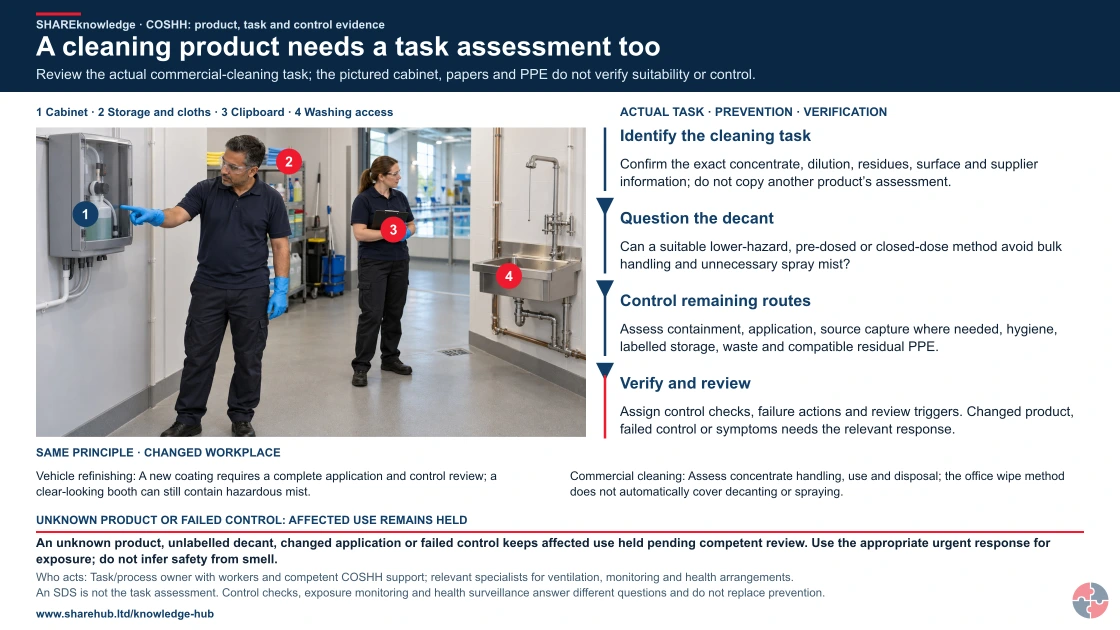
Trace the cleaning task from source to person
A safety data sheet describes the supplied product. The assessment must also explain what the work releases, how people could be exposed and how the chosen controls interrupt those routes.

A new coating reopens the exposure assessment
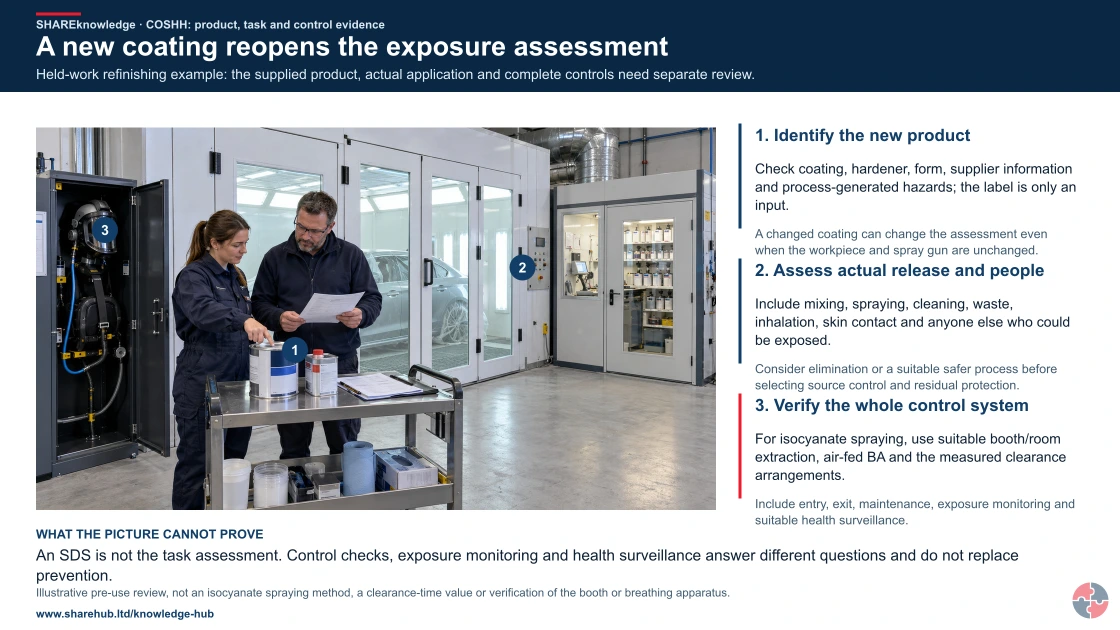
Full written explanation
Held-work refinishing example: the supplied product, actual application and complete controls need separate review.
- Identify the new product. Check coating, hardener, form, supplier information and process-generated hazards; the label is only an input.
- Assess actual release and people. Include mixing, spraying, cleaning, waste, inhalation, skin contact and anyone else who could be exposed.
- Verify the whole control system. For isocyanate spraying, use suitable booth/room extraction, air-fed BA and the measured clearance arrangements.
Change the pathway
- Reassess before use. A changed coating can change the assessment even when the workpiece and spray gun are unchanged.
- Avoid exposure first. Consider elimination or a suitable safer process before selecting source control and residual protection.
- Keep the scope complete. Include entry, exit, maintenance, exposure monitoring and suitable health surveillance.
Evidence check: An SDS is not the task assessment. Control checks, exposure monitoring and health surveillance answer different questions and do not replace prevention.
Primary references: HSE: COSHH assessment · HSE: principles of good control practice · HSE: two-pack isocyanate paints
Open the complete HD image (new tab)Download image
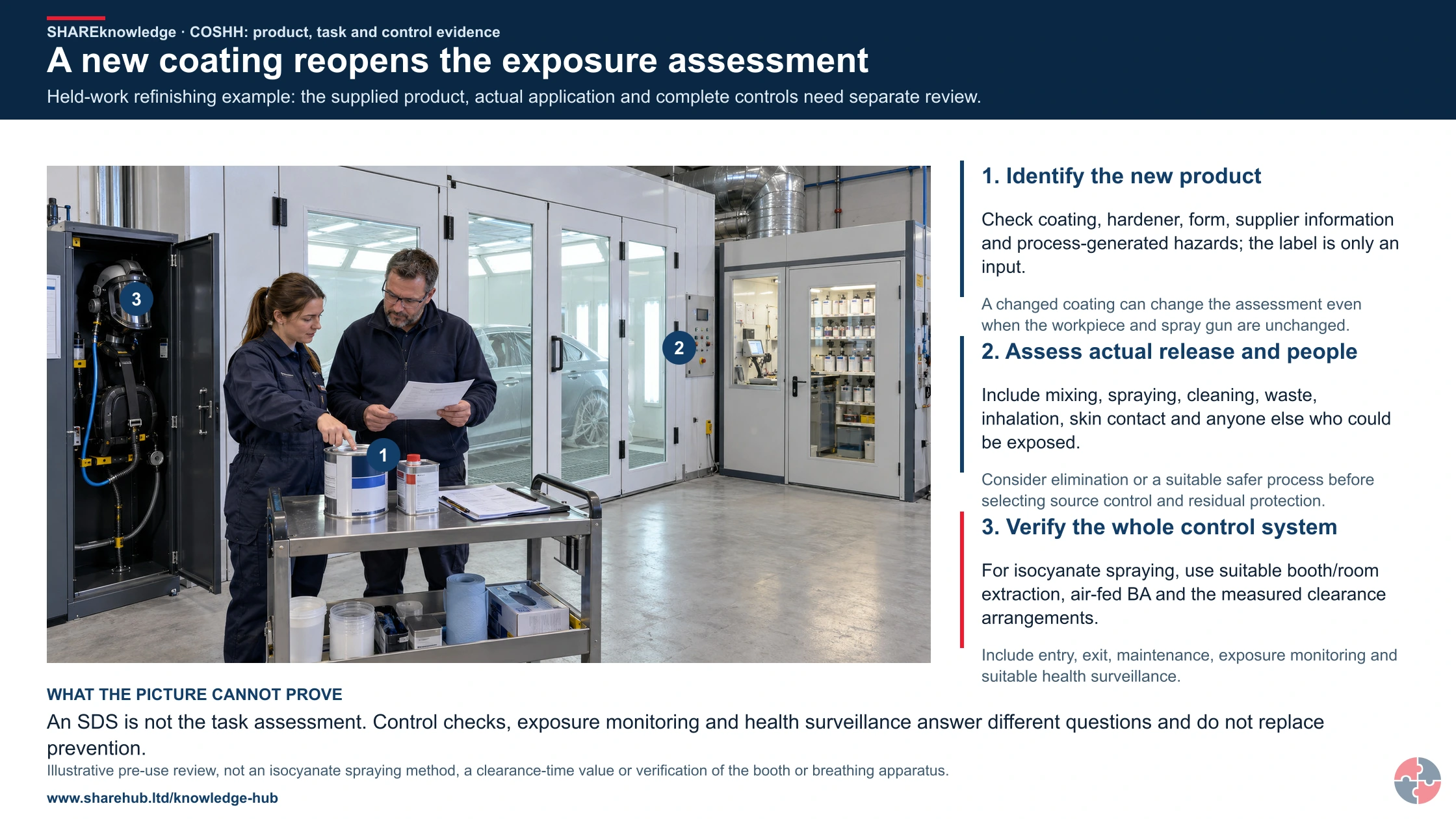
Primary references: HSE: COSHH assessment · HSE: principles of good control practice · HSE: two-pack isocyanate paints
Illustrative workshop task: cleaning a component at a bench. The product, process and control design must be assessed for the actual job; this example specifies no exposure limit, ventilation rate or glove material.
Source: product and process
Identify the cleaner, its concentration and form, and any residue or contaminant the work removes. Check whether the cleaning step can be avoided or a safer process or product can meet the task.
Release: opening, applying and disposing
Consider vapour, mist, splashes and contaminated cloths during use, waste handling and foreseeable spills. A closed container between uses addresses a different part of the task from controlling release during application.
People and routes
Trace inhalation at the breathing zone, contact with hands or forearms, transfer from surfaces and possible exposure of nearby workers or cleaners. Include duration and frequency.
Interrupt the route
Assess elimination or substitution first, then suitable containment and source capture where needed. Procedures, housekeeping and compatible PPE support the assessed controls; a written instruction does not extract vapour.
Check the evidence
Record who verifies containment or capture performance, what checks workers make, what failure means and when work must stop. Use competent exposure monitoring if needed to answer the defined exposure question.
| Evidence | Question it helps answer | It does not replace |
|---|---|---|
| Supplier information and SDS | What is known about this product and its hazards? | The task and exposure assessment. |
| Control checks and exposure monitoring | Are the defined controls working, and what exposure occurred in the sampled conditions? | Assessment of other tasks, routes, people or conditions. |
| Health surveillance, where required | Is there evidence of work-related health effects needing action through the appropriate programme? | Prevention and control of exposure. |
Reassess before use: an unknown product, changed process, failed extraction or unexpected symptoms needs the appropriate hold and escalation route. Do not infer safety from smell or a single reassuring reading.
Basis: HSE: carry out a COSHH risk assessment. The task sequence is an original worked application.
How should a COSHH health-risk assessment be carried out?
A COSHH assessment should identify hazardous substances, assess exposure, decide controls, record findings, implement actions and review effectiveness.
Assess the Actual Task
Two linked parts · 6 questions. Open Part 2 to complete the route.

Continue to questions 4–6 · Part 2 of 2


Read this visual as text
- Start: A substance is purchased, generated or changed for work.
- Question 1: Are purchased, used and process-generated substances identified? Decision owner: Competent COSHH assessor / task owner.
- YES: The required evidence or condition is confirmed. CONTINUE → QUESTION 2.
- NO / UNKNOWN — HOLD: Hold unknown materials and obtain reliable supplier or process information. HOLD → REPEAT QUESTION 1 AFTER CORRECTION.
- Question 2: Are physical form, release conditions and every exposed group mapped? Decision owner: Competent COSHH assessor / task owner.
- YES: The required evidence or condition is confirmed. CONTINUE → QUESTION 3.
- NO / UNKNOWN — HOLD: Include contractors, adjacent work and inhalation, skin, eyes, ingestion and injection where relevant. HOLD → REPEAT QUESTION 2 AFTER CORRECTION.
- Question 3: Can the source or exposure be prevented? Decision owner: Competent COSHH assessor / task owner.
- Yes: Remove, substitute or redesign the source and assess the alternative. CONTINUE → QUESTION 4.
- No: Specify suitable source-first controls for the remaining exposure. CONTINUE → QUESTION 4.
- Unknown: Investigate prevention options before relying on PPE. HOLD → OWNER RESOLVES BEFORE RESUMING.
- Question 4: Are controls available and verified under representative task conditions? Decision owner: Competent COSHH assessor / task owner.
- YES: The required evidence or condition is confirmed. CONTINUE → QUESTION 5.
- NO / UNKNOWN — HOLD: Do not use an SDS, exposure limit or supplier recommendation as task approval. HOLD → REPEAT QUESTION 4 AFTER CORRECTION.
- Question 5: Are maintenance, competence, hygiene and emergency arrangements ready? Decision owner: Competent COSHH assessor / task owner.
- YES: The required evidence or condition is confirmed. CONTINUE → QUESTION 6.
- NO / UNKNOWN — HOLD: Resolve the actual control and response gaps. HOLD → REPEAT QUESTION 5 AFTER CORRECTION.
- Question 6: Are release, stop conditions and review triggers owned and briefed? Decision owner: Competent COSHH assessor / task owner.
- YES: The required evidence or condition is confirmed. OUTCOME → RECORD AND HAND OVER.
- NO / UNKNOWN — HOLD: Keep the task held while critical evidence or responsibility is missing. HOLD → REPEAT QUESTION 6 AFTER CORRECTION.
- Outcome: Recorded assessment, named controls, stop route and release; or a documented hold for missing evidence.
Start by creating a substance and process inventory. Include what is bought, what is generated and what appears during cleaning, maintenance, waste handling and emergencies. Then observe the task. The person doing the work often knows where dust escapes, where splashes occur and where the written procedure is unrealistic.
The assessment should be task-based. A single product may need different assessments for brushing, spraying, decanting, heating, cleaning and waste handling. Similarly, a single dust hazard may need different controls for cutting, drilling, sweeping, bag emptying and filter changing.
The output should be a usable control plan. It should state what controls are required before work, during work and after work; who checks them; what training is required; what records are kept; and what triggers review.
| Step | What to do | Good evidence |
|---|---|---|
| Identify substances | List products, ingredients, generated contaminants, residues, waste and biological agents. | Inventory, SDS register, process map and worker input. |
| Identify health hazards | Use SDS, labels, WELs, HSE guidance, toxicology and process knowledge. | Hazard summary linked to task. |
| Understand exposure | Assess route, amount, duration, frequency, form, work method, environment and people affected. | Observation notes, exposure estimates and monitoring where needed. |
| Check current controls | Look at substitution, enclosure, LEV, ventilation, handling, hygiene, RPE/PPE and supervision. | Field observation, maintenance/test records and worker conversations. |
| Decide further controls | Prioritise elimination, substitution and engineering before administrative controls and PPE. | Action plan with owners and risk-based timescales. |
| Communicate and train | Brief workers on hazards, controls, emergencies, hygiene and reporting. | Training and competence records. |
| Verify and review | Use inspections, monitoring, health surveillance, incident learning and change control. | Review records, trend analysis and closed actions. |
Which exposure factors should be assessed before deciding controls?
Exposure depends on substance form, quantity, concentration, task method, frequency, duration, environment, people and control reliability.
Two tasks with the same substance can have very different risk. Opening a sealed container may create little exposure; spraying, heating or pressure-cleaning the same substance may create inhalable mist or vapour. Cutting a solid material may generate respirable dust that reaches deep lung tissue.
The assessment should look at normal work, non-routine work and foreseeable misuse. Cleaning and maintenance often create higher exposure than production because people disturb residues, open equipment, empty filters, enter enclosed spaces or work when normal controls are off.
Control reliability also matters. LEV may be excellent when correctly positioned and maintained, but weak if workers move the hood away. RPE may be suitable on paper but ineffective if it is not face-fitted, clean, worn correctly and compatible with other PPE.
| Factor | Questions to ask | Why it matters |
|---|---|---|
| Form | Is it dust, fume, vapour, mist, gas, liquid, paste, fibre or biological material? | Form strongly influences route of entry and controls. |
| Quantity and concentration | How much is used, generated or stored, and how concentrated is it? | Dose and spill/emergency potential affect risk. |
| Task method | Is it sprayed, heated, cut, mixed, brushed, poured, pressure-cleaned or sanded? | Work method can increase airborne or skin exposure. |
| Frequency and duration | How often and how long does exposure occur? | Short peaks and repeated exposure can both matter. |
| Environment | What is the ventilation, enclosure, temperature, humidity and space? | Poor ventilation and confined spaces can increase exposure. |
| People | Who is exposed, including contractors, cleaners, visitors, young or pregnant workers? | Different groups may have different competence or vulnerability. |
| Control reliability | Are controls maintained, used correctly and suitable for real work? | A control only protects people when it works in practice. |
How should workplace exposure limits be used?
Use the current EH40 entry, units and reference period as one test of airborne control; never treat a WEL as a general safe/unsafe line or permission to expose up to it.
EH40/2005 fourth edition was published in January 2020. The title retains “2005” as its series code. It lists current GB WELs and is approved for COSHH NI. Long-term limits use an 8-hour time-weighted average and short-term limits use a 15-minute reference period where assigned. Compare like with like and account for task timing and variability.
| Check | Correct use | Boundary |
|---|---|---|
| Current entry | Verify identity, form, units, limit and notation in the live EH40 source. | Similar names, salts or dust fractions may have different meanings. |
| Reference period | Use 8-hour TWA and/or 15-minute result as the entry specifies. | A short task result cannot be compared casually with an 8-hour limit. |
| Airborne route | Use personal air evidence where the question is worker inhalation exposure. | A WEL does not control skin, ingestion or injection risk. |
| No WEL | Use hazard data, good-practice control, analogous evidence and competent judgement. | No listed WEL does not mean no health risk. |
| Higher-consequence hazards | For carcinogens, mutagens and asthmagens reduce exposure as low as reasonably practicable. | Being below a WEL does not end the control decision. |
| Result and action | Interpret uncertainty, task representativeness and control observations; communicate and close actions. | Do not average away a peak or ignore visible escape and failed controls. |
When is exposure monitoring needed and what can it prove?
Monitor where needed to show control is adequate, demonstrate compliance or resolve uncertainty; define the question first and use a competent, representative strategy.
Four documents or measurements answer different questions


Read this visual as text
- SDS: Describes product hazards and supplier information; it does not assess every workplace task.
- AIR MONITORING: Assesses airborne exposure using a suitable representative method and competent interpretation.
- BIOLOGICAL MONITORING: Provides evidence of uptake for relevant substances, with appropriate interpretation and privacy.
- HEALTH SURVEILLANCE: Looks for relevant early health effects where required or appropriate; it does not replace source control.
Choose Monitoring or Surveillance
Two linked parts · 6 questions. Open Part 2 to complete the route.

Continue to questions 4–6 · Part 2 of 2


Read this visual as text
- Start: The assessor has uncertainty, a WEL, control concern, symptoms or a substance with surveillance criteria.
- Question 1: What question needs an answer? Decision owner: Competent COSHH assessor / task owner.
- Air / contamination: Choose appropriate air, area or surface evidence for the exposure question. CONTINUE → QUESTION 2.
- Body uptake: Use suitable biological monitoring with qualified interpretation and privacy. CONTINUE → QUESTION 2.
- Health effect: Use appropriate health surveillance or clinical assessment; it does not replace source control. CONTINUE → QUESTION 2.
- UNKNOWN / NONE FITS: Keep affected work or the decision held. The named owner resolves the facts; immediate protection takes priority. HOLD → OWNER RESOLVES BEFORE RESUMING.
- Question 2: Can the proposed method validly answer that question? Decision owner: Competent COSHH assessor / task owner.
- YES: The required evidence or condition is confirmed. CONTINUE → QUESTION 3.
- NO / UNKNOWN — HOLD: Strengthen controls and seek specialist advice rather than sampling without a purpose. HOLD → REPEAT QUESTION 2 AFTER CORRECTION.
- Question 3: Are task, group, duration and operating conditions representative? Decision owner: Competent COSHH assessor / task owner.
- YES: The required evidence or condition is confirmed. CONTINUE → QUESTION 4.
- NO / UNKNOWN — HOLD: Correct an unrepresentative sample or unsuitable reference-period comparison. HOLD → REPEAT QUESTION 3 AFTER CORRECTION.
- Question 4: Are competence, criteria and interpretation responsibilities clear? Decision owner: Competent COSHH assessor / task owner.
- YES: The required evidence or condition is confirmed. CONTINUE → QUESTION 5.
- NO / UNKNOWN — HOLD: Do not interpret one number outside its method and decision limits. HOLD → REPEAT QUESTION 4 AFTER CORRECTION.
- Question 5: Is confidential health information protected in its appropriate route? Decision owner: Competent COSHH assessor / task owner.
- YES: The required evidence or condition is confirmed. CONTINUE → QUESTION 6.
- NO / UNKNOWN — HOLD: Give managers necessary restrictions and actions rather than unrestricted clinical results. HOLD → REPEAT QUESTION 5 AFTER CORRECTION.
- Question 6: Act on the result Decision owner: Competent COSHH assessor / task owner.
- ACTION: Record control changes, communication, owner and follow-up; monitoring alone does not reduce exposure. OUTCOME → RECORD AND HAND OVER.
- Outcome: Sampling or surveillance plan, confidential result route, control actions and communication.
Measurement strategy boundary. HSE G409 and BS EN 689:2018 support a competent inhalation-exposure strategy: define the decision, substance and relevant fraction; identify comparable work and similar exposure groups; select a validated method and reference period; record task and control conditions; and interpret uncertainty. Neither document replaces COSHH, COSHH NI or the current EH40 entry, and a single result does not clear unobserved people, tasks or shifts.
| Source | Operational use | Boundary |
|---|---|---|
| HSE G409 Exposure measurement air sampling | Define the purpose before sampling; use competent advice, a suitable method and enough task information to interpret the result. | GB guidance. NI users should apply any useful technical method through COSHH NI and the HSENI route. |
| BS EN 689:2018 | Provides a voluntary strategy for testing inhalation exposure against occupational exposure limit values, including grouping and measurement planning. | Use the current edition competently. It does not replace legal assessment, current EH40 limits, skin-route assessment or immediate action on visible control failure. |
| Method | Useful question | Limit and action |
|---|---|---|
| Personal air sampling | What was in a worker breathing zone over the sampled task or period? | Representativeness, analytical method and reference period need competent interpretation. |
| Static or area sampling | Where is contaminant spreading or accumulating? | It may not represent personal breathing-zone exposure. |
| Direct-reading or screening instrument | When and where do levels change; is an alarm/control response triggered? | Selectivity, calibration and location can make a reading indicative only. |
| Surface wipe or contamination survey | Has material spread to surfaces with skin or ingestion implications? | It does not directly measure inhaled dose. |
| Biological monitoring | For suitable substances, how much has entered the body from all relevant routes? | Needs valid criteria, consent, privacy and specialist interpretation; it is not health surveillance. |
| No measurement | Can strong evidence and recognised good practice demonstrate adequate control? | Record the justification and revisit it after change, defect, symptoms or new evidence. |
When is health surveillance required?
Provide suitable surveillance when the legal and risk criteria are met; it must detect relevant adverse change early enough to protect workers and trigger control action.
Health surveillance is not automatic for every chemical and it is not general wellbeing screening. It is indicated where an identifiable disease or adverse health effect is linked to exposure, workplace conditions make it reasonably likely, and valid techniques can detect it and reduce harm; specified substances/processes can have additional requirements. A competent occupational-health route should determine the scheme and escalation.
| Activity | Purpose | Record and boundary |
|---|---|---|
| Skin surveillance | Detect relevant dermatitis or sensitisation early and review exposure/control. | Health record and individual confidential result; trained responsible person or OH route as appropriate. |
| Respiratory surveillance | Detect relevant respiratory change for work with respiratory sensitisers or other identified risk. | Competent scheme with symptom escalation; do not wait for severe disease. |
| Medical surveillance | Meet specific requirements where appointed-doctor or other medical oversight applies. | Check substance/process and legal route; do not generalise to all COSHH work. |
| Biological monitoring | Measure uptake or effect marker for a suitable substance. | Not the same as surveillance; handle consent, criteria and confidential interpretation. |
| Management learning | Use collective, anonymised findings to test controls and act on trends. | Managers do not need personal diagnoses or full clinical records. |
| Individual adverse result | Protect the person, review exposure and controls, and follow clinical/OH advice. | Surveillance does not make continued exposure acceptable. |
How can the hierarchy of controls guide controls after a hazardous-substance health-risk assessment?
ERICPD helps move the assessment from paperwork to stronger, practical control of exposure.
For hazardous substances, the hierarchy is critical. Removing the substance or process is stronger than controlling dust after it is created. Using pellets instead of powder, pre-mixed materials instead of dry mixing, water suppression, closed transfer and enclosure can all reduce exposure before people need RPE.
Administrative controls still matter, but they should support stronger controls. Written procedures, permits, restricted access and supervision are weak if the process still releases uncontrolled dust, vapour or fume. PPE and RPE can be essential, but they are vulnerable to poor fit, discomfort, wrong filter selection, poor maintenance and human behaviour.
Good control should be designed, used, maintained and checked. LEV requires correct design, hood positioning, statutory thorough examination and worker understanding. RPE needs selection, face fit, storage, cleaning and replacement. Gloves need compatibility checks because some chemicals pass through common glove materials.
For a solvent cleaning task, first ask whether the process can avoid the chemical or the cleaning step. A less hazardous product may substitute only after checking its actual formulation, use and waste route. Closed dispensing and local exhaust ventilation then provide engineering control for the residual airborne exposure; gloves and RPE are selected for remaining skin or inhalation routes, not as permission to leave a container open. ERICPD Eliminate/Reduce/Isolate/Control/PPE aligns with elimination, substitution, engineering, administrative control and PPE, while Discipline is the continuing check of whether each layer works.
The assessor records the product identity and safety data, task duration, quantity, bystanders, existing controls and any applicable workplace exposure limit. A competent person chooses a sampling strategy for the substance and exposure period; a compliant eight-hour average does not prove that a short peak, skin exposure or sensitisation risk is controlled. The supervisor checks container closure, extraction function, storage and spill response before release and repeats the check after a process change. If the material is unknown, extraction fails, symptoms arise or a spill escapes the controlled area, stop the task, protect others and reassess before restart. Health-surveillance decisions follow the actual legal trigger and exposure evidence.
How can the ERICPD hierarchy of controls guide controls after a hazardous-substance health-risk assessment?

| ERICPD level | Practical application | Evidence to check |
|---|---|---|
| Eliminate | Remove the hazardous substance or process, such as buying pre-cut materials or avoiding solvent cleaning. | Design/procurement review and substitution decision record. |
| Reduce | Use smaller quantities, lower concentration, less dusty forms, lower temperature or shorter exposure time. | Inventory limits, purchasing standards and task design. |
| Isolate | Use closed systems, enclosure, segregation, restricted access and sealed transfer. | Equipment design, access control and inspection records. |
| Control | Use LEV, ventilation, wet methods, safe handling, hygiene, storage separation and spill procedures. | LEV test, maintenance, monitoring and inspection findings. |
| PPE | Use suitable gloves, eye protection, coveralls and RPE where exposure remains. | Compatibility checks, face-fit records, issue and maintenance records. |
| Discipline | Train, supervise, audit, investigate defects and review after change. | Training matrix, supervisor checks, worker feedback and action close-out. |
How can the ISO 45001 hierarchy of controls guide controls after a hazardous-substance health-risk assessment?

| ESEAP control level | Practical application | Evidence to check |
|---|---|---|
| Elimination | Remove the hazardous substance or process, such as buying pre-cut materials or avoiding solvent cleaning. | Design/procurement review and substitution decision record. |
| Substitution / Engineering controls / Administrative controls | Use smaller quantities, lower concentration, less dusty forms, lower temperature or shorter exposure time. | Inventory limits, purchasing standards and task design. |
| Engineering controls / Administrative controls | Use closed systems, enclosure, segregation, restricted access and sealed transfer. | Equipment design, access control and inspection records. |
| Engineering controls / Administrative controls | Use LEV, ventilation, wet methods, safe handling, hygiene, storage separation and spill procedures. | LEV test, maintenance, monitoring and inspection findings. |
| PPE | Use suitable gloves, eye protection, coveralls and RPE where exposure remains. | Compatibility checks, face-fit records, issue and maintenance records. |
| Administrative controls | Train, supervise, audit, investigate defects and review after change. | Training matrix, supervisor checks, worker feedback and action close-out. |
What are the before, during and hand-back checks?
A usable assessment names the check, stop point, decision owner and evidence at each stage of the work.
| Stage | Check | Stop or hold | Evidence |
|---|---|---|---|
| Before selection/change | Challenge need, safer substance/form/process, quantity, storage, waste and emergency needs. | Do not buy or change until high-consequence or unknown information is resolved. | Substitution/change decision and approved specification. |
| Before task release | Match identity/SDS to task; verify people, route, LEV/ventilation, hygiene, PPE/RPE and spill response. | Mismatch, missing critical control or unbriefed people: no start. | Current assessment, check and briefing. |
| During work | Observe emission, contact, hood position, airflow indication, housekeeping and worker feedback. | Unexpected dust/fume/mist, failed control, spill or symptoms: stop affected work. | Supervisor observations and defect/escalation record. |
| Cleaning/maintenance | Isolate and decontaminate; control residues, filters, confined areas and waste. | Unknown contamination or uncontrolled opening: hold for competent plan. | Permit/method, contamination status and waste route. |
| Hand-back | Verify clean condition, control restoration, waste removal, labels/storage and changed information. | No visual-only release where functional testing or clearance is required. | As-left check, test result and named authority. |
| Review | Use exposure data, surveillance trends, incidents, change and worker reports. | Repeat failure or overdue critical action: management escalation and restriction. | Review decision, owner and effectiveness closure. |
What training supports assessment and control of hazardous substances?
Training should be layered so everyone understands basic precautions, higher-risk workers understand task controls and supervisors can verify exposure control.
General awareness is suitable for people who may encounter hazardous substances but do not carry out complex assessments. It should explain hazard symbols, labels, SDS basics, routes of entry, hygiene, spill reporting, storage, PPE/RPE limits and when to stop work.
Task-specific training is needed for people who mix, spray, cut, sand, weld, clean, decant, maintain, dispose of or work near hazardous substances. It should cover the actual COSHH assessment, control settings, LEV use, RPE, gloves, waste, emergency procedures and health surveillance signs.
Supervisors and managers need deeper training because they approve tasks, allocate resources, check field conditions and respond to monitoring results or symptoms. COSHH assessors need enough competence and authority to gather information, observe tasks, interpret SDS and WEL information, select controls and know when to seek specialist help.
| Role and learning | Practice on the actual task | Competence evidence and record | Assessor and reassessment trigger |
|---|---|---|---|
| Workers: identify task exposure | Check substance, label, actual use and controls; stop an unknown or failed-control task. | Observed task check and reporting decision. | Supervisor rechecks after product, task or symptom change. |
| Supervisors: test the assessment | Walk the real task, routes and controls; check ventilation, skin and ingestion exposure and emergency action. | Observed control check and corrected assessment. | Competent assessor reviews after process or incident change. |
| Occupational hygienists: assess exposure | Select air, surface or biological monitoring where appropriate; interpret WEL and uncertainty in task context. | Sampling strategy, rationale and interpreted results. | Technical peer reviews after new result or process change. |
| Occupational health: run surveillance | Select proportionate health surveillance for relevant disease risk and protect confidential results. | Qualified protocol, referral and action record. | Clinical lead reviews after findings or guidance change. |
| Managers: assure prevention | Fund substitution and engineering controls, set owners and verify that exposure stays controlled. | Current COSHH assessment, action closure and worker feedback. | Accountable lead reviews after new material or trend. |
Record observed task decisions, assessor and reassessment trigger; attendance alone does not establish competence.
What should happen when identity, control or exposure is uncertain?
Stop the affected task, move people to safety, prevent spread and use the specific emergency plan; do not identify substances by smell or improvise clean-up.
Unknown Release to Safe Hand-Back
Two linked parts · 6 questions. Open Part 2 to complete the route.

Continue to questions 4–6 · Part 2 of 2


Read this visual as text
- Start: An unknown container, unexpected dust/fume/mist, failed control or symptoms are reported.
- Question 1: Stop, withdraw and warn Decision owner: Competent COSHH assessor / task owner.
- ACTION: Cease the task if safe, prevent spread and unplanned entry. CONTINUE → QUESTION 2.
- Question 2: Is anyone seriously ill, breathless or in immediate danger? Decision owner: Competent COSHH assessor / task owner.
- YES — STOP / REFER: Call 999 and use emergency arrangements; no unprotected rescue. STOP / REFER → APPROPRIATE RESPONSE.
- NO: No such warning is identified; continue the remaining checks. CONTINUE → QUESTION 3.
- UNKNOWN — PROTECT FIRST: Protect people and hold the affected work. Obtain the responsible specialist’s assessment; do not assume the warning is absent. HOLD → OWNER RESOLVES BEFORE RESUMING.
- Question 3: Are trained responders and the actual hazard information available? Decision owner: Competent COSHH assessor / task owner.
- YES: The required evidence or condition is confirmed. CONTINUE → QUESTION 4.
- NO / UNKNOWN — HOLD: Keep out; do not identify by smell or improvise cleanup. HOLD → REPEAT QUESTION 3 AFTER CORRECTION.
- Question 4: Are source, contamination, decontamination and waste competently controlled? Decision owner: Competent COSHH assessor / task owner.
- YES: The required evidence or condition is confirmed. CONTINUE → QUESTION 5.
- NO / UNKNOWN — HOLD: Retain the area hold until the approved recovery scope is complete. HOLD → REPEAT QUESTION 4 AFTER CORRECTION.
- Question 5: Is area control verified independently of people’s health follow-up? Decision owner: Competent COSHH assessor / task owner.
- YES: The required evidence or condition is confirmed. CONTINUE → QUESTION 6.
- NO / UNKNOWN — HOLD: A normal reading or absence of symptoms cannot clear both decisions. HOLD → REPEAT QUESTION 5 AFTER CORRECTION.
- Question 6: Has the named authority accepted functional tests and hand-back? Decision owner: Competent COSHH assessor / task owner.
- YES: The required evidence or condition is confirmed. OUTCOME → RECORD AND HAND OVER.
- NO / UNKNOWN — HOLD: Keep work held until site recovery evidence and operating controls are accepted. HOLD → REPEAT QUESTION 6 AFTER CORRECTION.
- Outcome: Incident facts, exposure/medical route, decontamination and waste record, functional test and named area release.
| Trigger | Immediate action | Restart or hand-back requirement |
|---|---|---|
| Unknown or mismatched substance | Do not use, mix or discard; secure area/container and investigate through reliable records or competent analysis. | Identity and approved assessment, labelling, storage and disposal route. |
| Unexpected release or failed LEV | Stop source safely if trained, restrict access and follow alarm/isolation plan. | Repair, safe cleaning, functional verification and named release. |
| Splash, inhalation or symptoms | Use eyewash/shower/fresh-air and urgent medical/emergency advice as the specific plan directs; record exposure facts. | Worker follow-up plus task/control review; manager does not diagnose. |
| Spill beyond planned capability | Evacuate or isolate, call trained responders/emergency services and provide product/process information. | Incident command, decontamination, waste and scene release. |
| Contaminated casualty or clothing | Protect rescuers, follow decontamination/first-aid plan and prevent secondary exposure. | Clinical advice and controlled disposal/laundering; protect confidential health data. |
What records show hazardous substance health risks are controlled?
Records should show that risks were assessed, controls were selected, people were informed and the controls remain effective.
Records should support safe work, not bury people in paperwork. A useful COSHH record explains the task, substance, exposure route, control standard, training, monitoring, health surveillance and review triggers. It should be available to the people who need to use it.
SDS should be kept current and accessible, but SDS alone is not evidence of assessment. The strongest evidence is the combination of documents and field proof: workers using the controls, LEV performing properly, RPE face-fit completed, health surveillance acted on and actions closed.
Some records need long-term retention where health effects may emerge later, especially exposure and health surveillance records. Retention periods depend on the regulatory context and type of exposure.
Retention and confidentiality are different controls. The employer keeps the COSHH assessment, control and exposure evidence, and a limited employer health record where surveillance is required. Confidential clinical notes and test data remain medical records held in confidence by the occupational-health professional; managers should receive only the functional or control information they lawfully need.
| Record | Minimum or trigger | Owner, access and action |
|---|---|---|
| Assessment significant findings | GB regulation 6(4) and NI regulation 6(4): record significant findings where the employer has five or more employees. Recording remains good practice for smaller employers. | Employer-controlled task record; make the relevant controls and stop conditions available to workers and representatives. |
| Control examination and test | GB regulation 9(4) and the parallel NI duty: keep the suitable record for at least five years from the date it was made. | Employer control record, including defects, corrective action and release. This is distinct from daily user checks. |
| General exposure monitoring | GB regulation 10(5) and the parallel NI duty: at least five years where the record is not personal or identifiable exposure. | Employer or competent-hygiene record; retain method, task conditions, result, uncertainty, interpretation and action. |
| Identifiable personal exposure monitoring | Keep for at least 40 years from the date of the last entry where the monitoring record is representative of, or relates to, identifiable employees' personal exposure. | Secure employer exposure record. Give workers appropriate result information and preserve identity, method and task context. |
| Employer health record under COSHH | Keep for at least 40 years from the date of the last entry. Record identity, exposure/surveillance dates and the outcome or fitness/action needed, not confidential clinical findings. | Employer-controlled with restricted access. Offer the worker a copy when they leave and follow the applicable enforcing-authority route if the business ceases. |
| Confidential medical record | Clinical notes and test data are not the employer health record and are not an employer-retention file. They are retained under professional and applicable medical-record requirements. | Held in medical confidence by the occupational-health professional. Employer access needs the lawful written-consent route; transfer securely to a new occupational-health provider, not through line management. |
| Worker access, transfer and business cessation | Provide access to the employer health record and a copy on leaving where appropriate; preserve continuity when occupational-health providers change; follow the regulator route for records if the employer ceases trading. | Plan this before provider or business closure. Do not disclose another worker's data or move confidential clinical records into ordinary HR files. |
| Record type | Purpose | What good looks like |
|---|---|---|
| COSHH assessment | Records task-specific hazards, routes and controls. | Current, specific, understood and linked to real work. |
| SDS register | Provides supplier hazard and handling information. | Exact product, current version and accessible to relevant people. |
| Chemical inventory | Shows what is bought, stored and used. | Includes quantity, location, owner and review. |
| LEV examination | Verifies engineering control performance. | Thorough examination and test at required interval with actions closed. |
| RPE face-fit and maintenance | Shows RPE can protect the wearer. | Correct model, wearer, fit test, cleaning and filter change records. |
| Exposure monitoring | Shows airborne exposure or control performance. | Planned strategy, competent interpretation and action on results. |
| Health surveillance | Detects early signs where appropriate. | Confidential process, attendance, fitness/action advice and control review. |
| Training and competence | Shows people know and can apply controls. | Role-specific, refreshed and verified by supervision. |
| Incident and symptom reports | Triggers review and learning. | Investigated, trended and linked to revised controls. |
Which legal and supply routes apply in GB and Northern Ireland?
Use COSHH 2002 in Great Britain and COSHH NI 2003 in Northern Ireland; keep workplace-use duties distinct from the GB and NI chemical-supply regimes.
| Route | Workplace decision | Boundary |
|---|---|---|
| Great Britain | COSHH 2002: assess before work, prevent or adequately control exposure, maintain controls, monitor/surveil where required, inform and prepare for emergencies. | Use the current amended Regulations, ACOP and HSE guidance. Official source |
| Northern Ireland | COSHH NI 2003 and HSENI guidance provide the parallel NI workplace route. | It is a separate legal instrument; HSENI confirms EH40 approval under COSHH NI. Official source |
| Chemical supply in GB | UK REACH and GB CLP govern relevant supply-chain data, classification, labelling and communication. | A compliant product does not replace the employer task assessment. Official source |
| Chemical supply in NI | EU REACH and EU CLP continue to apply to substances/mixtures placed on the NI market under current arrangements. | Check cross-market supplier roles; workplace control remains under COSHH NI. Official source |
| Separate or additional regimes | Lead and asbestos have specific regulations; fire/explosion, pesticides, biocides, radiation, environment and transport may add duties. | Do not force every substance risk into a COSHH-only answer. GB source NI source |
What should a risk register include for hazardous substances?
The risk register should capture credible exposure routes, controls, owners, monitoring, health surveillance and review triggers.
A useful hazardous-substance risk register should not simply say 'COSHH assessment in place'. It should identify the substance or process, health effect, route of exposure, exposed groups, control standard, evidence and what would trigger escalation.
The register should also help leaders see patterns: repeated LEV defects, overdue face-fit tests, increasing skin complaints, old SDS, poor contractor controls or monitoring results that show exposure is close to a WEL.
| Risk event | Possible consequence | Key controls | Evidence to check |
|---|---|---|---|
| Dust generated during cutting or sanding | Respiratory disease, asthma, cancer or irritation depending on substance. | Elimination, pre-cutting, wet methods, LEV, RPE and cleaning. | Task assessment, LEV test, monitoring and RPE face fit. |
| Skin contact with irritant or sensitiser | Dermatitis, burns or allergic sensitisation. | Substitution, closed handling, compatible gloves, washing and skin checks. | Glove selection, skin surveillance and supervisor checks. |
| Spraying solvent or isocyanate product | Inhalation exposure, asthma, neurological effects or fire risk. | Enclosure, extraction, air-fed RPE, restricted access and health surveillance. | Spray booth test, RPE records and monitoring results. |
| LEV underperforming | Increased inhalation exposure despite apparent controls. | LEV examination, user checks, maintenance and defect escalation. | Thorough examination report and action close-out. |
| SDS out of date or wrong product | Hazards, controls or emergency actions misunderstood. | SDS register, supplier check and change control. | Current SDS and procurement review. |
| Contractor introduces hazardous substance | Host workers exposed without assessment or briefing. | Contractor approval, method review, SDS exchange and coordination. | Permit, RAMS, SDS and interface briefing. |
| Health surveillance shows early symptoms | Work-related ill health may worsen if exposure continues. | Exposure reduction, investigation, occupational health advice and review. | Surveillance outcome, revised assessment and action tracking. |
How do assessment decisions change in real work?
Use the whole task lifecycle: prerequisites, before/during/after controls, stop triggers, hand-back and evidence.
A cleaning product needs a task assessment too
Full written explanation
An illustrative commercial/leisure cleaning-equipment room shows a product/equipment cabinet, stored cleaning items and cloths, a review clipboard and a washing-access point. One literal numbered key identifies those four physical features. The cabinet front is open; the scene shows a closed container and connection hardware, not a verified or certified closed-dose design. People review the arrangement without pouring, spraying, decanting, mixing or an active release. The four unnumbered assessment checks address the exact concentrate, dilution, residues, surface and supplier information; whether suitable lower-hazard, pre-dosed or contained alternatives could avoid bulk handling and unnecessary mist; remaining exposure routes and integrated controls; then owned verification, failure action and change review. Genuine arrows show assessment order, not a chemical preparation or operating method. No pictured container identifies a chemical or concentration; equipment appearance and papers establish no system suitability, dilution, control performance, exposure result or permission to use it. Gloves and goggles are contextual, not a selected or proven compatible combination. The basin is washing-access context and establishes no hygiene performance, decontamination arrangement, emergency installation or treatment instruction. Product and SDS information, actual task assessment, control checks, exposure measurement and health surveillance answer different questions; they do not form a health-clearance chain or replace prevention. Existing appropriate urgent exposure response remains independent of paperwork or a completed assessment. An unknown product, unlabelled decant, changed application or failed control keeps affected use held pending competent review. Use the appropriate urgent response for exposure; do not infer safety from smell. Who acts: Task/process owner with workers and competent COSHH support; relevant specialists for ventilation, monitoring and health arrangements. An SDS is not the task assessment. Control checks, exposure monitoring and health surveillance answer different questions and do not replace prevention. Vehicle refinishing: A new coating requires a complete application and control review; a clear-looking booth can still contain hazardous mist. Commercial cleaning: Assess concentrate handling, use and disposal; the office wipe method does not automatically cover decanting or spraying.
Review the actual commercial-cleaning task; the pictured cabinet, papers and PPE do not verify suitability or control.
- Identify the cleaning task. Confirm the exact concentrate, dilution, residues, surface and supplier information; do not copy another product’s assessment.
- Question the decant. Can a suitable lower-hazard, pre-dosed or closed-dose method avoid bulk handling and unnecessary spray mist?
- Control remaining routes. Assess containment, application, source capture where needed, hygiene, labelled storage, waste and compatible residual PPE.
- Verify and review. Assign control checks, failure actions and review triggers. Changed product, failed control or symptoms needs the relevant response.
When the evidence does not fit: An unknown product, unlabelled decant, changed application or failed control keeps affected use held pending competent review. Use the appropriate urgent response for exposure; do not infer safety from smell.
Who acts: Task/process owner with workers and competent COSHH support; relevant specialists for ventilation, monitoring and health arrangements.
Changed workplace
Vehicle refinishing: A new coating requires a complete application and control review; a clear-looking booth can still contain hazardous mist.
Commercial cleaning: Assess concentrate handling, use and disposal; the office wipe method does not automatically cover decanting or spraying.
Evidence check: An SDS is not the task assessment. Control checks, exposure monitoring and health surveillance answer different questions and do not replace prevention.
Primary references: HSE: COSHH assessment · HSE: principles of good control practice · HSE: two-pack isocyanate paints
Open the complete HD image (new tab)Download image
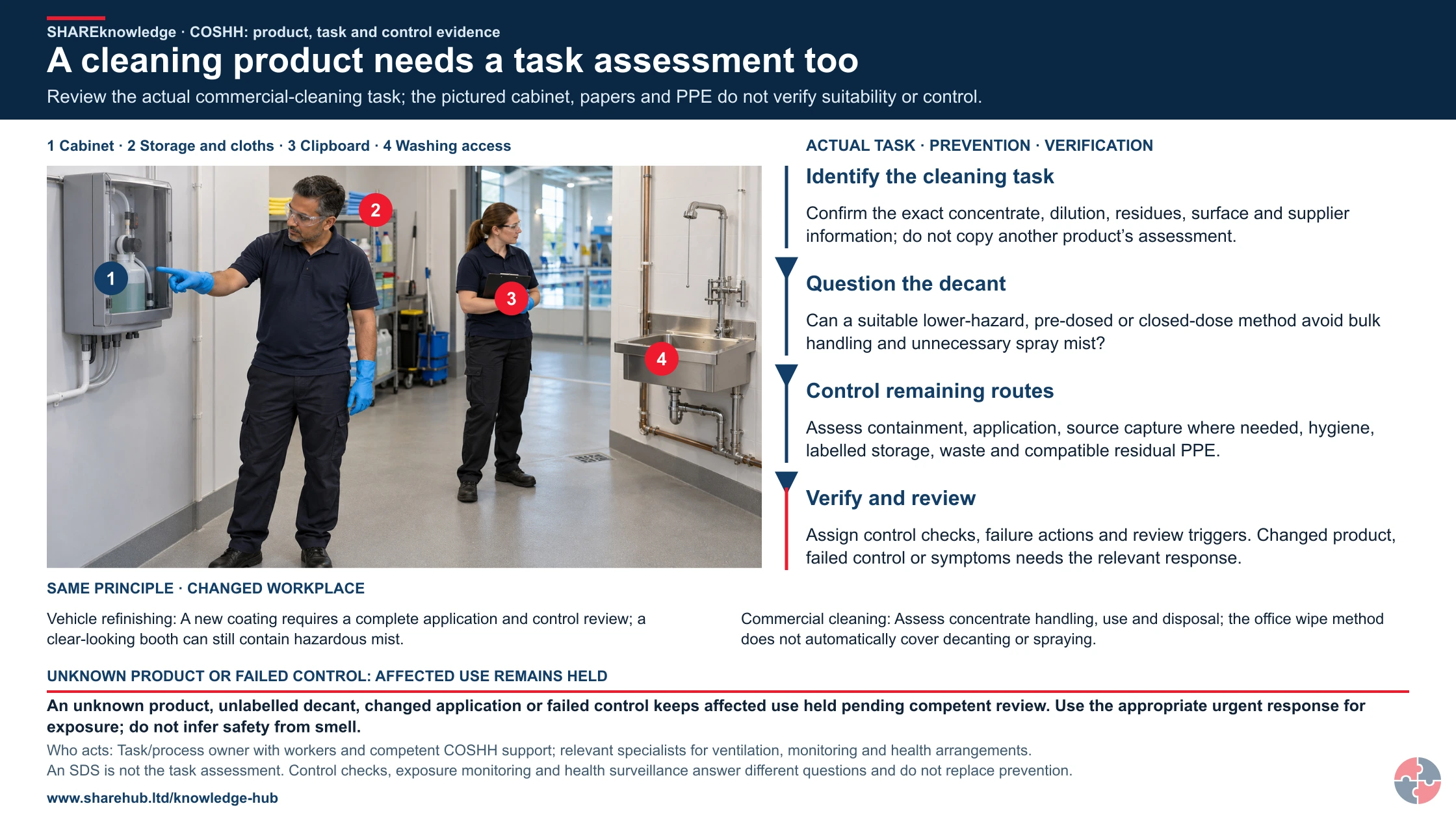
Primary references: HSE: COSHH assessment · HSE: principles of good control practice · HSE: two-pack isocyanate paints
Assess the task, not just the container


Read this visual as text
- The same product can create different exposure routes when stored, wiped, sprayed or spilled. The supplier sheet is an input; the assessment must address the actual method, people, quantities and controls.
- IDENTIFY
- OBSERVE THE TASK
- CONTROL THE ROUTE
For the controlled cleaning task, identify the product and removed contamination, the release during application and disposal, inhalation and skin-contact routes, nearby people and how the assessed controls interrupt exposure. The container label does not establish the task's exposure or the compatibility of gloves or other controls.
These cases are teaching examples, not generic approvals. Local substance identity, process, people, exposure and emergency arrangements still control the decision.
1. Cleaner changed from spray to controlled wipe
Task material and setting: Crownway Fuels Ltd uses a water-based cleaner on control-room desks; the outcome is to avoid unnecessary mist and skin contact.
People and prerequisites: Cleaners, control-room staff and visitors; verify the exact product, current SDS, surface compatibility, ventilation and skin condition concerns.
Before: Check whether cleaning is needed, choose a lower-hazard product and pre-dosed wipe or controlled cloth, brief hygiene and spill steps, and keep food and drink away.
During: Use the small quantity and method assessed; avoid spraying into the breathing zone and remove contaminated cloths to the agreed waste route.
Hold or stop: Wrong product, decanted unlabelled bottle, eye/skin symptoms or unexpected strong vapour: stop, isolate the item and obtain competent advice.
Completion and hand back: Clean the area, remove waste, wash hands, close any incident or product mismatch and restock only the approved product.
Evidence: Product ID, SDS version, task assessment, briefing and closed defect.
2. Welding fume with no product SDS
Task material and setting: A fabricator welds mild steel inside a workshop bay; the outcome is to assess fume generated by the process, not only the metal and gas cylinders.
People and prerequisites: Welder, nearby workers and maintainers; confirm material/coating, method, duration, enclosure, extraction and competent RPE advice.
Before: Remove coatings where safely possible, select a lower-emission process, position suitable LEV and verify airflow; provide suitable RPE for remaining risk.
During: Keep the hood at source, prevent fume spread, supervise technique and maintain segregation.
Hold or stop: Failed or misplaced LEV, visible fume escaping, unknown coating or unavailable required RPE: stop welding and restore the control plan.
Completion and hand back: Shut down safely, inspect extraction, deal with residues, record defects and release the bay only when controls are verified.
Evidence: Task assessment, material/coating information, LEV checks, RPE selection/fit and supervision record.
3. Wet cutting becomes indoor dry cutting
Task material and setting: A contractor proposes dry cutting silica-containing slabs indoors after the water supply fails; the outcome is to prevent an uncontrolled change.
People and prerequisites: Operator, nearby trades, cleaners and occupants; confirm material, silica content, location, work rate, extraction/water method and access control.
Before: Plan off-site or wet cutting where practicable, suitable on-tool extraction where needed, controlled area and a dust-free cleaning method.
During: Use only the authorised method and inspect controls throughout; keep others outside the controlled zone.
Hold or stop: No water or suitable extraction, dry sweeping, visible uncontrolled dust or unknown material: stop and do not accept RPE alone as permission to continue.
Completion and hand back: Clean with the planned dust-control method, verify the area, remove waste safely and update the assessment before any method change.
Evidence: Change record, assessment, control inspection, RPE evidence where needed and hand-back check.
4. Contractor spraying a two-pack isocyanate coating
Task material and setting: A specialist contractor proposes spraying a two-pack coating in a maintenance bay; the outcome is to control a respiratory sensitiser and host-contractor interface.
People and prerequisites: Sprayer, helpers, host workers and anyone who could enter; verify product, process, enclosure, ventilation, RPE, competence, decontamination and surveillance arrangements.
Before: Consider a non-isocyanate or non-spray method, agree enclosure and exclusion, competent air-fed RPE where required, emergency actions and host/contractor responsibilities.
During: Maintain enclosure and pressure/air supply, control entry and follow the defined application and decontamination method.
Hold or stop: Unknown product, failed ventilation or air supply, broken seal, unauthorised entry or respiratory symptoms: stop, evacuate as planned and escalate.
Completion and hand back: Complete curing and clearance criteria, decontaminate equipment, remove waste, close exposure events and hand the bay back under named authority.
Evidence: SDS, task assessment, contractor interface plan, control/RPE records, health-surveillance route and signed hand-back.
5. Unknown liquid in an unlabelled container
Task material and setting: A worker finds an unlabelled liquid in a reused bottle beside a dosing skid; the outcome is safe identification without exposure.
People and prerequisites: Operators, cleaners and maintainers; no one may identify it by smell, colour or informal taste/contact.
Before: Prevent access, check inventory, transfer records, original containers and people who controlled the task; prepare a competent sampling route only if needed.
During: Keep the container secure and compatible while identity and disposal are decided by authorised people.
Hold or stop: Do not use, mix, pour away, sniff or relabel from guesswork; leakage or symptoms triggers the emergency plan.
Completion and hand back: Identify through reliable evidence or dispose through the approved unknown-waste route; correct decanting, labelling and supervision failures.
Evidence: Photograph/location, isolation, investigation, identity evidence or waste note, and corrective action.
6. LEV failure during powder dispensing
Task material and setting: An operator sees powder escaping from a dispensing hood and the airflow indicator is outside its accepted range; the outcome is to prevent continued exposure.
People and prerequisites: Operator, nearby packers and maintenance team; know the accepted indicator condition, shutdown, isolation and spill-cleaning method.
Before: Check hood, indicator, waste level and make-up air before dispensing; stage the correct cleaning equipment and required PPE.
During: Keep the source inside the capture zone and observe emission and indicator condition.
Hold or stop: Escaping dust, alarm, damaged duct or uncertain airflow: stop feed, close or contain safely, restrict access and report; do not dry sweep.
Completion and hand back: Competent maintenance diagnoses and repairs; test function, clean safely and obtain authorised release before restart.
Evidence: Pre-use check, defect and isolation, maintenance, test result, cleaning and restart authority.
7. Spill, splash and worker symptoms
Task material and setting: A hose releases a solvent during transfer and a worker reports dizziness and eye irritation; the outcome is immediate life safety and controlled recovery.
People and prerequisites: Exposed worker, transfer team, responders and people downwind; use the specific emergency plan and current product information.
Before: Confirm alarms, isolation, escape, eyewash, spill kit, trained responders, waste route and emergency-service information before transfer.
During: Raise the alarm, stop transfer remotely if safe, move people to safety and follow first-aid/emergency advice; only trained equipped responders control the spill.
Hold or stop: Do not re-enter, improvise clean-up, diagnose symptoms or continue because a reading appears low; use emergency medical advice for the person.
Completion and hand back: Incident command confirms scene control; competent people verify equipment, contamination, waste and revised controls before hand-back.
Evidence: Timeline, exposure facts, medical/occupational-health referral, spill/waste record, investigation, retest and release.
8. Air result and the wrong averaging period
Task material and setting: Personal samples from a short powder-charging task are compared with an eight-hour limit without considering the task peak; the outcome is a valid interpretation and control decision.
People and prerequisites: Sampled workers and similar exposure groups; an occupational hygienist needs method, task timing, shift pattern, limit notation and control observations.
Before: Define the question and sampling strategy, identify the current EH40 entry and reference period, and record tasks and control state.
During: Observe the work, record changes and protect workers; sampling must not be used to justify visibly uncontrolled release.
Hold or stop: Uncertain identity, wrong analytical method, control failure or result above an applicable limit: reduce exposure immediately and obtain competent interpretation.
Completion and hand back: Communicate results and actions, improve controls, decide whether representative follow-up is needed and update the assessment.
Evidence: Sampling plan, calibration/method, task log, result and uncertainty, interpretation, worker communication and closed action.
How could Crownway Fuels Ltd run its assessment system?

Crownway Fuels Ltd would assess how a maintenance cleaning product is used, who can be exposed and which controls make that particular task acceptable.
Crownway Fuels Ltd · practical example
Assess the actual parts-cleaning job, not just the solvent
The key lesson A safety data sheet describes a product's hazards; a COSHH assessment connects those hazards to real exposure and controls at work.
The situation: A contractor proposes a solvent cleaner for oily pump components at Crownway's depot. The product has a safety data sheet, but the proposed work area is enclosed and other people pass nearby.
Why this matters: Vapour, skin contact, contaminated wipes and nearby ignition sources can create different problems from the same cleaning task.
How Crownway Fuels Ltd would manage it
- Observe the proposed method — Maintenance Coordinator. Define the product, quantity, application, duration, cleaning location and waste route with the contractor. Include people nearby and anyone later handling components or contaminated materials.
- Challenge the product and method — Health and Safety Lead. Use competent advice to consider avoiding the solvent or choosing a demonstrably less hazardous method. Check new risks before accepting substitution, including fire and material compatibility.
- Specify workable controls — Site Manager. Agree the assessed location, containment, ventilation and access arrangements with the relevant specialists. Identify any residual protective equipment and emergency arrangements appropriate to the actual exposure.
- Check the workface — Shift Supervisor. Confirm that the current product and method match the assessment and that required controls are usable. Ask the work party to explain spill reporting and the conditions for stopping.
- Verify the assessment in use — Health and Safety Lead. Review observations and any necessary exposure evidence. Resolve ineffective controls, unexpected symptoms or changed conditions before accepting the method for repeat work.
When the conditions change
- Recognise the trigger
- The cleaner, application method or work location changes.
- Make the immediate decision
- Do not start the affected cleaning until its exposure and fire-control questions are resolved.
- Verify the next step
- The Site Manager checks the reviewed product and cleaning method, ventilation and access controls, waste route and any necessary exposure verification at the workface.
What good looks like
The assessment explains how people could be exposed and shows controls operating during the job. The product sheet remains supporting information rather than the entire decision.
Evidence to look for: Current product information, task assessment, agreed method, control checks, relevant exposure evidence and closed corrective actions.
Common mistake to avoid: Filing the supplier's data sheet as the completed COSHH assessment.
Apply this to your work: Could someone use your assessment to explain how cleaning actually happens and what stops exposure?
Guidance behind the management approach: HSE: carrying out a COSHH assessment. Use the topic's legal and technical guidance for the applicable work and location.
| Gate | Decision | Record |
|---|---|---|
| Select | Can the substance or emission be eliminated, substituted or reduced before purchase/process approval? | Option and substitution decision. |
| Assess | Does the assessment describe exact task/form, routes, people, non-routine work and credible emergencies? | Approved task assessment and current SDS/other evidence. |
| Release | Are engineering controls, hygiene, competence, PPE/RPE and emergency arrangements actually available? | Pre-start check, permit where used and briefing. |
| Verify | What observation, testing, exposure monitoring or health surveillance shows control remains adequate? | LEV/test, sample interpretation, surveillance trend and actions. |
| Change | Has product, supplier, form, quantity, temperature, method, location, people or control changed? | Change hold, reassessment and communication. |
| Hand-back | Is the area clean, waste removed, equipment restored and affected information updated? | As-left check and named release. |
How does this topic align with ISO 45001?
Use these examples to connect the relevant clauses to your own occupational health and safety management system. For each clause, identify the person responsible, the control in use and the evidence that it works.
Scroll across the table to read all four columns.
| ISO 45001 clause | How it applies | What to put in place | How to verify it works |
|---|---|---|---|
| 6.1.2.2 Assessment of health and safety risks | Assess who could be exposed when a hazardous substance is used and how the task creates that exposure. Crownway’s pump-cleaning assessment includes the cleaner, nearby maintenance workers and people passing through the depot. | Review the safety data sheet alongside an observation of the job. Record how use in an enclosed space, skin contact, spill cleanup and waste handling affect the risk before approving the method. | A task assessment links each exposure route to the people affected and the agreed controls. A trial observation confirms that the assessment reflects how the job is actually done. |
| 8.1.2 Hierarchy of controls | The hierarchy of controls guides the choice of cleaning method before staff are asked to rely on protective equipment. | Ask maintenance and purchasing to trial a less hazardous cleaning method. Where solvent use remains necessary, specify suitable containment, ventilation and access controls before selecting protection for residual exposure. | Keep the method-selection record and observe a repeat job to verify that the chosen method works with the parts and the workspace. |
| 9.1.1 Monitoring and evaluating performance | Checking exposure controls during use helps reveal problems a written assessment would miss. | Assign a supervisor to verify the agreed ventilation and work setup at the job. Arrange competent exposure monitoring where the assessment calls for it, and record what should trigger reassessment. | Control checks cover the jobs and people identified in the assessment. Where monitoring or observations reveal a problem, a follow-up check demonstrates that the corrective action works. |
Selected applications of ISO 45001:2018 with Amendment 1:2024. Use the current standard for a full assessment and check the legal duties that apply to the work and location.
ISO 45001:2018 · 2024 climate action amendment · ISO 45002 implementation guidance · ISO technical committee clause FAQ
How does this topic support NEBOSH study and professional development?
For NEBOSH National General Certificate study, this topic links directly to routes of entry, body defences, assessment factors, labels, SDS, monitoring and COSHH control.
Learners should be able to explain how substances enter the body, how the body may be harmed, what information is taken from labels and SDS, why SDS are limited and why a workplace-specific assessment is needed. A strong answer uses examples such as welding fume, silica dust, solvents, cement, isocyanates, cleaning chemicals or biological agents.
Scenario answers should not say only 'complete a COSHH assessment'. They should describe the task, route of entry, workers exposed, frequency, duration, WELs where relevant, existing controls, further controls, training, monitoring, health surveillance and review triggers.
For professional development, the page supports supervisors, safety advisers and managers who need to move beyond paperwork and check whether controls work in the field.
| Study or CPD route | What to understand | Scenario application |
|---|---|---|
| NEBOSH National General Certificate Element 7.2 | Routes of entry, body defences, assessment factors, labels, SDS and monitoring limitations. | Explain how a COSHH assessment controls exposure in a realistic task. |
| Supervisor CPD | How to check controls, recognise weak signals and act on worker concerns. | Challenge missing LEV, poor hygiene, wrong gloves or uncontrolled dust. |
| COSHH assessor development | How to use SDS, WELs, task observation and exposure judgement. | Produce a suitable and sufficient task-based assessment. |
| Occupational hygiene awareness | When monitoring is useful and when specialist advice is needed. | Decide whether exposure data is needed and how results will be used. |
| Occupational health interface | When symptoms, surveillance or biological monitoring should trigger review. | Protect confidentiality while improving exposure control. |
How can management-system themes support assessment of health risks from hazardous substances?
ISO 45001 can strengthen governance, change, procurement, contractor and emergency interfaces, but it is a voluntary management-system standard and does not replace COSHH duties.
The current ISO 45001 edition, amendments and any replacement status require an authorised copy before relying on a clause map. Certification or alignment does not prove that a particular COSHH assessment, exposure control or measurement decision complies with GB or NI law.
The value comes from evidence. A management system should show that hazardous-substance controls are selected before work starts, maintained during work and reviewed after change, monitoring results, symptoms, incidents or audit findings.
| Management-system theme | How it supports the topic | Example evidence |
|---|---|---|
| Context of the organisation / Needs and expectations of workers and interested parties | Identifies high-risk processes, workers, contractors, public interfaces and regulatory expectations. | Chemical risk profile and interested-party review. |
| Organisational roles, responsibilities and authorities | Defines owners for SDS, assessments, controls, monitoring, health surveillance and review. | Role matrix and accountability records. |
| Hazard identification and assessment of OH&S risks and opportunities | Supports identification of substance hazards and exposure routes. | COSHH assessments and exposure pathway review. |
| Competence | Defines competence for workers, supervisors, assessors, LEV users and RPE wearers. | Training matrix, face-fit and competence checks. |
| Communication | Ensures hazards, controls, SDS changes, monitoring results and emergency actions are communicated. | Briefings, signage, SDS access and toolbox talks. |
| Operational planning and control | Controls procurement, storage, use, maintenance, cleaning, waste and contractor work. | Operational procedures, inspections and permit links. |
| Monitoring, measurement, analysis and performance evaluation | Checks exposure monitoring, LEV performance, health surveillance and audit findings. | Monitoring reports, LEV tests and trend analysis. |
| Incident, nonconformity and corrective action | Learns from exposure events, symptoms, spills, high readings, defects and complaints. | Investigation reports, revised assessments and closed actions. |
| Management of change | Supports planned control of product, supplier, quantity, process, temperature, location, workforce and control changes that can invalidate the assessment. | Change request, pre-change COSHH review, commissioning evidence and revised briefing. |
| Procurement, contractors and outsourcing | Connects purchasing and contractor controls to exact substance information, task interfaces and site control standards. | Approved-substance gate, contractor RAMS challenge, SDS/version check and interface record. |
| Emergency preparedness and response | Tests foreseeable releases, exposure events, decontamination, medical information and separate area/person hand-back routes. | Scenario exercise, spill-response capability check, eyewash inspection and corrective actions. |
What official learning shows why hazardous-substance assessment matters?
Official HSE guidance repeatedly shows that health harm can arise when employers miss process-generated substances, rely on generic assessments or fail to verify controls.
HSE COSHH guidance makes clear that a COSHH assessment should consider substances produced by the process, not only labelled hazardous products. That matters for construction dusts, wood dust, welding fume, metalworking mist and many other exposures.
HSE guidance on WELs also makes clear that hazardous-substance control is not simply a paperwork exercise. Employers need to protect workers from dusts, fumes, chemicals, vapours, mists, gases, biological agents and germs, and WELs are only one part of judging adequate control.
The practical learning is consistent: know what is really generated, understand the exposure route, control at source, maintain controls, train people and review whenever evidence suggests the assessment no longer reflects work.
| Learning theme | Why it matters | Management action |
|---|---|---|
| Process-generated exposure | Workers may be harmed by substances not listed in purchasing records. | Observe work and include generated dust, fume, mist and vapour. |
| SDS over-reliance | Supplier information cannot replace task-specific assessment. | Translate SDS into actual use, exposure and controls. |
| Control verification | LEV, RPE and hygiene controls can fail silently. | Use inspection, testing, monitoring and supervision. |
| Worker symptoms | Respiratory or skin symptoms may signal inadequate control. | Investigate early, reduce exposure and use occupational health advice. |
| Maintenance and cleaning | Non-routine tasks often create higher exposure. | Assess filter changes, residues, spill clean-up and waste handling. |
| Review after change | Substance, quantity, method, ventilation or worker group changes can invalidate the assessment. | Use management of change and action tracking. |
What are the warning signs that hazardous substance risks are not being assessed well?
Weak assessment usually shows up as generic paperwork, missing exposure routes, poor controls, symptoms, outdated SDS or unverified monitoring.
The assessment is just the SDS
This means the workplace has not assessed the actual task, exposure route, people or controls.
Generated dust or fume is missing
Cutting, welding, sanding, heating and cleaning may create substances not on a product label.
Workers cannot explain controls
Training or supervision may not be translating the assessment into safe work.
LEV is present but not used correctly
A hood in the wrong position or poor airflow can leave exposure uncontrolled.
RPE has no face-fit evidence
Tight-fitting RPE may not protect the wearer if it has not been fit tested.
Gloves are selected generically
Wrong glove material can allow breakthrough, increase skin exposure or create false confidence.
Monitoring results are filed away
Exposure data only has value if interpreted and used to improve controls.
Skin, breathing or eye symptoms are normalised
Symptoms should trigger investigation, exposure review and health advice.
Contractor substances are unmanaged
Host workers may be exposed to products or process hazards they were not briefed about.
Assessments do not change after process changes
Changed quantities, methods, ventilation or workers can invalidate old assumptions.
Chemical hazard symbols: what do they mean?
Exploding bomb
Explosive, self-reactive or organic peroxide hazards.
Flame
Flammable, self-heating or pyrophoric substances.
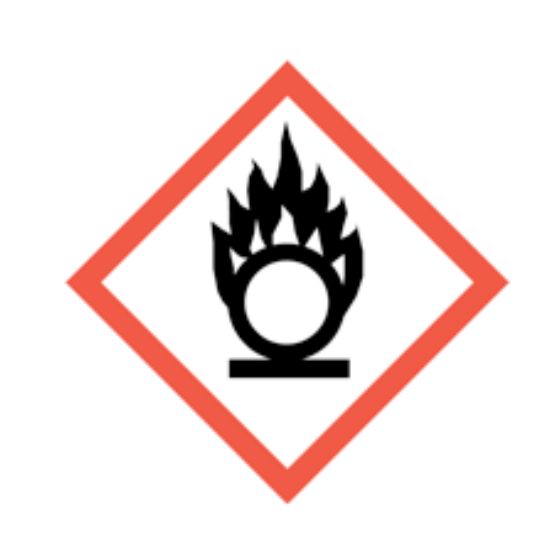
Flame over circle
Oxidising substances that can intensify fire.

Gas cylinder
Gas under pressure.
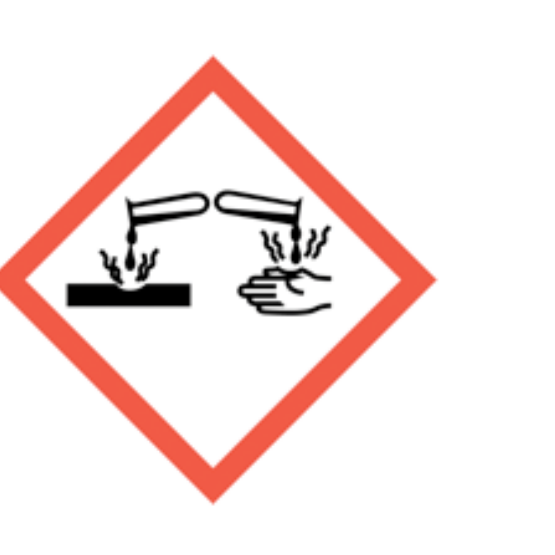
Corrosion
Skin burns, eye damage or corrosive to metals.
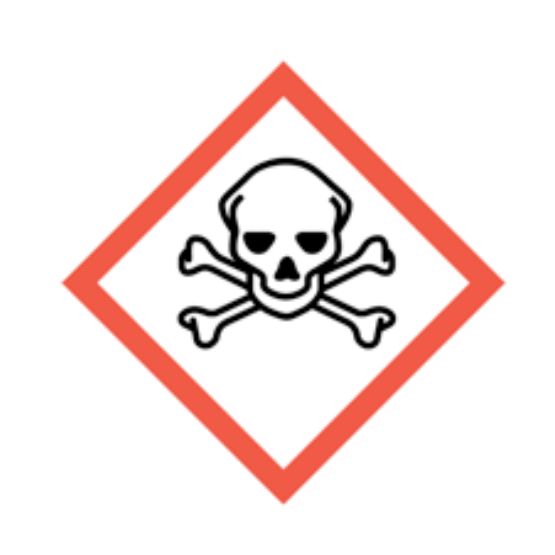
Skull and crossbones
Acute toxicity.
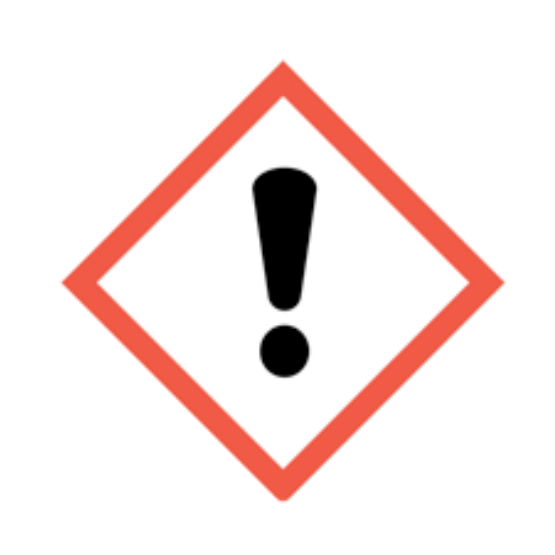
Exclamation mark
Irritation, harmful effects or skin sensitisation; some classifications cover drowsiness, dizziness or ozone-layer hazard. Read the actual hazard statements. Skin sensitisation differs from respiratory sensitisation.
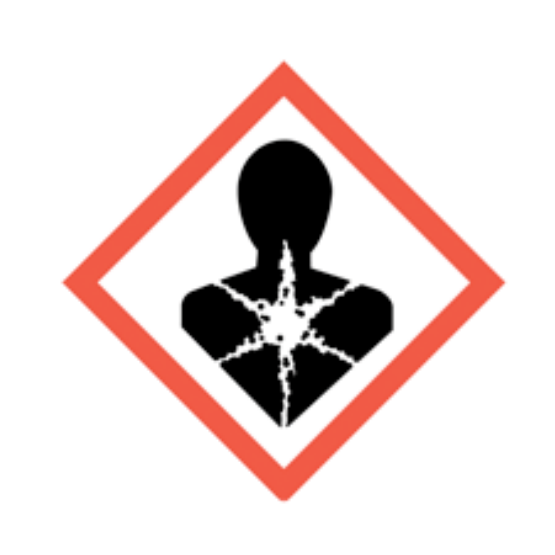
Health hazard
Serious health hazards, including organ damage, aspiration hazard, respiratory sensitisation, cancer and reproductive effects; some can follow a single exposure.
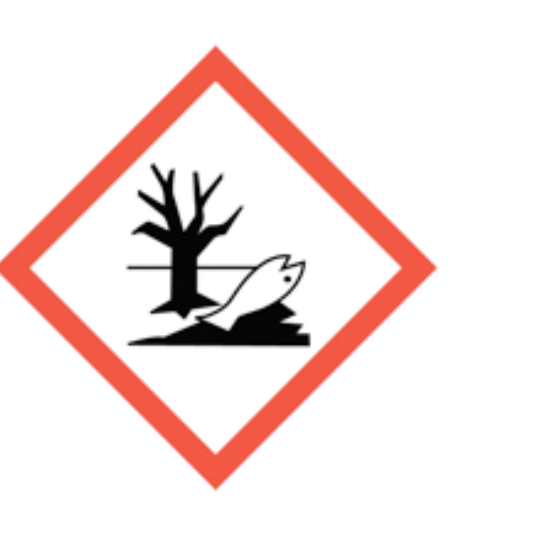
Environment
Hazardous to the aquatic environment.
Standards named on this page are background context. Confirm the current edition, scope and exact requirements from an authorised copy before applying them. The open official sources below support the specific public-law and regulator guidance claims they are cited for.
What do the acronyms and key terms mean?
Acronyms should be defined so readers can follow COSHH, exposure and health surveillance information.
| Acronym or term | Full wording | Meaning in this topic |
|---|---|---|
| COSHH | Control of Substances Hazardous to Health | Main GB framework for assessing and controlling hazardous substances. |
| SDS | Safety Data Sheet | Supplier document giving hazard, handling, exposure and emergency information. |
| CLP | Classification, Labelling and Packaging | Chemical classification and labelling system that supports hazard communication. |
| REACH | Registration, Evaluation, Authorisation and Restriction of Chemicals | Chemical supply-chain framework relevant to substance information and restrictions. |
| WEL | Workplace Exposure Limit | Airborne occupational exposure limit published in EH40. |
| EH40 | Workplace exposure limits publication | HSE publication listing current GB WELs. |
| LEV | Local Exhaust Ventilation | Engineering control that captures airborne contaminants near source. |
| RPE | Respiratory Protective Equipment | Respiratory equipment used where inhalation exposure remains. |
| PPE | Personal Protective Equipment | Protective equipment such as gloves, eye protection, coveralls or RPE. |
| ALARP | As Low As Reasonably Practicable | Control principle especially important for carcinogens, mutagens and asthmagens. |
| GHS | Globally Harmonized System | International basis for hazard classification and pictograms. |
| OEL | Occupational Exposure Limit | General term for exposure limits; WEL is the GB term used by HSE. |