SHARE Knowledge Hub
Assembly and muster points
An assembly or muster point is a planned place of safety where evacuees report after following a safe route. Choose and test it against the actual emergency, occupancy and site layout; account for everyone, tell responders promptly about anyone unaccounted for, and move people if the point becomes unsafe. Never re-enter to search.
Understanding Assembly and muster points
An assembly or muster point is a managed destination within an emergency arrangement, not merely a sign in a car park. It gives people a known place to move to, enables reliable accounting and communication, keeps evacuees away from response routes and supports an accurate briefing to emergency services. The correct location and behaviour depend on the incident: the safest fire assembly point may be unsafe during a toxic release, explosion, flood or hostile attack. Every site therefore needs a scenario-based strategy rather than one instruction applied to every alarm.
Why this matters at work
Choose destinations from credible incident consequences, not convenience. Fire may produce smoke, radiant heat, structural debris and firefighting streams. Flammable releases may travel, ignite or explode. Toxic substances may form a plume whose direction changes with wind and terrain. Flooding may isolate low ground. Structural failure can create debris zones. Security threats may make a familiar assembly area predictable and exposed. The assessment must connect each scenario to an alarm and protective action.
Evacuation can create burns, smoke exposure, slips, falls, panic, exertional illness and trauma. First-aid arrangements should remain accessible outside the incident area, with a route for ambulance access and casualty transfer. Triage and treatment take priority over roll-call administration; record that a casualty has moved so they are not also reported missing.
How organisations manage this in practice
Traffic controls should stop routine movements, keep emergency lanes clear and prevent departing vehicles from mixing with pedestrians. Drivers may be in cabs, yards, rest areas or loading bays and should receive the alarm. A vehicle gate may need to remain closed to outbound staff while opening for emergency services; these actions require defined authority and communication.
Organise large populations into identifiable zones or teams while preserving route width and visibility. Supervisors should know where to report numbers, and people should not crowd around the coordinator or sign. Avoid queues that extend into roads or back toward the incident. Where public evacuation is possible, plan steward deployment, accessible movement, reunification and communications rather than attempting an employee-style named roll call for an unknown crowd.
Inspect external routes, gates, signs, lighting, surfaces, barriers, alarm coverage, communication equipment, muster aids and responder information at a frequency proportionate to deterioration and change. Operational checks may be daily in a changing construction site or yard and less frequent in stable premises, supplemented by formal maintenance. Defects that defeat escape or accounting need immediate interim control.
If the assigned exit or assembly point is threatened by smoke, fire, traffic, a release or another hazard, use the safe alternative in the emergency plan or follow the incident controller and emergency services. Tell the controller if someone may be missing; never re-enter to look for them.
What is the scope of this guidance?
Use this page to plan and check the link between escape, a safe gathering place and reliable accounting. The actual fire strategy and emergency plan for the premises control the response.
There is no universal legal distance, location, headcount method or drill interval that makes every assembly point safe. Fire, toxic release, explosion, security threats and flooding can call for different actions, including moving to an alternative area or following a shelter strategy. Do not send people to a known unsafe point simply because it is marked on an old plan. Complex, high-hazard, healthcare, offshore and residential settings need their own competent arrangements.
Plan for accounting and a changing place of safety
A muster point is only useful while it remains a suitable place of safety for the incident. Assess the credible hazard footprint, safe route, assisted movement, traffic and responder access. No generic distance or blanket upwind instruction can replace that assessment.
Best-practice guide: Assembly and muster points
Plan for accounting and a changing place of safety
A muster point is only useful while it remains a suitable place of safety for the incident. Assess the credible hazard footprint, safe route, assisted movement, traffic and responder access. An assembly or muster point is a planned place of safety where evacuees report after following a safe route.
Turn assembly and muster points knowledge into a decision
An assembly or muster point is a planned place of safety where evacuees report after following a safe route. Choose and test it against the actual emergency, occupancy and site layout; account for everyone, tell responders promptly about anyone unaccounted for, and move people if the point becomes unsafe. Risk assessment, current plan, register, drill or event log.
Routine office evacuation
Use safe exit, report to team/host counter, consolidate roll-call. Controller briefs responders; authorised re-entry only after hazard and count are resolved.
Keep people away from the developing emergency
An unclear alarm response or obstructed route can delay evacuation. A muster point near smoke, traffic or emergency access can expose evacuees. Poor accounting can leave the incident controller uncertain who may still be inside. Use the full topic for the detailed mechanism, task limits and source scope.
Choose controls for assembly and muster points
Eliminate: Remove unsuitable assembly points and avoid routes through higher-risk areas. Reduce: Reduce route complexity, number of decision points and crowding at exits. Isolate: Separate evacuees from vehicles, hazardous substances, smoke, collapse zones and emergency access routes. Control: Use alarms, signage, emergency lighting, wardens, headcount systems, plans and drills; check radios, torches and spare batteries as communication and incident equipment. PPE: Provide suitable high-visibility and protective weather clothing only where the risk assessment requires it. Read the full control table for qualifications, ownership and verification. Use the actual task and applicable jurisdiction; existing technical approval remains unchanged.
Use the full assembly and muster points lesson
Use the full topic for the decision points, practical examples, detailed control tables and source scope. HSE guidance applies to Great Britain; use HSENI for the Northern Ireland route and the source’s stated jurisdiction. A simplified guide does not change the page’s technical-review or approval status.

Read all six steps as text
1. Plan for accounting and a changing place of safety
A muster point is only useful while it remains a suitable place of safety for the incident.
- Avoid / redesign: Remove unsuitable assembly points and avoid routes through higher-risk areas.
- Control the task: Separate evacuees from vehicles, hazardous substances, smoke, collapse zones and emergency access routes.
- Verify before release: Updated site plan and retired obsolete signs.
A muster point is only useful while it remains a suitable place of safety for the incident. Assess the credible hazard footprint, safe route, assisted movement, traffic and responder access. An assembly or muster point is a planned place of safety where evacuees report after following a safe route.
Apply it: Which part of this plan would you check at the workface before authorising the task?
2. Turn assembly and muster points knowledge into a decision
Use the evidence to improve the actual work arrangement.
- Change at source: Remove unsuitable assembly points and avoid routes through higher-risk areas.
- Make it observable: Updated site plan and retired obsolete signs.
- Keep useful evidence: Risk assessment, current plan, register, drill or event log.
An assembly or muster point is a planned place of safety where evacuees report after following a safe route. Choose and test it against the actual emergency, occupancy and site layout; account for everyone, tell responders promptly about anyone unaccounted for, and move people if the point becomes unsafe. Risk assessment, current plan, register, drill or event log.
Apply it: What evidence would show that the change improves this task, rather than only completing a record?
3. Routine office evacuation
Example: a practical application of the existing topic lesson.
- Setting: Office fire alarm during a normal working day.
- Act: Check exits, point, occupancy and host briefing before work.
- Hold / review: Hold if route or point is smoke-affected or a visitor is unresolved.
Use safe exit, report to team/host counter, consolidate roll-call. Controller briefs responders; authorised re-entry only after hazard and count are resolved.
Apply it: At which point would you hold this example, and what evidence would allow it to proceed?
4. Keep people away from the developing emergency
Connect the task, the route to the person and the control that can fail.
- Delay: An unclear alarm response or obstructed route can delay evacuation.
- Wrong location: A muster point near smoke, traffic or emergency access can expose evacuees.
- Missing information: Poor accounting can leave the incident controller uncertain who may still be inside.
An unclear alarm response or obstructed route can delay evacuation. A muster point near smoke, traffic or emergency access can expose evacuees. Poor accounting can leave the incident controller uncertain who may still be inside. Use the full topic for the detailed mechanism, task limits and source scope.
Apply it: Where is this harm route present in the actual work, and which control breaks it before anyone is exposed?
5. Choose controls for assembly and muster points
Start with the stronger practicable options and verify their effect.
- Eliminate: Remove unsuitable assembly points and avoid routes through higher-risk areas.
- Reduce: Reduce route complexity, number of decision points and crowding at exits.
- Isolate: Separate evacuees from vehicles, hazardous substances, smoke, collapse zones and emergency access routes.
- Control: Use alarms, signage, emergency lighting, wardens, headcount systems, plans and drills; check radios, torches and spare batteries as communication and incident equipment.
- PPE: Provide suitable high-visibility and protective weather clothing only where the risk assessment requires it.
Eliminate: Remove unsuitable assembly points and avoid routes through higher-risk areas. Reduce: Reduce route complexity, number of decision points and crowding at exits. Isolate: Separate evacuees from vehicles, hazardous substances, smoke, collapse zones and emergency access routes. Control: Use alarms, signage, emergency lighting, wardens, headcount systems, plans and drills; check radios, torches and spare batteries as communication and incident equipment. PPE: Provide suitable high-visibility and protective weather clothing only where the risk assessment requires it. Read the full control table for qualifications, ownership and verification. Use the actual task and applicable jurisdiction; existing technical approval remains unchanged.
Apply it: Which stronger option can be used here, and who will verify it before accepting the remaining risk?
6. Use the full assembly and muster points lesson
Follow the official sources below and retain the task-specific evidence.
- Official guidance: HSE emergency procedures (Current web guidance)
- Official guidance: HSE planning for incidents and emergencies at events (Current web guidance)
- Task decision: Risk assessment, current plan, register, drill or event log.
Use the full topic for the decision points, practical examples, detailed control tables and source scope. HSE guidance applies to Great Britain; use HSENI for the Northern Ireland route and the source’s stated jurisdiction. A simplified guide does not change the page’s technical-review or approval status.
Apply it: Which official source and full-topic section will you use to resolve the next decision?
During an incident, reconcile the people actually present and pass missing-person information to the proper command route. A drill should reveal uncertain occupancy and alternate-location decisions, not just measure the time taken by familiar staff to reach a sign.
The contractor is missing at shift overlap
Illustrative example. A drill at shift change finds that a visiting contractor is not included in either team count and the primary gathering area is obstructed.
Decision. Use the command/accounting arrangement and the planned alternate location; escalate the missing-person facts without untrained re-entry.
Evidence to check. Compare sign-in/out, shift occupancy, zone reports, assistance arrangements and the time/location last known.
Hold or escalation point. No all-clear based on the staff list alone, and no worker sent back to look.
Follow-up. Correct contractor accounting and alternate-route arrangements, then rehearse with representative occupancy.
Who does what before and during an evacuation?
The dutyholder owns the plan; each person follows the safe route; nominated staff coordinate assisted escape, accounting and the responder briefing without putting themselves in danger.
| Role | Before alarm | On alarm and evidence |
|---|---|---|
| Worker or visitor | Know alarm, safe exits, assigned point and reporting method. | Leave by a safe route, report in and give accurate information; induction or visitor brief. |
| Warden or trained helper | Know assigned area, personal limits and any assisted-escape task. | Guide or check only where safe; report status and unresolved locations; role briefing and drill record. |
| Supervisor or contractor lead | Maintain current team and work-area information, including shift changes. | Account for the team, reconcile absences and tell incident control about uncertainty; live roster. |
| Reception, security or host | Maintain visitor, driver and contractor sign-in/out and a usable backup. | Confirm who may be present, account for visitors and relay last-known details; access log. |
| Incident controller or deputy | Know site plan, alternatives, communications and emergency-service contact. | Combine reports, move people if conditions change and brief responders; event log. |
| Dutyholder, facilities or organiser | Assess hazards, routes, capacity, accessibility and neighbouring occupiers. | Keep plan, signs, gates, equipment and drills current; risk assessment and action tracker. |
Where does the local emergency plan take priority?
The local, competent fire and emergency plan must decide routes, evacuation strategy, safe area and who controls the incident; generic advice cannot override it.
Some buildings use staged or progressive evacuation, refuges or an assessed evacuation lift. A refuge is not automatically the final place of safety, and a standard passenger lift is not a default fire escape. The plan must say who supports each person and how the final safe destination is reached. The organisation cannot assume the fire and rescue service will make an incomplete assisted-escape plan work.
Review the plan when occupancy, tenants, works, hazards or exits change. Coordinate with other occupiers and responders where relevant. If the site is in danger and the documented point is compromised, use the assessed alternative or the emergency controller's safe instructions; call 999 for an actual emergency. No worker or warden should enter smoke or re-enter a danger area to confirm a count.
What are the key facts about assembly and muster points?
The key fact is that assembly points must help people get away from danger and allow reliable accounting after evacuation.
A sign is not enough
The assembly point must be connected to routes, alarms, lighting, wardens, accounting and emergency command.
A place of safety is the aim
The point should be outside or beyond the danger area, not trapped in a courtyard, smoke path, collapse zone or traffic route.
Capacity matters
The area should cope with the maximum likely population, including staff, visitors, contractors, public, shift overlap and vulnerable people.
Accounting must be planned
Roll-call, sign-in systems, visitor logs, contractor registers and lone-worker checks need clear ownership before the alarm sounds.
Secondary points may be needed
Fire, smoke, wind direction, chemical release, bomb threat, flooding or emergency vehicle routes can make the primary point unsafe.
Drills create evidence
Evacuation drills should test routes, timing, communication, vulnerable-person arrangements, headcount and improvement actions.
What are assembly and muster points?
Assembly and muster points are pre-planned safe gathering locations used after evacuation or emergency movement.
The term assembly point is common in offices, schools, shops and public premises. Muster point is often used on construction sites, process sites, offshore installations, vessels and high-hazard workplaces. Both terms describe a controlled gathering location where people can be kept out of harm's way and accounted for.
The assembly point is part of the emergency plan. It should be selected through risk assessment, shown on plans or fire action notices, explained during induction, tested in drills and reviewed after changes. It should not be selected because it is convenient for management or because a sign happens to fit there.
A robust arrangement also covers what happens at the point: who takes charge, who reports in, how visitors are accounted for, where people stand, how vulnerable people are supported, who speaks to emergency services, when people move to a secondary point and who gives the all-clear.
| Term | Meaning | Practical use |
|---|---|---|
| Assembly point | Designated location where evacuees gather after leaving the premises or work area. | Common in workplaces, schools, shops, offices and public premises. |
| Muster point | Designated location where personnel muster for accounting and instruction. | Common in construction, industrial, offshore and major-hazard settings. |
| Place of safety | A location away from immediate danger where people are no longer exposed to the emergency. | The key test for whether the selected point is suitable. |
| Place of relative safety | A safer intermediate location, such as another compartment, refuge or protected area. | May be used in staged evacuation or for people needing assistance. |
| Place of total or ultimate safety | A final safe location away from the building or hazard. | The destination for full evacuation where people are clear of continuing risk. |
| Secondary assembly point | Alternative point used if the primary point is unsafe or inaccessible. | Important for wind direction, smoke, chemical release, security threat or site changes. |
What makes an assembly point a real place of safety?
A real place of safety keeps people away from the foreseeable consequences of the emergency and allows them to be managed without creating new risks.
The place of safety test should be scenario-led. A point that is safe for a small kitchen fire may be unsafe for a warehouse fire, gas-cylinder event, construction-site fire, chemical release, bomb threat, flood or structural collapse. The risk assessment should ask what could happen, how far the effects could travel and whether the assembly point remains safe.
Distance from the building is only one factor. The point may also need to be clear of smoke travel, falling glass, cladding or scaffold collapse, flammable stores, LPG cages, bulk tanks, traffic routes, overhead power lines, unstable ground, flood paths and emergency-service access. It should also be practical in darkness, bad weather and high occupancy.
The point should not block fire appliances, ambulance access, hydrants, gates, delivery routes or site entrances. People standing in the route of emergency vehicles may be safer than inside the building, but they are not being well managed.
| Check | What to consider | Why it matters |
|---|---|---|
| Fire and smoke | Wind direction, smoke paths, heat, flame spread, openings and likely fire growth. | People may be exposed outside if the point is too close or downwind. |
| Collapse and falling material | Glass, masonry, scaffolds, cladding, roof materials, temporary works and stored items. | Evacuees should not wait inside a collapse or debris zone. |
| Dangerous substances | LPG, fuel, chemicals, gas cylinders, aerosols, dusts, oxidisers or process materials. | Explosion, toxic cloud or escalation can require greater separation or upwind muster. |
| Emergency access | Fire engines, ambulances, hydrants, gates, turning areas and incident-command locations. | The assembly point must not obstruct responders. |
| Traffic and plant | Roadways, yard traffic, reversing areas, forklift routes, public roads and car parks. | Evacuees can be struck by vehicles if the point or route is poorly placed. |
| Ground and weather | Slopes, ice, mud, flooding, lighting, shelter and crowd control. | People need to reach and remain at the point safely. |
| Population | Visitors, contractors, public, children, disabled people, shift workers and lone workers. | The point must serve everyone who could be on site. |
How should a safe assembly location be chosen?
Test each candidate against foreseeable incident effects, a usable route, maximum occupancy, accessible movement, responder access and the ability to account for people.
The fire risk assessment and emergency plan should identify what could make the place unsafe: smoke or heat travel, falling materials, explosion or toxic plume, active vehicles, crowding, weather, flooding or a secondary incident. One point may suffice; several zones or a different accounting method may be needed. Do not adopt a fixed number of metres or an area-per-person rule from an earlier document. A point across a live road may be less safe than a closer, protected and controlled area.
| Question | Accept only when | Hold or redesign when |
|---|---|---|
| Hazard envelope | The area stays outside credible fire, smoke, debris, release and vehicle effects for the scenario. | Effects or wind are uncertain, or the point lies in a potential danger area. |
| Route | People can reach it through clear, usable exits and controlled pedestrian movement. | A gate is locked, a road crossing is uncontrolled, or the route returns toward the hazard. |
| People | Peak occupants, visitors, contractors and assisted evacuees can gather and be counted. | Crowding blocks escape or people needing assistance cannot reach and use the area. |
| Response | The gathering area leaves responder access, hydrants and incident control free. | Crowds would obstruct appliances, ambulance movement or technical response. |
| Alternative | The plan identifies a viable way to relocate or disperse and keep accounting intact. | A single blocked or smoke-affected point leaves no safe response. |
How should site layout, routes and capacity be designed?
The layout should move people from final exits to safe gathering zones without blocking emergency access or creating crowd, traffic or weather risks.
Assembly arrangements should be shown on a simple site plan. The plan should identify buildings, exits, evacuation routes, assembly points, secondary points, vehicle routes, emergency access, hazardous stores, first-aid points, incident-control location and any areas where people must not gather.
Capacity should be based on the real maximum number of people, not the usual number. Include peak shifts, visitors, contractors, public events, training days, deliveries, cleaners, security, out-of-hours work and simultaneous occupants of shared buildings.
On construction sites, the layout is dynamic. Muster points may need to move as hoarding, scaffolds, cranes, cabins, excavations, hot works, temporary electrics, fuel stores and access gates change. The construction phase plan and site induction should stay aligned with the current layout.
| Design issue | What good looks like | Failure to avoid |
|---|---|---|
| Final exits | Final exits discharge to clear routes that lead away from danger. | People leave one door then wait directly beside the building. |
| Pedestrian routes | Routes avoid vehicle movement, plant operation, loading bays and public-road danger. | Evacuees cross active traffic routes without control. |
| Emergency vehicles | Assembly areas do not block fire appliances, ambulances, gates, hydrants or command points. | Crowds gather where responders need to work. |
| Crowd density | The area is large enough and can be divided by team, class, tenant, contractor or zone. | People bunch around the sign and block routes. |
| Environmental conditions | The route and point are usable in darkness, rain, snow, heat or poor visibility. | No lighting, muddy ground or slippery surfaces during drills. |
| Shared premises | Different occupiers' arrangements are coordinated. | Two businesses use the same small point without knowing total numbers. |
| Changing sites | Muster arrangements are reviewed after layout, phase or hazard changes. | Old induction maps show a point now inside the works area. |
How should assembly point signage and notices be managed?
Signs should make the route and destination obvious without relying on people remembering a verbal briefing under stress.
Assembly point signs normally use the green safe-condition style with a group-of-people symbol and directional arrows where needed. The precise sign choice should match the site and applicable sign standards, but the practical requirement is clarity: people should understand where to go even if they are visitors, contractors or new starters.
Directional signs are needed where the assembly point is not immediately visible from the exit or where several points exist. Fire action notices should identify the evacuation instruction and assembly location. On construction sites or events, temporary signs should move as the site changes and remain visible above plant, materials, hoarding and crowds.
Too many signs can create confusion. The best sign system is simple, consistent, visible, maintained and supported by induction and drills.
| Sign or notice | Purpose | Checks |
|---|---|---|
| Assembly point sign | Identifies the destination where people should gather. | Visible, correct location, not obstructed, weather-resistant and lit where needed. |
| Directional sign | Guides people along a route to the assembly point. | Placed at decision points and updated when routes change. |
| Fire action notice | Tells people what to do when the alarm sounds and where to report. | Plain language, current location and consistent with induction. |
| Site plan | Shows exits, routes, muster points and emergency access. | Current version displayed and used in briefings. |
| Zone or team markers | Helps headcount for large sites, schools, events or multi-tenant premises. | Teams know where to stand and who counts them. |
| Temporary signage | Supports changing construction, event or maintenance layouts. | Reviewed after layout changes and removed when obsolete. |
| Lighting and visibility | Makes the route and sign usable in darkness or poor visibility. | Emergency lighting, floodlighting and reflective/photoluminescent provision where needed. |
What should people do when evacuation is ordered?
Act on the alarm or instruction, leave by a safe route, report at the assigned safe area and stay available for accounting and further instruction.
Is the Assigned Point Still Safe
Two linked parts · 6 questions. Open Part 2 to complete the route.

Continue to questions 4–6 · Part 2 of 2


Read this visual as text
- Start: An alarm or evacuation instruction has been raised.
- Question 1: Is the assigned exit and route usable? Decision owner: Incident controller / evacuation coordinator.
- YES: The required evidence or condition is confirmed. CONTINUE → QUESTION 2.
- NO / UNKNOWN — HOLD: Use the planned safe alternative and tell incident control; do not pass through smoke or live traffic. HOLD → REPEAT QUESTION 1 AFTER CORRECTION.
- Question 2: Is the primary point clear of smoke, releases, traffic and responder conflict? Decision owner: Incident controller / evacuation coordinator.
- YES: The required evidence or condition is confirmed. CONTINUE → QUESTION 3.
- NO / UNKNOWN — HOLD: Stop directing people there and activate the assessed alternative or responder direction. HOLD → REPEAT QUESTION 2 AFTER CORRECTION.
- Question 3: Is the alternative route and gathering area also safe and accessible? Decision owner: Incident controller / evacuation coordinator.
- YES: The required evidence or condition is confirmed. CONTINUE → QUESTION 4.
- NO / UNKNOWN — HOLD: Hold unsafe movement and seek control/responder direction rather than improvising. HOLD → REPEAT QUESTION 3 AFTER CORRECTION.
- Question 4: Report in and keep together Decision owner: Incident controller / evacuation coordinator.
- ACTION: Tell the controller the destination, team and any assistance or missing-person facts. CONTINUE → QUESTION 5.
- Question 5: Has a new count been completed after relocation? Decision owner: Incident controller / evacuation coordinator.
- YES: The required evidence or condition is confirmed. CONTINUE → QUESTION 6.
- NO / UNKNOWN — HOLD: Reconcile people again; the previous count does not cover a changed location. HOLD → REPEAT QUESTION 5 AFTER CORRECTION.
- Question 6: Wait for authorised instructions Decision owner: Incident controller / evacuation coordinator.
- ACTION: Maintain accountability and do not re-enter without the incident command decision. OUTCOME → RECORD AND HAND OVER.
- Outcome: People reach and report at a safe area, or control holds movement and seeks responder/specialist direction while maintaining accountability.
- Stop and escalation boundary: Stop sending people to a known unsafe area. Do not improvise through smoke or a live vehicle route. Call 999 for an actual emergency and escalate missing persons.
Stop work immediately. Only perform a pre-planned, trained make-safe action if it will not delay escape. Do not collect belongings or assume the alarm is false. Use the local plan for staged evacuation, refuges and any assessed evacuation lift. If a route is blocked by smoke, fire or another danger, take the planned safe alternative; raise the alarm and tell the controller what failed.
At the point, report to the named counter or zone, keep access clear and tell someone before leaving or moving. A warden may check an assigned area only within the safe limits of the plan; they do not perform rescue in a dangerous atmosphere. Do not re-enter or resume work until the authorised decision is communicated and serious danger has ended.
| Stage | Action | Stop or escalation |
|---|---|---|
| Alarm | Stop work and use the safe exit in the local plan. | Unsafe exit, unclear alarm or missing assistance: alert control and use the safe alternative. |
| Travel | Keep moving away from the hazard without obstructing others or responders. | Smoke, moving plant or blocked gate: change route under plan and report the defect. |
| Arrival | Report in at the correct zone and keep access clear. | Unsafe point: relocate under controller direction and preserve accounting. |
| Control | Pass missing-person and hazard facts to the controller and responders. | Never re-enter to search or treat an uncertain count as complete. |
| Hand-back | Wait for authorised re-entry, relocation or dismissal instruction. | No restart while serious danger, damaged route or unresolved person remains. |
How should roll-call and missing-person escalation work?
Compare a live list of people who may be present with actual reports from each zone, promptly tell the incident controller what is unresolved, and give responders the best known facts without a search re-entry.
Signing in is not the same as accounting for everyone


Read this visual as text
- EXPECTED PEOPLE: Use current attendance and visitor information while recognising gaps or stale records.
- CONFIRMED SAFE: Record people actually accounted for at a safe location or through a reliable agreed route.
- UNACCOUNTED: Give responders the name, last known location and relevant facts; do not send colleagues back inside.
Reconcile and Escalate a Missing Person
Two linked parts · 6 questions. Open Part 2 to complete the route.

Continue to questions 4–6 · Part 2 of 2


Read this visual as text
- Start: Evacuees have reached one or more safe areas but the first count is incomplete.
- Question 1: Is the expected-person list current for workers, contractors, visitors and drivers? Decision owner: Incident controller / evacuation coordinator.
- YES: The required evidence or condition is confirmed. CONTINUE → QUESTION 2.
- NO / UNKNOWN — HOLD: Check attendance, departures and shift changes; keep uncertain names unresolved. HOLD → REPEAT QUESTION 1 AFTER CORRECTION.
- Question 2: Who is physically confirmed safe at each location? Decision owner: Incident controller / evacuation coordinator.
- YES: The required evidence or condition is confirmed. CONTINUE → QUESTION 3.
- NO / UNKNOWN — HOLD: Team leads give reliable reports to one controller; a sign-in entry is not safe confirmation. HOLD → REPEAT QUESTION 2 AFTER CORRECTION.
- Question 3: Have other muster points, vehicle locations and signed-out facts been reconciled? Decision owner: Incident controller / evacuation coordinator.
- YES: The required evidence or condition is confirmed. CONTINUE → QUESTION 4.
- NO / UNKNOWN — HOLD: Check reliable information without delaying responder briefing. HOLD → REPEAT QUESTION 3 AFTER CORRECTION.
- Question 4: Does anyone remain unaccounted for? Decision owner: Incident controller / evacuation coordinator.
- YES — STOP / REFER: Tell responders immediately with name, last reliable location, hazards and assistance needs. Nobody re-enters to search. STOP / REFER → APPROPRIATE RESPONSE.
- NO: No such warning is identified; continue the remaining checks. CONTINUE → QUESTION 5.
- UNKNOWN — PROTECT FIRST: Protect people and hold the affected work. Obtain the responsible specialist’s assessment; do not assume the warning is absent. HOLD → OWNER RESOLVES BEFORE RESUMING.
- Question 5: Update the event log Decision owner: Incident controller / evacuation coordinator.
- ACTION: Keep confirmed, unresolved and later corrected information distinct. CONTINUE → QUESTION 6.
- Question 6: Has any relocation or late safe report been passed to the controller? Decision owner: Incident controller / evacuation coordinator.
- YES: The required evidence or condition is confirmed. OUTCOME → RECORD AND HAND OVER.
- NO / UNKNOWN — HOLD: Recount and update responders promptly; do not leave an old missing-person status uncorrected. HOLD → REPEAT QUESTION 6 AFTER CORRECTION.
- Outcome: Named people confirmed safe or recorded as unresolved with last-known facts passed to responders; update the event log and any later relocation count.
- Stop and escalation boundary: Never send a worker or warden back into danger; never delay responder briefing while a digital list is reconciled; never call an uncertain count complete.
Combine staff rota, visitors, contractors, drivers, lone-worker check-ins and shift handover. A badge or tablet is not proof of physical presence or safe exit by itself; use a manual fallback and reconcile people who signed out, changed shifts or moved between areas. Each team or contractor lead should report a count and named exceptions to one controller. Record uncertainty instead of announcing an all-clear from an incomplete list.
For an unaccounted-for person, record name or description, last confirmed location and time, task, possible alternate exit and any known assistance need relevant to rescue. Pass this to the fire and rescue service or other responders promptly. Protect sensitive information; share only what is necessary for safety. Do not send staff back into the hazard.
| Check | If confirmed | If uncertain |
|---|---|---|
| Who was present? | Use current roster and sign-in/out data, including shift overlap and visitors. | Mark presence unknown and check host, security, supervisor and exit records. |
| Who is safe? | Named zone leads report people physically present or confirmed off site. | Do not infer safety from a badge scan, a vehicle absence or no reply. |
| Who remains unresolved? | Controller records names and last-known facts and briefs responders. | Escalate immediately; no worker re-entry or delayed 999 call. |
| People move again? | Recount at the alternative area and update controller. | Treat relocation as a new accounting event, not an automatic all-clear. |
Move the group without losing the count
A change of assembly point is also an accounting change. The incident controller needs to know who left the original point, who arrived at the alternative and who remains unaccounted for.
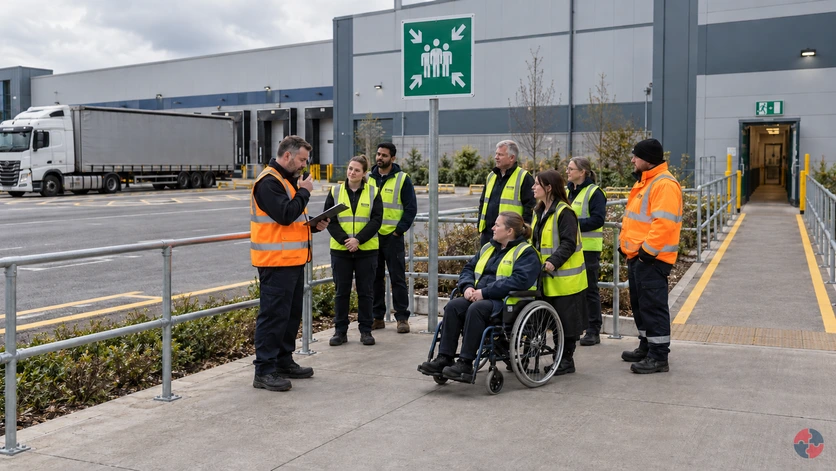
The exit is only part of the evacuation journey
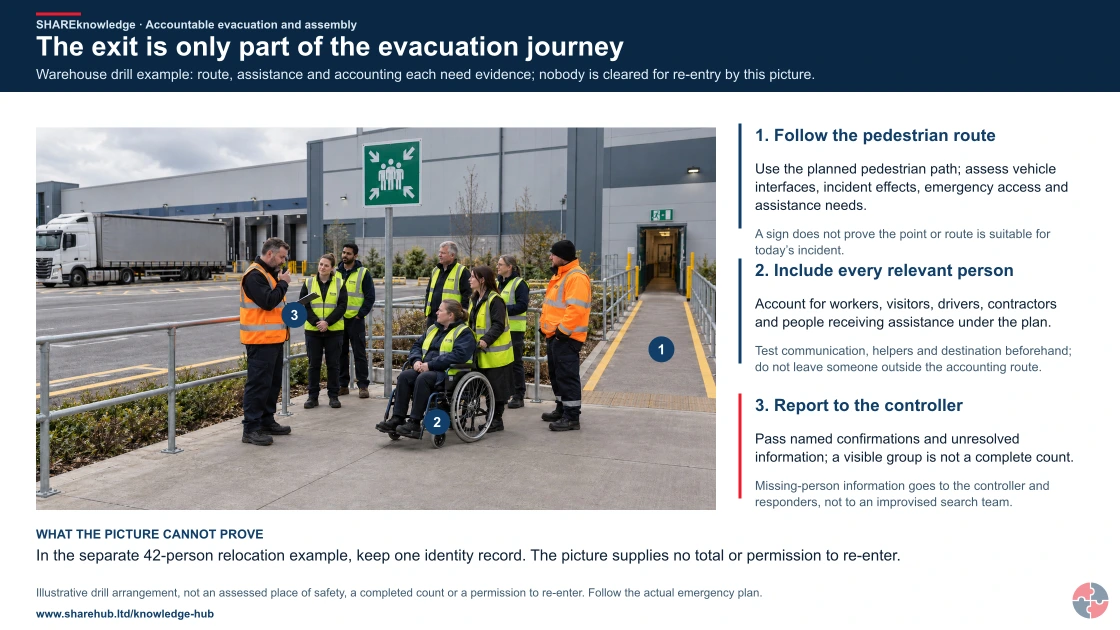
Full written explanation
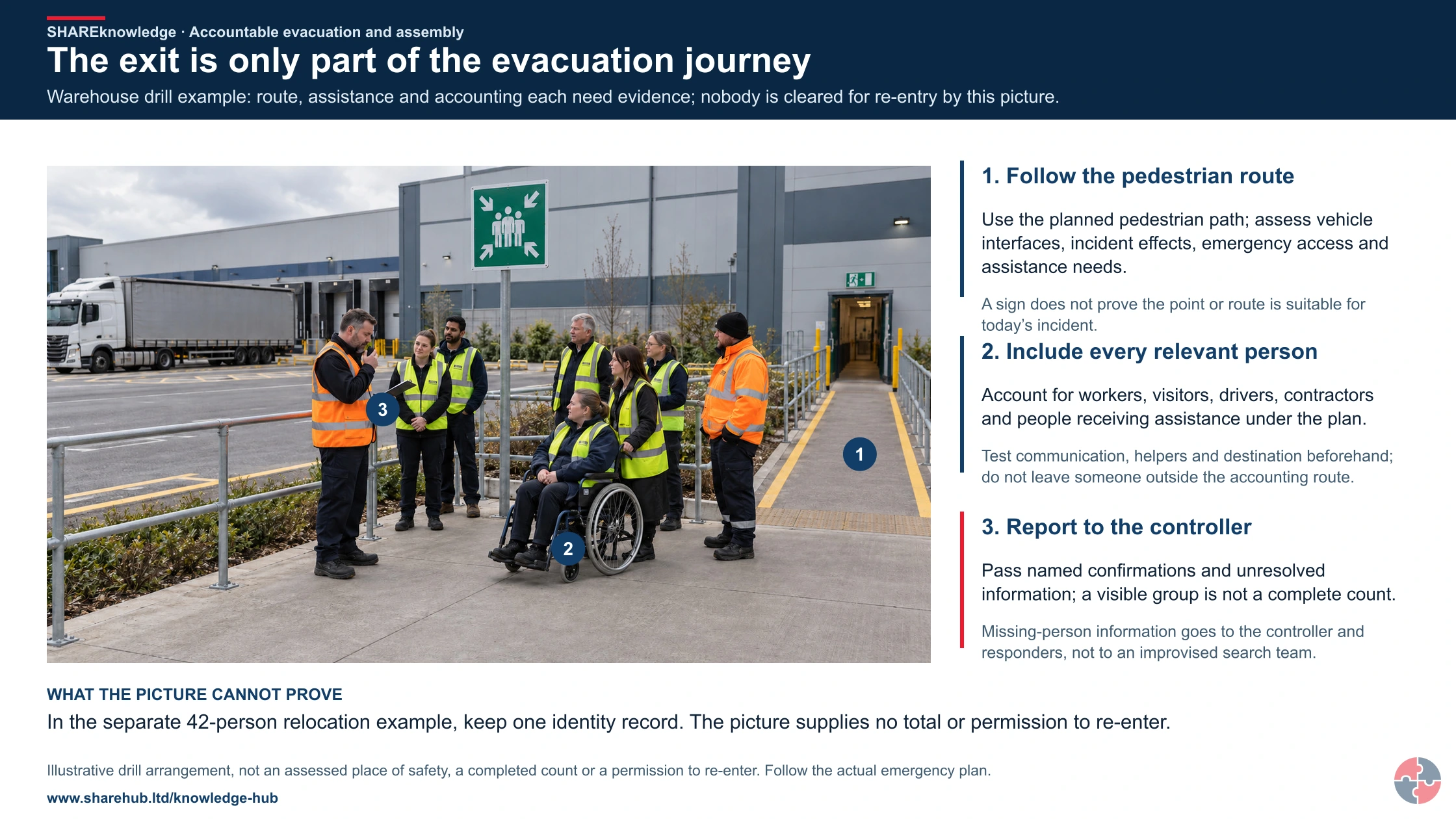
Warehouse drill example: route, assistance and accounting each need evidence; nobody is cleared for re-entry by this picture.
- Follow the pedestrian route. Use the planned pedestrian path; assess vehicle interfaces, incident effects, emergency access and assistance needs.
- Include every relevant person. Account for workers, visitors, drivers, contractors and people receiving assistance under the plan.
- Report to the controller. Pass named confirmations and unresolved information; a visible group is not a complete count.
Change the pathway
- Verify the actual route. A sign does not prove the point or route is suitable for today’s incident.
- Plan workable assistance. Test communication, helpers and destination beforehand; do not leave someone outside the accounting route.
- No self-directed return. Missing-person information goes to the controller and responders, not to an improvised search team.
Evidence check: In the separate 42-person relocation example, keep one identity record. The picture supplies no total or permission to re-enter.
Primary references: HSE: emergency procedures
Open the complete HD image (new tab)Download image
Primary references: HSE: emergency procedures
Drill: 42 people are expected. Forty have been confirmed at point A; two remain unaccounted for. The exercise controller directs the group to pre-assessed point B because the exercise scenario makes A unsuitable.
Confirm the assessed alternative
The controller communicates point B and the route in the local plan. Include assistance needs; keep the route clear of the incident area and emergency-service access.
Record departure
The group lead tells the controller that 40 identified people are moving from A. The record shows them as relocating, not as additional people or already arrived at B.
Confirm arrival
The receiving lead checks who has arrived and reports the result. Reconcile identities, visitors and contractors against the same record.
Report unresolved people
The two initially unaccounted-for people remain unresolved until reliable information changes their status. Pass their details and last-known information to the incident controller and responders.
| Check point | Confirmed at A | Relocating | Confirmed at B | Unaccounted for |
|---|---|---|---|---|
| Before the move | 40 | 0 | 0 | 2 |
| Departure reported | 0 | 40 | 0 | 2 |
| Arrival reconciled | 0 | 0 | 40 | 2 |
No self-directed re-entry: a headcount, a missing-person report or arrival at point B does not authorise anyone to go back into danger. Follow the local emergency command and responder arrangements.
Test the place of safety · Include people needing assistance · Communication and incident control.
Basis: HSE emergency procedures and GOV.UK evacuation planning. The numbers and relocation sequence are a teaching example; use the assessed plan for the actual site.
How are visitors, contractors and people needing assistance included?
Plan for every person likely to be present, including those who may not hear the alarm, know the site or use the usual route unaided.
Assisted Escape and Changed Conditions
Two linked parts · 6 questions. Open Part 2 to complete the route.

Continue to questions 4–6 · Part 2 of 2


Read this visual as text
- Start: A person may need help with an alarm, route or final safe destination.
- Question 1: Has the person been consulted about their escape needs? Decision owner: Incident controller / evacuation coordinator.
- YES: The required evidence or condition is confirmed. CONTINUE → QUESTION 2.
- NO / UNKNOWN — HOLD: Use appropriate private planning and suitable visitor arrangements. HOLD → REPEAT QUESTION 1 AFTER CORRECTION.
- Question 2: Is an agreed PEEP or relevant generic plan available? Decision owner: Incident controller / evacuation coordinator.
- YES: The required evidence or condition is confirmed. CONTINUE → QUESTION 3.
- NO / UNKNOWN — HOLD: Resolve the plan and final safe destination rather than assuming a refuge or ordinary lift completes escape. HOLD → REPEAT QUESTION 2 AFTER CORRECTION.
- Question 3: Are trained helpers, communication and the assessed route available now? Decision owner: Incident controller / evacuation coordinator.
- YES: The required evidence or condition is confirmed. CONTINUE → QUESTION 4.
- NO / UNKNOWN — HOLD: Alert incident control and use the pre-planned contingency. HOLD → REPEAT QUESTION 3 AFTER CORRECTION.
- Question 4: Has the route, support or gathering point changed? Decision owner: Incident controller / evacuation coordinator.
- YES — STOP / REFER: Recheck the assisted route and destination; tell control the actual assistance and location needs. STOP / REFER → APPROPRIATE RESPONSE.
- NO: No such warning is identified; continue the remaining checks. CONTINUE → QUESTION 5.
- UNKNOWN — PROTECT FIRST: Protect people and hold the affected work. Obtain the responsible specialist’s assessment; do not assume the warning is absent. HOLD → OWNER RESOLVES BEFORE RESUMING.
- Question 5: Is arrival at the final safe area confirmed? Decision owner: Incident controller / evacuation coordinator.
- YES: The required evidence or condition is confirmed. CONTINUE → QUESTION 6.
- NO / UNKNOWN — HOLD: Pass accurate unresolved-location facts to responders; keep unnecessary personal details private. HOLD → REPEAT QUESTION 5 AFTER CORRECTION.
- Question 6: Review after the event Decision owner: Incident controller / evacuation coordinator.
- ACTION: Update the plan with the person and check any failed interface or communication. OUTCOME → RECORD AND HAND OVER.
- Outcome: Person confirmed at final safe area, or controller and responders have accurate unresolved-location information; plan is reviewed after the event.
- Stop and escalation boundary: Do not assume an ordinary lift or refuge solves final escape. Do not leave the person unaccounted for or disclose unnecessary personal information.
Brief visitors and contractors on the alarm, route, safe area and host or supervisor contact when they arrive; keep sign-in/out current. At shift change, the outgoing and incoming supervisors must agree who owns each person in the count. Drivers, lone workers and people in remote rooms need an alarm and check-in method that works in the actual location.
Consult people who may need assistance, including those with temporary injuries or sensory, cognitive or mobility needs. Agree a personal emergency evacuation plan (PEEP) where appropriate and workable generic arrangements for visitors whose needs are not known ahead of time. Check refuge communication, trained help, equipment and the route to a final safe place. Do not promise a fixed number of helpers or assume a refuge can be used indefinitely. Respect dignity and keep personal information restricted.
| Group | Plan and test | Failure trigger |
|---|---|---|
| Visitors and contractors | Host or supervisor brief, live register, named counting owner and alternative-point message. | Unknown visitor status or contractor crew count. |
| Disabled or temporarily impaired people | Consult, agree individual or suitable generic escape support, practise and review the route. | Assistance unavailable, refuge communications fail or route is inaccessible. |
| Lone, remote and out-of-hours workers | Alarm coverage, contact method, shift owner and last-known location. | No response or unclear occupancy: escalate as unresolved. |
| Children, patients or public | Setting-specific supervision, dependency and staged-evacuation arrangements. | Generic external muster assumption conflicts with the site fire strategy. |
The Home Office disabled-escape guide is retained for technical principles in England, including consultation, PEEPs, visitor arrangements and not relying on an unplanned fire-service rescue. Some of its DDA and Disability Equality Duty references are historical: use the Equality Act 2010 route for current GB equality questions and the separate Disability Discrimination Act route for Northern Ireland, alongside the applicable fire law and plan.
How should alarm, communication and incident control be managed?
Communication should tell people when to evacuate, where to go, who is missing, what hazards remain and when the situation changes.
The alarm must be suitable for the workplace. A normal sounder may be adequate in an office, but noisy factories, outdoor construction sites, events, remote areas and workers wearing hearing protection may need visual alarms, radios, public-address systems, call trees, mobile alerts or wardens.
Communication at the assembly point matters just as much as the alarm. People may need to know whether they are at the correct point, whether to move to a secondary point, whether public roads are closed, whether a chemical release requires upwind movement, or whether they should stay available for witness information.
A named incident controller should receive information and avoid conflicting instructions. On larger premises or events, radio discipline, pre-agreed announcement wording and role cards help prevent confusion.
| Control | What it should do | Failure to avoid |
|---|---|---|
| Alarm | Warn all relevant people clearly and quickly. | Alarm cannot be heard in plant rooms, yards or noisy areas. |
| Visual signal | Support people who may not hear alarms or work in high-noise settings. | No visual cue for hearing-impaired or hearing-protection users. |
| Public-address message | Give calm instructions where people may be unfamiliar with routes. | Unclear or contradictory announcements. |
| Radios and phones | Connect wardens, security, supervisors and incident controller. | No agreed channel or radio failure during drill. |
| Incident controller | Receives headcount, hazard and missing-person information. | Several people give conflicting instructions. |
| Emergency services briefing | Provide missing-person, hazard, layout and access information. | Fire service arrives without site plan or hazard details. |
| Secondary point communication | Tell people when and how to move from primary to secondary point. | People drift away without accounting. |
When might the normal muster point be the wrong destination?
Reassess the destination when the incident changes the hazard footprint, route or available space; a printed sign cannot make an unsafe area safe.
A safe assembly point is a tested decision


Read this visual as text
- Assess smoke, vehicle movements, falling objects, access and capacity for the actual site. A signed location is not automatically safe in every incident; plan and communicate an appropriate alternative.
- SAFE ROUTE
- ACCOUNTABLE LOCATION
- PLANNED ALTERNATIVE
Check the actual place of safety, escape route, accessible assistance arrangements, traffic conflict and responder access. A signed point may become unsuitable during an incident. An alternative route and destination need assessed arrangements and a reconciled controller record; this scene supplies no universal distance or wind rule.
A fire may send smoke and debris toward the point; a release or explosion may affect both it and the route; an incident on the public road may make the crossing unsafe. In some settings the plan may use a protected refuge, staged evacuation, shelter or controlled dispersal. These are specialist, site-specific decisions, not interchangeable default instructions. Coordinate with emergency services and neighbouring occupiers where relevant.
| Scenario | Why the usual point may fail | Plan response |
|---|---|---|
| Wind shifts smoke toward the point | Evacuees would remain exposed despite leaving the building. | Controller directs movement to assessed safe alternative; recount. |
| Chemical or gas release | A plume or ignition zone may include the point or route. | Follow incident-specific shelter or evacuation plan and specialist/responders advice. |
| Vehicle incident or blocked road | Pedestrian crossing or responder access becomes dangerous. | Use controlled pedestrian route or different point; maintain count. |
| Construction phase change | Hoarding, scaffold, excavations or gates alter escape. | Stop occupancy or affected work until plan, route, signs and briefing are updated. |
| Healthcare or complex premises | Full immediate external evacuation may not match the fire strategy. | Follow assessed staged or progressive plan with clinical and assisted-escape roles. |
| Security threat or secondary incident | Original destination may be within a threat area. | Follow the security/emergency plan and police or incident-controller direction. |
How can the hierarchy of controls reduce evacuation risks around assembly and muster points?
ERICPD helps improve evacuation by designing out avoidable hazards before relying on people to remember instructions under pressure.
Assembly point control is not conventional PPE-led risk management, but ERICPD still helps. Eliminate poor assembly choices, reduce the complexity of routes, isolate evacuees from traffic and hazardous areas, control the process with signs, wardens and accounting, use PPE only where people have emergency roles, and reinforce discipline through drills.
The hierarchy is most useful when reviewing weak arrangements. If the current point is too close to the hazard, the answer is not more training; it is to move the point. If visitors are missed in roll-call, the answer is not a memo; it is a better visitor accounting system.
For an evening event beside a live vehicle route, first remove the need for people to cross moving traffic to reach muster. A different exit and assembly location can substitute for the exposed route. Where a crossing remains unavoidable, physical segregation, lighting and a protected waiting area are engineering controls; a steward, sign or briefing alone cannot stop a vehicle. ERICPD Eliminate/Reduce/Isolate/Control maps to route choice, reduced conflict and physical separation. The five-level hierarchy places the route and barriers ahead of headcounts and instructions; ordinary PPE has no useful role in making an unsafe muster point safe.
The event lead walks the route in the actual occupancy and lighting conditions, confirms that it does not conflict with responder access, and checks how a mobility-impaired person will reach a safe place. Marshals rehearse the communication and headcount method, but do not re-enter danger to reconcile a list. ERICPD Discipline means maintaining the route, correcting blocked exits and learning from drills. If smoke, wind, traffic, crowding or a blocked route makes the planned assembly point unsafe, use the pre-agreed alternative, notify incident command and account for people there. The plan should identify who can change the muster location and how that decision reaches every group.
How can the ERICPD hierarchy of controls reduce evacuation risks around assembly and muster points?

| ERICPD level | Practical application | Evidence to check |
|---|---|---|
| Eliminate | Remove unsuitable assembly points and avoid routes through higher-risk areas. | Updated site plan and retired obsolete signs. |
| Reduce | Reduce route complexity, number of decision points and crowding at exits. | Drill timing, route observations and occupancy review. |
| Isolate | Separate evacuees from vehicles, hazardous substances, smoke, collapse zones and emergency access routes. | Barriers, cones, traffic controls and marshal positions. |
| Control | Use alarms, signage, emergency lighting, wardens, headcount systems, plans and drills; check radios, torches and spare batteries as communication and incident equipment. | Emergency plan, drill record, radio/torch function check and inspection checklist. |
| PPE | Provide suitable high-visibility and protective weather clothing only where the risk assessment requires it. | PPE suitability, issue, condition, compatibility, storage and user briefing. |
| Discipline | Train people, practise drills, stop re-entry, review failures and keep records current. | Training matrix, debrief actions and management review. |
How can the ISO 45001 hierarchy of controls reduce evacuation risks around assembly and muster points?

| ESEAP control level | Practical application | Evidence to check |
|---|---|---|
| Elimination | Remove unsuitable assembly points and avoid routes through higher-risk areas. | Updated site plan and retired obsolete signs. |
| Engineering controls / Administrative controls | Reduce route complexity, number of decision points and crowding at exits. | Drill timing, route observations and occupancy review. |
| Engineering controls / Administrative controls | Separate evacuees from vehicles, hazardous substances, smoke, collapse zones and emergency access routes. | Barriers, cones, traffic controls and marshal positions. |
| Engineering controls / Administrative controls | Use alarms, signage, emergency lighting, wardens, headcount systems, plans and drills; check radios, torches and spare batteries as communication and incident equipment. | Emergency plan, drill record, radio/torch function check and inspection checklist. |
| PPE | Provide suitable high-visibility and protective weather clothing only where the risk assessment requires it. | PPE suitability, issue, condition, compatibility, storage and user briefing. |
| Administrative controls | Train people, practise drills, stop re-entry, review failures and keep records current. | Training matrix, debrief actions and management review. |
A radio, ordinary torch or spare battery is incident-control equipment, not PPE. No clothing or kit authorises a warden to enter smoke, search a danger area or remain at an unsafe point; personal safety limits and the responder handover still apply.
What should be checked before use, during an incident and at hand-back?
Inspect the route and area before occupancy, monitor whether they remain safe during the event, and only reopen or reset after a competent authorised check.
| Point | Before occupancy | During or after alarm |
|---|---|---|
| Route and gate | Verify exits, lighting, signs, gate release, traffic separation and current map. | Use alternative if blocked; log and isolate defect before reoccupation. |
| Assembly area | Check hazard exposure, capacity, accessible surface and responder access. | Move people if conditions change; recount and tell responders. |
| People data | Check rota, visitors, contractors, shifts, lone workers and manual backup. | Reconcile named exceptions; preserve an event log and correct bad data. |
| Assisted escape | Confirm agreed plan, helpers, equipment, refuge communications and destination. | Escalate any failed assistance immediately; review with person before restart. |
| Authority | Name controller and deputy; confirm 999 and responder briefing routes. | Authorised controller confirms hazard ended, access restored and re-entry decision. |
How should evacuation drills test assembly and muster arrangements?
Drills should test whether people can evacuate, reach the right point, be accounted for and learn from the exercise.
A drill that only times how quickly people leave the building is incomplete. It should also check whether routes were available, whether people knew the correct assembly point, whether visitors and contractors were accounted for, whether vulnerable-person arrangements worked and whether the incident controller received reliable information.
Drill frequency should reflect risk. Higher-risk, complex, high-turnover, public, night-shift, construction and care settings may need more frequent or varied drills than a small stable office. Different scenarios should be tested over time, including blocked routes, unavailable primary point, shift conditions or contractor presence.
Every drill should produce learning. Record what happened, what worked, what failed, who owns the action and when it will be checked. Small confusions in a drill are valuable because they show what would fail under stress.
| Drill check | What to observe | Action if weak |
|---|---|---|
| Alarm response | Do people move immediately and calmly? | Re-brief alarm meaning and supervisor expectations. |
| Route use | Do people use nearest safe route and avoid blocked/unsafe routes? | Improve signage, route training or route maintenance. |
| Assembly behaviour | Do people go to the right point and remain there? | Re-brief location, add signs or use zone markers. |
| Accounting | Are employees, visitors, contractors and lone workers accounted for? | Improve registers, host responsibility and contractor reporting. |
| PEEPs and assistance | Do support arrangements work respectfully and safely? | Review PEEPs, equipment, refuges and helper training. |
| Communication | Do wardens and incident controller exchange clear information? | Improve radios, role cards and reporting format. |
| Debrief | Are findings ranked, owned and closed? | Add action tracker and retest weak points. |
What records show assembly and muster arrangements are controlled?
Records should show that emergency arrangements are planned, communicated, practised, maintained and improved.
Emergency records should be simple but reliable. They should demonstrate the risk assessment, emergency plan, assembly point selection, route checks, sign inspections, training, fire warden appointments, visitor/contractor accounting, drills, debriefs and actions.
Records should be reviewed after change. New layouts, new tenants, different working hours, temporary works, construction phases, changed occupancy, disabled-person requirements, dangerous substances and incidents may all require updates.
Digital records can help, but the system still needs field evidence. A digital drill record is not enough if the assembly sign is hidden by stock or the visitor tablet is left inside the building during evacuation.
| Record | What it should show | Why it matters |
|---|---|---|
| Fire or emergency risk assessment | Hazards, people at risk, escape routes, assembly points and emergency controls. | Shows why the point and routes are suitable. |
| Emergency plan | Roles, alarm, routes, points, headcount, PEEPs, secondary points and all-clear process. | Turns assessment into action. |
| Site plan | Current exits, routes, points, emergency access and hazards. | Helps workers and emergency services understand the layout. |
| Drill record | Date, scenario, timing, participation, issues and actions. | Shows realistic practice and improvement. |
| Training matrix | Who has received induction, warden, supervisor and role-specific training. | Shows people know what to do. |
| Inspection records | Signs, routes, lighting, gates, traffic separation and assembly-area condition. | Finds defects before an emergency. |
| Visitor/contractor logs | Who was present and who accounted for them. | Supports reliable roll-call. |
| Action tracker | Findings from drills, incidents, audits and reviews. | Shows learning is completed. |
Which legal framework applies in each UK nation?
England and Wales use the Fire Safety Order; Scotland and Northern Ireland have separate non-domestic fire regimes. General work and construction duties also depend on location and activity.
The legal test is suitable risk assessment, emergency arrangements, safe routes, information, competent roles and training where required; a particular sign or distance alone does not prove compliance. A plan must fit the building, people and hazards. Construction emergency procedures and escape requirements also apply under the relevant construction regime. Obtain local specialist advice for complex or disputed cases.
| Nation or scope | Main route | Muster implication |
|---|---|---|
| England and Wales | Regulatory Reform (Fire Safety) Order 2005; nation guidance differs. | Responsible person assesses fire risk, provides safe escape and appropriate emergency procedures. |
| Scotland | Fire (Scotland) Act 2005 and Fire Safety (Scotland) Regulations 2006. | Dutyholders use Scottish non-domestic guidance and a suitable premises-specific plan. |
| Northern Ireland | Fire and Rescue Services (NI) Order 2006 and Fire Safety Regulations (NI) 2010. | Regulation 13 addresses emergency routes to a safe area beyond relevant premises; consult NIFRS. |
| Workplace emergencies | GB Management Regulations 1999; NI Management Regulations 2000. | Plan serious and imminent danger, competent response, information and coordination. |
| Construction in Great Britain | CDM Regulations 2015, especially regulations 30 and 31. | Foreseeable-emergency arrangements, tested evacuation and routes to an identified safe area. |
| Construction in Northern Ireland | CDM Regulations (NI) 2016, especially regulations 29 and 30. | Separate NI provisions for foreseeable emergencies, tested arrangements and routes to an identified safe area. |
Safety-sign standards can help communicate the route, but HSE L64 does not make every ISO 7010 symbol mandatory for all sites. Signs supplement rather than replace safe routes and briefings. Product-supply marking is outside this workplace-use topic.
What should a risk register include for assembly and muster points?
A useful register links evacuation failure routes to controls, owners, evidence and review triggers.
The risk register should capture more than the existence of an assembly point. It should identify credible failure routes: people gather in smoke, visitors are unaccounted for, the point blocks emergency vehicles, a disabled person's plan fails, a construction layout changes or a chemical release makes the primary point unsafe.
The register should also define assurance. The question is not 'do we have a sign?' but 'what evidence proves that everyone can get to a safe place and be accounted for when conditions are abnormal?'
| Event or failure route | Possible consequence | Key controls | Evidence to check |
|---|---|---|---|
| Assembly point too close to building | Evacuees exposed to smoke, heat, falling glass or collapse. | Scenario review, safe-distance check and secondary point. | Fire risk assessment, plan and drill observation. |
| Visitors not accounted for | Emergency services receive wrong missing-person information. | Visitor sign-in, host responsibility and roll-call process. | Visitor log and drill debrief. |
| Contractor group missing from muster | Workers remain in hazard area or leave site unreported. | Contractor induction, supervisor count and permit link. | Contractor register and muster report. |
| Primary point blocks fire service access | Emergency response delayed or crowd moved under pressure. | Emergency access review and point relocation. | Site plan, fire service feedback and inspection. |
| PEEP or assistance arrangement fails | Person needing assistance is delayed or left in unsuitable refuge. | PEEP review, trained helpers and equipment checks. | PEEP drill and action close-out. |
| Construction phase changes route | People follow obsolete signs or gather in active work area. | Temporary works review, updated induction and sign control. | Phase review and sign inspection. |
| Chemical release affects muster point | People gather downwind or inside plume path. | Upwind/secondary muster and incident communication. | DSEAR/emergency plan and tabletop exercise. |
How do assembly decisions work in real settings?
These eight BuildOut Ltd examples show the prerequisite, action, hold point, hand-back and evidence for routine and abnormal situations.
Keep one people record through a relocation
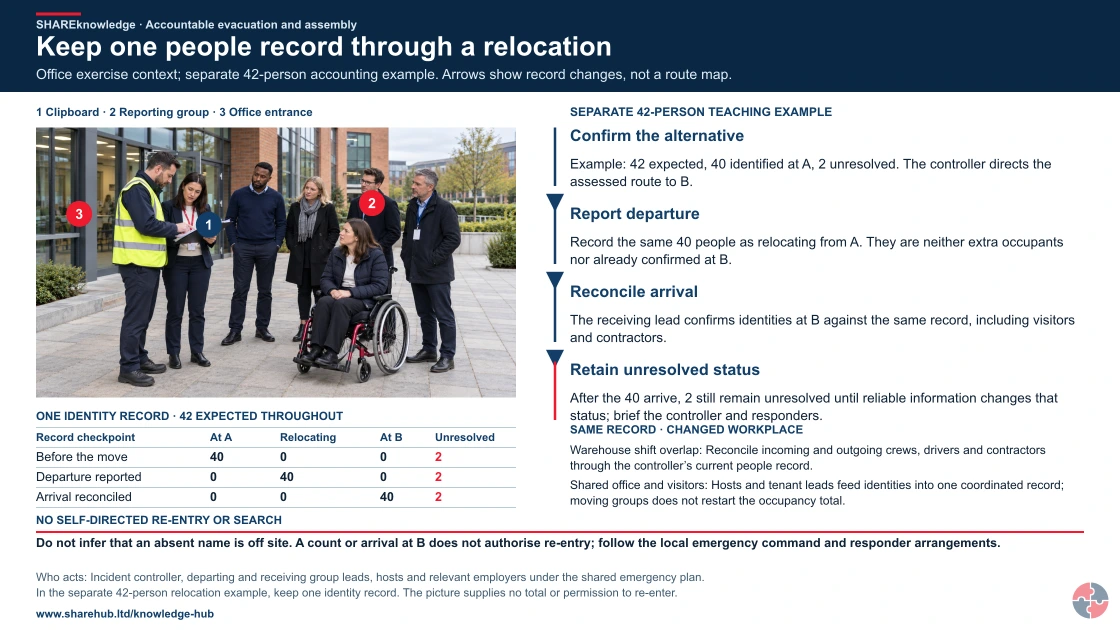
Full written explanation
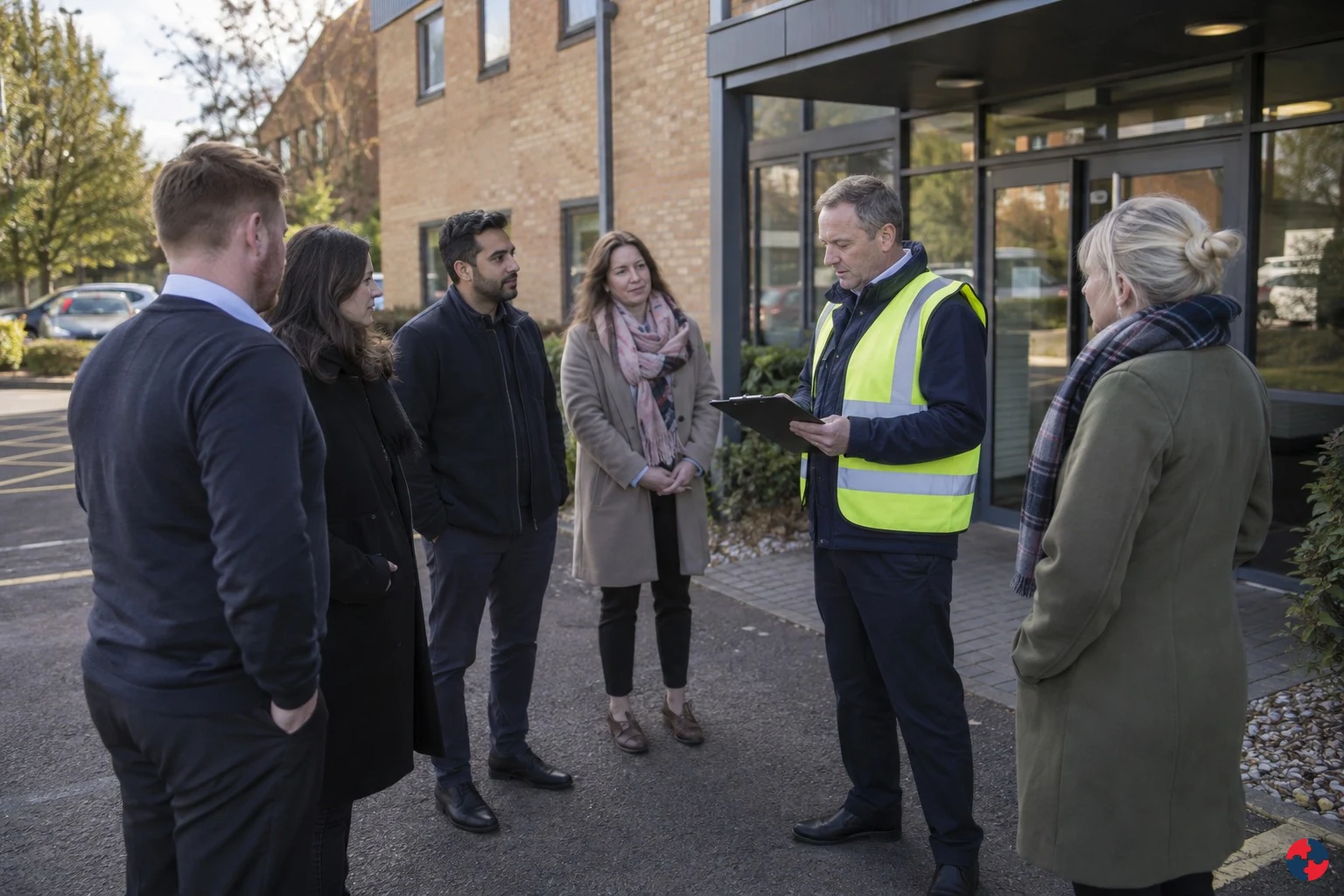
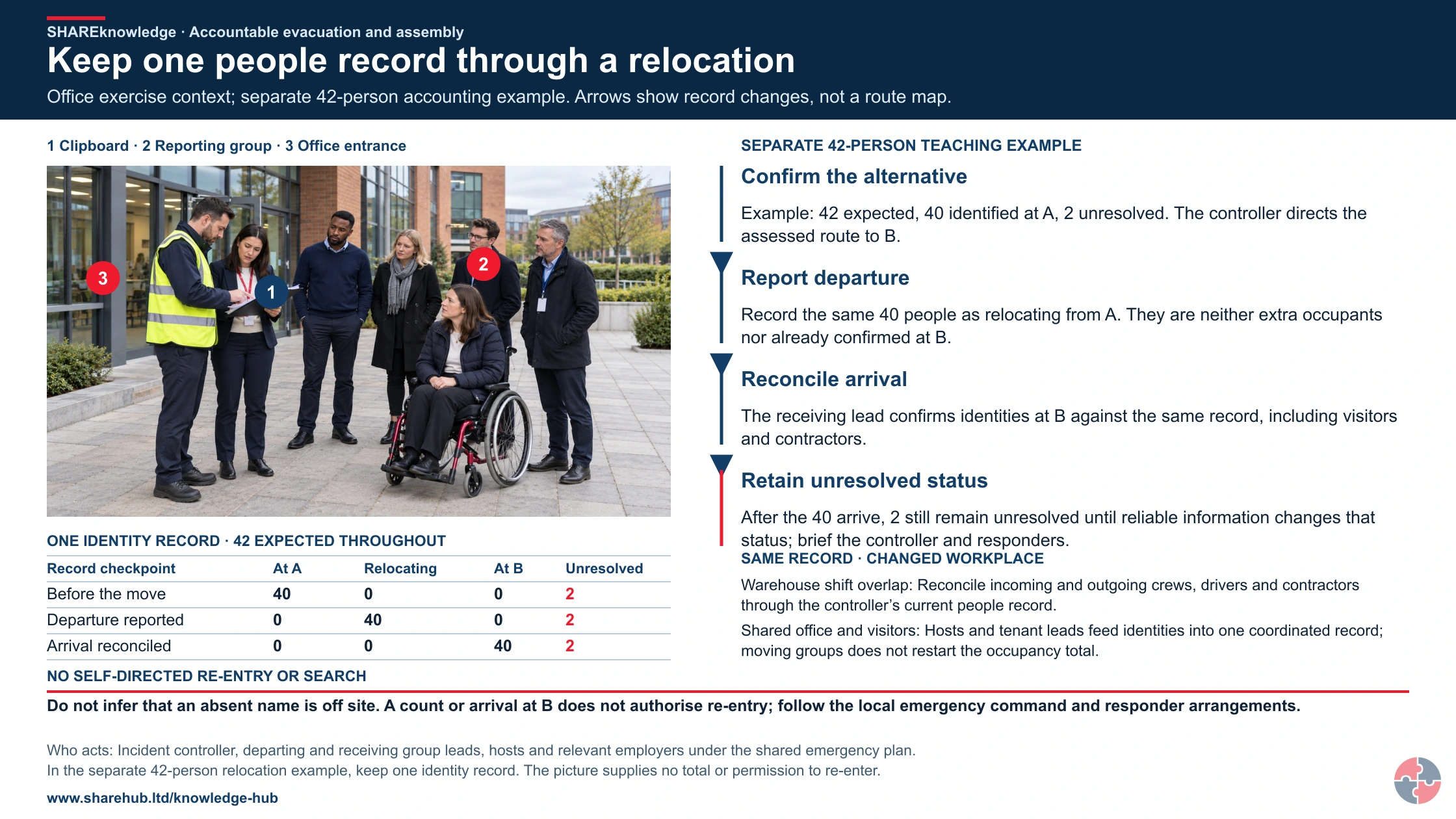
An illustrative UK shared-office exercise shows a reporting group outside the premises and two people reviewing an inert clipboard. One literal picture key identifies the clipboard, reporting group and office entrance. The normal scene is not an actual emergency, private register, assessed assembly location, safe route, completed journey or complete count. Appearance, wheelchair use, badge and clothing establish no personal capability, assistance requirement, appointment or competence. A SEPARATE 42-person teaching example keeps one identity record throughout a relocation. Before movement, 40 are identified at A and 2 remain unresolved. When departure is reported, the same 40 are relocating: they are not extra occupants and are not yet confirmed at B. After the receiving lead reconciles identities at B, 40 are confirmed there and the same 2 remain unresolved until reliable information changes their status. The expected total 42 is never restarted or added twice. A and B are example location identifiers. Arrows show reporting and accounting-state changes, not a mapped walking route or an assessed safe journey. The four unnumbered checks preserve the actual authority and evidence relationship: the controller directs the assessed alternative; the departing lead reports the same identified people; the receiving lead reconciles visitors and contractors against that record; unresolved status remains visible and is promptly passed to the controller and responders. Paperwork, digital reconciliation or a completed move must not delay urgent reporting. Nobody is instructed to search or re-enter by a count. Do not infer that an absent name is off site. A count or arrival at B does not authorise re-entry; follow the local emergency command and responder arrangements. Who acts: Incident controller, departing and receiving group leads, hosts and relevant employers under the shared emergency plan. In the separate 42-person relocation example, keep one identity record. The picture supplies no total or permission to re-enter. Warehouse shift overlap: Reconcile incoming and outgoing crews, drivers and contractors through the controller’s current people record. Shared office and visitors: Hosts and tenant leads feed identities into one coordinated record; moving groups does not restart the occupancy total.
Office exercise context; separate 42-person accounting example. Arrows show record changes, not a route map.
- Confirm the alternative. Example: 42 expected, 40 identified at A, 2 unresolved. The controller directs the assessed route to B.
- Report departure. Record the same 40 people as relocating from A. They are neither extra occupants nor already confirmed at B.
- Reconcile arrival. The receiving lead confirms identities at B against the same record, including visitors and contractors.
- Retain unresolved status. After the 40 arrive, 2 still remain unresolved until reliable information changes that status; brief the controller and responders.
When the evidence does not fit: Do not infer that an absent name is off site. A count or arrival at B does not authorise re-entry; follow the local emergency command and responder arrangements.
Who acts: Incident controller, departing and receiving group leads, hosts and relevant employers under the shared emergency plan.
Changed workplace
Warehouse shift overlap: Reconcile incoming and outgoing crews, drivers and contractors through the controller’s current people record.
Shared office and visitors: Hosts and tenant leads feed identities into one coordinated record; moving groups does not restart the occupancy total.
Evidence check: In the separate 42-person relocation example, keep one identity record. The picture supplies no total or permission to re-enter.
Primary references: HSE: emergency procedures
Open the complete HD image (new tab)Download image
Primary references: HSE: emergency procedures
Routine office evacuation
Task material and setting: Office fire alarm during a normal working day.
People and prerequisites: Staff, visitors and cleaners in an office; current alarm, exits, sign-in and controller.
Before: Check exits, point, occupancy and host briefing before work.
During: Use safe exit, report to team/host counter, consolidate roll-call.
Hold or stop: Hold if route or point is smoke-affected or a visitor is unresolved.
Completion and hand-back: Controller briefs responders; authorised re-entry only after hazard and count are resolved.
Evidence: Risk assessment, current plan, register, drill or event log.
Warehouse shift overlap
Task material and setting: Alarm while incoming and outgoing crews overlap.
People and prerequisites: Two shifts, drivers and contractors near active vehicle routes.
Before: Agree handover owner and live people list; segregate pedestrian travel.
During: Each shift lead reports named safe persons to controller.
Hold or stop: Do not infer an absent name is off site without confirmation.
Completion and hand-back: Reconcile both lists, report exceptions and reset roster.
Evidence: Shift handover, gate log, roll-call and corrective action.
Assisted evacuation in a multi-storey building
Task material and setting: Planned support for a worker unable to use stairs unaided.
People and prerequisites: Worker, agreed helper, warden and controller; refuge or equipment only as assessed.
Before: Consult worker; test PEEP, communication, helper cover and destination.
During: Use agreed assisted route without waiting for the fire service to make plan viable.
Hold or stop: Helper absent, refuge communication fails or route unsafe: escalate immediately.
Completion and hand-back: Confirm final safe arrival and revise plan after change.
Evidence: Restricted PEEP, helper training, drill observations.
Visitor-heavy event
Task material and setting: Public venue evacuation with many unfamiliar people.
People and prerequisites: Stewards, public, vendors and emergency responders; crowd and traffic constraints.
Before: Check capacity, routes, announcements, steward roles and accessible support.
During: Direct by safe routes, account by zone where feasible, avoid crowd pressure.
Hold or stop: Primary point congested or roadway unsafe: redirect under plan.
Completion and hand-back: Reconcile zones and document unresolved information.
Evidence: Event plan, steward brief, communication log, debrief.
Changed construction layout
Task material and setting: Hoarding moves the normal exit and muster gate.
People and prerequisites: Workers, sub-contractors and neighbours; scaffold, hot works and vehicles.
Before: Hold affected phase until route, gate, muster, signs and induction are revised.
During: Use new safe route and contractor supervisor counts.
Hold or stop: Stop if gate locked, route passes plant or old sign still misdirects people.
Completion and hand-back: Competent sign-off and briefing before work resumes.
Evidence: Phase plan, marked-up layout, gate test, briefing.
Chemical release and wind change
Task material and setting: Release causes primary outdoor point to lie in a plume path.
People and prerequisites: Process workers, nearby contractors and public; substance and wind unknown.
Before: Pre-plan scenario-specific shelter/evacuate decision and alternatives.
During: Follow incident controller and specialist/responder direction, then recount.
Hold or stop: Never instruct blanket upwind travel when route or release is uncertain.
Completion and hand-back: Pass substance, location, exposure and missing-person facts to responders.
Evidence: Emergency plan, process information, event and count logs.
Unresolved contractor
Task material and setting: Contractor does not appear on the first muster report.
People and prerequisites: Controller, contractor lead and fire service; uncertain last-known location.
Before: Keep sign-in and permit locations current with supervisor owner.
During: Check alternative exits and reliable off-site confirmation while escalating.
Hold or stop: No re-entry search and no all-clear from an incomplete list.
Completion and hand-back: Update responders promptly and close discrepancy only on evidence.
Evidence: Roster, permit, last-known report and event timeline.
Unsafe primary point
Task material and setting: Smoke and responder vehicles reach the planned point.
People and prerequisites: All evacuees, mobility assistance, controller and responders.
Before: Define alternate safe area and communication and count method.
During: Direct group by safe route, support assisted movement and recount.
Hold or stop: Do not leave anyone at compromised point or lose track of those moving.
Completion and hand-back: Confirm relocated count, keep access free and review site plan.
Evidence: Relocation message, second roll-call, incident review.
How could BuildOut Ltd manage assembly and muster points in practice?

BuildOut would manage muster points through site-specific planning, live layouts, contractor accounting, drills, PEEPs, inspections and review.
BuildOut Ltd
BuildOut Ltd is used as a construction and facilities example because assembly and muster arrangements often fail where permanent workplaces, temporary works, vehicles, contractors and changing site layouts overlap.
BuildOut treats muster planning as a live control, not an induction slide. Each project and premises has a current emergency plan showing exits, muster points, secondary points, emergency access, first-aid locations, hazardous stores, site gates and the incident-control location. The plan is reviewed whenever the site phase, hoarding, scaffold, craneage, temporary electrics, hot work or fuel storage changes.
Before work starts, BuildOut checks whether workers, visitors and contractors can reach the muster point without crossing active plant routes or blocking emergency vehicles. The site manager owns the primary and secondary point, but each contractor supervisor owns their own headcount and reports to the incident controller. Reception or security accounts for visitors and delivery drivers.
Drills are not treated as a tick-box exercise. BuildOut varies scenarios: blocked exit, unavailable primary muster point, out-of-hours alarm, visitor-heavy day, hot-work fire and chemical spill. Each drill records evacuation time, roll-call accuracy, warden feedback, route defects, signage issues, PEEP performance and action owners.
The senior team reviews trends across sites. If several drills show slow contractor accounting or poor visitor control, the company updates procurement requirements, induction scripts, access-control questions and supervisor training.
| Management area | How BuildOut manages it | Evidence used for assurance |
|---|---|---|
| Risk assessment | Links muster points to fire, traffic, dangerous substances, temporary works and public interface risks. | Fire risk assessment, construction phase plan and site layout review. |
| Site layout | Keeps primary and secondary points outside hazard areas and clear of emergency access. | Marked-up plan, inspection photos and phase-change review. |
| Visitor and contractor control | Uses host responsibility, sign-in data and contractor supervisor counts. | Visitor log, contractor register and roll-call record. |
| PEEPs and vulnerable people | Reviews employee PEEPs and generic visitor assistance arrangements. | PEEP review records and drill observations. |
| Training | Briefs workers at induction and gives fire wardens role-specific training. | Training matrix, warden list and toolbox talk records. |
| Drills and exercises | Runs realistic drills and tabletop scenarios for higher-risk sites. | Drill report, debrief, action tracker and retest evidence. |
| Learning | Reviews missed counts, route issues, obsolete signs and blocked gates as leading indicators. | Audit findings, incident reports and management review minutes. |
What should a fuel-site muster-point review consider?
Relate the incident location, people and communications to the emergency plan. The viewer does not designate a safe muster point or predict an incident footprint.
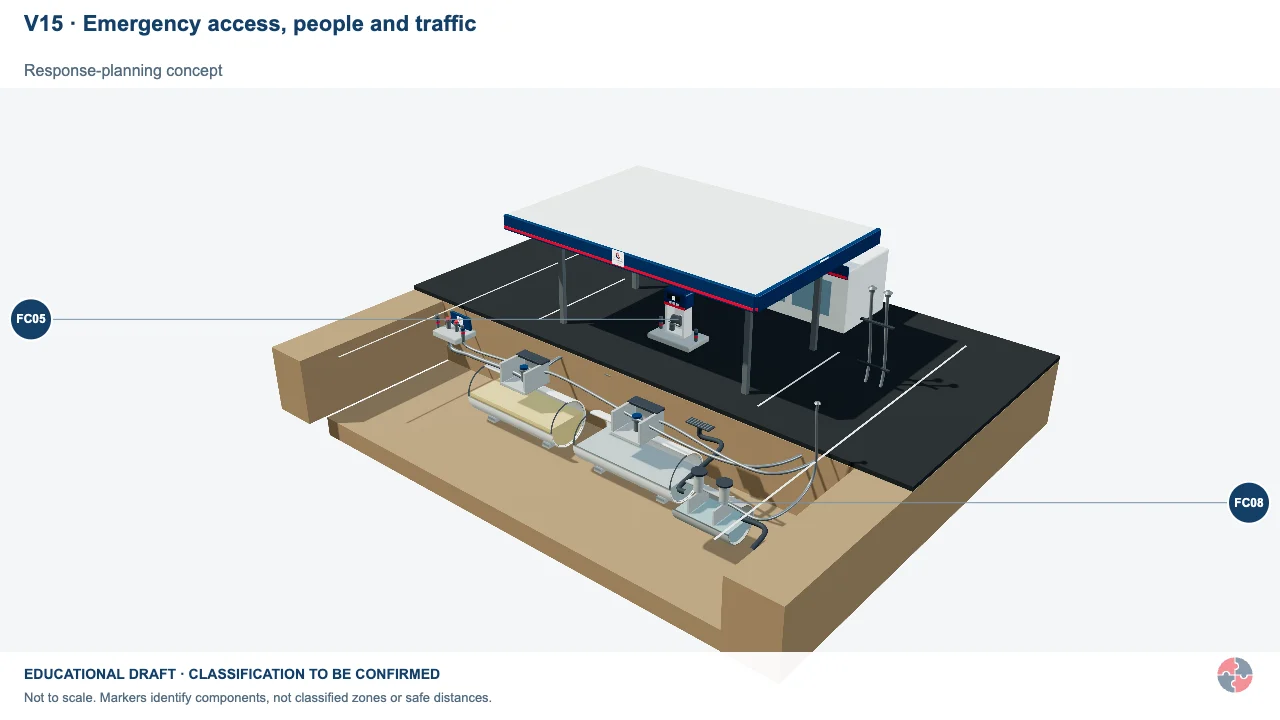

Emergency access, people and traffic
Delivery hoses, the movable refuelling interface and drainage sources can affect access and response. Plan routes around the incident and people involved rather than using a coloured zone as a muster boundary.
Activity focus: Inspect the tanker working area, hose route, nozzle/filler positions, separator covers and vent. Check communication, control of dispensing and traffic, and access for the response plan.
Illustrative site model view V15: examine where evacuees, traffic and responders could conflict, then check an assessed alternative route and assembly location. The model is a teaching aid; it does not validate travel distances, capacity, assisted escape, a live incident boundary or the site's emergency plan.
Educational illustration, not to scale. Coloured zones are teaching examples, not a site-specific hazardous-area classification.
What training supports effective assembly and muster arrangements?
Training should match the role, from simple evacuation awareness to fire warden, supervisor and emergency-controller competence.
General awareness should tell everyone what the alarm means, which routes to use, where to assemble, how to report in and why they must not re-enter. This belongs in induction and refresher briefings, with additional reminders after layout changes.
Short topical training is useful for higher-risk groups: fire wardens, reception, security, contractor supervisors, event stewards, school staff, night-shift supervisors, construction site managers and people supporting PEEPs. They need practical scenarios, not only a diagram.
Managers and dutyholders need deeper training on legal duties, fire risk assessment, evacuation strategy, accounting systems, disabled-person evacuation, record keeping, drills, multi-occupancy coordination and improvement after exercises.
| Role and learning | Practice on the actual task | Competence evidence and record | Assessor and reassessment trigger |
|---|---|---|---|
| Workers and visitors: leave and report in | Follow the correct alarm route, use a safe exit and report presence without re-entry. | Observed drill and correct reporting route. | Warden rechecks after layout, occupancy or alarm change. |
| Wardens and hosts: account for people | Check assigned areas only if safe, guide visitors, reconcile known people and report gaps. | Drill observation and reconciled visitor/contractor list. | Emergency controller rechecks after staffing or incident change. |
| Controllers: choose a safe point | Use the local risk assessment to choose primary or alternative safe area; share missing-person facts with responders. | Scenario decision, communications and debrief record. | Competent fire lead reviews after hazard or route change. |
| Accessibility leads: plan assisted escape | Agree individual support and final safe destination without assuming responders will complete the plan. | Practised support plan and participant feedback. | Competent lead reviews when needs or building change. |
| Dutyholders and contractors: maintain readiness | Keep routes, signs, alarms and work interfaces current; learn from drills. | Inspection and closed corrective-action evidence. | Accountable lead reviews after works, crowd change or failed drill. |
Record observed task decisions, assessor and reassessment trigger; attendance alone does not establish competence.
How does assembly and muster planning support NEBOSH study and professional development?
This topic helps learners connect emergency procedures, fire risk assessment, construction fire safety, vulnerable people and evidence of control.
For NEBOSH Construction Certificate study, assembly and muster points link directly to construction site fire precautions and emergency arrangements. Learners should be able to explain how a principal contractor controls changing site layouts, temporary routes, contractors, combustible materials and muster accounting.
For Fire Safety Certificate study, the topic links to fire risk assessment, emergency plans, means of escape, people at risk, staff training and fire drills. A strong answer explains how the plan works for visitors, disabled people, public occupants and people unfamiliar with the premises.
In scenario questions, avoid saying simply 'provide an assembly point'. Explain where it should be, why it is safe, how people get there, how they are counted, who controls the area, what happens if it becomes unsafe and what records prove the arrangement works.
| Study route | What to understand | Scenario application |
|---|---|---|
| NEBOSH Construction Certificate CN1-03 | Construction fire and emergency arrangements, changing layouts, temporary signs and contractor control. | Explain how the site plan, induction and drills change as the project changes. |
| NEBOSH Fire Safety Certificate FSC 6.2 | Emergency plans, training, evacuation, people at risk and fire drills. | Describe an evacuation arrangement that accounts for everyone and supports vulnerable people. |
| Supervisor CPD | Practical headcount, route checks and control of re-entry. | Use drill findings to improve team arrangements. |
| Facilities CPD | Signs, emergency lighting, routes, shared premises and record keeping. | Audit whether the plan works in the real building. |
| Event safety CPD | Crowd movement, stewarding, communication and dispersal. | Plan assembly or dispersal without creating crowding or traffic risk. |
How can management-system themes support assembly and muster points?
ISO 45001 and relevant British Standards can organise emergency planning, signs, building fire management and lighting, but they cannot approve a site-specific route, muster point, PEEP or legal conclusion.
ISO 45001 does not replace fire safety law, but it helps convert legal duties into managed arrangements. The table below gives management-system themes in original summary language; it does not reproduce or verify licensed ISO clause wording or numbers.
The best evidence is field evidence: drills, route inspections, warden feedback, closed actions and proof that the arrangements changed after site or occupancy changes.
| Management-system theme | How it supports the topic | Example evidence |
|---|---|---|
| Context of the organisation / Needs and expectations of workers and interested parties | Identifies premises, occupiers, visitors, contractors, public, vulnerable people and emergency responders. | Stakeholder review and premises profile. |
| Organisational roles, responsibilities and authorities | Defines responsible person, incident controller, wardens, hosts, contractor supervisors and deputies. | Role matrix and emergency role cards. |
| Hazard identification and assessment of OH&S risks and opportunities | Assesses fire, explosion, traffic, crowd, chemical, vulnerable-person and site-change risks. | Fire/emergency risk assessment and muster location review. |
| Competence | Defines competence for wardens, supervisors, incident controllers and people supporting PEEPs. | Training matrix and drill observations. |
| Communication | Ensures emergency instructions reach workers, visitors, contractors and shared occupiers. | Induction, visitor script, signs and briefing records. |
| Operational planning and control | Controls routes, signs, accounting, emergency access, drills and changing site layouts. | Inspection checklists, site plans and contractor controls. |
| Emergency preparedness and response | Supports emergency arrangements to be established, implemented and tested. | Emergency plan, drill schedule and exercise reports. |
| Monitoring, measurement, analysis and performance evaluation | Checks evacuation performance, accounting accuracy and action completion. | Drill metrics, audit findings and trend analysis. |
| Incident, nonconformity and corrective action | Learns from false alarms, drills, blocked routes, missed counts and real emergencies. | Debrief reports, corrective actions and retest evidence. |
Use the edition identified below as a benchmark and confirm it again at publication or project design. The applicable law, competent fire strategy, risk assessment, accessibility plan and live incident command remain controlling.
| Standard and edition | Practical decision it supports | Limit and release check |
|---|---|---|
| ISO 45001:2018 with Amendment 1:2024 | Structures roles, competence, communication, operational control, emergency preparedness, exercises and corrective action. | Voluntary management-system framework, not a legal or premises approval. ISO reports a replacement edition in development, so recheck at release. |
| BS EN ISO 7010:2020+A3:2022 | Supports consistent registered safety-sign meanings for emergency evacuation and safety facilities. | A compliant symbol does not establish a safe location or route, and the standard excludes regulated transport signalling. |
| BS 9999:2017 | Provides a building fire-safety design and management benchmark for applicable premises, including escape and ongoing management. | It is a code of practice, not the law; it excludes individual dwelling-houses and has limited application to some specialist buildings. |
| BS 5266-1:2025 | Supports competent design and management of emergency escape, local-area and standby lighting for premises. | Lighting alone does not make an exit, route or muster point suitable; apply the premises strategy, risk and maintenance evidence. |
Certification, a code-of-practice benchmark, a registered symbol or a lighting design cannot independently demonstrate that the selected destination, route, assisted escape or re-entry decision is safe or legally compliant.
What official learning shows why assembly and muster points matter?
Official fire, construction and event guidance repeatedly emphasises that evacuation arrangements must be planned, communicated, tested and reviewed.
HSE emergency-procedure guidance explains that people respond more reliably when they are well trained, competent, and have clearly agreed, recorded and rehearsed plans, actions and responsibilities. That is exactly what a muster arrangement should provide.
HSE event guidance is useful because it broadens the thinking beyond a building fire. Emergency plans may need to address evacuation, vulnerable people, traffic management, emergency vehicles, incident control, public communication and testing. These points apply strongly to public venues, events and complex workplaces.
Construction fire guidance is also important because construction sites change quickly. A muster point that was suitable last month may become unsuitable after hoarding changes, scaffold erection, temporary stores, hot work, excavations or altered access routes.
| Learning theme | Why it matters | Management action |
|---|---|---|
| Plans must be rehearsed | People do not reliably follow unfamiliar plans under stress. | Run realistic drills and tabletop exercises. |
| Emergency routes must remain available | Blocked or locked routes delay escape and accounting. | Inspect routes, doors, gates and lighting. |
| People with disabilities need planned arrangements | Evacuation should not rely on emergency-service intervention to make it work. | Use PEEPs or generic accessible arrangements. |
| Construction sites change | Routes and muster points can become obsolete during the project. | Review after phase changes and update induction. |
| Events need crowd and traffic planning | Evacuation can create crowd pressure, road risk and responder access problems. | Plan stewarding, PA messages, traffic control and dispersal. |
| Dangerous substances affect safe location | Fire or explosion risks may require greater distance or different wind-direction decisions. | Use DSEAR/emergency planning and secondary points. |
What are the warning signs that assembly and muster points are not well managed?
Weak arrangements usually show up in everyday confusion, missing records, poor signs, unreliable counts and unchanged plans after site changes.
People do not know where to go
This shows induction, signs or fire action notices are not working.
The point is too close to the building
Evacuees may be exposed to smoke, heat, falling debris or emergency-service activity.
Visitors are not counted
The organisation cannot give reliable missing-person information.
Contractors use a different process
Multiple accounting systems can leave gaps during an emergency.
The point blocks emergency vehicles
Responder access may be delayed or the crowd may have to move during the incident.
PEEPs are not tested
Assistance arrangements may fail when needed.
Construction signs are out of date
Changing site phases can make evacuation routes and points unsafe.
Drills produce actions that stay open
The organisation is collecting evidence without improving control.
Standards named on this page are background context. Confirm the current edition, scope and exact requirements from an authorised copy before applying them. The open official sources below support the specific public-law and regulator guidance claims they are cited for.
What do the acronyms and key terms mean?
Acronyms should be defined so readers can understand evacuation, fire safety, disabled-person planning and emergency control.
| Acronym or term | Full wording | Meaning in this topic |
|---|---|---|
| PEEP | Personal Emergency Evacuation Plan | Planned arrangements for a person who may need assistance to evacuate safely. |
| GEEP | Generic Emergency Evacuation Plan | Generic arrangements for visitors or public occupants whose individual needs are not known in advance. |
| FRA | Fire Risk Assessment | Assessment identifying fire hazards, people at risk and fire precautions. |
| RP | Responsible Person | Term commonly used under the Fire Safety Order for the person with fire safety duties in England and Wales. |
| DSEAR | Dangerous Substances and Explosive Atmospheres Regulations | Relevant where dangerous substances affect evacuation and muster decisions. |
| CDM | Construction (Design and Management) Regulations | Construction regulations requiring planning and management of site risks including emergency arrangements. |
| Warden or marshal | Fire warden or fire marshal | Trained person with evacuation support, sweep, reporting or crowd-control duties. |
| Incident controller | Person controlling the employer/site response | Receives information, liaises with emergency services and controls re-entry or relocation. |
| Place of safety | Safe place away from immediate danger | The destination the evacuation arrangements must achieve. |
| Secondary muster | Alternative assembly point | Used if the primary point is unsafe, inaccessible or affected by the incident. |