SHARE Knowledge Hub
Safety Signs and Signals
Safety signs and signals tell people about a remaining risk or required action at the point of decision. They include signboards, illuminated or acoustic signals, and agreed hand or verbal signals; the correct form depends on the task. A sign helps only when a person can see, understand and act on it in time, after stronger controls have addressed the underlying hazard.
Understanding Safety Signs and Signals
Safety signs and signals tell people about a remaining risk or required action at the point of decision. They include signboards, illuminated or acoustic signals, and agreed hand or verbal signals; the correct form depends on the task. A sign helps only when a person can see, understand and act on it in time, after stronger controls have addressed the underlying hazard.
Why this matters at work
Start with the task and hazard, then eliminate, isolate or otherwise control exposure. Identify the residual decision that a person must make, select the correct sign or signal, put it where that decision occurs, and test whether the intended people can perceive and understand it under actual work conditions. Too many signs can cause confusion; obsolete signs undermine trust.
For each condition, record who may be harmed, exposure pathway, credible consequence, current control, defect threshold, immediate restriction and permanent action. Evidence may include photographs, measurements, maintenance history, airflow tests, complaints and direct observation. Measurements need a valid method and context; one snapshot rarely proves a whole shift is comfortable or ventilated.
How organisations manage this in practice
Assess the activity, exposed people, credible events and existing controls before deciding on signage. HSE says signs are required where a significant risk cannot be avoided or controlled in another way, and there is no need where they do not help reduce risk or the risk is insignificant. A warning is useful only if a person can take an effective action after seeing or hearing it.
For a machine nip, fit guarding and isolation; a danger sign may communicate the remaining controlled-access rule. For vehicle impact, design separation and speed control before adding crossing and route signs. For chemical exposure, use containment and ventilation before relying on a warning or PPE instruction. Record why the sign is needed and the action it directs.
Use a change permit or equivalent review for significant temporary alterations. Mark the physical route, not only a revised drawing. Check plant access, contractor deliveries and emergency egress, and inspect at night or in adverse weather if the diversion remains open. A temporary layout can become semi-permanent; review it when work extends.
Assess the hazard, affected people and existing controls before choosing signs. Signs communicate significant residual risk where it cannot be avoided or sufficiently controlled by other means; they must tell people something on which they can act. Guard machinery, isolate energy, contain hazardous substances and separate vehicles and people where required before relying on warnings. A sign at a place where the recipient has no safe option may add little protection even if its symbol is technically correct.
Read the sign family and act before entering
Signs communicate residual risks and required actions after stronger precautions. Recognise their shape and meaning as well as colour, and place the actual standard sign before the decision point.

Prohibition
The red circular prohibition family tells you what must not be done. Identify the actual prohibited action from the correct symbol and any supplementary wording.
Warning
The yellow triangular warning family identifies a hazard. Stop to understand the hazard and the assessed precautions; a warning does not remove the source.
Mandatory
The blue circular mandatory family identifies a required action. Read the actual standard symbol and follow the task’s complete precautions rather than treating one item of PPE as clearance.
Safe condition and fire equipment
Green square/rectangular safe-condition signs identify escape/first-aid provision; red square/rectangular fire-equipment signs locate fire-fighting equipment. They serve different purposes.
Before the decision
Check visibility, lighting, location and understanding before a doorway, crossing or other exposure point. Remove obsolete, conflicting and obscured signs.
Keep standard symbols intact
Use appropriate standards-compliant sign artwork for the real workplace. The teaching shapes identify families only and are not replacement safety signs; SHARE branding belongs around, not inside, standard symbols.
Read the complete controls: ERICPD planning prompts
Discipline verifies and sustains all the controls; it is not a separate substitute for them.
| Prompt or level | Complete task-specific example |
|---|---|
| Eliminate | Move pedestrian access and picking away from the loading route so the crossing is no longer needed. |
| Reduce | Replace reversing-dependent unloading with a suitable drive-through arrangement after checking vehicle swept paths. |
| Isolate | Install suitable fixed separation and protected crossing points; design gates and routes to keep people out of the truck envelope. |
| Control | Check barrier strength, visibility, impact exposure and safe bay access for the actual trucks and loads. Agree delivery slots, driver waiting positions and crossing rules; stop vehicle movement before anyone enters the loading zone. |
| PPE | Use suitable visibility and foot protection for residual exposure; high-visibility clothing does not prevent a collision. |
| Discipline | Inspect barriers after impacts, prevent informal shortcuts and verify the route at busy periods. Read the accompanying source table for the framework distinctions. |
Read the complete controls: ESEAP effectiveness order
Compare stronger feasible controls while preserving the actual task, checks and release requirements.
| Prompt or level | Complete task-specific example |
|---|---|
| Elimination | Move pedestrian access and picking away from the loading route so the crossing is no longer needed. |
| Substitution | No separate measure is specified in this example. |
| Engineering controls | Replace reversing-dependent unloading with a suitable drive-through arrangement after checking vehicle swept paths. Install suitable fixed separation and protected crossing points; design gates and routes to keep people out of the truck envelope. Check barrier strength, visibility, impact exposure and safe bay access for the actual trucks and loads. |
| Administrative controls | Agree delivery slots, driver waiting positions and crossing rules; stop vehicle movement before anyone enters the loading zone. Inspect barriers after impacts, prevent informal shortcuts and verify the route at busy periods. |
| PPE | Use suitable visibility and foot protection for residual exposure; high-visibility clothing does not prevent a collision. Read the accompanying source table for the framework distinctions. |
The colour/shape teaching key is not a printable workplace sign or evidence of compliance. Keep segregation and other stronger controls in the task assessment.
Further source background retained from this topic
How can I practise this topic in 3D?
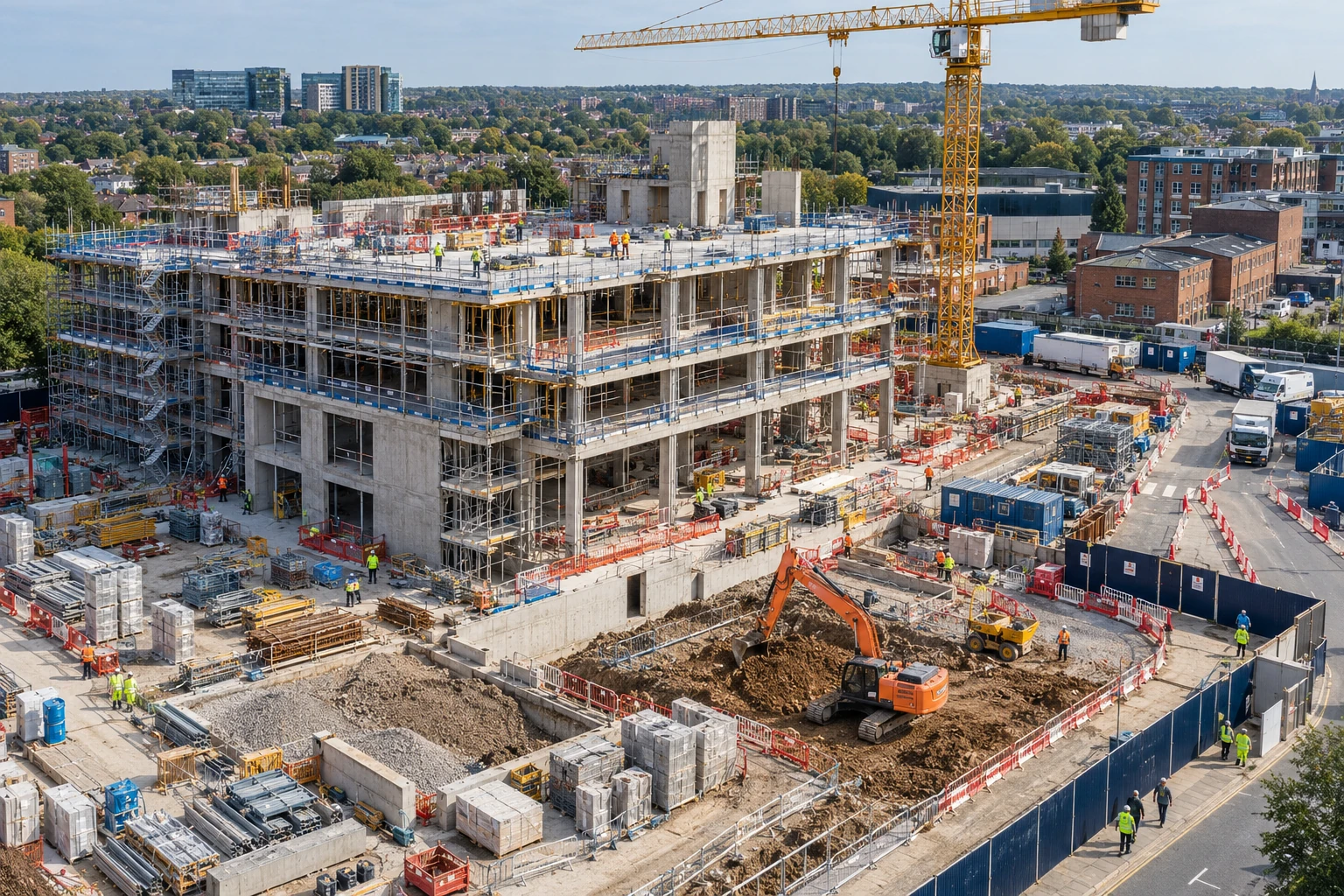

A delivery crosses the public pavement
All related inspection points 2 across 1 location
Construction site 2 inspection points
Practice in the SHAREhub environment. Browser practice is separate from workplace competence and formal learning records.
What are safety signs and signals for?
Safety signs and signals tell people about a remaining risk or required action at the point of decision. They include signboards, illuminated or acoustic signals, and agreed hand or verbal signals; the correct form depends on the task. A sign helps only when a person can see, understand and act on it in time, after stronger controls have addressed the underlying hazard.
Best-practice guide: Safety Signs and Signals

What are safety signs and signals for?
Safety signs and signals tell people about a remaining risk or required action at the point of decision. They include signboards, illuminated or acoustic signals, and agreed hand or verbal signals; the correct form depends on the task. Safety signs and signals tell people about a remaining risk or required action at the point of decision.
Turn safety signs and signals knowledge into a decision
Safety signs and signals tell people about a remaining risk or required action at the point of decision. They include signboards, illuminated or acoustic signals, and agreed hand or verbal signals; the correct form depends on the task. Conflict points mapped and segregation considered first.
Warehouse safety signs worked example
Risk assessment: Conflict points mapped and segregation considered first. Control: Barrier, pedestrian route, crossing and speed control installed.
How can harm occur and when must work stop?
A faded forklift warning at a blind warehouse corner can leave a pedestrian unaware of an approaching vehicle.
Choose controls for safety signs and signals
Elimination: Move pedestrian access and picking away from the loading route so the crossing is no longer needed. Engineering controls: Replace reversing-dependent unloading with a suitable drive-through arrangement after checking vehicle swept paths. Engineering controls: Install suitable fixed separation and protected crossing points; design gates and routes to keep people out of the truck envelope. Engineering controls: Check barrier strength, visibility, impact exposure and safe bay access for the actual trucks and loads. Administrative controls: Agree delivery slots, driver waiting positions and crossing rules; stop vehicle movement before anyone enters the loading zone. Read the full control table for qualifications, ownership and verification. Use the actual task and applicable jurisdiction; existing technical approval remains unchanged.
Use the full safety signs and signals lesson
Use the full topic for the decision points, practical examples, detailed control tables and source scope. HSE guidance applies to Great Britain; use HSENI for the Northern Ireland route and the source’s stated jurisdiction. A simplified guide does not change the page’s technical-review or approval status.

Read all six steps as text
1. What are safety signs and signals for?
Safety signs and signals tell people about a remaining risk or required action at the point of decision.
- Avoid / redesign: Move pedestrian access and picking away from the loading route so the crossing is no longer needed.
- Control the task: Install suitable fixed separation and protected crossing points; design gates and routes to keep people out of the truck envelope.
- Verify before release: If the hazardous step remains, keep it within the task assessment and select the stronger feasible remaining controls.
Safety signs and signals tell people about a remaining risk or required action at the point of decision. They include signboards, illuminated or acoustic signals, and agreed hand or verbal signals; the correct form depends on the task. Safety signs and signals tell people about a remaining risk or required action at the point of decision.
Apply it: Which part of this plan would you check at the workface before authorising the task?
2. Turn safety signs and signals knowledge into a decision
Use the evidence to improve the actual work arrangement.
- Change at source: Move pedestrian access and picking away from the loading route so the crossing is no longer needed.
- Make it observable: If the hazardous step remains, keep it within the task assessment and select the stronger feasible remaining controls.
- Keep useful evidence: Conflict points mapped and segregation considered first.
Safety signs and signals tell people about a remaining risk or required action at the point of decision. They include signboards, illuminated or acoustic signals, and agreed hand or verbal signals; the correct form depends on the task. Conflict points mapped and segregation considered first.
Apply it: What evidence would show that the change improves this task, rather than only completing a record?
3. Warehouse safety signs worked example
Example: a practical application of the existing topic lesson.
- Risk assessment: Conflict points mapped and segregation considered first.
- Control: Barrier, pedestrian route, crossing and speed control installed.
- Position: Sign placed at decision point before entry.
Risk assessment: Conflict points mapped and segregation considered first. Control: Barrier, pedestrian route, crossing and speed control installed.
Apply it: At which point would you hold this example, and what evidence would allow it to proceed?
4. How can harm occur and when must work stop?
Connect the task, the route to the person and the control that can fail.
- Source / exposure: A faded forklift warning at a blind warehouse corner can leave a pedestrian unaware of an approaching vehicle.
- Possible consequence: The route geometry and lack of separation create the collision pathway; the unreadable sign removes a final warning.
- Control failure: The supervisor should close or divert the crossing, restore physical segregation and sightlines, then replace and brief the sign before reopening.
A faded forklift warning at a blind warehouse corner can leave a pedestrian unaware of an approaching vehicle.
Apply it: Who could be exposed, including other trades, cleaners, maintainers and people nearby?
5. Choose controls for safety signs and signals
Start with the stronger practicable options and verify their effect.
- Elimination: Move pedestrian access and picking away from the loading route so the crossing is no longer needed.
- Engineering controls: Replace reversing-dependent unloading with a suitable drive-through arrangement after checking vehicle swept paths.
- Engineering controls: Install suitable fixed separation and protected crossing points; design gates and routes to keep people out of the truck envelope.
- Engineering controls: Check barrier strength, visibility, impact exposure and safe bay access for the actual trucks and loads.
- Administrative controls: Agree delivery slots, driver waiting positions and crossing rules; stop vehicle movement before anyone enters the loading zone.
Elimination: Move pedestrian access and picking away from the loading route so the crossing is no longer needed. Engineering controls: Replace reversing-dependent unloading with a suitable drive-through arrangement after checking vehicle swept paths. Engineering controls: Install suitable fixed separation and protected crossing points; design gates and routes to keep people out of the truck envelope. Engineering controls: Check barrier strength, visibility, impact exposure and safe bay access for the actual trucks and loads. Administrative controls: Agree delivery slots, driver waiting positions and crossing rules; stop vehicle movement before anyone enters the loading zone. Read the full control table for qualifications, ownership and verification. Use the actual task and applicable jurisdiction; existing technical approval remains unchanged.
Apply it: Which stronger option can be used here, and who will verify it before accepting the remaining risk?
6. Use the full safety signs and signals lesson
Follow the official sources below and retain the task-specific evidence.
- Official guidance: Primary source
- Official guidance: Official task guidance: www.hse.gov.uk
- Task decision: Conflict points mapped and segregation considered first.
Use the full topic for the decision points, practical examples, detailed control tables and source scope. HSE guidance applies to Great Britain; use HSENI for the Northern Ireland route and the source’s stated jurisdiction. A simplified guide does not change the page’s technical-review or approval status.
Apply it: Which official source and full-topic section will you use to resolve the next decision?
The GB and NI safety-sign instruments are separate. Signs may be necessary for significant residual risk, but a sign does not make an unsafe traffic crossing, open edge or unguarded machine safe. HSE L64 safety signs and signals.
A sign is needed where significant risk remains and the sign will help reduce that risk. Under the signs regulations’ residual-risk requirement, a sign is not needed where the risk is insignificant or already adequately controlled; separate fire-safety provisions may still require escape or equipment signs, or where a sign would add confusion rather than control.
Signs work best when they are simple, standard, visible and linked to a real control. A mandatory eye protection sign at the entrance to a workshop is useful if eye protection is required and available. The same sign is weak if nobody knows which tasks require which protection, or if flying-particle risks should have been controlled at source.
| Topic area | What it means | Professional test |
|---|---|---|
| Prohibition signs | Tell people what must not be done, such as no smoking or no unauthorised access. | Is the prohibited action clearly linked to a real hazard and enforced? |
| Warning signs | Warn of hazards such as vehicles, electricity, chemicals, forklifts or fragile roofs. | Is warning used after stronger controls have been considered? |
| Mandatory signs | Tell people what they must do, such as wear eye protection or keep a door shut. | Is the required action realistic, supplied and supervised? |
| Safe condition signs | Show emergency escape, first aid, emergency shower or assembly information. | Can people follow the route under stress or poor visibility? |
| Fire signs | Identify fire equipment, alarms and fire action information. | Are signs consistent with fire risk assessment and emergency plan? |
| Signals | Include acoustic alarms, lights, verbal communication and hand signals. | Are people trained in what the signal means and what action follows? |
| Traffic signs and markings | Control vehicle and pedestrian movement in workplaces. | Do they support layout, segregation and route control rather than replace them? |
How can harm occur and when must work stop?
A faded forklift warning at a blind warehouse corner can leave a pedestrian unaware of an approaching vehicle.
The route geometry and lack of separation create the collision pathway; the unreadable sign removes a final warning. The supervisor should close or divert the crossing, restore physical segregation and sightlines, then replace and brief the sign before reopening. For a crane signaller, loss of visual contact is a stop signal to the driver, not a reason to improvise a gesture. HSE L64 safety signs and signals
How can the hierarchy of controls control loading-bay collision risk before relying on warning signs?
Remove or reduce the hazard before relying on procedures or personal protection.
For safety signs, assess the actual task and first look for a way to remove the hazard. Where that is not possible, consider a safer substitute, engineered separation and then clear work procedures. PPE protects against remaining exposure; it does not make an uncontrolled task safe. HSE hierarchy of controls
The selected measures need a named owner, a usable stop point and a check that they still work when the task or conditions change. In Northern Ireland, verify the separate legal route and site instructions.
How can the ERICPD hierarchy of controls control loading-bay collision risk before relying on warning signs?

| Control level | Control for this activity | Owner and verification | Stop / restart decision |
|---|---|---|---|
| Eliminate | Move pedestrian access and picking away from the loading route so the crossing is no longer needed. | Transport owner observes the revised pedestrian journey and a representative delivery; confirm people no longer need to cross the truck route, including visiting drivers. | If the hazardous step remains, keep it within the task assessment and select the stronger feasible remaining controls. |
| Reduce, including substitution | Replace reversing-dependent unloading with a suitable drive-through arrangement after checking vehicle swept paths. | Transport designer trials the drive-through swept path with the actual vehicle and checks that a new blind crossing or reversing manoeuvre has not been introduced. | Reject an alternative if its performance is unproved or its new hazards are unresolved. |
| Isolate | Install suitable fixed separation and protected crossing points; design gates and routes to keep people out of the truck envelope. | Supervisor checks the actual boundary, affected people and connected work; verify separation or isolation before allowing access. | Hold or stop for damaged barrier, pedestrian intrusion or an unplanned reversing manoeuvre. |
| Control: physical safeguards | Check barrier strength, visibility, impact exposure and safe bay access for the actual trucks and loads. | Competent equipment/process owner checks route separation, crossing sightlines and representative truck movements. | Hold or stop for damaged barrier, pedestrian intrusion or an unplanned reversing manoeuvre. |
| Control: work method and response | Agree delivery slots, driver waiting positions and crossing rules; stop vehicle movement before anyone enters the loading zone. | Supervisor confirms the work limits, competent cover, communication and stop/restart authority with the people doing this activity. | Hold work when the agreed limits, competent cover or effective communication cannot be maintained. |
| PPE | Use suitable visibility and foot protection for residual exposure; high-visibility clothing does not prevent a collision. | Assessor confirms whether personal protection is needed and checks suitability, condition, compatibility and any required fit evidence. | Do not use unsuitable protection or rely on PPE to continue after an essential source control fails. |
| Discipline | Inspect barriers after impacts, prevent informal shortcuts and verify the route at busy periods. | Release only after transport manager verifies routes with drivers and pedestrians. Retain verification and unresolved restrictions at handover. | Keep the task on hold until required reinstatement evidence and unresolved defects are accepted by the responsible owner. |
How can the ISO 45001 hierarchy of controls control loading-bay collision risk before relying on warning signs?

| Five-level control stage(s) | Control for this activity | Owner and verification | Stop / restart decision |
|---|---|---|---|
| Elimination | Move pedestrian access and picking away from the loading route so the crossing is no longer needed. | Transport owner observes the revised pedestrian journey and a representative delivery; confirm people no longer need to cross the truck route, including visiting drivers. | If the hazardous step remains, keep it within the task assessment and select the stronger feasible remaining controls. |
| Engineering controls | Replace reversing-dependent unloading with a suitable drive-through arrangement after checking vehicle swept paths. | Transport designer trials the drive-through swept path with the actual vehicle and checks that a new blind crossing or reversing manoeuvre has not been introduced. | Reject an alternative if its performance is unproved or its new hazards are unresolved. |
| Engineering controls | Install suitable fixed separation and protected crossing points; design gates and routes to keep people out of the truck envelope. | Supervisor checks the actual boundary, affected people and connected work; verify separation or isolation before allowing access. | Hold or stop for damaged barrier, pedestrian intrusion or an unplanned reversing manoeuvre. |
| Engineering controls | Check barrier strength, visibility, impact exposure and safe bay access for the actual trucks and loads. | Competent equipment/process owner checks route separation, crossing sightlines and representative truck movements. | Hold or stop for damaged barrier, pedestrian intrusion or an unplanned reversing manoeuvre. |
| Administrative controls | Agree delivery slots, driver waiting positions and crossing rules; stop vehicle movement before anyone enters the loading zone. | Supervisor confirms the work limits, competent cover, communication and stop/restart authority with the people doing this activity. | Hold work when the agreed limits, competent cover or effective communication cannot be maintained. |
| PPE | Use suitable visibility and foot protection for residual exposure; high-visibility clothing does not prevent a collision. | Assessor confirms whether personal protection is needed and checks suitability, condition, compatibility and any required fit evidence. | Do not use unsuitable protection or rely on PPE to continue after an essential source control fails. |
| Administrative controls | Inspect barriers after impacts, prevent informal shortcuts and verify the route at busy periods. | Release only after transport manager verifies routes with drivers and pedestrians. Retain verification and unresolved restrictions at handover. | Keep the task on hold until required reinstatement evidence and unresolved defects are accepted by the responsible owner. |
How does the decision transfer between workplaces?
Apply the risk and barrier decision to the actual work and location.
In a warehouse, a sign may explain a one-way route after vehicles and people have been separated. In a hospital, a temporary warning needs to be placed before a wet-floor decision point while the spill is isolated and cleaned; it is removed when the hazard is gone. On a construction lift, the authorised signaller uses agreed signals from a protected position and the driver stops if communication is lost. Each setting needs a field check that the message matches the current route and hazard. HSE L64 safety signs and signals
How should safety signs be selected and managed?
Signage should follow the control sequence: assess risk, control the hazard, identify residual communication need, install, explain, inspect and review.
The correct starting point is the risk assessment. If people are entering a noisy area, the first question is whether noise can be reduced. If mandatory hearing protection remains necessary, the sign communicates the residual requirement. That logic applies to PPE, vehicles, chemicals, fire doors, restricted access and emergency routes. HSE L64 safety signs and signals.
Signage should also consider human factors. Too many signs, inconsistent symbols, poor lighting, faded markings, language-only warnings, signs hidden behind stock, or conflicting messages can reduce understanding and create sign blindness.
| Model step | What to define | Evidence or decision point |
|---|---|---|
| Assess risk | Hazard, people affected, task, route and residual risk. | Risk assessment or fire/traffic/COSHH assessment. |
| Apply stronger controls | Elimination, segregation, guarding, engineering, safe systems and supervision. | Evidence that signs are not replacing better controls. |
| Select sign or signal | Correct category, symbol, wording, colour, location and action. | Sign schedule and standard reference. |
| Install and position | Visible, legible, durable and placed at the decision point. | Installation check and route walk-through. |
| Explain and train | Meaning, action required and emergency response. | Induction, toolbox talk and visitor briefing. |
| Inspect and maintain | Clean, visible, lit, current and not damaged. | Inspection and defect record. |
| Review and remove | Update after layout, process, fire, route or hazard change. | MOC, refurbishment or incident review. |
How would signs fail in a warehouse traffic route?
A warehouse example shows why signs must support physical controls and route design.
A warehouse places warning signs on a shared route used by pedestrians and forklifts. The signs are correct symbols, but the route is still poorly designed: pedestrians cross behind racking, forklift drivers reverse near a blind corner, visitors are not briefed and a faded floor marking creates uncertainty. HSE safety signs.
The stronger approach redesigns the route so pedestrians and vehicles are segregated, adds protected crossings where needed, improves lighting, removes obsolete signs, marks the route clearly, briefs visitors and checks signs and markings during inspections.
| Stage | Weak handling | Stronger standard |
|---|---|---|
| Risk assessment | Sign added because forklifts operate nearby. | Conflict points mapped and segregation considered first. |
| Control | Warning sign used as main control. | Barrier, pedestrian route, crossing and speed control installed. |
| Position | Sign placed where people do not see it until they are in the route. | Sign placed at decision point before entry. |
| Understanding | Visitors expected to understand local rules. | Visitor briefing explains signs, route and exclusion zones. |
| Maintenance | Floor markings fade and old signs remain. | Inspection checks visibility, relevance and removal of outdated signs. |
| Review | Incident leads to more signs. | Incident leads to route redesign and sign rationalisation. |
What do the four safety sign colours mean?
Blue requires an action, red prohibits an action or identifies fire equipment, green identifies safe conditions or emergency help, and yellow warns of a hazard. Read the colour, shape and symbol together.
Choose a colour tab to bring that folder and its sign table to the front. Each row explains one sign and a specific example of how it is used.
Blue — Mandatory action
What the colour means: You must carry out the stated action or use the specified protection.
Recognise the shape: Round blue sign with a white pictogram.
| Sign example | What it means | Specific workplace example |
|---|---|---|
 Ear protection must be worn Mandatory · ISO 7010 M003 | Wear the specified hearing protection in this zone. | Before entering a hearing-protection zone in a workshop. |
 Eye protection must be worn Mandatory · ISO 7010 M004 | Wear the eye protection specified for this task or area. | An assessed cutting task requires suitable eye protection. |
 Face protection must be worn Mandatory · ISO 7010 M013 | Use the specified face protection; follow any separate eye-protection requirement. | A task with splash or flying-particle risk requires a suitable face shield. |
 General mandatory instruction Mandatory · ISO 7010 M001 | A specific action is compulsory; read the accompanying instruction. | A clearly stated local safety instruction beside the symbol. |
 Pedestrians must use this route Mandatory · ISO 7010 M024 | Use the designated pedestrian route. | A separated walkway through a vehicle-handling area. |
 Protective clothing must be worn Mandatory · ISO 7010 M010 | Wear the protective clothing specified for the activity. | Before entering an area where the assessed process requires protective clothing. |
 Read the instructions Mandatory · ISO 7010 M002 | Read and follow the relevant instructions before using the equipment. | At equipment whose safe use depends on the operating instructions. |
 Respiratory protection must be worn Mandatory · ISO 7010 M017 | Use the respiratory protection specified by the exposure assessment. | An authorised task requires suitable RPE and any necessary fit testing. |
 Safety boots must be worn Mandatory · ISO 7010 M008 | Wear the safety footwear specified for the hazard. | Before entering a warehouse loading or handling area. |
 Safety gloves must be worn Mandatory · ISO 7010 M009 | Wear the gloves specified for the actual task. | A handling task requires gloves selected for its cutting or chemical hazard. |
 Safety harness must be worn Mandatory · ISO 7010 M018 | Use the specified harness system within the planned work method. | An authorised work-at-height task with a designed restraint or fall-arrest system. |
 Safety helmet must be worn Mandatory · ISO 7010 M014 | Wear the specified head protection before entering. | At the entrance to a controlled construction work area. |
 Wash your hands Mandatory · ISO 7010 M011 | Wash hands as required by the hygiene arrangements. | At a handwashing point before entering a clean work area. |
Red — Prohibition and fire equipment
What the colour means: A red circle and diagonal bar prohibit an action. A red square or rectangle with a white pictogram identifies fire equipment or a fire alarm point.
Recognise the shape: Read the shape and symbol: red does not always mean the same instruction.
| Sign example | What it means | Specific workplace example |
|---|---|---|
 Direction to fire equipment Fire equipment · Supplementary fire direction arrow | Shows the direction to the identified fire equipment; read it with the equipment symbol. | A supplementary arrow leading to a fire-equipment position out of direct view. |
 Do not extinguish with water Prohibition · ISO 7010 P011 | Do not use water to fight the indicated fire hazard. | Where the fire-risk assessment identifies a material or equipment hazard requiring this prohibition. |
 Do not touch Prohibition · ISO 7010 P010 | Do not touch the item or surface indicated. | At a controlled hazard where contact is prohibited. |
 Emergency fire telephone Fire equipment · ISO 7010 F006 | Identifies a telephone intended for the fire response arrangements. | At the designated emergency fire telephone. |
 Fire alarm call point Fire equipment · ISO 7010 F005 | Identifies a manual point for raising the fire alarm. | At a manual fire-alarm call point on the planned escape route. |
 Fire extinguisher Fire equipment · ISO 7010 F001 | Identifies the location of a fire extinguisher. | Above an extinguisher position that must remain visible and accessible. |
 Fire hose reel Fire equipment · ISO 7010 F002 | Identifies the location of a fire hose or hose reel. | At a hose-reel cabinet or its approved direction sign. |
 Fire ladder Fire equipment · ISO 7010 F003 | Identifies a ladder provided for the fire or rescue arrangements. | At the designated fire-ladder storage position. |
 No industrial vehicles Prohibition · ISO 7010 P006 | Industrial vehicles must not enter this area. | At an entrance reserved for people or unsuitable for forklift access. |
 No naked flames or smoking Prohibition · ISO 7010 P003 | Do not introduce naked flames, ignition sources of this kind or smoking. | At a controlled area containing flammable vapours. |
 No pedestrian access Prohibition · ISO 7010 P004 | Pedestrians must not enter the marked route or area. | At a vehicle-only operating route with a separate pedestrian alternative. |
 No smoking Prohibition · ISO 7010 P002 | Smoking is prohibited in the marked area. | At the approach to a flammable-liquid storage area. |
 No unauthorised access Prohibition · GB Schedule 1 | Only authorised people may enter; follow the access arrangements. | At the entrance to a restricted plant room. |
 Water not for drinking Prohibition · ISO 7010 P005 | Do not drink water from this supply. | At a clearly identified non-potable water outlet. |
Green — Safe condition and emergency help
What the colour means: Find an emergency escape route, first aid or another safety facility.
Recognise the shape: Square or rectangular green sign with a white pictogram.
| Sign example | What it means | Specific workplace example |
|---|---|---|
 Accessible emergency exit left Safe condition · ISO 7010 E026 | Identifies an emergency exit to the left for people unable to walk or with a walking impairment. | At the planned accessible emergency exit; follow the building evacuation arrangements and any personal evacuation plan. |
 Assembly point Safe condition · ISO 7010 E007 | Identifies the designated emergency assembly location. | At the assembly point specified in the emergency plan. |
 Automated external defibrillator Safe condition · ISO 7010 E010 | Identifies the location of an AED. | At an AED cabinet or a direction sign to its location. |
 Emergency exit left Safe condition · ISO 7010 E001 | Identifies an emergency exit with the escape figure moving left. Use the appropriate supplementary arrow where route direction must be shown. | Above the appropriate emergency exit; route-direction signs must follow the verified escape plan. |
 Emergency exit right Safe condition · ISO 7010 E002 | Identifies an emergency exit with the escape figure moving right. Use the appropriate supplementary arrow where route direction must be shown. | Above the appropriate emergency exit; route-direction signs must follow the verified escape plan. |
 Emergency first aid telephone Safe condition · ISO 7010 E004 | Identifies a telephone for first-aid or escape assistance. | At the emergency assistance telephone identified in local arrangements. |
 Eyewash Safe condition · ISO 7010 E011 | Identifies an emergency eyewash facility. | At a suitable eyewash point provided for the assessed splash hazard. |
 First aid Safe condition · ISO 7010 E003 | Identifies first-aid equipment or a first-aid facility. | At the first-aid point shown in the workplace arrangements. |
 Safety shower Safe condition · ISO 7010 E012 | Identifies an emergency safety shower. | At the shower provided for the assessed contamination risk. |
 Stretcher Safe condition · ISO 7010 E013 | Identifies the location of a rescue stretcher. | At the stretcher storage point specified in the rescue arrangements. |
Yellow — Warning
What the colour means: Be aware of a hazard, take precautions and follow the assessed safe method.
Recognise the shape: Yellow triangle with a black border and black pictogram.
| Sign example | What it means | Specific workplace example |
|---|---|---|
 Biological risk Warning · ISO 7010 W009 | A biological-agent hazard may be present. | At a designated area with the appropriate biological-risk controls. |
 Corrosive material Warning · ISO 7010 W023 | Contact with the material may cause corrosive injury or damage. | At a controlled chemical area; also read the actual CLP label and SDS. |
 Danger electricity Warning · ISO 7010 W012 | There is an electrical hazard. | At electrical equipment where access and work are controlled. |
 Drop or falling edge Warning · ISO 7010 W008 | There is a change in level or an edge from which someone could fall. | Before a controlled edge or opening; barriers and edge protection remain necessary. |
 Explosive material Warning · ISO 7010 W002 | There is a risk involving explosive material. | At an authorised area where specialist explosive-material controls apply. |
 Flammable material Warning · ISO 7010 W021 | Material may ignite; control ignition and follow the fire-risk arrangements. | At a location where the assessed flammable-material hazard needs warning. |
 General danger Warning · ISO 7010 W001 | There is a hazard; read the supplementary information and take the stated precautions. | At a temporary or unusual hazard that needs a clear additional explanation. |
 Industrial vehicles Warning · ISO 7010 W014 | Industrial vehicles may operate in this area. | Before a workplace vehicle route or crossing decision. |
 Laser beam Warning · ISO 7010 W004 | Laser radiation may be present. | At a laser-controlled area with the specified access and eye-safety arrangements. |
 Low temperature Warning · ISO 7010 W010 | There is a low-temperature or cold-material hazard. | At the entrance to a cold room or a controlled cryogenic hazard area. |
 Non ionising radiation Warning · ISO 7010 W005 | A non-ionising-radiation hazard may be present. | At a controlled transmitter or similar assessed exposure area. |
 Obstacle Warning · ISO 7010 W007 | There is an obstacle or trip hazard on the route. | Before an unavoidable, controlled low-level obstruction. |
 Overhead load Warning · ISO 7010 W015 | There is a hazard from suspended or overhead loads. | At the approach to an authorised lifting-operation area. |
 Oxidising material Warning · ISO 7010 W028 | The material can intensify fire. | At an assessed oxidiser storage area with suitable segregation. |
 Radioactive material Warning · ISO 7010 W003 | There is an ionising-radiation or radioactive-material hazard. | At an authorised controlled area with its radiation-protection arrangements. |
 Strong magnetic field Warning · ISO 7010 W006 | A strong magnetic field may affect people or objects. | At the boundary of a controlled magnetic-field area. |
 Toxic material Warning · ISO 7010 W016 | There is a toxic-material hazard. | At a controlled location requiring the appropriate chemical and exposure precautions. |
The red prohibition circle and red fire-equipment rectangle have different purposes. Yellow warning signs are not substitutes for chemical CLP product labels. The former harmful or irritant black-cross-on-yellow-triangle sign has been omitted because it was removed from the GB signs schedule.
The images reproduce ISO 7010 standard symbols and the HSE UK reference example without redrawing. The SHARE jigsaw sits outside the sign artwork. Select the appropriate sign design, size, position and lighting for the assessed risk. Signs support the controls; they do not make an unsafe task safe. Existing GB and Northern Ireland legal distinctions below remain applicable.
Sources: HSE L64 safety signs and signals and GB Schedule 1. Standard artwork sources and reuse credits.
Download the illustrated colour tables (PDF)What do the main safety sign categories mean?
The category tells people whether they must stop, beware, do something, move to safety or find emergency equipment.
Standard colours and symbols matter because people may need to recognise the message quickly, under pressure, without detailed reading. This is especially important for visitors, contractors, emergency escape and vehicle movements.
Do not overload signs with unnecessary wording. Where extra information is needed, keep it clear and consistent with the symbol.
HSE L64 explains the Safety Signs and Signals Regulations 1996 and includes information about standardised symbols. Select a sign for the significant residual risk and the action a person must take; the existence of a symbol does not mean it belongs at every workplace. Check the applicable GB or NI signs duty and any separate traffic-sign rule before choosing and positioning a sign. HSE workplace safety signs; HSE L64.
| Category | Purpose | Example |
|---|---|---|
| Prohibition | Shows something must not be done. | No smoking near flammable storage. |
| Warning | Warns of a hazard that people may encounter. | Forklift trucks operating or electrical hazard. |
| Mandatory | Shows an action that must be taken. | Wear eye protection or keep this door closed. |
| Safe condition | Shows safe routes, first aid or emergency facilities. | Fire exit, first-aid room or emergency shower. |
| Fire equipment | Identifies fire-fighting equipment or alarm points. | Fire extinguisher, hose reel or call point. |
| Traffic and route signs | Controls workplace vehicle and pedestrian movement. | Stop, give way, one-way route or pedestrian crossing. |
| Signals | Uses light, sound, verbal or hand signals. | Evacuation alarm, reversing alarm or banksman signal. |
Read shape, symbol and action together: prohibition uses a red circle and diagonal bar; warning a yellow triangle with black border; mandatory action a blue circle; escape/first aid green square or rectangular information; fire equipment red square or rectangular information. Red alone does not distinguish prohibition from fire information. Workplace road-sign selection is a separate check against the appropriate road sign where one exists.
Signs are supporting controls, not primary risk controls
Signs communicate what people should do, but they rarely remove the hazard or prevent exposure by themselves.
A warning sign at an open edge is not edge protection. A mandatory PPE sign is not a substitute for containment or extraction. A vehicle warning sign is not segregation. A fire-door sign is not fire-door maintenance. The sign supports the control; it should not be the control.
This distinction is important for learners and auditors. Where serious harm is possible, ask what prevents contact with the hazard if somebody misses, misunderstands or ignores the sign.
| Scenario | Sign-only weakness | Better control |
|---|---|---|
| Forklift route | Pedestrians told to beware of trucks. | Separate route, barrier, crossing and vehicle controls. |
| Chemical splash | Wear goggles sign displayed. | Closed transfer, splash guard, eyewash, suitable goggles and training. |
| Fragile roof | Warning sign at access point only. | Prevent access, use safe platform/MEWP, permit and supervision. |
| Noise area | Hearing protection sign displayed. | Noise reduction, enclosure, maintenance, zones and suitable hearing protection. |
| Fire door | Keep shut sign displayed. | Self-closer, inspection, defect repair and no wedge policy. |
| Machinery | Warning sign on moving parts. | Guarding, interlocks, isolation and safe maintenance system. |
How do signs fail in real workplaces?
Signs usually fail because the workplace around the sign is poorly designed, poorly maintained or poorly understood.
A sign is only useful if people can see it, understand it and act on it in time. If the layout is confusing, lighting is poor, routes are blocked, signs are hidden, language is unclear or local behaviour contradicts the sign, the sign becomes decoration rather than control.
Supervisors should not respond to sign failure by adding more signs automatically. The first step is to ask why the existing sign did not help and whether layout, lighting, route design, induction, maintenance or supervision needs to change.
| Failure route | How it appears | Manager or supervisor next action |
|---|---|---|
| Layout weakness | People miss a warning because the hazard appears before the sign or the route design pushes them into the hazard. | Move the decision point, redesign the route, add barriers or change access control. |
| Lighting weakness | Fire exit, traffic or hazard signs cannot be read in dim areas, night work, smoke risk or poor weather. | Improve lighting or illuminated signs and check visibility during real operating conditions. |
| Language or understanding | Workers, visitors or contractors do not understand local wording, symbols or required action. | Use standard symbols, brief unfamiliar signs and avoid relying on text-only warnings. |
| Visibility and obstruction | Stock, hoarding, vehicles, open doors or temporary works hide signs. | Include sign visibility in inspections and temporary works/change checks. |
| Maintenance failure | Signs are faded, damaged, dirty, peeling or route markings have worn away. | Repair or replace promptly and review inspection frequency. |
| Behaviour-control weakness | People regularly ignore a sign because the required behaviour is impractical or not supervised. | Review the underlying control, work pressure, supervision and whether the safe route/action is realistic. |
| Conflicting signs | Old and new signs give different route, PPE, access or fire information. | Remove obsolete signs and verify the current plan before work continues. |
How should traffic signs and hand signals be managed?
Vehicle and banksman signals need route design, agreed meaning and trained people.
Workplace traffic signs should be consistent with the site traffic plan. They are particularly important for yards, loading bays, crossings, one-way routes, speed control, reversing areas, height restrictions and delivery-driver interface. HSE banksmen and signallers.
Hand signals require competence and visibility. A banksman signal system fails if the driver cannot see the banksman, if signals are not understood, or if people enter the exclusion zone.
| Signal issue | Control standard | Stop trigger |
|---|---|---|
| Banksman not visible | Driver must maintain visual contact or stop. | Banksman disappears from view. |
| Unclear hand signal | Signals are standard, trained and agreed before movement. | Driver is unsure what the signal means. |
| Faded route marking | Markings are maintained and inspected. | Drivers or pedestrians hesitate or use wrong route. |
| Temporary route change | Temporary signs and barriers are installed before route opens. | Old and new signs conflict. |
| Visitor driver | Signs supported by delivery instructions and induction. | Driver does not understand site route. |
| Poor lighting | Signs and markings remain visible in working conditions. | Sign cannot be read from the decision point. |
When should safety signs be reviewed or escalated?
Review is needed when signs are missing, unclear, damaged, obsolete, excessive or being used instead of stronger controls.
Escalation should be immediate where emergency, fire, traffic, chemical, electrical or restricted-access signage is missing or misleading. A wrong sign can be worse than no sign because it creates false confidence.
Review should also follow layout changes, new equipment, new substances, changes to fire strategy, construction phases, incidents, near misses and worker feedback.
| Trigger or question | Decision route | Escalate if |
|---|---|---|
| Does the sign match the hazard and required action? | Confirm against risk assessment and actual work. | Sign is wrong, vague or inconsistent. |
| Is the sign replacing a better control? | Review hierarchy of control. | Serious risk relies mainly on people noticing a sign. |
| Is the sign visible and legible? | Clean, reposition, light or replace. | People reach the hazard before seeing the sign. |
| Are there too many signs? | Rationalise and prioritise critical messages. | Sign clutter causes confusion or sign blindness. |
| Has the layout or hazard changed? | Update signs before work continues. | Old signs conflict with current routes or controls. |
| Do workers and visitors understand the sign? | Brief unfamiliar signs and required action. | Misunderstanding could create serious risk. |
Where do safety signs commonly fail?
Signs fail when they are unclear, ignored, out of date, poorly positioned, overused or treated as a substitute for risk control.
The most common failure is sign inflation. After an incident, organisations often add more signs instead of changing the route, guarding the hazard, improving supervision or fixing the design weakness.
Another failure is local improvisation: homemade signs, inconsistent colours, handwritten warnings and old signs left after the hazard has changed. These make the workplace harder to interpret, especially for visitors and contractors.
| Failure or weak practice | How it develops | What good looks like |
|---|---|---|
| Sign replaces control | Warning used where guarding, segregation or elimination is reasonably practicable. | Apply hierarchy of control first. |
| Poor location | Sign appears after the decision point. | Place at entrances, route choices and hazard approach points. |
| Sign clutter | Too many signs compete for attention. | Remove obsolete signs and prioritise critical messages. |
| Obsolete sign | Hazard, route or PPE requirement has changed. | Review signs after change and incident learning. |
| Unreadable sign | Dirty, faded, poorly lit, damaged or hidden. | Inspect and maintain signs. |
| Language-only warning | People who do not read the language miss the message. | Use standard symbols and brief where needed. |
| No training | Workers see signs but do not know required action. | Include signs and signals in induction and task briefings. |
What evidence should safety signs hold?
Evidence should show why signs are needed, what they mean, where they are located, how they are maintained and how people are briefed.
For low-risk areas, evidence may be simple inspection and induction records. For fire, transport, hazardous substances, confined spaces, electrical rooms, laboratories or construction sites, signage should be connected to the relevant risk assessment, plan or permit system.
A sign schedule is useful where there are many signs or changing routes. It helps prevent outdated or conflicting signage.
| Evidence item | What it should show | Assurance question |
|---|---|---|
| Risk assessment or technical assessment | Scope, hazards, affected people, control standard, residual risk, owner and review trigger. | Does it match current work, layout, people and equipment? |
| Action tracker | Actions, owners, priority, dates, interim controls and close-out evidence. | Are high-risk actions verified in the workplace, not just marked complete? |
| Training and briefing records | Who was trained or briefed, by whom, on what standard and how understanding was checked. | Can people explain the control and stop conditions? |
| Inspection and monitoring records | Planned checks, defects, trends, overdue items and corrective actions. | Do inspections sample the controls that prevent serious harm? |
| Incident and near-miss learning | Events, weak signals, investigations, themes and lessons applied. | Are repeated signals driving design or system improvement? |
| Management review | Trend, resources, assurance confidence, escalations and decisions. | Are leaders seeing real control confidence rather than activity counts alone? |
| Sign schedule or register | Type, location, purpose, owner and review date. | Are signs current and risk-based? |
| Risk assessment link | Why the sign is needed and what residual risk remains. | Does the sign support stronger controls? |
| Inspection and maintenance record | Signs, markings, lights and signals are clean, visible and working. | Are defects closed quickly? |
| Induction and briefing record | Workers, visitors and contractors understand signs and required actions. | Are unfamiliar signs explained? |
| Traffic or fire plan | Signs align with route, evacuation or emergency arrangements. | Do signs conflict with current plans? |
How should safety signs be assured?
Assurance should test whether signs communicate the right message at the right point and support real control of risk.
A good signage assurance walk follows a person through the workplace. Can they see the sign before the decision point? Is the action obvious? Does the sign match the actual hazard? Is there a better control missing?
Assurance should include unfamiliar users such as visitors, contractors, agency workers, delivery drivers and emergency responders.
| Assurance sample | What good looks like | Escalate if |
|---|---|---|
| Route walk-through | Signs are visible before decisions are made. | Hazard appears before the warning or instruction. |
| Sign-control link | Each sign supports a risk assessment or plan. | Signs are used as main control for serious hazards. |
| Worker understanding | People know what the sign means and what to do. | People guess or give inconsistent answers. |
| Maintenance sample | Signs, markings, lights and signals are clean and current. | Damaged or faded signs persist. |
| Change sample | Signs updated after layout, fire, traffic or process change. | Old and new signs conflict. |
| Visitor/contractor check | Non-routine users receive clear information. | Visitors enter restricted or vehicle areas. |
Test the signal with real operating noise, lighting and PPE: include hearing protection/hearing loss and reduced vision. Assess suitable visual, audible or other communication and continuity during power failure where the hazard persists. Restrict the affected task until the required action can be communicated effectively; louder alone is not necessarily safe.
Which duties and guidance apply in Great Britain and Northern Ireland?
Use the instrument for the work location and task; regulator guidance and voluntary standards have a different legal status.
Check the current statutory scope and site conditions before using a general lesson as an operational decision. GB duty; NI duty.
| Route | Direct instrument or guidance | Supporting source | Decision supported |
|---|---|---|---|
| GB safety-sign duty | GB Safety Signs and Signals Regulations 1996 | HSE L64 safety signs and signals | Use and maintain signs for significant residual risks within the GB instrument scope. |
| NI safety-sign duty | NI Safety Signs and Signals Regulations 1996 | HSENI signs, signals and road markings | Apply the separate NI instrument and traffic guidance. |
| GB assessment and duties | Health and Safety at Work etc. Act 1974 | Management of Health and Safety at Work Regulations 1999 | Assess risk and choose stronger controls before signs. |
| NI assessment and duties | Health and Safety at Work (Northern Ireland) Order 1978 | Management of Health and Safety at Work Regulations (Northern Ireland) 2000 | Apply separate NI assessment and employer duties. |
How should management check this work?
Use a defined plan, carry out the controls, check performance and correct what does not work.
For safety signs, assign a competent owner to set the work controls, check their use and review them after change, failure or new evidence. HSE managing health and safety
A management-system label or certificate is not approval of a site limit, procedure or individual work decision. Apply GB and NI duties to the correct location.
What competence does each level need?
Assess the decision a person must make on the real task; attendance alone does not prove competence.
Record who assessed the demonstration, the authorised scope and the change or defect that should trigger reassessment. Users must recognise a failed control even when a training or inspection record exists.
| Role | Learning to test | Demonstration, assessor, record and reassessment |
|---|---|---|
| New or visiting worker | Recognise site signs, fire route and required action | Walk the route and explain two signs; supervisor records induction; rebrief after a layout change. |
| Vehicle driver or signaller | Follow traffic plan and agreed hand/verbal signals | Demonstrate a stop when contact is lost; authorised trainer records task scope; reassess after signal or route change. |
| Supervisor | Decide whether a sign supports a real control | Inspect crossing, sign position and physical separation; manager samples closure after a defect or near miss. |
| Facilities or fire lead | Select, place and maintain signs against assessment | Field walk in normal and emergency-light conditions; competent reviewer checks plan after building or fire-plan change. |
| Specialist or adviser | Resolve symbol, accessibility or complex signal design | Document design rationale and user test; peer review after regulation, standard or equipment change. |
How could Riverside Leisure Ltd manage this in practice?

Riverside Leisure Ltd would use clear maintained safety signs to support effective controls, checking that people understand them and that they reflect the current hotel layout.
Riverside Leisure Ltd · practical example
Make signs agree with the route people can actually use
The key lesson Signs communicate residual risks and required actions; they do not replace engineering controls or a usable escape arrangement.
The situation: Temporary maintenance changes a guest corridor. Old exit arrows remain visible while new warning notices and contractor signs are added. Riverside would resolve the route and controls before relying on an expanding collection of signs.
Why this matters: Conflicting or excessive information can leave unfamiliar guests and new staff uncertain about where to go or what is prohibited.
How Riverside Leisure Ltd would manage it
- Resolve the underlying control — Hotel Manager. Confirm the assessed access and fire arrangements with the relevant responsible person and competent advisers. Do not use signs to justify an otherwise unsuitable route or unprotected work area.
- Choose clear messages — Facilities Coordinator. Select the appropriate recognised signs for the required actions and locations. Avoid homemade symbols that conflict with the site's established meanings and consider visibility and users' needs.
- Coordinate temporary changes — Duty Manager. Remove or cover superseded information as appropriate and check the temporary route from the user's approach. Confirm that contractor signs and barriers do not contradict guest directions.
- Explain unfamiliar signs — Department Supervisor. Brief employees and contractors on the actions signs require. Check understanding with new or agency staff and provide useful guest information through the hotel's normal arrangements.
- Maintain and verify — Facilities Coordinator. Inspect for damage, obscured signs and changes to layout or controls. After maintenance, restore the accepted arrangement, remove temporary signs and confirm directions remain accurate.
When the conditions change
- Recognise the trigger
- Routes or controls change, or signs conflict, disappear or become unreadable.
- Make the immediate decision
- Restrict affected access where contradictory directions or missing essential signs leave the safe action uncertain.
- Verify the next step
- The Duty Manager verifies signs against the accepted route and barriers; the responsible person resolves any fire-route change, and Facilities removes superseded signs before normal access resumes.
What good looks like
A person approaching the area sees a clear consistent message and can take the required safe action. The sign points to a real control or usable destination and remains legible.
Evidence to look for: Sign and route review, selected messages, temporary-change checks, staff briefings and reinstatement inspection.
Common mistake to avoid: Adding more signs while leaving the unsafe condition or contradictory old message unchanged.
Apply this to your work: Do your signs still describe the layout a visitor encounters today?
Guidance behind the management approach: HSE L64: safety signs and signals. Use the topic's legal and technical guidance for the applicable work and location.
A leisure business needs signs that help staff, customers, contractors and emergency responders. Riverside would ensure signs are standard, visible, maintained and linked to actual controls, especially around fire exits, pool chemicals, wet floors, vehicle deliveries and plant rooms.
| Management element | How the business would manage it | Evidence to review |
|---|---|---|
| Assess | Identify residual communication needs. | Risk assessment and fire/traffic plans. |
| Install | Use standard signs at decision points. | Sign schedule. |
| Brief | Explain signs to staff, contractors and visitors. | Induction record. |
| Inspect | Check signs and markings remain visible and current. | Inspection log. |
| Review | Update after layout, process, fire or route change. | Change review. |
How should safety signs relate to real fuel-site hazards and controls?
Locate the source and intended warning before considering sign placement. A sign or branded marker does not create a control boundary or establish equipment suitability.
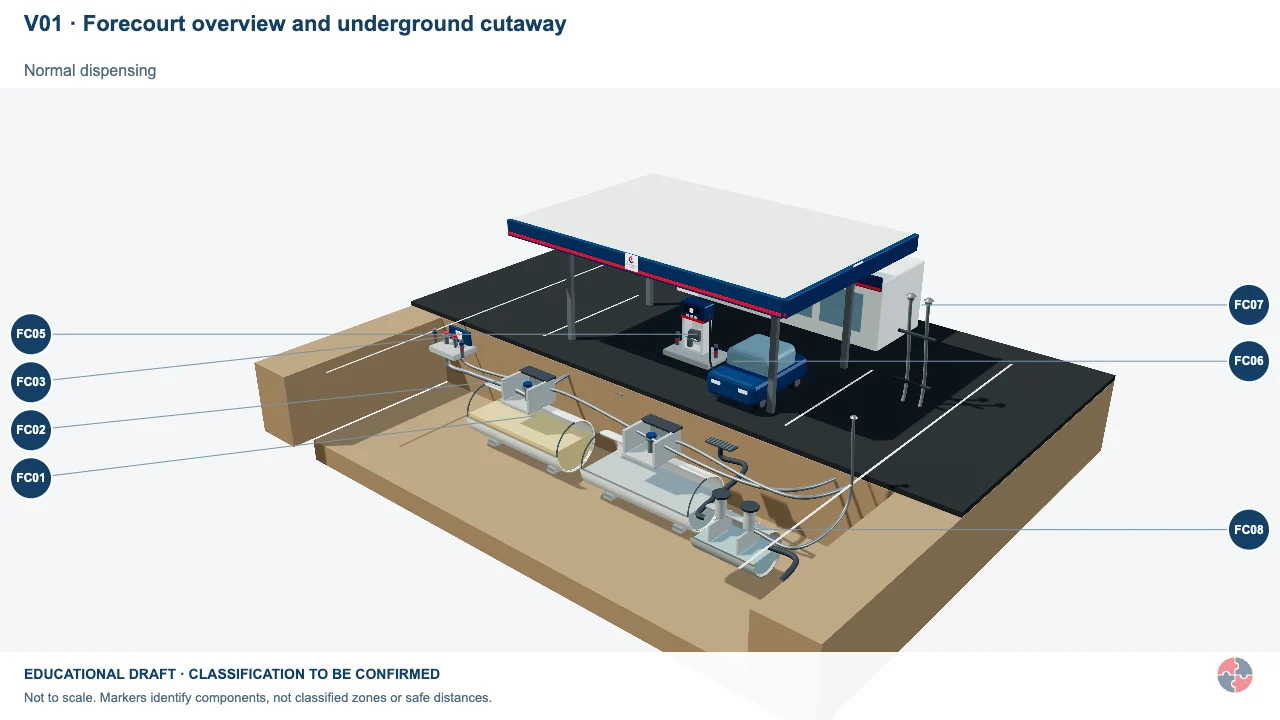
Forecourt overview and underground cutaway
A familiar forecourt contains connected systems above and below ground. Locate each source before considering where an explosive atmosphere could form.
Activity focus: Switch to delivery to inspect the added connection and changed activity.
Contextual workplace scene. Use the task, control and evidence checks in this section; appearance alone does not establish safe conditions, individual health or approval.
Educational illustration, not to scale. Coloured zones are teaching examples, not a site-specific hazardous-area classification.
What do the acronyms and key terms mean?
These terms separate the source, mechanism and decision used in the lesson.
| Term | Full expression | Meaning here |
|---|---|---|
| HSE | Health and Safety Executive | GB regulator and source of L64 guidance. |
| HSENI | Health and Safety Executive for Northern Ireland | NI regulator and separate legal route. |
| Signaller | Authorised person communicating a movement | Uses agreed signals from a protected position. |
| Residual risk | Risk remaining after stronger controls | Reason a sign may still be needed. |
Unlock another resource
You have used this month’s two free downloads. Publish a post in your own words to unlock one more resource, or choose SHARE Individual for 10 downloads per month.
You decide whether to share. If you do, use the relevant platform disclosure tools and do not make claims you do not genuinely hold.