
SHARE Knowledge Hub
Organisational Learning from Incidents and Near Misses
Organisational learning means finding and fixing the conditions that allowed an incident or near miss, then checking whether the fix works across similar work. Record the event, preserve evidence, involve workers, investigate proportionately and close actions against actual control performance; assess GB or Northern Ireland statutory reporting separately from internal learning.
Understanding Organisational Learning from Incidents and Near Misses
Organisational learning means changing risk controls because of evidence from incidents, near misses, weak signals and other sites. An investigation report, toolbox talk or closed action is not proof of learning. The test is whether the relevant barrier is stronger, the change works in real operation and the lesson reaches other exposed work.
Why this matters at work
Investigate selection, load rating and geometry, damage, storage, examination, procurement, lift planning and supervision where evidence supports them. A replacement sling alone does not correct a defective specification or examination system. Check equivalent stock and lifts, document restricted operating conditions and verify suitable equipment and the actual lift method before release. Follow up later demand and defects; a cordon that happened to contain this load is not proof every future dropped-load consequence is controlled.
Triage both actual harm and credible potential. Reconstruct the plausible escalation path using hazardous energy, exposed people, remaining barriers and the circumstances that stopped progression. A serious outcome must be technically credible, not an invented worst case. Record uncertainty explicitly; lack of injury or damage is not proof of low risk. A repeated low-harm event can also indicate a systemic weakness deserving deeper review.
How organisations manage this in practice
For a hypothetical maintenance near miss involving unexpected energisation, Eliminate an unnecessary intervention or design out access to dangerous motion where feasible. Reduce hazardous intervention and energy demands through suitable design and maintenance. Isolate energy using a verified arrangement appropriate to the actual plant and task. Control through suitable guards, safe systems, permits, ownership and checks. Specify the responsible technical/operational role, intended safety function, required performance and a practical acceptance test for each chosen measure.
An incident remedy can itself introduce risk. Review changes to equipment, software, staffing, procedures, suppliers and operating limits under the relevant management-of-change process. Check drawings, training, permits, spares, emergency plans and dependent sites. A temporary bypass or manual check must have explicit scope, monitoring, owner, expiry and escalation. Do not quietly convert it into permanent operation.
Consider immediate conditions and underlying system causes: equipment design, isolation access, identification, maintenance, conflicting instructions, workload, competence and supervision. Select controls that address supported causal paths, such as eliminating unnecessary intervention or improving verified isolation and guarding. PPE and a refresher course cannot reliably stop dangerous motion. Record the intended safety function, accountable owner and a practical acceptance test. Verify implementation before release and sustained performance during later representative work. Emergency stopping, rescue and safe reinstatement are separate recovery arrangements. Assess current national reporting categories independently and investigate similar equipment or tasks for the same weakness.
How can I practise this topic in 3D?


A near-overfill action is closed after a briefing only
All related inspection points 2 across 1 location
Crown Fuels terminal 2 inspection points
Practice in the SHAREhub environment. Browser practice is separate from workplace competence and formal learning records.
What does organisational learning mean in health and safety?
Organisational learning means identifying lessons and embedding them into work, controls, decisions and memory.
Best-practice guide: Organisational Learning from Incidents and Near Misses

What does organisational learning mean in health and safety?
Organisational learning means identifying lessons and embedding them into work, controls, decisions and memory. Organisational learning means finding and fixing the conditions that allowed an incident or near miss, then checking whether the fix works across similar work.
Turn organisational learning from incidents and near misses knowledge into a decision
Organisational learning means finding and fixing the conditions that allowed an incident or near miss, then checking whether the fix works across similar work. Record the event, preserve evidence, involve workers, investigate proportionately and close actions against actual control performance; assess GB or Northern Ireland statutory reporting separately from internal learning. Reporting data
the process operator worked example
Capture: Workers and contractors report near misses, weak signals and unsafe conditions. Evidence / response: Reporting data Classify: Potential severity and barrier impact determine investigation level. Evidence / response: Classification matrix
A closed action may leave the same exposure
An investigation stops at an individual error and misses work conditions. A reminder leaves the failed guard, layout or work process unchanged. People face the same harm route because effectiveness was never checked. Use the full topic for the detailed mechanism, task limits and source scope.
Choose controls for organisational learning from incidents and near misses
Pedestrian narrowly missed by reversing vehicle: Eliminate shared reversing by redesigning delivery; use one-way routes and segregated pedestrian paths. Near miss during chemical isolation or maintenance: Remove the need to open the system where feasible; engineer locked isolation and prove zero energy or containment before access. Separate and engineer: Eliminate the wet-cleaning/pedestrian overlap by rescheduling or using a dry method where suitable. Read the full control table for qualifications, ownership and verification. Use the actual task and applicable jurisdiction; existing technical approval remains unchanged.
Use the full organisational learning from incidents and near misses lesson
Use the full topic for the decision points, practical examples, detailed control tables and source scope. HSE guidance applies to Great Britain; use HSENI for the Northern Ireland route and the source’s stated jurisdiction. A simplified guide does not change the page’s technical-review or approval status.

Read all six steps as text
1. What does organisational learning mean in health and safety?
Organisational learning means identifying lessons and embedding them into work, controls, decisions and memory.
- Avoid / redesign: Eliminate shared reversing by redesigning delivery; use one-way routes and segregated pedestrian paths.
- Control the task: Eliminate the wet-cleaning/pedestrian overlap by rescheduling or using a dry method where suitable.
- Verify before release: Stop reversing or pedestrian access if barrier, visibility or agreed traffic route fails; reopen after physical control and briefing are verified.
Organisational learning means identifying lessons and embedding them into work, controls, decisions and memory. Organisational learning means finding and fixing the conditions that allowed an incident or near miss, then checking whether the fix works across similar work.
Apply it: Which part of this plan would you check at the workface before authorising the task?
2. Turn organisational learning from incidents and near misses knowledge into a decision
Use the evidence to improve the actual work arrangement.
- Change at source: Eliminate shared reversing by redesigning delivery; use one-way routes and segregated pedestrian paths.
- Make it observable: Stop reversing or pedestrian access if barrier, visibility or agreed traffic route fails; reopen after physical control and briefing are verified.
- Keep useful evidence: Reporting data
Organisational learning means finding and fixing the conditions that allowed an incident or near miss, then checking whether the fix works across similar work. Record the event, preserve evidence, involve workers, investigate proportionately and close actions against actual control performance; assess GB or Northern Ireland statutory reporting separately from internal learning. Reporting data
Apply it: What evidence would show that the change improves this task, rather than only completing a record?
3. the process operator worked example
Example: a practical application of the existing topic lesson.
- Capture: Workers and contractors report near misses, weak signals and unsafe conditions.
- Classify: Potential severity and barrier impact determine investigation level.
- Investigate: Root cause and human factors are reviewed.
Capture: Workers and contractors report near misses, weak signals and unsafe conditions. Evidence / response: Reporting data Classify: Potential severity and barrier impact determine investigation level. Evidence / response: Classification matrix
Apply it: At which point would you hold this example, and what evidence would allow it to proceed?
4. A closed action may leave the same exposure
Connect the task, the route to the person and the control that can fail.
- Weak finding: An investigation stops at an individual error and misses work conditions.
- Weak action: A reminder leaves the failed guard, layout or work process unchanged.
- Repeat event: People face the same harm route because effectiveness was never checked.
An investigation stops at an individual error and misses work conditions. A reminder leaves the failed guard, layout or work process unchanged. People face the same harm route because effectiveness was never checked. Use the full topic for the detailed mechanism, task limits and source scope.
Apply it: Where is this harm route present in the actual work, and which control breaks it before anyone is exposed?
5. Choose controls for organisational learning from incidents and near misses
Start with the stronger practicable options and verify their effect.
- Pedestrian narrowly missed by reversing vehicle: Eliminate shared reversing by redesigning delivery; use one-way routes and segregated pedestrian paths.
- Near miss during chemical isolation or maintenance: Remove the need to open the system where feasible; engineer locked isolation and prove zero energy or containment before access.
- Separate and engineer: Eliminate the wet-cleaning/pedestrian overlap by rescheduling or using a dry method where suitable.
Pedestrian narrowly missed by reversing vehicle: Eliminate shared reversing by redesigning delivery; use one-way routes and segregated pedestrian paths. Near miss during chemical isolation or maintenance: Remove the need to open the system where feasible; engineer locked isolation and prove zero energy or containment before access. Separate and engineer: Eliminate the wet-cleaning/pedestrian overlap by rescheduling or using a dry method where suitable. Read the full control table for qualifications, ownership and verification. Use the actual task and applicable jurisdiction; existing technical approval remains unchanged.
Apply it: Which stronger option can be used here, and who will verify it before accepting the remaining risk?
6. Use the full organisational learning from incidents and near misses lesson
Follow the official sources below and retain the task-specific evidence.
- Official guidance: Investigating accidents and incidents, HSG245
- Official guidance: Managing for health and safety, HSG65
- Task decision: Reporting data
Use the full topic for the decision points, practical examples, detailed control tables and source scope. HSE guidance applies to Great Britain; use HSENI for the Northern Ireland route and the source’s stated jurisdiction. A simplified guide does not change the page’s technical-review or approval status.
Apply it: Which official source and full-topic section will you use to resolve the next decision?
HSE describes a learning organisation as one that values learning from its own experience, looks outside itself for lessons and avoids complacency. The practical difference between passive learning and active learning is vital. Passive learning identifies lessons and files them. Active learning changes procedures, engineering, competence, procurement, supervision, audit questions, emergency drills and leadership decisions.Investigating accidents and incidents, HSG245 Managing for health and safety, HSG65
Near misses are especially valuable because they reveal control weaknesses before harm occurs. In process safety, a small leak, alarm flood, wrong line-up, bypassed interlock or incomplete handover may be a warning about a major accident pathway. A strong system therefore classifies events not only by actual harm, but by credible potential consequence and barrier degradation.
The core question is: what did this event tell us about the health of the system? If the answer is only 'the worker made a mistake', the organisation has learned very little. A deeper review asks what made the error likely, what barriers failed, why the action was reasonable to the person at the time, what weak signals existed and why earlier learning did not prevent recurrence.
| Stage | Purpose | Failure mode |
|---|---|---|
| Report | Capture incidents, near misses, unsafe conditions and weak signals. | People only report injuries or blameworthy events.Investigating accidents and incidents, HSG245 Managing for health and safety, HSG65 |
| Classify | Prioritise by actual and potential severity, barrier impact and recurrence. | High-potential near misses treated as minor.Investigating accidents and incidents, HSG245 Managing for health and safety, HSG65 |
| Investigate | Understand immediate, underlying and system causes. | Investigation stops at human error.Investigating accidents and incidents, HSG245 Managing for health and safety, HSG65 |
| Decide | Select controls that match the failure pathway. | Actions are awareness briefings only.Investigating accidents and incidents, HSG245 Managing for health and safety, HSG65 |
| Share | Communicate learning to those who can use it. | Lessons emailed but not discussed.Investigating accidents and incidents, HSG245 Managing for health and safety, HSG65 |
| Verify | Check actions are completed and effective. | Actions closed because documents were updated.Investigating accidents and incidents, HSG245 Managing for health and safety, HSG65 |
| Remember | Keep learning alive despite staff changes and time. | Corporate memory depends on one experienced person.Investigating accidents and incidents, HSG245 Managing for health and safety, HSG65 |
HSE Learning organisations directly supports the learning-organisation concepts used here; the task examples are SHARE teaching applications.
What does the incident learning loop look like?
The learning loop should connect each event to control improvement, verification and changes to the wider management system.
A useful learning-loop model is: event -> report -> triage -> investigate -> identify weak controls -> action -> verify -> communicate -> update risk profile, training and audit. The important point is that the loop does not end when the report is issued. It ends only when the organisation has changed something meaningful and checked that the change works.Investigating accidents and incidents, HSG245
In a mature system, the loop also feeds sideways and upward. Sideways means similar teams, sites and contractors receive the learning before the same weakness appears elsewhere. Upward means senior leaders see themes, repeated weak controls, overdue actions and resource gaps. Downward means workers see that reporting creates change, which improves trust and future reporting.
| Loop stage | What should happen | Common failure |
|---|---|---|
| Event | Incident, near miss, unsafe condition, audit finding or weak signal occurs. | Only injury events are treated as learning opportunities.Investigating accidents and incidents, HSG245 |
| Report | Workers can report quickly without fear or complex barriers. | Reports are delayed, filtered or discouraged.Investigating accidents and incidents, HSG245 |
| Triage | Potential consequence, recurrence and barrier impact determine priority. | Actual harm alone determines investigation level.Investigating accidents and incidents, HSG245 |
| Investigate | Facts, timeline, task, human factors and barrier condition are examined. | Investigation starts with blame or a preferred answer.Investigating accidents and incidents, HSG245 |
| Identify weak controls | Find which controls were absent, weak, bypassed, misunderstood or unverified. | Focus remains on what the person did wrong.Investigating accidents and incidents, HSG245 |
| Action | Actions strengthen design, process, competence, supervision or assurance. | Actions are generic reminders or repeated training.Investigating accidents and incidents, HSG245 |
| Verify | Someone checks the action is implemented and effective in real work. | Actions are closed when a document is uploaded.Investigating accidents and incidents, HSG245 |
| Communicate | Learning reaches workers, supervisors, contractors and similar risk owners. | Lessons are emailed but not translated into task-level understanding.Investigating accidents and incidents, HSG245 |
| Update systems | Risk profile, training, audits, procedures and standards are updated. | The event report sits outside the management system.Investigating accidents and incidents, HSG245 |
What should a learning-loop tracker capture?
A learning-loop tracker shows whether the organisation has learned, not merely whether an action has been marked closed.
Action closure is not the same as learning. A close-out date may prove that somebody edited a procedure, delivered a briefing or bought a piece of equipment. Learning requires evidence that the underlying weakness has been changed, that the action works in real operations and that the same weakness has been checked elsewhere.Investigating accidents and incidents, HSG245 Managing for health and safety, HSG65
For serious and high-potential events, the tracker should be reviewed by people with enough authority to challenge weak actions. If the action does not remove or control the system cause, it should not be accepted as learning.
| Tracker field | What to record | Quality test |
|---|---|---|
| Event | Incident, near miss, weak signal, audit finding or external learning source. | Is the event described clearly enough for others to understand the risk?Investigating accidents and incidents, HSG245 Managing for health and safety, HSG65 |
| Immediate cause | The visible failure or local trigger. | Does it avoid stopping at blame or vague human error?Investigating accidents and incidents, HSG245 Managing for health and safety, HSG65 |
| System cause | The deeper condition: design, workload, competence, supervision, interface, MOC or assurance weakness. | Would fixing this reduce recurrence?Investigating accidents and incidents, HSG245 Managing for health and safety, HSG65 |
| Action | Specific change to control, design, process, competence, resource or assurance. | Does the action match the system cause?Investigating accidents and incidents, HSG245 Managing for health and safety, HSG65 |
| Owner | Named person with authority to deliver the action. | Can the owner change the control, not just request it?Investigating accidents and incidents, HSG245 Managing for health and safety, HSG65 |
| Verification | Evidence that the action has been implemented in the workface. | Has somebody checked the real task or barrier?Investigating accidents and incidents, HSG245 Managing for health and safety, HSG65 |
| Effectiveness review | Later check that the weakness has reduced and no new failure route has appeared. | Is there observation, data, audit or worker feedback?Investigating accidents and incidents, HSG245 Managing for health and safety, HSG65 |
| Embedded learning | Procedure, training, design standard, risk profile, procurement or audit change. | Will the learning survive staff turnover and time?Investigating accidents and incidents, HSG245 Managing for health and safety, HSG65 |
Illustrative alarm action. Hold tanker transfer after a failed high-level response. The instrumentation lead owns correction; record the actual due date, risk rank, interim restriction and escalation to the operations manager if overdue. The acceptance criterion is the equipment-specific approved function test, witnessed by the named competent verifier; repair completion alone does not release transfer. Check comparable assets and record independent acceptance and the later dated effectiveness review. A failed later check reopens the action and restores the restriction.
What is the difference between passive and active organisational learning?
Passive learning notices a lesson; active learning embeds that lesson into controls, competence, design and assurance.
What is the difference between passive and active organisational learning?


Read the complete visual as text
- Passive learning notices a lesson; active learning embeds that…: Passive learning notices a lesson; active learning embeds that lesson into controls, competence, design and assurance.
- This distinction is central to a mature learning organisation.…: This distinction is central to a mature learning organisation. Passive learning looks respectable because reports are written, presentations are delivered and action trackers are updated. But if the same failure route still exists, the organisation has not learned in an operational sense. It has only stored information. Investigating accidents and incidents, HSG245 Managing for health and safety, HSG65
- Active learning changes the conditions that allowed the event.…: Active learning changes the conditions that allowed the event. A permit error may require procedure redesign, clearer isolation certificates, better supervision, competence assessment and audit sampling. A near miss with a reversing vehicle may require layout change, segregation, briefing, driver authorisation, delivery booking and management checks. A process alarm issue may require cause-and-effect review, alarm rationalisation, proof testing and operator response drills.
This distinction is central to a mature learning organisation. Passive learning looks respectable because reports are written, presentations are delivered and action trackers are updated. But if the same failure route still exists, the organisation has not learned in an operational sense. It has only stored information.Investigating accidents and incidents, HSG245 Managing for health and safety, HSG65
Active learning changes the conditions that allowed the event. A permit error may require procedure redesign, clearer isolation certificates, better supervision, competence assessment and audit sampling. A near miss with a reversing vehicle may require layout change, segregation, briefing, driver authorisation, delivery booking and management checks. A process alarm issue may require cause-and-effect review, alarm rationalisation, proof testing and operator response drills.
| Learning feature | Passive learning | Active learning |
|---|---|---|
| Report quality | Narrative says what happened. | Report explains barrier failure, context and system causes.Investigating accidents and incidents, HSG245 Managing for health and safety, HSG65 |
| Action type | Reminder, toolbox talk or procedure reissue. | Control redesign, engineering change, supervision change or assurance change.Investigating accidents and incidents, HSG245 Managing for health and safety, HSG65 |
| Communication | Email or noticeboard message. | Targeted conversation with people who perform or manage the task.Investigating accidents and incidents, HSG245 Managing for health and safety, HSG65 |
| Competence | Training attendance recorded. | Task competence, scenario response and supervisor checks verified.Investigating accidents and incidents, HSG245 Managing for health and safety, HSG65 |
| Corporate memory | Report stored in database. | Learning built into standards, procurement, design reviews and audits.Investigating accidents and incidents, HSG245 Managing for health and safety, HSG65 |
| Verification | Action closed when uploaded. | Effectiveness checked through observation, sampling and repeat-event review.Investigating accidents and incidents, HSG245 Managing for health and safety, HSG65 |
HSE Learning organisations directly supports the learning-organisation concepts used here; the task examples are SHARE teaching applications.
Why do organisations often fail to learn?
Organisations often fail to learn because the lesson does not survive blame, weak actions, poor verification or poor communication.
Failure to learn is rarely because no one wrote a report. It is usually because the report did not change the risk controls that mattered. Investigations may stop at immediate causes, actions may be too weak, managers may close actions without evidence, similar sites may never hear the lesson, or leadership may focus on whether the event is reportable instead of what it reveals about the system.Investigating accidents and incidents, HSG245 Introduction to human factors
This is why organisational learning needs governance. Serious and high-potential events should be reviewed for action quality, recurrence, barrier relevance and verification. Leaders should ask whether the same theme appears in audits, inspections, health surveillance, near misses, maintenance backlog, complaints or contractor performance.
| Pattern | What it looks like | Better management response |
|---|---|---|
| Blame response | The event is explained as carelessness or failure to follow rules. | Review job design, supervision, incentives, procedure usability and system conditions.Investigating accidents and incidents, HSG245 Introduction to human factors |
| Weak action | Briefing, poster or refresher training is used for every finding. | Select stronger controls that match the failed barrier or risk pathway.Investigating accidents and incidents, HSG245 Introduction to human factors |
| No verification | Actions are closed by the person who completed the task. | Require independent or supervisor verification in real work.Investigating accidents and incidents, HSG245 Introduction to human factors |
| Poor data quality | Incident categories are inconsistent and near misses are under-reported. | Improve definitions, triage, reporting ease and data review.Investigating accidents and incidents, HSG245 Introduction to human factors |
| Repeated near misses | Same theme appears in different language across sites. | Trend themes and escalate as system weakness.Investigating accidents and incidents, HSG245 Introduction to human factors |
| Lesson trapped locally | The team involved learns, but similar teams do not. | Use cross-site learning briefs, audit prompts and standard updates.Investigating accidents and incidents, HSG245 Introduction to human factors |
| External denial | Leaders assume major accidents elsewhere are not relevant. | Run local vulnerability reviews against external learning.Investigating accidents and incidents, HSG245 Introduction to human factors |
| Corporate memory decay | Learning disappears when experienced staff leave. | Embed lessons into procedures, competence, design rules and management review.Investigating accidents and incidents, HSG245 Introduction to human factors |
How does human performance affect this work?
Use the overview to move from a description of the last action towards questions about the work system. Compare the evidence for each explanation and identify an improvement whose effectiveness can be checked.
Select any box to open its explanation below. You can also use the grouped text headings. Several explanations can stay open for comparison.
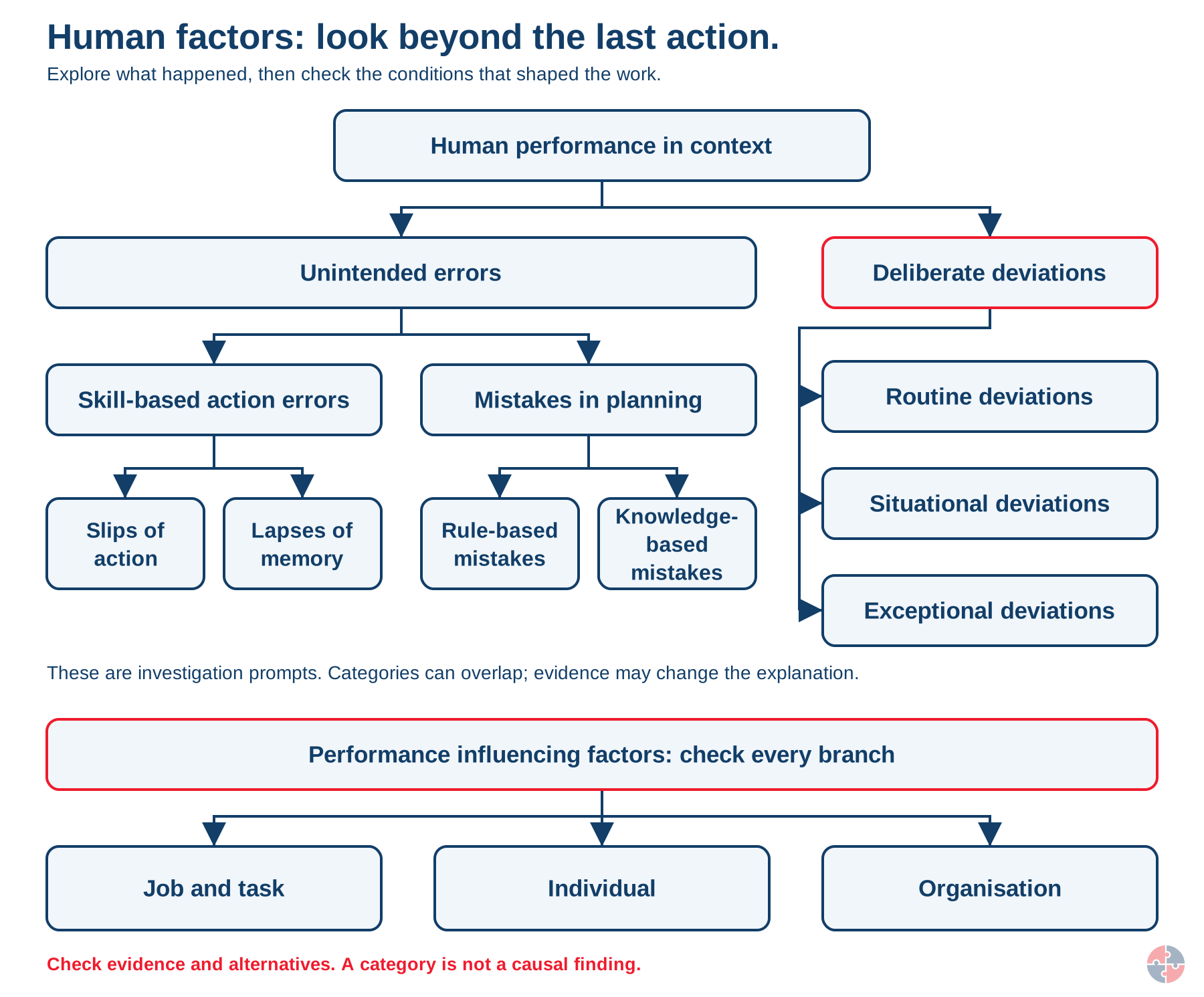
Original SHARElearn teaching overview. Arrows show groupings, not a causal sequence. Examples are fictional; no box establishes an actual cause, diagnosis or responsibility.
Inspect the full-size overview (new tab)
Start with the work context
Human performance in context
Human factors considers how the job, the individual and the organisation interact. A human action is a starting point for inquiry, not a complete explanation.
Fictional example: A pump control is operated incorrectly. The team examines what the operator could see, the control layout and the work arrangements.
Investigate and improve: Reconstruct the information and options available at the time. Ask what made the action understandable and what would prevent or tolerate it.
Unintended errors
An action or decision goes wrong without an intended departure from the expected method. Distinguish doing the wrong action from choosing an unsuitable plan.
Fictional example: A person intends to stop pump A but presses the adjacent control for pump B.
Investigate and improve: An outcome alone does not establish intent. Compare the person’s account, task sequence, equipment and available records; retain uncertainty.
Unintended errors: actions and decisions
Skill-based action errors
A familiar task is intended correctly but its execution goes wrong through a slip or lapse. Experienced people can be affected.
Fictional example: A routine restart is interrupted and the person resumes at the wrong point.
Investigate and improve: Examine distractions, task design and place-keeping aids. Repeating training alone does not remove the conditions that permit these errors.
Slips of action
The intended action is clear, but a different action is performed.
Fictional example: While reaching to stop a pump, a person operates a similar-looking neighbouring switch.
Investigate and improve: Check control spacing, identification, feedback, visibility and interruption. Consider clearer separation or error-tolerant design, with competent review and testing.
Lapses of memory
A needed step is forgotten or the person loses their place.
Fictional example: After an interruption, a person omits a required check while believing the sequence is complete.
Investigate and improve: Check the interruption and restart arrangements. Consider point-of-use prompts, reliable step records and proportionate independent checks for critical steps.
Mistakes in planning or judgement
The chosen action is carried out as intended, but the plan or judgement is unsuitable.
Fictional example: A person selects a familiar response to a warning, believing it fits the present conditions.
Investigate and improve: Check what was known, what the rule covered and how the situation was understood. Consider information, decision support and task-specific competence.
Rule-based mistakes
A remembered rule is misapplied, or an unsuitable rule is used. An apparently missing good rule also needs inquiry: was it known, understood and applicable?
Fictional example: A response suitable for pump A is applied to pump B even though their isolation requirements differ.
Investigate and improve: Inspect the actual procedure and its scope, access and revision. Explore interpretation. Missing a step does not by itself prove a deliberate deviation.
Knowledge-based mistakes
An unfamiliar situation is approached through reasoning without a suitable established solution; the resulting judgement is wrong.
Fictional example: An unusual pump condition is interpreted using incomplete information, leading to an inappropriate response.
Investigate and improve: Examine information gaps and available support. Improve escalation, diagnostic aids and arrangements for obtaining competent advice before uncertain work proceeds.
Deliberate deviations: understand why
Deliberate deviations / violations
A rule or procedure is knowingly departed from. The departure is intentional; harm need not be intended. Establish this distinction through evidence.
Fictional example: A required verification is knowingly bypassed to continue a task.
Investigate and improve: Ask why the rule was bypassed, whether it was workable and what the organisation encouraged or tolerated. Fair accountability and system improvements can both be needed.
Routine deviations
Departures become the usual way work is carried out.
Fictional example: A team commonly skips a required handover check and supervisors accept the practice.
Investigate and improve: Compare written arrangements with everyday work, including management knowledge and response. Make the safe method workable and verify that practice changes.
Situational deviations
A departure is associated with conditions such as time pressure, insufficient resources or unsuitable equipment. These conditions do not authorise unsafe work.
Fictional example: The correct equipment is unavailable and a deadline encourages an improvised shortcut.
Investigate and improve: Check resources, conflicting targets and whether people can stop and escalate. Remove the pressure or constraint rather than treating the shortcut as the solution.
Exceptional deviations
A departure occurs in unusual circumstances outside normal practice. This label is not an automatic justification.
Fictional example: During an unfamiliar equipment upset, a person knowingly bypasses a rule while trying to restore operation.
Investigate and improve: Reconstruct the situation and information available. Review abnormal-event preparation, support, escalation and protection; do not infer malicious intent from the outcome.
Check factors across every branch
Performance influencing factors
Conditions affecting performance can sit within the job, the individual or the organisation. Consider them across errors and deviations.
Fictional example: A difficult control layout combines with an interrupted shift and a production target.
Investigate and improve: Identify specific conditions, their evidence and how they interacted. Do not turn a list of factors into unsupported causal conclusions.
Job and task factors
Consider the work itself: equipment, interface design, instructions, workload, environment, timing and communication.
Fictional example: Two similar controls are poorly lit while alarms and interruptions compete for attention.
Investigate and improve: Observe representative work safely, compare intended and actual demands, and test feasible design changes with the people doing the task.
Individual factors
Consider relevant knowledge, experience, abilities and current needs fairly. Observed behaviour does not establish a health diagnosis or intent.
Fictional example: A newly assigned worker does not understand an unfamiliar alarm; a colleague also reports yawning after a long shift.
Investigate and improve: Check induction, understanding, shift and welfare information through appropriate private routes. Yawning alone proves neither fatigue nor the cause of an event; seek competent support when needed.
Organisational factors
Consider staffing, resources, supervision, targets, planning, culture, change management and learning from earlier events.
Fictional example: A known leak remains open because repair responsibility is unclear and closure is recorded without checking the work.
Investigate and improve: Trace decisions, ownership and earlier warnings. Improve the underlying arrangements and verify effectiveness, rather than closing the investigation at “operator error”.
Try the evidence questions
Choose one fictional pump or travel example. What is observed, what remains a hypothesis, which job or organisational factor needs checking, and what improvement would you test? Explain what evidence would change your view.
Explore at your own pace. These are optional thinking prompts: this page does not save answers, assess performance or create a learning record.
Sources and scope
Original SHARElearn overview informed by HSE guidance. The diagram groups concepts for learning; it does not model a causal sequence. Guidance checked 1 November 2026.
Continue with the incident and accident investigation course. The course outline explains its learning, optional reflections and completion requirements.
How should weak signals and corporate memory be protected?
Weak signals should be treated as early warning data, and corporate memory should be built into systems rather than left in people's heads.
Weak signals are small pieces of information that suggest risk is drifting before a serious event occurs. They may appear as repeated minor defects, awkward workarounds, inconsistent permit quality, nuisance alarms, temporary repairs, late maintenance, low near-miss reporting, contractor uncertainty or worker comments that something no longer feels right. HSE's learning-organisation guidance emphasises chronic unease and amplification of weak signals because smooth-looking operations can still be carrying hidden risk.Investigating accidents and incidents, HSG245 Introduction to human factors
Corporate memory is fragile. It can be lost through retirements, contractorisation, restructuring, staff turnover or over-reliance on one experienced person. Strong organisations convert memory into accessible standards, training, drawings, operating limits, scenario libraries, investigation themes, design rules, maintenance histories and management-review prompts.
| Learning risk | What it looks like | How to protect learning |
|---|---|---|
| Repeated minor defects | Same issue appears across shifts or sites but is closed locally. | Trend defects and review common system causes.Investigating accidents and incidents, HSG245 Introduction to human factors |
| Nuisance alarms | Operators routinely ignore, shelve or work around alarms. | Review alarm rationalisation, response logic and training.Investigating accidents and incidents, HSG245 Introduction to human factors |
| Maintenance drift | Temporary fixes remain in place or backlog grows quietly. | Escalate overdue safety-critical work and verify barrier health.Investigating accidents and incidents, HSG245 Introduction to human factors |
| Contractor knowledge loss | External teams do not know site history or abnormal risks. | Use bridging documents, induction, permit checks and learning briefs.Investigating accidents and incidents, HSG245 Introduction to human factors |
| Retirement or turnover | Critical know-how leaves with experienced workers. | Capture knowledge in procedures, scenario training and handover packs.Investigating accidents and incidents, HSG245 Introduction to human factors |
| Low reporting | Few near misses from high-risk work. | Test trust, ease of reporting and supervisor response.Investigating accidents and incidents, HSG245 Introduction to human factors |
| External accident denial | Leaders say 'that could not happen here'. | Run vulnerability reviews against major accident lessons.Investigating accidents and incidents, HSG245 Introduction to human factors |
HSE Learning organisations directly supports the learning-organisation concepts used here; the task examples are SHARE teaching applications.
How should external major accident learning be used?
External events should be tested against local vulnerability instead of being treated as interesting history.
For Diploma and process safety learners, external learning is a professional discipline. Major accidents such as Flixborough, Bhopal, Texas City, Buncefield and Anacortes are not there to memorise dates. They help organisations ask whether similar patterns exist locally: uncontrolled change, weak permit systems, poor start-up discipline, alarm and instrumentation weaknesses, contractor interfaces, fatigue, poor emergency planning or failure to learn from previous warnings.Investigating accidents and incidents, HSG245 Managing for health and safety, HSG65
The practical test is not 'have we briefed the lesson?' but 'have we checked whether the same failure route could occur here?' That requires scenario review, barrier mapping, audit sampling, maintenance and proof-test checks, operator interviews and evidence that any gaps are closed.
| External learning theme | Local question to ask | Evidence expected |
|---|---|---|
| Management of change | Could a technical or organisational change bypass our review process? | MOC sample, change-risk assessment and close-out evidence.Investigating accidents and incidents, HSG245 Managing for health and safety, HSG65 |
| Start-up and abnormal operations | Are start-up hazards understood and supervised? | Start-up procedure, competence checks and control-room evidence.Investigating accidents and incidents, HSG245 Managing for health and safety, HSG65 |
| Alarm response | Do operators know what action follows a critical alarm? | Cause-and-effect logic, drills and alarm review.Investigating accidents and incidents, HSG245 Managing for health and safety, HSG65 |
| Permit and isolation | Could work start with incomplete isolation or unclear authority? | Permit audit, isolation certificate and field verification.Investigating accidents and incidents, HSG245 Managing for health and safety, HSG65 |
| Contractor interface | Do contractors understand site major accident hazards? | Induction, bridging document and supervision record.Investigating accidents and incidents, HSG245 Managing for health and safety, HSG65 |
| Emergency response | Would escalation, evacuation and communication work in real time? | Exercise report, action tracker and role competence.Investigating accidents and incidents, HSG245 Managing for health and safety, HSG65 |
For named historical events, distinguish the investigation finding from the local lesson. CSB Texas City investigation and CSB Anacortes investigation are the US primary investigation routes; HSG245 (2004) is an investigation method, not an account of these later events. Use the listed Buncefield investigation for Buncefield. For each proposed transfer record the precise finding, local equipment/organisational similarity and evidence required before adopting a measure. US findings are not UK law; remaining named-case source-to-lesson mapping needs technical review.
How should incidents and near misses be classified?
Events should be classified by potential consequence, barrier failure, recurrence and learning value, not only injury outcome.
A low-injury event may still be a major warning. A dropped spanner that misses someone, a flammable vapour detector alarm, a damaged lifting accessory found before use or a wrong valve alignment corrected at the last second may all be high learning value events. The classification system should help managers see what could have happened if one more barrier had failed.Investigating accidents and incidents, HSG245 RIDDOR reporting
For process safety, classification should connect to the hazardous inventory and scenario: loss of containment, fire, explosion, toxic release, overpressure, runaway reaction, confined atmosphere or environmental release. For general health and safety, it should connect to fatal and serious harm potential, chronic health risk, vulnerability, recurrence and legal reporting.
| Classification lens | Question to ask | Example |
|---|---|---|
| Actual consequence | What harm or loss occurred? | First-aid injury or plant damage.Investigating accidents and incidents, HSG245 |
| Potential consequence | What could credibly have happened? | Forklift near miss with pedestrian in blind corner.Investigating accidents and incidents, HSG245 |
| Barrier impact | Which prevention, detection or mitigation barrier failed? | Gas detector alarm ignored or isolation not proved.Investigating accidents and incidents, HSG245 |
| Recurrence | Has this happened before in another form? | Repeated permit quality findings.Investigating accidents and incidents, HSG245 |
| Weak signal | Does it suggest drift or normalisation? | Operators routinely bypass an alarm because it is noisy.Investigating accidents and incidents, HSG245 |
| Learning value | Who else needs to know? | Similar sites, contractors or shift teams.Investigating accidents and incidents, HSG245 |
For the actual task hazard, HSE places elimination first, then substitution, engineering controls, administrative controls and suitable PPE for residual risk. Record why a higher control is not practicable and how the chosen measure is checked in use. HSE hierarchy of controls
| Material task hazard | Eliminate, substitute and engineer | Selection, owner and performance check | Failure, stop and direct sources |
|---|---|---|---|
| Pedestrian narrowly missed by reversing vehicle | Eliminate shared reversing by redesigning delivery; use one-way routes and segregated pedestrian paths. Barrier and gate the conflict point before relying on banksmen or hi-vis. | Transport owner walks the route with drivers and pedestrians; commissions segregation, checks barriers and route before shift, audits near misses. | Stop reversing or pedestrian access if barrier, visibility or agreed traffic route fails; reopen after physical control and briefing are verified. Workplace traffic Investigating accidents and incidents, HSG245 |
| Near miss during chemical isolation or maintenance | Remove the need to open the system where feasible; engineer locked isolation and prove zero energy or containment before access. | Technical owner checks incident sequence, permit, isolation test and similar assets; independently verifies corrective action before next job. | Pause affected tasks for unknown isolation state or repeat weak signal; escalate technical review instead of closing on retraining alone. Investigating accidents and incidents, HSG245 Introduction to human factors The safe isolation of plant and equipment, HSG253 |
| Repeated near misses on a smooth floor left wet after cleaning | Eliminate the wet-cleaning/pedestrian overlap by rescheduling or using a dry method where suitable. Dry the floor and physically exclude people until safe; signs, footwear and reminders are residual controls, not a substitute for a dry route. | Facilities owner checks the cleaning method and floor condition, records repeat events, tests the barrier and dry-floor release with cleaners and pedestrians, and samples other shifts. | Close the route immediately when wet or inadequately segregated; reopen only after drying and a physical walk-through confirms safe access.Investigating accidents and incidents, HSG245 HSE risk assessment Consulting employees Slips during cleaning Investigating accidents and incidents, HSG245 |
How can a near miss reveal major accident risk?
A near-miss example shows how learning should move from local fix to barrier review.
How can a near miss reveal major accident risk? — part 1 of 2


Read the complete visual as text
- A near-miss example shows how learning should move from…: A near-miss example shows how learning should move from local fix to barrier review.
- During tanker unloading at a fuel terminal, a high-level…: During tanker unloading at a fuel terminal, a high-level alarm sounds briefly and clears. The transfer is stopped, but the shift treats it as a nuisance instrument problem because no spill occurred. Maintenance finds a sticky level transmitter, replaces it and closes the job. A stronger learning system asks what would have happened if the independent high-level protection had also failed, whether operators understood response time, whether similar tanks have the same failure mode and whether Buncefield-type overfill learning is still embedded. Investigating accidents and incidents, HSG245 Buncefield investigation and fuel-storage reports Large-tank high-level system safety alert
How can a near miss reveal major accident risk? — part 2 of 2


Read the complete visual as text
- The event is not only an instrument defect. It…: The event is not only an instrument defect. It is a test of alarm response, proof testing, maintenance backlog, operating discipline, management review and corporate memory. That is the difference between fixing the fault and learning from the event.
- Treat the unloading alarm as a potentially degraded overfill…: Treat the unloading alarm as a potentially degraded overfill barrier. Pause the affected transfer route, preserve the alarm and test history, and ask engineering to establish whether the instrument, response process and comparable tanks remain dependable. A repair alone is not release: the technical owner verifies barrier function, operations tests the response under the revised method, and the manager checks that similar sites received and acted on the lesson before closing it. Investigating accidents and incidents, HSG245
During tanker unloading at a fuel terminal, a high-level alarm sounds briefly and clears. The transfer is stopped, but the shift treats it as a nuisance instrument problem because no spill occurred. Maintenance finds a sticky level transmitter, replaces it and closes the job. A stronger learning system asks what would have happened if the independent high-level protection had also failed, whether operators understood response time, whether similar tanks have the same failure mode and whether Buncefield-type overfill learning is still embedded.Investigating accidents and incidents, HSG245 Buncefield investigation and fuel-storage reports Large-tank high-level system safety alert
The event is not only an instrument defect. It is a test of alarm response, proof testing, maintenance backlog, operating discipline, management review and corporate memory. That is the difference between fixing the fault and learning from the event.
Treat the unloading alarm as a potentially degraded overfill barrier. Pause the affected transfer route, preserve the alarm and test history, and ask engineering to establish whether the instrument, response process and comparable tanks remain dependable. A repair alone is not release: the technical owner verifies barrier function, operations tests the response under the revised method, and the manager checks that similar sites received and acted on the lesson before closing it. Investigating accidents and incidents, HSG245
The linked large-tank alert concerns particular TAV level-switch installation/test arrangements. It is not a universal validation method for every transmitter; use the broader Buncefield evidence for general overfill lessons and equipment-specific competent instructions for the actual test. Do not copy historical temporary measures into a generic restart instruction.
What evidence shows organisational learning is working?
Evidence should show lessons are implemented, verified and retained, not merely identified.
Follow one near miss from report to potential-consequence classification, investigation, stronger action and field verification. Then check a comparable asset or site for the same weakness. An action marked complete after a briefing is not evidence that an alarm, barrier or decision route now performs as intended. Investigating accidents and incidents, HSG245
| Evidence | What it should show | What to challenge |
|---|---|---|
| Reporting data | Near misses, weak signals and incidents are captured across sites and teams. | No near misses in high-risk work may indicate under-reporting.Investigating accidents and incidents, HSG245 Managing for health and safety, HSG65 |
| Classification criteria | Potential severity and barrier degradation influence investigation level. | Only actual injury drives priority.Investigating accidents and incidents, HSG245 Managing for health and safety, HSG65 |
| Investigation quality | Immediate, underlying and system causes are explored. | Actions blame individuals or repeat training.Investigating accidents and incidents, HSG245 Managing for health and safety, HSG65 |
| Action tracker | Actions have owners, due dates, risk ranking and verification evidence. | Actions close by date rather than effectiveness.Investigating accidents and incidents, HSG245 Managing for health and safety, HSG65 |
| Learning briefs | Lessons reach workers, supervisors, contractors and similar sites. | One-way email with no discussion.Investigating accidents and incidents, HSG245 Managing for health and safety, HSG65 |
| Repeat-event review | Recurring themes and weak signals are trended. | Events reviewed in isolation.Investigating accidents and incidents, HSG245 Managing for health and safety, HSG65 |
| Management review | Leaders review serious events, overdue actions and barrier health. | Meeting focuses only on injury rates.Investigating accidents and incidents, HSG245 Managing for health and safety, HSG65 |
What should learners understand about incident learning?
Learners should explain how learning prevents repeat events by changing systems and barriers.
The table gives practical examples, evidence expectations and common decision points so the section can be used for learning, supervision, audit and review.Investigating accidents and incidents, HSG245 Managing for health and safety, HSG65
A near miss with no injury can still reveal failure of a high-consequence barrier. A good analysis tests system conditions such as alarm response, maintenance deferral and workload, then checks a control change in the field. 'Retrain the operator' is too weak unless competence was the cause and the actual barrier has been verified. Investigating accidents and incidents, HSG245
| Topic | Weak answer | Strong answer |
|---|---|---|
| Near miss value | No one was hurt, so it was minor. | The event had high potential and revealed a weak prevention barrier.Investigating accidents and incidents, HSG245 Managing for health and safety, HSG65 |
| Root cause | Operator failed to follow procedure. | Procedure usability, time pressure, supervision, competence and equipment design were reviewed.Investigating accidents and incidents, HSG245 Managing for health and safety, HSG65 |
| Action closure | Training completed. | Competence was assessed in the task and supervisor checks confirmed changed behaviour.Investigating accidents and incidents, HSG245 Managing for health and safety, HSG65 |
| External learning | It happened elsewhere. | The organisation tested whether the same failure pattern could exist locally.Investigating accidents and incidents, HSG245 Managing for health and safety, HSG65 |
| Corporate memory | Report stored in system. | Learning is in standards, training, audits, design rules and leadership review.Investigating accidents and incidents, HSG245 Managing for health and safety, HSG65 |
Which duties support organisational learning?
Check the legal route for the work location and the actual substance or change. Record the control decision, its owner and evidence.
An internal near-miss record and a statutory report are different decisions. Apply the current GB RIDDOR or NI reporting route to the facts, while using the investigation to examine control failure whether or not a report is required. A risk assessment and work method should then be reviewed where the event reveals a credible uncontrolled hazard. Investigating accidents and incidents, HSG245Report an incident
| Jurisdiction | Duty or guidance | Work decision | Direct source |
|---|---|---|---|
| Great Britain | Incident investigation and prevention | Use HSG245 to gather information, analyse causes, choose controls and implement an action plan; the workbook is guidance. | Investigating accidents and incidents, HSG245 |
| Great Britain | Statutory incident reporting | Check reportability under the current GB RIDDOR route; internal recording of a near miss does not itself make every event reportable. | RIDDOR reporting |
| Northern Ireland | Separate statutory reporting | Use HSENI NI RIDDOR 1997 guidance and thresholds; do not import GB 2013 rules. | Report an incident |
| Great Britain and Northern Ireland | Risk-review response | Update workplace risk assessment and verify controls when the event reveals an uncontrolled hazard. | HSE risk assessment HSENI risk assessment |
How should management arrangements verify controls?
Assign an owner, involve workers, check the control in use and act on failures before returning to routine work.
How should management arrangements verify controls?


Read the complete visual as text
- Assign an owner, involve workers, check the control in…: Assign an owner, involve workers, check the control in use and act on failures before returning to routine work.
- HSE’s Plan, Do, Check, Act guidance provides the government…: HSE’s Plan, Do, Check, Act guidance provides the government management route for this topic. Apply it to the actual task, equipment, people and jurisdiction, then keep the verification and corrective-action record. Standards-specific claims are held until their rights and competent review are resolved. HSE Plan, Do, Check, Act
HSE’s Plan, Do, Check, Act guidance provides the government management route for this topic. Apply it to the actual task, equipment, people and jurisdiction, then keep the verification and corrective-action record. Standards-specific claims are held until their rights and competent review are resolved. HSE Plan, Do, Check, Act
What training and awareness helps?
Training should build reporting confidence, investigation skill, just culture and action verification.
Workers need confidence to report a weak signal and take safe interim action. Investigators should practise distinguishing immediate facts from system causes and designing a stronger barrier action. Managers should demonstrate that an action is verified in the field and tested at comparable assets before it is closed. Investigating accidents and incidents, HSG245
| Level | Who and what | Demonstrated competence | Assessor, record and reassessment | Direct source |
|---|---|---|---|---|
| Worker | Operators and contractors — Report near misses, preserve immediate facts and identify stop points. | Demonstrate reporting and a safe interim action on a vehicle near miss. | Supervisor observes and records; repeat when process or reporting route changes. | Investigating accidents and incidents, HSG245 Workplace traffic |
| Investigator | Supervisors and safety representatives — Use HSG245 fact gathering, analysis and action design without blame shortcuts. | Assessor challenges a hypothetical root-cause narrative against evidence. | Investigation lead signs competence and review; refresh after failed action. | Investigating accidents and incidents, HSG245 Introduction to human factors |
| Assurance | Managers and action owners — Test whether source controls work and similar sites are covered. | Independent reviewer samples reopened work and repeat events. | Owner retains verification and overdue-action escalation. | Managing for health and safety, HSG65 Investigating accidents and incidents, HSG245 |
How could Crownway Fuels Ltd manage this in practice?

Crownway Fuels Ltd would turn a local investigation into checked improvements wherever the same weakness could occur.
Crownway Fuels Ltd · practical example
Make a delivery near miss change practice at another site
The key lesson Sharing a lesson is only the start; learning is demonstrated when relevant controls change and their effectiveness is checked.
The situation: A delivery near miss reveals confusion about who confirms the receiving area is ready. Another Crownway site uses a similar arrangement but has reported no event.
Why this matters: Sites can acknowledge a bulletin without recognising that the same underlying weakness exists in their own work.
How Crownway Fuels Ltd would manage it
- Identify the transferable cause — Health and Safety Lead. Use the investigation evidence to explain the failed control and contributing conditions. Separate established findings from assumptions and site-specific details.
- Identify affected operations — Area Operations Manager. Ask each Site Manager whether comparable delivery interfaces exist. Require a reasoned applicability review rather than a standard reply that the bulletin was read.
- Agree the local change — Site Manager. Review the receiving-area decision with staff and contractors. Adapt the necessary responsibilities, communication or physical arrangements to the actual site.
- Confirm implementation — Operations Director. Assign an owner and completion evidence for each affected location. Escalate resource or contractual issues that local managers cannot resolve.
- Test the lesson — Health and Safety Lead. Sample later delivery arrangements, speak to workers and review relevant exceptions. Close the learning action only when the intended control improvement can be demonstrated.
When the conditions change
- Recognise the trigger
- A second site finds the same unclear receiving-area readiness responsibility.
- Make the immediate decision
- Its Site Manager restricts the delivery arrangement that relies on that unresolved readiness check.
- Verify the next step
- The Site Manager verifies the local readiness responsibilities and communication with staff and drivers; later delivery observation tests the learning action.
What good looks like
A second site can explain why the lesson applies, what it changed and how a later delivery confirmed the change worked.
Evidence to look for: Investigation learning, applicability reviews, site actions, updated arrangements and later operating observations.
Common mistake to avoid: Closing a learning action because every manager clicked “acknowledged”.
Apply this to your work: Which lesson have you sent out without checking what anyone did with it?
Guidance behind the management approach: HSE HSG245: investigation, control measures and action plans. Use the topic's legal and technical guidance for the applicable work and location.
At a fuel terminal, small leaks, alarm issues, transfer deviations, permit findings and maintenance deferrals may reveal major accident risk. Crownway would classify events by potential consequence, investigate high-potential near misses, share external learning and track actions until controls are verified.Investigating accidents and incidents, HSG245 Managing for health and safety, HSG65
Crownway should rank the high-level alarm and other weak signals by potential consequence, not the absence of injury. Operations holds the affected transfer method, engineering tests the alarm and response barrier, and the investigator checks whether maintenance or workload contributed. The terminal manager then checks similar equipment and shift teams before signing closure. The board sees evidence of the changed barrier and response, not simply a count of reports completed. Investigating accidents and incidents, HSG245
| Management element | How the business would manage it | Evidence to review |
|---|---|---|
| Capture | Workers and contractors report near misses, weak signals and unsafe conditions. | Reporting data.Investigating accidents and incidents, HSG245 Managing for health and safety, HSG65 |
| Classify | Potential severity and barrier impact determine investigation level. | Classification matrix.Investigating accidents and incidents, HSG245 Managing for health and safety, HSG65 |
| Investigate | Root cause and human factors are reviewed. | Investigation report.Investigating accidents and incidents, HSG245 Managing for health and safety, HSG65 |
| Act | Actions improve controls, not just awareness. | Action tracker.Investigating accidents and incidents, HSG245 Managing for health and safety, HSG65 |
| Verify | Barrier checks confirm learning is embedded. | Assurance report.Investigating accidents and incidents, HSG245 Managing for health and safety, HSG65 |
How can the hierarchy of controls turn a machinery near-miss report into verified protection?
How can the ERICPD hierarchy of controls turn a machinery near-miss report into verified protection?

| Control level | Control for this activity | Owner and verification | Stop / restart decision |
|---|---|---|---|
| Eliminate | Remove the need to open the guard through external inspection or redesigned access where feasible. | Task owner verifies that the proposed change removes the named hazardous step, including foreseeable cleaning, maintenance and work transferred elsewhere. | If the hazardous step remains, keep it within the task assessment and select the stronger feasible remaining controls. |
| Reduce, including substitution | Use an approved off-line test rig or replaceable module where it safely removes hazardous live diagnosis. | Competent task/process owner validates suitability, compatibility and new hazards against the actual operating requirements before the alternative is adopted. | Reject an alternative if its performance is unproved or its new hazards are unresolved. |
| Isolate | Securely isolate hazardous motion and stored energy before repair; restrict access to the test zone. | Supervisor checks the actual boundary, affected people and connected work; verify separation or isolation before allowing access. | Hold or stop for unexpected motion, a defeated safeguard or an incomplete function test. |
| Control: physical safeguards | Repair and function-test the guard interlock and stopping behaviour using the approved machine procedure. | Competent equipment/process owner checks guard alignment, interlock function, stopping response and removal of temporary test arrangements. | Hold or stop for unexpected motion, a defeated safeguard or an incomplete function test. |
| Control: work method and response | Agree test authority, restart communication and any controlled diagnostic mode; never improvise a bypass to continue production. | Supervisor confirms the work limits, competent cover, communication and stop/restart authority with the people doing this activity. | Hold work when the agreed limits, competent cover or effective communication cannot be maintained. |
| PPE | Use protection for assessed maintenance contact hazards; PPE cannot compensate for a defective interlock. | Assessor confirms whether personal protection is needed and checks suitability, condition, compatibility and any required fit evidence. | Do not use unsuitable protection or rely on PPE to continue after an essential source control fails. |
| Discipline | Retain the test result and defect closure evidence; escalate overdue tests and repeated failures to the equipment owner. | Release only after competent maintainer and operations sign the tested return to service. Retain verification and unresolved restrictions at handover. | Keep the task on hold until required reinstatement evidence and unresolved defects are accepted by the responsible owner. |
How can the ISO 45001 hierarchy of controls turn a machinery near-miss report into verified protection?

| Control level | Control for this activity | Owner and verification | Stop / restart decision |
|---|---|---|---|
| Elimination | Remove the need to open the guard through external inspection or redesigned access where feasible. | Task owner verifies that the proposed change removes the named hazardous step, including foreseeable cleaning, maintenance and work transferred elsewhere. | If the hazardous step remains, keep it within the task assessment and select the stronger feasible remaining controls. |
| Engineering controls | Use an approved off-line test rig or replaceable module where it safely removes hazardous live diagnosis. | Competent task/process owner validates suitability, compatibility and new hazards against the actual operating requirements before the alternative is adopted. | Reject an alternative if its performance is unproved or its new hazards are unresolved. |
| Engineering controls | Securely isolate hazardous motion and stored energy before repair; restrict access to the test zone. | Supervisor checks the actual boundary, affected people and connected work; verify separation or isolation before allowing access. | Hold or stop for unexpected motion, a defeated safeguard or an incomplete function test. |
| Engineering controls | Repair and function-test the guard interlock and stopping behaviour using the approved machine procedure. | Competent equipment/process owner checks guard alignment, interlock function, stopping response and removal of temporary test arrangements. | Hold or stop for unexpected motion, a defeated safeguard or an incomplete function test. |
| Administrative controls | Agree test authority, restart communication and any controlled diagnostic mode; never improvise a bypass to continue production. | Supervisor confirms the work limits, competent cover, communication and stop/restart authority with the people doing this activity. | Hold work when the agreed limits, competent cover or effective communication cannot be maintained. |
| PPE | Use protection for assessed maintenance contact hazards; PPE cannot compensate for a defective interlock. | Assessor confirms whether personal protection is needed and checks suitability, condition, compatibility and any required fit evidence. | Do not use unsuitable protection or rely on PPE to continue after an essential source control fails. |
| Administrative controls | Retain the test result and defect closure evidence; escalate overdue tests and repeated failures to the equipment owner. | Release only after competent maintainer and operations sign the tested return to service. Retain verification and unresolved restrictions at handover. | Keep the task on hold until required reinstatement evidence and unresolved defects are accepted by the responsible owner. |
What do the acronyms and key terms mean?
Acronyms should be understood before they are used in assessments, briefings, audits or learning answers.
Acronyms can exclude newer readers if they are not explained. This section keeps the main terms available at the end of the page so the article stays readable while still supporting learners and audit users.
| Acronym | Meaning | Plain-English use |
|---|---|---|
| RCA | Root Cause Analysis | Structured analysis of underlying causes. |
| RIDDOR | Reporting of Injuries, Diseases and Dangerous Occurrences Regulations | Separate GB RIDDOR 2013 and NI RIDDOR 1997 routes; apply the correct instrument. |
| COMAH | Control of Major Accident Hazards | Separate GB COMAH 2015 and NI COMAH 2015 instruments; scope and duties require the applicable jurisdiction’s assessment. |
| KPI | Key Performance Indicator | Measure used to track performance. |
| MOC | Management of Change | Structured control of changes that affect risk. |
Unlock another resource
You have used this month’s two free downloads. Publish a post in your own words to unlock one more resource, or choose SHARE Individual for 10 downloads per month.
You decide whether to share. If you do, use the relevant platform disclosure tools and do not make claims you do not genuinely hold.