
SHARE Knowledge Hub
What should you know about conduct of operations and operational discipline?
For hazardous operations, a procedure is useful only when it matches plant reality and people follow its control intent. Define safe operating limits, shift ownership, abnormal response and stop authority; verify performance at the plant, investigate drift and repair weak controls before restart.
Understanding What should you know about conduct of operations and operational discipline?
For hazardous operations, a procedure is useful only when it matches plant reality and people follow its control intent. Define safe operating limits, shift ownership, abnormal response and stop authority; verify performance at the plant, investigate drift and repair weak controls before restart.
Why this matters at work
Observe how real work compares with the intended method. Ask whether time, access, tools, staffing and information make the method achievable. Record deviations and address their causes through engineering, planning or procedure improvement. A manager should verify correction and communicate relevant changes across shifts. HSE treats procedures as one part of risk control: they must support competence and physical protection. A signed procedure alone cannot demonstrate that the system is safe or that actual operating limits are known.
Record the loss, affected equipment and temporary restrictions. Investigate deterioration, unsuitable fittings, vibration, maintenance and operating conditions, then verify a lasting correction before authorised return to service. Check other similar connections and whether alarms, drainage or ignition control were compromised. Review why the recurring defect became normal and whether reporting or maintenance priorities discouraged escalation. The example does not define a universal acceptable leak size; the substance and credible consequences determine the required technical response.
How organisations manage this in practice
Identify the protective function, the scenario it controls and what capability is lost. Determine whether operation can continue safely under the actual risk assessment and authorised arrangements; some impairments require shutdown or restriction. Any compensating measure must be credible, resourced and within the available response time. Do not assume a person watching a screen provides equivalent protection to an automatic engineered function. Control simultaneous impairments and communicate them in permits and handovers. Maintain a visible impairment record with owner, reason, scope, restrictions, review time and restoration requirements. Resolve the underlying fault rather than repeatedly extending a temporary override. Restoration requires verified correction, correct settings and suitable testing before deliberately removing compensating measures. Record who verified the function and how operations accepted it. Review recurring causes and cumulative durations at management level. Neither this answer nor an override form establishes a site-specific basis for continuing operation.
Ask workers to describe the critical controls and demonstrate how they know those controls work. Compare procedures with actual conditions and examine where normal work requires improvisation. Sample overdue maintenance, repeat alarms, temporary repairs and unresolved actions. Include nights and contractors. Look at whether production pressures or staffing make the prescribed method unrealistic. A low reported-incident count can reflect underreporting rather than reliable control.
Focus on exceptions and decisions that affect safe control: current operating state, abnormal conditions, open permits, isolations, overrides, impaired barriers, leaks, temporary changes and outstanding actions. Use exact equipment references and controlled records. Identify which person owns each unresolved item, any restrictions and the next required action. Avoid a routine copied statement that hides change. Allow sufficient overlap and direct discussion for consequential information. The incoming person should cross-check important details and ask for clarification before accepting responsibility. If the required person or information is absent, use planned supervisory coverage and safe-state arrangements. Maintain an auditable record without replacing face-to-face understanding with signatures. Sample actual handovers for completeness, comprehension and follow-through. Communication arrangements must consider noise, workload, language and accessibility. A handover is a transfer of usable knowledge and responsibility; it cannot retrospectively validate an uncertain isolation or incomplete maintenance task.
What does good conduct of operations look like in practice?
Good conduct of operations means the organisation runs the plant or workplace in a controlled, disciplined and repeatable way, especially when conditions change.
Operational discipline is often misunderstood as simply telling people to follow procedures. In a mature system, procedures are accurate, usable and owned; supervisors verify critical work in the field; operators know the safe operating envelope; shift handovers transfer the real plant state; and deviations are visible rather than hidden as local workarounds.
The strongest sites treat everyday operating discipline as a major accident barrier. A missed handover, informal bypass, unclear line-up, deferred alarm, weak procedure or normalised workaround can defeat several technical safeguards at once. That is why conduct of operations should link procedures, training, alarm response, permits, isolations, MOC, maintenance, leadership field checks and learning from abnormal events.
| Area | What good looks like | Evidence |
|---|---|---|
| Operating envelope | Define normal, abnormal, start-up, shutdown and emergency limits so people know when they are inside or outside safe operation. | Operating limits, alarm response, trip set-points and deviation rules. |
| Procedure quality | Procedures should be usable at the point of work: clear steps, hold points, critical actions, expected readings and stop conditions. | Approved procedure, field validation and user feedback. |
| Shift handover | Handover should transfer plant state, isolations, overrides, impairments, abnormal conditions, permits and outstanding actions. | Structured handover log and supervisor review. |
| Control room and field discipline | Panel decisions and field actions must align so valves, lines, permits, alarms and equipment status match the intended operation. | Rounds, log sheets, independent verification and alarm response records. |
| Deviation management | Workarounds, temporary repairs, bypasses and informal changes must be recorded, risk assessed and time limited. | Deviation register, impairment log, MOC or technical authority approval. |
| Learning loop | Near misses, excursions, failed checks and operator feedback should improve procedures, training, alarm rationalisation and maintenance priorities. | Learning review and closed improvement actions. |
| Check | What to verify |
|---|---|
| Pre-job briefing | Confirm task, hazards, limits, roles, communication, permits, isolations and stop criteria before work starts. |
| Field verification | Check the plant or equipment condition matches the procedure before critical steps are taken. |
| Independent check | Use a second competent person for line-up, isolation, restart, critical valve position or high-consequence steps. |
| Abnormal condition response | Pause, stabilise, communicate and escalate rather than improvising outside procedure or operating limits. |
| End-of-task handback | Confirm equipment state, housekeeping, documentation, permits, temporary controls and open defects before leaving the job. |
How can I practise this topic in 3D?


The start procedure disagrees with the field equipment
All related inspection points 1 across 1 location
Crown Fuels terminal 1 inspection point
Practice in the SHAREhub environment. Browser practice is separate from workplace competence and formal learning records.
Carry the actual operating state across a shift change
Use a clearly shift case to join up the detailed controls. During Crownway’s evening shift, an operating parameter is abnormal and a safeguard is recorded as impaired. A temporary instruction restricts the affected transfer while maintenance investigates. The incoming shift must receive that actual state, its expiry or review condition and the person authorised to decide the next step.
Best-practice guide: Conduct Of Operations And Operational Discipline

Carry the actual operating state across a shift change
Use a clearly shift case to join up the detailed controls. During the process operator’s evening shift, an operating parameter is abnormal and a safeguard is recorded as impaired. For hazardous operations, a procedure is useful only when it matches plant reality and people follow its control intent.
Turn conduct of operations and operational discipline knowledge into a decision
For hazardous operations, a procedure is useful only when it matches plant reality and people follow its control intent. Define safe operating limits, shift ownership, abnormal response and stop authority; verify performance at the plant, investigate drift and repair weak controls before restart. The register has a named owner, review date, risk rating, control standard and action tracker.
Example business example
Risk register and legal duties: the site team records where conduct of operations and operational discipline can affect its work and links the entry to relevant UK duties, affected people, credible consequences and current controls. Evidence / response: The register has a named owner, review date, risk rating, control standard and action tracker. Significant changes, complaints or incidents trigger a review. Controls, equipment and procedures: The business turns the assessment into practical controls for its own activities, including suitable equipment, maintenance, supervision, emergency arrangements and contractor controls where relevant. Evidence / response: Supervisors check the work area and record whether controls are actually in place, not only whether a document exists.
Overfill control choices
Eliminate / eliminate: Cancel unnecessary transfer or redesign inventory route. Substitute / reduce: Lower rate or batch volume after checking process compatibility. Engineering / isolate and control: Independent high-high trip, tested shut valve and containment sized for scenario.
Choose controls for conduct of operations and operational discipline
Eliminate: Cancel unnecessary transfer or redesign inventory route. Substitute: Lower rate or batch volume after checking process compatibility. Engineering: Independent high-high trip, tested shut valve and containment sized for scenario. Administrative: Current procedure, independent line-up, handover and inhibit permit. PPE: Residual PPE for planned intervention; never an overfill barrier. Read the full control table for qualifications, ownership and verification. Use the actual task and applicable jurisdiction; existing technical approval remains unchanged.
Use the full conduct of operations and operational discipline lesson
Use the full topic for the decision points, practical examples, detailed control tables and source scope. HSE guidance applies to Great Britain; use HSENI for the Northern Ireland route and the source’s stated jurisdiction. A simplified guide does not change the page’s technical-review or approval status.

Read all six steps as text
1. Carry the actual operating state across a shift change
Use a clearly shift case to join up the detailed controls.
- Avoid / redesign: Cancel unnecessary transfer or redesign inventory route.
- Control the task: Independent high-high trip, tested shut valve and containment sized for scenario.
- Verify before release: Planner confirms need and safe route; no transfer if unknown.
Use a clearly shift case to join up the detailed controls. During the process operator’s evening shift, an operating parameter is abnormal and a safeguard is recorded as impaired. For hazardous operations, a procedure is useful only when it matches plant reality and people follow its control intent.
Apply it: Which part of this plan would you check at the workface before authorising the task?
2. Turn conduct of operations and operational discipline knowledge into a decision
Use the evidence to improve the actual work arrangement.
- Change at source: Cancel unnecessary transfer or redesign inventory route.
- Make it observable: Planner confirms need and safe route; no transfer if unknown.
- Keep useful evidence: The register has a named owner, review date, risk rating, control standard and action tracker.
For hazardous operations, a procedure is useful only when it matches plant reality and people follow its control intent. Define safe operating limits, shift ownership, abnormal response and stop authority; verify performance at the plant, investigate drift and repair weak controls before restart. The register has a named owner, review date, risk rating, control standard and action tracker.
Apply it: What evidence would show that the change improves this task, rather than only completing a record?
3. example business example
Example: a practical application of the existing topic lesson.
- Risk register and legal duties: the site team records where conduct of operations and operational discipline can affect its work and links the entry to relevant UK duties, affected people, credible consequences and current controls.
- Controls, equipment and procedures: The business turns the assessment into practical controls for its own activities, including suitable equipment, maintenance, supervision, emergency arrangements and contractor controls where relevant.
- Training and competence: Workers receive task-specific information on conduct of operations and operational discipline, while supervisors and managers learn how to check compliance, escalate defects and respond when conditions change.
Risk register and legal duties: the site team records where conduct of operations and operational discipline can affect its work and links the entry to relevant UK duties, affected people, credible consequences and current controls. Evidence / response: The register has a named owner, review date, risk rating, control standard and action tracker. Significant changes, complaints or incidents trigger a review. Controls, equipment and procedures: The business turns the assessment into practical controls for its own activities, including suitable equipment, maintenance, supervision, emergency arrangements and contractor controls where relevant. Evidence / response: Supervisors check the work area and record whether controls are actually in place, not only whether a document exists.
Apply it: At which point would you hold this example, and what evidence would allow it to proceed?
4. Overfill control choices
Connect the task, the route to the person and the control that can fail.
- Eliminate / eliminate: Cancel unnecessary transfer or redesign inventory route.
- Substitute / reduce: Lower rate or batch volume after checking process compatibility.
- Engineering / isolate and control: Independent high-high trip, tested shut valve and containment sized for scenario.
Eliminate / eliminate: Cancel unnecessary transfer or redesign inventory route. Substitute / reduce: Lower rate or batch volume after checking process compatibility. Engineering / isolate and control: Independent high-high trip, tested shut valve and containment sized for scenario.
Apply it: Who could be exposed, including other trades, cleaners, maintainers and people nearby?
5. Choose controls for conduct of operations and operational discipline
Start with the stronger practicable options and verify their effect.
- Eliminate: Cancel unnecessary transfer or redesign inventory route.
- Substitute: Lower rate or batch volume after checking process compatibility.
- Engineering: Independent high-high trip, tested shut valve and containment sized for scenario.
- Administrative: Current procedure, independent line-up, handover and inhibit permit.
- PPE: Residual PPE for planned intervention; never an overfill barrier.
Eliminate: Cancel unnecessary transfer or redesign inventory route. Substitute: Lower rate or batch volume after checking process compatibility. Engineering: Independent high-high trip, tested shut valve and containment sized for scenario. Administrative: Current procedure, independent line-up, handover and inhibit permit. PPE: Residual PPE for planned intervention; never an overfill barrier. Read the full control table for qualifications, ownership and verification. Use the actual task and applicable jurisdiction; existing technical approval remains unchanged.
Apply it: Which stronger option can be used here, and who will verify it before accepting the remaining risk?
6. Use the full conduct of operations and operational discipline lesson
Follow the official sources below and retain the task-specific evidence.
- Official guidance: HSE five-level hierarchy
- Official guidance: HSE operating procedures technical guidance
- Task decision: The register has a named owner, review date, risk rating, control standard and action tracker.
Use the full topic for the decision points, practical examples, detailed control tables and source scope. HSE guidance applies to Great Britain; use HSENI for the Northern Ireland route and the source’s stated jurisdiction. A simplified guide does not change the page’s technical-review or approval status.
Apply it: Which official source and full-topic section will you use to resolve the next decision?
Operational discipline is more than following a temporary note. The supervisor verifies that the note agrees with current plant conditions and the approved operating envelope, reconciles conflicting work and keeps the task held when those conditions are not met. Only the designated authority releases restart after the required checks and communication. This example illustrates control of operations, not a plant operating instruction or automatic COMAH classification.
Crownway: an impairment crosses the evening handover
Illustrative example. A transfer remains restricted after an abnormal indication; the next shift is under pressure to resume the loading programme.
Decision. The incoming supervisor reconciles the impairment, temporary instruction and maintenance status with the area authority before assignment.
Evidence to check. Current operating limits, safeguard status, temporary restrictions, work records and a clear restart decision owner.
Hold or escalation point. No local workaround, informal bypass or restart solely because the next shift has arrived.
Follow-up. Close the temporary change through the approved process and review why the abnormal condition and handover arose.
Hand over the plant state, including what is impaired
A shift-state record should make abnormal conditions, isolations, inhibited protection and outstanding actions visible to the incoming team.

Record actual state
Identify normal/abnormal operation, protection impairments and any assessed temporary arrangements.
Transfer understanding
Incoming and outgoing owners resolve critical uncertainties and confirm the actions and limits that apply.
Hold and verify
Do not begin the affected transfer while a critical state is unknown. Use the authorised restoration and operational-acceptance route.
The board is illustrative and gives no site-real set point, bypass authority or operating instruction.
What are the key points about conduct of operations and operational discipline?
Conduct of operations means keeping the plant within approved limits through usable procedures, verified status, disciplined handover and a clear stop response to abnormal conditions or failed barriers.
- Conduct of operations and operational discipline is a process safety topic that helps an organisation identify, control and assure the barriers needed to prevent or limit major accidents.
- In practice, conduct of operations and operational discipline should appear in design reviews, operating procedures, maintenance plans, training matrices, management meetings, audit protocols and emergency exercises.
- For study and website use, treat this part of conduct of operations and operational discipline as a link between technical hazard understanding and management discipline.
- Several near misses, alarm problems, leaks, permit findings or maintenance deferrals are reviewed separately and closed locally.
- For conduct of operations and operational discipline, a useful role test is to ask five people in different functions what they would do if a critical control was unavailable.
- Assurance for conduct of operations and operational discipline should be evidence-based.
- This chapter explains conduct of operations and operational discipline as a process safety management subject.
What is operational discipline?
It is consistent execution of an understood, workable operating envelope with a reliable response when conditions depart from it.
The HSE operating-procedures guide expects procedures for normal work and foreseeable abnormal or emergency conditions. Discipline requires a usable procedure, competent people, a clear plant-status record and a supervisor who does not reward bypassing controls to meet output. For a solvent tank transfer, specify receiving tank, line-up, inventory limit, high-high trip, independent check, shutdown and handover. If level indication conflicts or the trip is inhibited, the operator stops the transfer, secures the system and seeks competent investigation; continuing under a verbal assurance is unsafe.
How should operations be run and handed over?
Prepare, exchange and cross-check a written and spoken handover of plant state, abnormal conditions and incomplete work.

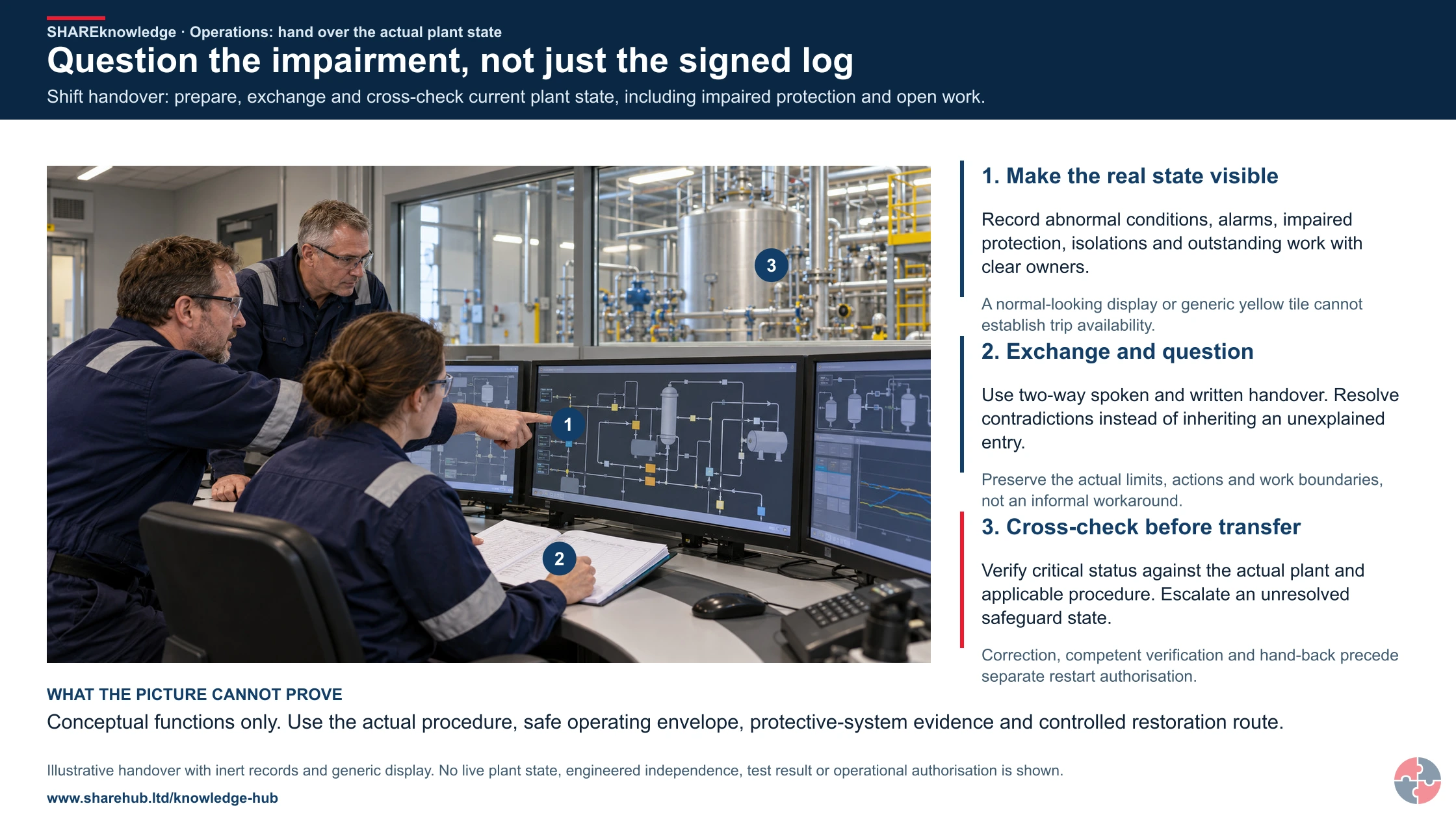
Question the impairment, not just the signed log
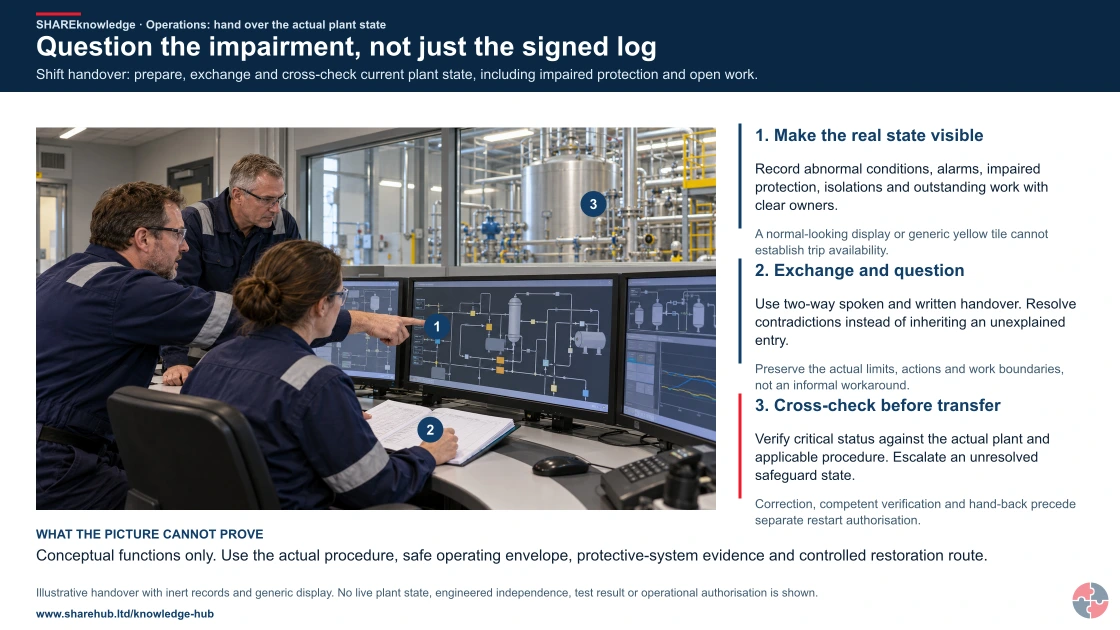
Full written explanation
Shift handover: prepare, exchange and cross-check current plant state, including impaired protection and open work.
- Make the real state visible. Record abnormal conditions, alarms, impaired protection, isolations and outstanding work with clear owners.
- Exchange and question. Use two-way spoken and written handover. Resolve contradictions instead of inheriting an unexplained entry.
- Cross-check before transfer. Verify critical status against the actual plant and applicable procedure. Escalate an unresolved safeguard state.
Change the pathway
- Indication is not protection proof. A normal-looking display or generic yellow tile cannot establish trip availability.
- A signature is not understanding. Preserve the actual limits, actions and work boundaries, not an informal workaround.
- Restoration has its own checks. Correction, competent verification and hand-back precede separate restart authorisation.
Evidence check: Conceptual functions only. Use the actual procedure, safe operating envelope, protective-system evidence and controlled restoration route.
Full operating, COMAH applicability and separate GB/NI legal context
Primary references: HSE: prepare, exchange and cross-check a handover (GB) · HSE: operating procedures and controlled changes (GB)
Open the complete HD image (new tab)Download image
Full operating, COMAH applicability and separate GB/NI legal context
Primary references: HSE: prepare, exchange and cross-check a handover (GB) · HSE: operating procedures and controlled changes (GB)
The HSE handover guide describes preparation, exchange and cross-check. At the transfer panel, the outgoing operator records tank level, active alarms, inhibited safeguards, isolation status, permit boundaries and who owns open actions. The incoming operator questions anomalies and confirms critical status against the plant or control display. The supervisor resolves contradictions before authorising transfer. A permit-to-work must specify the maintenance boundary and hand-back, rather than becoming a disconnected form.
On a small screen, scroll this table sideways to read all columns.
| Stage | Worker action | Verification and stop |
|---|---|---|
| Prepare | Outgoing operator records current tank, line, levels, inhibits and open permits. | Supervisor checks completeness; hold if state is uncertain. |
| Exchange | Both operators discuss abnormal trends, work in progress and limits. | Incoming operator reads back critical limits and owner. |
| Cross-check | Incoming operator checks tank/line status and alarm/inhibit register at plant. | Stop transfer on mismatch; supervisor/engineer resolve and sign restart. |
How can the hierarchy of controls reduce process risk before relying on operational discipline?
The failure chain often begins with weak procedures, changing plant, incomplete handover or production pressure; the top event occurs when a barrier no longer prevents loss of control.
An ageing transfer valve leaks, the high-high trip is inhibited after a fault, and the handover mentions only the maintenance ticket number. The next shift assumes the trip is available and transfers too much product. Separate preventive barriers are transfer limits, verified line-up and an independent tested trip; mitigations include containment and emergency isolation. Supervisory sampling of the actual task, proof-test records, alarm/inhibit status and near-miss trends expose degradation before a release. The safety lead should investigate a bypass as a control-system defect as well as a behaviour issue.
On a small screen, scroll this table sideways to read all columns.
How can the ERICPD hierarchy of controls reduce process risk before relying on operational discipline?

| Five-level / ERICPD | Specific option | Owner, proof and stop |
|---|---|---|
| Eliminate / eliminate | Cancel unnecessary transfer or redesign inventory route. | Planner confirms need and safe route; no transfer if unknown. |
| Substitute / reduce | Lower rate or batch volume after checking process compatibility. | Process engineer sets limit and checks new risks. |
| Engineering / isolate and control | Independent high-high trip, tested shut valve and containment sized for scenario. | Instrument engineer proves trip and closure; stop on failed test; process lead signs restart. |
| Administrative / discipline | Current procedure, independent line-up, handover and inhibit permit. | Supervisor observes and audits; stop on missing record or conflict. |
| PPE / PPE | Residual PPE for planned intervention; never an overfill barrier. | Task lead checks suitability; no uncontrolled intervention. |
How can the ISO 45001 hierarchy of controls reduce process risk before relying on operational discipline?

| Five-level / ERICPD | Specific option | Owner, proof and stop |
|---|---|---|
| Eliminate / eliminate | Cancel unnecessary transfer or redesign inventory route. | Planner confirms need and safe route; no transfer if unknown. |
| Substitute / reduce | Lower rate or batch volume after checking process compatibility. | Process engineer sets limit and checks new risks. |
| Engineering / isolate and control | Independent high-high trip, tested shut valve and containment sized for scenario. | Instrument engineer proves trip and closure; stop on failed test; process lead signs restart. |
| Administrative / discipline | Current procedure, independent line-up, handover and inhibit permit. | Supervisor observes and audits; stop on missing record or conflict. |
| PPE / PPE | Residual PPE for planned intervention; never an overfill barrier. | Task lead checks suitability; no uncontrolled intervention. |
HSE’s five-level hierarchy is the GB framework for elimination, substitution, engineering, administrative controls and PPE. ERICPD is complementary. Select measures for the actual hazard and work location, then verify physical and human controls separately.
Which duties govern major-hazard operations?
Check whether the establishment is in COMAH scope; GB and NI have separate 2015 instruments, while general safety and equipment duties still apply outside COMAH.
For qualifying GB sites, HSE COMAH guidance explains operator duties, MAPP and safety-management requirements; upper-tier sites also need safety reports. NI has its own COMAH Regulations (NI) 2015. Neither regime applies to every industrial site. Check dangerous-substance inventory and Schedule 1 thresholds against the latest available revised text and outstanding effects. HSE operating-procedure guidance is a GB technical source and can inform good practice elsewhere, but is not NI statute. The site needs competent assessment of any DSEAR, permit or equipment duties for its actual process.
On a small screen, scroll this table sideways to read all columns.
| Location | Legal scope | What to verify |
|---|---|---|
| Great Britain | COMAH 2015 if thresholds met. | MAPP/SMS, operating limits, barrier evidence and tier-specific report. |
| Northern Ireland | COMAH (NI) 2015 if thresholds met. | NI operator duties, operating limits and tier-specific report. |
| Great Britain outside COMAH | General and hazard-specific GB duties still apply. | Plant method, competent people, maintenance and stop rules. |
| Northern Ireland outside COMAH | General and hazard-specific NI duties still apply. | Plant method, competent people, maintenance and stop rules. |
What evidence shows good management of conduct of operations and operational discipline?
Good evidence shows that the topic is understood, controls are in place, people are competent and actions are reviewed.
Risk assessment and planning
Before a planned start, shutdown or change of operating mode, confirm the permitted limits, available utilities, alarm and trip status, people on duty and open maintenance work. Record any unresolved deviation and keep the plant in a safe state until the authorised owner confirms the controls and the handover are ready.
Inspection, audit and monitoring
Sample live operating records, overrides, shift handovers and the state of critical barriers. Compare the evidence with the approved procedure and investigate gaps before restart.
Learning and improvement
Use deviations, near misses and worker feedback to revise operating instructions and test whether corrective actions changed the way work is done. Handover and competence checks should cover abnormal as well as routine operation.
Which controls make operational discipline credible?
Design and maintain critical physical barriers, then give people usable limits and a tested stop route.
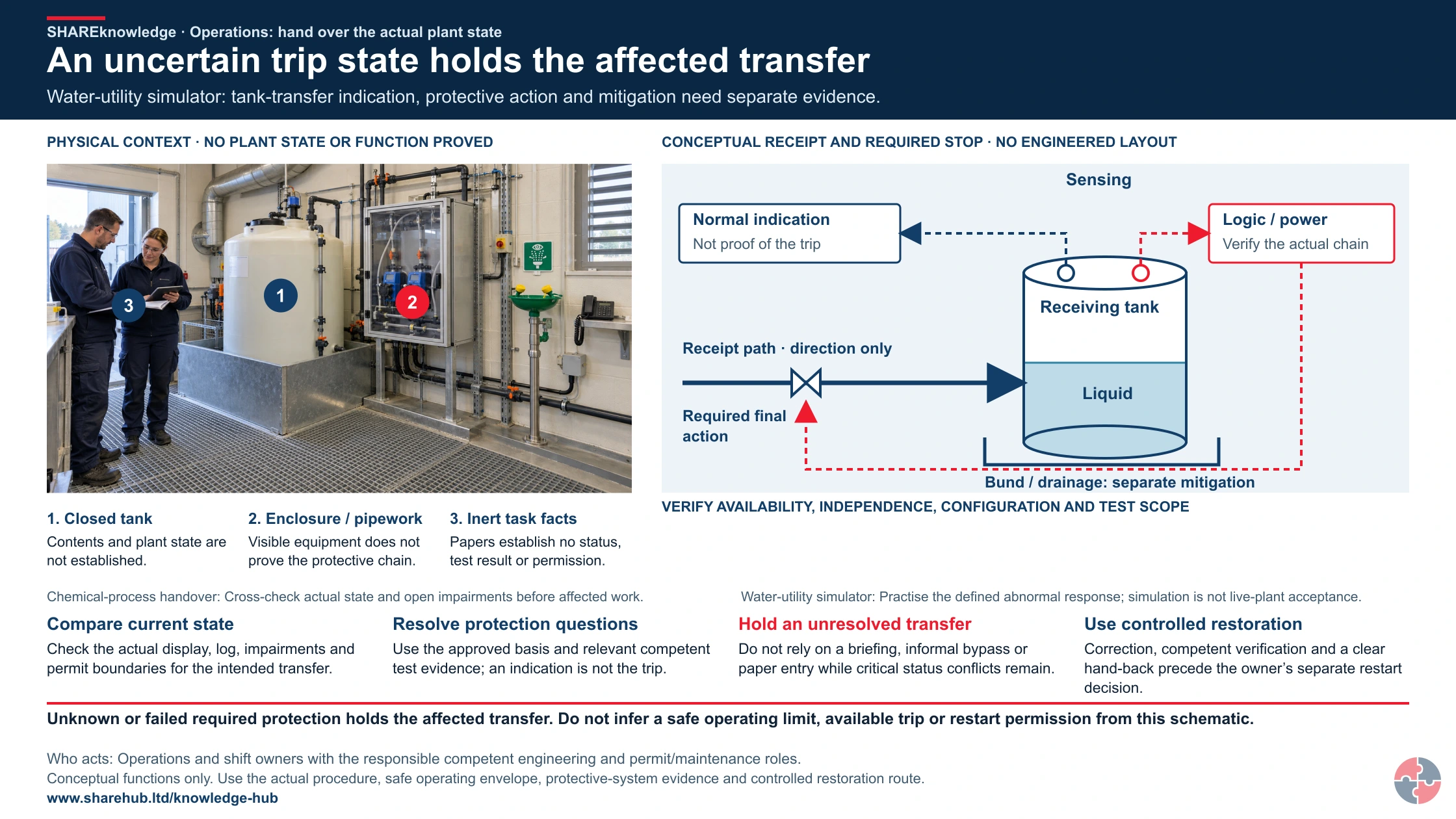
An uncertain trip state holds the affected transfer
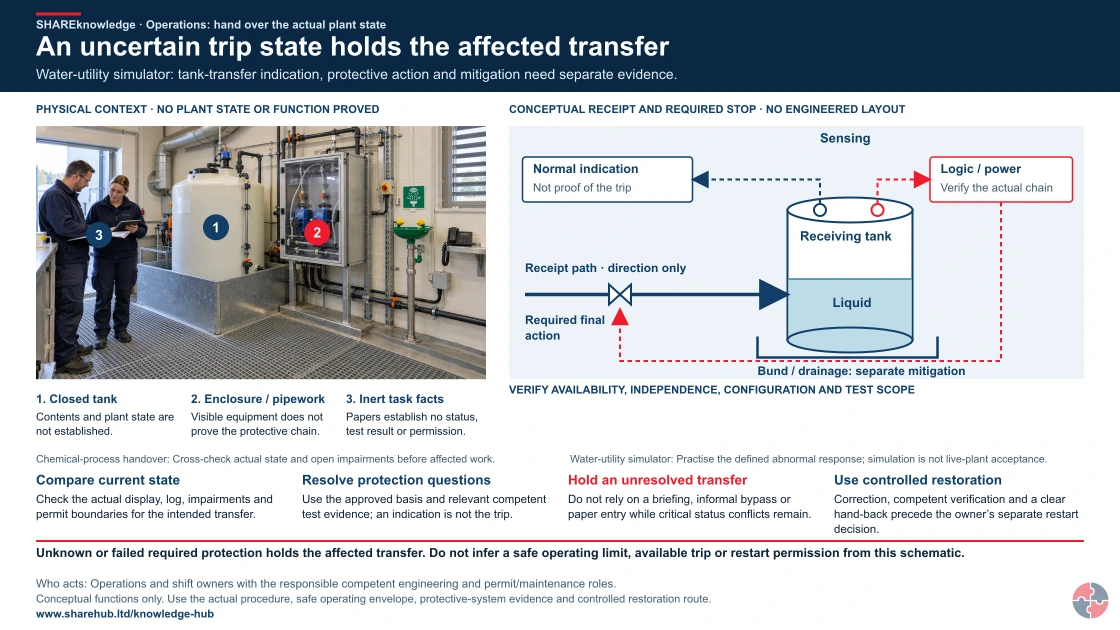
Full written explanation
An illustrative equipment room places a closed neutral tank, equipment enclosure and connected pipework beside ordinary uninjured people reviewing inert task facts. Picture key: 1 identifies the closed tank; 2 identifies the enclosure and pipework; 3 identifies the inert task facts. The picture identifies no chemical or service and establishes no actual receipt, dosing, flow, inventory, energy or valve state, protective function, containment or eyewash performance. The separate conceptual receipt diagram retains sensing, a navy normal-indication branch and a red sensing-to-logic/power-to-required-final-action chain. Normal indication is not proof of the trip. Its solid receipt arrow indicates direction only; the receiving-tank liquid shape supplies no actual level or content. Bund/drainage remains separate, unarrowed mitigation. Verify availability, independence, configuration and test scope against the actual plant; no pictured equipment is assigned to that conceptual chain. All four complete handover checks retain their source order: compare current state; resolve protection questions; hold an unresolved transfer; use controlled restoration. Their independent headings are unnumbered. Unknown or failed required protection holds the affected transfer. Correction, competent verification and a clear hand-back precede the owner’s separate restart decision; the diagram supplies no plant configuration, trip setting, proof-test method, bypass authority, safe operating limit or restart permission. The full accountable roles, evidence limits and both chemical-process-handover and water-utility-simulator examples accompany the explanation. The physical picture is neither a verified water utility nor a simulator state. Use the complete topic for the actual operating envelope, work and permit boundaries, engineering evidence, controlled restoration, separate GB/NI COMAH applicability and source qualifications. Existing Crownway and Crown Fuels teaching examples remain subject to their own technical and classification limits. No new operating, testing, isolation, emergency, clinical or legal instruction is given.
Water-utility simulator: tank-transfer indication, protective action and mitigation need separate evidence.
- Compare current state. Check the actual display, log, impairments and permit boundaries for the intended transfer.
- Resolve protection questions. Use the approved basis and relevant competent test evidence; an indication is not the trip.
- Hold an unresolved transfer. Do not rely on a briefing, informal bypass or paper entry while critical status conflicts remain.
- Use controlled restoration. Correction, competent verification and a clear hand-back precede the owner’s separate restart decision.
When the evidence does not fit: Unknown or failed required protection holds the affected transfer. Do not infer a safe operating limit, available trip or restart permission from this schematic.
Who acts: Operations and shift owners with the responsible competent engineering and permit/maintenance roles.
Changed workplace
Chemical-process handover: Cross-check actual state and open impairments before affected work.
Water-utility simulator: Practise the defined abnormal response; simulation is not live-plant acceptance.
Evidence check: Conceptual functions only. Use the actual procedure, safe operating envelope, protective-system evidence and controlled restoration route.
Full operating, COMAH applicability and separate GB/NI legal context
Primary references: HSE: prepare, exchange and cross-check a handover (GB) · HSE: operating procedures and controlled changes (GB)
Open the complete HD image (new tab)Download image
Full operating, COMAH applicability and separate GB/NI legal context
Primary references: HSE: prepare, exchange and cross-check a handover (GB) · HSE: operating procedures and controlled changes (GB)
An independent trip is valuable only if the set point, sensor, logic and final valve are specified and proof-tested. The operator should see a clear status and know the response to an inhibit. Supervisors must challenge routine overrides and confirm permitted compensating measures before affected work; some failures require outright suspension. Procedure changes go through management of change, training and an observed trial. HSE HSG254 can help choose leading indicators such as overdue trip tests, open inhibits and procedure deviations, alongside lagging releases and demands.
Commission the overfill protection against the actual tank inventory, substance, transfer rate and available response time. A competent engineer verifies sensor, logic, set point, final-valve closure and containment against approved acceptance criteria; record test evidence and maintenance/proof-test arrangements. Before transfer, the operator checks plant status and open impairments. Planned tests, shift checks and change review check continued performance. A failed test or unresolved state conflict holds transfer; correction, competent verification and a clear hand-back precede the process owner’s recorded restart authorisation. HSE operating-procedure guidance and HSG254 support operating limits and barrier assurance; a briefing does not replace a failed trip.
What should the risk or assurance register include for conduct of operations and operational discipline?
The register should describe credible events, the controls relied on and the evidence that proves those controls are alive.
| Event or issue | Risk route | Preventing controls | Response or mitigation | Evidence to check |
|---|---|---|---|---|
| Conduct of operations and operational discipline not identified in real work | People, plant or operations are exposed because the assessment does not reflect the task, environment or people affected. | Task-specific risk assessment, worker involvement, competent review and clear ownership. | Pause the work, reassess the activity, brief affected people and close immediate gaps. | Risk assessment, briefing records, supervisor checks and action close-out. |
| Controls degrade or are bypassed | Controls that were suitable become ineffective through wear, change, pressure, poor maintenance or normalisation of shortcuts. | Inspection, maintenance, monitoring, stop-work authority, defect reporting and management review. | Escalate defects, apply temporary controls, investigate recurrence and check similar areas. | Inspection findings, maintenance records, defect logs, audit results and management review. |
| Weak competence or communication | Workers, supervisors or contractors do not understand the risk, limits, controls or escalation route. | Role-based training, authorisation where needed, supervision, contractor control and refresher triggers. | Re-brief the team, stop unsafe work and update competence records or supervision plans. | Training matrix, authorisations, toolbox talks, observation records and incident learning. |
How could BuildOut Ltd manage conduct of operations and operational discipline?

BuildOut Ltd shows how conduct of operations and operational discipline can be translated into everyday business control, evidence and improvement.
BuildOut Ltd is used here as an example: a growing employer with operational teams, contractors, supervisors, managers and health and safety responsibilities. The exact controls would still need to match the real work, people, competent advice and current circumstances.
| Management area | How the business applies the topic | Evidence, oversight and improvement |
|---|---|---|
| Risk register and legal duties | BuildOut Ltd records where conduct of operations and operational discipline can affect its work and links the entry to relevant UK duties, affected people, credible consequences and current controls. | The register has a named owner, review date, risk rating, control standard and action tracker. Significant changes, complaints or incidents trigger a review. |
| Controls, equipment and procedures | The business turns the assessment into practical controls for its own activities, including suitable equipment, maintenance, supervision, emergency arrangements and contractor controls where relevant. | Supervisors check the work area and record whether controls are actually in place, not only whether a document exists. |
| Training and competence | Workers receive task-specific information on conduct of operations and operational discipline, while supervisors and managers learn how to check compliance, escalate defects and respond when conditions change. | Competence records are reviewed after incidents, poor audit findings, new equipment or changes in work methods. |
| Oversight, audit and learning | Managers review inspections, incidents, near misses, worker feedback and overdue actions so weak signals are not missed. | Findings are trended and used to improve training, risk assessments, purchasing decisions and management review. |
How do fuel-transfer states support disciplined operations?
Keep the selected activity, intended transfer path and protection status explicit. The animation is a teaching sequence, not a live status display or operating instruction.
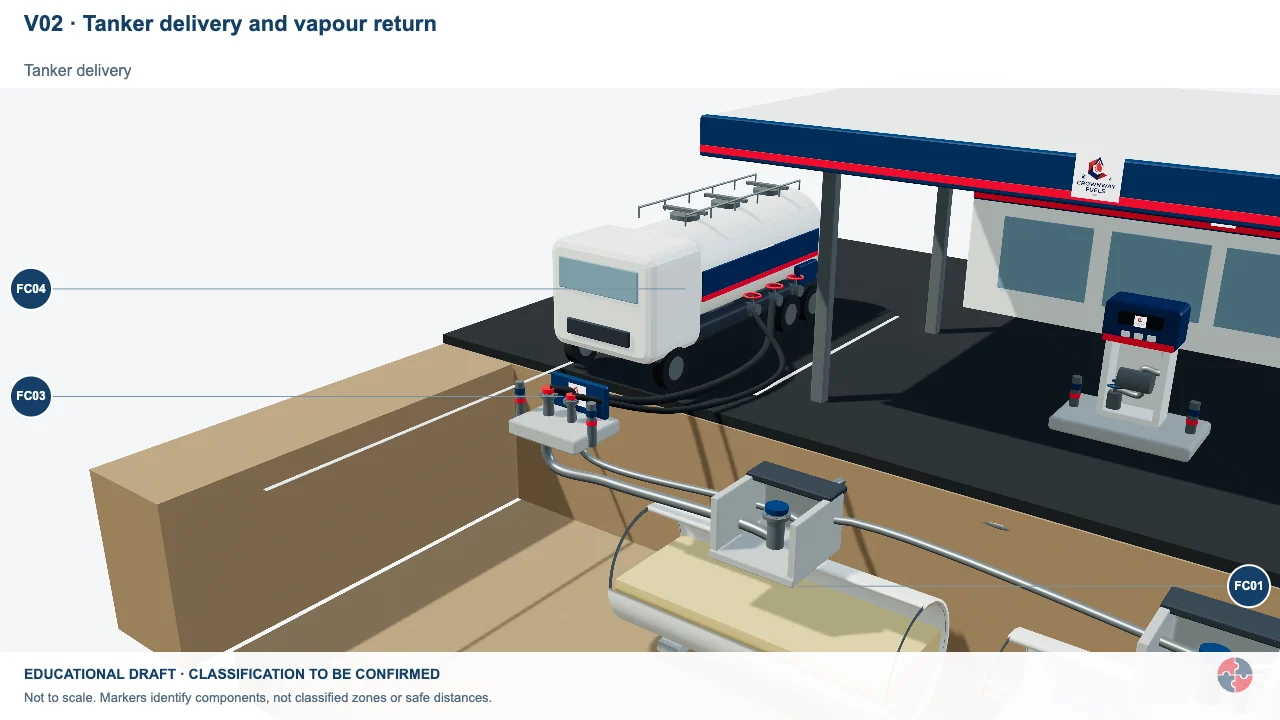
Tanker delivery and vapour return
During the proposed tanker delivery, product enters the receiving tank and displaced vapour returns to the tanker by a separate path. The delivery-hose teaching envelope follows the connected hose route.
Activity focus: Trace the tanker connection, product hose and receiving fill before following the Stage 1b vapour-return path. Inspect the whole delivery working area, including nearby traffic, dispensers and drainage.
Contextual workplace scene. Use the task, control and evidence checks in this section; appearance alone does not establish safe conditions, individual health or approval.
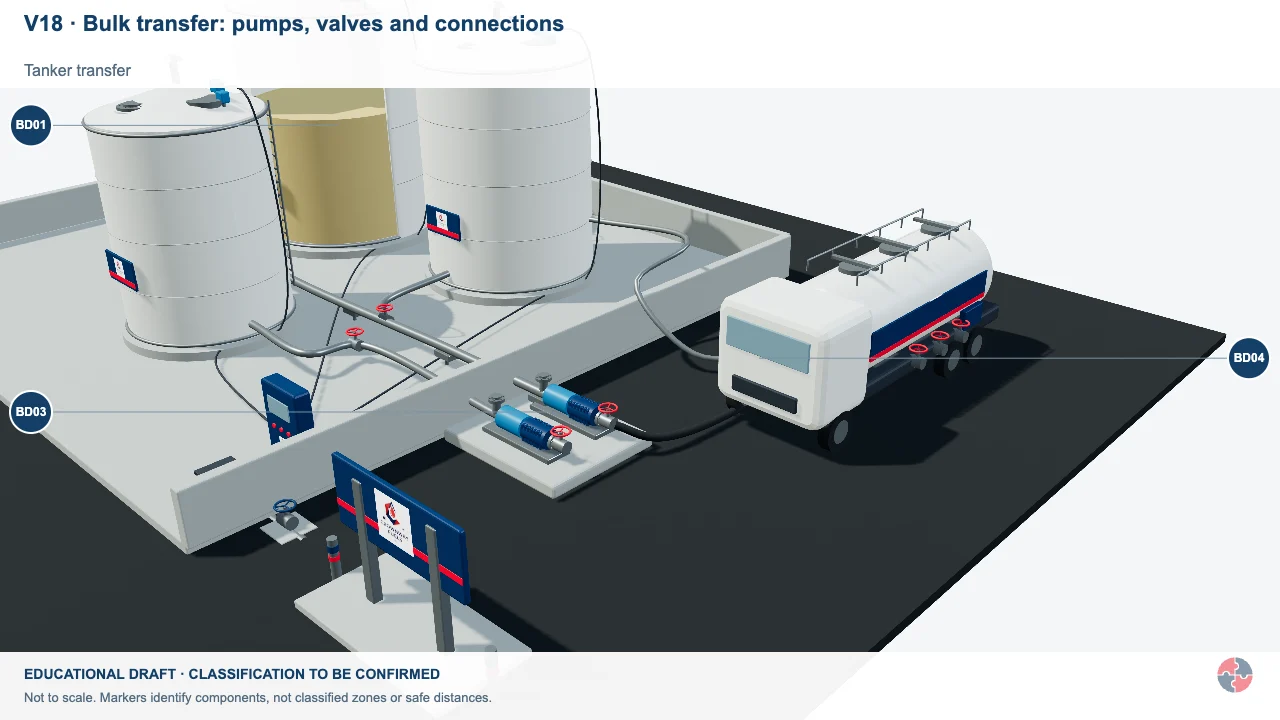
Tanker loading: liquid out, vapour back
Follow petrol from bulk storage into the tanker and the separate displaced-vapour route from the tanker to the terminal VRU.
Activity focus: Distinguish the product line, vapour collection line and tanker-loading protective controls.
Contextual workplace scene. Use the task, control and evidence checks in this section; appearance alone does not establish safe conditions, individual health or approval.
Educational illustration, not to scale. Coloured zones are teaching examples, not a site-specific hazardous-area classification.
What competence is needed for conduct of operations and operational discipline?
Competence should be practical, role-specific and checked through behaviour and evidence, not assumed from attendance alone.
Competence for conduct of operations and operational discipline should be matched to the role. Awareness may be enough for some people; others need practical authorisation, technical training, supervision skills or specialist advice.
Training should be refreshed after change, incidents, repeated defects, poor audit findings, new equipment, new guidance or a long gap since the task was last carried out.
| Role | Competence needed |
|---|---|
| Worker or operator | Understands the hazard, expected controls, defect reporting route, stop-work triggers and personal responsibilities for conduct of operations and operational discipline. |
| Supervisor | Can check the work area, challenge unsafe practice, confirm controls are in place and act on concerns or changing conditions. |
| Manager or dutyholder | Provides resources, competent advice, suitable equipment, training, monitoring and action close-out. |
| Specialist or competent person | Provides technical assessment, inspection, health advice, engineering input or legal interpretation where the topic requires specialist judgement. |
What should each role learn and demonstrate?
Learning must match the decisions people make, from recognising danger to checking that controls work.
Briefings should tell people how to act, but attendance alone does not show competence. Assess the real decision or task, record who assessed it and revisit after a material change, failed control or incident. A local authorisation is task-specific; no universal external certificate is implied.
On a small screen, scroll this table sideways to read all columns.
| Role and learning | Demonstration and assessor | Record and reassessment trigger |
|---|---|---|
| Transfer operator | Demonstrate line-up, trip-status check and abnormal stop; assessor is operations lead. | Authorisation record; reassess after alarm miss, change or absence. |
| Shift supervisor | Run a conflicting-status handover and stop decision; process-safety lead assesses. | Handover and drill record; repeat after near miss. |
| Maintenance lead | Demonstrate isolation and hand-back; site engineer assesses. | Permit and test evidence; reassess after boundary change. |
How can a management system sustain effective decisions?
Give each hazard or support route an owner, a control, a check and a response to failure.
Connect the operating envelope, handover, proof testing, permit interfaces and HSG254 indicators to named owners. Stop on a failed critical barrier and require a competent restart sign-off. An owner should sample actual work and corrective actions, not accept a policy or certificate as evidence that the controls work.
The free GB regulator guide HSE Managing for health and safety (HSG65) explains a plan–do–check–act approach: assign controls and owners, involve workers, check work as done, and correct failures. For Northern Ireland, use HSENI risk assessment guidance for the local duty. A certificate alone does not demonstrate that a control works.
What are the warning signs of weak management of conduct of operations and operational discipline?
Weak management is usually visible before harm occurs if supervisors and leaders look for practical warning signs.
- The risk assessment mentions conduct of operations and operational discipline but does not describe the actual work, people, equipment or environment.
- Controls rely mainly on people remembering rules rather than removing, reducing or isolating the hazard.
- Training records exist, but supervisors cannot explain what good control looks like at the point of work.
- Inspections repeatedly find the same defects or unsafe behaviours without lasting improvement.
- Incidents, symptoms, complaints or near misses are treated as isolated events rather than management-system learning.
- Senior managers receive activity numbers but not evidence that controls are effective.
Which terms are used?
These terms explain the operating and major-hazard decisions.
On a small screen, scroll this table sideways to read all columns.
| Term | Meaning | Use here |
|---|---|---|
| COMAH | Control of Major Accident Hazards | Qualifying major-hazard establishment regime; separate GB and NI instruments. |
| MAPP | Major Accident Prevention Policy | Required for COMAH establishments in scope. |
| SMS | Safety management system | Organises major-hazard controls and assurance. |
| PTW | Permit to work | Controlled high-risk task and hand-back interface. |
| Inhibit | Temporary removal or bypass of a safeguard | Requires control, visibility, review and stop decision. |
Unlock another resource
You have used this month’s two free downloads. Publish a post in your own words to unlock one more resource, or choose SHARE Individual for 10 downloads per month.
You decide whether to share. If you do, use the relevant platform disclosure tools and do not make claims you do not genuinely hold.