SHARE Knowledge Hub
Face Fit Testing
Face fit testing checks whether a specific tight-fitting respiratory protective equipment (RPE) facepiece seals adequately to an individual wearer. A pass is one part of protection: control exposure at source, select RPE for the hazard and task, issue the tested facepiece, check its seal every time and stop if the equipment, wearer or conditions change.
Understanding Face Fit Testing
Face-fit testing is a defined part of selecting tight-fitting respiratory protective equipment (RPE). It checks whether a particular make, model, material and size of facepiece can form an adequate seal on a particular wearer. It does not prove that the chosen RPE is adequate for the contaminant, task or environment; that the wearer is medically able to use it; or that the RPE will be worn, maintained and supervised properly. The result must be embedded in a wider RPE and exposure-control programme.
Why this matters at work
Harm occurs when airborne material bypasses the filter through gaps at the face seal, enters the lungs or eyes, or when an unsuitable device is used in a low-oxygen, unknown or rapidly changing atmosphere. Leakage becomes more likely with facial hair across the sealing surface, the wrong size or model, poor donning, damaged seals or straps, incompatible spectacles or other PPE, movement, sweat, communication, a loose harness, poor maintenance or a change in the wearer’s face or working conditions.
Correct use is required on every exposure occasion. The manufacturer’s pre-use seal check helps confirm current donning but cannot substitute for the formal fit test. Damage, changed PPE and removal in contaminated air can defeat protection after a pass. Work planning must allow suitable breaks and safe arrangements for cleaning, removal and replacement. Train the wearer to inspect and don the actual device in accordance with its instructions and perform the specified seal check on every use of a tight-fitting facepiece. Check damage, valves, straps, filter condition and other PPE interference. Stop and correct any poor seal or defect before entering exposure. A wearer check is an immediate use control and does not replace fit testing. Supervisors should sample real practice and ensure replacements do not silently introduce an untested model.
How organisations manage this in practice
A proportionate Plan-Do-Check-Act system should identify exposure tasks and the hierarchy of control; select and issue RPE; appoint competent fit testers; document results; train and supervise wearers; monitor defects, non-compliance, illness and changed circumstances; then act on findings. Senior leaders need assurance that RPE is not silently substituting for failed or absent engineering control.
HSE COSHH material is clear that RPE is not a substitute for engineering controls. RPE may be justified while engineering controls are installed, for maintenance and cleaning, spill response, emergencies, short one-off activities or tasks where residual exposure cannot otherwise be controlled adequately. It provides no protection to nearby people who are not wearing it, and its effectiveness depends on reliable user behaviour and equipment condition.
Assurance should look beyond the number of pass certificates. Leading indicators include completion of source-control actions, current RPE selection assessments, correct facepiece issue, fit tests matched to actual RPE, repeat tests after change, training/observations, seal-check compliance, defect response, maintenance completion and supervisor interventions. Lagging indicators include reports of symptoms, exposure events, failed tests, damaged devices, recurring workarounds, worker complaints and occupational-health trends where relevant.
What does a face-fit result establish?
A fit test shows whether a particular tight-fitting facepiece can seal to one wearer; it does not show that the device is adequate for the airborne hazard or safe in the atmosphere.
Select exposure controls and respiratory protective equipment (RPE) for the actual material, task and environment before testing. The pass record must match the issued make, model, material and size. Every donning still needs the manufacturer’s wearer seal check, and a changed mask, facial seal or other head-worn equipment may require reassessment. HSE INDG479 rev2 provides the current practical fit-test framework.
This is a work-control explanation, not a method protocol or authority to enter an unknown, oxygen-deficient or other dangerous atmosphere. Such work needs the relevant specialist assessment, breathing-apparatus and emergency arrangements. HSENI respiratory protection guidance provides the Northern Ireland route.
Updated 2026-09-25.
What does face fit testing mean in practical terms?
It means proving that a selected tight-fitting facepiece can form an adequate seal on the individual wearer.
Tight-fitting RPE includes disposable filtering facepieces, reusable half masks and full-face masks. These rely on a close seal against the wearer's skin. If the seal leaks, contaminated air can bypass the filter or breathing apparatus protection.
Fit testing should happen before the worker first uses the mask for hazardous work. The test should be carried out on the same type, make, model and size that the worker will actually wear, with other PPE considered because goggles, helmets, visors or hearing protection can affect the fit.
Face fit testing does not prove that the overall exposure control is adequate. It only tests one important part of the RPE control chain. The COSHH assessment still needs to address the substance, exposure route, concentration, work duration, other controls, filter type, assigned protection factor, maintenance and user competence.
Air follows an easier leakage path around a poor seal instead of passing through the intended filter or air supply. Movement, speech, incompatible eye protection and stubble can disturb that seal. Harm depends on the substance: an exposure may cause immediate irritation or breathing difficulty, while repeated exposure may contribute to asthma, lung disease or cancer years later. Feeling well and seeing little dust do not demonstrate adequate control.
Adequate means capable of controlling the identified hazard. Suitable means usable by this person for this task and environment. A fit test addresses the seal component of suitability; it does not measure the person’s workplace exposure. HSE HSG53 fourth edition and HSE INDG479 rev2.
What are the key facts about face fit testing?
The key facts are that tight-fitting RPE must fit the individual, fit is specific to the mask, and the user must seal-check every time.
Fit is individual
A mask that fits one worker may not fit another worker because face shape and size vary.
Fit is model-specific
A pass applies to the exact make, model, type and size tested, not every similar mask.
Facial hair breaks the seal
Hair in the seal area can allow leakage and prevents an adequate seal.
A seal check is not a fit test
The user seal check is needed every time, but formal fit testing is still required.
RPE is not the first control
Prevent, reduce and control exposure at source before relying on respiratory protection.
Records need managing
Fit-test records should be available to supervisors and reviewed after changes.
When is face fit testing needed?
Face fit testing is needed where a worker must wear tight-fitting RPE to protect against hazardous airborne exposure.
Typical tasks include cutting silica-containing materials, woodworking, handling dusty powders, spraying, working with certain fumes, asbestos-related work where suitable, cleaning contaminated areas, using chemicals that create airborne exposure or carrying out work where other controls do not reduce exposure enough.
The need should come from the risk assessment. If exposure can be eliminated, enclosed, substituted, captured by local exhaust ventilation or reduced by changing the process, those controls should be prioritised before RPE. Where RPE remains necessary, fit testing becomes part of proving the selected control can work.
| Situation | Fit-test expectation | Example |
|---|---|---|
| Disposable FFP mask used for dust | Fit test the exact make, model and size. | FFP3 for silica dust as part of wider controls. |
| Reusable half mask | Fit test for the specific facepiece. | Half mask with P3 filters for dusty task. |
| Full-face mask | Quantitative fit test required by the HSE method-selection guidance. | Full-face respirator for higher-risk work. |
| Different mask issued | Repeat fit test. | Supplier changes model due to stock shortage. |
| Loose-fitting hood | Fit test not required, but selection and training still required. | Powered hood for worker with facial hair. |
| Emergency-only mask | Assess and fit test if it is tight-fitting and may be relied on. | Escape or emergency response RPE. |
How can the hierarchy of controls reduce inhalation exposure before relying on face-fit-tested RPE?
ERICPD reminds organisations to prevent or reduce exposure before relying on RPE and fit testing.
RPE can be essential, but it is usually a later-stage control because it relies on selection, fit, wearer behaviour, maintenance and supervision. Higher-level controls include substitution, process enclosure, wet methods, local exhaust ventilation, segregation and task redesign.
Where RPE remains necessary, fit testing strengthens the PPE layer, but it does not turn RPE into an engineering control.
Choose the activity
How can the ERICPD hierarchy of controls reduce risks while drilling masonry with task-selected RPE?

| Control level | Control for this activity | Owner and verification | Stop / restart decision |
|---|---|---|---|
| Eliminate | Use preformed openings or a fixing design that avoids on-site drilling where feasible. | Process owner verifies that the revised workflow achieves the required output and the hazardous step is genuinely removed. | If the hazardous step remains, retain a task assessment and select the stronger feasible remaining controls. |
| Reduce, including substitution | Consider a suitable lower-dust fixing or installation method and check the new structural and access risks. | Process/technical owner validates the alternative, its compatibility and any new risks before adoption. | Reject the alternative if suitability is unproved or its new hazards are unresolved. |
| Isolate | Use effective compatible on-tool extraction or an assessed wet method; verify dust control at the drill point and protect adjacent people. | Supervisor verifies the task boundaries and that the separation or isolation protects affected people and connected work. | Hold or stop for untested tight-fitting model, poor seal, failed extraction or changed material. |
| Control: physical safeguards | Use effective compatible on-tool extraction or an approved wet method; verify dust control at the drill point. | Competent equipment/process owner checks material identity, source control, required protection and exact facepiece/fit-test match. | Hold or stop for untested tight-fitting model, poor seal, failed extraction or changed material. |
| Control: work method and response | Select adequate and suitable RPE for the task; obtain the correct fit-tested model or a suitable assessed alternative before release. | Supervisor confirms the limits, response, communication and restart authority with the people doing this activity. | Stop if the agreed method, communication, competent cover or task limits cannot be maintained. |
| PPE | Check facepiece model/size, fit-test evidence, seal and compatibility with eye/hearing protection; complete pre-use checks. | Assessor confirms whether PPE is needed and checks selection, condition, compatibility and any required face-fit evidence. | Do not rely on unsuitable or defective protection, or use PPE to continue after an essential source control fails. |
| Discipline | Review fit after relevant changes and replace damaged equipment; failed source control requires a task hold, not a mask swap. | Release only after supervisor confirms suitable source control and RPE before drilling. Retain the checks and unresolved restrictions at handover. | Keep the activity on hold while defects or required reinstatement evidence remain unresolved. |
How can the ISO 45001 hierarchy of controls reduce risks while drilling masonry with task-selected RPE?

| Control level | Control for this activity | Owner and verification | Stop / restart decision |
|---|---|---|---|
| Elimination | Use preformed openings or a fixing design that avoids on-site drilling where feasible. | Process owner verifies that the revised workflow achieves the required output and the hazardous step is genuinely removed. | If the hazardous step remains, retain a task assessment and select the stronger feasible remaining controls. |
| Substitution | Consider a suitable lower-dust fixing or installation method and check the new structural and access risks. | Process/technical owner validates the alternative, its compatibility and any new risks before adoption. | Reject the alternative if suitability is unproved or its new hazards are unresolved. |
| Engineering controls | Use effective compatible on-tool extraction or an assessed wet method; verify dust control at the drill point and protect adjacent people. | Supervisor verifies the task boundaries and that the separation or isolation protects affected people and connected work. | Hold or stop for untested tight-fitting model, poor seal, failed extraction or changed material. |
| Engineering controls | Use effective compatible on-tool extraction or an approved wet method; verify dust control at the drill point. | Competent equipment/process owner checks material identity, source control, required protection and exact facepiece/fit-test match. | Hold or stop for untested tight-fitting model, poor seal, failed extraction or changed material. |
| Administrative controls | Select adequate and suitable RPE for the task; obtain the correct fit-tested model or a suitable assessed alternative before release. | Supervisor confirms the limits, response, communication and restart authority with the people doing this activity. | Stop if the agreed method, communication, competent cover or task limits cannot be maintained. |
| PPE | Check facepiece model/size, fit-test evidence, seal and compatibility with eye/hearing protection; complete pre-use checks. | Assessor confirms whether PPE is needed and checks selection, condition, compatibility and any required face-fit evidence. | Do not rely on unsuitable or defective protection, or use PPE to continue after an essential source control fails. |
| Administrative controls | Review fit after relevant changes and replace damaged equipment; failed source control requires a task hold, not a mask swap. | Release only after supervisor confirms suitable source control and RPE before drilling. Retain the checks and unresolved restrictions at handover. | Keep the activity on hold while defects or required reinstatement evidence remain unresolved. |
How can the ERICPD hierarchy of controls reduce risks while cleaning oily valve components?

| Control level | Control for this activity | Owner and verification | Stop / restart decision |
|---|---|---|---|
| Eliminate | Buy components ready for assembly or remove an unnecessary cleaning stage where cleanliness requirements permit. | Process owner verifies that the revised workflow achieves the required output and the hazardous step is genuinely removed. | If the hazardous step remains, retain a task assessment and select the stronger feasible remaining controls. |
| Reduce, including substitution | Trial a suitable aqueous or other lower-hazard cleaning process; validate component finish and any new corrosion or skin risk. | Process/technical owner validates the alternative, its compatibility and any new risks before adoption. | Reject the alternative if suitability is unproved or its new hazards are unresolved. |
| Isolate | Use suitable contained cleaning or effective source capture where required by the actual formulation and exposure assessment; physically protect unrelated work and ignition-sensitive areas. | Supervisor verifies the task boundaries and that the separation or isolation protects affected people and connected work. | Hold or stop for unknown solvent, failed extraction, uncontrolled vapour or incompatible waste. |
| Control: physical safeguards | Use compatible enclosed cleaning equipment and effective local extraction where required; minimise open liquid and splash paths. | Competent equipment/process owner checks product identity, enclosure, extraction, waste containment and cleaning quality. | Hold or stop for unknown solvent, failed extraction, uncontrolled vapour or incompatible waste. |
| Control: work method and response | Identify the product and contamination, control decanting and waste, and prohibit unassessed mixing or heating. | Supervisor confirms the limits, response, communication and restart authority with the people doing this activity. | Stop if the agreed method, communication, competent cover or task limits cannot be maintained. |
| PPE | Select gloves, eye protection and any RPE for the actual formulation; a particulate mask does not protect against solvent vapour. Where tight-fitting RPE is selected, verify the exact facepiece model/size and fit-test match; choose suitable vapour protection rather than assuming a dust mask is adequate. | Assessor confirms whether PPE is needed and checks selection, condition, compatibility and any required face-fit evidence. | Do not rely on unsuitable or defective protection, or use PPE to continue after an essential source control fails. |
| Discipline | Maintain seals and extraction, check cleaning quality and investigate exposure or fire-control defects before restarting. | Release only after maintenance owner accepts the cleaning trial and verified controls. Retain the checks and unresolved restrictions at handover. | Keep the activity on hold while defects or required reinstatement evidence remain unresolved. |
How can the ISO 45001 hierarchy of controls reduce risks while cleaning oily valve components?

| Control level | Control for this activity | Owner and verification | Stop / restart decision |
|---|---|---|---|
| Elimination | Buy components ready for assembly or remove an unnecessary cleaning stage where cleanliness requirements permit. | Process owner verifies that the revised workflow achieves the required output and the hazardous step is genuinely removed. | If the hazardous step remains, retain a task assessment and select the stronger feasible remaining controls. |
| Substitution | Trial a suitable aqueous or other lower-hazard cleaning process; validate component finish and any new corrosion or skin risk. | Process/technical owner validates the alternative, its compatibility and any new risks before adoption. | Reject the alternative if suitability is unproved or its new hazards are unresolved. |
| Engineering controls | Use suitable contained cleaning or effective source capture where required by the actual formulation and exposure assessment; physically protect unrelated work and ignition-sensitive areas. | Supervisor verifies the task boundaries and that the separation or isolation protects affected people and connected work. | Hold or stop for unknown solvent, failed extraction, uncontrolled vapour or incompatible waste. |
| Engineering controls | Use compatible enclosed cleaning equipment and effective local extraction where required; minimise open liquid and splash paths. | Competent equipment/process owner checks product identity, enclosure, extraction, waste containment and cleaning quality. | Hold or stop for unknown solvent, failed extraction, uncontrolled vapour or incompatible waste. |
| Administrative controls | Identify the product and contamination, control decanting and waste, and prohibit unassessed mixing or heating. | Supervisor confirms the limits, response, communication and restart authority with the people doing this activity. | Stop if the agreed method, communication, competent cover or task limits cannot be maintained. |
| PPE | Select gloves, eye protection and any RPE for the actual formulation; a particulate mask does not protect against solvent vapour. Where tight-fitting RPE is selected, verify the exact facepiece model/size and fit-test match; choose suitable vapour protection rather than assuming a dust mask is adequate. | Assessor confirms whether PPE is needed and checks selection, condition, compatibility and any required face-fit evidence. | Do not rely on unsuitable or defective protection, or use PPE to continue after an essential source control fails. |
| Administrative controls | Maintain seals and extraction, check cleaning quality and investigate exposure or fire-control defects before restarting. | Release only after maintenance owner accepts the cleaning trial and verified controls. Retain the checks and unresolved restrictions at handover. | Keep the activity on hold while defects or required reinstatement evidence remain unresolved. |
How should RPE selection be linked to face fit testing?
RPE selection should start with the hazard and exposure, then fit testing confirms whether the selected tight-fitting facepiece fits the user.
RPE selection must consider the substance, form, concentration, exposure duration, oxygen level, work rate, wearer health, compatibility with other PPE and required protection factor. Fit testing only checks the face seal. It does not confirm that the filter type, protection factor or maintenance arrangements are suitable.
For dusts, mists and fumes, filter class matters. For gases and vapours, cartridge type, breakthrough and change schedules matter. For oxygen-deficient or immediately dangerous atmospheres, filtering RPE is not suitable and specialist respiratory equipment is needed.
Worked selection decision
A stores team offers another brand of FFP3 when the worker’s tested model is unavailable. Both packages say FFP3, but that is a filter classification, not evidence that the new face seal fits. The supervisor holds the task until the tested model is supplied or a competent selection review and fit test establish an alternative. If the task also introduces solvent vapour, neither the FFP3 label nor a successful fit test proves protection against that vapour.
Do not confuse a measured fit factor with the assigned protection factor (APF) used in RPE selection. A high fit-test score does not increase the permitted workplace concentration. Obtain the exposure assessment, substance form, required APF and manufacturer’s filter information before a safety-critical selection. HSE HSG53 fourth edition.
HSE ear-loop safety notice EPD1-2022 recommends against ear-loop respirators as tight-fitting RPE, including products with clips or tightening devices. Conformity marking alone does not resolve this fit problem.
Wearer health: the employer should ensure that the person is fit to use the selected RPE. If a medical condition or reported difficulty creates uncertainty, arrange appropriate medical assessment; do not assume every person can safely use every type of respirator. Before testing, the fit tester should establish fitness to wear RPE and seek employer confirmation, preferably in writing. Keep clinical details in the confidential health process. See INDG479.
Which face-fit test method and result should be accepted?
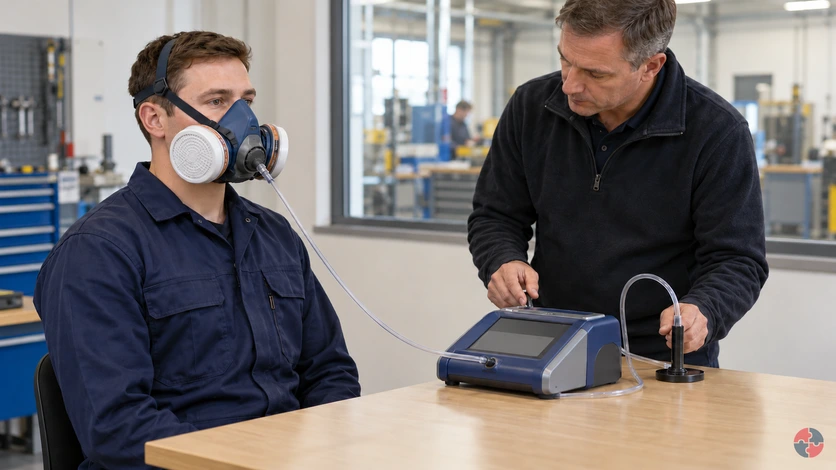
The method must suit the facepiece. Current HSE guidance describes taste-based qualitative testing for half masks and quantitative testing for half or full-face masks. A pass is valid only when the correct procedure and acceptance criteria were used.
A qualitative test gives a pass or fail using a bitter or sweet aerosol. The wearer must first demonstrate that they can taste the test agent; absence of taste without that sensitivity check cannot establish a pass. A quantitative test measures leakage using an instrument. Ambient particle counting compares particles outside and inside the facepiece; controlled negative pressure measures leakage by another method and is not suitable for disposable filtering facepieces.
| Facepiece | Method boundary | Acceptance decision |
|---|---|---|
| Disposable half mask | Taste or suitable ambient particle counting method. Controlled negative pressure is not applicable. | Quantitative minimum fit factor 100 in each exercise. Equipment must suit the filter class. |
| Reusable half mask, including tight-fitting powered or air-supplied variants | Taste, ambient particle counting or controlled negative pressure with the appropriate preparation. | Quantitative minimum fit factor 100 in each exercise. |
| Full-face mask | Quantitative method; a qualitative taste test is not suitable. | Quantitative minimum fit factor 2,000 in each exercise. |
| Loose-fitting hood or helmet | No face-seal fit test. | Still verify adequate protection, airflow, compatibility, wearer suitability and maintenance. |
These unitless fit-factor thresholds are from INDG479 rev2, table 2, for its specified test methods. They are not exposure limits, protection factors for use at work or permission to shorten the protocol. For example, a reusable half-mask test with one exercise at 90 and an overall result of 180 fails the per-exercise criterion of 100. Investigate the cause; do not average away a poor exercise.
Sampling-port update: October 2025 INDG479 permits a flush probe or an extended sampling tube for disposable half masks. Reusable masks need suitable adapters and representative sampling near the nose and mouth. This supersedes the blanket extended-port message in HSE’s March 2025 bulletin. The tester must follow the current guide and equipment instructions, not select a port from a photograph alone. HSE INDG479 rev2.
Fit tests are controlled assessments, not tests conducted in the actual hazardous atmosphere. The tester should check equipment, hygiene, wearer preparation, other head-worn PPE and the complete method before starting. Stop for invalid equipment checks, contamination, intolerance or an unreliable result. Do not repeatedly tighten or retest a poorly fitting facepiece to force a pass; INDG479 advises trying an alternative after two failed fit tests.
HSE INDG479 rev2 (October 2025) clarifies that a quantitative test can use a flush or extended port where the method is valid. The fit tester must use the current procedure and manufacturer-compatible equipment; a port configuration is not a shortcut around facepiece identity, wearer preparation or result interpretation.
How do facial hair and user seal checks affect protection?
Facial hair in the seal area can prevent tight-fitting RPE from sealing, and users should perform a seal check every time they put the mask on.
A tight-fitting mask needs clean contact with the skin. Stubble, beards, moustaches or sideburns in the seal area can create leakage paths. If a worker cannot be clean shaven for medical, religious or other reasons, loose-fitting powered RPE may need to be considered as part of a suitable alternative control.
A wearer seal check follows the specific manufacturer’s donning and checking instructions every time the facepiece is put on. It helps identify immediate fit problems but cannot replace the fit test.
Before during and after work
Before: identify the issued facepiece against the individual record; inspect its seal, straps, valves and filters; confirm no hair crosses the sealing surface; put it on in accordance with the manufacturer’s instructions; add compatible PPE and complete that manufacturer’s wearer seal check in a safe area. A generic pressure test may not suit every design.
During: keep the RPE in position while exposure remains possible. Leave the contaminated area if it slips, leaks, is damaged, becomes difficult to breathe through, loses airflow or the wearer feels unwell. Do not lift the facepiece to talk or adjust it inside the exposure zone.
After: follow the planned exit and contamination-control sequence before removing RPE; clean, inspect and store reusable equipment as instructed, dispose of single-use items correctly, and report defects. Keep unserviceable equipment out of circulation. HSE HSG53 fourth edition; HSE fit testing basics.
How does BuildOut Ltd apply face-fit testing to an actual job?

BuildOut Ltd would make sure each tight-fitting respirator is suitable for its wearer and that the exact successfully tested facepiece is available for the assessed task.
BuildOut Ltd · practical example
Match the issued respirator to the worker's fit test
The key lesson Fit testing checks the seal of a particular tight-fitting facepiece on an individual; a pre-use fit check and general training have different purposes.
The situation: A worker arrives for a dusty refurbishment task with a fit-test record for one respirator model. The site store has supplied a different model in the same protection category. The records and issued equipment do not match.
Why this matters: A filter rating cannot compensate for leakage around the face, and protective equipment still supports rather than replaces stronger dust controls.
How BuildOut Ltd would manage it
- Keep the source controls — Site Manager. Confirm the assessed dust controls and whether respiratory protection remains necessary. Hold work where the intended method or extraction is failing instead of treating a better mask as the whole solution.
- Check the exact facepiece — Trade Supervisor. Compare the issued make, model, type and size with the worker's successful test record. Check compatibility with other required equipment and any condition affecting the face seal.
- Resolve the mismatch — Plant and Procurement Coordinator. Provide the suitable tested facepiece or arrange selection and testing with a competent fit tester. Do not assume another model fits because it has the same claimed protection level.
- Confirm correct use — Trade Supervisor. Check instruction in fitting, pre-use fit checks, limitations, care and storage. Give the worker a clear route to stop if fit or condition changes; a daily check does not replace fit testing.
- Keep supply and records aligned — Health and Safety Manager. Sample issued equipment against current wearer records and task assessments. Review the relevant changes to facepiece or wearer circumstances before continuing to rely on the earlier result.
When the conditions change
- Recognise the trigger
- The facepiece differs from the tested model or a reliable seal cannot be achieved.
- Make the immediate decision
- No affected task requiring that tight-fitting RPE until suitable protection is established.
- Verify the next step
- The Site Manager checks that the issued make, model, type and size match a successful individual fit test and that the wearer can use and fit-check it with the other required equipment.
What good looks like
The worker has the right facepiece, can demonstrate the instructed checks and is supported when it does not seal. Procurement can maintain that exact suitable supply.
Evidence to look for: Task RPE selection, individual fit-test record, issued facepiece identity and user instruction.
Common mistake to avoid: Treating a fit-test certificate as transferable to any respirator.
Apply this to your work: Does the mask on the person's face match the one in their successful fit-test record?
Guidance behind the management approach: HSE: fit-testing basics. Use the topic's legal and technical guidance for the applicable work and location.
Match the wearer, facepiece and task
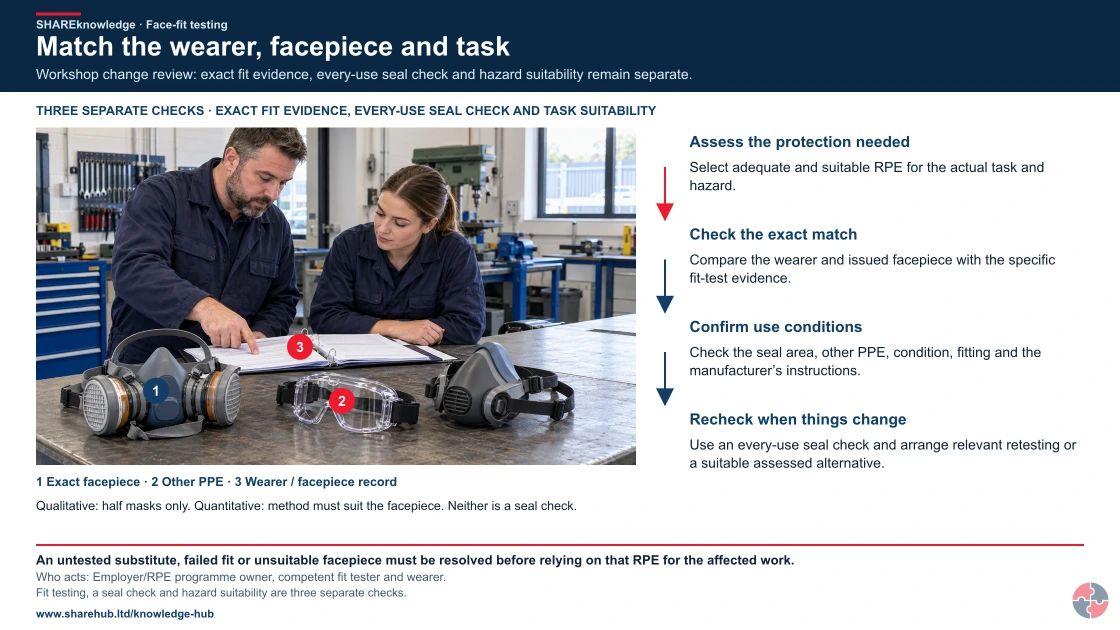
Full written explanation
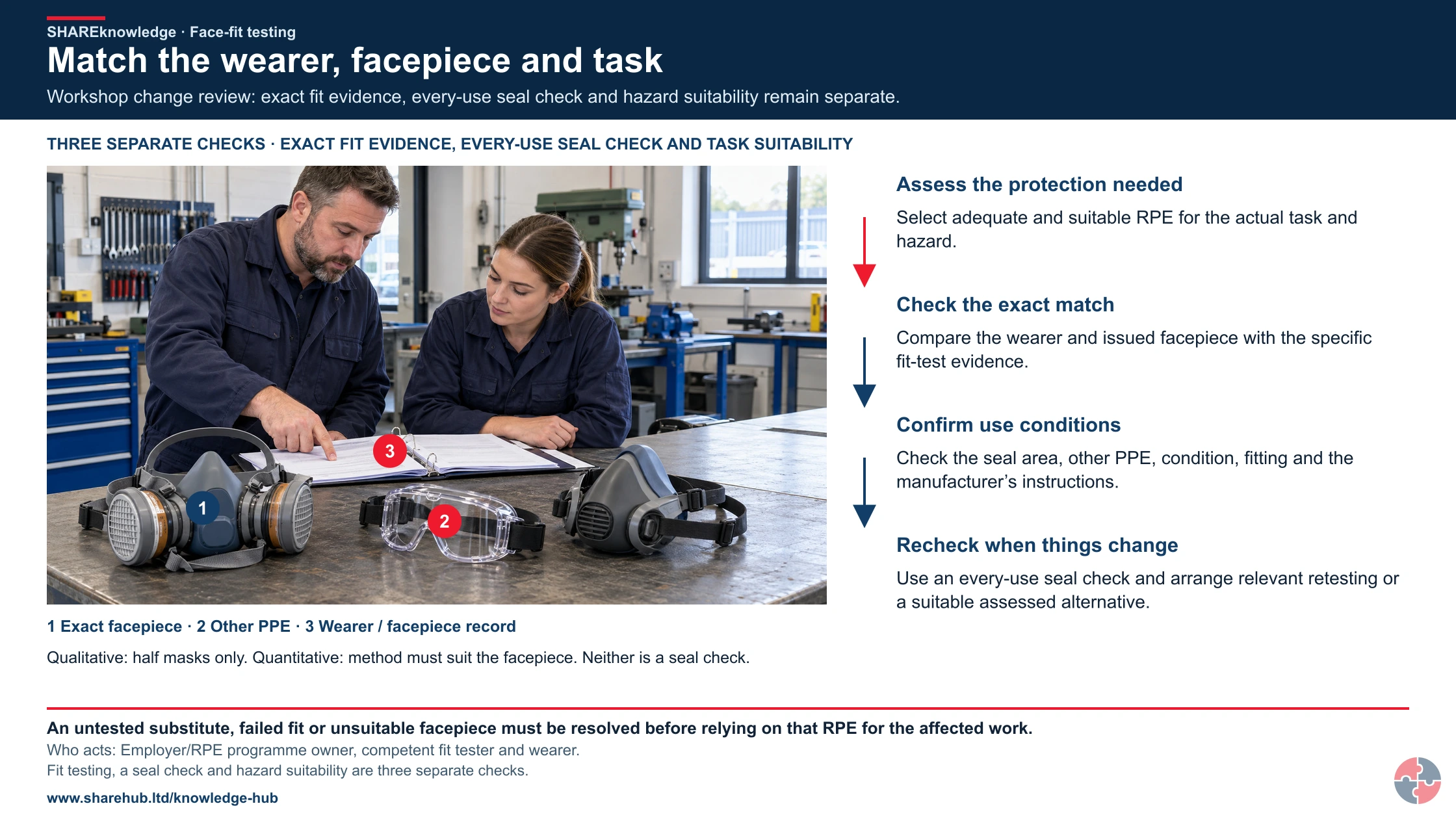
An illustrative UK workshop planning scene shows two colleagues reviewing an inert record beside two distinct unworn tight-fitting half-facepiece forms and separate goggles. The physical comparison makes exact device identity and PPE/condition changes visible as questions, not verified results. No one wears a facepiece; no seal geometry, test apparatus, sampling probe, result or clinical detail is illustrated. Four checks connect task/hazard adequacy, exact named wearer and facepiece evidence, actual fitting/condition/other-PPE/manufacturer information, and every-use seal checks with relevant retesting or a suitable assessed alternative after change. The method distinction is: qualitative taste methods apply to half masks, while any quantitative method must suit the facepiece; neither is an every-use seal check or a workplace suitability assessment. No test protocol, numerical fit threshold, device selection, actual pass/fail or protective filter rating is assigned. Picture key: 1 Exact facepiece · 2 Other PPE · 3 Wearer / facepiece record. The separate process headings are unnumbered.
Workshop change review: exact fit evidence, every-use seal check and hazard suitability remain separate.
- Assess the protection needed. Select adequate and suitable RPE for the actual task and hazard.
- Check the exact match. Compare the wearer and issued facepiece with the specific fit-test evidence.
- Confirm use conditions. Check the seal area, other PPE, condition, fitting and the manufacturer’s instructions.
- Recheck when things change. Use an every-use seal check and arrange relevant retesting or a suitable assessed alternative.
When the evidence does not fit: An untested substitute, failed fit or unsuitable facepiece must be resolved before relying on that RPE for the affected work.
Who acts: Employer/RPE programme owner, competent fit tester and wearer.
Changed workplace
Tested mask out of stock: A substitute model is not automatically covered by the previous fit test.
Wearer or facepiece changes: Review the fit evidence and actual use conditions; a previous pass is not permanent assurance.
Evidence check: Fit testing, a seal check and hazard suitability are three separate checks.
Masonry drilling when the tested mask is out of stock
Task material and setting: BuildOut Ltd needs to drill identified masonry for fixings in an enclosed refurbishment room. The aim is to complete the holes without exposing the operator or nearby trades to uncontrolled dust. The site survey and task assessment identify the material and any coatings before disturbance; this is an illustrative control sequence, not approval of a specific drilling method.
People and prerequisites: The drilling operative, helper, other contractors and subsequent cleaners may be affected. The supervisor and competent assessor agree the task, extraction and residual RPE requirements; the operative is trained on the drill, dust controls and issued facepiece. The employer has considered wearer health and PPE compatibility. No one starts on an assumption that unfamiliar material is safe.
Before: Avoid on-site drilling where practicable, then choose the assessed source control and restrict access. Check extraction, the cleanup method and the safe exit area. Match the individual fit-test record to the supplied make, model, material and size. The normal stock is unavailable: a different FFP3 is held back even though its class matches. Obtain the tested model or complete competent selection and fit testing for an alternative. Check seal-area hair, condition, other PPE and the manufacturer’s wearer seal check.
During: Run and observe the source controls throughout drilling. The helper keeps others outside the controlled area. Monitor extraction performance, containment, mask position and wearer comfort; stop if conditions differ from the assessment. A mask is supplementary protection and cannot justify continuing after extraction fails.
Hold or stop: Hold for unknown material, missing selection information, unverified fit, incompatible PPE or a failed seal check. Stop the dust-producing activity safely if extraction fails, dust escapes, the facepiece is damaged or the wearer feels unwell. Leave by the planned route while retaining RPE until clear of contamination. The supervisor obtains assessor or specialist advice and confirms restored controls before restart; a worker must not make an improvised filter or mask substitution.
Completion and hand back: Clean the area using the assessed method without creating another dust exposure. Check that people can re-enter safely under the site procedure. Inspect and store reusable RPE or dispose of single-use equipment, quarantine defects, and hand the area back to the responsible supervisor with unresolved restrictions clearly communicated.
Evidence: Retain the task assessment, material identification, RPE selection and exact fit-test report, worker instruction, source-control checks, defect or substitution record and supervisor’s restart and hand-back decision. Personal clinical details remain within the appropriate confidential process.
When conditions change
Contractor arrives with a different mask: the host and contractor agree the control arrangements and confirm the wearer-specific evidence before exposure; possession of a generic certificate is insufficient. New goggles or facial change: review whether fit could change and arrange a repeat test where needed. Unknown coating or suspect asbestos: hold the job for material identification and the applicable specialist controls; this RPE example cannot authorise disturbance. Emergency or rescue: raise the alarm and follow the planned response. Do not enter an unknown or oxygen-deficient atmosphere wearing a filtering respirator.
When should face fit testing be repeated?
Face fit testing should be repeated when the facepiece changes, the wearer changes physically or there is reason to doubt the fit.
A fit test is not a lifetime certificate. It applies to the tested wearer and facepiece at the time of test. Repeat testing is needed after significant weight change, facial injury or surgery, dental changes, facial scarring, change in mask model or size, or where the wearer reports poor fit.
Businesses should also set a periodic review frequency in their RPE programme. The frequency should reflect the risk, task, exposure, workforce change and internal standards.
| Trigger | Why it matters | Action |
|---|---|---|
| New make or model | Different masks fit differently. | Repeat fit test before use. |
| Different size | Seal geometry changes. | Repeat fit test. |
| Weight change | Face shape may change. | Review and repeat where fit may be affected. |
| Dental or facial change | Seal may no longer match face shape. | Repeat test. |
| PPE compatibility change | New goggles or helmet may interfere. | Recheck fit with all PPE. |
| Wearer reports leakage | Protection may not be reliable. | Stop and reassess. |
Also review a change in facepiece material, facial piercings and new head-worn PPE. Do not invent a universal one-year, two-year or three-year expiry for all fit-test certificates. Document your repeat-test review system, any applicable task-specific rule and the reason for a repeat test; changed circumstances can require action before a diary date. HSE INDG479 rev2.
What are the warning signs that face fit testing is not being managed?
Warning signs include mask substitution, facial hair in the seal area, missing records, poor seal checks, damaged masks, dirty storage and reliance on RPE instead of exposure control.
These signs matter because they turn a visible control into a false sense of protection. A worker may believe they are protected while contaminated air is bypassing the seal or the wrong filter is being used.
Supervisors should treat these as stop-and-fix issues. If the wrong mask is issued, the fit-test record is not current, the worker has hair in the seal area or the task is much dustier than expected, work should pause while the control is reviewed.
| Warning sign | How harm can develop | Response |
|---|---|---|
| Untested mask model | Worker uses a facepiece that may not seal. | Fit test before use or issue tested model. |
| Facial hair in seal area | Air leaks around the mask. | Clean-shaven requirement or suitable alternative RPE. |
| No seal check | Poorly donned mask goes unnoticed. | Hold RPE-dependent exposure until the wearer completes a satisfactory manufacturer-specified seal check; retrain and supervise where needed. |
| Damaged or dirty mask | Valve, strap or seal failure reduces protection. | Remove from use and replace. |
| RPE used instead of LEV | Exposure remains higher than necessary. | Review hierarchy and engineering controls. |
| Missing records | Supervisors cannot confirm suitability. | Hold RPE-dependent exposure until the exact wearer and facepiece fit evidence is confirmed; recover or replace the missing record and audit the cause. |
Suspected exposure or illness: stop and leave the exposure area safely, alert the supervisor and use local first-aid or emergency arrangements. Seek emergency help for severe breathing difficulty or collapse. Do not send an unprotected colleague into the hazard. Preserve the equipment and task details for investigation; the responsible person should assess medical follow-up and any applicable reporting duty. Never wait for a fit-test appointment to deal with an immediate exposure-control failure.
Who needs to understand face fit testing?
Workers, supervisors, COSHH assessors, managers, RPE users and fit testers all need to understand when fit testing is needed and what it proves.
RPE users
Need to know how to wear, check, clean, store and report problems with their assigned mask.
Supervisors
Need to check the correct mask is worn, workers are clean shaven where required and records are current.
COSHH assessors
Need to make sure RPE is selected only after higher-level exposure controls are considered.
Fit testers
Need competence in the chosen method, equipment, limitations, records and communication with wearers.
Procurement and stores
Need to avoid substituting a different model or size without fit testing and review.
Health and safety managers
Need to manage RPE registers, training, maintenance, audit and review.
What should be confirmed before releasing work that needs face-fit-tested RPE?
Before releasing work, confirm that the exposure controls, wearer, tested facepiece and actual task match, with clear stop points for changes or uncertainty.
A fit-test record belongs to the named wearer and tested facepiece. Before exposure, compare the actual make, model, type and size with the record, check compatibility with other PPE and confirm that the task assessment supports the selected RPE. A similar-looking replacement or a seal check cannot transfer an earlier result to a different mask.
Best-practice guide: Face Fit Testing
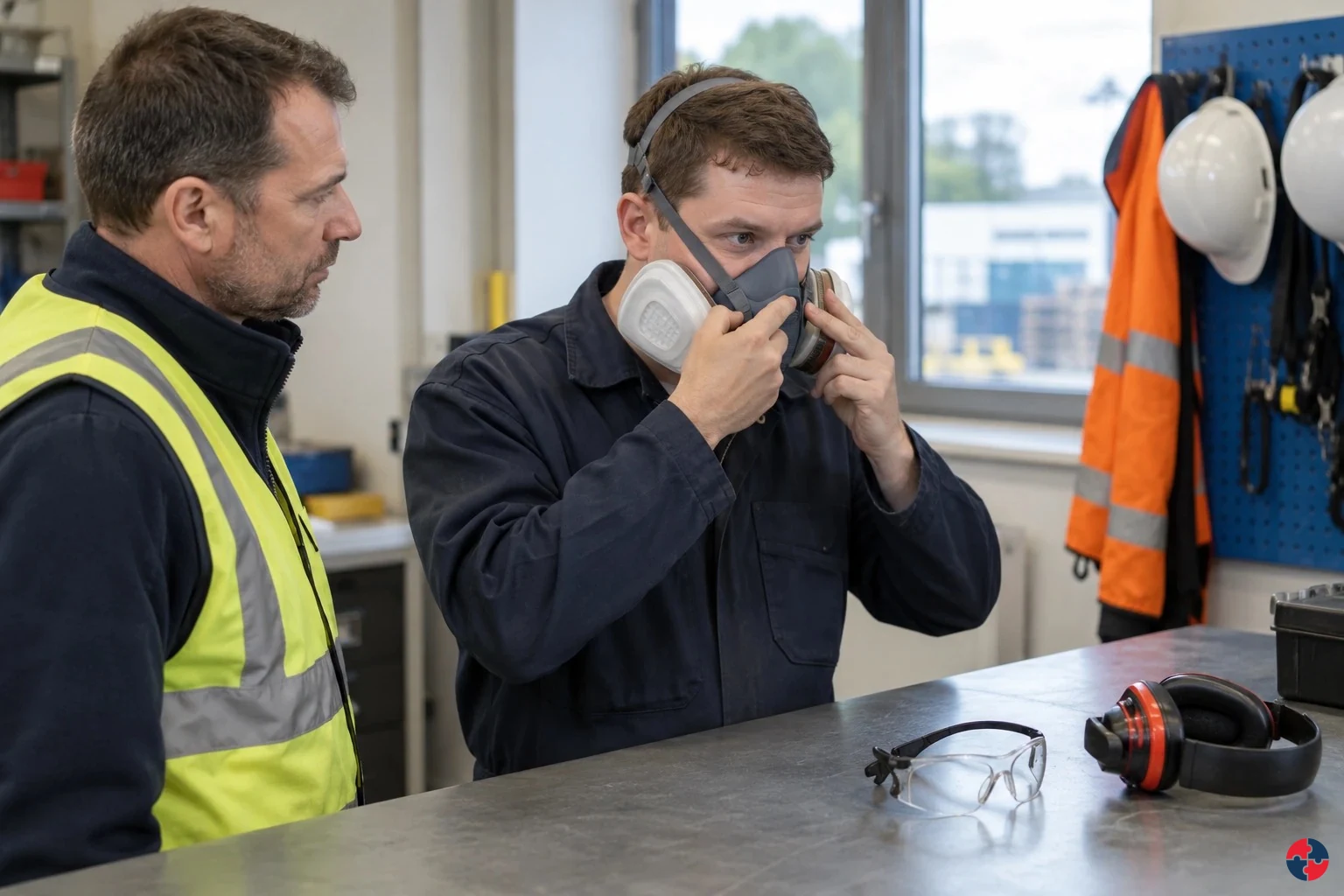
Release the task only when wearer, facepiece and exposure controls match
A fit-test record belongs to the named wearer and tested facepiece. Before exposure, compare the actual make, model, type and size with the record, check compatibility with other PPE and confirm that the task assessment supports the selected RPE. Face fit testing checks whether a specific tight-fitting respiratory protective equipment (RPE) facepiece seals adequately to an individual wearer.
Turn face fit testing knowledge into a decision
Face fit testing checks whether a specific tight-fitting respiratory protective equipment (RPE) facepiece seals adequately to an individual wearer. A pass is one part of protection: control exposure at source, select RPE for the hazard and task, issue the tested facepiece, check its seal every time and stop if the equipment, wearer or conditions change. Retain the task assessment, material identification, RPE selection and exact fit-test report, worker instruction, source-control checks, defect or substitution record and supervisor’s restart and hand-back decision.
Masonry drilling when the tested mask is out of stock
Run and observe the source controls throughout drilling. The helper keeps others outside the controlled area. Clean the area using the assessed method without creating another dust exposure.
Warning signs and likely harm
Untested mask model: Worker uses a facepiece that may not seal. Facial hair in seal area: Air leaks around the mask. No seal check: Poorly donned mask goes unnoticed.
Choose controls for the actual task
Elimination: Use preformed openings or a fixing design that avoids on-site drilling where feasible. Substitution: Consider a suitable lower-dust fixing or installation method and check the new structural and access risks. Engineering controls: Separate drilling from other trades and protect people downwind or in adjacent occupied areas. Engineering controls: Use effective compatible on-tool extraction or an approved wet method; verify dust control at the drill point. Administrative controls: Select adequate and suitable RPE for the task; obtain the correct fit-tested model or a suitable assessed alternative before release. Read the full control table for qualifications, ownership and verification. Use the actual task and applicable jurisdiction; existing technical approval remains unchanged.
Use the full face fit testing lesson
Use the full topic for the decision points, practical examples, detailed control tables and source scope. HSE guidance applies to Great Britain; use HSENI for the Northern Ireland route and the source’s stated jurisdiction. A simplified guide does not change the page’s technical-review or approval status.

Read all six steps as text
1. Release the task only when wearer, facepiece and exposure controls match
A fit-test record belongs to the named wearer and tested facepiece.
- Avoid / redesign: Use preformed openings or a fixing design that avoids on-site drilling where feasible.
- Control the task: Separate drilling from other trades and protect people downwind or in adjacent occupied areas.
- Verify before release: If the hazardous step remains, retain a task assessment and select the stronger feasible remaining controls.
A fit-test record belongs to the named wearer and tested facepiece. Before exposure, compare the actual make, model, type and size with the record, check compatibility with other PPE and confirm that the task assessment supports the selected RPE. Face fit testing checks whether a specific tight-fitting respiratory protective equipment (RPE) facepiece seals adequately to an individual wearer.
Apply it: Which part of this plan would you check at the workface before authorising the task?
2. Turn face fit testing knowledge into a decision
Use the evidence to improve the actual work arrangement.
- Change at source: Use preformed openings or a fixing design that avoids on-site drilling where feasible.
- Make it observable: If the hazardous step remains, retain a task assessment and select the stronger feasible remaining controls.
- Keep useful evidence: Retain the task assessment, material identification, RPE selection and exact fit-test report, worker instruction, source-control checks, defect or substitution record and supervisor’s restart and hand-back decision.
Face fit testing checks whether a specific tight-fitting respiratory protective equipment (RPE) facepiece seals adequately to an individual wearer. A pass is one part of protection: control exposure at source, select RPE for the hazard and task, issue the tested facepiece, check its seal every time and stop if the equipment, wearer or conditions change. Retain the task assessment, material identification, RPE selection and exact fit-test report, worker instruction, source-control checks, defect or substitution record and supervisor’s restart and hand-back decision.
Apply it: What evidence would show that the change improves this task, rather than only completing a record?
3. Masonry drilling when the tested mask is out of stock
Example: a practical application of the existing topic lesson.
- Setting: the site team needs to drill identified masonry for fixings in an enclosed refurbishment room.
- Act: Avoid on-site drilling where practicable, then choose the assessed source control and restrict access.
- Hold / review: Hold for unknown material, missing selection information, unverified fit, incompatible PPE or a failed seal check.
Run and observe the source controls throughout drilling. The helper keeps others outside the controlled area. Clean the area using the assessed method without creating another dust exposure.
Apply it: At which point would you hold this example, and what evidence would allow it to proceed?
4. Warning signs and likely harm
Connect the task, the route to the person and the control that can fail.
- Untested mask model: Worker uses a facepiece that may not seal.
- Facial hair in seal area: Air leaks around the mask.
- No seal check: Poorly donned mask goes unnoticed.
Untested mask model: Worker uses a facepiece that may not seal. Facial hair in seal area: Air leaks around the mask. No seal check: Poorly donned mask goes unnoticed.
Apply it: Who could be exposed, including other trades, cleaners, maintainers and people nearby?
5. Choose controls for the actual task
Control summary. Read the complete task-specific controls and checks in the linked topic.
- Elimination: Use preformed openings or a fixing design that avoids on-site drilling where feasible.
- Substitution: Consider a suitable lower-dust fixing or installation method and check the new structural and access risks.
- Engineering controls: Use effective compatible on-tool extraction or an assessed wet method; verify dust control at the drill point and protect adjacent people.
- Administrative controls: Select adequate and suitable RPE for the task; obtain the correct fit-tested model or a suitable assessed alternative before release.
- PPE: Check facepiece model/size, fit-test evidence, seal and compatibility with eye/hearing protection; complete pre-use checks.
Elimination: Use preformed openings or a fixing design that avoids on-site drilling where feasible. Substitution: Consider a suitable lower-dust fixing or installation method and check the new structural and access risks. Engineering controls: Separate drilling from other trades and protect people downwind or in adjacent occupied areas. Engineering controls: Use effective compatible on-tool extraction or an approved wet method; verify dust control at the drill point. Administrative controls: Select adequate and suitable RPE for the task; obtain the correct fit-tested model or a suitable assessed alternative before release. Read the full control table for qualifications, ownership and verification. Use the actual task and applicable jurisdiction; existing technical approval remains unchanged.
Apply it: Which stronger option can be used here, and who will verify it before accepting the remaining risk?
6. Use the full face fit testing lesson
Follow the official sources below and retain the task-specific evidence.
- Official guidance: HSE INDG479 rev2
- Official guidance: HSENI respiratory protection guidance
- Task decision: The supervisor obtains suitable equipment and competent selection or fit-testing advice before releasing the affected task; record the resolution and any repeat-test need.
Use the full topic for the decision points, practical examples, detailed control tables and source scope. HSE guidance applies to Great Britain; use HSENI for the Northern Ireland route and the source’s stated jurisdiction. A simplified guide does not change the page’s technical-review or approval status.
Apply it: Which official source and full-topic section will you use to resolve the next decision?
When a tight facial seal is unsuitable, stop that issue decision and obtain a competent selection of suitable alternative RPE that does not depend on the same seal. Keep material identification and dust extraction ahead of residual RPE. An unknown coating, atmosphere or failed extraction changes the task decision; a fit certificate cannot clear it. Review fit when relevant wearer, facepiece or PPE conditions change rather than inventing a universal expiry date.
BuildOut: a different mask at the gate
Illustrative example. A contractor arrives to drill masonry with a different mask model from the one recorded on their fit test.
Decision. The supervisor holds drilling while the competent assessor checks material, extraction, task-selected RPE and wearer-specific evidence.
Evidence to check. Identified material, working extraction, matching facepiece record, compatible goggles and observed correct fitting.
Hold or escalation point. No exposure while the issued model or required protection is unresolved; filtering RPE does not permit entry to an unknown atmosphere.
Follow-up. Stores and the contractor correct the substitution route; the supervisor verifies the revised issue before the next job.
How should you match the wearer, facepiece and task for face-fit testing?
Match the individual wearer to the tested facepiece make, model, material and size, then confirm that the RPE remains suitable for the task and exposure.
A gap at the seal can bypass the filter
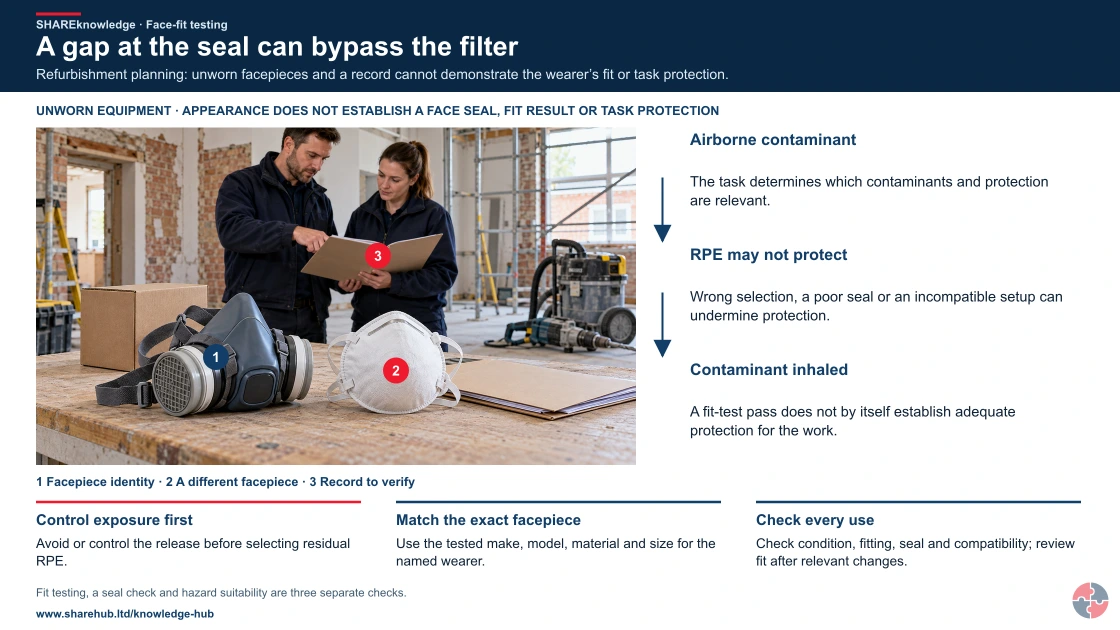
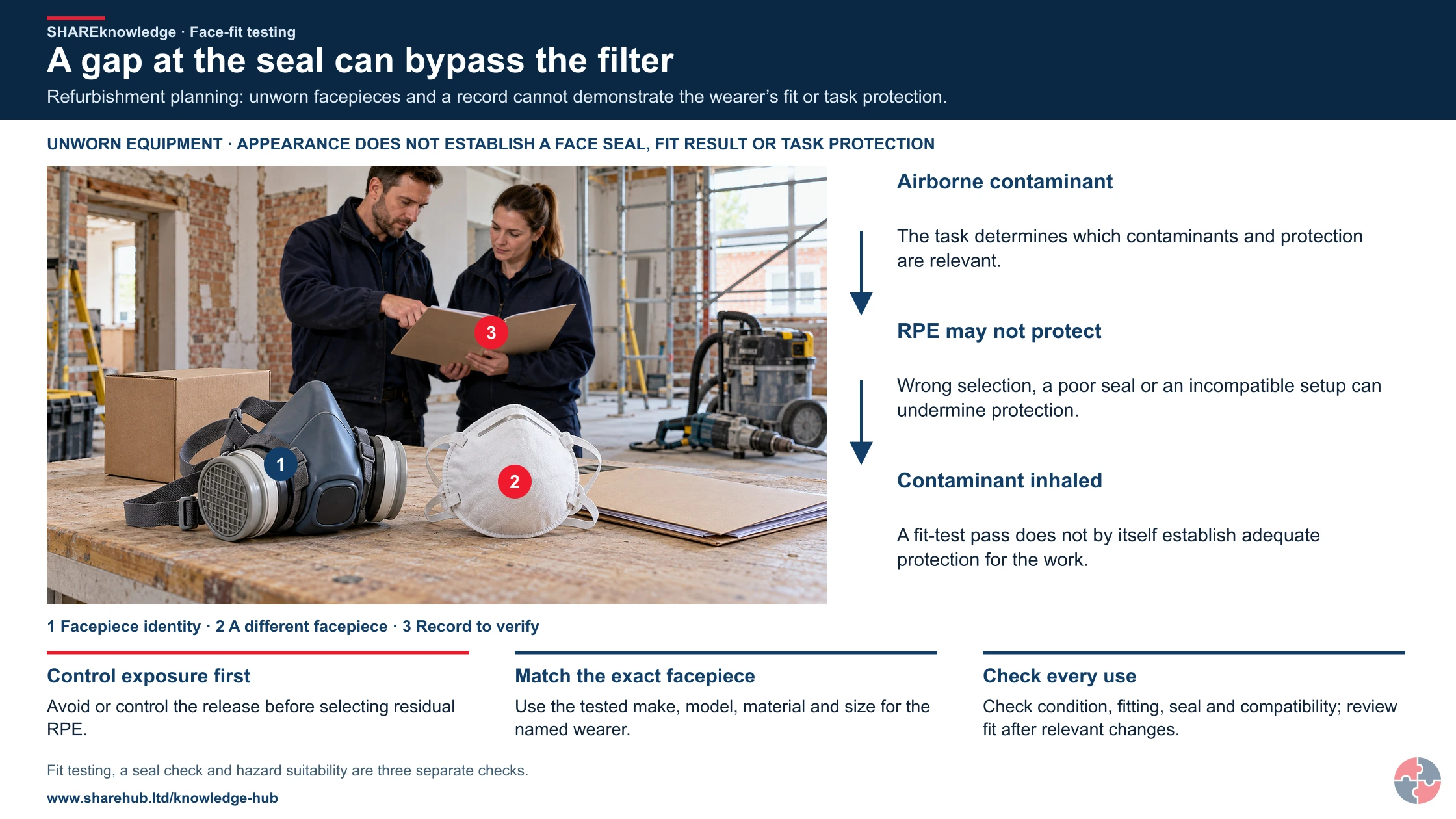
Full written explanation
An illustrative UK refurbishment planning scene shows two colleagues comparing an inert folder with two different unworn tight-fitting facepiece forms on a bench, with inactive drill/extraction equipment in the background and no airborne exposure. Numbered picture markers1–3 identify the equipment and record questions; no legible make/model, class, filter type, named wearer or passed test is established by their appearance. The pathway connects the following concerns: the task creates an airborne-contaminant question, wrong selection/poor seal/incompatible setup can undermine RPE, and contamination can be inhaled; a fit-test pass alone does not establish adequate task protection. The analytical title explains that a seal gap can bypass a filter, but the image does not demonstrate an actual leak, a face seal, gap geometry, a test setup or a person’s fit. Three control relationships require exposure control first, the exact tested wearer/facepiece match, and condition/fitting/seal/PPE compatibility checks at every use. No facepiece recommendation, fitted configuration, test exercise, protection level, safe atmosphere or work permission is supplied. Picture key: 1 Facepiece identity · 2 A different facepiece · 3 Record to verify. The separate process headings are unnumbered.
Refurbishment planning: unworn facepieces and a record cannot demonstrate the wearer’s fit or task protection.
- Airborne contaminant. The task determines which contaminants and protection are relevant.
- RPE may not protect. Wrong selection, a poor seal or an incompatible setup can undermine protection.
- Contaminant inhaled. A fit-test pass does not by itself establish adequate protection for the work.
Change the pathway
- Control exposure first. Avoid or control the release before selecting residual RPE.
- Match the exact facepiece. Use the tested make, model, material and size for the named wearer.
- Check every use. Check condition, fitting, seal and compatibility; review fit after relevant changes.
Evidence check: Fit testing, a seal check and hazard suitability are three separate checks.
A fit-test report applies to the tested wearer and identified facepiece. A pre-use seal check answers a different question and cannot replace fit testing.

Identify the equipment
Check the exact make, model, type and size against the wearer’s successful fit-test record. A similar-looking mask is not an equivalent record.
Control exposure at source
For masonry drilling, first consider avoiding the hole, then assess dust suppression or compatible on-tool extraction and protection of other trades.
Check before use
Follow the manufacturer’s fitting and seal-check instructions, and assess compatibility with other PPE. A particulate filter does not protect against solvent vapour.
Hold a mismatch
The supervisor obtains suitable equipment and competent selection or fit-testing advice before releasing the affected task; record the resolution and any repeat-test need.
Read the complete task-specific control examples
ERICPD is a planning cross-map: Discipline verifies and sustains every control. ESEAP compares effectiveness. A label does not authorise the task; retain the owner, evidence and stop or change decision.
Drilling masonry with task-selected RPE · ERICPD
- Eliminate
- Use preformed openings or a fixing design that avoids on-site drilling where feasible.
- Reduce
- Consider a suitable lower-dust fixing or installation method and check the new structural and access risks.
- Isolate
- Use effective compatible on-tool extraction or an assessed wet method; verify dust control at the drill point and protect adjacent people.
- Control
- Use effective compatible on-tool extraction or an approved wet method; verify dust control at the drill point.
- PPE
- Check facepiece model/size, fit-test evidence, seal and compatibility with eye/hearing protection; complete pre-use checks.
- Discipline
- Review fit after relevant changes and replace damaged equipment; failed source control requires a task hold, not a mask swap.
Drilling masonry with task-selected RPE · ESEAP
- Elimination
- Use preformed openings or a fixing design that avoids on-site drilling where feasible.
- Substitution
- Consider a suitable lower-dust fixing or installation method and check the new structural and access risks.
- Engineering controls
- Use effective compatible on-tool extraction or an assessed wet method; verify dust control at the drill point and protect adjacent people.
- Administrative controls
- Select adequate and suitable RPE for the task; obtain the correct fit-tested model or a suitable assessed alternative before release.
- PPE
- Check facepiece model/size, fit-test evidence, seal and compatibility with eye/hearing protection; complete pre-use checks.
Cleaning oily valve components · ERICPD
- Eliminate
- Buy components ready for assembly or remove an unnecessary cleaning stage where cleanliness requirements permit.
- Reduce
- Trial a suitable aqueous or other lower-hazard cleaning process; validate component finish and any new corrosion or skin risk.
- Isolate
- Use suitable contained cleaning or effective source capture where required by the actual formulation and exposure assessment; physically protect unrelated work and ignition-sensitive areas.
- Control
- Use compatible enclosed cleaning equipment and effective local extraction where required; minimise open liquid and splash paths.
- PPE
- Select gloves, eye protection and any RPE for the actual formulation; a particulate mask does not protect against solvent vapour.
- Discipline
- Maintain seals and extraction, check cleaning quality and investigate exposure or fire-control defects before restarting.
Cleaning oily valve components · ESEAP
- Elimination
- Buy components ready for assembly or remove an unnecessary cleaning stage where cleanliness requirements permit.
- Substitution
- Trial a suitable aqueous or other lower-hazard cleaning process; validate component finish and any new corrosion or skin risk.
- Engineering controls
- Use suitable contained cleaning or effective source capture where required by the actual formulation and exposure assessment; physically protect unrelated work and ignition-sensitive areas.
- Administrative controls
- Identify the product and contamination, control decanting and waste, and prohibit unassessed mixing or heating.
- PPE
- Select gloves, eye protection and any RPE for the actual formulation; a particulate mask does not protect against solvent vapour.
What training is needed for face fit testing and RPE?
Training should be layered from general awareness to task-specific use, supervisor oversight and competent fit tester capability.
Wearers need practical demonstration and observed use, including how to leave safely when a problem occurs. Supervisors need authority to reject an untested substitute and arrange alternatives without pressuring a worker to continue. Fit testers need competence in their actual method, equipment, diagnostic checks, wearer preparation, hygiene, exercises, result interpretation and records. A short awareness video or attendance certificate alone cannot demonstrate these abilities. HSE fit testing basics.
| Role | Learning to test | Competence demonstration | Assessor and record | Reassessment trigger |
|---|---|---|---|---|
| Nearby and new workers | Recognise airborne contamination, controlled zones and the report/leave route. | Identify an uncontrolled release and alert the right supervisor; no mask-use authorisation is inferred. | Supervisor observes the scenario and records induction. | New exposure, changed area or missed emergency response. |
| RPE wearers | Practise exact issued facepiece, donning, seal check, compatibility, cleaning and safe exit. | Don and check the device unaided on the real ensemble; identify defects and stop before exposure. | Competent supervisor or trainer signs task-specific practical record. | New facepiece, facial or PPE change, repeated failed check or observed misuse. |
| Competent fit testers | Choose valid qualitative/quantitative method, inspect equipment, prepare wearer, observe exercises and interpret pass/fail/invalid. | Conduct a witnessed valid test, troubleshoot without forcing a pass and issue a traceable report. | Competent technical lead assesses method practice and retains test/equipment records. | Method or equipment change, error trend, lapse in practice or revised HSE guidance. |
| Supervisors and contractor coordinators | Check source controls, exact fit record, facial seal, other PPE, issue control and stop/restart. | Challenge an untested substitution or failed extraction and arrange safe alternative work. | Operations/safety lead samples field decisions and contractor records. | Supply change, defect, exposure event or audit finding. |
| Managers, purchasers and technical assessors | Resource exposure prevention, RPE selection, compatible procurement, assurance and applicable GB/NI duty. | Approve a task-specific specification and trace assessment to worker, equipment and field use. | Competent safety lead reviews signed assessment, supplier evidence and action closure. | New material, RPE type, legal guidance or recurring failure. |
What records should a face fit testing system keep?
Records should show who was tested, what facepiece was tested, how it was tested, who tested it, the result and when review is needed.
Good records allow supervisors to confirm that the correct worker is using the correct mask for the task. They also help procurement avoid replacing masks with untested alternatives and help managers identify workers who need retesting.
Records should be easy to retrieve, but health or personal data should be handled responsibly. The record is mainly about RPE suitability, not private medical detail.
| Record field | Why it matters | Example |
|---|---|---|
| Wearer | Links the result to the individual. | Wearer name or unique individual ID. |
| Facepiece | Fit applies to exact make, model, type and size. | FFP3 brand/model/size. |
| Method | Shows whether qualitative or quantitative test was used. | Qualitative bitter test or quantitative test. |
| Result | Shows pass, fail or limitations. | Pass with clean-shaven condition. |
| Tester | Shows who carried out the test. | Competent tester details. |
| Date and review | Supports repeat testing and audit. | Test date and review trigger. |
The full report should also identify the facepiece material, filters, other PPE and accessories, whether an issued or test facepiece was used, exercises and pass criteria, and individual exercise results for quantitative tests. Record relevant assistance, repeat attempts, defects and test-equipment identity. INDG479 Annex 1 is the report checklist. A certificate saying only “FFP3 passed” is not enough to identify what may be issued.
Keep the fit-test report available to the wearer and authorised people who need it. Separate it from confidential clinical information. Examination, maintenance and repair records are distinct from a fit-test expiry rule; apply the relevant statutory retention requirement and programme arrangements. HSE INDG479 rev2; HSE HSG53 fourth edition.
Which duties apply in Great Britain and Northern Ireland?
Employers must prevent or adequately control relevant workplace exposure and provide suitable controls. Great Britain uses COSHH 2002; Northern Ireland uses COSHH NI 2003. The legal text and regulator route must match the work location.
| Route | What it means here | What to verify |
|---|---|---|
| Great Britain | COSHH 2002 governs covered hazardous substances; its ACOP supports fit testing as part of tight-fitting RPE selection. General HSWA and management duties also apply. | Assessment, prevention and control, suitable RPE, use, maintenance, information and training. COSHH Regulations 2002; HSE COSHH ACOP L5 sixth edition. |
| Northern Ireland | COSHH NI 2003 is the separate statutory route. HSENI gives NI RPE advice and links to HSE’s practical fit-testing guidance. | Use current NI regulations and HSENI advice, not a GB citation as NI law. COSHH Regulations Northern Ireland 2003; HSENI COSHH; HSENI respiratory protective equipment. |
| Special exposure regimes | Asbestos, lead and ionising radiation have specific regimes; emergency and confined-space work need specialist planning. | Confirm the applicable GB or NI instrument and task-specific guidance before using this general page. A fit-test pass does not authorise the activity. |
| Product supply | Market conformity and manufacturer or importer duties are separate from workplace selection and fit. | Check the declaration, traceability, instructions and the appropriate GB or NI supply guide. |
INDG479 is guidance, while an Approved Code of Practice has a special legal status explained in its introduction. Fit2Fit accreditation is a useful competence route, not a compulsory licence for every fit tester. General PPE duties do not replace COSHH where that specific regime covers the same risk. Do not describe every recommendation or a company’s stricter review interval as a statutory requirement.
The HSENI RPE page confirms that a successful test must match the make, model, type and size made available to the wearer. A GB HSE method guide may inform NI practice, but NI duties must be checked under NI instruments for the task.
How should face fit testing appear in a risk register?
The risk register should link each airborne exposure task to the selected controls, RPE type, fit-test status and supervision arrangements.
For each task, record the source of airborne contamination, people exposed (including cleaners, contractors and neighbours), the engineering controls and their failure signals, residual exposure assessment, selected RPE, accountable owner and action dates. Link the wearer and tested facepiece through a controlled register rather than putting unnecessary personal information in a widely shared risk register.
Audit a real work cycle: compare the record with the actual mask issued, watch donning and the seal check, check the extraction works, and follow a defect through to safe closure. Trend stock substitutions, repeated test failures, rejected equipment and reports of discomfort. An improving certificate count can conceal deteriorating exposure control.
How should face-fit and RPE controls be checked in practice?
Remove the actual hazard where possible, then use substitution and verified physical controls before relying on procedures or PPE. Discipline checks that the chosen barriers still work.
The cleaning product, contaminant concentration and required protection factor are unspecified in this example. No mask or filter can be prescribed until a competent assessment supplies those facts.
The scenario is solvent-cleaning vapour exposure. The controls below are reasoned task applications of linked guidance, not a prescribed design or evidence that each intervention appears verbatim in a source. A competent owner must check feasibility, local law and stop criteria.
Use current government guidance and competent task-specific advice; this section does not establish a technical specification.
Which standards support face-fit testing, and what are their limits?
Standards and management systems can help organise a reliable RPE programme, but they do not replace the legal duty, current regulator advice or product instructions.
Use current government guidance and competent task-specific advice; this section does not establish a technical specification.
BS EN ISO 45001:2023+A1:2024 can support risk ownership, competence, controlled records, operational checks and corrective action. Those management themes are useful here without treating certification or an unchecked clause list as proof of adequate RPE. The practical test is whether the organisation can trace a worker’s task to effective source controls, suitable equipment and observed correct use.
BS EN 136, BS EN 140 and BS EN 149 are product-family references cited in INDG479 for full-face, half-mask and filtering-half-mask performance respectively. A product marking does not establish fit to this individual. Check the current product declaration and applicable standard status for the actual procurement decision.
Use current government guidance and competent task-specific advice; this section does not establish a technical specification.
These are practical management-system themes, not a clause-by-clause interpretation. A competent reviewer must verify any clause mapping against a lawfully accessed current standard.
How does face fit testing support study and professional development?
For qualification and professional learning, face fit testing is best understood as one part of wider COSHH and respiratory risk control.
Exam-style scenarios may involve silica dust, wood dust, welding fume, spraying, asbestos, cement dust or poorly maintained LEV. A strong answer should explain that RPE must be suitable for the hazard and wearer, fit tested if tight-fitting, maintained, stored, supervised and supported by training.
The common weak answer is to say 'wear a mask'. Better answers explain the hierarchy of control, exposure prevention, LEV, wet methods, RPE selection, face fit testing, clean-shaven requirements, seal checks, health surveillance where relevant and record keeping.
What are the common questions about face-fit testing?
People usually ask when testing is needed, whether facial hair matters and what records should be kept.
What is face fit testing?
Face fit testing checks whether a tight-fitting RPE facepiece seals adequately to the individual wearer's face.
Who needs a face fit test?
Anyone required to wear tight-fitting RPE for work should be fit tested for the exact make, model, type and size they will use.
Is face fit testing needed for loose-fitting hoods?
No. Loose-fitting hoods and helmets do not rely on a tight face seal, but they still need correct selection, use, maintenance and training.
What is a qualitative fit test?
A qualitative fit test uses bitter or sweet taste detection and is suitable for disposable masks and reusable half masks, not full-face masks.
What is a quantitative fit test?
A quantitative fit test uses instruments to measure leakage and can be used for full-face masks as well as other tight-fitting facepieces.
Does facial hair matter?
Yes. Hair between the face and seal can prevent a tight fit, so tight-fitting RPE normally requires the wearer to be clean shaven in the seal area.
What is a user seal check?
A user seal check is a quick check by the wearer each time the mask is put on; it does not replace a formal face fit test.
When should a face fit test be repeated?
Repeat after changes to mask model or size, significant facial change, weight change, dental changes, facial surgery or where the fit is in doubt.
Are ear-loop masks suitable as tight-fitting RPE?
HSE has warned that ear-loop respirators do not provide protection as tight-fitting RPE and should not be used where tight-fitting RPE is required.
What records should be kept?
Keep the wearer's details, mask make/model/size, test method, result, tester, date and any limitations or repeat-test trigger.
Chemical hazard symbols: what do they mean?
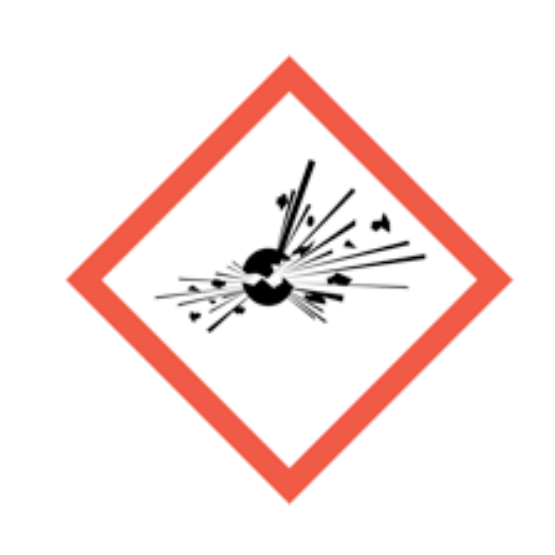
Exploding bomb
Explosive, self-reactive or organic peroxide hazards.
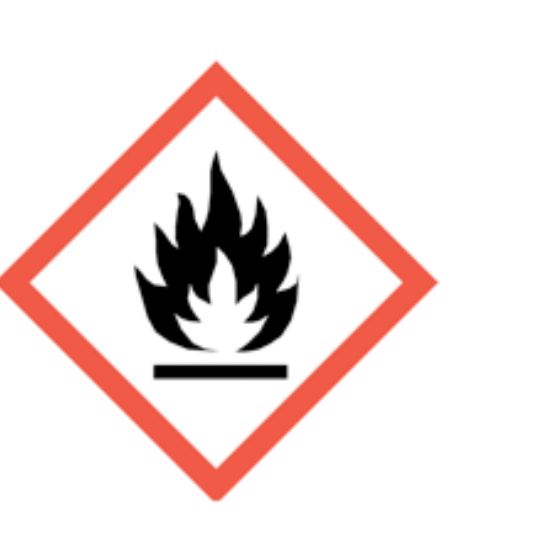
Flame
Flammable, self-heating or pyrophoric substances.
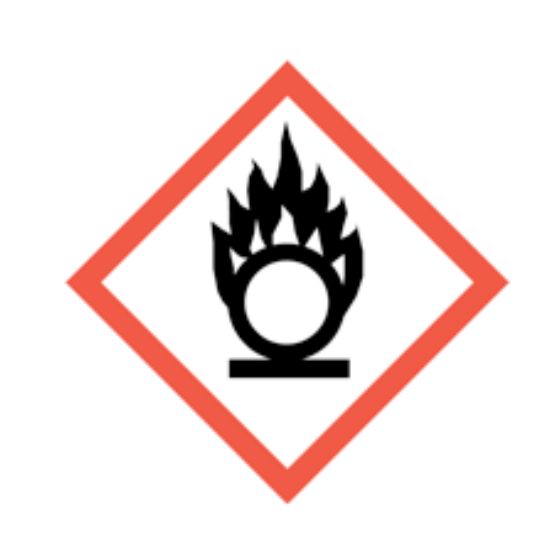
Flame over circle
Oxidising substances that can intensify fire.
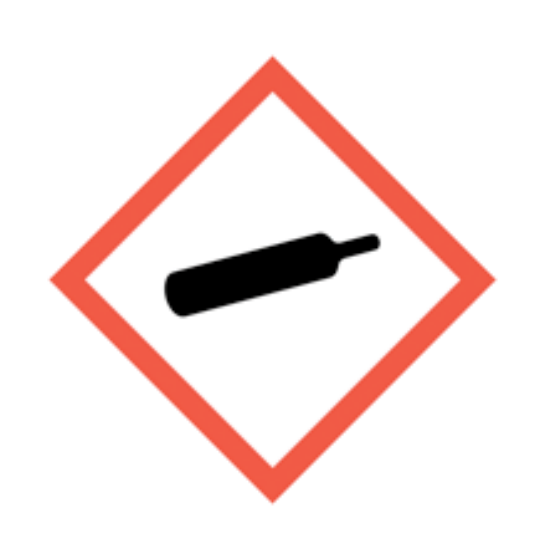
Gas cylinder
Gas under pressure.
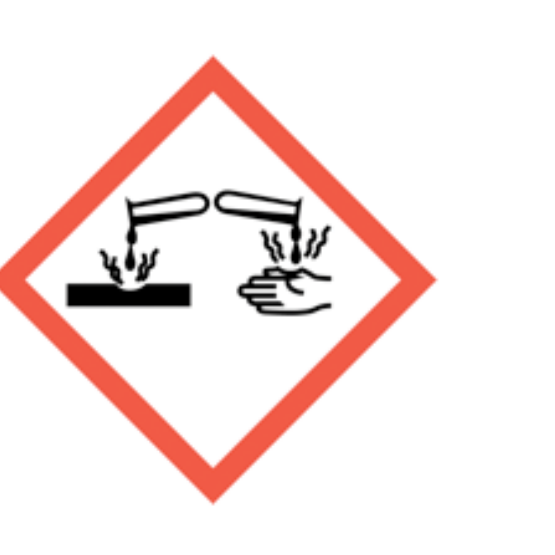
Corrosion
Skin burns, eye damage or corrosive to metals.
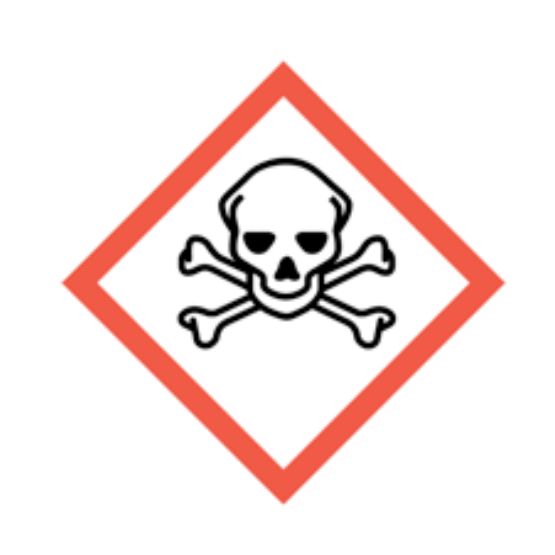
Skull and crossbones
Acute toxicity.
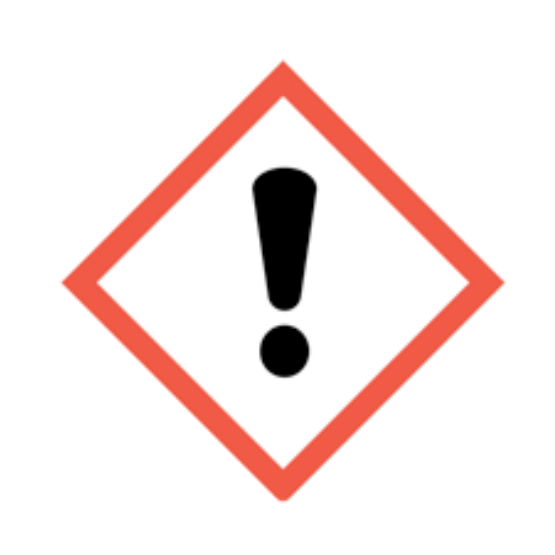
Exclamation mark
Irritation, harmful effects or skin sensitisation; some classifications cover drowsiness, dizziness or ozone-layer hazard. Read the actual hazard statements. Skin sensitisation differs from respiratory sensitisation.
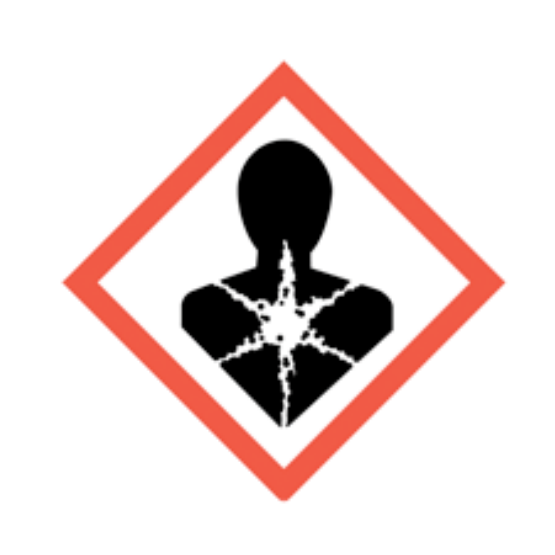
Health hazard
Serious health hazards, including organ damage, aspiration hazard, respiratory sensitisation, cancer and reproductive effects; some can follow a single exposure.
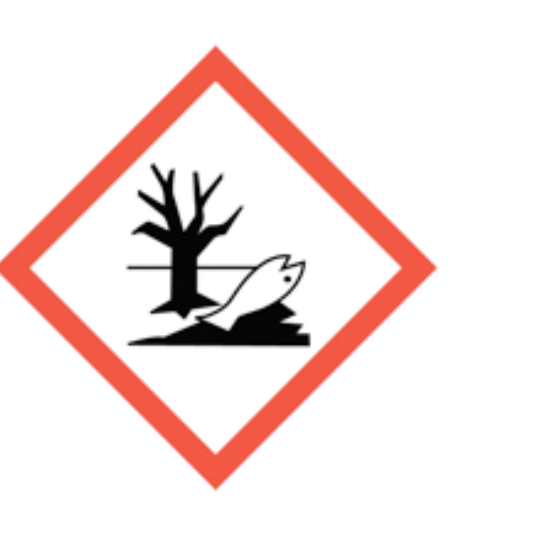
Environment
Hazardous to the aquatic environment.
What do the main face-fit testing and RPE terms mean?
The terms below explain the RPE, fit-testing and exposure-control abbreviations used in this guide.
Acronyms should be explained because RPE terminology can be confusing for new users.
| Acronym | Meaning | Plain English use |
|---|---|---|
| APF | Assigned Protection Factor | Expected level of protection for a class of RPE when correctly selected and used. |
| COSHH | Control of Substances Hazardous to Health | Separate GB and NI regulations and control frameworks for hazardous substances. |
| FFP | Filtering Facepiece | Disposable filtering mask such as FFP2 or FFP3. |
| LEV | Local Exhaust Ventilation | Engineering control that captures contaminants at source. |
| PPE | Personal Protective Equipment | Equipment worn to protect the person. |
| RPE | Respiratory Protective Equipment | Equipment used to protect the wearer from inhaling hazardous substances. |
| BA | Breathing apparatus | Supplies breathable air from an independent source; specialist selection is needed for oxygen-deficient atmospheres. |
| QLFT | Qualitative fit testing | Pass/fail method using a wearer’s detection of a test substance; not for full-face masks. |
| QNFT | Quantitative fit testing | Instrument-based measurement of facepiece fit under a validated procedure. |
Which BuildOut documents support this topic?
Download individual editable BuildOut documents for this topic. Procedures and plans contain completed arrangements; forms, checklists, assessments, RAMS and permits are blank masters. Registers include separate worked examples.
| Document | Purpose and content | Editable download |
|---|---|---|
| RPE selection and face-fit record BOUK-FRM-COSHH-01 · Blank editable master · v1.0 | Record compatible RPE, face-fit result, training and limitations. | Download DOCX Read preview |
Review and adapt the documents for your organisation, activities and jurisdiction before approval and issue. Open the SHAREms management-system hierarchy to find each document under its parent policy.