
SHARE Knowledge Hub
What is combustion and the fire triangle?
A fire needs fuel, an oxidiser and an ignition source. Use that model to prevent ordinary workplace fires, then assess escape, smoke and process-specific explosion risks. Combustible dust also needs dispersion and often confinement for an explosion: the simple triangle alone does not describe that scenario.
Understanding What is combustion and the fire triangle?
A fire needs fuel, an oxidiser and an ignition source. Use that model to prevent ordinary workplace fires, then assess escape, smoke and process-specific explosion risks. Combustible dust also needs dispersion and often confinement for an explosion: the simple triangle alone does not describe that scenario.
Why this matters at work
Combustible dust dispersed in air can ignite, often with confinement increasing consequences. A first event can disturb settled layers on beams, ledges, floors or services and create a larger secondary cloud. Ordinary materials such as flour, sugar, wood, coal and some metals or chemicals can therefore present explosion risks when finely divided. A material that appears difficult to ignite as a lump may behave differently as dust.
First consider replacement, a non-hot repair or a competent specialist route. If a competent assessment retains hot work, preparation must address the actual inventory, physical isolation, safe removal, cleaning, inspection, atmosphere checks and other relevant precautions under the applicable system. Gas-freeing alone may not remove non-volatile residue. Do not improvise a tank-entry or purging procedure from this Q&A, which supplies no acceptance limit or work authorisation. Record the assessment, evidence, responsible people and stop conditions. Protect nearby workers and emergency arrangements and verify the actual safe state before any hazardous work through competent site controls.
How organisations manage this in practice
Assess the real occupants, warning, escape, assistance, compartmentation, equipment, maintenance, work processes and credible failures. Coordinate dutyholders on shared premises and contractors introducing hot work, temporary materials or impairments. Apply current national record requirements rather than confusing England and Wales full assessment records with a different threshold under GB DSEAR. Record responsibility, findings, actions and verification and review after change. Use competent help where needed without assuming that employing an assessor transfers every duty. This Q&A provides national routing and practical considerations; it is not a site fire-risk assessment, evacuation approval or claim of specialist signoff.
Assess actual dust properties, generation, dispersion, ignition, containment, transfer, cleaning and foreseeable failures through competent DSEAR or the appropriate NI framework. Consider reliable testing or existing evidence where explosibility is uncertain. Prevent deposits and uncontrolled release, use suitable systems and maintenance and avoid cleaning methods that create a cloud. Explosion protection and isolation require competent design; a generic fire-triangle diagram cannot specify vents, suppression or equipment suitability. Record the evidence, assumptions, affected people, controls, emergency arrangements and review triggers. A small previous incident or absence of visible flame does not demonstrate that accumulated dust and connected equipment are safe.
The principle helps explain extinguishment, but the agent must suit the material, installation and safe-response strategy. Water can cool many ordinary solids but can spread some burning liquids, react with certain substances or create other hazards. Powder may interrupt flame with limited cooling; gas systems can create asphyxiation and re-entry risks. The choice requires the actual fire assessment, equipment and competent instructions rather than a triangle alone. Workers should follow the emergency plan: raise the alarm, stop or isolate only what is safe, leave promptly and call the fire service as appropriate. Escape must not depend on portable firefighting, recovering belongings or awaiting manager approval. Only people with the appropriate role, training and safe conditions should attempt the limited response specified locally, keeping escape available. Record equipment checks and impairment actions through the relevant regime. Do not prescribe a medium for an unknown chemical, battery or metal fire from this Q&A. Suppression does not necessarily remove continued fuel release, hot material or the conditions for reignition.
Follow the fuel through a change of state or task
The same liquid in a closed container, heated in use or released as a spray does not present the same event. A nominally empty vessel can retain hazardous residue. Use the triangle to ask what could meet, where and in what form, then select the appropriate fire or dangerous-substance assessment.
Best-practice guide: Combustion And The Fire Triangle
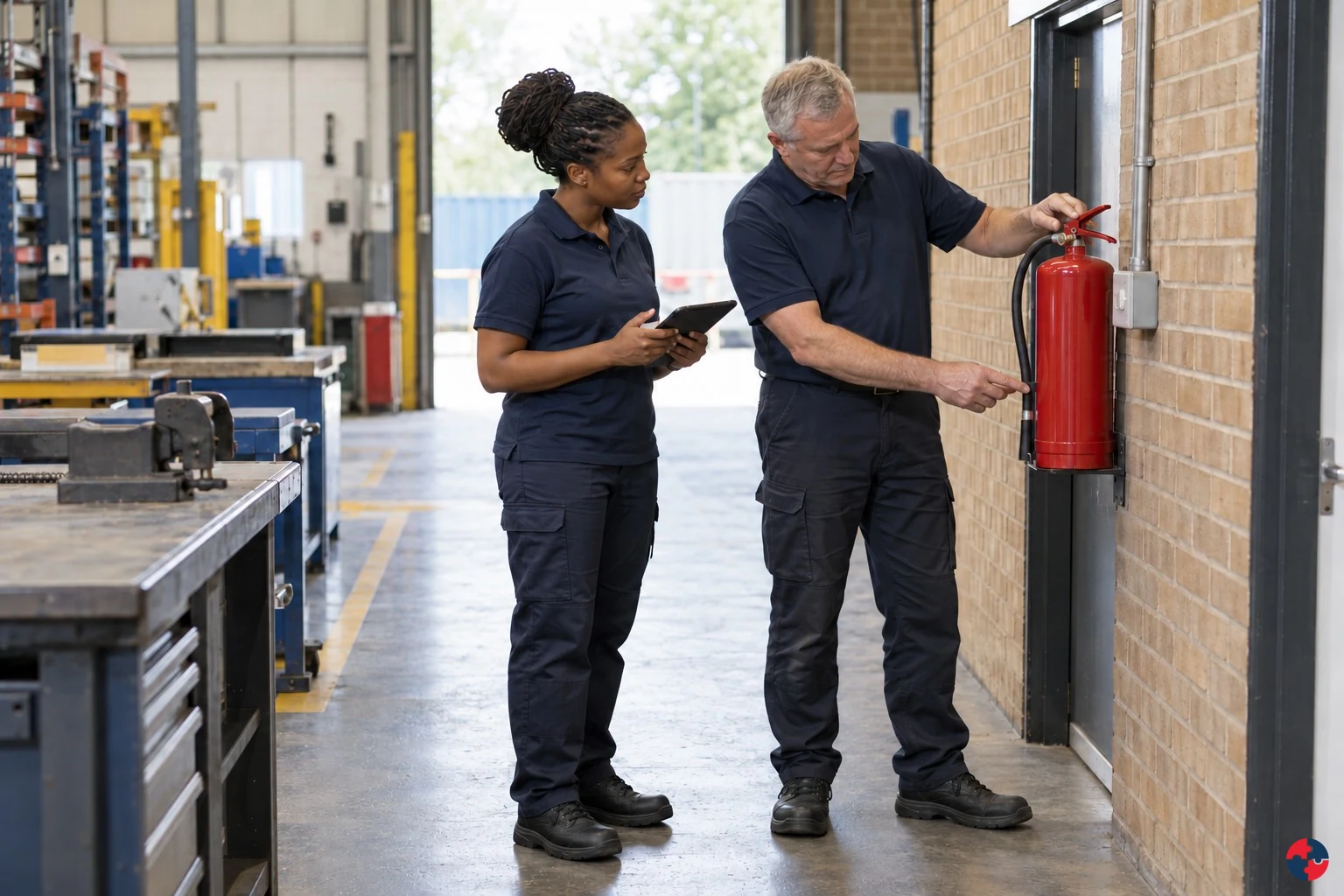
Follow the fuel through a change of state or task
The same liquid in a closed container, heated in use or released as a spray does not present the same event. A nominally empty vessel can retain hazardous residue. A fire needs fuel, an oxidiser and an ignition source.
Turn combustion and the fire triangle knowledge into a decision
A fire needs fuel, an oxidiser and an ignition source. Use that model to prevent ordinary workplace fires, then assess escape, smoke and process-specific explosion risks. Major accident hazard register, fire risk assessment, DSEAR assessment and action tracker.
the process operator worked example
Assess and analyse: Identifies credible fire and explosion scenarios involving fuel release, vapour, ignition, oxygen/oxidisers and escalation. Evidence / response: Major accident hazard register, fire risk assessment, DSEAR assessment and action tracker. Control fuel: Minimises combustible waste, controls tank inventories, segregates flammable stores and manages contaminated absorbents. Evidence / response: Inventory controls, housekeeping inspections and waste transfer records.
Warning signs and likely consequences
Combustible waste builds up: Fuel load increases and fire can spread faster. Hot work is treated casually: Sparks or heat ignite hidden fuel or residues. Fire doors are wedged or damaged: Smoke and heat spread into escape routes.
Choose controls for combustion and the fire triangle
Elimination: Remove unnecessary solvent cleaning and hot work near stores; use off-site cold fabrication if it meets the job. Substitution: Trial a less flammable product or lower-dust material after checking toxicity, compatibility and quality. Engineering: Closed solvent transfer, suitable ventilation and rated equipment; enclose dust transfer with designed extraction and explosion protection where needed. Administrative: Limit inventory, separate hot work, clean dust safely, inspect plant and brief alarm/evacuation routes. PPE: Fire or respiratory PPE only for residual assessed tasks and trained responders; it does not justify an explosive atmosphere. Read the full control table for qualifications, ownership and verification. Use the actual task and applicable jurisdiction; existing technical approval remains unchanged.
Use the full combustion and the fire triangle lesson
Use the full topic for the decision points, practical examples, detailed control tables and source scope. HSE guidance applies to Great Britain; use HSENI for the Northern Ireland route and the source’s stated jurisdiction. A simplified guide does not change the page’s technical-review or approval status.

Read all six steps as text
1. Follow the fuel through a change of state or task
The same liquid in a closed container, heated in use or released as a spray does not present the same event.
- Avoid / redesign: Remove unnecessary solvent cleaning and hot work near stores; use off-site cold fabrication if it meets the job.
- Control the task: Closed solvent transfer, suitable ventilation and rated equipment; enclose dust transfer with designed extraction and explosion protection where needed.
- Verify before release: Job planner checks method; hold if the fuel/ignition interface remains uncontrolled.
The same liquid in a closed container, heated in use or released as a spray does not present the same event. A nominally empty vessel can retain hazardous residue. A fire needs fuel, an oxidiser and an ignition source.
Apply it: Which part of this plan would you check at the workface before authorising the task?
2. Turn combustion and the fire triangle knowledge into a decision
Use the evidence to improve the actual work arrangement.
- Change at source: Remove unnecessary solvent cleaning and hot work near stores; use off-site cold fabrication if it meets the job.
- Make it observable: Job planner checks method; hold if the fuel/ignition interface remains uncontrolled.
- Keep useful evidence: Major accident hazard register, fire risk assessment, DSEAR assessment and action tracker.
A fire needs fuel, an oxidiser and an ignition source. Use that model to prevent ordinary workplace fires, then assess escape, smoke and process-specific explosion risks. Major accident hazard register, fire risk assessment, DSEAR assessment and action tracker.
Apply it: What evidence would show that the change improves this task, rather than only completing a record?
3. the process operator worked example
Example: a practical application of the existing topic lesson.
- Assess and analyse: Identifies credible fire and explosion scenarios involving fuel release, vapour, ignition, oxygen/oxidisers and escalation.
- Control fuel: Minimises combustible waste, controls tank inventories, segregates flammable stores and manages contaminated absorbents.
- Control ignition: Uses hot work permits, hazardous area equipment, bonding and earthing, vehicle controls and electrical maintenance.
Assess and analyse: Identifies credible fire and explosion scenarios involving fuel release, vapour, ignition, oxygen/oxidisers and escalation. Evidence / response: Major accident hazard register, fire risk assessment, DSEAR assessment and action tracker. Control fuel: Minimises combustible waste, controls tank inventories, segregates flammable stores and manages contaminated absorbents. Evidence / response: Inventory controls, housekeeping inspections and waste transfer records.
Apply it: At which point would you hold this example, and what evidence would allow it to proceed?
4. Warning signs and likely consequences
Connect the task, the route to the person and the control that can fail.
- Combustible waste builds up: Fuel load increases and fire can spread faster.
- Hot work is treated casually: Sparks or heat ignite hidden fuel or residues.
- Fire doors are wedged or damaged: Smoke and heat spread into escape routes.
Combustible waste builds up: Fuel load increases and fire can spread faster. Hot work is treated casually: Sparks or heat ignite hidden fuel or residues. Fire doors are wedged or damaged: Smoke and heat spread into escape routes.
Apply it: Who could be exposed, including other trades, cleaners, maintainers and people nearby?
5. Choose controls for combustion and the fire triangle
Start with the stronger practicable options and verify their effect.
- Elimination: Remove unnecessary solvent cleaning and hot work near stores; use off-site cold fabrication if it meets the job.
- Substitution: Trial a less flammable product or lower-dust material after checking toxicity, compatibility and quality.
- Engineering: Closed solvent transfer, suitable ventilation and rated equipment; enclose dust transfer with designed extraction and explosion protection where needed.
- Administrative: Limit inventory, separate hot work, clean dust safely, inspect plant and brief alarm/evacuation routes.
- PPE: Fire or respiratory PPE only for residual assessed tasks and trained responders; it does not justify an explosive atmosphere.
Elimination: Remove unnecessary solvent cleaning and hot work near stores; use off-site cold fabrication if it meets the job. Substitution: Trial a less flammable product or lower-dust material after checking toxicity, compatibility and quality. Engineering: Closed solvent transfer, suitable ventilation and rated equipment; enclose dust transfer with designed extraction and explosion protection where needed. Administrative: Limit inventory, separate hot work, clean dust safely, inspect plant and brief alarm/evacuation routes. PPE: Fire or respiratory PPE only for residual assessed tasks and trained responders; it does not justify an explosive atmosphere. Read the full control table for qualifications, ownership and verification. Use the actual task and applicable jurisdiction; existing technical approval remains unchanged.
Apply it: Which stronger option can be used here, and who will verify it before accepting the remaining risk?
6. Use the full combustion and the fire triangle lesson
Follow the official sources below and retain the task-specific evidence.
- Official guidance: HSE DSEAR in detail
- Official guidance: HSE five-level hierarchy
- Task decision: Major accident hazard register, fire risk assessment, DSEAR assessment and action tracker.
Use the full topic for the decision points, practical examples, detailed control tables and source scope. HSE guidance applies to Great Britain; use HSENI for the Northern Ireland route and the source’s stated jurisdiction. A simplified guide does not change the page’s technical-review or approval status.
Apply it: Which official source and full-topic section will you use to resolve the next decision?
For ordinary housekeeping, check combustible waste, storage and ignition separation. For vapour, mist, dust or contaminated equipment, use the specialist routes and competent engineering advice. Removing one triangle label on a diagram does not prove a process design, extinguisher choice or restart is safe; those decisions need the actual material, operating state and control evidence.
Crownway: an empty container still has residue
Illustrative example. A maintenance team proposes heating a container that is described as empty after liquid removal.
Decision. The planner holds the work and checks history, residues and safer methods through the specialist hot-work process.
Evidence to check. Material and process history, competent assessment, isolation and the authorised method and release conditions.
Hold or escalation point. No heating or cutting based solely on the word empty or the fire-triangle graphic.
Follow-up. Record the method decision and ensure the container’s status is communicated through storage and maintenance.
Fuel form changes the fire scenario
A liquid, its vapour and a dispersed dust need different assessment. The fuel–oxygen–ignition model is useful only when the actual reaction and conditions are understood.
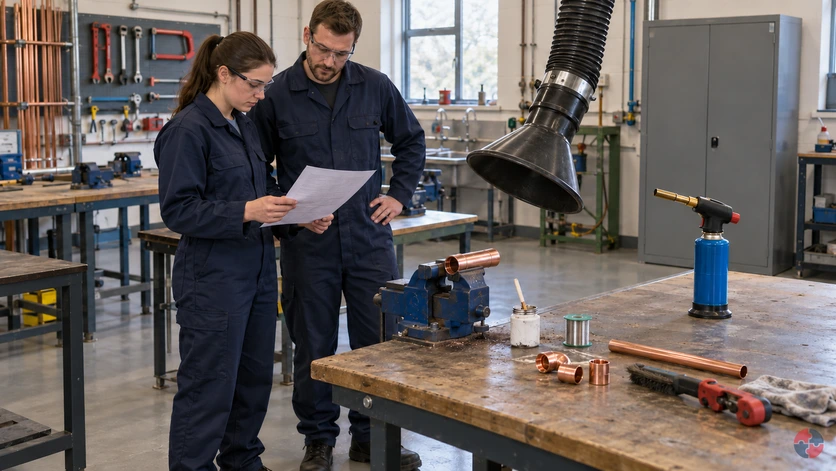
Find the fuel, oxidiser and potential ignition
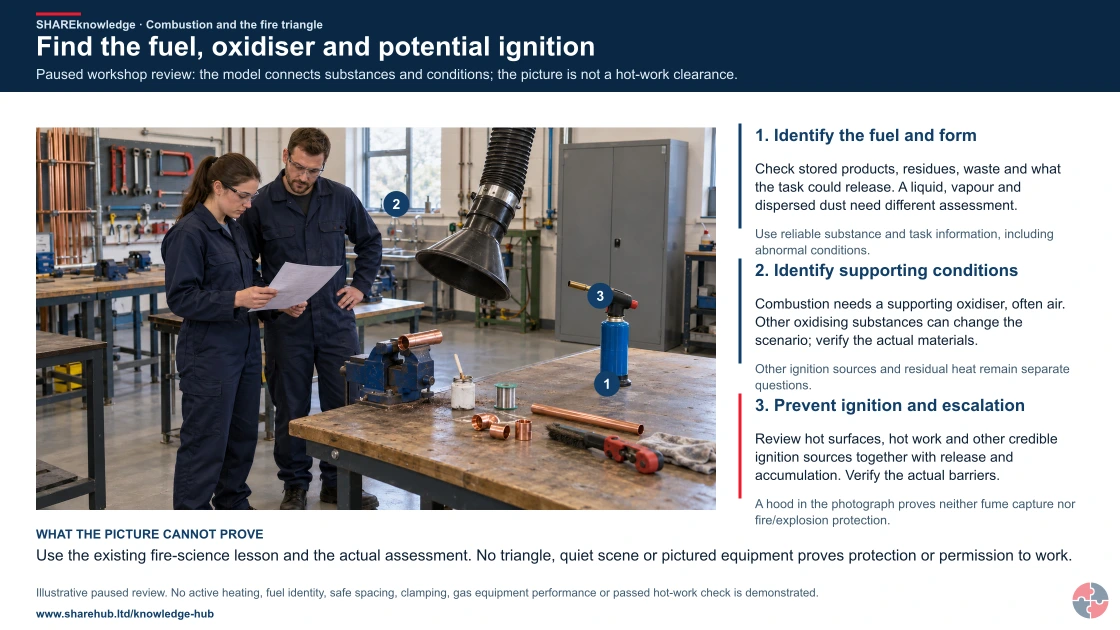
Full written explanation
Paused workshop review: the model connects substances and conditions; the picture is not a hot-work clearance.
- Identify the fuel and form. Check stored products, residues, waste and what the task could release. A liquid, vapour and dispersed dust need different assessment.
- Identify supporting conditions. Combustion needs a supporting oxidiser, often air. Other oxidising substances can change the scenario; verify the actual materials.
- Prevent ignition and escalation. Review hot surfaces, hot work and other credible ignition sources together with release and accumulation. Verify the actual barriers.
Change the pathway
- A cabinet does not identify its contents. Use reliable substance and task information, including abnormal conditions.
- An unlit torch is not an all-clear. Other ignition sources and residual heat remain separate questions.
- Check protection as well as prevention. A hood in the photograph proves neither fume capture nor fire/explosion protection.
Evidence check: Use the existing fire-science lesson and the actual assessment. No triangle, quiet scene or pictured equipment proves protection or permission to work.
Existing complete fire-science explainer and its learning boundaries
Primary references: HSE: dangerous-substance assessment (GB) · HSE: food-industry dust fire/explosion scope (GB)
Open the complete HD image (new tab)Download image
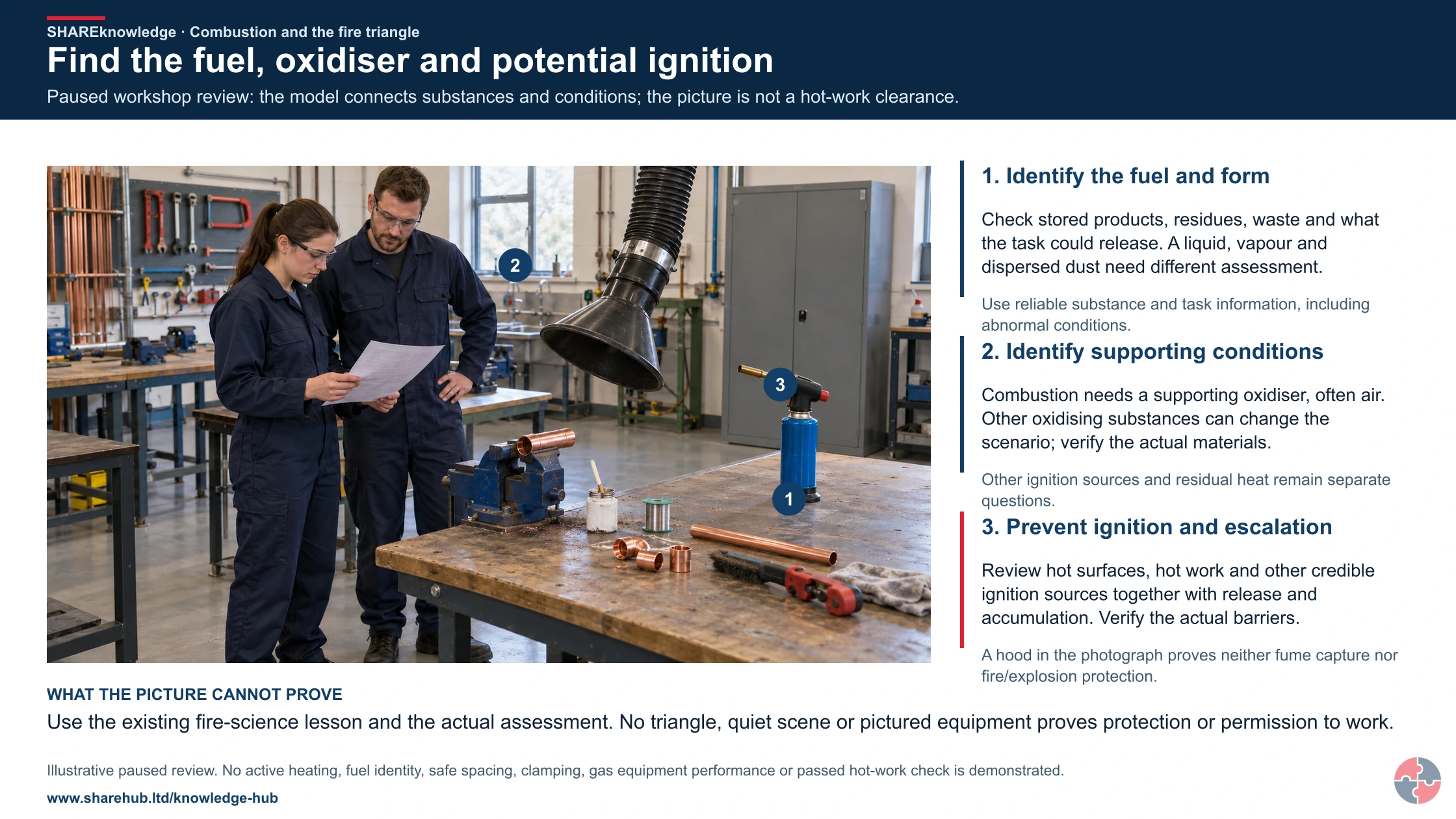
Existing complete fire-science explainer and its learning boundaries
Primary references: HSE: dangerous-substance assessment (GB) · HSE: food-industry dust fire/explosion scope (GB)

Fuel form
Identify what can be released, evaporated or dispersed during the task and foreseeable changes.
Factors together
Trace how fuel, a credible ignition source and supporting conditions can coincide; the triangle is a concept, not a universal operating boundary.
Prevention and protection
Prevent release/accumulation and ignition as assessed; verify any specialist consequence-control measures for the actual system.
No ignition distance, concentration limit, zoning result or emergency approach tactic is supplied by this teaching sketch.
What are the key points about combustion and the fire triangle?
The key points are that fire prevention controls fuel, oxygen and ignition, while fire protection manages heat, smoke, spread, warning, escape and emergency response if prevention fails.
Fuel is not always obvious
Packaging, waste, dust, vapour, oil residues, aerosols, furnishings, wall linings, lithium-ion batteries and process materials can all feed fire.
Ignition energy can be small
Hot work, static electricity, overheated bearings, electrical faults, smoking, heaters, vehicle exhausts and charging equipment can all provide ignition.
Oxygen can be enriched or supplied
Compressed oxygen, oxidising chemicals, leaking gas systems or increased ventilation can change fire behaviour.
Smoke is often the killer
Smoke can obscure escape routes, irritate the airway, incapacitate people and carry toxic products before flames reach them.
The triangle is prevention, not the whole system
A suitable fire strategy also needs detection, alarm, compartmentation, escape, emergency lighting, firefighting equipment, drills and maintenance.
Evidence matters
Risk assessments, inspections, tests, permits, training, drills and completed actions show whether controls are real or only assumed.
What is combustion?
Combustion is a heat-releasing chemical reaction between a fuel and oxygen or another oxidising agent.
Most workplace fires begin when a combustible material reaches a temperature at which vapours, gases or surface reactions can sustain burning. The reaction releases heat, and that heat feeds back into nearby fuel. Once the heat feedback is strong enough, fire can grow beyond the original ignition point.
The useful workplace question is not only 'can this burn?' but 'how easily can it ignite, how fast can it spread, what smoke or gases will it produce, who is nearby, and what controls stop the event escalating?' This is why the same fire triangle principle applies differently to a cardboard store, a paint booth, a battery charging area, a kitchen, a fuel depot and a construction site.
Combustion can be flaming, smouldering or explosive depending on fuel form, oxygen availability, confinement and turbulence. A solid timber panel, a solvent vapour cloud and a fine combustible dust cloud are all fuel, but they behave very differently.
| Term | What it means | Why it matters at work |
|---|---|---|
| Fuel | Something capable of burning or contributing combustible vapour, gas or dust. | Fuel amount, arrangement and form affect fire growth. |
| Oxidiser | Oxygen in air or another substance that supports oxidation. | Oxygen enrichment and oxidising chemicals can intensify fire. |
| Ignition energy | Heat, spark, flame, friction, static or electrical energy sufficient to start combustion. | Removing ignition sources prevents many fires. |
| Heat feedback | Heat from the fire warms nearby fuel and sustains the reaction. | Controls must stop early growth, not only initial ignition. |
| Products of combustion | Smoke, gases, heat, flame, soot and partially burned materials. | These drive life-safety, visibility, toxicity and evacuation risk. |
What does the fire triangle explain—and what does it miss?
Fuel, oxidiser and ignition energy must coincide for a fire to start; prevent their contact before ignition.
The HSE fire-safety introduction explains the three conditions for a fire to start. Once burning, heat feedback can sustain combustion after the original spark has gone; switching off that spark alone will not extinguish an established fire. Keep people clear and follow the evacuation plan. In a solvent-transfer room, fuel is vapour, ordinary air supplies oxygen and a non-rated electrical switch may ignite the cloud. At a waste store, cardboard provides fuel and a hot work spark can start a fire. The triangle helps choose a prevention control, but cannot establish whether a confined dust collector will explode. The HSE combustible-dust guide also considers fine dust, dispersion into a cloud and confinement. A competent process-safety assessment is required for a mill, filter or silo; never rely on a generic premises fire assessment alone.
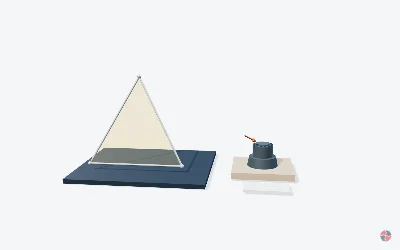

How do the fire triangle and tetrahedron explain combustion?
Gas is the fuel in this example. It burns with oxygen from the air after ignition supplies enough heat. The tetrahedron adds the chain reaction that keeps the flame burning. Select Stop gas to see what happens when the fuel supply ends.
Read the complete lesson without the viewer
A gas flame demonstrates the four linked requirements of the fire tetrahedron: gas fuel, oxygen from air, heat and chain reaction. Stopping gas extinguishes the flame while oxygen remains and residual heat fades.
FS01 · The fire triangle becomes a tetrahedron
Gas is the fuel in this example. It burns with oxygen from the air after ignition supplies enough heat. The tetrahedron adds the chain reaction that keeps the flame burning. Select Stop gas to see what happens when the fuel supply ends.
The four faces represent requirements for sustained flaming, not the shape of a flame. Ignition starts combustion; the established flame releases heat that helps incoming gas and oxygen continue reacting. Stopping the gas removes the fuel supply, so the flame and its chain reaction end. Oxygen remains in the surrounding air, and heated parts cool gradually.
Eight named structures and concepts
FS01-H01 · Fuel (gas)
Gas is the material that burns in this example. The gas supply feeds fuel to the flame. Stop gas ends that supply in the model.
FS01-H02 · Oxygen (air)
Air around the burner supplies oxygen. Oxygen reacts with the fuel. Air remains around the burner after the gas stops; oxygen alone cannot keep this flame burning.
FS01-H03 · Heat
Ignition supplies the heat that starts the flame. Once burning, the flame releases heat that helps the reaction continue. After the flame goes out, heated parts still take time to cool.
FS01-H04 · Chain reaction
Burning involves a continuing series of chemical reactions. Gas and oxygen keep reacting in the established flame, releasing heat. When the fuel supply ends, this continuing reaction dies away.
FS01-H05 · Flame
The flame is where gas and oxygen react. Combustion releases heat and light. The flame shrinks and disappears when the model stops supplying fuel.
FS01-H06 · Heat from the flame
Heat from burning helps sustain the flame. The warm arrows show energy transfer near the flame. They are not a flow of gas or a second ignition source.
FS01-H07 · Stop gas
This button ends the model’s fuel supply. With no continuing gas supply, the flame goes out and the chain reaction ends. Oxygen remains, while residual heat fades gradually.
FS01-H08 · Teaching model
The animation shows a simple gas-flame example. The tetrahedron explains the requirements for sustained flaming. Animation timing is illustrative; the button is a teaching control.
Four illustrative states
Ready: air is present
Air supplies oxygen, but the gas is off and there is no flame. Play the example to follow fuel, ignition and burning.
Gas and ignition
Gas supplies fuel. Ignition adds enough heat for the gas to start reacting with oxygen from the air, producing a flame.
The flame keeps burning
Gas and oxygen continue reacting and releasing heat. This chain reaction sustains the flame. Select Stop gas to remove the fuel supply.
Gas off: the flame dies away
The fuel supply has stopped, so the flame and chain reaction die away. Oxygen is still present. Heated parts lose their remaining heat gradually.
What makes this flame go out when you select Stop gas?
The oxygen disappears Oxygen remains in the surrounding air. The model stops the gas, which is the fuel for this flame.
The fuel supply ends Correct. Without a continuing fuel supply, the flame and chain reaction end. Oxygen remains, and residual heat dissipates gradually.
Sources, original geometry and review status
Original editable procedural geometry and illustrations. No third-party fire artwork, atlas, site model or incident footage is copied. Sources establish scientific context; the depiction requires competent scientific and editorial review. Three.js is supplied under its MIT licence.
FS01 HSE: Introduction to fire safety
No material-specific values have been added. Missing product, method and conditions remain unverified. This library gives no site approval, prediction or practical certification.
What types of fuel need to be considered?
Fuel can be any solid, liquid, gas, vapour, mist, dust, residue, packaging, furnishing or process material that can burn or intensify fire development.
Fuel form changes fire behaviour. A timber pallet may need sustained heating before it burns vigorously; fine wood dust can form a combustible cloud; solvent vapour may ignite at low temperature; an aerosol can may rupture when heated; plastic insulation can generate dense smoke; and oily rags may self-heat in the wrong conditions.
A fire risk assessment should therefore look beyond labels. It should include waste, temporary storage, construction materials, wall and ceiling linings, concealed voids, cable runs, cleaning chemicals, oils, greases, gases, adhesives, packaging, combustible dusts and materials introduced by contractors.
| Fuel form | Examples | Why it changes control |
|---|---|---|
| Solid fuel | Wood, paper, cardboard, textiles, plastics, insulation and furniture. | Arrangement, storage height and separation affect fire growth. |
| Liquid fuel | Petrol, solvents, paints, thinners, oils and cleaning products. | Vapour above the liquid may ignite before the liquid surface is visibly burning. |
| Gas or vapour | LPG, natural gas, hydrogen, solvent vapours and fuel vapours. | Can travel, accumulate and ignite remotely. |
| Mist or spray | Paint spraying, oil mist, aerosols and atomised cleaning products. | Fine droplets mix with air and can ignite rapidly. |
| Dust | Wood, flour, sugar, grain, coal, plastic and some metal dusts. | Clouds and layers can produce fire or explosion risk. |
| Process residue | Oil-soaked rags, grease deposits, lint, filters and contaminated absorbents. | Often missed because it builds up gradually. |
What ignition sources should be controlled?
Ignition sources should be controlled wherever they can provide enough heat, spark or energy to start combustion in nearby fuel.
Ignition control is most effective when it is designed into the work. Hot work should be avoided where possible, moved to a safer area where possible, or controlled by a permit, isolation, clearing combustibles, fire watch and hand-back checks. Electrical systems should be suitable, maintained and not overloaded. Smoking and vaping rules need to match real behaviour, not just signage.
In process and workshop environments, less obvious ignition sources matter: static electricity, friction, impact sparks, hot bearings, overheated motors, vehicle exhausts, charging equipment, heating elements, spontaneous heating and portable equipment brought in by contractors.
| Ignition source | Where it appears | Control expectations |
|---|---|---|
| Hot work | Welding, cutting, grinding, roofing, soldering and flame work. | Avoid, relocate or control by permit, isolation, fire watch and post-work checks. |
| Electrical faults | Damaged cables, overloaded sockets, poor panels and unsuitable equipment. | Inspection, maintenance, fixed installation checks and defect reporting. |
| Static electricity | Powder transfer, solvent handling, plastic containers and low-humidity operations. | Bonding, earthing, suitable containers and process assessment. |
| Friction and hot surfaces | Bearings, belts, brakes, exhausts, heaters and mechanical plant. | Maintenance, guards, temperature monitoring and separation from fuel. |
| Smoking and deliberate ignition | External areas, waste stores, entrances and poorly supervised sites. | Smoking controls, security, waste management and supervision. |
| Battery charging | Lithium-ion tools, e-bikes, forklifts, radios and portable devices. | Suitable charging areas, manufacturer instructions, damaged-battery quarantine and fire separation. |
How do oxygen and oxidising materials affect combustion?
Oxygen and oxidising materials affect combustion by making burning possible, faster, hotter or more difficult to control.
Ordinary air contains enough oxygen for many workplace fires. Oxygen-enriched atmospheres, leaking oxygen equipment or oxidising chemicals can make materials ignite more easily and burn more fiercely. Clothing, oils and greases can become far more hazardous in oxygen-rich conditions.
Oxidising materials are not always fuels themselves, but they can feed the reaction. Examples may appear in laboratories, healthcare, cleaning stores, water treatment, chemical processing and maintenance. They should be identified in inventories, safety data sheets and storage arrangements, then segregated from incompatible fuels and reducing agents.
| Issue | Why it matters | Controls |
|---|---|---|
| Oxygen cylinders | Leaks can enrich the local atmosphere and intensify fire. | Secure storage, leak checks, segregation and no oil/grease contamination. |
| Oxidising chemicals | Can feed combustion even when ordinary air is limited. | Inventory, SDS review, segregation and trained handling. |
| Ventilation | Can dilute vapours or smoke, but can also feed fire if poorly understood. | Design review and fire strategy alignment. |
| Confined or enclosed spaces | Oxygen depletion, enrichment or fuel-rich atmospheres may occur. | Atmosphere testing and confined-space controls where relevant. |
| Process oxygen | Oxygen may be used in cutting, welding, healthcare or chemical processes. | Isolation, equipment standards, flashback protection and competence. |
HSE INDG459 oxygen guidance supports oxygen-compatible equipment, cleanliness, ventilation and leak prevention. A competent specialist commissions oxygen-service systems; the user checks approved fittings, hose condition and contamination before use. Maintenance uses approved components and oxygen-compatible leak-test material. Suspected leakage or enrichment stops the work under the safe isolation/emergency plan; repair and competent verification precede restart. Do not use oxygen to refresh air or improvise equipment substitutions.
Why are smoke and combustion products central to life safety?
Smoke can obscure escape, and toxic combustion products can disable people before flame reaches them.
The fire-risk assessment must consider people who need more time or help to escape, the route from their actual work area, warning and compartmentation, and whether smoke can spread through doors, shafts or extraction. Do not assume an extinguisher can make a blocked route safe. On alarm, follow the site evacuation plan, call the fire service as directed and do not re-enter. The GOV.UK responsible-person guidance requires appropriate measures, training and an assessed premises in England and Wales; Scotland and NI use their own fire regimes.
How can a small fire develop into a serious incident?
A small fire can develop into a serious incident when heat feedback, ventilation, fuel arrangement, smoke movement and delayed response combine.
Early fire growth depends on what burns first and what surrounds it. If the first item is isolated and detected quickly, people may escape safely and the fire may remain limited. If nearby fuel is close, vertical, porous, dusty or arranged in stacks, the heat release can grow quickly.
Flashover is a severe fire-development stage where exposed combustible surfaces in an enclosure ignite almost together because the hot gas layer and radiant heat have become intense. Backdraught can occur when air is introduced into an oxygen-depleted, fuel-rich compartment. These are specialist firefighting hazards, but managers should understand the lesson: fire behaviour can change suddenly, and untrained people should not re-enter or improvise.
| Factor | How it affects fire | What to check |
|---|---|---|
| Fuel load | More fuel can increase fire size and duration. | Storage quantities and waste management. |
| Fuel arrangement | Vertical, stacked or concealed fuel can speed spread. | Racking, wall linings, voids and temporary storage. |
| Ventilation | Air can feed fire and move smoke. | Doors, windows, vents and mechanical systems. |
| Compartmentation | Open or damaged fire doors allow smoke and heat to spread. | Fire door checks, seals, closers and penetrations. |
| Detection delay | Late warning reduces escape time. | Alarm coverage, testing and response arrangements. |
| Human behaviour | People delay, investigate, collect belongings or ignore alarms. | Training, drills and supervision. |
The England offices/shops guide supports the role of fuel arrangement, compartmentation and smoke in escape. The 2009 GRA 5.8 provides historical physical explanations of flashover/backdraught; it was archived/withdrawn in 2020. It is cited for those definitions only and must not be used as current firefighting procedure. Workplace staff follow the evacuation plan and do not enter to diagnose or control these phenomena.
Where does combustion knowledge matter in ordinary and high-risk workplaces?
Combustion knowledge matters in ordinary workplaces, construction, hospitality, storage, laboratories, workshops and high-hazard process environments.
For an ordinary office, the fire triangle may point to overloaded extension leads, heaters near paper, waste accumulation, poor housekeeping and blocked escape routes. For a warehouse it may point to packaging, racking, battery charging, aerosols, LPG trucks and arson. For construction it may point to hot work, temporary electrics, timber frame structures, waste, flammable products and occupied-building interfaces.
Higher-risk workplaces need deeper assessment. DSEAR may apply where dangerous substances can create fire or explosion risks. Process safety settings may need hazardous area classification, ignition-source control, ventilation design, emergency shutdown, relief, detection, isolation, containment and inspection of safety-critical elements.
| Setting | Combustion issue | Additional focus |
|---|---|---|
| Office or shop | Paper, displays, electrics, heaters and customer areas. | Escape, alarms, housekeeping and staff training. |
| Leisure or hospitality | Kitchens, laundry, plant rooms, events, alcohol stores and public occupancy. | Cleaning, shut-down routines and vulnerable visitors. |
| Construction | Hot work, timber, temporary electrics, waste and occupied-building work. | Fire plan, permit controls and daily housekeeping. |
| Workshop | Grinding sparks, oils, rags, gas cylinders and chargers. | Segregation, maintenance and fire watch. |
| Chemical or process site | Flammable liquids, vapours, gases, dusts and oxidisers. | DSEAR, hazardous areas and barrier assurance. |
| Storage and warehousing | Packaging, racking, aerosols, batteries and arson risk. | Stock control, separation, sprinklers and security. |
How can the hierarchy of controls remove fuel, ignition and oxygen-related fire hazards?
First remove or minimise fuel and avoid ignition; engineer separation and containment, then verify procedures and emergency measures.
The HSE DSEAR guidance orders controls for dangerous substances: minimise quantity and release, control at source, prevent dangerous atmospheres, remove releases safely, avoid ignition and separate incompatibles. ERICPD and the five-level hierarchy help teach the decision, but DSEAR has its own specific ordering. Consider a workshop using solvent beside hot work: change the method where feasible, keep only the task quantity, close containers, ventilate and segregate the work; a permit and PPE are supporting checks, not substitutes for preventing vapour accumulation.
On a small screen, scroll this table sideways to read all columns.
How can the ERICPD hierarchy of controls remove fuel, ignition and oxygen-related fire hazards?

| Hierarchy / ERICPD | Intervention and feasibility | Owner, verification and stop |
|---|---|---|
| Elimination / eliminate | Remove unnecessary solvent cleaning and hot work near stores; use off-site cold fabrication if it meets the job. | Job planner checks method; hold if the fuel/ignition interface remains uncontrolled. |
| Substitution / reduce | Trial a less flammable product or lower-dust material after checking toxicity, compatibility and quality. | Process engineer approves trial; reject if new hazards outweigh benefit. |
| Engineering / isolate and control | Closed solvent transfer, suitable ventilation and rated equipment; enclose dust transfer with designed extraction and explosion protection where needed. | Engineer tests airflow and protection; stop for failed extraction, leak or damaged safeguard. |
| Administrative / discipline | Limit inventory, separate hot work, clean dust safely, inspect plant and brief alarm/evacuation routes. | Supervisor checks permit and housekeeping; stop for dust layers, solvent spill or failed isolation. |
| PPE / PPE | Fire or respiratory PPE only for residual assessed tasks and trained responders; it does not justify an explosive atmosphere. | Competent lead checks selection and training; no entry into uncontrolled release. |
How can the ISO 45001 hierarchy of controls remove fuel, ignition and oxygen-related fire hazards?

| Hierarchy / ERICPD | Intervention and feasibility | Owner, verification and stop |
|---|---|---|
| Elimination / eliminate | Remove unnecessary solvent cleaning and hot work near stores; use off-site cold fabrication if it meets the job. | Job planner checks method; hold if the fuel/ignition interface remains uncontrolled. |
| Substitution / reduce | Trial a less flammable product or lower-dust material after checking toxicity, compatibility and quality. | Process engineer approves trial; reject if new hazards outweigh benefit. |
| Engineering / isolate and control | Closed solvent transfer, suitable ventilation and rated equipment; enclose dust transfer with designed extraction and explosion protection where needed. | Engineer tests airflow and protection; stop for failed extraction, leak or damaged safeguard. |
| Administrative / discipline | Limit inventory, separate hot work, clean dust safely, inspect plant and brief alarm/evacuation routes. | Supervisor checks permit and housekeeping; stop for dust layers, solvent spill or failed isolation. |
| PPE / PPE | Fire or respiratory PPE only for residual assessed tasks and trained responders; it does not justify an explosive atmosphere. | Competent lead checks selection and training; no entry into uncontrolled release. |
HSE’s five-level hierarchy is the GB teaching framework for elimination, substitution, engineering, administrative controls and PPE. ERICPD is a complementary mnemonic. Select controls for the actual task and applicable work location, then check that they remain effective.
Commission closed transfer, extraction and explosion safeguards against the actual substance, release, plant layout and operating envelope with competent design advice. Record acceptance checks, operating limits and maintenance responsibilities. Users check the controls before work; planned inspection/testing and change review check continuing performance. A leak, failed extraction, damaged safeguard or uncontrolled dust deposit holds the affected process. Restart requires correction and verification against the assessment, with authorisation recorded. HSG103 is a 2003 technical publication containing historical law/standard references; use its dust principles with current HSE DSEAR guidance and the applicable law for today’s decisions.
How should combustion be assessed in a fire risk assessment?
Combustion should be assessed by identifying what can start fire, what can burn, who could be harmed, how fire and smoke could spread and what precautions are required.
A good fire risk assessment does not simply list extinguishers. It examines real work: storage, waste, electrics, heating, cooking, maintenance, contractors, charging, dangerous substances, escape routes, alarm coverage, disabled or vulnerable people, out-of-hours work and foreseeable misuse.
The five-step fire risk assessment approach remains a strong structure: identify fire hazards, identify people at risk, evaluate and act, record/plan/inform/train, and review. The combustion and fire triangle content sits mainly in step one, but it affects every later step because the scale and speed of fire determine warning, escape and emergency arrangements.
| Assessment step | Combustion-related question | Evidence |
|---|---|---|
| Identify hazards | What fuel, oxygen/oxidisers and ignition sources are present? | Site notes, photos, inventories and inspection findings. |
| Identify people at risk | Who could be exposed to heat, smoke or toxic products? | Occupancy profile, vulnerable-person arrangements and contractor information. |
| Evaluate and act | Which fuel or ignition controls are missing or weak? | Action plan with priorities and owners. |
| Record, plan, inform and train | Do people understand the fire risks and emergency plan? | Training records, briefings, drill records and contractor information. |
| Review | What change could invalidate the assessment? | Change records, incident learning and periodic review. |
When does the triangle lead to a DSEAR assessment?
Where a dangerous substance may cause fire or explosion at work, assess that process separately from the general building fire precautions.
The HSE DSEAR explanation covers flammable liquids, gases, vapours and explosible dust clouds, among other dangerous substances. A flour transfer, woodworking filter or solvent mixing station can create a release and ignition scenario; assess inventories, credible release, zoning where required, equipment, isolation and explosion mitigation with competent help. HSE’s food-dust example explains why a dust cloud can explode even when the bulk powder appears ordinary. Document assumptions and the failed-control response; suspend the process if safeguards or housekeeping fail.
Which fire-safety law applies in each UK jurisdiction?
Choose the premises location first, and assess process fire and explosion duties separately.
For non-domestic premises in England and Wales, the Regulatory Reform (Fire Safety) Order 2005 establishes the responsible-person and fire-risk-assessment route described by GOV.UK. In Scotland, Scottish Government guidance identifies the Fire (Scotland) Act 2005 and Fire Safety (Scotland) Regulations 2006. In Northern Ireland, NIFRS guidance identifies the Fire and Rescue Services (NI) Order 2006 and Fire Safety Regulations (NI) 2010. HSE’s GB process-fire/DSEAR guidance addresses dangerous-substance work. The NI DSEAR 2003 instrument establishes the Dangerous Substances and Explosive Atmospheres Regulations (Northern Ireland) 2003 for NI process work. Shared premises require coordination among dutyholders.
On a small screen, scroll this table sideways to read all columns.
| Location | General premises fire | Process hazard check |
|---|---|---|
| England and Wales | Fire Safety Order 2005; responsible person. | GB DSEAR 2002 where dangerous substances are in scope. |
| Scotland | Fire (Scotland) Act 2005 and 2006 Regulations. | GB DSEAR 2002 where dangerous substances are in scope. |
| Northern Ireland | NI Fire and Rescue Services Order 2006 and 2010 Regulations. | NI DSEAR 2003 where dangerous substances are in scope. |
The linked NI 2003 instrument is its original “made” version. Check subsequent amendments and current local requirements before a live legal decision; the original text is not a consolidated assurance of today’s requirements.
How could Crownway Fuels Ltd manage combustion and fire triangle risks?
Crownway Fuels Ltd would manage combustion risk by treating fuel, oxygen and ignition as live operating controls, not only as fire-training theory.
The bakery dust case needs more than a triangle
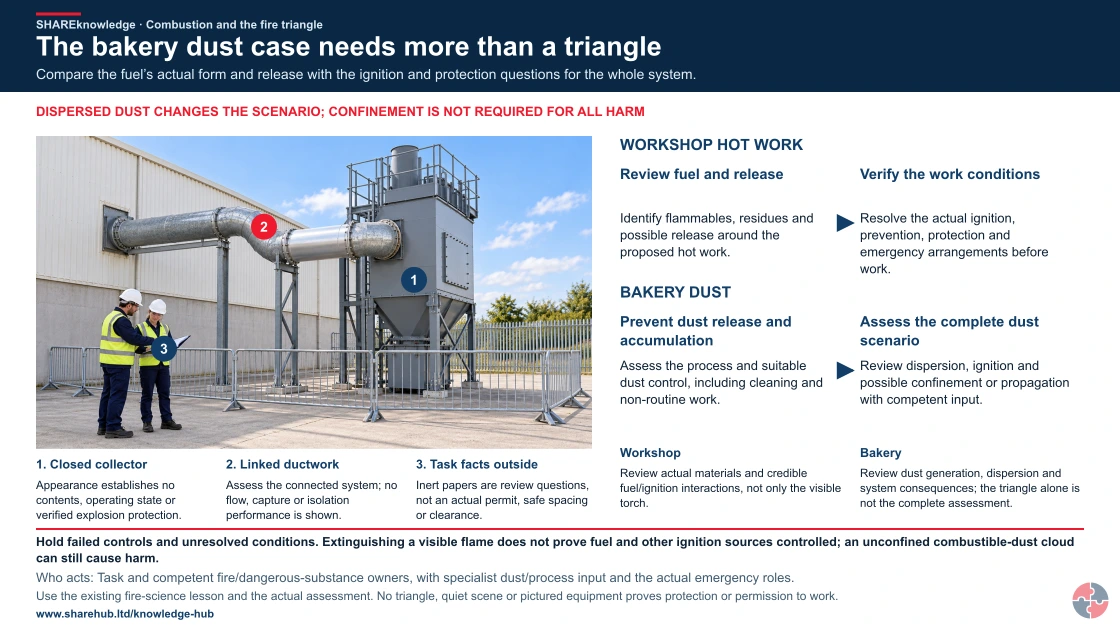
Full written explanation
An illustrative inactive food-process setting shows a whole closed collector, linked ductwork and normal colleagues reviewing inert work facts outside a temporary boundary. Picture key: 1 identifies the closed collector; 2 identifies linked ductwork; 3 identifies task facts outside. The picture does not identify flour, the actual contents or a verified bakery installation. The collector, panel, duct and temporary boundary establish no operating state, flow, capture, isolation, explosion rating, venting or protection performance, blast protection, safe spacing or permission. Two independent assessment tracks explain the changed questions. WORKSHOP HOT WORK links review of fuel and possible release to the actual ignition, prevention, protection and emergency arrangements. BAKERY DUST links prevention of release and accumulation to competent assessment of dispersion, ignition and possible confinement or propagation. Arrows remain within each track, and the separate process headings are unnumbered. The complete four checks, failed-control hold, responsible roles, evidence limits and both workplace cases support the comparison. A fire triangle is a starting concept, not a complete dust assessment: confinement is not required for all harm, and extinguishing a visible flame does not prove fuel and other ignition sources controlled. No release, dust cloud, flame, opening, cleaning, material handling, new reaction mechanism, numerical threshold, design, testing or operating method is depicted. Follow the complete topic for source, scientific-review, jurisdiction and emergency boundaries; emergency action must not wait for work papers or investigation.
Compare the fuel’s actual form and release with the ignition and protection questions for the whole system.
- Review fuel and release. Identify flammables, residues and possible release around the proposed hot work.
- Verify the work conditions. Resolve the actual ignition, prevention, protection and emergency arrangements before work.
- Prevent dust release and accumulation. Assess the process and suitable dust control, including cleaning and non-routine work.
- Assess the complete dust scenario. Review dispersion, ignition and possible confinement or propagation with competent input.
When the evidence does not fit: Hold failed controls and unresolved conditions. Extinguishing a visible flame does not prove fuel and other ignition sources controlled; an unconfined combustible-dust cloud can still cause harm.
Who acts: Task and competent fire/dangerous-substance owners, with specialist dust/process input and the actual emergency roles.
Changed workplace
Workshop: Review actual materials and credible fuel/ignition interactions, not only the visible torch.
Bakery: Review dust generation, dispersion and system consequences; the triangle alone is not the complete assessment.
Evidence check: Use the existing fire-science lesson and the actual assessment. No triangle, quiet scene or pictured equipment proves protection or permission to work.
Existing complete fire-science explainer and its learning boundaries
Primary references: HSE: dangerous-substance assessment (GB) · HSE: food-industry dust fire/explosion scope (GB)
Open the complete HD image (new tab)Download image
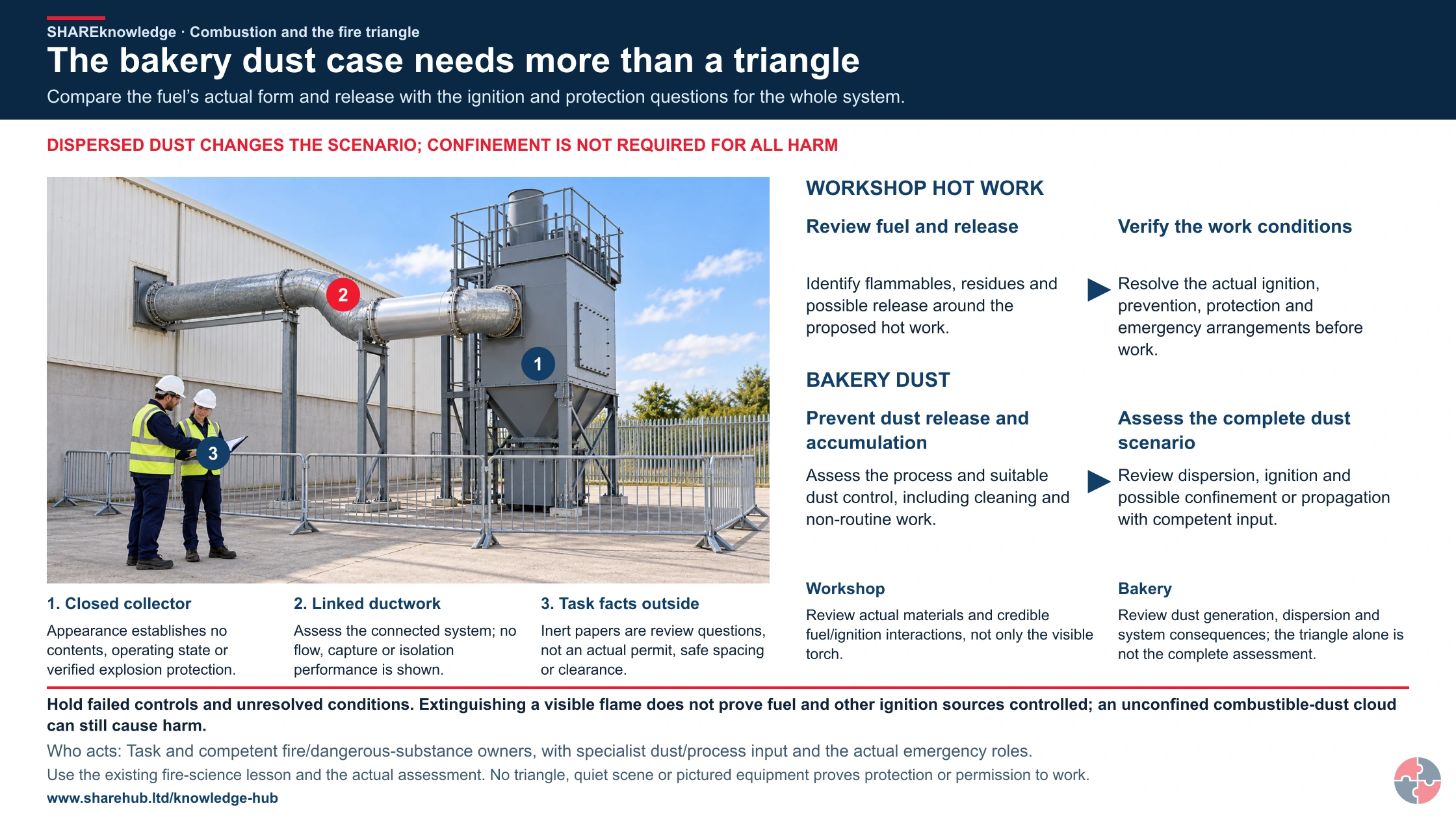
Existing complete fire-science explainer and its learning boundaries
Primary references: HSE: dangerous-substance assessment (GB) · HSE: food-industry dust fire/explosion scope (GB)
Crownway Fuels Ltd
A fuel storage and distribution business with tanker loading, fuel tanks, maintenance contractors, vehicle movements, workshops, offices, welfare areas and emergency-response duties.
Crownway starts with a register of major fire and explosion scenarios: loss of containment during tanker loading, overfill of a fuel tank, vapour release near an ignition source, hot work on contaminated equipment, static discharge during transfer, workshop fire affecting cylinders, and firewater run-off after an incident. Each scenario is linked to prevention, detection, control, mitigation and emergency barriers.
The fire risk assessment covers offices, welfare, workshops and stores, while the DSEAR assessment covers flammable liquids, vapours, tanker loading, hazardous areas and ignition-source controls. The two documents are cross-referenced because a general building fire can escalate into process equipment, and a process fire can threaten people in ordinary workplace areas.
Managers verify the system through layered assurance. Operators complete focused checks on bonding, earthing, spill control, housekeeping, no-smoking areas and abnormal odours. Supervisors review permits, isolations, maintenance defects and housekeeping. Senior leaders review overdue actions, impaired fire systems, repeat defects, drill learning and whether barrier health is deteriorating.
| Management area | How Crownway applies it | Evidence and improvement |
|---|---|---|
| Assess and analyse | Identifies credible fire and explosion scenarios involving fuel release, vapour, ignition, oxygen/oxidisers and escalation. | Major accident hazard register, fire risk assessment, DSEAR assessment and action tracker. |
| Control fuel | Minimises combustible waste, controls tank inventories, segregates flammable stores and manages contaminated absorbents. | Inventory controls, housekeeping inspections and waste transfer records. |
| Control ignition | Uses hot work permits, hazardous area equipment, bonding and earthing, vehicle controls and electrical maintenance. | Permit records, ATEX equipment register, inspection results and defect close-out. |
| Maintain protection | Tests alarms, detection, foam/suppression interfaces, emergency lighting, fire doors, extinguishers and hydrant access. | Maintenance records, impairment log and escalation process. |
| Train and supervise | Trains operators, drivers, contractors and managers on fire triangle controls, DSEAR expectations and emergency actions. | Training matrix, contractor induction and scenario drills. |
| Learn and improve | Reviews near misses, vapour alarms, spills, failed permits, fire drills and maintenance backlog as barrier-health evidence. | Trend reports, management review and verified corrective actions. |
How does a fuel-site example explain the fire triangle?
Use the fuel card and ignition-source view to connect fuel, air and a credible ignition source. A clear-looking area can still need assessment.
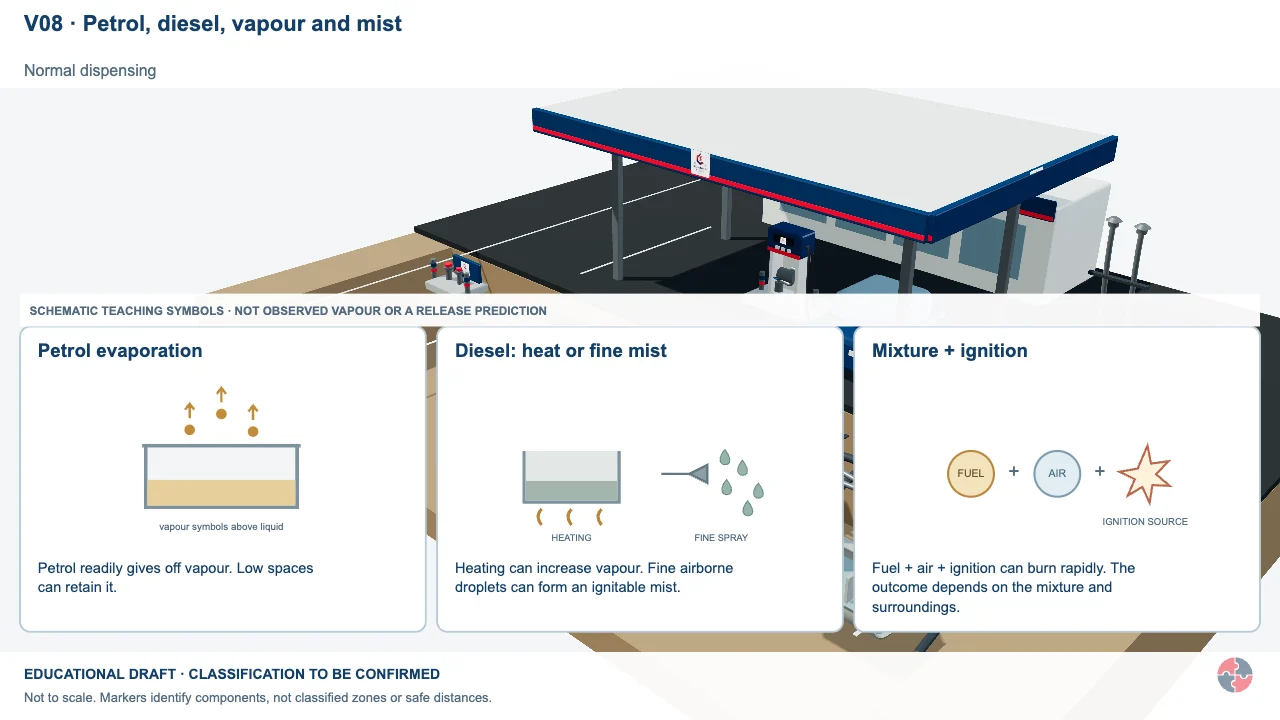
Petrol, diesel, vapour and mist
Compare petrol evaporation, diesel conditions and fine droplets. Petrol carried into a separator can remain a vapour source after the visible forecourt spill has passed.
Activity focus: Identify the actual product and release mechanism. For drainage, ask whether petrol could reach or remain in the separator; for refuelling, confirm the stated Stage II recovery arrangement.
Contextual workplace scene. Use the task, control and evidence checks in this section; appearance alone does not establish safe conditions, individual health or approval.
Educational illustration, not to scale. Coloured zones are teaching examples, not a site-specific hazardous-area classification.
What should each role learn and demonstrate?
Learning must match the decisions people make, from recognising danger to checking that controls work.
Briefings should tell people how to act, but attendance alone does not show competence. Assess the real decision or task, record who assessed it and revisit after a material change, failed control or incident. A local authorisation is task-specific; no universal external certificate is implied.
On a small screen, scroll this table sideways to read all columns.
| Role and learning | Demonstration and assessor | Record and reassessment trigger |
|---|---|---|
| All staff: fuel and ignition. | Identify actual materials and ignition sources on a walk-through. | Observed briefing and corrected storage. |
| Fire lead: escape. | Test alarm, exit, assistance and muster for a realistic shift. | Drill record and closed defects. |
| Process engineer: DSEAR. | Walk a solvent or dust release through controls and failures. | Signed assessment, test and restart gate. |
| Supervisor: hot work. | Demonstrate segregation, permit checks and post-work inspection. | Permit sample and observation. |
How does combustion and the fire triangle support NEBOSH Fire Safety Certificate study?
Combustion and the fire triangle support NEBOSH Fire Safety Certificate study by giving learners the science needed to explain practical fire prevention and fire risk assessment decisions.
This topic can support fire-safety study by helping learners understand combustion, the fire triangle, fuel, oxygen, ignition, fire development and products of combustion. Strong answers should avoid simply naming the triangle; they should show how the three sides are identified and controlled in a real workplace.
Scenario-based questions may describe a storeroom, workshop, kitchen, construction site, laboratory, plant room, fuel store or contractor activity. A good answer explains what can burn, what could ignite it, whether oxygen or oxidisers make conditions worse, how smoke affects escape, which controls are missing and what evidence would prove the precautions are working.
| Study area | What to know | How to apply it in a scenario |
|---|---|---|
| Combustion science | Fuel plus oxygen/oxidiser plus ignition releases heat. | Explain why the activity can start or sustain fire. |
| Fire triangle | Fuel, oxygen and ignition are the prevention target. | Recommend removing or controlling one or more sides. |
| Combustion products | Smoke, heat and toxic gases drive life-safety risk. | Link controls to escape, alarm, compartmentation and emergency planning. |
| Dangerous substances | DSEAR may apply to flammable liquids, vapours, gases, mists and dusts. | Identify whether specialist controls are needed. |
| Evidence | Records prove that arrangements exist and are maintained. | Refer to inspections, tests, training, drills, permits and action close-out. |
How can a management system sustain effective decisions?
Give each hazard or support route an owner, a control, a check and a response to failure.
The free GB regulator guide HSE Managing for health and safety (HSG65) explains a plan–do–check–act approach: assign controls and owners, involve workers, check work as done, and correct failures. For Northern Ireland, use HSENI risk assessment guidance for the local duty. A certificate alone does not demonstrate that a control works.
The free GB regulator guide HSE Managing for health and safety (HSG65) explains a plan–do–check–act approach: assign controls and owners, involve workers, check work as done, and correct failures. For Northern Ireland, use HSENI risk assessment guidance for the local duty. A certificate alone does not demonstrate that a control works.
What warning signs show combustion risk is not being controlled?
Warning signs include increasing fuel load, uncontrolled ignition sources, poor housekeeping, impaired fire precautions, weak permit control and people treating fire precautions as paperwork.
Weak fire control usually shows up before a fire. Waste is allowed to build up, flammable products are stored outside the agreed area, chargers are plugged into overloaded sockets, hot work starts before combustibles are cleared, fire doors are wedged open, alarm defects are tolerated, and managers sign off actions without checking the place where the risk exists.
These signs matter because they allow the fire triangle to assemble quietly. One overlooked ignition source beside accumulated fuel can become a fast-growing fire; one failed fire door can turn a contained fire into smoke spread through an escape route.
| Warning sign | How harm can develop | What to improve |
|---|---|---|
| Combustible waste builds up | Fuel load increases and fire can spread faster. | Housekeeping ownership, inspections and waste removal. |
| Hot work is treated casually | Sparks or heat ignite hidden fuel or residues. | Permit-to-work, fire watch and hand-back checks. |
| Fire doors are wedged or damaged | Smoke and heat spread into escape routes. | Fire door inspections and defect escalation. |
| Alarms or emergency lighting have overdue defects | People may receive late warning or struggle to escape. | Impairment process and maintenance close-out. |
| DSEAR risks are not recognised | Flammable atmospheres or dust clouds may ignite explosively. | Dangerous substance inventory and DSEAR assessment. |
| Training is only induction slides | People do not act correctly during real work or alarm conditions. | Practical drills, supervisor checks and role-specific training. |
What acronyms are used on this combustion and fire triangle page?
Acronyms should be explained so fire science, legislation and assurance language remains accessible.
| Acronym | Meaning | Why it matters |
|---|---|---|
| ATEX | Atmospheres Explosibles | Used for equipment and protective systems in potentially explosive atmospheres. |
| DSEAR | Dangerous Substances and Explosive Atmospheres Regulations | GB and NI have separate DSEAR instruments for dangerous-substance fire and explosion risk. |
| FRA | Fire risk assessment | Structured assessment of fire hazards, people at risk and precautions. |
| FSC | Fire Safety Certificate | NEBOSH Fire Safety Certificate study context. |
| HSE | Health and Safety Executive | Great Britain regulator for process fire, explosion and construction risks. |
| LPG | Liquefied petroleum gas | Common flammable gas fuel requiring controlled storage and use. |
| PPE | Personal protective equipment | Last-line protection for specific residual risks and trained roles. |
| SDS | Safety data sheet | Provides hazard and control information for dangerous substances. |