
SHARE Knowledge Hub
How should fuel, oxygen and explosion consequences be controlled?
Prevent dangerous releases and atmospheres before relying on ignition control. Limit fuel and oxygen, contain and ventilate releases, exclude ignition sources, and verify consequence protection for credible fire or explosion scenarios.
Understanding How should fuel, oxygen and explosion consequences be controlled?
Prevent dangerous releases and atmospheres before relying on ignition control. Limit fuel and oxygen, contain and ventilate releases, exclude ignition sources, and verify consequence protection for credible fire or explosion scenarios.
Why this matters at work
Ignition control and consequence mitigation remain necessary layers selected through the actual assessment. Check drains, ducts, pits and connected equipment where released material may travel or accumulate. Verify performance and define responses to failure. GB DSEAR and NI DSEAR use separate instruments; fire-law routes also differ by nation. This guidance does not calculate a zone, ventilation rate, separation distance or acceptable inventory for a real installation.
Identify credible fire, explosion, pressure and toxic-release outcomes and the people who may be affected. Check the role of containment, relief, segregation, detection, isolation, fire protection, escape and emergency communication. Assign performance standards and owners for critical functions, with suitable inspection, testing and maintenance. Consider common-cause failure and simultaneous impairments. A list of installed equipment is not evidence that each function will work when demanded.
How organisations manage this in practice
Choose cleaning equipment and methods suitable for the actual dust and hazardous-area conditions; an ordinary vacuum or a non-sparking hand tool alone is not sufficient evidence. Review access, isolation, ignition control and protection of connected equipment. Record deposit locations, causes, corrective actions and verification of control. Establish a risk-based inspection and cleaning programme tied to actual performance. The example supplies no universal permissible layer thickness or cleaning interval; specific hazard data and conditions determine the necessary precautions.
Competent authorised people should assess source isolation, containment, suitable detection and cleanup using substance-specific information. Escalate to emergency assistance when needed and prevent secondary exposure. Record the substance, available observations, affected areas and control failures without delaying urgent protection. Reoccupation and restart require verified conditions through the real responsible process, including the connected pit and drains. Review why containment failed and whether ventilation, storage or spill arrangements need improvement. No generic waiting time or detector reading in this example clears the area.
Prevent people entering or being exposed to oxygen-deficient releases and consider adjacent spaces and vents. Integrate confined-space avoidance and, where unavoidable, suitable entry and protected rescue arrangements. A filter respirator supplies no oxygen. Verify the system before service and after relevant change, with controlled records, competent operation and maintenance. This answer explains the decision boundary and cannot supply a purge sequence, nitrogen flow, exposure limit or authorisation to inert or enter real equipment.
Compare the event before choosing the barrier
Compare three events. An oxygen cylinder beside combustible stock raises separation and oxidiser-control questions. A solvent transfer raises containment, vapour and ignition questions. A combustible-dust task raises dust release, accumulation and process-protection questions. One general fire checklist cannot validate all three.
Best-practice guide: Control Of Fuel Oxygen And Explosion Consequences

Compare the event before choosing the barrier
Compare three events. An oxygen cylinder beside combustible stock raises separation and oxidiser-control questions. Prevent dangerous releases and atmospheres before relying on ignition control.
Turn control of fuel oxygen and explosion consequences knowledge into a decision
Prevent dangerous releases and atmospheres before relying on ignition control. Limit fuel and oxygen, contain and ventilate releases, exclude ignition sources, and verify consequence protection for credible fire or explosion scenarios. Inventory and SDS review.
the process operator control system
Dangerous substances register: Records fuels, gases, oxidisers, quantities, locations and limits. Evidence / response: Inventory and SDS review. DSEAR scenario assessment: Assesses release, accumulation, ignition and consequence. Evidence / response: DSEAR assessment and zone drawings.
Warning signs and workplace consequences
Excess flammable stock: Increases fire load, spill size and vapour release. Open containers or poor lids: Vapours can escape and find ignition sources. Dust layers on ledges or plant: Secondary explosion fuel may accumulate.
Choose controls for control of fuel oxygen and explosion consequences
Eliminate: Remove combustible powder process if product permits. Substitute: Use less dusty feed or smaller batch after trial. Engineering: Contain/extract dust; design ignition control and relief to safe place. Administrative: Clean layers, inspect equipment and manage change. PPE: Task PPE for residual exposure and emergency response. Read the full control table for qualifications, ownership and verification. Use the actual task and applicable jurisdiction; existing technical approval remains unchanged.
Use the full control of fuel oxygen and explosion consequences lesson
Use the full topic for the decision points, practical examples, detailed control tables and source scope. HSE guidance applies to Great Britain; use HSENI for the Northern Ireland route and the source’s stated jurisdiction. A simplified guide does not change the page’s technical-review or approval status.

Read all six steps as text
1. Compare the event before choosing the barrier
Compare three events.
- Avoid / redesign: Remove combustible powder process if product permits.
- Control the task: Contain/extract dust; design ignition control and relief to safe place.
- Verify before release: Designer records option; hold approval if safe alternative is feasible.
Compare three events. An oxygen cylinder beside combustible stock raises separation and oxidiser-control questions. Prevent dangerous releases and atmospheres before relying on ignition control.
Apply it: Which part of this plan would you check at the workface before authorising the task?
2. Turn control of fuel oxygen and explosion consequences knowledge into a decision
Use the evidence to improve the actual work arrangement.
- Change at source: Remove combustible powder process if product permits.
- Make it observable: Designer records option; hold approval if safe alternative is feasible.
- Keep useful evidence: Inventory and SDS review.
Prevent dangerous releases and atmospheres before relying on ignition control. Limit fuel and oxygen, contain and ventilate releases, exclude ignition sources, and verify consequence protection for credible fire or explosion scenarios. Inventory and SDS review.
Apply it: What evidence would show that the change improves this task, rather than only completing a record?
3. the process operator control system
Example: a practical application of the existing topic lesson.
- Dangerous substances register: Records fuels, gases, oxidisers, quantities, locations and limits.
- DSEAR scenario assessment: Assesses release, accumulation, ignition and consequence.
- Fuel and oxygen control: Limits stocks, segregates oxygen/oxidisers, controls waste and prevents vapour release.
Dangerous substances register: Records fuels, gases, oxidisers, quantities, locations and limits. Evidence / response: Inventory and SDS review. DSEAR scenario assessment: Assesses release, accumulation, ignition and consequence. Evidence / response: DSEAR assessment and zone drawings.
Apply it: At which point would you hold this example, and what evidence would allow it to proceed?
4. Warning signs and workplace consequences
Connect the task, the route to the person and the control that can fail.
- Excess flammable stock: Increases fire load, spill size and vapour release.
- Open containers or poor lids: Vapours can escape and find ignition sources.
- Dust layers on ledges or plant: Secondary explosion fuel may accumulate.
Excess flammable stock: Increases fire load, spill size and vapour release. Open containers or poor lids: Vapours can escape and find ignition sources. Dust layers on ledges or plant: Secondary explosion fuel may accumulate.
Apply it: Who could be exposed, including other trades, cleaners, maintainers and people nearby?
5. Choose controls for control of fuel oxygen and explosion consequences
Start with the stronger practicable options and verify their effect.
- Eliminate: Remove combustible powder process if product permits.
- Substitute: Use less dusty feed or smaller batch after trial.
- Engineering: Contain/extract dust; design ignition control and relief to safe place.
- Administrative: Clean layers, inspect equipment and manage change.
- PPE: Task PPE for residual exposure and emergency response.
Eliminate: Remove combustible powder process if product permits. Substitute: Use less dusty feed or smaller batch after trial. Engineering: Contain/extract dust; design ignition control and relief to safe place. Administrative: Clean layers, inspect equipment and manage change. PPE: Task PPE for residual exposure and emergency response. Read the full control table for qualifications, ownership and verification. Use the actual task and applicable jurisdiction; existing technical approval remains unchanged.
Apply it: Which stronger option can be used here, and who will verify it before accepting the remaining risk?
6. Use the full control of fuel oxygen and explosion consequences lesson
Follow the official sources below and retain the task-specific evidence.
- Official guidance: HSE INDG459 oxygen 2013 PDF
- Official guidance: HSE DSEAR in detail
- Task decision: Inventory and SDS review.
Use the full topic for the decision points, practical examples, detailed control tables and source scope. HSE guidance applies to Great Britain; use HSENI for the Northern Ireland route and the source’s stated jurisdiction. A simplified guide does not change the page’s technical-review or approval status.
Apply it: Which official source and full-topic section will you use to resolve the next decision?
Map barriers to the sequence: prevent release or accumulation, prevent ignition, then limit the consequences of a credible failure. Record what each barrier is intended to do and who verifies it. Engineered inerting, venting or suppression needs competent design and assurance. Inerting also creates asphyxiation and monitoring concerns; it is not a generic instruction to reduce oxygen in an occupied workplace.
Crownway: three maintenance jobs need different controls
Illustrative example. A depot reviews cylinder storage, a solvent transfer and dust-producing contractor work in the same planning meeting.
Decision. The site owner separates the scenarios and assigns the appropriate material, process and fire specialists rather than approving a common checklist.
Evidence to check. Actual fuel form, oxidiser, task state, location, containment and the defined barrier standards and checks.
Hold or escalation point. Hold the relevant work if its critical barrier or competent design basis is unresolved.
Follow-up. Review changes in inventory, condition and operating state before reusing an earlier assessment.
Separate prevention from consequence control
A vapour release, dust cloud and oxygen-enriched condition have different mechanisms. Prevention and engineered mitigation answer different questions.
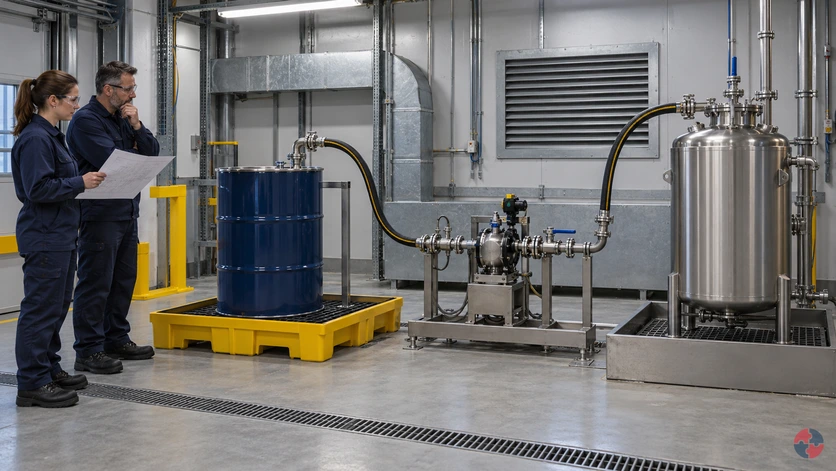
Prevent the release before relying on consequence protection
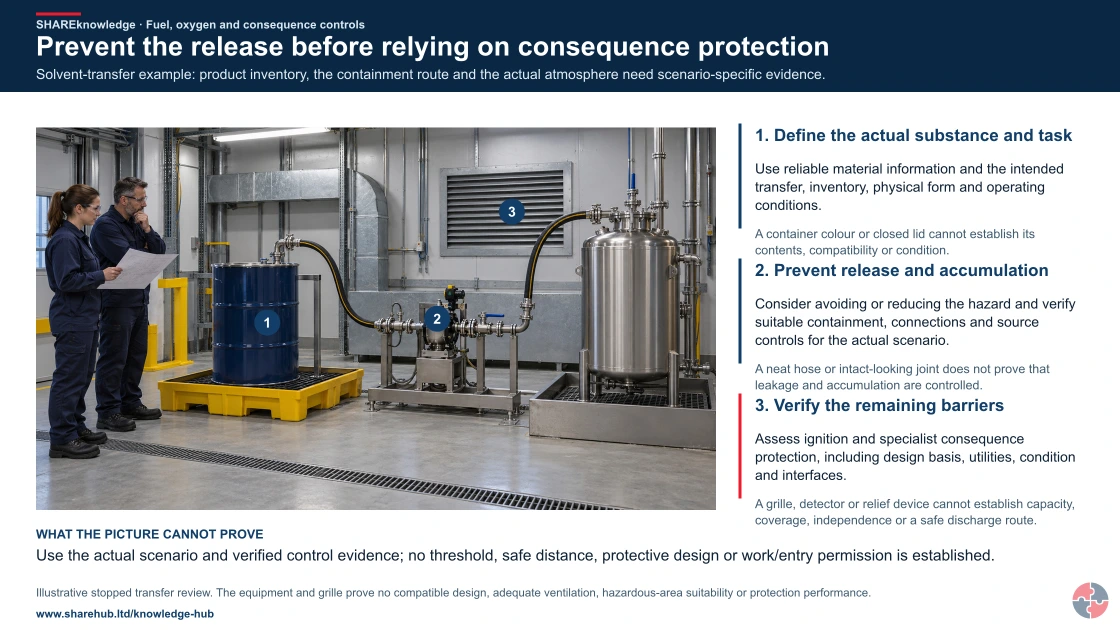
Full written explanation
Solvent-transfer example: product inventory, the containment route and the actual atmosphere need scenario-specific evidence.
- Define the actual substance and task. Use reliable material information and the intended transfer, inventory, physical form and operating conditions.
- Prevent release and accumulation. Consider avoiding or reducing the hazard and verify suitable containment, connections and source controls for the actual scenario.
- Verify the remaining barriers. Assess ignition and specialist consequence protection, including design basis, utilities, condition and interfaces.
Change the pathway
- Do not identify by appearance. A container colour or closed lid cannot establish its contents, compatibility or condition.
- Check the complete route. A neat hose or intact-looking joint does not prove that leakage and accumulation are controlled.
- Do not credit visible equipment. A grille, detector or relief device cannot establish capacity, coverage, independence or a safe discharge route.
Evidence check: Use the actual scenario and verified control evidence; no threshold, safe distance, protective design or work/entry permission is established.
Complete scenario-led fuel, oxygen and protection context
Primary references: HSE: DSEAR in detail (GB) · HSE INDG459: oxygen use in the workplace (GB) · HSE: inerting and asphyxiation concerns (GB)
Open the complete HD image (new tab)Download image
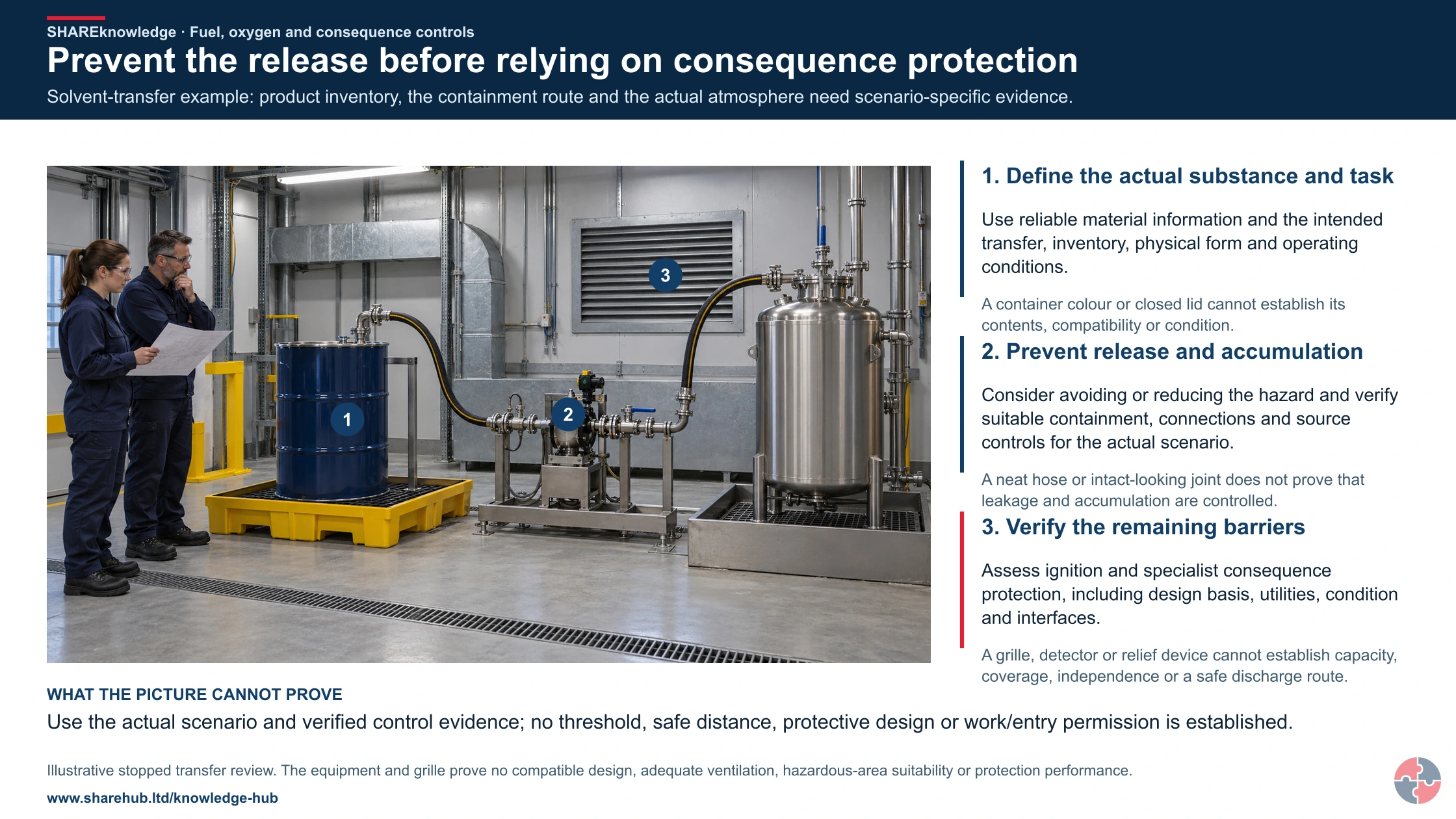
Complete scenario-led fuel, oxygen and protection context
Primary references: HSE: DSEAR in detail (GB) · HSE INDG459: oxygen use in the workplace (GB) · HSE: inerting and asphyxiation concerns (GB)

Identify the event
Specify material form, release/accumulation and conditions that can make the event credible.
Prevent the event
Assess controls on release, accumulation and ignition for that actual scenario, including changes.
Limit consequences
Verify specialist-designed isolation, relief or other protection and its safe discharge/interfaces. Do not infer suitability from a device’s appearance.
No generic vent area, oxygen threshold, safety distance or response tactic is supplied.
What are the key points for controlling fuel, oxygen and explosion consequences?
The key points are to reduce fuel, prevent release and accumulation, control oxygen or oxidisers, prevent ignition and limit consequences if prevention fails.
The familiar fire triangle is a useful starting point because fire needs fuel, oxygen and heat. Explosion risk adds more complexity: a fuel may need to be dispersed as vapour, gas, mist or dust; the mixture may need to sit within explosive limits; confinement or congestion may intensify pressure; and delayed ignition can turn a small release into a major event.
The best control strategy is prevention first. Remove or reduce dangerous substances, keep quantities low, prevent leaks and dust clouds, use closed containers, provide ventilation, segregate incompatible materials, prevent oxygen enrichment, keep ignition sources away and maintain equipment. Mitigation comes next: explosion relief, suppression, isolation, containment, pressure relief, emergency shutdown, alarm, escape and response planning.
| Point | Why it matters | Evidence |
|---|---|---|
| Reduce the fuel load | Less fuel usually means lower fire growth, smaller release and reduced explosion potential. | Inventory limits, store inspections and waste controls. |
| Prevent flammable atmospheres | Fuel–air combustion explosions need a combustible mixture within its explosive range; decomposition, runaway reactions and pressure explosions require their own assessment. | Ventilation, containment, gas detection and DSEAR assessment. |
| Control oxygen and oxidisers | Oxygen enrichment and oxidising substances can make fires intense and hard to extinguish. | Cylinder controls, segregation and oxygen-compatible equipment. |
| Control ignition | Ignition prevention remains critical even where fuel control is strong. | Hot-work permits, ATEX equipment and electrical inspection. |
| Manage dust and residues | Fine combustible particles or residues in tanks can ignite violently when dispersed or heated. | Housekeeping, extraction, cleaning and inspection evidence. |
| Plan for consequences | Venting, relief, suppression and emergency plans limit harm when prevention fails. | Design basis, maintenance records and drill learning. |
What is control of fuel, oxygen and explosion consequences?
It is the combined management of fire prevention, dangerous substances, oxidising conditions and explosion mitigation.
Fuel control means understanding what can burn, how easily it can ignite, how much is present and how it is stored, used, transferred, heated, sprayed, atomised, dried, charged, cleaned or disposed of. A liquid solvent, a pile of packaging, a dust layer, a gas cylinder and an empty drum with residue all behave differently.
Oxygen control means preventing enrichment, avoiding oxygen misuse and separating oxidising substances from fuels. The air normally contains about 21% oxygen; even modest enrichment can make clothing, oils, greases and other materials ignite more readily and burn intensely. Oxidisers such as some peroxides, nitrates or chlorates can support combustion without needing ordinary air as the limiting source.
Explosion consequence control means asking what happens if a flammable atmosphere ignites. The answer depends on fuel, concentration, confinement, congestion, ignition energy, flame speed, pressure relief, vent paths, building strength, separation, emergency response and people at risk.
| Area | What it includes | Typical workplace examples |
|---|---|---|
| Solid fuels | Combustible materials that contribute to fire growth. | Packaging, timber, plastics, textiles, waste and insulation. |
| Flammable liquids | Liquids that give off ignitable vapours. | Petrol, solvents, paints, inks, adhesives and cleaning fluids. |
| Flammable gases | Gases stored or used under pressure that may ignite or explode. | LPG, acetylene, hydrogen, methane and welding gases. |
| Combustible dusts | Fine particles that can explode when dispersed in air. | Wood dust, flour, sugar, grain, coal, metal powders and plastics. |
| Oxygen and oxidisers | Materials or atmospheres that intensify combustion. | Oxygen cylinders, oxidising chemicals and oxygen-enriched confined spaces. |
| Explosion mitigation | Measures that limit consequences after ignition. | Venting, suppression, isolation, containment and relief. |
How does this differ between ordinary workplaces and higher-risk sites?
Ordinary workplaces usually focus on good fire precautions, while higher-risk sites need detailed dangerous substance and explosion controls.
In offices, shops, schools and many low-risk premises, the main controls are sensible housekeeping, waste management, ignition control, electrical safety, storage discipline, fire doors, alarms, escape routes, extinguishers, training and emergency planning. Dangerous substances may still be present, but often in small quantities.
In workshops, laboratories, warehouses, food plants, paint shops, fuel sites, chemical stores, construction sites and process facilities, the same principles apply but the consequences can be larger. Flammable liquid vapours, gas releases, dust clouds, oxidisers, cylinders, hot work, drying ovens, charging rooms, extraction systems and process ventilation need more specific assessment.
| Setting | Typical focus | When to escalate |
|---|---|---|
| Office or retail | Combustible waste, electrical equipment, escape, alarm and routine housekeeping. | Aerosols, lithium batteries, gas cylinders or flammable storage increase complexity. |
| Workshop or maintenance area | Flammable liquids, welding gases, hot work, oily rags and ventilation. | DSEAR may apply where dangerous substances can create fire or explosion risk. |
| Laboratory | Small quantities but diverse chemicals, oxidisers, solvent vapours and reactions. | Compatibility, storage, fume extraction and emergency procedures need specialist review. |
| Food or wood processing | Combustible dust, extraction, housekeeping and ignition control. | Dust explosion assessment and protected extraction may be needed. |
| Fuel or chemical site | Major accident scenarios, bulk storage, vapour clouds, firewater and emergency isolation. | COMAH, DSEAR, process safety and specialist engineering controls may apply. |
How should the fire triangle be used?
Fuel, oxygen and ignition explain combustion, but explosion planning also considers atmosphere, confinement, dispersion and consequence.
The HSE DSEAR guide prioritises minimising inventory and release, source capture and atmosphere prevention before ignition control. A dust collector may contain a dispersed combustible cloud even when the room looks clean. Inerting can reduce oxygen in a vessel but creates an asphyxiation hazard, so instrument, alarm and recovery design matter. Check operating and fault conditions rather than relying on a simple triangle alone.
How should flammable liquids be stored and used?
Flammable liquids should be kept to minimum quantities, stored in suitable containers or tanks, segregated from ignition sources and handled to prevent vapour release.
Flammable liquids are dangerous because the vapour above the liquid can ignite or explode when mixed with air. Petrol, solvents, thinners, paints, inks, adhesives, cleaning fluids and some fuel oils may create vapour clouds, especially when decanted, sprayed, heated, spilled or used in open containers.
Good practice starts with substitution and quantity reduction. Keep only what is needed for the job, use closed containers, close lids, clean spills quickly, provide suitable ventilation, keep containers away from heat and electrical equipment, and store larger quantities in purpose-designed stores, cabinets, compounds or tanks. Bulk tanks need additional design, bunding, overfill, venting, separation, inspection and emergency controls.
| Control | What good looks like | Evidence |
|---|---|---|
| Substitution and quantity reduction | Use less hazardous products or smaller quantities where practicable. | Product review and inventory limit. |
| Suitable containers | Containers are closed, labelled, compatible and protected from damage. | Container inspections and SDS information. |
| Storage cabinets and stores | Workroom quantities are limited and larger stocks are separated. | Storage inspection and cabinet/store standard. |
| Transfer control | Decanting prevents spills, vapour release and static build-up. | Procedure, bonding/earthing where needed and spill response. |
| Bulk tank controls | Tanks have suitable design, bunding, vents, overfill prevention and inspection. | Tank records, inspection and maintenance evidence. |
| Emergency planning | Spills, fire, evacuation and environmental protection are planned. | Emergency plan, spill kit and firewater arrangements. |
How should flammable gases and pressurised gas systems be controlled?
Flammable gases should be stored, transported, connected, isolated and used so that leaks, ignition and cylinder escalation are prevented.
LPG, acetylene, hydrogen, methane and welding gases can create serious fire and explosion hazards. They may leak from cylinders, hoses, regulators, manifolds, valves, pipework or appliances. Because many gases are stored under pressure, consequences may include jet fire, flash fire, vapour cloud explosion, cylinder failure or missiles.
Controls include keeping cylinders upright and secure, separating fuel gases from oxygen, leak testing, closing valves when not in use, protecting hoses, using flashback arrestors where required, providing ventilation, preventing accumulation in low points or confined spaces, controlling hot work and keeping cylinders away from fire exposure.
| Control | What it prevents | Evidence |
|---|---|---|
| Cylinder storage | Damage, falls, heating and incompatible storage. | Cylinder store inspection and segregation. |
| Leak prevention | Formation of flammable gas clouds. | Leak test, maintenance and defect records. |
| Ventilation | Accumulation in rooms, pits, ducts or confined spaces. | Ventilation checks and gas detection where needed. |
| Ignition control | Ignition of leaked gas. | Hot-work permits and suitable electrical equipment. |
| Emergency isolation | Continued release during an incident. | Accessible isolation points and emergency briefings. |
| Cylinder fire response | Escalation to pressure failure or projectile risk. | Emergency plan and fire service information. |
How should combustible dust explosion risk be controlled?
Combustible dust risk should be controlled by preventing dust clouds, preventing dust layers, controlling ignition and protecting equipment where explosions remain credible.
Combustible dusts are often underestimated because the solid material may look harmless in bulk. Wood, flour, sugar, grain, coal, plastics, some chemicals and metal powders can explode if fine particles become suspended in air and meet an ignition source. A small primary explosion can disturb dust layers and create a much larger secondary explosion.
Housekeeping is a safety-critical control, not cosmetic tidiness. Dust layers on beams, cable trays, ledges, floors, ducts and equipment can become fuel for secondary explosions. Extraction and filtration systems also need careful design and maintenance because they can collect dust, provide confinement and contain ignition sources.
| Control | What good looks like | Evidence |
|---|---|---|
| Dust prevention | Processes minimise dust generation and leakage. | Enclosed transfer, extraction and maintenance records. |
| Housekeeping | Dust layers are not allowed to accumulate on surfaces. | Cleaning standard, inspection and photographs. |
| Extraction and LEV | Dust is captured and safely conveyed or filtered. | LEV examination and defect close-out. |
| Ignition control | Hot surfaces, sparks, static, friction and electrical sources are controlled. | ATEX assessment and maintenance records. |
| Explosion protection | Venting, suppression, isolation or containment is provided where needed. | Design basis, inspection and test records. |
| Change control | New powders, dryers, mills or filters are reviewed before use. | DSEAR review and MOC record. |
How should oxygen and oxidisers be controlled?
Oxygen and oxidisers should be controlled by preventing enrichment, preventing contamination, using compatible equipment and keeping them away from fuels.
Oxygen is not flammable, but it strongly supports combustion. Oxygen enrichment can make clothing, hair, rubber, plastics, oils and greases ignite more easily and burn much more fiercely. Oxygen cylinders and oxygen service equipment must therefore be kept clean, compatible, maintained and used only for their intended purpose.
Oxidising substances create a similar practical problem because they can intensify fire or react dangerously with fuels. They must be identified from labels and safety data sheets, segregated from flammables and combustibles, protected from contamination and included in emergency planning.
| Control | Why it matters | Evidence |
|---|---|---|
| Prevent oxygen enrichment | Small increases in oxygen concentration can make fire behaviour severe. | Leak checks, ventilation and oxygen monitoring where needed. |
| Use oxygen-compatible equipment | Oil, grease and unsuitable materials can react violently with oxygen. | Manufacturer information and maintenance records. |
| Never misuse oxygen | Using oxygen for dusting, cooling, tyre inflation or purging can cause fire/explosion. | Training, signs and supervision. |
| Segregate oxidisers | Oxidisers can intensify fire and react with fuels. | Storage segregation and compatibility chart. |
| Control confined-space use | Oxygen enrichment or depletion may not be detected by senses. | Permit, atmosphere monitoring and rescue plan. |
| Emergency response | Oxygen-contaminated clothing and materials may remain hazardous. | Emergency procedures and worker briefing. |
HSE INDG459, Oxygen use in the workplace, January 2013 directly supports oxygen-compatible equipment, cleanliness, leak prevention, ventilation and avoiding oxygen misuse. Competent specialists must design, install and commission high-pressure oxygen systems; maintain approved components and check hoses/connections before use. Suspend affected work on suspected leakage or contamination, make the area safe, repair the cause and verify safe conditions before reuse. Its standards references need checking for the current equipment and location.
How should ventilation be used and controlled?
Ventilation should prevent accumulation of flammable or explosive atmospheres, but it must be designed, maintained and understood.
Ventilation can dilute or remove flammable vapour, gas, mist or dust, but it is not a magic cure. The system has to capture or move contaminants from the right place to a safe place without spreading risk. Poorly positioned fans, blocked ducts, failed extraction, recirculation or ventilation shutdown can turn a controlled task into a dangerous atmosphere.
Ventilation shutdown needs careful thought. In a fire, shutting ventilation may help smoke control or prevent air feeding a fire; in a process or DSEAR context, shutting ventilation may allow flammable vapour to accumulate. The emergency plan should define what shuts down, what stays running, who decides and what alarms or interlocks are used.
| Ventilation issue | Risk | Control |
|---|---|---|
| General dilution | Vapour or gas may accumulate if air movement is poor. | Adequate room ventilation and monitoring. |
| Local exhaust | Dust, mist or vapour may escape at source. | LEV design, examination and maintenance. |
| Discharge location | Contaminants may be discharged near ignition, intakes or people. | Safe discharge design and inspection. |
| Shutdown logic | Incorrect shutdown may worsen smoke or flammable atmosphere risk. | Emergency strategy and tested controls. |
| Failure alarms | People may keep working after ventilation fails. | Interlocks, alarms and stop-work rules. |
| Temporary work | Contractor work may block vents, intakes or extraction. | Permit review and temporary change control. |
Define normal-operation, leak and fire ventilation actions in the assessed system design and emergency plan. Automatically stopping extraction can allow a flammable atmosphere to accumulate; continued running may introduce other fire hazards. Validate the chosen alarm, shutdown or continued-operation sequence for this actual process, including fault conditions. Workers should follow that agreed response and stop affected work when ventilation status is uncertain.
When is inerting useful and what can go wrong?
Inerting can prevent combustion by reducing oxygen below the level needed for ignition, but it introduces asphyxiation and reliability risks.
Inerting is used in some tanks, vessels, powder systems and process equipment to prevent a flammable atmosphere from igniting. Nitrogen is common, but other inert gases may be used. The control depends on maintaining the right oxygen concentration under normal, abnormal, filling, emptying, cleaning, maintenance and emergency conditions.
Inerting should be treated as an engineered safety-critical control. It can fail through air ingress, poor purge procedure, incorrect valve line-up, loss of supply, damaged seals, inadequate monitoring or misunderstanding during maintenance. It can also create a serious asphyxiation risk because oxygen-deficient atmospheres may not be noticed before collapse.
| Issue | Control expectation | Failure mode |
|---|---|---|
| Design basis | Defined limiting oxygen concentration and margin. | System used without knowing required oxygen level. |
| Monitoring | Oxygen concentration is monitored where needed. | Blind reliance on purge time or pressure. |
| Air ingress | Seals, vents and openings are controlled. | Maintenance introduces air into an inerted system. |
| Asphyxiation risk | Entry and access are controlled. | Workers exposed to oxygen-deficient atmosphere. |
| Change control | Product, temperature, pressure or operation changes are reviewed. | Old inerting settings used for new conditions. |
| Competence | Operators understand what inerting does and does not prove. | People assume inert means safe for entry or hot work. |
HSE inerting guidance requires a reliable inert-gas supply, monitoring and maintenance for enclosed plant. Define the oxygen limit and safety margin for the actual material, mixtures and operating states with competent engineering input; prove supply, alarms and protective actions during commissioning and planned tests. Check status before transfer and monitor during operation; loss of supply, air ingress or analyser failure requires the specified safe hold, cause correction and verified restoration before restart. An inert atmosphere is dangerous to breathe and never proves safe entry or hot work. Entry requires a separate assessed safe system and rescue arrangements. Historical standards in this technical page need current specialist checking.
How should explosive atmospheres be prevented?
Explosive atmospheres should be prevented by controlling dangerous substances, releases, accumulation, ignition sources and equipment suitability.
An explosive atmosphere is a mixture of dangerous substance and air in which combustion can spread after ignition. It may be created by normal operations, leaks, spills, cleaning, maintenance, charging, filling, draining, powder transfer or equipment failure. The aim is to prevent the atmosphere forming; where that cannot be fully achieved, the area must be classified and ignition sources controlled.
DSEAR assessment should consider the substance properties, quantity, process conditions, release points, ventilation, hazardous area extent, ignition sources, people exposed and foreseeable consequences. The assessment should lead to practical controls, not just zone drawings.
| Control | What it does | Evidence |
|---|---|---|
| Release prevention | Keeps dangerous substances inside equipment or containers. | Inspection, maintenance and defect records. |
| Ventilation and dilution | Prevents dangerous concentration from persisting. | Ventilation design and checks. |
| Hazardous area classification | Identifies where explosive atmospheres may occur. | DSEAR assessment and zone drawing. |
| Suitable equipment | Prevents electrical or mechanical equipment becoming ignition sources. | ATEX equipment register and inspections. |
| Static control | Controls charge build-up during transfer or handling. | Bonding, earthing and procedure checks. |
| Work control | Prevents hot work, contractors or maintenance creating ignition. | Permit to work and gas testing evidence. |
How should explosion consequences be limited?
Explosion consequences should be limited by relief, venting, suppression, isolation, containment, separation, emergency shutdown and emergency response planning.
Prevention is the priority, but some scenarios remain credible. Consequence controls are selected from the scenario: dust explosions in filters may need explosion venting, flameless venting, suppression or isolation; pressure systems may need relief; vapour cloud scenarios may need separation, drainage, gas detection, emergency shutdown, ignition control and occupied-building review.
Explosion panels and vents must discharge to a safe place. Suppression systems must detect and act quickly enough. Isolation must prevent flame or pressure travelling into connected equipment. Containment must be designed for the expected pressure. These are engineered controls, so they require design basis, inspection, maintenance and change control.
| Control | What it is used for | Assurance evidence |
|---|---|---|
| Explosion venting | Relieves pressure from equipment or rooms to a safe location. | Design basis, vent inspection and discharge-area control. |
| Explosion suppression | Detects early pressure rise and injects suppressant. | Inspection, servicing and functional test records. |
| Explosion isolation | Stops flame or pressure propagating through ducts or pipes. | Isolation device inspection and maintenance. |
| Containment | Equipment is designed to withstand expected explosion pressure. | Design calculations and integrity inspections. |
| Pressure relief | Protects vessels and systems from overpressure. | Relief device register and test records. |
| Emergency shutdown | Stops or isolates feed, fuel or energy. | ESD testing and operator training. |
| Firewater and runoff control | Controls fire escalation and environmental consequence. | Firewater plan, drainage plan and exercises. |
How can the hierarchy of controls control fuel and oxygen hazards and reduce explosion consequences?
Work from elimination and substitution through containment and engineering, then procedures and residual personal protection.
For a powder-transfer collector, assess a noncombustible or wet process first. If impracticable, reduce batch size and test a less dusty feed. Enclose and extract dust, control ignition, verify housekeeping, and design suitable explosion relief or suppression with safe discharge. The HSE dust explosion guide and relief guidance require specialist design. Stop transfer when extraction, inerting or protection status is uncertain.
On a small screen, scroll this table sideways to read all columns.
How can the ERICPD hierarchy of controls control fuel and oxygen hazards and reduce explosion consequences?

| Five-level / ERICPD | Choice and feasibility | Owner, evidence, failure and stop |
|---|---|---|
| Eliminate / eliminate | Remove combustible powder process if product permits. | Designer records option; hold approval if safe alternative is feasible. |
| Substitute / reduce | Use less dusty feed or smaller batch after trial. | Process engineer signs test; stop on unknown dust properties. |
| Engineering / isolate and control | Contain/extract dust; design ignition control and relief to safe place. | Engineer tests barriers; stop on failed extraction or protection. |
| Administrative / discipline | Clean layers, inspect equipment and manage change. | Supervisor records checks; stop on uncontrolled dust accumulation. |
| PPE / PPE | Task PPE for residual exposure and emergency response. | Lead verifies; no work if required protection fails. |
How can the ISO 45001 hierarchy of controls control fuel and oxygen hazards and reduce explosion consequences?

| Five-level / ERICPD | Choice and feasibility | Owner, evidence, failure and stop |
|---|---|---|
| Eliminate / eliminate | Remove combustible powder process if product permits. | Designer records option; hold approval if safe alternative is feasible. |
| Substitute / reduce | Use less dusty feed or smaller batch after trial. | Process engineer signs test; stop on unknown dust properties. |
| Engineering / isolate and control | Contain/extract dust; design ignition control and relief to safe place. | Engineer tests barriers; stop on failed extraction or protection. |
| Administrative / discipline | Clean layers, inspect equipment and manage change. | Supervisor records checks; stop on uncontrolled dust accumulation. |
| PPE / PPE | Task PPE for residual exposure and emergency response. | Lead verifies; no work if required protection fails. |
Use HSE’s five-level hierarchy with ERICPD, starting with eliminating or substituting the dangerous process. In this powder-transfer example, the process engineer establishes representative dust properties, collector volume and strength, connected duct geometry, foreseeable operating conditions and who could be exposed at a discharge point. A competent specialist selects and verifies the protection for this actual system, including propagation isolation and a safe discharge route where needed. Record commissioning and acceptance checks against that design; an ordinary process rotary valve is not automatically an explosion isolation device. Maintain extraction and protective devices to their specified requirements, with service, inspection and test evidence. Before transfer and during operation, the supervisor checks extraction indication, protection status, dust deposits and any changed material or duct arrangement. Unknown dust properties, a blocked relief path, failed extraction or impaired protection means stop and safe isolation. Correct the cause and verify the affected system against its acceptance criteria before authorised restart. HSE relief design factors and HSE dust protection and isolation guidance support these decisions.
How should these hazards appear in the risk register?
The risk register should record credible fire and explosion scenarios, not just list flammable substances.
A useful risk register describes the unwanted event, the route to harm and the controls relied on. For dangerous substances, that means recording scenarios such as vapour release during decanting, dust cloud ignition in an extraction system, oxygen enrichment in a confined space, hot work on a contaminated tank or overfill leading to a vapour cloud.
Each scenario should identify prevention barriers, mitigation barriers, emergency arrangements, responsible owners, inspection evidence and review triggers. This makes the register useful for audits, training, maintenance and management review.
| Scenario | Key barriers | Evidence |
|---|---|---|
| Solvent vapour release in a workroom | Quantity limits, closed containers, ventilation, ignition control and spill response. | Inventory, inspection and ventilation checks. |
| Dust explosion in extraction plant | Dust control, housekeeping, ignition control, explosion venting and isolation. | LEV records, cleaning checks and vent inspection. |
| Oxygen enrichment during hot work | Cylinder control, leak checks, hose removal, ventilation and training. | Permit, gas checks and equipment inspection. |
| Bulk fuel overfill and vapour cloud | Overfill prevention, alarms, procedures, bunding, detection and emergency plan. | Functional tests, tank records and drills. |
| Hot work on contaminated drum | Choose a cold method first. Unavoidable hot work needs a competent task-specific safe system, cleaning, inspection, isolation, appropriate testing and authorisation; inerting alone does not prove it safe. | Alternative-method decision, competent safe-system checks and authorisation evidence. |
| Oxidiser stored with combustibles | Segregation, compatibility review, labelling and emergency plan. | Storage inspection and SDS review. |
Which fire and explosion duties apply by location?
GB DSEAR 2002 and NI DSEAR 2003 are separate instruments requiring risk assessment, prevention/reduction and mitigation.
The HSE GB DSEAR guide describes control priorities and consequence mitigation. The NI statutory rule governs Northern Ireland workplaces; verify current effects and actual material/process. Fire precautions and major-hazard rules may add duties. Competent engineering must size relief, inerting, ventilation and protection.
How could Crownway Fuels Ltd manage fuel, oxygen and explosion consequences?

Crownway Fuels Ltd could manage these hazards through a DSEAR-led system that links inventories, scenarios, barriers, inspections, permits and emergency plans.
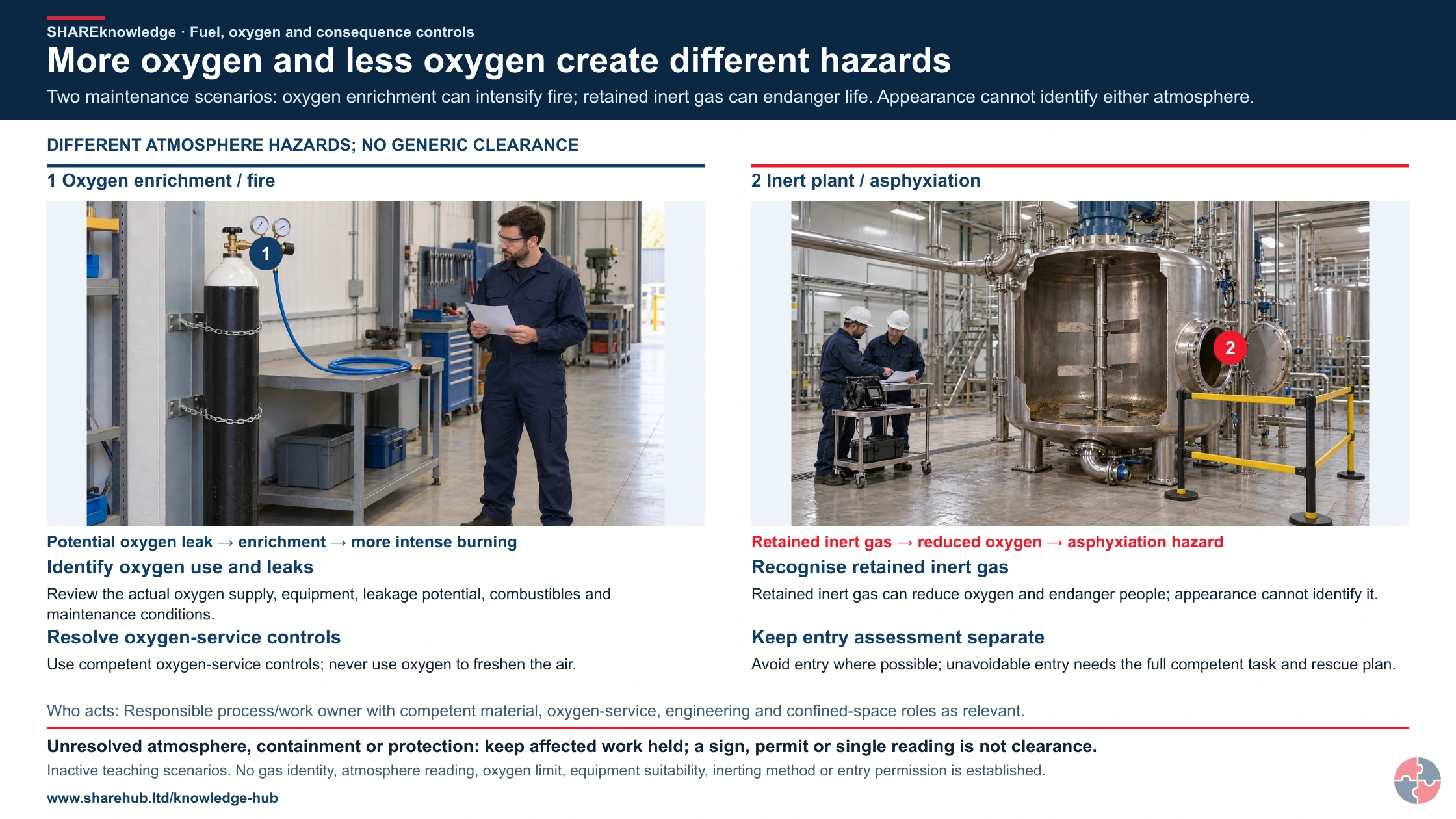
More oxygen and less oxygen create different hazards
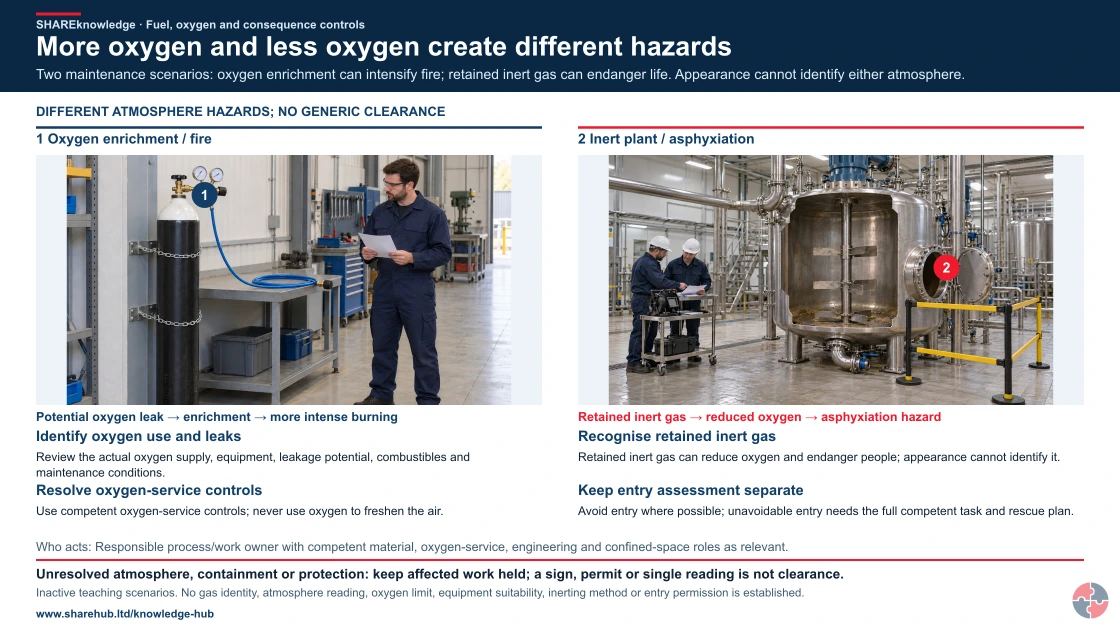
Full written explanation
Two maintenance examples distinguish oxygen enrichment from a dangerous reduction in oxygen. Picture key1, Oxygen enrichment / fire, identifies an inactive cylinder/regulator/hose review. Cylinder colour and blank gauges establish neither gas identity, pressure, equipment condition nor oxygen compatibility. A potential oxygen leak can enrich the surrounding atmosphere and intensify burning. The control questions are the actual oxygen supply, equipment, leak potential, combustibles and maintenance conditions, with competent oxygen-service controls. Oxygen must never be used to freshen the air. Picture key2, Inert plant / asphyxiation, identifies an enclosed vessel with connected pipework and a side opening; the people remain outside. Plant can retain inert gas, reducing oxygen and endangering people. The cutaway shows the physical enclosure, not a gas identity or a measured atmosphere. Keep entry assessment separate: avoid entry where possible; unavoidable entry requires the full competent task and rescue arrangement. The four process headings beneath the two examples are unnumbered. No live gas leak, flame, ignition, entry, purge, venting or gas test is shown. An open manway, blank gauge, sign, permit or single reading cannot resolve unknown atmosphere, containment or protection. Actual material, oxygen-service, engineering and confined-space roles need the relevant evidence; affected work stays held while these questions are unresolved. No oxygen/flammability/temperature value, pressure or regulator setting, safe distance, inerting sequence, emergency recipe or work/entry clearance is supplied.
Two maintenance scenarios: oxygen enrichment can intensify fire; retained inert gas can endanger life. Appearance cannot identify either atmosphere.
- Identify oxygen use and leaks. Review the actual oxygen supply, equipment, leakage potential, combustibles and maintenance conditions.
- Resolve oxygen-service controls. Use competent oxygen-service controls; never use oxygen to freshen the air.
- Recognise retained inert gas. Retained inert gas can reduce oxygen and endanger people; appearance cannot identify it.
- Keep entry assessment separate. Avoid entry where possible; unavoidable entry needs the full competent task and rescue plan.
When the evidence does not fit: Missing atmosphere, containment or protection evidence keeps the affected work held. Use the actual site arrangements; a sign, permit or one reading is not a complete work-release decision.
Who acts: Responsible process/work owner with competent material, oxygen-service, engineering and confined-space roles as relevant.
Changed workplace
Solvent transfer: Prevent the actual release and accumulation; verify ignition and consequence barriers against the credible scenario.
Oxygen-related maintenance: Assess oxygen enrichment and equipment compatibility; do not confuse this with reduced-oxygen inerted plant.
Evidence check: Use the actual scenario and verified control evidence; no threshold, safe distance, protective design or work/entry permission is established.
Complete scenario-led fuel, oxygen and protection context
Primary references: HSE: DSEAR in detail (GB) · HSE INDG459: oxygen use in the workplace (GB) · HSE: inerting and asphyxiation concerns (GB)
Open the complete HD image (new tab)Download image
Complete scenario-led fuel, oxygen and protection context
Primary references: HSE: DSEAR in detail (GB) · HSE INDG459: oxygen use in the workplace (GB) · HSE: inerting and asphyxiation concerns (GB)
Crownway Fuels Ltd
Crownway Fuels Ltd is a bulk fuel storage and distribution business used by SHARE to show how fire and explosion controls work in a higher-hazard operating environment.
Crownway keeps a dangerous substances register covering petrol, diesel, additives, LPG, aerosols, oxygen cylinders used by contractors, cleaning solvents and combustible wastes. The register records substance properties, quantities, storage location, flashpoint or gas properties where relevant, incompatibilities, maximum permitted stock, spill controls, firefighting implications and whether DSEAR applies.
The DSEAR assessment starts with scenarios rather than labels. Crownway considers tank overfill and vapour cloud formation, tanker loading release, flammable vapour in drains, LPG cylinder leak, hot work near residues, oxygen enrichment during maintenance, combustible waste fire, and ignition of vapour inside a pump house. Each scenario is linked to controls: overfill alarms, transfer procedures, bunding, drainage isolation, hazardous area classification, suitable electrical equipment, gas detection, hot-work permits, emergency shutdown and firewater strategy.
For everyday control, supervisors complete short inspections on storage, lids, waste, spill kits, oxygen and fuel-gas segregation, no-smoking controls, ignition sources, ventilation and housekeeping. Engineering teams maintain vents, valves, pumps, detection, earthing/bonding, electrical equipment and fire systems. HSSE reviews DSEAR actions, permit quality, contractor hot-work controls and emergency drill learning.
Crownway treats explosion mitigation as safety-critical. If a vent, relief device, gas detector, ESD function, firewater pump or foam system is impaired, the impairment is risk assessed, authorised, time limited and given compensating controls. Management review looks at overdue tests, repeat spills, alarm trends, housekeeping findings, contractor hot-work findings and whether the emergency plan still matches credible fuel and explosion scenarios.
| System element | How Crownway applies it | Evidence |
|---|---|---|
| Dangerous substances register | Records fuels, gases, oxidisers, quantities, locations and limits. | Inventory and SDS review. |
| DSEAR scenario assessment | Assesses release, accumulation, ignition and consequence. | DSEAR assessment and zone drawings. |
| Fuel and oxygen control | Limits stocks, segregates oxygen/oxidisers, controls waste and prevents vapour release. | Inspection and storage records. |
| Ignition control | Uses hazardous area equipment, hot-work permits and contractor controls. | Permit records and ATEX equipment register. |
| Explosion mitigation | Maintains vents, relief, shutdown, gas detection, firewater and foam systems. | Maintenance, test and impairment records. |
| Emergency learning | Exercises overfill, vapour release, tank fire and gas leak scenarios. | Drill reports and action close-out. |
How do fuel-site controls address fuel, ignition and consequences?
Inspect the selected control purpose: preventing a release, controlling an ignition source or limiting a consequence. A document label or coloured boundary is not itself a physical barrier.
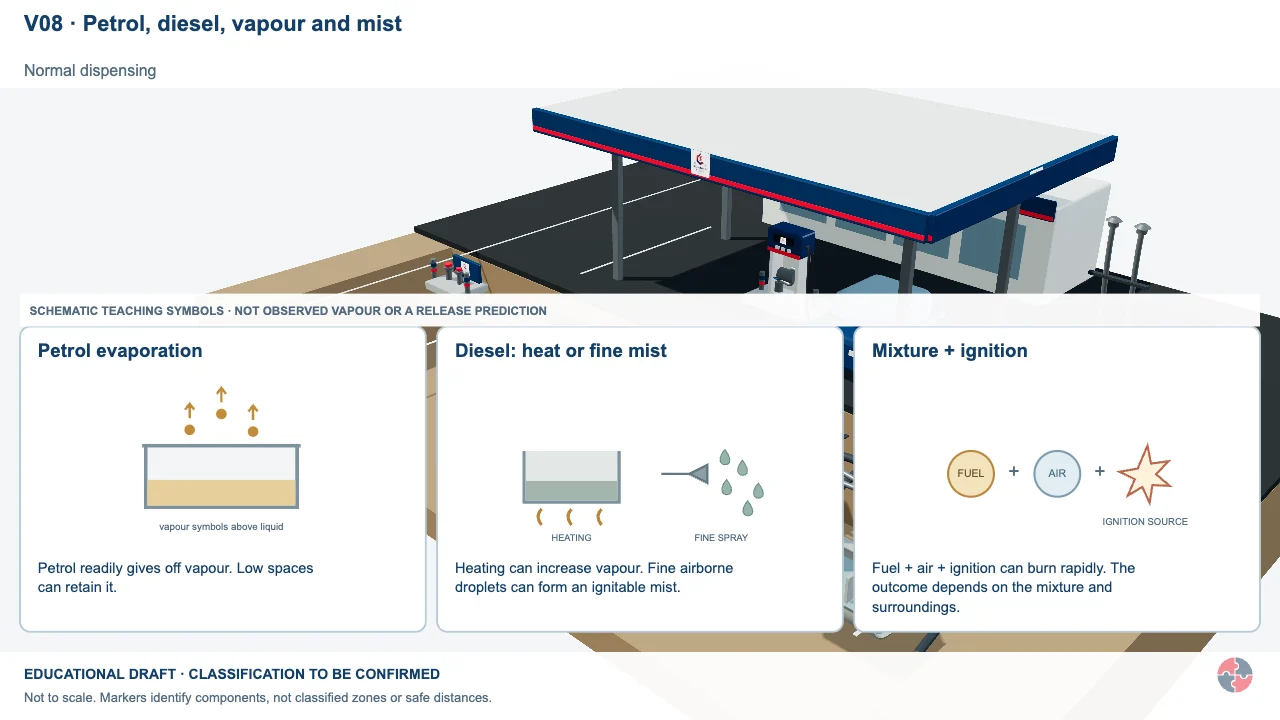

Petrol, diesel, vapour and mist
Compare petrol evaporation, diesel conditions and fine droplets. Petrol carried into a separator can remain a vapour source after the visible forecourt spill has passed.
Activity focus: Identify the actual product and release mechanism. For drainage, ask whether petrol could reach or remain in the separator; for refuelling, confirm the stated Stage II recovery arrangement.
Contextual workplace scene. Use the task, control and evidence checks in this section; appearance alone does not establish safe conditions, individual health or approval.
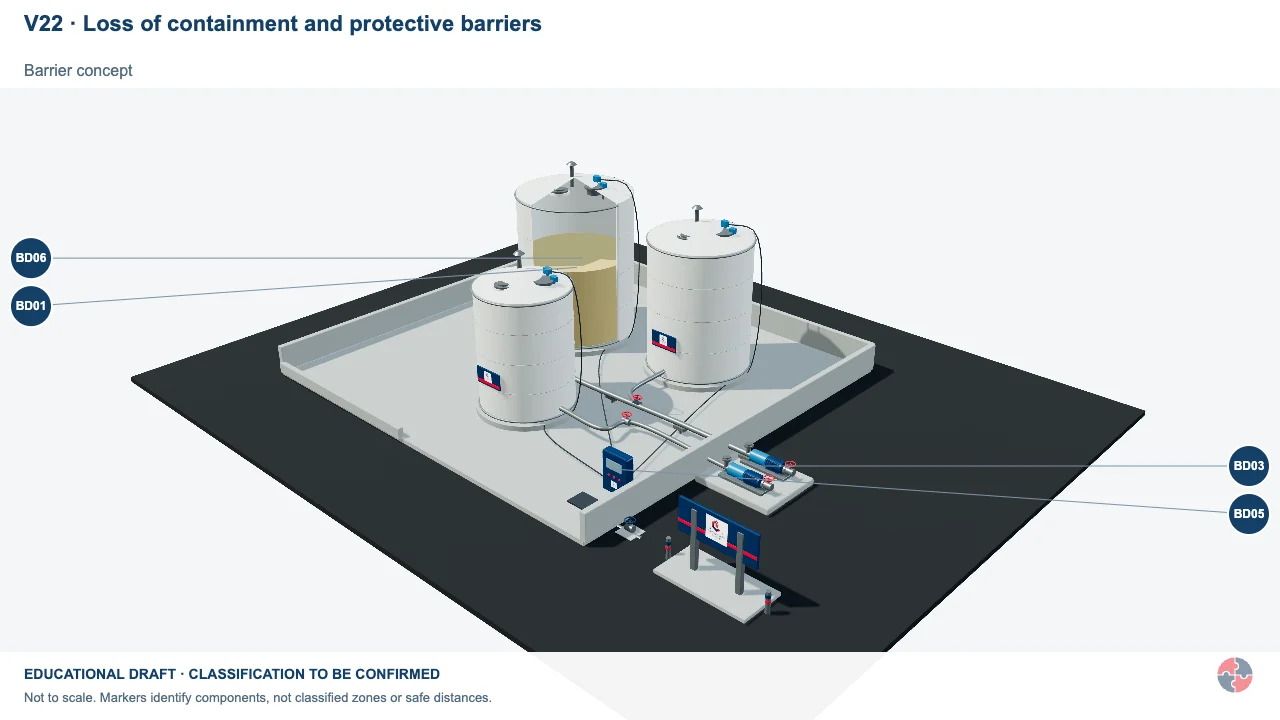
Loss of containment and protective barriers
For a selected transfer loss, examine controls intended to prevent release and controls intended to limit consequences.
Activity focus: Ask what each control does, who maintains it and what evidence shows it can work.
Contextual workplace scene. Use the task, control and evidence checks in this section; appearance alone does not establish safe conditions, individual health or approval.
Educational illustration, not to scale. Coloured zones are teaching examples, not a site-specific hazardous-area classification.
What should each role learn and demonstrate?
Learning must match the decisions people make, from recognising danger to checking that controls work.
Briefings should tell people how to act, but attendance alone does not show competence. Assess the real decision or task, record who assessed it and revisit after a material change, failed control or incident. A local authorisation is task-specific; no universal external certificate is implied.
On a small screen, scroll this table sideways to read all columns.
| Role and learning | Demonstration and assessor | Record and reassessment trigger |
|---|---|---|
| Process designer | Demonstrate hazard basis and prevention choices; specialist assesses. | Design record; revisit after material change. |
| Maintenance lead | Proof-check extraction/protection; engineer assesses. | Test log; repeat after failure. |
| Operator | Recognise alarms and stop transfer; supervisor observes. | Drill; repeat after control change. |
How does this topic support NEBOSH Fire Safety Certificate study?
For NEBOSH Fire Safety Certificate study, this topic sits around safe storage and use of flammable liquids, oxygen control and explosion consequence mitigation.
Fire-safety study can help learners move beyond naming the fire triangle. Strong answers explain how small quantities of flammable liquids should be stored, transported and used; how oxygen and oxidisers intensify fire; why ventilation may prevent or worsen particular scenarios; and how explosion prevention differs from explosion mitigation.
Scenario answers should identify the fuel form first: solid, liquid, vapour, gas, mist, dust or oxidiser. Then identify how it could be released, dispersed, ignited, confined or escalated. Controls should follow a logical route: eliminate or reduce fuel, prevent release, ventilate or contain safely, prevent ignition, maintain equipment, train people, plan emergencies and verify the control evidence.
| Study point | What to know | How to apply it |
|---|---|---|
| Small quantities of flammable liquids | Flashpoint, vapour release, storage, transfer, containers and ignition control. | Choose suitable cabinet, limits, lids, spill control and ventilation. |
| Oxygen control | Oxygen enrichment makes fires easier to start and harder to control. | Segregate cylinders, prevent leaks and never use oxygen as air. |
| Ventilation shutdown | Ventilation can dilute vapour but may affect smoke or air supply in fire. | Explain when systems should shut down or remain running. |
| Explosion prevention | Prevent release, accumulation and ignition. | Use DSEAR controls, zoning and suitable equipment. |
| Explosion mitigation | Limit consequences if ignition occurs. | Use relief, venting, suppression, isolation and emergency plans. |
| Evidence | Controls must be maintained and reviewed. | Use inspections, tests, training, permits and action close-out. |
How can a management system sustain effective decisions?
Give each hazard or support route an owner, a control, a check and a response to failure.
Link material properties, release control, ignition control, protection design, proof checks and change. An owner should sample actual work and corrective actions, not accept a policy or certificate as evidence that the controls work.
The free GB regulator guide HSE Managing for health and safety (HSG65) explains a plan–do–check–act approach: assign controls and owners, involve workers, check work as done, and correct failures. For Northern Ireland, use HSENI risk assessment guidance for the local duty. A certificate alone does not demonstrate that a control works.
Which major accidents show why fuel, oxygen and explosion consequence control matters?
Major accidents show that fuel release, vapour cloud formation, ignition, congestion and escalation can overwhelm weak controls.
Buncefield is the key UK learning anchor for this topic. A fuel overfill led to a large vapour cloud, followed by a severe explosion and major fire. The event injured over 40 people, damaged surrounding commercial and residential properties, caused a large evacuation and burned for several days. The learning is not only about storage tanks; it is about overfill prevention, vapour cloud behaviour, ignition control, site layout, emergency response, firewater and management assurance.
Phillips 66 Pasadena is another powerful process safety example. A flammable release during maintenance formed a vapour cloud that ignited, causing a massive explosion, multiple fires, 23 fatalities and many injuries. The learning is relevant to release prevention, isolation, maintenance control, congestion, emergency response and contractor/interface management.
| Incident | What failed in relation to this topic | Learning point |
|---|---|---|
| Buncefield fuel depot explosion and fire | Fuel overfill and vapour cloud formation led to severe explosion, fire escalation and off-site consequences. | Overfill prevention, vapour control, ignition control, emergency planning and assurance must work together. |
| HSE - Phillips 66 Pasadena case study | Flammable release during maintenance formed a vapour cloud that ignited with catastrophic consequences. | Isolation, maintenance control, congestion, release prevention and emergency response are critical. |
| HSE RR1190 vapour cloud explosion research | Research following Buncefield illustrates how buildings and enclosures can influence explosion severity. | Layout, congestion and enclosures can turn ignition into much more severe overpressure. |
HSE Buncefield investigation is GB incident evidence. HSE’s Phillips 66 Pasadena case study describes a US accident; its isolation and maintenance lessons do not define NI or GB law. HSE RR1190 vapour-cloud research examines explosion behaviour following Buncefield; use it as research evidence rather than a universal venting or building-design specification.
What warning signs show that fuel, oxygen and explosion controls are failing?
Warning signs include uncontrolled fuel load, poor housekeeping, leaking containers, oxygen misuse, failed ventilation, weak hot-work control and out-of-date DSEAR assessments.
These warning signs are practical because they show how harm can develop. Open solvent containers can release vapour. Dust layers can become secondary explosion fuel. Oxygen hoses left connected in a confined space can enrich the atmosphere. A blocked vent can allow flammable gas to accumulate. A copied hot-work permit can miss a change in plant condition.
Repeated small findings should be treated seriously. Fire and explosion events often develop from normalised weaknesses: untidy storage, poor labels, undocumented changes, broken extraction, informal decanting, blocked fire exits, untested gas detection or workers who do not know what to do when an alarm sounds.
| Warning sign | How harm can arise | Immediate response |
|---|---|---|
| Excess flammable stock | Increases fire load, spill size and vapour release. | Reduce stock and restore storage limits. |
| Open containers or poor lids | Vapours can escape and find ignition sources. | Close, label, remove or replace containers. |
| Dust layers on ledges or plant | Secondary explosion fuel may accumulate. | Clean safely and review extraction. |
| Oxygen used for cleaning or cooling | Oxygen enrichment can make clothing or materials ignite fiercely. | Stop work and retrain users. |
| Ventilation fault ignored | Flammable atmosphere may accumulate. | Stop affected work and repair controls. |
| Hot work near residues | Heat can vaporise residues and cause explosion. | Use cold methods or clean/gas-free under permit. |
| Expired DSEAR assessment | Changes in substances, layout or equipment may be missed. | Review assessment before continuing higher-risk work. |
What acronyms are used on this page?
Acronyms should be explained so the topic remains accessible to new learners and experienced professionals.
| Acronym | Meaning | Why it matters |
|---|---|---|
| ATEX | Atmospheres Explosibles | Common shorthand for equipment and protective systems used in explosive atmospheres. |
| BLEVE | Boiling liquid expanding vapour explosion | Major hazard involving sudden vessel failure and rapid vapour expansion. |
| COMAH | Control of Major Accident Hazards | Applies to qualifying major hazard establishments. |
| COSHH | Control of Substances Hazardous to Health | Relevant where dangerous substances also create health risks. |
| DSEAR | Dangerous Substances and Explosive Atmospheres Regulations | Core GB regulations for workplace fire and explosion risks from dangerous substances. |
| ESD | Emergency shutdown | System used to isolate or stop plant during abnormal or emergency conditions. |
| FSC | Fire Safety Certificate | NEBOSH Fire Safety Certificate study context. |
| HSG | Health and Safety Guidance | HSE guidance publication series. |
| LEV | Local exhaust ventilation | Captures dust, vapour, mist or fume at source. |
| LFL | Lower flammable limit | Lowest concentration of fuel in air that can propagate flame. |
| RPE | Respiratory protective equipment | May be needed for harmful smoke, dust or vapour exposure but does not prevent fire/explosion. |
| SDS | Safety data sheet | Provides substance hazard and handling information. |