
SHARE Knowledge Hub
What are chemical classification, REACH, CLP and safety data sheets?
Chemical labels and safety data sheets communicate supply hazards; they do not replace an assessment of the actual work. Great Britain uses GB CLP and UK REACH, while Northern Ireland follows EU CLP and EU REACH for its market. Check the destination, supplier role and current product information before purchase, transfer or use.
Understanding What are chemical classification, REACH, CLP and safety data sheets?
Chemical labels and safety data sheets communicate supply hazards; they do not replace an assessment of the actual work. Great Britain uses GB CLP and UK REACH, while Northern Ireland follows EU CLP and EU REACH for its market. Check the destination, supplier role and current product information before purchase, transfer or use.
Why this matters at work
Classification communicates hazardous properties under agreed criteria. It does not calculate the exposure created by a particular task. The same classified material can be in a small sealed container or an open heated process, with very different risks. Quantity, concentration, form, temperature, pressure, duration, route, people, containment and foreseeable failures matter. Products without a pictogram can still create hazardous dust, vapour, mist or reaction products during use. Use the exact label and SDS as inputs, then observe the task, including mixing, cleaning, maintenance and waste. Identify generated contaminants and whether supplier conditions cover the use. Prefer elimination or safer processes, then source and engineering controls, with suitable protection for residual exposure. Arrange emergencies separately. Record assumptions, action owners and evidence that controls work. GB or NI classification, supply and workplace duties must each be identified; one label cannot satisfy them all. A classification decision should be made by a competent supplier or product-stewardship process, while local COSHH assessment translates the hazards into a safe working arrangement.
For workplace use, ask what the task generates or changes. Heat, spraying, cutting, curing, contamination or degradation can create exposure not described by the original product's appearance. Obtain enough reliable information to assess health, fire, compatibility, disposal and emergency risks, and ask the supplier about gaps. Record product identity, relevant component or process evidence and the decision. An absence of mandatory SDS supply does not establish absence of workplace risk, and possession of one does not complete assessment. Seek competent assistance when composition or classification uncertainty prevents a justified control decision.
How organisations manage this in practice
Maintain the exact product, responsible supplier, supply role and market in the approval record. GB CLP and UK REACH should not be treated as identical to NI's EU CLP and REACH framework. Mandatory classification lists and notes can diverge, and a classification entry does not necessarily cover every hazard class. Use current official lists and competent review rather than an old exported spreadsheet or a remembered EU classification. Set review triggers for formulation changes, revised SDSs, new evidence, changed uses, legal-list updates and movements across markets. Check internal consistency between label, SDS, inventory, assessment and emergency information. Assign an owner to resolve discrepancies and withdraw superseded task instructions without losing required history. Preserve accurate scientific information while ensuring market-specific obligations and contacts are satisfied. Do not infer that one representative appointment or NI supply status covers every GB duty. Record the source and date of checks and obtain current advice for changing deadlines, restrictions, authorisation or notification questions that affect a real transaction.
Read the document as one account: hazards and toxicology should align; first aid, fire, spill and reactivity advice should be coherent; exposure controls should address the actual material. Check revision, responsible contact, relevant limits, incompatibilities and generic PPE recommendations. An EU-origin document is not automatically scientifically invalid, but applicable GB or NI duties must be met. Record the discrepancy, supplier response and acceptance decision. Then assess the real task, quantity, method, routes and people. A corrected SDS supports the assessment; it does not by itself approve the method or demonstrate suitable gloves, ventilation and emergency readiness.
Check GB CLP duties separately from UK REACH coverage. A representative arrangement needs actual written scope for the relevant substances and supply chain; it must not be presumed to discharge all classification and labelling obligations. NI supply follows a different framework, and direct NI-to-GB supply has specific duties rather than a universal EU-label exemption. Record role reasoning, evidence, responsible owners and current requirements before supply or use. Avoid copying deadline claims from an old file: relevant lists and transitional rules can change. Obtain current competent advice where role, coverage or authorisation remains uncertain.
Businesses that manufacture, import, place chemicals on the market, authorise substances, export chemicals or supply across Great Britain and Northern Ireland should check the current official REACH and CLP requirements for their role and jurisdiction.
Who needs to understand REACH, CLP and safety data sheets?
REACH, CLP and safety data sheets should be understood by people who specify, purchase, supply, receive, store, use, assess or supervise chemicals.
Chemical users
Need to read labels, recognise pictograms and follow local controls.
Supervisors
Need to check that SDS information has been translated into work instructions.
Procurement
Need to prevent unreviewed chemicals entering the organisation.
Stores teams
Need to manage labelling, packaging, segregation and SDS access.
H&S advisers
Need to use SDS and classification information in COSHH assessments.
Diploma learners
Need to explain the legal and practical role of REACH, CLP and SDS information.
Turn supplier information into an approved task
Follow a new product from procurement to use. Confirm supplier and product identity, the relevant market, current label and SDS, then the exact job, concentration, temperature, exposure routes, storage and disposal. The operational owner approves only the assessed use with effective controls; adding an SDS to a library does not authorise every task.
Best-practice guide: Chemical Classification Reach Clp And Safety Data Sheets

Turn supplier information into an approved task
Follow a new product from procurement to use. Confirm supplier and product identity, the relevant market, current label and SDS, then the exact job, concentration, temperature, exposure routes, storage and disposal. Chemical labels and safety data sheets communicate supply hazards; they do not replace an assessment of the actual work.
Turn chemical classification reach clp and safety data sheets knowledge into a decision
Chemical labels and safety data sheets communicate supply hazards; they do not replace an assessment of the actual work. Great Britain uses GB CLP and UK REACH, while Northern Ireland follows EU CLP and EU REACH for its market. Approval workflow.
the process operator information-control system
Procurement gate: No SDS and classification review, no purchase. Evidence / response: Approval workflow. Chemical register: Classification, pictograms, SDS date, location and owner. Evidence / response: Monthly register review.
REACH mechanisms
Registration: Information is submitted about substances manufactured or imported above relevant thresholds. Evaluation: Authorities assess information and concerns. Authorisation: Certain high-concern substances need permission for specific uses.
Choose controls for chemical classification reach clp and safety data sheets
Elimination: Avoid an unnecessary corrosive cleaner or open-decanting task at a workshop wash station. Substitution: Trial a less hazardous, ready-to-use formulation; compare the whole hazard profile and cleaning performance before approval. Engineering: Use a chemically compatible closed dispensing connection and splash containment instead of pouring concentrate near the face. Administrative: Keep product identity, approved use, SDS revision and task instruction together at the wash station; brief a replacement or contractor worker. PPE: Select chemical splash eye/face protection and compatible gloves for remaining contact risk; include fit, other PPE and cleaning/replacement limits. Read the full control table for qualifications, ownership and verification. Use the actual task and applicable jurisdiction; existing technical approval remains unchanged.
Use the full chemical classification reach clp and safety data sheets lesson
Use the full topic for the decision points, practical examples, detailed control tables and source scope. HSE guidance applies to Great Britain; use HSENI for the Northern Ireland route and the source’s stated jurisdiction. A simplified guide does not change the page’s technical-review or approval status.

Read all six steps as text
1. Turn supplier information into an approved task
Follow a new product from procurement to use.
- Avoid / redesign: Avoid an unnecessary corrosive cleaner or open-decanting task at a workshop wash station.
- Control the task: Use a chemically compatible closed dispensing connection and splash containment instead of pouring concentrate near the face.
- Verify before release: Buyer and task owner record why cleaning is needed and inspect whether the old task/product has actually been removed.
Follow a new product from procurement to use. Confirm supplier and product identity, the relevant market, current label and SDS, then the exact job, concentration, temperature, exposure routes, storage and disposal. Chemical labels and safety data sheets communicate supply hazards; they do not replace an assessment of the actual work.
Apply it: Which part of this plan would you check at the workface before authorising the task?
2. Turn chemical classification reach clp and safety data sheets knowledge into a decision
Use the evidence to improve the actual work arrangement.
- Change at source: Avoid an unnecessary corrosive cleaner or open-decanting task at a workshop wash station.
- Make it observable: Buyer and task owner record why cleaning is needed and inspect whether the old task/product has actually been removed.
- Keep useful evidence: Approval workflow.
Chemical labels and safety data sheets communicate supply hazards; they do not replace an assessment of the actual work. Great Britain uses GB CLP and UK REACH, while Northern Ireland follows EU CLP and EU REACH for its market. Approval workflow.
Apply it: What evidence would show that the change improves this task, rather than only completing a record?
3. the process operator information-control system
Example: a practical application of the existing topic lesson.
- Procurement gate: No SDS and classification review, no purchase.
- Chemical register: Classification, pictograms, SDS date, location and owner.
- COSHH link: SDS changes trigger assessment review.
Procurement gate: No SDS and classification review, no purchase. Evidence / response: Approval workflow. Chemical register: Classification, pictograms, SDS date, location and owner. Evidence / response: Monthly register review.
Apply it: At which point would you hold this example, and what evidence would allow it to proceed?
4. REACH mechanisms
Connect the task, the route to the person and the control that can fail.
- Registration: Information is submitted about substances manufactured or imported above relevant thresholds.
- Evaluation: Authorities assess information and concerns.
- Authorisation: Certain high-concern substances need permission for specific uses.
Registration: Information is submitted about substances manufactured or imported above relevant thresholds. Evaluation: Authorities assess information and concerns. Authorisation: Certain high-concern substances need permission for specific uses.
Apply it: Who could be exposed, including other trades, cleaners, maintainers and people nearby?
5. Choose controls for chemical classification reach clp and safety data sheets
Start with the stronger practicable options and verify their effect.
- Elimination: Avoid an unnecessary corrosive cleaner or open-decanting task at a workshop wash station.
- Substitution: Trial a less hazardous, ready-to-use formulation; compare the whole hazard profile and cleaning performance before approval.
- Engineering: Use a chemically compatible closed dispensing connection and splash containment instead of pouring concentrate near the face.
- Administrative: Keep product identity, approved use, SDS revision and task instruction together at the wash station; brief a replacement or contractor worker.
- PPE: Select chemical splash eye/face protection and compatible gloves for remaining contact risk; include fit, other PPE and cleaning/replacement limits.
Elimination: Avoid an unnecessary corrosive cleaner or open-decanting task at a workshop wash station. Substitution: Trial a less hazardous, ready-to-use formulation; compare the whole hazard profile and cleaning performance before approval. Engineering: Use a chemically compatible closed dispensing connection and splash containment instead of pouring concentrate near the face. Administrative: Keep product identity, approved use, SDS revision and task instruction together at the wash station; brief a replacement or contractor worker. PPE: Select chemical splash eye/face protection and compatible gloves for remaining contact risk; include fit, other PPE and cleaning/replacement limits. Read the full control table for qualifications, ownership and verification. Use the actual task and applicable jurisdiction; existing technical approval remains unchanged.
Apply it: Which stronger option can be used here, and who will verify it before accepting the remaining risk?
6. Use the full chemical classification reach clp and safety data sheets lesson
Follow the official sources below and retain the task-specific evidence.
- Official guidance: HSE five-level hierarchy
- Official guidance: HSENI COSHH
- Task decision: Approval workflow.
Use the full topic for the decision points, practical examples, detailed control tables and source scope. HSE guidance applies to Great Britain; use HSENI for the Northern Ireland route and the source’s stated jurisdiction. A simplified guide does not change the page’s technical-review or approval status.
Apply it: Which official source and full-topic section will you use to resolve the next decision?
Contrast this with process-generated welding fume or cutting dust: the assessment needs the material and process evidence even where no purchased fume product has an SDS. When an SDS revision changes hazard or control information, trace it to affected assessments, store arrangements and briefings. Record what changed and who accepted the revised controls rather than merely replacing the register date.
Crownway: a revised SDS changes the approved use
Illustrative example. A supplier revises the information for an existing maintenance cleaner.
Decision. Procurement alerts the assessment and operational owners, who compare the change with the actual use and verify compatibility and controls.
Evidence to check. Old and current SDS, affected tasks, supplier clarification where needed and the recorded reassessment decision.
Hold or escalation point. Hold an affected use if the revision reveals an unresolved hazard or unsuitable control.
Follow-up. Brief users and amend procurement and task instructions before revised use is released.
Turn label and safety-data information into a task assessment
A container label communicates identity and hazards. A safety data sheet supports the assessment, but neither describes all conditions of the local task.

Match the replacement product to current information
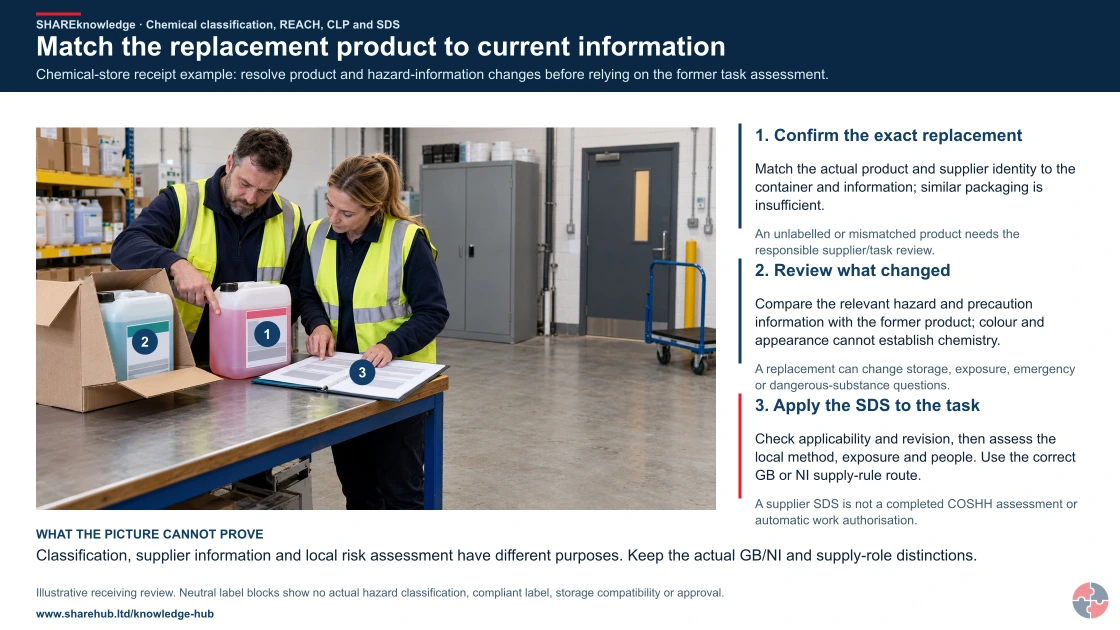
Full written explanation
Chemical-store receipt example: resolve product and hazard-information changes before relying on the former task assessment.
- Confirm the exact replacement. Match the actual product and supplier identity to the container and information; similar packaging is insufficient.
- Review what changed. Compare the relevant hazard and precaution information with the former product; colour and appearance cannot establish chemistry.
- Apply the SDS to the task. Check applicability and revision, then assess the local method, exposure and people. Use the correct GB or NI supply-rule route.
Change the pathway
- Resolve a mismatch before use. An unlabelled or mismatched product needs the responsible supplier/task review.
- Do not copy the former controls. A replacement can change storage, exposure, emergency or dangerous-substance questions.
- Information is an input. A supplier SDS is not a completed COSHH assessment or automatic work authorisation.
Evidence check: Classification, supplier information and local risk assessment have different purposes. Keep the actual GB/NI and supply-role distinctions.
Full product/SDS/local-assessment and GB/NI distinctions
Primary references: HSE: safety data sheets as assessment inputs (GB) · HSE: chemical classification in GB and NI
Open the complete HD image (new tab)Download image
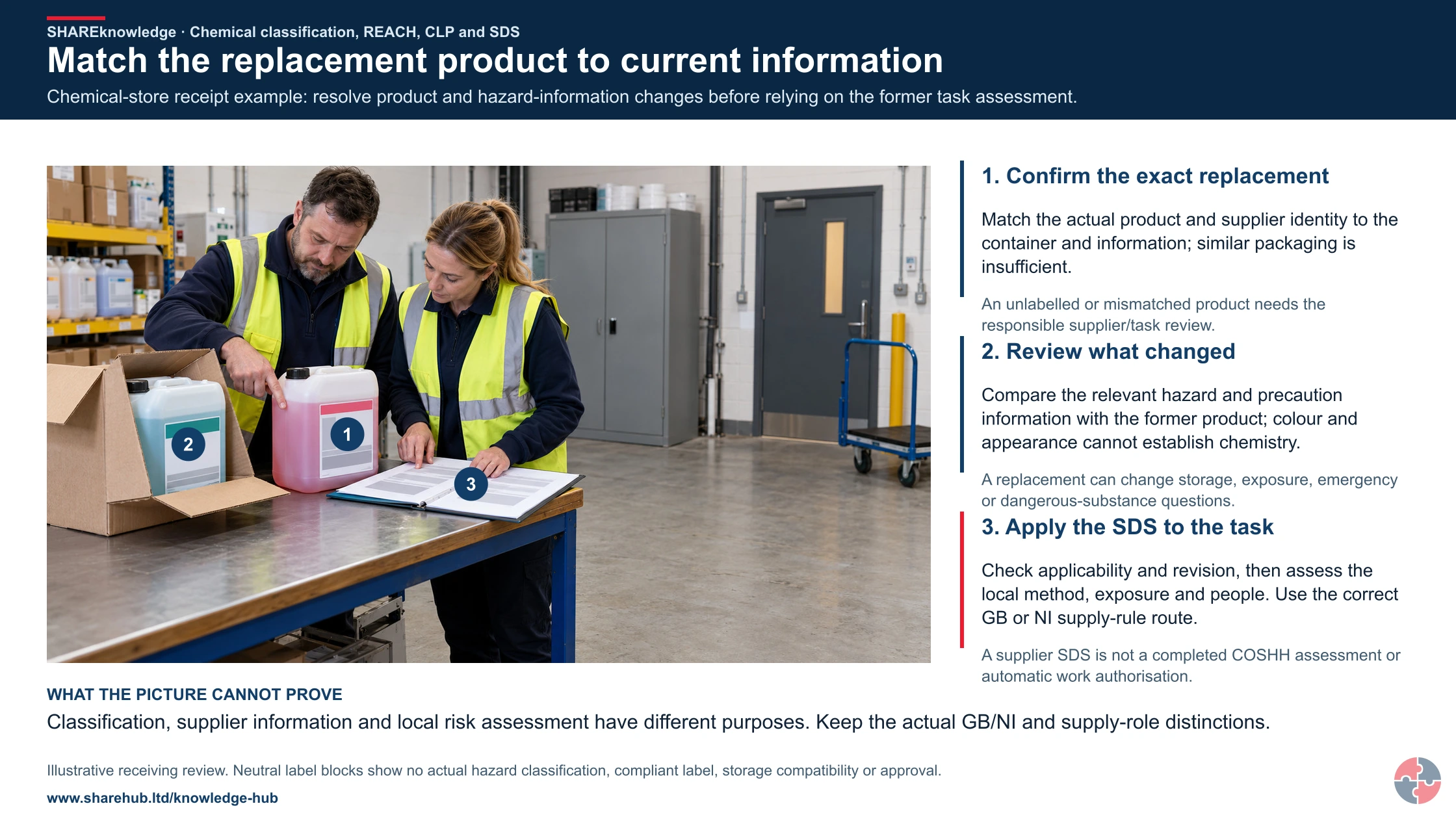
Full product/SDS/local-assessment and GB/NI distinctions
Primary references: HSE: safety data sheets as assessment inputs (GB) · HSE: chemical classification in GB and NI

Identity and hazard
Check product, supplier and hazard information on the actual container; resolve an unlabelled or mismatched product before use.
Current information
Obtain the relevant safety data sheet and check the revision and applicability. Select the correct GB or NI supply-rule route.
Local assessment
Match concentration, method, duration, release and people affected to suitable controls and emergency arrangements.
A safety data sheet is an input to the assessment, not a completed COSHH assessment or automatic work authorisation.
What are the key facts about chemical classification, REACH, CLP and safety data sheets?
The key facts are that classification identifies hazards, CLP communicates them, REACH manages chemical supply-chain information and SDSs support workplace risk assessment.
Classification comes before control
You cannot choose reliable controls until the hazards are understood.
CLP labels warn at point of use
Pictograms, signal words and hazard statements help users recognise the type of danger.
SDSs are not risk assessments
They describe the product, but do not know your task, ventilation, exposure time or worker competence.
REACH affects what can be supplied or used
Authorisation and restriction can change whether and how a substance may be used.
GB and NI rules can differ
Chemical supply into Great Britain and Northern Ireland may follow different CLP/REACH routes.
Information must trigger action
Classification and SDS information should update registers, COSHH assessments, training and emergency plans.
How can I practise this topic in 3D?


Wet cement and unassessed chemicals reach the skin
All related inspection points 2 across 1 location
Construction site 2 inspection points
Practice in the SHAREhub environment. Browser practice is separate from workplace competence and formal learning records.
What are chemical classification, REACH, CLP and safety data sheets?
They are connected systems for identifying chemical hazards, communicating them and turning supply-chain information into workplace control.
Classification decides what hazards a substance or mixture has. CLP then communicates those hazards through labels, pictograms, signal words, hazard statements, precautionary statements and packaging requirements.
REACH sits across the chemical supply chain. It is concerned with registration, evaluation, authorisation and restriction, which means it can affect the information available, the uses allowed and whether safer alternatives should be considered.
Safety data sheets join supply information to workplace management. A good business does not simply file SDSs. It uses them to approve chemicals, update COSHH assessments, set storage rules, select controls, plan spills, train people and review whether the chemical is still the right choice.
| System | Main purpose | Workplace use |
|---|---|---|
| Classification | Identifies hazard classes and categories. | Tells the assessor what kinds of harm to consider. |
| CLP | Communicates hazards through labels and packaging. | Helps users identify hazards quickly. |
| REACH | Manages registration, evaluation, authorisation and restriction. | Supports supply-chain control, substitution and legal use checks. |
| SDS | Provides structured hazard and safe-use information. | Feeds COSHH, storage, emergency and training decisions. |
| COSHH | Controls exposure at work. | Translates information into task-specific controls. |
How does chemical classification work?
Chemical classification compares evidence about a substance or mixture against defined hazard criteria for health, physical and environmental hazards.
Classification is not a label design exercise. It is a technical judgement about hazard. It considers evidence such as toxicology, corrosivity, flammability, explosivity, oxidising properties, aspiration hazard, sensitisation, carcinogenicity, reproductive toxicity and environmental effects.
In Great Britain, some substances have mandatory classification and labelling. Where mandatory classification does not cover all relevant hazards, suppliers may still need to self-classify using available information.
For workplace users, the practical value is that classification tells you what to look for in the COSHH or DSEAR assessment: inhalation, skin, eyes, fire, explosion, reactivity, environmental release, health surveillance, emergency response and substitution.
| Hazard family | Examples | Workplace meaning |
|---|---|---|
| Health hazards | Acute toxicity, corrosion, irritation, sensitisation, cancer and reproductive effects. | COSHH assessment, exposure control and health surveillance. |
| Physical hazards | Flammable, explosive, oxidising, self-reactive or gas under pressure. | DSEAR, storage, ignition control and emergency planning. |
| Environmental hazards | Aquatic toxicity and persistence. | Spill prevention, drainage protection and disposal controls. |
| Mandatory classification | Legally binding GB classification for certain substances. | Supplier must apply it where relevant. |
| Self-classification | Supplier evaluates information against criteria. | Important for mixtures and non-mandatory hazard classes. |
What does CLP require chemical labels and packaging to do?
CLP requires hazardous chemicals placed on the market to be classified, labelled and packaged so hazards are communicated and the package remains suitable for normal handling.
A CLP label is intended to tell users what the chemical is, what hazards it presents and what precautions are needed. The label normally includes product identifiers, supplier details, hazard pictograms, signal words, hazard statements and precautionary statements.
Packaging is part of risk control. It should prevent escape, resist damage from the chemical and withstand normal handling. Some products may need child-resistant closures or tactile warnings depending on classification and supply route.
Workplace users should check labels at receipt, storage and point of use. Damaged labels, old symbols, missing supplier information and decanted unlabelled bottles are control failures.
| Element | What it tells you | Workplace action |
|---|---|---|
| Product identifier | What the substance or mixture is. | Match to SDS and COSHH assessment. |
| Supplier details | Who supplied the chemical. | Contact supplier if information is missing. |
| Pictogram | Visual warning of hazard type. | Brief users on the meaning. |
| Signal word | Relative severity such as Danger or Warning. | Use to prioritise control attention. |
| Hazard statement | Nature and severity of hazard. | Translate into exposure controls. |
| Precautionary statement | Recommended prevention, response, storage and disposal action. | Build into local instructions. |
| Packaging | Container integrity and special features. | Check suitability, closures and storage. |
What do common CLP pictograms mean?
CLP pictograms use red-diamond symbols to alert users to major chemical hazard types.
Pictograms are useful, but they are not the whole label. Workers should read the signal word, hazard statements and precautionary statements as well as the symbol. The same pictogram can cover several different hazard statements.
Training should avoid treating pictograms as decoration. A flame symbol should prompt questions about ignition sources, storage and DSEAR. A corrosion symbol should prompt questions about gloves, goggles, emergency washing and compatible containers. The health-hazard symbol should prompt questions about chronic effects, respiratory sensitisation, cancer or reproductive harm.
A product may carry more than one pictogram, so control decisions should consider the combined hazard profile rather than one symbol in isolation.
| Pictogram meaning | Typical hazard | Workplace question |
|---|---|---|
| Flame | Flammable gases, liquids, solids or aerosols. | Are ignition sources, storage and ventilation controlled? |
| Corrosion | Skin corrosion, serious eye damage or corrosive to metals. | Are splash controls, PPE and washing arrangements suitable? |
| Skull and crossbones | Acute toxicity. | Is exposure prevented and emergency response understood? |
| Exclamation mark | Irritation, harmful toxicity or respiratory irritation. | Are skin, eye and inhalation routes controlled? |
| Health hazard | Cancer, respiratory sensitisation, reproductive harm or organ toxicity. | Are exposures reduced as far as needed and surveillance considered? |
| Gas cylinder | Gas under pressure. | Are cylinders secured, protected and stored correctly? |
| Flame over circle | Oxidising substances. | Are incompatibles and combustibles segregated? |
| Environment | Environmental hazard. | Are spills, drains and disposal controlled? |
What is a safety data sheet and what is it not?
An SDS is supplier hazard and handling information; it is not a COSHH assessment of a particular workplace task.
Check the product identity and revision, hazard classification, exposure controls, first aid, fire response, stability/compatibility and disposal information. Then observe the task: concentration, temperature, quantity, transfer, nearby people and by-products can change risk. The SDS may not cover fume or dust generated by cutting, heating or mixing. If the sheet is missing, outdated or for another formulation, the buyer and supervisor should hold use until the information is corrected and the assessment reviewed.
Which safety data sheet sections matter most for workplace risk control?
Several SDS sections are especially useful for COSHH, storage, emergency planning, PPE selection and control design.
All SDS sections have a purpose, but some sections are used repeatedly by safety practitioners. Section 2 tells you the classification and label elements. Section 4 supports first-aid planning. Sections 5 and 6 inform fire and spill response. Section 7 informs handling and storage. Section 8 informs exposure controls and PPE. Section 10 warns about reactivity and incompatibilities. Section 11 explains toxicology. Section 13 informs disposal.
SDS review should be recorded. The reviewer should note what controls were changed or confirmed, whether the COSHH assessment remains valid and whether workers need re-briefing.
If information is missing, contradictory or unclear, the supplier should be asked to clarify. Guesswork is a weak control.
| SDS section | What it covers | How to use it |
|---|---|---|
| 1 Identification | Product and supplier details. | Confirm correct product and supplier contact. |
| 2 Hazards identification | Classification and label elements. | Set assessment priorities. |
| 4 First-aid measures | Immediate response guidance. | Build first-aid and exposure procedures. |
| 5 Firefighting measures | Extinguishing media and fire hazards. | Inform fire plan and DSEAR review. |
| 6 Accidental release measures | Spill and release precautions. | Build spill response and PPE. |
| 7 Handling and storage | Safe use and storage conditions. | Design stores and work methods. |
| 8 Exposure controls/PPE | WELs, controls and PPE. | Select LEV, RPE, gloves and monitoring. |
| 10 Stability and reactivity | Incompatibles and hazardous reactions. | Prevent mixing and poor storage. |
| 11 Toxicological information | Health effects and routes. | Inform health surveillance and training. |
| 13 Disposal considerations | Waste handling advice. | Plan disposal and contaminated packaging. |
How does REACH influence workplace chemical decisions?
REACH influences workplace decisions by improving substance information and controlling substances through registration, evaluation, authorisation and restriction.
For most workplace users, REACH becomes visible through SDS information, exposure scenarios, restrictions, authorisation conditions and supplier communication. It can affect whether a substance is available, whether it can be used for a particular purpose and whether safer alternatives should be considered.
Authorisation is particularly important for substances of very high concern. Restriction may limit specific uses or conditions of use. These mechanisms should trigger procurement review and substitution thinking, not just a technical note in the chemical register.
Businesses that import, manufacture or place chemicals on the market have more complex duties than ordinary end users. They should verify their role in the supply chain and use official guidance.
| Mechanism | What it means | Workplace implication |
|---|---|---|
| Registration | Information is submitted about substances manufactured or imported above relevant thresholds. | Improves supply-chain knowledge. |
| Evaluation | Authorities assess information and concerns. | May lead to further controls or decisions. |
| Authorisation | Certain high-concern substances need permission for specific uses. | Check whether use is covered and substitution is feasible. |
| Restriction | Certain substances or uses are banned or limited. | Procurement and use must comply with restrictions. |
| Exposure scenarios | Describe conditions for safe use where provided. | Check whether workplace use matches supplier assumptions. |
How can the hierarchy of controls turn chemical hazard information into effective exposure controls?
SDS, REACH and CLP information should be used to identify hazards, exposure routes, storage requirements, emergency arrangements and controls for the actual task.
A strong COSHH assessment uses supplier information but does not stop there. It looks at the real work: how the chemical is handled, whether it is sprayed or heated, whether it is used in a confined space, whether it contacts skin, whether it is mixed, whether workers understand controls and whether nearby people can be exposed.
The assessment should be reviewed when classification changes, a new SDS is received, the task changes, workers report symptoms, monitoring suggests exposure, a spill occurs or a safer alternative becomes available.
This is also where procurement, stores and operations need to communicate. A new chemical should not reach a work area before assessment, storage and training are ready.
| Information found | Workplace question | Likely action |
|---|---|---|
| Corrosive classification | Could skin or eye contact occur? | Splash controls, gloves, goggles and eyewash. |
| Flammable classification | Could vapour ignite? | DSEAR review, storage and ignition control. |
| Respiratory sensitiser | Could workers inhale it? | Substitution, enclosure, LEV, RPE and health surveillance. |
| WEL in SDS section 8 | Could airborne exposure approach the limit? | Exposure monitoring and control review. |
| Incompatibility in section 10 | Could it be stored or mixed wrongly? | Segregation and decanting controls. |
| Restriction or authorisation note | Is use permitted and proportionate? | Procurement review and substitution. |
Worked control choice: a corrosive cleaner at a workshop
Use HSE’s five-level hierarchy to choose stronger measures before PPE. ERICPD is a useful six-part teaching mnemonic; it is not a separate legal test. The example maps both approaches to the real task. Apply HSENI COSHH guidance for a Northern Ireland workplace. Emergency washing and evacuation limit consequences; they do not prevent the original contact or mixing.
How can the ERICPD hierarchy of controls turn chemical hazard information into effective exposure controls?

| Hierarchy / ERICPD | Task change and harm pathway | Owner, check, failure and restart evidence |
|---|---|---|
| Elimination / Eliminate HSE hierarchy | Avoid an unnecessary corrosive cleaner or open-decanting task at a workshop wash station. | Buyer and task owner record why cleaning is needed and inspect whether the old task/product has actually been removed. Reappearance of an unapproved container stops use. |
| Substitution / Reduce HSE hierarchy | Trial a less hazardous, ready-to-use formulation; compare the whole hazard profile and cleaning performance before approval. | COSHH assessor matches label and SDS to the actual formulation and observes the trial. A new sensitiser, flammability or ineffective cleaning requires reassessment; "dilute" is not proof of safety. |
| Engineering / Isolate and Control HSE hierarchy | Use a chemically compatible closed dispensing connection and splash containment instead of pouring concentrate near the face. | Engineer commissions the connection, leak control and safe shutoff; operator checks before use and facilities maintain it. Leak, loose fitting or blocked containment stops dispensing until repaired. |
| Administrative / Control and Discipline HSE hierarchy | Keep product identity, approved use, SDS revision and task instruction together at the wash station; brief a replacement or contractor worker. | Supervisor observes one use and tests the missing-label response. Mismatched bottle or superseded instruction means quarantine, assessment review and a recorded restart decision. |
| PPE / PPE HSE hierarchy | Select chemical splash eye/face protection and compatible gloves for remaining contact risk; include fit, other PPE and cleaning/replacement limits. | Assessor records selection for the actual product; wearer and supervisor inspect condition. Damaged, unsuitable or unavailable PPE stops exposed work; PPE does not repair a failed dispensing system. |
How can the ISO 45001 hierarchy of controls turn chemical hazard information into effective exposure controls?

| Hierarchy / ERICPD | Task change and harm pathway | Owner, check, failure and restart evidence |
|---|---|---|
| Elimination / Eliminate HSE hierarchy | Avoid an unnecessary corrosive cleaner or open-decanting task at a workshop wash station. | Buyer and task owner record why cleaning is needed and inspect whether the old task/product has actually been removed. Reappearance of an unapproved container stops use. |
| Substitution / Reduce HSE hierarchy | Trial a less hazardous, ready-to-use formulation; compare the whole hazard profile and cleaning performance before approval. | COSHH assessor matches label and SDS to the actual formulation and observes the trial. A new sensitiser, flammability or ineffective cleaning requires reassessment; "dilute" is not proof of safety. |
| Engineering / Isolate and Control HSE hierarchy | Use a chemically compatible closed dispensing connection and splash containment instead of pouring concentrate near the face. | Engineer commissions the connection, leak control and safe shutoff; operator checks before use and facilities maintain it. Leak, loose fitting or blocked containment stops dispensing until repaired. |
| Administrative / Control and Discipline HSE hierarchy | Keep product identity, approved use, SDS revision and task instruction together at the wash station; brief a replacement or contractor worker. | Supervisor observes one use and tests the missing-label response. Mismatched bottle or superseded instruction means quarantine, assessment review and a recorded restart decision. |
| PPE / PPE HSE hierarchy | Select chemical splash eye/face protection and compatible gloves for remaining contact risk; include fit, other PPE and cleaning/replacement limits. | Assessor records selection for the actual product; wearer and supervisor inspect condition. Damaged, unsuitable or unavailable PPE stops exposed work; PPE does not repair a failed dispensing system. |
What should suppliers, purchasers and workplace users each do?
Chemical information management works best when suppliers provide accurate information, purchasers screen chemicals before buying and users apply task-specific controls.
Suppliers have duties around classification, labelling, packaging and safety information. Purchasers should not treat procurement as a purely commercial decision. A cheap product can create expensive controls, health surveillance, disposal problems or fire risk.
Stores teams should check labels, packaging condition, SDS access, expiry or shelf-life concerns, segregation and stock levels. Workplace users should check that the product, container and assessment match before use.
A good organisation creates a gate: no SDS review, no COSHH assessment, no storage approval, no worker briefing, no use.
| Role | What good looks like | Evidence |
|---|---|---|
| Supplier | Provides correct label, packaging and SDS where required. | Current SDS and compliant label. |
| Procurement | Screens chemicals before purchase. | Approval workflow and substitution review. |
| Stores | Checks receipt, label, compatibility and location. | Goods-in and storage inspection. |
| COSHH assessor | Uses SDS and task observation to set controls. | Assessment record and briefing. |
| Supervisor | Checks controls are used. | Inspection and observation record. |
| Worker | Uses the product as briefed and reports issues. | Training and reporting records. |
How do GB and Northern Ireland chemical supply rules differ?
Identify the market first: GB CLP and UK REACH govern the Great Britain supply route; EU CLP and EU REACH continue for the Northern Ireland market.
HSE describes GB CLP as the assimilated CLP regulation as amended for Great Britain. Northern Ireland supply follows EU CLP under the Windsor Framework; HSE also states EU REACH continues there. A GB buyer importing from NI may face a qualifying-goods notification or other UK REACH decision, but not every worker using a product is a registrant. Ask the competent supply-chain lead to verify the legal role, product, quantity and route before placing a product on either market. Workplace COSHH assessment remains a separate duty in GB or NI.
On a small screen, scroll this table sideways to read all columns.
| Decision | Great Britain | Northern Ireland |
|---|---|---|
| Classification and label | GB CLP for GB market. | EU CLP for NI market. |
| REACH supply system | UK REACH in GB. | EU REACH continues in NI; GB import may need a separate route. |
| SDS and workplace use | Current supplier SDS informs GB COSHH assessment. | Current supplier SDS informs NI COSHH assessment. |
| Owner/check | Supply-chain lead checks market and product change; site assessor checks the real task. | NI supply lead checks EU CLP/REACH route; site assessor checks the real task. |
Which legal duties apply to chemical information?
Keep supply classification and registration separate from workplace exposure control, and apply the GB or NI route for the market and site.
GB CLP and UK REACH concern supply roles, hazard classification, labelling, SDS and applicable registration, authorisation or restriction decisions. EU CLP and EU REACH continue in Northern Ireland. COSHH 2002 in GB and COSHH (NI) 2003 in NI require assessment and control of actual workplace exposure; the SDS is evidence, not the assessment. Fire and explosion hazards may require DSEAR or its NI counterpart and competent fire/process review. Check current substance-specific restrictions and supply obligations before asserting them.
On a small screen, scroll this table sideways to read all columns.
| Question | Supply-chain decision | Workplace decision |
|---|---|---|
| Which market? | GB/NI classification, label and REACH role checked by supplier or importer. | Site location determines COSHH instrument. |
| Is the SDS current? | Supplier provides appropriate current information for product and market. | Assessor tests concentration, quantity, method, by-products and exposed people. |
| What if information changes? | Procurement holds use or recontacts supplier for correction. | Supervisor updates assessment, controls and briefing before restart. |
How could Crownway Fuels Ltd manage REACH, CLP and SDS information?

Crownway Fuels Ltd would connect purchasing, current chemical information and task review so a replacement product does not bypass the site's controls.
Crownway Fuels Ltd · practical example
Check a replacement cleaner before it reaches the shift
The key lesson Classification, labelling and a safety data sheet communicate hazards; they do not prove that a particular workplace use is controlled.
The situation: A supplier offers a cheaper forecourt-cleaning product. Its packaging looks similar to the current product, but the formulation and precautions differ. A delivery should not silently become permission to use it.
Why this matters: An unnoticed substitution can invalidate glove selection, storage separation, spill arrangements and the method staff have learned.
How Crownway Fuels Ltd would manage it
- Identify the exact product — Maintenance Coordinator. Obtain the current supplier information for the actual product and formulation. Resolve mismatched names, damaged labels or unclear instructions before it enters the normal supply route.
- Check the relevant supply regime — Health and Safety Lead. Review the applicable GB chemical-supply requirements for Crownway's English sites. Keep any Northern Ireland supply or use decision on its separate verified route rather than assuming identical rules.
- Review the planned use — Site Manager. Compare the new information with the cleaning assessment and existing controls. Ask what changes for exposure, storage, incompatible materials, emergencies and waste; obtain competent advice where uncertain.
- Control the changeover — Shift Supervisor. Make the approved product and instructions identifiable, brief affected staff and prevent informal decanting into unlabelled containers. Remove superseded instructions from use without losing the change history.
- Check what arrived — Maintenance Coordinator. Verify the delivered product against the reviewed choice. Follow up staff feedback and update the chemical register and control arrangements when the change is accepted.
When the conditions change
- Recognise the trigger
- A formulation, supplier, product label or safety data sheet changes.
- Make the immediate decision
- Quarantine the unreviewed product from normal use while identity or precautions are uncertain.
- Verify the next step
- The Site Manager checks the delivered formulation against the approved-use review and confirms revised instructions, storage and user briefing are in place.
What good looks like
Purchasing can identify the reviewed product, staff understand its precautions, and the assessment refers to the same formulation being used on site.
Evidence to look for: Product identity, current safety data sheet, change review, approved-use record, register update and shift briefing.
Common mistake to avoid: Assuming similar branding or a familiar pictogram means the previous assessment still applies.
Apply this to your work: How would your team detect a supplier substitution before someone uses it?
Guidance behind the management approach: HSE: safety data sheets. Use the topic's legal and technical guidance for the applicable work and location.
An old data sheet cannot describe a changed maintenance task
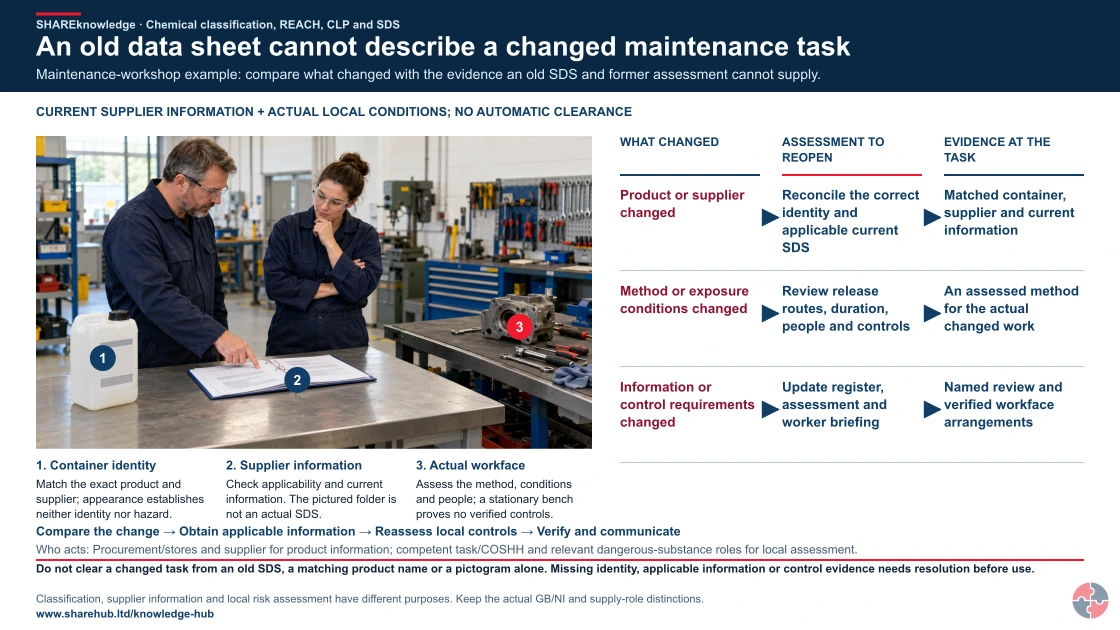
Full written explanation
A maintenance-workshop review links a closed neutral-label container, inert information folder and stationary workface. Two colleagues examine generic non-legible pages while a detached metal service component and unused tools remain on a separate dry bench. Picture key: 1 identifies the container; 2 identifies the supplier-information folder; 3 identifies the actual workface. The image provides no chemical identity, classification, compliant label or real SDS content. The comparison keeps three different changes distinct: product or supplier changes require identity and applicable information to be reconciled; method or exposure changes reopen the actual task assessment; information or control changes require register, assessment and briefing review. All three rows lead to the relevant workface evidence rather than a clearance inferred from paperwork. The separate four-stage process uses unnumbered headings in order. Classification communicates hazard; supplier information supports, but does not complete, the assessment of actual local work. The pictured closed cap, folder, service component and idle equipment establish no compatibility, verified control or permission to use a product. Apply the current product, market and supply-role distinctions in the complete GB/NI source; no new classification, registration, legal, emergency, PPE-selection or operating detail is supplied.
Maintenance-workshop example: compare what changed with the evidence an old SDS and former assessment cannot supply.
- Compare the change. Identify the actual product, method, conditions and affected people against the former task.
- Obtain applicable information. Resolve identity, current supplier/SDS information and the relevant GB/NI route.
- Reassess local controls. Use the changed exposure, storage, emergency and relevant DSEAR information in the actual task assessment.
- Verify and communicate. Update the register, assessment and briefing; resolve missing controls/evidence before the responsible work decision.
When the evidence does not fit: Do not clear a changed task from an old SDS, a matching product name or a pictogram alone. Missing identity, applicable information or control evidence needs resolution before use.
Who acts: Procurement/stores and supplier for product information; competent task/COSHH and relevant dangerous-substance roles for local assessment.
Changed workplace
Chemical store: A replacement product needs exact identity and relevant current information, not recognition of a familiar can.
Maintenance workshop: Changed work conditions reopen the task assessment even when a former SDS is still on file.
| WHAT CHANGED | ASSESSMENT TO REOPEN | EVIDENCE AT THE TASK |
|---|---|---|
| Product or supplier changed | Reconcile the correct identity and applicable current SDS | Matched container, supplier and current information |
| Method or exposure conditions changed | Review release routes, duration, people and controls | An assessed method for the actual changed work |
| Information or control requirements changed | Update register, assessment and worker briefing | Named review and verified workface arrangements |
Evidence check: Classification, supplier information and local risk assessment have different purposes. Keep the actual GB/NI and supply-role distinctions.
Full product/SDS/local-assessment and GB/NI distinctions
Primary references: HSE: safety data sheets as assessment inputs (GB) · HSE: chemical classification in GB and NI
Open the complete HD image (new tab)Download image
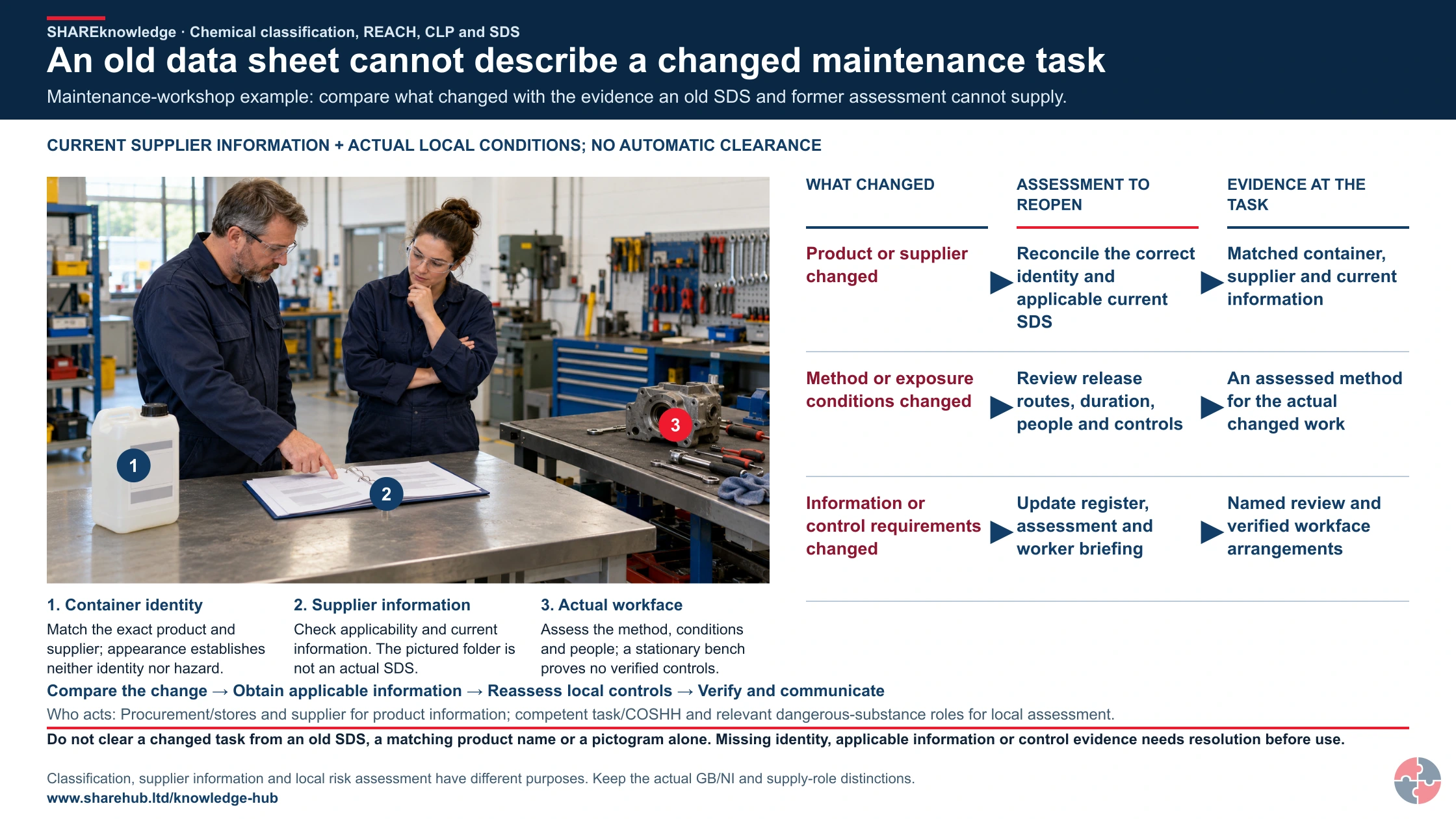
Full product/SDS/local-assessment and GB/NI distinctions
Primary references: HSE: safety data sheets as assessment inputs (GB) · HSE: chemical classification in GB and NI
Crownway Fuels Ltd
For this example, Crownway Fuels Ltd uses fuels, additives, cleaning chemicals, oils, laboratory reagents, tank-cleaning products and contractor chemicals across a bulk fuel operation.
Crownway requires an SDS and label review before a chemical is purchased or brought to site. Procurement cannot add a new product unless the HSSE adviser and operational owner confirm classification, storage compatibility, DSEAR relevance, COSHH controls, PPE/RPE, emergency arrangements and waste route.
The chemical register records product name, supplier, SDS date, classification, pictograms, WELs, storage location, approved uses, incompatible materials, assessment owner and review date. If an SDS changes, the system flags the relevant COSHH assessments and training material for review.
Stores check container labels, packaging condition, segregated storage and whether decanted containers are approved and labelled. Supervisors brief workers using plain-language task cards, not full SDS printouts. Incident learning is linked back to the register: spills, odours, wrong product use or missing labels trigger procurement and training review.
| System element | Example control | Assurance method |
|---|---|---|
| Procurement gate | No SDS and classification review, no purchase. | Approval workflow. |
| Chemical register | Classification, pictograms, SDS date, location and owner. | Monthly register review. |
| COSHH link | SDS changes trigger assessment review. | Change log and re-briefing record. |
| DSEAR link | Flammable classifications trigger dangerous-substance review. | DSEAR risk assessment. |
| Stores checks | Labels, packaging, segregation and decanting. | Inspection checklist. |
| Training | Task cards explain key SDS and label information. | Observed competence and refresher records. |
| Learning | Spills and label failures update controls. | Incident-action close-out. |
Which fuel data should a safety-data-sheet review establish?
Link the fuel explanation to the selected product, temperature and release mechanism. A generic petrol or diesel label does not replace the current product safety data.
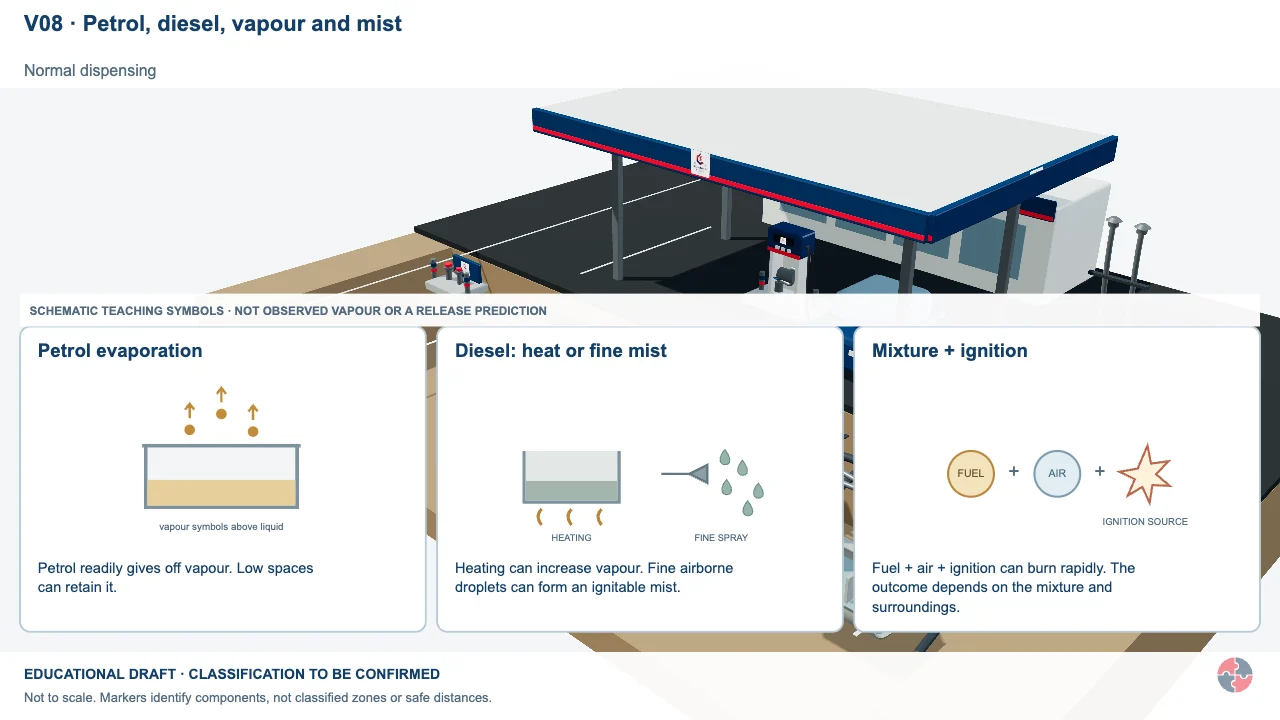
Petrol, diesel, vapour and mist
Compare petrol evaporation, diesel conditions and fine droplets. Petrol carried into a separator can remain a vapour source after the visible forecourt spill has passed.
Activity focus: Identify the actual product and release mechanism. For drainage, ask whether petrol could reach or remain in the separator; for refuelling, confirm the stated Stage II recovery arrangement.
Contextual workplace scene. Use the task, control and evidence checks in this section; appearance alone does not establish safe conditions, individual health or approval.
Educational illustration, not to scale. Coloured zones are teaching examples, not a site-specific hazardous-area classification.
What should each role learn and demonstrate?
Learning must match the decisions people make, from recognising danger to checking that controls work.
Briefings should tell people how to act, but attendance alone does not show competence. Assess the real decision or task, record who assessed it and revisit after a material change, failed control or incident. A local authorisation is task-specific; no universal external certificate is implied.
On a small screen, scroll this table sideways to read all columns.
| Role and learning | Demonstration and assessor | Record and reassessment trigger |
|---|---|---|
| Buyer/supplier liaison: market and product identity. | Competent supply lead checks a GB and NI purchase scenario, label and SDS revision. | Approval record; reassess after market, supplier or formula change. |
| COSHH assessor: task exposure. | Safety adviser compares SDS with observed use and process-generated hazards. | Signed task assessment; revisit after method or quantity change. |
| Stores/worker: label and stop response. | Supervisor observes container identification, transfer label and what to do when data conflict. | Observation and briefing; repeat after a mismatch or near miss. |
| Manager: information change control. | Manager traces one SDS update into purchasing, assessment and worker briefing. | Change log and spot check; repeat after revision. |
What does this topic require for NEBOSH Diploma study?
For NEBOSH Diploma study, this topic requires understanding how REACH, CLP and SDS information supports workplace health-risk advice and control decisions.
Diploma answers should do more than define acronyms. They should explain how classification leads to hazard communication, how CLP labels inform users, how SDS sections support COSHH assessment and how REACH authorisation or restriction can drive substitution.
Scenario questions may involve an employer relying only on SDSs, a supplier changing classification, unlabelled decanted chemicals, missing exposure scenarios, use of a restricted substance, poor flammable storage or workers not understanding pictograms.
A strong answer links law, technical understanding and evidence: register, SDS review, COSHH assessment, procurement gate, DSEAR review, worker briefing, exposure monitoring, health surveillance and management review.
| Study area | What to know | Scenario application |
|---|---|---|
| REACH aims | Registration, evaluation, authorisation and restriction. | Explain how supply-chain duties affect workplace use. |
| GB CLP | Classification, labelling and packaging for GB market. | Identify label and classification failures. |
| SDS structure | 16 sections and their practical use. | Use sections to build a COSHH assessment. |
| Exposure scenarios | Conditions of safe use where supplied. | Check workplace use matches assumptions. |
| Authorisation/restriction | Controls for high-concern or restricted substances. | Recommend substitution and procurement review. |
| COSHH translation | Task-specific exposure and control decisions. | Explain why SDS filing is not enough. |
How can a management system sustain effective decisions?
Give each hazard or support route an owner, a control, a check and a response to failure.
Use a product identity, destination market, SDS version and task assessment as one controlled change trail. Sample the real container and work method; stop use when the hazard information is missing or inconsistent. An owner should sample actual work and corrective actions, not accept a policy or certificate as evidence that the controls work.
The free GB regulator guide HSE Managing for health and safety (HSG65) explains a plan–do–check–act approach: assign controls and owners, involve workers, check work as done, and correct failures. For Northern Ireland, use HSENI risk assessment guidance for the local duty. A certificate alone does not demonstrate that a control works.
What are the warning signs that chemical information is not being managed well?
Warning signs include outdated SDSs, unlabelled containers, old symbols, missing COSHH links, procurement bypasses, poor worker understanding and no process for classification changes.
Weak SDS and classification management usually shows up before harm occurs. Workers cannot explain pictograms. Stores have unlabelled containers. Procurement buys a substitute without assessment. SDSs are out of date. COSHH assessments refer to a previous formulation. Flammable or corrosive classifications are not reflected in storage or emergency arrangements.
Each sign can lead to harm: wrong product use, incompatible storage, fire, chemical burn, uncontrolled inhalation exposure, ineffective PPE or delayed emergency response.
The corrective action should fix the system. Update the register, review approvals, re-brief workers, relabel containers, change storage and assign owners for SDS updates.
| Warning sign | How harm can develop | Action |
|---|---|---|
| Outdated SDS | Controls may no longer match classification or formulation. | Request current SDS and review COSHH. |
| Unlabelled decanted container | Wrong use, ingestion or emergency confusion. | Remove from use and improve decanting controls. |
| Product substituted by purchasing | New hazards bypass assessment. | Reinstate approval gate. |
| Workers do not understand pictograms | Hazards are ignored at point of use. | Refresh label and task training. |
| SDS filed but no COSHH update | Supplier information is not translated into controls. | Update assessment and brief users. |
| No restriction or authorisation check | Substance may be used unlawfully or without conditions. | Review REACH status and substitution. |
| Damaged packaging | Leaks, contamination or wrong storage may occur. | Quarantine and inspect stock. |
Chemical classification, REACH, CLP and safety data sheet FAQs - what do people ask?
Common questions focus on what the acronyms mean, what an SDS can and cannot do, and how chemical information becomes workplace control.
What is chemical classification?
Chemical classification is the process of identifying the health, physical and environmental hazards of a substance or mixture.
What does CLP mean?
CLP means Classification, Labelling and Packaging, the system used to communicate chemical hazards through labels, pictograms and packaging rules.
What does REACH mean?
REACH means Registration, Evaluation, Authorisation and Restriction of Chemicals.
What is a safety data sheet?
A safety data sheet is supplier information describing hazards, handling, storage, exposure controls, first aid, firefighting, stability, toxicology and disposal.
Is an SDS a COSHH assessment?
No. The SDS informs a COSHH assessment, but the assessment must consider the actual workplace task, exposure and controls.
What are hazard pictograms?
Hazard pictograms are red-diamond symbols that warn about hazards such as flammability, corrosion, toxicity, oxidising properties, gas pressure and health effects.
What is the difference between GB CLP and EU CLP?
GB CLP applies to chemicals placed on the Great Britain market, while chemicals placed on the Northern Ireland market are subject to EU CLP arrangements.
When should an SDS be reviewed?
Review an SDS when a product is introduced, formulation changes, classification changes, the supplier updates it, the task changes or an incident occurs.
Which SDS sections are most useful for COSHH?
Sections 2, 4, 5, 6, 7, 8, 10, 11 and 13 are often especially useful for workplace control decisions.
What is authorisation under REACH?
Authorisation controls certain substances of very high concern and may only allow use under specified conditions.
What is restriction under REACH?
Restriction bans or limits certain substances, uses or conditions of use.
Who needs training on SDS and labels?
Chemical users, supervisors, stores, procurement, maintenance, H&S advisers and emergency responders need role-specific training.
Chemical hazard symbols: what do they mean?
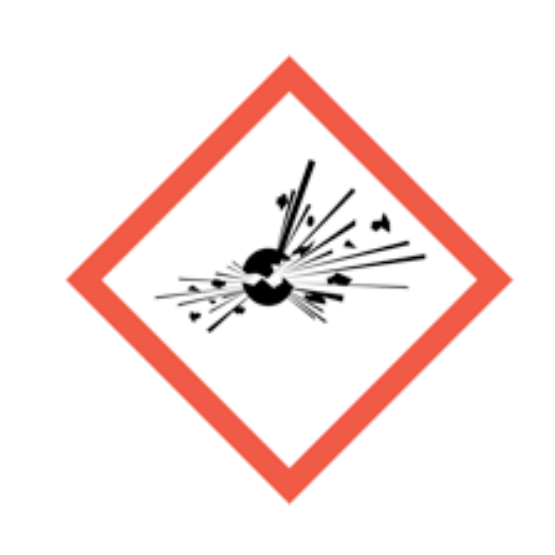
Exploding bomb
Explosive, self-reactive or organic peroxide hazards.
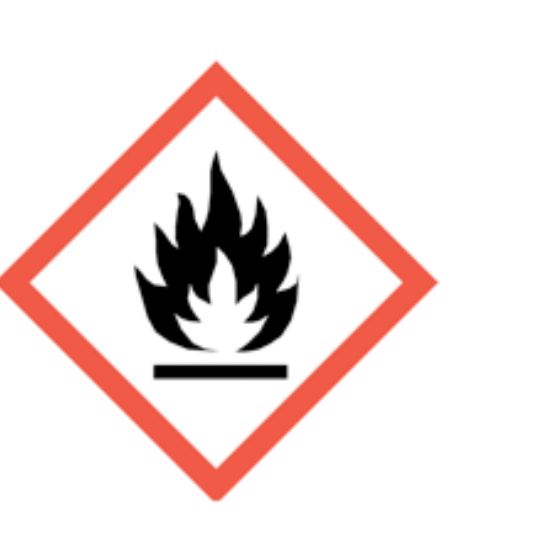
Flame
Flammable, self-heating or pyrophoric substances.

Flame over circle
Oxidising substances that can intensify fire.

Gas cylinder
Gas under pressure.
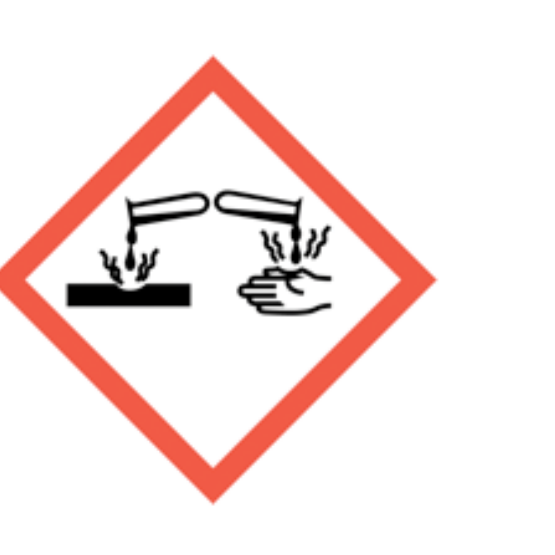
Corrosion
Skin burns, eye damage or corrosive to metals.
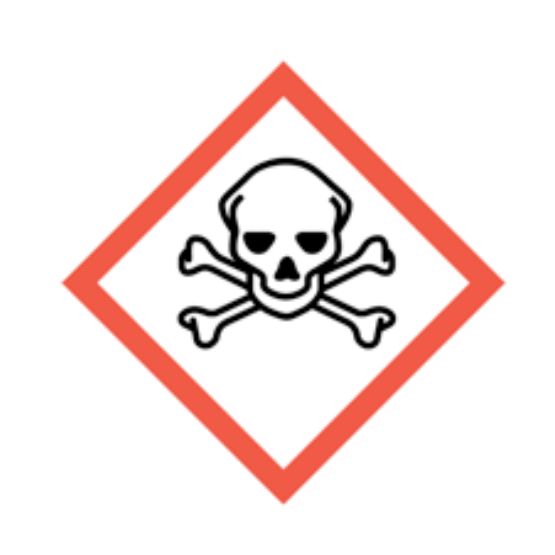
Skull and crossbones
Acute toxicity.

Exclamation mark
Irritation, harmful effects or skin sensitisation; some classifications cover drowsiness, dizziness or ozone-layer hazard. Read the actual hazard statements. Skin sensitisation differs from respiratory sensitisation.

Health hazard
Serious health hazards, including organ damage, aspiration hazard, respiratory sensitisation, cancer and reproductive effects; some can follow a single exposure.
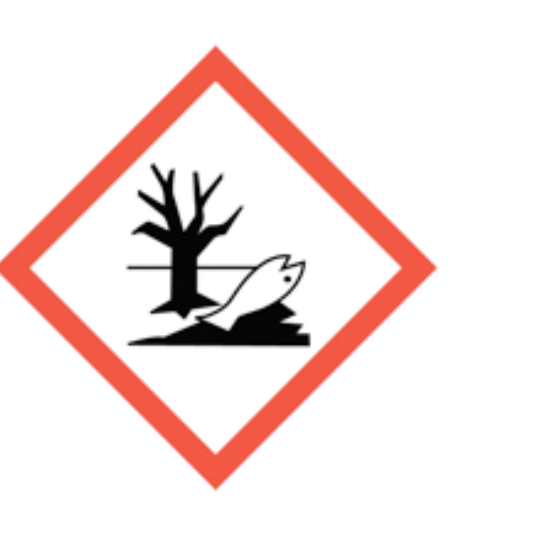
Environment
Hazardous to the aquatic environment.
What acronyms and terms should readers understand for REACH, CLP and safety data sheets?
The topic is acronym-heavy, so terms should be explained clearly for workers, managers and learners.
| Term | Meaning | Plain-English use |
|---|---|---|
| REACH | Registration, Evaluation, Authorisation and Restriction of Chemicals | Chemical supply-chain regulation. |
| CLP | Classification, Labelling and Packaging | Hazard classification and label communication system. |
| GB CLP | Great Britain CLP regime | Applies to chemicals placed on the Great Britain market. |
| SDS | Safety Data Sheet | Supplier document used to inform workplace assessment. |
| COSHH | Control of Substances Hazardous to Health | Workplace exposure-control regulations. |
| WEL | Workplace Exposure Limit | Airborne exposure limit listed in EH40. |
| MCL | Mandatory Classification and Labelling | Legally binding GB classification where applicable. |
| SVHC | Substance of Very High Concern | High-concern REACH substance category. |
| PPE | Personal Protective Equipment | Worn protection selected using SDS and task risk. |
| DSEAR | Dangerous Substances and Explosive Atmospheres Regulations | Fire and explosion regime for dangerous substances. |