SHARE Knowledge Hub
Burnout and work-related stress
This page uses burnout as a workplace discussion term for sustained exhaustion, withdrawal or difficulties coping with work. These signs do not establish a clinical diagnosis or a classification; HSE guidance supports examining harmful work pressures, recognising changes in behaviour and providing appropriate support. A strong workplace response does not treat burnout as a personal weakness or solve it with resilience training alone; it examines work design, workload, control, support, role clarity, relationships, fairness, emotional demand, recovery time, change management, management behaviour and confidential individual support. Good practice is to prevent harmful work stressors first, support the person second, and use individual coping tools only as part of a wider system of risk assessment, consultation, adjustment, review and learning.
Understanding Burnout and work-related stress
This page uses burnout as a workplace discussion term for sustained exhaustion, withdrawal or difficulties coping with work. These signs do not establish a clinical diagnosis or a classification; HSE guidance supports examining harmful work pressures, recognising changes in behaviour and providing appropriate support. A strong workplace response does not treat burnout as a personal weakness or solve it with resilience training alone; it examines work design, workload, control, support, role clarity, relationships, fairness, emotional demand, recovery time, change management, management behaviour and confidential individual support. Good practice is to prevent harmful work stressors first, support the person second, and use individual coping tools only as part of a wider system of risk assessment, consultation, adjustment, review and learning.
Why this matters at work
Examine demands, control, support, relationships, role and change using actual work evidence and worker discussion. Identify duration, predictability, conflicting priorities, staffing, competence and the chance to recover rather than treating all pressure as equivalent. HSE's approach supports assessment and prevention of underlying work causes; the duty is to assess and act, not simply to run a survey or wellbeing campaign.
Review work causes during the absence rather than preserving the same overload for return. Identify essential and deferrable tasks, real available hours, competence mix and the time needed to supervise new starters. Vacancies, leave, training and turnover can make nominal staffing misleading. Repeated overtime should prompt a capacity decision rather than being treated as proof that the gap is solved.
How organisations manage this in practice
Select specific changes that the responsible manager can implement: revise commitments, provide cover, clarify escalation, resolve role conflict or make a break genuinely available. Test whether nominal choice is real when a continuous duty has no relief or every request is urgent. Name owners, resources, dates, interim arrangements and verification. Review the change under representative conditions and adapt it if it fails. GB and NI have separate legal instruments even where the work-design reasoning is similar. Do not present a framework score as a diagnosis or a validated percentage reduction in burnout, and keep private support cases open where needs remain despite team improvement.
Use worker discussion and relevant records to select changes in staffing, commitments, priorities or sequencing. Training may support skills but cannot create missing hours or make an unavailable break real. Name an accountable owner and resources, record interim protection and verify the revised work during representative peaks. Protect individual health information and provide private support alongside the group assessment. Review whether pressure has moved to another shift or manager and adapt the plan if it fails. The outcome should be evidence about work conditions and implementation, not a claimed reduction in burnout based solely on attendance at a resilience session or a small survey.
Listen privately, clarify what the person is experiencing and decide whether the present task is safe and urgent health support is needed. A driver struggling to stay alert or a lifeguard losing vigilance needs prompt cover without a manager first diagnosing burnout. Do not leave the distressed worker to find their own replacement. Where there is immediate danger or serious health concern, use the appropriate urgent or emergency arrangements. Then examine the work system: demand, vacancies, priorities, support, conflict and recovery opportunities may affect others too. Individual support and a team assessment can both be necessary, with different records and access. WHO describes burnout as an occupational phenomenon, not a managerial diagnosis or universal explanation for fatigue. Keep clinical assessment with healthcare professionals and name the person able to change capacity or commitments. Record practical actions and review whether they occurred. A referral or supportive conversation alone does not demonstrate that excessive workload has reduced or that the person is ready for every duty.
Burnout concerns should be handled through respectful conversation, work-related stress risk assessment, appropriate support, confidentiality and competent advice where needed. Managers should not diagnose workers. If someone may be at immediate risk of harm, is unable to work safely, or describes severe deterioration, follow the organisation's emergency, safeguarding, occupational health or medical escalation arrangements.
Change demands and verify recovery in real work
Persistent overload is a work-design question as well as a private support concern. Make an unsafe task safe immediately, then compare demand, staffing, actual hours, breaks and recovery. A wellbeing event does not close a recurring capacity shortfall.
Best-practice guide: Burnout and work-related stress

Change demands and verify recovery in real work
Persistent overload is a work-design question as well as a private support concern. Make an unsafe task safe immediately, then compare demand, staffing, actual hours, breaks and recovery. This page uses burnout as a workplace discussion term for sustained exhaustion, withdrawal or difficulties coping with work.
Turn burnout and work-related stress knowledge into a decision
This page uses burnout as a workplace discussion term for sustained exhaustion, withdrawal or difficulties coping with work. These signs do not establish a clinical diagnosis or a classification; HSE guidance supports examining harmful work pressures, recognising changes in behaviour and providing appropriate support. Keep work-demand and hours evidence, action owners and the review outcome.
Logistics team with persistent overtime
Map actual demand, staffing, overtime, shift swaps and breaks with workers. Leadership changes capacity or service commitments and trials the revised roster under named ownership. Review actual hours, usable breaks, safe journey decisions, error/near-miss signals and worker feedback after the roster trial.
How chronic overload removes recovery
Preventive action changes the work as well as offering support. Verify actual demands, usable breaks, overtime and transferred work with workers after the agreed changes; a conversation alone does not show that exposure has changed.
Choose controls for burnout and work-related stress
Elimination: Remove avoidable chronic overload: cancel low-value reporting, pause non-essential dispatches and fund vacancy cover rather than asking the exhausted team to absorb more. Substitution: Replace a rota of repeated late shifts with a designed schedule that shares peaks and provides recovery; test that work is not simply moved to another team. Engineering: A physical engineering control has no direct analogue for every psychosocial stressor. Administrative: Set clear priorities, decision rights, break cover and a confidential reporting/review route; keep worker consultation and incident learning active. PPE: There is no PPE that prevents burnout. Read the full control table for qualifications, ownership and verification. Use the actual task and applicable jurisdiction; existing technical approval remains unchanged.
Use the full burnout and work-related stress lesson
Use the full topic for the decision points, practical examples, detailed control tables and source scope. HSE guidance applies to Great Britain; use HSENI for the Northern Ireland route and the source’s stated jurisdiction. A simplified guide does not change the page’s technical-review or approval status.

Read all six steps as text
1. Change demands and verify recovery in real work
Persistent overload is a work-design question as well as a private support concern.
- Avoid / redesign: Remove avoidable chronic overload: cancel low-value reporting, pause non-essential dispatches and fund vacancy cover rather than asking the exhausted team to absorb more.
- Control the task: A physical engineering control has no direct analogue for every psychosocial stressor.
- Verify before release: Operations director checks hours, errors and worker feedback weekly; stop a safety-critical assignment when fatigue may impair safe performance.
Persistent overload is a work-design question as well as a private support concern. Make an unsafe task safe immediately, then compare demand, staffing, actual hours, breaks and recovery. This page uses burnout as a workplace discussion term for sustained exhaustion, withdrawal or difficulties coping with work.
Apply it: Which part of this plan would you check at the workface before authorising the task?
2. Turn burnout and work-related stress knowledge into a decision
Use the evidence to improve the actual work arrangement.
- Change at source: Remove avoidable chronic overload: cancel low-value reporting, pause non-essential dispatches and fund vacancy cover rather than asking the exhausted team to absorb more.
- Make it observable: Operations director checks hours, errors and worker feedback weekly; stop a safety-critical assignment when fatigue may impair safe performance.
- Keep useful evidence: Keep work-demand and hours evidence, action owners and the review outcome.
This page uses burnout as a workplace discussion term for sustained exhaustion, withdrawal or difficulties coping with work. These signs do not establish a clinical diagnosis or a classification; HSE guidance supports examining harmful work pressures, recognising changes in behaviour and providing appropriate support. Keep work-demand and hours evidence, action owners and the review outcome.
Apply it: What evidence would show that the change improves this task, rather than only completing a record?
3. Logistics team with persistent overtime
Example: a practical application of the existing topic lesson.
- Setting: A dispatch team works repeated late shifts after vacancies.
- Act: Remove the driver from a safety-critical journey if alertness is doubtful, arrange safe cover, ask privately about support and assess the team workload rather than label the person.
- Hold / review: Do not assign the fatigued driver to a hazardous journey or call the issue closed with resilience training while excessive hours remain.
Map actual demand, staffing, overtime, shift swaps and breaks with workers. Leadership changes capacity or service commitments and trials the revised roster under named ownership. Review actual hours, usable breaks, safe journey decisions, error/near-miss signals and worker feedback after the roster trial.
Apply it: At which point would you hold this example, and what evidence would allow it to proceed?
4. How chronic overload removes recovery
Illustrative work-design mechanism, not a diagnosis or measured workload score.
- Demand and capacity: Competing work, staffing gaps and unclear priorities can exceed the capacity actually available.
- Lost recovery: Missed breaks and hidden overtime can sustain the exposure while the rota still appears compliant.
- Change and verify: Remove or defer work and arrange competent cover; check recovery and whether pressure moved to another team. Hold a doubtful safety-critical task under the current procedure.
Preventive action changes the work as well as offering support. Verify actual demands, usable breaks, overtime and transferred work with workers after the agreed changes; a conversation alone does not show that exposure has changed.
Apply it: What changed in the real working week, and which evidence could show the pressure was merely transferred?
5. Choose controls for burnout and work-related stress
Start with the stronger practicable options and verify their effect.
- Elimination: Remove avoidable chronic overload: cancel low-value reporting, pause non-essential dispatches and fund vacancy cover rather than asking the exhausted team to absorb more.
- Substitution: Replace a rota of repeated late shifts with a designed schedule that shares peaks and provides recovery; test that work is not simply moved to another team.
- Engineering: A physical engineering control has no direct analogue for every psychosocial stressor.
- Administrative: Set clear priorities, decision rights, break cover and a confidential reporting/review route; keep worker consultation and incident learning active.
- PPE: There is no PPE that prevents burnout.
Elimination: Remove avoidable chronic overload: cancel low-value reporting, pause non-essential dispatches and fund vacancy cover rather than asking the exhausted team to absorb more. Substitution: Replace a rota of repeated late shifts with a designed schedule that shares peaks and provides recovery; test that work is not simply moved to another team. Engineering: A physical engineering control has no direct analogue for every psychosocial stressor. Administrative: Set clear priorities, decision rights, break cover and a confidential reporting/review route; keep worker consultation and incident learning active. PPE: There is no PPE that prevents burnout. Read the full control table for qualifications, ownership and verification. Use the actual task and applicable jurisdiction; existing technical approval remains unchanged.
Apply it: Which stronger option can be used here, and who will verify it before accepting the remaining risk?
6. Use the full burnout and work-related stress lesson
Follow the official sources below and retain the task-specific evidence.
- Official guidance: HSE Management Standards overview
- Official guidance: HSE fatigue and shift design
- Task decision: Keep work-demand and hours evidence, action owners and the review outcome.
Use the full topic for the decision points, practical examples, detailed control tables and source scope. HSE guidance applies to Great Britain; use HSENI for the Northern Ireland route and the source’s stated jurisdiction. A simplified guide does not change the page’s technical-review or approval status.
Apply it: Which official source and full-topic section will you use to resolve the next decision?
Agree a change that reduces the excessive demand and verify it across representative shifts. Check whether pressure has moved to unpaid hours, contractors or another team. Personal health details remain private while the shared action plan records capacity, commitments and evidence of effectiveness.
An apparent roster fix creates hidden overtime
Illustrative example. A logistics team shortens scheduled shifts but staff still finish the same commitments in unrecorded extra time.
Decision. Reopen the action and change staffing, workload or service commitments so actual demand fits safe capacity.
Evidence to check. Compare scheduled and actual hours, missed breaks, vacancies, output commitments and worker feedback.
Hold or escalation point. Do not declare success from the published rota while real hours and unsafe fatigue remain.
Follow-up. Review representative shifts and check the improvement does not transfer overload to another group.
Reduce demand, then check the real week
A supportive discussion is a beginning. The practical question is whether the demands, staffed capacity and usable recovery opportunities have changed in the week people actually work.
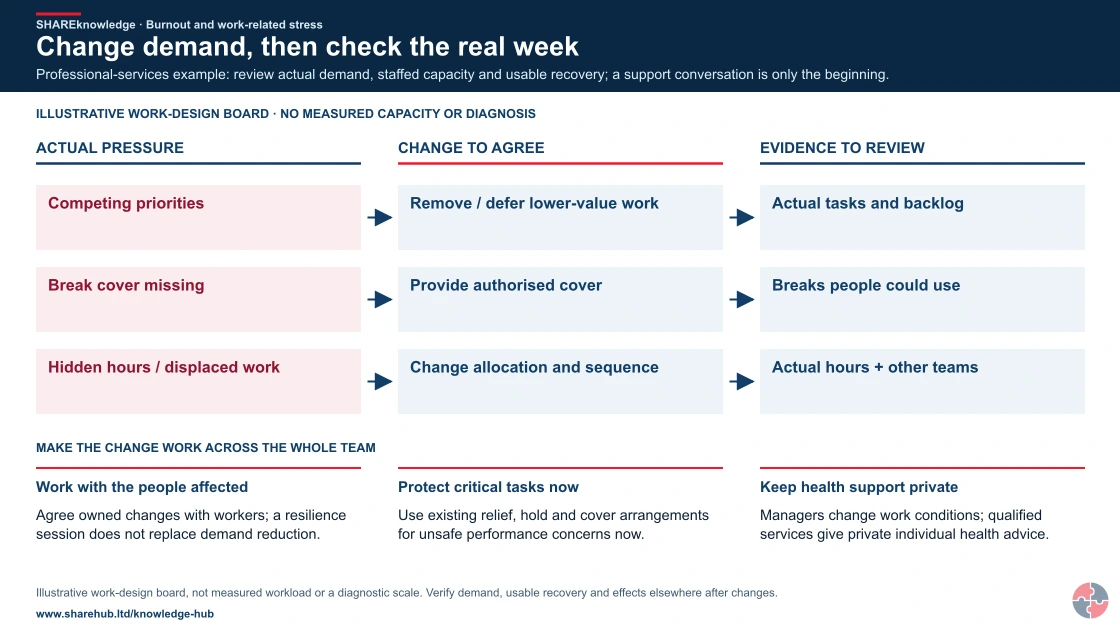
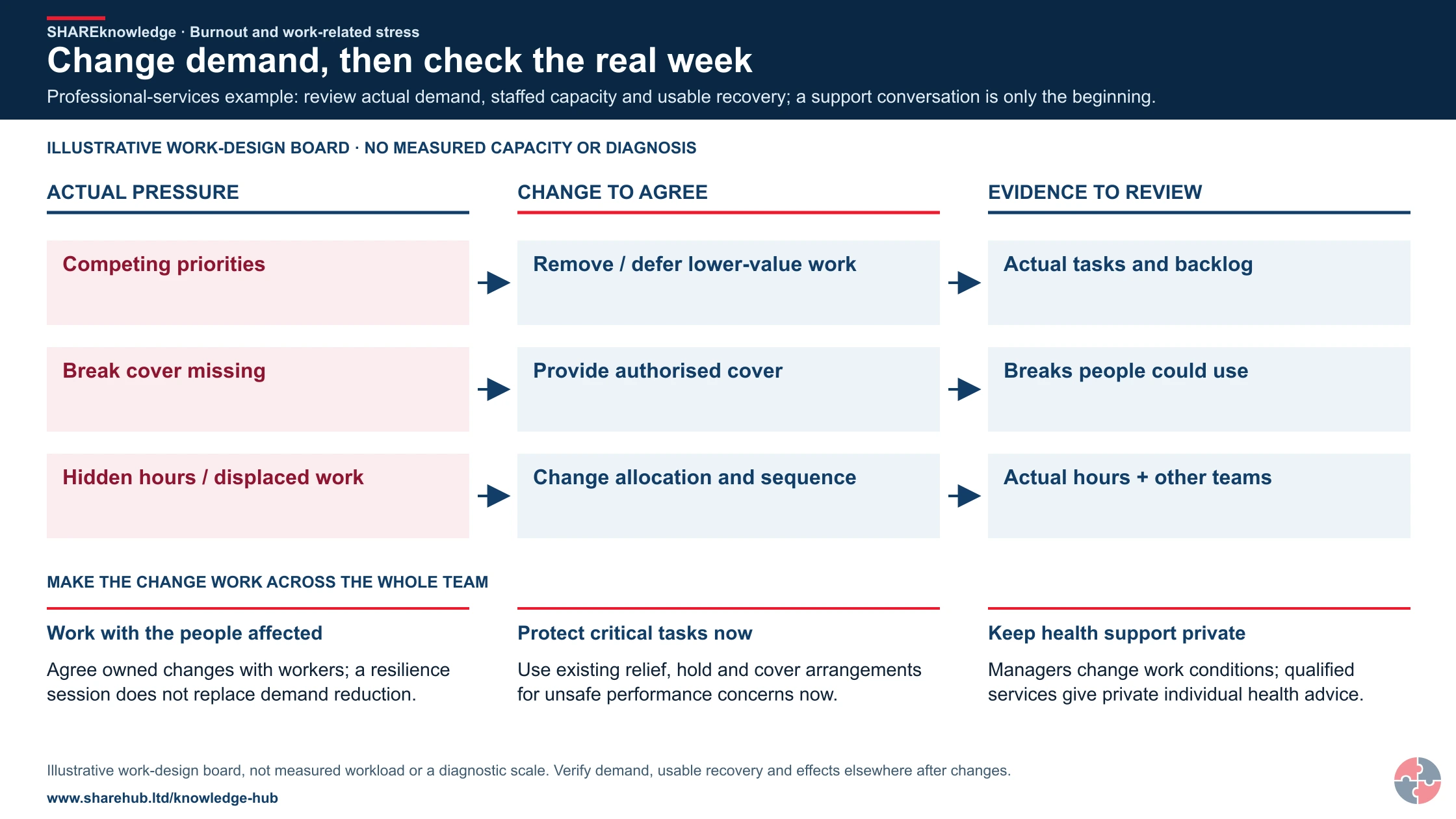
Change demand, then check the real week
Full written explanation
Professional-services example: review actual demand, staffed capacity and usable recovery; a support conversation is only the beginning.
- Identify the real pressure. Compare priorities, actual hours, cover and worker feedback rather than relying on a target-only dashboard.
- Change the work. Remove or defer work, resolve priorities and provide authorised cover so breaks and recovery are usable.
- Verify the real week. Check backlog, actual breaks, hidden overtime and effects on other teams; do not transfer the pressure elsewhere.
Change the pathway
- Work with the people affected. Agree owned changes with workers; a resilience session does not replace demand reduction.
- Protect critical tasks now. Use existing relief, hold and cover arrangements for unsafe performance concerns now.
- Keep health support private. Managers change work conditions; qualified services give private individual health advice.
| Actual pressure | Change to agree | Evidence to review |
|---|---|---|
| Competing priorities | Remove / defer lower-value work | Actual tasks and backlog |
| Break cover missing | Provide authorised cover | Breaks people could use |
| Hidden hours / displaced work | Change allocation and sequence | Actual hours + other teams |
Evidence check: Illustrative work-design board, not measured workload or a diagnostic scale. Verify demand, usable recovery and effects elsewhere after changes.
Primary references: HSE: Management Standards for work-related stress · HSE: fatigue
Open the complete HD image (new tab)Download image
Primary references: HSE: Management Standards for work-related stress · HSE: fatigue

- Demand and staffed capacity
- Remove / defer + authorised cover
- Review breaks, overtime and transfer
Read the labels in the full-size drawing
- BEFORE: demand exceeds staffed capacity
- AFTER: remove / defer tasks and add cover
- Check actual breaks, hidden hours and effects on other teams
| Work factor | Change to agree | Evidence after implementation |
|---|---|---|
| Demand exceeds staffed capacity | Cancel or defer low-value work, resolve priorities and provide authorised cover. | Actual tasks completed/deferred, backlog and worker feedback, rather than a target-only dashboard. |
| Recovery exists only on paper | Make break cover and the work sequence workable. | Missed breaks, hidden overtime and whether recovery opportunities were actually usable. |
| Pressure moves elsewhere | Check the effect of changed dispatches, rotas or allocation on colleagues and other teams. | Receiving-team capacity, errors, near misses and unresolved competing priorities. |
| Immediate critical task | If alertness or safe performance is doubtful, follow the current hold/cover arrangement. | Named competent cover and a recorded task decision; do not wait for a burnout label. |
This is a planning board, not measured workload data or a diagnostic scale. Keep organisational responsibility, private support and qualified health advice distinct; PPE or a resilience course cannot resolve chronic excessive demand.
What are the key facts about burnout?
The key facts are that burnout is work-related, preventable, system-sensitive and should be managed through work design as well as individual support.
Burnout is not laziness
It is commonly linked to chronic work stressors and reduced recovery, not poor attitude.
Work design matters
Workload, control, support, relationships, role clarity and change management are central prevention factors.
Managers should not diagnose
They should ask what is happening, what work factors are contributing and what support is needed.
Confidentiality matters
Health and wellbeing information can be sensitive personal data and should be handled carefully.
Individual tools are not enough
Mindfulness, resilience or time-management advice cannot compensate for unsafe workload or poor management.
Safety can be affected
Exhaustion and reduced concentration can increase errors, conflict, poor judgement and incident risk.
What is burnout?
Burnout is a commonly used term for sustained exhaustion and detachment associated with work pressure. It is a prompt to examine work-related stress risks, support the person and avoid diagnosis. See HSE Management Standards
Use reported exhaustion, detachment or difficulty concentrating as information for a respectful conversation about demands, control, support, relationships, role and change. The discussion examples below are not three diagnostic dimensions or a validated burnout score. Managers should assess work pressures and immediate task safety while qualified clinicians consider health causes and individual advice.
Burnout can overlap with stress, fatigue, anxiety, depression, grief, physical illness, caring responsibilities, neurodivergent burnout, trauma exposure or long-term health conditions. That is why managers should avoid labels and instead focus on respectful enquiry, work impact, safety, support and competent signposting.
For workplace management, the useful question is not 'Is this person burnt out?' The better questions are: what work factors are creating sustained pressure, what impact is the person experiencing, what safety or wellbeing risks exist, what support is needed, what work controls can change, and how will the organisation review whether those changes worked?
Exhaustion. Persistent physical, emotional or mental depletion. Review workload, hours, breaks, recovery and safety-critical duties.
Mental distance. Feeling detached, cynical, numb or disconnected from work. Explore demands, values conflict, recognition, relationships and support.
Reduced effectiveness. Feeling less capable, making more errors or struggling to concentrate. Review priorities, staffing, supervision, task complexity and support.
Chronic stressor. A pressure that continues without adequate control or recovery. Assess root work factors instead of relying on individual coping.
Occupational context. The issue is connected to work conditions and work organisation. Use HSE stress risk assessment and consultation.
How can burnout show up in people and teams?
Sustained work stress can affect concentration, mood, sleep, behaviour and the quality of safety-critical decisions. Patterns vary by person, so use them to start a respectful conversation and assess the work, not to label a medical condition. See HSE Management Standards
Burnout rarely arrives as one neat symptom. A worker may feel constantly drained, dread opening emails, avoid calls, become more irritable, take longer to make decisions, stop contributing ideas, withdraw socially or feel that effort makes no difference. Others may keep performing outwardly while working longer hours, using annual leave to catch up, hiding mistakes or losing recovery time.
Physical and cognitive effects matter for safety. Poor sleep, headaches, muscle tension, stomach symptoms, low energy, slower thinking, forgetfulness and reduced concentration can affect driving, plant operation, medication accuracy, customer aggression response, lone working, manual handling, permit decisions or process control.
At team level, burnout can show up through increased absence, presenteeism, turnover, conflict, complaints, missed deadlines, overtime, quality defects, incident trends, poor morale and reduced trust in managers.
Emotional. Irritability, tearfulness, numbness, hopelessness or dread of work. Private conversation, support route and review of stressors.
Cognitive. Poor concentration, indecision, memory lapses or reduced problem-solving. Review workload, complexity, deadlines and safety-critical tasks.
Physical. Exhaustion, sleep problems, headaches, tension or stomach symptoms. Signpost to health support and review work demands/recovery.
Behavioural. Withdrawal, presenteeism, longer hours, increased errors or conflict. Check workload, support, relationships and supervision.
Team. High turnover, overtime, sickness, grievances or low engagement. Team stress risk assessment and action plan.
What work factors can contribute to burnout?
Burnout risk increases when sustained work demands exceed the worker's control, support and recovery. See HSE Management Standards overview
HSE's Management Standards give a practical way to understand work-related stressors: demands, control, support, relationships, role and change. These are not abstract headings; they describe the day-to-day conditions that decide whether people can work sustainably.
Burnout risk can rise in high workload periods, understaffed teams, emotionally demanding roles, safety-critical operations, constant change, poor management behaviour, bullying, unclear priorities, conflicting instructions, lack of recognition, values conflict, insecure employment or cultures that reward long hours.
Personal life and health factors can also affect resilience and recovery, but employers should be careful not to use personal factors to avoid controlling work risks. A fair assessment asks what the organisation can reasonably change about the work.
High demands. Too much work, intensity, emotional load or unrealistic deadlines. Workload review, prioritisation, staffing and recovery planning.
Low control. Little say over pace, method, breaks or priorities. Increase autonomy and involve workers in planning.
Poor support. Insufficient manager, peer, training or resource support. Regular check-ins, mentoring, resource review and escalation routes.
Poor relationships. Conflict, bullying, isolation or poor team climate. Behaviour standards, mediation, investigation and team repair.
Unclear role. Conflicting duties, unclear authority or shifting expectations. Role clarification, decision rights and priority setting.
Poorly managed change. Uncertainty, fear, poor consultation or repeated change fatigue. Change communication, consultation and impact assessment.
How can burnout affect work and safety?
Burnout can affect safe performance, quality, communication, absence, retention and decision-making. See HSE mental health conditions at work
Burnout is not only a wellbeing concern. It can affect how work is done. Exhausted workers may miss steps, make slower decisions, become more reactive, avoid difficult conversations, take shortcuts, work while unwell or struggle to maintain attention during routine tasks.
For safety-critical work, fatigue and reduced concentration require careful assessment. A worker who is driving, operating machinery, managing live electrical work, issuing permits, controlling a process, dispensing medication or supervising high-risk work may need temporary controls while support and workload are reviewed.
The workplace response should avoid punishment for disclosure. If people believe they will be blamed for saying they are struggling, the organisation loses early warning data and problems surface later through incidents, absence or resignation.
Errors. Missed checks, data mistakes or forgotten tasks. Reduce overload, simplify priorities and increase supervision temporarily.
Decision quality. Slower decisions, avoidance or reactive judgement. Clarify escalation, reduce complexity and provide support.
Communication. Irritability, withdrawal or conflict. Manager check-in, team norms and relationship support.
Attendance. Absence, presenteeism or late starts. Supportive absence management and return-to-work planning.
Safety-critical work. Reduced vigilance or fatigue in high-risk tasks. Fitness-for-work discussion and temporary task adjustment.
Retention. Loss of motivation, disengagement or resignation. Address root causes and career/support concerns.
How do the HSE Management Standards help prevent burnout?
The HSE Management Standards help employers assess and control the work-design factors associated with work-related stress. See HSE Management Standards overview; HSENI Management Standards for work stress
The Management Standards approach is useful because it moves burnout prevention away from slogans and towards risk assessment. It asks employers to identify stressors, gather evidence, consult workers, agree practical actions and review whether controls have worked.
The six standards can be used for individual concerns, team reviews and organisation-wide improvement. For example, a worker's burnout concern may require immediate support, but repeated concerns in one department may indicate staffing, role, workload or management problems that need a team-level action plan.
A strong approach uses multiple sources of evidence: absence, turnover, overtime, workload data, incident trends, grievances, worker surveys, focus groups, one-to-one conversations and action close-out.
Demands. Is workload, pace, emotional demand or working time sustainable? Reprioritise work, add resource or redesign rotas.
Control. Do people have enough say in how and when work is done? Allow scheduling influence, break planning or method flexibility.
Support. Do people have manager, peer, training and resource support? Regular check-ins and clearer escalation routes.
Relationships. Are conflict, bullying or isolation being managed? Behaviour standards, early intervention and mediation.
Role. Do people understand duties, priorities and boundaries? Clarify role, remove conflicting objectives and agree priorities.
Change. Is change explained, consulted on and paced realistically? Change impact assessment and communication plan.
How should managers talk about burnout concerns?
Managers should hold private, respectful conversations that explore work impact and support without diagnosing. See HSE mental health conditions at work
A good conversation starts with observable concern rather than judgement. For example: 'I have noticed you seem exhausted and you mentioned the workload is becoming difficult. I wanted to check how you are and what support might help.' The manager should listen, ask open questions, avoid promises they cannot keep and agree practical next steps.
The conversation should separate health details from work impact. The worker should not be pressured to disclose a diagnosis. It is usually enough to understand what work factors are causing difficulty, what tasks are affected, what support or adjustments may help, whether occupational health advice is needed and how confidentiality will be handled.
Managers should document agreed actions proportionately, keep information restricted to those who need it and set a review date. If safety-critical work is affected, temporary controls should be agreed sensitively and reviewed.
Prepare. Choose a private setting and review relevant work factors. Public confrontation or surprise formal process.
Open. Use observable facts and concern. Labelling the person as burnt out or weak.
Listen. Ask what is happening and what support may help. Interrupting, minimising or giving instant fixes.
Assess work factors. Discuss workload, control, support, role, relationships and change. Making it only about personal resilience.
Agree actions. Set practical controls, support routes and review dates. Leaving the worker with vague reassurance only.
Record carefully. Record actions and necessary work impact information. Recording unnecessary health detail widely.
What workplace adjustments may help with burnout or related mental health difficulties?
Adjustments should reduce disadvantage, support recovery and address the work factors making the issue worse. See HSE mental health conditions at work
Adjustments should be individual, practical and reviewed. Some people may need a temporary workload reduction, phased return, clearer priorities, fewer interruptions, protected breaks, reduced overtime, flexible working, changed communication methods or temporary removal from emotionally intense tasks.
Where a worker has a mental health problem that meets the Equality Act disability definition, the legal duty to make reasonable adjustments may apply. Even where the legal test is not met, supportive changes can still prevent deterioration and help people remain at work.
Adjustments should not become a hidden way of transferring workload harm to colleagues. If one person's workload is reduced, the team plan should explain what is stopped, postponed, redistributed or resourced.
Workload. Reduce volume, pause non-essential work or reset deadlines. Has demand become sustainable without overloading others?
Working time. Flexible hours, reduced overtime, protected breaks or phased return. Is recovery improving and are safety risks controlled?
Role clarity. Agree priorities, decision boundaries and escalation routes. Does the worker know what matters most?
Communication. Regular check-ins, preferred channel or fewer unplanned calls. Is support useful without becoming intrusive?
Environment. Quieter workspace, hybrid work or reduced distraction. Does the setting support concentration and recovery?
Support. Buddy, coaching, occupational health or employee assistance route. Is the support timely, confidential and effective?
Has the work reduced, or has it only been postponed?
When hours or duties are temporarily reduced, decide what happens to the work removed from the plan. Leaving every task in the person’s queue can turn a supportive arrangement into an accumulating deadline problem. The manager must agree what will stop, be deferred with a realistic new date, be reassigned with capacity, or remain within the person’s current role. The worker should be able to see those priorities clearly.
For an illustrative coordinator return, the manager reviews open tasks with the worker and relevant team leads before the first adjusted week. Identify essential decisions, pause lower-priority work and provide competent cover without overloading another person. Check actual requests, interruptions and work outside agreed hours after the arrangement starts. If the queue grows or urgent work repeatedly overrides the plan, change capacity, scope or priorities and review the support. A shorter rota is not evidence that workload reduced if the same expectations continue. Individual clinical and fitness advice remains separate from the manager’s responsibility to make the work plan practical.
Guidance and scope: Original SHARE workload example applying HSE GB and HSENI NI work-stress guidance. It uses demands, control, support and role clarity as assessment themes, without diagnosing burnout or prescribing recovery time. HSE Management Standards HSENI Management Standards for work stress
How should confidentiality and health data be managed?
Health and wellbeing information should be handled fairly, lawfully, securely and only shared where there is a clear need. See HSE mental health conditions at work
Burnout conversations can quickly involve sensitive health information. Employers should be clear about what information is being recorded, why it is needed, who can see it, how long it will be kept and how it will be protected. Workers should not feel that a support conversation will become workplace gossip or an uncontrolled management note.
Managers should usually record work impact and agreed actions rather than detailed medical history. Occupational health reports should be handled through appropriate HR/health channels, with consent and clear explanation of what will be shared with management.
Confidentiality has limits where there is a serious safety, safeguarding or legal concern, but those limits should be explained carefully and only necessary information should be shared.
Transparency. Tell workers what health information is collected and why. Privacy notice and conversation notes.
Data minimisation. Record only what is necessary for support, safety and management. Proportionate absence, adjustment and OH records.
Access control. Restrict sensitive information to people with a genuine need. HR system permissions and manager guidance.
Retention. Keep records only as long as necessary. Retention schedule and review process.
Occupational health. Use competent advice for functional recommendations. Referral consent and OH report handling process.
Anonymised trends. Use aggregated data for organisational learning where possible. Stress risk dashboard without identifying individuals.
How should burnout be assessed as a workplace risk?
Burnout should be assessed through work-related stress risk assessment, team data and individual support conversations. See HSE Management Standards overview
A workplace risk assessment should look for organisational causes rather than waiting for individuals to become unwell. Useful evidence includes workload, overtime, staffing gaps, absence, turnover, engagement, complaints, supervision quality, incident trends, customer aggression, change programmes and worker feedback.
Individual cases should be handled respectfully, but they should also prompt a wider question: is this an isolated situation or a signal of a team stressor? If several people in one team are exhausted, staying late, withdrawing or making errors, the control may need to be team-level redesign.
Actions should be specific and owned. 'Improve wellbeing' is not a control. 'Reduce open caseloads to agreed limits by adding temporary resource and reviewing allocation weekly' is a control.
Workload data. Excessive caseload, backlog or unrealistic demand. Prioritise, stop work, add resource or redesign process.
Working hours. Long hours, missed breaks or repeated overtime. Control overtime and build recovery time.
Absence/presenteeism. People unwell, exhausted or working while not fit. Support conversations and workload review.
Turnover. People leaving high-pressure teams. Exit analysis and management review.
Incidents/errors. Cognitive overload or fatigue affecting quality/safety. Review staffing, supervision and task design.
Worker feedback. Poor support, unclear role or change fatigue. Action plan using Management Standards.
What should leaders do to prevent burnout?
Leaders should make work sustainable, resource controls and challenge cultures that reward overwork. See HSE identifying work-related stress factors
Burnout prevention cannot be delegated entirely to wellbeing champions. Senior leaders influence workload, staffing, change pace, performance targets, management behaviour, job design, technology burden, recognition and whether workers believe it is safe to speak up.
Good leadership means treating psychosocial risk like any other business risk: define risk appetite, gather data, consult workers, fund controls, monitor performance and review outcomes. It also means not celebrating heroic overwork as the default way to deliver.
Leaders should look for mismatch between stated values and real incentives. If the organisation says recovery matters but promotes only the people who are always online, burnout risk will remain.
Set workload expectations. Prevents hidden overload and unpaid recovery loss. Resource plans, prioritisation and workload caps.
Train managers. Managers shape support, fairness and early intervention. Training records and manager capability checks.
Consult workers. Workers understand where pressure is created. Focus groups, surveys and action feedback.
Monitor indicators. Finds patterns before harm escalates. Dashboard of overtime, absence, turnover and actions.
Resource controls. Stress risks cannot be solved without time and capacity. Budget, staffing and process changes.
Review culture. Challenges overwork, stigma and silence. Leadership review and behaviour standards.
Which legal duties apply to burnout and work-related stress?
Legal duties come from health and safety law, equality law, employment practice and data protection law.
Employers have a health and safety duty to assess and manage work-related stress risks. The same Plan, Do, Check, Act discipline used for physical hazards should be applied to psychosocial risks: identify stressors, decide controls, act, consult, monitor and review.
Mental health difficulties may also engage equality duties, absence management, reasonable adjustments, employment relations and data protection. Because the facts are often sensitive, legal, HR and occupational health advice may be needed for individual cases.
| Duty or regulation | Jurisdiction | How it applies | Practical evidence |
|---|---|---|---|
| Health and Safety at Work etc. Act 1974 | Great Britain | Requires employers to protect workers and others from health and safety risks, including work-related stress risks. | Stress risk assessment, management arrangements and action tracking. |
| Management of Health and Safety at Work Regulations 1999 | Great Britain | Requires suitable risk assessment, preventive measures, competent advice and cooperation. | Management Standards assessment, consultation and review records. |
| Equality Act 2010 | Great Britain | May require reasonable adjustments where a mental health condition meets the disability definition. | Adjustment discussions, OH advice and review records. |
| UK General Data Protection Regulation | United Kingdom | Applies to processing personal data, including health data as special category data. | Privacy information, lawful basis and access controls. |
| Data Protection Act 2018 | United Kingdom | Supports UK data protection rules and conditions for processing sensitive information. | Appropriate policy document and retention controls. |
| Employment Rights Act 1996 | Great Britain | Relevant to employment rights, absence, detriment and fair management processes. | Fair process, absence records and documented decisions. |
| Health and Safety at Work (Northern Ireland) Order 1978 | Northern Ireland | Protect worker health, including work-related stress. | NI stress-risk decision. |
| Management of Health and Safety at Work Regulations (Northern Ireland) 2000 | Northern Ireland | Assess and act on work-related stress risk. | NI group risk assessment. |
| Disability Discrimination Act 1995 (NI employment route) | Northern Ireland | Consider reasonable adjustments for a qualifying disability; a burnout label alone does not decide eligibility. | Individual barrier and adjustment review. |
Equality Act 2010 workplace disability adjustments are the Great Britain route. Northern Ireland uses its separate Disability Discrimination Act 1995 framework; a burnout label alone does not establish a disability.
How could Riverside Leisure Ltd manage burnout risk?

Riverside Leisure Ltd could manage burnout through work-design controls, supportive management, confidential support and trend-based improvement.
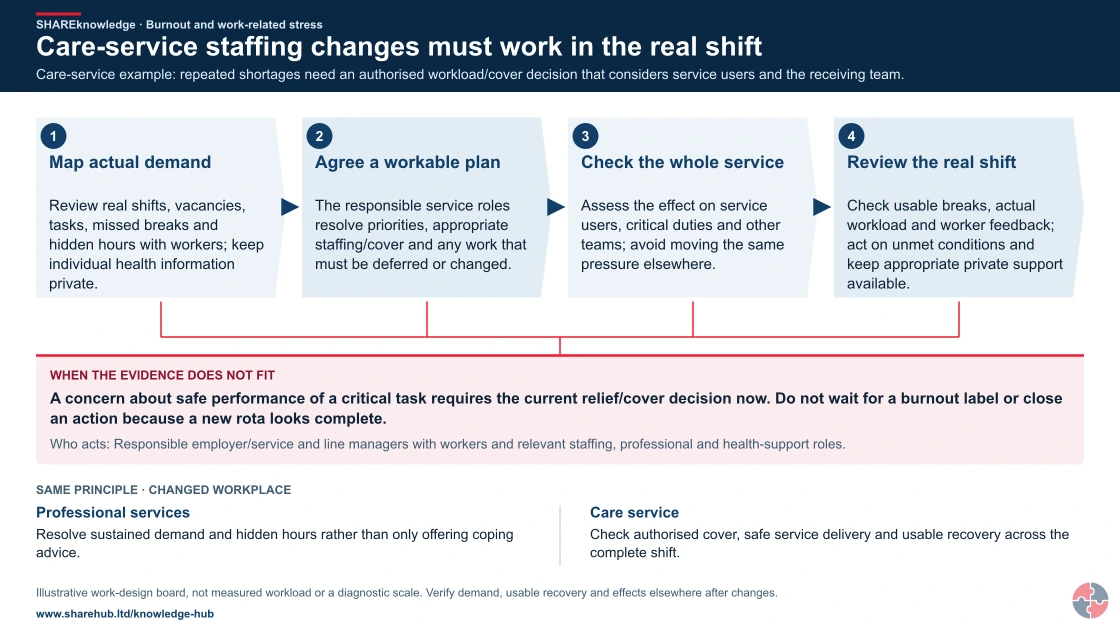
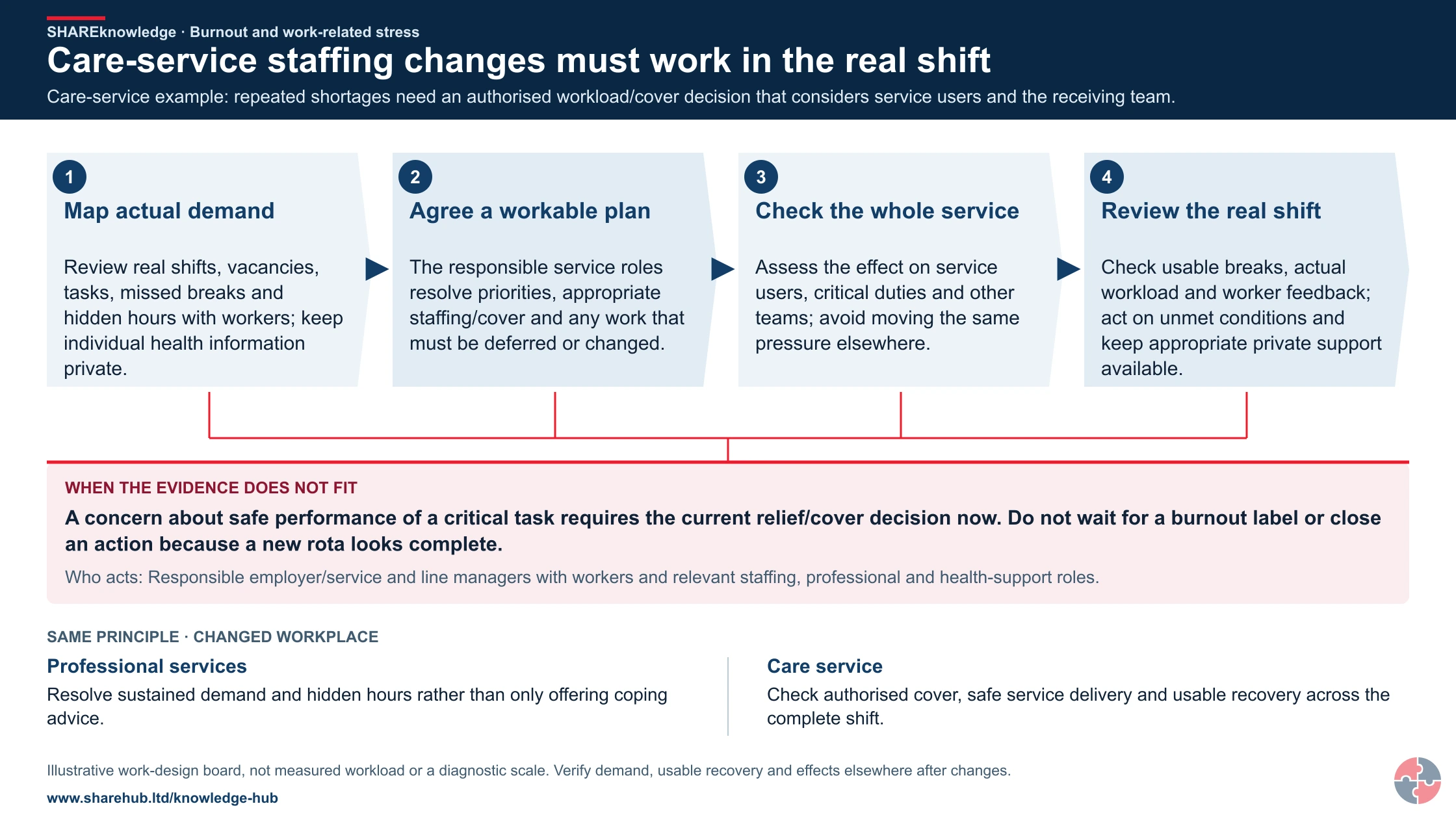
Care-service staffing changes must work in the real shift
Full written explanation
Care-service example: repeated shortages need an authorised workload/cover decision that considers service users and the receiving team.
- Map actual demand. Review real shifts, vacancies, tasks, missed breaks and hidden hours with workers; keep individual health information private.
- Agree a workable plan. The responsible service roles resolve priorities, appropriate staffing/cover and any work that must be deferred or changed.
- Check the whole service. Assess the effect on service users, critical duties and other teams; avoid moving the same pressure elsewhere.
- Review the real shift. Check usable breaks, actual workload and worker feedback; act on unmet conditions and keep appropriate private support available.
When the evidence does not fit: A concern about safe performance of a critical task requires the current relief/cover decision now. Do not wait for a burnout label or close an action because a new rota looks complete.
Who acts: Responsible employer/service and line managers with workers and relevant staffing, professional and health-support roles.
Changed workplace
Professional services: Resolve sustained demand and hidden hours rather than only offering coping advice.
Care service: Check authorised cover, safe service delivery and usable recovery across the complete shift.
Evidence check: Illustrative work-design board, not measured workload or a diagnostic scale. Verify demand, usable recovery and effects elsewhere after changes.
Primary references: HSE: Management Standards for work-related stress · HSE: fatigue
Open the complete HD image (new tab)Download image
Primary references: HSE: Management Standards for work-related stress · HSE: fatigue
Riverside Leisure Ltd
a leisure and holiday park operator with hotels, clubhouses, restaurants, events, pools, maintenance teams and seasonal peaks
Riverside has predictable burnout risk points: peak holiday periods, long shifts, customer complaints, event pressure, lifeguard vigilance, kitchen intensity, maintenance call-outs, seasonal staffing gaps and managers covering absences. The company therefore treats burnout as a work-design issue rather than a wellbeing-campaign topic.
The HR and H&S leads run a psychosocial risk review before each peak season. They examine staffing ratios, overtime, break compliance, absence, turnover, guest complaint data, incident trends, lone-working tasks, manager span of control and teams with repeated rota changes. Workers and supervisors are consulted using structured questions based on the HSE Management Standards.
Managers are trained to hold private early conversations. They ask about workload, control, support, relationships, role and change; agree practical actions such as rota changes, protected breaks, temporary task relief, clearer priorities or referral to occupational health; and record only what is necessary. Health information is kept in HR channels, while anonymised trend data is used for management review.
Riverside checks whether controls work. First-line managers review workload and break compliance weekly. Second-line HR/H&S advisers sample teams, speak with worker representatives and audit agreed actions. Third-line review looks at absence, turnover, grievances, incident trends, exit interviews and whether managers are closing actions or simply moving pressure between teams.
When burnout indicators rise, Riverside does not only offer a resilience webinar. It reviews staffing, peak-season scope, event scheduling, supervisor support, customer aggression controls, rest facilities, job rotation, communication and whether commercial decisions are creating unsustainable work.
Assess. Reviews workload, overtime, absence, turnover, complaints, incidents and seasonal demand. Psychosocial risk register and Management Standards review.
Analyse. Identifies teams where demands, support, role clarity or change are creating sustained pressure. Trend dashboard and worker consultation notes.
Train. Trains managers on supportive conversations, stress risk assessment, confidentiality and adjustments. Training matrix and manager competence checks.
Implement. Uses rota controls, protected breaks, workload prioritisation, support routes and OH referrals. Action plans, rota records and referral process.
Check. Audits break compliance, action closure, absence patterns and worker feedback. First/second/third-line assurance records.
Learn. Reviews near misses, complaints, grievances, exit interviews and absence cases for system causes. Learning review and updated controls.
Improve. Changes staffing, work design, manager training, peak planning and communication. Management review decisions and improvement tracker.
What training is useful for preventing and managing burnout?
Training should be layered from general awareness to manager capability and leadership ownership of work design.
General awareness should help workers understand burnout, stress, early signs, support routes, confidentiality and why reporting pressure early matters. It can be delivered through short online learning or toolbox-style wellbeing sessions, but should not imply that individuals alone are responsible for coping.
Managers need deeper practical training. They should be able to recognise work-related stressors, use the HSE Management Standards, hold supportive conversations, avoid diagnosis, make referrals, consider adjustments, manage absence fairly, protect confidentiality and know when to escalate safety concerns.
Senior leaders need training on psychosocial risk governance: how workload, staffing, change, targets and culture create risk; how to interpret wellbeing data; and how to fund controls.
Competence means a person can carry out the actual task safely, recognise a changed condition and respond correctly. Attendance alone is insufficient. The matrix makes assessment, ownership, records and reassessment explicit.
| Role | Required learning | How competence is assessed | Assessor or owner | Record | Reassess when |
|---|---|---|---|---|---|
| Worker | Recognise stress signs, support routes and safety stop | Explain own reporting route and a fatigue escalation scenario | Line manager or wellbeing lead | Briefing and route check | Support or role changes |
| Supervisor | Hold private, non-diagnostic conversation and alter work | Role-play workload conversation and safe-task decision | HR/OH adviser | Observed scenario and action record | Team workload or risk changes |
| Manager | Assess six work factors and resource prevention | Review overtime, errors and worker feedback into a funded action | Senior leader | Risk and resource decision | Trend worsens or roster changes |
| Adviser | Separate workplace signs from clinical diagnosis, stress duties and GB/NI law | Audit a case without diagnosis or confidential-data spill | Competent peer/HR reviewer | Case and source review | Law or guidance changes |
How does burnout support qualification study and professional development?
Burnout supports study by connecting health, work design, leadership, consultation and risk management.
For NEBOSH National General Certificate learners, burnout links to moral, legal and financial reasons for health and safety, work-related stress, consultation, health surveillance/wellbeing interfaces, management systems, leadership and worker involvement. Scenario answers should focus on identifying stressors and applying controls, not on diagnosing workers.
For diploma-level learners, burnout is a strong example of psychosocial risk. Higher-quality answers connect organisational culture, job design, leadership, human factors, worker consultation, data protection, equality duties and monitoring.
In practice, professionals should learn how to translate wellbeing concerns into risk assessment language without losing the human tone: demands, controls, evidence, owner, review date and worker voice.
NEBOSH General Certificate. Stress risk factors, consultation, management systems and worker support. Team has high overtime, absence and complaints.
NEBOSH Diploma. Psychosocial risk, leadership, culture, legal duties and assurance. Organisation has repeated burnout indicators across departments.
Manager CPD. Supportive conversations and work-factor review. Worker discloses exhaustion and reduced concentration.
HR/Wellbeing CPD. Confidentiality, adjustments, OH referral and trend data. Absence cases show common workload causes.
H&S adviser CPD. Management Standards, action tracking and audits. Audit whether stress controls are effective.
How can management systems strengthen burnout prevention?
Management systems make psychosocial risk visible, owned, monitored and improved.
A management system should define how stress risks are assessed, how workers are consulted, how managers are trained, how individual concerns are handled, how confidential records are controlled, how adjustments are reviewed and how leaders monitor trends.
A voluntary management framework can provide a management-system framework for identifying, controlling and reviewing work-related psychosocial risk. This is a standard-level application; no exact clause claim is made.
The practical management cycle is to assign owners, provide resources and competence, verify controls or workload changes, investigate failure and improve. ISO certification alone does not prove the task is safe.
What are the warning signs that burnout risk is not controlled?
Warning signs include chronic overload, silence, presenteeism, long hours, repeated absence, conflict, mistakes and managers treating resilience as the only answer. See HSE mental health conditions at work
Burnout risk often becomes visible through weak signals long before formal absence. People stop taking breaks, work through annual leave, answer messages at all hours, stop raising concerns, become cynical, make uncharacteristic errors or resign quietly. Managers may normalise this as commitment.
The harm pathway is gradual. Chronic demands without recovery can affect sleep, mood, concentration, relationships and physical health. At work, this can become poor decisions, conflict, unsafe shortcuts, customer complaints, absence, turnover and loss of trust.
Persistent overtime. Recovery is lost and fatigue increases. Review workload, staffing and deadlines.
Breaks regularly missed. Workers have no recovery during shifts. Protect breaks and monitor compliance.
High presenteeism. People work while unwell and errors increase. Supportive conversations and absence culture review.
Cynicism or withdrawal. Trust and engagement decline. Explore work factors and team climate.
Repeated errors. Cognitive overload affects quality and safety. Reduce complexity, improve support and review safety-critical tasks.
Only resilience offered. Root work stressors remain uncontrolled. Apply Management Standards and action work-design causes.
Sensitive information shared casually. Workers stop disclosing concerns and trust collapses. Reinforce confidentiality and data protection controls.
Is burnout a medical diagnosis?
A manager cannot determine a medical diagnosis from exhaustion, cynicism or reduced effectiveness. Similar signs may accompany illness or pressures outside work. Address the work-related stress risks and offer a route to qualified health advice when needed. See HSE Management Standards
The same signs can accompany depression, anxiety, sleep problems, medication effects or other illness. Managers must not diagnose or use a burnout label to rule out clinical assessment. A worker can seek GP or appropriate health advice while the employer addresses work factors.
What should change in the work before asking for more resilience?
Map the actual demand: hours, queue, staffing, emotional load, interruptions, conflicting goals and recovery time. Consult workers privately and as a team; use the six HSE factors—demands, control, support, relationships, role and change—to choose a measurable work-design action. See HSE Management Standards overview
Support the person and redesign the work


Read the complete visual as text
- WORK DEMAND: Vacancies, persistent overtime and missed breaks can create sustained overload. Compare actual demand with available capacity.
- SAFETY NOW: Doubtful alertness matters for the proposed journey. Arrange safe cover rather than requiring a diagnostic label first.
- SOURCE CONTROL: Leadership can change staffing, capacity or service commitments. A resilience session alone does not remove excessive hours.
- VERIFY: Review real hours, usable breaks, errors and worker feedback; check that pressure has not moved to another team or off the timesheet.
Change workload or capacity, clarify priority and authority, and review after a stated period. Confidential individual support and reasonable adjustments can run in parallel, but a webinar or app does not remove an unmanageable rota. For safety-critical duties, make an immediate fitness-for-task decision with competent occupational-health input where needed.
Fatigue needs its own safe-task decision alongside a work-stress review. Check actual working time, overtime, on-call interruptions and recovery; agreement to extra hours or nominal compliance with working-time limits does not demonstrate safe alertness. For a work journey, arrange a safe alternative when a driver is tired, then address the staffing and demand that produced the situation. HSE fatigue and shift design; HSE driving for work
How do decisions work on a real shift?
These examples show prerequisites, controls, stop conditions, decision owner, hand-back and evidence. Adapt them to the actual site, person and jurisdiction. See HSE Management Standards overview
Change the workload before asking for more resilience


Read the complete visual as text
- Protect the exhausted driver
- Map the real hours and demand
- Verify that pressure actually falls
- The photograph provides topic context. Logistics team with persistent overtime is an illustrative learning example; the checks below must be adapted to the actual task.
Dispatch overtime: evidence for a work-design correction


Read the complete visual as text
- 1. ACTUAL TASK: Describe repeated late shifts, vacancies, missed breaks, error signals and the exhausted driver’s actual journey.
- 2. PEOPLE AND BASIS: The manager arranges safe cover when alertness is doubtful and offers a private support conversation.
- 3. BEFORE: Map demand, staffing, overtime, shift swaps and breaks with workers; assign leadership ownership for capacity changes.
- 4. VERIFY DURING: Trial the revised roster and workload; check transferred pressure and hidden hours, with OH advice for individual restrictions where needed.
- 5. HOLD OR REFER: Do not allocate the doubtful journey or close the action with resilience training while excessive demand continues.
- 6. HAND BACK AND REVIEW: Review hours, breaks, safe journey decisions and feedback; adjust capacity again where needed and keep individual duty decisions separate.
Logistics team with persistent overtime
Task material and setting: A dispatch team works repeated late shifts after vacancies. Error reports, missed breaks and sick leave rise; a driver says they are exhausted.
People and prerequisites: The dispatch manager, drivers, worker representatives and capacity owner need actual shift/overtime/on-call hours, missed breaks, service demand and safe journey/cover arrangements; individual health conversations remain private.
Before: Remove the driver from a safety-critical journey if alertness is doubtful, arrange safe cover, ask privately about support and assess the team workload rather than label the person.
During: Map actual demand, staffing, overtime, shift swaps and breaks with workers. Leadership changes capacity or service commitments and trials the revised roster under named ownership. Check that pressure has not moved to another team or been hidden in unrecorded hours; OH advises on individual restrictions where needed.
Hold or stop: Do not assign the fatigued driver to a hazardous journey or call the issue closed with resilience training while excessive hours remain.
Decision owner: Operations director owns capacity; line manager controls immediate tasks; worker and OH inform the support plan.
Completion and hand back: Review actual hours, usable breaks, safe journey decisions, error/near-miss signals and worker feedback after the roster trial. Do not call the work-design action complete while excessive demand persists; adjust capacity again. Individual duties return through a separate safe-task/support decision and qualified advice where required.
Evidence: Keep work-demand and hours evidence, action owners and the review outcome. Handle individual health/adjustment records separately with restricted access; small-team aggregates can still identify a person and require a privacy decision.
Changed conditions: Reassess when the task, people, asset, work design, evidence or legal scope changes.
Source scope: HSE stress/fatigue/driving guidance is GB; NI work-risk duties and HSENI guidance apply separately. This work-design review is not a burnout diagnosis or medical fitness certification.
Healthcare team after repeated difficult incidents
Task material and setting: A ward team has high emotional demand, unstable staffing and unclear handovers. Several staff report detachment and errors.
People and prerequisites: The service and clinical leads need workload/acuity, real cover, handover failures and a safe escalation route, alongside worker input and confidential HR/OH support.
Before: Address immediate patient and worker safety, offer private conversations and urgent clinical help if anyone cannot stay safe; avoid speculative diagnoses.
During: Reconcile actual caseload with competent staffing and handover capacity, assign actions to service leaders and test clearer role/escalation arrangements with staff. Offer private individual support; counselling attendance does not demonstrate staffing or patient-safety control.
Hold or stop: Do not leave staff alone with an unsafe caseload or treat counselling as the sole control for repeated understaffing.
Decision owner: Service manager owns roster and risk control; HR/OH supports confidential individual plans; clinical leads own patient safety.
Completion and hand back: Verify the revised rota supplies competent cover and usable escalation, then review handovers, missed breaks, errors and worker feedback on a defined date. Reopen the demand assessment if pressure remains or shifts to others; preserve private clinical and adjustment decisions.
Evidence: Keep group risk assessment, staffing decision, action owner and restricted-access support records.
Changed conditions: Reassess when the task, people, asset, work design, evidence or legal scope changes.
Source scope: The ward scenario illustrates work-related stress controls, not clinical staffing ratios or a diagnosis. Service/clinical leads determine competent capacity, with separate GB/NI work and disability duties.
How can the hierarchy of controls reduce excessive work demands and burnout risk?
ERICPD (Eliminate, Reduce including substitution, Isolate, Control, PPE, Discipline) and HSE’s five-level hierarchy (elimination, substitution, engineering, administrative, PPE) guide related but non-identical choices. Start at source; consider feasibility and any risk shifted elsewhere. Discipline means maintaining, supervising and learning from controls, not blaming workers. See HSE hierarchy; HSE five-level hierarchy of control
How can the ERICPD hierarchy of controls reduce excessive work demands and burnout risk?

| Five-level choice | ERICPD map | Task-specific intervention and feasibility | Owner, check, failure and stop |
|---|---|---|---|
| Elimination | Eliminate | Remove avoidable chronic overload: cancel low-value reporting, pause non-essential dispatches and fund vacancy cover rather than asking the exhausted team to absorb more. | Operations director checks hours, errors and worker feedback weekly; stop a safety-critical assignment when fatigue may impair safe performance. See HSE identifying work-related stress factors |
| Substitution | Reduce / substitute | Replace a rota of repeated late shifts with a designed schedule that shares peaks and provides recovery; test that work is not simply moved to another team. | Rota owner models demand and consults staff; revise if overtime or missed breaks reappear. See HSE Management Standards overview |
| Engineering | Isolate / Control | A physical engineering control has no direct analogue for every psychosocial stressor. A capacity-limited scheduling system may technically prevent double-booking, but its settings and override rules must support a real staffing decision. | Operations analyst tests workload limits and overrides; manager stops using an automated allocation that repeatedly breaches capacity. See HSE Management Standards overview |
| Administrative | Control / Discipline | Set clear priorities, decision rights, break cover and a confidential reporting/review route; keep worker consultation and incident learning active. | Line manager samples rota adherence and follows up staff feedback; escalate if actions are overdue or health and safety indicators worsen. See HSE Management Standards overview |
| PPE | PPE | There is no PPE that prevents burnout. Individual coping tools and clinical support may help a person but must not be mislabelled as protective equipment or used instead of work redesign. | Manager checks agreed support and work factors together; seek clinical or urgent help when symptoms or safety concerns warrant it. See HSE work-related stress standards; HSE mental health conditions at work |
How can the ISO 45001 hierarchy of controls reduce excessive work demands and burnout risk?

| Five-level choice | ERICPD map | Task-specific intervention and feasibility | Owner, check, failure and stop |
|---|---|---|---|
| Elimination | Eliminate | Remove avoidable chronic overload: cancel low-value reporting, pause non-essential dispatches and fund vacancy cover rather than asking the exhausted team to absorb more. | Operations director checks hours, errors and worker feedback weekly; stop a safety-critical assignment when fatigue may impair safe performance. See HSE identifying work-related stress factors |
| Substitution | Reduce / substitute | Replace a rota of repeated late shifts with a designed schedule that shares peaks and provides recovery; test that work is not simply moved to another team. | Rota owner models demand and consults staff; revise if overtime or missed breaks reappear. See HSE Management Standards overview |
| Engineering | Isolate / Control | A physical engineering control has no direct analogue for every psychosocial stressor. A capacity-limited scheduling system may technically prevent double-booking, but its settings and override rules must support a real staffing decision. | Operations analyst tests workload limits and overrides; manager stops using an automated allocation that repeatedly breaches capacity. See HSE Management Standards overview |
| Administrative | Control / Discipline | Set clear priorities, decision rights, break cover and a confidential reporting/review route; keep worker consultation and incident learning active. | Line manager samples rota adherence and follows up staff feedback; escalate if actions are overdue or health and safety indicators worsen. See HSE Management Standards overview |
| PPE | PPE | There is no PPE that prevents burnout. Individual coping tools and clinical support may help a person but must not be mislabelled as protective equipment or used instead of work redesign. | Manager checks agreed support and work factors together; seek clinical or urgent help when symptoms or safety concerns warrant it. See HSE work-related stress standards; HSE mental health conditions at work |
How does the hierarchy apply to each material harm route?
Each route below maps all five HSE levels to ERICPD, records where a stronger control may not be feasible, and states who checks failure and when the task must stop. It supplements the general task hierarchy above; site conditions and the affected people still govern the final control choice.
| Material hazard | Five levels and ERICPD for this route | Higher-order feasibility and decision | Owner, effectiveness check and stop trigger |
|---|---|---|---|
| Chronic overload and fatigue | Eliminate: remove low-value work and unsafe assignment; substitute/reduce: redesign the rota and workload; engineering/isolate: enforce capacity limits in scheduling; administrative/control and discipline: priority, breaks, consultation and review; PPE: none—individual coping is support, not a protective barrier. | Demand cannot always disappear, but capacity and service commitment must be aligned; moving excess work to another team is not elimination. | Operations owner checks hours, breaks, errors and worker feedback; stop safety-critical assignment when alertness is doubtful or limits repeatedly fail. See HSE Management Standards overview; HSE identifying work-related stress factors |
| Bullying, conflict and unsafe relationships | Eliminate: stop harmful conduct and remove exposure during investigation; substitute/reduce: redesign reporting lines or tasks where fair and feasible; engineering/isolate: secure confidential reporting/access arrangements where useful; administrative/control and discipline: fair investigation, behaviour standards and follow-up; PPE: none—resilience training cannot control harassment. | Moving the affected person alone can transfer harm; HR and management must assess retaliation, power and confidentiality before any change. | Senior manager/HR checks reports, response time and recurrence without exposing private details; intervene on credible ongoing harm or unsafe contact. See HSE Management Standards overview; HSE mental health conditions at work |
What does official guidance add to this decision?
Assess demands, control, support, relationships, role and change in the actual work. Address work design and review outcomes without making a clinical diagnosis.
Use the current HSE stress Management Standards and the jurisdiction-specific duties listed on this page to verify the actual task and controls.
If a contract or competent design specifies a published technical standard, obtain authorised access to its current text and check its exact scope and edition. Apply the standard only within its stated scope; this guidance does not reproduce its clauses.
What do the acronyms and key terms mean?
Acronyms help readers follow health, HR, data protection and occupational health terminology.
| Acronym or term | Meaning | Why it matters |
|---|---|---|
| EAP | Employee Assistance Programme | Common support route for counselling or wellbeing advice. |
| OH | Occupational Health | Competent health advice on work impact and adjustments. |
| GP | General Practitioner | Primary healthcare route for personal medical advice. |
| DPIA | Data Protection Impact Assessment | May be needed for higher-risk processing of worker health information. |
| UK GDPR | UK General Data Protection Regulation | Core data protection framework for personal and health data. |
| HSE | Health and Safety Executive | GB regulator for workplace health and safety. |
| MS | Management Standards | HSE framework for work-related stress risk factors. |
| RTW | Return to Work | Process for supporting return after absence. |
| KPI | Key Performance Indicator | Can track trends such as overtime, absence or action close-out. |
| CPD | Continuing Professional Development | Ongoing learning for managers and advisers. |