SHARE Knowledge Hub
Anxiety and workplace wellbeing
Anxiety can be a normal response to uncertainty or a health problem that affects daily life. At work, prevent harmful demands and poor work design, make space for private support and agreed adjustments, and pause a safety-sensitive task if a person cannot perform it safely. Managers should not diagnose or prescribe treatment. Use urgent clinical help for crisis, and call 999 where someone is in immediate danger.
Understanding Anxiety and workplace wellbeing
Anxiety can be a normal response to uncertainty or a health problem that affects daily life. At work, prevent harmful demands and poor work design, make space for private support and agreed adjustments, and pause a safety-sensitive task if a person cannot perform it safely. Managers should not diagnose or prescribe treatment. Use urgent clinical help for crisis, and call 999 where someone is in immediate danger.
Why this matters at work
Cognitive effects can include repetitive worry, catastrophic interpretation, difficulty concentrating, reduced working memory, indecision and narrowed attention. Behaviour may include reassurance seeking, avoidance, over-checking, withdrawal or difficulty starting and completing tasks. Avoidance can maintain anxiety, but an employer must not force exposure to a genuinely unsafe work condition or imitate clinical exposure therapy.
Ask why the system depended on performance while distressed, why relief was unavailable, why workload or bullying reports were unresolved, and whether targets or culture discouraged a safe pause. Distinguish a trigger from root causes. Corrective action should remove or reduce the exposure and strengthen recovery, not merely require resilience training.
How organisations manage this in practice
Return to work is a risk-managed process, not proof of complete recovery. Review the work conditions that preceded or aggravated absence, confirm priorities and workload, identify safety-critical restrictions, restore access and training, agree contact and escalation, brief only those who need to implement changes and plan phased hours or duties where useful. Do not return someone to the same uncontrolled stressor, allow backlog to defeat a phased return or make permanent decisions from a short period of illness.
A good organisation controls psychosocial hazards at source. It designs achievable work, gives appropriate control, provides competent and accessible support, prevents unacceptable behaviour, clarifies roles and manages change well. Individual wellbeing resources, occupational health, an employee assistance programme and NHS routes can complement this work, but they do not replace correction of harmful workloads, insecure systems, bullying, fatigue or poor management practice.
Discuss the person’s actual functional barriers and the demands of the role. Possible changes include predictable hours, clear written priorities, protected breaks, quieter work, preferred communication, appointment time, task changes or a phased return. Choose and review the arrangement with the person and relevant occupational health advice; the same measure will not suit everyone.
What does this anxiety and wellbeing guide cover?
Use this guide for work-design prevention, supportive management and safe escalation; it is not a clinical assessment or employment-law decision.
It covers anxiety and wellbeing in leisure, service and other UK workplaces. A worker may experience ordinary worry, a diagnosed condition or a different health issue with similar signs. The page separates Great Britain and Northern Ireland law.
Choose private support and a practical work change
Support the person and examine the work together. A worker may need a private conversation while the team also needs clearer roles, workable demand and adequate cover. Keep urgent help available through the existing route without presenting every anxiety concern as an emergency.
Agree a specific work change, owner and review date. Measure the practical barrier that prompted it: queue length, conflicting instructions, unavailable support or an unsafe workload. Confidential personal information should not be copied into a team action register.
Reception pressure during a swim changeover
Illustrative example. A receptionist reports anxiety during a peak queue with repeated complaints and unclear escalation.
Decision. Provide immediate task support and agree a staffing/role-clarity trial alongside a private conversation.
Evidence to check. Check arrival demand, available cover, complaint routes and worker feedback across representative changeovers.
Hold or escalation point. Do not treat reassurance or resilience training as closure of a persistent staffing gap.
Follow-up. Review whether the queue and role conflict improve, keeping personal support information restricted.
Where is the clinical, HR and privacy boundary?
Managers discuss work impact and support, not diagnosis, prescriptions or a private medical history.
NHS information describes symptoms and care routes; only a qualified health professional assesses an individual. Work capability, safety-sensitive duties, disability, absence and performance decisions may require occupational-health, HR or legal input. Explain confidentiality limits before a conversation: immediate safety may require proportionate sharing, but a team rarely needs a diagnosis. Keep routine work actions separate from restricted health notes.
What should each role do?
Give workers a safe way to speak up, give supervisors authority to make work safe, and give specialists the questions that need their expertise.
| Role | Action | Evidence or escalation |
|---|---|---|
| Worker | Raise harmful work factors or support needs; seek NHS/GP help if symptoms affect life. | Task or concern report; no diagnosis required. |
| Supervisor | Make unsafe tasks safe, ask privately about barriers and arrange agreed changes. | Cover, action owner and review. |
| Manager or employer | Assess work-stress factors with workers and resource controls. | Risk assessment and completed actions. |
| HR and occupational health | Advise on fair process, adjustments, function and return to work within remit. | Restricted advice and work plan. |
| Contractor or agency host | Coordinate staffing, roles, incident and support routes. | Briefing and interface check. |
| Safety representative or adviser | Test work-design risks and whether controls work. | Worker feedback and assurance record. |
Choose the help needed now
If there is immediate danger or a serious medical emergency, call 999. For urgent distress without immediate danger, use the nation-specific urgent support route. A safety-sensitive duty may need competent cover while support is arranged; appearance alone cannot establish fitness.
For routine concerns, speak privately and agree a manageable next step. The work-factor record below helps managers change the work without requiring a diagnosis.
Is this ordinary anxiety, a work-safety hold or an emergency?
Ordinary anxiety calls for support and work review; inability to perform a safety-critical task calls for safe cover or a hold; immediate danger calls for emergency help.
| Situation | Immediate action | Next route |
|---|---|---|
| Worry or symptoms without immediate danger | Listen privately, assess work factors and offer NHS/GP signposting. | Agree work actions and review. |
| Concentration or function is unreliable in a safety-sensitive duty | Secure the activity and arrange competent cover or stop it under the local plan. | Private discussion and occupational-health input if needed. |
| Urgent mental-health need without immediate danger | Promptly use the correct nation route: England NHS 111 mental-health option; Scotland NHS 24 on 111; Wales NHS 111 press 2; Northern Ireland Lifeline 0808 808 8000 for distress or despair, or GP/out-of-hours GP for urgent clinical assessment. | Do not leave to a routine EAP queue. |
| Immediate danger to self or others, collapse or serious physical emergency | Call 999; follow the call handler and keep people safe. | Professional handover and restricted record. |
What are the key principles?
Prevent harmful work factors first, respond to the person second, and review whether both the work and the support actually changed.
Work-related stress can aggravate mental-health difficulties; a person can also have anxiety unrelated to work. Neither fact removes the employer duty to manage foreseeable work risk. An EAP, resilience course or breathing tip is an adjunct, not a substitute for reasonable workload, control, support, clear roles and respectful relationships. Support is not a promise that all duties can continue unchanged; assess actual task safety and avoid assumptions.
What is anxiety, and when might someone seek help?
Anxiety is worry, fear or nervous arousal; persistent, hard-to-control anxiety affecting daily life is a reason to seek qualified health advice.
NHS guidance describes physical, emotional and behavioural signs, including racing heart, tension, poor sleep, trouble concentrating and avoidance. The same signs can have other causes. A manager should neither label ordinary worry a disorder nor dismiss a worker who is struggling. GP, NHS or equivalent local clinical services can advise on assessment and treatment.
How can anxiety affect daily function and work?
Anxiety may affect sleep, attention, physical sensations, decisions and communication, but impact differs from person to person.
Some people experience palpitations, nausea, breathlessness, rapid thoughts, irritability or avoidance. Panic symptoms can be frightening. Do not assume new severe chest pain, collapse or breathlessness is “just anxiety”; use the local first-aid and emergency route. For work, ask which task is difficult, what remains manageable and what would help. A diagnosis label is less useful than current functional information for task planning.
Change a work factor and check whether it helps
Use the six HSE work-design areas to organise action with workers. These are organisational and support measures; referral to a specialist is not an engineering control. The café example below keeps every decision connected to a person who can change the work.
| Work factor | Practical action | Owner and evidence to review |
|---|---|---|
| Demands | Plan cover for the lunchtime queue and protect agreed breaks. | Shift manager: check actual cover, missed breaks and worker feedback after the next busy shifts. |
| Control | Agree where staff can vary task sequence or ask for relief. | Team leader: confirm staff can use the arrangement in practice. |
| Support | Provide a named escalation contact and enough time to use it. | Duty manager: check that requests receive a useful response. |
| Relationships | Address unacceptable behaviour through a fair reporting route. | Manager outside the concern: review actions and recurrence, protecting privacy. |
| Role | Resolve conflicting instructions about service, cleaning and cash handling. | Operations manager: check that workers can explain current priorities. |
| Change | Brief the team before a revised service pattern and invite concerns. | Change owner: record questions, actions and a date to check the effect. |
Separate private support: agree with the worker what functional information needs sharing, possible adjustments and a review date. Healthcare advice and personal details stay within the appropriate confidential route. The organisational record describes changed work and evidence, not diagnoses.
A completed action list is not proof of improvement. Ask workers whether the change works, check operational evidence and revise ineffective arrangements. Existing task-control illustrations remain available for their specific examples.
How can the hierarchy of controls reduce workplace demands that contribute to anxiety?
Assess demands, control, support, relationships, role and change with workers, then change the work conditions that create avoidable harm.
Connect the concern to changes at work


Read this visual as text
- WORK DESIGN: Examine demands, control, support, relationships, role and change.
- INDIVIDUAL SUPPORT: Listen to functional needs and offer appropriate health or employee support without diagnosing.
- PRACTICAL REVIEW: Agree cover, adjustments and a review date; check the experience of the worker and team.
Work Design or Individual Support
Two linked parts · 6 questions. Open Part 2 to complete the route.

Continue to questions 4–6 · Part 2 of 2


Read this visual as text
- Start: A worker or team reports anxiety, stress, workload or changes in function.
- Question 1: Is there immediate danger or a serious physical emergency? Decision owner: Responsible manager with occupational-health / clinical support.
- YES — STOP / REFER: Use the emergency route and 999; do not assume serious chest symptoms are just anxiety. STOP / REFER → APPROPRIATE RESPONSE.
- NO: No such warning is identified; continue the remaining checks. CONTINUE → QUESTION 2.
- UNKNOWN — PROTECT FIRST: Protect people and hold the affected work. Obtain the responsible specialist’s assessment; do not assume the warning is absent. HOLD → OWNER RESOLVES BEFORE RESUMING.
- Question 2: Is a safety-sensitive task currently unreliable? Decision owner: Responsible manager with occupational-health / clinical support.
- YES — STOP / REFER: Arrange competent cover or pause the activity before continuing the conversation. STOP / REFER → APPROPRIATE RESPONSE.
- NO: No such warning is identified; continue the remaining checks. CONTINUE → QUESTION 3.
- UNKNOWN — PROTECT FIRST: Protect people and hold the affected work. Obtain the responsible specialist’s assessment; do not assume the warning is absent. HOLD → OWNER RESOLVES BEFORE RESUMING.
- Question 3: Have demands, control, support, relationships, role and change been explored with workers? Decision owner: Responsible manager with occupational-health / clinical support.
- YES: The required evidence or condition is confirmed. CONTINUE → QUESTION 4.
- NO / UNKNOWN — HOLD: Assess organisational contributors; do not use resilience advice as the sole response to work hazards. HOLD → REPEAT QUESTION 3 AFTER CORRECTION.
- Question 4: Has the worker been offered a private functional-support discussion? Decision owner: Responsible manager with occupational-health / clinical support.
- YES: The required evidence or condition is confirmed. CONTINUE → QUESTION 5.
- NO / UNKNOWN — HOLD: Listen to work barriers without requiring a diagnosis or unrelated clinical history. HOLD → REPEAT QUESTION 4 AFTER CORRECTION.
- Question 5: Are practical organisational actions and any individual adjustments owned? Decision owner: Responsible manager with occupational-health / clinical support.
- YES: The required evidence or condition is confirmed. CONTINUE → QUESTION 6.
- NO / UNKNOWN — HOLD: Name resources, actions and review rather than recording concern alone. HOLD → REPEAT QUESTION 5 AFTER CORRECTION.
- Question 6: Has effectiveness been reviewed with the people affected? Decision owner: Responsible manager with occupational-health / clinical support.
- YES: The required evidence or condition is confirmed. OUTCOME → RECORD AND HAND OVER.
- NO / UNKNOWN — HOLD: Revise the work design and support if the arrangement is not helping. HOLD → REPEAT QUESTION 6 AFTER CORRECTION.
- Outcome: Work-factor action plan, private adjustment plan where needed, and review of effectiveness.
- Stop and escalation boundary: Do not diagnose, require disclosure of diagnosis, or use resilience advice as the only action when work hazards exist.
Consider a contact-centre team whose call queue and late rota change leave workers without breaks or control over difficult calls. The manager first tests whether unnecessary repeat contacts can be removed through a corrected service process. Moving some cases to a supported specialist route substitutes a lower-pressure method; an adequate staffing model and reliable call-transfer function change the work system rather than asking individuals to be more resilient. These are adapted elimination, substitution and engineering or organisational design decisions within ERICPD Eliminate/Reduce/Isolate. Clear workload limits, breaks, escalation, consultation and manager training are administrative layers; PPE has no meaningful role in this psychosocial example. The worker is not the hazard.
The team manager records baseline queue length, breaks missed, worker feedback and incidents, agrees an action owner and tests the revised staffing and transfer route over more than one shift. ERICPD Discipline means maintaining the arrangement, checking for unintended queue displacement and learning from reports rather than blaming someone for anxiety. If the team has no safe escalation capacity, threats continue, or a worker reports an immediate crisis, stop the affected exposure and use the urgent support route; do not wait for a survey score or make a diagnosis. Individual support and any lawful adjustment are separate, confidential decisions alongside the work-risk assessment.
| Factor | Example problem | Work-design action |
|---|---|---|
| Demands | Back-to-back poolside shifts or reception queues without cover. | Resource work, breaks and achievable pace. |
| Control | No say over rota or method where flexibility is feasible. | Consult on patterns and practical autonomy. |
| Support | No manager cover or clear help route after an incident. | Named support and timely supervision. |
| Relationships | Bullying, customer abuse or unresolved team conflict. | Prevent and respond through safe, fair routes. |
| Role | Conflicting instructions for safeguarding and customer service. | Clarify authority and escalation. |
| Change | Late rota or site changes without consultation. | Explain, consult, train and review impact. |
How can the ERICPD hierarchy of controls reduce workplace demands that contribute to anxiety?

| ERICPD control level | Topic-specific example | Source and full task context |
|---|---|---|
| Eliminate | Remove avoidable repeat contacts and harmful work demands. | Read the full task example, checks and stop points on this page. HSE stress Management Standards · HSENI work-related stress Management Standards |
| Reduce | Move suitable cases to a supported specialist route. | Read the full task example, checks and stop points on this page. HSE stress Management Standards · HSENI work-related stress Management Standards |
| Isolate | Provide reliable staffing and call-transfer arrangements. | Read the full task example, checks and stop points on this page. HSE stress Management Standards · HSENI work-related stress Management Standards |
| Control | Protect breaks, workload limits and safe escalation. | Read the full task example, checks and stop points on this page. HSE stress Management Standards · HSENI work-related stress Management Standards |
| PPE | PPE has no meaningful role in this psychosocial example. | Read the full task example, checks and stop points on this page. HSE stress Management Standards · HSENI work-related stress Management Standards |
| Discipline | Check queues, missed breaks and worker feedback after changes. | Read the full task example, checks and stop points on this page. HSE stress Management Standards · HSENI work-related stress Management Standards |
How can the ISO 45001 hierarchy of controls reduce workplace demands that contribute to anxiety?

| ESEAP control level | Topic-specific example | Source and full task context |
|---|---|---|
| Elimination | Remove avoidable repeat contacts and harmful work demands. | Read the full task example, checks and stop points on this page. HSE stress Management Standards · HSENI work-related stress Management Standards |
| Administrative controls | Move suitable cases to a supported specialist route. | Read the full task example, checks and stop points on this page. HSE stress Management Standards · HSENI work-related stress Management Standards |
| Administrative controls | Provide reliable staffing and call-transfer arrangements. | Read the full task example, checks and stop points on this page. HSE stress Management Standards · HSENI work-related stress Management Standards |
| Administrative controls | Protect breaks, workload limits and safe escalation. | Read the full task example, checks and stop points on this page. HSE stress Management Standards · HSENI work-related stress Management Standards |
| PPE | PPE has no meaningful role in this psychosocial example. | Read the full task example, checks and stop points on this page. HSE stress Management Standards · HSENI work-related stress Management Standards |
| Administrative controls | Check queues, missed breaks and worker feedback after changes. | Read the full task example, checks and stop points on this page. HSE stress Management Standards · HSENI work-related stress Management Standards |
How can anxiety affect work safely and fairly?
Focus on actual work function, barriers and the safety of the task, not stereotypes about an anxious person.
Safety-Sensitive Duty
Two linked parts · 6 questions. Open Part 2 to complete the route.

Continue to questions 4–6 · Part 2 of 2


Read this visual as text
- Start: A lifeguard, driver or other safety-sensitive worker reports that concentration or function is unreliable.
- Question 1: Make the current task safe Decision owner: Responsible manager with occupational-health / clinical support.
- ACTION: Secure the duty under the local plan; do not create an unsafe cover gap. CONTINUE → QUESTION 2.
- Question 2: Is competent relief available? Decision owner: Responsible manager with occupational-health / clinical support.
- Yes: Complete a clear handover before the worker leaves the critical duty. CONTINUE → QUESTION 3.
- No: Stop or restrict the affected activity under the local emergency or operating plan. CONTINUE → QUESTION 3.
- Unknown: Treat coverage as unresolved and call the responsible lead. HOLD → OWNER RESOLVES BEFORE RESUMING.
- Question 3: Talk privately once safety is settled Decision owner: Responsible manager with occupational-health / clinical support.
- ACTION: Ask about function and the work; explain temporary task limits respectfully. CONTINUE → QUESTION 4.
- Question 4: Is appropriate functional or occupational-health advice available where needed? Decision owner: Responsible manager with occupational-health / clinical support.
- YES: The required evidence or condition is confirmed. CONTINUE → QUESTION 5.
- NO / UNKNOWN — HOLD: Keep the relevant duty held while uncertainty is resolved. HOLD → REPEAT QUESTION 4 AFTER CORRECTION.
- Question 5: Are support, controls and an authorised return decision agreed? Decision owner: Responsible manager with occupational-health / clinical support.
- YES: The required evidence or condition is confirmed. CONTINUE → QUESTION 6.
- NO / UNKNOWN — HOLD: A calmer appearance alone does not demonstrate safe task performance. HOLD → REPEAT QUESTION 5 AFTER CORRECTION.
- Question 6: Review the arrangement Decision owner: Responsible manager with occupational-health / clinical support.
- ACTION: Record only necessary restrictions, owner and review trigger; avoid automatic permanent exclusion. OUTCOME → RECORD AND HAND OVER.
- Outcome: Competent cover and recorded task decision, followed by reviewed support and authorised hand-back.
- Stop and escalation boundary: No unsafe gap, public diagnosis, automatic permanent exclusion or restart based solely on a calmer appearance.
Concentration, stamina or sleep loss may matter during lifeguarding, driving, lone work or emergency response. Ask what the worker can do now and what support or cover is needed. A temporary hold on an affected duty protects everyone while options are assessed; it should not silently become a permanent exclusion or a disciplinary finding. Review personal concerns alongside team workload and incidents so the employer does not privatise a work-design problem.
How should a manager start a supportive conversation?
Ask privately what work is making harder, listen without diagnosis, agree practical next steps and explain what information must be shared.
Begin with an observation such as a workload change or missed break, not a label. Ask how the person is, whether work contributes, what has helped, what changes they would like considered and when to review. Offer a choice of manager, HR, representative or occupational-health route when the line manager is part of the problem. Explain the safety and confidentiality limits honestly. Record the agreed work actions, owner and review date, not an unnecessary symptom narrative.
| Step | Question or action | Boundary |
|---|---|---|
| Open | What parts of work are difficult right now? | Do not ask for a diagnosis to start. |
| Explore | What work factor or change would help? | Consider group-level hazards too. |
| Agree | Which changes can start, who owns them, when review? | Check task safety and fairness. |
| Share | What must a supervisor know to implement this? | Keep health detail restricted. |
How should workplace risks be assessed?
Use an organisation-level work-stress assessment plus a proportionate individual task and support discussion where needed.
Consult workers and representatives about demands, control, support, relationships, role and change. Look at shift patterns, incidents, absence and feedback without treating any one measure as a diagnosis. Record controls, owner and effectiveness check. Separately, if a worker identifies a barrier or unsafe task, agree a person-centred plan with functional advice where necessary. HSE says GB employers must assess and act on work stress, and HSENI describes the NI duties. A voluntary wellbeing survey alone is not the whole assessment.
| Level | Question | Record |
|---|---|---|
| Organisation and team | Where do demands, hours, change or unacceptable behaviour create risk? | Consultation, assessment and action owner. |
| Task and role | What capability and cover are needed for safe operation? | Task hold/release decision. |
| Individual support | Which work barriers and changes does this person identify? | Restricted plan, owner and review. |
| Effectiveness | Did workload and support improve in practice? | Worker feedback and control verification. |
What work changes might help?
Choose adjustments with the worker and review them against the actual role; support can be offered even when disability status is uncertain.
Possible changes include clearer written priorities, predictable communication, altered start times, protected breaks, quieter work space, regular check-ins, changed customer contact, temporary duties or phased return. Do not promise that any one adjustment is universally reasonable or safe. Where disability law applies, GB employers use Equality Act 2010; NI employers use the Disability Discrimination Act 1995 route. Consider specialist functional advice for complex return, medication or safety-sensitive questions.
| Barrier | Possible work change | Review |
|---|---|---|
| Unpredictable demand | Agree priorities, staffing and notice of change. | Worker feedback and workload check. |
| Noisy public area | Quiet work location or protected recovery break where role permits. | Task coverage and feasibility. |
| Reduced confidence after absence | Staged duties, structured supervision and clear goals. | Agreed review date. |
| Safety-sensitive uncertainty | Competent cover and occupational-health input if needed. | Authorised task decision. |
How should health information be protected?
Collect only information needed for work safety and support, identify a lawful basis and special-category condition, and restrict access.
ICO guidance treats worker health information as special-category data. Explain the purpose and who will know what. A rota lead may need to know an agreed shift change, not the diagnosis behind it. Keep occupational-health reports and clinical information away from ordinary team incident or performance files. Avoid promising absolute secrecy where there is immediate safety danger; share proportionately and document why.
| Record | Appropriate content | Access |
|---|---|---|
| Work action | Agreed duty, adjustment, owner and review. | Only implementers. |
| Occupational-health report | Relevant functional advice and clinical detail only where justified. | Restricted HR/OH route. |
| Incident fact | What happened, task and immediate safety response. | Relevant safety process; no unnecessary diagnosis. |
What happens during acute distress or immediate danger?
First make people and the task safe; use urgent clinical help for crisis and 999 where someone is in immediate danger.
Urgent Mental-Health Response
Two linked parts · 5 questions. Open Part 2 to complete the route.

Continue to questions 4–5 · Part 2 of 2


Read this visual as text
- Start: A worker is in acute distress, reports possible self-harm or has severe physical symptoms.
- Question 1: Is there immediate danger, possible imminent self-harm, collapse or serious physical illness? Decision owner: Emergency services.
- YES — STOP / REFER: Call 999 and follow the call handler; keep the affected task safe. STOP / REFER → APPROPRIATE RESPONSE.
- NO: No such warning is identified; continue the remaining checks. CONTINUE → QUESTION 2.
- UNKNOWN — PROTECT FIRST: Protect people and hold the affected work. Obtain the responsible specialist’s assessment; do not assume the warning is absent. HOLD → OWNER RESOLVES BEFORE RESUMING.
- Question 2: Is help urgent but not immediately life-threatening? Decision owner: Responsible manager with occupational-health / clinical support.
- Yes: Use the current nation-specific NHS or local urgent clinical route; arrange professional handover. CONTINUE → QUESTION 3.
- No immediate urgency: Offer an appropriate support and healthcare route and agree work follow-up. CONTINUE → QUESTION 3.
- Uncertain safety: Seek urgent professional assessment; do not leave an immediate risk to routine HR or EAP. STOP / REFER → APPROPRIATE RESPONSE.
- Question 3: Is a suitable professional handover or support contact established? Decision owner: Responsible manager with occupational-health / clinical support.
- YES: The required evidence or condition is confirmed. CONTINUE → QUESTION 4.
- NO / UNKNOWN — HOLD: Explain necessary safety sharing; do not promise absolute secrecy. HOLD → REPEAT QUESTION 3 AFTER CORRECTION.
- Question 4: Are work duties and immediate welfare arrangements safe? Decision owner: Responsible manager with occupational-health / clinical support.
- YES: The required evidence or condition is confirmed. CONTINUE → QUESTION 5.
- NO / UNKNOWN — HOLD: Arrange competent cover, safe support and the appropriate local plan. HOLD → REPEAT QUESTION 4 AFTER CORRECTION.
- Question 5: Review work factors separately Decision owner: Responsible manager with occupational-health / clinical support.
- ACTION: Later agree private functional support and organisational actions; avoid workplace diagnosis. OUTCOME → RECORD AND HAND OVER.
- Outcome: Emergency or urgent clinical handover, protected records and later separate work-risk review.
- Stop and escalation boundary: Do not leave an immediate risk to routine HR or EAP, promise absolute secrecy or assume severe chest symptoms are “just panic”.
Ordinary anxiety is not an emergency by itself. For urgent mental-health help without immediate danger, use the correct nation route: England NHS 111 mental-health option or urgent GP; Scotland NHS 24 on 111 for mental-health distress or GP in opening hours; Wales NHS 111 press 2; in Northern Ireland, Lifeline 0808 808 8000 for distress or despair, and GP or out-of-hours GP for urgent clinical assessment or access to the local HSC crisis team. These routes are not emergency dispatch. If a person may act on immediate self-harm intent, someone is in danger, or there is collapse or a serious physical emergency, call 999. Stay with the person where safe, summon support, follow the call handler and do not turn the moment into a disciplinary or performance discussion. After professional handover, protect privacy and separately review any work factors.
| Situation | Action | Do not |
|---|---|---|
| Acute distress but safe | Pause work, listen and connect to the relevant nation-specific urgent-help route below. | Leave the worker waiting for routine EAP where urgent care is needed. |
| Immediate danger or serious physical emergency | Call 999 and make the location safe; follow the call handler. | Try to diagnose or manage alone. |
| After handover | Provide support and review work hazards separately. | Put sensitive clinical details into team notes. |
Urgent help without immediate danger: use the route for the nation where the person is. If someone cannot be kept safe, call 999 instead. Check the linked live service before using a local contact card.
| Nation | Urgent help without immediate danger | Emergency boundary |
|---|---|---|
| England | Call NHS 111 and select the mental-health option, use NHS 111 online or ask for an urgent GP appointment. | Call 999 if someone is in immediate danger or cannot be kept safe. |
| Scotland | Call NHS 24 on 111 for mental-health distress; during opening hours contact your GP for urgent advice. | Call 999 if someone is in immediate danger or cannot be kept safe. |
| Wales | Call NHS 111 Wales and press 2 for urgent mental-health support. | Call 999 if someone is in immediate danger or cannot be kept safe. |
| Northern Ireland | Call Lifeline on 0808 808 8000 for distress or despair; contact GP or out-of-hours GP for urgent clinical assessment and ask about the local HSC crisis team. | Call 999 if someone is in immediate danger or cannot be kept safe. |
Which legal duties apply in Great Britain and Northern Ireland?
Both jurisdictions require work-risk management, but use different safety and disability statutes; UK data-protection law applies across both.
GB employers use the Health and Safety at Work etc Act 1974 and Management Regulations 1999 for health and safety, including work-related stress. NI employers use the Health and Safety at Work (NI) Order 1978 and Management Regulations (NI) 2000. HSE and HSENI each promote the six-factor Management Standards as an assessment approach, not a legal certificate. Disability and reasonable-adjustment duties depend on the facts: GB Equality Act 2010 versus NI Disability Discrimination Act 1995 as applied there. Ordinary anxiety is not automatically a disability. UK GDPR and the Data Protection Act 2018 require protected handling of worker-health information. Employment, discrimination or safety-sensitive decisions may need jurisdiction-specific advice.
| Issue | Great Britain | Northern Ireland |
|---|---|---|
| Work-risk assessment | 1974 Act and Management Regulations 1999; HSE stress guidance. | 1978 Order and Management Regulations 2000; HSENI guidance. GB source NI source |
| Disability adjustments | Equality Act 2010 where statutory criteria are met. | DDA 1995 as applied to NI where statutory criteria are met. GB source NI source |
| Health information | UK GDPR and Data Protection Act 2018. | UK GDPR and Data Protection Act 2018. Official source |
| Guidance standards | HSE six-factor approach; NICE NG212 and voluntary ISO guidance. | HSENI six-factor approach; NICE principles and voluntary ISO guidance with NI law. Official source NI HSENI guidance NICE guidance ISO standard overview |
How do anxiety and wellbeing decisions look in real work?
Use the actual task, staffing and worker preference to decide what to change, pause, cover and review.
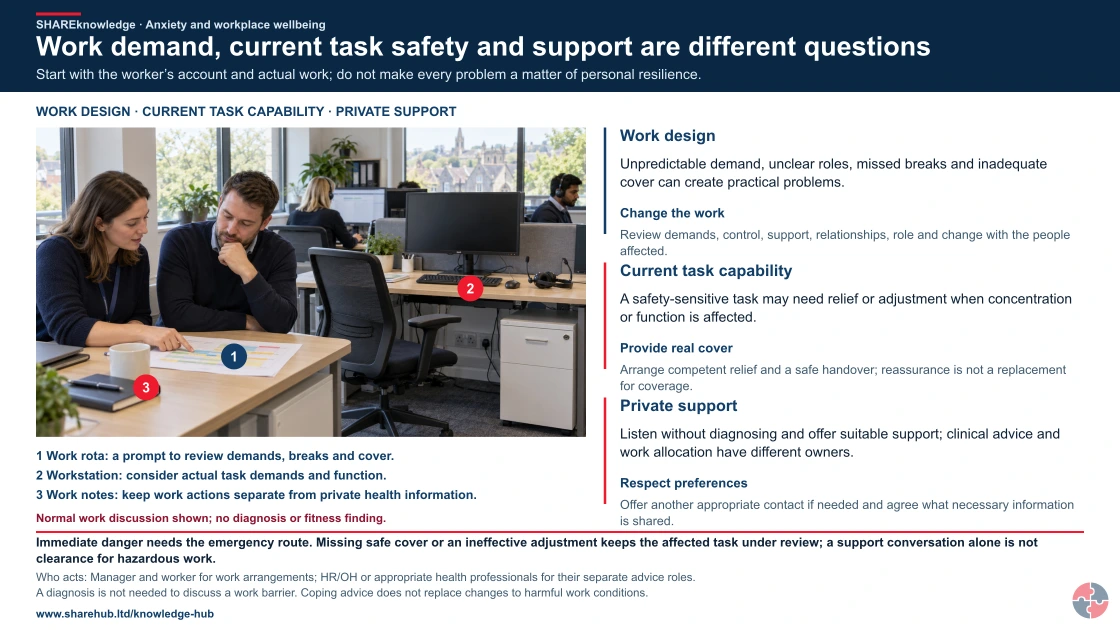
Work demand, current task safety and support are different questions
Full written explanation
An illustrative UK contact-centre setting shows normal colleagues reviewing an inert work rota beside service workstations and a closed work notebook. A single numbered picture key identifies the rota, workstation and work notes. These physical features provide prompts about demands, breaks, cover, task function and proportionate work actions; they do not show symptoms or identify anyone as anxious. A complete parallel comparison keeps three related questions distinct: work design and changes to harmful conditions; current task capability and real competent cover; private support and the worker’s preferences about appropriate help and necessary information sharing. All six HSE work-design areas remain in the work-design action. These are different questions, not stages of illness or a diagnostic sequence. An open-office work discussion is not a private healthcare consultation. A rota or calm conversation cannot prove safe cover, effective adjustments or fitness for a safety-sensitive task. A diagnosis is not needed to discuss a work barrier, and coping advice does not replace work changes. Immediate danger uses the existing emergency route without waiting for routine planning or support follow-up.
Start with the worker’s account and actual work; do not make every problem a matter of personal resilience.
- Work design. Unpredictable demand, unclear roles, missed breaks and inadequate cover can create practical problems.
- Current task capability. A safety-sensitive task may need relief or adjustment when concentration or function is affected.
- Private support. Listen without diagnosing and offer suitable support; clinical advice and work allocation have different owners.
Change the pathway
- Change the work. Review demands, control, support, relationships, role and change with the people affected.
- Provide real cover. Arrange competent relief and a safe handover; reassurance is not a replacement for coverage.
- Respect preferences. Offer another appropriate contact if needed and agree what necessary information is shared.
Evidence check: A diagnosis is not needed to discuss a work barrier. Coping advice does not replace changes to harmful work conditions.
Primary references: HSE advice for managers — focus on work adjustments and appropriate support · HSE stress risk assessment — assess the actual work and act on findings · HSE Management Standards — six distinct areas of work design
Open the complete HD image (new tab)Download image
Primary references: HSE advice for managers — focus on work adjustments and appropriate support · HSE stress risk assessment — assess the actual work and act on findings · HSE Management Standards — six distinct areas of work design
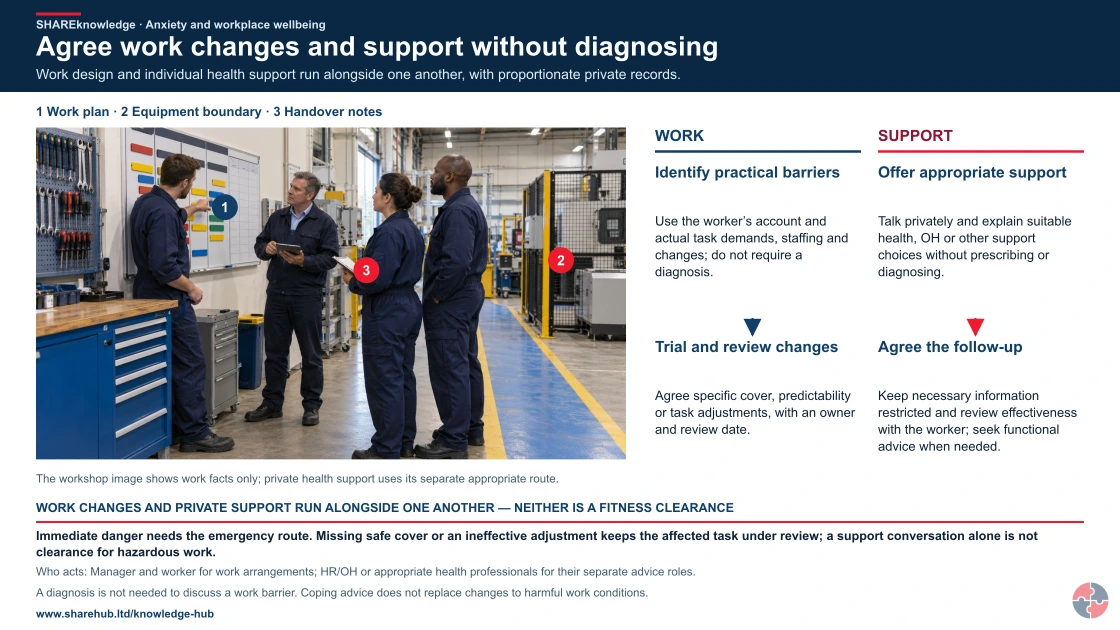
Agree work changes and support without diagnosing
Full written explanation
An illustrative UK maintenance-workshop work-plan review shows normal colleagues, a planning board, a closed equipment boundary and inert handover notes. One literal numbered picture key identifies those three physical features. The scene represents work facts only; it does not depict private healthcare, a medical record, assessment of an individual, verified isolation or permission to enter or restart equipment. Two separate unnumbered tracks explain the actual relationship. WORK uses the worker’s account and task/staffing evidence to identify practical barriers, then trial and review agreed changes with an owner and review date. SUPPORT offers a private appropriate choice of health, occupational-health or other help, then agrees proportionate restricted follow-up and functional advice where needed. The genuine order stays within each track; neither track is a gate that automatically completes or clears the other. Reassurance cannot replace competent task cover, and a supportive conversation is not fitness clearance. Routine records describe changed work and necessary facts, without requiring a diagnosis or circulating private health information. Urgent help remains separate from routine planning. No symptoms, diagnosis, therapy, medical treatment, crisis technique, new disability or employment rule, or return-to-work approval is supplied.
Work design and individual health support run alongside one another, with proportionate private records.
- Identify practical barriers. Use the worker’s account and actual task demands, staffing and changes; do not require a diagnosis.
- Trial and review changes. Agree specific cover, predictability or task adjustments, with an owner and review date.
- Offer appropriate support. Talk privately and explain suitable health, OH or other support choices without prescribing or diagnosing.
- Agree the follow-up. Keep necessary information restricted and review effectiveness with the worker; seek functional advice when needed.
When the evidence does not fit: Immediate danger needs the emergency route. Missing safe cover or an ineffective adjustment keeps the affected task under review; a support conversation alone is not clearance for hazardous work.
Who acts: Manager and worker for work arrangements; HR/OH or appropriate health professionals for their separate advice roles.
Changed workplace
Contact centre: Review unpredictable demand, break cover and escalation arrangements with the team.
Maintenance return: Agree task-specific support and functional restrictions before the appropriate manager allocates safety-sensitive duties.
Evidence check: A diagnosis is not needed to discuss a work barrier. Coping advice does not replace changes to harmful work conditions.
Primary references: HSE advice for managers — focus on work adjustments and appropriate support · HSE stress risk assessment — assess the actual work and act on findings · HSE Management Standards — six distinct areas of work design
Open the complete HD image (new tab)Download image
Primary references: HSE advice for managers — focus on work adjustments and appropriate support · HSE stress risk assessment — assess the actual work and act on findings · HSE Management Standards — six distinct areas of work design
Change the work as well as offering support


Read this visual as text
- Unclear information, inadequate cover, missed breaks and high demands are work-design questions. Use worker feedback and a practical cover plan rather than locating every problem within one person.
- CHECK THE DEMANDS
- PROVIDE REAL COVER
- REVIEW WITH WORKERS
These Riverside Leisure Ltd examples are teaching scenarios, not diagnoses or ready-made fitness decisions. Managers should seek competent HR, occupational-health or clinical advice when the facts require it.
1. Peak-time reception queue
Task material and setting: Riverside Leisure Ltd receives a surge of complaints during a school-holiday swim changeover; the outcome is a safe, staffed service.
People and prerequisites: Reception staff, visitors and duty manager; queue and escalation routes are known.
Before: Plan staffing, clear customer information, breaks and a route for abusive behaviour.
During: Duty manager redistributes queue work, gives a worker a short break and handles an escalated complaint.
Hold or stop: Threats, blocked exit or a worker unable to continue safely: withdraw and summon help; call 999 for immediate danger.
Completion and hand back: Review queue design, abusive incidents and whether breaks were practicable.
Evidence: Roster, customer-flow check and incident/action record.
2. Lifeguard asks to leave poolside
Task material and setting: A lifeguard reports acute anxiety and cannot maintain concentration at poolside; the outcome is continuous supervision of swimmers.
People and prerequisites: Swimmers, team and lifeguard; a qualified replacement and duty manager are available.
Before: Maintain sufficient competent cover and a clear handover route before the shift.
During: Arrange prompt relief and a safe handover; talk privately after cover is secured.
Hold or stop: No competent relief or coverage gap: follow the pool emergency and operational plan, including stopping affected activity if required.
Completion and hand back: Assess task capability and support with the worker, occupational health if needed, and authorised return to safety-sensitive duties.
Evidence: Cover record, task decision and restricted support plan.
3. Late rota change across leisure centres
Task material and setting: A revised rota gives short notice of site and hours changes, increasing uncertainty for multiple staff.
People and prerequisites: Staff, managers and customers; staff consultation and coverage plan are available.
Before: Communicate reasons and timing early, ask about constraints and assess demand, travel and childcare effects.
During: Adjust coverage and give clear written roles and points of contact; check if extra support is needed.
Hold or stop: Unclear competent cover or unsafe fatigue: hold affected duties while the plan is corrected.
Completion and hand back: Collect worker feedback and revise rota procedure rather than framing all distress as poor resilience.
Evidence: Change communication, consultation and rota review.
4. Return after anxiety-related absence
Task material and setting: A swimming instructor returns following time away and requests predictability and a staged caseload.
People and prerequisites: Instructor, pupils, manager and HR; capability and lesson-cover needs are considered.
Before: Discuss work barriers, preferences and possible adjustments; seek occupational-health input where functional advice is needed.
During: Agree a time-limited schedule, clear lesson plan and regular private check-ins without circulating diagnosis.
Hold or stop: If a task cannot be performed safely or an agreed adjustment fails, pause that task and review with the worker.
Completion and hand back: Review effectiveness and update the plan; statutory disability questions use GB or NI route as applicable.
Evidence: Agreed work plan, owner, review date and minimum necessary health record.
5. Agency and contractor interface at an event
Task material and setting: Riverside brings in temporary workers for a crowded outdoor activity event; the outcome is clear roles and support routes.
People and prerequisites: Agency staff, contractors, visitors and Riverside leads; host and supplier coordination is needed.
Before: Brief workload, breaks, behaviour standards, emergency contacts and who can stop unsafe work.
During: Use a named supervisor, predictable updates and accessible reporting as conditions change.
Hold or stop: Ambiguous role, abuse or inadequate safe staffing: hold the affected task and escalate.
Completion and hand back: Debrief the contractor interface and correct gaps before the next event.
Evidence: Briefing, coverage plan and feedback actions.
6. Anxious lone close-down worker
Task material and setting: A lone evening worker says they feel unsafe after a recent threatening visitor incident.
People and prerequisites: Worker and any late users; alarm, check-in and safe exit arrangements are part of the work plan.
Before: Review the real violence and lone-work exposure, not only the worker response; assess staffing, exits and alarm reliability.
During: Arrange a second worker or changed close-down method if the risk assessment requires it; offer private support.
Hold or stop: Failed check-in, renewed threat or no safe exit: do not continue alone; use emergency help for immediate danger.
Completion and hand back: Verify controls, incident support and the worker-agreed work plan before lone work resumes.
Evidence: Incident, alarm test, rota decision and restricted support record.
7. Worker says they cannot stay safe
Task material and setting: During a private meeting a worker describes an immediate risk of self-harm; the outcome is emergency help and safety.
People and prerequisites: Worker, manager and nearby colleagues; a second person can call for help without crowding the worker.
Before: Know the site emergency and crisis contact route; keep the conversation calm and private.
During: If there is immediate danger, call 999 and follow the call handler; stay with the person where safe while help arrives.
Hold or stop: Do not leave this to a routine EAP referral, formal performance meeting or promise of absolute confidentiality.
Completion and hand back: After professional handover, support affected people, restrict records and separately review any work factors.
Evidence: Emergency handover facts, restricted record and follow-up owner.
How should wellbeing appear in a risk register?
Record hazardous work conditions and controls, not a named “anxious employee” as the hazard.
Entries can cover peak reception demand, violence exposure, inadequate lifeguard relief, unpredictable shifts, lone close-down or poor change communication. Give each a control owner, worker consultation and a test of effectiveness. Keep individual adjustment and health records separately restricted. Review after incidents, rota changes, feedback, absence patterns or a failed control.
| Exposure | Control | Evidence and trigger |
|---|---|---|
| Peak public demand | Staffing, queue information, breaks and help route. | Queue and incident trend; review after seasonal change. |
| Safety-sensitive cover | Competent relief and clear handover. | Rota and cover test; hold after failure. |
| Threat or lone work | Safe exit, alarm and second-worker option where assessed. | Incident review and alarm check. |
| Unpredictable change | Consultation, notice and role clarity. | Worker feedback and revised schedule. |
How could Riverside Leisure Ltd put this into practice?

Riverside should improve work design across busy public services while offering private, practical support to individuals.
Riverside Leisure Ltd operates leisure centres, outdoor activities and hospitality-style customer areas. It maps school-holiday queues, poolside vigilance, lone closing, incidents and rota changes against the six work-design factors. The duty manager plans competent cover and breaks before a peak. A lifeguard can request relief without announcing a diagnosis to swimmers or colleagues. HR and occupational health can help agree a staged return where needed; the team sees only the work arrangement. Senior leaders check whether staffing, change notice, response to threats and adjustment reviews work in practice, rather than counting awareness-course attendance as the main control.
| Owner | Decision | Evidence |
|---|---|---|
| Operations manager | Resource peaks, lifeguard cover and safe close-down. | Roster and cover checks. |
| Duty manager | Respond to task holds, customer conflict and work pressure. | Shift action and incident record. |
| HR and occupational health | Coordinate fair, private adjustments and return planning. | Restricted plan and review. |
| Safety adviser | Assess six work factors with worker voice. | Risk register and verified actions. |
What should workers and managers practise?
Train for the role: workers need help and stop routes; managers need risk, conversation, privacy and escalation skills.
An awareness course alone cannot control excessive work pressure. All workers should know how to report harmful demands, seek support and make a task safe. Supervisors should practise private conversations, cover decisions, crisis escalation and the six work factors. HR and occupational-health specialists need competence within their own remit. No universal anxiety certificate or fixed renewal interval is claimed.
| Role and learning | Practice on the actual task | Competence evidence and record | Assessor and reassessment trigger |
|---|---|---|---|
| Workers: report and make the task safe | Practise a confidential help request, a safe task pause and urgent escalation when needed. | Observed scenario and correct support/report route. | Supervisor checks after role, workload or support change. |
| Supervisors: discuss and control work | Use a private conversation, identify work factors, avoid diagnosis and agree task controls. | Observed case exercise and reviewed action record. | Competent manager checks after symptoms, absence or weak action. |
| HR and privacy advisers: protect fairness | Separate necessary adjustments, confidential health data and performance or conduct decisions. | Case review with lawful information-sharing boundary. | Legal/privacy lead rechecks after policy or law change. |
| Occupational health and clinicians: advise within scope | Assess individual health and functional needs; direct clinical care is not a supervisor task. | Qualified opinion and confidential referral/return plan. | Clinical lead rechecks after material health or work change. |
| Senior managers: prevent work stressors | Assess demand, control, support, relationships, role and change; verify controls with workers. | Work-risk review, feedback and closed corrective actions. | Accountable lead reviews after trend or serious event. |
Record observed safe-task and support decisions, assessor and reassessment trigger; course attendance does not replace work-risk controls or clinical advice.
What can NICE and ISO guidance add?
NICE NG212 puts organisation-level prevention first; ISO 45001 and ISO 45003 can structure psychosocial-risk governance, but none replaces applicable law or a task decision.
NICE NG212 recommends a tiered approach with organisation-level conditions as the foundation, then individual and targeted support. ISO 45001 is a voluntary occupational-health and safety management standard; ISO 45003 is psychosocial-risk guidance within such a system; verify its current edition and scope from an authorised copy. An ISO certificate is not proof that a pool has enough lifeguard cover, that a crisis route works or that adjustments are lawful and effective.
How should leaders know whether wellbeing controls work?
Plan with workers, change harmful conditions, check lived experience and correct failed controls.
Use risk assessment and consultation to choose prevention actions. Implement staffing, break, support, role and change controls; provide private individual support where needed. Check actual shifts, incidents, worker feedback, absence patterns and adjustment timeliness without diagnosing from statistics. Senior leaders resource and verify changes, and protect identifiable health information.
| Stage | Decision | Evidence |
|---|---|---|
| Plan | Identify six work-design risks with workers. | Assessment and priorities. |
| Do | Change staffing, tasks, communications and support routes. | Roster, briefing and action record. |
| Check | Test controls and listen to affected workers. | Feedback and control review. |
| Act | Revise weak controls and verify closure. | Owner and effectiveness check. |
What suggests wellbeing controls are failing?
Repeated missed breaks, unclear roles, unsafe cover, unresolved bullying or workers afraid to disclose barriers signal a control problem.
Other signals include repeated short-notice rota changes, high turnover, distress after customer incidents, delayed adjustments or a crisis route nobody can use. A single absence or behaviour does not diagnose anxiety. Ask workers what is happening, check task safety and test whether the work-design action was actually delivered.
Standards named on this page are background context. Confirm the current edition, scope and exact requirements from an authorised copy before applying them. The open official sources below support the specific public-law and regulator guidance claims they are cited for.
What do the acronyms and key terms mean?
Keep clinical care, work risk, adjustments and privacy terms separate.
| Term | Meaning |
|---|---|
| GP | General practitioner for medical assessment and care. |
| OH | Occupational health: specialist work-function advice. |
| EAP | Employee assistance programme where the organisation offers one. |
| HSE / HSENI | GB / Northern Ireland workplace safety regulators. |
| UK GDPR | UK data-protection law requiring extra safeguards for health data. |