SHARE Knowledge Hub
Anger management
Anger is a normal feeling, but abuse, threats and violence are safety issues. If a conversation becomes unsafe, create distance, withdraw from the task, summon help and call 999 for immediate danger. For ordinary frustration, pause and address the cause; managers should reduce work pressures, respond fairly to complaints and offer support without excusing harmful behaviour.
Understanding Anger management
Anger is a normal feeling, but abuse, threats and violence are safety issues. If a conversation becomes unsafe, create distance, withdraw from the task, summon help and call 999 for immediate danger. For ordinary frustration, pause and address the cause; managers should reduce work pressures, respond fairly to complaints and offer support without excusing harmful behaviour.
Why this matters at work
Harm includes cuts, bruising, fractures, head injury, musculoskeletal injury, infection, disability and death. Threats and persistent abuse can also cause acute stress, anxiety, depression, sleep disturbance or post-traumatic stress, including for witnesses. Secondary harm can arise during restraint, escape, vehicle movement or process abandonment.
Anger is an emotion and does not by itself establish misconduct, violence, incapacity or mental illness. Organisational decisions should be based on observable behaviour, credible context, work demands, impact and evidence. A raised but controlled challenge to an unsafe decision is different from targeted abuse, a threat, property damage, stalking, physical assault or a person in acute distress. Labelling all disagreement as an anger problem can suppress consultation and hide defects in work design or management conduct.
How organisations manage this in practice
Good practice begins with prevention: fair job design, realistic demand, worker control, capable supervision, respectful relationships, clear roles, well-managed change, safe service design, staffing, layout and security. It provides early routes to raise concerns, proportionate conflict resolution and access to support. Where behaviour escalates, safety takes priority: create distance, avoid arguing, use calm communication, summon help, withdraw and activate emergency arrangements.
Eliminate unnecessary confrontational transactions, cash handling, lone visits or face-to-face enforcement where safer design can achieve the objective. Reduce wait, uncertainty, repeated refusal and exposure time. Isolate through screens, remote contact, controlled rooms or separation from machinery. Control with staffing, clear information, appointments, alarms, CCTV, security and coordinated procedures. PPE has limited applicability and must not create a false sense of safety.
Assess the reported unsafe equipment condition on its evidence, separately from the disagreement and any conduct issue. A person’s anger cannot establish that their safety concern is wrong; walking away without safe task ownership can create another hazard. Once the task is secure, hold a private conversation about observations, work pressures and support and use a fair process for any allegation. Record who owns the task, current isolation or permit status and the next authorised action. Review conflicting production and maintenance priorities, escalation routes and whether staff can pause safely without losing critical control. Verify both technical resolution and the adequacy of the handover.
What does this guidance cover?
This is a work guide to ordinary anger, conflict, stress, abuse and violence boundaries; it is not a diagnosis, therapy manual or licence to stay in danger.
The immediate action depends on behaviour and risk, not on labelling a person. Everyday disagreement can be paused and solved. Abuse, threats, harassment or assault require protection, reporting and a fair response. An acute threat to life or safety requires 999. Managers should consider work design and individual support without using either to excuse unsafe behaviour.
Choose safety, complaint or everyday conflict support
Start with behaviour and risk. Ordinary frustration can be paused and discussed, but threats, blocked exits or unsafe communication during a critical task require the safety route. Personal calming skills do not replace protection from abuse or a fair complaint process.
A disagreement, a threat and repeated pressure need different routes
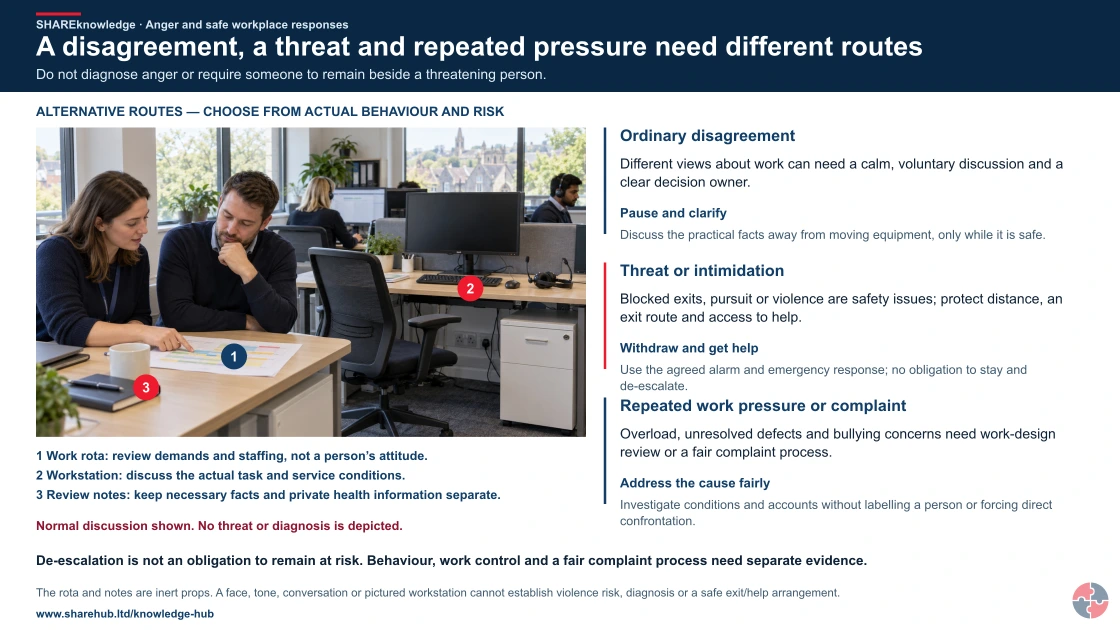
Full written explanation
An illustrative UK customer-service office shows normal colleagues reviewing a work rota beside actual service workstations and a closed review notebook. One numbered key identifies the rota, workstation and notes. The scene makes workload, staffing, task conditions and necessary factual review visible without labelling a colleague as a hazard. No threat, clinical state or diagnostic sign is depicted. Beside the scene, three distinct alternatives match the actual situation to its response: ordinary disagreement can use a calm voluntary practical discussion; threat or intimidation requires distance, withdrawal and access to help; repeated work pressure or a complaint needs work-design review or a fair complaint process. These are alternatives, not stages of anger or a compulsory de-escalation sequence. The correct route depends on actual behaviour and risk, not the appearance of the people illustrated. An unsafe worker need not remain beside a threatening person or undertake direct confrontation. A normal conversation, rota or pictured workstation cannot prove an effective exit/alarm arrangement, settle a complaint, diagnose a person or release a hazardous task. Work control, behaviour, private health information and fair complaint evidence remain different questions.
Do not diagnose anger or require someone to remain beside a threatening person.
- Ordinary disagreement. Different views about work can need a calm, voluntary discussion and a clear decision owner.
- Threat or intimidation. Blocked exits, pursuit or violence are safety issues; protect distance, an exit route and access to help.
- Repeated work pressure or complaint. Overload, unresolved defects and bullying concerns need work-design review or a fair complaint process.
Change the pathway
- Pause and clarify. Discuss the practical facts away from moving equipment, only while it is safe.
- Withdraw and get help. Use the agreed alarm and emergency response; no obligation to stay and de-escalate.
- Address the cause fairly. Investigate conditions and accounts without labelling a person or forcing direct confrontation.
Evidence check: De-escalation is not an obligation to remain at risk. Behaviour, work control and a fair complaint process need separate evidence.
Primary references: HSE violence prevention — work design, layout, staffing and help arrangements · HSE stress Management Standards — demands, relationships, role and support · GOV.UK workplace bullying and harassment — fair complaint context; apply the topic’s jurisdiction qualifications
Open the complete HD image (new tab)Download image
Primary references: HSE violence prevention — work design, layout, staffing and help arrangements · HSE stress Management Standards — demands, relationships, role and support · GOV.UK workplace bullying and harassment — fair complaint context; apply the topic’s jurisdiction qualifications
After safety is secured, record factual conduct and the task conditions separately from private health information. Review predictable delivery conflicts, unclear decisions, lone-working arrangements and escalation access. Support does not excuse harmful behaviour, and an investigation should not begin with a diagnostic label.
Repeated disputes at the delivery gate
Illustrative example. A lone gate marshal receives abuse when two deliveries arrive for the same slot.
Decision. Protect the marshal through the existing withdrawal/help arrangements, then redesign the delivery coordination and escalation route.
Evidence to check. Retain factual incident information, booking conflicts, staffing and whether safe withdrawal/help were available.
Hold or escalation point. Do not require the marshal to stay in an unsafe interaction to resolve a scheduling failure.
Follow-up. Check the revised delivery plan under busy conditions and ask whether support is available when conflict recurs.
Who does what when anger or conflict affects work?
The person affected can pause and report; the supervisor protects the task and people; managers fix work risks and handle complaints fairly.
| Role | Immediate action | Planning and evidence |
|---|---|---|
| Worker or witness | Pause safely, use agreed exit/help route, report facts and call 999 for immediate danger. | Note what happened, when, where and who may be at risk; seek support. |
| Supervisor | Stop a safety-critical task if concentration or communication is impaired; separate people and summon help. | Fix scheduling or communication triggers; hand serious allegations to an impartial route. |
| Manager or project lead | Protect affected people, agree task restart and ensure no retaliation. | Assess stress and violence risk, resource controls and verify follow-up. |
| Contractor and host | Coordinate safe traffic, access and disagreement routes across employers. | Record interface decisions and brief both workforces. |
| HR, wellbeing or occupational health | Offer proportionate support and fair conduct or grievance processes. | Keep clinical details restricted; seek work-function advice where useful. |
| Safety adviser and leadership | Review incident patterns and whether controls prevent repeat harm. | Check worker consultation, actions and emergency readiness. |
Is this frustration, harmful behaviour or immediate danger?
Choose the route from what is happening now: a safe disagreement can be paused, abuse needs protective action, and immediate danger needs 999.
Choose the response to the situation


Read this visual as text
- DISAGREEMENT: Use a calm, private discussion where it is safe and voluntary; clarify the issue and next action.
- THREAT OR VIOLENCE: Prioritise distance, withdrawal, assistance and the emergency arrangements.
- SAFE WORK: Pause a task if current concentration or behaviour makes it unsafe; assess function without making a diagnosis.
Anger or Immediate Danger
Two linked parts · 5 questions. Open Part 2 to complete the route.

Continue to questions 4–5 · Part 2 of 2


Read this visual as text
- Start: A workplace conversation is becoming heated or someone reports intimidating behaviour.
- Question 1: Is there immediate danger, assault, a blocked exit or a credible imminent threat? Decision owner: Supervisor / independent HR or incident lead.
- YES — STOP / REFER: Create distance, withdraw, summon help and call 999 when emergency assistance is needed. STOP / REFER → APPROPRIATE RESPONSE.
- NO: No such warning is identified; continue the remaining checks. CONTINUE → QUESTION 2.
- UNKNOWN — PROTECT FIRST: Protect people and hold the affected work. Obtain the responsible specialist’s assessment; do not assume the warning is absent. HOLD → OWNER RESOLVES BEFORE RESUMING.
- Question 2: What remains after immediate safety is addressed? Decision owner: Supervisor / independent HR or incident lead.
- Abuse / intimidation: Protect the person, set safe boundaries and use the reporting route. CONTINUE → QUESTION 3.
- Safe disagreement: Pause the dependent task and establish the facts and ownership. CONTINUE → QUESTION 3.
- Uncertain safety: Keep separation and obtain appropriate supervisory or security help. HOLD → OWNER RESOLVES BEFORE RESUMING.
- Question 3: Can the conversation continue voluntarily and safely? Decision owner: Supervisor / independent HR or incident lead.
- YES: The required evidence or condition is confirmed. CONTINUE → QUESTION 4.
- NO / UNKNOWN — HOLD: Do not require a threatened worker to stay, mediate or diagnose someone else. HOLD → REPEAT QUESTION 3 AFTER CORRECTION.
- Question 4: Is communication reliable enough for any dependent critical task? Decision owner: Supervisor / independent HR or incident lead.
- YES: The required evidence or condition is confirmed. CONTINUE → QUESTION 5.
- NO / UNKNOWN — HOLD: Keep the lift, traffic movement or other task safely stopped. HOLD → REPEAT QUESTION 4 AFTER CORRECTION.
- Question 5: Record and route the follow-up Decision owner: Supervisor / independent HR or incident lead.
- ACTION: Use emergency, conduct, complaint or support routes as appropriate; keep technical restart separate. OUTCOME → RECORD AND HAND OVER.
- Outcome: Emergency handover, protected complaint route or authorised work restart with records.
- Stop and escalation boundary: Do not require a threatened worker to stay, mediate or diagnose the other person. Stop safety-critical work when clear communication is lost.
Do not infer risk from a diagnosis, disability, personality or raised emotion alone. Look at actual words, actions, proximity, weapons or objects, escape routes and whether the person can stop. Do not require a threatened worker to negotiate, mediate or remain in place. Conversely, do not treat a respectful safety challenge or grievance as misconduct merely because it is expressed strongly.
| Situation | First route | Do not |
|---|---|---|
| Frustration or disagreement without threat | Pause if useful; listen, agree facts, owner and return time. | Suppress a legitimate safety concern. |
| Insults, intimidation, bullying or persistent abuse | Set boundary, create space, protect others, report and choose fair process. | Assume mediation is safe or require victim to confront the person. |
| Threat, assault, unsafe pursuit or immediate risk | Withdraw, raise alarm, summon security or police and call 999 for immediate danger. | Stay to de-escalate or physically intervene without an authorised safe role. |
| Immediate self-harm or harm-to-others concern | Call 999, give location and follow dispatcher; protect bystanders. | Leave it as a routine wellbeing or conduct referral. |
What are the key facts about anger at work?
Anger itself is ordinary; the workplace must respond to harmful behaviour and prevent work conditions that make stress and violence more likely.
| Fact | Operational meaning |
|---|---|
| Feeling is not behaviour | A worker may challenge unfairness respectfully; abuse, threats or violence are separate issues. |
| Safety before resolution | Withdraw, summon help and call 999 for immediate danger; do not make a threatened person negotiate. |
| Work design matters | Assess demands, control, support, relationships, role and change; remove avoidable triggers. |
| Support and standards coexist | Offer GP, EAP or occupational-health support where suitable, while protecting others and using fair process. |
| Facts and learning matter | Record behaviour and context, not personality labels; check whether controls failed and actions worked. |
What is anger management?
Anger management is the set of skills, support and workplace controls used to recognise anger and prevent it becoming harmful.
Anger can range from mild irritation to intense rage. It may be brief and proportionate, or it may become frequent, explosive, suppressed, resentful or directed at the wrong person. The workplace issue is not whether people ever feel angry; it is whether anger is understood, expressed safely and managed before it damages health, relationships or safety.
For individuals, anger management includes noticing early body signs, stepping away when safe, slowing breathing, challenging unhelpful thoughts, expressing needs clearly, listening, problem solving and seeking help where anger feels difficult to control. For organisations, it includes good work design, fair leadership, respectful culture, conflict resolution, violence-prevention arrangements and clear behaviour standards.
Anger can also be a symptom or companion of other issues: stress, trauma, anxiety, depression, sleep loss, pain, substance misuse, neurodivergent overwhelm, financial pressure, bullying, domestic abuse or personal loss. A competent workplace response stays curious and supportive while still protecting others from harm.
| Aspect | Details | Workplace meaning |
|---|---|---|
| Topic name | Anger management. | A wellbeing, behaviour, conflict and risk-management topic. |
| Normal emotion | Anger is a common response to threat, injustice, frustration or blocked needs. | Feeling angry is not misconduct by itself. |
| Problem pattern | Anger becomes a problem when it is frequent, intense, intimidating, unsafe or damaging. | Managers need to distinguish support needs from conduct and safety risks. |
| Main mechanisms | Fight-or-flight response, threat perception, unhelpful thinking, stress load and communication breakdown. | The work environment can make escalation more or less likely. |
| Possible outcomes | Conflict, stress, reduced teamwork, errors, absence, harassment, aggression or violence. | Anger should be handled before it becomes an incident. |
| Management focus | Early recognition, de-escalation, support, work design, respectful behaviour and learning. | A mature organisation addresses both individual and system contributors. |
What can trigger anger at work?
Anger can be triggered by perceived threat, unfairness, disrespect, frustration, overload, poor communication or loss of control.
A trigger is the event that sets anger off, but it is rarely the full cause. A worker may react strongly to a rota change because they are exhausted, caring for someone at home or feel they have been ignored repeatedly. A customer may become aggressive because they feel trapped in a system that will not solve their problem. A supervisor may snap because workload, time pressure and unclear expectations have been building all week.
Understanding triggers is not the same as accepting harmful behaviour. It helps the workplace prevent recurrence. If incidents cluster around queues, closing time, lone work, poor handovers or unrealistic targets, that is useful management intelligence.
| Trigger | How it can build anger | Workplace examples | Controls to consider |
|---|---|---|---|
| Perceived disrespect | People feel belittled, ignored, mocked or spoken down to. | Abrupt emails, public criticism, sarcasm, customer abuse or poor manager tone. | Respectful communication standards, feedback training and early challenge. |
| Injustice or unfairness | People believe rules, workload or decisions are inconsistent. | Unexplained rota changes, favouritism, unfair discipline or unclear promotion decisions. | Transparent decisions, consultation and grievance routes. |
| Frustration and blocked goals | People cannot complete work because systems, resources or decisions block them. | Broken equipment, slow approvals, unclear instructions or repeated rework. | Fix barriers, clarify roles and improve planning. |
| High demands | Work pressure narrows tolerance and increases irritability. | Understaffing, deadlines, customer queues, emergency work or excessive overtime. | Stress risk assessment, staffing review and realistic workload. |
| Low control | People feel powerless over pace, method or decisions affecting them. | No input into shifts, breaks, task order or customer-handling rules. | Participation, autonomy and supervisor flexibility. |
| Personal strain | Sleep loss, pain, financial pressure, bereavement, health problems or home conflict can lower resilience. | Sudden behaviour change or repeated short temper from someone usually calm. | Private support conversation, signposting and temporary adjustments. |
What happens in the body when someone becomes angry?
Anger activates a stress response that prepares the body to act quickly but can reduce calm judgement.
The body response is useful in real danger, but it can be unhelpful in a meeting, call centre, vehicle cab or workshop. Heart rate rises, breathing can become faster, muscles tense, attention narrows and the person may feel a strong urge to interrupt, shout, leave, blame or retaliate. The physical state can then feed the angry thoughts, making escalation more likely.
This is why practical techniques are often physical first: pause, breathe out slowly, unclench hands, lower shoulders, drink water, step away if safe, walk, write down the issue, or agree to return to the conversation. The aim is to allow time to settle, consider the facts and choose a safer response.
| Response | What may happen | Workplace risk | Helpful intervention |
|---|---|---|---|
| Fast heartbeat | The body prepares for action. | Impulsive decisions or confrontation. | Pause, breathe, slow the conversation. |
| Muscle tension | Jaw, shoulders, fists or posture tighten. | Intimidating body language or physical escalation. | Step back, relax shoulders and create space. |
| Fast breathing | Breathing becomes shallow or rapid. | Panic-like symptoms or raised voice. | Longer out-breath and grounding. |
| Narrow attention | The person focuses on the threat or unfairness. | Poor listening and missed information. | Repeat facts calmly and avoid piling on detail. |
| Hot thoughts | Words such as always, never, must or unfair can intensify anger. | Blame, accusation and escalation. | Reframe into specific issue, need and next step. |
| After-effects | Guilt, shame, exhaustion, headache or conflict repair may follow. | Withdrawal, absence or repeated resentment. | Debrief, repair and learn without humiliation. |
How can unmanaged anger affect work?
Unmanaged anger can affect safety, decision-making, teamwork, wellbeing, attendance and trust.
In safety terms, anger is not only a personal wellbeing issue. It can distort judgement, reduce listening, damage handovers, trigger shortcuts, increase vehicle or machinery risk and cause people to avoid raising concerns. In public-facing work it can escalate with customers or service users and leave workers anxious about the next shift.
For the person experiencing anger, repeated activation can affect sleep, blood pressure, concentration, relationships and mental wellbeing. For those around them, repeated outbursts can feel threatening even when no physical violence occurs. A workplace that ignores this may drift into bullying, fear, retaliation and under-reporting.
| Area affected | Possible impact | Why it matters |
|---|---|---|
| Safety-critical tasks | Reduced judgement, distraction, rushing or rule breaking. | Driving, machinery, isolation, care work and high-risk tasks need calm attention. |
| Team relationships | Fear, resentment, avoidance and poor communication. | Teams stop sharing information when conflict feels unsafe. |
| Leadership trust | Managers who shout or intimidate lose credibility. | People comply outwardly but stop reporting honestly. |
| Customer interaction | Conflict can escalate into complaints, threats or violence. | Public-facing workers need de-escalation and support. |
| Health and wellbeing | Stress, sleep problems, anxiety, guilt or isolation. | A worker may need support before the pattern becomes entrenched. |
| Employment consequences | Misconduct, grievances, absence or formal action. | Early support and clear boundaries are fairer than delayed crisis response. |
What early warning signs should people notice?
Early warning signs are physical, emotional, thinking and behaviour changes that show anger is escalating.
Early recognition is the most useful skill because it gives people choices. Once anger has fully escalated, reasoning becomes harder and the person may feel driven to defend, attack or leave. A worker who knows their own signs can take a time-out before shouting. A manager who recognises escalation can lower the heat of the conversation.
Warning signs should be treated as prompts for action, not labels. The same clenched jaw or short reply might come from pain, grief, fatigue or anxiety. The conversation should focus on what is happening and what helps, not on calling someone an angry person.
| Sign type | Examples | Practical response |
|---|---|---|
| Physical | Fast heartbeat, tense shoulders, clenched fists, tight jaw, heat, sweating or stomach tension. | Pause, breathe, unclench, drink water, stand down from immediate confrontation. |
| Thinking | All-or-nothing words, blame, rumination, assuming intent or replaying unfairness. | Ask what fact is known, what is assumed and what outcome is needed. |
| Emotional | Irritation, resentment, humiliation, fear, panic, shame or feeling trapped. | Name the feeling privately and choose a safe next step. |
| Verbal | Raised voice, sarcasm, swearing, interrupting or personal comments. | Slow the conversation, set respectful boundaries and take a break. |
| Behavioural | Pacing, door slamming, aggressive gestures, leaving abruptly or refusing to engage. | Create space, avoid blocking exits and use de-escalation. |
| Pattern | Repeated complaints, conflicts, grievances, near misses or customer incidents. | Review work design, training, supervision and support. |
What can a person do when anger rises?
If it is safe, pause, breathe, leave the exchange briefly and return to the specific issue; seek help when anger is hard to control.
NHS suggests recognising early signs, giving yourself time to think, calming breathing, talking to someone and exercise. On site, first leave a machine, vehicle or lift in a safe state before stepping away. A time-out is not permission to abandon a dependent task. Once calm, raise the actual problem through the supervisor, safety, grievance or other appropriate route. If anger is harming relationships or behaviour has become abusive or violent, ask a GP about support; an EAP may also help where available.
| Moment | Action | Boundary |
|---|---|---|
| Early tension | Notice clenched hands, racing thoughts or raised voice; slow breathing and pause before replying. | No technique is guaranteed or a substitute for removing a threat. |
| Safety-critical task | Stop safely and tell the responsible person that communication or concentration is impaired. | Do not walk away leaving plant, traffic or a dependent person uncontrolled. |
| Conversation | Ask for a break, state the fact and concern, listen, and agree the next step and return time. | Do not force direct resolution after threats or bullying. |
| Repeated difficulty | Seek GP or suitable confidential support and discuss work causes with the manager. | A manager does not diagnose or prescribe treatment. |
How can the hierarchy of controls reduce workplace conflict and aggression risks?
Change work design and public-facing arrangements first, then give people clear behaviour, help, withdrawal and reporting routes.
Use the six HSE/HSENI stress factors to find causes, not to label a person. For foreseeable public aggression, review waiting times, signage, lighting, layout, staffing, secure exits, alarms, lone work and the power to end an interaction. Consult workers about actual incidents. De-escalation skills help but cannot replace staffing or a safe exit. Recheck controls after a change, complaint or near miss.
For a lone receptionist facing predictable aggressive behaviour at closing time, the manager first asks whether the late lone service can be removed or moved to a staffed remote channel. That is task elimination or substitution within ERICPD Eliminate/Reduce. If face-to-face service remains, a protected reception layout, clear exit and reliable alarm are engineering or physical separation, chosen with the worker and tested at the actual desk. Appointment rules, staffing levels, de-escalation, a clear right to end an interaction and response rehearsals are administrative layers. PPE is rarely a useful primary control for verbal threats. The facilities owner tests the alarm and escape route; the shift manager checks staffing and escalation cover before opening.
ERICPD Isolate/Control describe separation and the safe service method, while Discipline means sustaining staffing, alarm tests, support and learning after reports. Record threats as facts rather than a diagnosis of the customer or worker. A credible threat, blocked exit, failed alarm or unavailable response contact is a hold on the exposed service until a competent manager makes it safe. After an event, protect the person, call emergency services where necessary, preserve the incident facts, offer support and test whether the work design changed; a de-escalation course alone cannot compensate for a failed exit or lone-work arrangement.
| Priority | Control | Check |
|---|---|---|
| Remove avoidable trigger | Fix broken systems, unrealistic queues, unclear roles or conflicting schedules. | Workers confirm the problem and improvement. |
| Design the setting | Provide visibility, safe layout, staffing, communication, exits and alarms matched to the risk. | Walk-through and alarm/help test. |
| Set boundaries | Publish respectful conduct, service refusal, stop-work and complaint routes. | People can use routes without retaliation. |
| Practise response | Train exposed roles in recognition, calm communication, withdrawal and reporting. | Scenario exercise and incident trends. |
| Support and learn | Offer post-incident welfare and fair investigations; adjust controls. | Action owner and verified closure. |
How can the ERICPD hierarchy of controls reduce workplace conflict and aggression risks?

| ERICPD control level | Topic-specific example | Source and full task context |
|---|---|---|
| Eliminate | Remove avoidable late lone service. | Read the full task example, checks and stop points on this page. |
| Reduce | Assess a staffed remote service alternative. | Read the full task example, checks and stop points on this page. |
| Isolate | Provide an assessed protected reception layout and safe exit. | Read the full task example, checks and stop points on this page. |
| Control | Plan staffing, escalation and the right to end an unsafe interaction. | Read the full task example, checks and stop points on this page. |
| PPE | PPE is rarely a useful control for verbal threats. | Read the full task example, checks and stop points on this page. |
| Discipline | Test alarms and response cover, and learn from incident reports. | Read the full task example, checks and stop points on this page. |
How can the ISO 45001 hierarchy of controls reduce workplace conflict and aggression risks?

| ERICPD control level | Topic-specific example | Source and full task context |
|---|---|---|
| Eliminate | Remove avoidable late lone service. | Read the full task example, checks and stop points on this page. |
| Reduce | Assess a staffed remote service alternative. | Read the full task example, checks and stop points on this page. |
| Isolate | Provide an assessed protected reception layout and safe exit. | Read the full task example, checks and stop points on this page. |
| Control | Plan staffing, escalation and the right to end an unsafe interaction. | Read the full task example, checks and stop points on this page. |
| PPE | PPE is rarely a useful control for verbal threats. | Read the full task example, checks and stop points on this page. |
| Discipline | Test alarms and response cover, and learn from incident reports. | Read the full task example, checks and stop points on this page. |
When does anger become a workplace safety incident?
Abuse, threats and assault connected with work are violence risks; protect people immediately and use a separate fair process to establish facts.
HSE includes abuse and threats in work-related violence, not only physical injury. Do not dismiss serious verbal abuse as part of the job. Give workers a safe way to withdraw and summon help, preserve relevant evidence and support witnesses. A complaint about bullying or protected-characteristic harassment also needs the right HR/equality process. Do not assume that a personal dispute at work automatically meets statutory reporting criteria; assess work connection and the correct GB or NI rules after the immediate response.
| Observed behaviour | Immediate route | Follow-up |
|---|---|---|
| Raised but respectful challenge | Pause or clarify task facts. | Resolve the issue; do not punish a safety concern. |
| Repeated insults or intimidation | Set boundary and protect the affected person. | Record facts and use fair conduct or complaint route. |
| Threat, pursuit, assault or blocked exit | Withdraw, raise alarm; call 999 for immediate danger. | Preserve evidence, support people and assess reporting. |
| Bullying or discriminatory harassment | Protect against further harm and retaliation. | Use impartial HR/equality route; NI and GB law differ. |
What happens during an unsafe incident or acute crisis?
Move people away from immediate danger, call 999 when safety or life is at risk, and let trained responders take over; investigate only afterwards.
Complaint Support and Learning
Two linked parts · 6 questions. Open Part 2 to complete the route.

Continue to questions 4–6 · Part 2 of 2


Read this visual as text
- Start: A worker reports repeated shouting, humiliation, bullying or possible harassment.
- Question 1: Is there current danger or a risk of retaliation? Decision owner: Supervisor / independent HR or incident lead.
- YES — STOP / REFER: Protect the worker and use emergency, security or appropriate safeguarding arrangements. STOP / REFER → APPROPRIATE RESPONSE.
- NO: No such warning is identified; continue the remaining checks. CONTINUE → QUESTION 2.
- UNKNOWN — PROTECT FIRST: Protect people and hold the affected work. Obtain the responsible specialist’s assessment; do not assume the warning is absent. HOLD → OWNER RESOLVES BEFORE RESUMING.
- Question 2: Is the receiving manager independent of the complaint? Decision owner: Supervisor / independent HR or incident lead.
- YES: The required evidence or condition is confirmed. CONTINUE → QUESTION 3.
- NO / UNKNOWN — HOLD: Use another manager or the formal impartial route if the supervisor is implicated. HOLD → REPEAT QUESTION 2 AFTER CORRECTION.
- Question 3: Are facts, privacy limits and fair process explained? Decision owner: Supervisor / independent HR or incident lead.
- YES: The required evidence or condition is confirmed. CONTINUE → QUESTION 4.
- NO / UNKNOWN — HOLD: Record necessary facts; do not promise absolute secrecy or force unsafe mediation. HOLD → REPEAT QUESTION 3 AFTER CORRECTION.
- Question 4: Is support available without requiring unrelated clinical disclosure? Decision owner: Supervisor / independent HR or incident lead.
- YES: The required evidence or condition is confirmed. CONTINUE → QUESTION 5.
- NO / UNKNOWN — HOLD: Use the appropriate support or professional route with minimum sharing. HOLD → REPEAT QUESTION 4 AFTER CORRECTION.
- Question 5: Have work factors and violence controls been reviewed separately? Decision owner: Supervisor / independent HR or incident lead.
- YES: The required evidence or condition is confirmed. CONTINUE → QUESTION 6.
- NO / UNKNOWN — HOLD: Use de-identified learning where suitable and correct organisational contributors. HOLD → REPEAT QUESTION 5 AFTER CORRECTION.
- Question 6: Communicate and review Decision owner: Supervisor / independent HR or incident lead.
- ACTION: Explain the outcome within privacy limits and review protection and systemic actions. OUTCOME → RECORD AND HAND OVER.
- Outcome: Fair outcome communicated within privacy limits, support arranged and systemic controls reviewed.
- Stop and escalation boundary: Never force direct mediation where unsafe, promise absolute secrecy or put clinical details into routine team records.
Give the exact location, behaviour and any known injury to the call handler. Use a site alarm, security or first-aid route as appropriate, but none should delay 999 for immediate danger. Do not corner the person, block an exit or attempt physical intervention beyond a trained and authorised role. For urgent mental-health help without immediate danger, people in England can use NHS 111 mental-health access or ask for an urgent GP appointment. In Northern Ireland, contact a GP or out-of-hours GP and ask about the local HSC crisis team, or call Lifeline free on 0808 808 8000 for distress or despair at any hour. These routes do not replace 999 when anyone is in immediate danger or cannot be kept safe. NHS 111 mental-health access on the linked NHS page is an England service, not a universal NI route. Offer affected workers practical support and avoid a rushed return to the same risk.
For urgent mental-health help without immediate danger in Wales, call NHS 111 and choose option 2 (NHS 111 Wales). In Scotland, call NHS 111 (NHS 24). Use 999 when anyone is in immediate danger.
| Step | Action | Record after safety |
|---|---|---|
| Protect | Create distance, stop affected work and move others to safety. | Who was at risk and which work stopped. |
| Summon | Use site help; call 999 for immediate danger or serious injury. | Call time and location. |
| Handover | Follow dispatcher and responder instructions; provide factual observations. | Handover facts without speculation or diagnosis. |
| Recover | Offer welfare support, secure evidence and assess GB/NI reporting route. | Incident, support and control-change records. |
| Urgent distress without immediate danger | For urgent distress without immediate danger: England — NHS 111 mental-health access or an urgent GP appointment; Scotland — NHS 111; Wales — NHS 111 option 2; Northern Ireland — GP, out-of-hours GP or Lifeline. If anyone becomes unsafe, call 999. | Support offered, route used and any change in immediate safety risk; limit sensitive detail. |
How do these decisions work in real tasks?
These BuildOut cases cover routine disagreement, a safety-critical lift, customer abuse, a bullying complaint, a contractor interface, lone work and acute crisis.
Choose safety, fair complaint handling or ordinary discussion
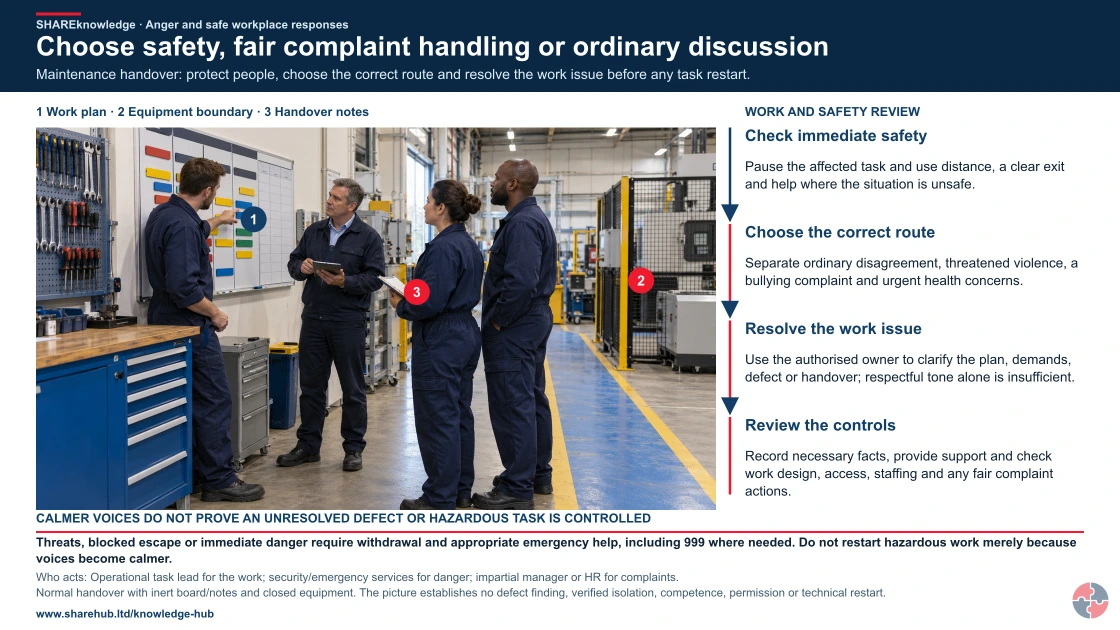
Full written explanation
An illustrative UK maintenance-workshop handover shows a work board, closed guarded equipment and inert handover notes. A single numbered picture key identifies these physical features; the separate safety/work review has unnumbered headings in its genuine order. Check immediate safety, choose the correct route, resolve the actual work issue through the authorised owner, then review controls and necessary facts. The board and notes support questions about demands, the work plan, changed conditions and accountable decisions. The equipment boundary gives the real task context; it does not identify a defect, prove isolation or establish permission to enter or restart. Respectful conversation alone cannot resolve an unclear hazardous task or failed barrier. Safety, the technical work decision, support and a fair complaint process keep their own evidence and responsible roles. The scene contains normal colleagues, not an acted confrontation, diagnosis or clinical intervention. A threat, blocked escape or immediate danger uses the existing withdrawal and emergency-help arrangements; a calmer tone is not work clearance. The image adds no therapy, disciplinary finding, medical or legal rule, isolation method or technical restart procedure.
Maintenance handover: protect people, choose the correct route and resolve the work issue before any task restart.
- Check immediate safety. Pause the affected task and use distance, a clear exit and help where the situation is unsafe.
- Choose the correct route. Separate ordinary disagreement, threatened violence, a bullying complaint and urgent health concerns.
- Resolve the work issue. Use the authorised owner to clarify the plan, demands, defect or handover; respectful tone alone is insufficient.
- Review the controls. Record necessary facts, provide support and check work design, access, staffing and any fair complaint actions.
When the evidence does not fit: Threats, blocked escape or immediate danger require withdrawal and appropriate emergency help, including 999 where needed. Do not restart hazardous work merely because voices become calmer.
Who acts: Operational task lead for the work; security/emergency services for danger; impartial manager or HR for complaints.
Changed workplace
Customer-service office: Provide a safe exit, help and workable demand controls; a worker need not tolerate threats to keep a queue moving.
Maintenance handover: Keep an unresolved defect or unclear hazardous task held while the authorised owner resolves the work issue.
Evidence check: De-escalation is not an obligation to remain at risk. Behaviour, work control and a fair complaint process need separate evidence.
Primary references: HSE violence prevention — work design, layout, staffing and help arrangements · HSE stress Management Standards — demands, relationships, role and support · GOV.UK workplace bullying and harassment — fair complaint context; apply the topic’s jurisdiction qualifications
Open the complete HD image (new tab)Download image
Primary references: HSE violence prevention — work design, layout, staffing and help arrangements · HSE stress Management Standards — demands, relationships, role and support · GOV.UK workplace bullying and harassment — fair complaint context; apply the topic’s jurisdiction qualifications
Withdraw from a threat


Read this visual as text
- Keep distance and an exit route, use the agreed alarm and withdraw to help. Use 999 where immediate danger warrants it. De-escalation is not an obligation to stay beside a threatening person.
- KEEP DISTANCE
- KEEP AN EXIT
- WITHDRAW AND GET HELP
1. Disagreement in a site briefing
Task material and setting: Two BuildOut Ltd trades disagree over delivery order in a routine site briefing; the outcome is a safe sequence, not forced agreement.
People and prerequisites: Operatives, supervisor and nearby plant users; the briefing is away from moving equipment and the supervisor can pause the task.
Before: Check the programme, traffic plan and affected permits; let each trade state the practical constraint without personal labels.
During: Pause the conversation if voices rise, clarify facts and ownership, choose an agreed sequence and brief affected workers.
Hold or stop: Personal insults, blocking an exit or rushing plant movement: stop the task and move people apart; escalate to the site manager.
Completion and hand back: Restart only after the work sequence and traffic interface are clear; review any unresolved allocation issue.
Evidence: Briefing change, work plan and any factual near-miss record.
2. Angry handover before a crane lift
Task material and setting: A supervisor and signaller argue about a changed lifting slot; the outcome is to prevent a distracted or unclear lift.
People and prerequisites: Lifting team, nearby contractors and delivery driver; the lift plan and authorised decision-maker are available.
Before: Stop and secure the lift, check the actual plan and changed conditions, and give the team time away from confrontation.
During: The lift supervisor resolves the sequence and rebriefs the team before work resumes.
Hold or stop: No clear signal, intimidation, impaired concentration or unresolved plan change: no lift; a calmer tone alone is not clearance.
Completion and hand back: Authorised lift lead confirms team understanding and hand-back under the site lift procedure.
Evidence: Plan revision, briefing and stop/restart decision.
3. Abusive customer at a reception desk
Task material and setting: A visitor shouts at a BuildOut project reception worker over access refusal; the outcome is a safe exit and controlled service response.
People and prerequisites: Reception worker, visitor and others in the lobby; a second worker, alarm and exit route are identified.
Before: Provide clear entry rules and a way to summon help; avoid lone exposure where the risk assessment requires support.
During: Use a calm, brief explanation from safe distance; offer an alternative contact and withdraw if abuse continues.
Hold or stop: Threats, pursuit, blocked exit or physical contact: leave, raise the alarm and call 999 for immediate danger; no worker must stay to de-escalate.
Completion and hand back: Provide welfare support, preserve facts and review reception staffing and layout.
Evidence: Incident note, witness account, security log and control review.
4. Complaint that the supervisor shouts
Task material and setting: A worker reports repeated public humiliation by a supervisor; the outcome is a fair complaint route and protection from retaliation.
People and prerequisites: Worker, supervisor and team; an independent manager or HR contact can receive the account.
Before: Check immediate safety and any need to separate reporting lines; explain confidentiality limits and support options.
During: Record the worker account, preserve relevant messages and choose an impartial process proportionate to seriousness.
Hold or stop: Threats, discriminatory harassment or retaliation: escalate promptly; do not require the worker to confront the supervisor alone.
Completion and hand back: Tell parties the outcome and safeguards within privacy limits; review leadership conditions and behaviour.
Evidence: Complaint, evidence, decisions, support and control actions.
5. Contractor dispute at a gate
Task material and setting: A subcontractor driver disputes an unannounced access change with a gate marshal; the outcome is a safe route and no vehicle movement during conflict.
People and prerequisites: Driver, marshal, pedestrians and other contractors; host and contractor contacts are named.
Before: Publish access changes, provide holding space and a contact route; confirm the marshal can stop the queue.
During: Stop the vehicle, move discussion away from the traffic route and get the authorised logistics lead to resolve the change.
Hold or stop: Vehicle movement, threatening behaviour or no agreed route: keep the gate closed and use site emergency response if necessary.
Completion and hand back: Rebrief host and contractors; restart only with a clear route and communication.
Evidence: Access-change notice, contractor briefing, incident facts and revised traffic plan.
6. Lone worker hears a threat
Task material and setting: A lone site caretaker receives a credible threat during an evening lock-up; the outcome is safe withdrawal and rapid support.
People and prerequisites: Caretaker and any late workers; working phone, check-in contact and exit route were planned.
Before: Check the lone-work communication, site layout and secure areas before the shift.
During: Leave the threatened area, contact the check-in person and security, and call 999 if immediate danger is present.
Hold or stop: Failed phone, missing check-in or unsafe return route: do not continue lock-up alone or re-enter to investigate.
Completion and hand back: A responsible manager arranges safe site control, support and a revised lone-work plan.
Evidence: Check-in failure, threat report, response times and control changes.
7. Worker says they may hurt themselves or someone else
Task material and setting: During a difficult meeting, a worker describes an immediate intention to harm; the outcome is immediate safety and professional help.
People and prerequisites: Worker, colleagues and manager; the room has an exit and someone can call emergency services.
Before: Keep a calm tone, make space and avoid argument or amateur diagnosis; arrange another person to help summon support.
During: If anyone is in immediate danger, call 999, give location and follow the call handler; move others to safety without unsafe physical intervention.
Hold or stop: Do not leave the risk to a routine EAP referral, disciplinary meeting or promise of absolute confidentiality.
Completion and hand back: After professional handover, protect privacy, support affected people and review work factors and return arrangements separately.
Evidence: Emergency call and handover facts, restricted support record and later work-risk review.
What should be checked before, during and after exposed work?
Check the work conditions and help route before a task, stop at a credible safety trigger, and restart only when the person and task are protected.
Return to a Safety Critical Task
Two linked parts · 5 questions. Open Part 2 to complete the route.

Continue to questions 4–5 · Part 2 of 2


Read this visual as text
- Start: A dispute has interrupted a lift, traffic move or other task needing clear coordination.
- Question 1: Is the interrupted task in a verified safe state? Decision owner: Supervisor / independent HR or incident lead.
- YES: The required evidence or condition is confirmed. CONTINUE → QUESTION 2.
- NO / UNKNOWN — HOLD: Secure the load, vehicle, plant or workface under the local method. HOLD → REPEAT QUESTION 1 AFTER CORRECTION.
- Question 2: Is the actual plan and condition still valid? Decision owner: Supervisor / independent HR or incident lead.
- YES: The required evidence or condition is confirmed. CONTINUE → QUESTION 3.
- NO / UNKNOWN — HOLD: Resolve changed instructions, hazards or interfaces before restarting. HOLD → REPEAT QUESTION 2 AFTER CORRECTION.
- Question 3: Are threats and unreliable concentration or communication resolved? Decision owner: Supervisor / independent HR or incident lead.
- YES: The required evidence or condition is confirmed. CONTINUE → QUESTION 4.
- NO / UNKNOWN — HOLD: Keep work held and arrange appropriate support or alternative people. HOLD → REPEAT QUESTION 3 AFTER CORRECTION.
- Question 4: Can the authorised lead confirm everyone understands the plan and signals? Decision owner: Supervisor / independent HR or incident lead.
- YES: The required evidence or condition is confirmed. CONTINUE → QUESTION 5.
- NO / UNKNOWN — HOLD: Rebrief and check understanding; a calmer tone alone is insufficient. HOLD → REPEAT QUESTION 4 AFTER CORRECTION.
- Question 5: Has restart been authorised and recorded within the work scheme? Decision owner: Supervisor / independent HR or incident lead.
- YES: The required evidence or condition is confirmed. OUTCOME → RECORD AND HAND OVER.
- NO / UNKNOWN — HOLD: Keep conduct/support decisions separate from the technical hand-back. HOLD → REPEAT QUESTION 5 AFTER CORRECTION.
- Outcome: A documented authorised restart, or continued hold with new controls and support.
- Stop and escalation boundary: No restart on a calmer tone alone. Hold for an unresolved plan, threat, unclear signal or missing decision owner.
| Stage | Practical check | Hold or hand-back |
|---|---|---|
| Before | Review interface, staffing, roles, likely conflict, exit, communication and complaint route. | Do not start lone or public-facing work with a broken essential help route. |
| During | Notice escalation; pause safety-critical work; use calm communication only while safe. | Threat, unsafe concentration, blocked exit or alarm failure means withdraw and escalate. |
| After | Support affected people, record facts, review work causes, decide safe restart. | Manager verifies changed controls and briefs the next shift or contractor. |
After immediate safety, follow two separate routes
Use withdrawal and emergency arrangements first when there is danger. Afterwards, a calmer conversation does not prove that an interrupted safety-critical task can restart.
Task route: operations owner
- Keep affected equipment or activity in the established safe state.
- Check the current plan, people, communications and any changed conditions.
- Rebrief roles and signals; resolve defects or missing information.
- The authorised task owner records the restart decision under the relevant scheme.
People route: impartial recipient
- Offer a private welfare conversation and support.
- Provide an impartial route to report a concern or complaint.
- Record facts, protect relevant evidence and explain information access.
- Agree follow-up without requiring mediation as the price of safety or support.
Worked example: a heated exchange interrupts a lifting operation. The lifting team checks the plan and communication arrangements before any restart. Separately, an uninvolved manager receives the complaint. Closing one route does not close the other.
Bring the routes together only to learn: review staffing, workload, layout, escalation and repeated problems with workers. Expressions or a mental-health label cannot establish threat or blame.
How should support, fairness and privacy work together?
Ask what work support is needed, record behaviour facts fairly, restrict health details and explain when safety requires limited sharing.
A manager can ask about the effect on work and offer GP, EAP or occupational-health routes without demanding a diagnosis. An allegation of bullying or violence needs a fair process for everyone involved, including the accused, with protection from retaliation. Health information is special-category data: identify a lawful basis and condition, minimise access and keep it separate from routine incident facts. Do not promise absolute confidentiality where an immediate threat, safeguarding or legal duty requires action. A possible disability may call for adjustments under the correct GB or NI law, but does not remove protection for others.
| Information or route | Appropriate handling | Limit |
|---|---|---|
| Incident facts | Record behaviour, time, setting, people affected and action taken. | Avoid speculative diagnoses or personality labels. |
| Health disclosure | Ask only what is necessary for support, safety or adjustments. | Restricted access and documented legal basis/condition. |
| Complaint | Use an impartial, timely process and support each party. | Do not force direct mediation where unsafe. |
| Immediate threat | Share necessary facts with responders and protect others. | Safety escalation is not blocked by a promise of secrecy. |
Which legal duties differ between Great Britain and Northern Ireland?
GB and NI have separate health-and-safety, reporting and equality routes; no statute requires a universal anger-management course.
Employers assess and control foreseeable work-related stress and violence, consult and inform workers, and review arrangements. GB uses the Health and Safety at Work etc Act 1974, Management Regulations 1999 and RIDDOR 2013. NI uses the 1978 Order, Management Regulations (NI) 2000 and RIDDOR (NI) 1997. Reportability needs a qualifying work connection and outcome; do not import GB thresholds into NI. Bullying is not automatically unlawful discrimination, but harassment linked to protected characteristics can be; GB Equality Act 2010 does not govern NI employment. NI disability duties follow the Disability Discrimination Act 1995 as applied there. UK data-protection law applies to personal and health records. Separate disciplinary, criminal and safeguarding advice may be necessary for the actual facts.
| Issue | Great Britain | Northern Ireland |
|---|---|---|
| General work risk | Health and Safety at Work etc Act 1974; Management Regulations 1999. | Health and Safety at Work (NI) Order 1978; Management Regulations (NI) 2000. |
| Violence and stress | Assess foreseeable work risk using HSE guidance. | Assess foreseeable work risk using NI law and HSENI guidance. |
| Statutory reporting | RIDDOR 2013; check work connection and qualifying injury/event. | RIDDOR (NI) 1997; check NI criteria, which differ. |
| Equality and adjustments | Equality Act 2010 where statutory criteria apply. | NI equality legislation; Disability Discrimination Act 1995 route where applicable. |
| Personal information | UK GDPR/Data Protection Act 2018. | UK GDPR/Data Protection Act 2018. |
How should risk and assurance be recorded?
Record situations and controls, not an “angry employee” label; check whether workers can leave, report and get support when a risk materialises.
Relevant entries might cover a late gate, complaint desk, high-pressure lifting interface or repeated intimidating management behaviour. Name an owner and the evidence that a control works. Reassess after changed shifts, customer incidents, grievances, near misses or a failed alarm. Record the facts of an incident separately from restricted health or HR records; review RIDDOR only against jurisdictional criteria.
| Exposure | Control | Evidence and trigger |
|---|---|---|
| Public complaint or refusal | Staffing, clear information, exit and help route. | Incident trend; retest after layout or demand change. |
| Workload and change | Consultation, role clarity and realistic task allocation. | Stress actions and worker feedback. |
| Threats at lone location | Contact, check-in, alarm and withdrawal authority. | Practical exercise; hold work if communication fails. |
| Manager intimidation | Independent complaint route and leadership accountability. | Worker confidence, complaint handling and repeat pattern. |
How could BuildOut Ltd put this into practice?

BuildOut should prevent predictable site and contractor conflicts, protect workers during threats and use fair support and conduct routes after safety is secured.
BuildOut Ltd manages construction projects with delivery gates, lifting slots, noisy shared work areas and changing subcontractor programmes. The project manager publishes coordination decisions and a route for unresolved clashes. Supervisors stop dependent tasks when a dispute undermines clear communication; they do not push an angry team through a lift to meet programme. A gate marshal can withdraw from abuse and reach the logistics lead. HR receives complaints about a supervisor through an independent route. An affected worker is offered support without being required to disclose a diagnosis to the team. The safety adviser reviews actual incident patterns and whether staffing, programme and exit controls have improved.
| Owner | Control | Evidence |
|---|---|---|
| Project manager | Resolve programme and contractor interface conflicts before live work. | Programme, coordination log and briefing. |
| Lift or task supervisor | Hold safety-critical work when communication or concentration is unreliable. | Stop and authorised restart record. |
| Logistics lead | Give marshals safe exits, help and access-change information. | Gate plan, communication test and incident review. |
| HR and senior manager | Handle complaints impartially, protect against retaliation and offer support. | Restricted case and action records. |
| Safety adviser | Trend violence and stress-related work factors without diagnosing workers. | Risk review and verified corrective actions. |
What awareness and practice should roles receive?
Match practice to the risks of the job: all staff need boundaries and help routes; exposed workers need scenario practice; managers need fair intervention and work-design skills.
HSE expects risk-based violence training where workers may be exposed, including temporary and agency staff. This does not mean every worker needs a named anger-management certificate. Public-facing and lone roles may need alarm, withdrawal and de-escalation practice; specialised physical intervention needs a separate competent, authorised assessment. Managers should learn how to assess stress and respond to complaints without diagnosing or forcing unsafe mediation. Check competence through real scenarios and changed controls, not an invented universal renewal interval.
| Role and learning | Practice on the actual task | Competence evidence and record | Assessor and reassessment trigger |
|---|---|---|---|
| Workers: pause and report | Practise early self-regulation, safe exit from aggression and reporting without diagnosing others. | Observed scenario with de-escalation, withdrawal and report route. | Supervisor checks after incident, task or team change. |
| Supervisors: protect before mediation | Recognise threats, stop unsafe contact, preserve facts and arrange fair follow-up. | Observed role play and proportionate incident record. | Competent manager checks after escalation or poor response. |
| Lone-worker and front-line leads | Check staffing, communication, escape, alarm and customer-interface controls. | Drill, device check, route inspection and worker feedback. | Operational lead reviews after changed service or violence trend. |
| HR and privacy advisers | Separate conduct, disability support, complaints and restricted health data. | Case exercise with lawful information sharing and fair process. | Legal/privacy lead checks after policy or law change. |
| Managers: reduce work drivers | Assess workload, role conflict and violence trends; close controls and support needs. | Risk review, anonymised trend and verified corrective action. | Accountable lead reviews after trend, serious event or new work. |
Record the practised safe-exit, de-escalation and reporting decision, assessor and reassessment trigger. Attendance at a course does not authorise physical intervention or replace the site violence plan.
What can ISO 45001 and ISO 45003 add?
ISO 45001 can structure safety management and ISO 45003 can guide psychosocial risk work; neither is a compulsory anger-treatment standard.
Use the current editions to test worker consultation, work design, violence-response planning, learning and improvement. An ISO certificate does not show that a lone worker can raise an alarm, that a bullying complaint was fair or that a crisis call will be made promptly. Those need task-specific evidence and the applicable GB or NI legal assessment.
How should the management system learn from conflict?
Use leadership, worker participation, assessment, action and review to reduce repeat harm, while keeping individual health and complaint records restricted.
| Stage | Decision | Evidence |
|---|---|---|
| Plan | Identify stress and violence exposures with workers and contractors. | Risk assessment and priorities. |
| Do | Fix work design, provide exits and help routes, train exposed roles. | Briefings, tests and support arrangements. |
| Check | Review incident, complaint and worker-feedback patterns, including non-injury abuse. | Trend and control-effectiveness review. |
| Act | Change the control and confirm it works before closing the action. | Owner, due action and verified closure. |
What are the warning signs that anger management is not working?
Warning signs include repeated conflict, low reporting, normalised shouting, fear of managers, customer aggression and unresolved work pressure.
The visible argument is often the end of the chain. Earlier signs include people avoiding a supervisor, sarcastic team culture, workers not taking breaks, grievance patterns, repeated customer complaints, increasing sickness absence, turnover from one team, or near misses after confrontations.
Each sign should be treated as learning. If workers only report violence after injury, reporting is weak. If a manager repeatedly shouts but delivers targets, leadership control is weak. If customer aggression spikes at closing time, staffing, communication or service design may need attention.
| Warning sign | How it can cause harm | What to do |
|---|---|---|
| Normalised shouting | People may feel intimidated and stop raising concerns. | Set leadership expectations and intervene early. |
| Repeated team conflict | Trust breaks down and work information is withheld. | Review roles, workload, communication and mediation options. |
| Customer aggression not reported | Risk patterns remain hidden. | Simplify reporting and show visible follow-up. |
| Managers blame personality only | System causes such as workload or unfairness are missed. | Review work design and management practices. |
| Support with no boundaries | Unsafe behaviour may continue and harm others. | Combine support with clear standards. |
| Formal action with no support | Underlying stress or health factors may worsen. | Use fair process, support and occupational-health advice where needed. |
| No learning after incidents | The same trigger repeats. | Investigate, assign actions and verify closure. |
Standards named on this page are background context. Confirm the current edition, scope and exact requirements from an authorised copy before applying them. The open official sources below support the specific public-law and regulator guidance claims they are cited for.
What do the acronyms and key terms mean?
Acronyms should be defined because anger management overlaps wellbeing, HR, safety, violence prevention and occupational health.
| Acronym or term | What it means | Why it matters |
|---|---|---|
| CBT | Cognitive behavioural therapy. | A talking-therapy approach often used in anger-management programmes and self-help resources. |
| EAP | Employee assistance programme. | Confidential support service some employers provide for counselling or practical advice. |
| HR | Human resources. | Often supports conduct, grievances, adjustments and wellbeing processes. |
| HSE | Health and Safety Executive. | Great Britain’s regulator for workplace health and safety, including stress and violence guidance. |
| OH | Occupational health. | Specialist advice on work impact, fitness, restrictions and return to work. |
| RIDDOR | Reporting of Injuries, Diseases and Dangerous Occurrences Regulations. | May apply to reportable injuries linked to work-related violence. |
| UK GDPR | UK General Data Protection Regulation. | Relevant to health, support and personal records. |
| Management Standards | HSE’s approach to work-related stress risk factors. | Useful for identifying work conditions that can increase anger and conflict. |