SHARE Knowledge Hub
Addictions and Dependency
Addiction or dependency may affect health and work, but a manager cannot diagnose it from behaviour. Offer private support and qualified help. If someone may not be fit for a safety-critical task, pause that task calmly, protect others and follow the policy. Clinical care and workplace fitness are separate decisions.
Understanding Addictions and Dependency
Addictions and dependency at work is a health, psychosocial, fitness-for-work and organisational-management topic.
Why this matters at work
If there is a credible concern that a person cannot perform the task safely, pause the hazardous activity and arrange a safe handover or isolation. Move the discussion to a suitable private place with respectful supervision. Assess observable symptoms and whether urgent medical help is needed; apparent impairment can have causes other than substance use. Do not delay emergency care while seeking a sample or a senior signature.
Define the purpose before introducing testing: a specific safety question, an incident investigation or a relevant sector requirement may call for different evidence. Consider whether testing is necessary and proportionate to the actual role and risk and whether a less intrusive method would answer the question. Consult workers, establish a transparent policy and obtain appropriate data protection and employment advice. Obtain the worker’s consent to screening: a workplace sample cannot be forced. Handle any refusal through the applicable fair policy and employment process rather than treating it as a positive test result.
How organisations manage this in practice
Keep clinical occupational health records separate from management records. A supervisor may need to know that driving is restricted and when review is due, without knowing a diagnosis, test values or therapy history. Explain access, sharing, retention, correction and confidentiality limits in advance and protect accuracy and security. Assess high risk processing, including a proposed testing programme, through the appropriate impact assessment. Check current ICO guidance and the applicable GB or NI employment and equality route before implementing a consequential policy. Do not promise complete secrecy where serious safety or legal duties may require proportionate disclosure, and do not circulate speculation in general incident or team records.
Agree practical work arrangements based on function and task demands, including any temporary restriction from safety critical activity, appointment needs, communication and review. Occupational health can advise on capability, treatment effects and adjustments; managers normally need the functional opinion rather than detailed clinical records. A supportive referral is not automatic immunity from every separate unsafe act, but support and fair accountability can coexist. Check that help is accessible across shifts, locations and employment arrangements. Identify a coordinating owner and review whether the plan works in actual duties, rather than measure support solely by the existence of an employee assistance telephone number.
A positive screen does not by itself establish current impairment, addiction or the cause of an incident. Interpretation depends on specimen, detection window, medicine, analytical threshold and method. A justified programme needs competent providers, accurate collection and identity checks, chain of custody, contamination prevention, confirmation, medical review and a fair dispute process. Keep emergency treatment independent of testing and do not use covert sample collection as a shortcut. Specify who receives which result and how long it is retained. Reassess the programme’s value and adverse impact; screening is one possible part of a wider prevention and support system, not the solution on its own.
This page is workplace guidance and learning content, not medical advice, counselling, diagnosis or treatment. Anyone affected by addiction, dependency, withdrawal, mental health crisis or medication concerns should use qualified support such as a GP, NHS service, occupational health, employee assistance provider, specialist addiction service or safeguarding route where appropriate.
What should managers focus on?
Managers should focus on observed work impact, immediate safety, fitness for work, agreed support and review. They should not diagnose addiction, demand unnecessary medical detail or rely on gossip.
When should qualified support be used?
Qualified support should be used where treatment, withdrawal, medication, relapse, mental health risk, safeguarding, return to safety-critical duties or complex adjustments need professional judgement.
How should confidentiality be protected?
Health, testing and support information should be collected only where necessary, kept secure, shared strictly on a need-to-know basis and explained clearly to the worker before records or referrals are made.
How should this workplace guide be used?
Use this guide for workplace prevention, fair support and safe task decisions; health professionals decide diagnosis, withdrawal and treatment.
It covers substance-related concerns and behaviours such as gambling where work may be affected. It does not make every private habit a workplace matter, or assume a disclosed condition makes a worker unfit.
For an individual decision, use current NHS, workplace, privacy and jurisdiction-specific sources. Managers control immediate work risk and offer support; qualified clinicians assess treatment and withdrawal.
Protect the task and open a private support route
Respond to what is observed and what the task requires. Dependency, present impairment, prescribed medicines and fatigue are different questions. A worker can request support without being unsafe at that moment, while an immediate functional concern may require temporary task cover before its cause is known.
Keep shared operational records limited to the restriction, cover and responsible owner. Private health or testing information belongs in the appropriate restricted system. Agree the next conversation and hand-back decision; a supervisor should not use a diagnostic label or an improvised test to settle fitness.
A lifeguard reports a concern before duty
Illustrative example. A worker privately says they are not confident they can carry out the pool-cover task safely and asks for help.
Decision. Arrange competent cover, check immediate welfare and agree a confidential support route.
Evidence to check. Record the affected duties and cover in the operational handover; keep the personal discussion separately restricted.
Hold or escalation point. Do not return the worker to safety-critical cover because staffing is short or a test is unavailable.
Follow-up. A named manager agrees the review, functional advice needed and a proportionate return decision.
Who handles safety, support, privacy and clinical care?
Workers report safety effects or seek help; supervisors pause unsafe tasks; HR manages fair process; occupational health advises function; clinicians manage health care.
Work safety and private support need their own decisions
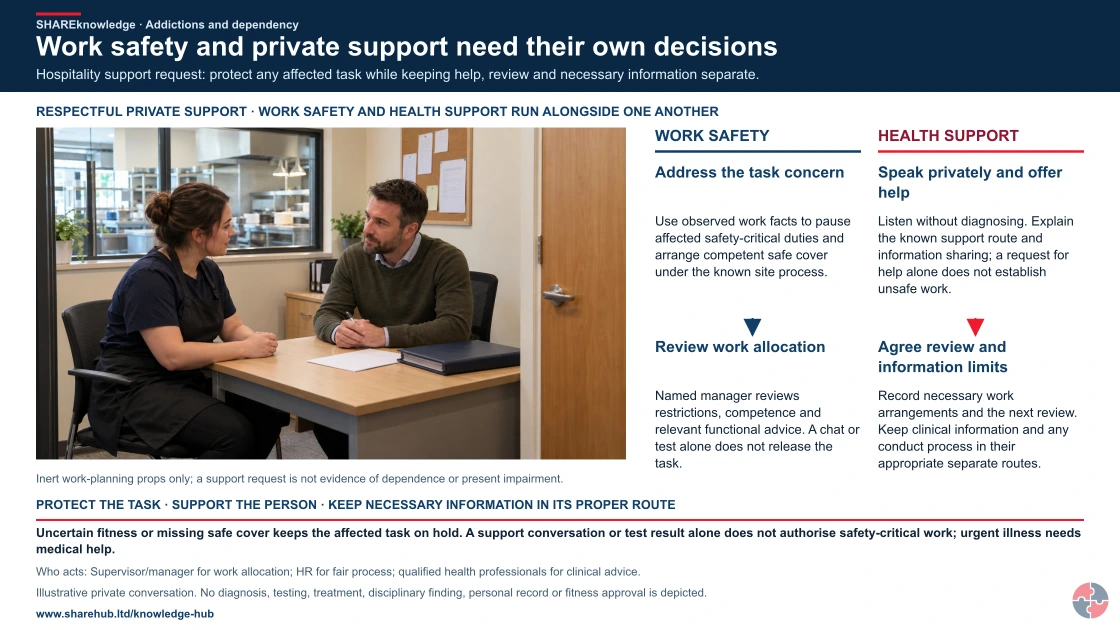
Full written explanation
A detailed realistic HD hospitality staff-office scene shows a neutral employee/manager conversation in a closed private room beside an empty restaurant preparation area. A closed folder and plain sheet are inert props, not real health or operational records. A complete native parallel relationship distinguishes WORK SAFETY from HEALTH SUPPORT. The work route uses observed task facts, competent cover and a named manager’s review of work arrangements; the support route listens without diagnosis, explains known help/information routes and agrees a necessary review. Neither a request for help nor a support conversation alone establishes unsafe work or releases safety-critical duties. The two roles remain connected without substituting clinical interpretation or confidential detail for the task decision. No intoxication cues, test/sample collection, clinical advice, treatment, automatic work-return standard, compulsory disclosure, disciplinary conclusion or new employment/data-processing rule is depicted. All original source checks and existing technical/legal/health qualifications remain in the retained written teaching. Clinical, testing and employment-rule extensions are explicitly outside this visual packet.
Hospitality support request: protect any affected task while keeping help, review and necessary information separate.
- Address the immediate concern. Use observed work facts to pause the affected safety-critical task and arrange safe cover.
- Review the work assignment. The responsible manager confirms restrictions, competence and the agreed return arrangements.
- Speak privately and offer help. Listen without diagnosing; explain the known policy and appropriate GP, specialist or OH support.
- Agree review and information limits. Record necessary arrangements; keep clinical information and any conduct process appropriately separate.
When the evidence does not fit: Uncertain fitness or missing safe cover keeps the affected task on hold. A support conversation or test result alone does not authorise safety-critical work; urgent illness needs medical help.
Who acts: Supervisor/manager for work allocation; HR for fair process; qualified health professionals for clinical advice.
Changed workplace
Delivery before departure: Keep the vehicle parked and arrange authorised cover while the immediate concern is resolved.
Maintenance rota change: Review fatigue and workload, while offering private help without labelling a crew as dependent.
Evidence check: A person is not the hazard. Control the work and support the person without turning observations into a diagnosis.
Primary references: HSE managing drug and alcohol misuse at work — observed changes are not a diagnosis (GB) · HSE safety-critical work — actual task assessment and temporary work arrangements · HSE supporting employees — known policy and discreet support · HSE developing a policy — current policy and review context
Open the complete HD image (new tab)Download image
Primary references: HSE managing drug and alcohol misuse at work — observed changes are not a diagnosis (GB) · HSE safety-critical work — actual task assessment and temporary work arrangements · HSE supporting employees — known policy and discreet support · HSE developing a policy — current policy and review context
Safety, clinical care and privacy are different decisions


Read this visual as text
- TASK SAFETY: Arrange safe cover or restrict the affected activity when current function is a concern.
- HEALTH SUPPORT: Offer appropriate clinical or specialist help through a private route.
- NECESSARY RECORD: Record work arrangements and restrict sensitive personal information to those who need it.
Task protection, qualified health support and necessary records have different owners. Bring them together through agreed arrangements and review; a test result does not replace the task-specific decision.
| Role | Action | Boundary |
|---|---|---|
| Workers and contractors | Use the support route early and report anything that may affect safe work. | No need to disclose irrelevant diagnosis to a whole team. |
| Supervisors | Observe work facts, pause a credible unsafe task and speak privately. | Do not diagnose, prescribe or force a test. |
| Managers and HR | Apply the known policy, consult, record proportionately and arrange fair support or investigation. | Separate welfare, safety and conduct decisions. |
| Safety and operational leads | Identify critical tasks, contractor interfaces and systemic work pressures. | Do not use a positive screen as the whole risk assessment. |
| Occupational health and clinicians | Assess health or functional restrictions and advise where appropriate. | Management decides work assignment; clinicians decide treatment. |
What are the key points for addictions and dependency?
The key points are that addiction is a health issue, impairment is a safety issue, and both need a fair system that people understand before a problem occurs.
Addiction is not the same as occasional misuse
Addiction involves reduced control and continued use or behaviour despite harm. Misuse may be occasional or risky, while dependence can involve tolerance, cravings and withdrawal when the substance or behaviour is stopped.
Managers should not diagnose
Workplace observations such as absence, conflict, fatigue, errors or smell of alcohol are prompts for a private conversation and risk decision, not proof of addiction or misconduct.
Safety-critical work needs clear boundaries
Driving, machinery, work at height, electrical work, lone work, safeguarding, plant operation and public-safety roles may need immediate temporary controls if impairment is reasonably suspected.
Support and accountability can exist together
A supportive employer can signpost to help, adjust work and allow treatment time while still enforcing rules about being fit for work and not placing others at risk.
Policy must be known before it is needed
Drug, alcohol, medication and dependency policies should explain self-referral, confidentiality, testing, reasonable suspicion, disciplinary links, support routes and return-to-work expectations.
Work can help or worsen the issue
Stress, fatigue, poor supervision, isolation, bullying, pain, shift patterns, job insecurity and workplace drinking culture can all influence whether someone asks for help or hides a problem.
What are addictions and dependency?
Addiction is loss of control over doing, taking or using something to the point where it can cause harm, while dependence means the body or mind has adapted so strongly that stopping can cause cravings, distress or withdrawal.
A manager cannot infer a diagnosis from these patterns. NHS describes addiction broadly, while HSE distinguishes misuse from dependence; an observed work problem calls for a factual, private response.
Addiction is often associated with alcohol, illegal drugs, prescription medicines, gambling and nicotine, but it can also involve behaviours such as gaming, internet use, shopping, sex or work. The common thread is not the object of the addiction; it is the pattern of reduced control, repeated use or behaviour, continuing despite harm, craving, secrecy and difficulty stopping.
Dependence can be physical, psychological or both. Physical dependence may involve tolerance and withdrawal symptoms. Psychological dependence may involve powerful urges, routines, emotional relief, reward seeking or using the substance or behaviour to cope with stress, trauma, pain, boredom, loneliness or distress.
Workplace management should focus on function and risk rather than labels. The relevant questions are: is the person safe to do the task today; are there work factors making the problem worse; what support route is available; what information needs to be confidential; and what review is needed?
| Concept | Plain-English meaning | Workplace significance |
|---|---|---|
| Addiction | Reduced control over a substance or behaviour despite harm or serious difficulty stopping. | May affect attendance, concentration, judgement, relationships, finances, safety and willingness to disclose problems. |
| Dependence | The body or mind has adapted to the substance or behaviour, making stopping difficult and sometimes physically risky. | Withdrawal, cravings, sleep problems or distress may affect fitness for work, recovery, attendance or rehabilitation planning. |
| Tolerance | Needing more of a substance or behaviour to get the same effect. | Can increase health harm and may make patterns less visible until a significant event occurs. |
| Withdrawal | Physical or psychological symptoms after reducing or stopping a substance or behaviour. | May create fatigue, tremor, anxiety, sweating, nausea, irritability, distraction or other functional limitations. |
| Impairment | A reduced ability to work safely because of alcohol, drugs, medicine, fatigue, withdrawal, distress or another factor. | This is the safety decision point: control the task first, then manage welfare, policy and support. |
How do these decisions play out in real work?
Start with the actual task and observed risk, protect privacy, stop unsafe activity and agree a documented hand-back.
These examples are teaching scenarios, not a licence to diagnose, test or set a universal alcohol or drug threshold.
1. Worker asks for support before a safety problem
Task material and setting: A Riverside Leisure Ltd leisure-centre administrator privately asks about gambling-related distress; the outcome is support without an invented impairment finding.
People and prerequisites: Worker, line manager and HR may be affected; the manager knows the confidential referral route and immediate role demands.
Before: Offer a private conversation, explain information sharing and ask about work barriers rather than debt or diagnosis.
During: Agree work actions, NHS or specialist signposting and a review date; do not disclose a label to colleagues.
Hold or stop: Hold any new cash-handling restriction for a factual role risk decision, not a stereotype about gambling.
Completion and hand back: Review agreed work changes and the worker view; clinical care remains with qualified services.
Evidence: Minimum necessary work actions, owner, permitted sharing route and review date.
2. Driver appears unfit before a delivery
Task material and setting: A delivery driver appears confused and unsteady before using a vehicle; the outcome is to prevent unsafe travel and protect welfare.
People and prerequisites: Driver, road users and site staff may be affected; a supervisor has the fitness escalation policy and alternative transport.
Before: Identify the assigned driving duty, observe facts without guessing the cause and speak privately.
During: Pause driving, secure keys under the agreed site process, arrange safe supervision and seek first-aid or emergency help if clinically concerning.
Hold or stop: Do not let the person drive home or restart because a brief conversation or single test looks reassuring.
Completion and hand back: HR or occupational health advises the later work process; a named manager authorises duty return on appropriate evidence.
Evidence: Observed facts, duty pause, welfare action, policy route and later authorisation.
3. Prescribed medicine changes alertness
Task material and setting: A plant operator reports drowsiness after a medicine change; the outcome is safe duties without demanding a diagnosis.
People and prerequisites: Operator and nearby crews may be affected; supervisor knows the task and occupational health can assess functional restrictions.
Before: Ask about effects relevant to the task, not the medicine name unless necessary for a qualified process.
During: Temporarily assign non-critical work and refer for clinical or occupational-health advice.
Hold or stop: Do not equate lawful prescribing with automatic fitness; do not tell the worker to stop medicine.
Completion and hand back: Review restrictions and agree task return with the named work authority after qualified advice.
Evidence: Task risk, temporary assignment, OH advice summary and review.
4. Overtime and fatigue after a rota change
Task material and setting: A maintenance team reports fatigue and increased drinking concerns after extended shifts; the outcome is safer work design and private help routes.
People and prerequisites: Workers, contractors and the public may be affected; manager and safety lead assess the rota and critical tasks.
Before: Review hours, breaks, near misses, workload and worker feedback without collecting unnecessary personal histories.
During: Reduce unsafe fatigue exposure, brief workers on support and investigate the changed work pattern.
Hold or stop: Stop a high-risk job when alertness is uncertain; do not label a whole crew as dependent.
Completion and hand back: Verify revised rota controls and individual support actions separately.
Evidence: Rota risk assessment, consultation, near-miss trend and action owners.
5. Contractor raises a possible impairment concern
Task material and setting: A subcontractor may be unfit for work at height at an occupied refurbishment site; the outcome is a coordinated stop and fair handover.
People and prerequisites: Contractor, host team and occupants may be affected; both employers know the site policy and supervisor contacts.
Before: Agree fitness and stop-work arrangements at induction; verify the actual task and safe alternative.
During: Pause the height task, keep the person safe and contact the contractor manager privately.
Hold or stop: Do not let unclear employment ownership delay the stop; do not circulate rumours to the client.
Completion and hand back: Contractor employer manages welfare and employment process; host verifies safe replacement and task restart.
Evidence: Observed task risk, contractor notification, replacement competence and restart authorisation.
6. Near miss followed by a proposed test
Task material and setting: After a leisure-centre plant-room near miss, someone proposes immediate drug testing; the outcome is safe incident control and lawful, useful evidence.
People and prerequisites: Operator, colleagues and investigation team may be affected; HR, safety and a qualified testing provider check the agreed policy.
Before: Secure plant, care for people and preserve factual evidence. Check the known testing policy, role risk, less intrusive options and separate data-processing basis.
During: If justified, seek practical agreement to the sample and use a transparent, competent process with a recorded UK GDPR basis and special-category condition; investigate equipment and system causes too.
Hold or stop: Do not force or covertly obtain a sample, or infer addiction, current impairment or misconduct from one screen. Handle refusal fairly under the known policy.
Completion and hand back: A qualified professional interprets medical information; named managers decide work status and corrective actions.
Evidence: Incident timeline, policy and sample decision, data-processing basis, minimum result handling and retention, system findings and authorised task clearance.
What types of addiction and dependency may affect workplace wellbeing?
Different addictions create different health, behaviour and safety issues, so policy and support should be broad enough to cover substances and behaviours without becoming vague.
A behavioural concern such as gambling is not automatically an intoxication risk. Connect any work control to the actual task, conduct and evidence.
Alcohol and drug problems are often the most visible because they can directly affect fitness for work, driving, machinery and decision-making. Prescribed and over-the-counter medicines also matter because some can affect alertness, reaction time or judgement even when used lawfully.
Behavioural addictions such as gambling, gaming, internet use or compulsive working may not involve intoxication, but they can still affect sleep, finances, relationships, mental health, concentration and attendance. A mature workplace approach recognises these issues without treating every private habit as a work matter.
The work connection is strongest where the problem affects performance, wellbeing, relationships, conduct, safety-critical tasks, driving, safeguarding, public interaction, security, fatigue or attendance.
| Pattern | How it may present | Why it matters at work |
|---|---|---|
| Alcohol dependency or harmful drinking | Regular drinking more than intended, cravings, morning drinking, withdrawal symptoms, hangovers, concealment or concern from others. | May affect driving, machinery, work at height, public contact, conflict, attendance, performance and safety-critical decision-making. |
| Drug misuse or dependency | Use of illegal drugs, misuse of controlled medicines, intoxication, withdrawal, secrecy, mood change, debt or possession concerns. | Can create impairment risk, legal concerns, safeguarding issues, conduct issues and safety risk in high-hazard roles. |
| Medication dependence or misuse | Taking more than prescribed, using someone else’s medicine, drowsiness, slowed reaction, confusion or withdrawal effects. | Workers may be using medicine lawfully but still need a fitness-for-work discussion if side effects affect safety. |
| Gambling addiction | Financial distress, secrecy, distraction, debt, stress, using work devices, conflict or pressure around paydays. | May affect mental health, attention, trust, vulnerability to fraud or pressure and working relationships. |
| Gaming, internet or digital dependency | Sleep loss, fatigue, distraction, compulsive checking, reduced recovery time or neglect of responsibilities. | Can affect alertness, concentration, attendance, performance and fatigue-sensitive work. |
| Work addiction or compulsive overwork | Working excessive hours, inability to switch off, neglecting breaks or leave, exhaustion and relationship strain. | Can lead to burnout, errors, poor role modelling, unhealthy culture and hidden fatigue risk. |
How can addiction and dependency affect work?
Addiction and dependency can affect work through health, behaviour, attendance, concentration, judgement, fatigue, relationships and immediate fitness for safety-critical tasks.
Absence, errors or changed behaviour have many possible causes. Avoid labels and ask what work support or safety control is needed.
The signs that bring the issue to work are rarely neat. A person may still be performing well in some parts of the job while struggling with absence, mood, sleep, conflict, missed deadlines or safety lapses elsewhere. Some people disclose early; others hide the problem because they fear judgement or disciplinary action.
A useful management response separates observations from assumptions. The employer can discuss facts such as missed shifts, unsafe behaviour, near misses or concern about fitness for work. The manager should avoid labelling the person as addicted, intoxicated or dishonest unless there is clear evidence and the policy route supports that conclusion.
Work can also contribute. High pressure, long hours, trauma exposure, bullying, poor supervision, isolation, excessive entertaining, availability of alcohol, fatigue and insecure work can make dependency harder to manage or recovery harder to sustain.
| Impact area | How it may show at work | How harm can develop |
|---|---|---|
| Safety performance | Near misses, poor judgement, delayed reactions, rule breaking, distraction or unsafe operation. | Impairment, withdrawal or fatigue can reduce situational awareness and increase the likelihood of injury to the worker or others. |
| Attendance and timekeeping | Monday or post-payday absence, lateness, unexplained gaps, appointments or repeated short-term absence. | Without early support, absence can become disciplinary, recovery becomes harder and the person may hide the cause. |
| Behaviour and relationships | Irritability, conflict, withdrawal, secrecy, mood swings or unusual reactions to feedback. | Teams may lose trust, managers may respond inconsistently, and stigma can stop people seeking help. |
| Quality and productivity | Errors, rework, missed deadlines, reduced concentration or inconsistent output. | The organisation may treat symptoms as performance failure while the underlying health and work factors remain unmanaged. |
| Financial and safeguarding risk | Debt, gambling, vulnerability, pressure from others or risky decisions involving money or access. | Some roles may need additional controls around cash, purchasing, lone work, security or safeguarding. |
| Health and recovery | Sleep disturbance, distress, withdrawal symptoms, physical illness, mental health deterioration or relapse. | Poorly designed work or insensitive management can worsen harm and delay treatment. |
Protect the task and support the person
Use these three connected responsibilities for the workplace decision. Keep the existing task-control examples as supporting detail; no hierarchy diagram, PPE item or screening result can diagnose dependency or restore fitness for a particular duty.
Manager: protect the task
Describe the observed concern and the work that may be affected. Arrange safe cover or restrict the safety-critical duty where needed. Temporary alternative duties are an organisational arrangement; physical guarding remains a separate engineered control.
Qualified support: address health
Offer a private conversation and access to appropriate clinical or occupational health support. Ask about the support and adjustments needed for work; do not demand an explanation or diagnosis beyond the manager’s role.
Agreed record: retain necessary arrangements
Record the restriction or adjustment, responsible person, agreed communication and review date. Keep clinical details in the appropriate restricted record and share only what the recipient needs for their task.
| Decision field | What to establish |
|---|---|
| Current work and concern | The actual duties, relevant functional concern and any immediate restriction; distinguish observed facts from assumptions. |
| Support and adjustments | The agreed support route and practical work arrangements, informed by appropriate professional advice. |
| Acceptance and follow-up | Who can authorise the duty, what evidence they need, the limits of the arrangement and when it will be reviewed with the worker. |
| If conditions change | Pause the affected duty, arrange cover and revisit the arrangement. A negative screen is not automatic authority to resume safety-critical work. |
What must be checked before, during and after work?
Define safety-critical duties in advance, pause a task when fitness is credibly uncertain and require an authorised return decision.
Return to Safety-Critical Duty
Two linked parts · 5 questions. Open Part 2 to complete the route.

Continue to questions 4–5 · Part 2 of 2


Read this visual as text
- Start: A paused worker may be ready to resume a critical task.
- Question 1: Are the actual task demands and consequences understood? Decision owner: Responsible manager with HR / occupational health support.
- YES: The required evidence or condition is confirmed. CONTINUE → QUESTION 2.
- NO / UNKNOWN — HOLD: Define what function must be reliable before considering return. HOLD → REPEAT QUESTION 1 AFTER CORRECTION.
- Question 2: Is appropriate functional advice available where needed? Decision owner: Responsible manager with HR / occupational health support.
- YES: The required evidence or condition is confirmed. CONTINUE → QUESTION 3.
- NO / UNKNOWN — HOLD: Seek qualified clinical or occupational-health input without demanding full medical records. HOLD → REPEAT QUESTION 2 AFTER CORRECTION.
- Question 3: Are agreed adjustments, supervision and controls in place? Decision owner: Responsible manager with HR / occupational health support.
- YES: The required evidence or condition is confirmed. CONTINUE → QUESTION 4.
- NO / UNKNOWN — HOLD: Maintain the affected duty restriction until the arrangement is ready. HOLD → REPEAT QUESTION 3 AFTER CORRECTION.
- Question 4: Has the empowered manager accepted a task-specific return? Decision owner: Responsible manager with HR / occupational health support.
- YES: The required evidence or condition is confirmed. CONTINUE → QUESTION 5.
- NO / UNKNOWN — HOLD: A negative screen, diagnosis label or reassurance alone does not authorise the duty. HOLD → REPEAT QUESTION 4 AFTER CORRECTION.
- Question 5: Record and review the return Decision owner: Responsible manager with HR / occupational health support.
- ACTION: Record limits, necessary information sharing, review date and triggers for reassessment. OUTCOME → RECORD AND HAND OVER.
- Outcome: Documented task-specific authorisation with privacy-preserving restriction summary and review date.
- Stop and escalation boundary: No return based solely on a negative screen, a diagnosis label, promise of abstinence or unqualified reassurance.
| Stage | Action | Hold or stop | Evidence |
|---|---|---|---|
| Before work | Explain policy, support and relevant medication-effect reporting; identify critical tasks and alternatives. | Unknown fitness arrangement for a critical role: resolve before assignment. | Task assessment, briefing and contacts. |
| During work | Use factual observations and private conversation; protect the person and others. | Credible unfitness, unsafe conduct or severe illness: pause work and escalate. | Facts, welfare action and temporary controls. |
| After a concern | Refer to HR or OH as appropriate, review wider causes and set a proportionate plan. | Do not return on rumour, a single screen or unqualified reassurance. | Advice summary, decision owner and review date. |
| After an incident | Preserve evidence, investigate systems and consider reporting obligations on facts. | No covert or improvised testing; no clinical judgement by line management. | Incident record, testing basis if any and corrective action. |
How should safety-critical work be managed where addiction or impairment may be relevant?
Safety-critical work should be controlled through a clear fitness-for-work process that removes immediate risk calmly, then deals with support, evidence and policy afterwards.
Respond to a Safety-Critical Concern
Two linked parts · 6 questions. Open Part 2 to complete the route.

Continue to questions 4–6 · Part 2 of 2


Read this visual as text
- Start: A supervisor has a credible concern about fitness for a specific high-risk task.
- Question 1: Is there emergency illness or immediate danger? Decision owner: Responsible manager with HR / occupational health support.
- YES — STOP / REFER: Use emergency arrangements and 999 for serious illness; protect the task first. STOP / REFER → APPROPRIATE RESPONSE.
- NO: No such warning is identified; continue the remaining checks. CONTINUE → QUESTION 2.
- UNKNOWN — PROTECT FIRST: Protect people and hold the affected work. Obtain the responsible specialist’s assessment; do not assume the warning is absent. HOLD → OWNER RESOLVES BEFORE RESUMING.
- Question 2: Are the assigned task and factual functional concern clear? Decision owner: Responsible manager with HR / occupational health support.
- YES: The required evidence or condition is confirmed. CONTINUE → QUESTION 3.
- NO / UNKNOWN — HOLD: Record observations without diagnosing the cause. HOLD → REPEAT QUESTION 2 AFTER CORRECTION.
- Question 3: Can the safety-critical duty be covered or paused safely? Decision owner: Responsible manager with HR / occupational health support.
- YES: The required evidence or condition is confirmed. CONTINUE → QUESTION 4.
- NO / UNKNOWN — HOLD: Arrange competent relief or stop the dependent activity; no unsafe gap. HOLD → REPEAT QUESTION 3 AFTER CORRECTION.
- Question 4: Speak privately and check welfare Decision owner: Responsible manager with HR / occupational health support.
- ACTION: Listen, explain the task restriction and agree appropriate health or employee support. CONTINUE → QUESTION 5.
- Question 5: Is safe onward welfare support arranged? Decision owner: Responsible manager with HR / occupational health support.
- YES: The required evidence or condition is confirmed. CONTINUE → QUESTION 6.
- NO / UNKNOWN — HOLD: Do not assume the person can drive home or leave unsupported. HOLD → REPEAT QUESTION 5 AFTER CORRECTION.
- Question 6: Is there a named task-specific later review? Decision owner: Responsible manager with HR / occupational health support.
- YES: The required evidence or condition is confirmed. OUTCOME → RECORD AND HAND OVER.
- NO / UNKNOWN — HOLD: Keep the duty held while suitable functional advice and controls are unresolved. HOLD → REPEAT QUESTION 6 AFTER CORRECTION.
- Outcome: Immediate danger controlled; factual record; named later return decision.
- Stop and escalation boundary: Do not diagnose, test ad hoc or allow driving home merely because the person wants to leave.
Pause a credible unsafe task without waiting to prove a diagnosis. A later return to critical duties is a management decision informed by task risk and qualified functional advice, not a clinical treatment decision.
The safety question is not whether someone has an addiction diagnosis. The immediate question is whether there is a reasonable concern that the person cannot safely perform the task now. This may relate to alcohol, drugs, medication, withdrawal, fatigue, distress or another health issue.
A good system identifies safety-critical roles in advance. It also explains who can stop work, what alternatives are available, who should be contacted, how the conversation is recorded, when occupational health is needed and how return to safety-critical duties is authorised.
Removing someone from a task should be done privately and proportionately. Public confrontation increases shame, conflict and defensiveness. The correct sequence is usually: make the work safe, protect the person and others, document factual observations, follow the policy, offer support and review whether the wider system needs improvement.
Review a temporary restriction. Name the person who will reassess the task, the functional evidence needed and the review date. Share only the work restriction with people who allocate or supervise the task; diagnosis and treatment details stay with the worker and appropriate health professionals. Adjustments or alternative duties should be discussed with the worker and checked again if the work or condition changes.
| Safety-critical area | Potential concern | Good control approach |
|---|---|---|
| Driving and workplace transport | Alcohol, drugs, sedating medicines, sleep loss or withdrawal can affect reaction time and judgement. | Identify driving roles, require medication disclosure where it may affect safety, train supervisors and use temporary alternative duties where fitness is uncertain. |
| Machinery, tools and plant | Reduced coordination, attention or decision-making can expose the person or others to moving parts, stored energy or collision. | Use clear stop-work authority, supervision, permit or authorisation controls and a fitness-for-work route before restarting work. |
| Work at height or near water | Impairment can increase fall, drowning, rescue and delayed-response risk. | Control through task reassignment, buddy systems, rescue arrangements, supervision and review before return to task. |
| Public-facing conflict or safeguarding | Substance use, withdrawal or gambling pressure may worsen conflict, vulnerability or decision-making. | Use escalation routes, lone-working controls, safeguarding policies, cash handling controls and supervisor support. |
| Night work and fatigue-sensitive work | Addiction and withdrawal can interact with poor sleep and shift fatigue. | Review shifts, breaks, overtime, commute risk, fatigue reporting and temporary adjustments during treatment or recovery. |
| Contractors and agency workers | Different employers and short placements can create unclear expectations. | Set site fitness-for-work rules in contractor induction, procurement, permits, incident reporting and supervision arrangements. |
How should employers support workers affected by addiction or dependency?
Support should be confidential, practical and linked to work impact, while making clear that unsafe work cannot continue where impairment creates risk.
A private route to support


Read this visual as text
- A voluntary disclosure should open confidential support and a practical work discussion. Do not infer a diagnosis from appearance, rumour or a single performance problem.
- LISTEN PRIVATELY
- PROTECT THE TASK
- AGREE SUPPORT
Illustrative private support conversation. Agree practical work arrangements and a review point without inferring a diagnosis from appearance or sharing unnecessary health details.
Support a Voluntary Disclosure
Two linked parts · 6 questions. Open Part 2 to complete the route.

Continue to questions 4–6 · Part 2 of 2


Read this visual as text
- Start: A worker privately says they need help with alcohol, drugs or a behaviour such as gambling.
- Question 1: Listen privately Decision owner: Responsible manager with HR / occupational health support.
- ACTION: Thank the worker for raising the concern; discuss work effects and preferred support. CONTINUE → QUESTION 2.
- Question 2: Does current duty create an immediate safety risk? Decision owner: Responsible manager with HR / occupational health support.
- YES — STOP / REFER: Pause or change the duty and arrange competent cover before the support conversation continues. STOP / REFER → APPROPRIATE RESPONSE.
- NO: No such warning is identified; continue the remaining checks. CONTINUE → QUESTION 3.
- UNKNOWN — PROTECT FIRST: Protect people and hold the affected work. Obtain the responsible specialist’s assessment; do not assume the warning is absent. HOLD → OWNER RESOLVES BEFORE RESUMING.
- Question 3: Are the worker and manager clear about available qualified support? Decision owner: Responsible manager with HR / occupational health support.
- YES: The required evidence or condition is confirmed. CONTINUE → QUESTION 4.
- NO / UNKNOWN — HOLD: Offer the relevant clinical, occupational-health or specialist route; no withdrawal instructions. HOLD → REPEAT QUESTION 3 AFTER CORRECTION.
- Question 4: Is any information sharing necessary and explained? Decision owner: Responsible manager with HR / occupational health support.
- YES: The required evidence or condition is confirmed. CONTINUE → QUESTION 5.
- NO / UNKNOWN — HOLD: Share only what is required for safety or support; do not promise absolute secrecy. HOLD → REPEAT QUESTION 4 AFTER CORRECTION.
- Question 5: Are work adjustments, owner and review agreed? Decision owner: Responsible manager with HR / occupational health support.
- YES: The required evidence or condition is confirmed. CONTINUE → QUESTION 6.
- NO / UNKNOWN — HOLD: Record functional arrangements rather than unrelated clinical history. HOLD → REPEAT QUESTION 5 AFTER CORRECTION.
- Question 6: Does follow-up show the arrangement is safe and useful? Decision owner: Responsible manager with HR / occupational health support.
- YES: The required evidence or condition is confirmed. OUTCOME → RECORD AND HAND OVER.
- NO / UNKNOWN — HOLD: Revise support and restrictions with qualified advice as needed. HOLD → REPEAT QUESTION 6 AFTER CORRECTION.
- Outcome: Agreed work actions, narrow information sharing, responsible owner and review date.
- Stop and escalation boundary: Do not demand unrelated medical history, promise absolute secrecy or give withdrawal instructions.
NHS or specialist services manage treatment. HSE supports discreet help, including occupational-health referral and possible temporary transfer from safety-critical work.
A worker is more likely to disclose a problem if they believe the organisation will respond discreetly and fairly. Support should therefore be visible before an incident: policy summaries, intranet signposting, manager training, employee assistance information, occupational health referral routes and clear self-referral wording.
Support does not mean the employer becomes a treatment provider. The employer helps the person access suitable help, adjusts work where reasonable and safe, protects confidentiality and keeps agreed actions under review. Diagnosis, treatment and clinical risk decisions belong with appropriate health professionals.
Some support will be short term, such as time off for appointments, adjusted duties during withdrawal risk or temporary removal from driving. Other support may be longer term, such as relapse prevention planning, workload changes, changes to events culture, financial wellbeing signposting or regular review meetings.
| Support area | Practical approach | Boundary to manage |
|---|---|---|
| Early self-referral | Tell workers how to ask for help before an incident, who receives the information and how confidentiality works. | Self-referral should not be undermined by unclear disciplinary wording or gossip. |
| Occupational health | Use occupational health where work restrictions, medication side effects, rehabilitation or safety-critical duties need specialist advice. | Managers should ask functional questions, not request unnecessary clinical detail. |
| Time for treatment | Consider reasonable time off or flexible working for GP, counselling, treatment, recovery groups or specialist appointments. | Agree review dates and avoid open-ended arrangements with no work plan. |
| Temporary task adjustment | Move the person away from safety-critical work, lone work, driving, cash handling or high-conflict tasks where justified. | Do not treat reassignment as punishment; explain the safety reason and review route. |
| Work design review | Look at workload, shifts, overtime, pressure, isolation, trauma exposure, bullying, breaks and workplace alcohol culture. | Do not focus only on the worker if the work environment is contributing to harm. |
| Return-to-work support | Agree a manager-facing work plan covering suitable duties, task restrictions, observable work-safety triggers, support contacts, a review owner and date, and who needs each restriction. Keep personal relapse history and recovery plans with the worker and appropriate care or occupational-health professionals. | Share only minimum functional information; the worker need not disclose a diagnosis or personal relapse history to the line manager. |
What should a workplace addiction, drug and alcohol policy include?
A good policy explains expectations, support routes, safety-critical controls, testing rules, confidentiality and consequences before anyone has to make a difficult decision.
Agree policy and consultation before an incident; it should explain the difference between self-referral, immediate task control, testing and fair conduct process.
The policy should not sit in isolation. It should connect to health and safety arrangements, wellbeing, absence, disciplinary, capability, data protection, occupational health, contractor management, driving, safeguarding, lone working and event procedures.
Consultation matters because drug and alcohol rules can affect trust, privacy, contracts and worker relations. Workers need to know whether the policy covers work time, work premises, business travel, work vehicles, company events, on-call periods, prescribed medicines and safety-critical roles.
The strongest policies make early help easy. They distinguish self-referral from being found unfit at work, explain what happens after disclosure, and set out the circumstances where testing or temporary removal from duties may be considered.
| Policy component | What it should say | Why it matters |
|---|---|---|
| Purpose and scope | Explain that the policy protects health, safety, welfare, service quality and fair treatment. | Prevents the policy being seen only as a disciplinary tool. |
| Definitions | Define alcohol, drugs, controlled substances, prescribed medicines, misuse, dependency, impairment and safety-critical work. | Reduces ambiguity when managers need to act quickly. |
| Self-referral | Explain how workers can disclose concerns and access support before an incident. | Encourages earlier help-seeking and reduces hidden risk. |
| Fitness for work | State that workers must be fit to work and must report medication or other factors that could affect safety. | Connects the policy to real operational risk. |
| Manager response | Set out how managers should handle concerns, observations, conversations, escalation and records. | Improves consistency and prevents informal or discriminatory handling. |
| Testing | Explain whether testing is justified, the known sample-agreement route, the separate data-processing basis and special-category condition, substances, method, quality, confidentiality and fair consequences. | Testing is intrusive and must be justified, transparent and technically reliable. |
| Disciplinary link | Explain when conduct action may be considered and how support or treatment will be taken into account. | Keeps accountability fair without discouraging disclosure. |
| Review and consultation | State who owns the policy, how often it is reviewed and how workers or representatives are consulted. | Keeps policy live as work, law, roles and risk change. |
What health information can managers collect and share?
Collect only information needed for a defined work decision, explain its use, restrict access and keep clinical detail out of routine notes.
Health and testing data can be special-category personal information. Practical agreement to sampling does not automatically supply the UK GDPR basis for processing. Before a testing programme, ICO guidance calls for a recorded purpose, lawful basis and special-category condition, fair notice, necessity, retention limits and consideration of less intrusive options. Do not secretly test a sample or use it for a different purpose. A worker can be told that a safety-critical duty is paused without colleagues being told a diagnosis or result.
| Decision | Needed information | Avoid |
|---|---|---|
| Immediate task safety | Observed facts, task, time, risk and temporary control. | Rumours, labels or irrelevant health history. |
| Occupational-health referral | Work demands and functional questions for the specialist. | Demanding raw clinical records from a line manager. |
| Testing, if justified | Purpose, role scope, method, notice, lawful basis, special-category condition, retention and quality safeguards. | Covert, blanket or unvalidated testing. |
| Return to work | Restrictions, suitable duties, review date and authorised decision. | Sharing treatment detail with the whole team. |
Before considering a test
Define the safety purpose, whose work creates the relevant risk and why a less intrusive approach is insufficient. Plan the response to a positive, negative, disputed or refused result before collecting a sample.
Justify the purpose
Identify the relevant policy and role-specific safety concern. Testing should answer that defined question, not explore a worker’s private life.
Explain and protect
Explain the test, its use and consequences. Establish the applicable consent arrangements, lawful basis, special-category condition, access controls and retention period with the appropriate advisers.
Check reliability and interpretation
Use suitable collection, chain-of-custody and analysis arrangements. Qualified interpretation must consider the test’s limitations and any relevant medication; a result alone is not a diagnosis or a task-release decision.
The ICO distinguishes consent to the physical test from the data-protection basis for handling results. Read the privacy safeguards and task-specific return checks alongside the detailed decision map.
When can testing be part of a workplace response?
Testing needs a justified, known policy and the worker's practical agreement to a sample; separately document the UK GDPR lawful basis and special-category condition for using health data. Neither agreement nor one result proves impairment.
Decide Whether Testing Is Justified
Two linked parts · 7 questions. Open Part 2 to complete the route.

Continue to questions 5–7 · Part 2 of 2


Read this visual as text
- Start: An employer proposes testing after an incident, suspicion or for a role.
- Question 1: Is a necessary safety or other lawful testing purpose documented? Decision owner: Responsible manager with HR / occupational health support.
- YES: The required evidence or condition is confirmed. CONTINUE → QUESTION 2.
- NO / UNKNOWN — HOLD: Do not test; control the immediate task risk by less intrusive means and seek HR/privacy advice. HOLD → REPEAT QUESTION 1 AFTER CORRECTION.
- Question 2: Do the role, trigger and known policy cover this proposal? Decision owner: Responsible manager with HR / occupational health support.
- YES: The required evidence or condition is confirmed. CONTINUE → QUESTION 3.
- NO / UNKNOWN — HOLD: Resolve scope, consultation, employment terms and jurisdiction before sampling. HOLD → REPEAT QUESTION 2 AFTER CORRECTION.
- Question 3: Have less intrusive alternatives been considered? Decision owner: Responsible manager with HR / occupational health support.
- YES: The required evidence or condition is confirmed. CONTINUE → QUESTION 4.
- NO / UNKNOWN — HOLD: Use a proportionate alternative where it can meet the purpose. HOLD → REPEAT QUESTION 3 AFTER CORRECTION.
- Question 4: Are the data lawful basis, special-category condition and safeguards recorded separately? Decision owner: Responsible manager with HR / occupational health support.
- YES: The required evidence or condition is confirmed. CONTINUE → QUESTION 5.
- NO / UNKNOWN — HOLD: No test until qualified privacy review resolves access, retention and processing. HOLD → REPEAT QUESTION 4 AFTER CORRECTION.
- Question 5: Does the worker agree to provide the sample? Decision owner: Responsible manager with HR / occupational health support.
- Yes: Explain the procedure and use the competent provider under the known policy. CONTINUE → QUESTION 6.
- No: Do not force a sample; follow a fair HR review. Refusal does not prove impairment. STOP / REFER → APPROPRIATE RESPONSE.
- Unclear: Clarify the request and policy while maintaining independent task-safety controls. HOLD → OWNER RESOLVES BEFORE RESUMING.
- Question 6: Are quality, interpretation and challenge arrangements suitable? Decision owner: Responsible manager with HR / occupational health support.
- YES: The required evidence or condition is confirmed. CONTINUE → QUESTION 7.
- NO / UNKNOWN — HOLD: Do not make a diagnosis or misconduct finding from one screening result. HOLD → REPEAT QUESTION 6 AFTER CORRECTION.
- Question 7: Keep decisions separate Decision owner: Responsible manager with HR / occupational health support.
- ACTION: Record the governed result narrowly; continue incident investigation and task-fitness review independently. OUTCOME → RECORD AND HAND OVER.
- Outcome: Documented sample decision and separate data-processing basis, minimum protected result and retention, or a justified no-test decision.
- Stop and escalation boundary: No forced or covert sample, blanket random testing without role justification, or misconduct finding from one screen. Handle refusal fairly under a justified known policy.
HSE says an employee cannot be forced to provide a sample; a refusal may have consequences only through good grounds, a known justified policy and a fair process. Practical agreement to sampling is separate from the employer's documented UK GDPR lawful basis and special-category condition for processing health data. ICO asks employers to justify the purpose, role scope, necessity, less intrusive alternatives, transparency, retention and competent interpretation; it says blanket testing is rarely justified. NI employers must also check HSENI contract and consultation guidance. A result can indicate exposure or presence but does not automatically establish current impairment, addiction or misconduct. First control immediate safety without waiting for a result. ICO notes that this guidance is under review after the Data (Use and Access) Act; recheck it before publication.
| Question | Required decision | Stop or hold |
|---|---|---|
| Why test? | Document a role-specific safety purpose, less intrusive alternatives, and the separate lawful basis and special-category condition for data processing. | No purpose or lawful basis: do not test. |
| Who and when? | Limit scope to defined roles or triggers, explain the known policy and request the worker's practical agreement to sampling. | No forced or covert sample, or blanket testing merely for perceived fairness; handle refusal under the justified policy and fair process. |
| What data may be kept? | State who sees a limited result, the purpose, secure retention period, deletion rule and review route before testing. | Sample agreement alone is not a UK GDPR basis; do not retain irrelevant medicine or diagnosis details. |
| How? | Use competent provider, validated method, quality controls and result challenge route. | Unreliable or contaminated sample: do not infer impairment. |
| What follows? | Interpret with medication and timing context; decide work safety and support separately. | Do not diagnose or punish from one screen alone. |
How should managers talk to someone where addiction or dependency may be affecting work?
Managers should talk privately about observed work impact, listen without diagnosis, explain safety boundaries and agree the next practical step.
Do not promise absolute secrecy: explain a narrow safety or legal sharing exception and record only necessary work facts.
The first conversation is often the turning point. A clumsy conversation can drive the issue underground; a fair and calm conversation can make support possible while still protecting standards and safety. Managers should prepare by separating facts from assumptions.
Useful facts include dates, missed work, errors, near misses, behaviour observed, safety concerns, complaints, fatigue signs or changes in performance. Unhelpful assumptions include labels, rumours, moral judgement or speculation about what a person does outside work.
The manager should explain confidentiality early, while also being honest that information may need to be shared with HR, occupational health, safeguarding, first aid or operational leaders where safety or legal duties require it.
| Stage | What to do | Example wording |
|---|---|---|
| Prepare | Write down factual observations, policy triggers and immediate safety concerns before the meeting. | I want to talk about some changes I have noticed at work and understand whether support or changes are needed. |
| Start privately | Choose a private setting and avoid public confrontation or embarrassment. | This is a private conversation. I am not here to diagnose anything, but I do need to discuss work impact and safety. |
| Ask open questions | Ask how the person is, whether work is making anything harder and what support might help. | Is anything affecting your ability to work safely or consistently at the moment? |
| Explain boundaries | Be clear about safety-critical duties, fitness for work and any immediate restrictions. | Because this task involves driving, I need to pause that duty today while we understand the risk. |
| Signpost | Offer routes such as GP, NHS services, occupational health, EAP, HR, union or specialist support. | We can discuss occupational health referral and support options; you do not need to give me unnecessary medical detail. |
| Record and review | Record agreed work actions, owners, confidentiality limits and review date. | I will record the work adjustments and review date, not private medical details that are not needed. |
How can the hierarchy of controls reduce workplace risks associated with addiction and dependency?
ERICPD can be used to reduce impairment and dependency-related risk by changing work, removing triggers where possible and using personal controls only as the last layer.

Improve the work, protect the task and offer private support
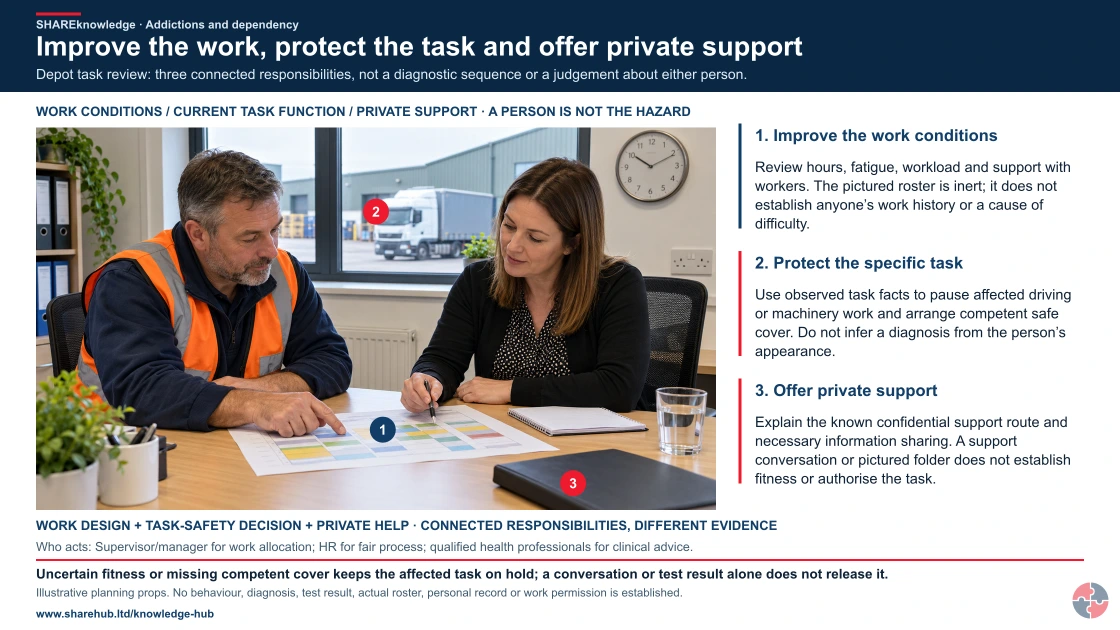
Full written explanation
A detailed realistic HD logistics office scene shows two normally posed colleagues reviewing an inert work roster with a stationary lorry visible outside and a closed folder on the desk. Native markers identify work-design information, the specific driving task and information boundaries rather than labelling a person as a medical case. The complete explanation keeps three connected responsibilities distinct: review hours/fatigue/workload and support; respond proportionately to observed task-function concerns through cover or restrictions; and offer the known private support route without diagnosis. The photo does not demonstrate actual hours, observed impairment, dependency, a personal medical record, test result or competence/fitness decision. No symptom, brain/anatomy image, treatment, substance threshold, employment rule or work-return criterion is added. The original hierarchy distinctions, task controls, roles, holds, cases and current source qualifications remain unchanged.
Depot task review: three connected responsibilities, not a diagnostic sequence or a judgement about either person.
- Work conditions. Hours, fatigue, workload and workplace culture can influence safety and whether people seek support.
- Current task function. Observed difficulties in safety-critical work need a proportionate task-safety response, not a diagnosis.
- Private health support. Offer appropriate help through confidential support, occupational-health or clinical routes.
Change the pathway
- Improve the work. Review shifts, workload and support with workers; avoid blaming a whole team.
- Remove the unsafe exposure. Hold affected driving or machinery work and arrange competent safe cover when fitness is uncertain.
- Use necessary information. Keep health information restricted and record the work arrangements proportionately.
Evidence check: A person is not the hazard. Control the work and support the person without turning observations into a diagnosis.
Primary references: HSE managing drug and alcohol misuse at work — observed changes are not a diagnosis (GB) · HSE safety-critical work — actual task assessment and temporary work arrangements · HSE supporting employees — known policy and discreet support · HSE developing a policy — current policy and review context
Open the complete HD image (new tab)Download image
Primary references: HSE managing drug and alcohol misuse at work — observed changes are not a diagnosis (GB) · HSE safety-critical work — actual task assessment and temporary work arrangements · HSE supporting employees — known policy and discreet support · HSE developing a policy — current policy and review context
Organisational workload, shifts and culture can be assessed, but these controls do not replace individual clinical care.
The hierarchy of control is normally used for physical hazards, but it is still useful here if it is applied carefully. The aim is not to control a person as a hazard; it is to control the work conditions, safety-critical exposure and organisational decisions that could allow harm to develop.
For addiction and dependency, elimination may mean removing alcohol from safety-critical events, eliminating lone high-risk work where fitness is uncertain, or removing unnecessary overtime that drives fatigue. Reduction may mean redesigning shifts, improving support, reducing stressors or limiting access to substances at work events.
Personal controls such as self-reporting, training, monitoring and testing are weaker if the culture punishes disclosure or managers ignore early signs. They should sit behind better work design, clear policy and practical support.
For a delivery driver who appears confused before departure, the supervisor first removes the driving exposure: the vehicle stays parked and a competent replacement takes the journey. This is ERICPD Eliminate for that shift and the five-level elimination choice for the immediate task; it is not a diagnosis or permanent ban. A redesign that avoids lone time-critical driving, such as moving the delivery to a staffed route, is a substitution or reduction option for future work. The transport manager checks that the replacement holds the necessary authorisation and that keys and dispatch records match the hold. If no safe cover exists, the delivery does not start.
A physical interlock or controlled vehicle-key issue can stop unauthorised use and is an engineering or access-control layer only where the fleet system actually has it; a policy, supervisor check, private welfare conversation and occupational-health referral are administrative measures. ERICPD Isolate corresponds to keeping the affected worker away from the driving task, not isolating the person socially. Ordinary PPE does not make an unfit driver safe. The duty manager records the observation, cover, welfare action and release authority, then checks the arrangement at the next shift and after any near miss. If fitness or authorisation remains uncertain, the driving hold stays in place. ERICPD Discipline means maintaining and learning from these controls; any employment conduct decision runs separately.
How can the ERICPD hierarchy of controls reduce workplace risks associated with addiction and dependency?

| ERICPD level | Practical application | Example controls |
|---|---|---|
| Eliminate | Remove work practices that create unnecessary risk or make dependency harder to disclose. | Keep alcohol out of safety-critical work settings; avoid unnecessary lone safety-critical work where an individual fitness assessment identifies a current risk; eliminate excessive overtime after late events. Review any temporary task change with the worker and appropriate occupational-health advice. |
| Reduce | Reduce work factors that increase stress, fatigue, isolation or exposure to risky cultures. | Shift review, workload control, manager check-ins, breaks, safer events policy and limits on work-related drinking. |
| Isolate | Separate the person from immediate safety-critical exposure while support and assessment take place. | Temporary alternative duties away from driving, machinery, work at height, safeguarding or cash-sensitive roles. |
| Control | Use systems that make expectations, support and escalation clear. | Drug and alcohol policy, medication reporting, occupational health referral, contractor rules, supervision and risk assessment. |
| PPE | Personal protective equipment is rarely central, but may still matter where role change affects task hazards. | If duties change temporarily, ensure task-specific PPE, training and induction are still suitable. |
| Discipline | Sustain the work controls through supervision, maintenance of the agreed cover plan, worker feedback and learning; do not treat a person or a diagnosis as a hazard. | The duty manager checks that a competent replacement is available, records the hold and return owner, reviews the rota and near misses, and corrects a failed arrangement. Any separate conduct process is fair, evidence-based and never a substitute for control. |
How can the ISO 45001 hierarchy of controls reduce workplace risks associated with addiction and dependency?

| ESEAP control level | Practical application | Example controls |
|---|---|---|
| Elimination / Administrative controls | Remove work practices that create unnecessary risk or make dependency harder to disclose. | Keep alcohol out of safety-critical work settings; avoid unnecessary lone safety-critical work where an individual fitness assessment identifies a current risk; eliminate excessive overtime after late events. Review any temporary task change with the worker and appropriate occupational-health advice. |
| Administrative controls | Reduce work factors that increase stress, fatigue, isolation or exposure to risky cultures. | Shift review, workload control, manager check-ins, breaks, safer events policy and limits on work-related drinking. |
| Administrative controls | Separate the person from immediate safety-critical exposure while support and assessment take place. | Temporary alternative duties away from driving, machinery, work at height, safeguarding or cash-sensitive roles. |
| Administrative controls | Use systems that make expectations, support and escalation clear. | Drug and alcohol policy, medication reporting, occupational health referral, contractor rules, supervision and risk assessment. |
| PPE | Personal protective equipment is rarely central, but may still matter where role change affects task hazards. | If duties change temporarily, ensure task-specific PPE, training and induction are still suitable. |
| Administrative controls | Sustain the work controls through supervision, maintenance of the agreed cover plan, worker feedback and learning; do not treat a person or a diagnosis as a hazard. | The duty manager checks that a competent replacement is available, records the hold and return owner, reviews the rota and near misses, and corrects a failed arrangement. Any separate conduct process is fair, evidence-based and never a substitute for control. |
Which duties apply in Great Britain and Northern Ireland?
Use separate GB and NI health-and-safety and disability-law routes; UK data protection applies, while testing and sector duties depend on the actual role.
Great Britain uses the Health and Safety at Work etc Act 1974 and Management Regulations 1999. Northern Ireland uses the Health and Safety at Work (NI) Order 1978 and Management Regulations (NI) 2000. Identify critical tasks and assess foreseeable risk; a general addiction label does not settle fitness. The Equality Act 2010 applies in GB, not NI. Both GB and NI disability frameworks exclude addiction to alcohol, nicotine or other substances from the disability definition except where addiction followed medical prescription or treatment; a separate related impairment can still qualify. Seek individual legal advice and consider practical support even without a legal adjustment duty. ICO worker-health guidance applies to sensitive data. Criminal, transport or sector rules need role-specific legal review; no universal testing threshold or certificate is asserted.
| Jurisdiction or issue | Route | Decision boundary |
|---|---|---|
| Great Britain work safety | Health and Safety at Work etc Act 1974; Management Regulations 1999. | Assess actual work risks and set protective arrangements. Official source |
| Northern Ireland work safety | Health and Safety at Work (NI) Order 1978; Management Regulations (NI) 2000. | Use HSENI guidance and NI instruments. Official source |
| Great Britain disability | Equality Act 2010 and disability regulations. | Addiction exclusion and any related impairment require careful case assessment. Official source |
| Northern Ireland disability | Disability Discrimination Act 1995 NI framework and NI guidance. | Equality Act 2010 is not the NI route. Official source |
| Worker health data | UK data protection law and ICO guidance. | Necessity, lawful basis, transparency, security and retention. Official source |
| Special sectors or offences | Role-specific driving, transport and controlled-drug law. | Check the actual activity and current legislation; no blanket rule. GB general duty NI source GB sector-law guidance |
What should be recorded in the risk and wellbeing register?
The register should identify where addiction, dependency or impairment could create work risk, what controls exist and how support and assurance are checked.
Use aggregate or anonymised trend information for management assurance where feasible; keep individual health data in restricted case records.
The register should avoid naming individuals unless it is an individual case-management record with a lawful purpose and restricted access. The general risk register should focus on roles, tasks, events, conditions and controls.
A good register helps leaders see where work design or culture may be increasing risk: long shifts, late events, lone working, driving, public conflict, alcohol at work functions, high stress, access to controlled medicines, financial pressure or seasonal work patterns.
Case records should be separate from the general register. Individual records should document agreed work restrictions, adjustments, support routes, review dates and who needs to know, without collecting unnecessary diagnostic detail.
| Register item | What to record | Evidence of control |
|---|---|---|
| Safety-critical roles | Driving, machinery, work at height, water safety, lone work, safeguarding, security, cash handling or plant operation. | Role risk assessment, fitness-for-work policy, induction, supervision and stop-work authority. |
| Work factors | Stressors, shifts, fatigue, isolation, high-pressure peaks, traumatic events, bullying or workplace drinking culture. | Stress assessment, shift review, worker consultation, event controls and wellbeing action plan. |
| Policy coverage | Drug, alcohol, medication, dependency, testing, self-referral, contractor and disciplinary links. | Approved policy, consultation evidence, review date and worker communication. |
| Support routes | GP/NHS signposting, occupational health, employee assistance, HR, union, first aid, safeguarding and local specialist services. | Published route, manager scripts, referral records and worker feedback. |
| Testing governance | Whether testing applies, roles in scope, trigger criteria, provider, practical sample agreement, separate data-processing basis, confidentiality and retention. | Data protection impact assessment, contract controls, chain-of-custody records and management review. |
| Learning signals | Incidents, near misses, absences, fatigue reports, conflict, disclosure trends and recurring support delays. | Trend review, anonymised learning, action tracker and effectiveness checks. |
How could Riverside Leisure Ltd manage addictions and dependency?

Riverside Leisure Ltd keeps the task pause, clinical care, occupational-health advice and HR process as separate decisions. A supervisor shares only restrictions needed to protect the job and authorises return with a named decision owner.
Riverside Leisure Ltd would manage addiction and dependency as both a wellbeing matter and a fitness-for-work control because its work includes leisure operations, public-facing conflict, hospitality, late events, driving, maintenance and water-related activities.
Riverside’s policy would apply to employees, casual workers, agency staff and contractors. It would define safety-critical duties such as lifeguarding, operating plant, driving vehicles, maintaining pools and attractions, supervising outdoor activities, handling aggressive customers, managing security incidents and working alone during opening or lock-up.
The business would start with assessment rather than assumptions. Department managers would review where alcohol, drugs, medication effects, gambling stress, fatigue or dependency could affect public safety, safeguarding, cash handling, conflict management, driving or water rescue. Those risks would sit in the wellbeing and operational risk registers with named control owners.
Riverside would also review culture. Hospitality events, staff socials, seasonal-worker accommodation, late finishes, tips, high-pressure summer periods and customer alcohol use can all shape risk. Controls would include an events alcohol standard, supervisor briefing, confidential self-referral route, occupational health referral for complex cases, employee assistance signposting and escalation rules where a person may be unfit for duty.
| Management area | How Riverside manages it | Evidence and improvement loop |
|---|---|---|
| Assessment and risk register | Maps safety-critical tasks across pools, outdoor activities, catering, events, maintenance, driving, security and lone work; identifies where impairment or withdrawal could create serious harm. | Reviewed risk register, seasonal risk review, event risk assessments and incident trend review after peak periods. |
| Policy and consultation | Consults staff and worker representatives on a drug, alcohol, medication and dependency policy covering self-referral, testing triggers, safety-critical duties and confidentiality. | Approved policy, consultation notes, induction records and annual policy review. |
| Operational controls | Uses stop-work authority, temporary redeployment, supervisor checks, shift controls and escalation when someone may be unfit for lifeguarding, driving, plant rooms or public-safety duties. | Supervisor decision logs, duty-change records, return-to-task authorisation and safety-critical role list. |
| Support and referral | Offers confidential HR discussion, GP/NHS signposting, occupational health referral, EAP support and time off for treatment or recovery meetings where appropriate. | Referral records with limited access, agreed adjustment plans, review dates and anonymised uptake trends. |
| Training and competence | Trains all workers on policy and self-referral; trains supervisors in private conversations, observed facts, confidentiality, reasonable suspicion and safety escalation. | Training matrix, scenario exercises, manager refresher sessions and post-incident learning. |
| Contractor and agency control | Includes fitness-for-work and substance rules in supplier contracts, site induction and event contractor briefings. | Procurement standards, contractor induction, non-conformance records and event debrief actions. |
| Learning and improvement | Reviews near misses, complaints, absence patterns, conflict incidents, staff feedback and support delays without exposing personal health details. | Quarterly wellbeing review, anonymised lessons learned, action tracker and board-level assurance summary. |
What awareness and competence do different roles need?
Brief everyone on the policy and help routes; train managers to act on facts and specialists to handle testing, privacy and return decisions.
Record the demonstrated decision, assessor, limits of authority and action needed. Reassess after a changed task, equipment, policy or incident; this guide does not invent a universal certificate or fixed refresher interval.
| Role and learning | Practice on the actual task | Competence evidence and record | Assessor and reassessment trigger |
|---|---|---|---|
| Workers and contractors: know support and safety routes | Use the confidential self-referral route, disclose medication effects that could affect safe work and stop an unsafe task. | Accessible briefing plus a scenario response showing correct support and escalation. | Supervisor checks at induction and after policy or role change. |
| Supervisors: respond without diagnosis | Practise a private conversation, record observed facts, pause credible safety-critical risk and arrange appropriate support. | Observed scenario and documented decision that separates fitness, welfare and privacy. | Competent manager checks after incident, weak scenario or changed policy. |
| HR and safety leads: apply a fair process | Use the correct GB or NI duty route, review proportional controls and share only necessary functional information. | Case exercise, policy review and privacy-aware record audit. | Legal or privacy specialist checks on law, testing or process change. |
| Occupational health and testing specialists: advise within scope | Demonstrate method quality, qualified interpretation, confidential clinical handling and functional return advice. | Professional competence, quality records and case governance review. | Relevant clinical or testing lead checks after method change or disputed result. |
| Senior managers: assure policy and support | Challenge unsafe duties, resource access to support and review anonymised trends without exposing medical detail. | Documented resource decision, action closure and effectiveness review. | Senior leadership and worker representatives review after trends or incidents. |
What can a management standard and stress guidance add?
Use ISO 45001 as a voluntary management framework and HSE stress tools for work factors; neither is addiction treatment or testing authority.
| Reference | Useful scope | Boundary |
|---|---|---|
| ISO 45001:2018 | Consultation, hazard control, competence and review. | Voluntary; no duty to certify or to test workers. |
| HSE Management Standards | Assess avoidable demands, control, support, relationships, role and change. | Does not diagnose or treat addiction. |
| Retained stress PDFs | Background on organisational stress management. | INDG430 and WBK01 are not dependency or NI legal protocols. |
When must a wellbeing concern become an emergency response?
Call 999 for a serious immediate medical emergency; pause unsafe work and use first-aid or safeguarding routes while qualified responders take over.
Severe alcohol withdrawal can include hallucinations, severe tremors or seizures; NHS says call 999 for these symptoms. Do not advise a person with physical dependence to stop alcohol suddenly. If someone is seriously unwell, unconscious, struggling to breathe or at immediate risk of harm, follow emergency arrangements. A line manager does not provide detoxification or mental-health diagnosis. After immediate care, HR and occupational health handle work arrangements privately.
| Trigger | Immediate action | Do not |
|---|---|---|
| Severe illness or severe withdrawal signs | Call 999, follow trained first aid and responder direction. | Delay while starting an HR meeting or test. |
| Credible unfitness for critical work | Pause task, prevent unsafe driving and arrange private welfare support. | Assume the cause or allow unsupervised return. |
| Disclosure without immediate danger | Listen privately, signpost to GP or specialist service and agree work review. | Give treatment or withdrawal instructions. |
How can a management system make addiction and dependency arrangements robust?
A management system helps the organisation move from good intentions to planned duties, competent managers, controlled records, monitored outcomes and improvement.
ISO 45001 is voluntary; certification neither proves a person fit nor authorises blanket testing.
Wellbeing arrangements often fail because they depend on individual manager confidence rather than a reliable system. ISO-style management thinking helps define leadership expectations, worker participation, risk assessment, competence, communication, document control, operational planning and improvement.
ISO 45001 is not a wellbeing treatment standard, but its clauses provide a useful structure for making sure addiction and dependency controls are owned, communicated, checked and improved. ISO 45003 can also support psychosocial risk thinking where work factors such as stress, fatigue, isolation or bullying are relevant.
| Management-system theme | How it supports the topic | Evidence to look for |
|---|---|---|
| Leadership and commitment | Leaders set a clear expectation that support, confidentiality and safety-critical boundaries are all part of responsible management. | Policy statement, leadership briefings, resource decisions and review of wellbeing trends. |
| Consultation and participation of workers | Workers and representatives help shape policy, testing rules, support routes and realistic controls. | Consultation records, worker feedback, union engagement and action closure. |
| Actions to address risks and opportunities | Addiction-related impairment, fatigue, work stressors and safety-critical roles are assessed systematically. | Risk register entries, role mapping, event reviews and work-factor assessment. |
| Competence | Managers and supervisors are trained to use the policy fairly and control immediate risk. | Training matrix, competence checks, case reviews and refresher records. |
| Communication | Workers know the rules, support routes, confidentiality boundaries and medication reporting expectations. | Induction materials, intranet pages, toolbox talks and campaign records. |
| Operational planning and control | Fitness-for-work decisions are embedded into operations, contractor control, driving, events and safety-critical activities. | Procedures, contractor standards, event plans and temporary duty-change records. |
| Monitoring, measurement, analysis and performance evaluation | The organisation reviews anonymised trends without exposing unnecessary personal data. | Absence trends, incident themes, support-route usage, action tracking and assurance reports. |
| Incident, nonconformity and corrective action | Incidents and concerns lead to learning about work design, policy clarity, training and support gaps. | Investigation reports, anonymised learning, corrective actions and effectiveness checks. |
What are the warning signs that addiction and dependency are not being managed well?
Poor management shows up when people hide problems, managers improvise, safety-critical decisions are inconsistent and support is only offered after harm has occurred.
These are prompts to check work impact, never proof of substance use or a diagnosis.
Warning signs should be treated as system signals, not as proof that a particular person has an addiction. If several indicators appear together, the organisation should ask whether policy, culture, supervision, workload or support routes are failing.
The harm pathway is usually progressive. A person may first avoid disclosure, then work while unfit, miss appointments, experience conflict, become involved in near misses or reach a crisis point. Good organisations interrupt that pathway early.
| Warning sign | How it may manifest | How it can cause harm |
|---|---|---|
| No visible support route | Workers do not know whether to speak to a manager, HR, occupational health, EAP or GP. | People hide problems until absence, conflict, unsafe work or crisis forces a response. |
| Managers diagnose or moralise | Conversations include labels, judgement, gossip or assumptions rather than observed work facts. | Trust collapses, discrimination risk increases and the underlying issue becomes harder to manage. |
| Safety-critical roles are not identified | Driving, machinery, lifeguarding, work at height or lone work are treated like ordinary duties. | A worker may continue in a task while impaired, withdrawing, fatigued or medically unfit. |
| Testing is unclear or overused | Workers do not understand when testing applies, what is tested or how results are used. | Testing becomes intrusive, disputed or unfair and may fail to prove actual fitness risk. |
| Confidentiality is weak | Health or testing information is discussed widely or stored in ordinary notes. | People stop disclosing, data protection risk increases and relationships are damaged. |
| Policy only becomes visible after incidents | Training happens after a near miss, complaint or disciplinary case. | The organisation misses the chance to support early and control risk before harm occurs. |
| Work factors are ignored | Stress, fatigue, bullying, trauma exposure, pain or workplace drinking culture are not reviewed. | The organisation treats the person as the problem while leaving triggers and barriers unchanged. |
Standards named on this page are background context. Confirm the current edition, scope and exact requirements from an authorised copy before applying them. The open official sources below support the specific public-law and regulator guidance claims they are cited for.
What do the acronyms and key terms mean?
Acronyms should be defined because addiction, health, employment and safety language can easily become confusing or intimidating.
| Acronym or term | What it means | Why it matters |
|---|---|---|
| EAP | Employee Assistance Programme. | A confidential support service some employers provide for counselling, signposting or short-term help. |
| OH | Occupational health. | Specialist health advice linking a worker’s health, capability and restrictions to work demands. |
| GP | General Practitioner. | A common first route into NHS assessment, advice, medication review or referral. |
| DPIA | Data Protection Impact Assessment. | A structured privacy assessment needed where intrusive monitoring or testing is being considered. |
| CBT | Cognitive behavioural therapy. | A talking therapy that may be part of treatment for some addiction or related mental health issues. |
| Fitness for work | Whether a person is capable of doing the task safely at that time. | The practical safety decision, especially for driving, machinery, public safety and safety-critical work. |
| Self-referral | A route allowing a worker to ask for help before a manager or incident triggers formal action. | Encourages earlier support and can reduce hidden risk. |