SHARE Knowledge Hub
Alcohol, Glycol and Ketone Poisoning
Workplace exposure to methanol, ethylene glycol, acetone or methyl ethyl ketone needs a product-specific response. Stop a suspected exposure, keep others out of the affected area and get urgent medical advice: methanol and ethylene glycol can cause delayed serious injury. Call 999 for severe symptoms or a suspected harmful exposure requiring emergency help; do not make someone vomit or give food or drink. Prevent exposure through substitution, containment, ventilation, hygiene and verified task controls.
Understanding Alcohol, Glycol and Ketone Poisoning
Workplace exposure to methanol, ethylene glycol, acetone or methyl ethyl ketone needs a product-specific response. Stop a suspected exposure, keep others out of the affected area and get urgent medical advice: methanol and ethylene glycol can cause delayed serious injury. Call 999 for severe symptoms or a suspected harmful exposure requiring emergency help; do not make someone vomit or give food or drink. Prevent exposure through substitution, containment, ventilation, hygiene and verified task controls.
Why this matters at work
Do not wait for obvious illness after a credible harmful exposure. Some solvents cause delayed systemic effects: methanol can have a latent period before serious visual and metabolic injury, and ethylene glycol can progress from apparent intoxication to severe organ harm. Temporary improvement or normal conversation is not clinical clearance.
Assess how the actual product is used, generated, transferred, cleaned and discarded. Record physical form, quantity, temperature, pressure, volatility, spraying, open surface, frequency, duration and inhalation, skin, eye and ingestion pathways. Include other people nearby, maintenance, spills, ventilation failure and foreseeable misuse. Use reliable hazard information and observe work as performed. Prefer eliminating the hazardous task or substituting a suitable safer method, then containment and effective source ventilation. Specify how each selected control must perform, such as capture position, lid use, compatible gloves and replacement, isolation and operating restrictions. Assess storage, ignition and physical fire or explosion risks alongside health exposure without conflating the regimes. Define competence, maintenance, emergency arrangements and any justified monitoring or health surveillance. Record significant findings under the applicable GB or NI duties and explain material assumptions and uncertainty. Obtain specialist input where mixtures, unusual processes or high consequence releases exceed local competence. Verify the controls during use and review after change, symptoms or failure.
How organisations manage this in practice
Stop or restrict the deficient task and obtain medical help for suspected harmful exposure. Preserve the exposure history and clearly label estimates and missing information. Before restart, investigate containment, capture, product handling and the reason the release occurred. Verify the corrected controls under representative work and communicate the authorised method and restrictions. Biological monitoring, where appropriate, requires its own justified timing and interpretation and cannot be interchanged with an air result. Do not use an improved later reading or a worker’s recovery to erase the initial event or close an unresolved control failure.
Find the reliable product identity and safety data without delaying help or exposing someone else. Record concentration, additives, amount or uncertainty, time, route, symptoms and first aid and provide the packaging information to clinicians. Methanol can produce an apparently quiet interval before serious toxicity, so the absence of immediate illness is not reassuring clearance. Healthcare professionals decide observation and treatment. Secure the uncertain container and investigate decanting, labelling and access arrangements before it is used again. Keep clinical decisions, the worker’s functional return and acceptance of workplace controls separate. Correct the identity failure at source rather than rely only on another warning about drinking liquids.
Establish the exact product, ingredients, concentration and process before choosing controls or explaining health effects. Use a reliable label and current safety data sheet, with CAS or other unambiguous identity where relevant. Alcohol, glycol, ketone, solvent and catalyst are families or descriptions, not sufficient chemical identities. Product additives and mixtures can also change the assessment. Methanol differs from beverage ethanol; ethylene glycol differs from propylene glycol and from glycol ethers. MEK and MEKP are not interchangeable, and acetone is not acetonitrile. Such name confusion can lead to wrong exposure limits, gloves, segregation, spill methods or clinical information. Keep identity intact through inventory, transfer, decanting and emergency records and never use food or drink containers. If identity is uncertain, stop the transfer or proposed treatment assumption and obtain competent supplier, hygiene or emergency advice. Give responders the best reliable product information without delaying care. A correctly identified safety data sheet still informs, rather than replaces, the workplace COSHH assessment.
Which named solvents and workplace tasks does this guide cover?
This is workplace exposure guidance for named alcohols, glycols and ketones, not a diagnosis or a treatment protocol.
It covers work with methanol, ethylene glycol, acetone and methyl ethyl ketone (MEK, 2-butanone), including blends and contaminated waste. It does not treat beverage alcohol use, diabetic ketosis, every glycol or every ketone as the same hazard. The exact product, concentration, route, quantity, task and site conditions govern the decision.
Identify the liquid and the actual exposure route
Similar names do not make solvents interchangeable. Verify the product, chemical identity and current SDS, then assess the actual transfer, cleaning or maintenance task. Keep toxic industrial alcohols, glycols and ketones separate from alcohol-wellbeing questions.
A substitute can change toxicity, flammability, skin exposure and emergency information even when the cleaning result looks unchanged. Compare the complete method and medical handover facts before approving a change; the workplace record must not become a treatment instruction.
A solvent substitution at the cleaning bench
Illustrative example. A replacement drum is offered for the approved acetone wipe-cleaning method, but its chemical identity and assessment are not confirmed.
Decision. Hold the substitution and compare the actual product and task before allowing use.
Evidence to check. Check label/CAS identity, SDS revision, intended application, routes, ventilation and compatible handling arrangements.
Hold or escalation point. No use of an unlabelled or assumed-equivalent liquid; follow the immediate-action route if exposure has occurred.
Follow-up. The assessor records the accepted method and briefs purchasing and users so the change is controlled.
Who should act at each stage of solvent work?
Workers stop and report unsafe exposure; supervisors control the task; specialists assess the product and exposure; clinicians make treatment decisions.
| Role | Action | Boundary or record |
|---|---|---|
| Worker or contractor | Check identity and controls, use the approved method, stop on symptoms, spill or failed extraction. | Report product, task, time and exposure route; do not self-diagnose. |
| Supervisor or host | Verify task controls and contractor interfaces; hold unsafe work and protect bystanders. | Record decision owner and restart criteria. |
| Purchaser and storekeeper | Check safer alternatives, SDS, labels, compatibility and approved storage before receipt. | Do not substitute a product on its generic family name alone. |
| Maintainer and cleaner | Check isolation, residues, ventilation, waste and emergency plan for non-routine work. | No opening or cleaning unknown material. |
| COSHH assessor and hygienist | Assess actual routes, WELs, monitoring need, LEV and glove compatibility. | An air result does not settle skin or ingestion risk. |
| First aider and safety lead | Call for urgent help, follow the site plan, hand over known product facts, investigate controls. | No workplace antidote or clinical clearance. |
What are the key facts about alcohol, glycol and ketone poisoning?
Do not wait for symptoms after suspected harmful solvent exposure: stop work and seek urgent medical advice. Severe emergency signs need 999; other advice routes differ between Great Britain and Northern Ireland.
This is general workplace guidance, not medical, legal or HR advice. A suspected harmful exposure needs prompt medical advice even if the person appears well; methanol and ethylene glycol effects can be delayed. Severe signs need 999. Do not use a guessed dose or symptom threshold to clear someone.
What symptoms matter first?
- Headache, dizziness, nausea, light-headedness, drowsiness, confusion or poor coordination during solvent work.
- Eye, nose, throat or skin irritation after cleaning, coating, spraying, decanting or spill work.
- Blurred vision, photophobia, repeated vomiting, collapse, seizure, severe sleepiness or symptoms that worsen after the task has stopped.
What should happen immediately?
- Stop the task, move away from vapour or mist exposure if safe, and prevent others entering the affected area.
- Remove contaminated clothing and wash exposed skin where liquid contact has occurred.
- Identify the product, solvent ingredients, task, time, route of exposure and safety data sheet for responders and clinicians.
When is medical assessment needed?
- Collapse, seizure, stopped or severe difficulty breathing or other serious signs: call 999 immediately.
- In Great Britain, if someone may have swallowed, touched or breathed something harmful, follow the NHS 999 or A&E route without waiting for symptoms; call 111 promptly if unsure whether it is harmful.
- In Northern Ireland, get immediate GP or GP out-of-hours advice if the person seems well; if prompt advice is unavailable and a hazardous substance is suspected, go to an emergency department. Serious signs need 999.
This is workplace guidance
It is not medical, legal or HR advice. Suspected harmful exposure needs prompt medical advice without waiting for symptoms; employment or disciplinary decisions require a separate competent process.
Methanol is high consequence
Methanol can cause metabolic acidosis, optic-nerve injury and permanent visual loss after a delay, so early symptoms must not be dismissed as a simple hangover-like effect.
Ethylene glycol can damage kidneys
Ethylene glycol may begin with intoxication-like symptoms before progressing to acidosis, cardiopulmonary stress and kidney injury.
Ketones are not harmless
Acetone and MEK are common industrial solvents that can cause irritation and central nervous system depression; MEK exposure can also be more serious at high doses.
Skin contact matters
Wet rags, contaminated gloves, soaked sleeves and poor washing can add to body dose and cause dermatitis, even where inhalation is the obvious concern.
PPE is not the main control
Respiratory protective equipment and gloves are important for residual risk, but the stronger controls are substitution, closed handling, ventilation, containment and exposure monitoring.
What is alcohol, glycol and ketone poisoning?
It is harmful exposure to a specific chemical in one of these families; the family label alone does not predict the route or severity.
Product identity changes the poisoning question


Read this visual as text
- IDENTIFY THE PRODUCT: Use reliable supplier information for the actual formulation and constituents.
- IDENTIFY THE ROUTE: Consider inhalation, skin, eye and possible ingestion, including contaminated clothing or hands.
- ESCALATE THE EVENT: Give clinicians the substance and timing; do not wait for delayed effects after suspected poisoning.
Methanol can cause delayed metabolic acidosis and visual injury after ingestion, inhalation or skin absorption. Ethylene glycol poisoning is most often an ingestion concern: it can cause delayed acidosis and acute kidney injury; room-temperature vapour is much less likely to cause heavy exposure, but heating or aerosol generation changes the inhalation question. Acetone and MEK are volatile ketones that can irritate and impair coordination at high exposure; severe systemic effects depend on dose and route. Propylene glycol is not interchangeable with ethylene glycol, and “ketones” in a medical blood test do not identify a workplace solvent.
| Substance | Workplace clue | High-consequence distinction |
|---|---|---|
| Methanol | Cleaner, fuel or solvent blend; verify the SDS. | Early symptoms may be followed by delayed acidosis and visual injury. |
| Ethylene glycol | Antifreeze, coolant or de-icer; verify the exact glycol. | Accidental ingestion is especially serious; heated or aerosol use needs inhalation assessment. |
| Acetone | Fast-evaporating cleaning or coating solvent. | Irritation, flammability and impaired coordination at high exposure. |
| MEK / 2-butanone | Coatings, inks and adhesives. | Irritation and CNS effects; severe systemic toxicity is possible after substantial exposure. |
Where are alcohols, glycols and ketones found at work?
They are found in solvent-rich products, industrial fluids, cleaning agents, coatings, adhesives, inks, coolants and antifreeze or de-icing systems.
A worker may not see the chemical name on the front of a container. These substances may appear in blends, thinners, cleaners, resins, inks, coatings, degreasers, antifreeze, coolants and maintenance chemicals. That is why safety data sheet review, container labelling and a live chemical register matter.
The same product can behave differently depending on how it is used. A small amount of solvent wiped onto a bench in a ventilated area is not the same risk as heated solvent, spraying, open-top cleaning, pressure washing, line purging, tank entry or cleaning in a poorly ventilated room. The COSHH assessment must describe the task, not just the product.
| Substance or group | Typical workplace uses | Main concern |
|---|---|---|
| Methanol | Inks, resins, adhesives, dyes, laboratory use, cleaners, antifreeze and chemical manufacture. | Central nervous system depression and high-consequence risk of acidosis and visual injury. |
| Ethylene glycol | Antifreeze, de-icing fluids, coolants, heat-transfer fluids, polyester manufacture and industrial formulations. | Severe poisoning can progress to metabolic acidosis and kidney injury. |
| Acetone | Cleaning, degreasing, nail and cosmetic products, plastics, coatings, resins and laboratory work. | Rapid evaporation, irritation, flammability and solvent intoxication at high exposure. |
| Methyl ethyl ketone (MEK) | Coatings, adhesives, printing inks, resins, surface cleaning and chemical manufacture. | Irritation and CNS depression, with more serious systemic effects in high or repeated exposure. |
| Mixed solvent products | Paint thinners, strippers, degreasers, adhesives, cleaners and maintenance products. | Combined routes and ingredients can make generic control assumptions unreliable. |
| Solvent-contaminated waste | Rags, absorbents, wipes, sludge, spill waste, filters and contaminated PPE. | Continued vapour release, skin contamination, fire risk and poor disposal control. |
How do these substances enter the body at work?
The main workplace routes are inhalation of vapour, mist or aerosol, skin contact with liquid and accidental ingestion from contamination.
Inhalation is often the dominant route for volatile alcohols and ketones because vapour can build up quickly in poorly ventilated work areas. Heating, spraying, agitation, pressure release, open containers and spill evaporation can all increase airborne concentration. Workers nearby may be exposed even when they are not directly handling the solvent.
Skin contact is often underestimated. Contaminated gloves, solvent-soaked cuffs, wet rags kept in pockets, poor glove compatibility and delayed washing can keep the chemical in contact with skin. Some solvents also defat the skin, damaging the skin barrier and making dermatitis more likely.
Ingestion is less common as an intended workplace route but remains important. Eating, drinking, smoking or vaping with contaminated hands, using drink bottles or unlabelled containers, siphoning, poor welfare arrangements and poor housekeeping can create accidental ingestion risk. Ethylene glycol and methanol incidents are especially serious where ingestion is possible.
| Route | How exposure happens | Practical prevention |
|---|---|---|
| Inhalation | Breathing vapour, mist or aerosol from open handling, spraying, heated fluids, cleaning, spills or enclosed spaces. | Substitution, closed transfer, LEV, general ventilation, lids, process enclosure, monitoring and task planning. |
| Skin absorption and skin damage | Liquid contact through splashes, soaked clothing, contaminated gloves, wet rags or repeated solvent wiping. | Closed handling, splash control, compatible gloves, sleeves, washing facilities, skin checks and contaminated clothing rules. |
| Eye contact | Splashes during decanting, mixing, pressure release, cleaning or spill response. | Closed systems, splash screens, eye protection, eyewash provision and careful transfer methods. |
| Accidental ingestion | Contaminated hands, eating or drinking in work areas, poor labelling or solvents in unsuitable containers. | No eating in chemical areas, hygiene rules, labelled containers, welfare facilities and supervision. |
| Secondary exposure | Nearby workers exposed to vapours or contaminated surfaces from another team's task. | Segregation, permits, communication, restricted access and contractor coordination. |
What is the damage mechanism of alcohol, glycol and ketone poisoning?
The shared mechanism is solvent toxicity affecting the brain and nervous system, with chemical-specific organ damage depending on metabolism.
Confirm the product and review the printing-cleaning task
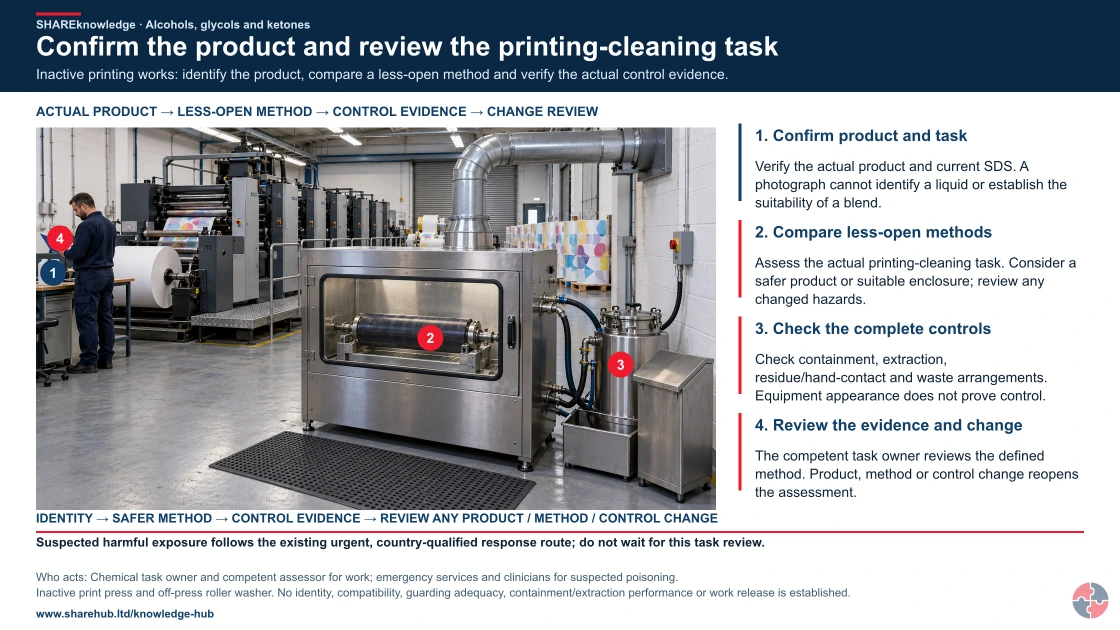
Full written explanation
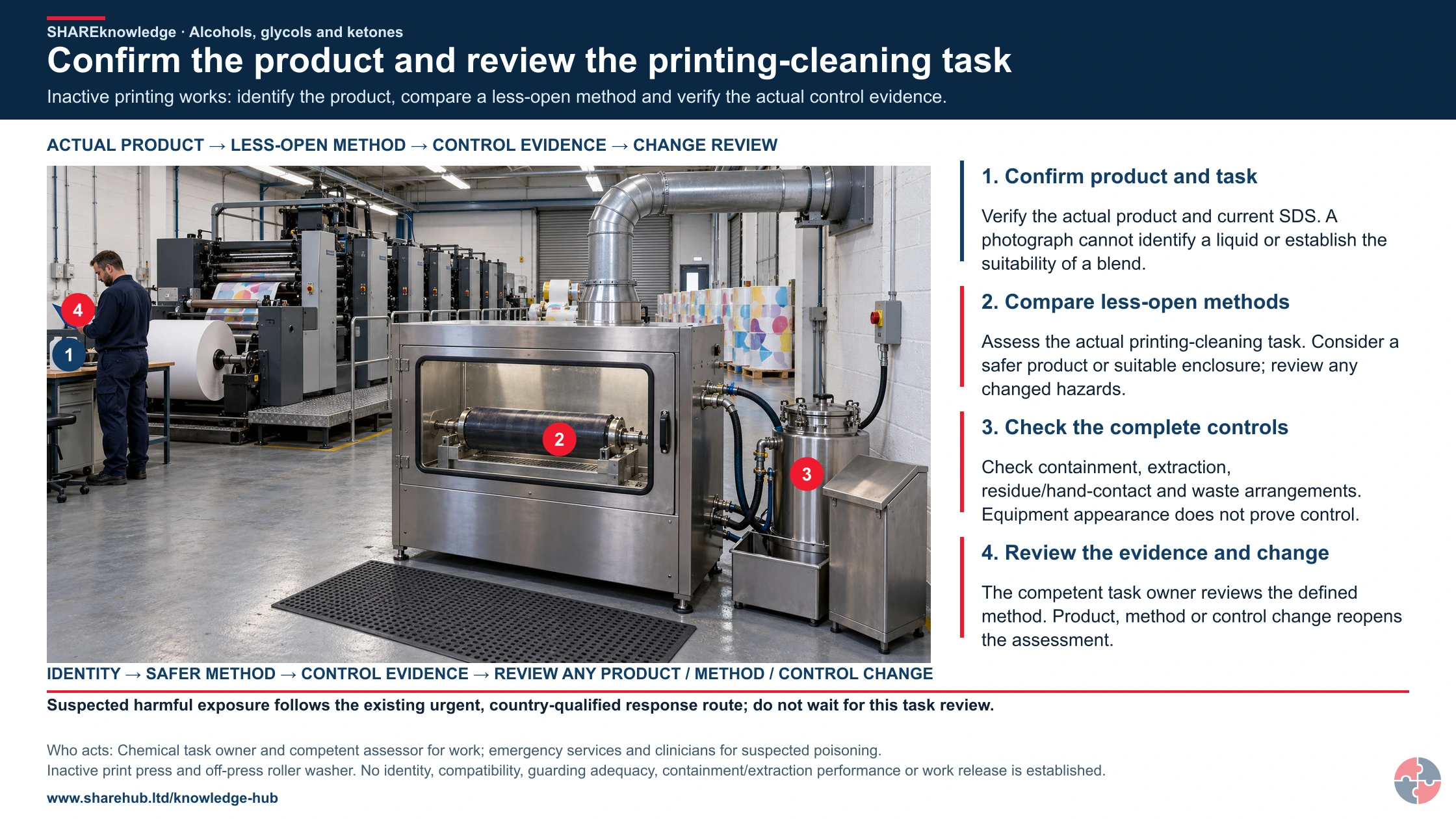
An illustrative UK printing works shows a recognisable inactive paper-web press with a separate closed off-press roller-cleaning cabinet. A stationary printing cylinder is visible through the closed window; continuous intact hoses connect the cabinet and closed supply vessel, an extraction duct leaves the enclosure, and a closed residue/wiper container is nearby. An inert supplier-information review remains separate from active handling. Four checks follow product and task identity, consideration of a safer/less-open method, complete containment/extraction/contact/waste evidence and competent review when product, method or control changes. The picture does not identify a substance, prove compatibility, prove guarding/interlocks or extraction performance, prescribe a cleaning system, or authorise work. No access, opening, mixing, wiping, sampling, press operation or maintenance sequence is taught. Suspected harmful exposure uses the existing urgent country-qualified route. No anatomical/clinical/treatment/rescue or numeric guidance is added; existing GB/NI source and urgent-response qualifications stay authoritative.
Inactive printing works: identify the product, compare a less-open method and verify the actual control evidence.
- Verify the substance. Keep an unlabelled product closed and out of use; obtain reliable product identity and current supplier information.
- Choose the safer method. Assess the actual use, routes, temperature and flammability; consider a safer product or closed handling.
- Verify the controls. Check containment, extraction, hygiene, compatible PPE and the planned emergency arrangements.
- Release the defined task. The competent owner approves the assessed task and reviews any product, method or control change.
When the evidence does not fit: Suspected poisoning bypasses this pre-work route: call 999 for harmful exposure and use the existing urgent response. Do not wait for symptoms, product classification or a completed assessment.
Who acts: Chemical task owner and competent assessor for work; emergency services and clinicians for suspected poisoning.
Changed workplace
Vehicle workshop: An unlabelled coolant-like liquid is held for reliable identification; colour and container appearance do not identify it.
Printing works: Reduce open solvent cleaning and verify the product-specific controls; a different formulation reopens the assessment.
Evidence check: Product approval is not a clinical clearance. Suspected harmful exposure needs urgent help; a chemical family name cannot determine treatment.
Chemical-specific mechanisms and primary references
Primary references: HSE COSHH — prevent or control exposure at source · HSE safety data sheets — input to the assessment, not the assessment itself · HSE printers — actual process, product and task determine the controls · HSE P30 — contextual off-press enclosed-cleaning equipment scope
Open the complete HD image (new tab)Download image
Chemical-specific mechanisms and primary references
Primary references: HSE COSHH — prevent or control exposure at source · HSE safety data sheets — input to the assessment, not the assessment itself · HSE printers — actual process, product and task determine the controls · HSE P30 — contextual off-press enclosed-cleaning equipment scope
Solvents can be absorbed into the bloodstream and distributed to organs that are sensitive to chemical disturbance. The central nervous system is often affected early because many solvents interfere with normal nerve function, producing drowsiness, dizziness, incoordination and impaired judgement. That is why an apparently mild exposure can still create immediate safety risk around vehicles, machinery, work at height, confined spaces or hot work.
Methanol and ethylene glycol require particular caution because the body metabolises them into more toxic products. Methanol metabolism can lead to acidosis and optic-nerve injury. Ethylene glycol metabolism can lead to acidosis and kidney damage. This creates a dangerous pattern where the worker may first look intoxicated or unwell, then later deteriorate as organ-specific toxicity develops.
Ketones such as acetone and MEK are often thought of as ordinary solvents, but that can be misleading. At sufficient exposure they can irritate the eyes, throat and skin, depress the central nervous system and, for MEK in particular, contribute to more serious systemic toxicity where exposure is high or repeated.
| Mechanism element | Explanation | Practical workplace meaning |
|---|---|---|
| Shared solvent effect | Central nervous system depression causes slowed reaction, poor coordination, drowsiness and impaired judgement. | A worker may become unsafe before they realise they are significantly exposed. |
| Methanol metabolism | Toxic metabolites can drive metabolic acidosis and optic-nerve injury. | Visual symptoms after methanol-related work are a serious warning sign. |
| Ethylene glycol metabolism | Toxic metabolites can cause acidosis and kidney injury after an early intoxication-like phase. | Early symptoms may understate the later severity of poisoning. |
| Ketone solvent narcosis | Acetone and MEK can produce irritation and CNS depression; MEK can be more serious at high exposure. | Repeated headaches or dizziness during ketone use should trigger a control review. |
| Skin barrier damage | Solvents can remove oils from the skin and irritate or inflame tissue. | Dermatitis may indicate both local damage and poor chemical hygiene. |
| Aggravating factors | Spraying, heating, poor ventilation, mixed solvents, enclosed work and delayed decontamination increase dose. | Risk assessment must consider task conditions, not only the substance name. |
What are the symptoms of alcohol, glycol and ketone poisoning?
Symptoms often begin with headache, dizziness, nausea, drowsiness, irritation and poor coordination, but severe cases may progress to visual, neurological or kidney injury.
The early symptom pattern can be easy to dismiss because it may resemble tiredness, dehydration, a viral illness or ordinary alcohol intoxication. That is dangerous in solvent work because symptoms can mean exposure is already affecting the central nervous system.
The symptoms that most change the level of concern are visual disturbance after methanol-related work, severe drowsiness or collapse after solvent exposure, repeated vomiting, confusion, seizure, breathing difficulty, kidney pain or reduced urine output after glycol exposure, and any cluster of symptoms affecting more than one person after the same task.
Workers should be encouraged to report early symptoms without fear of blame. Early reporting is a control measure because it allows the business to stop the task, check exposure, improve ventilation, review PPE, identify the chemical and arrange medical assessment before harm escalates.
| Stage | Typical symptoms | What this may mean |
|---|---|---|
| Early | Headache, dizziness, light-headedness, nausea, mild confusion, eye or throat irritation and skin dryness. | Early solvent absorption, irritation or poor ventilation during the task. |
| Moderate | Drowsiness, poor coordination, staggering, vomiting, visual disturbance, weakness or worsening confusion. | More substantial solvent poisoning or early chemical-specific organ effects. |
| Severe | Collapse, coma, seizure, severe breathing depression, marked visual symptoms, metabolic illness or kidney-related symptoms. | High-consequence poisoning requiring medical assessment and workplace investigation. |
| Delayed | Symptoms return or worsen after leaving work, especially visual symptoms after methanol or kidney symptoms after glycol exposure. | A delayed toxic effect may be developing even if the worker initially seemed to recover. |
| Skin and eye effects | Redness, burning, dermatitis, cracked skin, eye pain or watering. | Liquid contact, vapour irritation or inadequate splash and glove controls. |
How can alcohol, glycol and ketone poisoning affect working life and future health?
It can affect working life by reducing attention, balance, reaction time, vision, skin tolerance and fitness for safety-critical tasks.
The immediate work impact is often safety related. A person who is dizzy, drowsy or poorly coordinated should not drive, use machinery, work at height, enter confined spaces, perform electrical work, supervise hazardous tasks or work alone in a way that depends on fast reaction.
Longer-term impact depends on the agent and severity. Methanol poisoning can damage vision permanently. Ethylene glycol poisoning can damage kidneys and may require ongoing medical review. Repeated solvent work can also affect confidence, skin health, attendance, role suitability and whether the worker can return to particular hazardous tasks.
Return-to-work decisions should be based on medical and occupational-health advice, the actual exposure route, symptom history, investigation findings and evidence that controls have been improved. It is rarely enough to send the person back to the same task with the same ventilation, same gloves and same instructions.
| Area affected | Possible impact on work | Possible longer-term impact |
|---|---|---|
| Central nervous system | Poor concentration, delayed reaction and impaired judgement during safety-critical work. | Persistent neurological symptoms are possible after severe solvent poisoning. |
| Vision | Blurred vision, photophobia or impaired visual judgement can make driving and precision work unsafe. | Methanol poisoning can cause permanent optic injury or visual loss. |
| Kidneys | Illness, fatigue and medical restriction after glycol-related injury. | Ethylene glycol poisoning can lead to acute kidney injury and follow-up requirements. |
| Skin | Painful dermatitis can make glove wearing and repeated chemical work difficult. | Recurrent dermatitis may require task adjustment and skin surveillance. |
| Mental wellbeing | An incident can create anxiety about returning to the area or task. | Confidence may depend on clear investigation, visible control improvement and supportive management. |
Take the product identity, not a guess
Suspected poisoning needs medical help immediately, even if symptoms have not started. Use the urgent response below. Gather information only when this is safe and does not delay care.
1. Match the product
Use the exact container label and current safety data sheet (SDS). Match the product name, supplier and constituents. An unlabelled decant or the word “solvent” cannot identify the chemical.
2. Describe the exposure
Give the task, route of contact, time and duration, known amount and control failure. Say what is uncertain. Report symptoms, or that none have appeared, without treating that as reassurance.
3. Hand over safely
Pass safely available label photographs or supplier information to the clinicians. Keep the source secure. Do not return to an unsafe area to retrieve a container, improvise an antidote or induce vomiting.
Worked example: a parts cleaner splashes from a decanted bottle. The supervisor reports “product identity not yet confirmed”, the time and affected route, while another person obtains the supplier record from outside the work area. Healthcare proceeds while identity is checked.
What should happen after suspected poisoning or a spill?
Stop exposure and protect others, then seek urgent medical advice for a suspected harmful exposure even if the person initially appears well.
Possible Poisoning
Two linked parts · 6 questions. Open Part 2 to complete the route.

Continue to questions 4–6 · Part 2 of 2


Read this visual as text
- Start: Someone may have swallowed, touched or breathed a harmful workplace chemical.
- Question 1: Are helpers safe from contamination or an unsafe atmosphere? Decision owner: Chemical task supervisor / competent assessor.
- YES: The required evidence or condition is confirmed. CONTINUE → QUESTION 2.
- NO / UNKNOWN — HOLD: No improvised rescue entry; use the emergency plan. HOLD → REPEAT QUESTION 1 AFTER CORRECTION.
- Question 2: Is there collapse, seizure, breathing difficulty or unconsciousness? Decision owner: First aider / emergency services.
- YES — STOP / REFER: Call 999 immediately and follow the dispatcher. STOP / REFER → APPROPRIATE RESPONSE.
- NO: No such warning is identified; continue the remaining checks. CONTINUE → QUESTION 3.
- UNKNOWN — PROTECT FIRST: Protect people and hold the affected work. Obtain the responsible specialist’s assessment; do not assume the warning is absent. HOLD → OWNER RESOLVES BEFORE RESUMING.
- Question 3: Has suspected poisoning been referred promptly to healthcare? Decision owner: Clinical service.
- YES: The required evidence or condition is confirmed. CONTINUE → QUESTION 4.
- NO / UNKNOWN — HOLD: Use the current local urgent or emergency route even before delayed symptoms; no self-driving. HOLD → REPEAT QUESTION 3 AFTER CORRECTION.
- Question 4: Which exposure information is safely available? Decision owner: First aider / clinical service.
- Known product: Provide label or SDS, route, timing and actions without delaying care. CONTINUE → QUESTION 5.
- Unknown product: State the uncertainty; do not smell, taste or enter to identify it. CONTINUE → QUESTION 5.
- Skin / eye contamination: Leave the source and begin safe running-water rinsing under product, dispatcher and first-aid advice. CONTINUE → QUESTION 5.
- Question 5: Avoid harmful improvisation Decision owner: Chemical task supervisor / competent assessor.
- ACTION: Do not induce vomiting, give food or drink, or improvise an antidote. CONTINUE → QUESTION 6.
- Question 6: Keep the work held Decision owner: Chemical task supervisor / competent assessor.
- ACTION: Investigate and verify controls after clinical handover; delayed visual or kidney signs are not a waiting test. OUTCOME → RECORD AND HAND OVER.
- Outcome: Medical responder handover completed; affected work isolated until verified controls and authorised restart.
- Stop and escalation boundary: Do not wait for delayed visual or kidney signs. Do not induce vomiting, give food or drink, improvise an antidote or let the person drive.
Call 999 for unconsciousness, seizure, stopped or severe difficulty breathing, collapse or other severe symptoms. In Great Britain, NHS also directs 999 or A&E when someone may have swallowed, touched or breathed something harmful; if unsure whether it is harmful, call 111 promptly. In Northern Ireland, nidirect says get immediate GP or GP out-of-hours advice when the person seems well; if prompt advice is unavailable for a suspected hazardous substance, go to an emergency department. Do not drive yourself. Follow emergency-dispatcher and trained first-aider instructions. Move away from the source only if safe; do not send an unprotected rescuer into vapour, an enclosed space or a spill. For a skin or eye splash with one of the named chemicals, get clear of the source safely, avoid secondary exposure, remove contaminated clothing without pulling it over the head, and promptly wash affected skin with lukewarm water and soap or irrigate the affected eye with lukewarm water; remove contact lenses if safe. Follow the actual product SDS, site first-aid plan and dispatcher advice for the specific substance or blend while arranging medical advice. Do not delay initial decontamination while finding paperwork or treat it as a substitute for assessment.
Do not induce vomiting, give food or drink, or attempt a workplace antidote. Find the product label, SDS, likely ingredients, route, time and task details for clinicians, but do not delay help or expose someone to collect them. Methanol and ethylene glycol injury may be delayed; apparent recovery is not clearance. Preserve the scene safely and hold related work until the cause and controls are verified.
| Condition | Immediate route | Do not do |
|---|---|---|
| Severe symptoms or suspected harmful exposure | For severe symptoms call 999. For suspected harmful exposure without severe signs, follow the NHS 999 or A&E route in GB; in NI seek prompt GP or out-of-hours advice if well, and go to ED if this is unavailable promptly for a hazardous substance. Alert the first aider and isolate affected work. | Do not wait for visual or kidney symptoms. |
| Harm uncertain | In GB call NHS 111 promptly; in NI seek GP or out-of-hours advice promptly. If NI advice is unavailable and a hazardous substance is suspected, go to ED. | Do not decide from odour or a generic product name. |
| Vapour or enclosed-space incident | Keep people out; use the trained site emergency/rescue plan. | Do not make an unprotected rescue entry. |
| Responder handover | Provide label, SDS, task, time, route and symptoms if known. | Do not give food, drink, alcohol, charcoal or improvised treatment. |
| Skin or eye splash with an identified named chemical | Avoid secondary exposure; remove contaminated clothing without pulling it over the head. Begin washing affected skin with lukewarm water and soap or irrigating the eye with lukewarm water; remove contact lenses if safe. Follow the actual SDS and site plan while seeking medical advice. | Do not delay initial action to locate paperwork, assume a blend has the same instructions, or treat first aid as medical clearance. |
How do controls change across real solvent tasks?
The following six examples show start, hold, emergency and hand-back decisions for routine, changed and abnormal work.
A failed extraction alarm holds the spray job


Read this visual as text
- Keep the product closed and spray equipment inactive while the extraction fault is investigated. Control exposure and ignition, protect neighbouring trades and verify restoration before any release.
- STOP BEFORE SPRAYING
- KEEP OTHERS CLEAR
- TEST BEFORE RESTART
Illustrative spray-shop task. The scene cannot identify the chemical. Keep the product closed and equipment inactive while the failed extraction is investigated; control exposure and ignition and verify restoration before authorised restart. Use the actual label and SDS for substance identity.
They are teaching cases, not site procedures. Use the actual SDS, assessed process and local emergency plan.
1. Routine acetone wipe cleaning
Task material and setting: Crownway Fuels Ltd mechanics clean a part using a small approved acetone product in a ventilated workshop; the outcome is a clean part without avoidable vapour, skin or fire exposure.
People and prerequisites: Mechanics and nearby workers may be affected. The worker has product-specific instruction, current SDS, an approved work area and suitable equipment.
Before: Check product label, quantity, ventilation, ignition control, compatible gloves and lidded waste route; use a safer method if effective.
During: Use only the approved quantity and method, keep the container closed between applications, and report headache, irritation or failed ventilation.
Hold or stop: Unknown blend, unlabelled bottle, wrong glove or ventilation fault: do not start or continue.
Completion and hand back: Close the container, secure contaminated waste, clean the area and report any symptoms; supervisor confirms controls before a changed method.
Evidence: SDS, COSHH assessment, user check, waste record and symptom/defect report.
2. Ethylene glycol coolant transfer
Task material and setting: A depot worker transfers identified ethylene-glycol coolant through a closed connection; the outcome is no spill, mist or accidental ingestion route.
People and prerequisites: Operators, cleaners and contractors may be affected. The transfer system and receiving container are approved and labelled.
Before: Check identity against the SDS, hose/connection condition, containment, eyewash and spill plan; keep drinks and food out of the area.
During: Use the closed route, watch for leaks, prevent hand-to-mouth contamination and stop on a connection failure.
Hold or stop: Unknown glycol type, unlabeled receiving vessel, leak, spray or heated/misted change: hold and reassess rather than applying room-temperature assumptions.
Completion and hand back: Isolate and clean only under the approved plan; account for waste and verify the connection before hand-back.
Evidence: Transfer check, inventory, defect and incident record where relevant.
3. Methanol-containing product substitution
Task material and setting: Purchasing proposes a new methanol-containing cleaner for Crownway; the outcome is an approved or rejected change before stock reaches users.
People and prerequisites: Purchasers, mechanics, stores and emergency responders may be affected. A competent COSHH assessor and operational owner review the actual blend.
Before: Compare with solvent-free or lower-hazard methods; check label, SDS, task quantity, vapour and skin routes, flammability and emergency access.
During: Trial only after approved controls and worker briefing; check real use conditions, not just catalogue claims.
Hold or stop: No ingredient identity, no credible emergency route, or no assessment of severe delayed methanol effects: do not release for use.
Completion and hand back: Approve with conditions or reject; update register, SDS access, training and disposal route.
Evidence: Substitution decision, signed assessment, training and stock approval.
4. Contractor spraying in a poorly ventilated bay
Task material and setting: A contractor plans to spray a ketone-containing coating near vehicle work; the outcome is a controlled job without exposing bystanders or creating an ignition risk.
People and prerequisites: Contractors, depot workers and drivers may be affected. Host and contractor agree access, ventilation, fire controls and permit requirements.
Before: Confirm product/SDS, spray method, booth or enclosure, extraction, people nearby, RPE assessment and DSEAR controls.
During: Keep the zone controlled and watch extraction, spray drift and symptoms; coordinate any scope change with the host.
Hold or stop: Extraction failure, uncontrolled drift, ignition source, mixed-product change or uncertain respirator suitability: stop and isolate.
Completion and hand back: Allow re-entry and hand back only on the site procedure and confirmed control restoration.
Evidence: Host-contractor handover, permit, ventilation check, monitoring decision and close-out.
5. Unlabelled solvent drum during maintenance
Task material and setting: Maintenance finds an unlabelled drum and stained pipework before a line break; the outcome is identification and control before opening the system.
People and prerequisites: Maintainers, cleaners and bystanders may be affected. A supervisor can hold the permit and obtain product evidence.
Before: Stop the line break; isolate the system, secure the area and trace inventory, label and SDS through the owner.
During: Do not sniff or sample casually; arrange competent identification and revised COSHH and fire assessments.
Hold or stop: Unknown contents or residual pressure, vapour or contaminated drainage: no entry, line break or improvised cleanup.
Completion and hand back: Resume only after identity, isolation, controls and emergency route are approved; hand over findings to next shift.
Evidence: Permit hold, identification evidence, updated assessment and restart authority.
6. Suspected toxic-liquid ingestion
Task material and setting: A worker is found beside an open coolant container, reports possible swallowing and appears well; the outcome is prompt medical triage despite a possible symptom-free interval.
People and prerequisites: The worker and would-be rescuers may be affected. A colleague alerts the first aider and emergency services through the site plan.
Before: Stop work, keep others from the liquid and locate the container, label and SDS without exposing anyone else.
During: Get medical help immediately without waiting for symptoms. In Great Britain, NHS directs 999 or A&E for possible harmful ingestion. In Northern Ireland, nidirect directs immediate GP or GP out-of-hours advice if the person appears well; if prompt advice is unavailable for a suspected hazardous substance, go immediately to an emergency department. Call 999 for serious symptoms. Follow dispatcher/first-aider instructions and hand over the exact product and timing without delaying help.
Hold or stop: Do not wait for symptoms, induce vomiting, give food, drink or an antidote, or allow self-driving; do not enter a hazardous atmosphere to retrieve packaging.
Completion and hand back: Keep the job isolated until incident control, medical handover and a competent investigation allow restart.
Evidence: Emergency timeline, product identity, responder handover, incident report and corrective-action close-out.
How can the hierarchy of controls reduce exposure to alcohols, glycols and ketones?
Prevention is achieved by applying ERICPD: eliminate, reduce, isolate, control, PPE and discipline.
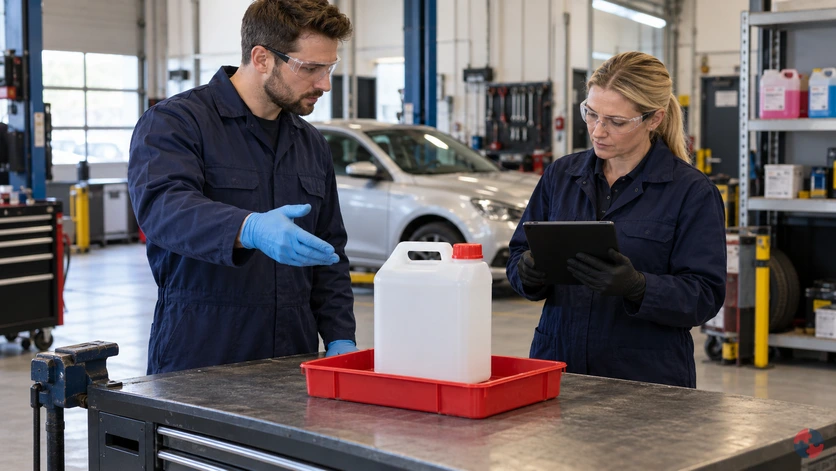
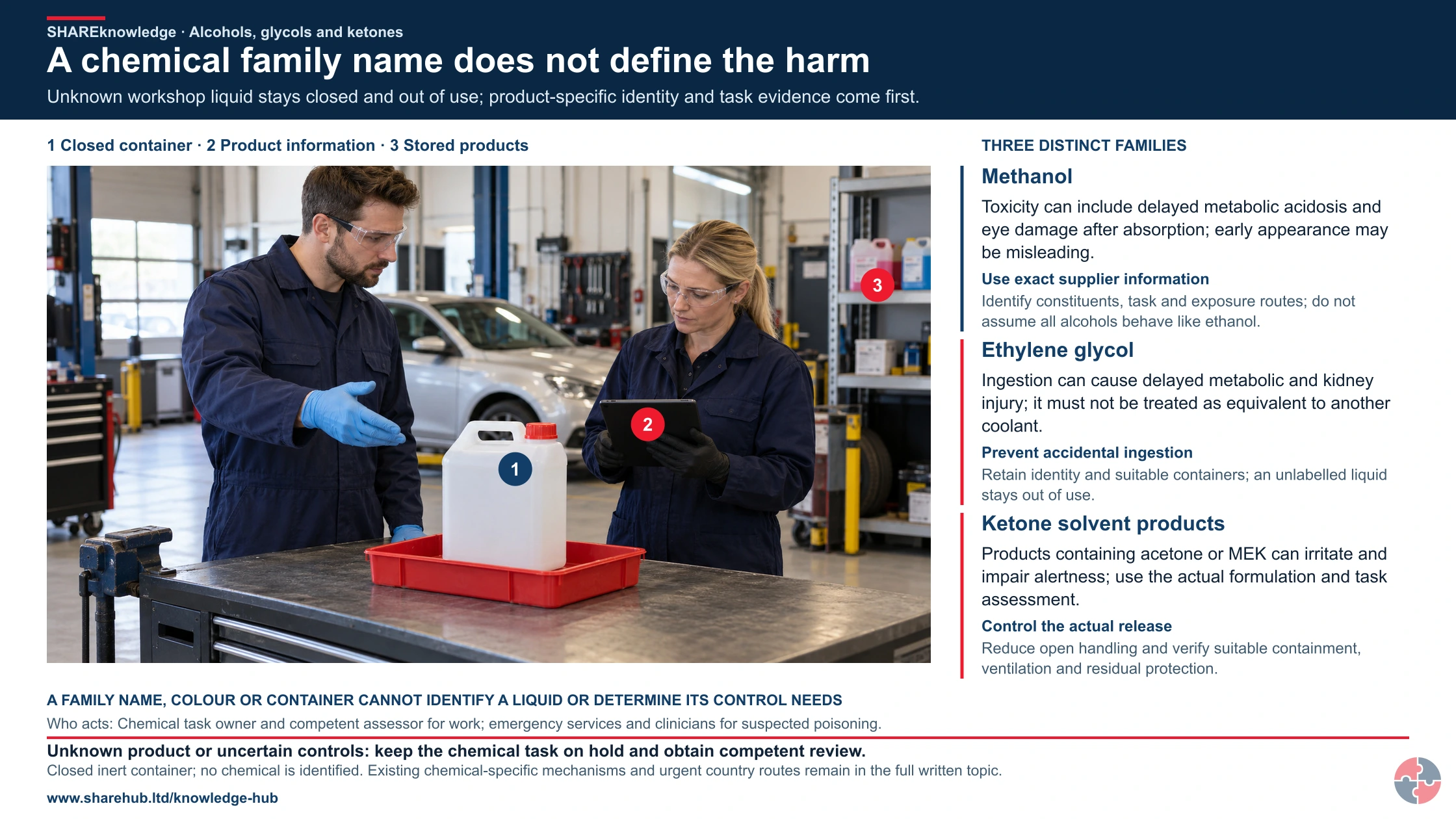
A chemical family name does not define the harm
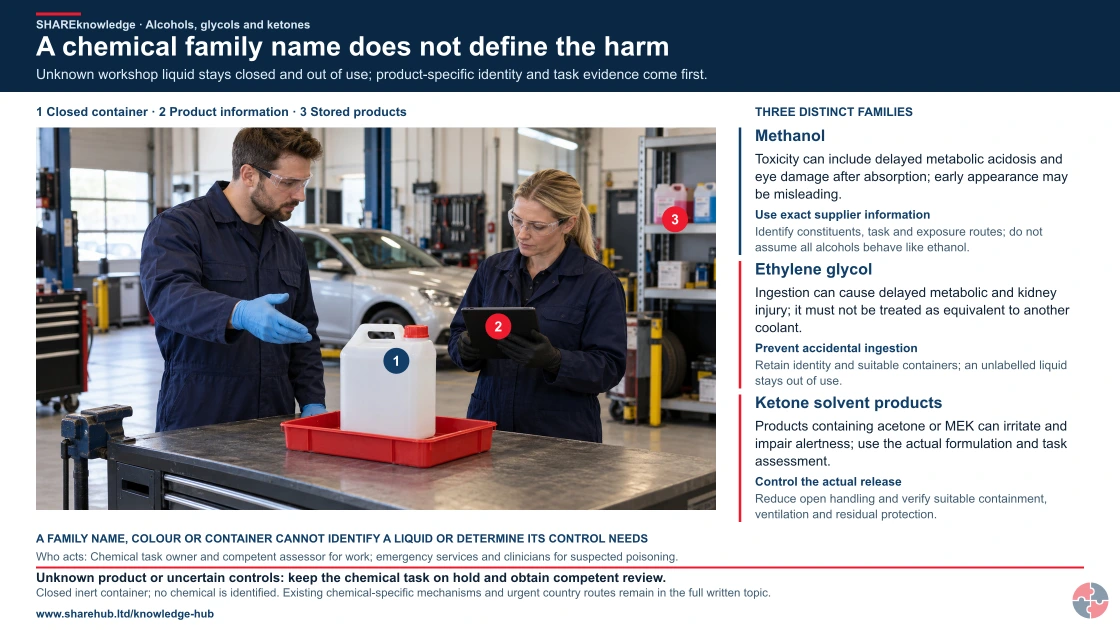
Full written explanation
An illustrative UK vehicle-workshop scene shows a closed unlabelled container in a tray, normal colleagues stopped before use and an inert product-information review. A single literal picture key identifies the closed container, product-information device and stored products. A separate native comparison shows the three chemical families, their complete source qualifications and the three control principles without arrows between families. Methanol, ethylene glycol and ketone products remain distinct; a container, colour or chemical-family name cannot identify the contents or determine control needs. Reliable exact product/SDS information supports, but does not itself constitute, the actual task assessment. No anatomy, tissue damage, metabolic sequence, clinical sign, diagnosis, treatment, PPE choice, quantity or threshold is newly illustrated. Unknown product and uncertain controls keep the task on hold for competent review. Follow the full chemical-specific guidance and applicable GB/NI urgent route; the picture is not medical triage, a handling recipe or work clearance.
Unknown workshop liquid stays closed and out of use; product-specific identity and task evidence come first.
- Methanol. Toxicity can include delayed metabolic acidosis and eye damage after absorption; early appearance may be misleading.
- Ethylene glycol. Ingestion can cause delayed metabolic and kidney injury; it must not be treated as equivalent to another coolant.
- Ketone solvent products. Products containing acetone or MEK can irritate and impair alertness; use the actual formulation and task assessment.
Change the pathway
- Use exact supplier information. Identify constituents, task and exposure routes; do not assume all alcohols behave like ethanol.
- Prevent accidental ingestion. Retain identity and suitable containers; an unlabelled liquid stays out of use.
- Control the actual release. Reduce open handling and verify suitable containment, ventilation and residual protection.
Evidence check: Product approval is not a clinical clearance. Suspected harmful exposure needs urgent help; a chemical family name cannot determine treatment.
Chemical-specific mechanisms and primary references
Primary references: HSE COSHH — prevent or control exposure at source · HSE safety data sheets — input to the assessment, not the assessment itself · HSE printers — actual process, product and task determine the controls · HSE P30 — contextual off-press enclosed-cleaning equipment scope
Open the complete HD image (new tab)Download image
Chemical-specific mechanisms and primary references
Primary references: HSE COSHH — prevent or control exposure at source · HSE safety data sheets — input to the assessment, not the assessment itself · HSE printers — actual process, product and task determine the controls · HSE P30 — contextual off-press enclosed-cleaning equipment scope
Product and Task Approval
Two linked parts · 6 questions. Open Part 2 to complete the route.

Continue to questions 4–6 · Part 2 of 2


Read this visual as text
- Start: A new or changed product is proposed for cleaning, coating or coolant use.
- Question 1: Are the exact substance or blend and supplier information known? Decision owner: Chemical task supervisor / competent assessor.
- YES: The required evidence or condition is confirmed. CONTINUE → QUESTION 2.
- NO / UNKNOWN — HOLD: Hold purchase or use; identify an unlabelled liquid or unknown glycol. HOLD → REPEAT QUESTION 1 AFTER CORRECTION.
- Question 2: Is a safer effective option available? Decision owner: Chemical task supervisor / competent assessor.
- Yes: Select and assess the alternative and its own hazards. CONTINUE → QUESTION 3.
- No: Record the remaining task and necessary controls. CONTINUE → QUESTION 3.
- Unknown: Compare options before committing to the process. HOLD → OWNER RESOLVES BEFORE RESUMING.
- Question 3: Are form, temperature, exposure routes and flammability assessed? Decision owner: Chemical task supervisor / competent assessor.
- YES: The required evidence or condition is confirmed. CONTINUE → QUESTION 4.
- NO / UNKNOWN — HOLD: Reassess the actual use; a chemical-family name is insufficient. HOLD → REPEAT QUESTION 3 AFTER CORRECTION.
- Question 4: Are ventilation, compatibility, containment and protection verified? Decision owner: Chemical task supervisor / competent assessor.
- YES: The required evidence or condition is confirmed. CONTINUE → QUESTION 5.
- NO / UNKNOWN — HOLD: Hold an unknown or unproven control, including glove or respirator suitability. HOLD → REPEAT QUESTION 4 AFTER CORRECTION.
- Question 5: Are workers, response and change controls ready? Decision owner: Chemical task supervisor / competent assessor.
- YES: The required evidence or condition is confirmed. CONTINUE → QUESTION 6.
- NO / UNKNOWN — HOLD: Brief the defined method and stop criteria before task release. HOLD → REPEAT QUESTION 5 AFTER CORRECTION.
- Question 6: Authorise only the defined task Decision owner: Chemical task supervisor / competent assessor.
- ACTION: Record owner, assessment and review after material or method change. OUTCOME → RECORD AND HAND OVER.
- Outcome: Approved controlled task with owner and records, or rejected/held change with a named evidence request.
- Stop and escalation boundary: Stop if the task depends on generic family names, unlabelled transfer, an unknown glycol or unverified PPE compatibility.
The strongest prevention decisions happen before the product is bought or the task is designed. Procurement should challenge whether a methanol-containing, high-VOC, highly flammable or more toxic product is needed, whether a water-based or lower-hazard product will work, and whether the process can be closed or automated.
Once the product is in use, control has to match the exposure route. Inhalation risk needs containment, local exhaust ventilation, general ventilation, lids, closed transfer and exposure monitoring. Skin risk needs splash prevention, compatible gloves, sleeve protection, hygiene, contaminated clothing rules and washing facilities. Fire and explosion risk may also need DSEAR controls, because many alcohols and ketones are flammable.
PPE is important but should not be used to excuse poor process design. Respiratory protective equipment, gloves and goggles depend on correct selection, compatibility, fit, maintenance and user behaviour. A worker wearing unsuitable gloves while handling methanol-contaminated rags is not protected simply because the risk assessment says gloves are worn.
For workshop decanting, identify the exact product and route before choosing a control: methanol, ethylene glycol and ketones do not have interchangeable toxicity, volatility or fire behaviour. First ask whether the wipe, coolant or transfer task can be removed; then test a suitable lower-hazard product with the same performance and material compatibility. Those are elimination and substitution within ERICPD Eliminate/Reduce. A closed dispenser, compatible transfer fittings, bund and suitable extraction are engineered containment, selected for the actual liquid and commissioned by the responsible engineer. A pre-use check covers label, seal, hose, capture and spill capacity; a failed connection or unknown formulation holds the job.
The supervisor limits access and quantity, checks the safety data sheet and teaches a demonstrated method; these are administrative layers. Gloves, eye protection and any RPE are selected from product-specific evidence for residual exposure, with replacement and fit limits recorded. ERICPD Isolate/Control describe the physical separation and controlled method, while Discipline means maintaining the dispenser and learning from drips or symptoms. If ingestion is suspected, symptoms develop, ventilation fails or a spill exceeds the trained response, stop work and use the clinical or emergency route; a measured air value below an eight-hour WEL does not clear skin contact or a short high exposure.
How can the ERICPD hierarchy of controls reduce exposure to alcohols, glycols and ketones?

| ERICPD level | What it means for this topic | Practical workplace examples | Key limitations |
|---|---|---|---|
| Eliminate | Remove the hazardous solvent or remove the solvent-rich task entirely. | Buy pre-cleaned parts, eliminate wipe-cleaning, move to solvent-free adhesives, remove unnecessary methanol-containing products. | Not always feasible where the chemical is part of specialist process chemistry. |
| Reduce | Use less hazardous substances, lower quantities, lower temperatures and shorter exposure time. | Water-based products, lower-toxicity cleaners, smaller decants, closed containers and limiting the number of exposed workers. | Residual exposure may remain and substitute products still need COSHH assessment. |
| Isolate | Separate workers from vapour, spray, splashes and contaminated equipment. | Closed transfer, enclosed cleaning units, segregated spray areas, restricted access and remote operation. | Isolation can fail during maintenance, spills, filter changes and cleaning. |
| Control | Use engineering and procedural controls to stop vapour and liquid contact reaching people. | LEV, general ventilation, sealed lids, spill kits, compatible containers, exposure monitoring, DSEAR zoning where relevant and emergency plans. | Controls must be maintained, tested and checked during real tasks, not only when new. |
| PPE | Use suitable protective equipment for residual inhalation, skin and eye risk. | Chemical-resistant gloves, splash goggles, face protection, coveralls and fit-tested RPE where required. | PPE can fail through wrong material, breakthrough, poor fit, contamination or poor removal. |
| Discipline | Use training, supervision, hygiene and work rules to keep controls effective. | No eating in chemical areas, labelled containers, symptom reporting, permit control, safe waste storage and task briefings. | Human behaviour is variable and should support, not replace, higher-order controls. |
How can the ISO 45001 hierarchy of controls reduce exposure to alcohols, glycols and ketones?

| ESEAP control level | What it means for this topic | Practical workplace examples | Key limitations |
|---|---|---|---|
| Elimination / Substitution | Remove the hazardous solvent or remove the solvent-rich task entirely. | Buy pre-cleaned parts, eliminate wipe-cleaning, move to solvent-free adhesives, remove unnecessary methanol-containing products. | Not always feasible where the chemical is part of specialist process chemistry. |
| Substitution / Engineering controls / Administrative controls | Use less hazardous substances, lower quantities, lower temperatures and shorter exposure time. | Water-based products, lower-toxicity cleaners, smaller decants, closed containers and limiting the number of exposed workers. | Residual exposure may remain and substitute products still need COSHH assessment. |
| Engineering controls / Administrative controls | Separate workers from vapour, spray, splashes and contaminated equipment. | Closed transfer, enclosed cleaning units, segregated spray areas, restricted access and remote operation. | Isolation can fail during maintenance, spills, filter changes and cleaning. |
| Engineering controls / Administrative controls | Use engineering and procedural controls to stop vapour and liquid contact reaching people. | LEV, general ventilation, sealed lids, spill kits, compatible containers, exposure monitoring, DSEAR zoning where relevant and emergency plans. | Controls must be maintained, tested and checked during real tasks, not only when new. |
| PPE | Use suitable protective equipment for residual inhalation, skin and eye risk. | Chemical-resistant gloves, splash goggles, face protection, coveralls and fit-tested RPE where required. | PPE can fail through wrong material, breakthrough, poor fit, contamination or poor removal. |
| Administrative controls | Use training, supervision, hygiene and work rules to keep controls effective. | No eating in chemical areas, labelled containers, symptom reporting, permit control, safe waste storage and task briefings. | Human behaviour is variable and should support, not replace, higher-order controls. |
What checks are needed before, during and after work?
Identify the product and exposure route before work, watch the control during work, and close the task only after contamination and defects are dealt with.
During Work Control Failure
Two linked parts · 6 questions. Open Part 2 to complete the route.

Continue to questions 4–6 · Part 2 of 2


Read this visual as text
- Start: A worker notices symptoms, a leak, spray drift or extraction failure during solvent work.
- Question 1: Is anyone seriously ill or in immediate danger? Decision owner: Chemical task supervisor / competent assessor.
- YES — STOP / REFER: Call 999 for severe illness and activate the site response plan. STOP / REFER → APPROPRIATE RESPONSE.
- NO: No such warning is identified; continue the remaining checks. CONTINUE → QUESTION 2.
- UNKNOWN — PROTECT FIRST: Protect people and hold the affected work. Obtain the responsible specialist’s assessment; do not assume the warning is absent. HOLD → OWNER RESOLVES BEFORE RESUMING.
- Question 2: Can the task stop without adding exposure? Decision owner: Chemical task supervisor / competent assessor.
- YES: The required evidence or condition is confirmed. CONTINUE → QUESTION 3.
- NO / UNKNOWN — HOLD: Keep out of an unsafe atmosphere and use trained response arrangements. HOLD → REPEAT QUESTION 2 AFTER CORRECTION.
- Question 3: Warn and protect nearby work Decision owner: Chemical task supervisor / competent assessor.
- ACTION: Stop spraying or release generation; isolate only where trained, authorised and safe. CONTINUE → QUESTION 4.
- Question 4: Have affected people received prompt appropriate clinical advice? Decision owner: Chemical task supervisor / competent assessor.
- YES: The required evidence or condition is confirmed. CONTINUE → QUESTION 5.
- NO / UNKNOWN — HOLD: Use the current nation-specific route for suspected harmful exposure; do not wait for symptoms. HOLD → REPEAT QUESTION 4 AFTER CORRECTION.
- Question 5: Are source, affected area and failed controls competently assessed? Decision owner: Chemical task supervisor / competent assessor.
- YES: The required evidence or condition is confirmed. CONTINUE → QUESTION 6.
- NO / UNKNOWN — HOLD: Keep the area held; disappearing smell does not demonstrate safety. HOLD → REPEAT QUESTION 5 AFTER CORRECTION.
- Question 6: Has the named owner accepted restored controls and restart? Decision owner: Chemical task supervisor / competent assessor.
- YES: The required evidence or condition is confirmed. OUTCOME → RECORD AND HAND OVER.
- NO / UNKNOWN — HOLD: Retain restrictions until the defect, incident and verification evidence are complete. HOLD → REPEAT QUESTION 6 AFTER CORRECTION.
- Outcome: People safe and medically triaged; area held or handed back under named approval with defect and incident records.
- Stop and escalation boundary: No unprotected rescue, continued spray after LEV failure, or return based only on smell disappearing.
| Stage | Check | Hold point | Evidence |
|---|---|---|---|
| Before purchase or change | Confirm actual ingredients, safer option, SDS, storage, flammability and disposal. | Unknown blend or unassessed substitute: do not release. | Approval and chemical register. |
| Before use | Check label, task assessment, enclosure/LEV, ignition control, compatible PPE and emergency route. | Failed control, missing SDS or unlabelled vessel: do not start. | Pre-use check and briefing. |
| During use | Keep lids and capture working, protect bystanders, prevent skin and hand-to-mouth exposure. | Symptoms, leak, spray drift, extraction fault or changed task: stop and isolate. | Defect or exposure report. |
| Completion | Close and label containers, secure waste, check skin/contact incidents and hand over remaining hazards. | No hand-back while a release or unresolved defect remains. | Waste, maintenance and handover record. |
| After an event | Arrange medical route, investigate similar work and verify corrective actions. | Do not restart on an untested verbal assurance. | Incident, review and authorisation. |
What should a COSHH assessment cover for these substances?
A COSHH assessment should connect the chemical, task, route of exposure, exposure level, controls, monitoring and emergency response.
A generic COSHH assessment for solvents is not enough. The assessment should identify the exact product ingredients, percentage ranges, boiling point or volatility, flammability, WELs, skin notation, physical form, routes of entry, task frequency, quantity used, work area, ventilation, people exposed and abnormal situations such as spills or maintenance.
The assessment should also identify how exposure will be checked. For solvent vapours this may include occupational hygiene monitoring against EH40 workplace exposure limits, checking LEV performance, reviewing symptoms, observing the task and confirming whether controls are actually used. For skin exposure, direct observation, glove selection, breakthrough information and dermatitis reports are often more useful than air monitoring alone.
Emergency arrangements should not be an afterthought. The assessment should define eyewash, washing facilities, contaminated clothing rules, spill response, first aid, medical assessment routes, isolation of contaminated areas, waste disposal and how the site communicates product information to responders.
| Assessment question | What good looks like | Evidence to check |
|---|---|---|
| What is the exact chemical or blend? | The assessment names methanol, ethylene glycol, acetone, MEK or the relevant solvent ingredients. | SDS, label, chemical inventory and procurement record. |
| How can it enter the body? | Inhalation, skin, eye and ingestion routes are considered separately. | Task observation, hygiene review, glove assessment and ventilation review. |
| What exposure limits or toxic warnings apply? | EH40 WELs, skin notation and safety data sheet hazard statements are reviewed. | EH40 record, SDS section 8 and exposure monitoring plan. |
| Which tasks create peak exposure? | Spraying, heating, decanting, cleaning, spill response, filter changes and enclosed work are assessed. | Method statement, permit, monitoring data and supervision checks. |
| How are controls verified? | Ventilation, containment, PPE, storage and hygiene controls are tested or inspected. | LEV records, inspection sheets, RPE face-fit, glove compatibility and audit findings. |
| What happens after symptoms or spills? | There is a clear stop-work, decontamination, medical assessment and investigation route. | Emergency plan, first-aid arrangements, incident report and action close-out. |
When are exposure monitoring and health surveillance needed?
Use competent task-specific assessment to decide on monitoring; health surveillance is selective and is not the same as air sampling.
Check the substance and averaging period in HSE EH40, HSE exposure-monitoring guidance; seek specialist interpretation for skin, ingestion or short-peak exposure.
Compare airborne results with the correct substance, units and averaging period in current EH40. A measured result below a WEL does not rule out short peaks, skin contact or ingestion, and odour is not a reliable exposure gauge. Ethylene glycol vapour and particulate/mist must not be conflated. HSE recommends monitoring when needed to demonstrate WEL compliance or control effectiveness. Health surveillance is indicated where an associated adverse health effect can be detected early and the workplace conditions make it likely; skin disease can be relevant. Seek competent occupational-health advice rather than routine organ testing for everyone handling a solvent.
| Question | Decision | Limit |
|---|---|---|
| Airborne exposure | Hygienist checks actual product, vapour/mist, task peaks and EH40 period. | WEL is an airborne control tool, not an ingestion or skin safety limit. |
| LEV performance | User checks and competent examination/test assess control at the point of use. | A fan running does not prove effective capture. |
| Skin effects | Review contact, glove compatibility and dermatitis patterns. | Air samples cannot prove skin control. |
| Health surveillance | Apply HSE/HSENI criteria with competent occupational-health input. | Not universal testing or a substitute for prevention. |
Which duties apply in Great Britain and Northern Ireland?
Workplace exposure and fire duties have separate GB and Northern Ireland instruments; supplier classification and SDS duties are a different question.
In Great Britain, the 1974 Act and COSHH 2002 frame workplace assessment and control; DSEAR 2002 adds fire/explosion controls where relevant. In Northern Ireland, use the 1978 Order, COSHH (NI) 2003 and DSEAR (NI) 2003. HSENI says EH40 WELs are legally binding under COSHH (NI). Check amended law and the actual process. Product-supply classification, label and SDS rules do not by themselves assess the workplace task; confirm the applicable GB or NI supply regime for the product.
| Question | Great Britain | Northern Ireland |
|---|---|---|
| General work duties | Health and Safety at Work etc Act 1974. | Health and Safety at Work (NI) Order 1978. GB source NI source |
| Health exposure | COSHH Regulations 2002. | COSHH Regulations (NI) 2003; HSENI states EH40 WELs apply. GB source NI source |
| Flammable atmosphere | DSEAR 2002 where relevant. | DSEAR (NI) 2003 where relevant. GB source NI source |
| Product supply | Check current classification, labelling and SDS supply rules separately. | Check the NI product-supply route separately; do not assume GB marking or documents transfer unchanged. Official source |
How should the risk register describe alcohol, glycol and ketone poisoning?
The risk register should describe the solvent task, exposed people, exposure route, controls, monitoring evidence and recovery actions.
A useful risk register entry does not simply say 'solvents'. It names the product or family, identifies whether methanol, ethylene glycol, acetone, MEK or a mixed solvent is involved, and describes where exposure could occur. It should also separate routine tasks from non-routine tasks such as spill response, line breaks, tank cleaning, confined-space entry, filter changes and contractor cleaning.
The register should connect the hazard to visible evidence. If the control is LEV, there should be test records and user checks. If the control is compatible gloves, there should be selection evidence and replacement rules. If the control is substitution, procurement should prevent drift back to the old product.
| Risk route | Possible harm | Controls | Evidence and assurance |
|---|---|---|---|
| Open solvent cleaning | CNS depression, irritation, dermatitis and fire risk. | Substitute product, local ventilation, small quantities, lids, gloves and no lone work. | COSHH assessment, SDS, task observation, LEV record and symptom reports. |
| Methanol-containing product | Delayed acidosis, visual injury, neurological harm and severe poisoning. | Avoid where possible, closed handling, medical response plan, exposure monitoring and strict hygiene. | Chemical register, purchase approval, WEL review, training and emergency drill. |
| Ethylene glycol handling | Poisoning, kidney injury, skin contact and accidental ingestion risk. | Closed transfer, labelled containers, welfare controls, spill response and no food/drink in area. | Inventory, task plan, spill records, hygiene checks and first-aid briefing. |
| Spraying or heated use | High airborne exposure and flammable atmosphere risk. | Spray booth, LEV, DSEAR controls, ignition control, RPE assessment and restricted access. | Monitoring report, DSEAR assessment, RPE face-fit, maintenance and permit record. |
| Maintenance or contractor work | Unexpected release, contaminated residues and poor handover. | Permit control, isolation, cleaning certificate, SDS briefing and supervision. | Permit, handover record, contractor induction and post-job review. |
| Symptoms or near miss | Continuation of exposure leading to more serious poisoning. | Stop work, medical assessment, investigation and control improvement before restart. | Incident report, action close-out, risk assessment update and worker feedback. |
How could Crownway Fuels Ltd manage alcohol, glycol and ketone poisoning?

Crownway Fuels Ltd would manage the risk through controlled chemical purchasing, COSHH assessment, closed handling, monitoring, training and learning from exposure events.
How Crownway applies the programme
Crownway Fuels Ltd would treat solvent and glycol handling as a controlled hazardous-substance programme, not a collection of small maintenance products.
Crownway Fuels Ltd is a fuel, depot and industrial-fluid business with bulk storage, maintenance workshops, vehicle bays, contractor cleaning, spill response and seasonal handling of antifreeze or de-icing products. The business keeps a chemical register that identifies methanol-containing products, glycols, acetone, MEK, thinners, cleaners and solvent-contaminated waste. New solvent products cannot be purchased until the safety data sheet, WELs, flammability and safer alternatives have been reviewed.
At operational level, Crownway maps solvent tasks into the risk register: decanting, bund cleaning, pump maintenance, line breaking, wipe cleaning, parts washing, spill response and waste handling. Routine work uses labelled containers, closed transfer where possible, lids, compatible pumps, local ventilation, spill control and chemical-resistant PPE selected against the actual solvent. Non-routine work is controlled by permits, isolation, supervision and pre-job briefings.
The company does not wait for a serious poisoning event before learning. Supervisors review reports of headaches, dizziness, solvent odour, dermatitis, spill near misses and poor container labelling. The HSSE team checks exposure-monitoring needs, LEV test records, glove selection, RPE face-fit, first-aid arrangements and contractor compliance. Actions are tracked to close-out in the management system and reviewed at monthly operational risk meetings.
| Management area | How Crownway manages it | Evidence, oversight and improvement |
|---|---|---|
| Chemical register and procurement | Products are approved before purchase, with methanol, glycol, acetone, MEK, flammability and WEL information flagged. | Approved product list, SDS review, substitution record and purchasing controls. |
| COSHH task assessment | Assessments are task-specific for transfer, cleaning, maintenance, de-icing, spill response and waste handling. | COSHH records, task observations, worker consultation and review dates. |
| Engineering and operational controls | Closed transfer, lids, LEV, bunded storage, segregation, ignition control and spill kits are used where needed. | Inspection records, LEV tests, DSEAR assessment, maintenance logs and audit findings. |
| Training and competence | Workers are trained on solvent symptoms, routes of entry, SDS basics, hygiene, decontamination, PPE limits and stop-work rules. | Training matrix, toolbox talks, supervisor checks and competence observations. |
| Health, exposure and incident monitoring | Symptom reports, dermatitis concerns, exposure monitoring needs and spill trends are reviewed. | Occupational hygiene reports, health surveillance decisions, incident trends and management review minutes. |
| Contractor management | Contractors handling solvents receive SDS information, site rules, permit requirements and waste arrangements. | Contractor RAMS, induction record, permit sign-off and post-job review. |
| Learning and continuous improvement | Any solvent near miss or symptom cluster triggers investigation and checking of similar tasks elsewhere. | Action tracker, risk-register update, procedure revision and worker feedback loop. |
What training is needed for alcohol, glycol and ketone exposure control?
Training should match the person's role, from general solvent awareness through to specialist COSHH and occupational hygiene competence.
Training should explain the topic in layers. Everyone who may encounter solvent products needs simple awareness: do not sniff to check safety, do not decant into unlabelled containers, do not eat in chemical areas, report symptoms and know where eyewash and washing facilities are. People doing the task need more practical instruction on specific products, routes of entry, ventilation, spills, PPE and waste.
Supervisors need a deeper level because they decide whether a task starts, stops or changes. They should understand symptom escalation, medical assessment triggers, permit requirements, contractor control, how to read SDS sections that matter for work, and how to verify that controls are used rather than assumed.
Specialist support may be needed for COSHH assessors, occupational hygienists, health surveillance providers, DSEAR specialists and managers approving substitution or monitoring budgets. This is where the organisation turns general awareness into a controlled management system.
| Role and learning | Practice on the actual task | Competence evidence and record | Assessor and reassessment trigger |
|---|---|---|---|
| Workers: identify the exact solvent | Read the product label and SDS, use specified controls, stop and report symptoms or spill. | Observed product check, safe transfer and alarm/report route. | Supervisor rechecks after product, blend or task change. |
| Supervisors: control the task | Verify containment, ventilation, ignition controls, gloves and emergency plan before work. | Observed setup, stop decision and documented hand-back. | Competent manager rechecks after leak, near miss or failed ventilation. |
| First aiders: escalate within role | Practise safe withdrawal, 999 route and clear product/SDS handover without prescribing treatment. | Scenario exercise with correct escalation and handover. | First-aid lead rechecks after exercise or route change. |
| Hygienists and occupational health specialists | Select chemical-specific exposure assessment and health surveillance only where justified. | Interpreted monitoring, clinical referral boundary and confidential record. | Qualified specialist peer checks after new evidence or symptoms. |
| Managers and procurement: prevent substitution errors | Approve lower-risk material where feasible and verify supplier information and control changes. | Approved substitution review and closed corrective actions. | Accountable lead reopens after supplier, incident or regulatory change. |
Record the demonstrated decision, assessor and limits of authority. Reassess after changes to the task, substance, equipment or response plan, or after an incident; no universal certificate period is assumed.
Which standards help, and what do they not prove?
ISO 45001 can organise exposure-risk assurance, but it cannot identify a solvent, set a glove breakthrough time or replace a COSHH assessment.
ISO 45001 is a voluntary occupational health and safety management standard; verify the applicable edition and amendments from an authorised current copy before formal mapping. It can structure worker consultation, competence, change control, emergency planning and improvement. Its certification is not evidence that a specific methanol, ethylene glycol, acetone or MEK task is controlled. For the actual task, use current legislation, EH40, the product SDS, competent occupational-hygiene assessment and manufacturer instructions for the equipment and PPE. Do not invent a universal BS or EN solvent-control specification.
How can management systems support solvent poisoning control?
Management systems help by turning chemical control into planned, owned, monitored and reviewed work.
ISO 45001 is not required to manage solvent risks, but its structure is useful. It asks whether the organisation has identified hazards, assessed risks, consulted workers, controlled operations, managed contractors, planned emergencies, evaluated performance and improved after incidents.
For this topic, the value is in connecting systems that are often separate: procurement, chemical register, COSHH assessment, DSEAR, training, PPE issue, LEV testing, occupational hygiene, health surveillance, incident investigation and management review.
| Management-system theme | How it supports the topic | Evidence to look for |
|---|---|---|
| Consultation and participation of workers | Workers help identify real solvent tasks, symptoms, poor ventilation and impractical controls. | Worker feedback, consultation notes and updated assessments. |
| Hazard identification and assessment of OH&S risks and opportunities | Solvent hazards, exposure routes, peak tasks and non-routine work are identified. | Chemical register, COSHH assessments and risk register. |
| Competence | People are competent to use, supervise, assess and monitor solvent work. | Training matrix, assessor competence and supervisor verification. |
| Operational planning and control | Solvent handling, storage, transfer, cleaning, maintenance and waste are controlled. | Procedures, permits, contractor controls and procurement rules. |
| Emergency preparedness and response | The site plans for spills, exposure symptoms, decontamination and medical assessment. | Emergency plan, drills, first-aid arrangements and spill records. |
| Performance evaluation | Exposure monitoring, LEV results, health surveillance and incident trends are reviewed. | Monitoring reports, inspections, audits and management review. |
| Incident, nonconformity and corrective action | Symptoms, spills, exposure exceedances and control failures lead to corrective action. | Investigation reports, action close-out and control verification. |
What are the warning signs that controls are failing?
Controls may be failing when symptoms, vapour release, skin contamination, poor housekeeping or weak records become normal.
The biggest warning sign is normalisation. If people accept headaches after cleaning, dizziness after spraying, solvent smell in a workroom, soaked gloves, unlabelled bottles or repeated small spills as normal, the control system is already drifting.
Warning signs should be treated as learning data. A single complaint may reveal a ventilation problem. Two people with similar symptoms may indicate a shared exposure route. A dermatitis trend may show that glove selection is wrong. A spill response that depends on improvisation may show that the emergency plan has never been tested.
- Workers repeatedly report headache, dizziness, nausea, drowsiness or eye/throat irritation during the same solvent tasks.
- There is visible evaporation, mist, spray drift, solvent odour or poor ventilation during cleaning, spraying or decanting.
- Workers have frequent skin contamination, soaked gloves, dermatitis or poor access to washing facilities.
- Symptoms are dismissed as tiredness, hangovers or personal health issues without reviewing the chemical exposure history.
- COSHH assessments describe generic solvent use but do not name methanol, ethylene glycol, acetone, MEK or the actual product blend.
- LEV records, exposure monitoring, glove compatibility and RPE face-fit evidence are missing or out of date.
- Contractors bring solvent products onto site without SDS review, task assessment or waste arrangements.
- Spills and near misses are cleaned up but not investigated for root causes or similar-task risk.
| Warning sign | How it can cause harm | What to check |
|---|---|---|
| Recurring headaches or dizziness | May indicate uncontrolled solvent absorption and immediate safety-critical impairment. | Ventilation, task duration, WEL monitoring, SDS and worker reports. |
| Skin contamination or dermatitis | May add to body dose and cause occupational skin disease. | Glove compatibility, hygiene, contaminated clothing and washing facilities. |
| Visual symptoms after solvent work | May indicate high-consequence methanol-related poisoning. | Product ingredients, exposure route, medical assessment and task controls. |
| Kidney-related illness after glycol work | May indicate significant glycol poisoning or delayed organ injury. | Chemical history, medical assessment, spill or ingestion route and controls. |
| Generic COSHH wording | Specific solvent hazards may be missed. | Actual ingredients, WELs, routes of entry, task observation and monitoring. |
| PPE as the main control | Exposure may continue if gloves, RPE or behaviour fail. | Substitution, enclosure, LEV, maintenance and supervision evidence. |
Standards named on this page are background context. Confirm the current edition, scope and exact requirements from an authorised copy before applying them. The open official sources below support the specific public-law and regulator guidance claims they are cited for.
What do the acronyms and key terms mean?
Acronyms should be defined because solvent, COSHH and occupational-hygiene discussions often use shorthand.
| Acronym or term | What it means | Why it matters |
|---|---|---|
| CNS | Central nervous system. | The brain and nervous system are commonly affected early by solvent exposure. |
| MEK | Methyl ethyl ketone. | A ketone solvent used in coatings, adhesives, resins and cleaning work. |
| COSHH | Control of Substances Hazardous to Health. | The main UK framework for assessing and controlling hazardous substance exposure. |
| SDS | Safety data sheet. | Provides product hazard, control, PPE and emergency information but does not replace task assessment. |
| WEL | Workplace exposure limit. | A legal or guidance exposure limit listed in EH40 for airborne hazardous substances. |
| LEV | Local exhaust ventilation. | Engineering control used to capture vapours, mists or fumes near the source. |
| RPE | Respiratory protective equipment. | Respirators or breathing protection used where residual airborne risk remains. |
| PPE | Personal protective equipment. | Includes gloves, eye protection, clothing and RPE for residual exposure. |
| DSEAR | Dangerous Substances and Explosive Atmospheres Regulations. | Important where flammable solvent vapours create fire or explosion risk. |
| ERICPD | Eliminate, Reduce, Isolate, Control, PPE, Discipline. | A practical hierarchy used to select stronger risk controls. |