SHARE Knowledge Hub
Halogenated Hydrocarbon Diseases
Halogenated hydrocarbon diseases are illnesses linked to harmful exposure to particular halogenated solvents, especially chlorinated cleaning and degreasing agents. During cleaning or maintenance, vapour can be inhaled and liquid can contact or pass through skin, causing acute nervous-system effects, dermatitis and, for specific chemicals such as trichloroethylene, longer-term organ damage and cancer. The critical decisions are to identify the exact substance and lawful use, remove or contain the exposure source, and stop when controls fail.
Understanding Halogenated Hydrocarbon Diseases
Halogenated hydrocarbon diseases are illnesses linked to harmful exposure to particular halogenated solvents, especially chlorinated cleaning and degreasing agents. During cleaning or maintenance, vapour can be inhaled and liquid can contact or pass through skin, causing acute nervous-system effects, dermatitis and, for specific chemicals such as trichloroethylene, longer-term organ damage and cancer. The critical decisions are to identify the exact substance and lawful use, remove or contain the exposure source, and stop when controls fail.
Why this matters at work
The practical standard is a documented source-to-person control system: confirm chemical identity and current supply status, question the need for the solvent, select a safer method where feasible, contain and extract vapour, prevent liquid contact, maintain equipment, check exposure, prepare for leaks and ill health, and verify performance under routine and abnormal conditions. Controls must cover operators, cleaners, maintenance workers, contractors, visitors and neighbouring premises, not just the person who opens a container.
UKHSA's dichloromethane information is agent-specific; its description of historical restrictions is not a complete statement of current GB or NI use permissions. For planned work, obtain current SDS and regulatory information and use the relevant COSHH route. Prevent or reduce release with safer processes and suitable containment or extraction before personal protection. Determine whether the question describes an active exposure, which may require immediate safe withdrawal and professional help. Keep uncertainty explicit. A general solvent label, lack of a flammable pictogram or an apparently normal air reading cannot establish that all health and physical risks are controlled.
How organisations manage this in practice
First consider eliminating the solvent task or using a genuinely safer process, assessing any new chemical, fire, mechanical or waste hazards. Where solvent use remains, minimise open handling, use suitable closed equipment or containment and provide extraction designed for the actual emission. Temperature, workpiece size, agitation, opening and maintenance can change release substantially. General room ventilation may not capture vapour at source. Check skin and eye contact, contaminated clothing, drying, waste and cleaning as well as inhalation. Select protection using chemical-specific compatibility and task information; a generic glove or mask description is insufficient. Commission engineering controls and give users clear indicators and a safe defect response. Monitoring should represent actual tasks and relevant exposure periods and cannot alone resolve skin uptake or every long-term risk. Keep current limit and restriction information for the identified agent. Record performance and corrective actions, and review substitutions or process changes before use. An SDS or supplier assertion does not authorise work or establish that existing controls remain suitable.
Biological monitoring can indicate uptake, while health surveillance looks for adverse health changes; they answer different questions and need suitable professional input. Neither replaces prevention or provides a general diagnosis or clearance certificate. Review unexpected results, trends and symptoms against controls, work changes and other exposure routes. Communicate understandable findings to workers and keep clinical information confidential. Record management actions and verify improvement, including similar tasks and workers where appropriate. Do not apply one solvent's limit or biological guidance value to the whole family, or assume a satisfactory shift-average air result closes skin-contamination or acute-exposure concerns.
Map sources that are normally closed but opened intermittently: degreaser lids, stills, filter changes, sump cleaning, spent solvent drums, pipe breaks, transfer hoses and laundry machine doors. Include damaged packages in transport and contaminated workwear. A low routine average can hide a short high exposure during loading, cleaning or repair. Change of supplier or formulation is a new assessment trigger, not an administrative substitution.
What should you remember before work starts?
Name the chemical, prevent exposure at source and stop if the task, controls or people’s condition changes.
A familiar trade name, a small quantity or absence of smell does not prove safety. Vapour may be invisible. A closed system during production can become an open exposure source during cleaning, draining or repair. An air result below a limit does not establish that skin contact, short peaks or another chemical are controlled.
What should happen if someone may have been exposed?
Stop further exposure safely and seek immediate medical help for suspected harmful inhalation, skin contact or swallowing; use the emergency route for your location and call 999 for severe signs.
Suspected harmful exposure — protect people and obtain help


Read the complete visual as text
- Start: Stop further exposure safely and raise the alarm. Do not delay help to collect records.
- Question 1: Would helping require entry into a dangerous atmosphere? Decision owner: Worker/first aider from safety, supervisor and relevant clinical or emergency service.
- YES / UNKNOWN: Do not enter. Call emergency services or the specialist response team from safety; continue the urgent medical-help check. Owner: Worker/first aider from safety, supervisor and relevant clinical or emergency service. CONTINUE → QUESTION 2.
- NO: Use the local first-aid/emergency plan from a safe position; continue the urgent medical-help check. Owner: Worker/first aider from safety, supervisor and relevant clinical or emergency service. CONTINUE → QUESTION 2.
- Question 2: Collapse, unconsciousness, seizure or serious breathing difficulty? Decision owner: Worker/first aider from safety, supervisor and relevant clinical or emergency service.
- YES: Call 999 from safety and follow the call handler. Give product, task, time, route and symptoms only if safely available; restrict access and tell the supervisor. Owner: Worker/first aider from safety, supervisor and relevant clinical or emergency service. STOP / REFER → APPROPRIATE RESPONSE.
- NO: Use the relevant nation’s immediate medical-help route. Owner: Worker/first aider from safety, supervisor and relevant clinical or emergency service. CONTINUE → QUESTION 3.
- UNKNOWN: Seek emergency advice from safety and follow the call handler; do not delay for a diagnosis or records. Owner: Worker/first aider from safety, supervisor and relevant clinical or emergency service. STOP / REFER → APPROPRIATE RESPONSE.
- Question 3: Where did the suspected exposure occur? Decision owner: Worker/first aider from safety, supervisor and relevant clinical or emergency service.
- ENGLAND: For suspected harmful inhalation, contact or swallowing, call 999 or go to A&E under NHS advice. Do not drive yourself. Owner: Worker/first aider from safety, supervisor and relevant clinical or emergency service. STOP / REFER → APPROPRIATE RESPONSE.
- NORTHERN IRELAND: Get immediate medical help; 999/ED for serious illness. If well, seek prompt GP/out-of-hours advice; go to ED if prompt advice is unavailable for a hazardous substance. Owner: Worker/first aider from safety, supervisor and relevant clinical or emergency service. STOP / REFER → APPROPRIATE RESPONSE.
- SCOTLAND / WALES: Use the current local route in the page: Scotland NHS24 111 for urgent non-life-threatening care or GP; Wales immediate medical advice, 111 if harm is uncertain, 999/A&E for suspected harmful exposure. UK life-threatening emergency: 999. Owner: Worker/first aider from safety, supervisor and relevant clinical or emergency service. STOP / REFER → APPROPRIATE RESPONSE.
- Outcome: Accepted clinical/emergency handover, restricted access and supervisor informed.
- Stop and escalation boundary: Filter masks do not supply oxygen. No re-entry, rescue manoeuvre, treatment or safe clearance time is supplied. The following process-restart route applies separately.
Do not enter a contaminated room, tank, pit or other dangerous atmosphere to attempt an unplanned rescue. Move away and raise the alarm. In England, NHS advice says to call 999 or go to A&E if someone may have breathed in, touched or swallowed something harmful. In Scotland, phone NHS 24 on 111 for urgent non-life-threatening care or contact your GP during opening hours; call 999 for a life-threatening emergency. In Wales, NHS 111 Wales says to get immediate medical advice for suspected poisoning and to phone 111 if unsure whether the substance is harmful; call 999 or go to A&E for a suspected harmful exposure. In Northern Ireland, seek medical help immediately: call 999 or attend an emergency department for serious illness, use a GP or GP out-of-hours route if the person is well, and go to an emergency department if prompt advice is unavailable for a potentially hazardous substance. Call 999 from anywhere in the UK for collapse, unconsciousness, seizures or serious breathing difficulty. Give responders the product label or safety data sheet (SDS), task, time, route and symptoms if safely available; do not delay help to collect records. NHS England poisoning advice; NHS inform urgent care route; NHS 111 Wales poisoning; nidirect poisoning advice.
For recurring symptoms, seek GP or occupational-health assessment and review the task promptly. A headache or rash alone does not identify the chemical or prove causation. Neither a manager nor an online symptom checklist can rule out serious exposure. Clinical assessment and return-to-work decisions belong with qualified health professionals.
What are halogenated hydrocarbons and why can they cause disease?
Halogenated hydrocarbons are organic chemicals containing fluorine, chlorine, bromine or iodine; the page title describes a group of exposure-related illnesses, not a single medical diagnosis.
Solvents are useful because they dissolve substances such as grease and can evaporate quickly. Evaporation transfers liquid into air: a worker can inhale vapour without seeing a cloud. Absorbed solvent may enter the bloodstream and affect organs beyond the original contact site. Some solvents also remove protective oils from skin. Dose, exposure duration, route, mixture and the particular chemical all change the outcome.
For example, trichloroethylene (TCE, also called trichloroethene) is rapidly distributed after absorption. The body converts it into other chemicals, called metabolites, which contribute to its toxicity. Acute exposure can impair the brain and coordination; repeated exposure can damage the nervous system, liver and kidneys. It is carcinogenic to humans. These findings must not be applied indiscriminately to every refrigerant or halogenated compound. UKHSA trichloroethylene toxicology.
Where can exposure occur?
Exposure occurs where a substance escapes containment, reaches the skin or is changed by the process, especially during open cleaning and non-routine maintenance.
Look beyond the person holding the container: nearby operators, cleaners, maintenance staff, contractors and waste handlers may be affected. Workshop trays, solvent-wet cloths, dry-cleaning equipment, laboratory transfers, paint removal and process vessels need task-specific controls. Old stock and unlabelled waste cannot be assessed from appearance.
A drain, low area or poorly ventilated enclosure can collect hazardous vapour. Refrigerant circuit opening may add pressurised release, cold injury and oxygen-displacement hazards. Do not transfer a cleaning-solvent method to refrigeration work. Identify the refrigerant, equipment instructions, competence and emergency arrangements separately.
The same exposure logic transfers between sectors, but the product, process and lawful-use check must be repeated. The examples below are possible tasks, not evidence that the chemical is common or approved in that sector.
| Sector and task | People, route and harm | Strongest feasible controls | Residual check or stop point |
|---|---|---|---|
| Manufacturing: metal-parts degreasing | Operators, maintainers and waste handlers; vapour and skin transfer can cause acute impairment or dermatitis, with substance-specific long-term disease. | Avoid solvent if the specification permits; otherwise use an approved enclosed system and verified extraction. | Hold on unapproved chemical, failed enclosure or extraction; verify maintenance opening and waste route. |
| Construction: coating removal at a transient site | Applicator and nearby trades; DCM vapour and skin contact can cause serious acute illness. | Select a safer removal method first; if DCM paint stripper is proposed, verify lawful use, professional certificate and assessed engineering controls. | Stop on missing certificate, uncontrolled adjacent exposure or a change of room or ventilation. |
| Logistics: fleet-maintenance parts cleaning | Mechanic, nearby drivers and waste contractor; an open cleaning tray can release vapour and contaminate skin. | Use purchased clean parts or assessed aqueous cleaning where feasible; otherwise approved enclosed cleaning and controlled waste. | Do not carry an open tray through an occupied depot; stop on a changed product or extraction fault. |
Hospitality is not given a separate halogenated-solvent example: the evidence reviewed did not establish a distinct routine task. A hotel renovation contractor would use the construction decision above; refrigeration maintenance needs its own refrigerant-specific assessment.
How does the chemical reach the body?
The main routes are breathing vapour or mist, contact with skin or eyes, and swallowing contamination transferred from hands or surfaces.
Vapour is the gas above an evaporating liquid; mist consists of liquid droplets, for example from spraying. Both may be breathed in, but the control and respiratory protection must suit the actual form. Skin exposure can continue inside a contaminated glove or sleeve. Some chemicals pass through intact glove material without a visible hole.
Keep contaminated hands away from food, drink and smoking materials. Wash after handling and before breaks using suitable washing facilities, not solvent. Eye splashes require immediate first-aid action under the product-specific plan. Heated residues may create new harmful substances, so a normal-use SDS assessment must also consider the process.
How do changes in the job change the decision?
A change of chemical, location, temperature or containment is a reason to reassess before continuing, even when the basic task name stays the same.
Use these short variations with the full Crownway example below. They illustrate SHARE planning decisions, not permissions to use the substances.
| Changed condition | Decision before work |
|---|---|
| A contractor brings a substitute cleaner | Hold chemical approval until the current SDS, intended use, equipment compatibility and disposal route have been reviewed. Safer in one respect may mean worse in another. |
| A cabinet must be drained or its filter replaced | Treat opening and waste handling as separate tasks. Isolate and plan containment, ventilation and competent maintenance before breaking containment. |
| Welding is proposed on solvent-cleaned metal | Stop the hot-work release until the responsible person verifies residue removal and the method’s suitability. Do not use smell as the test or invent a waiting period. |
| A release occurs near a basement, pit or occupied room | Withdraw, warn others and activate the emergency arrangements. Do not enter to investigate without an assessed response system. |
| Refrigeration plant develops a leak | Use the refrigerant-specific response and competent service team. Do not improvise with a solvent spill kit or assume a filter mask makes entry safe. |
What health effects are immediate and which may develop later?
High exposure to some solvents can cause rapid impairment or collapse; repeated exposure to particular chemicals can cause lasting disease, sometimes without useful early warning.
Dizziness, drowsiness, nausea, confusion and poor coordination can make driving, machinery use or work at height unsafe before a person recognises the exposure. Skin irritation, burns or dermatitis may follow contact. Serious organ effects and cancer risk are chemical-specific: symptoms are not a reliable measure of absorbed dose. The chain is source → vapour or contaminated surface → inhalation or skin/eye contact → nervous system, skin or other organs; a longer exposure or higher release can increase dose, while long-latency harm may have no useful early sign.
| Source and task | Route and affected tissue | Likely or established harm | Warning and stop trigger |
|---|---|---|---|
| Open solvent cleaning or a cabinet fault | Evaporating chlorinated solvent reaches air; inhalation affects the brain and other organs. | Acute dizziness, drowsiness and impaired coordination; very high exposure can cause collapse. | Symptoms, leak or failed extraction: leave safely, stop work and use the medical route above. Do not enter a suspect atmosphere for rescue. |
| Solvent-wet parts, gloves or waste | Liquid transfers through skin or splashes eyes; some chemicals also enter the bloodstream. | Irritation or dermatitis; systemic effects depend on the chemical and absorbed dose. | Wet or damaged glove, splash or skin symptoms: stop contact, use product-specific first aid and seek medical help for suspected harm. |
| Repeated TCE exposure during cleaning or maintenance | Inhaled or skin-absorbed TCE and metabolites affect nervous system, liver and kidneys. | Established organ toxicity and carcinogenicity; cancer can occur without an early warning symptom. | Unapproved use, recurrent exposure or failed containment: hold work for authorisation and competent control review, even if no one feels ill. |
| Heated or disturbed solvent residue | Process change can release additional harmful substances into breathing air. | Effects depend on the identified residue and process; do not infer a safe outcome from a normal-use SDS alone. | Unknown residue or proposed hot work: stop and obtain specialist verification before release. |
| Substance or group | What matters for the decision |
|---|---|
| Trichloroethylene (TCE) | Neurological, liver and kidney effects and carcinogenicity are established concerns. Seek elimination or substitution; apply the relevant carcinogen control requirements. |
| Dichloromethane (DCM or methylene chloride) | Vapour and skin exposure can cause systemic effects; high exposure can be severe. Its uses and restrictions must be checked specifically, particularly paint stripping. |
| Other solvents and refrigerants | Use the exact substance data. Do not infer cancer risk, flammability, safe exposure or glove resistance from the chemical family name. |
Recovery depends on the injury, substance and exposure; removal from work does not guarantee that effects are reversible. Record the occupational history and obtain clinical advice. UKHSA trichloroethylene toxicology; UKHSA dichloromethane information.
What should the emergency plan require?
The plan must protect the affected person and responders, end exposure safely and obtain medical help without creating another casualty.
Raise the alarm from safety


Read the complete visual as text
- Raise the alarm from safety
- Do not enter for an unplanned rescue
- Give safely available information
- Raise the alarm, keep others away and do not enter for an unplanned rescue. Filters do not supply oxygen. Seek immediate medical help through the nation-specific route; do not delay help to collect records.
Workers raise the alarm, withdraw and keep others away. Only people assigned and equipped for a safe response should isolate a leaking system or manage a spill. Use the SDS first-aid instructions and local first-aid arrangements for skin or eye contamination; do not improvise neutralising chemicals. Suspected harmful inhalation, skin contact or swallowing needs immediate medical help through the relevant England, Scotland, Wales or Northern Ireland route above. Do not induce vomiting or give food or drink after suspected swallowing. NHS England poisoning advice; NHS inform urgent care route; NHS 111 Wales poisoning; nidirect poisoning advice.
Filtering respirators remove selected contaminants; they do not supply oxygen. Unknown or oxygen-deficient atmospheres require specialist assessment and response arrangements, not a worker wearing an ordinary filter mask. Keep contaminated clothing and waste from spreading exposure. A competent person must assess re-entry and restart after the cause is controlled. HSE types of respiratory protection.
When must work stop and who releases it again?
Stop the affected activity when identity, containment, ventilation, protective equipment or the agreed work conditions cannot be confirmed; symptoms or a release also require immediate escalation.
After an exposure: separate process restart checks


Read the complete visual as text
- Start: Emergency help and access restriction have already occurred; this does not postpone them.
- Question 1: Have competent checks confirmed control effectiveness? Decision owner: Supervisor with competent control/engineering support.
- YES: Check the separate supervisor release. Owner: Supervisor with competent control/engineering support. CONTINUE → QUESTION 2.
- NO / UNKNOWN: Hold the task, investigate and resolve the cause; repeat only after effectiveness has been verified. Owner: Supervisor with competent control/engineering support. HOLD → REPEAT QUESTION 1 AFTER CORRECTION.
- Question 2: Has the supervisor authorised the assessed method to restart? Decision owner: Supervisor with competent control/engineering support.
- YES: Process restart only. Any personal return to work follows clinical advice. Owner: Supervisor with competent control/engineering support. OUTCOME → RECORD AND HAND OVER.
- NO / UNKNOWN: Keep the task held until the responsible supervisor has reviewed the competent evidence and released the assessed method. Owner: Supervisor with competent control/engineering support. HOLD → REPEAT QUESTION 2 AFTER CORRECTION.
- Outcome: Process decision recorded separately from clinical advice and personal fitness.
- Stop and escalation boundary: No automatic return from an exposure, alarm or referral to routine work.
The following are SHARE operational hold points to include in the local method. They implement risk controls; they are not a separate set of statutory permit rules.
| Trigger | Immediate action | Evidence before restart |
|---|---|---|
| Unknown liquid, residue or conflicting SDS | Do not open or use it; notify the supervisor. | Competent identification and a revised task assessment. |
| Extraction alarm, failed capture or damaged enclosure | Suspend work safely and report the defect. | Repair and verification that the required control performs as intended. |
| Unexpected smell, leak or contaminated gloves | Move clear as appropriate; report and contain only if authorised and safe. | Source of release corrected, compatible protection and clean work area confirmed. |
| Dizziness, confusion, breathing difficulty or collapse | Withdraw safely, alert first aid and call emergency services as required; do not enter to rescue. | Clinical advice for the person and competent review of controls; no automatic return because symptoms settle. |
| Hot work or contractor method differs from the assessment | Hold the task and coordinate site and contractor responsibilities. | Approved revised method, verified isolation and residue controls. |
Absence of odour is not a release criterion. The supervisor records who checked the control, what evidence was used and any limits on restart.
What should a useful COSHH assessment establish?
The assessment must connect the exact product and its hazards to how people actually work, including maintenance, waste and foreseeable abnormal events.
Identify the product · verify controls · stop if they fail


Read the complete visual as text
- Identify the product
- Verify the controls
- Stop if they fail
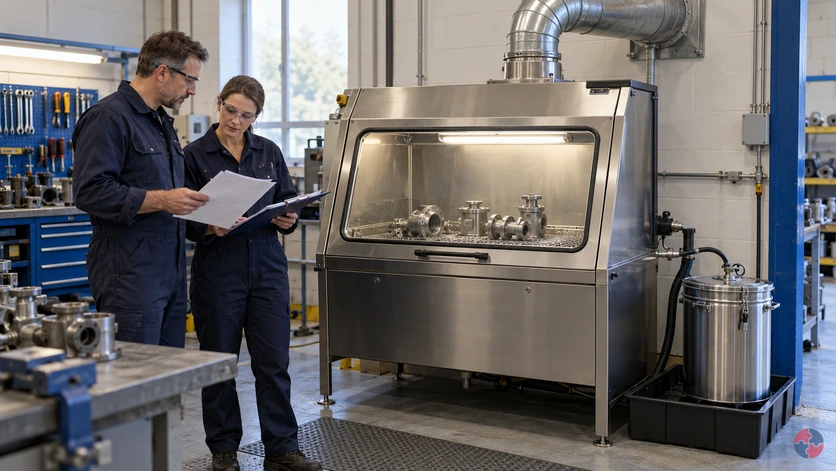
- Conceptual closed-cabinet scene. Substitution comes first; a status light does not prove capture. The exact chemical, lawful intended use, equipment compatibility, protection and waste arrangements need competent verification.
Start with label, substance names and CAS identifiers, current SDS and supplier instructions. Establish quantities, temperature, release points, duration, exposed people, skin contact and the surrounding ventilation. Observe the job: an SDS describes a product but cannot show whether a worker puts their head into a cabinet or carries an open tray through an occupied room.
Record the elimination or substitution decision, required controls, how they are checked, emergency actions and review triggers. The assessor must recognise where specialist hygiene, engineering or occupational-health advice is needed. Chemical approval should resolve uncertain use restrictions and equipment compatibility before purchase. Do not substitute a generic training certificate for a task assessment. HSE COSHH assessment; HSENI COSHH guidance.
How can the hierarchy of controls reduce exposure to halogenated hydrocarbon solvents?
First avoid the hazardous solvent or change the process; where it remains necessary, contain the release and verify the engineering controls before relying on personal protection.
Eliminate or substitute. Consider purchased clean parts, mechanical cleaning or an assessed aqueous process. Compare the whole task: replacement products can introduce heat, corrosion, skin or fire hazards. A substitution is accepted only when it does the job with lower overall risk.
Enclose and capture. Use a suitable closed cleaning or transfer system and local exhaust ventilation (LEV) where required. Keep lids and access panels in their intended positions, limit open handling, segregate incompatible storage and close labelled waste containers. Follow the equipment instructions for safe operation and cleaning; do not bypass an interlock to improve production.
Organise and verify. Restrict the exposed group, prevent unauthorised chemicals entering, plan maintenance and provide washing facilities. Training and supervision maintain these controls; telling people to be more careful cannot fix ineffective extraction.
Select PPE for the real exposure. Obtain current glove-manufacturer data for the exact product or mixture, concentration, temperature and contact pattern. Material name or a standards marking alone does not demonstrate compatibility. Agree change and disposal rules; do not turn a laboratory breakthrough result into a universal safe wearing time. Tight-fitting respiratory protection needs suitable selection, face-fit testing and correct use; a dust filter is not a general solvent-vapour control. HSE chemical glove selection; HSE types of respiratory protection.
ERICPD is a six-stage planning mnemonic used on this page, not a statutory permission or a reason to stop at PPE. It maps to HSE’s elimination, substitution, engineering, administrative and PPE hierarchy. Here, Discipline means competent training, supervision, checking and follow-through on an agreed method, never blame or a substitute for effective controls. HSE five-level control hierarchy; HSE managing risk using PPE.
Choose the activity
How can the ERICPD hierarchy of controls reduce risks while cleaning oily valve components?

| Control level | Control for this activity | Owner and verification | Stop / restart decision |
|---|---|---|---|
| Eliminate | Buy components ready for assembly or remove an unnecessary cleaning stage where cleanliness requirements permit. | Process owner verifies that the revised workflow achieves the required output and the hazardous step is genuinely removed. | If the hazardous step remains, retain a task assessment and select the stronger feasible remaining controls. |
| Reduce, including substitution | Trial a suitable aqueous or other lower-hazard cleaning process; validate component finish and any new corrosion or skin risk. | Process/technical owner validates the alternative, its compatibility and any new risks before adoption. | Reject the alternative if suitability is unproved or its new hazards are unresolved. |
| Isolate | Use a designated cleaning station away from ignition sources and unrelated work; segregate contaminated items and waste. | Supervisor verifies the task boundaries and that the separation or isolation protects affected people and connected work. | Hold or stop for unknown solvent, failed extraction, uncontrolled vapour or incompatible waste. |
| Control: physical safeguards | Use compatible enclosed cleaning equipment and effective local extraction where required; minimise open liquid and splash paths. | Competent equipment/process owner checks product identity, enclosure, extraction, waste containment and cleaning quality. | Hold or stop for unknown solvent, failed extraction, uncontrolled vapour or incompatible waste. |
| Control: work method and response | Identify the product and contamination, control decanting and waste, and prohibit unassessed mixing or heating. | Supervisor confirms the limits, response, communication and restart authority with the people doing this activity. | Stop if the agreed method, communication, competent cover or task limits cannot be maintained. |
| PPE | Select gloves, eye protection and any RPE for the actual formulation; a particulate mask does not protect against solvent vapour. | Assessor confirms whether PPE is needed and checks selection, condition, compatibility and any required face-fit evidence. | Do not rely on unsuitable or defective protection, or use PPE to continue after an essential source control fails. |
| Discipline | Maintain seals and extraction, check cleaning quality and investigate exposure or fire-control defects before restarting. | Release only after maintenance owner accepts the cleaning trial and verified controls. Retain the checks and unresolved restrictions at handover. | Keep the activity on hold while defects or required reinstatement evidence remain unresolved. |
How can the ISO 45001 hierarchy of controls reduce risks while cleaning oily valve components?

| Control level | Control for this activity | Owner and verification | Stop / restart decision |
|---|---|---|---|
| Elimination | Buy components ready for assembly or remove an unnecessary cleaning stage where cleanliness requirements permit. | Process owner verifies that the revised workflow achieves the required output and the hazardous step is genuinely removed. | If the hazardous step remains, retain a task assessment and select the stronger feasible remaining controls. |
| Substitution | Trial a suitable aqueous or other lower-hazard cleaning process; validate component finish and any new corrosion or skin risk. | Process/technical owner validates the alternative, its compatibility and any new risks before adoption. | Reject the alternative if suitability is unproved or its new hazards are unresolved. |
| Engineering controls | Use a designated cleaning station away from ignition sources and unrelated work; segregate contaminated items and waste. | Supervisor verifies the task boundaries and that the separation or isolation protects affected people and connected work. | Hold or stop for unknown solvent, failed extraction, uncontrolled vapour or incompatible waste. |
| Engineering controls | Use compatible enclosed cleaning equipment and effective local extraction where required; minimise open liquid and splash paths. | Competent equipment/process owner checks product identity, enclosure, extraction, waste containment and cleaning quality. | Hold or stop for unknown solvent, failed extraction, uncontrolled vapour or incompatible waste. |
| Administrative controls | Identify the product and contamination, control decanting and waste, and prohibit unassessed mixing or heating. | Supervisor confirms the limits, response, communication and restart authority with the people doing this activity. | Stop if the agreed method, communication, competent cover or task limits cannot be maintained. |
| PPE | Select gloves, eye protection and any RPE for the actual formulation; a particulate mask does not protect against solvent vapour. | Assessor confirms whether PPE is needed and checks selection, condition, compatibility and any required face-fit evidence. | Do not rely on unsuitable or defective protection, or use PPE to continue after an essential source control fails. |
| Administrative controls | Maintain seals and extraction, check cleaning quality and investigate exposure or fire-control defects before restarting. | Release only after maintenance owner accepts the cleaning trial and verified controls. Retain the checks and unresolved restrictions at handover. | Keep the activity on hold while defects or required reinstatement evidence remain unresolved. |
How can the ERICPD hierarchy of controls reduce risks while operating a solvent dry-cleaning machine?

| Control level | Control for this activity | Owner and verification | Stop / restart decision |
|---|---|---|---|
| Eliminate | Use a suitable solvent-free garment-cleaning route where a validated trial meets the customer and garment requirements. | Process owner verifies that the revised workflow achieves the required output and the hazardous step is genuinely removed. | If the hazardous step remains, retain a task assessment and select the stronger feasible remaining controls. |
| Reduce, including substitution | Evaluate a suitable lower-hazard cleaning system with its fire, skin, quality and waste risks before changing process. | Process/technical owner validates the alternative, its compatibility and any new risks before adoption. | Reject the alternative if suitability is unproved or its new hazards are unresolved. |
| Isolate | Keep the solvent machine and contaminated work separate from general occupied areas and incompatible work. | Supervisor verifies the task boundaries and that the separation or isolation protects affected people and connected work. | Hold or stop for leak, uncontrolled vapour, cycle fault or failed ventilation. |
| Control: physical safeguards | Maintain the specified closed machine, seals, recovery, ventilation and any loading/unloading safeguards. | Competent equipment/process owner checks exact solvent, machine seals, drying cycle, recovery and ventilation. | Hold or stop for leak, uncontrolled vapour, cycle fault or failed ventilation. |
| Control: work method and response | Follow loading, drying and unloading requirements; control solvent replenishment, residue removal and maintenance through the approved method. | Supervisor confirms the limits, response, communication and restart authority with the people doing this activity. | Stop if the agreed method, communication, competent cover or task limits cannot be maintained. |
| PPE | Select solvent-compatible skin/eye protection and any assessed RPE; ordinary dust masks do not protect against solvent vapour. | Assessor confirms whether PPE is needed and checks selection, condition, compatibility and any required face-fit evidence. | Do not rely on unsuitable or defective protection, or use PPE to continue after an essential source control fails. |
| Discipline | Inspect leaks and cycle performance, maintain recovery/extraction and keep waste in suitable closed containers. | Release only after machine owner accepts the repaired and tested cleaning cycle. Retain the checks and unresolved restrictions at handover. | Keep the activity on hold while defects or required reinstatement evidence remain unresolved. |
How can the ISO 45001 hierarchy of controls reduce risks while operating a solvent dry-cleaning machine?

| Control level | Control for this activity | Owner and verification | Stop / restart decision |
|---|---|---|---|
| Elimination | Use a suitable solvent-free garment-cleaning route where a validated trial meets the customer and garment requirements. | Process owner verifies that the revised workflow achieves the required output and the hazardous step is genuinely removed. | If the hazardous step remains, retain a task assessment and select the stronger feasible remaining controls. |
| Substitution | Evaluate a suitable lower-hazard cleaning system with its fire, skin, quality and waste risks before changing process. | Process/technical owner validates the alternative, its compatibility and any new risks before adoption. | Reject the alternative if suitability is unproved or its new hazards are unresolved. |
| Engineering controls | Keep the solvent machine and contaminated work separate from general occupied areas and incompatible work. | Supervisor verifies the task boundaries and that the separation or isolation protects affected people and connected work. | Hold or stop for leak, uncontrolled vapour, cycle fault or failed ventilation. |
| Engineering controls | Maintain the specified closed machine, seals, recovery, ventilation and any loading/unloading safeguards. | Competent equipment/process owner checks exact solvent, machine seals, drying cycle, recovery and ventilation. | Hold or stop for leak, uncontrolled vapour, cycle fault or failed ventilation. |
| Administrative controls | Follow loading, drying and unloading requirements; control solvent replenishment, residue removal and maintenance through the approved method. | Supervisor confirms the limits, response, communication and restart authority with the people doing this activity. | Stop if the agreed method, communication, competent cover or task limits cannot be maintained. |
| PPE | Select solvent-compatible skin/eye protection and any assessed RPE; ordinary dust masks do not protect against solvent vapour. | Assessor confirms whether PPE is needed and checks selection, condition, compatibility and any required face-fit evidence. | Do not rely on unsuitable or defective protection, or use PPE to continue after an essential source control fails. |
| Administrative controls | Inspect leaks and cycle performance, maintain recovery/extraction and keep waste in suitable closed containers. | Release only after machine owner accepts the repaired and tested cleaning cycle. Retain the checks and unresolved restrictions at handover. | Keep the activity on hold while defects or required reinstatement evidence remain unresolved. |
Controls at source protect nearby people as well as the operator. Product approval, TCE authorisation or DCM paint-stripper restrictions must be resolved separately before any control package is used. HSE COSHH principles of good control practice.
How should the selected controls be checked in practice?
ERICPD is used here as a planning mnemonic. The linked HSE five-level hierarchy is the official source for the order and relative reliability of controls; the two labels are not identical.
Start with removing or redesigning the hazard, test substitution and engineered separation, then verify the remaining procedure and PPE against the real task.
A glove choice needs evidence


Read the complete visual as text
- Exact chemical or mixture
- Contact conditions
- Manufacturer performance data
- Check the exact product or mixture, contact conditions and manufacturer performance data. Permeation can occur without visible damage; contaminated gloves can prolong contact. No universal polymer or change interval is implied.
A dry-cleaning operator unloads garments from a machine using an identified chlorinated solvent. Vapour can be inhaled at the door and liquid can contact skin during filter or waste work. The process owner first checks the exact substance, lawful use, machine instructions and current assessment; an unknown product or failed containment is a hold point. The example does not authorise any particular solvent or process. HSE COSHH assessment
ERICPD is a six-stage planning aid. The HSE five-level hierarchy separates substitution, engineering, administration and PPE. ERICPD Isolate usually means engineered separation; Control can be physical or procedural; Discipline sustains controls but cannot replace them. HSE five-level control hierarchy; HSE managing risk using PPE
How should management verify controls for this task?
For Halogenated Hydrocarbon Diseases, the management check should start with a real control decision: Purchaser and process owner record the required cleanliness and approved alternative. Name the person who will test it, keep evidence from the actual work, and reopen the assessment when the failure condition in the hierarchy table occurs. HSE management-system guidance.
A review should compare the planned control with what workers and supervisors can use in practice. Record the defect, owner, interim protection, verification and next review trigger so that a policy statement or certificate does not stand in for a working control.
How should exposure limits and health surveillance be used?
Use exposure limits to assess airborne exposure over the stated period, while separately controlling skin contact, short peaks and any chemical-specific health risk.
An occupational hygienist selects representative personal sampling, including the tasks most likely to create high exposure. EH40 values are concentrations in air, not a permission to work for a specified time. The following examples are from the current HSE-listed January 2020 edition, checked on 25 September 2026; verify the live list before operational use. HSENI states that the EH40 list is legally binding under COSHH NI. HSE EH40 workplace exposure limits; HSENI COSHH guidance.
| Substance | 8-hour time-weighted average | 15-minute time-weighted average | Relevant note |
|---|---|---|---|
| Dichloromethane, CAS 75-09-2 | 100 ppm / 353 mg/m³ | 200 ppm / 706 mg/m³ | Sk: skin absorption contributes to dose; BMGV: biological monitoring guidance value exists. Source: HSE EH40 workplace exposure limits |
| Trichloroethylene, CAS 79-01-6 | 100 ppm / 550 mg/m³ | 150 ppm / 820 mg/m³ | Carc and Sk: carcinogen controls and skin absorption matter. Source: HSE EH40 workplace exposure limits |
| Tetrachloroethylene, CAS 127-18-4 | 20 ppm / 138 mg/m³ | 40 ppm / 275 mg/m³ | Sk: an air-only assessment misses skin uptake. Source: HSE EH40 workplace exposure limits |
Worked decision, measurements. A DCM operator has 15 minutes at 240 ppm and the other 7.75 hours at 20 ppm. The 8-hour average is (240 × 0.25 + 20 × 7.75) ÷ 8 = 26.9 ppm, below 100 ppm. The measured 15-minute period is nevertheless above 200 ppm. The task fails the short-term limit: suspend that exposure-producing method, investigate and improve control, then verify before restart. The low shift average cannot cancel the short peak. This example assumes representative measurements and unchanged units; it does not account for skin absorption or other substances.
Health surveillance is a scheme of repeated checks for work-related effects where the statutory criteria are met. Arrange competent occupational-health input to choose a relevant method and act on results. Biological monitoring measures a chemical or its metabolites in the body; it is not automatically a diagnosis or a substitute for controlling exposure. Do not prescribe routine liver tests, a universal annual medical or a surveillance programme solely because a product belongs to this chemical family. HSE health surveillance.
What records let a manager check that controls still work?
Keep evidence of the substance, task, control performance, exposure assessment and action taken; separate confidential medical information from ordinary management records.
Retain the chemical inventory and relevant SDS revisions, assessment and substitution decisions, manufacturer instructions, LEV reports and repairs, training demonstrations, exposure-monitoring reports, incidents and action closure. A risk-register entry should name the exposure scenario, affected group, control owner, evidence of effectiveness and unresolved actions.
Set record retention through the applicable COSHH provisions and occupational-health governance, not one expiry period for every document. Supervisors need appropriate fitness or work-restriction advice, not unrestricted access to clinical notes. Check whether monitoring includes maintenance and contractors; a tidy register cannot compensate for an unassessed job.
Which duties apply in Great Britain and Northern Ireland?
GB uses COSHH 2002 as amended; Northern Ireland uses COSHH NI 2003 as amended. Both require hazardous-substance risks to be assessed and exposure prevented or adequately controlled.
Maintain and use controls, provide appropriate information and training, prepare emergency arrangements and arrange monitoring and health surveillance when the relevant conditions apply. For carcinogens, mutagens and asthmagens, the regulator guidance requires exposure as low as reasonably practicable as well as compliance with any WEL.
| Decision | Great Britain | Northern Ireland |
|---|---|---|
| Workplace exposure | COSHH Regulations 2002; use HSE guidance and statutory text. | COSHH NI 2003; use HSENI guidance and statutory text. |
| Chemical supply and permitted use | UK REACH applies in GB. TCE is on Annex XIV; confirm a current authorisation covering the exact intended use or a valid exemption before purchase or use. HSE authorisation route. | EU REACH continues in NI. TCE is on Annex XIV; confirm the exact use is authorised or exempt under the NI/EU route. HSENI TCE update and HSENI route. |
| Incident and disease reporting | RIDDOR 2013 criteria apply; HSE disease guidance explains diagnosis and specified work links. | RIDDOR NI 1997 applies; use the HSENI reporting route. |
A solvent complaint or diagnosis is not automatically reportable under the same category everywhere. The responsible person checks the facts, applicable criteria and deadline promptly. Fire, explosion, equipment, pressure and confined-space duties may also apply to the actual installation; refer to the related pages and the jurisdiction-specific legal assessment.
TCE is a use-specific authorisation hold point. TCE is on Annex XIV of UK REACH in GB and EU REACH in NI. Before procurement or work, confirm that the actual use and supply chain are covered by a current applicable authorisation or exemption; a COSHH assessment, enclosure or WEL result cannot replace that decision. HSE UK REACH authorisation overview; HSENI trichloroethylene authorisation update; HSENI REACH authorisation.
DCM paint stripping is a separate restriction hold point. Outside an industrial paint-stripping installation, a professional must complete mandatory training, pass the HSE competence assessment and hold the HSE-issued certificate before buying or using DCM-based paint stripper in GB or NI. Industrial installations have different conditions that must be checked for the actual process. A COSHH form alone does not establish that supply or use is lawful. HSE solvent guidance; HSE DCM task guidance; HSENI dichloromethane.
SHARE examples and site chemical-approval rules are practical guidance. Voluntary management standards can support assurance but do not authorise chemical use or prove a glove, respirator or cleaning plant suitable. Product declarations and current manufacturer instructions must be checked for the actual equipment.
How could Crownway Fuels Ltd run and hand back a cleaning task?

Crownway would approve the chemical and controls before the batch, monitor the enclosed process during use and verify a clean, controlled hand-back afterwards.
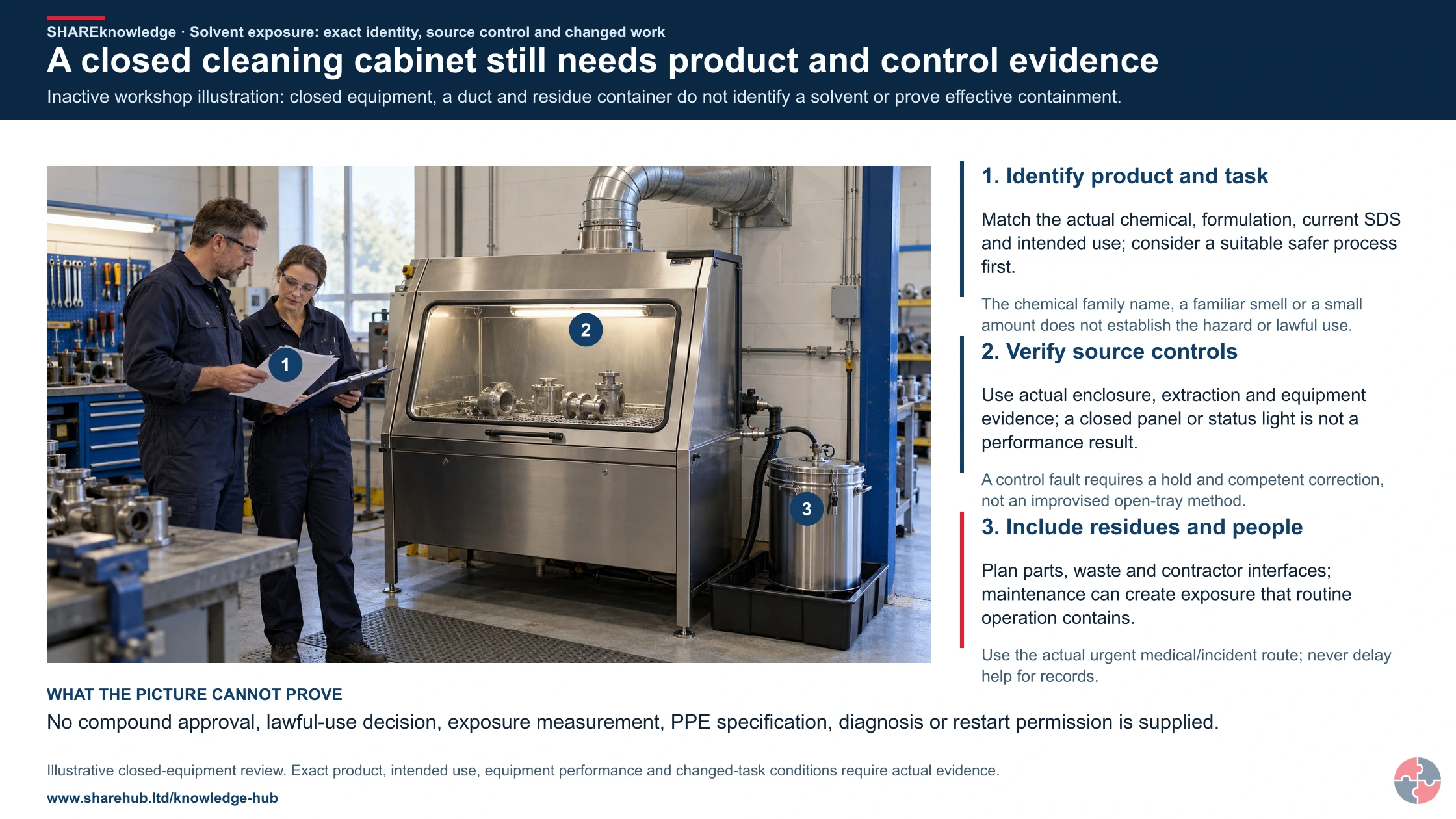
A closed cleaning cabinet still needs product and control evidence
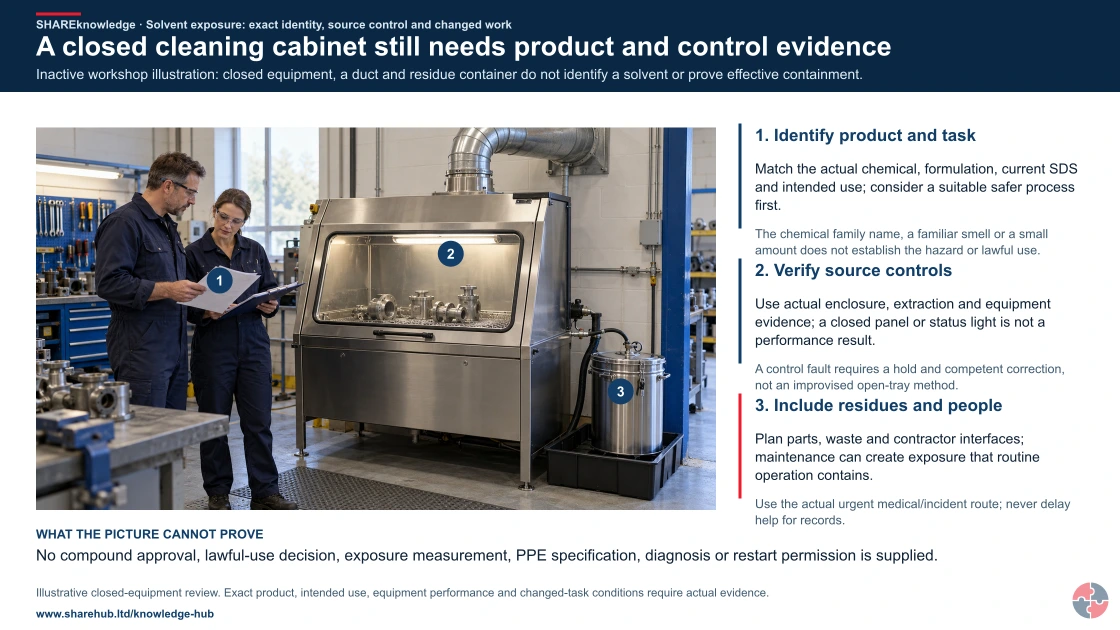
Full written explanation
A new realistic UK workshop illustration shows two maintenance colleagues reviewing inert papers beside a closed parts-cleaning cabinet, connected duct and closed residue container in a tray. Three numbered questions connect the actual solvent and formulation, source containment and extraction, and residue/maintenance/waste interfaces. Valve components are visible through the closed window, but no loading, opening, solvent transfer or heating is shown. The picture supplies no compound identity, approved use, working extraction result or PPE specification. The existing glove-evidence visual remains relevant to exact formulation and contact conditions, without choosing a material or generic wearing time. The second native comparison explains why closed routine operation cannot establish safety for opening equipment or disturbing residues.
Inactive workshop illustration: closed equipment, a duct and residue container do not identify a solvent or prove effective containment.
- Identify product and task. Match the actual chemical, formulation, current SDS and intended use; consider a suitable safer process first.
- Verify source controls. Use actual enclosure, extraction and equipment evidence; a closed panel or status light is not a performance result.
- Include residues and people. Plan parts, waste and contractor interfaces; maintenance can create exposure that routine operation contains.
Change the pathway
- No family-wide assumption. The chemical family name, a familiar smell or a small amount does not establish the hazard or lawful use.
- No workaround for failure. A control fault requires a hold and competent correction, not an improvised open-tray method.
- Keep urgent help separate. Use the actual urgent medical/incident route; never delay help for records.
Evidence check: No compound approval, lawful-use decision, exposure measurement, PPE specification, diagnosis or restart permission is supplied.
Use the full task assessment, restrictions and separate health-response boundaries
Primary references: HSE actual substance/task assessment · HSE product/contact-specific gloves · HSE UK REACH authorisation overview · UKHSA TCE-specific toxicology
Open the complete HD image (new tab)Download image
Use the full task assessment, restrictions and separate health-response boundaries
Primary references: HSE actual substance/task assessment · HSE product/contact-specific gloves · HSE UK REACH authorisation overview · UKHSA TCE-specific toxicology
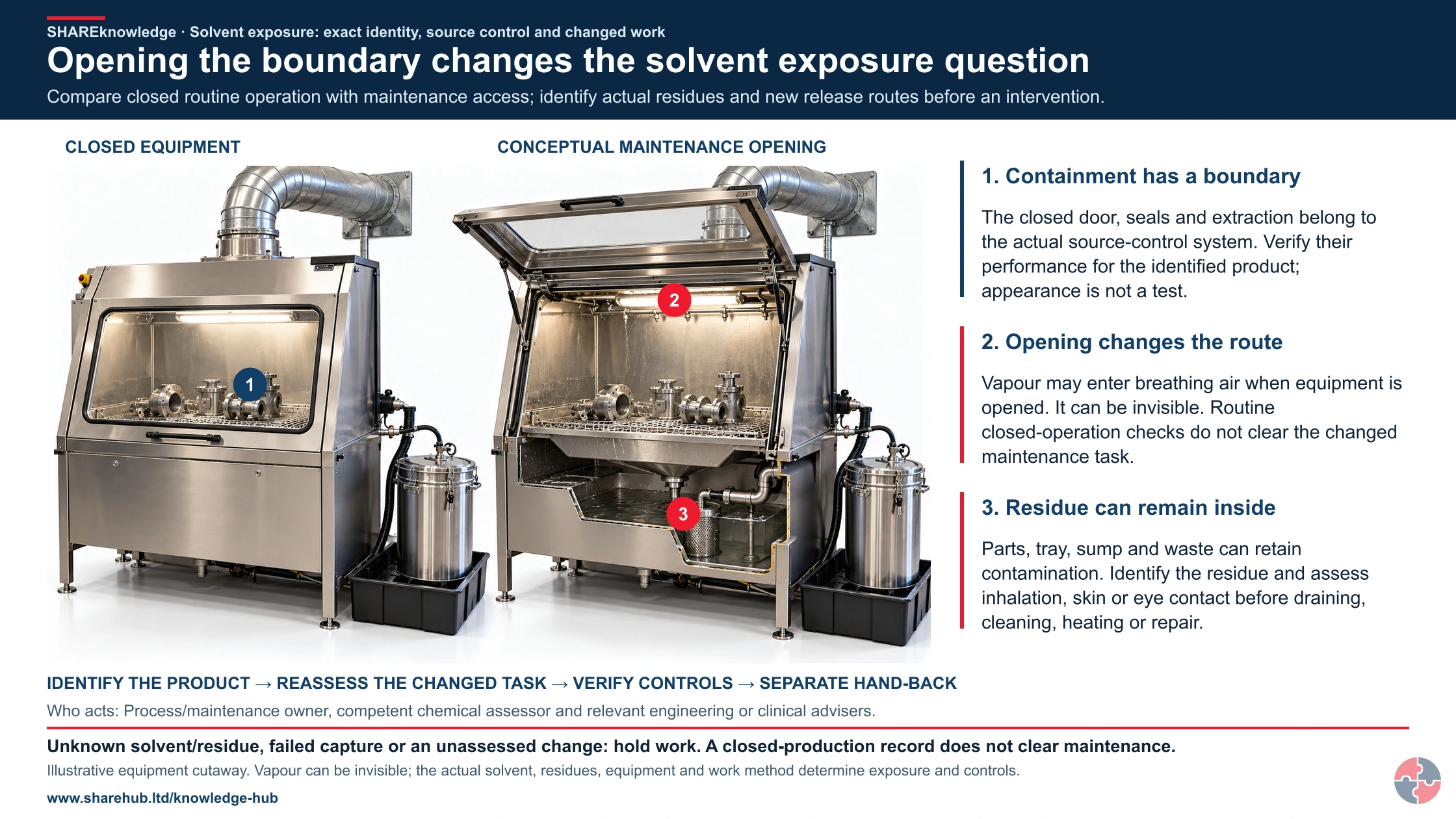
Opening the boundary changes the solvent exposure question
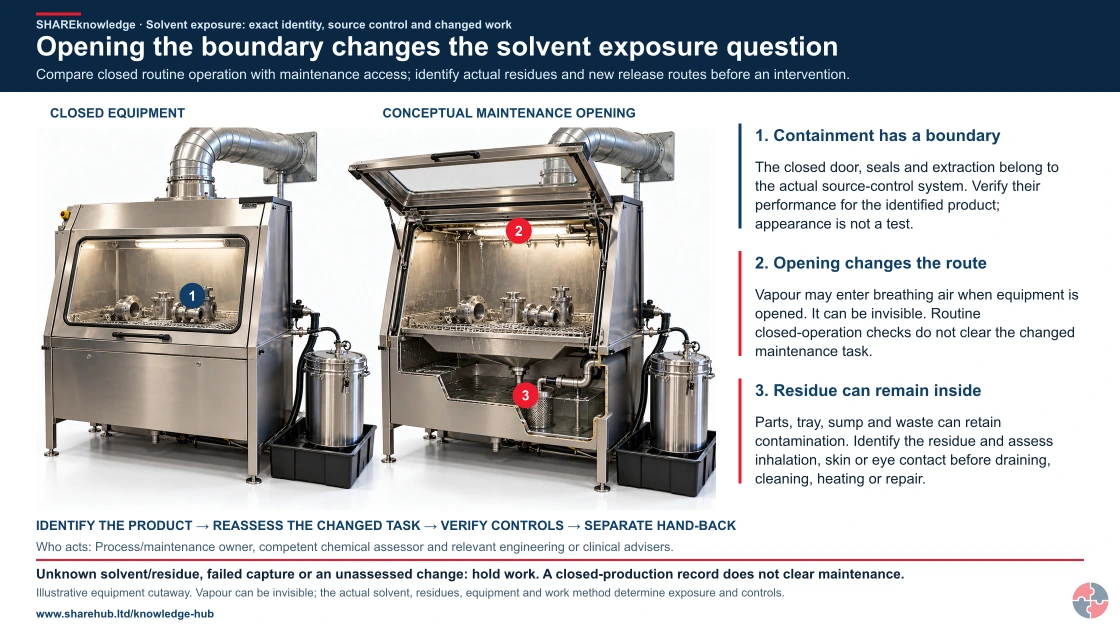
Full written explanation
A realistic HD equipment comparison shows the same closed cleaning cabinet beside a conceptual maintenance opening, with the door raised and a physical cutaway revealing the internal valve parts, drain tray, sump and closed residue route. Three numbered explanations connect the closed boundary/seals/extraction to actual source-control evidence; the changed open boundary to potentially invisible vapour entering breathing air; and retained residues to inhalation and skin/eye-contact questions. No vapour cloud, measured dose or operating person is shown. The cutaway is illustrative equipment geometry, not a validated design, specified solvent or commissioning instruction. An exact-product review, changed-task assessment, actual controls and separate competent hand-back remain required. Medical response and personal return remain separate. No chemical approval, exposure limit, clearance time, PPE specification, diagnosis, treatment or permission to open equipment is supplied.
Compare closed routine operation with maintenance access; identify actual residues and new release routes before an intervention.
- Match actual identity and use. Resolve compound, formulation, current SDS and any applicable use restrictions.
- Define the changed boundary. Include opening, residues, contractors, other substances and proposed heating.
- Verify suitable controls. Reassess enclosure/capture, handling, PPE evidence and waste for the real task.
- Separate hand-back and health. Verify the process before release; personal return follows the appropriate clinical route.
When the evidence does not fit: Unknown solvent/residue, failed capture or an unassessed change: hold work. A closed-production record does not clear maintenance.
Who acts: Process/maintenance owner, competent chemical assessor and relevant engineering or clinical advisers.
Changed workplace
Routine cabinet cleaning: Use the actual approved product and effective source controls; never improvise open handling after a fault.
Maintenance opening: Identify residues and new routes before work; competent process release and personal health decisions remain separate.
Evidence check: No compound approval, lawful-use decision, exposure measurement, PPE specification, diagnosis or restart permission is supplied.
Use the full task assessment, restrictions and separate health-response boundaries
Primary references: HSE actual substance/task assessment · HSE product/contact-specific gloves · HSE UK REACH authorisation overview · UKHSA TCE-specific toxicology
Open the complete HD image (new tab)Download image
Use the full task assessment, restrictions and separate health-response boundaries
Primary references: HSE actual substance/task assessment · HSE product/contact-specific gloves · HSE UK REACH authorisation overview · UKHSA TCE-specific toxicology
Release or hold a cleaning task
2 linked parts. Follow the question numbers and complete the applicable route.
Part 1 of 2 · Questions 1–3

Continue · Part 2 of 2 · Questions 4–6


Read the complete visual as text
- Start: Oily valve parts are proposed for cleaning; the supervisor has not released the task.
- Question 1: Can an assessed safer process meet the cleaning specification? Decision owner: Cleaning supervisor with competent COSHH, engineering and legal-use advice.
- YES: Select and assess the safer process; apply the following checks to that process and equipment. Owner: Cleaning supervisor with competent COSHH, engineering and legal-use advice. CONTINUE → QUESTION 2.
- NO: Continue the product and lawful-use check. Owner: Cleaning supervisor with competent COSHH, engineering and legal-use advice. CONTINUE → QUESTION 2.
- UNKNOWN: Hold selection while the competent assessor establishes feasible alternatives and the cleaning specification. Owner: Cleaning supervisor with competent COSHH, engineering and legal-use advice. HOLD → REPEAT QUESTION 1 AFTER CORRECTION.
- Question 2: Are the product, current SDS and lawful intended use confirmed? Decision owner: Cleaning supervisor with competent COSHH, engineering and legal-use advice.
- YES: Check equipment, control and waste compatibility. Owner: Cleaning supervisor with competent COSHH, engineering and legal-use advice. CONTINUE → QUESTION 3.
- NO / UNKNOWN: Hold and obtain product and legal-use advice. For proposed TCE, verify use-specific Annex XIV authorisation or exemption in the applicable jurisdiction. For relevant professional DCM stripping, resolve mandatory training and HSE certification. Owner: Cleaning supervisor with competent COSHH, engineering and legal-use advice. HOLD → REPEAT QUESTION 2 AFTER CORRECTION.
- Question 3: Are equipment compatibility, controls and waste arrangements verified? Decision owner: Cleaning supervisor with competent COSHH, engineering and legal-use advice.
- YES: Check people, protection and emergency readiness. Owner: Cleaning supervisor with competent COSHH, engineering and legal-use advice. CONTINUE → QUESTION 4.
- NO / UNKNOWN: Hold for competent assessment, repair and actual control verification. Owner: Cleaning supervisor with competent COSHH, engineering and legal-use advice. HOLD → REPEAT QUESTION 3 AFTER CORRECTION.
- Question 4: Are instructed people, assessed protection and emergency arrangements ready? Decision owner: Cleaning supervisor with competent COSHH, engineering and legal-use advice.
- YES: Supervisor releases only the assessed method. Keep checking for faults, symptoms and changes. Owner: Cleaning supervisor with competent COSHH, engineering and legal-use advice. CONTINUE → QUESTION 5.
- NO / UNKNOWN: Hold and close the preparation gaps with the supervisor before recheck. Owner: Cleaning supervisor with competent COSHH, engineering and legal-use advice. HOLD → REPEAT QUESTION 4 AFTER CORRECTION.
- Question 5: Any control fault, release, symptom or unassessed change? Decision owner: Cleaning supervisor with competent COSHH, engineering and legal-use advice.
- YES: Stop safely and alert the supervisor; check for possible harmful exposure or emergency. Owner: Cleaning supervisor with competent COSHH, engineering and legal-use advice. CONTINUE → QUESTION 6.
- NO: Follow the specified completion and hand-back sequence; close waste, record checks and report defects. Owner: Cleaning supervisor with competent COSHH, engineering and legal-use advice. OUTCOME → RECORD AND HAND OVER.
- UNKNOWN: Stop affected work; protect people and obtain competent advice. Treat suspected harmful exposure under the emergency route. Owner: Cleaning supervisor with competent COSHH, engineering and legal-use advice. STOP / REFER → APPROPRIATE RESPONSE.
- Question 6: Possible harmful exposure or emergency? Decision owner: Cleaning supervisor with competent COSHH, engineering and legal-use advice.
- YES / UNKNOWN: Follow the emergency plan and the separate suspected-exposure route. Clinical advice governs the person’s return; process restart needs verified controls and supervisor release. Owner: Cleaning supervisor with competent COSHH, engineering and legal-use advice. STOP / REFER → APPROPRIATE RESPONSE.
- NO: Keep the affected task held for competent fault/change review and verified controls before supervisor release. Owner: Cleaning supervisor with competent COSHH, engineering and legal-use advice. HOLD → REPEAT QUESTION 3 AFTER CORRECTION.
- Outcome: Complete the assessed hand-back or retain the hold; there is no automatic restart.
- Stop and escalation boundary: A task assessment does not itself authorise a restricted chemical use. Process restart and personal return to work are separate decisions.
This worked example applies the source guidance to a routine job and its likely disruptions. The local risk assessment and manufacturer instructions supply the actual operating settings.
Cleaning valve parts at Crownway Fuels Ltd
Task, material and setting: Crownway Fuels Ltd, an example company, needs to clean oily steel valve parts in its indoor maintenance workshop using an existing enclosed solvent-cleaning cabinet. The supervisor first checks whether an assessed aqueous process can achieve the required cleanliness. The actual solvent, its current SDS and the cabinet instructions must be identified. If TCE is proposed, confirm the use-specific Annex XIV authorisation or exemption before procurement or work; this example does not approve TCE or DCM use.
People and prerequisites: The operator, neighbouring fitters, waste handler and visiting maintenance contractor may be affected. The operator is instructed in the cabinet and emergency arrangements. A competent assessor verifies the product, lawful intended use, material compatibility, exposure controls and glove selection. Engineering support confirms cabinet and extraction performance.
Before: Review the cleaning specification and substitution decision. Match the approved product to its label and SDS, check enclosure, extraction indication, interlocks and waste arrangements as required by the instructions. Confirm washing facilities and the response contact. Brief nearby workers and agree the contractor interface. The supervisor holds release until each prerequisite is evidenced.
During: Load and operate within the manufacturer’s limits, keeping the enclosure closed for the specified cycle. Watch the control indicators and avoid leaning into the opening. Keep contaminated parts and waste within the controlled handling route. The operator reports any alarm, release or symptoms and does not improvise an open-tray method to finish the batch.
Hold or stop: An extraction fault stops the task. The supervisor arranges safe isolation and competent repair. A contractor arriving with a different cleaner triggers a fresh assessment before use. Unknown residue or proposed hot work is held for specialist review. If a worker becomes dizzy, withdraw safely and activate medical and incident arrangements; do not enter a contaminated area for an unplanned rescue.
Completion and hand-back: Use the specified shutdown and unloading sequence; keep capture operating for the period required by the equipment method, without inventing a generic clearance time. Close labelled waste containers, check the area and equipment, remove contamination safely and report defects. After a failure, restart requires documented control verification and supervisor release; personal return to work follows relevant clinical advice.
Evidence: Keep the substitution review, approved assessment and SDS revision, operator instruction record, control checks, maintenance verification, waste record and any incident or exposure-monitoring results. The risk-register owner tracks defects and contractor changes to closure.
What competence and instruction do people need?
People need enough knowledge, practical instruction and supervision for their assigned task, with specialist support where the risk or control is beyond their competence.
Workers should demonstrate product identification, pre-use checks, safe handling, PPE use, hygiene and the response to an alarm or symptom. Supervisors need to recognise assessment changes and prevent unauthorised restart. Purchasers need the substitution and use-restriction checks. Maintainers need the plant-specific isolation and opening method; emergency responders need the assessed response capability.
Use observation and questions to confirm understanding, including language and literacy needs. Refresh instruction when the product, method, equipment or evidence changes. There is no generic “halogenated hydrocarbon certificate” expiry. Professional DCM paint stripping outside an industrial installation requires mandatory training, a passed HSE competence test and an HSE-issued certificate before purchase or use in GB and NI; check the industrial route separately.
| Role and learning | Practical demonstration | Assessor and retained evidence | Reassess when |
|---|---|---|---|
| Nearby staff and new starters: recognise vapour, contact and alarm routes | Point out the safe withdrawal route and who to notify; awareness is not operator release. | Supervisor checks understanding; retain induction or briefing record. | A new chemical, changed layout or emergency route affects them. |
| Operator: approved product, cabinet sequence, checks, hygiene and stop points | Identify label and SDS; show pre-use check, closed operation and safe fault report on the actual task. | Competent supervisor observes and records task authorisation. | Product, plant, method, fault pattern or observed practice changes. |
| Maintainer or specialist responder: isolation, opening and assessed response | Demonstrate plant-specific isolation and contained maintenance or the specialist response role; ordinary workers do not attempt entry rescue. | Engineering or response lead assesses scope and keeps maintenance or response competence evidence. | Equipment or response method changes, or a failure exposes a gap. |
| Supervisor and contractor coordinator: approval, interfaces and release | Challenge a changed cleaner or failed extraction and document hold, repair evidence and release. | Manager samples decisions and records the assessed method and defect closure. | Contractor, product, process or control evidence changes. |
| Purchaser, manager and assessor: substitution, lawful use and assurance | Show a documented alternative comparison, TCE/DCM use check and sampling or control decision with specialist advice. | Competent chemical assessor or manager signs the decision; retain source, SDS and risk-register action. | Supplier, restrictions, exposure evidence or task specification changes. |
What tells a manager that the system needs attention?
Repeated symptoms, unapproved chemical changes, open waste, unreliable extraction and missing maintenance coverage are signs to investigate the exposure controls.
Speak with workers about when and where symptoms or smells occur, including the end of a shift and maintenance work. Do not use smell to measure exposure, and do not dismiss a concern because routine monitoring was low. Compare reported conditions with the sampled task, check defect closure and observe real handling.
If a procedure repeatedly drives people to bypass containment, change the process or workload. Share the non-confidential learning with affected workers and contractors, assign actions and confirm that the change works in practice.
What do the acronyms and key terms mean?
Use the full meaning when briefing workers so that labels and reports lead to the right action.
| Term | Full form | Meaning here |
|---|---|---|
| COSHH | Control of Substances Hazardous to Health | GB and NI workplace exposure-control rules use separate instruments. |
| SDS | Safety data sheet | Supplier hazard information that informs, but does not replace, the task assessment. |
| WEL / TWA | Workplace exposure limit / time-weighted average | Air concentration assessed over the stated 8-hour or 15-minute reference period. |
| ppm / mg/m³ | Parts per million / milligrams per cubic metre | Different air concentration units; compare like with like for the identified chemical. |
| LEV | Local exhaust ventilation | Capture and removal of contaminant near its release point. |
| RPE | Respiratory protective equipment | Task- and contaminant-specific breathing protection; filter types do not supply oxygen. |
| ALARP | As low as reasonably practicable | An additional exposure-control requirement for relevant hazards, beyond an air limit. |
| TCE / DCM | Trichloroethylene / dichloromethane | Two distinct chlorinated solvents; DCM is also called methylene chloride. |
| ERICPD | Eliminate, Reduce, Isolate, Control, Personal Protective Equipment, Discipline | A six-stage control-planning aid; not itself a law or use authorisation. |
| Metabolite | Not an acronym | A chemical formed as the body processes another substance. |
About this reference: SHARE Knowledge Hub Editorial, version 2.0. Use the exact chemical, local assessment and current supplier instructions for a real task; this educational page is not a process authorisation or emergency procedure.
Unlock another resource
You have used this month’s two free downloads. Publish a post in your own words to unlock one more resource, or choose SHARE Individual for 10 downloads per month.
You decide whether to share. If you do, use the relevant platform disclosure tools and do not make claims you do not genuinely hold.