SHARE Knowledge Hub
Acute Inhalation Injury
A harmful airborne release can injure the lungs. Leave the area, raise the alarm and prevent unsafe rescue. Suspected harmful inhalation needs urgent healthcare even if symptoms are mild or absent; call 999 for serious illness or an active dangerous release. Use the nation-specific urgent-care route below; clinicians decide observation and fitness for work.
Understanding Acute Inhalation Injury
Acute inhalation injury is harm arising during or after a short-duration exposure to a harmful airborne substance or an unsafe atmosphere. The agent may be a gas, vapour, fume, mist, smoke, aerosol, dust or biological material, or the atmosphere may contain too little oxygen. Effects range from transient eye and airway irritation to bronchospasm, chemical burns, pulmonary oedema, systemic poisoning, collapse, permanent lung damage and death.
Why this matters at work
Possible effects include irritation, coughing, wheeze, chest tightness, breathlessness, headache, dizziness, confusion or collapse. Serious exposure may have no visible injury, and some irritant injuries worsen after apparent improvement. Do not use a worker’s ability to speak, a normal looking face or a low later reading to exclude harm.
The topic is distinct from chronic occupational lung disease, although one event can produce long-term consequences such as reactive airways dysfunction, persistent asthma, reduced lung function, neurological effects or psychological trauma. It is also distinct from ordinary odour complaints: smell is not a dependable exposure measure because odour thresholds vary, olfactory fatigue can occur and some lethal atmospheres have little or no useful warning.
How organisations manage this in practice
Consider short peaks and unintended releases separately from shift averages. Prefer eliminating the hazardous task or substance, reducing generation and using suitable containment or source capture. Specify the performance needed from ventilation, isolation, alarms, work methods and maintenance, then check it during representative work. RPE must match the contaminant, concentration, oxygen conditions, wearer and task; a generic mask is not a complete control. Define stop and emergency arrangements and obtain competent hygiene or engineering advice where uncertainty is important. Record assumptions, controls and review triggers, including symptoms, changed products, modified equipment and failed protection.
Eliminate the hazardous substance or exposure-generating task where reasonably practicable. Reduce quantity, concentration, pressure, temperature, dustiness, spray energy and exposure time. Isolate the source from people using closed transfer, enclosure, remote operation, segregation and restricted access. Control remaining emissions at source through containment, local exhaust ventilation, process control, detection and automatic isolation.
Management review should combine exposure data, occupational-health trends, maintenance backlog, changes, contractor work and incident learning. High-consequence unknowns should prompt conservative decisions. Action closure should demonstrate reduced exposure or improved barrier performance, not merely a revised procedure. Worker consultation helps reveal discomfort, workarounds and peaks that formal sampling misses.
This page is workplace guidance, not medical advice. Suspected harmful inhalation needs urgent healthcare even before severe symptoms; follow the nation-specific route below.
What symptoms matter first?
- Burning eyes, nose, mouth or throat after gas, fume, vapour, mist or smoke exposure.
- Coughing, choking, wheeze, hoarseness, chest tightness or breathlessness.
- Symptoms that worsen, return later or affect more than one person from the same task or area.
What should happen immediately?
- Leave the exposure area and move to fresh air if this can be done safely.
- Raise the alarm, stop others entering and do not attempt an unsafe rescue.
- Identify the substance, product, task and exposure timing for responders and clinicians.
When is medical assessment needed?
- Suspected inhalation of a harmful substance, even if symptoms are mild or not yet present.
- Severe or worsening breathlessness, wheeze, chest pain, collapse, confusion or blue/grey colour.
- Exposure to an unknown, high-concentration, corrosive, toxic, confined-space or fire-smoke atmosphere.
- Delayed breathing symptoms after the person initially seemed to recover.
Where does acute inhalation injury guidance apply?
Use this page for workplace prevention and safe first decisions; clinical assessment, observation, treatment and fitness for work need qualified healthcare advice.
It covers sudden airborne releases in cleaning, construction, maintenance, hot work, plant rooms and fires. It is not a diagnosis, gas re-entry clearance or rescue procedure. For an actual event, follow the site emergency plan and responding services.
Use two tracks: exposed person and affected area
Possible inhalation injury needs the urgent route first. A form, air reading or apparently normal appearance must not delay the existing healthcare instructions. Unknown gases, concentrations or oxygen conditions also prevent an improvised rescue or ordinary re-entry decision.
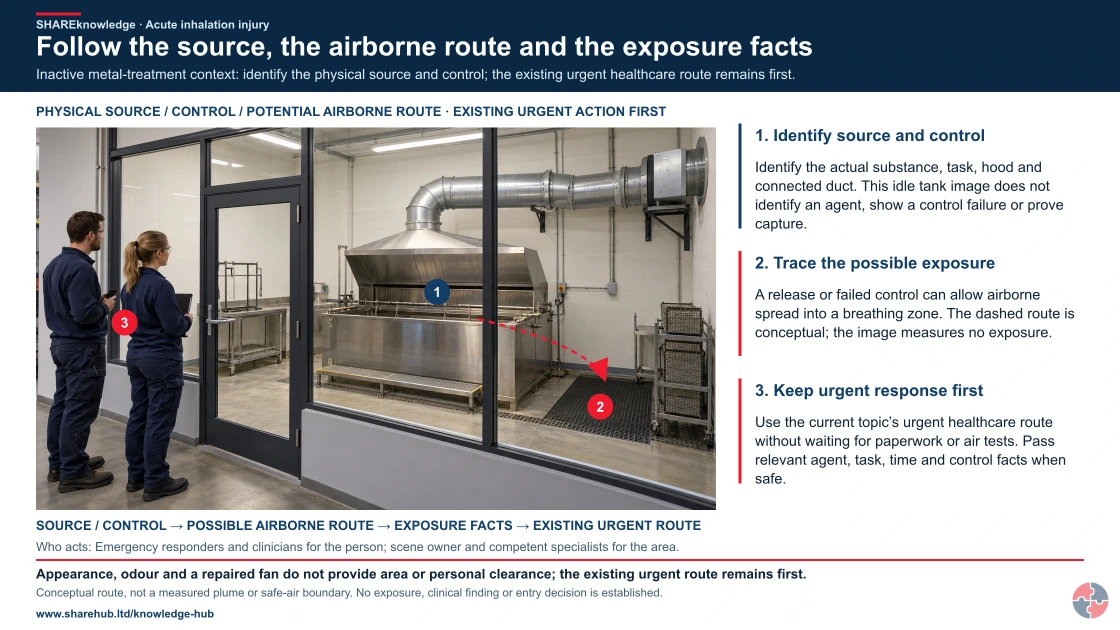
Follow the source, the airborne route and the exposure facts
Full written explanation
A detailed realistic HD inactive metal-treatment room shows a treatment tank, hood, continuous extraction duct and fan casing behind a closed glazed partition. Staff remain outside the room and do not operate controls or enter. Native labels identify physical source/control questions, conceptual potential airborne spread into occupiable space and the agent/task/time/control facts relevant to the existing urgent healthcare route. The dashed arrow is a possible route only; it is not a plume, measured airflow, confirmed exposure or a safe-air boundary. No person is depicted ill and no anatomical injury, symptoms, treatment, interval, detector value, PPE selection or rescue method is shown. The closed door and pictured extraction do not prove either side safe, confirm substance identity, establish capture performance or authorise entry. The current topic’s existing country-qualified urgent instructions remain first and are not delayed by investigation or paperwork. Protected original teaching and clinical wording remain unchanged as retained source material; this graphic supplies no new clinical instruction.
Inactive metal-treatment context: identify the physical source and control; the existing urgent healthcare route remains first.
- A substance becomes airborne. Fume, vapour, mist or gas can reach the breathing zone after a release or failed control.
- A person may inhale it. Identity, task, time and control state help responders understand the possible exposure.
- Harm may not be immediate. Symptoms can be delayed; apparently feeling better does not establish that exposure was harmless.
Change the pathway
- Prevent the release. Choose a safer or closed method and effective source control for the actual task.
- Protect the withdrawal route. Use the established emergency arrangements; do not enter an unknown atmosphere to rescue someone.
- Get appropriate help. Follow the page’s urgent healthcare route promptly and share relevant exposure facts safely.
Evidence check: Medical follow-up and area hand-back answer different questions; neither substitutes for the other.
Primary references: HSE COSHH emergencies — preparation, trained response and information for responders (GB) · NHS poisoning — current clinical source; retain the full topic’s country-qualified routes · HSE COSHH assessment — actual task, substance, exposure and controls (GB)
Open the complete HD image (new tab)Download image
Primary references: HSE COSHH emergencies — preparation, trained response and information for responders (GB) · NHS poisoning — current clinical source; retain the full topic’s country-qualified routes · HSE COSHH assessment — actual task, substance, exposure and controls (GB)
Use two owners after the immediate response: the scene owner controls isolation, investigation and safe area hand-back; clinicians and appropriate occupational-health advisers handle the exposed person. Restarting a process does not mean a person has been medically cleared, and medical review does not prove the area safe.
Extraction fails during an indoor task
Illustrative example. Workers report irritation after extraction stops during a fume-generating refurbishment task.
Decision. Use the urgent-action route, restrict the affected area and arrange competent investigation of the emission and failed extraction.
Evidence to check. Preserve product/process identity, time, task, control state and the facts needed by responders; keep health details restricted.
Hold or escalation point. Do not re-enter on odour, an unrelated meter or one worker feeling better.
Follow-up. The area owner verifies source control under representative operation; individual return follows the appropriate clinical/work-support route.
Who does what when inhalation exposure is possible?
Workers stop and report a suspected release; supervisors control work and the area; specialists assess exposure and controls; clinicians decide medical care.
| Role | Action | Boundary and evidence |
|---|---|---|
| Workers and cleaners | Use approved products and controls; do not mix unknown chemicals; leave, warn others and report symptoms or alarms. | Give location, task, product and symptoms without re-entering. |
| Supervisors and contractors | Coordinate products and hot work, check ventilation, stop exposed work and account for people. | Hold restart until source and controls are assessed; log authority. |
| Managers and purchasers | Specify safer products and engineered controls; resource maintenance and contractor review. | Retain assessments, training and change records. |
| Hygienists and maintainers | Verify exposure routes, LEV, detectors and controls using competent methods. | Sampling does not itself clear an unknown atmosphere. |
| First aiders and responders | Follow training from a safe position; call emergency services and pass substance details. | Do not improvise a contaminated-atmosphere rescue. |
| Clinicians and occupational health | Assess symptoms, observation, follow-up and fitness for work. | Employer provides facts, not treatment or observation periods. |
What is acute inhalation injury?
Acute inhalation injury is sudden damage to the respiratory tract or lung tissue after breathing in a harmful airborne substance.
A workplace description of exposure is not a medical diagnosis. Clinicians determine the condition; the employer prevents further exposure and passes accurate incident details.
It is not a single disease with one cause. It is a pattern of injury that can affect different parts of the respiratory system depending on the substance, concentration, exposure duration, particle or droplet size, water solubility, reactivity and depth of penetration into the lungs.
Highly water-soluble irritants tend to affect the moist upper airway first, producing burning eyes, throat irritation, coughing, choking, hoarseness or tracheobronchitis. Less soluble or deeper-penetrating agents may reach the bronchioles and alveoli, where they can damage the alveolar-capillary membrane and cause chemical pneumonitis, pulmonary oedema, acute lung injury or acute respiratory distress syndrome.
The workplace importance is that acute inhalation injury often follows a control failure: a release, spill, fire, incompatible mixture, failed local exhaust ventilation, poor isolation, unsafe confined-space entry, poor storage, poor cleaning method or inadequate emergency response. Some injuries are immediately obvious, while others deteriorate after a delay, so any significant exposure should be treated seriously.
| Aspect | Explanation | Workplace relevance |
|---|---|---|
| Main definition | Short-term injury to the airways or lungs after inhaling a harmful airborne substance. | Can follow leaks, spills, process upsets, fires, cleaning incidents, confined-space work or maintenance. |
| Main body systems affected | Eyes, nose, throat, larynx, trachea, bronchi, bronchioles, alveoli and lung tissue. | Symptoms can range from irritation to respiratory failure. |
| Typical onset | May be immediate, rapidly progressive or delayed depending on the agent. | Workers who initially seem well may still need observation after significant exposure. |
| Related terms | Irritant gas inhalation, smoke inhalation, chemical pneumonitis, pulmonary oedema, acute lung injury and ARDS. | Different terms may appear in incident reports, clinical notes or occupational health records. |
| Main prevention theme | Prevent releases and control airborne exposure before people breathe the substance. | Relying on first aid or PPE after a release is a weak control strategy. |
Suspected harmful inhalation: act before using the learning tools
If someone may have breathed in a harmful substance, obtain emergency medical help. Call 999 for an emergency, including severe breathing difficulty, collapse, seizures or loss of consciousness. Do not enter a potentially dangerous atmosphere to reach the person. Alert the site emergency team and keep others away.
Follow the full urgent-action route and give responders the product or process information from a safe place. Symptoms can be delayed; a person feeling better and a normal reading taken later do not by themselves resolve the exposure.
How should these decisions work on real tasks?
Check the actual substance and airborne route before work; stop on a release or failed control; separate area restart from medical clearance.
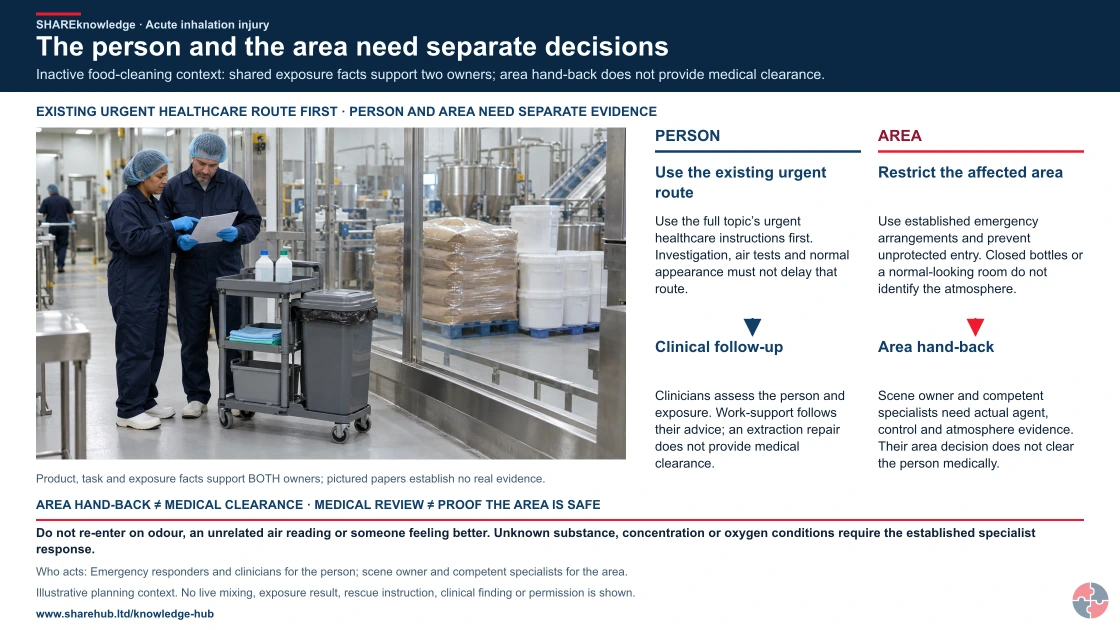
The person and the area need separate decisions
Full written explanation
A detailed realistic HD food-factory planning scene shows closed cleaning-product containers on a trolley and staff reviewing inert paperwork beside a partition to production. It is an inactive task-information context, not a depicted release, mixed product, exposed casualty or safe atmosphere. A complete native parallel relationship distinguishes two tracks from the same possible event. PERSON: the current topic’s existing urgent healthcare route remains first, followed by appropriate clinical/work-support decisions. AREA: established emergency arrangements restrict access and competent owners need actual agent/control/atmosphere evidence for separate area hand-back. There is no arrow converting one track’s outcome into the other’s clearance. Shared product/task/exposure facts inform both owners, but pictured pages, bottle colours, normal appearance or a repaired control establish none of those decisions. No new country-wide clinical instruction, symptom/treatment sequence, observation period, rescue/entry method, chemical mixing procedure, threshold or work permission is provided. All existing urgent country routes, original core checks, native anatomy/hierarchy/controls and complete source text remain unchanged; clinical damage and procedure imagery remain held.
Inactive food-cleaning context: shared exposure facts support two owners; area hand-back does not provide medical clearance.
- Use the urgent healthcare route. Call 999 for suspected harmful inhalation; do not wait for an investigation or meter result.
- Keep clinical follow-up separate. Clinicians assess exposure and the person; appropriate work-support arrangements follow their advice.
- Restrict the affected area. Use the established emergency response and competent source control; prevent unprotected entry.
- Verify area hand-back. The authorised area owner needs suitable agent, control and atmosphere evidence before restart.
When the evidence does not fit: Do not re-enter on odour, an unrelated air reading or someone feeling better. Unknown substance, concentration or oxygen conditions require the established specialist response.
Who acts: Emergency responders and clinicians for the person; scene owner and competent specialists for the area.
Changed workplace
Metal-treatment work: Record agent and task information when safe; keep exposure care separate from extraction repair.
Food-production cleaning: Unknown chemical atmosphere: prevent entry and use the planned response, without improvising a rescue.
Evidence check: Medical follow-up and area hand-back answer different questions; neither substitutes for the other.
Primary references: HSE COSHH emergencies — preparation, trained response and information for responders (GB) · NHS poisoning — current clinical source; retain the full topic’s country-qualified routes · HSE COSHH assessment — actual task, substance, exposure and controls (GB)
Open the complete HD image (new tab)Download image
Primary references: HSE COSHH emergencies — preparation, trained response and information for responders (GB) · NHS poisoning — current clinical source; retain the full topic’s country-qualified routes · HSE COSHH assessment — actual task, substance, exposure and controls (GB)
A changed exhaust route changes the risk


Read this visual as text
- A generator that was acceptably located can become hazardous when doors, barriers, wind or occupancy change. Stop the source and protect people before reviewing its location; do not run an engine indoors or in a poorly ventilated enclosure.
- EXHAUST SOURCE
- ENTRY ROUTE
- PEOPLE AFFECTED
Illustrative route-change example. Exhaust may enter through an opening, but the photograph cannot establish gas concentration or a safe alternative location. Assess the actual source, pathway and occupied areas.
These examples teach decisions, not product instructions or clinical protocols. Unknown concentration, oxygen status, product identity or health effect is a hold point.
1. Routine cleaning without mixed chemicals
Task material and setting: BuildOut cleaners use one approved product in an occupied building; the outcome is clean surfaces without harmful gas or mist.
People and prerequisites: Cleaners, occupants and contractors may be affected; the supervisor briefs the product-specific assessment and SDS.
Before: Check label, dilution, compatible storage, room use and planned ventilation. Never mix products.
During: Use the approved method, keep others clear where specified and report unexpected irritation.
Hold or stop: Stop on an unknown product, suspected mixing, new odour, coughing or failed ventilation; leave and raise the alarm for a release.
Completion and hand back: Close and store product safely; supervisor checks the area before normal use.
Evidence: Product identity, assessment, briefing and symptom or defect record.
Urgent clinical route: If harmful inhalation is suspected, withdraw, alarm and seek urgent healthcare without waiting for symptoms: England/Wales 999 or A&E; Scotland 999 for a poisoning emergency or NHS 24 for other urgent advice; NI prompt GP/out-of-hours if well, emergency department if potentially hazardous and advice delayed, 999 if seriously ill. Never delay for paperwork or attempt unsafe rescue.
2. New adhesive in an enclosed room
Task material and setting: A subcontractor proposes a new solvent adhesive in a small room; the outcome is an approved method before use.
People and prerequisites: Installers and nearby workers may be affected; the host supervisor and assessor need actual product and room data.
Before: Get the current SDS; check substitution, application, airborne exposure, ventilation, escape and other contractors.
During: Start only with approved controls; check ventilation and worker reports during use.
Hold or stop: Hold if identity, vapour controls or RPE suitability is unknown. A particle mask is not gas protection.
Completion and hand back: Remove waste; check the room under the site plan and hand back to the host.
Evidence: Product approval, assessment, air-control evidence and hand-back.
Urgent clinical route: If harmful inhalation is suspected, withdraw, alarm and seek urgent healthcare without waiting for symptoms: England/Wales 999 or A&E; Scotland 999 for a poisoning emergency or NHS 24 for other urgent advice; NI prompt GP/out-of-hours if well, emergency department if potentially hazardous and advice delayed, 999 if seriously ill. Never delay for paperwork or attempt unsafe rescue.
3. Welding extraction fails mid-task
Task material and setting: A welder notices poor capture during indoor hot work; the outcome is to prevent uncontrolled fume inhalation.
People and prerequisites: Welder, fire watch and adjacent trades may be affected; a supervisor and competent maintainer assess the defect.
Before: Confirm source capture, hood position, ventilation and task-specific RPE before striking an arc.
During: Stop welding when extraction fails or fume enters the breathing zone; warn adjacent teams.
Hold or stop: Do not continue solely because a disposable mask is present; hold for an assessed alternative.
Completion and hand back: Repair and prove effective capture before resuming, with supervisor hand-back.
Evidence: LEV defect, repair, verification and revised task briefing.
Urgent clinical route: If harmful inhalation is suspected, withdraw, alarm and seek urgent healthcare without waiting for symptoms: England/Wales 999 or A&E; Scotland 999 for a poisoning emergency or NHS 24 for other urgent advice; NI prompt GP/out-of-hours if well, emergency department if potentially hazardous and advice delayed, 999 if seriously ill. Never delay for paperwork or attempt unsafe rescue.
4. Unknown gas in a plant room
Task material and setting: An alarm and unwell worker suggest a gas release; the outcome is life safety and controlled rescue.
People and prerequisites: Worker, colleagues, responders and occupants may be affected; only trained equipped responders enter an unsafe atmosphere.
Before: Know alarm, evacuation, isolation and rescue arrangements before entry; keep the inventory available.
During: Leave, raise the alarm, call 999 for a significant release or ill person, isolate access and follow incident command.
Hold or stop: Do not enter to retrieve someone or switch off plant without a safe authorised route; a filter mask is not an entry permit.
Completion and hand back: Incident command decides re-entry; clinicians assess people; the site authority checks equipment before restart.
Evidence: Alarm time, possible substance, exposed people, responder handover and restart approval.
Urgent clinical route: If harmful inhalation is suspected, withdraw, alarm and seek urgent healthcare without waiting for symptoms: England/Wales 999 or A&E; Scotland 999 for a poisoning emergency or NHS 24 for other urgent advice; NI prompt GP/out-of-hours if well, emergency department if potentially hazardous and advice delayed, 999 if seriously ill. Never delay for paperwork or attempt unsafe rescue.
5. Generator exhaust after a layout change
Task material and setting: Temporary exhaust enters a work area after barriers and wind change; the outcome is to stop exposure and correct setup.
People and prerequisites: Construction workers, cleaners and visitors may be affected; supervisor owns change review.
Before: Plan generator location, exhaust direction, openings, enclosure and occupied areas.
During: Stop use and move people away when exhaust enters the area or symptoms are reported; seek medical advice for exposure.
Hold or stop: Do not use smell or a shift-average reading to dismiss a release; hold until source and route are controlled.
Completion and hand back: Relocate or redesign, verify controls in changed conditions and brief teams.
Evidence: Change record, exposure investigation, reports and verification.
Urgent clinical route: If harmful inhalation is suspected, withdraw, alarm and seek urgent healthcare without waiting for symptoms: England/Wales 999 or A&E; Scotland 999 for a poisoning emergency or NHS 24 for other urgent advice; NI prompt GP/out-of-hours if well, emergency department if potentially hazardous and advice delayed, 999 if seriously ill. Never delay for paperwork or attempt unsafe rescue.
6. Suspected exposure and safe hand-back
Task material and setting: After a cleaning error several workers cough and one is breathless; the outcome is rapid care and a safe restart.
People and prerequisites: Exposed workers, first aiders and occupants may be affected; incident command, clinicians and occupational health have different roles.
Before: The emergency plan identifies alarm, assembly, product records and responder briefing.
During: Evacuate, call 999 for serious symptoms or the significant event, prevent unsafe entry and pass product and timing details.
Hold or stop: Do not prescribe an observation period or send someone back because symptoms briefly improve.
Completion and hand back: Clinicians decide assessment; occupational health advises work fitness; site authority verifies controls and releases the area.
Evidence: Exposure timeline, SDS, reported symptoms, response, reporting decision and prevention actions.
Urgent clinical route: If harmful inhalation is suspected, withdraw, alarm and seek urgent healthcare without waiting for symptoms: England/Wales 999 or A&E; Scotland 999 for a poisoning emergency or NHS 24 for other urgent advice; NI prompt GP/out-of-hours if well, emergency department if potentially hazardous and advice delayed, 999 if seriously ill. Never delay for paperwork or attempt unsafe rescue.
A source move can change who is exposed
Illustrative exhaust pathway, not a measured plume: an outdoor combustion source is moved beside a doorway. The opening connects the source area to an occupied room. Changes in wind, doors or ventilation can change who is exposed; the absence of visible smoke is not evidence of a safe atmosphere.
Source: changed equipment position
Record the source and what changed: position, running time, fuel, operating load or nearby work. Stop or control the source only where it is safe and within the person’s authority.
Route: opening into an occupied space
Identify the door, window or intake and the people who could be reached. Prevent access to the affected space while the competent assessment and emergency response establish what is needed.
People: possible exposure
Record who may have been exposed, when, the suspected substance and available task facts. Give that information to the medical team without waiting for a complete investigation.
Area and control decision
A competent person assesses the relevant atmosphere and controls. The authorised operational owner accepts the defined hand-back before the area or task restarts.
Person and clinical decision
Clinical assessment and follow-up address the exposed person. Area clearance, a later reading or the ability to walk away does not substitute for medical advice.
Both decisions must be addressed. Follow the separate area and people clearance route; no improvised rescue or restart follows from this illustration.
Which workplace agents and activities can cause acute inhalation injury?
Acute inhalation injury can be caused by sudden exposure to irritant gases, corrosive vapours, smoke, fumes, mists, aerosols and reactive chemical mixtures.
Worked selection error: a particulate respirator used for welding fume does not become suitable for solvent vapour or an oxygen-deficient plant room. HSE says particle filters do not trap gases or supply oxygen. Stop and obtain a substance- and atmosphere-specific decision.
The hazardous form matters as much as the chemical name. A liquid may become dangerous when sprayed, heated, atomised, mixed, spilled into a drain, used in an enclosed space or released from pressure. A solid may create fume when welded or heated. A harmless-looking cleaning task can create a toxic gas if incompatible products are mixed.
Common work scenarios include ammonia releases from refrigeration or cleaning products, chlorine or chloramine gas from incompatible cleaning chemicals, nitrogen oxides during welding or high-temperature combustion, hydrogen chloride from chemical reaction or fire, phosgene from heating chlorinated materials, smoke from fires involving plastics or synthetic materials, and metal or chemical fumes from hot work.
| Agent or source | How exposure may occur | Typical injury concern |
|---|---|---|
| Ammonia | Refrigeration leaks, chemical handling, cleaning products or agriculture-related use. | Upper-airway burning, cough, bronchospasm and potentially severe airway injury at high exposure. |
| Chlorine or chloramine | Disinfection, water treatment, bleach mixed with acids or ammonia-containing products. | Eye and airway irritation, chest tightness and possible lower-lung injury. |
| Nitrogen oxides | Welding and high-temperature combustion; check the actual process and atmosphere. | Nitrogen oxides can irritate airways; suspected harmful exposure needs prompt clinical assessment, not a workplace diagnosis. |
| Phosgene or similar lower-lung agents | Specialist chemical processes or thermal decomposition of chlorinated substances. | Deep lung injury with delayed breathlessness and pulmonary oedema risk. |
| Smoke and combustion products | Building fires, process fires, burning plastics, insulation, synthetic materials or confined fire scenes. | Mixed toxic inhalation exposure, oxygen displacement and airway or lung injury. |
| Acid gases and mists | Hydrogen chloride from acid cleaning, pickling, chemical reaction, spills or burning PVC. | Nose and throat irritation, cough and wheeze; severe hydrogen chloride exposure can injure airways or cause pulmonary oedema. |
| Metal fumes and heated materials | Welding, hot cutting, brazing, soldering, foundry work or overheating coatings. | Acute fume-related illness or more serious chemical pneumonitis depending on substance and dose. |
| Poorly controlled sprays and aerosols | Spray painting, disinfectant fogging, pressure washing with chemicals or atomised cleaners. | Deep inhalation of droplets and airway irritation, especially in enclosed spaces. |
How does acute inhalation injury damage the airways and lungs?
The damage mechanism depends on where the inhaled substance deposits and how strongly it reacts with wet respiratory tissue.
The respiratory tract is lined with moist surfaces. Irritant and corrosive gases can dissolve in that moisture and form acids, alkalis or reactive products that inflame, burn or disrupt the tissue. The body then responds with swelling, mucus, coughing, bronchospasm and inflammatory fluid. In severe cases, the airway can narrow or become obstructed.
Lower-lung injury is especially serious because the alveoli are where oxygen moves into the blood. If toxic substances damage the alveolar-capillary membrane, fluid can leak into the air spaces, causing non-cardiogenic pulmonary oedema. Oxygen transfer falls, breathlessness increases and the person may need hospital respiratory support.
A key teaching point is that dose and timing are not always obvious. A short high-concentration exposure can be more dangerous than a longer low-level smell complaint. Delayed symptoms are possible with lower-solubility agents, so a person who has been exposed and then seems stable should not simply be sent back to work without competent assessment.
| Mechanism | What happens in the body | Practical workplace implication |
|---|---|---|
| Upper-airway irritation | The substance dissolves in the moist eyes, nose, throat, larynx or upper airway and causes immediate irritation or swelling. | Prompt burning, watering eyes, sore throat or coughing should trigger evacuation and exposure review. |
| Tracheobronchitis | The trachea and bronchi become inflamed, causing cough, wheeze, chest tightness and airway narrowing. | Workers may be unable to continue work safely and may deteriorate if exposure continues. |
| Chemical pneumonitis | Toxic injury affects deeper lung tissue and triggers inflammation in the lung parenchyma. | Symptoms may progress after the initial event and require medical assessment. |
| Pulmonary oedema | Fluid leaks into the lungs after damage to the alveolar-capillary membrane. | Delayed breathlessness, crackles, low oxygen or fatigue after exposure is a serious warning sign. |
| Acute respiratory distress syndrome | Severe inflammatory lung injury causes widespread oxygen-transfer failure. | This is a life-threatening outcome requiring emergency hospital treatment. |
| Reactive airways dysfunction | A single high exposure can leave the airways unusually reactive afterwards. | A worker may later experience asthma-like symptoms triggered by fumes, cold air or exertion. |
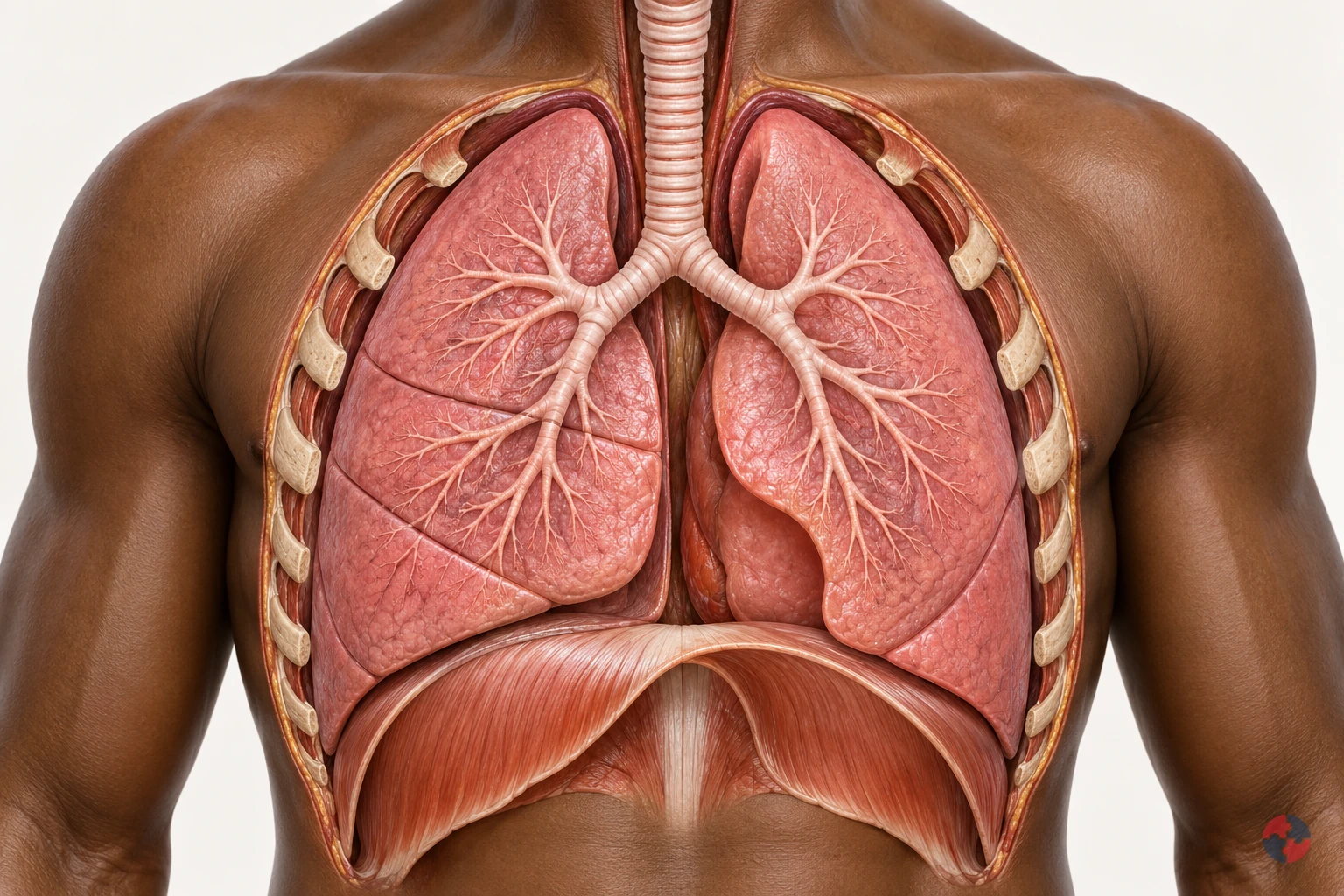

How do the lungs work, and how can workplace exposures affect breathing?
Interactive anatomy · Respiratory tract and lungs · Updated 2026-10-23
Read all anatomy and process explanations without the viewer
Simplified education, not diagnosis, a lung-function or oxygen-saturation test, an exposure calculator or a fitness-to-work assessment. No breath-holding challenge, breathing-rate score or personal health-data collection. Ordinary particle filters do not protect against every gas or oxygen deficiency. COPD and coal-dust topics may reuse normal anatomy only until separate mechanisms are reviewed.
Nose and mouth
Air enters and leaves here. The nose and mouth connect the outside air with the respiratory passages. Air moves through these openings on both the inward and outward breath. Follow the route towards the windpipe before looking at the smaller branches. The illustrated flow is air, a mixture of gases, rather than pure oxygen passing directly into blood. Frimley Health NHS Foundation Trust: How your lungs work · Central and North West London NHS Foundation Trust: How do we breathe?
Trachea
The windpipe carries air into the chest. The trachea, commonly called the windpipe, carries air down towards the chest. It divides into the two main bronchi that supply the lungs. Locate this shared passage before following either branch. Its role is to conduct air towards the gas-exchange regions and provide an outward route for the next exhalation. Frimley Health NHS Foundation Trust: How your lungs work
Bronchi
A main branch carries air into each lung. The two main bronchi take air from the windpipe into the right and left lungs. They divide into progressively smaller branches, distributing the breath through the lungs. Use the split as a landmark before following one highlighted route. These are air passages, distinct from the blood vessels that run through the same organs. Frimley Health NHS Foundation Trust: How your lungs work · University Hospitals of North Midlands NHS Trust: My lung surgery: about your lungs
Bronchioles
Smaller branches distribute air. Bronchioles are smaller branches of the airway system inside the lungs. Their branching routes lead towards clusters of alveoli, where the breath reaches the gas-exchange surface. Follow one branch to its end, using the others as context. This simplified route represents part of a much larger network supplying the lungs together. Frimley Health NHS Foundation Trust: How your lungs work
Alveoli
Tiny air sacs provide a gas-exchange surface. Alveoli are tiny air sacs at the ends of the small airway routes. Their close relationship with surrounding capillaries allows oxygen to pass towards blood and carbon dioxide towards alveolar air. Connect the highlighted cluster with the enlarged gas-exchange view. The enlargement changes the scale so the air space and neighbouring blood vessel can be distinguished. Frimley Health NHS Foundation Trust: How your lungs work · Central and North West London NHS Foundation Trust: How do we breathe?
Air–blood barrier
A thin boundary separates air from blood. The thin alveolar and capillary walls separate air in the sac from blood in its neighbouring vessel. Oxygen and carbon dioxide cross this boundary in opposite directions. Locate the tissue between the two spaces in the enlarged view. Blood cells remain in the vessel; the model does not represent an open connection through which air and blood mix. Central and North West London NHS Foundation Trust: How do we breathe?
Pulmonary capillaries
Small blood vessels pass beside the air sacs. Pulmonary capillaries are small blood vessels beside the alveoli. Blood moving through them receives oxygen and releases carbon dioxide across the thin exchange boundary, then continues through the circulation. Follow the labelled gas routes separately from the blood cells. These cells stay inside the capillary rather than moving into the air sac. Central and North West London NHS Foundation Trust: How do we breathe?
Diaphragm
This muscle helps make room for a breath. The diaphragm is a broad, dome-shaped breathing muscle beneath the lungs. It contracts and flattens downwards during inhalation, helping increase the space in the chest. During a quiet exhalation it relaxes towards its dome shape. Compare it with the rib cage: their changing positions help move air without the lung tissue acting as a contracting muscle. Cambridge University Hospitals NHS Foundation Trust: Breathing techniques to ease breathlessness: muscles involved
Rib cage and breathing muscles
Chest movement changes the space around the lungs. The rib cage protects the chest organs and moves with the breathing muscles. Expansion upwards and outwards helps increase chest space during inhalation; relaxation reduces that space during a quiet exhalation. Compare this movement with the diaphragm below the lungs. Together these structures provide the mechanics that allow air to move through the airways. Central and North West London NHS Foundation Trust: How do we breathe? · Cambridge University Hospitals NHS Foundation Trust: Breathing techniques to ease breathlessness: muscles involved
Pleura
Two thin layers surround the lungs and line the chest. The pleura has two thin layers around the lungs and inside the chest wall. A small amount of fluid between them allows the surfaces to slide with less friction as breathing changes the chest space. Locate this outer covering separately from the internal air sacs; it is not the thin air–blood exchange boundary. Blackpool Teaching Hospitals NHS Foundation Trust: Pleural clinic
Open the complete process transcript
The process, step by step
1 · Make space
Breathing in begins with a change in the space inside the chest. The diaphragm, a dome-shaped muscle beneath the lungs, contracts and moves downwards. Muscles around the ribs help lift the chest upwards and outwards. As the lungs expand with this changing space, air can enter through the airways. Locate the diaphragm and rib cage together rather than treating the lungs as muscles that pull themselves open. The model separates the movement into a teaching step so you can follow its purpose. In the body, chest movement, airflow and blood circulation are connected parts of a continuing process. Central and North West London NHS Foundation Trust: How do we breathe? · Cambridge University Hospitals NHS Foundation Trust: Breathing techniques to ease breathlessness: muscles involved
What to watch: Locate the diaphragm beneath the lungs and the rib cage around them; compare their positions with the space occupied by the lungs.
Why it matters: Changing the chest space draws air into the lung passages. The breathing muscles supply the movement, while the lungs expand with the chest to receive the next breath.
Explore this step: Select the diaphragm and rib cage in turn, then explain how their movement helps air enter without the lungs contracting like muscles.
2 · Move air
Air entering through the nose or mouth travels down the trachea, or windpipe, towards the chest. The trachea divides into the two main bronchi, with one route supplying each lung. Follow this continuous passage in the whole-chest view before moving into the smaller branches. The moving air is a mixture of gases, including oxygen; it is not a stream of pure oxygen travelling straight into the blood. These larger airways carry the breath towards the places where gas exchange happens. The same connected passages also provide the outward route when air is breathed out. Frimley Health NHS Foundation Trust: How your lungs work
What to watch: Start at the nose and mouth, follow the trachea downwards and find the split into the right and left main bronchi.
Why it matters: The larger passages distribute air to both lungs and connect the outside air with the smaller branches inside. Gas exchange takes place further along the route, rather than within the windpipe.
Explore this step: Trace the route to each lung and distinguish the tubes carrying air from the separate vessels carrying blood.
3 · Reach the air sacs
Inside each lung, the bronchi divide into smaller branches called bronchioles. These passages distribute air towards clusters of tiny air sacs, the alveoli. Follow one branch in the close-up and connect its end with an air-sac cluster, using the other branches as surrounding context. These routes distribute the breath throughout the lungs rather than supplying only one working air sac. A real lung contains many branching routes and air sacs operating together. This distribution brings air close to a large network of small blood vessels, preparing for the exchange shown in the next view. Frimley Health NHS Foundation Trust: How your lungs work
What to watch: Follow one smaller airway to the cluster of air sacs at its end, keeping the other branches as surrounding context.
Why it matters: Branching delivers air throughout the lungs instead of to one large chamber. The many air sacs bring the inhaled gases close to blood vessels where oxygen and carbon dioxide can cross.
Explore this step: Trace one complete branch to its air sacs, then explain how the many branches distribute air throughout the lungs.
4 · Change scale
The lesson now changes from a branching airway to an enlarged air–blood interface. An alveolus contains air; beside it runs a capillary containing blood. Their very thin walls form the boundary across which gases can move. Locate the air space, the separating tissue and the inside of the vessel before following any gas symbols. The magnified view represents a tiny part of the same lung, not a separate organ or a hole that joins air and blood into one space. The enlargement helps explain how the two systems can exchange gases while keeping their contents separate. Central and North West London NHS Foundation Trust: How do we breathe?
What to watch: Find the air inside the enlarged alveolus, the thin separating boundary and the neighbouring capillary with blood cells inside it.
Why it matters: A close boundary allows gases to cross between alveolar air and capillary blood. Keeping the two spaces separate lets ventilation and circulation cooperate without blood cells entering the air sac.
Explore this step: Identify the air space and blood-vessel space, then point to the boundary each gas must cross between them.
5 · Exchange gases
At the air–blood boundary, oxygen moves from the alveolar air into the capillary blood. At the same time, carbon dioxide carried back from the body moves from the blood into the air sac. The two gases cross in opposite directions; blood cells stay within the vessel. Follow each labelled symbol separately so that exchanging gases is not confused with mixing the air and blood together. Blood then carries oxygen onwards towards the heart and the body’s tissues. The teaching symbols simplify continuous gas movement, and their size, colour and speed do not represent a measurement. Central and North West London NHS Foundation Trust: How do we breathe?
What to watch: Follow the O₂ symbol towards the capillary and the CO₂ symbol towards the air sac, while locating the blood cells within the vessel.
Why it matters: Oxygen can be carried onwards for use by the body, while carbon dioxide returns to the airways for removal. Both transfers connect the breath with the continuing circulation of blood.
Explore this step: Trace the two gas routes in opposite directions and explain why a blood cell should remain inside the capillary.
6 · Breathe out
During a quiet breath out, the diaphragm and other breathing muscles relax. The diaphragm returns towards its dome shape, chest space decreases and air moves back along the airways to the nose or mouth. This outgoing air carries carbon dioxide that crossed from the blood into the alveoli. Trace the route in reverse without reversing the direction of blood circulation: oxygen-carrying blood continues towards the heart while another breath prepares to enter. The model presents a single cycle to explain the relationship. It does not show breathing as a series of separate events in which circulation stops between steps. Central and North West London NHS Foundation Trust: How do we breathe? · Cambridge University Hospitals NHS Foundation Trust: Breathing techniques to ease breathlessness: muscles involved
What to watch: Compare the diaphragm and chest with the inhalation step, then follow the outward airway route from the lungs to the nose or mouth.
Why it matters: Exhalation removes air containing carbon dioxide from gas exchange. Meanwhile, blood circulation continues carrying oxygen onwards, linking this breathing cycle with the needs of the rest of the body.
Explore this step: Trace the outward air route and the onward blood route separately, then describe why they are connected processes with different pathways.
Mechanisms and their limits
Acute irritant injury Some inhaled gases and particles irritate the airway lining. Welding-related exposures can cause coughing or chest tightness; extreme exposures to some gases can also damage the deeper lung. The lining overlay and possible deeper injury are separate examples, not inevitable outcomes. Substance and exposure matter. Do not apply a welding example unchanged to chlorine or ammonia. Irritants can also cause asthma; these teaching categories are not mutually exclusive diagnoses. HSE: Health risks from welding
Understand welding respiratory hazards
Choose RPE for the actual hazard
Acute irritant injury — follow the anatomy
Look at: The lining of the branching airways.
What changes: Irritating dust, fumes or vapours can inflame the airway surface.
Why it matters: Coughing and discomfort are warning signs; appearance alone cannot identify the exposure.
What to do: Control the substance at source with suitable extraction and task-specific controls.
Welding fume reaches an unprotected breathing zone
Fabrication bay: fume capture is ineffective during a welding task. Thirty-two seconds shows the route and a possible acute irritant effect; onset and seriousness vary with the substance and exposure. This is a welding-related irritant example. It must not be relabelled as a chemical-specific ammonia, chlorine or oxygen-deficiency injury.
Check the work and controls The welder is positioned close to the fume plume. The example begins with failed capture, not permission to continue welding without effective control. HSE: Health risks from welding · Health and Safety Executive: Welding fume: protect your workers
Airborne material is breathed in Gases and fine fume particles can enter with inhaled air and contact the lining of larger airways. A particle filter is not protection against every gas or lack of oxygen. HSE: Health risks from welding · HSE: Respiratory protective equipment at work
Possible irritation or deeper injury The airway lining is highlighted: coughing, throat irritation or chest tightness may occur. Severe irritant exposure can also affect deeper lung tissue; the patch is not a predicted dose or diagnosis. HSE: Health risks from welding
Stop exposure and restore effective controls Move away from exposure safely and obtain help for symptoms. Review alternative joining, fume reduction, suitable extraction and any required RPE. Severe breathing difficulty needs 999; never enter a contaminated space unprotected. Health and Safety Executive: Welding fume: protect your workers · NHS: Shortness of breath · HSE: Asphyxiation hazards in welding and allied processes
Read the practice situations and all answer explanations
LU-Q1: Which plan best addresses the hazard?
A team plans repeated concrete cuts with a handheld cut-off saw. Dust can enter the operator’s and nearby workers’ breathing zones.
Open a window and use the same dry-cutting method. — A window alone does not control dust generated beside the face. Choose task controls that prevent or capture it at source.
First reduce the need to cut, then assess source suppression or extraction and any required suitable RPE. — This addresses the task before exposure occurs. Check that suppression or extraction works and that required RPE is suitable, fitted and used.
Continue while nobody is coughing. — Symptoms are not an exposure monitor. Harmful respirable dust may be invisible, and a worker can feel well during exposure.
HSE: Construction dust: cutting paving blocks, kerbs and flagsLU-Q2: What is the most useful next action?
A bakery worker notices repeated wheeze after dusty flour tasks, including some symptoms later in the evening.
Report the pattern and seek medical and workplace assessment. — Reporting the pattern allows exposure controls and clinical assessment to be reviewed. Symptoms can be delayed; a clinician may need further investigation.
Use this model to diagnose occupational asthma. — The model explains a mechanism. It cannot diagnose asthma or establish that work caused it.
Assume the task is safe if breathing improves away from work. — Improvement away from work may be useful information for investigation, but it does not show that returning to the same exposure is safe.
HSE: Asthma: an overview · HSE: Advice for employers: occupational asthma · NHS: Asthma · HSE: Flour dust and risks to bakersLU-Q3: What is the important distinction?
One diagram shows a narrowed airway at LUN03–04. A second shows scarred gas-exchange tissue around LUN05–07.
They show the same disease at successive stages. — Narrowed airways and scarred lung tissue are different changes. One is not automatically the next stage of the other.
Both effects disappear when airborne dust settles. — Removing airborne dust does not reverse established fibrosis. Controlling further exposure remains important.
Airway narrowing and tissue fibrosis are different mechanisms. — Correct. Airway narrowing affects the passage for air; fibrosis affects lung tissue and its function. Neither picture supplies an individual diagnosis.
NHS: Silicosis · NHS: AsthmaSources and how the model is made
The opening images are AI-generated anatomical illustrations. The interactive 3D models and labelled SVG diagrams use original procedural artwork. These teaching images are not medical scans or diagnostic tools. Source references support the learner explanations and do not grant artwork rights.
- Frimley Health NHS Foundation Trust: How your lungs work — Normal airway branching, air sacs and capillary gas exchange; factual text only.
- Central and North West London NHS Foundation Trust: How do we breathe? — Thin alveolar/capillary walls, opposing gas transfer, circulation and chest mechanics. No illustrations or exercises copied.
- Cambridge University Hospitals NHS Foundation Trust: Breathing techniques to ease breathlessness: muscles involved — Diaphragm movement and breathing-muscle context only; this module does not prescribe breathing exercises.
- HSE: Health risks from welding — Welding-related airway irritation, possible deeper injury and irritant asthma; not a universal pattern for every gas.
- HSE: Asthma: an overview — Sensitisation, later triggering and work aggravation. Legacy labelling language and statistics are not reused.
- HSE: Advice for employers: occupational asthma — Exposure prevention, controls and health surveillance only; legacy legislation wording is not reused.
- NHS: Silicosis — Silica-associated inflammation/fibrosis, varying latency, irreversible damage and possible progression after exposure stops.
- HSE: Why is asbestos dangerous? — Asbestosis, mesothelioma and pleural disease are distinct; long disease latency.
- HSE: Construction dust: cutting paving blocks, kerbs and flags — Task design, source suppression/extraction, suitable RPE and checking controls; not a generic dust safe-dose rule.
- NHS: Shortness of breath — Emergency recognition of severe breathing difficulty and 999; emergency advice is outside the activity.
- NHS: Asthma — Narrowed/swollen airways, symptoms and clinical diagnosis; no medication doses or treatment plan reproduced.
- University Hospitals of North Midlands NHS Trust: My lung surgery: about your lungs — Right/left lung lobe counts and airway anatomy; no source image copied.
- Blackpool Teaching Hospitals NHS Foundation Trust: Pleural clinic — Pleural layers and the small lubricating fluid layer outside lung tissue; no procedural teaching included.
- HSE: Asphyxiation hazards in welding and allied processes — Oxygen-deficient spaces and need for independent air supply; no unprotected entry or rescue.
- HSE: Respiratory protective equipment at work — RPE selection must match the contaminant and conditions; filtering protection is not a supply of oxygen.
- HSE: Flour dust and risks to bakers — Flour sensitisation and practical reduction of dusty handling; exposure-limit numbers are not reused.
- Health and Safety Executive: Asbestos essentials — Task planning, training and competent asbestos work arrangements for the maintenance exposure example; not permission to disturb unknown material or a licence/classification decision.
- Health and Safety Executive: Welding fume: protect your workers — Alternative joining, fume reduction, LEV, suitable RPE and maintained controls for the welding-fume example. No unprotected exposure or rescue procedure.
What are the symptoms of acute inhalation injury?
Symptoms can include eye and throat irritation, cough, wheeze, chest tightness, breathlessness and, in severe cases, respiratory failure.
Do not use a symptom list to decide someone is fit to remain at work. NHS England and NHS Wales say suspected harmful inhalation warrants 999 or A&E even before severe symptoms; Scotland and Northern Ireland have the routes below. Call 999 for severe breathing difficulty, collapse or an active dangerous release; symptoms can appear later.
Symptoms should be interpreted in context. Mild throat irritation after a brief smell of a weak product is different from breathlessness after a gas release in a plant room. The employer still needs to listen to reports because repeated minor symptoms during the same task may be the first sign that exposure controls are poor.
The most worrying symptoms are those that affect breathing, consciousness or oxygenation: worsening shortness of breath, inability to speak normally, chest tightness, wheeze, coughing blood, confusion, collapse, blue or grey colour, or symptoms that return or worsen after a delay. These should not be managed as routine first-aid cases.
| Stage | Typical symptoms | What this may mean |
|---|---|---|
| Early irritation | Burning eyes, watery eyes, runny nose, sore throat, unpleasant taste, coughing or throat tightness. | Irritant exposure has occurred and the worker should leave the exposure area. |
| Airway involvement | Hoarseness, choking, wheeze, chest tightness, persistent cough or noisy breathing. | Tracheobronchitis, bronchospasm or upper-airway swelling may be developing. |
| Lower-lung concern | Increasing breathlessness, fatigue, reduced exercise tolerance, crackles, low oxygen or worsening chest symptoms. | Chemical pneumonitis or pulmonary oedema may be developing, including after a delay. |
| Severe emergency | Gasping, unable to speak, confusion, collapse, blue or grey colour, respiratory failure or loss of consciousness. | Immediate emergency response and medical care are needed. |
| Longer-term sequelae | Persistent cough, wheeze, breathlessness on exertion, asthma-like symptoms or reduced lung function. | Occupational health and clinical follow-up may be needed after significant exposure. |
What is the safe first response to suspected inhalation exposure?
Leave the hazardous area, raise the alarm and prevent unprotected entry. Suspected harmful inhalation needs urgent healthcare without waiting for severe symptoms; call 999 for serious illness or an active dangerous release.
Area clearance and clinical follow-up are separate


Read this visual as text
- AREA DECISION: Identify the agent, stop the source safely, restrict access and verify the atmosphere or controls.
- PERSON DECISION: Assess symptoms and exposure history through the appropriate clinical route. Effects can be delayed.
- SAFE RESTART: Authorised area hand-back and medical follow-up must each have the evidence appropriate to that decision.
Keep the two hand-backs separate: competent atmosphere/control assessment supports the operational restart decision; medical assessment supports care of the exposed person. Neither substitutes for the other.
Respond to a Suspected Release
Two linked parts · 6 questions. Open Part 2 to complete the route.

Continue to questions 4–6 · Part 2 of 2


Read this visual as text
- Start: A worker reports a gas alarm, unusual airborne release or breathing symptoms.
- Question 1: Can people leave without further exposure? Decision owner: Task supervisor / competent exposure specialist.
- YES: The required evidence or condition is confirmed. CONTINUE → QUESTION 2.
- NO / UNKNOWN — HOLD: Use the planned emergency response; keep untrained rescuers out. HOLD → REPEAT QUESTION 1 AFTER CORRECTION.
- Question 2: Alarm and prevent entry Decision owner: Task supervisor / competent exposure specialist.
- ACTION: Warn others and maintain the scene boundary. CONTINUE → QUESTION 3.
- Question 3: Is there collapse, severe breathing difficulty or other serious illness? Decision owner: First aider / emergency services.
- YES — STOP / REFER: Call 999 now and follow the call handler. STOP / REFER → APPROPRIATE RESPONSE.
- NO: No such warning is identified; continue the remaining checks. CONTINUE → QUESTION 4.
- UNKNOWN — PROTECT FIRST: Protect people and hold the affected work. Obtain the responsible specialist’s assessment; do not assume the warning is absent. HOLD → OWNER RESOLVES BEFORE RESUMING.
- Question 4: Has prompt healthcare been arranged for suspected harmful inhalation? Decision owner: Clinical service.
- YES: The required evidence or condition is confirmed. CONTINUE → QUESTION 5.
- NO / UNKNOWN — HOLD: Use the current nation-specific urgent or emergency route, even before severe symptoms. Do not drive yourself to emergency care. HOLD → REPEAT QUESTION 4 AFTER CORRECTION.
- Question 5: Brief responders from safety Decision owner: Task supervisor / competent exposure specialist.
- ACTION: Give product, route, timing and known people if safely available; paperwork must not delay help. CONTINUE → QUESTION 6.
- Question 6: Are exposed people and the scene under the appropriate separate care and control? Decision owner: Task supervisor / competent exposure specialist.
- YES: The required evidence or condition is confirmed. OUTCOME → RECORD AND HAND OVER.
- NO / UNKNOWN — HOLD: Keep the scene secured and follow clinical advice; no self-set observation period. HOLD → REPEAT QUESTION 6 AFTER CORRECTION.
- Outcome: People in safe care; scene under incident command; exposed-person record started.
- Stop and escalation boundary: No untrained entry, self-set observation period or delay while searching for paperwork.
Urgent-care routes: Suspected harmful inhalation needs urgent healthcare even before severe symptoms: England and Wales use 999 or A&E; in Scotland call 999 for a poisoning emergency and use NHS 24 for other urgent advice; in Northern Ireland seek prompt GP or out-of-hours advice if well, go to an emergency department if a potentially hazardous substance is involved and rapid advice is unavailable, and call 999 for serious illness. Do not drive yourself or delay the emergency call for paperwork. If it is unclear whether a substance was harmful, England and Wales use NHS 111; elsewhere use the relevant local urgent-care or GP route. A mild odour alone does not establish poisoning or automatically require an ambulance.
Move to a safe place and follow the emergency plan and responders. Do not send an unprotected colleague into a contaminated room. From safety, identify the product or process and give responders the label, safety data sheet, time and location, likely route and names of people exposed. Do not delay a 999 call while looking for paperwork. A person who initially appears well may still need clinical advice because effects can develop later.
Boundary: This page does not specify oxygen, medication, decontamination, treatment, observation hours or return-to-work clearance. Trained first aiders follow their training and emergency-service instructions; clinicians decide care. Incident command controls the scene and competent site personnel verify the source and controls before restart.
| Stage | Do | Do not assume | Record or hand over |
|---|---|---|---|
| Recognise | Stop work, leave the source, warn others and raise the alarm. | No smell or mild symptoms prove safety. | Location, time, task and people exposed. |
| Protect others | Keep people out and use the planned emergency route. | A particle mask or untrained rescue makes entry safe. | Alarm, exclusion and responder contact. |
| Get help | For suspected harmful inhalation, use the nation-specific urgent-care route above without waiting for severe symptoms; call 999 for serious illness or an active dangerous release. | A web page can decide clinical observation. | Product label, SDS and exposure timeline if safely available. |
| Restore | Incident command controls re-entry; technical authority verifies controls; occupational health advises work fitness. | A shift-average air result or absence of symptoms clears the area or person. | Clinical advice route, findings and site restart. |
How can the hierarchy of controls prevent harmful inhalation of workplace gases, vapours and dust?
Acute inhalation injury is prevented by removing or reducing the release, separating people from the hazard, controlling airborne exposure and preparing for credible emergencies.
Select a Safe Task Method
Two linked parts · 6 questions. Open Part 2 to complete the route.

Continue to questions 4–6 · Part 2 of 2


Read this visual as text
- Start: A new or changed chemical task may create airborne exposure.
- Question 1: Is the substance or process-generated contaminant identified? Decision owner: Task supervisor / competent exposure specialist.
- YES: The required evidence or condition is confirmed. CONTINUE → QUESTION 2.
- NO / UNKNOWN — HOLD: Hold the task for supplier, process and competent assessment information. HOLD → REPEAT QUESTION 1 AFTER CORRECTION.
- Question 2: Can exposure be avoided or the method substituted? Decision owner: Task supervisor / competent exposure specialist.
- Yes: Assess and use the safer effective method. CONTINUE → QUESTION 3.
- No: Document why and design source controls for the remaining task. CONTINUE → QUESTION 3.
- Unknown: Compare practical alternatives before proceeding. HOLD → OWNER RESOLVES BEFORE RESUMING.
- Question 3: Are airborne form, routes and nearby people assessed? Decision owner: Task supervisor / competent exposure specialist.
- YES: The required evidence or condition is confirmed. CONTINUE → QUESTION 4.
- NO / UNKNOWN — HOLD: Include mist, fume, gas, vapour, particles and oxygen risks as relevant. HOLD → REPEAT QUESTION 3 AFTER CORRECTION.
- Question 4: Are containment, ventilation and task-selected protection verified? Decision owner: Task supervisor / competent exposure specialist.
- YES: The required evidence or condition is confirmed. CONTINUE → QUESTION 5.
- NO / UNKNOWN — HOLD: A generic mask or SDS alone does not approve the task. HOLD → REPEAT QUESTION 4 AFTER CORRECTION.
- Question 5: Are escape, response, competence and stop conditions ready? Decision owner: Task supervisor / competent exposure specialist.
- YES: The required evidence or condition is confirmed. CONTINUE → QUESTION 6.
- NO / UNKNOWN — HOLD: Resolve gaps and brief everyone affected. HOLD → REPEAT QUESTION 5 AFTER CORRECTION.
- Question 6: Do actual conditions still match the assessed method? Decision owner: Task supervisor / competent exposure specialist.
- YES: The required evidence or condition is confirmed. OUTCOME → RECORD AND HAND OVER.
- NO / UNKNOWN — HOLD: Stop on change and return to identification and control checks. HOLD → REPEAT QUESTION 6 AFTER CORRECTION.
- Outcome: Documented task approval and worker briefing, or a hold for missing evidence.
- Stop and escalation boundary: Do not accept a generic mask or an SDS alone as the assessment.
ERICPD works well for this topic because it stops the assessment jumping straight to masks. Respiratory protective equipment may be essential for some residual or emergency risks, but it should not be the main answer to a foreseeable gas release, incompatible chemical mixture, poor ventilation or unsafe confined-space entry.
The strongest controls remove the exposure pathway before it reaches the worker: safer substances, closed transfer, automated dosing, segregation, ventilation designed for the contaminant, gas detection, interlocks, isolation, permit-to-work, safe cleaning rules, maintenance and emergency planning. Supervision and training then keep those controls alive in daily work.
In an enclosed wash-down area, the supervisor should prevent a gas or vapour release before choosing respirators. Remove the incompatible chemical combination or the task altogether if feasible; substitute a less hazardous product only after confirming it works for the surface and does not introduce a different hazard. A closed-dosing system and extraction located at the release point are engineering controls, with separation that keeps other workers out of the plume. These are ERICPD Eliminate, Reduce, Isolate and Control mapped to five-level elimination, substitution and engineering. The facilities engineer commissions the dosing and ventilation, while the task owner checks product identity, connections, airflow indication and occupied-area boundary before work.
Written instructions, access control, supervision and emergency drills are administrative safeguards. Suitable RPE may address an assessed residual exposure during planned work, but a filtering device is not permission to enter an unknown or oxygen-deficient atmosphere. ERICPD Discipline means testing extraction, maintaining the dosing system and investigating any smell, symptom or alarm without blaming the worker. If a product is unknown, a mix is suspected, ventilation fails, symptoms appear or a detector alarms, stop, withdraw and use the planned emergency route. Rescue and area release require competent protected responders and appropriate measurements; an exposure limit is not a rescue threshold.
How can the ERICPD hierarchy of controls prevent harmful inhalation of workplace gases, vapours and dust?

| ERICPD level | What it means for this topic | Practical examples | Limitations |
|---|---|---|---|
| Eliminate | Remove the inhalation hazard or the task that creates it. | Avoid incompatible chemical use, remove unnecessary fumigation, use pre-mixed products, design out manual chemical transfer. | Not always possible for essential process chemicals or emergency fire scenarios. |
| Reduce | Lower the quantity, concentration, pressure, temperature or release potential. | Use smaller containers, lower-volatility products, reduced inventories, closed dosing, lower-pressure systems and shorter exposure windows. | A short high-dose release can still cause serious harm if containment fails. |
| Isolate | Separate people from the source or the contaminated area. | Closed systems, remote operation, exclusion zones, gas cabinets, bunded chemical stores, segregated cleaning stores and confined-space control. | Isolation fails if people re-enter without permission or if alarms and boundaries are unclear. |
| Control | Use engineering and procedural barriers to prevent or capture airborne releases. | Local exhaust ventilation, general ventilation, gas detection, alarms, interlocks, maintenance, permit-to-work, emergency plans and spill procedures. | Controls need design, commissioning, testing, maintenance and user discipline. |
| PPE | Use suitable respiratory, eye, skin and emergency protection for residual risks. | Fit-tested RPE, chemical goggles, gloves, coveralls, escape hoods or breathing apparatus for trained responders where needed. | PPE is weaker than source control and may fail if poorly selected, fitted, worn or maintained. |
| Discipline | Make sure people understand and follow the system. | Training, supervision, incompatible-chemical rules, drills, reporting of symptoms, stop-work authority and contractor briefing. | Human performance is variable, so discipline must support stronger controls rather than replace them. |
How can the ISO 45001 hierarchy of controls prevent harmful inhalation of workplace gases, vapours and dust?

| ESEAP control level | What it means for this topic | Practical examples | Limitations |
|---|---|---|---|
| Elimination / Substitution | Remove the inhalation hazard or the task that creates it. | Avoid incompatible chemical use, remove unnecessary fumigation, use pre-mixed products, design out manual chemical transfer. | Not always possible for essential process chemicals or emergency fire scenarios. |
| Substitution / Engineering controls / Administrative controls | Lower the quantity, concentration, pressure, temperature or release potential. | Use smaller containers, lower-volatility products, reduced inventories, closed dosing, lower-pressure systems and shorter exposure windows. | A short high-dose release can still cause serious harm if containment fails. |
| Engineering controls / Administrative controls | Separate people from the source or the contaminated area. | Closed systems, remote operation, exclusion zones, gas cabinets, bunded chemical stores, segregated cleaning stores and confined-space control. | Isolation fails if people re-enter without permission or if alarms and boundaries are unclear. |
| Engineering controls / Administrative controls | Use engineering and procedural barriers to prevent or capture airborne releases. | Local exhaust ventilation, general ventilation, gas detection, alarms, interlocks, maintenance, permit-to-work, emergency plans and spill procedures. | Controls need design, commissioning, testing, maintenance and user discipline. |
| PPE | Use suitable respiratory, eye, skin and emergency protection for residual risks. | Fit-tested RPE, chemical goggles, gloves, coveralls, escape hoods or breathing apparatus for trained responders where needed. | PPE is weaker than source control and may fail if poorly selected, fitted, worn or maintained. |
| Administrative controls | Make sure people understand and follow the system. | Training, supervision, incompatible-chemical rules, drills, reporting of symptoms, stop-work authority and contractor briefing. | Human performance is variable, so discipline must support stronger controls rather than replace them. |
What are the before, during and after work hold points?
Check the substance and release controls before work; stop on alarms, symptoms or failed ventilation; prove controls before hand-back.
| Stage | Check and action | Stop or hold | Evidence |
|---|---|---|---|
| Before | Confirm product, SDS, COSHH assessment, containment, ventilation, nearby people and emergency route. | Unknown product, incompatible mix, unassessed room or missing rescue plan. | Approved method and briefing. |
| During | Watch capture, alarms, spills, changing conditions and worker symptoms. | Release, cough cluster, alarm or failed LEV. | Stop and exposure report. |
| After | Close containers, remove residues, restore extraction and isolate defects. | Do not reoccupy until competent incident control allows it. | Area hand-back and defect closure. |
| After an incident | Record people, substance, timing and failures; arrange medical and occupational-health routes. | Do not send people back on a self-set observation period. | Investigation, reporting decision and prevention verification. |
What should a COSHH assessment cover for acute inhalation injury?
A COSHH assessment should identify the substance, the way it can become airborne, who may breathe it in, how exposure is prevented and what happens if controls fail.
Investigate and Prevent Recurrence
Two linked parts · 5 questions. Open Part 2 to complete the route.

Continue to questions 4–5 · Part 2 of 2


Read this visual as text
- Start: An exposure, alarm, symptom cluster or near miss is reported.
- Question 1: Are people, substance, timing and exposure route recorded? Decision owner: Task supervisor / competent exposure specialist.
- YES: The required evidence or condition is confirmed. CONTINUE → QUESTION 2.
- NO / UNKNOWN — HOLD: Preserve facts and uncertainty without reopening exposure. HOLD → REPEAT QUESTION 1 AFTER CORRECTION.
- Question 2: Have failed barriers and other exposed work been identified? Decision owner: Task supervisor / competent exposure specialist.
- YES: The required evidence or condition is confirmed. CONTINUE → QUESTION 3.
- NO / UNKNOWN — HOLD: Investigate process, equipment, supervision and nearby activities. HOLD → REPEAT QUESTION 2 AFTER CORRECTION.
- Question 3: Has the responsible person checked the applicable reporting route promptly? Decision owner: Task supervisor / competent exposure specialist.
- YES: The required evidence or condition is confirmed. CONTINUE → QUESTION 4.
- NO / UNKNOWN — HOLD: Use the GB or NI criteria; non-reportability does not remove the need to learn. HOLD → REPEAT QUESTION 3 AFTER CORRECTION.
- Question 4: Do corrective actions change the exposure source or failed barrier? Decision owner: Task supervisor / competent exposure specialist.
- YES: The required evidence or condition is confirmed. CONTINUE → QUESTION 5.
- NO / UNKNOWN — HOLD: Revise weak actions and assign owners and acceptance criteria. HOLD → REPEAT QUESTION 4 AFTER CORRECTION.
- Question 5: Are effectiveness, communication and restart evidence complete? Decision owner: Task supervisor / competent exposure specialist.
- YES: The required evidence or condition is confirmed. OUTCOME → RECORD AND HAND OVER.
- NO / UNKNOWN — HOLD: Keep open or reopen until competent verification supports the release. HOLD → REPEAT QUESTION 5 AFTER CORRECTION.
- Outcome: Verified control improvements, worker communication and documented reporting decision.
- Stop and escalation boundary: Do not equate no RIDDOR report with no need to investigate, or close an action on paperwork alone.
An SDS informs but does not replace the COSHH assessment. Assess actual work, bystanders, foreseeable failures and short peaks. Use a current EH40 value only for the exact substance, units and reference period; never use it to clear an emergency scene.
A useful assessment is task-specific. It should not simply attach a safety data sheet and state that gloves or masks are available. It should describe the actual work: storage, decanting, mixing, cleaning, spraying, heating, welding, maintenance, line breaking, confined-space entry, emergency response and waste handling.
The assessment should also consider peak and short-term exposure, not just an average shift exposure. Acute inhalation injury often happens during a short uncontrolled release or task upset, so the assessment needs to examine credible failures: wrong chemical added, blocked extraction, spill in a small room, leaking valve, fire, poor ventilation, alarm ignored or worker entering an area before it is safe.
| Assessment prompt | What to consider | Good evidence |
|---|---|---|
| Substance and form | Gas, vapour, mist, aerosol, fume, smoke, dust or mixed combustion products. | Chemical register, safety data sheets, process knowledge and task observations. |
| Exposure route | Who may breathe it in, how close they are to the source and whether exposure could be sudden or delayed. | Task exposure profile, worker groups and emergency exposure scenarios. |
| Short-term peaks | Whether a brief release could exceed safe levels or cause immediate irritation or lung injury. | Short-term monitoring data, incident scenarios, alarm set points and exposure modelling where needed. |
| Controls | Elimination, substitution, enclosure, LEV, ventilation, segregation, isolation, alarms, safe systems and RPE. | Commissioning records, inspection records, maintenance logs and supervisor checks. |
| Emergency arrangements | What happens after a release, who responds, how the area is isolated and how casualties are managed. | Emergency plan, drills, debriefs, first-aid arrangements and responder information. |
| Information and training | Whether workers know the hazards, symptoms, controls, reporting route and PPE or RPE limits. | Training matrix, toolbox talks, competence checks and observation records. |
| Review triggers | Incidents, symptoms, odour complaints, monitoring results, process change, new products or poor control performance. | Updated assessment, action close-out and management review records. |
How should exposure monitoring and health surveillance be used?
Exposure monitoring checks whether airborne controls are effective, while health surveillance checks for early signs of harm where it is appropriate.
Separate Area and People Clearance
Two linked parts · 5 questions. Open Part 2 to complete the route.

Continue to questions 4–5 · Part 2 of 2


Read this visual as text
- Start: A suspected inhalation event has ended and work may need to restart.
- Question 1: Is the source stopped and the affected atmosphere competently assessed? Decision owner: Task supervisor / competent exposure specialist.
- YES: The required evidence or condition is confirmed. CONTINUE → QUESTION 2.
- NO / UNKNOWN — HOLD: Keep the area held; absence of smell is not clearance. HOLD → REPEAT QUESTION 1 AFTER CORRECTION.
- Question 2: Are controls restored and proven for the actual task? Decision owner: Task supervisor / competent exposure specialist.
- YES: The required evidence or condition is confirmed. CONTINUE → QUESTION 3.
- NO / UNKNOWN — HOLD: Repair, test and resolve the failed barrier before operational release. HOLD → REPEAT QUESTION 2 AFTER CORRECTION.
- Question 3: Have affected people received appropriate clinical advice? Decision owner: Clinical service / occupational health.
- YES: The required evidence or condition is confirmed. CONTINUE → QUESTION 4.
- NO / UNKNOWN — HOLD: Arrange the clinical route independently of area readings. HOLD → REPEAT QUESTION 3 AFTER CORRECTION.
- Question 4: Are the named area authority and work-fitness advice distinct? Decision owner: Task supervisor / competent exposure specialist.
- YES: The required evidence or condition is confirmed. CONTINUE → QUESTION 5.
- NO / UNKNOWN — HOLD: Do not use one air sample to clear both the workplace and the person. HOLD → REPEAT QUESTION 4 AFTER CORRECTION.
- Question 5: Record separate hand-backs Decision owner: Task supervisor / competent exposure specialist.
- ACTION: Record area evidence and operational acceptance; keep confidential clinical follow-up in its proper route. OUTCOME → RECORD AND HAND OVER.
- Outcome: Distinct signed area hand-back and clinical or occupational-health follow-up.
- Stop and escalation boundary: No single air sample, absence of smell or symptom-free interval clears both the scene and the person.
Use HSE exposure-monitoring guidance, HSE health-surveillance guidance, HSENI COSHH guidance for their different decisions; none sets an emergency-entry threshold.
Separate air monitoring, detector alarms, planned health surveillance and clinical assessment after an incident. None substitutes for another. The retained RCS surveillance PDF is not a general acute-injury follow-up schedule.
Exposure monitoring is not the same as health surveillance. Monitoring can measure airborne concentration in a worker's breathing zone, the general area, a leak point or the background environment. It is useful where the assessment needs better evidence, where exposure limits may be approached, where controls might fail, or where a significant health effect could result from deterioration.
Health surveillance is not a replacement for exposure control. It may be relevant where there is a known disease or adverse health effect associated with the substance, it is possible to detect early change, and workplace conditions make the effect reasonably foreseeable. After an acute inhalation incident, occupational health input may also help with fitness for work, follow-up, restrictions and return-to-work planning.
| Area | Purpose | How it should be used |
|---|---|---|
| Air monitoring | Measure airborne gases, vapours, fumes, mists or dusts. | Use to validate controls, investigate complaints, check exposure limits and improve assessments. |
| Gas detection and alarms | Warn of release, oxygen displacement or dangerous atmosphere where relevant. | Set alarm response rules, maintain detectors and train workers in what each alarm means. |
| LEV checks | Confirm local exhaust ventilation is capturing the contaminant at source. | Use user checks, maintenance, thorough examination and defect close-out. |
| Biological monitoring | Assess uptake into the body for some substances where suitable methods exist. | Use only with competent occupational hygiene or occupational health advice and clear interpretation. |
| Health surveillance | Detect early adverse health changes where appropriate. | Use symptom questionnaires, lung-function review or occupational health assessment where risk justifies it. |
| Incident follow-up | Track exposed workers after significant exposure. | Record symptoms, medical advice, restrictions, follow-up and any work-related recurrence. |
Which legal routes apply in Great Britain and Northern Ireland?
Great Britain uses COSHH 2002 and Northern Ireland uses COSHH (NI) 2003; other duties depend on the task and incident.
Employers assess and prevent or adequately control relevant hazardous-substance exposure, maintain controls, inform and train workers, and plan for foreseeable emergencies. In Great Britain use COSHH 2002 and HSE guidance; in Northern Ireland use COSHH (NI) 2003 and HSENI guidance. Defined confined-space risks have separate GB 1997 and NI 1999 instruments. RIDDOR reporting is fact- and category-specific: GB uses the 2013 route and NI the 1997 route. Not every symptom or release is automatically reportable; internal investigation may still be necessary. Product classification and SDS supply duties are distinct from workplace-use assessment. ISO 45001 is voluntary.
| Jurisdiction and trigger | Applicable route | Decision boundary |
|---|---|---|
| Great Britain: Hazardous substances | COSHH Regulations 2002, as amended. | Assess actual material and task, prevent or adequately control exposure. Official source |
| Northern Ireland: Hazardous substances | COSHH Regulations (NI) 2003, as amended. | Use the NI instrument and HSENI guidance; check the substance and control duty. Official source |
| Great Britain: Confined-space defined risk | Confined Spaces Regulations 1997. | Avoid entry where possible; plan safe work and rescue before entry. Official source |
| Northern Ireland: Confined-space defined risk | Confined Spaces Regulations (NI) 1999. | Use the NI route; avoid entry where possible and plan rescue. Official source |
| Great Britain: Statutory incident reporting | GB RIDDOR 2013 route. | Use current GB criteria for injuries, diseases and dangerous occurrences; do not infer reportability from symptoms alone. Official source |
| Northern Ireland: Statutory incident reporting | NI RIDDOR 1997 route. | Use HSENI criteria and time limits, not the GB over-seven-day rule. Official source |
| GB and NI: Product supplied to workplace | Current classification, labelling and safety data sheet route. | Supplier information informs but does not replace the site assessment or emergency plan. Official source |
What should the risk register include for acute inhalation injury?
The risk register should connect each credible inhalation scenario to the controls, owners, evidence and emergency actions that prevent harm.
A useful register separates routine exposure from credible acute release scenarios. Routine low-level fume exposure may need LEV, monitoring and health surveillance. A sudden release scenario may need isolation, alarms, emergency shutdown, evacuation, rescue planning and breathing apparatus for trained responders.
The register should also make control ownership visible. If nobody owns the gas detector, LEV test, chemical segregation rule, emergency drill, RPE inspection or contractor handover, the control can degrade quietly until the next incident.
| Register item | What to record | Why it matters |
|---|---|---|
| Credible release scenarios | Gas leak, spill, fire, incompatible mixture, failed LEV, confined-space atmosphere or maintenance disturbance. | Prevents the assessment focusing only on routine use. |
| Worker groups exposed | Operators, cleaners, maintenance, contractors, drivers, responders, visitors and adjacent workers. | Shows who needs information, exclusion or training. |
| Controls and owners | Substitution, containment, LEV, ventilation, alarms, segregation, permit controls, RPE and emergency plans. | Creates accountability for each barrier. |
| Inspection and test evidence | LEV checks, detector calibration, alarm tests, emergency shower checks, RPE inspections and drill records. | Proves controls remain available and effective. |
| Emergency action | Evacuation, isolation, rescue restrictions, first aid, substance information and medical escalation. | Reduces confusion during a time-critical event. |
| Learning and review | Symptoms, near misses, monitoring results, incidents, defects and complaints. | Turns weak signals into improvements before serious harm occurs. |
How could BuildOut Ltd manage acute inhalation injury risk?

BuildOut Ltd would manage acute inhalation injury by treating fumes, gases, vapours, mists and smoke as foreseeable construction and refurbishment hazards.
BuildOut keeps site release control separate from worker care. Its supervisor stops affected work, the emergency team handles the scene, clinicians assess exposed people and occupational health advises work fitness. The named site authority releases the area after competent checks.
BuildOut Ltd workplace example
BuildOut Ltd is a construction and refurbishment contractor. Its inhalation-injury scenarios include solvent or adhesive use in enclosed rooms, accidental mixing of cleaning chemicals, welding and hot work fumes, generator exhaust, fire or smoke during refurbishment, disturbance of unknown residues, spray-applied products, and confined or poorly ventilated plant rooms.
The business keeps a hazardous-substance register and links higher-risk products to task-specific COSHH assessments. Supervisors check that workers do not decant chemicals into unlabelled containers, cleaners do not mix products, hot work has ventilation and fire controls, and contractors cannot introduce high-risk chemicals without review.
Learning is built into the system. Odour complaints, headaches, coughing, failed LEV checks, missing product labels, emergency-drill findings and near misses are reviewed at project level and then shared through procurement rules, toolbox talks, supervisor briefings and updates to standard method statements.
| Management area | How BuildOut manages it | Evidence and improvement loop |
|---|---|---|
| Assessing the risk | Identifies tasks that can create gases, vapours, mists, fumes or smoke, including cleaning, hot work, spraying, enclosed work and emergency scenarios. | COSHH assessments, pre-construction information, RAMS review, product approval and project risk register. |
| Analysing exposure | Separates routine fume exposure from acute release events and looks at peak exposure, ventilation, worker proximity and emergency escape. | Exposure profile, photographs, site observations, monitoring records and task briefings. |
| Implementing controls | Uses safer products, segregated storage, no-mixing rules, LEV, ventilation, exclusion zones, permit-to-work, labelled containers and emergency arrangements. | Inspection records, permit checks, LEV logs, site audits and supervisor sign-off. |
| Training and competence | Provides general awareness for all workers, task briefings for higher-risk work and deeper training for supervisors and managers. | Training matrix, toolbox talks, competence checks and observation of live tasks. |
| Contractor and procurement control | Requires subcontractors to submit safety data sheets and COSHH controls before bringing chemicals, sprays, fuels or hot-work processes to site. | Approved product list, contractor RAMS review, induction checks and non-conformance actions. |
| Emergency readiness | Plans how to evacuate, isolate the area, identify substances, prevent unsafe rescue and get exposed people to medical help. | Emergency plan, drill records, debriefs, first-aid review and action close-out. |
| Checking and learning | Reviews symptoms, odour complaints, near misses, monitoring results, defects and incident investigations for patterns. | Monthly review, corrective actions, revised method statements, procurement changes and management review. |
What training is needed to prevent acute inhalation injury?
Training should match the role, from basic awareness for all workers to deeper competence for supervisors, assessors and emergency responders.
Training must fit the substance and task; no universal external certificate is asserted. A first aider or short-video viewer is not qualified by that fact to enter an unsafe atmosphere or decide clinical observation.
Training should not be limited to reading a safety data sheet. People need to understand how gases, fumes, vapours, aerosols and smoke are created in their own tasks, what early symptoms feel like, why incompatible chemicals must not be mixed and why an odour complaint can be a control failure rather than an inconvenience.
Supervisors need more depth because they approve the work, coordinate contractors, check controls and decide whether to stop a task. Managers and assessors need enough understanding to challenge poor COSHH assessments, commission monitoring, interpret findings and make sure learning is embedded after incidents.
| Role and learning | Practice on the actual task | Competence evidence and record | Assessor and reassessment trigger |
|---|---|---|---|
| Workers and visitors: recognise and leave | Identify a release or alarming symptoms, move to a safe area and alert others; do not re-enter or perform unprotected rescue. | Observed alarm/escape scenario and correct report. | Area supervisor checks after new chemical, process or alarm route. |
| Task users: prevent airborne release | Demonstrate product identification, no-mixing, containment, extraction check and stop on failed control. | Observed task, permit or authorisation, and corrected defect. | Competent task assessor checks before independent work and after change. |
| Supervisors: control affected work | Verify substances, interfaces, ventilation and exclusion; pause work and arrange emergency response after a suspected release. | Scenario exercise, live field check and documented hand-back. | Competent manager checks after incident or failed inspection. |
| Hygiene and occupational-health specialists | Choose valid exposure assessment and surveillance for the actual material; separate WEL compliance from acute medical evaluation. | Traceable monitoring method, interpretation, referral and professional review. | Qualified peer checks after material, method or health finding change. |
| Emergency responders and incident command | Practise protected response, source isolation, emergency-services liaison and casualty handover within defined capability. | Observed drill, equipment readiness and learning closure. | Incident commander and competent responder lead check after drill or event. |
Record the demonstrated decision, assessor and limits of authority. Reassess when the task, material, equipment, policy or evidence changes, or after an incident; no universal certificate or fixed renewal period is claimed.
What do exposure limits and management standards mean here?
An EH40 workplace exposure limit is an averaged GB control benchmark, not an emergency-entry or medical-clearance value; ISO 45001 is voluntary.
| Reference | Purpose | Boundary |
|---|---|---|
| EH40/2005, fourth edition 2020 | Lists GB WELs using 8-hour and, where set, 15-minute reference periods. | No generic WEL is a rescue threshold; check exact substance and units. |
| HSG258 local exhaust ventilation | Supports source-capture design, checks and maintenance. | A running fan does not prove capture for changed work. |
| ISO 45001:2018 | Supports planning, emergencies, participation and improvement. | Voluntary; no replacement for COSHH or clinical decisions. |
The current ISO 45001 edition and amendments require an authorised copy for formal mapping; it does not replace a site release assessment or clinical decision.
How can a management system support acute inhalation injury control?
A management system can make inhalation risks, control ownership, checks and learning from failures visible and repeatable.
ISO 45001 is voluntary. A certificate or completed form does not prove a release barrier works or a person is medically fit.
Management systems are useful where they make live controls more reliable. For acute inhalation injury, the system should help a business identify hazardous substances, plan work, control contractors, maintain LEV and alarms, train workers, check emergency arrangements, investigate symptoms and update risk assessments after change.
The value is not the clause number itself. The value is being able to show that the organisation knows where harmful airborne releases could occur, has controls in place, checks those controls and learns when evidence shows they are weak.
| Management-system theme | How it supports this topic | Practical evidence |
|---|---|---|
| Hazard and exposure identification | Identify inhalation hazards and credible release or exposure scenarios. | COSHH assessments, hazardous-substance register, task observations and emergency scenarios. |
| Applicable legal duties | Keep applicable GB or NI duties and site requirements current. | Legal register covering COSHH, DSEAR, confined spaces, RIDDOR and PPE where relevant. |
| Task competence | Verify competence for tasks that can create inhalation exposure. | Training matrix, assessor competence, supervisor briefings and contractor competence checks. |
| Communication and handover | Give affected people the product, task and alarm information they need. | Safety data sheet access, briefings, signage, alarm response instructions and shift handover. |
| Operational control | Plan containment, ventilation and permit decisions for the actual process. | Permit-to-work, LEV, ventilation, chemical segregation, storage, procurement and emergency controls. |
| Emergency arrangements | Prepare and practise evacuation and safe response to a release. | Gas-release drills, first-aid arrangements, evacuation records and debrief actions. |
| Control performance checks | Test whether exposure and engineered controls remain effective. | Exposure monitoring, LEV tests, gas detector checks, inspections and health surveillance trends. |
| Investigation and corrective action | Investigate symptoms or failures and verify corrective action. | Incident reports, root-cause analysis, corrective actions and verified close-out. |
What are the warning signs that inhalation risks are not being managed well?
Warning signs include repeated irritation, odour complaints, uncontrolled releases, poor ventilation, weak training and emergency plans that people do not understand.
Warning signs should be treated as intelligence. A worker coughing during the same cleaning task every week, a recurring smell in a plant room or an extractor that is noisy but ineffective can all be early signs that the system is allowing exposure.
The harm can manifest quickly. A poorly controlled gas release can injure several people at once, prevent safe escape, contaminate rescuers and create a delayed medical problem that is not visible at the time of the incident. That is why weak signals need investigation before they become a serious event.
| Warning sign | How it can cause harm | How it may show up at work |
|---|---|---|
| Repeated coughing or throat irritation during the same task | Indicates workers may be breathing an irritant or poorly controlled contaminant. | Toolbox talk comments, first-aid reports, supervisor observations or sickness patterns. |
| Odour complaints treated as normal | Odour can indicate release even where exposure is not being measured. | Workers say a room always smells after cleaning, spraying, hot work or plant start-up. |
| Unlabelled or mixed chemicals | Can create toxic gases or unexpected reactions. | Decanted bottles, shared cleaning cupboards, missing safety data sheets or poor storage separation. |
| Poor ventilation or failed LEV | Allows fumes, vapours or mists to build up in the breathing zone. | Blocked hoods, no airflow indication, overdue examination, damaged ducting or visible contaminant clouds. |
| People rely on disposable masks for unknown gases | Incorrect RPE may give false confidence and fail to protect. | Generic masks issued without substance assessment, fit testing or cartridge change rules. |
| Unsafe rescue behaviour | Unprotected re-entry can create multiple casualties. | Workers enter a contaminated room to help a colleague without training or equipment. |
| No learning after near misses | Similar release scenarios can recur and escalate. | Repeated minor leaks, alarm activations or symptoms closed without root-cause review. |
Standards named on this page are background context. Confirm the current edition, scope and exact requirements from an authorised copy before applying them. The open official sources below support the specific public-law and regulator guidance claims they are cited for.
What do the acronyms and key terms mean?
Acronyms should be explained because inhalation-injury topics combine clinical, occupational hygiene and emergency response language.
| Acronym or term | What it means | Why it matters |
|---|---|---|
| ALI | Acute lung injury. | A serious pattern of lung injury that may follow significant inhalation exposure. |
| ARDS | Acute respiratory distress syndrome. | A life-threatening severe inflammatory lung injury requiring emergency hospital care. |
| COSHH | Control of Substances Hazardous to Health. | GB COSHH 2002 and NI COSHH 2003 are separate workplace regimes. |
| DSEAR | Dangerous Substances and Explosive Atmospheres Regulations. | Flammable gas or vapour risks may also trigger separate GB or NI dangerous-substance duties. |
| EH40 | HSE publication containing GB workplace exposure limits. | Used to identify workplace exposure limits for airborne hazardous substances. |
| LEV | Local exhaust ventilation. | Engineering control that captures airborne contaminants close to the source. |
| RADS | Reactive airways dysfunction syndrome. | Asthma-like condition that can follow a single high-level irritant exposure. |
| RPE | Respiratory protective equipment. | Respirators or breathing apparatus used where residual inhalation risk remains. |
| SDS | Safety data sheet. | Supplier information about substance hazards, controls and emergency actions. |
| WEL | Workplace exposure limit. | An airborne concentration limit averaged over a reference period. |