
Hotel, pool and leisure safety / Guest rooms, housekeeping and laundry safety
Hotel, pool and leisure safety · SH-HOTEL-02Guest rooms, housekeeping and laundry safety
Free online training · Approximate learning time: 170–260 minutes · Self-paced
Turn rooms around without handing hidden water, chemical, handling or escape risks to the next person.
Full public teaching and readers are free without an account. A free learner account is required for saved LMS progress and recorded assessment. Completion and any course-completion certificate depend on the configured LMS conditions.
Who this course is for
Housekeepers, room attendants, laundry teams, reception and housekeeping supervisors
Turn rooms around without handing hidden water, chemical, handling or escape risks to the next person. Follow the task, explain harm, compare controls and justify what may be released.
Independent hotel, pool and leisure awareness using the fictional Riverside model. GB workplace guidance; apply corresponding NI and nation-specific arrangements. England-specific fire guidance is labelled. Learning does not establish practical competence, clinical advice, specialist work or operational authority.
Learning outcomes
- Recognise room-release defects and distinguish visual checks from specialist verification.
- Choose safer handling, cleaning and waste arrangements for housekeeping work.
- Coordinate water, appliance, window and escape-route restrictions before returning a room to use.
Course outline
Understand the hotel work
- A clean room is only one part of releaseRecognise room-release defects and distinguish visual checks from specialist verification.
- Design the task around the personChoose safer handling, cleaning and waste arrangements for housekeeping work.
Establish evidence and responsibility
- Release a room through separate checksDistinguish presentation, equipment condition and safety restrictions when returning a room to use.
- Control the cleaning task, including chemicalsAssess the actual product, exposure and work sequence rather than relying on smell or appearance.
Choose controls and practise
- Reduce strain across the housekeeping shiftExplain how task design, repetition and equipment affect handling risk.
- Coordinate laundry, equipment and occupied routesMaintain safe separation and handback while linen and equipment move through the hotel.
- Hot water creates a scald exposureWithdraw a suspect outlet and request a competent instrument-based check; do not test it on skin. Review the assessed outlet design, mixing arrangement where required and maintenance. Plan alternative facilities for the guest, then verify both safe user delivery and the continuing water-control scheme.
- Low-use room has unmanaged water stagnationIdentify all affected outlets and the actual water history. A competent person should determine the system-specific action, including use restrictions, appropriate flushing or remedial work and verification. Do not prescribe a universal flushing time or assume one negative sample replaces a functioning control scheme.
- Window protection has failedAssess foreseeable users, opening arrangements, access and maintenance. Restrict the affected room or opening until competent correction is verified. Checks must avoid exposing the tester to the drop. Any restriction should also be coordinated with the building's intended ventilation and fire arrangements.
- Corridor trolley blocks escapePlan housekeeping storage at design level, with practical recesses and workable replenishment. Temporary parking still needs to preserve the assessed escape route and fire-door operation. Coordinate with housekeeping workload so the safe arrangement is achievable during room turnaround, rather than issuing an instruction with nowhere to store equipment.
- Damaged electrical appliance remains availableRemove and clearly segregate the defect, arrange an appropriate replacement and report the fault. Maintenance decisions and checks must match the equipment and its use; a sticker is not proof of present safety. The controlled baseline here is a tagged, unavailable appliance, so investigate its actual status before declaring it in service.
- Repetitive bed making strains the workerObserve an entire room task with the people doing it. Consider bed height and access, mattress handling, linen design, aids and task organisation. Avoid assuming everyone can use the same technique. Reports of discomfort should lead to early adjustment and appropriate support, not pressure to work through pain.
Verify the connected service
- Linen trolley is overloaded or defectiveUse smaller or better-arranged loads where needed, maintain wheels and brakes and assess thresholds, lifts and gradients. The scene includes a manageable baseline, so compare its actual condition with the current load. Stop a defective trolley rather than compensating by pushing harder or using another person without assessment.
- Incompatible cleaning chemicals are mixedUse only the authorised product and method for the surface. Keep original identification, product-specific instructions and compatible segregated storage. Never improvise a stronger mixture or use smell to investigate a suspected release. Isolate the affected area and follow the chemical emergency arrangement with specialist help where needed.
- Cleaning exposure is hidden behind glovesAssess actual products and application methods, including spraying and cleaning overhead. Reduce skin contact and wet work before selecting compatible gloves. Provide suitable use, removal, drying and replacement arrangements, along with a supportive symptom-reporting route and appropriate occupational-health advice.
- Laundry fire load and heat are poorly controlledFollow the manufacturer's loading, cleaning, drying and cooling instructions and the assessed laundry process. Keep lint control, ventilation and maintenance effective. Coordinate the laundry with fire detection and escape arrangements; do not assume a cycle ending means a hot load can be compacted or left unattended safely.
- Hidden sharp in bedroom wasteAvoid hand sorting and compression, secure the area and use a trained found-sharps procedure with suitable tools and containers. Ordinary gloves are not guaranteed needlestick protection. Following an exposure, use the local immediate first-aid and urgent clinical-advice route; preserve confidentiality and avoid delaying assessment while investigating blame.
Apply, hand over and assess
- A busy hotel shift: justify each releaseCoordinate water, appliance, window and escape-route restrictions before returning a room to use.
- Take a verified action into the workplaceConnect one actual task to an owner, evidence and a clear release or escalation decision.
Activities, model practice and assessment
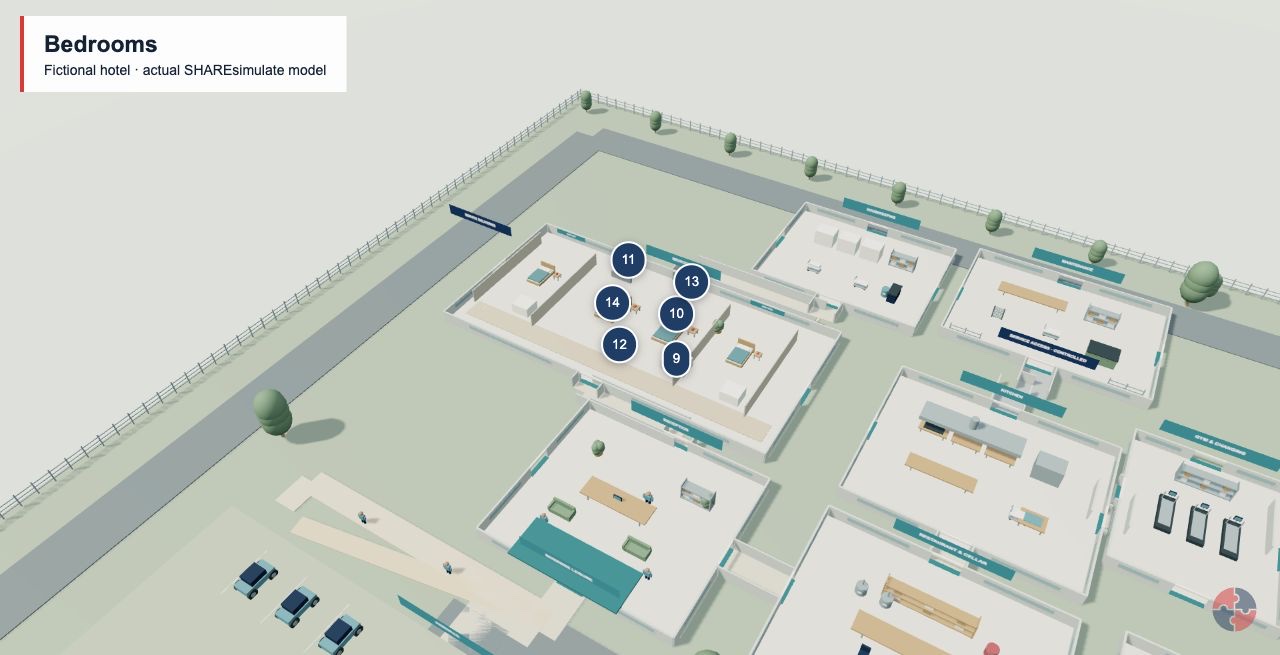
Work through 5 required applied activities and 3 model-practice pauses, with explanatory feedback and independent lesson decisions. Complete 11 distinct model mission sequences across those pauses. Use the actual fictional Riverside hotel, pool and leisure model or its equivalent accessible route to complete the required decision sequences; launching the model alone does not complete practice.
The 20-question assessment requires at least 80% plus every designated critical safety answer. Complete the required activities, practice and lesson checks. Points and badges cannot offset a critical safety error.
Use the LMS for confirmed save/resume and recorded results. Any certificate follows its configured passed-completion and grade conditions.
Open the public interactive practice copy; public practice is separate from the LMS record.
Sources and learning provenance
Original fictional cases are paired with public SHAREhub teaching and structured topic records. Use the applicable jurisdiction and primary guidance for live work.
- HSE · hot and cold water systems
- HSE · window restrictor safety bulletin; check the assessed guest and building context
- Home Office · sleeping accommodation fire guidance (England; use the applicable nation-specific guidance)
- Home Office · means of escape for disabled people (England; use the applicable nation-specific guidance)
- HSE · work on electrical equipment
- HSE · manual handling
- HSE · pushing and pulling assessment
- HSE · COSHH and cleaners
- HSE · cleaning and dermatitis
- HSE · maintenance of work equipment
- HSE · blood-borne viruses at work
- NHS · cuts, wounds and when to get help
Topic sections, source identities and versions
| Public topic | Chunk and version | Jurisdiction and sources |
|---|---|---|
| thermal-environments-heat-stress-and-cold-stress · controls-hierarchy | thermal-environments-heat-stress-and-cold-stress--controls-hierarchy 2.4 | GB, NI source-hse_heat, an-th11, an-th7, source-hseni_temperature |
| manual-handling · assessment-boundaries | manual-handling--assessment-boundaries 2.0 | Great Britain, Northern Ireland hse-manual, hse-l23, hse-mac, hse-toolkit, hse-toolfaq, hse-filters, hseni-manual |
| coshh-control-measures-and-health-surveillance · controls | coshh-control-measures-and-health-surveillance--controls 20261016-letter-review-1 | Great Britain, Northern Ireland source-coshh-hse-control, source-coshh-hse-spray, source-coshh-ni-coshh, source-coshh-hierarchy, source-coshh-mr2, source-coshh-lev-commission, share-hierarchy-iosh |
| fire-emergency-plans-business-continuity-and-environmental-impacts · plan-content | fire-emergency-plans-business-continuity-and-environmental-impacts--plan-content 20261016-letter-review-1 | England, Scotland, Great Britain gov-fire-safety-risk-assessment-offices-and-shops-fire-safety-risk-assessment-offices-and-, gov-publications-practical-fire-safety-guidance-existing-non-residential-premises-2, hse-workplace-health-emergency-procedures-htm |
| legionella-management · control-scheme | legionella-management--control-scheme 2026-10-02-additive-1 | Great Britain, Northern Ireland legionella-management-src-01, legionella-management-src-03 |
| working-at-height · hierarchy | working-at-height--hierarchy 4.0 | Great Britain, Northern Ireland source-gb_law, source-ni_law, source-hse_intro, source-hse_assess |
| electrical-control-measures-safe-systems-and-inspection · controls | electrical-control-measures-safe-systems-and-inspection--controls 2.2 | Great Britain, Northern Ireland hse-intro, hse-hsg85, hse-rights-06, www-hse-gov-uk-electricity-maintenance-isolate-htm, share-hierarchy-iosh |
| skin-health · glove-selection | skin-health--glove-selection | Great Britain skin-health--gloves, skin-health--engineering-gloves |
| sharps-awareness · response | sharps-awareness--response | sharps-awareness--primary-2 |
Course SH-HOTEL-02 · version 2026.10.20.hotel.2. .
Questions about this course
Is this training free?
Full public teaching and readers are free without an account. A free learner account is required for saved LMS progress and recorded assessment. Completion and any course-completion certificate depend on the configured LMS conditions.
How long should I allow?
Approximately 170–260 minutes, including teaching, lesson checks, required activities, model or accessible practice and one assessment attempt. Individual pace, review and retries vary. Save and resume in the LMS.
Can I learn without a 3D-capable browser?
Yes. The complete HTML reader provides the teaching. Required model practice has an equivalent accessible decision route in the interactive course. Use the LMS route for recorded learning.
What is required to pass?
Complete the required learning, activities, practice and lesson decisions. The 20-question final assessment requires at least 80% plus every designated critical safety answer. Points cannot compensate for a critical safety error. Follow the feedback before retrying.
Does this authorise hotel or leisure work?
Independent hotel, pool and leisure awareness using the fictional Riverside model. GB workplace guidance; apply corresponding NI and nation-specific arrangements. England-specific fire guidance is labelled. Learning does not establish practical competence, clinical advice, specialist work or operational authority. This independent course does not award an external qualification or replace competent task assessment, practical training or site authorisation.
Which manual handling assessments will you learn to use?
TILEO helps you review the wider task; MAC supports appropriate lifting, carrying and team handling of inanimate loads; RAPP supports appropriate pushing and pulling.
These aids support the activity assessment. Repetitive upper-limb work may need ART; variable or complex tasks may need other HSE tools or a fuller competent assessment. Mechanical lifting, stored energy, equipment safety and health decisions retain their separate controls. A low factor score, a downloaded report or completion of this course does not approve the work.
This additional teaching takes about 2–5 minutes, in addition to the course estimate. Optional reading and workplace assessment take additional time.
Learn how to select the method, use separate reports for mixed tasks, add a company logo and keep editable Word or PDF records. After a saved pass, the course offers a direct route to the assessment tools. Workplace assessment and practical competence remain separate from course completion.