
Crown Fuels and process safety / Safe operations, isolation, permits and tank entry
Crown Fuels and process safety · SH-FUEL-05Safe operations, isolation, permits and tank entry
Free online training · Approximate learning time: 140–220 minutes · Self-paced
From an operating abnormality to controlled maintenance and a justified restart
Full public teaching and readers are free without an account. A free learner account is required for saved LMS progress and recorded assessment. Completion and any course-completion certificate depend on the configured LMS conditions.
Who this course is for
Terminal operators, supervisors, maintainers, permit issuers and contractor coordinators working within their authorised roles.
Follow a fictional pump from an abnormal trend through isolation, permit coordination and tank-entry planning to handback. Learn to challenge incomplete evidence, identify connected work and state when an operation must remain unavailable. Model missions let you practise the decisions; the course does not authorise live plant work.
Fuel-terminal operators, maintenance and permit teams; no instruction to perform live isolation, gas testing or entry without competence and site authority.
Learning outcomes
- Explain why a stopped pump, a signed permit and a zero gauge each leave important questions unanswered.
- Identify the evidence needed to coordinate isolation, line breaking, simultaneous work and any unavoidable tank entry.
- Defend a controlled handback and restart using defect, permit, configuration and protection evidence.
Course outline
Understand work control boundaries
- Recognise the operating boundary before the leak growsDistinguish normal operation, abnormal response and maintenance release.
- Isolation controls sources, not just the start buttonExplain the evidence boundary for pump maintenance and a line break.
Establish operating and work-control requirements
- Make permits describe the real shared worksiteCoordinate hot work and transfers without treating documents as physical protection.
- Avoid tank entry, then plan a workable rescue if entry is unavoidableIdentify the distinction between a cleaned tank and an authorised safe entry.
- Pump seals: contain the release before treating the floorA clean floor does not demonstrate intact primary containment. Investigate the source before calling the defect closed.
- A stopped pump still contains hazardous energyStopping is an operating action; isolation establishes and maintains the safe condition needed for the work.
- Abnormal vibration: protect the operating envelopeAn excursion is information requiring a defined response; surviving previous excursions does not validate them.
- When the procedure and plant disagree, stop the uncertain stepA signature approves a document; field validation shows whether a person can safely use it.
Respond to alarms, trips and opening equipment
- Alarm flooding: acknowledgement is not corrective actionJudge an alarm by the timely, correct action it enables, not by whether it sounded or was acknowledged.
- After a trip: a reset is not a readiness reviewSafe restoration is a controlled task with evidence, ownership and a defined sequence.
- Prove the isolation before opening containmentIsolation is a verified physical condition with controlled ownership, not a valve command or a reassuring gauge alone.
Coordinate permits, simultaneous work and tank entry
- Resolve interacting jobs before either permit is releasedControl the interaction between activities, including changes over time; separate paperwork does not create physical independence.
- Hot work: a permit must describe proven conditionsPermit validity depends on the real job and current conditions, including work happening around it.
- Tank entry: avoid entry, then prove the complete safe systemAvoid entry first; necessary entry requires a complete verified safe system and effective rescue arrangements in advance.
Control handback and restart
- The repair is finished: is the pump ready?Integrate defect, permit, isolation and protective-system evidence into one restart decision.
- Turn the learning into a verified workplace actionChoose a bounded action, owner, task-specific evidence and escalation trigger within your role.
Activities, model practice and assessment
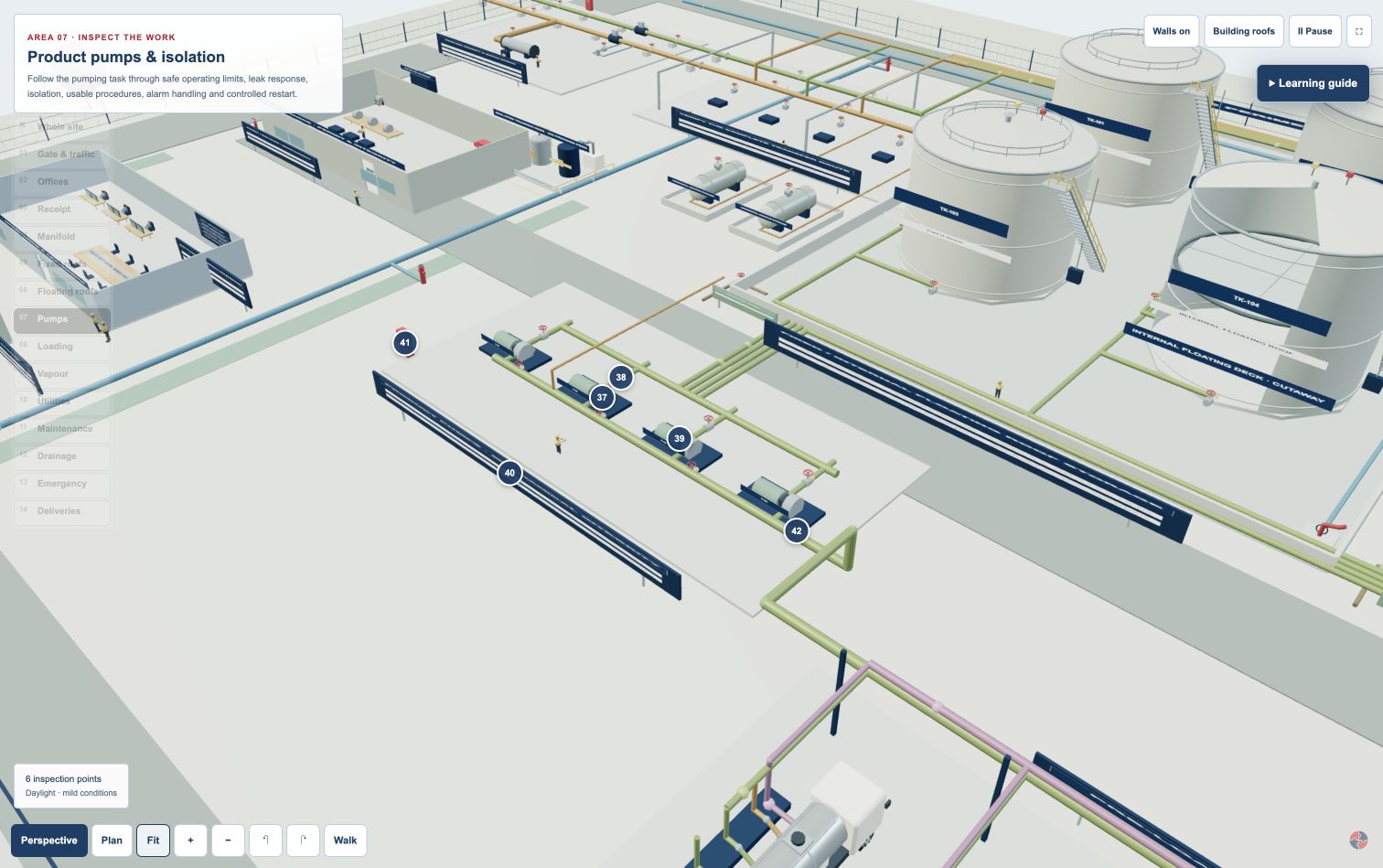
Work through 4 required applied activities and 3 model-practice pauses, with explanatory feedback and independent lesson decisions. Complete 10 distinct model mission sequences across those pauses. Use the actual fictional Crown Fuels model or its equivalent accessible route to complete the required decision sequences; launching the model alone does not complete practice.
The 20-question assessment requires at least 80% plus every designated critical safety answer. Complete the required activities, practice and lesson checks. Points and badges cannot offset a critical safety error.
Use the LMS for confirmed save/resume and recorded results. Any certificate follows its configured passed-completion and grade conditions.
Open the public interactive practice copy; public practice is separate from the LMS record.
Sources and learning provenance
Original fictional cases are paired with public SHAREhub teaching and structured topic records. Use the applicable jurisdiction and primary guidance for live work.
- HSE: permit-to-work systems
- HSE: safe isolation of plant and equipment, HSG253
- HSE: introduction to confined spaces
- HSE: operating procedures
Topic sections, source identities and versions
| Public topic | Chunk and version | Jurisdiction and sources |
|---|---|---|
| safe-operating-envelope · excursion-response | safe-operating-envelope--excursion-response 2.2 | Great Britain, Northern Ireland safe-operating-envelope--operating, safe-operating-envelope--controls, safe-operating-envelope--comahgb, safe-operating-envelope--comahni |
| isolation-lockout-and-line-breaking · verification | isolation-lockout-and-line-breaking--verification | Great Britain, Northern Ireland isol-legacy-01, isol-legacy-02 |
| permit-to-work-systems · permit-lifecycle | permit-to-work-systems--permit-lifecycle 2.0 | Great Britain source-hse_guidance_on_permit_to_work_systems_hsg250, source-hse_safe_isolation_of_plant_and_equipment_hsg253 |
| confined-spaces-risk-management · rescue-governance | confined-spaces-risk-management--rescue-governance 20261016-letter-review-1 | Great Britain, Northern Ireland source-csrm-hse-l101, source-csrm-hse-law, source-csrm-ni-law, source-csrm-ni-acop |
| asset-integrity-and-mechanical-integrity · emergency-response | asset-integrity-and-mechanical-integrity--emergency-response 20261016-letter-review-1 | Great Britain, Northern Ireland hse-comah, hseni-comah, hse-mi-guide, hse-pressure, hse-l122, hseni-pressure |
| isolation-lockout-and-line-breaking · energy-sources | isolation-lockout-and-line-breaking--energy-sources | Great Britain, Northern Ireland isol-legacy-01, isol-legacy-02 |
| standard-operating-procedures · validation-and-walkdown | standard-operating-procedures--validation-and-walkdown | Great Britain standard-operating-procedures--operating |
| fire-and-gas-detection-alarms-and-shutdown · alarm-load | fire-and-gas-detection-alarms-and-shutdown--alarm-load 20261016-letter-review-1 | Great Britain hse-topics-alarm-management-htm, hse-sragtech-techmeascontsyst-htm |
| safe-start-up-and-shutdown · startup-readiness-gate | safe-start-up-and-shutdown--startup-readiness-gate 2.1 | safe-start-up-and-shutdown--operating, safe-start-up-and-shutdown--change, safe-start-up-and-shutdown--permit, safe-start-up-and-shutdown--controls, safe-start-up-and-shutdown--plant, safe-start-up-and-shutdown--isolation |
| isolation-lockout-and-line-breaking · line-breaking | isolation-lockout-and-line-breaking--line-breaking | Great Britain, Northern Ireland isol-legacy-01, isol-legacy-02 |
| simultaneous-operations-and-interface-risk · permit-board | simultaneous-operations-and-interface-risk--permit-board | Great Britain simultaneous-operations-and-interface-risk--ptw |
| isolation-lockout-and-line-breaking · handover | isolation-lockout-and-line-breaking--handover | Great Britain, Northern Ireland isol-legacy-01, isol-legacy-02 |
| pre-start-up-safety-review-and-operational-readiness · readiness-gate | pre-start-up-safety-review-and-operational-readiness--readiness-gate 2.0 | source-hse_commissioning_and_operating_procedures |
Course SH-FUEL-05 · version 2026.10.20.1. .
Questions about this course
Is this training free?
Full public teaching and readers are free without an account. A free learner account is required for saved LMS progress and recorded assessment. Completion and any course-completion certificate depend on the configured LMS conditions.
How long should I allow?
Approximately 140–220 minutes, including teaching, lesson checks, required activities, model or accessible practice and one assessment attempt. Individual pace, review and retries vary. Save and resume in the LMS.
Can I learn without a 3D-capable browser?
Yes. The complete HTML reader provides the teaching. Required model practice has an equivalent accessible decision route in the interactive course. Use the LMS route for recorded learning.
What is required to pass?
Complete the required learning, activities, practice and lesson decisions. The 20-question final assessment requires at least 80% plus every designated critical safety answer. Points cannot compensate for a critical safety error. Follow the feedback before retrying.
Does this authorise fuel operations?
Fuel-terminal operators, maintenance and permit teams; no instruction to perform live isolation, gas testing or entry without competence and site authority. This independent course does not award a NEBOSH qualification or replace competent task assessment, practical training or site authorisation.