SHARE Knowledge Hub
Safe Operating Envelope
A safe operating envelope is the set of approved conditions and limits within which a process can operate without defeating its safety basis. Pressure, temperature, level, flow, composition and the availability of protective systems can move a plant towards loss of containment, fire, explosion or toxic release. Operators need a defined response to each warning, alarm and excursion, backed by engineered protection and a competent restart decision.
Understanding Safe Operating Envelope
A safe operating envelope is the set of process conditions within which a plant, its materials and its protective measures can operate without creating an unacceptable major-accident risk. It is not one number on a control screen. It is a justified set of upper and lower limits, operating modes, material constraints, safeguard assumptions and response actions tied to pressure, temperature, level, flow, composition, reaction state, utilities and equipment condition.
Why this matters at work
Decision record: Sector and system: Car garages: high-voltage battery bay; Breach and potential harm: Battery damage, incorrect charging or failed isolation can cause shock, thermal runaway, toxic smoke and burns.; Boundary and prevention: Use manufacturer-specific voltage, current, temperature and isolation conditions; segregate damaged batteries and provide detection and ventilation where justified.; Response proof and restart: Stop charging or repair on abnormal heat, damage or insulation fault.
Decision record: Sector and system: Haulage: fuel transfer or refrigerated trailer; Breach and potential harm: Overfill, hose failure or refrigeration fault can cause spill, fire, cold exposure or unsafe product conditions.; Boundary and prevention: Define fill, pressure, coupling, temperature and electrical limits for the actual load; provide immobilisation, containment and monitoring.; Response proof and restart: Stop transfer or trailer use on alarm, leak or lost monitoring.
How organisations manage this in practice
Decision record: Decision or control: Field verification; Required action: define cycle type, count, severity and inspection triggers and preserve transient history through control-system and equipment changes; Evidence or owner: design fatigue basis, historian counts, event classification, inspection, crack findings, remaining-life assessment and operating restrictions; Restrict or stop when: actual cycle count, severity or damage differs materially from the design and inspection basis.
Decision record: Decision or control: Field verification; Required action: assess technical basis, hazard-study effects, common cause, human response, testing, training and every downstream occurrence before release; Evidence or owner: change request, calculations, marked-up logic and documents, multidisciplinary review, tests, PSSR, communication and post-change review; Restrict or stop when: the change lacks traceability, independent check or complete implementation across linked systems.
Decision record: Assurance question: Is change controlled across the complete protective system?; Minimum record: Change description and basis; hazard review; affected calculations, drawings, software, setpoints, procedures, spares, training, proof tests and emergency arrangements; pre-startup review; closure evidence and superseded records.; Escalate when: Any affected element is omitted, the as-built plant differs from the approved basis or temporary change has no owner, expiry and restoration evidence..
Separate the limit, the alarm and the protective function
A safe operating envelope comes from the validated process basis. An alarm asks for a defined response; an independent protective function performs its specified action. They are different safeguards.

Normal operating range
Use the approved plant limits for the actual materials, equipment and operating mode. The unnumbered trend illustrates change only; its bands are not set points.
Alarm and response
Identify who responds, the required action and the time available in the validated scenario. An alarm has no protective value if it is unnoticed or a feasible response cannot be completed in time.
Protective function
Establish the required sensor, logic and final-element response and its verification. Do not treat an operator alarm as interchangeable with an independently specified protective function.
Trend still rising
Recognise a developing deviation and follow the plant-specific abnormal/emergency procedure. A general learning diagram cannot prescribe a reaction-cooling or shutdown sequence.
Impaired alarm or protection
Apply the authorised impairment arrangements. Keep operation on hold where the required safe arrangement is unproven; a bypass entry alone is not compensating protection.
Cause and restart authority
After an excursion, establish the cause, reconcile equipment status and verify required safeguards. The designated technical and operational authorities authorise any restart using the actual plant evidence.
Read the complete controls: ERICPD planning prompts
Discipline verifies and sustains all the controls; it is not a separate substitute for them.
| Prompt or level | Complete task-specific example |
|---|---|
| Eliminate | Use a validated non-reactive route or suitable supplied intermediate where it removes the hazardous reaction step. |
| Reduce | Evaluate less energetic chemistry or formulation using reaction testing; do not assume dilution or a smaller batch is inherently safe. |
| Isolate | Use closed charging and segregate people from credible release and relief paths. |
| Control | Prove cooling, agitation, feed permissives and required protective functions against the reaction-hazard study. Verify reagent identity and charge order; define addition holds and control-room actions for cooling loss or abnormal temperature. |
| PPE | Select chemical splash and other assessed protection for normal residual tasks; PPE cannot protect someone from an uncontrolled runaway. |
| Discipline | Hold restart after an excursion until process engineering explains the batch condition and authorises the next step. Read the accompanying source table for the framework distinctions. |
Read the complete controls: ESEAP effectiveness order
Compare stronger feasible controls while preserving the actual task, checks and release requirements.
| Prompt or level | Complete task-specific example |
|---|---|
| Elimination | Use a validated non-reactive route or suitable supplied intermediate where it removes the hazardous reaction step. |
| Substitution | Evaluate less energetic chemistry or formulation using reaction testing; do not assume dilution or a smaller batch is inherently safe. |
| Engineering controls | Use closed charging and segregate people from credible release and relief paths. Prove cooling, agitation, feed permissives and required protective functions against the reaction-hazard study. |
| Administrative controls | Verify reagent identity and charge order; define addition holds and control-room actions for cooling loss or abnormal temperature. Hold restart after an excursion until process engineering explains the batch condition and authorises the next step. |
| PPE | Select chemical splash and other assessed protection for normal residual tasks; PPE cannot protect someone from an uncontrolled runaway. Read the accompanying source table for the framework distinctions. |
No generic operating value, alarm delay, bypass permission or automatic restart is provided. Use the validated hazard study and plant-specific arrangements.
Further source background retained from this topic
How can I practise this topic in 3D?
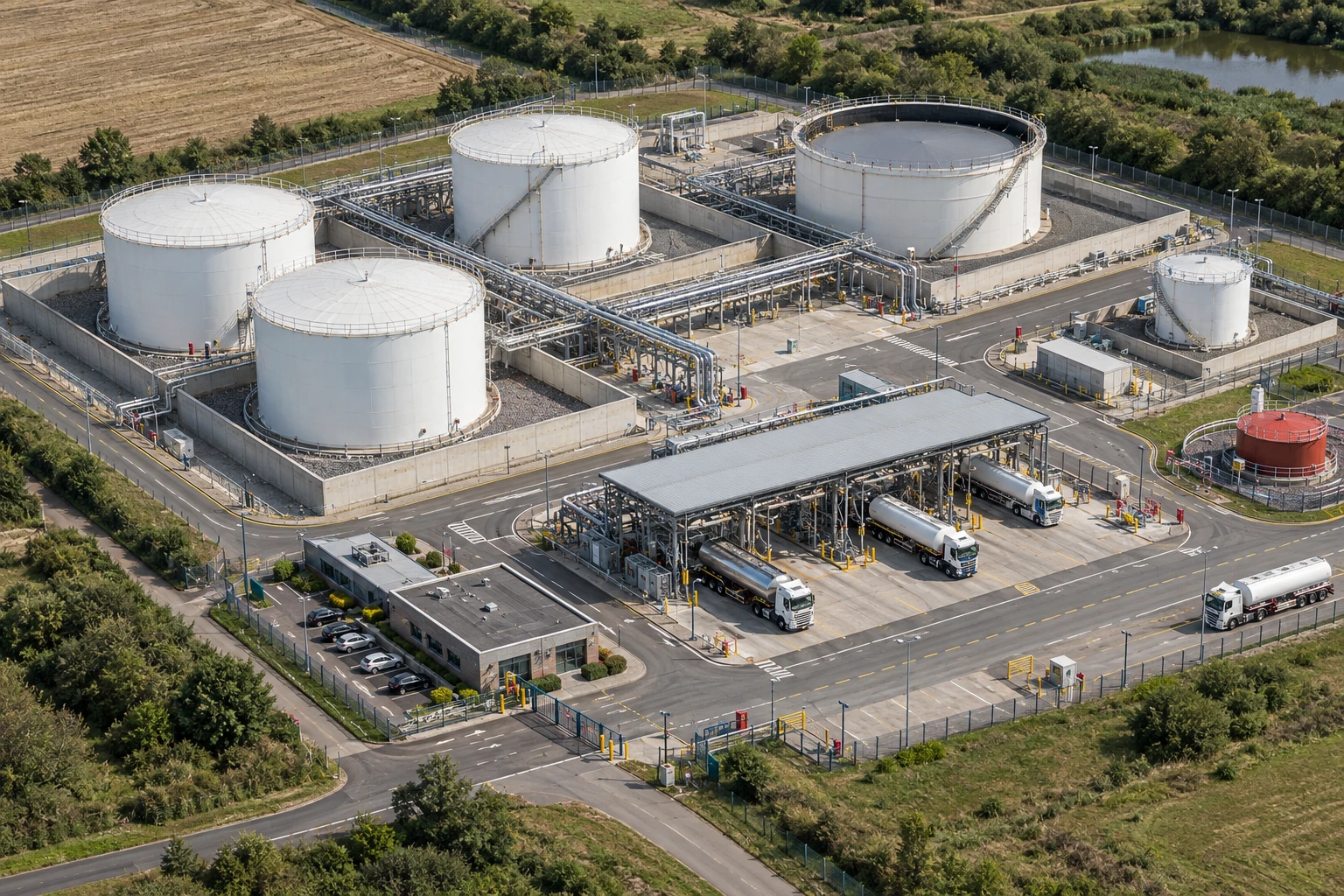

A proposed rapid valve closure ignores pipeline surge
All related inspection points 6 across 1 location
Crown Fuels terminal 6 inspection points
Practice in the SHAREhub environment. Browser practice is separate from workplace competence and formal learning records.
What is safe operating envelope?
The envelope links the process design basis, operating limits, alarms, trips and operator actions to prevent loss of control.
Best-practice guide: Safe Operating Envelope

What is safe operating envelope?
The envelope links the process design basis, operating limits, alarms, trips and operator actions to prevent loss of control. A safe operating envelope is the set of approved conditions and limits within which a process can operate without defeating its safety basis.
Turn safe operating envelope knowledge into a decision
A safe operating envelope is the set of approved conditions and limits within which a process can operate without defeating its safety basis. Pressure, temperature, level, flow, composition and the availability of protective systems can move a plant towards loss of containment, fire, explosion or toxic release. Confirm tank level, ullage, route line-up, alarm status and transfer limits. (HSE)
Safe Operating Envelope worked example
Before transfer: Confirm tank level, ullage, route line-up, alarm status and transfer limits. (HSE) During transfer: Monitor trend, flow, level and alarm status against defined response time. (HSE)
Operating-limit harm routes
Exposure route 1: High tank level during transfer; overflow can expose people to vapour, fire or toxic material. Exposure route 2: Pressure or temperature excursion; containment failure can cause burns, blast injury or toxic exposure. Exposure route 3: Composition or reaction condition changes; uncontrolled reaction or incompatible mixture can release heat, pressure or toxic products.
Choose controls for safe operating envelope
Elimination: Use a validated non-reactive route or suitable supplied intermediate where it removes the hazardous reaction step. Substitution: Evaluate less energetic chemistry or formulation using reaction testing; do not assume dilution or a smaller batch is inherently safe. Engineering controls: Use closed charging and segregate people from credible release and relief paths. Engineering controls: Prove cooling, agitation, feed permissives and required protective functions against the reaction-hazard study. Administrative controls: Verify reagent identity and charge order; define addition holds and control-room actions for cooling loss or abnormal temperature. Read the full control table for qualifications, ownership and verification. Use the actual task and applicable jurisdiction; existing technical approval remains unchanged.
Use the full safe operating envelope lesson
Use the full topic for the decision points, practical examples, detailed control tables and source scope. HSE guidance applies to Great Britain; use HSENI for the Northern Ireland route and the source’s stated jurisdiction. A simplified guide does not change the page’s technical-review or approval status.

Read all six steps as text
1. What is safe operating envelope?
The envelope links the process design basis, operating limits, alarms, trips and operator actions to prevent loss of control.
- Avoid / redesign: Use a validated non-reactive route or suitable supplied intermediate where it removes the hazardous reaction step.
- Control the task: Use closed charging and segregate people from credible release and relief paths.
- Verify before release: If the hazardous step remains, keep it within the task assessment and select the stronger feasible remaining controls.
The envelope links the process design basis, operating limits, alarms, trips and operator actions to prevent loss of control. A safe operating envelope is the set of approved conditions and limits within which a process can operate without defeating its safety basis.
Apply it: Which part of this plan would you check at the workface before authorising the task?
2. Turn safe operating envelope knowledge into a decision
Use the evidence to improve the actual work arrangement.
- Change at source: Use a validated non-reactive route or suitable supplied intermediate where it removes the hazardous reaction step.
- Make it observable: If the hazardous step remains, keep it within the task assessment and select the stronger feasible remaining controls.
- Keep useful evidence: Confirm tank level, ullage, route line-up, alarm status and transfer limits. (HSE)
A safe operating envelope is the set of approved conditions and limits within which a process can operate without defeating its safety basis. Pressure, temperature, level, flow, composition and the availability of protective systems can move a plant towards loss of containment, fire, explosion or toxic release. Confirm tank level, ullage, route line-up, alarm status and transfer limits. (HSE)
Apply it: What evidence would show that the change improves this task, rather than only completing a record?
3. Safe Operating Envelope worked example
Example: a practical application of the existing topic lesson.
- Before transfer: Confirm tank level, ullage, route line-up, alarm status and transfer limits. (HSE)
- During transfer: Monitor trend, flow, level and alarm status against defined response time. (HSE)
- Alarm issue: Alarm impairment reviewed, temporary restriction set and senior approval required. (HSE)
Before transfer: Confirm tank level, ullage, route line-up, alarm status and transfer limits. (HSE) During transfer: Monitor trend, flow, level and alarm status against defined response time. (HSE)
Apply it: At which point would you hold this example, and what evidence would allow it to proceed?
4. Operating-limit harm routes
Connect the task, the route to the person and the control that can fail.
- Exposure route 1: High tank level during transfer; overflow can expose people to vapour, fire or toxic material.
- Exposure route 2: Pressure or temperature excursion; containment failure can cause burns, blast injury or toxic exposure.
- Exposure route 3: Composition or reaction condition changes; uncontrolled reaction or incompatible mixture can release heat, pressure or toxic products.
Exposure route 1: High tank level during transfer; overflow can expose people to vapour, fire or toxic material. Exposure route 2: Pressure or temperature excursion; containment failure can cause burns, blast injury or toxic exposure. Exposure route 3: Composition or reaction condition changes; uncontrolled reaction or incompatible mixture can release heat, pressure or toxic products.
Apply it: Who could be exposed, including other trades, cleaners, maintainers and people nearby?
5. Choose controls for safe operating envelope
Start with the stronger practicable options and verify their effect.
- Elimination: Use a validated non-reactive route or suitable supplied intermediate where it removes the hazardous reaction step.
- Substitution: Evaluate less energetic chemistry or formulation using reaction testing; do not assume dilution or a smaller batch is inherently safe.
- Engineering controls: Use closed charging and segregate people from credible release and relief paths.
- Engineering controls: Prove cooling, agitation, feed permissives and required protective functions against the reaction-hazard study.
- Administrative controls: Verify reagent identity and charge order; define addition holds and control-room actions for cooling loss or abnormal temperature.
Elimination: Use a validated non-reactive route or suitable supplied intermediate where it removes the hazardous reaction step. Substitution: Evaluate less energetic chemistry or formulation using reaction testing; do not assume dilution or a smaller batch is inherently safe. Engineering controls: Use closed charging and segregate people from credible release and relief paths. Engineering controls: Prove cooling, agitation, feed permissives and required protective functions against the reaction-hazard study. Administrative controls: Verify reagent identity and charge order; define addition holds and control-room actions for cooling loss or abnormal temperature. Read the full control table for qualifications, ownership and verification. Use the actual task and applicable jurisdiction; existing technical approval remains unchanged.
Apply it: Which stronger option can be used here, and who will verify it before accepting the remaining risk?
6. Use the full safe operating envelope lesson
Follow the official sources below and retain the task-specific evidence.
- Official guidance: HSE operating procedures
- Official guidance: HSE control systems
- Task decision: Confirm tank level, ullage, route line-up, alarm status and transfer limits. (HSE)
Use the full topic for the decision points, practical examples, detailed control tables and source scope. HSE guidance applies to Great Britain; use HSENI for the Northern Ireland route and the source’s stated jurisdiction. A simplified guide does not change the page’s technical-review or approval status.
Apply it: Which official source and full-topic section will you use to resolve the next decision?
The safe operating envelope comprises the full approved operating conditions, including normal operation and justified abnormal or transition conditions, with the required safeguards. The normal operating window is a subset of that envelope; alarms, trips, safe operating limits and ultimate design constraints have distinct purposes. It is not just a set of numbers on a control screen. It is the technical agreement between design, hazard studies, operating procedures, alarms, trips, relief systems, maintenance, competence and management of change. See HSE operating procedures for the relevant source and scope.
A plant can drift outside its envelope slowly. Alarm set points may be changed, excursions may become routine, temporary bypasses may persist, new feedstock may alter reaction behaviour, or operators may learn that exceeding a limit is tolerated. Effective management keeps both the technical limits and the management discipline visible so the limits remain meaningful.
| Topic area | What it means | Professional test |
|---|---|---|
| Design basis | The original assumptions for plant, materials, relief, control and safeguards. | Can the site explain why each key limit exists? (HSE) |
| Operating window | Normal preferred range for stable, reliable operation. | Are trends monitored before limits are challenged? (HSE) |
| Safe operating limit | Boundary beyond which design or hazard assumptions may be invalid. | Is exceedance treated as a safety event, not a production nuisance? (HSE) |
| Alarm and trip philosophy | Detection and automatic/manual response before loss of control. | Are alarm priorities, operator actions and trip tests current? (HSE) |
| Excursion management | Actions when limits are exceeded or approached. | Is there clear stop, stabilise, escalate and review logic? (HSE) |
| MOC | Review when plant, feed, people, procedures or limits change. | Are temporary and subtle changes captured? (HSE) |
How can an operating limit become a major accident?
Pressure, temperature, level, composition or flow can move beyond the assessed design basis; if detection and protection fail, hazardous material or energy reaches people.
For example, an overfilled tank can release flammable liquid or vapour. Ignition can cause burns and blast injury; an unignited toxic release can affect breathing or skin. A hot or over-pressurised vessel can fail with additional mechanical injury. The material, inventory, confinement and weather determine the actual consequence; no universal set point follows from this example. See HSE control systems for the relevant source and scope.
| Deviation and likely harm | Warning and stop decision |
|---|---|
| High tank level during transfer; overflow can expose people to vapour, fire or toxic material. | Level trend, alarm or independent protection is abnormal: stop transfer under the approved procedure; verify capacity and barriers before restart. (HSE) |
| Pressure or temperature excursion; containment failure can cause burns, blast injury or toxic exposure. | Trend approaches the defined limit, utility fails or trip is impaired: stabilise or shut down under the site plan and escalate. (HSE) |
| Composition or reaction condition changes; uncontrolled reaction or incompatible mixture can release heat, pressure or toxic products. | Unknown feed, inhibitor or utility condition: hold addition and obtain competent process review. (HSE) |
A small repeated excursion is an early warning, not evidence that the limit is safe to ignore. Response time, independent protection and consequences belong in the technical basis.
How should safe operating envelope be structured?
Distinguish normal operating range, alarm point, safe limit and protective trip; each has a technical basis and a different required response.
The practical model is: design basis -> safe operating limits -> operating procedures -> monitoring and alarms -> operator response -> protective trips/interlocks -> excursion review -> MOC. Every limit should have a reason, a control, a response and evidence. See HSE control systems for the relevant source and scope.
Learners should understand the difference between normal operating range, alarm point, trip point and ultimate design limit. Treating these as interchangeable is a major weakness. The operating team needs time to detect, diagnose and respond before the process reaches a condition where engineered protection or emergency response must take over.
| Model step | What to define | Evidence or decision point |
|---|---|---|
| Define limits | Pressure, temperature, level, flow, composition, inventory, utilities and reaction conditions. | Safe limit register and technical basis. (HSE) |
| Set operating windows | Normal ranges, alarm limits and trip limits. | Control room displays and operating procedures. (HSE) |
| Define response | What operator does at warning, alarm, trip and excursion. | Alarm response sheets and escalation rules. (HSE) |
| Control impairment | Rules for bypassed alarms, failed instruments or unavailable trips. | Bypass log and temporary operating restriction. (HSE) |
| Review excursions | Trend and investigate operation outside envelope. | Excursion log, RCA and action tracker. (HSE) |
| Manage change | Review limits after feed, equipment, software, procedure or staffing changes. | MOC record and procedure update. (HSE) |
How can the hierarchy of controls prevent a batch excursion during cooling-dependent reagent charging?
Remove or reduce the hazard before relying on procedures or personal protection.
For safe operating envelope, assess the actual task and first look for a way to remove the hazard. Where that is not possible, consider a safer substitute, engineered separation and then clear work procedures. PPE protects against remaining exposure; it does not make an uncontrolled task safe. HSE hierarchy of controls
The selected measures need a named owner, a usable stop point and a check that they still work when the task or conditions change. In Northern Ireland, verify the separate legal route and site instructions.
How can the ERICPD hierarchy of controls prevent a batch excursion during cooling-dependent reagent charging?

| Control level | Control for this activity | Owner and verification | Stop / restart decision |
|---|---|---|---|
| Eliminate | Use a validated non-reactive route or suitable supplied intermediate where it removes the hazardous reaction step. | Task owner verifies that the proposed change removes the named hazardous step, including foreseeable cleaning, maintenance and work transferred elsewhere. | If the hazardous step remains, keep it within the task assessment and select the stronger feasible remaining controls. |
| Reduce, including substitution | Evaluate less energetic chemistry or formulation using reaction testing; do not assume dilution or a smaller batch is inherently safe. | Competent task/process owner validates suitability, compatibility and new hazards against the actual operating requirements before the alternative is adopted. | Reject an alternative if its performance is unproved or its new hazards are unresolved. |
| Isolate | Use closed charging and segregate people from credible release and relief paths. | Supervisor checks the actual boundary, affected people and connected work; verify separation or isolation before allowing access. | Hold or stop for cooling or agitation loss, wrong charge, abnormal temperature or unavailable safeguard. |
| Control: physical safeguards | Prove cooling, agitation, feed permissives and required protective functions against the reaction-hazard study. | Competent equipment/process owner checks reagent identity, cooling flow, agitation, feed isolation and protective functions. | Hold or stop for cooling or agitation loss, wrong charge, abnormal temperature or unavailable safeguard. |
| Control: work method and response | Verify reagent identity and charge order; define addition holds and control-room actions for cooling loss or abnormal temperature. | Supervisor confirms the work limits, competent cover, communication and stop/restart authority with the people doing this activity. | Hold work when the agreed limits, competent cover or effective communication cannot be maintained. |
| PPE | Select chemical splash and other assessed protection for normal residual tasks; PPE cannot protect someone from an uncontrolled runaway. | Assessor confirms whether personal protection is needed and checks suitability, condition, compatibility and any required fit evidence. | Do not use unsuitable protection or rely on PPE to continue after an essential source control fails. |
| Discipline | Hold restart after an excursion until process engineering explains the batch condition and authorises the next step. | Release only after process owner approves batch disposition and tested safeguards. Retain verification and unresolved restrictions at handover. | Keep the task on hold until required reinstatement evidence and unresolved defects are accepted by the responsible owner. |
How can the ISO 45001 hierarchy of controls prevent a batch excursion during cooling-dependent reagent charging?

| Five-level control stage(s) | Control for this activity | Owner and verification | Stop / restart decision |
|---|---|---|---|
| Elimination | Use a validated non-reactive route or suitable supplied intermediate where it removes the hazardous reaction step. | Task owner verifies that the proposed change removes the named hazardous step, including foreseeable cleaning, maintenance and work transferred elsewhere. | If the hazardous step remains, keep it within the task assessment and select the stronger feasible remaining controls. |
| Substitution | Evaluate less energetic chemistry or formulation using reaction testing; do not assume dilution or a smaller batch is inherently safe. | Competent task/process owner validates suitability, compatibility and new hazards against the actual operating requirements before the alternative is adopted. | Reject an alternative if its performance is unproved or its new hazards are unresolved. |
| Engineering controls | Use closed charging and segregate people from credible release and relief paths. | Supervisor checks the actual boundary, affected people and connected work; verify separation or isolation before allowing access. | Hold or stop for cooling or agitation loss, wrong charge, abnormal temperature or unavailable safeguard. |
| Engineering controls | Prove cooling, agitation, feed permissives and required protective functions against the reaction-hazard study. | Competent equipment/process owner checks reagent identity, cooling flow, agitation, feed isolation and protective functions. | Hold or stop for cooling or agitation loss, wrong charge, abnormal temperature or unavailable safeguard. |
| Administrative controls | Verify reagent identity and charge order; define addition holds and control-room actions for cooling loss or abnormal temperature. | Supervisor confirms the work limits, competent cover, communication and stop/restart authority with the people doing this activity. | Hold work when the agreed limits, competent cover or effective communication cannot be maintained. |
| PPE | Select chemical splash and other assessed protection for normal residual tasks; PPE cannot protect someone from an uncontrolled runaway. | Assessor confirms whether personal protection is needed and checks suitability, condition, compatibility and any required fit evidence. | Do not use unsuitable protection or rely on PPE to continue after an essential source control fails. |
| Administrative controls | Hold restart after an excursion until process engineering explains the batch condition and authorises the next step. | Release only after process owner approves batch disposition and tested safeguards. Retain verification and unresolved restrictions at handover. | Keep the task on hold until required reinstatement evidence and unresolved defects are accepted by the responsible owner. |
How would a safe operating envelope fail during a tank transfer?
A worked example shows how level, flow, alarm response and handover can become a major loss-of-containment pathway.
A fuels site transfers product into a storage tank. The weak system states that the operator must monitor level and stop before high level. During a busy shift, the flow rate is higher than expected, the high-level alarm has a history of nuisance activation, and a temporary instruction allows operation while a level transmitter is under review. See HSE control systems for the relevant source and scope.
The stronger system defines normal fill rate, maximum level, high alarm, high-high trip, operator response time, independent overfill protection, transfer authorisation, handover content, alarm impairment rules and management review of excursions.
If the high-level alarm activates while the transmitter is under review, the operator follows the defined stop response and confirms the receiving tank is safe; the team does not improvise a new fill limit. Before the next transfer, the technical owner resolves the instrument defect and records why the alarm, trip and independent protection are available.
| Stage | Weak handling | Stronger standard |
|---|---|---|
| Before transfer | Assume tank has capacity because previous shift said it was fine. | Confirm tank level, ullage, route line-up, alarm status and transfer limits. (HSE) |
| During transfer | Operator watches several screens and responds if alarm sounds. | Monitor trend, flow, level and alarm status against defined response time. (HSE) |
| Alarm issue | Alarm treated as nuisance. | Alarm impairment reviewed, temporary restriction set and senior approval required. (HSE) |
| Limit approach | Continue to finish transfer. | Slow, stop or divert before safe limit is challenged. (HSE) |
| Handover | Incoming shift told transfer is running. | Handover includes level, rate, alarm status, permit/temporary controls and stop point. (HSE) |
| After event | Close as operator attention issue. | Review envelope, alarm performance, staffing, handover and MOC. (HSE) |
“Slow, stop or divert” means only the pre-assessed safe response. Diversion requires an approved compatible route and verified receiving capacity; an unknown route or insufficient capacity is a hold point.HSE operating procedures
Tank timeline: before receipt, the engineer confirms usable ullage and the approved flow/closure assumptions; during receipt, the operator compares the trend with independent checks; an uncertain transmitter or unavailable essential overfill function creates a HOLD, even if the display remains normal. Resume only after the designated authority verifies the required protection and receiving capacity. Record the state change, evidence, decision owner and review trigger; actual response margins/setpoints remain plant-specific.HSE control systems HSE operating procedures
What should a safe limit register contain?
The register should show each limit, its technical basis, response and evidence.
A safe limit register is the bridge between process safety information and frontline operation. It prevents limits being treated as magic numbers with no owner or explanation. See HSE operating procedures for the relevant source and scope.
The register should be understandable to operators and robust enough for engineers, auditors and investigators.
| Limit type | What to record | Why it matters |
|---|---|---|
| Pressure | Normal range, alarm, trip, relief basis and maximum allowable pressure. | Protects containment and relief design. (HSE) |
| Temperature | Normal range, reaction/decomposition limits and material limits. | Controls runaway, ignition, degradation and equipment integrity. (HSE) |
| Level | Normal, high, high-high, overfill protection and response time. | Prevents overfill, carryover, pump damage and release. (HSE) |
| Composition | Feed, impurity, oxygen, moisture or inhibitor limits. | Protects chemistry, corrosion, flammability and quality. (HSE) |
| Flow | Minimum/maximum flow, cooling, agitation and transfer assumptions. | Protects heat removal, mixing, line integrity and process stability. (HSE) |
| Utility state | Power, instrument air, nitrogen, cooling water or steam availability. | Defines whether safeguards and process control can function. (HSE) |
What should happen when the envelope is challenged?
Excursions should trigger stabilisation, escalation, recording and learning, not informal tolerance.
An excursion is useful safety information. Even if no harm occurs, it may show that the process, procedure, alarm, instrument, training or staffing assumption is weak. See HSE operating procedures for the relevant source and scope.
Repeated small excursions are especially important. They often reveal normalisation before a serious loss of control.
| Excursion stage | Expected response | Evidence |
|---|---|---|
| Approaching limit | Recognise trend and take planned corrective action. | Trend record and operator log. (HSE) |
| Alarm | Follow defined response and escalate if response is uncertain. | Alarm response record. (HSE) |
| Trip or shutdown | Stabilise plant and do not restart without review. | Trip log and restart authorisation. (HSE) |
| Manual override or bypass | Use formal authorisation, time limit and compensating controls. | Bypass register and approval. (HSE) |
| Repeated excursion | Investigate systemic cause. | RCA, MOC and action tracker. (HSE) |
| Limit change request | Use competent technical review and MOC. | Approved change and updated documents. (HSE) |
Hold or safely stop an operation with an impaired credited safety function unless the designated competent authority demonstrates effective protection for that specific operating state. Record the permitted limits, concurrent impairments, owner, expiry and review triggers. A signature and time limit alone do not make a bypass safe.HSE control systems
How should operating states be understood?
A visual operating-states model helps learners see that response changes as the process moves from normal control toward emergency control.
A safe operating envelope is easiest to use when people can picture the state they are in. Normal operation needs routine monitoring; abnormal operation needs active correction; alarm state needs defined response; trip state needs stabilisation; emergency shutdown needs command and emergency arrangements; restart needs permission. See HSE operating procedures for the relevant source and scope.
This model is useful for control-room training, simulator exercises, shift handover, alarm rationalisation and investigation. It stops teams treating every state as if it is just another normal operating variation.
| State | What it means | Required discipline |
|---|---|---|
| Normal | The process is inside normal operating range with barriers available. | Monitor, record trends and keep within approved operating limits. (HSE) |
| Abnormal | A condition is outside normal range but has not yet reached a safe limit or alarm state. | Correct early, increase attention and log the weak signal. (HSE) |
| Alarm | A defined condition requires operator response within an expected time. | Follow alarm response, communicate status and escalate uncertainty. (HSE) |
| Trip | A safety or control function has acted to move the process toward a safer state. | Stabilise, investigate cause and prevent reset/restart by habit. (HSE) |
| Emergency shutdown | The process needs rapid movement to a defined safe state. | Use emergency procedure, command structure and site emergency arrangements. (HSE) |
| Restart permission | The process may only restart after cause, condition, safeguards and authority are confirmed. | Use restart review, handover and readiness evidence. (HSE) |
Where are operating envelopes used beyond a tank farm?
The controlled variables differ, but each site needs a justified safe range, effective safeguards and a defined response to deviation.
Apply the design basis to the actual process. The examples show transferable decisions, not interchangeable numerical limits. See HSE operating procedures for the relevant source and scope.
| Process, people and harm route | Strongest control and stop check |
|---|---|
| Chemical manufacturing: a batch reactor with changing feed can overheat and over-pressure, exposing operators to fire or toxic release. | Assess safer chemistry and inventory, then verify cooling, temperature protection and feed interlock. Hold feed when utility or composition is uncertain. (HSE) |
| Food production: an industrial refrigeration plant can lose containment after pressure or temperature control failure, exposing maintainers to refrigerant. | Keep equipment integrity and protective trips effective; maintenance lead verifies pressure basis and isolation. Stop on leak or impaired protection. (HSE) |
| Energy or fuel storage: a transfer tank can overfill and release flammable material near drivers and staff. | Use capacity verification, monitored transfer and independent overfill prevention; supervisor stops transfer on abnormal level or failed instrument. (HSE) |
| Bulk logistics: a tanker loading system can exceed designed flow or pressure and fail at a hose or connection, exposing drivers and loaders. | Engineer verifies compatible equipment and shutdown; loading lead checks line-up and alarms. Hold if transfer conditions do not match the approved envelope. (HSE) |
Construction is omitted here because it is not a representative process-envelope setting for these liquid and chemical examples; temporary works have their own design limits and specialist controls.
When should safe operating envelope be paused or escalated?
Stop, stabilise or shut down at the defined response point when an operating parameter approaches a safe limit; do not wait for the trip to rescue a normal transfer.
Before starting, the operator checks the approved limit, current level or pressure, route line-up, alarm and trip availability, and who may authorise the transfer. During operation, a rising trend, unexpected rate or impaired instrument triggers the written response and a call to the shift supervisor. Restart follows a competent review of the excursion and confirmation that the affected safeguard and operating basis are restored. See HSE operating procedures for the relevant source and scope.
| Trigger or question | Decision route | Escalate if |
|---|---|---|
| Is the process inside normal range? | Continue only when the approved conditions and required safeguards are available and verified. Normal readings alone do not justify operation with an unavailable essential protective function. | Trend is moving toward alarm or limit. (HSE) |
| Is an alarm active? | Take defined alarm response. | Alarm meaning or response is unclear. (HSE) |
| Has a safe limit been exceeded? | Stabilise, stop or shut down as procedure requires. | There is pressure to continue production. (HSE) |
| Is a safety-critical instrument bypassed? | Hold or safely stop if required protection cannot be demonstrated. A designated competent authority must assess the impairment and effective alternative protection before any bounded release. | Bypass affects a major accident barrier. (HSE) |
| Has feed, process or operating method changed? | Use MOC before relying on existing limits. | Change affects chemistry, pressure, temperature or relief assumptions. (HSE) |
| Are repeated excursions occurring? | Investigate and review envelope. | Repeated events are normalised. (HSE) |
Where does safe operating envelope commonly fail?
An envelope fails when the actual plant can pass an assessed limit without a timely, reliable response.
A tank level number copied into a procedure is weak if the instrument is drifting, the high alarm is ignored, or the trip is bypassed. The technical owner should compare the limit register with the design basis and live alarm set points; operators should demonstrate the response in the control room. An unapproved bypass or repeated excursion is a barrier defect, even when no release occurred. See HSE control systems for the relevant source and scope.
Limits without basis: Numbers exist but nobody can explain why. Maintain safe limit register with technical owner.
Alarm flooding or nuisance alarms: Operators stop trusting alarm meaning. Rationalise alarms and define response actions.
Excursion normalisation: Limits are exceeded without review. Treat excursions as weak signals and investigate repeats.
Bypass drift: Temporary bypass becomes accepted operation. Time-limit bypasses and require authorisation.
What evidence should safe operating envelope hold?
Keep the technical basis for each limit beside the live evidence that its alarm, trip and response remain available.
For one hazardous transfer, retrieve the limit register, cause-and-effect or alarm schedule, recent proof-test and impairment records, operating log, excursion investigation and any management-of-change record. Compare those records with field tags and the current display. A signed procedure alone cannot show that the instrument or final element would act. See HSE control systems for the relevant source and scope.
Safe limit register: Technical basis, approved range, alarm and trip set points, required response, authoriser and revision history. Check the displayed values against the approved register.
Instrument and barrier records: Calibration, proof-test, bypass, impairment and maintenance evidence for the sensors, logic and final elements credited in the assessment. Check overdue or failed tests before operation.
Excursion and change records: Time-stamped trends, operator action, investigation, temporary restriction, management-of-change decision and competent restart approval. Verify that repeat excursions changed the system rather than only the log.
Operator competence: Observed response to a relevant alarm and explanation of the stop point, supported by current procedure and authorisation scope. A training attendance sheet alone is insufficient.
How should safe operating envelope be assured?
Sample a live parameter from its design basis through display, alarm response, trip test, defect management and restart decision.
The process engineer confirms the basis and set points; the instrument specialist checks test and bypass status; the shift supervisor observes the operator response. Managers review repeated excursions and overdue safety-critical defects together. If the required trip is unavailable, the designated authority applies the site impairment rule and restricts or stops operation until a justified safe state is proven. See HSE HSG254 process safety indicators for the relevant source and scope.
Control room sample: Good evidence: Displays show limits, alarms and operator response clearly. Warning sign: Operators rely on memory or informal limits.
Excursion review: Good evidence: Excursions produce action and learning. Warning sign: Events are dismissed because no release occurred.
MOC sample: Good evidence: Changes update limits, procedures and training. Warning sign: Limits survive change without review.
Barrier health dashboard: Good evidence: Trips, alarms, relief and instrumentation status are visible. Warning sign: Safety-critical defects are buried in maintenance backlog.
Which legal route applies in Great Britain or Northern Ireland?
The general safety framework differs between GB and NI, and COMAH is an additional site-specific regime only where its scope is met.
A safe operating limit or handover rule is a site control derived from the hazard assessment and technical basis; it is not a universal statutory number. Check the applicable instrument and amendments for the actual location, substance and operation. HSE technical guidance is not itself legislation. See GB Management Regulations 1999 for the relevant source and scope.
| Location | Duty and scope | Source route and decision |
|---|---|---|
| Great Britain | General work-risk assessment and safe systems: Management Regulations 1999 with the 1974 Act framework. | Check the official GB instrument route and current amendments before a compliance determination. (Legislation) (1974 Act) |
| Northern Ireland | Separate Management Regulations (Northern Ireland) 2000 and 1978 Order framework. | Check the official NI instrument route and current amendments before a compliance determination. (Legislation) (1978 Order) |
| Great Britain | COMAH 2015 applies when dangerous-substance threshold and activity rules bring the establishment into scope. | HSE COMAH guidance explains prevention, mitigation, safety management and reports as applicable. (HSE) |
| Northern Ireland | COMAH (Northern Ireland) 2015 is a separate NI regime for establishments within scope. | HSENI explains the NI competent authority and legal route. (HSENI) |
Product conformity and workplace operation are separate decisions. Use manufacturer and design information for the equipment, then verify that operating, maintenance and emergency controls remain suitable.
How should management check this work?
Use a defined plan, carry out the controls, check performance and correct what does not work.
For safe operating envelope, assign a competent owner to set the work controls, check their use and review them after change, failure or new evidence. HSE managing health and safety
A management-system label or certificate is not approval of a site limit, procedure or individual work decision. Apply GB and NI duties to the correct location.
Where does functional safety fit?
Where a trip or interlock is credited with reducing major-accident risk, the site must manage the safety instrumented function throughout its lifecycle, not assume an alarm or control loop is an independent protective layer.
HSE describes functional safety as the part of overall safety that depends on an automated system responding correctly to its inputs. A site must define, maintain and test each safety function against its own hazard assessment; this general guidance does not verify a trip or assign its integrity requirement. HSE functional safety
| Question | Practical application | Boundary |
|---|---|---|
| What is credited? | Identify the hazardous scenario, required safe state and the instrumented function allocated to reduce risk. | An ordinary alarm or basic control loop is not automatically an independent SIS. (HSE) (HSE) |
| What keeps it available? | Use the approved specification, validation, proof-test, impairment and modification arrangements. | Test intervals and integrity claims need the site assessment and competent verification. (HSE) (HSE) |
| What if it is impaired? | Apply the site impairment and operating restriction rule before continuing or restarting. | A temporary instruction cannot silently replace a credited safety function. (HSE) (HSE) |
Exact licensed clauses and site-specific design claims need rights-cleared access and specialist verification.
How is competence demonstrated at each level?
Learning must match the decisions a person actually makes, and practical demonstration matters more than attendance.
A briefed operator must know why a limit exists, the first response, the mandatory stop point and the effect of a failed safeguard. A displayed number alone is not competence. Technical ownership and operator authority need separate records. See HSE operating procedures for the relevant source and scope.
| Role | Learning, assessment, record and reassessment |
|---|---|
| Operators and nearby workers | Recognise alarms, limits, leaks and stop routes; operator demonstrates a real trend, alarm response and safe shutdown. Supervisor assesses and records scope; reassess after change or excursion. (HSE) |
| Maintainers and instrument technicians | Test sensors, trips, relief or isolation within authorisation; competent technical lead observes and records test limits. Reassess on equipment or logic change. (HSE) |
| Shift supervisors | Challenge bypasses, authorise holds and verify restart conditions. Process safety manager samples a real excursion and decision; reassess after abnormal event. (HSE) |
| Engineers, designers and purchasers | Explain technical basis, compatibility and change-control decision; design authority checks calculations and specification. Reassess when material, inventory or plant changes. (HSE) |
| Managers, advisers and auditors | Trace limit to hazard scenario, barrier test and action close-out. Competent reviewer samples evidence and trend decisions; update on new guidance or repeated failures. (HSE) |
There is no universal certificate or fixed refresher period for every role. Set reassessment from changes, unsafe practice, incidents and evidence that the control is not working.
How could Crownway Fuels Ltd manage this in practice?

Crownway Fuels Ltd would manage safe operating envelope by connecting risk assessment, work planning, competent people, live checks, evidence and leadership review.
Crownway would use safe operating envelopes for fuel storage, tanker unloading, vapour recovery, tank level control, pump operation, alarm response, maintenance return-to-service and emergency isolation. The operational question is whether site teams understand the limits and whether excursions become visible to managers before they become releases.
This company example illustrates how the cited HSE control principle could be applied; its particular tasks, records and decisions require the organisation’s own hazard assessment and authorisation.
| Management element | How the business would manage it | Evidence to review |
|---|---|---|
| Tank limits | Define level, flow, ullage and overfill protection. | Safe limit register. (HSE principle) |
| Transfer controls | Confirm line-up, alarm status and stop point. | Transfer checklist. (HSE principle) |
| Impairments | Control failed level instruments or alarms. | Bypass/impairment log. (HSE principle) |
| Handover | Pass transfer status and abnormal conditions between shifts. | Shift log. (HSE principle) |
| Assurance | Review excursions, alarms and maintenance backlog. | Process safety dashboard. (HSE principle) |
Which operating assumptions matter in a fuel-system safe operating envelope?
Connect fuel conditions, the intended transfer path and protection functions. The document does not provide operating limits, setpoints or permission to run equipment.
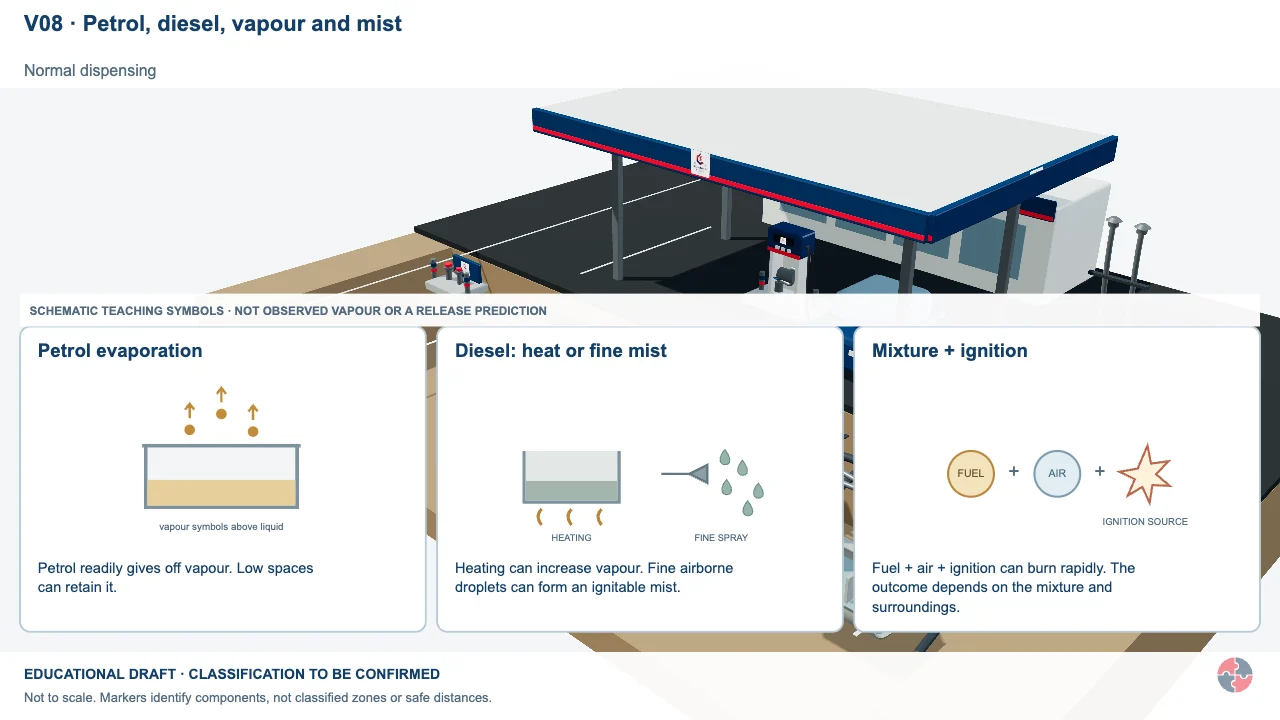
Petrol, diesel, vapour and mist
Compare petrol evaporation, diesel conditions and fine droplets. Petrol carried into a separator can remain a vapour source after the visible forecourt spill has passed.
Activity focus: Identify the actual product and release mechanism. For drainage, ask whether petrol could reach or remain in the separator; for refuelling, confirm the stated Stage II recovery arrangement.
Contextual workplace scene. Use the task, control and evidence checks in this section; appearance alone does not establish safe conditions, individual health or approval.
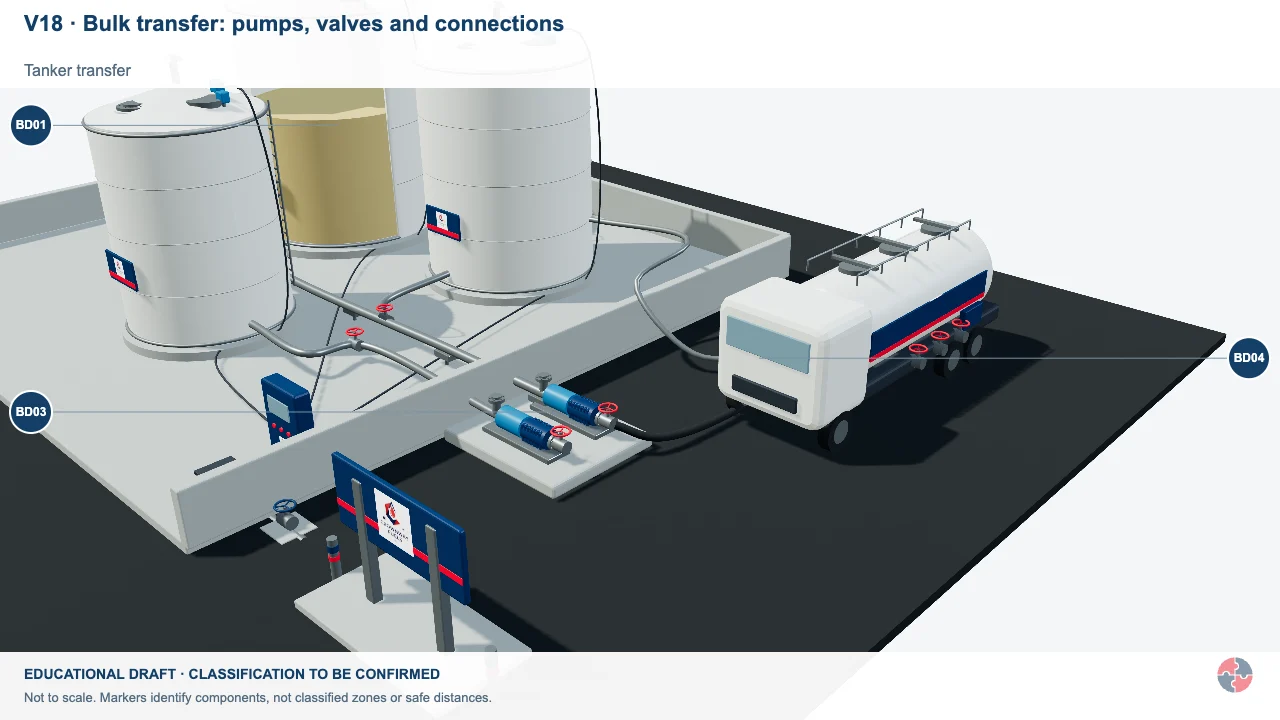
Tanker loading: liquid out, vapour back
Follow petrol from bulk storage into the tanker and the separate displaced-vapour route from the tanker to the terminal VRU.
Activity focus: Distinguish the product line, vapour collection line and tanker-loading protective controls.
Contextual workplace scene. Use the task, control and evidence checks in this section; appearance alone does not establish safe conditions, individual health or approval.
Educational illustration, not to scale. Coloured zones are teaching examples, not a site-specific hazardous-area classification.
Acronyms and terms used in this topic
The terms below distinguish legal regimes, management methods and operating decisions.
| Letters or term | Full expansion | Meaning here |
|---|---|---|
| HSE | Health and Safety Executive | GB workplace safety regulator. |
| HSENI | Health and Safety Executive for Northern Ireland | NI workplace safety regulator. |
| COMAH | Control of Major Accident Hazards | Separate GB and NI 2015 regimes for establishments within scope. |
| MOC | Management of change | Competent review before a change alters a safe operating limit or barrier. |
| PPE | Personal protective equipment | Residual protection, not control of a major release. |
| Excursion | Not an acronym | A deviation from an approved operating range or safety limit requiring the defined response. |
Unlock another resource
You have used this month’s two free downloads. Publish a post in your own words to unlock one more resource, or choose SHARE Individual for 10 downloads per month.
You decide whether to share. If you do, use the relevant platform disclosure tools and do not make claims you do not genuinely hold.