
Chilled pie production and food safety / Machinery, isolation and safe engineering handback
Chilled pie production and food safety · SH-PIE-04Machinery, isolation and safe engineering handback
Free online training · Approximate learning time: 120–180 minutes · Self-paced
Prevent dangerous access, control stored energy and prove both forms of readiness.
Full public teaching and readers are free without an account. A free learner account is required for saved LMS progress and recorded assessment. Completion and any course-completion certificate depend on the configured LMS conditions.
Who this course is for
Production operators, cleaners, supervisors, maintainers and contractor coordinators.
Use the mixer, sheeter, depositor, steam jacket and packaging cutter to examine how ordinary interruptions expose people. Practise stopping and challenging the work, then reconcile safe engineering return with food-hygiene and product release.
Machinery and maintenance decision awareness for the fictional FOOD environment. No live isolation, electrical proving, pressure-system work, guard design or technical validation instruction is supplied. Apply separate GB/NI duties and competent site-specific methods.
Learning outcomes
- Recognise entanglement, drawing-in, crushing, cutting and pressure-release mechanisms.
- Distinguish guarding, command stops, isolation and verified safe conditions.
- Identify competent functional-test and pressure-maintenance evidence.
- Coordinate engineering handback, tool accounting and separate hygienic/product release.
Course outline
Recognise mechanisms and access modes
- Name the mechanism before choosing the safeguardIdentify drawing-in, crushing and cutting exposures during normal work and foreseeable intervention.
- An open guard is a question about the whole safety functionRecognise a defeated interlock and define competent restoration without unsafe testing.
Maintain guards and safety functions
- Stopped does not mean isolated from every energy sourceDefine the evidence needed before access to an electrically and pneumatically powered depositor.
- Pressure and heat remain hazards during jacket maintenanceIdentify the task-specific isolation, pressure-system and reinstatement evidence for a steam jacket.
Control all relevant energy before intervention
- Film recovery needs a safe route past the cutterPrevent unexpected movement during packaging recovery and maintain hygiene control afterwards.
- Engineering handback and hygienic release answer different questionsReconcile the repaired machine, tools, residues, protective functions and product status.
- Mixer guard defeated during scrapingExplain the decision using the observed condition, the harm route and the evidence needed for release.
- Pastry sheeter in-running nipExplain the decision using the observed condition, the harm route and the evidence needed for release.
- Depositor moves on trapped pneumatic energyExplain the decision using the observed condition, the harm route and the evidence needed for release.
Coordinate recovery and maintenance
- Steam-jacket maintenance releases pressureExplain the decision using the observed condition, the harm route and the evidence needed for release.
- Thermoformer cutter access during film recoveryExplain the decision using the observed condition, the harm route and the evidence needed for release.
- Engineering handback leaves contamination in the lineExplain the decision using the observed condition, the harm route and the evidence needed for release.
Hand back engineering and hygiene readiness
- The engineer is finished, but the line is not handed backIntegrate safe intervention, protective functions and hygienic/product readiness before restart.
- Take a verified action into the workplaceConnect one actual task to an owner, evidence and a clear release or escalation decision.
Activities, model practice and assessment
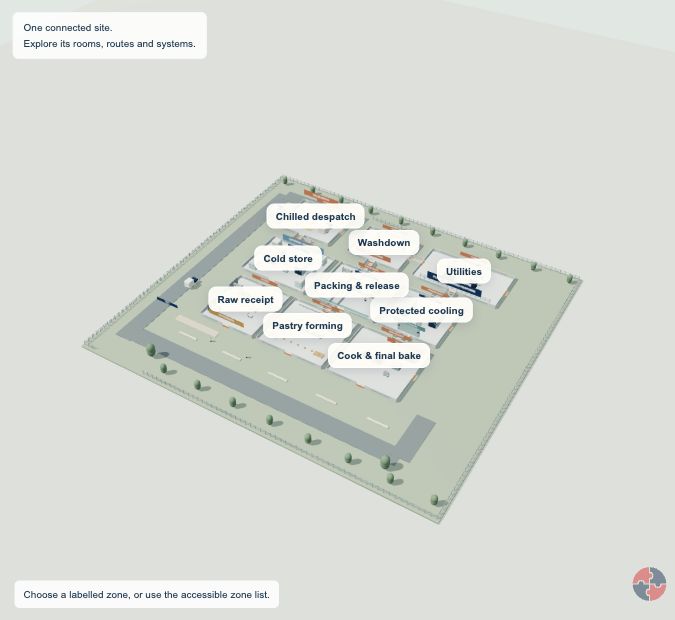
Work through 5 required applied activities and 3 model-practice pauses, with explanatory feedback and independent lesson decisions. Complete 6 distinct model mission sequences across those pauses. Use the actual fictional pie factory model or its equivalent accessible route to complete the required decision sequences; launching the model alone does not complete practice.
The 20-question assessment requires at least 80% plus every designated critical safety answer. Complete the required activities, practice and lesson checks. Points and badges cannot offset a critical safety error.
Use the LMS for confirmed save/resume and recorded results. Any certificate follows its configured passed-completion and grade conditions.
Open the public interactive practice copy; public practice is separate from the LMS record.
Sources and learning provenance
Original fictional cases are paired with public SHAREhub teaching and structured topic records. Use the applicable jurisdiction and primary guidance for live work.
- HSE: processing and packaging machinery hazards
- HSE: maintenance of work equipment
- HSE: Provision and Use of Work Equipment Regulations
- HSE: Pressure Systems Safety Regulations
- FSA MyHACCP: prerequisite requirements
Topic sections, source identities and versions
| Public topic | Chunk and version | Jurisdiction and sources |
|---|---|---|
| machinery-hazards · mechanisms | machinery-hazards--mechanisms 2.0 | Great Britain, Northern Ireland hse-intro, hse-l22 |
| machinery-hazards · lifecycle | machinery-hazards--lifecycle 2.0 | Great Britain, Northern Ireland hse-intro, hse-puwer, hse-maintenance, supply-gb, supply-ni |
| guards-and-machinery-interlocks · interlock | guards-and-machinery-interlocks--interlock 2.4 | Great Britain, Northern Ireland src-guards-l22, src-guards-hse-intro |
| maintenance-inspection-and-testing-of-work-equipment-and-machinery · functional-testing | maintenance-inspection-and-testing-of-work-equipment-and-machinery--functional-testing 2.0 | Great Britain, Northern Ireland hse-l22, hse-maint |
| isolation-lockout-and-line-breaking · energy-sources | isolation-lockout-and-line-breaking--energy-sources | Great Britain, Northern Ireland isol-legacy-01, isol-legacy-02 |
| isolation-lockout-and-line-breaking · verification | isolation-lockout-and-line-breaking--verification | Great Britain, Northern Ireland isol-legacy-01, isol-legacy-02 |
| work-equipment-lifting-equipment-and-pressure-systems · pressure-written-scheme | work-equipment-lifting-equipment-and-pressure-systems--pressure-written-scheme 3.0 | Great Britain, Northern Ireland source-l122, source-pssr_overview, source-gb_pssr, source-ni_pssr, source-hseni_l122, source-pssr_use |
| isolation-lockout-and-line-breaking · line-breaking | isolation-lockout-and-line-breaking--line-breaking | Great Britain, Northern Ireland isol-legacy-01, isol-legacy-02 |
| guards-and-machinery-interlocks · intervention | guards-and-machinery-interlocks--intervention 2.4 | Great Britain, Northern Ireland src-guards-hse-maint, src-guards-hse-quarry, src-guards-l22, src-guards-hse-interlock |
| machinery-hazards · controls | machinery-hazards--controls 2.0 | Great Britain, Northern Ireland hse-l22, hse-maintenance, hse-puwer |
| food-safety · hazards | food-safety--hazards 20261016-letter-review-1 | England, Wales, Northern Ireland, Scotland govuk-food-hygiene-businesses, food-business-guidance-hazard-analysis-and-critical-control-point-haccp, foodstandards-running-a-food-business-food-hygiene, food-business-guidance-allergen-guidance-for-food-businesses |
| guards-and-machinery-interlocks · guard-choice | guards-and-machinery-interlocks--guard-choice 2.4 | Great Britain, Northern Ireland src-guards-l22, src-guards-hse-intro |
| work-equipment-lifting-equipment-and-pressure-systems · pressure-operation | work-equipment-lifting-equipment-and-pressure-systems--pressure-operation 3.0 | Great Britain, Northern Ireland source-pssr_use, source-l122, source-maintenance, source-gb_pssr, source-ni_pssr |
| safe-shift-handover · handover-quality-check | safe-shift-handover--handover-quality-check 2.2 | Great Britain, Northern Ireland safe-shift-handover--handover, safe-shift-handover--permits, safe-shift-handover--ni-maintenance |
| guards-and-machinery-interlocks · assurance | guards-and-machinery-interlocks--assurance 2.4 | Great Britain, Northern Ireland src-guards-l22 |
| isolation-lockout-and-line-breaking · handover | isolation-lockout-and-line-breaking--handover | Great Britain, Northern Ireland isol-legacy-01, isol-legacy-02 |
| food-safety · records | food-safety--records 20261016-letter-review-1 | England, Wales, Northern Ireland, Scotland govuk-food-hygiene-businesses, food-business-guidance-hazard-analysis-and-critical-control-point-haccp, foodstandards-running-a-food-business-food-hygiene, food-business-guidance-allergen-guidance-for-food-businesses |
Course SH-PIE-04 · version 2026.10.20.1. .
Questions about this course
Is this training free?
Full public teaching and readers are free without an account. A free learner account is required for saved LMS progress and recorded assessment. Completion and any course-completion certificate depend on the configured LMS conditions.
How long should I allow?
Approximately 120–180 minutes, including teaching, lesson checks, required activities, model or accessible practice and one assessment attempt. Individual pace, review and retries vary. Save and resume in the LMS.
Can I learn without a 3D-capable browser?
Yes. The complete HTML reader provides the teaching. Required model practice has an equivalent accessible decision route in the interactive course. Use the LMS route for recorded learning.
What is required to pass?
Complete the required learning, activities, practice and lesson decisions. The 20-question final assessment requires at least 80% plus every designated critical safety answer. Points cannot compensate for a critical safety error. Follow the feedback before retrying.
Does this authorise factory operations?
Machinery and maintenance decision awareness for the fictional FOOD environment. No live isolation, electrical proving, pressure-system work, guard design or technical validation instruction is supplied. Apply separate GB/NI duties and competent site-specific methods. This independent course does not award an external qualification or replace competent task assessment, practical training or site authorisation.