SHARE Knowledge Hub
Worker Engagement in Major Accident Prevention
Workers can identify the gap between how hazardous plant is designed to operate and what happens during start-up, handover, maintenance and abnormal conditions. Their observations prevent major accidents only when someone connects them to a credible scenario, checks the affected barrier, makes a competent decision and reports back. Consultation and participation strengthen the operator’s control of fire, explosion and toxic-release risk; they do not transfer its legal duties to workers.
Understanding Worker Engagement in Major Accident Prevention
Workers can identify the gap between how hazardous plant is designed to operate and what happens during start-up, handover, maintenance and abnormal conditions. Their observations prevent major accidents only when someone connects them to a credible scenario, checks the affected barrier, makes a competent decision and reports back. Consultation and participation strengthen the operator’s control of fire, explosion and toxic-release risk; they do not transfer its legal duties to workers.
Why this matters at work
A major-accident hazard involves high-consequence fire, explosion, toxic release or environmental damage. A barrier is a measure with a defined preventive or mitigative function; an impairment means required performance may not be available. A weak signal is an early indication of degradation, such as repeated alarm suppression or overdue proof testing. A near miss is not judged only by injury outcome but by its credible potential.
Worker engagement is meaningful involvement of people who perform or are affected by work in identifying risk, making decisions and checking controls. Consultation requires information, listening and consideration before decisions, not merely telling workers the result. A safety representative is a formal role under the applicable consultation arrangements. A safety-critical task is a human action whose failure could cause, fail to prevent or fail to mitigate a major accident.
How organisations manage this in practice
The MAPP states the operator's aims and principles for controlling major-accident hazards. It should be concise but must connect to the live safety management system that implements it. A signed policy without plant procedures, competence, maintenance, change control, emergency arrangements, monitoring, audit and review is not evidence of delivery.
Operators, maintainers and contractors see how equipment and procedures behave in real work, including awkward access, recurring faults, bypasses and competing demands. Their knowledge can reveal weakening barriers before an accident. Involve them in identifying credible scenarios, designing practical controls and checking whether arrangements work. Formal consultation with employees or representatives has its own legal requirements; broader participation supports it but should not be used to replace the appropriate representative route. Provide relevant information, time, accessible communication and feedback on concerns. Keep the operator's and employer's responsibilities clear: worker involvement does not transfer the duty to fund, design or authorise safe operation. Record issues, decisions, owners and verification. Include nights, temporary staff and contractors so the process reflects the whole operation. A workshop attendance list or a suggestion box does not show influence. The practical test is whether concerns change decisions and whether workers can challenge a deteriorating control without pressure to keep production moving.
Record the issues raised and show how decisions considered them. Provide time and resources and return feedback to the originating shift or employer. Keep formal employee consultation requirements distinct from contractor coordination, since one arrangement may not discharge both. Review whether temporary and less confident workers can raise issues safely and whether urgent messages cross handovers reliably. Measure action and barrier improvement rather than attendance alone. A repeated concern from a night operator should receive the same technical assessment as one raised by a senior daytime manager.
A barrier concern needs a return path to workers
Worker and contractor knowledge must reach someone able to act. Technical verification, client operating release and returned feedback are separate parts of closure.

Report the observed signal
The worker or contractor records the actual concern and immediate restrictions through the shift route.
Own the technical response
The technical barrier owner investigates, corrects and provides relevant accepted test evidence; consultation is not technical acceptance.
Client operating decision
The client’s operating owner decides release or continued restrictions using the evidence and applicable arrangements.
Return the outcome
Inform the reporter and affected shifts, check effectiveness and keep unresolved actions open. An incident stand-down alone is not routine operating release.
Read the complete task-specific control examples
ERICPD is a planning cross-map: Discipline verifies and sustains every control. ESEAP compares effectiveness. A label does not authorise the task; retain the owner, evidence and stop or change decision.
Worker Engagement in Major Accident Prevention · ERICPD
- Eliminate
- Remove an unnecessary tank transfer or manual sampling step through an approved process redesign.
- Reduce
- Test a genuinely less hazardous material or replacement process through a competent compatibility and change review. Smaller working inventory is source reduction; closed sampling of unchanged hazardous material is engineering control. A worker suggestion starts the review; check for transferred pressure, reaction, cleaning or maintenance risk.
- Isolate
- For intrusive maintenance, establish the verified plant isolation required by the approved task procedure.
- Control
- Use the hazard-study findings in usable operating instructions, permit interfaces, shift handover and emergency exercises.
- PPE
- PPE does not stop an overfill, prove a process barrier or authorise entry into an uncontrolled release; emergency response needs the approved plan and competent team.
- Discipline
- Close worker reports with a barrier owner, action and evidence; maintain safeguards and revisit the hazard review after changes or repeated defects.
Worker Engagement in Major Accident Prevention · ESEAP
- Elimination
- Remove an unnecessary tank transfer or manual sampling step through an approved process redesign.
- Substitution
- Test a genuinely less hazardous material or replacement process through competent compatibility and change review. Smaller inventory is source reduction; closed sampling of unchanged hazardous material is engineering, not material substitution.
- Engineering controls
- For intrusive maintenance, establish the verified plant isolation required by the approved task procedure. For transfer, validate the specified overfill safeguard and separation from occupied areas. Operators and maintainers challenge line identity, bypasses and practical access. A specified closed sampling system for the unchanged material is engineering control.
- Administrative controls
- Use the hazard-study findings in usable operating instructions, permit interfaces, shift handover and emergency exercises.
- PPE
- PPE does not stop an overfill, prove a process barrier or authorise entry into an uncontrolled release; emergency response needs the approved plan and competent team.
How can I practise this topic in 3D?
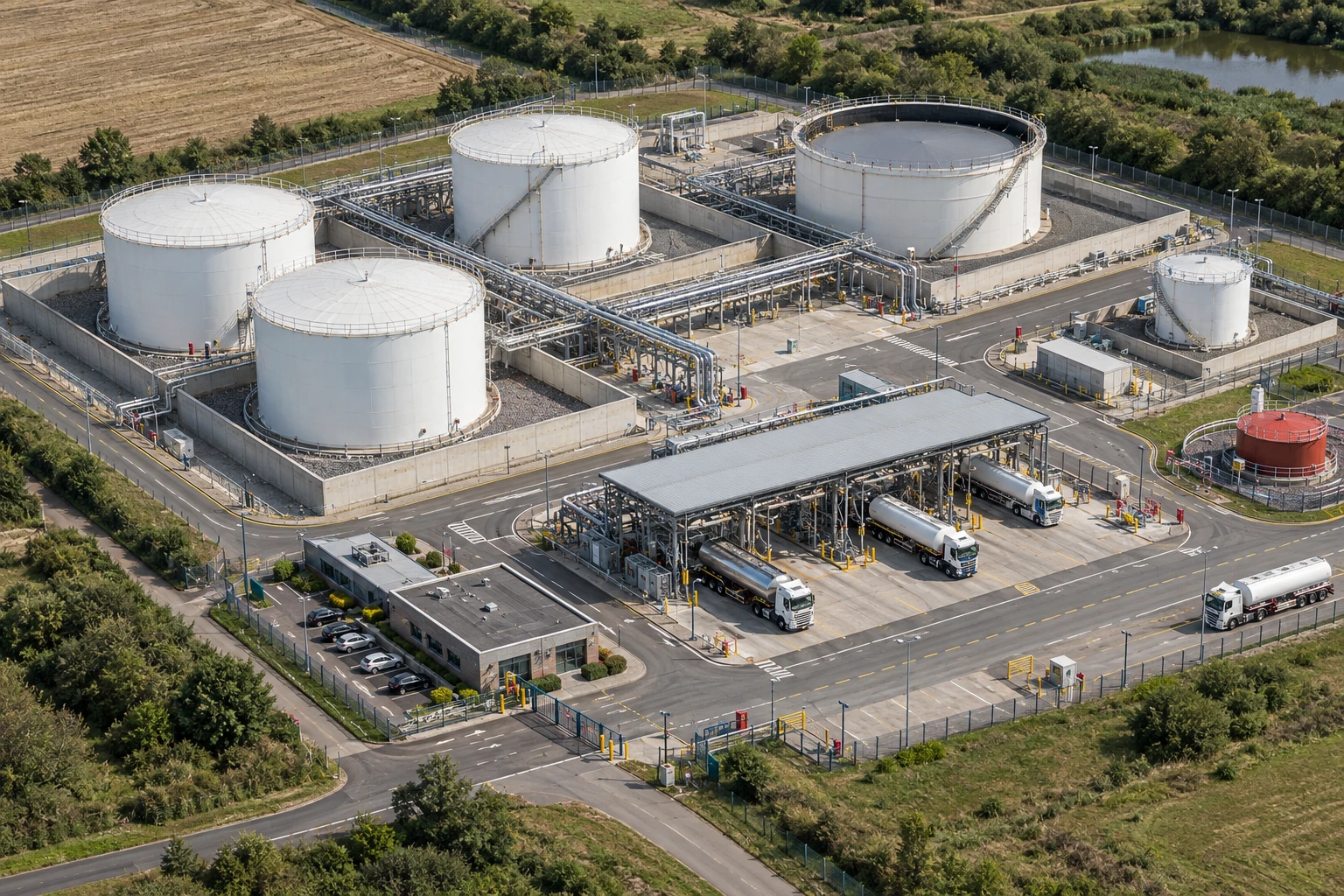

A night-shift warning does not reach the decision maker
All related inspection points 1 across 1 location
Crown Fuels terminal 1 inspection point
Practice in the SHAREhub environment. Browser practice is separate from workplace competence and formal learning records.
When does COMAH apply to this topic?
Control of Major Accident Hazards (COMAH) applicability depends on the establishment, dangerous substances, quantities and legal exclusions. Establish the Great Britain or Northern Ireland jurisdiction and the actual tier before assigning COMAH duties; the need to involve workers in controlling serious hazards is wider than COMAH. Where it applies, the operator’s major accident prevention policy (MAPP) connects those risks to its prevention arrangements.
Do not classify a site from its industry label, headcount or accident history. The competent assessment needs the relevant inventory, substance classifications, quantities that are present or likely to be present, applicable aggregation rules and the current Schedule 1. Changes to inventory or activity can require the assessment to be revisited. A small workforce can operate a major-hazard establishment, while a large industrial workplace may fall outside COMAH.
| Setting | What this means for engagement | Important limit |
|---|---|---|
| Lower-tier COMAH establishment | Connect relevant employee and subcontractor involvement to the major accident prevention policy and the proportionate safety management arrangements that implement it. | Do not import all upper-tier requirements automatically. Lower-tier status is not evidence of low consequence or permission to use weak controls. |
| Upper-tier COMAH establishment | Use workforce knowledge to challenge the assumptions behind the safety report and consult persons working in the establishment when preparing the internal emergency plan. | Consultation and a completed safety report do not themselves prove that the plant is safe. Technical demonstration, implementation and verification remain necessary. |
| Other hazardous work | Apply relevant consultation and risk-control duties under the regime governing the activity. Use the concern-to-control method as good practice where appropriate. | Offshore, transport and other excluded or specially regulated activities need their own applicability check. This page does not settle those boundaries. |
Keep the establishment's applicability decision in its controlled legal and process-safety information. Workers need a plain-language explanation of the major accident scenarios relevant to their work, not responsibility for calculating COMAH thresholds. Where jurisdiction, inventory or tier is uncertain, obtain competent advice before making a compliance claim.
A major accident can harm the environment before anyone is injured
Example: a worker notices damaged bunding and an uncertain drainage route near dangerous-substance storage. They report the observation from a safe place and follow the site’s immediate-danger arrangements if a release is occurring. The supervisor records the concern and restrictions; the technical/environment owner assesses the major-release and environmental pathway, verifies containment repair and feeds back to the reporter. Workers do not enter a spill or improvise drain isolation. The operating owner separately decides release on accepted evidence.
Why can worker engagement prevent a major accident?
People doing the work can reveal the gap between the way a process is intended to operate and the way it actually operates. Engagement helps prevent major accidents when those observations change hazard assessments, safeguards, work conditions and management decisions.
Best-practice guide: Worker Engagement in Major Accident Prevention

Why can worker engagement prevent a major accident?
People doing the work can reveal the gap between the way a process is intended to operate and the way it actually operates. Engagement helps prevent major accidents when those observations change hazard assessments, safeguards, work conditions and management decisions. Workers can identify the gap between how hazardous plant is designed to operate and what happens during start-up, handover, maintenance and abnormal conditions.
Turn worker engagement in major accident prevention knowledge into a decision
Workers can identify the gap between how hazardous plant is designed to operate and what happens during start-up, handover, maintenance and abnormal conditions. Their observations prevent major accidents only when someone connects them to a credible scenario, checks the affected barrier, makes a competent decision and reports back. Study record, assumptions, action owner, proof test and worker feedback.
Operator in a tank overfill hazard review
Operator describes actual transfer, alarms and workarounds; engineer tests safeguard independence and response time. Assign design and procedure actions; field-check before acceptance.
Missed worker knowledge can leave a barrier weak
Operators and maintainers see workarounds, leaks or unreliable alarms. The concern is not heard, recorded or acted on. A degraded barrier remains available for the next major-accident demand. Use the full topic for the detailed mechanism, task limits and source scope.
Choose controls for the actual task
Eliminate, reduce or simplify the hazard: Can an unnecessary hazardous transfer or manual intervention be removed, or inventory and process complexity reduced? Engineered prevention and mitigation: Are containment, detection, shutdown and other safeguards reliable, usable and appropriately independent? Work organisation and procedures: Can competent people complete the critical tasks with the available time, information, staffing and access? Emergency arrangements and personal protection: Can people recognise the event and carry out their assigned protective actions within the approved plan? Read the full control table for qualifications, ownership and verification. Use the actual task and applicable jurisdiction; existing technical approval remains unchanged.
Use the full worker engagement in major accident prevention lesson
Use the full topic for the decision points, practical examples, detailed control tables and source scope. HSE guidance applies to Great Britain; use HSENI for the Northern Ireland route and the source’s stated jurisdiction. A simplified guide does not change the page’s technical-review or approval status.

Read all six steps as text
1. Why can worker engagement prevent a major accident?
People doing the work can reveal the gap between the way a process is intended to operate and the way it actually operates.
- Avoid / redesign: Can an unnecessary hazardous transfer or manual intervention be removed, or inventory and process complexity reduced?
- Control the task: Can competent people complete the critical tasks with the available time, information, staffing and access?
- Verify before release: A documented engineering and risk assessment of the option, including new hazards and why the chosen solution is suitable.
People doing the work can reveal the gap between the way a process is intended to operate and the way it actually operates. Engagement helps prevent major accidents when those observations change hazard assessments, safeguards, work conditions and management decisions. Workers can identify the gap between how hazardous plant is designed to operate and what happens during start-up, handover, maintenance and abnormal conditions.
Apply it: Which part of this plan would you check at the workface before authorising the task?
2. Turn worker engagement in major accident prevention knowledge into a decision
Use the evidence to improve the actual work arrangement.
- Change at source: Can an unnecessary hazardous transfer or manual intervention be removed, or inventory and process complexity reduced?
- Make it observable: A documented engineering and risk assessment of the option, including new hazards and why the chosen solution is suitable.
- Keep useful evidence: Study record, assumptions, action owner, proof test and worker feedback.
Workers can identify the gap between how hazardous plant is designed to operate and what happens during start-up, handover, maintenance and abnormal conditions. Their observations prevent major accidents only when someone connects them to a credible scenario, checks the affected barrier, makes a competent decision and reports back. Study record, assumptions, action owner, proof test and worker feedback.
Apply it: What evidence would show that the change improves this task, rather than only completing a record?
3. Operator in a tank overfill hazard review
Example: a practical application of the existing topic lesson.
- Setting: Process-site overfill study, not plant-operating permission.
- Act: Provide drawings, trends and prior concerns; agree study scope and competent facilitation.
- Hold / review: Hold credit for an untested safeguard or an unsupported human action.
Operator describes actual transfer, alarms and workarounds; engineer tests safeguard independence and response time. Assign design and procedure actions; field-check before acceptance.
Apply it: At which point would you hold this example, and what evidence would allow it to proceed?
4. Missed worker knowledge can leave a barrier weak
Connect the task, the route to the person and the control that can fail.
- Observation: Operators and maintainers see workarounds, leaks or unreliable alarms.
- Lost signal: The concern is not heard, recorded or acted on.
- Consequence: A degraded barrier remains available for the next major-accident demand.
Operators and maintainers see workarounds, leaks or unreliable alarms. The concern is not heard, recorded or acted on. A degraded barrier remains available for the next major-accident demand. Use the full topic for the detailed mechanism, task limits and source scope.
Apply it: Where is this harm route present in the actual work, and which control breaks it before anyone is exposed?
5. Choose controls for the actual task
Control summary. Read the complete task-specific controls and checks in the linked topic.
- Elimination: Remove an unnecessary tank transfer or manual sampling step through an approved process redesign.
- Substitution: Test a genuinely less hazardous material or replacement process through competent compatibility and change review.
- Engineering controls: For intrusive maintenance, establish the verified plant isolation required by the approved task procedure.
- Administrative controls: Use the hazard-study findings in usable operating instructions, permit interfaces, shift handover and emergency exercises.
- PPE: PPE does not stop an overfill, prove a process barrier or authorise entry into an uncontrolled release; emergency response needs the approved plan and competent team.
Eliminate, reduce or simplify the hazard: Can an unnecessary hazardous transfer or manual intervention be removed, or inventory and process complexity reduced? Engineered prevention and mitigation: Are containment, detection, shutdown and other safeguards reliable, usable and appropriately independent? Work organisation and procedures: Can competent people complete the critical tasks with the available time, information, staffing and access? Emergency arrangements and personal protection: Can people recognise the event and carry out their assigned protective actions within the approved plan? Read the full control table for qualifications, ownership and verification. Use the actual task and applicable jurisdiction; existing technical approval remains unchanged.
Apply it: Which stronger option can be used here, and who will verify it before accepting the remaining risk?
6. Use the full worker engagement in major accident prevention lesson
Follow the official sources below and retain the task-specific evidence.
- Official guidance: Control of Major Accident Hazards Regulations 2015
- Official guidance: Control of Major Accident Hazards Regulations (Northern Ireland) 2015
- Task decision: Inform the reporter and affected shifts, check effectiveness and keep unresolved actions open. An incident stand-down alone is not routine operating release.
Use the full topic for the decision points, practical examples, detailed control tables and source scope. HSE guidance applies to Great Britain; use HSENI for the Northern Ireland route and the source’s stated jurisdiction. A simplified guide does not change the page’s technical-review or approval status.
Apply it: Which official source and full-topic section will you use to resolve the next decision?
Process safety concerns the prevention and mitigation of events such as a large loss of containment, fire, explosion or toxic release. Good personal-injury performance remains important, but it does not establish that a tank cannot overfill or that an emergency shutdown system will work. The organisation must examine the hazardous inventory, initiating events, consequences and the barriers relied on to interrupt each scenario.
Connect the observation to a possible failure
An operator saying that a level display occasionally stops changing is reporting an observation, not necessarily proving an instrument fault. The next questions are operational: what was entering or leaving the tank, what other evidence was available, what response was expected, and which independent protection was relied on? A repeated reset, a difficult valve, an unclear label or a delayed maintenance job may affect a major accident barrier even when no injury or release has occurred.
A preventive barrier stops an event from developing; a mitigative barrier limits consequences after the event begins. Their effectiveness depends on more than their presence on a drawing. A safeguard needs a defined function, suitable design, maintained condition, appropriate independence and evidence of performance. Worker knowledge can expose a hidden dependency, such as two supposedly separate checks relying on the same faulty indication, or an emergency action requiring a route that is blocked during maintenance.
Examine the conditions for human performance
If a protection depends on someone noticing, understanding and acting, examine the whole task. Can the person detect the signal amongst other alarms? Is the required response unambiguous? Is there enough time, access, staffing and authority to act? Are fatigue, noise, protective equipment, competing work or a poor interface making the assumed response unrealistic? Asking people to be more vigilant is not an adequate answer to an unworkable task.
Engagement is therefore part of the management system, not an extra layer of goodwill. Hazard studies need operating experience; maintenance planning needs information about recurring defects; change control needs the views of those who will use the new arrangement; leaders need to know when production expectations conflict with the basis of safety. The useful output is a better decision and a demonstrably effective control, not simply an attendance record.
What makes engagement more than a briefing?
Communication gives people information. Consultation allows informed views to influence a decision before it is final. Engagement keeps people involved in identifying problems, developing controls and checking whether the changes work in practice.
All three have a place. A briefing can communicate a revised alarm response, but it cannot retrospectively consult workers on a decision already taken. A workshop can gather suggestions, but it is not effective engagement if actions disappear into an inaccessible register. The organisation needs to show what was proposed, what workers said, how those views were considered, what was decided and how the result was communicated.
A practical consultation cycle
- Define the decision. Explain the issue, affected work, major accident scenarios, available options and constraints. Be clear about which matters can change and who will decide.
- Reach the affected people. Include the shifts, disciplines and subcontracted activities with relevant knowledge. Use the applicable representative arrangements and provide an accessible route for individual observations.
- Give time and information. Supply a proposed document, drawings or scenario description early enough for people to consider it and discuss it with colleagues. Do not use a complex technical presentation as the only opportunity to respond.
- Examine disagreement. Separate factual uncertainty from preferences. Test the disputed assumption or seek competent assessment; record material concerns that remain unresolved.
- Decide and explain. State which suggestions were adopted, modified or rejected and why. A reasoned response is needed even when management does not accept a proposal.
- Verify the result. Check the revised arrangement with affected workers after implementation, including its use under relevant abnormal conditions. Reopen the matter if the problem remains.
Use a combination of methods. A control-room discussion may reveal an alarm problem; a representative may detect that it occurs across several shifts; a structured engineering review may establish the failure mechanism. An anonymous channel can help surface a concern, but it does not replace a staffed urgent-reporting route. Explain how confidential information will be handled and avoid promising anonymity that the organisation cannot actually protect.
A useful test for a manager is: can a worker point to a decision that changed because of their input? A useful second test is: can the technical owner show evidence that the resulting control is effective? Neither test alone is enough.
What are the Great Britain legal routes?
In Great Britain, distinguish general employee consultation duties from the additional process-safety duties at an establishment within COMAH 2015. Participation does not transfer the employer's or operator's responsibilities to the workforce.
The Health and Safety at Work etc. Act 1974 provides the wider framework. The Safety Representatives and Safety Committees Regulations 1977 apply to consultation through recognised trade-union-appointed safety representatives where that route applies. The Health and Safety (Consultation with Employees) Regulations 1996 provide for consultation with employees not covered by those representatives, either directly or through elected representatives of employee safety. Different arrangements can operate within one organisation; establish who is represented by which route.
Consultation must take place in good time on relevant health and safety matters. Examples include changes that may substantially affect health and safety, arrangements for competent assistance, information about risks and preventive measures, training arrangements and the health and safety implications of new technology. The applicable regulations set the detail, including information, training, time and facilities for representatives. A management-selected spokesperson should not be treated as an elected representative where the law requires an election.
| Duty or arrangement | Application in major accident prevention | Evidence to retain |
|---|---|---|
| Employee consultation under the applicable 1977 or 1996 route | Consult affected employees or their representatives before settling a significant change to work, staffing, technology or training that affects health and safety. | The proposal, information provided, opportunity to respond, views received, decision and response. Retain the representative and coverage arrangements. See Safety Representatives and Safety Committees Regulations 1977; Health and Safety (Consultation with Employees) Regulations 1996. |
| COMAH 2015 Regulation 7 and Schedule 2 | Implement the MAPP through proportionate arrangements. Address roles, training and involvement of employees and relevant subcontracted personnel within the safety management system. | Connections between the policy, hazard studies, actual work, competence, concern handling and management review; not a policy statement alone. See Control of Major Accident Hazards Regulations 2015. |
| Upper-tier COMAH internal emergency planning | Regulation 12 requires consultation with persons working in the establishment when preparing the internal plan, alongside the other specified consultees. | Comments on the proposed arrangements, how practical difficulties were resolved, and relevant plan and exercise revisions. See Control of Major Accident Hazards Regulations 2015. |
The table is a topic guide, not an exhaustive legal checklist. Check the current consolidated instruments and establishment-specific requirements before relying on them. HSE L111 explains the GB COMAH framework; it should not be relabelled as Northern Ireland legislation.
What changes in Northern Ireland?
Northern Ireland has separate COMAH and employee-consultation legislation. Use the NI instruments and HSENI guidance for an NI establishment, even where a company's management system is shared with sites in Great Britain.
The wider framework is the Health and Safety at Work (Northern Ireland) Order 1978. The Safety Representatives and Safety Committees Regulations (Northern Ireland) 1979 and the Health and Safety (Consultation with Employees) Regulations (Northern Ireland) 1996 provide the relevant representative and other-employee consultation routes. Map the actual workforce and representation arrangements rather than copying a GB legal register and changing its heading.
The Control of Major Accident Hazards Regulations (Northern Ireland) 2015 are S.R. 2015 No. 325. Their safety management provisions address relevant employee and subcontracted-personnel involvement. Upper-tier internal emergency planning has its own consultation requirements under Regulation 12. These sit alongside general consultation arrangements, rather than replacing them.
| NI decision | What the organisation should establish | Practical record |
|---|---|---|
| Which consultation route covers each employee group? | Identify the applicable union-appointed representative, direct-consultation or elected-representative arrangements under NI law. | Coverage by workplace and shift, the way representatives are selected, and how people can raise an issue outside a scheduled meeting. See Safety Representatives and Safety Committees Regulations (Northern Ireland) 1979; Health and Safety (Consultation with Employees) Regulations (Northern Ireland) 1996. |
| Is the establishment within NI COMAH, and at which tier? | Have the actual dangerous-substance inventory and legal applicability assessed against the NI instrument. Do not infer status from the parent company's GB sites. | The controlled applicability assessment and the connection between worker involvement, the MAPP and the site's safety management arrangements. See Control of Major Accident Hazards Regulations (Northern Ireland) 2015. |
| Who must contribute to the upper-tier internal plan? | Consult persons working in the establishment and fulfil the other NI consultation requirements. Include practical input from relevant subcontracted activities. | Issues raised, decisions and revisions. Record whether the proposed response works for the actual workforce and site conditions. See Control of Major Accident Hazards Regulations (Northern Ireland) 2015. |
A common company procedure can support both jurisdictions if its responsibilities and legal references remain accurate. Use a local legal owner to check amendments, regulator interfaces and site-specific requirements. This page does not claim that a GB approval, training certificate or consultation record establishes NI compliance.
Who must be involved, and when?
Involve the people whose work, knowledge or safety is affected while there is still a genuine opportunity to change the decision. Reach all relevant shifts and interfaces; consulting the most available people is not the same as consulting the affected workforce.
Choose lawful consultation route
2 linked parts. Follow the question numbers and complete the applicable route.
Part 1 of 2 · Questions 1–3

Continue · Part 2 of 2 · Questions 4–5


Read the complete visual as text
- Start: Change, training, procedure or upper-tier internal emergency plan may affect people.
- Question 1: Where is the establishment? Decision owner: Client legal / consultation owner.
- GREAT BRITAIN: Check GB COMAH applicability and GB represented/unrepresented consultation routes. Owner: Client legal / consultation owner. CONTINUE → QUESTION 2.
- NORTHERN IRELAND: Check NI COMAH applicability and NI represented/unrepresented consultation routes. Owner: Client legal / consultation owner. CONTINUE → QUESTION 3.
- UNKNOWN: Hold decision; determine jurisdiction and establishment/tier from competent evidence. Owner: Client legal / consultation owner. HOLD → REPEAT QUESTION 1 AFTER CORRECTION.
- Question 2: GB upper-tier internal emergency plan? Decision owner: GB consultation owner.
- YES: Consult persons working and listed bodies under applicable GB Regulation 12; record views before approval. Owner: GB consultation owner. CONTINUE → QUESTION 4.
- NO: Consult represented/unrepresented groups in good time through GB route. Owner: GB consultation owner. CONTINUE → QUESTION 4.
- UNKNOWN: Hold and establish GB scope/tier; site name alone does not decide. Owner: GB consultation owner. HOLD → REPEAT QUESTION 2 AFTER CORRECTION.
- Question 3: NI upper-tier internal emergency plan? Decision owner: NI consultation owner.
- YES: Consult persons working and listed bodies under applicable NI Regulation 12; record views before approval. Owner: NI consultation owner. CONTINUE → QUESTION 4.
- NO: Consult represented/unrepresented groups in good time through NI route. Owner: NI consultation owner. CONTINUE → QUESTION 4.
- UNKNOWN: Hold and establish NI scope/tier; do not copy GB law. Owner: NI consultation owner. HOLD → REPEAT QUESTION 3 AFTER CORRECTION.
- Question 4: Do affected shifts and safety-relevant subcontractors have usable information, representation and time to respond? Decision owner: Client consultation owner.
- YES: Technical owner considers views, decides and explains reasons. Owner: Client consultation owner. CONTINUE → QUESTION 5.
- NO / UNKNOWN — HOLD: Hold decision; correct inclusion, access, representation and response time. Owner: Client consultation owner. HOLD → REPEAT QUESTION 4 AFTER CORRECTION.
- Question 5: Are controls tested and accepted before release? Decision owner: Client technical / operating owners.
- YES: Communicate decision, reasons and review with affected people. Owner: Client technical / operating owners. OUTCOME → RECORD AND HAND OVER.
- NO / UNKNOWN — HOLD: Hold change/task; consultation alone does not prove effective control. Owner: Client technical / operating owners. HOLD → REPEAT QUESTION 5 AFTER CORRECTION.
- Outcome: Consultation complete with tested control release, or explicit consultation/release hold.
Map the work before choosing the meeting. A change to tank transfer may involve a control-room operator, field operator, driver, instrument technician, maintenance planner and emergency team. Each sees a different part of the risk. Ask who performs the task during nights, holidays, start-up and breakdowns, not just who holds the normal daytime role. Use the legally applicable consultation route alongside these technical contributions.
Make participation possible
Plan release from operational duties, cover for attendance, accessible information and enough preparation time. Rotate sessions or use representative feedback so an off-shift team is not consistently excluded. Consider language, literacy, disability, digital access and confidence speaking in front of managers. Verify understanding through discussion of a realistic task; a translated handout or a signed attendance sheet is not proof that a person can use the information.
Ask specific questions: where does the document differ from actual plant conditions? Which step is difficult when another task is taking place? What happens if a display, radio or utility is unavailable? What information is missing at shift change? These questions make it easier to contribute than asking whether everyone is happy with the procedure. Record a minority concern about a safety-critical assumption even if most participants have not experienced it.
Set consultation around the lifecycle
Seek operating and maintenance input during design, before access and equipment choices become difficult to change. Revisit the discussion during commissioning, before hazardous introduction, following modifications and after abnormal events. Maintenance shutdowns and temporary staffing arrangements deserve attention because the normal pattern of work and protection may be disturbed. A final briefing communicates an approved arrangement; it should not be the first time affected workers see it.
There is no universal consultation period that suits every decision. Allow time proportionate to complexity and workforce coverage, and retain the opportunity for informed responses before the final decision. An immediate danger still requires the site's prompt protective response: do not delay urgent action for a committee meeting. Consult on the ongoing arrangements and resulting changes once the immediate situation is controlled.
How should a concern become a verified barrier decision?
Use a traceable route from observation to safe response, competent assessment, action, verification and feedback. A concern is not closed merely because it has been acknowledged, assigned a work order or marked complete in a database.
Concern to verified barrier fix and feedback


Read the complete visual as text
- 1. REPORT THE ACTUAL SIGNAL: Client operator and BuildOut maintenance technician report observed trend and plant state; follow the approved response for that exact alarm. No invented threshold.
- 2. MAKE SAFE AND TRIAGE: Client supervisor restricts transfer if indication/protection is uncertain. Suspected release uses site emergency plan and incident command; nuisance/false alarms still need competent cause/barrier check.
- 3. INVESTIGATE AND VERIFY: Client technical owner identifies scenario, affected function, restriction and evidence; authorised technicians test controls under the site arrangements.
- 4. NAMED RELEASE AND FEEDBACK: Client operating owner accepts test/release evidence. Inform reporter, affected shifts and contractors, then check later effectiveness. Incident stand-down alone is not routine operating release.
Barrier verification and client operating release


Read the complete visual as text
- Start: Non-emergency barrier concern, or incident command has accepted scene handback.
- Question 1: Has incident scene handback, if needed, been accepted by the technical/operating owner? Decision owner: Client recovery owner.
- YES: Hold affected work; identify scenario, barrier, restrictions, repair and evidence. Owner: Client recovery owner. CONTINUE → QUESTION 2.
- NO / UNKNOWN — HOLD: Incident response continues; no re-entry or routine restart. Owner: Client recovery owner. HOLD → REPEAT QUESTION 1 AFTER CORRECTION.
- Question 2: Can competent owner verify effective control with accepted evidence? Decision owner: Client technical authority.
- YES: Test relevant prevention/independent protection and assess common causes. Owner: Client technical authority. CONTINUE → QUESTION 3.
- NO / UNKNOWN — HOLD: Maintain hold and assigned action; false alarm label alone is not evidence. Owner: Client technical authority. HOLD → REPEAT QUESTION 2 AFTER CORRECTION.
- Question 3: Are test results and operating conditions accepted by named client operating authority? Decision owner: Client operating owner.
- YES: Record authorised release; BuildOut controls its own task under host arrangements. Owner: Client operating owner. CONTINUE → QUESTION 4.
- NO / UNKNOWN — HOLD: Hold affected plant/work; contractor or software tick cannot release client operation. Owner: Client operating owner. HOLD → REPEAT QUESTION 3 AFTER CORRECTION.
- Question 4: Have reporter, affected shifts and contractors received outcome and review? Decision owner: Client supervisor / representative.
- YES: Check later effectiveness and close verified action. Owner: Client supervisor / representative. OUTCOME → RECORD AND HAND OVER.
- NO / UNKNOWN — HOLD: Keep feedback/action open; reporting frequency alone does not prove safety. Owner: Client supervisor / representative. HOLD → REPEAT QUESTION 4 AFTER CORRECTION.
- Outcome: Client-authorised verified release and worker feedback, or continued held action.
The following is a suggested management method, not a prescribed HSE form or a substitute for the site's alarm and emergency procedures. It works best when the reporting channel connects to existing operations, maintenance, impairment and change-control systems. Avoid several disconnected registers in which the same unresolved issue appears to have been passed to someone else.
| Stage | Action and decision owner | Evidence that allows progression |
|---|---|---|
| Recognise and respond | The worker follows the authorised local response and contacts the responsible supervisor or control room. A current release or immediate danger follows the emergency route; an uncertain precondition prevents the affected job starting. | A clear description of what was observed, where and when, the operating state and the immediate response. Do not delay urgent communication to finish a form. |
| Assess the affected scenario | The supervisor obtains competent operations and technical assessment. Identify which barrier may be degraded, what else is unavailable and whether current or planned activity remains within the approved basis of safety. | The scenario, affected safeguards, uncertainties, current restrictions and a named decision owner. Absence of an incident is not evidence that the concern is harmless. |
| Control and assign | The authorised owner establishes any required hold or operating restriction and commissions the appropriate investigation or work. Any proposed temporary arrangement goes through the site's impairment or change process. | Scope, responsible person, priority tied to consequence, review point and conditions that trigger escalation. A due date alone does not justify continuing the activity. |
| Correct and verify | Competent people carry out the approved work and test against defined acceptance criteria. Check related procedures, training, drawings and similar equipment where the finding may recur. | Actual inspection or test results, unresolved limitations, document changes and the competent verification required by the site's system. Use independent verification where the risk and arrangements require it. |
| Release and learn | The authorised operations owner confirms the plant and work are ready for controlled handback or restart. The reporter and affected teams receive the outcome, and management checks effectiveness afterwards. | Named release, continuing restrictions, clear handover, feedback and the basis for closing the concern. Reopen it if the symptom or underlying weakness returns. |
What should a useful concern record contain?
Record the equipment or location, task and operating mode; what the person actually saw, heard or could not confirm; the timing and whether it has happened before; any available safe-to-obtain evidence; the immediate response; and who now owns the decision. The assessor adds the credible scenario, affected barrier, related impairments, required action, acceptance criteria and release route. Keep observation separate from diagnosis: "the displayed level did not change during transfer" is more useful than an unsupported assertion that a particular component failed.
Where evidence is unavailable, record that explicitly and decide how the uncertainty will be controlled. Do not send an untrained person into an exposed area to obtain a photograph or reading. A worker must be able to report a credible concern without first assembling a technically complete case.
Feedback should explain both the outcome and the reasoning. If investigation finds that the indication was functioning as designed, explain the basis and any changes needed to prevent misunderstanding. If the concern was justified, show what was fixed and how it was checked. Respectful treatment of a report that proves benign helps keep the next important warning visible.
Which weak signals deserve attention?
Treat recurring abnormalities, uncertain plant state and unreliable safeguards as information about possible barrier degradation. Their significance depends on the credible scenario and combined plant condition, not on whether someone has already been injured.
Worker concern: emergency, signal or work interface


Read the complete visual as text
- Start: Any worker/contractor/representative reports defect, abnormal plant state, alarm or unsafe interface.
- Question 1: Suspected release, fire, toxic atmosphere or immediate danger? Decision owner: Client incident command / worker.
- YES: Withdraw, warn and follow approved site emergency plan; incident command controls response/accountability. After accepted scene handback, use barrier verification guide. Owner: Client incident command / worker. STOP / REFER → APPROPRIATE RESPONSE.
- NO: Check actual alarm/signal and known plant state. Owner: Client incident command / worker. CONTINUE → QUESTION 2.
- UNKNOWN: Use approved emergency escalation, keep clear and report known facts without improvising. Owner: Client incident command / worker. STOP / REFER → APPROPRIATE RESPONSE.
- Question 2: Is there an alarm or abnormal signal? Decision owner: Client operator / supervisor.
- YES: Follow actual signal-specific approved response; report trend/state. Owner: Client operator / supervisor. CONTINUE → QUESTION 3.
- NO: Make current job safe under local authority; screen barrier impairment. Owner: Client operator / supervisor. CONTINUE → QUESTION 4.
- UNKNOWN: Hold affected activity and seek supervisor/technical interpretation of signal. Owner: Client operator / supervisor. HOLD → REPEAT QUESTION 2 AFTER CORRECTION.
- Question 3: Does site plan require emergency response, or has danger emerged? Decision owner: Client supervisor.
- YES: Use emergency plan and incident command; no routine operation until separate handback/assessment. Owner: Client supervisor. STOP / REFER → APPROPRIATE RESPONSE.
- NO: Restrict activity if indication/protection uncertain; investigate even false/nuisance alarm through technical owner. Owner: Client supervisor. CONTINUE → Barrier verification and client operating release.
- UNKNOWN: Hold and escalate via site plan; do not silence or suppress signal. Owner: Client supervisor. HOLD → REPEAT QUESTION 3 AFTER CORRECTION.
- Question 4: Could major-accident barrier be impaired or state unknown? Decision owner: Client supervisor / technical owner.
- YES / UNKNOWN: Hold affected activity, identify scenario and call technical owner. Owner: Client supervisor / technical owner. CONTINUE → Barrier verification and client operating release.
- NO: Work-risk owner records, acts and feeds back; verify closure of the concern. Owner: Client supervisor / technical owner. OUTCOME → RECORD AND HAND OVER.
- Outcome: Incident command, technical hold or tracked work-risk concern; reporter receives outcome.
A weak signal is a clue that requires evaluation, not a diagnosis. A repeated small leak may indicate deteriorating containment; a difficult alarm response may reveal a human-performance problem; several apparently unrelated workarounds may expose an unrealistic procedure. The importance can become clear only when records from different teams are brought together.
| Observation | Question for competent assessment | Useful evidence and response |
|---|---|---|
| Repeated alarms, resets or apparently frozen readings | Is the process abnormal, the indication unreliable, the response unclear or the alarm burden preventing effective action? Which protection depends on this information? | Preserve relevant trends and event timing through authorised means. Follow the local alarm response and escalate unresolved uncertainty; do not suppress the signal merely because it recurs. |
| A small leak repeatedly repaired at the same point | Has the failure mechanism been understood, and could the same mechanism affect other locations or lead to a larger release? | Link defect and repair history to the equipment and operating conditions. Review the containment risk and adequacy of the repair, not just whether the area appears dry now. |
| Temporary bypasses or deferred safety-critical work | Is the original assessment still valid, are restrictions being followed, and have other impairments reduced the remaining protection? | Check the current impairment register, authorisation, expiry or review conditions and actual configuration. An overdue review or unknown barrier state requires escalation under site rules. |
| Informal workarounds or contradictory documents | Is the approved task achievable with the actual equipment, staffing and information? Could people act on the wrong plant or omit a critical check? | Discuss real work without treating a workaround as an approved method. Hold affected uncertain work and correct the controlled instructions through the proper process. |
| Concern records repeatedly closed without evidence | Has risk been reduced, or only the administrative backlog? Are related events being split across separate registers? | Sample the physical condition, test results and worker feedback. Reopen unsupported closures and identify the management weakness that allowed them. |
Review patterns by scenario and barrier as well as by department. A transfer problem, an overdue instrument test and a staffing concern may belong to one overfill scenario even though three different teams logged them. Conversely, do not assume all repeated observations share a cause. A competent assessment must test that connection.
Agree risk-based response and escalation arrangements locally. This page does not set a universal number of alarms, leaks or overdue days that is acceptable. Where a required protection cannot be confirmed, the question is whether the affected operation can be justified now, not whether the next reporting threshold has been reached.
When should work be held, and who can release it?
Do not start or continue an affected task on an unverified safety-critical assumption. Follow the site's authorised protective response, make the concern known and obtain the assessment needed to establish a safe way forward. Raising a stop does not authorise a person to manipulate unfamiliar plant.
Separate three different situations
Immediate danger or an actual release: use the site's alarm, withdrawal, muster and emergency arrangements as applicable. Contact the designated control or emergency function from a safe position. Do not improvise isolation, rescue or firefighting from this guide. Only designated, trained and equipped personnel perform response actions within the approved plan.
An alarm or abnormal condition during operation: apply the approved operating response and involve the responsible operations team. Not every alarm is automatically a site emergency, but recurrence does not make an alarm safe to ignore. If the condition or required protection remains unresolved, competent personnel must assess the scenario and determine the necessary restrictions, shutdown or other authorised response.
A missing prerequisite before a job: hold the job where equipment identity, plant state, isolation, permit conditions, competence or essential safeguards cannot be established. Tell the person controlling the plant and any affected interfaces. "We did it this way last time" and schedule pressure are not verification.
Keep authority to stop distinct from authority to restart
Define an accessible stop-and-escalate arrangement, including who receives a concern when the normal supervisor is unavailable. Make the expected protective response clear for each role. Technical assessment belongs to people competent in the relevant hazard and safeguards. The site must also identify who can authorise the return to the affected activity and what evidence that person needs.
Release should confirm the original concern has been addressed, required safeguards are available, any temporary conditions are formally controlled, documents and permits reflect the actual state, and affected people understand the handback. The incoming shift must know about remaining restrictions. A repaired component is not necessarily a ready process; reassembly, reinstatement, testing and operational readiness may all need separate confirmation.
An emergency controller's handback ends a phase of incident response; it is not by itself engineering acceptance or permission to restart production. Post-incident damage, unexplained alarms, protective-system demands and changed plant conditions require the appropriate technical assessment. Never use a routine concern-closure process to bypass that assessment.
How should workers contribute to hazard studies?
Use operating and maintenance experience to challenge the assumptions in a structured hazard study. A worker's presence on the attendance list is only useful if the study examines the actual task, abnormal conditions and feasibility of the safeguards.
The study leader needs the relevant process information, drawings, operating modes and competence in the chosen method. Worker participation does not replace engineering analysis or turn a discussion into a formal hazard and operability study (HAZOP). Equally, engineering calculations cannot establish how a task is performed on a night shift without evidence about that work. Select participants because of the knowledge they bring, and explain the method and scope so they can contribute effectively.
Before the session
Give participants the scenario and the relevant controlled information. Invite them to identify unclear tags, recurrent defects, awkward access, manual interventions, alarm-response difficulties and differences between written procedures and actual work. Where safe and appropriate, a planned walk-through can clarify the task. Do not create a hazardous condition on live plant to demonstrate what might go wrong.
During the session
Follow the scenario through causes, loss of control, consequences and safeguards. Ask what happens during start-up, shutdown, cleaning, maintenance and utility failure as well as normal operation. Examine who must act, what information they receive, what could distract them and whether the assumed response time is realistic. Challenge a claim of independence where two safeguards depend on the same sensor, power source or human response.
For an overfill scenario, an operator might explain that the transfer can continue across shift change, a driver might identify a communication gap, and a technician might question how independent protection is tested. These are inputs to the study, not conclusions that a particular design is adequate. Record uncertainty as an action with an owner and an acceptance requirement; do not convert it to "operator to take care".
After the session
Translate findings into changes to the design, operating envelope, procedures, maintenance or training as appropriate. Define which actions are prerequisites for hazardous introduction or restart. Track completion evidence and the verification needed for high-consequence actions. Tell participants what was accepted and how their concerns were resolved; invite them to test the usability of the revised arrangement within a safe, controlled setting.
Preserve the reasoning with the controlled hazard-study record. Future teams should be able to see why a safeguard was credited, what assumptions it relies on and what would require a review. Otherwise a later equipment or staffing change may silently remove the conditions on which the original assessment depended.
How should workers help develop usable procedures?
A safety-critical procedure must fit the actual task, plant and user. Involve experienced users in its development and validation, but obtain the necessary technical approval before issue and assess competence before relying on people to use it.
Begin by identifying the critical steps and the failure each step prevents. A generic instruction to "check the system" gives neither the expected condition nor the action required when it is absent. Conversely, burying a critical limit in several pages of background text can make it difficult to use under pressure. Separate explanatory learning material from the controlled sequence used at the point of work.
| Procedure element | Question for users and technical owners | What the approved instruction should make clear |
|---|---|---|
| Scope and prerequisites | Does the procedure identify the right plant, mode, material, competence and initial condition? | When the instruction applies, required permissions and safeguards, and the conditions that prevent the task starting. |
| Critical sequence and checks | Can the user identify the actual equipment and complete the steps in the intended order without conflicting work? | Unambiguous actions, controlled limits or acceptance criteria, responsibilities and any independently verified hold points. |
| Abnormal conditions | What happens if an expected reading is absent, an alarm occurs or the task cannot be completed as written? | The approved response, escalation route and boundary of the user's authority. Do not leave the person to invent a workaround. |
| Completion and handback | How does the next person know what was completed and what state the equipment is in? | Required checks, records, reinstatement and release arrangements, including any restrictions that remain after the task. |
Validate in a suitable safe setting: an approved walk-through, simulation or supervised task as appropriate to the risk. Include less experienced authorised users as well as the person who drafted the document. Experienced staff may unconsciously supply missing knowledge, making a poor procedure appear clear. Check lighting, access, gloves, display layout and the location of the instruction where they affect use.
Use controlled review and issue arrangements. A helpful handwritten note on one shift's copy is evidence of a possible improvement, not a substitute for change control. Check related procedures, drawings, permits and training before replacing the old version. Explain the reason for changed critical steps, then verify that the new instruction is available where the work occurs and that superseded copies cannot mislead users.
What must a safety-critical handover transfer?
A handover transfers an accurate understanding of current plant state, outstanding work and foreseeable changes. It must give the incoming team enough information to recognise restrictions and take control of its responsibilities, not just confirm that a log has been read.
Handover is vulnerable when knowledge is split between a control-room log, a maintenance system, permits, personal notes and conversations. Give the outgoing team time to prepare and the incoming team time to question inconsistencies. HSE emphasises appropriate face-to-face, two-way communication supported by written information; plan the arrangements around the risk and actual work pattern.
| Information to transfer | What needs explaining | Incoming team's confirmation |
|---|---|---|
| Plant and operating mode | Which transfers or processes are running, stopped or awaiting action; relevant trends; abnormal conditions; and the next expected changes. | The incoming person can relate the record to the current indication and understands what needs attention first. |
| Safeguards and restrictions | Impaired protection, authorised overrides, current operating restrictions, compensating arrangements and their review or expiry conditions. | The restrictions remain visible and owned. Any mismatch or unknown safeguard state is escalated before the affected activity proceeds. |
| Maintenance and permits | Open work, equipment unavailable for use, isolation status, incomplete reinstatement and interactions with other teams or contractors. | The team knows who controls each interface and does not mistake a completed maintenance task for operational handback. |
| Concerns and actions | Unresolved observations, tests awaited, decisions outstanding, action owners and the circumstances requiring further escalation. | The concern retains an owner across the shift boundary, including when the normal specialist is unavailable. |
For example, "tank alarm checked" is not an adequate handover if it conceals an intermittent fault, a temporary restriction and a test still requiring verification. The record should identify the tank, the concern, the approved response so far, current restrictions and who must decide the next step. The incoming operator should ask questions rather than infer that "checked" means safe for unrestricted service.
Apply the same discipline to maintenance handback, leave cover and transfer between control locations. If the information and the actual state disagree, resolve the discrepancy through the authorised route. Do not improvise a plant change simply to make the equipment match the paperwork.
How should contractors and maintainers be involved?
Combine the host's knowledge of the process and its hazards with the contractor's knowledge of the specialist task. Agree the interfaces, verify the work conditions and preserve an effective route for contractor concerns before, during and after the job.
A contractor may recognise a mechanical defect, access problem or unsuitable work method that the host has not considered. The host may know about process residues, adjoining operations or a temporary impairment that the contractor cannot see. Neither party should assume that the other has supplied all necessary information. Relevant subcontracted-personnel involvement is part of the COMAH safety management context; separate employer and coordination duties also remain relevant.
Before work and at the worksite
Review the task, plant identity, hazardous contents and energy sources, required competence, permit boundaries, isolation arrangements, emergency provisions and simultaneous operations. Include the people who will actually perform and control the work. A contractor induction is not a substitute for the job-specific discussion, and a trade qualification does not establish knowledge of the site's particular process hazards.
For intrusive work, the authorised isolator, permit issuer and performing team must use the site's approved isolation and verification arrangements. The method depends on the system and hazard; this page does not prescribe a valve arrangement, venting sequence or test. An issued permit is a communication and control mechanism, not physical proof that the equipment is correctly identified, isolated or safe to open.
During work
Stop the affected activity and notify the responsible host and contractor supervisors if the identified equipment, conditions or scope do not match the work pack. Unexpected pressure, residue, conflicting work or an unclear boundary must be assessed before proceeding. Changes in method or plant condition may require the permit and risk assessment to be reconsidered; a verbal reassurance should not bypass the controlled process.
Completion and learning
Hand back a clear statement of what was done, what was not done, what was tested and what remains unavailable or restricted. Reinstatement and operational release must follow the site arrangements. Capture specialist observations before the team demobilises, including defects on similar equipment and difficulties with the work pack. Link the findings to the host's maintenance, integrity and change processes, with feedback to the contractor where relevant.
For shutdowns, review the combined loss of safeguards and the interfaces between many jobs. One team maintaining detection, another restricting access and a third preparing to restart can create a risk none of them sees alone. Coordination needs someone with authority and an accurate view of the whole affected plant.
How does worker input improve management of change?
Consult people affected by a proposed change before implementation, and test whether the assumptions behind safe operation remain valid. Include temporary, procedural and organisational changes as well as physical modifications.
Consult before safety-critical change


Read the complete visual as text
- 1. ASK BEFORE DECISION: Client MOC owner supplies usable hazard/change information early to operators, maintenance, night shift, representatives and safety-relevant contractors.
- 2. TEST REAL WORK: Workers challenge display clutter, handover needs and conflicting permits. Trial revised display/procedure safely, with no live process setpoint or logic detail.
- 3. TECHNICAL DECISION: Technical owner considers views and explains what changed or why not. Consultation is two-way; it is not a veto or substitute for engineering.
- 4. HOLD UNTIL VERIFIED: Client authority holds restart until accepted tests and training are complete; feed back reasons and review actual effect after release.
Changing an alarm display, transfer rate, material, shift pattern, contractor interface or maintenance strategy can alter risk without adding a new vessel. A change labelled "like for like" still needs the appropriate screening: the important question is whether the function, conditions, dependencies or basis of safety changes. Workers can identify consequences that are easy to miss in a desk-based review.
| Change | Worker contribution | Decision or evidence needed |
|---|---|---|
| New equipment or control interface | Test visibility, identification, access, expected feedback and the ability to recognise and respond to abnormal states. | Technical assessment of the changed hazards and safeguards, usability validation, updated instructions and authorised readiness review before use. |
| Reduced staffing or altered roles | Explain overlapping tasks, peak workload, breaks, emergency demands and activities previously supported by experienced staff. | Assessment of competence and workload in normal and abnormal conditions. A headcount comparison alone does not establish adequate coverage. |
| Temporary plant or safeguard impairment | Identify how restrictions will be understood across shifts and how work may interact with the temporary state. | Formal assessment, authorisation, controlled configuration, review or expiry conditions and a defined return-to-normal plan. |
| Revised procedure or maintenance interval | Bring defect history and actual task experience; challenge missing steps and unrealistic assumptions about access or response. | The technical basis for the change, effects on related controls, consultation response and verification that the change achieves its intended outcome. |
Give participants a clear description of the existing arrangement and the proposal. Ask what new errors become possible and which previous checks disappear. Record safety-critical objections and how they were resolved; do not record silence at a briefing as acceptance. Management must make the decision using competent advice and the applicable consultation duties, not a simple majority vote on whether a major hazard is acceptable.
Before implementation, close the actions that are prerequisites for use, update controlled documents and assess the competence of affected people. After implementation, review actual performance and unexpected consequences. A temporary change needs a controlled end: either reinstate the original arrangement with verification or assess and authorise a permanent change. Repeated extensions should not allow an unreviewed temporary condition to become normal operation.
How can workers improve emergency arrangements?
Workers can test whether an emergency plan is credible for the actual plant, shifts, contractors and people who may need assistance. Consultation and exercises improve preparedness; the approved site plan governs an actual emergency.
Emergency exercise: warning and accountability


Read the complete visual as text
- 1. CONSULT THE PEOPLE: For an applicable upper-tier internal emergency plan, client planner consults persons working and required bodies through actual GB/NI route; include BuildOut contractors and night shifts.
- 2. OBSERVE A SAFE EXERCISE: Clearly labelled drill tests warning reach and accountability away from plant; no release intervention, rescue or chemical isolation is demonstrated.
- 3. FIND AND OWN GAPS: One area misses warning or a visitor is not promptly accounted for: client incident controller/planner owns correction and informs affected people.
- 4. CORRECT AND RETEST: Verify warning reaches affected people and accountability works across shifts; close action only with accepted test and feedback. Do not classify every site as upper tier.
At upper-tier COMAH establishments, the internal-plan consultation requirement includes persons working in the establishment. This is a specific duty, alongside the other required consultees and emergency-planning obligations. Do not present an upper-tier duty as automatically applying to every workplace, or assume that general consultation removes the need for this plan-specific involvement.
Test the assumptions before an event
Use credible scenarios drawn from the inventory and hazard assessment. Ask whether people can recognise the warning, understand the required response, contact the right function and be accounted for. Include night shifts, contractors, visitors, lone or remote tasks and people with access or communication needs. Examine loss of normal power or communications and routes affected by the incident or by maintenance.
Workers may explain that an alarm is difficult to recognise in a particular area, a muster arrangement does not capture temporary contractors or an instruction assumes a route that is unavailable during a shutdown. Turn those observations into controlled plan changes and retest the affected part. Do not treat a faster drill as automatically better if people misunderstand the scenario or are exposed to avoidable exercise risk.
Conduct exercises safely and learn from them
Plan the exercise, participants, limits, observers and response to a real emergency during the exercise. Use a tabletop or controlled simulation when a live exercise would create unnecessary risk. Do not disable live protection or expose people to hazardous material to make a scenario realistic. Debrief different roles separately where that helps people speak candidly, then bring the findings together.
Record what was expected, what actually happened, why it differed and what will change. Allocate an owner and verification method to each important action. Update the plan, training and interfaces as required, and provide feedback to the workforce. An exercise is not complete merely because attendance has been recorded.
Keep incident command and technical release separate
During a real event, use the designated alarm, withdrawal, emergency-services and incident-command arrangements. Do not substitute a consultation meeting or an online checklist for those instructions. Following the response, technical specialists and the authorised operations owner must assess damage, safeguard condition and readiness before restart. Emergency handback alone does not confirm that the process is ready for service.
What information, training and competence are needed?
People need enough process knowledge to understand the hazard, recognise the limits of their role and contribute meaningfully. Awareness training, participation in a meeting and competence to perform a safety-critical task are different things.
Explain the relevant hazardous inventory, credible scenarios, operating limits, safeguards and emergency arrangements in a form the audience can use. A worker should understand why a check matters and what to do when its acceptance condition is not met. Do not expect every participant to interpret a complex engineering study without support, and do not remove the important technical meaning when simplifying information.
| Learning need | Suitable practical approach | Evidence and boundary |
|---|---|---|
| General major accident awareness | Explain the local scenarios, warning signs, reporting route and protective actions relevant to the person's location and role. | Use discussion and realistic questions to check understanding. Awareness does not authorise operation, isolation or emergency intervention. |
| Safety-critical task competence | Provide task-specific instruction, supervised practice and assessment against the actual procedure and relevant abnormal conditions. | Record assessed capability, authorisation limits and any supervision needed. A course certificate or time served alone is not sufficient evidence. |
| Representative participation | Provide the information, training, time and facilities required under the applicable arrangements, with support to understand process-safety questions. | Representatives can gather views and challenge assumptions. The role does not make them the engineering approver or transfer the employer's duties. |
| Supervision and technical decisions | Develop capability to interpret concerns, recognise combined impairments, seek specialist advice and make decisions within delegated authority. | Maintain a clear competence and authority matrix, including out-of-hours cover and the points where escalation is mandatory. |
Refresh the learning when equipment, procedures, responsibilities or hazards change, or when observation and incidents reveal a gap. Include rare but important operating modes through suitable simulations or scenario discussions. A person may perform a normal task fluently while being unprepared for an unusual start-up or loss of a key indication.
Knowledge held only by one experienced person is vulnerable to absence or retirement. Capture the reasoning behind critical steps, not just the sequence, and have it technically checked before using it in training. Make current information accessible at the point of work while protecting genuinely sensitive material appropriately. Security or confidentiality arrangements should not leave affected people without the information needed to work safely.
How should leaders respond to bad news?
The response to a difficult report tells workers whether speaking up is worthwhile. Listen, control immediate risk, investigate the conditions of work and explain the decision. Do not reward silence or treat a high reporting count as proof of poor performance.
A supervisor can undermine a reporting system by dismissing a repeated alarm as normal, blaming the reporter for delaying production or demanding a complete diagnosis before listening. The effect can extend beyond the individual incident: others learn which concerns are unwelcome. Senior managers need to examine these everyday responses as well as formal survey results.
Investigate how the work was actually possible
When a procedure was not followed, first establish the task, available information, equipment condition, workload, supervision and competing demands. Ask whether the instruction was accurate and usable, whether the necessary resources were available and whether informal workarounds had previously been tolerated. Do not stop the investigation at "operator error" or assume that retraining will correct a defective interface or an impossible workload.
This is not an absence of accountability. Maintain clear expectations, decision rights and a fair process for examining conduct. Separate learning and technical assessment from unsupported blame. Consider organisational decisions, such as a maintenance deferral or staffing change, with the same seriousness as the actions of the person at the equipment.
Make leadership contact useful
During a planned visit, ask someone to explain the most significant scenario in their area, the protection they rely on and the issue that most concerns them today. Do not turn the discussion into an examination or encourage unsafe demonstrations. Follow the concern through the system and return with an answer. A visible visit without follow-through can weaken confidence rather than build it.
Review participation across shifts and employment arrangements. Check whether contractors and temporary workers can raise an issue without having to rely on a single commercial contact. Make alternative escalation routes known where someone believes a concern is being dismissed. Employment protections and dispute routes depend on the facts and jurisdiction; obtain appropriate advice rather than promising a particular legal outcome.
A mature system can explain why a concern was not substantiated, acknowledge when management was wrong and reopen an action that failed. Its measure of success is better control of risk and confidence in the response, not the disappearance of inconvenient reports.
How can the hierarchy of controls turn workforce knowledge into stronger major accident controls?
Remove the hazard where reasonably practicable. If it remains, consider a safer method, engineering controls and safe work arrangements before personal protective equipment for residual risk.
HSE places elimination, substitution, engineering, administrative controls and personal protective equipment in that order. Verify that the chosen controls work on the actual task.
ERICPD (Eliminate, Reduce including substitution, Isolate, Control, personal protective equipment (PPE), Discipline) is a SHARE decision prompt. HSE’s five-level hierarchy supplies the public control sequence. Worker engagement helps the technical owner choose and verify controls; consultation itself is not an engineered barrier. For a tank-transfer or maintenance task, the operator must test stronger design options before crediting procedure or PPE. Discipline means maintaining controls and learning from failure.
How can the ERICPD hierarchy of controls turn workforce knowledge into stronger major accident controls?

| ERICPD prompt | HSE relation | Task-specific measure | Owner, verification and stop point |
|---|---|---|---|
| Eliminate | Elimination | Remove an unnecessary tank transfer or manual sampling step through an approved process redesign. Operators identify where the step creates a release opportunity; the technical authority checks whether removing it changes inventory, quality or another hazard. | Process owner records the design decision and checks the revised flow in the field. Hold the change until the hazard review confirms the step is genuinely removed and no new uncontrolled scenario appears. Basis: HSE human factors in risk assessment |
| Reduce, including substitution | Substitution or safer design | Test a genuinely less hazardous material or replacement process through a competent compatibility and change review. Smaller working inventory is source reduction; closed sampling of unchanged hazardous material is engineering control. A worker suggestion starts the review; check for transferred pressure, reaction, cleaning or maintenance risk. | Technical authority verifies material compatibility, operating conditions and the credible release scenario. Reject a substitute that transfers risk to pressure, reaction, cleaning or maintenance work. Basis: HSE human factors in risk assessment; HSE COMAH 2015 operator guide |
| Isolate | Engineering controls | For intrusive maintenance, establish the verified plant isolation required by the approved task procedure. For transfer, validate the specified overfill safeguard and separation from occupied areas. Operators and maintainers challenge line identity, bypasses and practical access. | Authorised isolation and engineering owners check the actual plant, isolation evidence and safeguard test results. Hold work when identity, isolation integrity, independence or required performance is uncertain. Basis: HSE HSG253 The safe isolation of plant and equipment; HSE safety alert on high-level systems at large storage tanks |
| Control | Administrative controls | Use the hazard-study findings in usable operating instructions, permit interfaces, shift handover and emergency exercises. Ask the people doing the task to test alarm actions, communications and abnormal conditions rather than merely sign the document. | Shift lead verifies the current plant state, open permits, overrides and response roles before work. Stop or escalate when the procedure cannot be followed safely or a credited response is unavailable. Basis: HSE human factors and procedures; HSE shift handover |
| PPE | Personal protective equipment for residual exposure | Select task-specific protective equipment for the residual chemical or physical exposure after stronger measures. PPE does not stop an overfill, prove a process barrier or authorise entry into an uncontrolled release; emergency response needs the approved plan and competent team. | Competent safety and task owners check suitability, fit, compatibility, condition and maintenance for the actual material and activity. Hold the task if protection or exposure limits cannot be established. Basis: HSE hierarchy of control; HSE workplace emergency procedures |
| Discipline | Sustain all control levels | Close worker reports with a barrier owner, action and evidence; maintain safeguards and revisit the hazard review after changes or repeated defects. Provide a usable feedback route across shifts and contractors. | Operations owner checks field completion and process-safety indicators rather than closure counts alone. Reopen the decision when leaks, bypasses, alarms or workarounds recur. Basis: HSE HSG254 Developing process safety indicators; HSE HSG263 Involving your workforce |
How can the ISO 45001 hierarchy of controls turn workforce knowledge into stronger major accident controls?

| ERICPD prompt | HSE relation | Task-specific measure | Owner, verification and stop point |
|---|---|---|---|
| Eliminate | Elimination | Remove an unnecessary tank transfer or manual sampling step through an approved process redesign. Operators identify where the step creates a release opportunity; the technical authority checks whether removing it changes inventory, quality or another hazard. | Process owner records the design decision and checks the revised flow in the field. Hold the change until the hazard review confirms the step is genuinely removed and no new uncontrolled scenario appears. Basis: HSE human factors in risk assessment |
| Reduce, including substitution | Substitution or safer design | Test a genuinely less hazardous material or replacement process through a competent compatibility and change review. Smaller working inventory is source reduction; closed sampling of unchanged hazardous material is engineering control. A worker suggestion starts the review; check for transferred pressure, reaction, cleaning or maintenance risk. | Technical authority verifies material compatibility, operating conditions and the credible release scenario. Reject a substitute that transfers risk to pressure, reaction, cleaning or maintenance work. Basis: HSE human factors in risk assessment; HSE COMAH 2015 operator guide |
| Isolate | Engineering controls | For intrusive maintenance, establish the verified plant isolation required by the approved task procedure. For transfer, validate the specified overfill safeguard and separation from occupied areas. Operators and maintainers challenge line identity, bypasses and practical access. | Authorised isolation and engineering owners check the actual plant, isolation evidence and safeguard test results. Hold work when identity, isolation integrity, independence or required performance is uncertain. Basis: HSE HSG253 The safe isolation of plant and equipment; HSE safety alert on high-level systems at large storage tanks |
| Control | Administrative controls | Use the hazard-study findings in usable operating instructions, permit interfaces, shift handover and emergency exercises. Ask the people doing the task to test alarm actions, communications and abnormal conditions rather than merely sign the document. | Shift lead verifies the current plant state, open permits, overrides and response roles before work. Stop or escalate when the procedure cannot be followed safely or a credited response is unavailable. Basis: HSE human factors and procedures; HSE shift handover |
| PPE | Personal protective equipment for residual exposure | Select task-specific protective equipment for the residual chemical or physical exposure after stronger measures. PPE does not stop an overfill, prove a process barrier or authorise entry into an uncontrolled release; emergency response needs the approved plan and competent team. | Competent safety and task owners check suitability, fit, compatibility, condition and maintenance for the actual material and activity. Hold the task if protection or exposure limits cannot be established. Basis: HSE hierarchy of control; HSE workplace emergency procedures |
| Discipline | Sustain all control levels | Close worker reports with a barrier owner, action and evidence; maintain safeguards and revisit the hazard review after changes or repeated defects. Provide a usable feedback route across shifts and contractors. | Operations owner checks field completion and process-safety indicators rather than closure counts alone. Reopen the decision when leaks, bypasses, alarms or workarounds recur. Basis: HSE HSG254 Developing process safety indicators; HSE HSG263 Involving your workforce |
Distinguish replacement, inventory reduction and containment
A genuinely less hazardous material or process replacing the original is substitution, after compatibility and change review. Smaller working inventory is inherent risk reduction. A closed sampling system containing the same hazardous material is engineering control. The broader ERICPD Reduce prompt can discuss all three, but the ESEAP Substitution example should mean actual hazard replacement; apply these distinctions when reading the retained graphics.
What controls should worker input influence?
Use worker knowledge to improve the hierarchy of controls, not merely to add reminders and signatures. First consider removing or reducing the hazard, then appropriate engineered protection and work-system improvements, with competent assessment of the whole scenario.
Workers often know which manual interventions, awkward tasks or repeated faults create exposure. That information can support a design improvement, less hazardous process choice or more maintainable arrangement. The proposal still needs technical assessment: moving a control, changing a material or automating a task can introduce new failure modes and dependencies.
| Control level | Question informed by workers | Evidence of a stronger response |
|---|---|---|
| Eliminate, reduce or simplify the hazard | Can an unnecessary hazardous transfer or manual intervention be removed, or inventory and process complexity reduced? | A documented engineering and risk assessment of the option, including new hazards and why the chosen solution is suitable. |
| Engineered prevention and mitigation | Are containment, detection, shutdown and other safeguards reliable, usable and appropriately independent? | Defined performance requirements, maintenance and test arrangements, controlled changes and evidence that the installed system meets its function. |
| Work organisation and procedures | Can competent people complete the critical tasks with the available time, information, staffing and access? | Validated instructions, clear handovers, coordinated permits, realistic workload and a functioning stop-and-escalate route. |
| Emergency arrangements and personal protection | Can people recognise the event and carry out their assigned protective actions within the approved plan? | Suitable arrangements, role-specific training and safely tested response. These measures do not justify avoidable failures in primary prevention. |
When the proposed action is "brief everyone again", ask which failure mechanism the briefing will address. If the problem is an unreliable instrument, inaccessible valve or contradictory permit, awareness may be helpful but cannot restore the physical or organisational control. If the issue genuinely is a knowledge gap, define the learning need and assess the resulting capability rather than counting attendance.
Changes should be proportionate to the risk and supported by competent judgement. This guide does not select a safety integrity level, specify an alarm set point or authorise operation with degraded protection. Those decisions require the establishment's technical basis, applicable standards and controlled assessment.
How should engagement appear in process safety indicators?
Measure whether concerns reach the right decision-maker and whether critical controls remain effective. Pair checks on important management activities with evidence of failures or unwanted outcomes; meeting counts and personal-injury rates cannot establish major accident control.
HSG254 provides a six-step approach: organise the work, define its scope, identify risk-control outcomes and lagging indicators, identify critical activities and leading indicators, establish reporting, then review and improve the system. Use the relevant scenarios and control systems to select measures. The examples below are suggested applications, not HSE-mandated targets.
| Control outcome | Possible active check | Failure signal and interpretation |
|---|---|---|
| Critical concerns receive a competent decision before affected work proceeds | Sample high-consequence concern records for a named owner, scenario assessment, restrictions and evidence supporting the decision. | A job proceeds with an unresolved prerequisite, or a known impairment is absent from handover. Investigate the decision failure even if no release occurred. |
| Concern closure represents an effective correction | Sample closed actions against the actual equipment condition, test evidence and feedback from affected workers. | The same defect recurs, the action has no verification or the worker still cannot perform the revised task. Reopen and examine the closure process. |
| Consultation influences significant changes before implementation | Check selected change records for relevant shift and contractor input, responses to concerns and completed readiness actions. | Workers discover the change only after issue, or an omitted work interface produces an unsafe condition. Review planning and consultation coverage. |
| Critical information survives shift and team boundaries | Observe selected handovers and trace current restrictions from their source record to the incoming team's understanding. | A restriction, open permit or unavailable safeguard is lost between teams. Examine the interface rather than simply requiring more log entries. |
A worked interpretation
Suppose an example site samples twelve closed barrier-related concerns and finds that nine contain the required verification evidence. The result is nine out of twelve for that sample, not proof that three quarters of the entire plant is safe. Examine the three exceptions individually: one unsupported closure involving overfill protection may need immediate operational attention regardless of the aggregate percentage. Record how the sample was chosen and whether it covers different shifts and risk types.
Next ask whether the actions were effective. If verified repairs repeatedly fail or workers report the same difficulty, the acceptance criteria or corrective action may be inadequate. A rising concern count could reflect worsening plant condition, improved reporting confidence or both. A falling count could reflect improvement or suppression. Combine the numbers with field evidence, interviews and scenario knowledge before deciding what they mean.
Define the owner, denominator, data source, review frequency, tolerance and required response for each measure. Set these according to the control's risk and rate of deterioration; do not import a universal monthly target. Leaders should be able to show what decision followed a warning and whether the chosen measures still address the site's important hazards.
What evidence proves engagement changes risk?
Trace a real concern through the organisation and back to the worksite. Good assurance connects what a worker reported with the assessed scenario, decision, physical or procedural change, verification and the worker's understanding of the outcome.
Policy statements, committee minutes and positive interviews provide context, but do not establish that a barrier is healthy. Select a high-consequence scenario and examine the current evidence for its safeguards. Then ask how workforce information has influenced that evidence. Include a difficult case, such as an overdue action, rejected suggestion, repeated defect or temporary impairment, rather than sampling only successful closures.
A practical audit trail
- Start with the original observation. Can the record distinguish what happened from later assumptions? Is the relevant equipment, operating mode and concern identifiable?
- Check the risk decision. Who assessed the scenario and the combined barrier state? Was the person's competence and authority appropriate? What restrictions applied while uncertainty remained?
- Follow the action. Does the work order, procedure revision or change record address the cause rather than merely acknowledge the report? Are dependencies and related equipment considered?
- Examine verification. Are there actual results against suitable acceptance criteria? Is a sign-off being used as a substitute for the underlying evidence?
- Check handback and feedback. Did the authorised owner release the activity with any limitations understood? Do the reporter and affected shifts know what changed?
- Test effectiveness. Has the concern recurred, or created a different difficulty? Is there a defined reason and owner for reopening the matter?
Connect the trail to the risk register or equivalent controlled scenario record. A useful entry identifies the major accident scenario, affected barrier, current condition, uncertainty, restrictions, responsible owner and evidence needed for the next decision. The concern register can reference that entry rather than duplicating an inconsistent risk assessment. An action date should not conceal that the underlying activity cannot currently be justified.
At management review, examine repeated themes across departments, resource decisions, ageing or deferred safety-critical work, overdue temporary arrangements and whether worker involvement is changing outcomes. Retain the decisions and their basis. An auditor should be able to distinguish an action closed administratively, a control restored technically and an improvement shown to remain effective.
Use assurance proportionately and independently where the risk requires it. Do not ask workers to prove system performance by exposing themselves to live hazards or deliberately challenging protective systems outside an approved test. Observation, controlled records, competent testing and safe scenario exercises provide complementary evidence.
How could BuildOut Ltd put this into practice?

In this worked example, BuildOut Ltd is a maintenance contractor working at a client's fuel-storage establishment. It connects a technician's concern to the client's barrier assessment and verified handback, while retaining its own responsibilities to its employees. The client remains the site operator.
BuildOut's supervisor is preparing a planned instrument-maintenance job. During the pre-job discussion, a technician asks about an intermittent high-level indication described in the work pack. The client's night operator explains that related alarms have been raised on several transfers and sometimes cleared after a reset. The maintenance planner regards the job as a routine instrument replacement; the operator is concerned that the underlying behaviour has not been explained.
1. Establish the concern and keep the work controlled
The supervisor does not dismiss the observation because no overfill has occurred, and does not ask the technician to prove the concern by experimenting on live protection. BuildOut holds its affected work where the required conditions are not established and contacts the client's responsible operations supervisor. The client uses its approved operating arrangements to control the transfer activity and determine the immediate response. Neither the contractor nor this worked example prescribes how the plant should be shut down or isolated.
The concern record identifies the tank, the reported behaviour, the operating modes in which it occurred, the relevant work order and the people who supplied the observations. The client links the concern to the overfill scenario and the current impairment information. It confirms its own jurisdiction and COMAH applicability from controlled records; working for a COMAH client does not make BuildOut the establishment operator.
2. Bring the right people into the assessment
The client brings together operations, instrument engineering and process safety, with BuildOut's specialist technician and input from the relevant worker representative. They examine the available trends, event history, maintenance records, current configuration and the protection credited in the hazard assessment. The question is not simply whether the display can be made to look normal. It is whether the actual cause is understood and whether the required prevention and mitigation remain effective.
The operator explains what information is available during a busy transfer and where the instruction is ambiguous. The technician identifies which parts of the approved test and repair are within BuildOut's competence and which require the client's engineering authority. The representative asks whether other shifts have experienced the same difficulty. The client retains responsibility for the technical decision and any operating restrictions while the issue is unresolved.
3. Specify a correction and the evidence for acceptance
The investigation defines the work required, its boundaries and the test evidence needed before handback. Where a change is proposed, it enters the client's change-control process, including effects on the hazard assessment, procedure, maintenance and training. BuildOut confirms that its work pack, people and equipment are suitable. The permit issuer and authorised isolator establish and verify the conditions using the site's approved method; the team does not treat the permit itself as proof of isolation.
The supervisor explains why an agreed completion date is not authority to proceed if prerequisites fail. If the work reveals a different fault, the team stops the affected activity and returns the changed scope to the responsible owners. No one substitutes an informal bypass or repeated reset for the required assessment. Any proposed temporary arrangement would require its own justified, authorised and controlled route.
4. Complete the job without losing the plant state
BuildOut records the work actually completed, components or settings affected, test results, unresolved limitations and anything not reinstated. The client's competent technical authority for the equipment reviews the evidence required by its system. Operations confirms the wider plant is ready, relevant protection is available and the approved handback conditions have been met. The person authorised by the client, not the reporting worker or the contractor's commercial manager, decides on release to the affected operation.
The shift handover identifies the concern, its resolution, remaining restrictions if any and the relevant controlled records. The revised instruction is discussed with both day and night operators. They use a suitable safe walkthrough or scenario exercise to check that the response is understandable. Technical sign-off and user validation answer different questions, so one is not used to replace the other.
5. Close the loop and check that the improvement lasts
The original technician, operator and representative receive an explanation of the findings and outcome. BuildOut retains the learning relevant to its work packs and supervision; the client considers whether similar equipment or tasks share the weakness. At a subsequent risk-based review, the responsible manager checks recurrence, actual use of the instruction and whether all required verification evidence is retained. A repeat symptom reopens the issue instead of generating another isolated "routine" job.
The outcome is not a claim that engagement alone prevented a specific accident. The defensible result is that a previously fragmented concern became an owned scenario assessment, controlled work, verified correction and understood handback. The practical lesson for BuildOut is to preserve the interface between contractor expertise and the client's plant knowledge, with enough evidence to show who made each decision and why.
How does this work across real tasks?
Eight process-site cases cover hazard study, routine alarm response, handover, contractor isolation, change, emergency exercise, repeated defect and an actual release.
Each case is a learning pattern, not permission to operate a plant. The real site's process information, permits, competence, equipment state, technical authority and emergency plan control the decision.
| Case | Hold point | Owner |
|---|---|---|
| Hazard study | Unknown safeguard performance. | Study leader and technical authority. |
| Alarm response | Unverified high-level condition. | Shift supervisor. |
| Shift handover | Open override or permit mismatch. | Incoming shift lead. |
| Contractor isolation | Line identity uncertain. | Host and contractor leads. |
| Change | Unassessed alarm logic. | MOC owner. |
| Emergency exercise | Missed warning. | Emergency planner. |
| Repeated leak | Containment condition unclear. | Asset owner. |
| Actual release | Uncontrolled hazardous atmosphere. | Incident command. |
Operator in a tank overfill hazard review
Task material and setting: Process-site overfill study, not plant-operating permission. The study leader and technical authority first hold credit for any unverified safeguard or unsupported operator action; operators and maintainers provide actual transfer, alarm, inventory and work-around evidence. A competent engineer tests the credible scenario and independence, response and condition of the safeguards against site information. Escalate unknown barrier performance, missing drawings or a potential current hazard to the supervisor under the local hold and emergency route as indicated. Record assumptions, action owners, field verification and rejected options. The technical authority accepts only tested controls before the relevant activity is released; tell the workers what changed and review effectiveness.
People and prerequisites: Operator, maintainer, process engineer and study leader; current P&IDs, inventory, alarm history and task sequence.
Before: Provide drawings, trends and prior concerns; agree study scope and competent facilitation.
During: Operator describes actual transfer, alarms and workarounds; engineer tests safeguard independence and response time.
Hold or stop: Hold credit for an untested safeguard or an unsupported human action.
Completion and hand back: Assign design and procedure actions; field-check before acceptance.
Evidence: Study record, assumptions, action owner, proof test and worker feedback.
Routine high-level alarm that keeps recurring
Task material and setting: Process-site recurring high-level alarm, not an alarm setpoint or emergency threshold. The operator follows the approved response for the actual signal, reports known level, trend and plant state, and warns or withdraws under the site emergency plan if release or immediate danger is suspected. The shift supervisor holds or restricts transfer when indication or protection is uncertain and calls the instrument and asset technical owners; a nuisance or false alarm is still investigated, not suppressed by assumption. Competent personnel inspect, repair and test the applicable prevention and protection functions under the site method. Record alarm history, restriction, test and worker feedback; the named operations authority releases routine transfer only on verified evidence and reviews recurrence.
People and prerequisites: Shift operator and supervisor; bulk tank, level indication and independent protection; trained response.
Before: Check current limit, transfer plan and alarm state against approved instructions.
During: Follow alarm action and report trend; supervisor restricts transfer and calls instrument/asset owner.
Hold or stop: Stop or hold transfer if level cannot be trusted or required protection is impaired.
Completion and hand back: Engineer tests and repairs; operations verifies normal response before release.
Evidence: Alarm trend, hold, test, release authority and operator feedback.
Handover with a temporary interlock bypass
Task material and setting: Process-site degraded-barrier handover, not authority to operate with a bypass. The outgoing operator makes the current plant state and restrictions safe under the local procedure, then jointly checks the bypass, permit, trend and compensating measures with the incoming lead. Hold affected operation if bypass ownership, expiry, permit interface or protection is uncertain; call the supervisor and technical owner rather than treating a signed sheet as proof. Record verbal and written handover, field check, restrictions, action owner and restoration test. The named incoming lead accepts only a verified state; routine service returns only after the authorised technical and operating release, with affected workers briefed.
People and prerequisites: Outgoing and incoming operators, supervisor; bypass register, permit, process trend and compensating measures.
Before: Reconcile live plant state, authorised bypass and permitted operating limits.
During: Use face-to-face verbal and written handover; incoming shift cross-checks in field.
Hold or stop: Hold affected operation if bypass ownership, expiry or compensating control is unclear.
Completion and hand back: Incoming lead accepts only verified restrictions and arranges restoration.
Evidence: Signed handover, bypass record, field check and restoration test.
Contractor preparing to open a process line
Task material and setting: Process-site process-line opening, not a valve lineup, isolation sequence or permit to break containment. The host operator and contractor lead stop work and jointly walk down exact line identity, contents, adjacent tasks and emergency interface. A competent authorised isolator applies and verifies the site-approved, plant-specific isolation and safe state; the permit issuer checks the task, interactions, evidence and conditions with the people doing the work. A permit alone does not make the line safe. Hold the break for unknown identity, residual hazardous material, failed proof, conflicting permit or changed plant state; escalate to the host technical authority. Record permit, isolation proof, worksite check and defects. After work, the authorised team inspects, formally reinstates and tests through the approved method; the named host operating owner accepts documented handback before routine operation under the applicable GB or NI COMAH duties.
People and prerequisites: Contractor fitter, host operator, permit issuer and authorised isolator; line drawing, lockout and drain/vent plan.
Before: Walk down identity, contents, adjacent work, isolation and emergency arrangements together.
During: Verify isolation and permit conditions through the authorised site method; contractor challenges mismatch.
Hold or stop: No line break where identity, isolation, residual material or permit interface is uncertain.
Completion and hand back: Inspect work, restore plant in controlled sequence and formally hand back.
Evidence: Permit, isolation proof, worksite check, defect note and release record.
New alarm logic before a plant restart
Task material and setting: Process-site alarm-display change, not a software or restart instruction. The MOC owner holds implementation until affected shifts, representative and contractor interface can challenge the credible scenario and actual response. Engineers test normal and abnormal conditions, safeguard independence, display and procedure use, and training against the site-approved plan. Escalate incomplete logic, proof, training or an impaired barrier to the technical authority; do not release from a meeting decision alone. Record consultation, rejected options with reasons, test, training and pre-start checks. The named technical and operations authorities approve only the evidenced change, explain it to workers, and review initial operation.
People and prerequisites: Control engineer, operators, MOC owner and technical authority; logic change, cause-and-effect chart, simulator or test rig.
Before: Screen the change, consult affected shifts, update information and approve a test plan.
During: Operators test realistic normal and abnormal states; engineer verifies function and independence.
Hold or stop: Hold restart if logic, display, procedure, training or proof test is incomplete.
Completion and hand back: Technical authority approves release; review initial operation and gather worker feedback.
Evidence: MOC, test, training, pre-start-up checks and approval.
Night-shift emergency exercise
Task material and setting: Process-site upper-tier night-shift exercise, not a real evacuation route or distance. The emergency planner consults persons working, including relevant contractors, and briefs the controlled scenario, observers and exercise limits. If a real incident or unsafe condition arises, stop the exercise and follow the actual site emergency plan and incident command. Observers record warning, information and accountability gaps; the planner and responsible technical owners correct and retest the affected arrangement. Record consultation, objectives, observations, action owners, retest and participant feedback. The named emergency-plan owner accepts the revised plan only after the applicable GB or NI upper-tier consultation and competent review; the exercise itself does not authorise plant restart.
People and prerequisites: Emergency planner, night crew, contractor and incident controller; authorised exercise scenario and muster routes.
Before: Consult persons working, brief exercise limits and coordinate response organisations under the plan.
During: Run the planned drill; observers note alarm recognition, accountability and control-room information.
Hold or stop: Terminate the exercise if a real incident or unsafe condition occurs; follow actual emergency instructions.
Completion and hand back: Correct plan, alarms or training; retest affected element and tell participants what changed.
Evidence: Consultation, exercise objectives, observations, actions and retest.
Repeated flange seepage after a temporary repair
Task material and setting: Process-site recurring seepage, not permission to operate to a generic leak limit. The operator reports the actual substance, location and trend, keeps people clear and restricts the task under the local procedure; suspected release or immediate danger goes to the site emergency plan and incident command. The supervisor and asset engineer assess credible containment failure and related joints with competent inspection. Hold operation if integrity or the approved envelope cannot be verified; do not close as housekeeping. Record history, restrictions, repair and test evidence, similar-asset review and worker feedback. The named asset and operations owners accept verified containment before routine release and check whether recurrence has stopped.
People and prerequisites: Operator, maintenance planner, asset engineer and supervisor; leak record, process material and repair history.
Before: Identify substance and credible consequence; establish safe restriction and competent inspection.
During: Engineer assesses integrity and options; worker explains when seepage occurs.
Hold or stop: Hold operation if containment cannot be shown within approved limits.
Completion and hand back: Repair and test using site procedure; review similar joints and worker reports.
Evidence: Defect history, risk decision, repair proof and effectiveness review.
Unexpected hazardous release during a shift
Task material and setting: Process-site hazardous release, not a rescue, isolation or evacuation-distance instruction. People withdraw, warn others, raise the alarm and follow the approved site emergency plan for the actual substance, conditions and signal; communicate only known facts from safety and account for workers and contractors. Do not re-enter, isolate, rescue or improvise outside training and incident command. The incident controller and emergency responders direct response; the operator keeps affected activity held after the immediate event. Record alarm, accountability, response and known plant state. Competent technical owners investigate and verify damaged or impaired barriers and remedial tests; a named operating authority grants any routine restart only after incident-command handback, site-specific review and recorded release, with lessons fed back to workers.
People and prerequisites: Operators, contractors, incident controller and emergency services; actual site inventory, alarms and emergency plan.
Before: Workers know alarms, escape and reporting routes; site plan and response resources are current.
During: Recognise release, withdraw, raise alarm and communicate known facts from a safe location.
Hold or stop: Do not re-enter, isolate or rescue outside training, authority and incident command.
Completion and hand back: Incident command hands back the incident scene. Restart requires separate authorised technical and operations release after the required investigation, corrective work and verification; worker learning feeds into those decisions.
Evidence: Alarm and accountability records, response log, investigation and approved release.
What can major accident learning add?
Use investigations to challenge local assumptions about barriers, staffing, training and ignored warnings. The purpose is to identify a comparable weakness and test local controls, not to retell a disaster or suggest that the workforce alone was responsible.
Texas City and organisational conditions
The US Chemical Safety Board's investigation of the 2005 BP Texas City refinery explosion identified organisational and safety deficiencies, including issues affecting training, staffing and fatigue. This is international accident learning, not UK law. The relevant question for a UK site is whether management decisions have made an assumed human response unrealistic or left important concerns unresolved.
For local learning, select one safety-critical task and ask workers to explain how it is performed during normal operation and an unusual operating mode. Compare that account with the hazard assessment's assumptions about competence, workload and supervision. Record any gap and assign a competent owner; do not conclude that another site's specific staffing number is the answer for this one.
Buncefield and proof that protection works
HSE's alert following the 2005 Buncefield fire and explosion highlighted the importance of installation and testing of the particular high-level safety systems discussed in the alert. Its hardware-specific detail must not be generalised into an isolation or testing instruction for other equipment.
The broader learning question is whether the organisation can show that the protection it relies on will perform its required function. Ask what recurring observations, test anomalies or maintenance difficulties workers have raised, and trace one through to the engineering evidence. Do not let a normal-looking display or a completed maintenance entry stand in for verification of the relevant safeguard.
For either case, keep a short local-learning record: the failure pattern considered, similarities and differences, the safeguards relied on here, evidence examined, action owner and effectiveness check. A toolbox talk about an accident is only the start of learning if no one tests whether the same organisational weakness exists locally.
How should management arrangements be checked?
Assign responsibility, assess the actual risk, implement controls, monitor whether they work and review after change or failure.
HSE’s Plan, Do, Check, Act guidance supports management review. It does not replace topic-specific law, technical assessment or competent sign-off.
What do the acronyms and key terms mean?
COMAH, MAPP, safety management system (SMS), safety report, worker consultation, barrier, weak signal and technical authority are related but not interchangeable.
| Term | Meaning | Boundary |
|---|---|---|
| COMAH | Control of Major Accident Hazards: the dangerous-substance major-accident regime. | GB and NI instruments differ. |
| MAPP | Operator's major accident prevention policy. | Not the whole control system. |
| SMS | Safety management system implementing the MAPP. | Must work in the field. |
| Barrier | Measure preventing or limiting a scenario. | Requires performance evidence. |
| Weak signal | Early sign of control degradation. | Needs investigation, not a score alone. |
| HAZOP | Structured hazard and operability study. | Technical method, not worker consultation itself. |
| MOC | Management of change. | Site approval route. |
| SIMOPS | Simultaneous operations. | Interfaces must be controlled. |
| ERICPD | Eliminate, Reduce including substitution, Isolate, Control, personal protective equipment, Discipline. | A SHARE decision prompt; sustain controls and learning rather than blame. |
| PPE | Personal protective equipment. | Protection for residual task exposure after stronger feasible controls. |
| HSE and HSENI | Health and Safety Executive for Great Britain and Health and Safety Executive for Northern Ireland. | Choose the regulator and legal route for the work location. |
Unlock another resource
You have used this month’s two free downloads. Publish a post in your own words to unlock one more resource, or choose SHARE Individual for 10 downloads per month.
You decide whether to share. If you do, use the relevant platform disclosure tools and do not make claims you do not genuinely hold.