SHARE Knowledge Hub
Process Safety Leadership and Visible Commitment
Visible process-safety leadership is demonstrated when leaders make and fund decisions that preserve major-accident barriers, especially under pressure to produce. A visit, slogan or low injury rate is not evidence that containment, relief, shutdown and emergency arrangements are healthy. Leaders need to understand the credible hazard, ask about degraded barriers, authorise a stop when needed, and verify corrective action in the field.
Understanding Process Safety Leadership and Visible Commitment
Process safety leadership is the active direction, resourcing and assurance of controls that prevent and limit major accidents. Visible commitment means that leaders understand the hazards, engage with the people and plant, act on weak signals, fund barriers and make defensible stop or continue decisions. A site visit or signed policy has value only when it changes decisions and follows through.
Why this matters at work
Review combinations, recurrence and common causes rather than waiting for an injury or loss of containment. Ask what evidence would disconfirm the reassuring interpretation. Give uncertain high-consequence signals competent review and interim control. Chronic unease means disciplined curiosity, not constant alarm or refusal to make decisions.
Use the same scenario identity across the safety report, indicators, assurance, investment and operating decisions. Ask what would have to be true for the risk claim to remain valid and what evidence proves it today. When a decision affects several scenarios, show the common cause and cumulative exposure rather than reviewing each weakness in isolation.
How organisations manage this in practice
Senior sponsorship should ensure that changes to plant, process, software, people and organisation enter a proportionate management-of-change process. Leaders must protect time for hazard review, define decision gates and prevent schedule pressure from splitting one material change into apparently minor parts.
Procurement decisions can change material composition, equipment integrity, spares, software, inspection quality and emergency response. Identify safety-critical specifications and prevent substitution without technical review. Evaluate lifecycle support, lead time and traceability rather than purchase price alone.
The minimum evidence pack should include scenario and barrier registers, authority and delegation, resource and backlog decisions, field observations, indicator definitions and raw-source trace, change and degraded-operation records, assurance findings, emergency exercises and verified action closure. Review the pack with workforce and technical challenge, then update it as plant and organisation change.
Review quality indicators such as late hazard studies, open safety-critical actions, redlines, failed commissioning tests and changes implemented before approval. Sample whether affected information, training, maintenance and emergency arrangements reached the field. Closure should mean the approved change works and the safety basis is aligned, not that forms are complete.
The leader’s evidence pack records the signal, decision authority, advice and dissent, interim plant state, owner, due point and verification requirement. Follow up across shifts and similar units, test restoration in the field, and review why vacancies, repeat alarms and deferrals were allowed to coincide. This is a teaching case rather than an incident finding, universal staffing rule or validated design calculation.
How can I practise this topic in 3D?
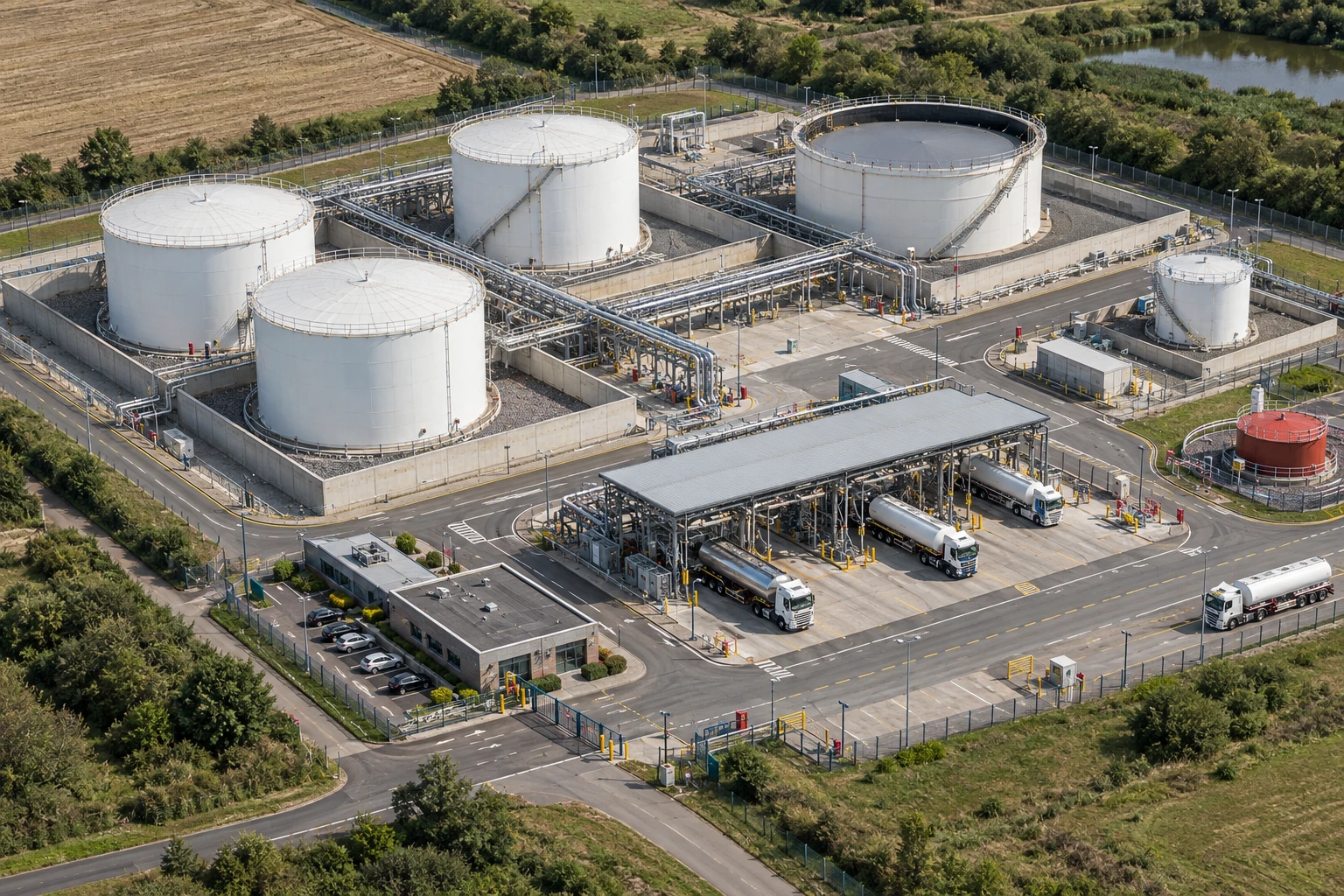

Production pressure overrides a degraded barrier
All related inspection points 1 across 1 location
Crown Fuels terminal 1 inspection point
Practice in the SHAREhub environment. Browser practice is separate from workplace competence and formal learning records.
What is process safety leadership?
It is leadership that keeps attention on low-frequency, high-consequence hazards even when day-to-day performance looks good.
Best-practice guide: Process Safety Leadership and Visible Commitment

What is process safety leadership?
The harm path from leadership is visible when an overdue proof test is accepted to protect the schedule, a trip cannot be relied on, and a foreseeable overfill or loss of containment exposes people to fire, blast or harmful release. A leader does not operate the valve, but controls resources, priority and the restart threshold. Visible process-safety leadership is demonstrated when leaders make and fund decisions that preserve major-accident barriers, especially under pressure to produce.
Turn process safety leadership and visible commitment knowledge into a decision
Visible process-safety leadership is demonstrated when leaders make and fund decisions that preserve major-accident barriers, especially under pressure to produce. A visit, slogan or low injury rate is not evidence that containment, relief, shutdown and emergency arrangements are healthy. Barrier standard, impairment decision, funding/reprioritisation record, test result, operational handback and board review of recurrence.
Operational example: decisions and evidence
Pause the affected transfer while the competent team verifies the trip and safe alternative; communicate the reason to crews and customers without blame. Restore and proof-test the barrier, close the impairment, update the delivery plan and examine why the test became overdue.
Where does process safety leadership fail?
Leadership fails when major accident risk is invisible, bad news is filtered or production pressure quietly outranks barriers.
Choose controls for process safety leadership and visible commitment
Change the work: Eliminate, Reduce including substitution, Isolate, Control, personal protective equipment (PPE) and Discipline (ERICPD) is a prompt for decisions. Strengthen prevention: HSE’s five-level hierarchy prioritises elimination, substitution, engineering controls, administrative controls and PPE. Verify the barriers: They are related frameworks, not identical laws; apply them to the actual task and check the resulting control. Sustain the controls: Eliminate major-accident exposure where a design or business decision can remove a hazardous inventory or operation. Review the decision: Leaders should test a proposal against the actual scenario, not treat behavioural reminders as an engineering alternative. Read the full control table for qualifications, ownership and verification. Use the actual task and applicable jurisdiction; existing technical approval remains unchanged.
Use the full process safety leadership and visible commitment lesson
Use the full topic for the decision points, practical examples, detailed control tables and source scope. HSE guidance applies to Great Britain; use HSENI for the Northern Ireland route and the source’s stated jurisdiction. A simplified guide does not change the page’s technical-review or approval status.

Read all six steps as text
1. What is process safety leadership?
The harm path from leadership is visible when an overdue proof test is accepted to protect the schedule, a trip cannot be relied on, and a foreseeable overfill or loss of containment exposes people to fire, blast or harmful release.
- Avoid / redesign: Eliminate, Reduce including substitution, Isolate, Control, personal protective equipment (PPE) and Discipline (ERICPD) is a prompt for decisions.
- Control the task: They are related frameworks, not identical laws; apply them to the actual task and check the resulting control.
- Verify before release: Eliminate, Reduce including substitution, Isolate, Control, personal protective equipment (PPE) and Discipline (ERICPD) is a prompt for decisions.
The harm path from leadership is visible when an overdue proof test is accepted to protect the schedule, a trip cannot be relied on, and a foreseeable overfill or loss of containment exposes people to fire, blast or harmful release. A leader does not operate the valve, but controls resources, priority and the restart threshold. Visible process-safety leadership is demonstrated when leaders make and fund decisions that preserve major-accident barriers, especially under pressure to produce.
Apply it: Which part of this plan would you check at the workface before authorising the task?
2. Turn process safety leadership and visible commitment knowledge into a decision
Use the evidence to improve the actual work arrangement.
- Change at source: Eliminate, Reduce including substitution, Isolate, Control, personal protective equipment (PPE) and Discipline (ERICPD) is a prompt for decisions.
- Make it observable: Eliminate, Reduce including substitution, Isolate, Control, personal protective equipment (PPE) and Discipline (ERICPD) is a prompt for decisions.
- Keep useful evidence: Barrier standard, impairment decision, funding/reprioritisation record, test result, operational handback and board review of recurrence.
Visible process-safety leadership is demonstrated when leaders make and fund decisions that preserve major-accident barriers, especially under pressure to produce. A visit, slogan or low injury rate is not evidence that containment, relief, shutdown and emergency arrangements are healthy. Barrier standard, impairment decision, funding/reprioritisation record, test result, operational handback and board review of recurrence.
Apply it: What evidence would show that the change improves this task, rather than only completing a record?
3. Operational example: decisions and evidence
Example: a practical application of the existing topic lesson.
- Setting: A terminal’s independent overfill trip has an overdue proof test during a high-volume delivery period.
- Act: Confirm the overfill scenario, trip performance standard, last valid test, compensating measures and contractual schedule pressure.
- Hold / review: No transfer under the normal envelope while independent protection remains unproved or a temporary measure lacks competent approval.
Pause the affected transfer while the competent team verifies the trip and safe alternative; communicate the reason to crews and customers without blame. Restore and proof-test the barrier, close the impairment, update the delivery plan and examine why the test became overdue.
Apply it: At which point would you hold this example, and what evidence would allow it to proceed?
4. Where does process safety leadership fail?
Connect the task, the route to the person and the control that can fail.
- Source / exposure: Leadership fails when major accident risk is invisible, bad news is filtered or production pressure quietly outranks barriers.
- Possible consequence: It appears when actions stay overdue, operators stop reporting nuisance alarms, shutdowns are delayed, maintenance is deferred, MOC quality drops, contractor concerns are ignored or leaders ask only about injury rates.
- Control failure: Strong leadership uses those signals as prompts to look deeper, not as irritations to manage away.
Leadership fails when major accident risk is invisible, bad news is filtered or production pressure quietly outranks barriers.
Apply it: Who could be exposed, including other trades, cleaners, maintainers and people nearby?
5. Choose controls for process safety leadership and visible commitment
Start with the stronger practicable options and verify their effect.
- Change the work: Eliminate, Reduce including substitution, Isolate, Control, personal protective equipment (PPE) and Discipline (ERICPD) is a prompt for decisions.
- Strengthen prevention: HSE’s five-level hierarchy prioritises elimination, substitution, engineering controls, administrative controls and PPE.
- Verify the barriers: They are related frameworks, not identical laws; apply them to the actual task and check the resulting control.
- Sustain the controls: Eliminate major-accident exposure where a design or business decision can remove a hazardous inventory or operation.
- Review the decision: Leaders should test a proposal against the actual scenario, not treat behavioural reminders as an engineering alternative.
Change the work: Eliminate, Reduce including substitution, Isolate, Control, personal protective equipment (PPE) and Discipline (ERICPD) is a prompt for decisions. Strengthen prevention: HSE’s five-level hierarchy prioritises elimination, substitution, engineering controls, administrative controls and PPE. Verify the barriers: They are related frameworks, not identical laws; apply them to the actual task and check the resulting control. Sustain the controls: Eliminate major-accident exposure where a design or business decision can remove a hazardous inventory or operation. Review the decision: Leaders should test a proposal against the actual scenario, not treat behavioural reminders as an engineering alternative. Read the full control table for qualifications, ownership and verification. Use the actual task and applicable jurisdiction; existing technical approval remains unchanged.
Apply it: Which stronger option can be used here, and who will verify it before accepting the remaining risk?
6. Use the full process safety leadership and visible commitment lesson
Follow the official sources below and retain the task-specific evidence.
- Official guidance: HSE leadership for the major hazard industries INDG277
- Official guidance: HSE essential principles of good leadership
- Task decision: Barrier standard, impairment decision, funding/reprioritisation record, test result, operational handback and board review of recurrence.
Use the full topic for the decision points, practical examples, detailed control tables and source scope. HSE guidance applies to Great Britain; use HSENI for the Northern Ireland route and the source’s stated jurisdiction. A simplified guide does not change the page’s technical-review or approval status.
Apply it: Which official source and full-topic section will you use to resolve the next decision?
Process safety leadership is tested when there is pressure: production delay, maintenance backlog, shutdown cost, contractor conflict, staffing shortage, overdue inspection, alarm problem or open MOC action. Visible commitment means leaders make decisions that protect barriers, not just speeches that say safety matters.
The strongest leaders do not rely on injury statistics to tell them whether a process plant is safe. They ask about loss-of-containment scenarios, safety-critical equipment, relief systems, alarm health, bypasses, start-up readiness, emergency drills and whether people feel able to report bad news.
| Leadership behaviour | What it means | Evidence |
|---|---|---|
| Scenario awareness | Leaders know credible major accident scenarios. | Risk profile, bowties and safety report briefings. |
| Barrier focus | Questions target prevention, detection, control and mitigation barriers. | Barrier dashboard and field verification. |
| Resource decisions | Maintenance, competence and engineering actions receive resources. | Budget decisions and action close-out. |
| Bad-news response | Weak signals are welcomed and acted on. | Near-miss and escalation records. |
| Visible field engagement | Leaders ask useful questions at the plant, not generic tour questions. | Leadership visit notes and actions. |
| Accountability | Open actions, impairments and risk acceptances have owners. | Governance minutes and escalation. |
A leader’s first test is whether they can name the high-consequence scenarios and the few controls whose failure could let them happen. The next test is what happens when one control is impaired: who knows, who can stop, who supplies resources, and who verifies return to service. Listening to a worker matters only if the signal changes a decision. The evidence is a trace from board priority to funded work, operational hold and field-verified closure.
Source: HSE leadership for the major hazard industries INDG277
Source: HSE essential principles of good leadership
The harm path from leadership is visible when an overdue proof test is accepted to protect the schedule, a trip cannot be relied on, and a foreseeable overfill or loss of containment exposes people to fire, blast or harmful release. A leader does not operate the valve, but controls resources, priority and the restart threshold. Stop the affected operation when a safety-critical barrier is unproved, and release it only with competent evidence that protection is restored. Source: HSE leadership for the major hazard industries INDG277
How can the hierarchy of controls guide leadership action on major accident prevention?
Eliminate, Reduce including substitution, Isolate, Control, personal protective equipment (PPE) and Discipline (ERICPD) is a prompt for decisions. HSE’s five-level hierarchy prioritises elimination, substitution, engineering controls, administrative controls and PPE. They are related frameworks, not identical laws; apply them to the actual task and check the resulting control.
Eliminate major-accident exposure where a design or business decision can remove a hazardous inventory or operation. Leaders should test a proposal against the actual scenario, not treat behavioural reminders as an engineering alternative.
Substitute or reduce inventory, pressure, temperature or material where technically possible. The decision needs competent process review and resources to prove the changed basis; a cheaper substitute without hazard analysis can move the risk.
Isolate and engineer through containment, shutdown, detection, relief and physical separation. Leaders need a clear performance standard, impairment threshold, maintenance plan and funded repair. A missing safety-critical test is a hold decision, not a dashboard colour.
Control, PPE and Discipline: procedures, supervision, drills, indicators and management review sustain engineered barriers. PPE is residual task protection, not a major-accident strategy. ERICPD provides a planning prompt while HSE’s five-level hierarchy orders risk controls; the leadership duty is to resource the stronger feasible control and verify it.
Source: HSE hierarchy of controls
Source: HSE leadership for the major hazard industries INDG277
How can the ERICPD hierarchy of controls guide leadership action on major accident prevention?

| ERICPD control level | Topic-specific example | Source and full task context |
|---|---|---|
| Eliminate | Fund and implement a feasible redesign that removes the hazardous scenario. | Read the full task example, checks and stop points on this page. HSE hierarchy of controls · HSE leadership for the major hazard industries INDG277 |
| Reduce | Assess genuine lower-hazard material/process replacement; minimising severity alone is reduction. | Read the full task example, checks and stop points on this page. HSE hierarchy of controls · HSE leadership for the major hazard industries INDG277 |
| Isolate | Provide demonstrated containment, shutdown, detection, relief and physical separation. | Read the full task example, checks and stop points on this page. HSE hierarchy of controls · HSE leadership for the major hazard industries INDG277 |
| Control | Govern procedures, competence, drills, impairments, review and follow-through with named authorities. | Read the full task example, checks and stop points on this page. HSE hierarchy of controls · HSE leadership for the major hazard industries INDG277 |
| PPE | Provide suitable residual task equipment; executive attention or paperwork is not PPE. | Read the full task example, checks and stop points on this page. HSE hierarchy of controls · HSE leadership for the major hazard industries INDG277 |
| Discipline | Check field evidence and recurring causes; funding approval cannot substitute for technical acceptance and operations handback. | Read the full task example, checks and stop points on this page. HSE hierarchy of controls · HSE leadership for the major hazard industries INDG277 |
How can the ISO 45001 hierarchy of controls guide leadership action on major accident prevention?

| ESEAP control level | Topic-specific example | Source and full task context |
|---|---|---|
| Elimination | Fund and implement a feasible redesign that removes the hazardous scenario. | Read the full task example, checks and stop points on this page. HSE hierarchy of controls · HSE leadership for the major hazard industries INDG277 |
| Substitution | Assess genuine lower-hazard material/process replacement; minimising severity alone is reduction. | Read the full task example, checks and stop points on this page. HSE hierarchy of controls · HSE leadership for the major hazard industries INDG277 |
| Engineering controls | Provide demonstrated containment, shutdown, detection, relief and physical separation. | Read the full task example, checks and stop points on this page. HSE hierarchy of controls · HSE leadership for the major hazard industries INDG277 |
| Administrative controls | Govern procedures, competence, drills, impairments, review and follow-through with named authorities. | Read the full task example, checks and stop points on this page. HSE hierarchy of controls · HSE leadership for the major hazard industries INDG277 |
| PPE | Provide suitable residual task equipment; executive attention or paperwork is not PPE. | Read the full task example, checks and stop points on this page. HSE hierarchy of controls · HSE leadership for the major hazard industries INDG277 |
What is visible commitment and what is leadership theatre?
Visible commitment is proven by useful questions, difficult decisions, resources and verified improvement; theatre looks active but does not strengthen barriers.
A leader walking the site and asking 'is everyone being safe?' may mean well, but the question is too broad. In process safety, stronger questions are: which safety-critical controls are impaired today, which alarms are standing, what MOC actions are overdue, what maintenance has been deferred, what weak signals are repeating, and what would stop this job?
Visible commitment also includes what leaders do after the visit. If workers raise a concern and nothing changes, visibility becomes theatre. If leaders close the loop, allocate resources and remove blockers, trust and control improve.
| Leadership activity | Visible commitment | Leadership theatre |
|---|---|---|
| Site visit preparation | Review top major accident scenarios, overdue MOC actions, impaired barriers, weak signals and previous commitments before visiting. | Arrive with a generic checklist and treat the visit mainly as visibility. |
| Questions asked | Ask about relief valves, bypasses, alarm health, safe limits, proof tests, permit conflicts and what would stop the job. | Ask mainly whether everyone is wearing PPE and whether there have been any injuries. |
| Worker voice | Let operators, technicians and contractors explain work as done, including awkward truths and informal workarounds. | Hear only filtered messages from the management chain. |
| Resource decisions | Release budget, people, engineering support or shutdown time when barrier health needs it. | Praise the team for low injury rates while deferring safety-critical maintenance. |
| MOC and temporary risk | Challenge overdue MOC actions, temporary repairs and risk acceptances until authority, expiry and controls are clear. | Accept broad reassurance that the site has it under control. |
| Weak signals | Treat small leaks, nuisance alarms, repeated defects and near misses as possible process safety information. | Treat weak signals as noise unless actual harm has occurred. |
| Verification | Return to check whether field conditions changed and whether actions are effective. | Close actions from a meeting update without checking the plant. |
| Learning | Use themes to update governance, objectives, competence and assurance. | Treat each issue as isolated and move on. |
How does leadership change a barrier decision?
A worked example shows leadership under production pressure, where visible commitment means choosing barrier health over convenience.
Crownway Fuels Ltd has an overdue proof test on an independent high-high level trip for a fuel storage tank. The site is under delivery pressure and a shutdown window has already moved twice. The dashboard still shows low personal injury numbers, so a weak leadership response would be to defer the test again and accept verbal reassurance that operators will monitor levels closely.
A strong process safety leader asks what scenario the trip protects, what other barriers are available, whether manual monitoring is independent and reliable, who is authorised to accept temporary risk, what customers or production plans need adjusting, and when the proof test will be completed. The decision is visible because it changes priorities, not because the leader gave a talk.
| Decision point | Weak leadership response | Strong leadership response |
|---|---|---|
| Overdue proof test | Defer because operations are busy. | Ask what major accident barrier is degraded and escalate. |
| Production pressure | Treat delivery schedule as fixed. | Review production plan against barrier impairment. |
| Temporary controls | Rely on operator vigilance. | Define independent temporary controls and risk acceptance. |
| Risk ownership | Let local team carry informal risk. | Named senior owner approves or stops operation. |
| Action close-out | Accept email saying test will be done. | Verify proof test result and update dashboard. |
| Learning | Treat as one overdue task. | Review backlog, planning and resource causes. |
Operational example: decisions and evidence
Task material and setting: A terminal’s independent overfill trip has an overdue proof test during a high-volume delivery period.
People and prerequisites: Shift lead owns transfer; instrument specialist tests the trip; process-safety lead judges barrier impairment; executive sponsor controls resources and release authority.
Before: Confirm the overfill scenario, trip performance standard, last valid test, compensating measures and contractual schedule pressure.
During: Pause the affected transfer while the competent team verifies the trip and safe alternative; communicate the reason to crews and customers without blame.
Hold or stop: No transfer under the normal envelope while independent protection remains unproved or a temporary measure lacks competent approval.
Completion and hand back: Restore and proof-test the barrier, close the impairment, update the delivery plan and examine why the test became overdue.
Evidence: Barrier standard, impairment decision, funding/reprioritisation record, test result, operational handback and board review of recurrence.
Source: HSE leadership for the major hazard industries INDG277
Source: HSE essential principles of good leadership
Three different decisions: the executive sponsor approves resources and escalation; the competent technical authority accepts test/repair or a tested engineered equivalent; operations controls handback and restart. No sponsor may overrule unresolved performance-standard failure or a statutory restriction by signing risk acceptance. Illustrative record: independent overfill trip, affected tank-transfer scenario, hazardous transfer held, repair/proof-test reference required, next-shift/expiry review and immediate stop on changed conditions. Crownway is a teaching case, not a documented HSE incident.
Where does process safety leadership fail?
Leadership fails when major accident risk is invisible, bad news is filtered or production pressure quietly outranks barriers.
Weak leadership rarely announces itself. It appears when actions stay overdue, operators stop reporting nuisance alarms, shutdowns are delayed, maintenance is deferred, MOC quality drops, contractor concerns are ignored or leaders ask only about injury rates. These are cultural and governance signals.
Strong leadership uses those signals as prompts to look deeper, not as irritations to manage away.
| Failure mode | How it develops | What competent management does |
|---|---|---|
| Injury-rate fixation | Leaders equate low lost-time injury rate with process safety health. | Review process safety indicators and high-potential events. |
| Field visits are superficial | Tours focus on PPE and housekeeping only. | Use scenario and barrier-focused questions. |
| Bad news filtered | Managers sanitise weak signals before board review. | Create direct worker voice and independent assurance. |
| Deferred maintenance normalised | Backlog grows under production pressure. | Risk-rank, resource and escalate safety-critical backlog. |
| Action closure weak | Actions closed administratively. | Require evidence and effectiveness checks. |
| Contractors excluded | Leadership ignores contractor interface risk. | Include contractor work in assurance and engagement. |
| Risk acceptance informal | Temporary operation continues without authority. | Define decision rights and time-bound controls. |
What evidence shows leadership commitment is real?
Evidence should show leaders are making decisions, allocating resources and verifying improvement against major accident risks.
Leadership evidence is not the number of posters or speeches. It is the trail of decisions that show process safety risk was understood and acted on. Minutes should show meaningful questions, resource decisions, escalation of red issues, challenge of overdue actions and learning from weak signals.
Field evidence should match board language. If leaders say bypass control is critical, the bypass register, operator interviews and field checks should prove that message has reached work as done.
| Evidence item | What good looks like | Weakness to challenge |
|---|---|---|
| Board minutes | Top scenarios, degraded barriers and resource decisions are discussed. | Minutes focus only on injury statistics. |
| Leadership field notes | Questions and actions target barriers and weak signals. | Generic safety tour comments. |
| Action tracker | High-risk actions have owners, dates and verified close-out. | Repeated extensions without challenge. |
| Resource decisions | Budget and staffing decisions protect safety-critical work. | Critical maintenance deferred without governance. |
| Worker feedback | People report bad news without fear. | Weak signals hidden or filtered. |
| Assurance reports | Independent findings reach leaders unedited. | Findings softened before review. |
| Risk acceptances | Temporary operations have clear authority and time limits. | Informal acceptance by local teams. |
What should leaders ask in management review?
Leadership assurance should test the health of barriers, weak signals and decisions rather than count activity alone.
A useful review meeting starts with the major accident scenarios. Leaders should ask which barriers are degraded, what has changed, what has been deferred, what weak signals are repeating and whether actions are effective. This creates a direct line from hazard to control to evidence.
The review should also test whether the leadership system itself is working: are decisions timely, are resources adequate, are technical authorities listened to, and does the workforce trust the escalation process?
| Question | Why it matters | Evidence requested |
|---|---|---|
| What are our top major accident scenarios? | Keeps high-consequence risk visible. | Risk profile and bowties. |
| Which safety-critical barriers are degraded? | Shows live control weakness. | Barrier dashboard and impairment log. |
| What actions are overdue and why? | Tests accountability and resources. | Action tracker and owner review. |
| What weak signals are increasing? | Finds drift before events. | Near-miss, alarm, leak and defect trends. |
| Where has production pressure challenged safety? | Reveals goal conflict. | Risk acceptances and stop-work examples. |
| How do we know learning changed the field? | Avoids paper-only improvement. | Verification records and worker interviews. |
What do learners commonly misunderstand?
The common mistake is describing leadership as attitude instead of decision-making under risk pressure.
A strong answer should show how leaders influence resources, priorities, information flow, action closure, culture and assurance. It should include examples where leaders ask barrier questions and make decisions that protect major accident controls.
A weak answer says leaders should 'be committed' without explaining what that changes in the management system.
| Learner question | Strong answer should include | Weak answer to avoid |
|---|---|---|
| What is visible commitment? | Field engagement, barrier questions, resources and verified action. | Leaders should be seen on site. |
| Why are injury rates insufficient? | They do not measure low-frequency major accident barrier health. | Low injury rates prove safety. |
| How should leaders respond to weak signals? | Welcome, escalate, resource and verify actions. | Tell teams to be more careful. |
| What is a strong board question? | Which barriers are degraded and what risk is accepted? | How many audits were done? |
| How does leadership affect culture? | Reactions to bad news teach people what is really valued. | Culture is posters and slogans. |
Which legal duties and guidance are relevant?
Process safety topics sit across general health and safety law, major accident control, equipment safety, dangerous substances and management-system duties.
| Duty or guidance | What it requires | How to apply it |
|---|---|---|
| Health and Safety at Work etc. Act 1974 | Requires employers to protect workers and others so far as reasonably practicable. | GB leaders resource and oversee controls that protect workers and others, including high-consequence hazards. |
| Management of Health and Safety at Work Regulations 1999 | Requires risk assessment, preventive arrangements, competence, cooperation and review. | GB leaders ensure assessment, competent arrangements and review lead to funded corrective decisions. |
| COMAH Regulations 2015 | In-scope lower-tier sites need a major accident prevention policy (MAPP) and safety-management arrangements; upper-tier sites also need a safety report. | For in-scope GB sites, leaders own lower-tier MAPP and safety-management arrangements; upper-tier sites also maintain a safety report. Review major-accident barrier impairment and closure. |
| DSEAR 2002 | Requires dangerous substances and explosive atmosphere risks to be eliminated or controlled. | GB leaders ensure dangerous-substance fire/explosion controls are funded, checked and restored when impaired. |
| PUWER 1998 | Requires work equipment to be suitable, maintained and used safely. | GB leaders resource maintenance and inspection of safety-critical work equipment and act on defects. |
| Pressure Systems Safety Regulations 2000 | Requires pressure systems and protective devices to be managed safely. | Where GB pressure systems are in scope, leaders maintain examination, protective-device and safe-limit arrangements and act on overdue tests. |
| Health and Safety at Work (Northern Ireland) Order 1978 | Apply the general health, safety and welfare duty to this work setting. | NI leaders resource and oversee protection of workers and others under the general duty. |
| Management of Health and Safety at Work Regulations (Northern Ireland) 2000 | Assess work risks and maintain preventive arrangements appropriate to the actual task. | NI leaders ensure assessment, preventive arrangements, competence and review produce action. |
| Control of Major Accident Hazards Regulations (Northern Ireland) 2015 | In-scope lower-tier sites need a major accident prevention policy (MAPP) and safety-management arrangements; upper-tier sites also need a safety report. | For in-scope NI sites, leaders own lower-tier MAPP/safety-management duties; upper-tier sites additionally prepare a safety report. Require evidence of barrier closure. |
Apply GB general duties and COMAH where the establishment is in scope; NI has separate general and COMAH instruments. HSE leadership publications describe management practice, not extra statutes. The operative test is whether leaders resource and verify controls for the actual major-accident hazard.
How should the control be managed and reviewed?
For a GB workplace, HSE guidance supports identifying the actual risk, taking practical protective steps and reviewing whether they work. Name the decision owner, check the control during the real task and correct a failed arrangement. Apply the separate Northern Ireland duties and guidance where the work is in NI.
GB management guidance: HSE managing health and safety
What training and competence are needed?
Leadership development should teach major accident scenarios, barrier thinking, weak signals and assurance-quality questions.
Training should be role-based. General awareness creates a baseline, but supervisors, managers, advisers and senior leaders need different levels of decision-making, verification and escalation competence.
| Role | What to demonstrate | Who checks | Record and reassessment |
|---|---|---|---|
| Operators and supervisors | Escalate a degraded barrier and exercise stop authority. | Process-safety lead observes a simulated impairment. | Response and handback record. |
| Technical authorities | Explain performance standard and credible failure. | Independent peer challenges a barrier case. | Calculation and assurance sign-off. |
| Site leaders | Make a resource and stop decision under production pressure. | Executive sponsor reviews a real or simulated case. | Decision rationale and field closure. |
| Board and auditors | Trace priority, funding, indicators and unresolved impairment. | Independent assurance samples recent high-consequence decisions. | Minutes, action closure and trend review. |
Source context: HSE leadership for the major hazard industries INDG277
How could Crownway Fuels Ltd manage this in practice?

Crownway would make leadership visible through scenario review, field questions, barrier dashboards, weak-signal escalation and verified action closure.
In a fuel business, leaders must understand storage, transfer, overfill, vapour cloud, fire, explosion and environmental scenarios. Crownway would train leaders to ask process safety questions during site visits and management reviews.
| Management element | How the business would manage it | Evidence to review |
|---|---|---|
| Brief | Leaders understand top scenarios and barriers. | Leadership risk briefing. |
| Visit | Field engagements focus on alarms, permits, isolations and weak signals. | Visit action log. |
| Decide | Resource maintenance, competence and engineering controls. | Decision record. |
| Escalate | Review degraded barriers and overdue actions. | Barrier dashboard. |
| Verify | Check action effectiveness at the point of work. | Field verification. |
Source context: HSE leadership for the major hazard industries INDG277
What do the acronyms and key terms mean?
Acronyms should be understood before they are used in assessments, briefings, audits or learning answers.
Acronyms can exclude newer readers if they are not explained. This section keeps the main terms available at the end of the page so the article stays readable while still supporting learners and audit users.
| Acronym | Meaning | Plain-English use |
|---|---|---|
| COMAH | Control of Major Accident Hazards | Major-accident regime with separate GB and Northern Ireland regulations; check the site threshold. |
| PSM | Process Safety Management | Management of major accident hazard controls. |
| MOC | Management of Change | Controlled review before changes are made. |
| SCE | Safety Critical Element | A system, structure or component whose failure could contribute to a major accident. |
| KPI | Key Performance Indicator | A measure used to track performance. |
Unlock another resource
You have used this month’s two free downloads. Publish a post in your own words to unlock one more resource, or choose SHARE Individual for 10 downloads per month.
You decide whether to share. If you do, use the relevant platform disclosure tools and do not make claims you do not genuinely hold.