SHARE Knowledge Hub
Health and Safety Leadership and Influence
Health and safety leadership and influence is the way leaders shape risk control through priorities, resources, communication, trust, decision-making and what they tolerate under pressure. Strong leaders make safe work practical: they listen to workers, fund controls, challenge weak signals, support stop-work decisions, learn fairly from incidents and make sure health risks receive the same attention as acute injuries. Leadership is not just a senior title; supervisors, advisers, technical authorities and worker representatives all influence whether rules become real controls at the point of work.
Understanding Health and Safety Leadership and Influence
Health and safety leadership is the direction, decisions and accountability through which owners, directors, managers and supervisors make risk control possible.
Why this matters at work
A leader should know whether a concern can travel from a worker to someone with authority before harm occurs. Test the route by tracing actual examples: when a cleaner reported chemical irritation, was exposure reviewed; when a driver reported a near miss, was the yard redesigned; when a mechanic reported a lift defect, was use stopped? Record owners, feedback and reasons for decisions. Protect identity where needed, but do not promise absolute secrecy. A rise in reporting can indicate better trust or more hazard, so review context instead of rewarding a lower count.
Assign a responsible lead for each significant risk and barrier, but avoid a structure in which the safety department 'owns' all hazards while operations controls plant and budget. Name who can stop work, who authorises repair, who accepts residual risk and who verifies restart. Board members should ask about serious deficiencies, overdue actions, health as well as injury, worker concerns and contractor interfaces. A paper policy and a green dashboard are insufficient if the organisation lacks independent challenge or failed equipment continues operating.
How organisations manage this in practice
Workers are sources of practical risk intelligence and have consultation rights through applicable legislation. HSE's leadership principles emphasise effective upward communication, not only instructions sent down. Consult employees or representatives in good time on matters affecting their health and safety; involve those doing the work in risk assessment, procedure design and change. A briefing after a purchase or layout decision is not the same as consultation. Provide access for part-time, agency, contractor and night-shift workers where their risks are affected, while respecting the relevant legal route and employer boundaries.
A leadership statement is credible only if the organisation provides people, time, equipment, maintenance, supervision, welfare and competent advice needed to achieve it. HSE's leadership Do stage calls for adequately resourced arrangements, risk assessment, competent advice and worker involvement. A manager may have a sound procedure but be unable to release staff for training or take a machine down for repair; the resource decision then undermines the control. Assess capability before adopting a new process, expanding output or reducing staffing.
Use consequence-sensitive metrics. In a garage, a failed extraction test may deserve urgent attention even if no asthma case is recorded. In a petrochemical plant, an impaired safety-critical alarm or overdue test should not be diluted in an average safe-act score. In a warehouse, pedestrian conflicts during peak dispatch matter more than a tidy day-shift inspection. Define denominators, time period, site, task and data quality. Protect health and identifiable survey information. Avoid targets that reward silence or cosmetic closure of actions.
Where does this fit in Plan, Do, Check, Act?
Leadership sits at the centre because decisions about priorities, resources, accountability and response to concerns affect every stage. Involve workers in those decisions and demonstrate the same standards in everyday management behaviour.
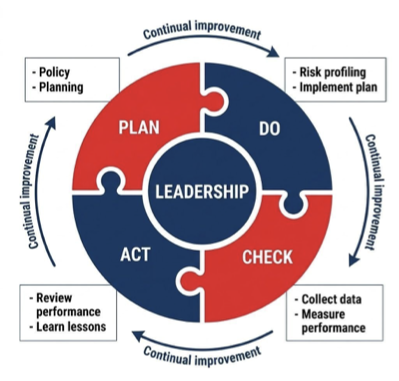

ISO 45001:2018 + Amd 1:2024
Plan: risks, obligations and objectives
Understand the activities and people affected, identify hazards, assess risks and opportunities, establish applicable requirements and set owned OH&S objectives. Risk profiling informs planning as well as implementation.
Evidence to connect: Activity review; risk and legal registers; worker input; objectives, owners, resources and measures of success.
Connected work
Do: put the arrangements into practice
Provide competent people, usable current information and suitable resources. Operate the agreed controls and manage procurement, contractors, change and emergencies with worker involvement.
Evidence to connect: Current policies and procedures; competence evidence; maintenance and operational records; contractor, change and emergency arrangements.
Connected work
Check: test performance and control effectiveness
Evaluate reliable monitoring and measurement, relevant compliance evidence, internal audits and management review. Routine checks and independent audit serve different purposes; low accident numbers alone cannot show that controls work.
Evidence to connect: First-line checks; exposure and control-performance information; compliance evaluations; audit samples and management-review decisions.
Connected work
Act: improve and verify the change
Respond to incidents, nonconformities and ineffective controls. Protect people, address the causes, assign action and verify effectiveness, then update affected risks, arrangements and competence requirements.
Evidence to connect: Corrective actions with owners and dates; cause analysis; verified changes; revised documents and feedback into the next plan.
Connected work
Leadership connects every stage
Leaders own the effectiveness of the OH&S system, set priorities and provide resources. Context defines what the system must address; worker consultation and participation inform decisions throughout the cycle, not just at the centre.
Evidence to connect: An accurate system scope; policy commitments; clear authority and responsibilities; worker participation; resource and review decisions followed through.
Connected work
Read the picture as a learning aid, not an official ISO clause diagram. Its risk-profiling label sits under Do; ISO planning also addresses hazards, risks, opportunities and relevant obligations before work begins. Likewise, formal ISO management review is part of performance evaluation, with its decisions feeding subsequent improvement. Activities can span more than one stage.
The complete PDCA and management-system explanation ISO 45001 connection
In the SHAREhub environment: link the risk or objective, its current arrangement, monitoring evidence and any improvement action. Retain a responsible owner, relevant dates and evidence that the change worked; a link between records is not proof of effectiveness.
The cycle can organise a management system, but the diagram, a document library or a completed checklist does not establish conformity, certification or legal compliance. Use the authorised applicable standard and actual workplace evidence. Do not wait for the next audit or annual review to address an ineffective control.
What are the key points for health and safety leadership and influence?
Leadership is proven by decisions, resources, follow-through and how people respond when risk conflicts with pressure.
What are the key points for health and safety leadership and influence? — part 1 of 2


Read the complete visual as text
- Leadership is proven by decisions, resources, follow-through and how…: Leadership is proven by decisions, resources, follow-through and how people respond when risk conflicts with pressure.
- Leadership makes risk visible: Good leaders ask which controls are weak, which actions are overdue and what help is needed.
- Influence is wider than authority: Advisers, supervisors and respected workers can influence decisions even when they do not hold the budget.
What are the key points for health and safety leadership and influence? — part 2 of 2


Read the complete visual as text
- Trust is built through action: Workers report more when leaders act fairly and close the feedback loop.
- Resources are leadership evidence: A leader who wants safe work must fund maintenance, competence, staffing, equipment and time.
- Pressure reveals priorities: Culture is exposed when programme, cost, production or client pressure competes with control of risk.
Best-practice guide: Health and Safety Leadership and Influence
What are the key points for health and safety leadership and influence?
Leadership is proven by decisions, resources, follow-through and how people respond when risk conflicts with pressure. Health and safety leadership and influence is the way leaders shape risk control through priorities, resources, communication, trust, decision-making and what they tolerate under pressure.
Turn health and safety leadership and influence knowledge into a decision
Health and safety leadership and influence is the way leaders shape risk control through priorities, resources, communication, trust, decision-making and what they tolerate under pressure. Strong leaders make safe work practical: they listen to workers, fund controls, challenge weak signals, support stop-work decisions, learn fairly from incidents and make sure health risks receive the same attention as acute injuries. Leadership risk dashboard and barrier review pack.
the process operator worked example
Assessing: Review major accident scenarios, maintenance backlog, barrier health, worker concerns, contractor performance and audit findings. Evidence / response: Leadership risk dashboard and barrier review pack. Analysing: Separate urgent control failures from strategic weaknesses such as ageing assets, weak supervision or competence gaps. Evidence / response: Risk-ranked action list and board decision paper.
Leadership warning signs
Actions stay overdue: Known risks become normalised. Only injury rates are reviewed: Health risks and major hazards are missed. Workers do not report concerns: Weak signals disappear.
Choose controls for health and safety leadership and influence
Eliminate HSE five-level hierarchy: Test whether production can avoid the on-site bulk transfer using a sealed supplied module or redesigned inventory. Reduce: A less-flammable product would not meet this motor-fuel specification, so no material substitution is credited. Isolate HSE five-level hierarchy: Separate tank-transfer equipment from public routes, ignition sources and vulnerable drains. Control: Install independently tested high-level shutdown with suitable sensor, logic and final element for the actual tank. Control: Use positive line-up and pre-transfer hold only after engineered safeguards are available. Read the full control table for qualifications, ownership and verification. Use the actual task and applicable jurisdiction; existing technical approval remains unchanged.
Use the full health and safety leadership and influence lesson
Use the full topic for the decision points, practical examples, detailed control tables and source scope. HSE guidance applies to Great Britain; use HSENI for the Northern Ireland route and the source’s stated jurisdiction. A simplified guide does not change the page’s technical-review or approval status.

Read all six steps as text
1. What are the key points for health and safety leadership and influence?
Leadership is proven by decisions, resources, follow-through and how people respond when risk conflicts with pressure.
- Avoid / redesign: Test whether production can avoid the on-site bulk transfer using a sealed supplied module or redesigned inventory.
- Control the task: Separate tank-transfer equipment from public routes, ignition sources and vulnerable drains.
- Verify before release: Unproved supply or new hazard holds redesign.
Leadership is proven by decisions, resources, follow-through and how people respond when risk conflicts with pressure. Health and safety leadership and influence is the way leaders shape risk control through priorities, resources, communication, trust, decision-making and what they tolerate under pressure.
Apply it: Which part of this plan would you check at the workface before authorising the task?
2. Turn health and safety leadership and influence knowledge into a decision
Use the evidence to improve the actual work arrangement.
- Change at source: Test whether production can avoid the on-site bulk transfer using a sealed supplied module or redesigned inventory.
- Make it observable: Unproved supply or new hazard holds redesign.
- Keep useful evidence: Leadership risk dashboard and barrier review pack.
Health and safety leadership and influence is the way leaders shape risk control through priorities, resources, communication, trust, decision-making and what they tolerate under pressure. Strong leaders make safe work practical: they listen to workers, fund controls, challenge weak signals, support stop-work decisions, learn fairly from incidents and make sure health risks receive the same attention as acute injuries. Leadership risk dashboard and barrier review pack.
Apply it: What evidence would show that the change improves this task, rather than only completing a record?
3. the process operator worked example
Example: a practical application of the existing topic lesson.
- Assessing: Review major accident scenarios, maintenance backlog, barrier health, worker concerns, contractor performance and audit findings.
- Analysing: Separate urgent control failures from strategic weaknesses such as ageing assets, weak supervision or competence gaps.
- Implementing: Fund safety-critical maintenance, strengthen permit leadership, improve contractor mobilisation and set stop-work expectations.
Assessing: Review major accident scenarios, maintenance backlog, barrier health, worker concerns, contractor performance and audit findings. Evidence / response: Leadership risk dashboard and barrier review pack. Analysing: Separate urgent control failures from strategic weaknesses such as ageing assets, weak supervision or competence gaps. Evidence / response: Risk-ranked action list and board decision paper.
Apply it: At which point would you hold this example, and what evidence would allow it to proceed?
4. Leadership warning signs
Connect the task, the route to the person and the control that can fail.
- Actions stay overdue: Known risks become normalised.
- Only injury rates are reviewed: Health risks and major hazards are missed.
- Workers do not report concerns: Weak signals disappear.
Actions stay overdue: Known risks become normalised. Only injury rates are reviewed: Health risks and major hazards are missed. Workers do not report concerns: Weak signals disappear.
Apply it: Who could be exposed, including other trades, cleaners, maintainers and people nearby?
5. Choose controls for health and safety leadership and influence
Start with the stronger practicable options and verify their effect.
- Eliminate HSE five-level hierarchy: Test whether production can avoid the on-site bulk transfer using a sealed supplied module or redesigned inventory.
- Reduce: A less-flammable product would not meet this motor-fuel specification, so no material substitution is credited.
- Isolate HSE five-level hierarchy: Separate tank-transfer equipment from public routes, ignition sources and vulnerable drains.
- Control: Install independently tested high-level shutdown with suitable sensor, logic and final element for the actual tank.
- Control: Use positive line-up and pre-transfer hold only after engineered safeguards are available.
Eliminate HSE five-level hierarchy: Test whether production can avoid the on-site bulk transfer using a sealed supplied module or redesigned inventory. Reduce: A less-flammable product would not meet this motor-fuel specification, so no material substitution is credited. Isolate HSE five-level hierarchy: Separate tank-transfer equipment from public routes, ignition sources and vulnerable drains. Control: Install independently tested high-level shutdown with suitable sensor, logic and final element for the actual tank. Control: Use positive line-up and pre-transfer hold only after engineered safeguards are available. Read the full control table for qualifications, ownership and verification. Use the actual task and applicable jurisdiction; existing technical approval remains unchanged.
Apply it: Which stronger option can be used here, and who will verify it before accepting the remaining risk?
6. Use the full health and safety leadership and influence lesson
Follow the official sources below and retain the task-specific evidence.
- Official guidance: HSE leadership principles
- Official guidance: INDG417 Leading health and safety at work
- Task decision: Leadership risk dashboard and barrier review pack.
Use the full topic for the decision points, practical examples, detailed control tables and source scope. HSE guidance applies to Great Britain; use HSENI for the Northern Ireland route and the source’s stated jurisdiction. A simplified guide does not change the page’s technical-review or approval status.
Apply it: Which official source and full-topic section will you use to resolve the next decision?
Leadership makes risk visible
Good leaders ask which controls are weak, which actions are overdue and what help is needed.
Influence is wider than authority
Advisers, supervisors and respected workers can influence decisions even when they do not hold the budget.
Trust is built through action
Workers report more when leaders act fairly and close the feedback loop.
Resources are leadership evidence
A leader who wants safe work must fund maintenance, competence, staffing, equipment and time.
Pressure reveals priorities
Culture is exposed when programme, cost, production or client pressure competes with control of risk.
What does health and safety leadership and influence mean?
It means using authority, credibility and professional influence to make risk control real in daily decisions.
Leadership is not only about giving speeches or approving a policy. It is the set of repeated behaviours that tell people what matters. If leaders ask only about output, people learn output matters most. If leaders ask about barrier health, worker concerns, overdue actions and health risks, people learn risk control matters too.
Influence matters because many people who affect health and safety do not sit at the top of the hierarchy. A supervisor can influence how a team handles shortcuts. A safety adviser can influence investment by presenting evidence clearly. A worker representative can influence control design by explaining how the work is actually done.
| Leadership question | Strong answer | Weak answer |
|---|---|---|
| What gets attention? | Significant risks, weak signals, worker concerns and control health. | Only injury numbers and good-news dashboards. HSE leadership principles |
| What gets funded? | Controls, maintenance, competence and monitoring for the highest risks. | Low-cost campaigns while known defects remain. HSE leadership principles |
| What happens after bad news? | Leaders listen, learn, act and feed back. | Reporter is challenged or the issue is minimised. HSE leadership principles |
| Who is heard? | Workers, supervisors, technical specialists, contractors and representatives. | Only senior voices or convenient views. HSE leadership principles |
| How are trade-offs made? | Risk consequences are visible before cost or time decisions are accepted. | Safety is discussed after decisions are already made. HSE leadership principles |
A leader’s decision about a failed high-level switch is more revealing than a safety speech. HSE leadership principles
How do leadership styles affect health and safety?
How to read the leadership comparison
The styles table is a SHARE explanatory comparison. HSE’s cited essential principles support active leadership, involvement and review; they do not prescribe this list of styles or guarantee a particular result. Use the comparison as a prompt to examine the decision, resources and observed response.
Leadership styles affect whether people comply only when watched, engage because they believe, or adapt safely to changing conditions.
Transactional leadership uses standards, targets, supervision and accountability. It can be useful for basic compliance, but it can become narrow if leaders only chase checklist completion or low injury numbers.
Transformational leadership creates commitment by connecting people to purpose, trust and improvement. Situational leadership changes approach according to risk, competence, urgency and maturity. A new worker on a high-risk task may need clear direction; a competent team redesigning a process may need involvement and coaching.
| Style | Useful when | Risk if overused | Good leadership behaviour |
|---|---|---|---|
| Transactional | Clear standards, routine checks and accountability are needed. | People comply only for the metric or when watched. | Use standards with field verification and fair feedback. HSE leadership principles |
| Transformational | Culture, trust and improvement need commitment. | Inspiring language replaces hard control decisions. | Connect vision to resources, action and evidence. HSE leadership principles |
| Situational | People, tasks and risk levels vary. | Leaders are inconsistent without explaining why. | Match supervision style to risk, competence and change. HSE leadership principles |
| Coaching | Teams need learning, confidence and problem solving. | Urgent risk is over-discussed instead of stopped. | Coach after immediate control is secured. HSE leadership principles |
| Directive | Immediate danger or strict critical control is involved. | People stop speaking up if directive style is constant. | Use firmly for stop-work and life-critical standards. HSE leadership principles |
Adapt how a leader listens and decides, but never trade away a required critical safeguard for output. HSE leadership principles
What does visible felt leadership look like?
Visible felt leadership means workers see leaders engaging with real work and believe that concerns will lead to action.
A leadership tour is valuable only if it reaches beyond a staged walkaround. Leaders should ask people what can hurt them, what makes safe work difficult, which controls are unreliable and what has not been fixed. The response matters more than the visit.
Credibility is damaged when leaders ask for openness but fail to close actions. It is strengthened when leaders return to explain what changed, why something cannot be done yet and what interim control is in place.
| Behaviour | What it shows | Evidence |
|---|---|---|
| Asks about critical controls | Leader understands risk, not just compliance. | Tour notes linked to risk register. HSE leadership principles |
| Listens without blame | People can report weak signals. | Worker feedback and concern closure. HSE leadership principles |
| Checks action closure | Follow-through matters. | Verified action tracker. HSE leadership principles |
| Stops work when needed | Safety priority survives pressure. | Stop-work record and learning note. HSE leadership principles |
| Returns with feedback | Consultation is real. | You said/we did communication. HSE leadership principles |
A useful visit asks to see a live safeguard, its test evidence and the worker’s stop point. INDG417 Leading health and safety at work
How can people influence health and safety without direct authority?
Influence without authority relies on evidence, relationships, credibility, timing and ethical escalation.
Health and safety professionals often need to influence people who control budget, programme and operations. A strong adviser does not simply say 'the law requires it'. They explain the risk pathway, who could be harmed, what evidence exists, what options are available, what the consequences are and what decision is needed.
Influence also requires courage. Where a serious risk is being normalised, the professional should escalate clearly, keep records, separate fact from opinion and avoid overclaiming beyond their competence.
| Influence route | How it works | Example |
|---|---|---|
| Evidence | Use observations, trend data, legal duties and incident learning. | Show repeated permit handback failures and the risk created. HSE leadership principles |
| Framing | Translate technical risk into business, legal and human consequences. | Explain how a delayed repair could become an exposure or prosecution. HSE leadership principles |
| Relationships | Build trust before conflict arises. | Work with supervisors on practical controls, not only audit criticism. HSE leadership principles |
| Timing | Influence before decisions become fixed. | Join procurement or design reviews early. HSE leadership principles |
| Escalation | Raise serious unresolved risk to the right level. | Record unresolved life-safety concerns and escalate to senior leadership. HSE leadership principles |
Use accurate hazard and cost evidence to secure physical control and maintenance resources. HSE leadership principles
How should leaders behave when safety conflicts with pressure?
Leaders should make risk visible, pause unsafe work and decide with evidence when cost, time or production pressure increases.
The situations below are common points where leadership intent is tested. Each example shows how a weak decision can normalise drift, and how a stronger decision keeps the risk visible, owned and controlled.
| Pressure situation | Poor leadership response | Better leadership response |
|---|---|---|
| Project is behind programme | Push teams to work faster and accept shortcuts. | Replan sequence, check critical controls and communicate the decision. HSE leadership principles |
| Maintenance backlog is growing | Defer repairs without risk ranking. | Risk-rank backlog and protect safety-critical tasks. HSE leadership principles |
| Client wants rapid start | Mobilise contractors before competence and RAMS are checked. | Hold mobilisation until minimum controls are verified. HSE leadership principles |
| Production target is at risk | Bypass alarm or inspection because the plant normally behaves. | Stop or hold the affected transfer. Restore and verify the alarm or inspection before restart; any temporary equivalent control requires competent design, documented change control and lawful release. HSE large-tank high-level-switch safety alert |
| Budget is tight | Cut training, supervision or monitoring first. | Protect controls linked to significant risk and record trade-offs. HSE leadership principles |
Hold the affected transfer when a relied-on overfill alarm, trip or required inspection is bypassed or overdue; seek competent restoration and verified release. HSE large-tank high-level-switch safety alert HSE Buncefield learning
What leadership decisions show whether the culture is real?
Leadership is tested when the safer decision costs time, money, output or social comfort.
Leadership decision scenarios


Read the complete visual as text
- Production pressure: Leadership decision that builds trust: Pause the task, check whether critical controls remain effective and explain any delay to the client or production team. Evidence to retain: Risk review, revised plan, permit hold point and leadership note.
- Deferred maintenance: Leadership decision that builds trust: Risk-rank the backlog and protect safety-critical inspections, alarms, relief devices, guards, isolation points and emergency systems. Evidence to retain: Backlog review, temporary control record and management review decision.
- Worker stops a job: Leadership decision that builds trust: Thank the worker, make the area safe, verify the concern and feed back what changed without blame. Evidence to retain: Stop-work log, supervisor review, action closure and worker feedback.
- Contractor raises a concern: Leadership decision that builds trust: Treat it as useful intelligence, review the interface risk and do not pressure the contractor to continue outside agreed controls. Evidence to retain: Contractor concern record, bridging document update and mobilisation review.
A leadership page becomes useful when it moves from values into choices. People judge leaders by what happens when a job is late, production is under pressure, a contractor challenges a permit, or a worker stops work because conditions do not match the plan.
Good leaders make the risk conversation explicit. They ask what could go wrong, which controls are critical, what evidence is missing, who has authority to decide, and what temporary arrangements are needed while the permanent fix is completed.
| Scenario | Leadership decision that builds trust | Evidence to retain |
|---|---|---|
| Production pressure | Pause the task, check whether critical controls remain effective and explain any delay to the client or production team. | Risk review, revised plan, permit hold point and leadership note. HSE leadership principles |
| Deferred maintenance | Risk-rank the backlog and protect safety-critical inspections, alarms, relief devices, guards, isolation points and emergency systems. | Backlog review, temporary control record and management review decision. HSE large-tank high-level-switch safety alert |
| Worker stops a job | Thank the worker, make the area safe, verify the concern and feed back what changed without blame. | Stop-work log, supervisor review, action closure and worker feedback. HSE leadership principles |
| Contractor raises a concern | Treat it as useful intelligence, review the interface risk and do not pressure the contractor to continue outside agreed controls. | Contractor concern record, bridging document update and mobilisation review. HSE leadership principles |
The named decision owner should test whether a critical control works before authorising restart. INDG417 Leading health and safety at work HSE large-tank high-level-switch safety alert
How should leaders link resources to risk decisions?
Resource decisions should be based on risk profile, legal duty, control criticality and evidence of drift.
A leadership team that approves a risk register but does not resource the actions has not controlled the risk. Resource decisions include people, time, competent advice, maintenance, equipment, monitoring, training and supervision.
The strongest resource decisions are transparent. They show why a control is needed, what risk it reduces, what alternatives were considered, what will happen if it is delayed and how interim control will be assured.
| Decision area | Evidence leaders should review | Good output |
|---|---|---|
| Maintenance | Backlog, defect severity and safety-critical equipment status. | Risk-ranked plan and escalation route. HSG254 Developing process safety indicators |
| Competence | Training matrix, field observations and incident themes. | Role-based competence plan. HSG254 Developing process safety indicators |
| Health risk | Exposure data, health surveillance trends and COSHH findings. | Funded control and monitoring plan. HSG254 Developing process safety indicators |
| Contractors | Prequalification, audit findings and performance data. | Stronger contractor rules and mobilisation gates. HSG254 Developing process safety indicators |
| Emergency readiness | Drill learning, equipment status and staffing. | Action plan with owners and test dates. HSG254 Developing process safety indicators |
Fund independent overfill protection and prompt defect repair before rewarding lagging injury figures. INDG417 Leading health and safety at work HSG254 Developing process safety indicators
How do communication and trust affect leadership?
Communication builds trust when leaders are honest, specific, timely and willing to act on what they hear.
Good communication is not broadcasting instructions. It is a loop: leaders explain intent, workers explain reality, concerns are recorded, decisions are made and feedback returns to the people affected.
Trust is lost when leaders ask for reports but respond with silence, blame or token action. Trust grows when leaders make uncertainty visible and explain why some actions are immediate while others need planning.
| Communication point | What good looks like | Warning sign |
|---|---|---|
| Purpose | People understand why the message matters. | Generic campaign slogan. HSE leadership principles |
| Specificity | Clear task, risk, control and action. | Vague instruction to be careful. HSE leadership principles |
| Listening | Workers can challenge and ask questions. | One-way briefing. HSE leadership principles |
| Feedback | People see what changed. | Concerns disappear into a system. HSE leadership principles |
| Consistency | Messages match decisions. | Leaders say safety first but reward shortcuts. HSE leadership principles |
Make it safe to report bad news and show when a concern changed the transfer method. HSE organisational culture
How should leaders use worker voice?
Worker voice should be used to improve decisions, control design and trust, not simply to tick a consultation box.
Worker voice only adds value when it reaches people who can act. The routes below show different ways leaders can capture practical knowledge from the workforce and convert concerns into visible decisions and feedback.
| Worker voice route | Leadership value | Evidence |
|---|---|---|
| Safety representatives | Structured challenge and worker insight. | Meeting minutes and action feedback. HSE consulting and involving workers |
| Toolbox discussions | Task-specific weak signals and practical ideas. | Action notes linked to supervisor checks. HSE consulting and involving workers |
| Stop-work reports | Early warning that conditions are outside assumptions. | Stop-work log and learning review. HSE consulting and involving workers |
| Near-miss reporting | Weak signals before harm. | Report quality and trend review. HSE consulting and involving workers |
| Focus groups | Deeper insight into trust, pressure and culture. | Themes, actions and feedback. HSE consulting and involving workers |
Operators and maintainers can identify a bypass or weak test procedure before leaders see a dashboard. HSE consulting and involving workers HSENI trade-union representatives and consultation
What does leadership look like in high-risk workplaces?
High-risk leadership focuses on critical controls, barrier health, abnormal conditions and the risk of low-frequency high-consequence events.
In process safety, construction, transport, utilities and healthcare settings, leaders can be misled by low injury rates. A site can look tidy and still have weak isolation, ageing equipment, poor emergency readiness, unmanaged fatigue or defective fire controls.
Leaders should therefore ask about significant hazard scenarios, critical controls and assurance evidence. The question is not only 'did anyone get hurt?' but 'what could have gone badly wrong today and what proved the control was healthy?'
| Prompt | Why it matters | Example evidence |
|---|---|---|
| Which critical controls are degraded? | Prevents false confidence. | Barrier dashboard and overdue tests. HSE Buncefield learning |
| Which assumptions changed? | Change can invalidate controls. | MOC register and risk review. HSE Buncefield learning |
| What are workers worried about? | Weak signals may sit with frontline teams. | Concern log and action feedback. HSE Buncefield learning |
| What would make us stop? | Defines decision points before pressure rises. | Stop-work criteria and permit hold points. HSE Buncefield learning |
| What did we learn from near misses? | Turns events into prevention. | Investigation action verification. HSE Buncefield learning |
Low personal-injury counts cannot prove major-accident barriers; review overfill demands, bypasses and test failures. HSE Buncefield learning HSG254 Developing process safety indicators
What evidence shows leadership is working?
Leadership evidence should show decisions, resources, worker involvement, action closure and control improvement.
Evidence should be read as a chain rather than a filing exercise. A single record rarely proves good management on its own; stronger assurance comes from matching records, observations, interviews, trends and verified action closure.
| Evidence | What it can evidence | What to challenge |
|---|---|---|
| Board or senior review minutes | Risk is discussed at decision level. | Are decisions and resources recorded? HSE leadership principles |
| Action close-out | Leaders follow through. | Does closure prove field change? HSE leadership principles |
| Worker concern feedback | Voice leads to action. | Do people receive feedback? HSE leadership principles |
| Risk-based resource plan | Resources match significant risk. | Are health risks and chronic exposures included? HSE leadership principles |
| Leadership tours | Leaders engage with real work. | Are tours evidence-led or staged? HSE leadership principles |
| Audit and monitoring themes | Leaders respond to weak signals. | Are repeat themes escalated? HSE leadership principles |
Compare board decisions with field-tested barrier health and the closure of overdue safety-critical actions. HSG65 Managing for health and safety HSG254 Developing process safety indicators
How can the hierarchy of controls guide leadership decisions towards stronger risk controls?
ERICPD is used here as a planning mnemonic. The linked HSE five-level hierarchy is the official source for the order and relative reliability of controls; the two labels are not identical.
A manager or observer can enable and verify a control, but the hierarchy applies to the real vehicle, dust or overfill hazard.
How do ERICPD and the five-level hierarchy test the physical control? — part 1 of 2


Read the complete visual as text
- ERICPD is used here as a planning mnemonic. The…: ERICPD is used here as a planning mnemonic. The linked HSE five-level hierarchy is the official source for the order and relative reliability of controls; the two labels are not identical.
- A manager or observer can enable and verify a…: A manager or observer can enable and verify a control, but the hierarchy applies to the real vehicle, dust or overfill hazard.
How do ERICPD and the five-level hierarchy test the physical control? — part 2 of 2


Read the complete visual as text
- At a bulk-fuel terminal, a tank high-level switch is…: At a bulk-fuel terminal, a tank high-level switch is bypassed before unloading. Overfill can release fuel and form a flammable vapour cloud; ignition can cause fire or explosion with serious injury or death. Leadership is shown by holding the transfer, funding a reliable design and requiring a verified restart; a signed acceptance form does not protect the tank. HSE Buncefield learning HSE large-tank high-level-switch safety alert
- ERICPD is a six-stage planning aid; HSE’s five levels…: ERICPD is a six-stage planning aid; HSE’s five levels separate substitution, engineering, administration and residual PPE. Isolate usually maps to engineered separation; ERICPD Control can be physical or administrative. Discipline sustains a control through supervision, maintenance and learning and cannot replace it. HSE five-level hierarchy HSE five-level hierarchy
At a bulk-fuel terminal, a tank high-level switch is bypassed before unloading. Overfill can release fuel and form a flammable vapour cloud; ignition can cause fire or explosion with serious injury or death. Leadership is shown by holding the transfer, funding a reliable design and requiring a verified restart; a signed acceptance form does not protect the tank. HSE Buncefield learning HSE large-tank high-level-switch safety alert
ERICPD is a six-stage planning aid; HSE’s five levels separate substitution, engineering, administration and residual PPE. Isolate usually maps to engineered separation; ERICPD Control can be physical or administrative. Discipline sustains a control through supervision, maintenance and learning and cannot replace it. HSE five-level hierarchy HSE five-level hierarchy
How can the ERICPD hierarchy of controls guide leadership decisions towards stronger risk controls?

| ERICPD stage | HSE / IOSH level | Task intervention and harm-chain break | Owner and effectiveness evidence | Failure or stop point |
|---|---|---|---|---|
| Eliminate HSE five-level hierarchy | Elimination HSE five-level hierarchy | Test whether production can avoid the on-site bulk transfer using a sealed supplied module or redesigned inventory. HSE Buncefield learning | Process owner checks capacity, delivery and displaced risks. | Unproved supply or new hazard holds redesign. |
| Reduce / substitute HSE five-level hierarchy | Substitution considered HSE five-level hierarchy | A less-flammable product would not meet this motor-fuel specification, so no material substitution is credited. Reduce inventory and transfer frequency as separate design measures. HSE Buncefield learning | Technical owner documents why substitution fails and tests reduced inventory. | Do not count a smaller inventory as substitution. |
| Isolate HSE five-level hierarchy | Engineering control HSE five-level hierarchy | Separate tank-transfer equipment from public routes, ignition sources and vulnerable drains. HSE Buncefield learning | Site manager verifies physical layout and containment. | Open drain or barrier breach holds transfer. |
| Control: physical HSE five-level hierarchy | Engineering control HSE five-level hierarchy | Install independently tested high-level shutdown with suitable sensor, logic and final element for the actual tank. HSE Buncefield learning | Competent engineer commissions and function-tests it; operator checks status. | Failed test, bypass or uncertain state stops transfer. |
| Control: method HSE five-level hierarchy | Administrative control HSE five-level hierarchy | Use positive line-up and pre-transfer hold only after engineered safeguards are available. HSE Buncefield learning | Supervisor witnesses start and records current drawing. | Wrong connection or overdue critical action holds start. |
| PPE HSE five-level hierarchy | PPE HSE five-level hierarchy | Use product-compatible splash protection for residual handling; it cannot prevent overfill or explosion. HSE Buncefield learning | Assessor checks compatibility, issue and condition. | Damaged PPE stops contact work, while barrier failure stops transfer. |
| Discipline HSE five-level hierarchy | Sustains controls HSE five-level hierarchy | Review alarm demands, bypasses, proof tests and delayed repairs at board level; fund corrective design. HSE Buncefield learning | Director checks HSG254 indicators and field closure. | Repeat demand or overdue safety-critical defect escalates and holds affected transfer. |
How can the ISO 45001 hierarchy of controls guide leadership decisions towards stronger risk controls?

| ESEAP control level | HSE / IOSH level | Task intervention and harm-chain break | Owner and effectiveness evidence | Failure or stop point |
|---|---|---|---|---|
| Elimination HSE five-level hierarchy | Elimination HSE five-level hierarchy | Test whether production can avoid the on-site bulk transfer using a sealed supplied module or redesigned inventory. HSE Buncefield learning | Process owner checks capacity, delivery and displaced risks. | Unproved supply or new hazard holds redesign. |
| Substitution HSE five-level hierarchy | Substitution considered HSE five-level hierarchy | A less-flammable product would not meet this motor-fuel specification, so no material substitution is credited. Reduce inventory and transfer frequency as separate design measures. HSE Buncefield learning | Technical owner documents why substitution fails and tests reduced inventory. | Do not count a smaller inventory as substitution. |
| Engineering controls HSE five-level hierarchy | Engineering control HSE five-level hierarchy | Separate tank-transfer equipment from public routes, ignition sources and vulnerable drains. HSE Buncefield learning | Site manager verifies physical layout and containment. | Open drain or barrier breach holds transfer. |
| Engineering controls HSE five-level hierarchy | Engineering control HSE five-level hierarchy | Install independently tested high-level shutdown with suitable sensor, logic and final element for the actual tank. HSE Buncefield learning | Competent engineer commissions and function-tests it; operator checks status. | Failed test, bypass or uncertain state stops transfer. |
| Administrative controls HSE five-level hierarchy | Administrative control HSE five-level hierarchy | Use positive line-up and pre-transfer hold only after engineered safeguards are available. HSE Buncefield learning | Supervisor witnesses start and records current drawing. | Wrong connection or overdue critical action holds start. |
| PPE HSE five-level hierarchy | PPE HSE five-level hierarchy | Use product-compatible splash protection for residual handling; it cannot prevent overfill or explosion. HSE Buncefield learning | Assessor checks compatibility, issue and condition. | Damaged PPE stops contact work, while barrier failure stops transfer. |
| Administrative controls HSE five-level hierarchy | Sustains controls HSE five-level hierarchy | Review alarm demands, bypasses, proof tests and delayed repairs at board level; fund corrective design. HSE Buncefield learning | Director checks HSG254 indicators and field closure. | Repeat demand or overdue safety-critical defect escalates and holds affected transfer. |
How should management verify controls for this task?
For fuel tank overfill protection during bulk transfer, the management check should start with a real control decision: Test whether production can avoid the on-site bulk transfer using a sealed supplied module or redesigned inventory. Name the person who will test it, keep evidence from the actual work, and reopen the assessment when the failure condition in the hierarchy table occurs. HSE management-system guidance.
A review should compare the planned control with what workers and supervisors can use in practice. Record the defect, owner, interim protection, verification and next review trigger so that a policy statement or certificate does not stand in for a working control.
Which duties apply in Great Britain and Northern Ireland?
Culture, behaviour and leadership support the applicable duties, but no statute requires a slogan or observation-card programme.
Use the instrument for the site’s jurisdiction and representative structure. Statutory reporting of specified dangerous occurrences is distinct from learning from ordinary near misses. Management of Health and Safety at Work Regulations 1999 Management of Health and Safety at Work Regulations (NI) 2000 HSE consulting and involving workers HSENI trade-union representatives and consultation
| Decision | Great Britain | Northern Ireland |
|---|---|---|
| General work duties | GB Health and Safety at Work etc. Act 1974: protect workers and affected others. Instrument | NI Health and Safety at Work Order 1978: separate NI general duty. Instrument |
| Assessment and management | GB Management Regulations 1999: suitable assessment and effective planning, control, monitoring and review. Instrument | NI Management Regulations 2000: separate NI assessment and arrangements route. Instrument |
| Recognised union safety representatives | GB Safety Representatives and Safety Committees Regulations 1977 apply where representatives are appointed by a recognised union. Instrument | NI Safety Representatives and Safety Committees Regulations 1979 provide the corresponding NI route. Instrument |
| Other employee consultation | GB Consultation with Employees Regulations 1996 apply where the 1977 representative route does not cover workers. Instrument | NI Consultation with Employees Regulations 1996 provide the corresponding NI route. Instrument |
| Specified reportable events | GB RIDDOR 2013 covers specified injuries, diseases and dangerous occurrences; ordinary near misses are for internal learning. Instrument | NI RIDDOR 1997 is the separate NI reporting instrument; ordinary near misses are not automatically reportable. Instrument |
How could Crownway Fuels Ltd act on control evidence?

Crownway Fuels Ltd would demonstrate leadership by acting on critical-control evidence, providing resources and supporting managers who hold an activity when its safeguards cannot be demonstrated.
Crownway Fuels Ltd · practical example
Choose a safe operating decision under delivery pressure
The key lesson Leadership is visible in decisions about risk, resources and competing priorities; a favourable injury rate cannot establish the condition of a major-accident safeguard.
The situation: A review finds that evidence for a tank's critical overfill protection is unresolved just before a planned delivery. The personal-injury dashboard is favourable, but it does not answer whether the protection needed for that receipt is available.
Why this matters: Delivery pressure creates a real test of the policy. Managers need to resolve the commercial consequences of a safety restriction so an operator is not left to choose between production and an uncertain critical control.
How Crownway Fuels Ltd would manage it
- Ask about the control — Operations Director. Ask which tank and activity are affected, what evidence is missing and what could happen if the protection fails. Take technical advice from the relevant competent people instead of accepting an overall green dashboard.
- Support the immediate decision — Site Manager. Hold the affected receipt while the required control condition cannot be demonstrated. Tell the Shift Supervisor and delivery planner what is restricted, who owns the decision and what evidence is needed to reconsider it.
- Provide the resources — Operations Director. Agree the people, access, time and funding needed to resolve the issue. Make the delivery and commercial consequences visible so pressure is dealt with by management rather than passed down to an operator.
- Verify in the field — Maintenance Coordinator. Arrange the appropriate technical work and verification. The authorised operating decision uses the resulting evidence and current restrictions; an invoice or a statement that the job is complete is insufficient on its own.
- Challenge the wider weakness — Managing Director. Review why assurance became overdue or unclear, whether other assets are affected and whether resources or reporting need to change. Ask the Health and Safety Lead to check that the agreed improvement works.
When the conditions change
- Recognise the trigger
- The required condition of the tank’s critical overfill safeguard cannot be demonstrated.
- Make the immediate decision
- The Site Manager holds the affected receipt and records the restriction; the Operations Director supports the decision and funds the necessary resolution.
- Verify the next step
- The appropriate authorised operating decision is based on competent verification of the required safeguards and the current operating conditions.
What good looks like
The delivery decision follows the condition of the safeguards, managers visibly back the restriction, and the board can trace its decision to resources, verification and learning.
Evidence to look for: Control exception, technical advice, operating restriction, resource decision, verification record and management review of the underlying weakness.
Common mistake to avoid: Accepting a low injury rate or a completed maintenance invoice as proof that the required protection will operate.
Apply this to your work: What would your senior team do if a critical control could not be demonstrated on a busy day?
Guidance behind the management approach: HSE: essential principles of good leadership. Use the topic's legal and technical guidance for the applicable work and location.
In this worked example, Crownway Fuels Ltd stores and transfers fuels. Leadership must not rely on low personal injury numbers; it needs visible assurance that tanks, alarms, permits, contractors, isolations, emergency systems and workforce concerns are being managed.
| Management element | How the business would manage it | Evidence to review |
|---|---|---|
| Assessing | Review major accident scenarios, maintenance backlog, barrier health, worker concerns, contractor performance and audit findings. | Leadership risk dashboard and barrier review pack. HSG254 Developing process safety indicators |
| Analysing | Separate urgent control failures from strategic weaknesses such as ageing assets, weak supervision or competence gaps. | Risk-ranked action list and board decision paper. HSE leadership principles |
| Implementing | Fund safety-critical maintenance, strengthen permit leadership, improve contractor mobilisation and set stop-work expectations. | Budget approval, revised standards and leadership briefings. HSE large-tank high-level-switch safety alert |
| Checking | Carry out visible felt leadership visits focused on live controls, not staged housekeeping. | Tour notes, action tracking and field verification. HSG254 Developing process safety indicators |
| Learning | Use Buncefield-style overfill and vapour cloud learning, local near misses and alarm trends to challenge false confidence. | Learning review and revised assurance questions. HSE Buncefield learning |
| Improving | Use repeat findings to adjust resources, competence, supervision and management review rather than launching another campaign. | Management review decisions and effectiveness checks. HSG65 Managing for health and safety |
How does this decision transfer across sectors?
Culture, observation and leadership must lead to the control required by the actual task and harm route.
The manager names the people exposed, physical failure, strongest practicable option and hold point before interpreting a survey or observation trend. HSE organisational culture HSE introduction to human factors
| Sector | Task, people and harm route | Strongest feasible decision and check | Hold point |
|---|---|---|---|
| Fuel logistics | Tank high-level switch is bypassed before unloading. | Director holds transfer, funds repair and sees a witnessed test. | No release from injury statistics or a signed form. HSE large-tank high-level-switch safety alert |
| Construction | Dust extraction fails during concrete chasing. | Manager resources repair or redesign and checks the live task. | Stop on uncontrolled dust. HSE chasing concrete and mortar |
| Leisure | Delivery vehicles and visitors share an entrance. | Leader funds physical separation and checks it at peak arrival. | Hold deliveries through an occupied conflict zone. HSE separating pedestrians and vehicles |
How can readers practise this decision?
Use health and safety leadership and influence as a workplace case: identify the real task, the person who owns the control decision and the evidence that shows the control is working. State what would make work pause and who would authorise a safe restart.
Then trace each legal or medical claim to a direct source in Official links, checking whether it applies in Great Britain, Northern Ireland or both. Explain any uncertainty and the specialist advice needed rather than filling the gap with an assumed rule.
These are SHARE practice prompts, not an accredited syllabus or marking rule. For management-system context, see HSE management-system guidance.
What must each role demonstrate before acting?
Awareness and attendance are starting points; practical decisions, assessor, record and reassessment trigger depend on the role.
Observe the actual or simulated decision, check who assessed it, and retain evidence of a hold or corrected control. Leadership and coaching cannot compensate for a missing engineering measure. HSE leadership principles INDG417 Leading health and safety at work HSE large-tank high-level-switch safety alert HSG254 Developing process safety indicators
| Role | Learning and practical demonstration | Assessor and evidence | Reassess when |
|---|---|---|---|
| Operator or maintainer | Recognise a bypass, hold transfer and state the escalation route. | Supervisor observes a scenario and records authorised scope. | Failed test, changed tank or procedure. HSE large-tank high-level-switch safety alert HSE leadership principles |
| Supervisor | Challenge start-up under output pressure and verify functioning overfill protection. | Manager samples recorded hold and restart evidence. | Alarm demand, bypass or overdue action. HSE large-tank high-level-switch safety alert HSE leadership principles |
| Engineer or technical authority | Assess high-level switch, interlock and any temporary equivalent measure within competence. | Independent specialist peer-checks design and test record. | New device, failure mode or manufacturer instruction. HSE large-tank high-level-switch safety alert HSE leadership principles |
| Site manager | Fund repair and prevent transfer until the critical control is demonstrably effective. | Director reviews resource decision and field verification. | Repeat defect or maintenance backlog. HSE large-tank high-level-switch safety alert HSE leadership principles |
| Director or safety adviser | Ask for barrier-health data and worker concerns, then test action closure in the field. | Board or independent reviewer records challenge and decision. | Major change, repeated demands or conflicting evidence. HSG254 Developing process safety indicators HSE leadership principles |
What warning signs show leadership is weak?
Warning signs appear when leaders talk about safety but their decisions reward silence, drift or unmanaged risk.
Warning signs are included because failure usually appears before a serious event. Treat these points as prompts for inspection, audit, supervision and management review rather than as simple compliance statements.
| Warning sign | How harm can develop | Action |
|---|---|---|
| Actions stay overdue | Known risks become normalised. | Escalate risk-ranked backlog. HSE leadership principles |
| Only injury rates are reviewed | Health risks and major hazards are missed. | Add leading indicators and barrier checks. HSE leadership principles |
| Workers do not report concerns | Weak signals disappear. | Improve trust and feedback. HSE leadership principles |
| Budgets cut controls first | Risk increases quietly. | Review resource decisions against risk profile. HSE leadership principles |
| Leadership visits are staged | Real work and pressure are hidden. | Use evidence-led field engagement. HSE leadership principles |
| Bad news is blamed | People hide mistakes. | Use fair learning and just culture. HSE leadership principles |
What do the acronyms and key terms mean?
Acronyms should be understood before they are used in assessments, briefings, audits or learning answers.
Acronyms can exclude newer readers if they are not explained. This section keeps the main terms available at the end of the page so the article stays readable while still supporting learners and audit users.
| Acronym | Meaning | Plain-English use |
|---|---|---|
| DN1 | NEBOSH National Diploma DN1 learning context; SHARE practice material | Diploma unit covering workplace health and safety management. |
| PDCA | Plan, Do, Check, Act | Continuous management cycle used by HSE and management systems. |
| KPI | Key Performance Indicator | Metric used to track control health or performance. |
| OH&S | Occupational Health and Safety | Term used in ISO 45001. |
| VFL | Visible Felt Leadership | Leadership that workers can see and believe because it is followed by action. |
| ERICPD | Eliminate, Reduce, Isolate, Control, PPE, Discipline | Six-stage control planning aid, not a statute. HSE five-level hierarchy |
| RIDDOR | Reporting of Injuries, Diseases and Dangerous Occurrences Regulations | Separate GB and NI instruments cover specified reportable events; ordinary near misses are internal learning.Reporting of Injuries, Diseases and Dangerous Occurrences Regulations 2013 |
Unlock another resource
You have used this month’s two free downloads. Publish a post in your own words to unlock one more resource, or choose SHARE Individual for 10 downloads per month.
You decide whether to share. If you do, use the relevant platform disclosure tools and do not make claims you do not genuinely hold.