
SHARE Knowledge Hub
Knife Safety
Knife safety means designing and using cutting work so an exposed edge or point cannot reach people during cutting, changing, cleaning, carrying or disposal. A slip, sudden breakthrough or hidden blade can cause cuts, punctures and serious bleeding; repeated forceful work can cause persistent upper-limb problems. Eliminate unnecessary cuts first, then use a tool matched to the task, stable support, a controlled blade path and safe handback.
Understanding Knife Safety
Knife safety means designing and using cutting work so an exposed edge or point cannot reach people during cutting, changing, cleaning, carrying or disposal. A slip, sudden breakthrough or hidden blade can cause cuts, punctures and serious bleeding; repeated forceful work can cause persistent upper-limb problems. Eliminate unnecessary cuts first, then use a tool matched to the task, stable support, a controlled blade path and safe handback.
Why this matters at work
Severity ranges from superficial cuts to tendon, nerve or arterial injury, puncture, amputation and fatal bleeding. A short blade can still cause severe harm, and a blunt or broken blade can penetrate. The assessment should examine credible anatomy in the line of fire: fingers bracing a package, forearm below a cut, thigh used as an improvised support, abdomen in a pull cut, foot beneath a dropped tool and colleagues nearby.
HSE identifies slipping during cutting or trimming as a common mechanism, often injuring the non-knife hand or fingers. Other mechanisms include sudden breakthrough, blade breakage, an exposed blade left on a surface, carrying in a pocket or hand, reaching into storage, sharpening, washing a hidden knife, changing a blade, dropping a knife, or waste handling after disposal.
How organisations manage this in practice
A retractable knife only controls risk when the mechanism suits the task and works as intended. Fully automatic retraction is generally less dependent on the user's thumb action. Spring-loaded designs require the user to release the actuator once the blade engages the material. Manual designs remain exposed until deliberately closed. Training must explain the actual mechanism rather than call all three 'self-retracting'.
Procurement and design change are key. Repeated cuts to open bags or cartons may be removed through supplier packaging. Flash trimming may be reduced through process maintenance. Pre-portioned food can remove some knife work. Ask suppliers for packaging and tool options, and involve workers in trials because they understand material variation and failure conditions.
People indirectly exposed include cleaners, maintenance workers, agency staff, delivery drivers, customers, waste contractors and young workers. Consider language, handedness, glove size, grip, experience and task change. A safe system that protects only the trained primary user is incomplete.
Compare samples with the approved specification before release. Small changes to spring force, blade depth, point geometry, handle texture or lock can change risk. Counterfeit or poorly controlled replacement blades may break, fit loosely or defeat retraction. Quarantine unverified substitutions and test through the change-control route.
How can I practise this topic in 3D?


Knife injury during raw meat trimming
All related inspection points 1 across 1 location
From flour to chilled despatch 1 inspection point
Practice in the SHAREhub environment. Browser practice is separate from workplace competence and formal learning records.
What makes knife work dangerous?
A knife injury occurs when an exposed edge or point reaches a person. Control the cut, the tool and its entire life cycle: the user, supporting hand, cleaner, colleague or waste handler may be injured at different stages.
Best-practice guide: Knife Safety
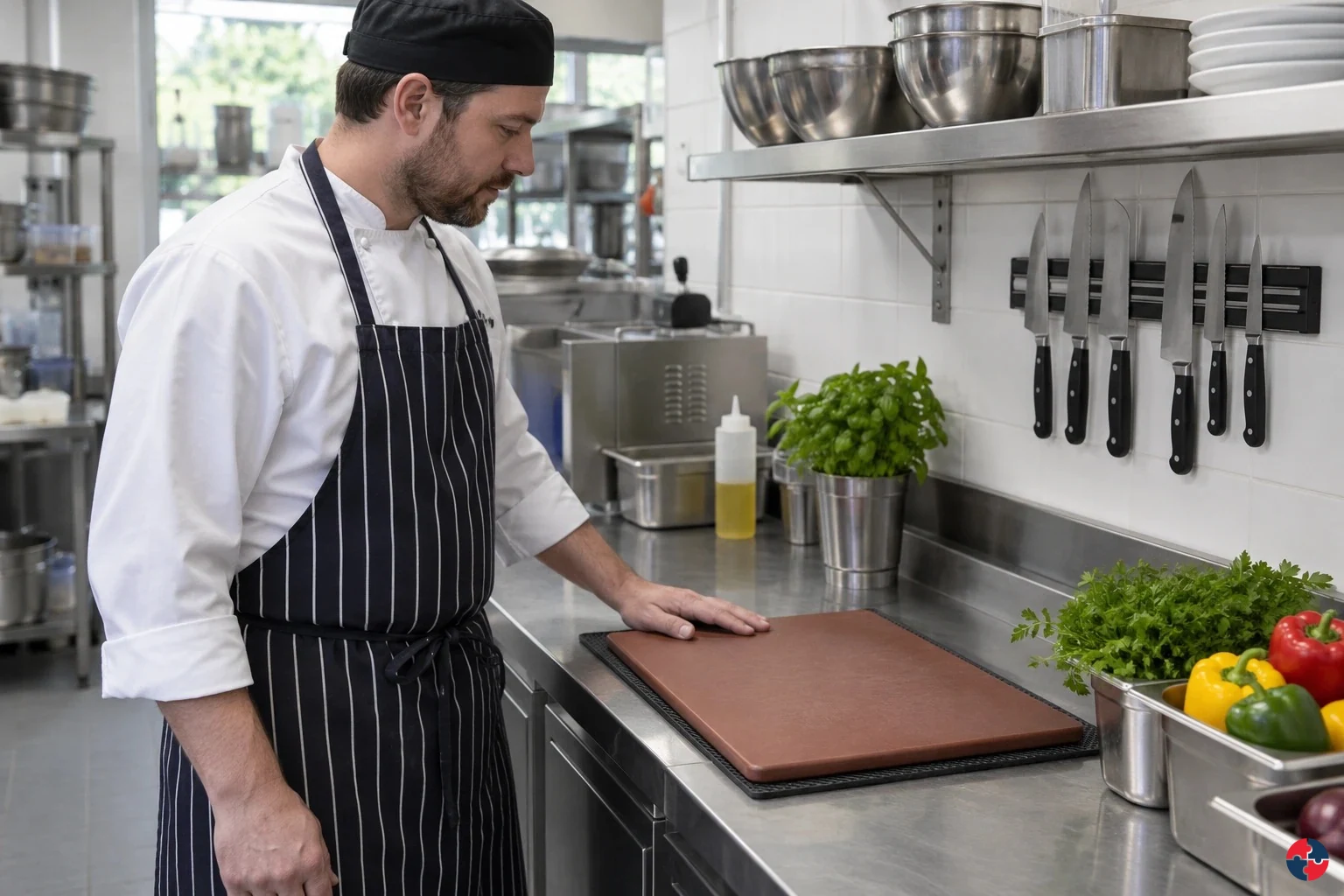
What makes knife work dangerous?
A knife injury occurs when an exposed edge or point reaches a person. Control the cut, the tool and its entire life cycle: the user, supporting hand, cleaner, colleague or waste handler may be injured at different stages. Knife safety means designing and using cutting work so an exposed edge or point cannot reach people during cutting, changing, cleaning, carrying or disposal.
Turn knife safety knowledge into a decision
Knife safety means designing and using cutting work so an exposed edge or point cannot reach people during cutting, changing, cleaning, carrying or disposal. A slip, sudden breakthrough or hidden blade can cause cuts, punctures and serious bleeding; repeated forceful work can cause persistent upper-limb problems. Keep the task and cutter approval, representative trial, practical competence record, defect and fragment action, observed correction, contractor interface agreement and waste handover where relevant.
the site team: opening and trimming fit-out materials
Open normal film with the approved concealed tool and use the assessed insulation method. Put each tool safe between tasks; clear offcuts without sweeping toward an edge. Count and secure issued tools, close or replace the blade container, inspect for loose blades and leave the bench safe for cleaners.
Knife task, harm route and early stop signs
Opening film or cartons: Slip or sudden breakthrough reaches supporting fingers: cut or deeper tendon, nerve or vessel injury. Boning or food preparation: Point or edge travels into non-knife hand, forearm or torso: puncture, severe cut or bleeding. Blade change, cleaning or disposal: Unshielded or hidden edge contacts cleaner, changer or waste handler: cut or puncture; contamination may complicate injury.
Choose controls for knife safety
Packaging cut: Ask the supplier for tear-open cartons or delivered-to-size material so no hand blade enters the repeated opening task. Packaging cut: For compatible film, trial a concealed-edge or fully automatic retracting cutter instead of an exposed utility blade. Packaging cut: Support or clamp the package; use a physical guide or guarded station to keep the free hand and passers-by outside the credible slip and breakthrough path. Packaging cut: Specify cut direction, one-tool-per-task selection, blade-change and rigid disposal method, and practical demonstration. Packaging cut: Trial a task-matched glove or forearm protector for residual cut or puncture exposure, checking fit, wet grip and any machine entanglement. Read the full control table for qualifications, ownership and verification. Use the actual task and applicable jurisdiction; existing technical approval remains unchanged.
Use the full knife safety lesson
Use the full topic for the decision points, practical examples, detailed control tables and source scope. HSE guidance applies to Great Britain; use HSENI for the Northern Ireland route and the source’s stated jurisdiction. A simplified guide does not change the page’s technical-review or approval status.

Read all six steps as text
1. What makes knife work dangerous?
A knife injury occurs when an exposed edge or point reaches a person.
- Avoid / redesign: Ask the supplier for tear-open cartons or delivered-to-size material so no hand blade enters the repeated opening task.
- Control the task: Support or clamp the package; use a physical guide or guarded station to keep the free hand and passers-by outside the credible slip and breakthrough path.
- Verify before release: Purchaser records the specification and samples deliveries.
A knife injury occurs when an exposed edge or point reaches a person. Control the cut, the tool and its entire life cycle: the user, supporting hand, cleaner, colleague or waste handler may be injured at different stages. Knife safety means designing and using cutting work so an exposed edge or point cannot reach people during cutting, changing, cleaning, carrying or disposal.
Apply it: Which part of this plan would you check at the workface before authorising the task?
2. Turn knife safety knowledge into a decision
Use the evidence to improve the actual work arrangement.
- Change at source: Ask the supplier for tear-open cartons or delivered-to-size material so no hand blade enters the repeated opening task.
- Make it observable: Purchaser records the specification and samples deliveries.
- Keep useful evidence: Keep the task and cutter approval, representative trial, practical competence record, defect and fragment action, observed correction, contractor interface agreement and waste handover where relevant.
Knife safety means designing and using cutting work so an exposed edge or point cannot reach people during cutting, changing, cleaning, carrying or disposal. A slip, sudden breakthrough or hidden blade can cause cuts, punctures and serious bleeding; repeated forceful work can cause persistent upper-limb problems. Keep the task and cutter approval, representative trial, practical competence record, defect and fragment action, observed correction, contractor interface agreement and waste handover where relevant.
Apply it: What evidence would show that the change improves this task, rather than only completing a record?
3. the site team: opening and trimming fit-out materials
Example: a practical application of the existing topic lesson.
- Setting: The contractor opens flooring packs and trims insulation at a lit, stable ground-level bench on a fit-out site.
- Act: Separate the tasks, mark a work zone and check light, bench, floor and material stability.
- Hold / review: A thick strap jams the concealed mouth, the insulation batch is harder than trialled, the retracting tool sticks, or a colleague enters the blade zone: stop and obtain the correct assessed tool or reset the area.
Open normal film with the approved concealed tool and use the assessed insulation method. Put each tool safe between tasks; clear offcuts without sweeping toward an edge. Count and secure issued tools, close or replace the blade container, inspect for loose blades and leave the bench safe for cleaners.
Apply it: At which point would you hold this example, and what evidence would allow it to proceed?
4. Knife task, harm route and early stop signs
Connect the task, the route to the person and the control that can fail.
- Opening film or cartons: Slip or sudden breakthrough reaches supporting fingers: cut or deeper tendon, nerve or vessel injury.
- Boning or food preparation: Point or edge travels into non-knife hand, forearm or torso: puncture, severe cut or bleeding.
- Blade change, cleaning or disposal: Unshielded or hidden edge contacts cleaner, changer or waste handler: cut or puncture; contamination may complicate injury.
Opening film or cartons: Slip or sudden breakthrough reaches supporting fingers: cut or deeper tendon, nerve or vessel injury. Boning or food preparation: Point or edge travels into non-knife hand, forearm or torso: puncture, severe cut or bleeding. Blade change, cleaning or disposal: Unshielded or hidden edge contacts cleaner, changer or waste handler: cut or puncture; contamination may complicate injury.
Apply it: Who could be exposed, including other trades, cleaners, maintainers and people nearby?
5. Choose controls for knife safety
Start with the stronger practicable options and verify their effect.
- Packaging cut: Ask the supplier for tear-open cartons or delivered-to-size material so no hand blade enters the repeated opening task.
- Packaging cut: For compatible film, trial a concealed-edge or fully automatic retracting cutter instead of an exposed utility blade.
- Packaging cut: Support or clamp the package; use a physical guide or guarded station to keep the free hand and passers-by outside the credible slip and breakthrough path.
- Packaging cut: Specify cut direction, one-tool-per-task selection, blade-change and rigid disposal method, and practical demonstration.
- Packaging cut: Trial a task-matched glove or forearm protector for residual cut or puncture exposure, checking fit, wet grip and any machine entanglement.
Packaging cut: Ask the supplier for tear-open cartons or delivered-to-size material so no hand blade enters the repeated opening task. Packaging cut: For compatible film, trial a concealed-edge or fully automatic retracting cutter instead of an exposed utility blade. Packaging cut: Support or clamp the package; use a physical guide or guarded station to keep the free hand and passers-by outside the credible slip and breakthrough path. Packaging cut: Specify cut direction, one-tool-per-task selection, blade-change and rigid disposal method, and practical demonstration. Packaging cut: Trial a task-matched glove or forearm protector for residual cut or puncture exposure, checking fit, wet grip and any machine entanglement. Read the full control table for qualifications, ownership and verification. Use the actual task and applicable jurisdiction; existing technical approval remains unchanged.
Apply it: Which stronger option can be used here, and who will verify it before accepting the remaining risk?
6. Use the full knife safety lesson
Follow the official sources below and retain the task-specific evidence.
- Official guidance: HSE PPIS12 How to reduce hand knife injuries
- Official guidance: HSE hand knives
- Task decision: Keep the task and cutter approval, representative trial, practical competence record, defect and fragment action, observed correction, contractor interface agreement and waste handover where relevant.
Use the full topic for the decision points, practical examples, detailed control tables and source scope. HSE guidance applies to Great Britain; use HSENI for the Northern Ireland route and the source’s stated jurisdiction. A simplified guide does not change the page’s technical-review or approval status.
Apply it: Which official source and full-topic section will you use to resolve the next decision?
A slip, sudden breakthrough, moving material or broken blade can drive the edge into fingers, a limb or torso. Hidden knives in a sink, drawer, packaging pile or bin create surprise contact. Deep cuts can injure tendons, nerves or blood vessels; a small blade can still cause severe bleeding. Rushing, poor light, wet grip and missing replacement tools make loss of control more likely. Sources: HSE PPIS12 How to reduce hand knife injuries, HSE hand knives.
The central question is why a hand knife is needed at all. If it remains necessary, the approved knife, material, support, direction, people, pace, condition, cleaning and disposal must work together. Machine blades, clinical sharps and violence incidents need their own specialist systems; a hand-knife procedure is not enough for them. Sources: HSE PPIS12 How to reduce hand knife injuries, HSE PUWER overview.
Who chooses, uses and checks a safe knife system?
The person cutting checks the actual tool and blade path; the supervisor stops an unsuitable method; purchasers and managers remove needless cuts and supply a proven tool and disposal route.
Before starting, the user checks the approved cutter, material support and clear hand position, then stops for injury or a missing blade. The supervisor observes real cuts, authorises blade change only for competent people and corrects jams, high force or rushed pace. The purchaser trials alternatives with users; a maintainer checks any guarded or powered equipment under its own system. A safety adviser challenges weak controls and samples incident and defect evidence. See the competence route and tool-selection decision. Sources: HSE hand-knife guidance, HSE work-equipment overview.
How can a cutting task cause immediate or lasting harm?
The harm source is the blade and the force applied to a material, together with repeated hand and arm effort. An edge can slip, break through, be exposed after a cut or remain hidden; it can cut or puncture skin and deeper tissue. Repeated forceful cutting may also cause persistent upper-limb disorders.
A short blade can cut tendons, nerves or blood vessels if the supporting hand or body is in its path. A point driven toward the torso can cause serious internal bleeding. A hidden edge may injure a cleaner or waste handler later. High repetition, force, awkward wrist posture, wet grip, poor support, a failed guard and rushed pace all change likelihood or severity. Sources: HSE PPIS12 How to reduce hand knife injuries, HSE safe use of knives in the kitchen, HSE occupational health risks in food manufacture.
| Task or exposure | Route and likely harm | Warning and stop or escalation |
|---|---|---|
| Opening film or cartons | Slip or sudden breakthrough reaches supporting fingers: cut or deeper tendon, nerve or vessel injury. | Material shifts, force rises, blade extends too far or hand enters path: stop and reset tool/support. Sources: HSE PPIS12 How to reduce hand knife injuries. |
| Boning or food preparation | Point or edge travels into non-knife hand, forearm or torso: puncture, severe cut or bleeding. | Wet grip, rolling food, damaged edge or changed product: hold and reassess the method; urgent first aid for serious injury. Sources: HSE safe use of knives in the kitchen. |
| Blade change, cleaning or disposal | Unshielded or hidden edge contacts cleaner, changer or waste handler: cut or puncture; contamination may complicate injury. | Blade fragment missing, knife hidden in sink or loose in waste: isolate area/product and account for edge. Sources: HSE hand knives. |
| High-rate repeated cutting | Forceful, repetitive hand and wrist work may cause persistent upper-limb pain or conditions; this is distinct from an acute cut. | Rising force, fatigue, pain, tingling or loss of grip: report, assess pace, tool and workstation before continuing unchanged. Sources: HSE occupational health risks in food manufacture. |
Treat the last row as a work-design and occupational-health issue; it does not make the worker a hazard. A machine blade has additional mechanical energy and needs a separate machinery assessment. Sources: HSE occupational health risks in food manufacture, HSE PUWER overview.
How should the task and cutter be chosen?
First remove the cut where practicable. For a remaining cut, select the least exposed blade that works reliably on the actual material; trial its grip, depth, support, failure mode and use by the people who will operate it.
Supplier packaging that tears open, delivered-to-size stock or process changes can remove repeated cuts. Scissors, fixed guides, jigs or a powered process can help, but assess new pinch, entanglement, cleaning and maintenance risks. A machine cutter requires its machine guarding and isolation system. Sources: HSE PPIS12 How to reduce hand knife injuries, HSE PUWER overview.
| Design | Potential use | What must be checked |
|---|---|---|
| Concealed or bladeless | Film, strapping or packaging compatible with a shielded mouth. | Can it cut the thickest actual material without force, jam or guard defeat? Sources: HSE PPIS12 How to reduce hand knife injuries. |
| Fully automatic retract | Cuts requiring an exposed edge where withdrawal after the cut reduces exposure. | It is designed to retract after leaving the cut even if the actuator stays held. Verify actual behaviour with the real grip, material and foreseeable debris using maker-approved checks. Sources: HSE PPIS12 How to reduce hand knife injuries. |
| Spring retract | An assessed alternative where the slider is released during the cut. | The spring return requires release of the actuator; holding it can defeat retraction. Verify actual behaviour and technique using maker-approved checks. Sources: HSE PPIS12 How to reduce hand knife injuries. |
| Manual retract or fixed edge | Tasks needing controlled exposure, such as a suitable culinary knife. | Why is the exposed edge necessary, and how is it put safe between cuts? Sources: HSE PPIS12 How to reduce hand knife injuries. |
Worked choice: BuildOut Ltd opens shrink-wrapped flooring packs. A hook cutter shields the edge and cuts the actual film without damaging product, so it is trialled first. On an unusually thick strap it jams and workers pull harder; the task stops while a different approved strap tool is assessed. The team does not tape the guard back or simply extend a utility blade farther. Sources: HSE PPIS12 How to reduce hand knife injuries.

Record why the selected geometry is needed: the minimum necessary exposed blade length, a rounded end where a point adds no value, and the actual retraction behaviour. Use manufacturer-approved function checks on the real task; do not deliberately create a live fault.
How should a cutter trial lead to a safe release decision?
Observe an assessed cutter on representative material and with its users, then record its permitted task, protective function, support, replacement route and stop conditions. A material or tool change needs a new suitability decision before the changed task proceeds.
A cutter marked “safety” still needs to suit the actual cut and user. HSE recommends task selection and user trials; a successful trial does not replace the suitability assessment. Plan a controlled trial of an already assessed candidate, with stable support and a clear blade path. Let workers explain awkward grip or excessive effort without needing to finish an unsafe cut. Sources: HSE PPIS12 How to reduce hand knife injuries.
The example record below joins purchasing to workstation use. It is not a universal pass certificate. Tool instructions, the work assessment and a competent release decision determine what is acceptable; HSE supplies GB methods and HSENI PUWER (Northern Ireland) 1999 gives the Northern Ireland equipment-duty route.
On a narrow screen, scroll this example table sideways to read all columns.
| Trial element | What to observe | Decision and evidence |
|---|---|---|
| Material and cut | Include the thickest approved pack, required opening and normal work support. Record the minimum necessary exposed blade length and a rounded end where a point is unnecessary. | Reject a method that needs an unapproved blade setting, hand-held support in the slip path or force outside a controlled cut. Sources: HSE PPIS12 How to reduce hand knife injuries. |
| User and grip | Include relevant left- and right-handed use, the assessed gloves and representative reach. | Check that the user can hold and operate the cutter comfortably without changing the safe support or blade path. Sources: HSE PPIS12 How to reduce hand knife injuries. |
| Function and finish | Check the protective function using the maker-approved method and record actual end-of-cut retraction. Fully automatic designs retract even if the actuator is held; spring return requires release. Never deliberately create a live fault. | A sticking mechanism or damaged holder stops use. Do not deliberately jam a live blade to make a training scenario. Sources: HSE work equipment maintenance, HSENI PUWER (Northern Ireland) 1999. |
| Change, storage and spares | Show the permitted blade change or unit replacement, storage and used-blade collection. | Confirm compatible replacements are accessible. Maintenance is for competent people using suitable instructions and tools. Sources: HSE work equipment maintenance, HSENI PUWER (Northern Ireland) 1999. |
| Release and review | Record cutter model, material range, observations, rejected options and the person authorising use. | A new supplier, altered pack or failed function triggers a new suitability decision before that changed task continues. Sources: HSE PPIS12 How to reduce hand knife injuries, HSENI PUWER (Northern Ireland) 1999. |
Packaging-change example: a replacement pack is too thick for the approved concealed cutter. A worker proposes pulling harder and holding the pack against their body. Stop that changed task and have the supervisor reassess the material and support, with the purchaser checking compatible alternatives. The old trial remains valid evidence for its original material; it does not authorise the new pack. Record the new decision and demonstrate the approved method before release. Sources: HSE PPIS12 How to reduce hand knife injuries, HSENI PUWER (Northern Ireland) 1999.
Check restart at the workstation: the selected cutter and material match the decision, any defect is dealt with, protection works, the support and safe path are ready, and the user can explain the stop rule. An unopened replacement box or a training attendance sheet alone does not establish these facts. Sources: HSE work equipment maintenance, HSENI PUWER (Northern Ireland) 1999.
Learning check: ask the user to show the normal safe method, then explain what they would do if the cutter sticks, material changes or a blade fragment is missing. Use a discussion or safe inert prop for faults; never defeat a guard or introduce a live blade defect. Keep the actual cutting demonstration within its assessed conditions.
How can the hierarchy of controls reduce risks while preparing food with a hand knife?
Remove unnecessary cuts where possible, then use safer tools and engineered separation before relying on work rules or PPE. Trial the real task, including cleaning and blade change, and stop when a guard, retraction or grip control fails.
HSE puts elimination, substitution, engineering controls, administrative controls and PPE in that order. Physical support and guarded tools should prevent hand contact; training and supervision keep a workable system in use. Source: HSE managing risk using PPE.
Check the selected tool against wet, awkward and high-force work, and correct failures in the design or method. Do not blame a worker or accept a failed guard because a glove was issued. Source: HSE managing risk using PPE.
| Task and control level | Intervention and feasibility | Owner, check, failure and stop |
|---|---|---|
| Packaging cut: 1 Elimination | Ask the supplier for tear-open cartons or delivered-to-size material so no hand blade enters the repeated opening task. Trial real deliveries; special packs may still need a controlled exception. | Purchaser records the specification and samples deliveries. An improvised cut or changed pack pauses the method. Sources: HSE PPIS12 How to reduce hand knife injuries. |
| Packaging cut: 2 Substitution | For compatible film, trial a concealed-edge or fully automatic retracting cutter instead of an exposed utility blade. A thick strap needs a separately approved tool; forcing the film cutter defeats the benefit. | Purchaser and users test thick, wet and awkward batches. Jams, excess force or defeated retraction reject the tool. Sources: HSE PPIS12 How to reduce hand knife injuries, HSE hand knives. |
| Packaging cut: 3 Engineering | Support or clamp the package; use a physical guide or guarded station to keep the free hand and passers-by outside the credible slip and breakthrough path. Secure the edge before cleaning. | Supervisor checks support, guard and retraction before use and at changeover. Moving material, failed guard or encroachment stops the cut. Sources: HSE PPIS12 How to reduce hand knife injuries, HSE PUWER overview. |
| Packaging cut: 4 Administrative | Specify cut direction, one-tool-per-task selection, blade-change and rigid disposal method, and practical demonstration. Observe busy and contractor shifts; correction sustains the engineered design. | Supervisor samples the real cut and accounts for blade fragments. A missing fragment, hidden knife, jam or shortcut holds the task. Sources: HSE PPIS12 How to reduce hand knife injuries, HSE hand knives. |
| Packaging cut: 5 PPE | Trial a task-matched glove or forearm protector for residual cut or puncture exposure, checking fit, wet grip and any machine entanglement. It does not make a wrong tool safe. | PPE selector checks product evidence, wear and user trial. Damaged, snagging or grip-reducing PPE is replaced and the method reassessed. Sources: HSE PPE selection and use, HSE PPIS12 How to reduce hand knife injuries. |
| Repeated meat cutting: 1 Elimination | Buy pre-portioned product or redesign/automate the repeated hand cut where product quality and cleaning controls permit; assess new machine hazards separately. | Production manager trials output and observes remaining manual cuts. Hidden hand work or new pinch exposure prevents release. Sources: HSE occupational health risks in food manufacture, HSE PUWER overview. |
| Repeated cutting: 2 Substitution | Trial a lower-force, task-matched knife or process for the real wet product. A powered alternative is accepted only after guarding, cleaning and maintenance are assessed. | Technical lead compares force, grip, product quality and new hazards. Rising force or unsafe machine access rejects the substitute. Sources: HSE occupational health risks in food manufacture, HSE PUWER overview. |
| Repeated cutting: 3 Engineering | Provide a stable product fixture and workable bench height so the wrist is not repeatedly forced into an awkward posture; keep cleaning access safe. | Production engineer observes different users and shift speeds. Moving product, excessive reach or frequent forceful recovery stops redesign approval. Sources: HSE occupational health risks in food manufacture. |
| Repeated cutting: 4 Administrative | Set a workable pace, tool-maintenance route, recovery and early symptom reporting; rotation may help but cannot repair poor tool geometry. Supervisors act on rising force and repeat reports. | Supervisor checks real throughput, blade condition and worker feedback; pain, tingling or lost grip prompts assessment before unchanged work resumes. Sources: HSE occupational health risks in food manufacture, HSE work equipment maintenance. |
| Repeated cutting: 5 PPE | No glove prevents forceful repetition or an upper-limb disorder; an ill-fitting glove may increase grip force. Select cut protection for the separate blade-contact hazard only. | PPE selector checks grip and compatibility. Do not accept PPE issue as closure of the force/repetition risk. Sources: HSE occupational health risks in food manufacture, HSE PPE selection and use. |
A powered substitute can introduce entanglement and maintenance exposure, and a glove can worsen grip or create a machine hazard. Reassess the whole alternative and its cleaning, jam and blade-change stages before claiming risk reduction. Sources: HSE PUWER overview, HSE PPE selection and use.
The same five-level test covers the separate blade-change and hidden-edge hazard: eliminate on-site blade changes with a suitable service or preloaded system if feasible; substitute a safer cartridge; use an enclosed holder and rigid collector (engineering); allow a trained changer to account for fragments and hand back a secured tool (administrative control); use assessed residual hand protection only where it does not reduce control. The tool owner checks the holder, container and fragment count before release. A missing fragment, loose edge or unknown replacement blade stops the job and isolates the area. Sources: HSE PPIS12 How to reduce hand knife injuries, HSE PUWER overview. Source: HSE managing risk using PPE.
How can the ERICPD hierarchy of controls reduce risks while preparing food with a hand knife?

| Control level | Control for this activity | Owner and verification | Stop / restart decision |
|---|---|---|---|
| Eliminate | Buy suitable prepared ingredients or redesign preparation so the knife task is unnecessary. | Task owner verifies that the proposed change removes the named hazardous step, including foreseeable cleaning, maintenance and work transferred elsewhere. | If the hazardous step remains, keep it within the task assessment and select the stronger feasible remaining controls. |
| Reduce, including substitution | Choose a suitable safer cutting process or knife for the ingredient and work, checking any new machine or handling hazards. | Competent task/process owner validates suitability, compatibility and new hazards against the actual operating requirements before the alternative is adopted. | Reject an alternative if its performance is unproved or its new hazards are unresolved. |
| Isolate | Provide a separate preparation position and stable workholding so other people and the non-cutting hand stay outside the cutting path. | Supervisor checks the actual boundary, affected people and connected work; verify separation or isolation before allowing access. | Hold or stop for unstable item, damaged blade, unsafe reach or a hidden knife in wash water. |
| Control: physical safeguards | Maintain a suitable knife and non-slip board/support; provide safe knife storage and a visible, controlled washing arrangement. | Competent equipment/process owner checks knife suitability and condition, stable board, hand position, storage and washing method. | Hold or stop for unstable item, damaged blade, unsafe reach or a hidden knife in wash water. |
| Control: work method and response | Agree the cutting method, work pace and safe carrying/cleaning; never leave a loose knife hidden in a sink or reach into an unseen blade. | Supervisor confirms the work limits, competent cover, communication and stop/restart authority with the people doing this activity. | Hold work when the agreed limits, competent cover or effective communication cannot be maintained. |
| PPE | Use suitable cut-resistant protection for the assessed task and hand where appropriate, checking fit, hygiene and dexterity; gloves are not cut-proof. | Assessor confirms whether personal protection is needed and checks suitability, condition, compatibility and any required fit evidence. | Do not use unsuitable protection or rely on PPE to continue after an essential source control fails. |
| Discipline | Remove damaged knives, maintain edges through the approved method and review injuries, near misses and actual preparation demands. | Release only after kitchen supervisor accepts suitable equipment and a workable preparation method. Retain verification and unresolved restrictions at handover. | Keep the task on hold until required reinstatement evidence and unresolved defects are accepted by the responsible owner. |
How can the ISO 45001 hierarchy of controls reduce risks while preparing food with a hand knife?

| Control level | Control for this activity | Owner and verification | Stop / restart decision |
|---|---|---|---|
| Elimination | Buy suitable prepared ingredients or redesign preparation so the knife task is unnecessary. | Task owner verifies that the proposed change removes the named hazardous step, including foreseeable cleaning, maintenance and work transferred elsewhere. | If the hazardous step remains, keep it within the task assessment and select the stronger feasible remaining controls. |
| Substitution | Choose a suitable safer cutting process or knife for the ingredient and work, checking any new machine or handling hazards. | Competent task/process owner validates suitability, compatibility and new hazards against the actual operating requirements before the alternative is adopted. | Reject an alternative if its performance is unproved or its new hazards are unresolved. |
| Engineering controls | Provide a separate preparation position and stable workholding so other people and the non-cutting hand stay outside the cutting path. | Supervisor checks the actual boundary, affected people and connected work; verify separation or isolation before allowing access. | Hold or stop for unstable item, damaged blade, unsafe reach or a hidden knife in wash water. |
| Engineering controls | Maintain a suitable knife and non-slip board/support; provide safe knife storage and a visible, controlled washing arrangement. | Competent equipment/process owner checks knife suitability and condition, stable board, hand position, storage and washing method. | Hold or stop for unstable item, damaged blade, unsafe reach or a hidden knife in wash water. |
| Administrative controls | Agree the cutting method, work pace and safe carrying/cleaning; never leave a loose knife hidden in a sink or reach into an unseen blade. | Supervisor confirms the work limits, competent cover, communication and stop/restart authority with the people doing this activity. | Hold work when the agreed limits, competent cover or effective communication cannot be maintained. |
| PPE | Use suitable cut-resistant protection for the assessed task and hand where appropriate, checking fit, hygiene and dexterity; gloves are not cut-proof. | Assessor confirms whether personal protection is needed and checks suitability, condition, compatibility and any required fit evidence. | Do not use unsuitable protection or rely on PPE to continue after an essential source control fails. |
| Administrative controls | Remove damaged knives, maintain edges through the approved method and review injuries, near misses and actual preparation demands. | Release only after kitchen supervisor accepts suitable equipment and a workable preparation method. Retain verification and unresolved restrictions at handover. | Keep the task on hold until required reinstatement evidence and unresolved defects are accepted by the responsible owner. |
What must be ready before a cut?
Use the approved tool for this material and cut. Confirm that the blade, handle and guard work; the material is stable; the supporting hand, body and others are outside the likely slip path; and storage, waste and first aid are accessible.
The task assessment should name the material, thickness and variation, frequency, cut direction and endpoint, bench or fixture, blade setting, PPE and stop rule. Test difficult batches and peak pace, not only a tidy demonstration. Workers need a replacement knife at the point of work so a defect does not become an incentive to improvise. Sources: HSE PPIS12 How to reduce hand knife injuries, HSENI PUWER (Northern Ireland) 1999.
A culinary task needs the right knife and stable board. A wet food line must also control slippery floors and handles. A mobile construction cut needs light, stable support and enough space so another person cannot enter the path. Never use the hand, thigh or knee as a cutting board. Sources: HSE safe use of knives in the kitchen, HSE hand knives, HSE food and drink safety hazards.
The pre-use check looks for a secure blade, undamaged point and handle, working lock or retraction, clean grip and a clear support surface. Do not test sharpness with a finger. A failed mechanism, unknown material, missing fixture or absent replacement is a hold point. Sources: HSE PPIS12 How to reduce hand knife injuries, HSE work equipment maintenance.
How should the cut be controlled?
Keep the free hand and all other people outside the credible blade path, support the material, use controlled force and a clear endpoint, and put the edge safe whenever cutting pauses.
Cut away from the body where the task permits, but define the real direction for the actual material. If resistance changes, the object rolls, the blade snags or people enter the zone, stop and reset. More force, twisting or pulling toward the abdomen is not an acceptable workaround. Sources: HSE hand knives, HSE safe use of knives in the kitchen.
Keep the workstation lit, at a workable height and free of offcuts, grease and trips. Wet or cold gloves can affect grip; trial the combination in actual conditions. If the safe method cannot meet the planned rate, change the process or rate. Supervisors should look for these conditions instead of attributing every cut to carelessness. Sources: HSE PPIS12 How to reduce hand knife injuries, HSE food and drink safety hazards.
Retractable does not mean risk-free: confirm how that model withdraws the edge and do not hold or modify it in a way that defeats the action. Stop a jam; use its approved clearing method, not a finger or another knife. Sources: HSE PPIS12 How to reduce hand knife injuries.
What happens when the knife is carried, changed, cleaned or discarded?
Protect and account for the edge at every handover. Carry or store it in a suitable sheath, holder or safe rack; change and clean blades by a defined method; put used blades directly into a suitable rigid collection route.
| Stage | Control | Hold or stop |
|---|---|---|
| Carry and hand over | Retract or sheath and use a transfer point; use a sheath or holder for transport between work areas. For necessary kitchen movement, carry the blade pointing down and do not carry other objects at the same time; put the knife safely away before moving a load. HSE safe use of knives in the kitchen. | Never carry a loose exposed blade in a pocket or catch a falling knife. Sources: HSE hand knives. |
| Blade change or sharpening | Use a stable area, the maker method and a ready blade collector. Anyone changing or sharpening a blade needs instruction and demonstrated competence appropriate to that method; complexity determines additional controls, authorisation or specialist help. | Stop for loose holder, unknown blade, uncontrolled spring or missing fragment. Sources: HSE work equipment maintenance. |
| Cleaning | Keep the edge visible, clean one knife at a time and use a compatible brush or holder. | No hidden knife beneath cloth or submerged in sink. Sources: HSE safe use of knives in the kitchen. |
| Storage and disposal | Keep approved tools available and edge protected; use a rigid, sized container or contractor-agreed route. | No loose blade in general waste, overfilled bin or unguarded drawer. Sources: HSE hand knives. |
A chipped or broken blade requires the affected task to stop and all pieces to be accounted for. Protect potentially contaminated food or product through its own foreign-body plan. Do not resume because a replacement blade fits; investigate the cause and check the work material and holder. Sources: HSE PPIS12 How to reduce hand knife injuries, HSE food and drink safety hazards.
Sharpening or replacement criteria depend on the knife, use and manufacturer instructions. A worn culinary edge may increase force, while a disposable concealed cutter may be replaced as a unit. No universal weekly interval or “razor sharp” rule is appropriate. Sources: HSE safe use of knives in the kitchen, HSE work equipment maintenance.
How should cut protection be chosen?
Use PPE for the residual blade path after improving the tool and method. Select for the body part, cut versus puncture mechanism, grip, fit, hygiene and compatibility with any moving machinery; no glove is cut-proof.
A glove on the supporting hand may reduce injury, but its cut test does not establish resistance to a pointed knife. Boning may need forearm or torso protection; a drop hazard may require suitable footwear. Supplier performance and instructions must match the actual product and task. Trial all sizes and representative wet or greasy conditions without deliberately testing PPE against a live blade. Sources: HSE PPIS12 How to reduce hand knife injuries, HSE PPE selection and use, HSENI personal protective equipment.
A glove that snags or reduces grip is itself a warning. Near rollers or powered cutters, assess entanglement separately; a glove suitable for handling an isolated blade may be unsafe during operation. Provide and replace required work PPE through the applicable duty. GB’s 2022 limb (b) extension must not be presented as the NI PPE regulation. Sources: HSE extended PPE duty from 2022, HSENI personal protective equipment, HSE PUWER overview.
What should happen after an injury or lost blade?
Stop the work, make the blade safe if this does not delay help, call the local first aider and emergency services for serious or life-threatening injury, then preserve facts and check whether a statutory report is required in the correct jurisdiction.
First-aid needs assessment should consider credible severe bleeding, body area, shift coverage, lone or remote work, emergency access and trained people. It should determine equipment and competence under the current first-aid guidance. This page does not teach wound treatment. Tell workers how to raise the alarm and give responders the site location. Sources: HSE first aid at work L74, HSENI first aid at work.
Investigate the blade path, material, tool, pace, maintenance, PPE and prior warning signs. Take the tool out of use while the cause is established. A missing knife or fragment needs a proportionate search and product or public-access response; prompt reporting should not be punished. Sources: HSE PPIS12 How to reduce hand knife injuries, HSE managing for health and safety HSG65.
Not every cut or stitched wound is reportable. GB RIDDOR 2013 and NI RIDDOR 1997 have different categories and thresholds for absence or inability to do normal duties, including attending on restricted duties. The relevant incapacity threshold is over seven consecutive days in GB and over three in NI, excluding the accident day but including non-working days. The responsible person must check the actual reportable category and live regulator route for the event and location. Record the internal incident even if no statutory report is due. Sources: HSE RIDDOR reportable incident types, HSENI accident reporting.
Call 999 immediately for life-threatening or uncontrolled bleeding. Do not delay the alarm while finding a designated first aider. A very deep wound, lost feeling or movement, or an embedded object needs immediate medical assessment through A&E; call 999 when urgent transport or emergency help is needed. Do not remove an embedded object or drive yourself. Follow the emergency call handler and current first-aid guidance.
How do the decisions transfer across industries?
The same blade-contact logic applies across sectors, but the material, people, work pace and strongest feasible control change. These examples are prompts to assess the actual task, not standard tool specifications.
| Setting and people | Mechanism and harm | Strongest feasible control and residual check |
|---|---|---|
| Manufacturing: worker debones wet meat beside a line; cleaners and relief staff enter. | Point or edge reaches non-knife hand or torso; repeated force may also harm wrist and arm. | Trial product support, suitable knife geometry and pace; segregate cleaning. Add task-matched protection. Stop on wet grip, increased force or puncture trend. Sources: HSE occupational health risks in food manufacture. |
| Construction: fit-out worker trims insulation at a bench while contractors deliver. | Unstable sheet or sudden breakthrough directs blade toward hand or passer-by: cut or puncture. | Specify pre-cut stock where viable; otherwise support/clamp material, use assessed lower-exposure cutter and separate deliveries. Stop for changed material or encroachment. Sources: HSE PPIS12 How to reduce hand knife injuries. |
| Hospitality: cook prepares rolling food at a busy kitchen board; washer later handles knife. | Knife slips into supporting fingers or becomes hidden in sink: cut, possible deep tissue injury. | Stable board, task-matched maintained knife and safe storage before task switch. Stop when food rolls, board moves or cleaning would conceal edge. Sources: HSE safe use of knives in the kitchen. |
| Logistics: picker opens cartons and straps near other workers; waste handler clears packaging. | Over-extended blade breaks through into hand or product; loose used blade later cuts waste handler. | Ask supplier for tear-open packs; trial concealed film cutter and separate strap tool, with rigid blade collection. Stop on jam, excess force or loose blade. Sources: HSE hand knives. |
The construction row connects to BuildOut Ltd’s worked example below. The other rows deliberately show different materials and affected people without repeating the five-level hierarchy.
How does a fit-out cutting task stay safe when conditions change?
BuildOut Ltd can control a routine material cut by specifying its tool and support, checking the path and stopping when the work or blade changes. The same method must work through contractor interfaces, defects and handback.
BuildOut Ltd: opening and trimming fit-out materials
Task material and setting: The contractor opens flooring packs and trims insulation at a lit, stable ground-level bench on a fit-out site. Film, straps and insulation differ; the desired outcome is cut material without blade contact or product damage. Deliveries and other trades share the area.
People and prerequisites: The cutter, supporting colleague, delivery crew, cleaners and waste contractor may be affected. The supervisor has assessed the exact materials, approved a concealed packaging cutter and separate insulation tool after trials, provided a stable support, replacement stock, waste route, first aid and task-specific demonstration.
Before: Separate the tasks, mark a work zone and check light, bench, floor and material stability. Inspect each tool’s blade, holder and guard. Confirm the cutting path and supporting-hand position; place the used-blade collector nearby. Agree with the delivery contractor when they may enter.
During: Open normal film with the approved concealed tool and use the assessed insulation method. Put each tool safe between tasks; clear offcuts without sweeping toward an edge. The supervisor samples use during the delivery peak, not only at shift start.
Hold or stop: A thick strap jams the concealed mouth, the insulation batch is harder than trialled, the retracting tool sticks, or a colleague enters the blade zone: stop and obtain the correct assessed tool or reset the area. If a blade chips, account for every fragment and isolate affected product. A missing first aider or uncontrolled work-at-height change needs a different authorised plan.
Completion and hand back: Count and secure issued tools, close or replace the blade container, inspect for loose blades and leave the bench safe for cleaners. The next shift receives any defect, missing fragment, changed material or temporary control before accepting the task.
Evidence: Keep the task and cutter approval, representative trial, practical competence record, defect and fragment action, observed correction, contractor interface agreement and waste handover where relevant.
Direct task and equipment guidance: HSE PPIS12 How to reduce hand knife injuries, HSE PUWER overview, HSE work equipment maintenance.
Food-line variation: a wet boning task has repeated supporting-hand punctures. Pause that method and reassess knife geometry, food support, pace, glove cut and puncture performance, grip, cleaning and floor condition across shifts. A glove purchase alone cannot fix a thrust toward the hand. Sources: HSE food and drink safety hazards, HSE safe use of knives in the kitchen, HSE PPE selection and use.
Who selects, teaches and checks the system?
Managers resource safer design and suitable tools; purchasers control approved specifications and spares; supervisors verify real technique and stop conditions; workers use the method and report failure promptly.
Train people on the actual cutter, material support, blade path, change, cleaning, storage, PPE and first-aid route. Observe a representative cut and abnormal response, including jam, defect and interruption. Agency workers and contractors need the same local controls. New and young workers need assessment and supervision appropriate to their experience; there is no blanket age ban or universal knife certificate. Sources: HSE health and safety training INDG345, HSE PPIS12 How to reduce hand knife injuries, HSENI PUWER (Northern Ireland) 1999.
Workers and their representatives should help trial cutters and identify awkward grip, pressure or stock problems. A supervisor should correct the system that encourages a workaround. Review after injury, near miss, blade loss, material or supplier change, or evidence of failed retraction. Use observation and corrected hazards alongside injury data; zero reports alone do not prove control. Sources: HSE PPIS12 How to reduce hand knife injuries, HSE managing for health and safety HSG65.
Attendance alone does not authorise the task. The assessor should observe the real work and record what was demonstrated, with a reassessment when conditions change.
| Role | What to learn | Demonstration | Assessor | Record | Reassess when |
|---|---|---|---|---|---|
| Knife user | Approved cutter, support, blade path, stop and first aid | Make representative cut and respond to jam, defect and interruption | Competent supervisor | Observed assessment on actual tool and material | New tool or material, near miss or poor observation Sources: HSE PPIS12 How to reduce hand knife injuries, HSE health and safety training INDG345. |
| Blade changer or cleaner | Instruction and competence for the actual method, isolation, controlled change or sharpening, fragment count, cleaning and disposal | Demonstrate maker-compatible change and fragment response | Authorised competent trainer | Task authorisation and observation | Changed blade, holder, process or fragment incident Sources: HSE work equipment maintenance, HSE PPIS12 How to reduce hand knife injuries. |
| Supervisor | Task and tool selection, pace, stock and handback | Observe work across shifts and correct an unsafe workaround | Manager or competent safety adviser | Workstation check and action verification | Injury, repeat defects, changed production rate Sources: HSE PPIS12 How to reduce hand knife injuries, HSE health and safety training INDG345. |
| Purchaser and manager | Specification, trial, supply, contractor interface and resource | Approve a tested tool and justify rejection of an incompatible one | Competent operational/safety lead | Trial, approval and review record | Supplier, packaging or task change Sources: HSE PPIS12 How to reduce hand knife injuries, HSE PUWER overview. |
Which duties apply in Great Britain and Northern Ireland?
Both jurisdictions require work risks and equipment to be controlled, but the legal instruments differ. Apply the law for the workplace and incident location; do not transfer a GB reporting threshold or PPE amendment to Northern Ireland.
| Area | Great Britain | Northern Ireland |
|---|---|---|
| General assessment | Health and Safety at Work etc. Act 1974; Management Regulations 1999. Sources: HSE PUWER overview. | Health and Safety at Work (NI) Order 1978; Management Regulations (NI) 2000. Sources: HSENI PUWER (Northern Ireland) 1999. |
| Knife as work equipment | PUWER 1998: suitability, maintenance, inspection when needed, instruction and training. Sources: HSE PUWER overview. | PUWER (NI) 1999: HSENI explicitly includes knives, with equivalent practical duties. Sources: HSENI PUWER (Northern Ireland) 1999. |
| Residual PPE | PPE at Work Regulations 1992 as amended; 2022 limb (b) coverage where applicable. Sources: HSE extended PPE duty from 2022. | PPE at Work Regulations (NI) 1993; check NI worker status and current amendments separately. Sources: HSENI personal protective equipment. |
| First aid and reporting | First-Aid Regulations 1981; RIDDOR 2013. Check specified injury and over-seven-day routes. Sources: HSE RIDDOR reportable incident types. | First-Aid Regulations (NI) 1982; RIDDOR (NI) 1997. Check major injury and over-three-day routes. Sources: HSENI accident reporting. |
A knife supplied as a product raises separate product-supply and conformity questions from its safe workplace use. Obtain current supplier documentation and manufacturer instructions for the actual tool or PPE and market; an old HSE leaflet’s CE wording does not settle current GB or NI marking. ISO 45001 can support management assurance voluntarily but is not a knife specification or legal requirement. Sources: HSE PUWER overview, HSENI PUWER (Northern Ireland) 1999, HSE PPE selection and use, HSENI personal protective equipment. Sources: HSE PUWER overview, HSENI PUWER (Northern Ireland) 1999.
Where do other systems take over?
A hand-knife page should route machine blades, clinical sharps, food hygiene, work at height, public carrying and threats to the relevant specialist system while preserving the blade-contact controls.
For a powered slicer or guillotine, use machine-specific safeguarding, isolation, stored-energy and blade-handling procedures. Do not reach into a jam with a hand knife or rely on gloves near moving parts. Sources: HSE PUWER overview, HSENI PUWER (Northern Ireland) 1999.
A work reason can be relevant when carrying a lawful knife in public, but it is not an automatic legal defence. Check the current GOV.UK rules, the site policy, tool type and UK jurisdiction; seek legal or police advice for uncertain cases. Secure transport and work-only issue are sensible controls. Threats with a knife belong to the workplace violence and emergency plan; staff should withdraw and call police rather than disarm someone. Sources: GOV.UK selling, buying and carrying knives.
Food businesses must also manage hygiene and foreign-body contamination. Clinical sharps and potentially infectious waste have separate requirements. Work at height needs a task-specific dropped-object and tether assessment; avoid cutting aloft where possible. Sources: HSE food and drink safety hazards, HSE PPIS12 How to reduce hand knife injuries.
How should BuildOut Ltd know the controls work?

BuildOut Ltd should check whether approved cutters, supports, stock, training, storage and disposal remain effective under real demand. Investigate exceptions and verify that corrective actions change the work.
The manager maintains a task and cutter matrix, worker-trial decisions, supplier information, observed competence, defect and replacement routes, first-aid needs assessment, incident and near-miss review, and a controlled disposal arrangement. A weekly action list is useful only when someone confirms the failed guard, jam or missing stock is resolved at the workstation. Sources: HSE PPIS12 How to reduce hand knife injuries, HSE managing for health and safety HSG65.
Warning signs include rising blade changes, repeated cuts to the same hand, loose blades in waste, personal knives, defects reported but not replaced, guards taped back and a safe method that cannot meet the production rate. Treat one high-consequence exception as significant even if a percentage dashboard looks green. Review after task, tool, material or legal change. Sources: HSE PPIS12 How to reduce hand knife injuries, HSE hand knives.
What can a health and safety management system add?
A proportionate management system can help specify, trial and review knife controls. A certificate does not prove that a particular cutter or glove is suitable for the task.
HSE explains that ISO 45001 is an optional management standard and that legal compliance is assessed against real evidence and observations. Record user trials, guard and retraction checks, blade-change arrangements and corrections after failure. Select residual hand protection against the actual task, including fit, grip and entanglement risks, using the HSE PPE guidance. Source: HSE health and safety management systems.
What do the acronyms and key terms mean?
Name the blade mechanism and the relevant duty clearly so controls are not confused.
| Term | Meaning | Why it matters |
|---|---|---|
| PUWER | Provision and Use of Work Equipment Regulations | Separate GB and NI instruments govern suitable work equipment. |
| PPE | Personal protective equipment | Residual protection after improving tool and method. |
| RIDDOR | Reporting of Injuries, Diseases and Dangerous Occurrences Regulations | GB 2013 and NI 1997 instruments have different injury routes. |
| Blade path | Where an edge may travel after slip or breakthrough | Keep hands and people outside the credible path. |
| Automatic retraction | Edge withdraws after leaving material without user closure | Test the actual mechanism; not all retractable knives do this. |
Unlock another resource
You have used this month’s two free downloads. Publish a post in your own words to unlock one more resource, or choose SHARE Individual for 10 downloads per month.
You decide whether to share. If you do, use the relevant platform disclosure tools and do not make claims you do not genuinely hold.