SHARE Knowledge Hub
Formal and Informal Health and Safety Management Systems
A health and safety management system should match real hazards, people and change. Informal arrangements can work for simple low-risk tasks, while complex or high-consequence work needs more repeatable evidence. GB and NI both require written policy and recorded significant risk findings at five or more employees; ISO 45001 certification remains voluntary.
Understanding Formal and Informal Health and Safety Management Systems
A health and safety management system should match real hazards, people and change. Informal arrangements can work for simple low-risk tasks, while complex or high-consequence work needs more repeatable evidence. GB and NI both require written policy and recorded significant risk findings at five or more employees; ISO 45001 certification remains voluntary.
Why this matters at work
Compare written expectations with an actual task under ordinary operating pressure. Ask the worker to describe what happens when equipment is unavailable, a delivery is late or an experienced colleague is absent. Observe safely; do not ask anyone to demonstrate an unsafe workaround. Identify the control that the adaptation supports or defeats. Useful adaptation can be assessed and incorporated through controlled change; a lost safeguard needs immediate attention. Capture what prompted the deviation, including equipment design, resourcing and conflicting instructions. Calling every deviation misconduct can hide problems; calling every deviation resilience can legitimise exposure. Preserve facts, assess the actual hazard and assign a competent owner to decide the corrected arrangement. Informal conversations inform the decision, while authorisation remains explicit.
A retail or hospitality procedure must work at peak demand with the actual staffing, customer contact and contractor activity. A distribution procedure must reach visiting drivers, agency workers and different shifts. Observe a safe handover and compare it with the written roles: who knows the changed delivery route, who reports damaged equipment and who can obtain a timely decision? Consultation and usable information can reveal why an instruction is routinely missed. The examples do not set vehicle-separation distances, staffing ratios, food temperatures or fatigue limits. Those decisions require the relevant risk-specific sources and assessment. Capture recurring interface failures as system issues, resource correction and confirm the changed arrangement is understood. Restrict or pause the affected exposure where necessary safeguards cannot be verified.
How organisations manage this in practice
Plan by understanding the risk profile, applicable requirements, responsibilities and resources. Do by implementing suitable controls with competent people and worker involvement. Check whether controls work through relevant observations, inspection, monitoring and incident learning. Act by correcting weaknesses and reviewing whether priorities or arrangements need to change. This is a management cycle, not a demand for four separate binders.
Use HSE's management principles to connect leadership, risk assessment, implementation, checking and review. Identify what needs reliable recorded control, such as safety-critical tasks, changes, responsibilities, training and emergency arrangements, and support it with usable communication and worker participation. Great Britain and NI have separate legal foundations retained in the guide. Certification and a named management framework are not universal legal requirements for every employer. The test is whether actual risks are identified and controlled with appropriate evidence. Keep gaps and outstanding actions visible rather than describing the system as effective solely because policies have been signed.
Identify who controls the work area, equipment, hazards and decisions at each interface. Exchange relevant information about the actual activities, simultaneous work, isolations, access, welfare and emergencies. Verify contractor capability and supervision proportionately to the task. A generic questionnaire or induction signature does not prove that the contractor's method fits the site or that conflicting work has been resolved.
Add repeatable control when a growing business outgrows memory
A small team can coordinate some routine work through direct conversation, but growth changes the reliability of memory. New sites, contractors, absences and high-consequence activities need clear owners, controlled information and evidence that decisions reached the workface. The test is whether controls work consistently, not the length of the manual or the presence of an ISO certificate.
Follow one changed hazard: a new contractor introduces a product or opens a barrier at a second site. Identify who assesses it, authorises the method, briefs the receiving team, checks the physical control and accepts hand-back. Keep local prompts short while retaining the records needed for assurance. Use the construction and process-system routes where specialist complexity demands more than a general management arrangement.
BuildOut: the second site misses the change
Illustrative example. A business expands from one supervisor-led team to multiple sites and contractors; one team does not receive a changed work method.
Decision. Management assigns change ownership and a short site-level release and hand-back check linked to the shared system.
Evidence to check. Hazard review, current instructions, actual worker/contractor briefing and observed control effectiveness.
Hold or escalation point. Do not assume a small workforce, a large manual or certification exempts the business from controlling serious risk.
Follow-up. Sample another site and absence scenario; simplify the local tool while correcting coordination failures.
Follow one concern from the workface to verified action
A proportionate management system makes controls reliable in real work. Certification and document volume are not substitutes for effective arrangements.
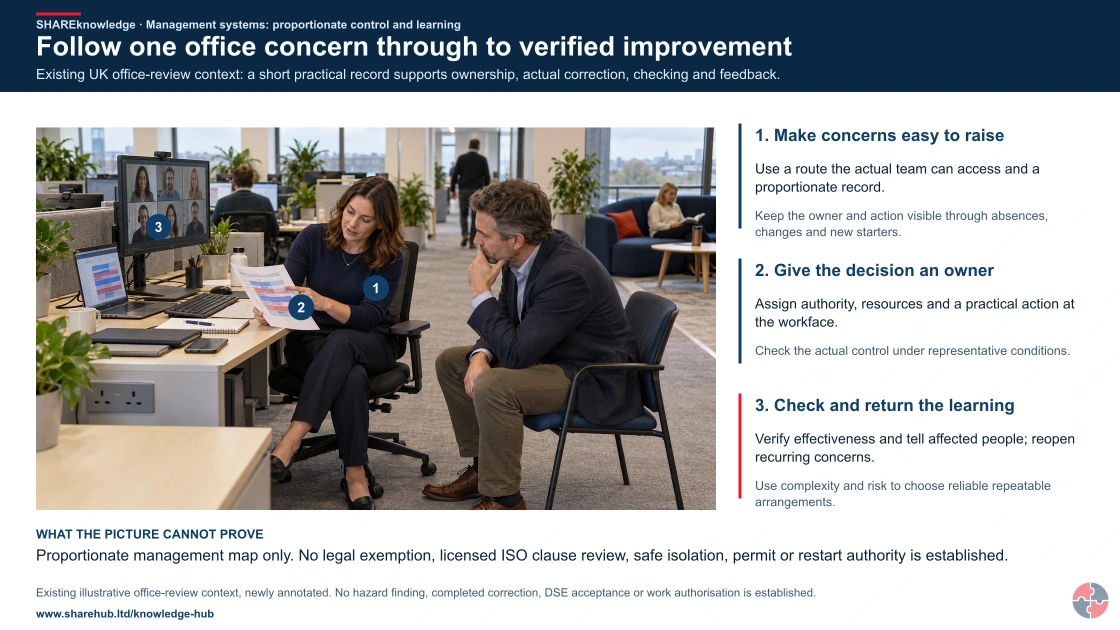
Follow one office concern through to verified improvement
Full written explanation
An editable landscape annotation meaningfully reuses the inspected original UK hybrid-office review scene: two people discuss inert work/calendar information at a workstation, with other office activity in view. Three numbered questions connect an accessible concern route, an accountable correction and a representative check with feedback. The picture supplies actual office context without asserting an observed hazard, medical condition, completed correction, adequate workstation or approved work arrangement. It teaches proportionate repeatable management rather than a mandatory form or certification decision. The existing engineering-workplace inspection scene remains separately available for the higher-complexity context.
Existing UK office-review context: a short practical record supports ownership, actual correction, checking and feedback.
- Make concerns easy to raise. Use a route the actual team can access and a proportionate record.
- Give the decision an owner. Assign authority, resources and a practical action at the workface.
- Check and return the learning. Verify effectiveness and tell affected people; reopen recurring concerns.
Change the pathway
- Conversation needs continuity. Keep the owner and action visible through absences, changes and new starters.
- A closed form is not a correction. Check the actual control under representative conditions.
- More paper is not more control. Use complexity and risk to choose reliable repeatable arrangements.
Evidence check: Proportionate management map only. No legal exemption, licensed ISO clause review, safe isolation, permit or restart authority is established.
Follow a real concern to an owned correction and field evidence
Primary references: HSE HSG65: proportionate Plan Do Check Act · HSE ISO 45001 adoption context
Open the complete HD image (new tab)Download image
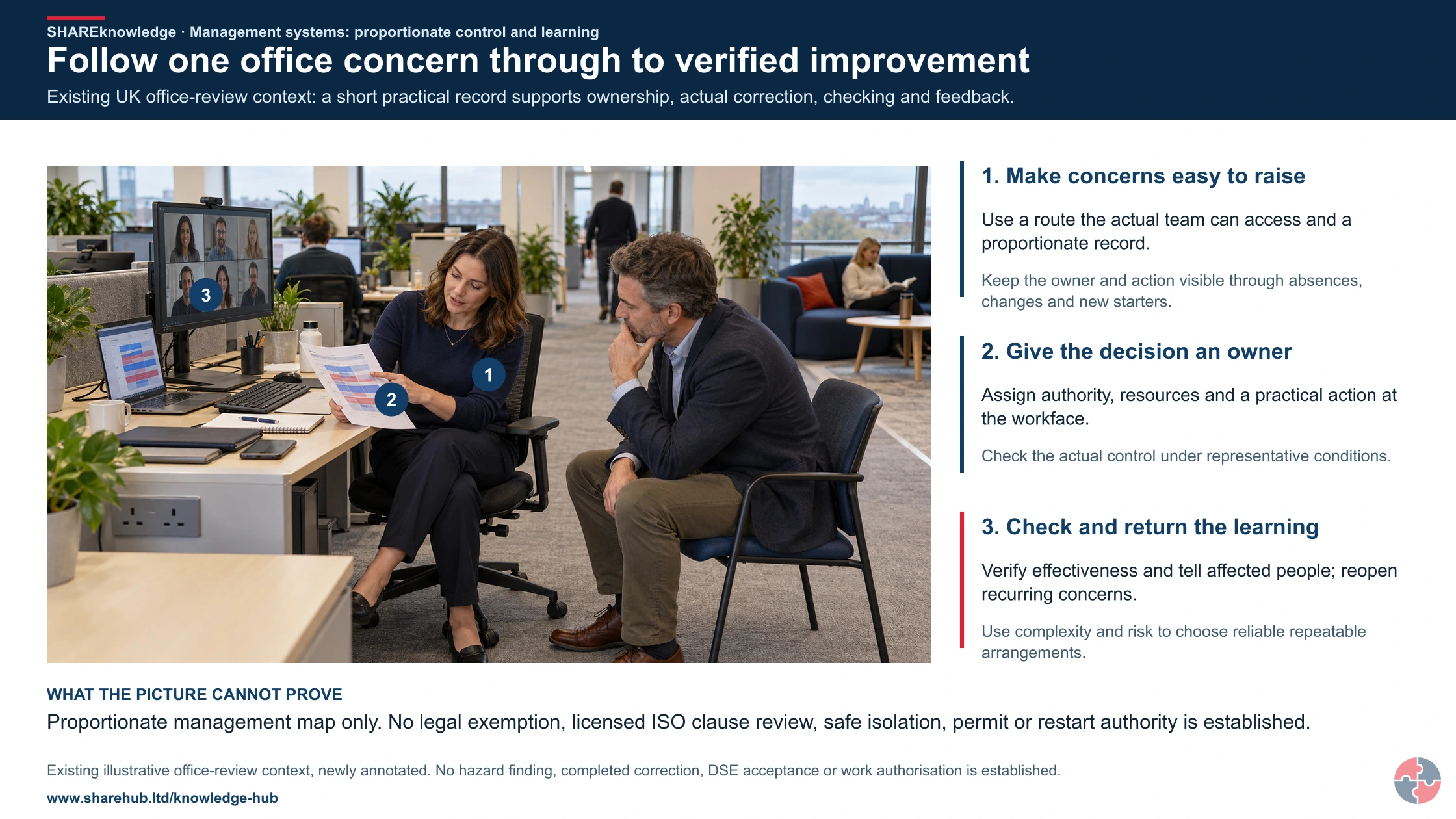
Follow a real concern to an owned correction and field evidence
Primary references: HSE HSG65: proportionate Plan Do Check Act · HSE ISO 45001 adoption context

Capture the concern
Use a route workers can access and a record proportionate to the task and organisation.
Own the decision
Assign someone with authority and resources to assess the concern and change the actual control.
Check the work
Verify the correction under representative conditions rather than closing it when a form is complete.
Return the learning
Feed the result back to workers and relevant sites. A small stable team and a complex multi-site organisation may need different records and coordination.
Read the complete task-specific control examples
ERICPD is a planning cross-map: Discipline verifies and sustains every control. ESEAP compares effectiveness. A label does not authorise the task; retain the owner, evidence and stop or change decision.
Formal and Informal Health and Safety Management Systems · ERICPD
- Eliminate
- Remove unnecessary solvent cleaning.
- Reduce
- Select less hazardous cleaner if feasible.
- Isolate
- Enclose or extract emissions and maintain plant.
- Control
- Document short method, owner and competence.
- PPE
- Use substance-compatible protection for residual exposure.
- Discipline
- Review defects and worker feedback, then change controls.
Formal and Informal Health and Safety Management Systems · ESEAP
- Elimination
- Remove unnecessary solvent cleaning.
- Substitution
- Select less hazardous cleaner if feasible.
- Engineering controls
- Enclose or extract emissions and maintain plant.
- Administrative controls
- Document short method, owner and competence.
- PPE
- Use substance-compatible protection for residual exposure.
What are the key facts about formal and informal systems?
Choose a management system proportionate to hazards, complexity, change and people affected. Even a small organisation must assess and control risk; in both GB and NI, five or more employees trigger written policy and significant-risk-assessment-record requirements. ISO 45001 certification is voluntary and does not prove every legal duty is met.
Informal can be suitable
Simple risks may be managed through direct control, brief records and visible supervision.
Formal can be necessary
Complex, multi-site, contractor-heavy or high-hazard work needs stronger structure and evidence.
Certification is not enough
An ISO certificate does not prove workers understand controls or that critical actions are closed.
Too much paperwork can weaken control
People may work around a system if it is slow, duplicated or detached from real work.
Too little structure can create memory risk
A system built around one experienced person may collapse when they are absent.
Check HSE GB policy guidance and HSENI NI policy guidance for the five-employee threshold; HSE ISO 45001 advice explains certification’s limited evidential role.
What is a health and safety management system?
A health and safety management system is the organised way an employer plans, controls, checks and improves health and safety.
A management system includes policy, roles, risk assessment, competence, consultation, communication, operating control, emergency arrangements, incident reporting, monitoring, audit and leadership review.
The question is not whether the system looks impressive. The question is whether it helps real people make safe decisions when work is busy, conditions change and competing pressures appear.
A health and safety management system is the way a business turns intention into reliable action. It is not just a policy, a certificate or a folder of procedures. It is the daily rhythm by which hazards are identified, risks are assessed, controls are selected, people are trained, work is supervised, failures are reported and leaders decide what needs to improve.
The difference between formal and informal systems is mainly the amount of structure, evidence and repeatability. Informal does not mean careless; it means controls may be simple, direct and locally managed. Formal does not mean better by default; it means the organisation has decided that the risk, size, complexity or evidence need requires clearer documented arrangements.
When can an informal management system work well?
Direct conversations and simple records can work for stable, low-risk work if everyone knows controls and decisions still survive absence or change. Informality cannot waive risk assessment, consultation or a written record required by the workforce size.
Informal systems can work well in small, stable, low-risk settings where the owner or manager sees the work, knows the people and can correct problems quickly. A small office, local retail unit or simple service business may not need a complex management manual to control basic risks.
The danger is that informal systems often depend on memory, habit and personalities. They weaken when the business grows, a key person leaves, a new starter joins, contractors arrive, work becomes higher risk or the organisation needs to prove what was checked and when.
| Feature | When it works | When it becomes weak |
|---|---|---|
| Short procedures | Tasks are simple and workers are experienced. | Tasks vary, new starters arrive or contractors need clarity. |
| Direct supervision | The supervisor is present and competent. | The system depends on one person being available. |
| Simple records | Few checks are needed and failures are rare. | Trends cannot be spotted because records are too thin. |
| Verbal communication | Small teams work together daily. | Shifts, language, remote work or handover make messages unreliable. |
| Owner-manager control | The owner understands the work and sees it often. | Growth creates layers of management and hidden work. |
When does a formal management system add value?
More formal arrangements are justified when hazards are severe, work is distributed, contractors or shifts interact, or safety-critical controls need traceable ownership. Formal documents must match live work and produce reliable decisions, not a binder of unused procedures.
Formal systems add value when they make important controls repeatable. Construction projects, manufacturing sites, transport fleets, process plants and multi-site organisations need arrangements that survive shift changes, contractor interfaces, document revisions, management changes and operational pressure.
A formal system should still feel usable. If procedures are written for auditors rather than workers, people will either ignore them or build an informal shadow system. The best formal systems translate corporate standards into practical tools: permits, registers, induction standards, inspection prompts, competence matrices and clear escalation routes.
| Feature | What it provides | Risk if poorly designed |
|---|---|---|
| Policy and standards | Clear expectations and decision rights. | Generic wording no one uses. |
| Document control | Current procedures and removed obsolete versions. | Workers follow old instructions. |
| Competence matrix | Role-specific training and authorisation. | Training attendance mistaken for competence. |
| Audit programme | Independent sampling of controls. | Audits become tick-box exercises. |
| Management review | Leadership challenge of trends and resources. | Reviews focus on lagging numbers only. |
| Certification | External structure and periodic assessment. | Certificate used as a substitute for field verification. |
How should a business choose the right level of structure?
Choose the least complex system that reliably controls the actual risk, meets legal recording requirements and lets workers report changes. Escalate structure when one-person knowledge, multiple sites or high-consequence barriers make informal control fragile.
Proportionality is the heart of good system design. A business should not copy a complex certified system just because it looks professional, and it should not stay informal just because it has always worked that way. The risk profile should decide the level of control.
Useful triggers for more formality include repeated incidents, rapid growth, new supervisors, remote work, higher-risk equipment, hazardous substances, contractors, shift working, client assurance requirements, regulator attention and poor action closure.
| Factor | Low formality may suit | Higher formality is usually needed |
|---|---|---|
| Hazard severity | Low consequence office or welfare hazards. | Construction, chemicals, machinery, fire, transport or process safety. |
| Workforce size | Small stable team. | Large, changing, shift-based or multi-language workforce. |
| Contractors | Rare low-risk contractor visits. | Routine contractor work, CDM roles or process interfaces. |
| Change | Little change in tasks or equipment. | Frequent MOC, growth, new plant or restructuring. |
| Evidence need | Simple checks and local records. | Legal defence, audit, client assurance, regulator interest or certification. |
How can the hierarchy of controls turn safety-management arrangements into effective risk controls?
A system should direct people toward stronger hazard controls and show whether those controls work. Procedures, training and audit support a control, but do not replace elimination or engineering where those are feasible.
A workshop relies on one supervisor’s memory to control solvent cleaning and ventilation.
A growing contractor sends different crews to changing high-risk sites.
How can the ERICPD hierarchy of controls turn safety-management arrangements into effective risk controls?

| Hazard and harm route | ERICPD → five-level control | Task intervention and feasibility | Owner, test and evidence | Failure and stop decision |
|---|---|---|---|---|
| Small workshop solvent cleaning | Eliminate → Elimination | Remove unnecessary solvent cleaning. Source: HSE hierarchy of control. | Owner verifies product and finish. | Hazardous task unnecessary: stop. |
| Same scenario | Reduce → Substitution | Select less hazardous cleaner if feasible. Source: HSE hierarchy of control. | Buyer checks new substance risk. | Substitute unassessed: reject. |
| Same scenario | Isolate → Engineering | Enclose or extract emissions and maintain plant. Source: HSE hierarchy of control. | Engineer checks capture and condition. | Extraction failed: stop task. |
| Same scenario | Control → Administrative | Document short method, owner and competence. Source: HSE HSG65 managing for health and safety. | Supervisor observes live work. | Method depends on one absent person: pause. |
| Same scenario | PPE → PPE | Use substance-compatible protection for residual exposure. Source: HSE hierarchy of control. | Assessor checks selection and fit. | PPE is only prevention: revise. |
| Same scenario | Discipline → Administrative assurance | Review defects and worker feedback, then change controls. Source: HSE HSG65 managing for health and safety. | Owner records close-out. | Repeated defect: suspend task. |
| Multi-site contractor work | Eliminate → Elimination | Avoid work at height or hazardous interface where feasible. Source: HSE hierarchy of control. | Planner checks design option. | Unnecessary exposure remains: redesign. |
| Same scenario | Reduce → Substitution | Use safer method, prefabrication or remote inspection. Source: HSE hierarchy of control. | Project lead tests feasibility. | New risk unassessed: hold. |
| Same scenario | Isolate → Engineering | Provide engineered access and physical segregation. Source: HSE hierarchy of control. | Competent person verifies each site. | Barrier missing: stop work. |
| Same scenario | Control → Administrative | Use site plan, induction, permit and documented handover. Source: HSE HSG65 managing for health and safety. | Supervisor observes task. | Site change not briefed: hold. |
| Same scenario | PPE → PPE | Use suitable residual protection, never as substitute for access design. Source: HSE hierarchy of control. | Supervisor checks fit and use. | Only control is PPE: reject. |
| Same scenario | Discipline → Administrative assurance | Sample permits, defects and close-out across sites. Source: HSE HSG65 managing for health and safety. | Management reviews trends. | Recurring failure: restrict work. |
How can the ISO 45001 hierarchy of controls turn safety-management arrangements into effective risk controls?

| Hazard and harm route | ERICPD → five-level control | Task intervention and feasibility | Owner, test and evidence | Failure and stop decision |
|---|---|---|---|---|
| Small workshop solvent cleaning | Eliminate → Elimination | Remove unnecessary solvent cleaning. Source: HSE hierarchy of control. | Owner verifies product and finish. | Hazardous task unnecessary: stop. |
| Same scenario | Reduce → Substitution | Select less hazardous cleaner if feasible. Source: HSE hierarchy of control. | Buyer checks new substance risk. | Substitute unassessed: reject. |
| Same scenario | Isolate → Engineering | Enclose or extract emissions and maintain plant. Source: HSE hierarchy of control. | Engineer checks capture and condition. | Extraction failed: stop task. |
| Same scenario | Control → Administrative | Document short method, owner and competence. Source: HSE HSG65 managing for health and safety. | Supervisor observes live work. | Method depends on one absent person: pause. |
| Same scenario | PPE → PPE | Use substance-compatible protection for residual exposure. Source: HSE hierarchy of control. | Assessor checks selection and fit. | PPE is only prevention: revise. |
| Same scenario | Discipline → Administrative assurance | Review defects and worker feedback, then change controls. Source: HSE HSG65 managing for health and safety. | Owner records close-out. | Repeated defect: suspend task. |
| Multi-site contractor work | Eliminate → Elimination | Avoid work at height or hazardous interface where feasible. Source: HSE hierarchy of control. | Planner checks design option. | Unnecessary exposure remains: redesign. |
| Same scenario | Reduce → Substitution | Use safer method, prefabrication or remote inspection. Source: HSE hierarchy of control. | Project lead tests feasibility. | New risk unassessed: hold. |
| Same scenario | Isolate → Engineering | Provide engineered access and physical segregation. Source: HSE hierarchy of control. | Competent person verifies each site. | Barrier missing: stop work. |
| Same scenario | Control → Administrative | Use site plan, induction, permit and documented handover. Source: HSE HSG65 managing for health and safety. | Supervisor observes task. | Site change not briefed: hold. |
| Same scenario | PPE → PPE | Use suitable residual protection, never as substitute for access design. Source: HSE hierarchy of control. | Supervisor checks fit and use. | Only control is PPE: reject. |
| Same scenario | Discipline → Administrative assurance | Sample permits, defects and close-out across sites. Source: HSE HSG65 managing for health and safety. | Management reviews trends. | Recurring failure: restrict work. |
Use competent controlled simulations and safely planned field observations or equipment tests. Do not create hazardous releases, defeat a live protection layer, expose customers to allergens, or create live traffic/height/energy danger for training.
How does information flow through a good health and safety management system?
A good system moves information from risk identification into control, evidence, learning and leadership decisions.
The best way to understand a management system is to follow one risk through the business. A hazard is identified, placed into a risk assessment or register, controlled through equipment, people and procedures, communicated through training and briefings, checked by supervisors and audits, and improved through incidents, inspections and management review.
When that flow breaks, the system becomes decorative. A risk register that does not influence training is weak. An audit that raises actions no one closes is weak. A policy that does not shape procurement, contractor rules or supervision is weak. A good system creates a visible chain from intention to evidence.
| Stage | What should happen | What good evidence looks like |
|---|---|---|
| Identify | Recognise hazards, legal duties, affected people and significant risks. | Risk profile, legal register, worker consultation and incident themes. |
| Assess | Decide likelihood, consequence, existing controls and additional actions. | Risk assessments, method statements, COSHH assessments or project plans. |
| Control | Turn decisions into equipment standards, procedures, permits, training and supervision. | Controlled documents, procurement standards, inspection sheets and permits. |
| Check | Verify controls through frontline checks, leadership inspections, audits and monitoring. | Completed checks, findings, photographs, sampling evidence and trend review. |
| Learn | Investigate incidents, near misses, complaints, defects and audit repeats. | Root cause analysis, action tracker and effectiveness checks. |
| Improve | Update resources, standards, training, design, procurement or leadership focus. | Management review decisions and evidence that changes reached the workplace. |
What does proportionate structure look like by business size and risk?
Proportionate structure means using enough system discipline to control the risk without burying people in paperwork that adds no value.
The same legal duties can require very different management arrangements. A micro business with low-risk work may need a short policy, simple risk assessments and clear supervision. A growing contractor needs registers, document control and contractor management. A high-risk process business needs formal assurance because the consequences of failure can be severe.
The practical question is whether the organisation can prove who owns the risk, what controls are required, whether people are competent, whether controls are checked and whether learning leads to change.
A micro business might prove control through a short policy, simple risk assessments, training notes, equipment checks and direct supervision. A growing contractor may need an approved contractor list, RAMS review, inspection schedule, training matrix, plant register and incident tracker. A process or high-risk business needs safety-critical registers, management of change, permits, competence assurance and emergency testing.
The learning point is that the system should answer the same basic questions at every scale: who owns the risk, what must be controlled, how do people know what to do, how is the control checked, what happens when it fails, and how does leadership learn from the evidence?
| Business type | Suitable system style | What good evidence looks like |
|---|---|---|
| Micro business with simple risks | Short written arrangements, direct supervision, simple training and basic inspection records. | Named owner, simple risk assessments, evidence of induction, equipment checks and action closure. |
| Growing contractor | More formal registers for risk, training, plant, contractors, inspections and incidents. | Training matrix, approved contractor list, RAMS review, inspection schedule and defect tracker. |
| Construction business | Project-level controls under the central system, with site files, CPPs, permits and supervisor checks. | Construction phase plan, temporary works records, site induction, toolbox talks and audit findings. |
| Multi-site service business | Consistent standards with local implementation and regional assurance. | Common policy, local risk assessments, regional audit programme and management review. |
| High-risk or process business | Formal safety management system with barrier assurance, MOC, competence, permit systems and emergency planning. | Safety critical element register, MOC records, proof tests, process safety indicators and leadership review. |
| Certified organisation | ISO 45001-style framework with documented information, audit and external review. | Certification scope, internal audits, corrective actions and evidence that controls work in the field. |
What does management-system maturity look like in real businesses?
Management-system maturity is the ability to control risk consistently as the business grows, changes and comes under pressure.
Maturity does not mean having more paperwork. A mature micro business may have only a few documents, but the owner can show the main risks, explain the controls and prove that essential checks happen. An immature large business may have hundreds of procedures but weak supervision, poor action closure and little worker trust.
The test is resilience. Can the system work when the experienced supervisor is on leave, a contractor arrives late, a machine fails, a client changes the programme, or a regulator asks for evidence? If not, the arrangements need strengthening.
| Maturity level | How it looks in practice | What would improve it |
|---|---|---|
| Reactive | Acts after injuries, relies on memory and closes actions by conversation. | Create basic registers, assign owners and verify action completion. |
| Basic | Has risk assessments and training records but checks are inconsistent. | Add supervisor inspections, review trends and link training to task competence. |
| Managed | Uses planned inspections, contractor checks, incident learning and management review. | Improve quality of audit sampling and worker involvement. |
| Assured | Uses first, second and third-line checks with evidence-led leadership review. | Test serious-risk controls and challenge drift before incidents occur. |
| Learning organisation | Uses weak signals, worker intelligence and audit learning to redesign controls. | Keep simplification and usability under review so the system remains practical. |
How do informal systems fail in real workplaces?
Informal systems fail when knowledge, decisions and controls depend on memory, habit or one experienced person rather than reliable arrangements.
Informal failure is rarely dramatic at first. It shows up as small inconsistencies: different supervisors giving different instructions, training discussed but not recorded, contractors allowed to start on trust, actions closed without verification or old risk assessments copied into new work.
Those small gaps become serious when pressure increases. A near miss, injury, enforcement visit, claim or major client audit can expose that the business was relying on goodwill rather than a resilient system.
| Failure example | How harm can develop | What stronger control looks like |
|---|---|---|
| Knowledge held in one person's head | Work stops being controlled when that person is absent, leaves or is overloaded. | Document critical controls, cross-train deputies and review handover arrangements. |
| No reliable records | The business cannot prove inspections, training, maintenance or corrective actions happened. | Use simple registers and action trackers proportionate to the risk. |
| Inconsistent contractor control | Contractors receive different rules depending on who is on duty. | Create prequalification, induction, site rules and supervision standards. |
| Verbal changes to method | Workers follow an altered method that has not been risk assessed. | Use change control for significant changes and brief the revised method. |
| Actions closed by conversation | Defects appear closed but no one checks the physical fix. | Require evidence of completion and effectiveness review. |
| Supervisor style varies | One team gets strong coaching while another drifts into shortcuts. | Use common checklists, supervisor training and second-line assurance. |
How does HSG65 structure good management?
HSE HSG65 uses Plan, Do, Check, Act to integrate health and safety into ordinary management. Use it to test whether hazards and worker feedback change controls and resources, not merely whether files exist.
HSG65 is useful because it describes management as a cycle, not a document. Plan means understanding the risk and deciding priorities. Do means organising people and implementing controls. Check means measuring whether controls are working. Act means reviewing results and improving the system.
For learners, the simple way to remember HSG65 is to connect it to evidence. Plans should produce risk profiles and objectives; doing should produce competence, procedures and supervision; checking should produce inspections, audits and investigations; acting should produce management decisions and closed improvements.
| Stage | What it means | Good evidence |
|---|---|---|
| Plan | Set policy, profile risks, define priorities and responsibilities. | Policy, risk profile, objectives and resource plan. |
| Do | Organise people, competence, communication and operational controls. | Procedures, training, consultation and control implementation. |
| Check | Measure performance through inspections, audits, monitoring and investigation. | Inspection records, audit reports, incident learning and KPIs. |
| Act | Review performance and improve arrangements. | Management review, action tracking and revised plans. |
HSE HSE HSG65 managing for health and safety is Great Britain; NI employers should apply HSENI policy and risk-assessment guidance under NI law.
How can BS EN ISO 45001 support formal and informal health and safety management systems management?
A voluntary occupational health and safety system can help organisations define roles, worker participation, risk controls, assurance and improvement proportionate to their hazards.
HSE public guidance supports practical GB management themes only. Use the current authorised standard and competent advice for ISO clause mapping, conformity and certification decisions; these themes do not establish compliance.
What evidence shows a management system is working?
A system is working when records, behaviours and outcomes show that controls are known, used, checked and improved.
Evidence should show control in the real workplace, not simply document existence. A risk assessment should match the task; a training record should link to competence; an inspection should find real conditions; an audit should test controls; and actions should be closed only when the fix has been checked.
A strong management system also uses weak signals. Near misses, maintenance defects, repeated minor injuries, worker concerns, audit repeats and overdue actions all tell leaders where the system is starting to drift.
| Evidence type | What it shows | What to sample |
|---|---|---|
| Risk profile | The organisation understands its significant risks. | Top risks, risk register and leadership review. |
| Procedures | Controls are defined for important tasks. | Field match between written method and real work. |
| Competence records | People are trained and authorised. | Observation and questioning, not certificates alone. |
| Inspections and audits | Controls are checked at different levels. | Quality of findings and action closure. |
| Incident learning | Weak signals are investigated and acted on. | Root causes, corrective actions and repeat events. |
| Management review | Leaders challenge performance and resources. | Minutes, decisions and improvement plans. |
What legal records are needed in GB and NI?
Both GB and NI employers must assess and control work risks. With five or more employees, they must have a written health and safety policy and record significant risk-assessment findings; a certificate is neither a substitute nor a legal requirement.
Below five employees, writing the general policy and significant findings may not be legally required, but the duty to assess and manage risks remains. Simple written records may still be the sensible way to survive absence, change and contractor interfaces.
GB uses the Health and Safety at Work etc. Act 1974 and Management Regulations 1999; NI uses the Health and Safety at Work (NI) Order 1978 and Management Regulations (NI) 2000. The written policy, recorded findings and management arrangements are distinct from voluntary system certification.
| Jurisdiction | Duty or source | Where it applies | Practical implication |
|---|---|---|---|
| GB | GB Health and Safety at Work Act 1974 | GB general duty and policy threshold. | Safe arrangements and written policy at five or more. |
| GB | GB Management Regulations 1999 | GB assessment and arrangements. | Record significant findings at five or more. |
| NI | NI Health and Safety Order 1978 | NI general duty and policy route. | NI safe arrangements and written policy at five or more. |
| NI | NI Management Regulations 2000 | NI assessment and arrangements. | Record significant findings at five or more. |
The HSE GB policy page and HSENI NI policy page describe the written-policy threshold; HSENI risk assessment and HSE GB risk assessment and significant findings describe recorded significant findings.
How could BuildOut Ltd manage this in practice?

BuildOut Ltd would use a more formal system for construction risk while keeping site tools simple enough for supervisors and contractors to use.
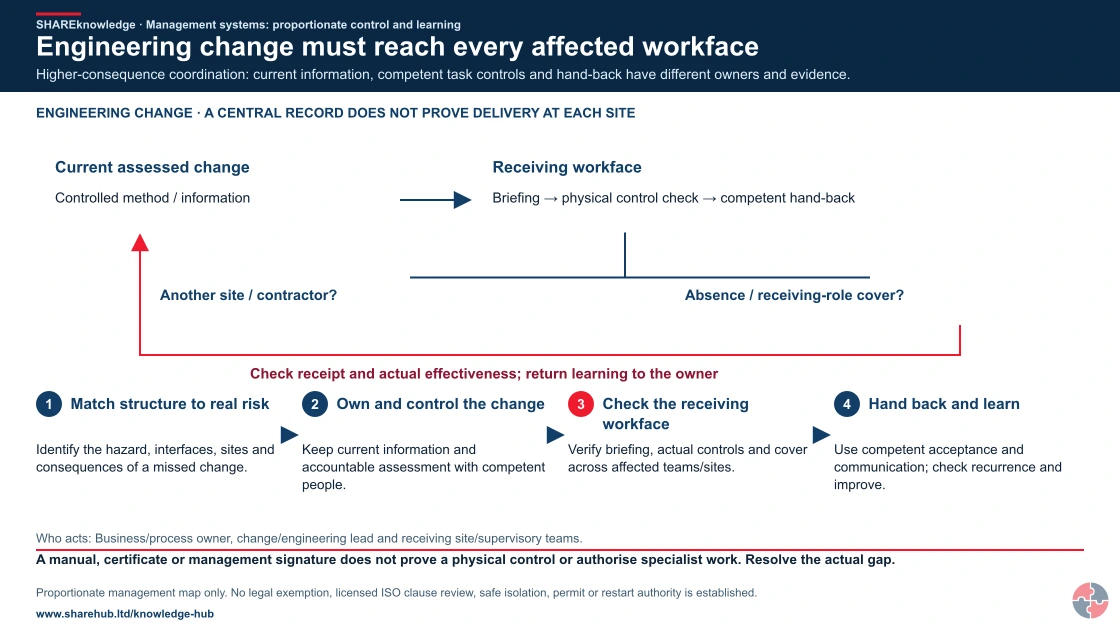
Engineering change must reach every affected workface
Full written explanation
A connected native engineering-maintenance information route follows a proposed method/equipment change from competent assessment and current controlled information through the receiving team briefing, physical-control verification and competent hand-back/communication. A second site and an absent-role cover question branch off the communication point; a feedback return line prevents a central record from being mistaken for delivery at every workface. The route is a management-system teaching map, not an isolation, permit or restart procedure. Actual specialist task controls, GB/NI legal applicability and licensed ISO clause approval remain outside the diagram.
Higher-consequence coordination: current information, competent task controls and hand-back have different owners and evidence.
- Match structure to real risk. Identify the hazard, interfaces, sites and consequences of a missed change.
- Own and control the change. Keep current information and accountable assessment with competent people.
- Check the receiving workface. Verify briefing, actual controls and cover across affected teams/sites.
- Hand back and learn. Use competent acceptance and communication; check recurrence and improve.
When the evidence does not fit: A manual, certificate or management signature does not prove a physical control or authorise specialist work. Resolve the actual gap.
Who acts: Business/process owner, change/engineering lead and receiving site/supervisory teams.
Changed workplace
Small stable office: Keep concern, owner, correction, checking and feedback simple and usable.
Engineering maintenance: Use controlled change and evidence through interfaces, absence and hand-back.
Evidence check: Proportionate management map only. No legal exemption, licensed ISO clause review, safe isolation, permit or restart authority is established.
Follow a real concern to an owned correction and field evidence
Primary references: HSE HSG65: proportionate Plan Do Check Act · HSE ISO 45001 adoption context
Open the complete HD image (new tab)Download image
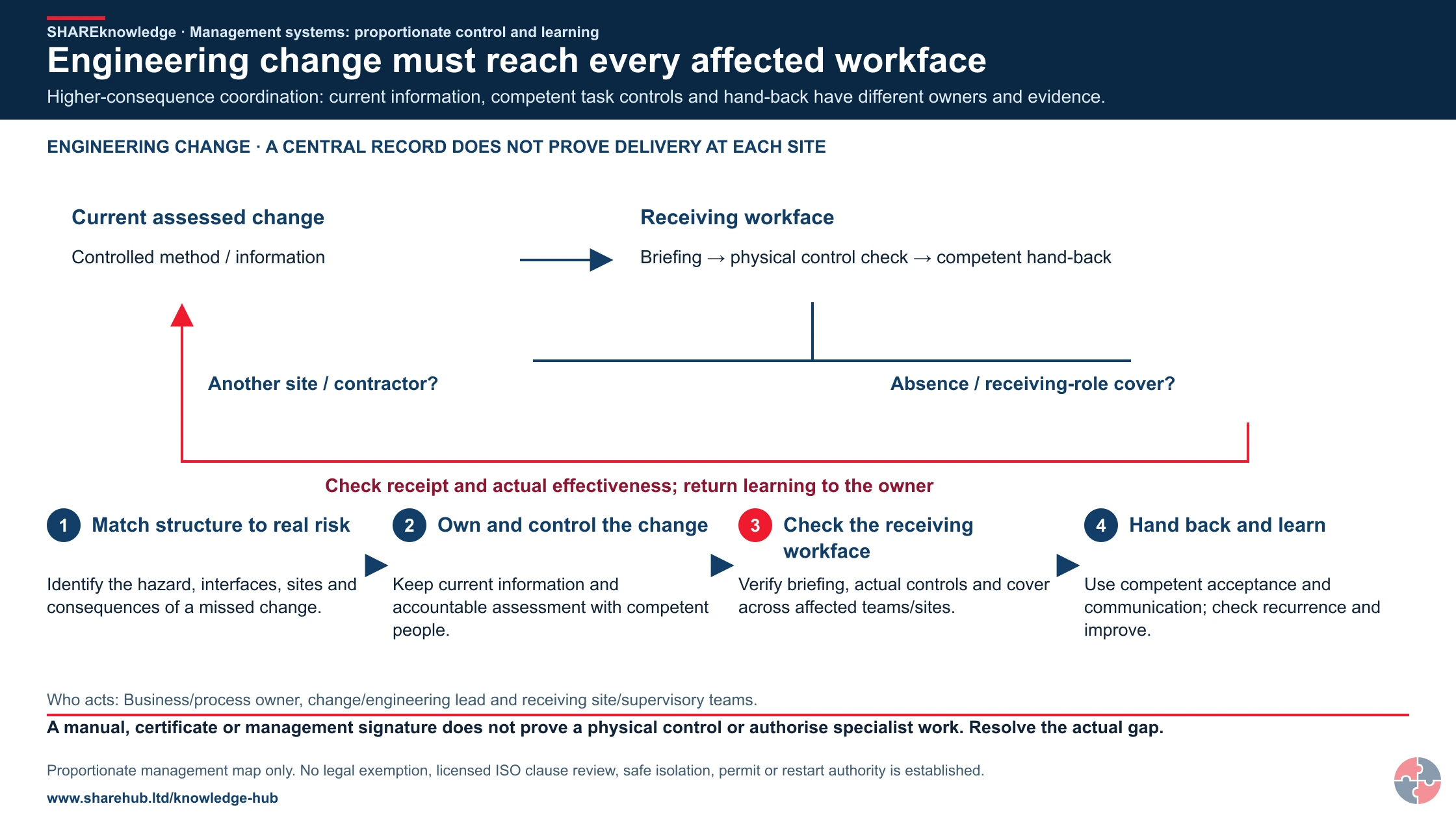
Follow a real concern to an owned correction and field evidence
Primary references: HSE HSG65: proportionate Plan Do Check Act · HSE ISO 45001 adoption context
In this worked example, BuildOut Ltd has multiple construction projects, subcontractors, temporary works and changing site conditions. A purely informal system would be too fragile, but a bulky office-only system would also fail.
BuildOut Ltd is a useful example because construction risk cannot be managed by one informal conversation. The company needs central standards, but every project also needs site-specific planning, contractor control, temporary works arrangements, plant checks, permits, inductions and supervisor verification.
A robust system would connect tender risk review, project risk registers, construction phase plans, RAMS approval, training, daily briefings, inspections, incident learning and leadership review. That is how the business avoids a split between office assurance and site reality.
| Management element | How the business would manage it | Evidence to review |
|---|---|---|
| Assessing | Use a risk profile to identify high-consequence work: work at height, lifting, excavation, silica dust, plant and temporary works. | Risk profile and project risk registers. |
| Designing the system | Keep group standards formal, but convert them into site-ready permits, briefings and inspection checks. | Controlled procedures and site packs. |
| Contractor management | Set prequalification rules, induction, RAMS review, supervision and audit expectations. | Approved contractor list and onboarding evidence. |
| Monitoring | Use first-line supervisor checks, second-line HSSE inspections and third-line audits. | Inspection dashboards, audit reports and action tracker. |
| Learning | Investigate incidents and near misses, then update standards, training and procurement controls. | Investigation reports and revised documents. |
| Review | Senior managers review trends, overdue actions, resources and repeat findings. | Management review minutes and decisions. |
The construction-company example uses HSE HSG65 managing for health and safety to connect project controls, checking and management action.
Use competent controlled simulations and safely planned field observations or equipment tests. Do not create hazardous releases, defeat a live protection layer, expose customers to allergens, or create live traffic/height/energy danger for training.
Who needs management-system competence?
Test whether each role can find, apply, question and improve real controls rather than recite a policy.
Management-system training should be practical. Workers need to know the arrangements that affect their task and how to stop or report unsafe work. Supervisors need to know how to brief, check, challenge and close actions. Managers need to know how to read trends, allocate resources and avoid rewarding shortcuts.
The most important competence test is whether people can use the system when work is busy. If the only people who understand the system are the health and safety adviser and the auditor, the system is not embedded.
| Role | Learning to test | Competence demonstration | Assessor and record | Reassessment trigger |
|---|---|---|---|---|
| Workers | Find relevant controls and report change. | Explain stop and escalation for one task. | Supervisor observes. | Task or location change. |
| Supervisors | Translate policy into field controls. | Brief and verify one high-risk job. | Manager samples field record. | New hazard or contractor. |
| Managers | Resource, consult and close risk actions. | Review overdue action and worker challenge. | Director signs review. | Incident or growth. |
| Safety advisers | Map GB/NI duties and proportional records. | Audit five-employee threshold and control evidence. | Peer adviser checks. | Jurisdiction or law change. |
| Auditors | Test control effectiveness, not document count. | Trace hazard to field control and corrective action. | Independent lead reviews sample. | Repeated finding. |
HSE leadership guidance supports testing managers on decisions and resources, not policy recall.
Use competent controlled simulations and safely planned field observations or equipment tests. Do not create hazardous releases, defeat a live protection layer, expose customers to allergens, or create live traffic/height/energy danger for training.
What warning signs show a management system is failing?
A failing system often looks tidy in the office while workarounds, overdue actions and weak supervision appear in the workplace.
Warning signs are often cultural as much as procedural. People may say the right things in meetings while the real work is controlled by habit, workarounds and personal judgement. That is why field verification, worker conversation and action tracking matter.
A good reviewer looks for drift: the same audit findings returning, contractor rules being applied inconsistently, risk assessments not matching the job, training gaps being accepted, or leaders focusing on injury numbers while ignoring serious-risk controls.
| Warning sign | How harm can develop | Action |
|---|---|---|
| Procedures are not used | Workers improvise because documents are too long, old or unrealistic. | Observe work and rewrite procedures with users. |
| Actions stay overdue | Known defects remain open until an incident occurs. | Escalate overdue actions and review resources. |
| Audit findings repeat | The system records failure without fixing causes. | Investigate why corrective action is ineffective. |
| One person holds all knowledge | Absence or turnover removes system memory. | Document critical knowledge and cross-train roles. |
| Certification is over-relied on | Leaders assume risk is controlled because a certificate exists. | Sample real controls, incidents and worker understanding. |
Repeated findings should trigger the HSE HSG65 managing for health and safety and verified corrective action.
What do the acronyms and key terms mean?
Acronyms should be understood before they are used in audits, management review or study answers.
| Acronym | Meaning | Plain-English use |
|---|---|---|
| HSG65 | HSE guidance Managing for health and safety | UK Plan, Do, Check, Act management model. |
| ISO | International Organization for Standardization | Publishes standards including ISO 45001. |
| PDCA | Plan, Do, Check, Act | Continuous improvement cycle used in HSG65 and management systems. |
| RAMS | Risk Assessment and Method Statement | Common contractor and task-planning document. |
| GB | Great Britain | GB risk and policy rules. |
| NI | Northern Ireland | Separate NI risk and policy rules. |
Unlock another resource
You have used this month’s two free downloads. Publish a post in your own words to unlock one more resource, or choose SHARE Individual for 10 downloads per month.
You decide whether to share. If you do, use the relevant platform disclosure tools and do not make claims you do not genuinely hold.