SHARE Knowledge Hub
Eye health and eyesight at work
Eye health at work covers both preventable injury from splashes, particles and radiation and discomfort or visual difficulty during screen tasks. Remove or contain the hazard before selecting eye protection; assess display screen equipment, offer eligible users eye tests on request and provide special corrective appliances only when the test shows they are needed for screen work. Sudden loss of vision, a chemical splash or penetrating injury needs urgent clinical care.
Understanding Eye health and eyesight at work
Eye health at work covers both preventable injury from splashes, particles and radiation and discomfort or visual difficulty during screen tasks. Remove or contain the hazard before selecting eye protection; assess display screen equipment, offer eligible users eye tests on request and provide special corrective appliances only when the test shows they are needed for screen work. Sudden loss of vision, a chemical splash or penetrating injury needs urgent clinical care.
Why this matters at work
Artificial optical radiation risk depends on wavelength, output, exposure duration and the path to workers and bystanders, including reflection. Enclosure and restriction of access can prevent exposure before reliance on protective filters. Ordinary tinted spectacles do not establish adequate protection. Sunlight sits outside the artificial-radiation instrument but still needs the appropriate general workplace assessment. Identify the actual optical source, exposure paths and bystanders before choosing filters or screens. Consider reflected radiation and work through gaps as well as the person holding the equipment. Apply enclosure, screening and access controls, then select suitable eye and face protection for the process. Check that helpers and nearby workers remain protected. Do not infer a safe filter shade from a generic task name; obtain process and manufacturer information and competent assessment where the optical exposure is uncertain.
Dust, fume, gas and vapour can irritate or injure eyes directly and may also affect vision or comfort indirectly. Sources include wood, flour, mineral, metal and process dusts; welding/cutting fumes; solvents; sprays; exhaust; cleaning agents; biological material; hot/cold environments and poor ventilation. Exposure can be a symptom of a wider control failure affecting respiratory health as well as eyes. Do not treat eye irritation as a PPE-only matter: review containment, local exhaust ventilation, work method, cleaning, maintenance, process temperature/pressure and the substance safety data.
How organisations manage this in practice
For Eliminate, Reduce, Isolate and Control, record the protective purpose, owner and practical verification. Explain why any remaining exposure needs PPE. Do not describe eyewash as splash prevention or place an emergency response inside these preventive controls. Control includes engineering; a procedure cannot replace required enclosure, guarding or exposure control.
Keep evidence proportionate to risk: DSE assessment/checklist and action log; user information/training; eye-test process and funding record; workstation reviews; lighting/glare actions; task/COSHH/radiation assessments; PPE selection/issue/inspection; LEV/guard/eyewash maintenance where applicable; first-aid assessment; incident/near-miss records; adjustments and review dates; and worker feedback. Record only the health information necessary for a legitimate work purpose, with clear confidentiality and retention controls. Review after new equipment, changed task/location, symptoms, injury, exposure, change in worker need or failed control.
For return to work, agree the functional task arrangement and relevant review with the worker and competent advisers. Confirm necessary exposure controls and protective compatibility; review temporary restrictions when the task or functional advice changes. Do not use a prescription, a generic symptom label or completion of a company form as a medical clearance.
Separate acute eye harm from routine screen difficulty
In the mixed leisure-centre example, a splash interrupts chemical work: first aid, urgent care and control of the hazard come first. The supervisor keeps the affected task held until splash protection, eyewash and transfer controls are restored and verified. A requested DSE eye test follows its own route and does not replace injury assessment.
- Chemical splash or sudden vision change — Use immediate first aid and urgent medical assessment; do not wait for a DSE review.
- Specialist chemical-eye response — Read the existing emergency detail alongside the substance and site plan.
- Routine screen discomfort or requested eye test — Assess the workstation and use the DSE-user eye-test route.
- Choose protective eyewear — Select task-compatible protection; ordinary spectacles are not splash protection.
For eligible DSE users, retain the requested eye-test arrangements and the limits on special corrective appliances needed for screen work. Do not promise ordinary spectacles universally or treat them as chemical protection. Record only the functional adjustment and review information needed by the manager.
Content amended 19 October 2026 by the SHARE Knowledge Hub editorial team. This records an editorial content change; the existing technical-review and approval status still applies.
Separate urgent injury from routine eyesight support
A splash, foreign body, injury or sudden concerning change needs its appropriate immediate first-aid/medical route. Routine screen-work support is a separate assessment and adjustment process.

Control the particle source before relying on eyewear
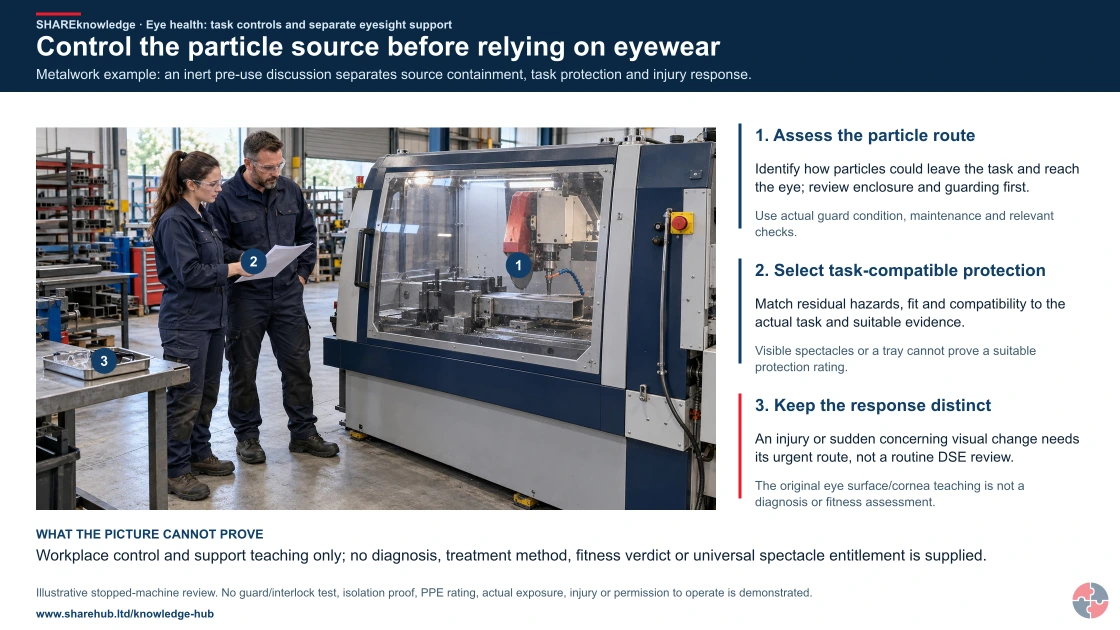
Full written explanation
Two colleagues wearing clear spectacles review an inert sheet beside a closed transparent cutting-machine guard. An eyewear tray is on a separate bench. Markers identify the enclosed work area, review sheet and tray. No machine operates, sparks fly, eye is injured or clinical method is shown. Appearance cannot verify guard/interlock performance, isolation or eyewear rating; original normal eye anatomy and native learning controls remain separate and unchanged.
Metalwork example: an inert pre-use discussion separates source containment, task protection and injury response.
- Assess the particle route. Identify how particles could leave the task and reach the eye; review enclosure and guarding first.
- Select task-compatible protection. Match residual hazards, fit and compatibility to the actual task and suitable evidence.
- Keep the response distinct. An injury or sudden concerning visual change needs its urgent route, not a routine DSE review.
Change the pathway
- A closed window is not a test. Use actual guard condition, maintenance and relevant checks.
- Ordinary glasses are not all-purpose PPE. Visible spectacles or a tray cannot prove a suitable protection rating.
- Anatomy is explanatory. The original eye surface/cornea teaching is not a diagnosis or fitness assessment.
Evidence check: Workplace control and support teaching only; no diagnosis, treatment method, fitness verdict or universal spectacle entitlement is supplied.
Urgent eye harm and routine screen support remain separate
Primary references: HSE: DSE eyes and eyesight testing · NHS: eye injuries and urgent care · HSE: managing risk using PPE
Open the complete HD image (new tab)Download image
Urgent eye harm and routine screen support remain separate
Primary references: HSE: DSE eyes and eyesight testing · NHS: eye injuries and urgent care · HSE: managing risk using PPE

Urgent route first
Use the relevant immediate first-aid and medical arrangements for injury or sudden concerning symptoms; do not wait for a routine eyesight appointment.
Control the task
Assess source controls and the actual splash, particle or other eye hazard before selecting appropriate protection.
Routine support
Use the applicable eyesight/DSE assessment and private work-adjustment process, checking equipment, task and usability.
The anatomy is explanatory, not a diagnostic test, treatment method or statement of an individual’s fitness.
What is the immediate workplace decision for an eye concern?
For an injury or sudden visual change, make work safe and follow urgent NHS/first-aid routes. For ongoing screen discomfort or visual difficulty, assess the task and workstation, explain eye-test access and discuss support privately without diagnosing the cause.
What is the immediate workplace decision for an eye concern? — part 1 of 2


Read the complete visual as text
- For an injury or sudden visual change, make work…: For an injury or sudden visual change, make work safe and follow urgent NHS/first-aid routes. For ongoing screen discomfort or visual difficulty, assess the task and workstation, explain eye-test access and discuss support privately without diagnosing the cause.
- Eye symptoms and changes in vision can have many…: Eye symptoms and changes in vision can have many causes. Managers, supervisors and safety advisers should not diagnose a worker or decide whether a symptom is clinically serious. Their role is to control workplace hazards, support safe work, provide required arrangements and signpost to appropriate health advice.
- Chemical splash, penetrating eye injury, sudden vision change, severe…: Chemical splash, penetrating eye injury, sudden vision change, severe eye pain or major eye trauma should be handled through the workplace first-aid procedure and appropriate medical assessment. Routine discomfort from screen work, lighting or glare should still be taken seriously because it may affect comfort, concentration, fatigue and safe performance.
What is the immediate workplace decision for an eye concern? — part 2 of 2


Read the complete visual as text
- Health information about eyesight, eye conditions or disability should…: Health information about eyesight, eye conditions or disability should be treated confidentially. Most managers need to know what support or adjustment is needed, not private clinical detail.
- A pool technician reports a chemical splash while a…: A pool technician reports a chemical splash while a receptionist reports repeated screen discomfort. The manager starts immediate eye irrigation and emergency assessment for the splash; separately, the DSE assessor reviews screen position, glare and breaks and arranges the eligible user’s requested eye test. Neither case is handled by guessing a diagnosis.
Eye symptoms and changes in vision can have many causes. Managers, supervisors and safety advisers should not diagnose a worker or decide whether a symptom is clinically serious. Their role is to control workplace hazards, support safe work, provide required arrangements and signpost to appropriate health advice.
Chemical splash, penetrating eye injury, sudden vision change, severe eye pain or major eye trauma should be handled through the workplace first-aid procedure and appropriate medical assessment. Routine discomfort from screen work, lighting or glare should still be taken seriously because it may affect comfort, concentration, fatigue and safe performance.
Health information about eyesight, eye conditions or disability should be treated confidentially. Most managers need to know what support or adjustment is needed, not private clinical detail.
A pool technician reports a chemical splash while a receptionist reports repeated screen discomfort. The manager starts immediate eye irrigation and emergency assessment for the splash; separately, the DSE assessor reviews screen position, glare and breaks and arranges the eligible user’s requested eye test. Neither case is handled by guessing a diagnosis.
Where do workplace eye-health decisions stop and clinical care begin?
Control the work hazard and arrange appropriate support; let qualified clinicians diagnose and treat eye conditions. A sudden visual change or eye injury needs the urgent route, not a routine management conversation.
Workplace health boundary and support — part 1 of 2


Read the complete visual as text
- Advice boundary: Good practice: Control work risks and signpost for clinical assessment without diagnosing the worker. Evidence: Known first-aid, urgent-care and support routes.
- Confidential route: Good practice: Workers can raise concerns privately without unnecessary personal detail being shared. Evidence: Confidential reporting/support route.
- Occupational health route: Good practice: Use occupational health where work-health fitness, restrictions or adjustments need professional advice. Evidence: Referral and recommendations.
- Reasonable adjustments: Good practice: Consider duties and practical adjustments where health conditions may affect work. Evidence: Adjustment discussion and review.
Workplace health boundary and support — part 2 of 2


Read the complete visual as text
- Safety-critical trigger: Good practice: Pause or restrict safety-critical work if symptoms, medication, fatigue or injury could create immediate risk. Evidence: Fitness-for-task review.
- What managers should not ask: Good practice: Avoid diagnosis, intrusive medical detail or speculative assumptions. Evidence: Manager guidance and record quality.
- What managers should not record: Good practice: Do not record unnecessary health detail; record work impact, adjustments and agreed support. Evidence: Minimum necessary records.
| Boundary | Good practice | Evidence |
|---|---|---|
| Advice boundary | Control work risks and signpost for clinical assessment without diagnosing the worker. | Known first-aid, urgent-care and support routes. |
| Confidential route | Workers can raise concerns privately without unnecessary personal detail being shared. | Confidential reporting/support route. |
| Occupational health route | Use occupational health where work-health fitness, restrictions or adjustments need professional advice. | Referral and recommendations. |
| Reasonable adjustments | Consider duties and practical adjustments where health conditions may affect work. | Adjustment discussion and review. |
| Safety-critical trigger | Pause or restrict safety-critical work if symptoms, medication, fatigue or injury could create immediate risk. | Fitness-for-task review. |
| What managers should not ask | Avoid diagnosis, intrusive medical detail or speculative assumptions. | Manager guidance and record quality. |
| What managers should not record | Do not record unnecessary health detail; record work impact, adjustments and agreed support. | Minimum necessary records. |
What are the key facts about eye health and eyesight at work?
The key facts are that most eye-health controls are practical, preventive and task-specific.
DSE users have specific rights
Eligible users can request eye and eyesight tests and special corrective appliances where needed for DSE work only.
Screen discomfort is manageable
Lighting, glare, screen position, font size, breaks and workstation setup can reduce eye strain.
Eye injuries can be severe
Chemical splash, impact, dust, biological material and optical radiation need suitable controls and first-aid arrangements.
PPE must fit the hazard
Safety glasses, goggles, face shields and welding protection are not interchangeable.
Vision affects safe work
Driving, plant operation, lone work, machine tasks, reading displays and emergency response can be affected by eyesight issues.
Adjustments protect inclusion
Reasonable adjustments can help people work safely and confidently where eyesight affects work.
What does eye health and eyesight mean in workplace management?
It means protecting vision and eye comfort while making sure work is designed, assessed and adjusted for safe performance.
Eye health includes the condition of the eyes, comfort, exposure to hazards and access to appropriate advice. Eyesight refers to how well a person sees for near, distance, contrast, colour, depth, glare and changing light conditions. At work, both can influence safety and wellbeing. See NHS look after your eyes.
Work can affect eyes directly through dust, chemicals, UV, lasers, welding arc, flying particles, biological material or poorly controlled optical radiation. Work can also affect comfort through screens, poor lighting, glare, reflections, dry air, long concentration periods or lack of breaks.
A good management approach looks at the task first. What does the person need to see, for how long, under what lighting, with what hazards, and what could happen if vision is impaired?
| Area | What it covers | Workplace evidence |
|---|---|---|
| DSE | Screen use, workstation setup, breaks and eyesight tests. | DSE assessment and eye-test process. |
| Physical eye hazards | Impact, flying particles, dust and debris. | Risk assessment and eye protection selection. |
| Chemical hazards | Splashes, vapours, mists and irritants. | COSHH assessment, eyewash and PPE. |
| Optical radiation | UV, lasers, welding arc and intense light. | Exposure assessment and specialist controls. |
| Lighting and glare | Illumination, contrast, reflections and visibility. | Lighting review and worker feedback. |
| Adjustments | Support for eyesight difficulty or eye conditions. | Adjustment plan and review dates. |
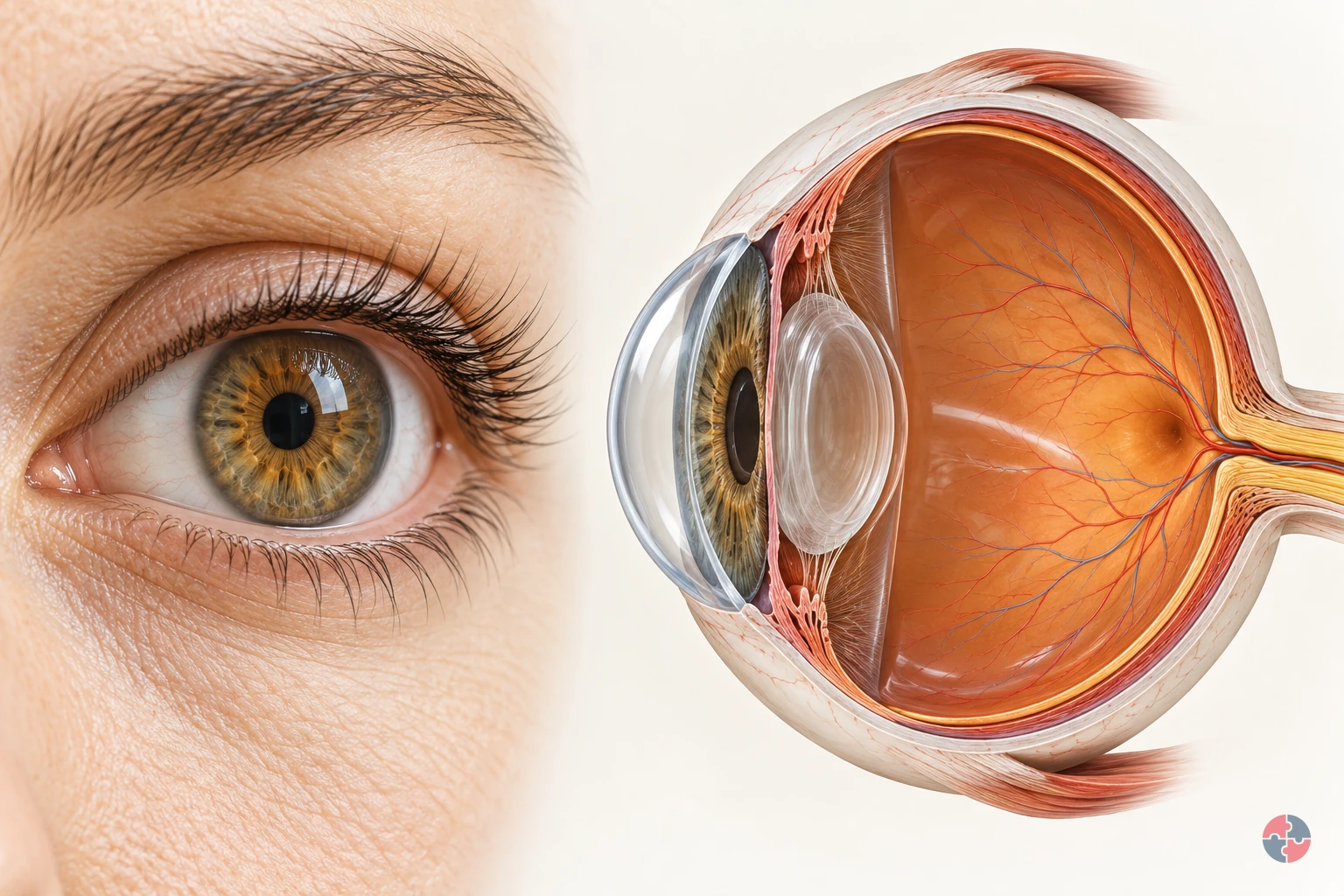

How does the eye turn light into vision, and how do workplace hazards injure it?
Interactive anatomy · Eye function and injury · Updated 2026-10-23
Read all anatomy and process explanations without the viewer
Educational illustration, not a diagnostic symptom checker or a reproduction of an individual’s vision. No acuity/brightness challenge, flashing screen, camera permission, eye-drop prescription, patching instruction, lens-removal manoeuvre or home-neutralisation exercise. Ordinary DSE comfort is separate from trauma; eyesight correction is separate from hazard protection.
Eyelids
Blinking spreads tears over the front of the eye. The eyelids pass over the exposed front of the eye when a person blinks. Their movement spreads the tear film, helping keep that surface moist and smooth. In the surface view, use the lid margins to locate the area they cover. This surface-maintenance role supports the optical pathway; the lid does not carry visual signals to the brain. Moorfields Eye Hospital NHS Foundation Trust: Dry eye: the tear film
Tear film
A thin tear layer keeps the surface moist and smooth. A thin film of tears covers the front of the eye. It lubricates the surface and contributes to a smooth boundary through which light passes. Blinking redistributes this film. Its thickness is enlarged in the teaching view so its position can be seen; it is a surface layer rather than a pool of liquid inside the eyeball. Moorfields Eye Hospital NHS Foundation Trust: Dry eye: the tear film
Cornea
The clear front surface bends incoming light. The transparent cornea forms the curved front of the eye, providing an outer protective boundary and bending incoming light. It works with the lens to focus the light towards the retina. Follow the rays through the front curve in the cutaway, then compare its location with the tear film lying over the surface. Moorfields Eye Hospital NHS Foundation Trust: What makes up your eye
Iris
The coloured ring controls the pupil opening. The iris is the coloured ring around the pupil. Its muscles change the size of the opening and so control how much light can enter the eye. Locate the ring separately from the transparent lens behind it. This light-entry role is different from the focusing work performed by the cornea and lens. Moorfields Eye Hospital NHS Foundation Trust: What makes up your eye
Pupil
An opening lets light enter the eye. The pupil is the central opening in the iris through which light passes. It looks dark when viewed from the front because it opens into the inside of the eye. It is not a solid black disc. In the cutaway, follow the route through this opening towards the transparent lens behind it. Moorfields Eye Hospital NHS Foundation Trust: What makes up your eye
Lens
The clear lens helps focus light on the retina. The transparent lens sits behind the iris and adds to the focusing action of the cornea. In a living eye its shape can change to help focus on objects at different distances. Use the cutaway to locate the lens between the pupil opening and the retina; the simplified ray diagram is not an eyesight test. Moorfields Eye Hospital NHS Foundation Trust: What makes up your eye
Retina
The light-sensitive layer lines the back of the eye. The retina is the light-sensitive tissue lining the inside of the back of the eye. Light focused by the cornea and lens reaches this layer, where specialised cells begin converting it into electrical information. Its position against the inner wall connects the whole-eye view with the separate enlarged photoreceptor inset. Moorfields Eye Hospital NHS Foundation Trust: What makes up your eye · Oxford University Hospitals NHS Foundation Trust: Tackling vision loss: normal signal pathway
Photoreceptors
Specialised retinal cells begin the light-to-signal conversion. Photoreceptors are specialised cells in the retina that respond to light and begin the conversion into electrical signals. Locate the retinal lining first, then connect it with the enlarged cell inset. That inset explains a change of process and scale; it does not represent a separate organ or every cell involved in retinal processing. Oxford University Hospitals NHS Foundation Trust: Tackling vision loss: normal signal pathway
Optic nerve
Visual signals travel from the eye towards the brain. The optic nerve carries electrical information from the retina towards the brain. In the model, the symbol changes from a light ray to a neural signal at the retina to distinguish these processes. Locate where the nerve leaves the back of the eye. Light itself does not travel along the nerve as a beam. Oxford University Hospitals NHS Foundation Trust: Tackling vision loss: normal signal pathway
Brain destination
The brain processes the incoming visual signals. The brain processes the visual information arriving from the eyes, helping us make sense of what we see. This marker shows a destination outside the eyeball rather than a structure within it. Follow the optic-nerve route to the marker after locating the retina; the detailed pathways inside the brain are not depicted here. Oxford University Hospitals NHS Foundation Trust: Tackling vision loss: normal signal pathway
Open the complete process transcript
The process, step by step
1 · Refresh the surface
A blink carries a thin layer of tears across the exposed front of the eye. This tear film keeps the surface moist and helps create a smooth first surface for incoming light. Look at the eyelids and the enlarged tear layer together: the lid spreads the film rather than pushing tears into the eyeball. The surface view separates these structures so their relationship is easier to see. This is the preparation for the optical pathway that follows; a clear view depends on the condition of the front surface as well as the structures deeper inside. Moorfields Eye Hospital NHS Foundation Trust: Dry eye: the tear film
What to watch: Locate the eyelid margins and the thin tear layer in front of the cornea, using the surface view to separate them.
Why it matters: The refreshed film lubricates the front of the eye and helps keep its surface smooth. It supports the passage of light before the cornea and lens focus that light deeper inside.
Explore this step: Select the eyelids, then the tear film, and describe which structure moves and which surface it covers.
2 · Bend incoming light
The cornea is the transparent, curved front of the eye. Incoming light changes direction as it passes through this surface, beginning the focusing process. In the whole-eye cutaway, trace the illustrative rays from outside the eye towards the lens. Their bend shows the cornea doing optical work rather than acting only as a window. The cornea also forms part of the protective outer boundary, so its clarity and shape matter to seeing. The rays simplify the route through a healthy eye; they are not a measurement of an individual person’s focus or vision. Moorfields Eye Hospital NHS Foundation Trust: What makes up your eye
What to watch: Find the clear curved front of the eye and follow where the incoming light rays change direction as they pass through it.
Why it matters: Beginning to direct the light here allows the cornea and lens to work together. A transparent front surface lets light enter while forming part of the eye’s protective boundary.
Explore this step: Trace one ray from outside the cornea to the lens and identify the first place its direction changes.
3 · Focus towards the back
After passing through the cornea, light enters through the pupil, the opening in the coloured iris. The iris changes the size of that opening to control how much light enters. Behind it, the transparent lens works with the cornea to bring light towards the retina at the back. Follow the model from front to back and distinguish the pupil opening from the solid lens. In a living eye the lens can change shape to help focus at different distances. This simplified view explains the route and the relationship between the structures, rather than testing accommodation or eyesight. Moorfields Eye Hospital NHS Foundation Trust: What makes up your eye
What to watch: Identify the iris around the pupil opening, the transparent lens behind it and the light-sensitive retina lining the back of the eye.
Why it matters: Controlling light entry and focusing it are different jobs. Together they allow light to reach the sensitive tissue at the back in a useful pattern for the next stage of vision.
Explore this step: Name the opening light passes through, then the transparent structure it reaches next; follow the route to the retina.
4 · Convert at the retina
The retina is the light-sensitive tissue lining the back of the eye. Its photoreceptor cells respond to light and begin converting it into electrical information. Locate the retinal lining, then use the enlarged cell inset to connect the whole-eye view with this smaller-scale event. The inset makes the conversion easier to discuss without suggesting that the cells are that large inside the eye. At this point the lesson changes from the path of light to the path of a nerve signal. The model does not show every retinal cell or all the processing that takes place between them. Oxford University Hospitals NHS Foundation Trust: Tackling vision loss: normal signal pathway
What to watch: Locate the retina on the inner back wall, then connect it with the enlarged photoreceptor inset outside the whole-eye cutaway.
Why it matters: This conversion connects the eye’s optical system with its nervous system. The focused light pattern can now be represented by signals that travel from the retina towards the brain.
Explore this step: Point to where the light pathway ends and explain why the enlarged cells are an inset rather than another organ.
5 · Carry and interpret the signal
Visual information leaves the retina through the optic nerve and travels towards the brain. The brain processes this incoming information so that we can recognise and make sense of what we see. Follow the model’s neural-signal symbol from the back of the eye to the external brain marker, and compare it with the earlier light rays. The symbols represent different processes: a nerve carries signals, not a beam of light or a miniature picture travelling through a tube. The brain marker identifies the destination outside the eyeball; the detailed visual pathways within the brain are beyond this simplified model. Oxford University Hospitals NHS Foundation Trust: Tackling vision loss: normal signal pathway
What to watch: Find where the optic nerve leaves the back of the eye and trace its route towards the separate brain destination marker.
Why it matters: The earlier stages deliver and convert light; this stage carries the resulting information onwards. Vision therefore depends on the retina, its nerve connection and the brain working with the eye’s optical structures.
Explore this step: Compare the light-ray and neural-signal symbols, then explain what travels through the pupil and what travels through the optic nerve.
Mechanisms and their limits
Surface abrasion A scratch affects the corneal surface. A superficial abrasion is different from a deeper or complicated injury, which may affect vision or leave scarring. The restrained line marks a surface example; the optional deeper-scar comparison is separately labelled. Not every dust contact penetrates the eye. The image does not promise a healing time or reproduce anyone’s vision. Guy’s and St Thomas’ NHS Foundation Trust: Corneal abrasion · NHS Organ Donation: About cornea donation
Match eye protection to particles and the task
Recognise when an injury needs medical help
Chemical injury A chemical splash can harm the surface and front of the eye. The substance and exposure affect the injury; the overlay shows possible affected regions rather than a fixed depth. Immediate rinsing and emergency help take priority over the illustration. Acids, alkalis and named irritants are not interchangeable presets. No pH or penetration simulation is provided. University Hospitals Dorset NHS Foundation Trust: Chemical injury to the eye
Select suitable splash protection
Read current NHS chemical-eye first aid
Radiation injury · arc-eye Welding radiation can injure the cornea. Pain and redness may appear hours later, and other eye structures can also be affected. The static radiation symbol and patterned surface overlay are different from a metal-fragment impact. No immediate pain does not establish that no injury occurred. No safe viewing-time threshold or obligatory retinal burn is shown. HSE: Health risks from welding: arc-eye
Understand arc-eye and welding hazards
Match eye and face protection to radiation
High-speed or penetrating injury A fast-moving fragment or penetrating object can cause a serious injury. Apparent outside appearance does not provide clearance to return to work. A dotted track represents a possible path, not a measured wound or an inevitable injury to every highlighted structure. Do not remove an object that has pierced the eye. Emergency assessment takes priority; do not treat this as a surface-scratch exercise. NHS: Eye injuries · University Hospital Southampton NHS Foundation Trust: Eye emergency department
Select impact protection for the task
Understand emergency eye-care indications
Surface abrasion — follow the anatomy
Look at: The clear corneal surface at the front of the eye.
What changes: A particle or scratch can damage its outer layer.
Why it matters: The cornea has many nerves, so a small abrasion can feel very painful or gritty.
What to do: Prevent particles reaching the eye and follow the eye-injury guidance; do not rub it.
Dust at a stores task and a surface scratch
A worker clears a dusty stock shelf and a loose particle reaches the front of the eye. The sequence contrasts particle contact with a chosen surface abrasion; it does not measure injury depth or healing time. A gritty or painful eye cannot be diagnosed from this image. High-speed impact, sight change or severe pain needs the separate emergency route.
Eye contact is possible The task can release dust close to the face. Review how the shelf is cleaned and whether task-matched eye protection is needed. HSE: Using the right type of PPE
Contact with the front surface A loose particle contacts the tear-covered cornea. Do not rub the eye; this is different from an embedded high-speed fragment. NHS: Eye injuries · Guy’s and St Thomas’ NHS Foundation Trust: Corneal abrasion
A corneal-abrasion example The small labelled surface scratch illustrates an abrasion. It may feel painful or gritty and affect vision, but a clinician must examine the eye rather than infer depth from the model. Guy’s and St Thomas’ NHS Foundation Trust: Corneal abrasion
Use the appropriate help route For loose material, use the eye-washing advice; never try to remove an embedded object. Seek assessment for concerns and use emergency help for sight changes, severe pain or high-speed injury. NHS: Eye injuries · University Hospital Southampton NHS Foundation Trust: Eye emergency department
Chemical injury — follow the anatomy
Look at: The front surface of the eye and the tissues beneath it.
What changes: A chemical can damage the surface and, depending on the substance, penetrate deeper.
Why it matters: A chemical burn can threaten sight even when the outside appearance seems limited.
What to do: Rinse immediately with plenty of clean, non-hot water; for a strong chemical, go to A&E or call 999 and keep rinsing while waiting.
A concentrated-cleaner splash to the eye
During cleaning, liquid splashes from an open transfer close to a worker’s face. Irrigation and help start immediately in reality. Thirty-two seconds is only the explanation length, not an acceptable delay or a complete rinse. Chemical type and exposure affect injury. The older chemical-eye leaflet supports the broad mechanism only; current NHS eye-injury guidance controls the immediate action.
Reduce the splash opportunity An open container is being handled at face level. Review transfer arrangements and eye/face protection selected for the chemical and task. HSE: Using the right type of PPE
Chemical reaches the eye surface The splash contacts the cornea and surrounding surface. This is a chemical-contact route, not a flying shard or a mechanical surface graze. University Hospitals Dorset NHS Foundation Trust: Chemical injury to the eye · NHS: Eye injuries
Surface and anterior injury are possible An annotated region shows possible injury to the front of the eye; some chemicals can penetrate further. The diagram does not predict depth from splash size, pH or pain. University Hospitals Dorset NHS Foundation Trust: Chemical injury to the eye
Rinse now and get emergency help Begin copious clean-water irrigation and follow the eye guidance for at least 20 minutes while arranging emergency assessment. Keep rinsing as directed; do not neutralise with another chemical or wait for playback. NHS: Eye injuries
Radiation injury · arc-eye — follow the anatomy
Look at: The outer corneal cells exposed to ultraviolet radiation.
What changes: Unprotected exposure to a welding arc can injure these cells.
Why it matters: Pain, watering and light sensitivity may begin hours after the exposure.
What to do: Use suitable welding screens and eye protection and obtain medical advice for symptoms.
A nearby unscreened welding arc
A colleague works near a welding station where screening and eye protection are ineffective. Time jump: arc-eye symptoms can begin several hours after exposure. The delayed effect is not shown as an instant beam burning through the eye. This is a UV-related front-of-eye injury example, not a retinal laser injury or a diagnosis from redness.
Consider people around the weld Welding radiation can affect the welder and nearby people. Suitable screens and correctly selected eye/face protection must match the process. HSE: Health risks from welding: arc-eye · HSE: Using the right type of PPE
Radiation reaches the front of the eye The example marks exposure to welding radiation at the cornea. It is not a sound wave or a particle cutting a path to the retina. HSE: Health risks from welding: arc-eye
Later corneal irritation The timeline jumps to a later painful, light-sensitive eye: arc-eye can be delayed. The restrained surface pattern identifies the example region without measuring damage. HSE: Health risks from welding: arc-eye
Get advice and correct protection Stop further exposure and obtain appropriate eye assessment, using emergency help for severe pain or sight changes. Review screening and process-matched protection before resuming the work. NHS: Eye injuries · HSE: Using the right type of PPE
High-speed or penetrating injury — follow the anatomy
Look at: The entry point through the eye and the internal structures behind it.
What changes: A high-speed fragment can penetrate and injure deeper tissues.
Why it matters: A small entry mark can conceal a sight-threatening injury.
What to do: Do not remove an embedded object or press on the eye; obtain emergency help.
A high-speed fragment from a workshop task
A fragment is projected during a power-tool task and strikes the eye. This explains an acute event without replaying an impact spectacle. Emergency help must not wait for the 32-second sequence. A tiny surface mark does not exclude a deeper injury. The mechanism is not assessed by choosing a fragment size or a target in the viewer.
Control the projectile hazard Check the tool, workpiece and safeguards, plus eye/face protection suited to the impact risk. Ordinary vision correction is not hazard protection. HSE: Using the right type of PPE
A fragment strikes at speed The example uses a neutral contact marker rather than a graphic penetration. High-speed eye impact needs emergency assessment even before its depth is known. NHS: Eye injuries
Possible injury beyond the surface A separate depth annotation explains that a fragment may damage internal structures. The illustration does not determine where a real fragment travelled or the likely vision outcome. NHS: Eye injuries · University Hospital Southampton NHS Foundation Trust: Eye emergency department
Do not remove or press on it Arrange emergency assessment for a pierced eye or high-speed impact. Do not probe, remove an embedded object or rub the eye; the chemical-irrigation branch is not a generic treatment for penetration. NHS: Eye injuries · University Hospital Southampton NHS Foundation Trust: Eye emergency department
Read the practice situations and all answer explanations
EY-Q1: What should happen first?
A strong cleaning chemical splashes into an eye. Immediate help is displayed before the question.
Watch the demonstration before taking action. — Do not delay rinsing or medical help for this lesson.
Begin rinsing with plenty of clean, non-hot water and get emergency help. — Hold the eye open and use a gentle water flow for at least 20 minutes; keep rinsing while waiting for help.
Add a household chemical to neutralise it. — Use the water-rinsing route and medical help, not improvised chemical neutralisation.
NHS: Eye injuries · University Hospitals Dorset NHS Foundation Trust: Chemical injury to the eyeEY-Q2: What is the appropriate response?
A fragment strikes an eye during grinding.
Seek emergency assessment; leave any pierced object in place. — High-speed impact needs emergency assessment. Do not rub the eye or remove a pierced object.
Pull out anything that appears to be stuck. — Do not attempt removal. Get emergency help.
Return to work if vision seems unchanged. — Feeling able to see is not clearance after a high-speed injury.
NHS: Eye injuries · University Hospital Southampton NHS Foundation Trust: Eye emergency departmentEY-Q3: Which statement is correct?
A worker is close to welding without a task-specific eye-protection assessment.
No immediate pain proves the eyes are unharmed. — Arc-eye pain may start several hours later. Lack of immediate pain does not establish safety.
Ordinary spectacles protect against every welding hazard. — Corrective spectacles are not a complete hazard assessment. Impact, splash and radiation protection require suitable selection.
Protection must match the radiation hazard, and pain may be delayed. — Correct. Control exposure and select appropriate protection for the task and nearby people. The lesson provides no safe viewing time.
HSE: Health risks from welding: arc-eye · HSE: Using the right type of PPESources and how the model is made
The opening images are AI-generated anatomical illustrations. The interactive 3D models and labelled SVG diagrams use original procedural artwork. These teaching images are not medical scans or diagnostic tools. Source references support the learner explanations and do not grant artwork rights.
- Moorfields Eye Hospital NHS Foundation Trust: What makes up your eye — Normal cornea, iris, pupil, lens and posterior eye layout; use anatomy text selectively. No image copied.
- Moorfields Eye Hospital NHS Foundation Trust: Dry eye: the tear film — Blinking spreads the tear film, which lubricates the eye and supports a smooth surface. No treatment instructions copied.
- Guy’s and St Thomas’ NHS Foundation Trust: Corneal abrasion — A scratch/graze of the cornea and the distinction between a superficial injury and complications; no healing-time promise or eye treatment prescribed.
- NHS: Eye injuries — March 2026 guidance: immediate chemical irrigation and emergency help; high-speed/penetrating injury; severe pain or sight changes. Minimum rinsing time is not a clearance test.
- University Hospitals Dorset NHS Foundation Trust: Chemical injury to the eye — Possible surface/anterior-segment damage only. Printed review date November 2023 is overdue; current emergency actions rely on EY-S4, not this leaflet alone.
- HSE: Health risks from welding: arc-eye — Welding radiation can injure the cornea, cause delayed pain and harm other eye structures; no safe viewing time.
- HSE: Using the right type of PPE — Eye protection must match impact, splash, dust or radiation hazards and fit the task/user.
- Oxford University Hospitals NHS Foundation Trust: Tackling vision loss: normal signal pathway — Photoreceptors convert light to electrical signals, carried through the optic nerve to the brain. Research treatment content is not reused.
- NHS Organ Donation: About cornea donation — Injury or disease can leave the cornea cloudy/distorted and affect vision. Source is factual context, not donation advice in this lesson.
- University Hospital Southampton NHS Foundation Trust: Eye emergency department — Chemical injury, penetrating trauma and severe visual symptoms require emergency eye care. Local opening hours/contact instructions are not generalised.
What signs or symptoms might affect work?
Possible work-relevant signs include eye strain, headaches, blurred vision, dryness, watering, redness, sensitivity to light or difficulty seeing tasks clearly.
Symptoms are not proof of a diagnosis, but they are prompts for a respectful conversation and risk review. A person reporting headaches during screen work may need a DSE review, eye test, lighting change, break pattern review or medical advice depending on the pattern.
Changes in vision can also affect safety-critical tasks. If a person cannot read displays, judge distance, recognise colour coding, see hazards, drive safely or use machinery controls, the task may need temporary adjustment until the issue is assessed.
| Sign or pattern | Possible work impact | Workplace response |
|---|---|---|
| Eye strain or tired eyes | Reduced concentration and discomfort. | Review screen, lighting, breaks and eye-test route. |
| Headaches during DSE | Fatigue, reduced focus and performance impact. | DSE assessment and workload review. |
| Blurred vision | Errors reading displays or documents. | Discuss safe work and signpost to eye test. |
| Dry or watery eyes | Discomfort in screen or dusty environments. | Review airflow, breaks, dust and task design. |
| Light sensitivity | Difficulty in bright, outdoor or glare-heavy work. | Adjust lighting, glare, PPE or task allocation. |
| Reduced peripheral or night vision | Driving, plant or public-interface risk. | Fitness-for-task review and occupational health input where needed. |
Which workplace factors can affect eyes and eyesight?
Workplace factors include screens, lighting, glare, dust, chemicals, impact hazards, UV, optical radiation, PPE fit and safety-critical visual demands.
The workplace should not treat every eye issue as a personal health matter. Poor screen setup, small text, reflections, intense lighting, dusty processes, chemical handling, lack of eyewash or unsuitable eyewear can all make problems more likely or more severe.
The assessment should consider work-as-done. For example, a worker may wear prescription glasses and need compatible over-goggles; a cleaner may decant chemicals in a cramped area; a lifeguard may deal with glare; a welder needs the right filter shade; and a maintenance worker may switch between impact, dust and splash hazards.
| Work factor | Possible effect | Control |
|---|---|---|
| Long screen focus | Eye strain and headaches. | DSE setup, breaks and eye tests. |
| Poor lighting | Squinting, errors and fatigue. | Lighting review and task lighting. |
| Glare and reflections | Visual discomfort and reduced visibility. | Screen position, blinds and anti-glare measures. |
| Dust and particles | Irritation or injury. | LEV, wet methods and eye protection. |
| Chemical splash | Burns or serious eye damage. | Substitution, closed handling, eyewash and goggles/face shield. |
| UV or welding arc | Eye damage and burns. | Shielding, exclusion and suitable filters. |
| Poor PPE compatibility | Gaps, misting or non-use. | Fit, prescription options and worker involvement. |
How should DSE eye health and eyesight be managed?
DSE should be managed through workstation assessment, suitable setup, breaks, information, training and eye-test arrangements.
Display screen equipment work can create temporary discomfort if poorly managed. Common factors include screen distance, font size, contrast, glare, reflections, lighting, dry environments, intense focus and poor break patterns. See HSE DSE eyes and eyesight testing.
Display screen equipment (DSE) users covered by the relevant GB or NI rules can request an appropriate eye and eyesight test paid for by the employer. Special corrective appliances are required only when that test shows they are needed specifically for the screen-viewing distance; ordinary glasses suitable for general use do not automatically qualify. DSE work can cause temporary discomfort but is not known to cause permanent eye damage.
A DSE user is someone who uses display screen equipment daily for continuous periods of an hour or more as a significant part of normal work. The GB and NI regulator guides use this practical threshold; infrequent or very brief screen use is outside this specific DSE-user route. Eligible users can request an employer-paid eye and eyesight test, and a special appliance is provided only if that test shows it is needed specifically for screen distance.
The employer should identify DSE users, assess workstations, reduce risks, provide information and training, and arrange eye and eyesight tests on request. If a special corrective appliance is needed only for DSE work, the employer must provide it.
| Control | What good looks like | Evidence |
|---|---|---|
| DSE assessment | Screen, keyboard, chair, lighting, glare and work pattern reviewed. | Completed DSE checklist. |
| Eye test route | Users know how to request an appropriate test. | Policy, records and reimbursement process. |
| Corrective appliances | Provided where needed for DSE work only. | Optician recommendation and purchase record. |
| Breaks and changes | Work allows changes of activity or short breaks. | Work design and manager briefing. |
| Lighting and glare | Screen is readable without reflections or squinting. | Assessment notes and worker feedback. |
| Home and hybrid work | DSE arrangements cover regular home working. | Remote DSE checklist and support. |
Which eye hazards need risk control beyond DSE?
Eye hazards beyond DSE include impact, dust, chemicals, biological material, UV, lasers, welding arc and intense light.
These hazards should be controlled through risk assessment before PPE. For chemicals, check the safety data sheet, concentration, task, splash likelihood, eyewash and emergency arrangements. For dust and particles, consider enclosure, local exhaust ventilation, guarding, wet methods and tool selection.
Optical radiation risks need specialist thinking where lasers, UV curing, welding, intense lamps or similar sources are present. The control may include enclosure, interlocks, screens, exclusion zones, training and suitable eyewear.
| Hazard | Examples | Controls |
|---|---|---|
| Impact | Grinding, cutting, drilling and flying fragments. | Guarding, screens and impact-rated eye protection. |
| Dust | Wood, cement, silica, plasterboard and general construction dust. | LEV, wet methods, enclosure and goggles where needed. |
| Chemical splash | Cleaning chemicals, acids, alkalis and solvents. | Substitution, closed handling, eyewash and splash goggles. |
| Biological material | Blood, body fluids or contaminated water. | Safe systems, face protection and hygiene. |
| UV | Outdoor work, welding, curing lamps and sun exposure. | Shade, screens, filter lenses and skin/eye protection. |
| Lasers or intense light | Alignment, maintenance and optical equipment. | Enclosure, interlocks, exclusion zones and specialist eyewear. |
How should eye protection be selected and managed?
Eye protection should be selected for the specific hazard, fitted to the user and compatible with other PPE and prescription needs.
Safety glasses are not the same as sealed goggles, and goggles are not the same as a face shield. Impact, splash, dust, molten metal, welding, UV and biological hazards may require different protection. Where splash risk is significant, a face shield may need to be used with goggles rather than instead of them. See HSE choosing the right eye protection.
PPE management should include selection, standards, fit, comfort, anti-mist arrangements, cleaning, storage, replacement, supervision and worker feedback. If PPE is uncomfortable or incompatible, people will improvise.
| Hazard | Typical protection consideration | Management check |
|---|---|---|
| Low-energy particles | Impact-rated safety glasses. | Side protection and condition. |
| Dust | Close-fitting goggles where dust can bypass glasses. | Seal, misting and compatibility. |
| Chemical splash | Splash goggles and face shield where needed. | COSHH assessment and eyewash. |
| Welding | Correct filter shade and face/eye protection. | Task, process and arc exposure. |
| UV or optical radiation | Source-specific filter or enclosure. | Specialist assessment. |
| Prescription users | Prescription safety eyewear or over-goggles. | Fit, comfort and clear vision. |
How can reasonable adjustments support eyesight and eye health?
Reasonable adjustments should focus on functional barriers, safe performance and fair access to work.
Some workers may have visual impairment, fluctuating eyesight, light sensitivity, eye conditions, migraines linked to visual triggers or temporary issues after treatment. The right adjustment depends on the person and task. See Acas reasonable adjustments.
Adjustments can be simple: larger text, screen magnification, improved lighting, reduced glare, altered display contrast, task lighting, flexible breaks, changed seating, modified driving requirements, assistive technology, alternative formats, buddy arrangements or occupational health advice.
| Barrier | Adjustment options | Review point |
|---|---|---|
| Small text or display | Magnification, larger monitors or adjusted software. | Does the worker read comfortably and accurately? |
| Glare or light sensitivity | Blinds, screen filters, seating changes or task lighting. | Is discomfort reduced without creating other risk? |
| Colour-coded information | Add text, symbols or patterns. | Can the worker interpret critical information? |
| Travel or driving | Review driving duties and timing. | Is fitness for task confirmed? |
| PPE prescription needs | Prescription safety eyewear. | Does protection fit and vision remain clear? |
| Fatigue from visual load | Breaks, task rotation or workload changes. | Are symptoms and performance improving? |
How should confidentiality and health data be handled?
Health information about eyesight should be kept confidential and shared only where there is a clear need and lawful basis.
Managers should ask what support is needed and whether work is contributing to the problem. They should not ask unnecessary clinical questions. Where occupational health is involved, the manager usually needs functional advice: restrictions, adjustments, review date and safety implications.
DSE eye-test records and adjustment information should be handled in line with data protection principles. Workers should know why information is being collected, who will see it and how it will be used.
| Information | Good practice | Risk if handled poorly |
|---|---|---|
| Eye-test request | Record only what is needed for DSE process. | Over-sharing personal health details. |
| Optician recommendation | Use for DSE appliance decision. | Unnecessary disclosure to managers. |
| Occupational health advice | Share functional recommendations. | Private diagnosis shared widely. |
| Adjustment plan | Agree what colleagues need to know. | Stigma, gossip or discrimination. |
| Safety restriction | Communicate only to those managing the risk. | Unsafe work or loss of trust. |
What first-aid arrangements matter for eye hazards?
First-aid arrangements should match the eye hazards, including eyewash, emergency showers, trained first aiders and clear escalation routes.
Where chemicals, dusts, biological material, high-energy particles or optical radiation are present, the first-aid assessment should consider eye-specific response. Eyewash should be accessible, maintained, suitable for the hazard and included in worker briefings. See NHS eye injuries.
For a chemical splash, begin rinsing with plenty of clean, not hot water immediately and continue for at least 20 minutes while urgent medical help is arranged; follow the current NHS eye-injury guidance and the workplace chemical information. Do not rub the eye or try to remove an embedded object. A strong chemical, penetrating injury, high-speed impact or change in sight after injury needs emergency assessment.
First aid is not a substitute for prevention. If eye splashes or particles are occurring, the task needs redesign, better containment, improved PPE or stronger supervision.
| Hazard | First-aid consideration | Evidence |
|---|---|---|
| Chemical splash | Immediate irrigation and medical assessment route. | Eyewash checks and COSHH briefing. |
| Dust or particle | Irrigation and assessment if symptoms continue. | First-aid arrangements and PPE review. |
| Impact injury | Do not delay appropriate assessment. | Incident procedure and first-aid training. |
| UV or welding arc exposure | Advice route for painful or affected eyes. | Welding controls and worker briefing. |
| Biological splash | Irrigation, reporting and exposure protocol. | Exposure procedure and first-aid records. |
How can the hierarchy of controls prevent flying swarf and eye injury during metal drilling?
Use HSE’s hierarchy to eliminate or substitute a hazard where practicable, then apply engineering and administrative controls before relying on PPE. Check each chosen control against the actual task and stop when it fails.
Eye PPE is important, but it should not be the first and only control. If dust can be suppressed, if a chemical can be substituted, if a process can be enclosed or if a screen can block flying particles, those controls are usually stronger.
Five-level control hierarchy for eye hazards: eliminate the splash, particle or optical exposure where practicable; substitute a safer material or process after checking new risks; engineer enclosures, guards, extraction and lighting; use administrative controls such as task instruction, DSE assessment, breaks and first-aid readiness; select suitable eye PPE for residual exposure. PPE cannot make an uncontrolled splash task safe.
PPE becomes more reliable when the task is well designed, the hazard is reduced, the equipment fits, people are trained and supervisors check real use.
How can the ERICPD hierarchy of controls prevent flying swarf and eye injury during metal drilling?

| Control level | Control for this activity | Owner and verification | Stop / restart decision |
|---|---|---|---|
| Eliminate | Order a suitably predrilled bracket or alter the fixing arrangement so local drilling is unnecessary. | Task owner verifies that the proposed change removes the named hazardous step, including foreseeable cleaning, maintenance and work transferred elsewhere. | If the hazardous step remains, keep it within the task assessment and select the stronger feasible remaining controls. |
| Reduce, including substitution | Use a suitable safer hole-making process or fixture after checking material, thickness, tool capacity and finish. | Competent task/process owner validates suitability, compatibility and new hazards against the actual operating requirements before the alternative is adopted. | Reject an alternative if its performance is unproved or its new hazards are unresolved. |
| Isolate | Secure the bracket in suitable workholding and keep hands, clothing and other people away from the rotating tool. | Supervisor checks the actual boundary, affected people and connected work; verify separation or isolation before allowing access. | Hold or stop for loose workpiece, binding, damaged bit or an entanglement exposure. |
| Control: physical safeguards | Use a compatible maintained drill, bit and guarding; provide stable support and safe swarf collection. | Competent equipment/process owner checks material, bit/tool compatibility, workholding and guarding. | Hold or stop for loose workpiece, binding, damaged bit or an entanglement exposure. |
| Control: work method and response | Confirm material and hidden contamination, follow tool instructions and stop/isolate before adjustments or clearing swarf. | Supervisor confirms the work limits, competent cover, communication and stop/restart authority with the people doing this activity. | Hold work when the agreed limits, competent cover or effective communication cannot be maintained. |
| PPE | Use suitable eye protection and other assessed PPE; avoid gloves or loose items that can be caught by rotating parts. | Assessor confirms whether personal protection is needed and checks suitability, condition, compatibility and any required fit evidence. | Do not use unsuitable protection or rely on PPE to continue after an essential source control fails. |
| Discipline | Check bits, chuck, power supply and workholding; quarantine defective equipment and verify repairs before reuse. | Release only after supervisor verifies the safe setup and correct tool. Retain verification and unresolved restrictions at handover. | Keep the task on hold until required reinstatement evidence and unresolved defects are accepted by the responsible owner. |
How can the ISO 45001 hierarchy of controls prevent flying swarf and eye injury during metal drilling?

| Control level | Control for this activity | Owner and verification | Stop / restart decision |
|---|---|---|---|
| Elimination | Order a suitably predrilled bracket or alter the fixing arrangement so local drilling is unnecessary. | Task owner verifies that the proposed change removes the named hazardous step, including foreseeable cleaning, maintenance and work transferred elsewhere. | If the hazardous step remains, keep it within the task assessment and select the stronger feasible remaining controls. |
| Engineering controls | Use a suitable safer hole-making process or fixture after checking material, thickness, tool capacity and finish. | Competent task/process owner validates suitability, compatibility and new hazards against the actual operating requirements before the alternative is adopted. | Reject an alternative if its performance is unproved or its new hazards are unresolved. |
| Engineering controls | Secure the bracket in suitable workholding and keep hands, clothing and other people away from the rotating tool. | Supervisor checks the actual boundary, affected people and connected work; verify separation or isolation before allowing access. | Hold or stop for loose workpiece, binding, damaged bit or an entanglement exposure. |
| Engineering controls | Use a compatible maintained drill, bit and guarding; provide stable support and safe swarf collection. | Competent equipment/process owner checks material, bit/tool compatibility, workholding and guarding. | Hold or stop for loose workpiece, binding, damaged bit or an entanglement exposure. |
| Administrative controls | Confirm material and hidden contamination, follow tool instructions and stop/isolate before adjustments or clearing swarf. | Supervisor confirms the work limits, competent cover, communication and stop/restart authority with the people doing this activity. | Hold work when the agreed limits, competent cover or effective communication cannot be maintained. |
| PPE | Use suitable eye protection and other assessed PPE; avoid gloves or loose items that can be caught by rotating parts. | Assessor confirms whether personal protection is needed and checks suitability, condition, compatibility and any required fit evidence. | Do not use unsuitable protection or rely on PPE to continue after an essential source control fails. |
| Administrative controls | Check bits, chuck, power supply and workholding; quarantine defective equipment and verify repairs before reuse. | Release only after supervisor verifies the safe setup and correct tool. Retain verification and unresolved restrictions at handover. | Keep the task on hold until required reinstatement evidence and unresolved defects are accepted by the responsible owner. |
Illustrative seven-step decision route; this is a SHARE teaching example, not a prescribed legal checklist.
| Step | Action | Check | Failure mode | Hold point |
|---|---|---|---|---|
| Eliminate | Remove splash or projectile exposure by redesigning the task. | Designer and worker test revised method. | Hazard may shift to maintenance. | Do not restart until new method is assessed. |
| Substitute | Use a less hazardous product or lower-energy process where practicable. | COSHH lead reviews new SDS and exposure. | Substitute may still injure the eye. | Hold untested product change. |
| Engineer | Enclose splash points, guard tools and control glare/lighting. | Supervisor checks physical controls at task. | Damaged guard or poor geometry leaves exposure. | Stop on critical guard failure. |
| Administer | Set DSE assessment, cleaning, breaks, safe work and first-aid access. | DSE lead reviews user feedback and training. | Paper check may miss actual discomfort. | Reassess on complaint or task change. |
| Protect | Select task-specific eye protection for remaining hazard. | Competent lead checks fit, compatibility and condition. | Ordinary spectacles may not protect against splash. | No hazardous task with missing required PPE. |
| Respond | Irrigate chemical splash immediately and seek urgent care. | First-aider follows NHS guidance and local emergency plan. | Delay or rubbing may worsen injury. | Do not route acute injury into routine DSE review. |
| Review | Check incidents, eye-test requests and adjustment effectiveness. | Manager verifies action and privacy boundary. | Symptom may be mislabelled as a conduct issue. | Escalate unresolved safety or clinical concern. |
What legal duties apply to eye health and eyesight at work?
Choose the legal route by site nation and task: GB and NI have separate DSE and PPE instruments. Chemical, optical-radiation and disability issues require the relevant assessment and nation-specific advice; a screen eye test is not the response to an acute eye injury.
| Where | Instrument or rule | Practical boundary |
|---|---|---|
| Great Britain | Health and Safety (Display Screen Equipment) Regulations 1992 | GB DSE workstation, breaks and eye-test duties. |
| Northern Ireland | Health and Safety (Display Screen Equipment) Regulations (Northern Ireland) 1992 | NI DSE workstation, breaks and eye-test duties. |
| Great Britain | Personal Protective Equipment at Work Regulations 1992 | GB employer PPE duties, subject to amendments. |
| Northern Ireland | Personal Protective Equipment at Work Regulations (Northern Ireland) 1993 | NI employer PPE duties, subject to amendments. |
| Great Britain | Control of Substances Hazardous to Health Regulations 2002 | GB hazardous-substance exposure controls. |
| Northern Ireland | Control of Substances Hazardous to Health Regulations (Northern Ireland) 2003 | NI hazardous-substance exposure controls. |
| Great Britain | Health and Safety at Work etc. Act 1974 | GB general work-safety duties |
| Northern Ireland | Health and Safety at Work (Northern Ireland) Order 1978 | NI general work-safety duties |
| Great Britain | Management of Health and Safety at Work Regulations 1999 | GB risk assessment and prevention arrangements |
| Northern Ireland | Management of Health and Safety at Work Regulations (Northern Ireland) 2000 | NI risk assessment and prevention arrangements |
| Great Britain | Equality Act 2010 | GB disability and reasonable-adjustment duties where legal test is met |
| Northern Ireland | Disability Discrimination Act 1995 (NI application) | NI disability employment duties as amended |
The DSE eye-test duty applies to users in scope and tests requested under the relevant GB or NI regulation; special corrective appliances are provided when the test shows they are needed specifically for screen work. Ordinary prescription glasses are not automatically employer-funded under this duty.
How should eye health and eyesight appear in a risk register?
Eye risks should be recorded by task, hazard, affected people, controls, first aid and review triggers.
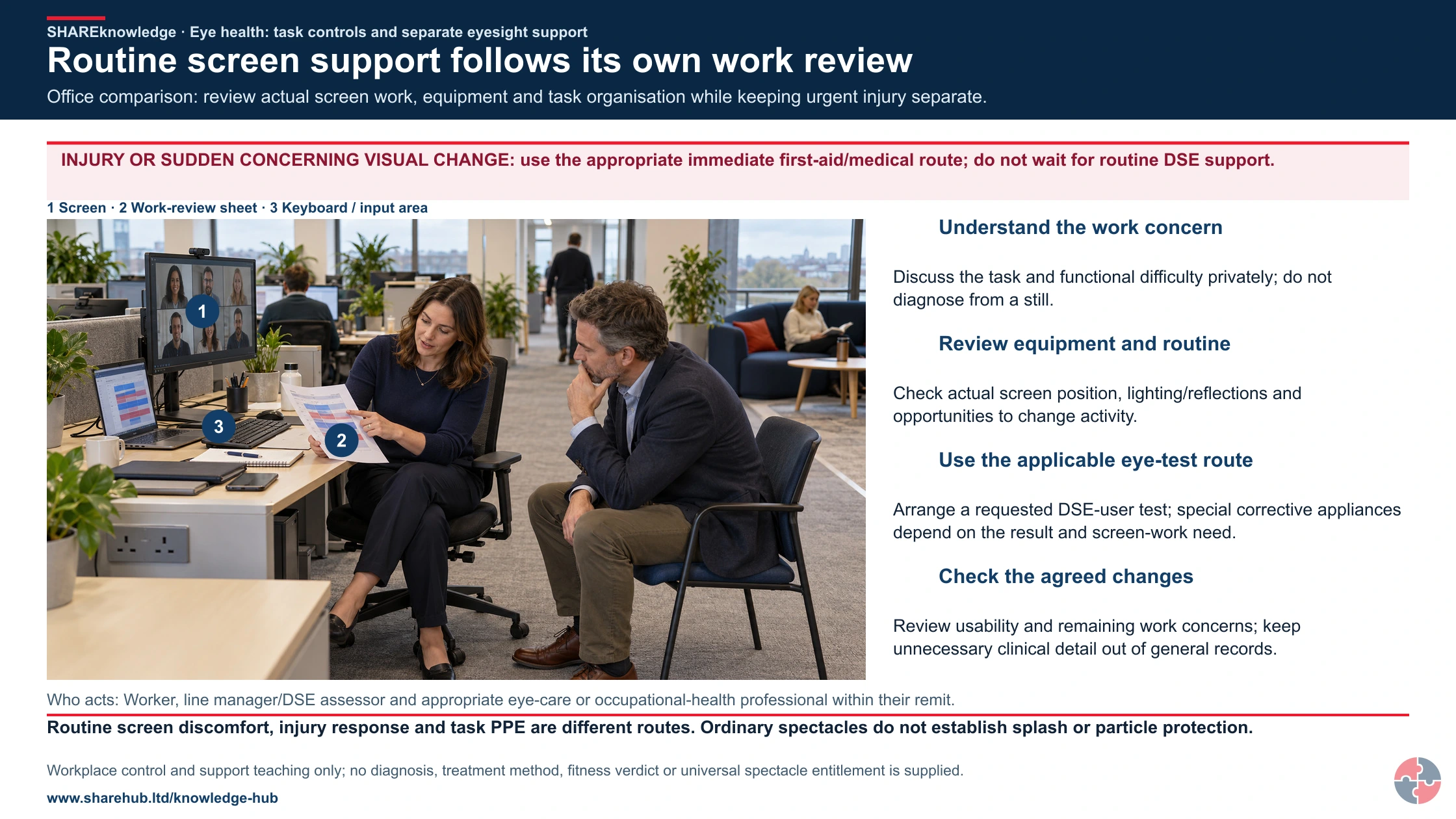
Routine screen support follows its own work review
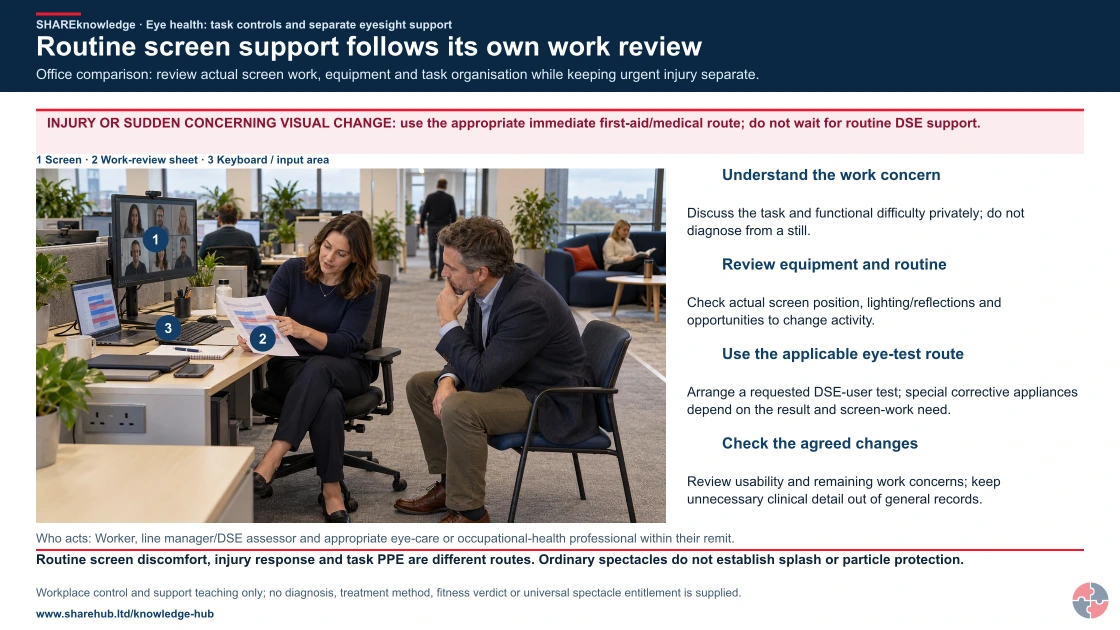
Full written explanation
INJURY OR SUDDEN CONCERNING VISUAL CHANGE: use the appropriate immediate first-aid/medical route; do not wait for routine DSE support.
The exact retained hybrid-office scene shows screens, separate input equipment and an inert work-calendar review. Native markers identify the screen, review sheet and input area; they do not diagnose symptoms, measure glare or establish a completed DSE assessment. Four checks connect confidential work concerns, the actual workstation and work routine, requested DSE-user eye-test arrangements and follow-up. A distinct urgent band prevents injury or sudden concerning change waiting for routine support. Existing normal anatomy and native DSE controls remain unchanged. Picture key: 1 Screen · 2 Work-review sheet · 3 Keyboard / input area. The separate process headings are unnumbered.
Office comparison: review actual screen work, equipment and task organisation while keeping urgent injury separate.
- Understand the work concern. Discuss the task and functional difficulty privately; do not diagnose from a still.
- Review equipment and routine. Check actual screen position, lighting/reflections and opportunities to change activity.
- Use the applicable eye-test route. Arrange a requested DSE-user test; special corrective appliances depend on the result and screen-work need.
- Check the agreed changes. Review usability and remaining work concerns; keep unnecessary clinical detail out of general records.
When the evidence does not fit: Routine screen discomfort, injury response and task PPE are different routes. Ordinary spectacles do not establish splash or particle protection.
Who acts: Worker, line manager/DSE assessor and appropriate eye-care or occupational-health professional within their remit.
Changed workplace
Metal fabrication: Control source hazards and select suitable residual protection.
Office screen work: Assess equipment, work routine and applicable requested eye tests.
Evidence check: Workplace control and support teaching only; no diagnosis, treatment method, fitness verdict or universal spectacle entitlement is supplied.
Urgent eye harm and routine screen support remain separate
Primary references: HSE: DSE eyes and eyesight testing · NHS: eye injuries and urgent care · HSE: managing risk using PPE
Open the complete HD image (new tab)Download image
Urgent eye harm and routine screen support remain separate
Primary references: HSE: DSE eyes and eyesight testing · NHS: eye injuries and urgent care · HSE: managing risk using PPE
Do not hide eye hazards inside broad headings such as 'PPE' or 'DSE'. A risk register should distinguish screen discomfort, chemical splash, flying particles, UV, optical radiation and safety-critical vision requirements.
For health and wellbeing cases, individual medical details should not be placed in general risk registers. The register should record workplace controls and functional safety considerations.
| Risk | Controls | Evidence |
|---|---|---|
| DSE eye strain | Assessment, lighting, breaks, eye-test route and training. | DSE records and worker feedback. |
| Chemical splash | Substitution, closed handling, goggles, face shield and eyewash. | COSHH assessment and eyewash checks. |
| Flying particles | Guarding, screens and impact-rated eyewear. | PUWER/PPE inspection records. |
| Dust irritation | LEV, wet methods and suitable goggles. | Exposure controls and PPE records. |
| UV or optical radiation | Enclosure, shielding and filter eyewear. | Optical radiation assessment. |
| Vision impairment affecting task | Functional assessment and reasonable adjustments. | Adjustment plan and review date. |
How could Riverside Leisure Ltd manage eye health and eyesight?

Riverside Leisure Ltd could manage eye health by linking DSE, pool chemicals, outdoor glare, maintenance tasks, PPE and worker support into one practical system.
A decision that changes work — part 1 of 3


Read the complete visual as text
- 1. Task and setting: Pool chemical handling and office screen work at a leisure centre; two different eye-risk routes.
- 2. People and prerequisites: Worker, first aider, supervisor, DSE assessor, PPE selector and occupational health contact; eyewash and emergency route are known.
- 3. Before the task: Control the chemical transfer and select suitable splash protection; assess screen setup, glare, breaks and eligible DSE-user status.
A decision that changes work — part 2 of 3


Read the complete visual as text
- 1. Check during work: If a splash occurs, start immediate irrigation and seek urgent medical help; for screen discomfort, review the workstation and ask about support without diagnosing.
- 2. Stop, hold or refer: Stop the hazardous task after a splash, missing protection or faulty eyewash; do not treat sudden visual change as routine DSE strain.
A decision that changes work — part 3 of 3


Read the complete visual as text
- 1. Completion and hand-back: Restore chemical controls, record the incident and first-aid follow-up; arrange requested DSE eye testing and review any work adjustment privately.
- 2. Retained evidence: Task assessment, eyewash and PPE checks, first-aid record, DSE assessment, eye-test arrangement and agreed support review.
Riverside Leisure Ltd (worked example). a leisure operator with swimming pools, gyms, reception desks, outdoor activity areas, maintenance teams, cleaning chemicals, lifeguards, instructors and customer-facing staff.
Riverside would manage eye health across very different tasks. Reception and administration staff would have DSE assessments, screen setup support, eye-test arrangements and lighting/glare reviews. Lifeguards and outdoor activity staff would manage glare, sunlight and visual scanning demands. Pool and cleaning teams would control chemical splash, vapour irritation and eyewash availability. Maintenance staff would manage drilling, grinding, dust and impact risks.
The business would not treat this as a poster campaign. It would maintain a DSE register, PPE matrix, COSHH assessments, eyewash inspection checks, safety eyewear standards, optical radiation controls where relevant, training records and a confidential adjustment process. Supervisors would check whether controls are used, comfortable and compatible with prescription needs.
Learning would come from DSE feedback, first-aid records, near misses, chemical splash reports, PPE non-use, worker wellbeing conversations and audit findings. Leadership would review recurring issues such as screen discomfort, missing eyewash checks, misting goggles, glare complaints or delays in eye-test reimbursement.
| Management activity | How Riverside would apply it | Evidence produced |
|---|---|---|
| Assess and analyse | Review DSE, chemical, UV, dust, impact and visual-demand risks by role. | Risk register, DSE records and COSHH assessments. |
| Implement controls | Improve lighting, provide eyewash, select suitable PPE and manage glare. | Action tracker and inspection records. |
| Train and brief | Train staff on DSE setup, chemical splash response and PPE use. | Training matrix and toolbox briefings. |
| Support individuals | Offer confidential conversations, eye-test route and reasonable adjustments. | Adjustment plan and review dates. |
| Check and audit | Audit DSE completion, eyewash checks, PPE condition and first-aid trends. | Audit findings and dashboard. |
| Procure well | Buy compatible prescription safety eyewear and anti-mist options where needed. | Procurement specification and issue records. |
| Learn and improve | Review incidents, complaints, non-use and worker feedback. | Lessons learned and revised standards. |
A decision that changes work
Task, material and setting: Pool chemical handling and office screen work at a leisure centre; two different eye-risk routes.
People and prerequisites: Worker, first aider, supervisor, DSE assessor, PPE selector and occupational health contact; eyewash and emergency route are known.
Before: Control the chemical transfer and select suitable splash protection; assess screen setup, glare, breaks and eligible DSE-user status.
During: If a splash occurs, start immediate irrigation and seek urgent medical help; for screen discomfort, review the workstation and ask about support without diagnosing.
Hold or stop: Stop the hazardous task after a splash, missing protection or faulty eyewash; do not treat sudden visual change as routine DSE strain.
Completion and hand back: Restore chemical controls, record the incident and first-aid follow-up; arrange requested DSE eye testing and review any work adjustment privately.
Evidence: Task assessment, eyewash and PPE checks, first-aid record, DSE assessment, eye-test arrangement and agreed support review.
What training and competence support eye health and eyesight at work?
Training should be tiered from general awareness to task-specific eye hazard control and manager support competence.
General awareness can cover screen setup, breaks, glare, reporting discomfort, eye-test routes and not ignoring eye symptoms. It is suitable for induction, digital learning or short wellbeing briefings.
Task-specific training is needed for people handling chemicals, generating dust, welding, using lasers or intense light, grinding, cutting or working outdoors. Supervisors need enough competence to select controls, check PPE and stop unsafe work.
Managers and HR need training on confidential conversations, DSE duties, reasonable adjustments, occupational health referral routes and avoiding assumptions about capability.
| Role | Learning | Demonstration | Assessor | Record | Reassess when |
|---|---|---|---|---|---|
| Worker | Recognise eye hazard and report symptoms | Show emergency route | Supervisor | Briefing | Task change |
| DSE assessor | Assess screen and work routine | Review actual workstation | Competent lead | Assessment | Complaint |
| Manager | Arrange test and support | Explain request route | HR/OH | Action record | Need change |
| PPE selector | Match protection to hazard | Trial fit and compatibility | Safety lead | Selection record | New product |
| First aider | Respond to splash or impact | Run scenario drill | Clinical lead | Training | Incident |
| Occupational health | Advise on function and privacy | Scope adjustment review | Clinical lead | Confidential advice | Persistent issue |
How does eye health and eyesight support health and safety study?
This topic supports study by connecting health, task design, DSE duties, exposure control, PPE and inclusive management.
For general health and safety study, eye health can appear in DSE, PPE, COSHH, wellbeing, disability, safety-critical work, first aid or occupational health scenarios. A strong answer explains both the legal route and the practical control.
For example, a screen-work scenario should mention DSE assessment, lighting, glare, breaks, eye-test entitlement and information/training. A chemical splash scenario should mention substitution, containment, COSHH, eyewash, PPE, first aid and review.
| Scenario | What to include | Practical evidence |
|---|---|---|
| DSE discomfort | Assessment, setup, breaks and eyesight-test route. | DSE checklist and eye-test process. |
| Chemical splash risk | COSHH, substitution, eyewash and splash protection. | COSHH assessment and eyewash checks. |
| Flying particles | Guarding, screens and suitable eye PPE. | Risk assessment and PPE issue record. |
| UV or optical radiation | Exposure assessment, shielding and filter eyewear. | Optical radiation controls. |
| Vision impairment | Confidential support and reasonable adjustments. | Adjustment plan and occupational health advice. |
| PPE non-use | Fit, comfort, misting, prescription and supervision. | Worker feedback and revised PPE selection. |
How do management frameworks support this topic?
HSE’s Plan–Do–Check–Act guidance helps assign ownership, deliver controls, check evidence and improve weak arrangements. Apply the relevant legal duties and task-specific technical evidence separately.
Official management guidance: HSE Managing for health and safety (HSG65)
| Framework | Status and scope | Contribution | Limit |
|---|---|---|---|
| HSE HSG65 | GB regulator management guidance | Plan, do, check and act with evidence of current control | Apply to the actual high-consequence scenario. |
What are the warning signs that eye health and eyesight are not being managed?
Warning signs include repeated eye discomfort, poor DSE completion, unsuitable eyewear, splash near misses, missing eyewash checks and ignored adjustment requests.
These signs can cause harm by allowing preventable strain, errors, injury or exclusion to continue. For example, misting goggles may lead to non-use; poor lighting may contribute to errors; missing eyewash checks may delay response after a splash; and unaddressed eyesight difficulty may affect driving or machinery tasks.
The response should be practical: talk privately, review the task, check the controls, involve competent advice where needed and record actions without collecting unnecessary medical detail.
| Warning sign | How it can cause harm | Response |
|---|---|---|
| Repeated headaches during screen work | Fatigue, errors and discomfort. | Review DSE, breaks and eye-test route. |
| Safety eyewear not worn | Impact or splash exposure. | Check fit, comfort, prescription and supervision. |
| Misting goggles | People may remove protection or lose visibility. | Select anti-mist or alternative protection. |
| Missing eyewash checks | Poor response to splash. | Inspect, replenish and brief workers. |
| Dust in eyes reported repeatedly | Controls are not containing exposure. | Review LEV, wet methods and PPE. |
| Glare complaints ignored | Visual discomfort and reduced task performance. | Review lighting, blinds and screen position. |
| Adjustment request delayed | Exclusion, distress or unsafe work. | Hold confidential discussion and review options. |
What do the acronyms and key terms mean?
Acronyms should be defined so readers can understand DSE, PPE and health routes clearly.
| Term | Meaning | Why it matters |
|---|---|---|
| COSHH | Control of Substances Hazardous to Health Regulations. | Relevant to chemical and dust eye hazards. |
| DSE | Display screen equipment. | Relevant to screen work and eye-test duties. |
| LEV | Local exhaust ventilation. | Controls dust, vapour or fume at source. |
| OH | Occupational health. | Provides work-focused health advice. |
| PPE | Personal protective equipment. | Includes eye and face protection where risk remains. |
| RPE | Respiratory protective equipment. | May be used alongside eye protection for dust or chemical hazards. |
| SDS | Safety data sheet. | Source of chemical eye hazard and first-aid information. |
| UV | Ultraviolet radiation. | Can harm eyes and skin depending on exposure. |
| Eye and eyesight test | A professional assessment of vision and eye health for an eligible DSE user. | The DSE duty is request-based and special corrective appliances depend on the test result. |