SHARE Knowledge Hub
Epicondylitis, tennis elbow and golfer’s elbow at work
Tennis elbow usually causes pain on the outside of the elbow; golfer’s elbow affects the inside. Repeated gripping, twisting, forceful tool use and limited recovery can contribute to upper-limb symptoms, but a manager cannot diagnose their cause from a job title. Review the actual task and symptoms early, reduce the loading and seek clinical or occupational-health advice when safe work or recovery is uncertain.
Understanding Epicondylitis, tennis elbow and golfer’s elbow at work
Epicondylitis describes elbow tendon pain conditions commonly called tennis elbow, usually on the outside of the elbow, and golfers elbow, usually on the inside. They can affect grip, lifting, wrist movement, tool use and sleep. They are clinical conditions with more than one possible cause; work can cause, contribute to or aggravate symptoms but should not be assumed to be the sole cause.
Why this matters at work
Risk rises when factors combine. A short task may be tolerable, while the same action over many hours, at a poor height, in cold conditions, with a heavy or poorly maintained tool, under time pressure and without breaks can substantially increase physical load. Task variation must use different muscle groups to create recovery; rotating between similar grip-intensive jobs may simply move the same risk around.
Epicondylitis is consistent with cumulative tendon loading where gripping, twisting, wrist extension or flexion, lifting, pushing, pulling or vibration demand exceeds present capacity and recovery. HSE identifies prolonged repetition, awkward or static posture, sustained or excessive force, extended task duration, poor environment and poor work organisation as upper-limb risk factors.
How organisations manage this in practice
For an assembly trigger trial, retain the initial rating rationale and the defect or design feature causing effort. Record elimination and engineering options considered, why the selected change is suitable, and any interim protection. Name an owner for tool maintenance, a production owner for staffing and breaks, and a competent authoriser for release. Record the specification and revision so a replacement part, changed material or new target can be checked against the same basis.
Manufacturing and heavy industry should target assembly, fastening, cutting, trimming, packing, maintenance, controls, handling and rework. Review tool balance, trigger force, component location, conveyor height, jigging, line speed, shift duration, quality rejects, changeover and maintenance. Strong evidence includes observation across shifts, ART/MAC assessments, design trials, tool maintenance, worker consultation and symptom trend review.
Audit a real task from its risk assessment to work on an ordinary shift. Confirm that the recorded tool and material match current use, the jig or aid is available and maintained, breaks and rotation occur, instructions are understood, and practical competency and supervision checks exist. Follow a recent change through authorisation, worker consultation, trial and effectiveness review. Record the sampled task, shift, people consulted and evidence limitations; one successful observation does not represent every task or operator.
Reject a tool trial that moves the strain elsewhere
In BuildOut’s powered-driver trial, the worker reports less twisting but more load while holding a heavier tool overhead. The supervisor rejects that version and asks the tool buyer and ergonomic assessor to trial support, reach and fixing changes together. Merely moving the worker to another task with similar gripping is not an effective reduction.
- Observe the task and loading — Review force, repetition, reach, posture, recovery and worker feedback.
- Change tools and work design — Test the whole task and actual work pace.
- Respond to symptoms — Pause worsening work and keep the clinical or occupational-health route available.
The supervisor owns the review at normal and peak demand and records the worker’s feedback, accepted change and next review. Stop a task that worsens symptoms or remains uncontrolled; persistent symptoms retain the clinical or occupational-health route. Do not turn the workplace trial into diagnosis or copied rehabilitation exercises.
Content amended 19 October 2026 by the SHARE Knowledge Hub editorial team. This records an editorial content change; the existing technical-review and approval status still applies.
Reduce grip and tool-reaction demand at the task
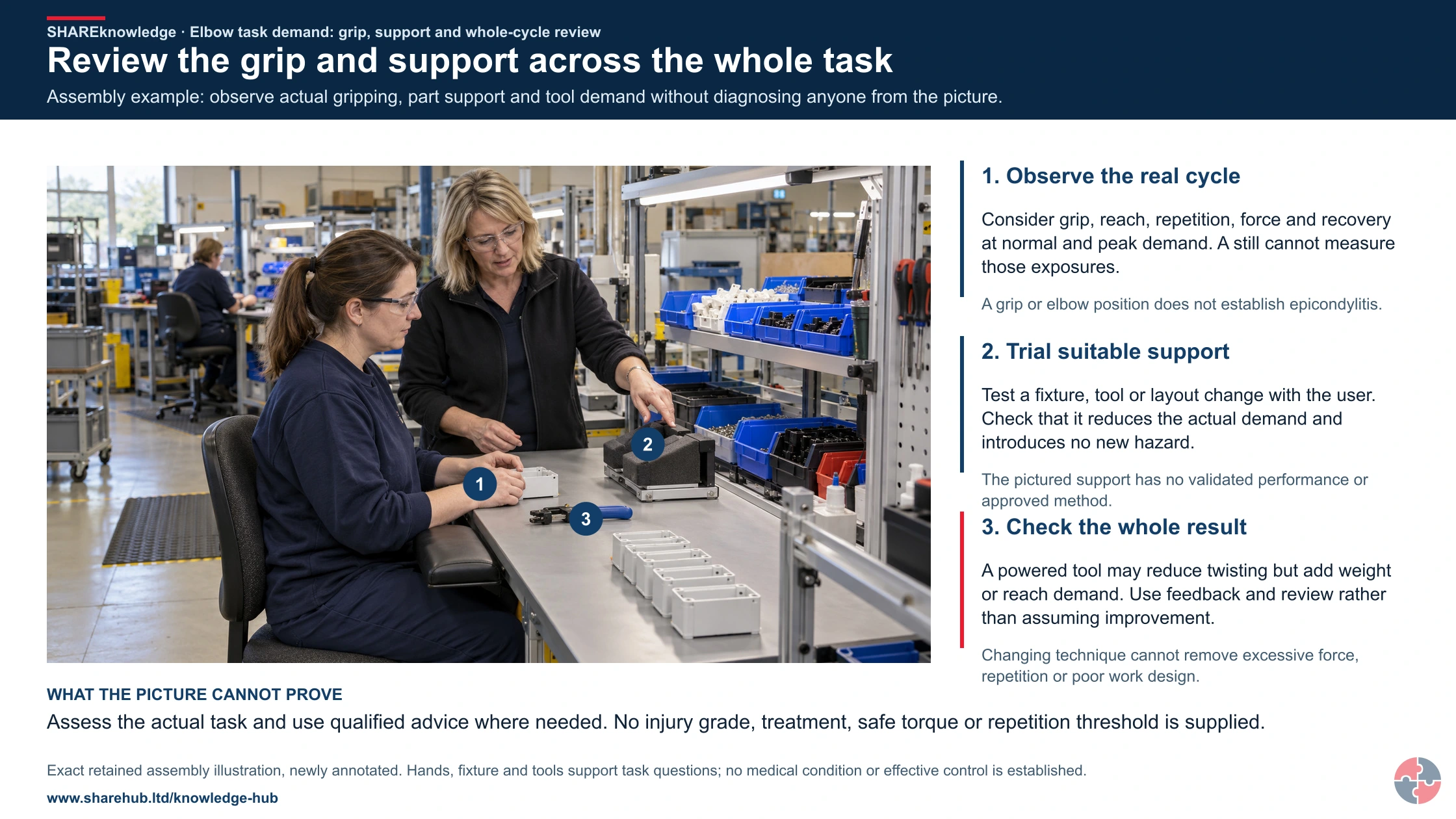
Medial and lateral elbow anatomy helps orient the lesson. A work trial considers the actual grip, reach and reaction forces without deciding the clinical cause of pain.
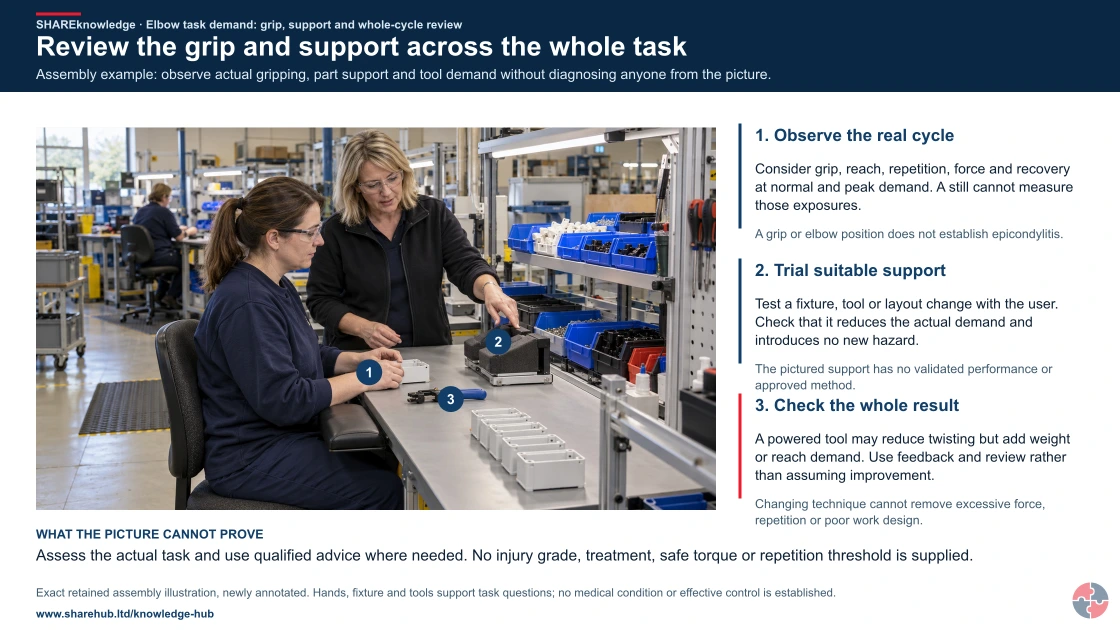
Review the grip and support across the whole task
Full written explanation
Assembly example: observe actual gripping, part support and tool demand without diagnosing anyone from the picture.
- Observe the real cycle. Consider grip, reach, repetition, force and recovery at normal and peak demand. A still cannot measure those exposures.
- Trial suitable support. Test a fixture, tool or layout change with the user. Check that it reduces the actual demand and introduces no new hazard.
- Check the whole result. A powered tool may reduce twisting but add weight or reach demand. Use feedback and review rather than assuming improvement.
Change the pathway
- No diagnosis from a task label. A grip or elbow position does not establish epicondylitis.
- A fixture is a proposal. The pictured support has no validated performance or approved method.
- Technique alone is incomplete. Changing technique cannot remove excessive force, repetition or poor work design.
Evidence check: Assess the actual task and use qualified advice where needed. No injury grade, treatment, safe torque or repetition threshold is supplied.
Reject a trial that transfers load; retain a separate clinical/OH route
Primary references: HSE: upper limb work demands and practical trials · NHS: tennis elbow information and qualified help
Open the complete HD image (new tab)Download image
Reject a trial that transfers load; retain a separate clinical/OH route
Primary references: HSE: upper limb work demands and practical trials · NHS: tennis elbow information and qualified help

Observe the demand
Look at force, grip, reach, repetition, duration and recovery across the real cycle.
Trial the task change
Assess suitable support, a fixture or tool/layout change with the user, checking new hazards and usability.
Review function
Use worker feedback and appropriate clinical advice for persistent or concerning symptoms.
An anatomy diagram does not establish an injury grade or prescribe exercises or treatment.
What is the advice boundary for epicondylitis?
This page gives workplace guidance, not medical diagnosis, treatment advice or legal advice.
What is the advice boundary for epicondylitis? — part 1 of 2


Read the complete visual as text
- This page gives workplace guidance, not medical diagnosis, treatment…: This page gives workplace guidance, not medical diagnosis, treatment advice or legal advice.
- Anyone with new, persistent, worsening or function-limiting elbow pain…: Anyone with new, persistent, worsening or function-limiting elbow pain should use appropriate NHS, GP, physiotherapy, musculoskeletal or occupational-health routes. Managers should not diagnose tennis elbow, golfer's elbow or any other health condition.
What is the advice boundary for epicondylitis? — part 2 of 2


Read the complete visual as text
- The employer's role is to understand how work may…: The employer's role is to understand how work may contribute to symptoms, review risk factors, adjust tasks where needed, protect confidentiality and involve competent advice where the work-health question is unclear.
- Health information should be handled carefully. Records should focus…: Health information should be handled carefully. Records should focus on functional impact, agreed adjustments, restrictions, review dates and work controls rather than unnecessary clinical detail.
Anyone with new, persistent, worsening or function-limiting elbow pain should use appropriate NHS, GP, physiotherapy, musculoskeletal or occupational-health routes. Managers should not diagnose tennis elbow, golfer's elbow or any other health condition.
The employer's role is to understand how work may contribute to symptoms, review risk factors, adjust tasks where needed, protect confidentiality and involve competent advice where the work-health question is unclear.
Health information should be handled carefully. Records should focus on functional impact, agreed adjustments, restrictions, review dates and work controls rather than unnecessary clinical detail.
What should a manager do when elbow symptoms are reported?
Ask which actions are painful, check whether the task can be done safely, and reduce grip force or repetition while the worker seeks appropriate clinical advice. Do not diagnose the condition or assume that work is its sole cause.
A fit-out worker reports outer-elbow pain during repeated screwdriving. The supervisor pauses that task, checks tool and fixing choice, trials a supported powered driver and a different task mix, and agrees a review date. If symptoms persist, the worker follows the NHS route and the employer considers occupational-health advice.
What are the key facts about epicondylitis?
The key facts are that epicondylitis usually involves tendon overload, can be work-aggravated and needs early task-focused action.
Outside or inside elbow
Tennis elbow usually affects the outside of the elbow; golfer's elbow usually affects the inside.
Overload, not only sport
The names are misleading because many cases relate to work, hobbies or ordinary gripping and twisting activities.
Risk factors combine
Repetition, force, awkward posture, vibration, long duration and poor recovery are more concerning when several occur together.
Symptoms can persist
Many cases improve, but recovery can be slow and symptoms can last months or longer.
Task change matters
Reducing aggravating loads usually matters more than simply telling the worker to cope better.
Clusters need investigation
Several similar symptoms in one job or team suggest a shared work design problem.
What is epicondylitis, tennis elbow and golfer's elbow?
Epicondylitis is a painful condition affecting tendon attachments around the elbow where forearm muscles attach to bone.
Tennis elbow, or lateral epicondylitis, usually affects the common extensor tendon origin on the outside of the elbow. These forearm muscles help extend the wrist and fingers, and they are loaded during gripping, lifting, mouse use, tool use and twisting tasks. See NHS tennis elbow. See NHS inform golfer’s elbow.
Golfer's elbow, or medial epicondylitis, usually affects the flexor-pronator tendon origin on the inside of the elbow. These tissues are loaded during gripping, wrist flexion, forearm rotation, pulling, lifting and forceful hand work.
In occupational health, it is more useful to think in terms of tendon load and recovery than the label alone. The same elbow may be aggravated by forceful grip, repeated wrist movement, vibration, cold working conditions, poor tool design or a sudden increase in workload.
| Type | Typical pain area | Common aggravating actions |
|---|---|---|
| Lateral epicondylitis / tennis elbow | Outside of the elbow, sometimes spreading into the forearm. | Gripping, lifting, moving the wrist, twisting, mouse use and tool use. |
| Medial epicondylitis / golfer's elbow | Inside of the elbow, sometimes spreading down the forearm. | Gripping, wrist flexion, making a fist, lifting, pulling and forearm rotation. |
| Epicondylar tendinopathy | Broader clinical description for tendon overload around the epicondyle. | Repeated mechanical loading without enough recovery. |
| Work-related upper limb disorder | Wider HSE category including shoulders, arms, wrists, hands, fingers and neck. | Repetition, force, posture, vibration, DSE and poor work organisation. |
What symptoms and work effects can epicondylitis cause?
Epicondylitis can cause elbow pain, tenderness, reduced grip, forearm pain, stiffness and difficulty with everyday work tasks.
Symptoms often develop gradually rather than after one clear accident. A worker may first notice pain when lifting a kettle, turning a handle, shaking hands, holding a tool, using a mouse, gripping materials or straightening the arm. See NHS tennis elbow. See NHS inform golfer’s elbow.
The work impact can be significant even when the condition is not dangerous in itself. Pain can slow tasks, reduce grip reliability, make manual handling harder, affect sleep, reduce tolerance for repetitive work and create compensating movements that stress other parts of the arm or shoulder.
| Symptom or effect | What it may suggest | Workplace response |
|---|---|---|
| Outside elbow pain | Possible lateral epicondylitis or extensor tendon overload. | Review gripping, lifting, mouse and wrist-extension tasks. |
| Inside elbow pain | Possible medial epicondylitis or flexor-pronator overload. | Review pulling, wrist flexion, pronation and forceful grip tasks. |
| Reduced grip strength | Tendon pain may be limiting hand force. | Reduce loads and tool force; consider aids. |
| Pain with twisting | Forearm rotation may be aggravating symptoms. | Review screwdriver, valve, wringing and handle-turning tasks. |
| Pain that affects sleep or persists | Symptoms may need clinical or occupational-health input. | Signpost to appropriate support and review work exposure. |
| Several workers report symptoms | Task design may be a shared risk factor. | Investigate the task and consult workers. |
How can work mechanisms contribute to epicondylitis?
Work can contribute by repeatedly loading the forearm tendons faster or harder than they can recover.
Tendons adapt to load, but repeated high or poorly distributed load can create pain and reduced function. The risk is not repetition alone. It is the combination of how often the movement happens, how much force is used, how far the wrist or elbow moves from neutral, how long the exposure lasts, how much recovery is available and whether tools or workstations fit the person and the task.
HSE upper limb disorder guidance highlights repetition, awkward posture, sustained or excessive force, long duration without suitable rest, handheld power-tool use, work organisation and environmental factors. Psychosocial factors such as high workload, tight deadlines and low control can also influence how symptoms develop, are reported and recover.
| Mechanism | How it loads tissues | Example |
|---|---|---|
| Repeated gripping | Repeated contraction of forearm muscles loads tendon attachments. | Holding pliers, trowels, knives, scanners, tools or stock. |
| Forceful grip | Higher force increases tendon load and fatigue. | Tight fasteners, heavy materials, poor handles or blunt tools. |
| Forearm twisting | Pronation and supination load muscles attaching near the elbow. | Screwdriving, valve turning, wringing and rotating parts. |
| Awkward wrist posture | Wrist flexion, extension or deviation changes tendon loading. | Working with bent wrists, poor mouse position or poorly placed materials. |
| Vibration | Hand-held vibrating tools can combine with grip force and posture. | Grinding, drilling, breaking, sanding or vibrating equipment. |
| Low recovery | Tissues have insufficient time to settle between exposures. | High pace, overtime, low task variation or few breaks. |

How does a working hand move, and what changes in nerve and tendon problems?
Interactive anatomy · Tendons, nerves and cushioning tissues · Updated 2026-10-23
Read all anatomy and process explanations without the viewer
General anatomy and example mechanisms, not diagnosis, treatment choice or fitness-for-work assessment. These are examples of mechanisms. Similar symptoms can have different causes. Self-provocation or nerve-tapping tests Exercise or stretching prescriptions Automatic symptom classification or a generic RSI lesion Treatment, return-to-work clearance or a task-based diagnosis Unreviewed shoulder, medial-elbow or trigger-finger damage overlays The prepatellar-bursitis route requires the dedicated labelled front-of-knee inset. A wrist/shoulder substitute is not suitable. Prompt-help text remains outside the model and scenarios.
Forearm flexor muscles
These muscles contract and pull through tendons to bend the fingers and thumb. The forearm flexor muscles generate the pull transmitted through tendons into the fingers and thumb. As the illustrated grip closes, follow the muscle region towards those slender connections. Their action bends the finger joints; the tendon transfers the pull rather than generating it. The visible shape change makes this relationship clearer and does not measure muscle effort. Gloucestershire Hospitals NHS Foundation Trust: Flexor Tendon Injuries
Flexor tendons
These tendons carry muscle force into the hand. Flexor tendons connect forearm muscles with bones in the hand. Their glide lets a muscle’s pull bend the finger joints while guided paths keep the tendons near the skeleton. Nine flexor tendons pass through the carpal tunnel. Compare their mechanical role with the nearby median nerve, which carries signals rather than pulling on bone. Gloucestershire Hospitals NHS Foundation Trust: Flexor Tendon Injuries · Whittington Health NHS Trust: Carpal Tunnel Syndrome
Tendon sheath
The sheath surrounds the tendon and supports smooth glide. A tendon sheath surrounds and supports a tendon as it glides. Along the fingers, pulley structures help keep the tendon close to the bones so its pull acts along a guided route. Watch the tendon move relative to its surroundings. A sheath is part of that supporting passage, not another muscle producing the same pull. Gateshead Health NHS Foundation Trust: Trigger Finger/Thumb Release Surgery
Carpal bones
Eight small carpal bones make up the wrist. Their curved arrangement forms the bony side of the carpal tunnel. The transverse carpal ligament closes the tunnel across the palm side. King’s College Hospital NHS Foundation Trust: Carpal tunnel syndrome — patient information · Kent Community Health NHS Foundation Trust: Carpal tunnel syndrome guide for patients
Transverse carpal ligament
This strong ligament spans the palm side of the wrist. It forms the roof above the median nerve and flexor tendons. Separating layers in the model helps reveal these relationships. King’s College Hospital NHS Foundation Trust: Carpal tunnel syndrome — patient information · Whittington Health NHS Trust: Carpal Tunnel Syndrome
Median nerve
The median nerve carries signals for feeling and some thumb movement. The median nerve carries sensory information from the thumb, index and middle fingers and part of the ring finger, and helps control some thumb muscles. Follow its branches beyond the shared wrist passage. The cyan travel cue represents communication; it is not a visible electrical flash, a nerve-speed measurement or a map for diagnosing altered sensation. NHS: Carpal tunnel syndrome · Kent Community Health NHS Foundation Trust: Carpal tunnel syndrome guide for patients · Whittington Health NHS Trust: Carpal Tunnel Syndrome
Thumb tendon: APL
Abductor pollicis longus helps move the thumb away from the hand. APL passes along the thumb side of the wrist through the first dorsal compartment. Follow it towards the base of the thumb. Ashford and St Peter’s Hospitals NHS Foundation Trust: De Quervains · Wrightington, Wigan and Leigh Teaching Hospitals NHS Foundation Trust: De Quervain’s Syndrome
Thumb tendon: EPB
Extensor pollicis brevis helps straighten the thumb. EPB travels beside APL through the first dorsal compartment on the thumb side of the wrist. Ashford and St Peter’s Hospitals NHS Foundation Trust: De Quervains · Wrightington, Wigan and Leigh Teaching Hospitals NHS Foundation Trust: De Quervain’s Syndrome
First dorsal compartment
A small passage on the thumb side of the wrist guides APL and EPB. The tendons normally glide through their sheath here. This is the location of the De Quervain’s example; the carpal tunnel lies on the palm side. Ashford and St Peter’s Hospitals NHS Foundation Trust: De Quervains · Wrightington, Wigan and Leigh Teaching Hospitals NHS Foundation Trust: De Quervain’s Syndrome
Outer elbow tendon attachment
Forearm tendons attach to bone near the outside of the elbow. Forearm extensor tendons attach near the bony point on the outside of the elbow, the lateral epicondyle. These muscles extend and help steady the wrist during gripping. Link the closer attachment view with the tool task to see why an elbow structure matters during hand use. Pain here does not establish a torn or detached tendon. NHS: Tennis elbow · Berkshire Healthcare NHS Foundation Trust: Advice and resources: Lateral elbow tendinopathy · Newcastle Hospitals NHS Foundation Trust: Tennis elbow
Prepatellar bursa
A fluid-containing sac helps reduce friction at the front of the kneecap. The prepatellar bursa lies between the kneecap and the overlying soft tissues, outside the knee joint. Its fluid-containing structure helps cushioning and smooth glide over bone. Compare the closer view with the worker’s knee contact in the floor task. The normal view locates the sac; it does not diagnose inflammation or measure pressure during kneeling. NHS: Bursitis · Leeds Community Healthcare NHS Trust: About pre-patella bursitis
Open the complete process transcript
The process, step by step
Watch muscles pull and tendons glide
The forearm muscles provide much of the pull that closes the fingers around an object. When these muscles contract, their tendons transmit force into the hand and pull on the finger bones, bending the joints. The tendons glide along guided paths rather than pulling away from the fingers like loose cords. Follow the muscle-to-tendon connection as the illustrated grip closes, then follow the return movement as the hand opens. The model enlarges this motion so that you can connect the movement at the fingers with the working structures farther up the forearm. Gloucestershire Hospitals NHS Foundation Trust: Flexor Tendon Injuries · Gateshead Health NHS Foundation Trust: Trigger Finger/Thumb Release Surgery
What to watch: Look from the forearm muscle bellies towards the slender flexor tendons, then follow their paths into the fingers around the handle.
Why it matters: Tendons transfer a muscle’s mechanical pull to bone, allowing joints to move. Guided tendon paths help direct that pull through the hand; the nerve has a different role in signalling.
Explore this step: Pause during the grip and trace one tendon from its forearm muscle towards the finger.
Watch tendon glide through the wrist
The carpal tunnel is a passage at the wrist, with a bony boundary formed by the carpal bones and a strong ligament spanning the palm side. Nine flexor tendons and the median nerve pass through this shared space. The tendons transmit the pull that helps bend the fingers and thumb; the nerve carries signals. Follow the tendon movement beneath the ligament roof and compare it with the nerve’s position. The cutaway separates the layers for learning, but these structures normally remain close together within a connected wrist. King’s College Hospital NHS Foundation Trust: Carpal tunnel syndrome — patient information · Kent Community Health NHS Foundation Trust: Carpal tunnel syndrome guide for patients · Whittington Health NHS Trust: Carpal Tunnel Syndrome
What to watch: Find the carpal bones and ligament roof, then compare the flexor tendons with the median nerve passing through the same wrist passage.
Why it matters: The tunnel brings several structures through a compact part of the wrist. Understanding their different functions explains why tendon glide and nerve signalling must be explored separately even though they occupy nearby space.
Explore this step: Use the labels to identify the tunnel boundary, a tendon and the nerve without changing to an injury example.
Follow the nerve signal
The median nerve links part of the hand with the nervous system. It carries sensory information from the thumb, index finger, middle finger and part of the ring finger, and helps control some muscles at the base of the thumb. Follow the cyan travelling cue along the nerve and into its branches. This colour illustrates signalling; a real nerve does not visibly light up. Compare that pathway with the tendons beside it: tendons transfer mechanical pull, whereas the nerve carries information. The simplified branches are a teaching map, not a test of a person’s sensation. Kent Community Health NHS Foundation Trust: Carpal tunnel syndrome guide for patients · Whittington Health NHS Trust: Carpal Tunnel Syndrome
What to watch: Follow the cyan cue along the median nerve through the wrist into the palm, keeping the adjacent tendons in view.
Why it matters: Sensation helps the nervous system receive information from the hand, while motor signals contribute to thumb control. Distinguishing information from mechanical pull makes the coordinated hand function easier to understand.
Explore this step: Compare the nerve cue with tendon glide and explain which one represents information and which represents force transfer.
Follow the thumb tendons
Two tendons run along the thumb side of the wrist through the first dorsal compartment. They connect forearm muscles to the thumb and glide as the thumb changes position. Abductor pollicis longus, labelled APL, helps move the thumb away from the hand. Extensor pollicis brevis, labelled EPB, helps straighten it. Follow the two labelled paths rather than assuming they pass through the palm-side carpal tunnel. The model brings their movement and location into view so that the separate actions and their shared guiding passage can be understood together. Ashford and St Peter’s Hospitals NHS Foundation Trust: De Quervains · Wrightington, Wigan and Leigh Teaching Hospitals NHS Foundation Trust: De Quervain’s Syndrome
What to watch: Find APL and EPB beside the thumb side of the wrist, then follow both labelled paths through the first dorsal compartment.
Why it matters: Different tendon actions contribute to positioning the thumb for hand use. Their shared passage guides glide, but the two tendons retain different attachments and functions; they are not interchangeable parts.
Explore this step: Select each tendon in turn and connect its name with the thumb movement described in the explanation.
Follow the elbow during a tool task
A tool task involves more than the muscles that visibly close the fingers. Forearm extensor muscles also help hold the wrist steady while the hand grips. Follow these muscles back towards their tendon attachment near the bony point on the outside of the elbow, called the lateral epicondyle. Watch the technician’s illustrated grip and tool turn, then use the closer elbow view to connect the activity with this attachment. A moving tool does not demonstrate a damaged tendon: the normal task and the separate tissue example explain different things. NHS: Tennis elbow · Newcastle Hospitals NHS Foundation Trust: Tennis elbow
What to watch: Watch the hand grip the screwdriver, then follow the working forearm towards the tendon attachment on the outside of the elbow.
Why it matters: Wrist stability helps the hand grip and use an object, so a tendon attachment near the elbow can be involved in a hand task. Movement alone does not show injury or quantify the demand.
Explore this step: Switch between Work activity and Elbow cutaway and describe how the two views relate to the same task.
Locate the bursa in front of the kneecap
The prepatellar bursa is a small fluid-containing sac in front of the kneecap. It helps the overlying soft tissues move across the bone with less friction. First locate the front of the knee in the floor-laying task, then follow the linked closer view to the thin sac outside the knee joint. This shows where contact during kneeling relates to the anatomy; the bursa is not a cushion inside the joint. The normal location lesson remains separate from the example of bursal irritation, and the short model sequence does not predict when symptoms would occur. Leeds Community Healthcare NHS Trust: About pre-patella bursitis · NHS Musculoskeletal Matters Dorset: Prepatellar bursitis
What to watch: Locate the kneeling worker’s front-of-knee contact, then find the thin bursa between the kneecap and the overlying soft tissues in the close view.
Why it matters: Glide between soft tissue and bone is a different function from movement inside the knee joint. Locating the bursa makes the relevant contact area clear without inferring tissue damage from posture alone.
Explore this step: Compare Floor-laying task with Knee cutaway and identify which side of the kneecap contains the bursa.
Mechanisms and their limits
Lateral elbow: tendon problem The wrist extensor muscles help lift the wrist and work during gripping. Their tendons attach at the outside of the elbow. Repeated or excessive gripping and twisting can contribute to pain at this attachment. The local colour and pattern identify a possible tendon problem at the outer elbow. They do not show measured tissue damage, a rupture or a simple inflammation process. Pain intensity does not reveal tissue damage. Similar symptoms can have different causes. This outer-elbow view does not illustrate golfer’s elbow on the inside. NHS: Tennis elbow · Berkshire Healthcare NHS Foundation Trust: Advice and resources: Lateral elbow tendinopathy · NHS MyHealth Devon: Golfers & Tennis Elbow · Newcastle Hospitals NHS Foundation Trust: Tennis elbow
HSE: reduce force, repetition and prolonged postures
NHS: lateral elbow tendinopathy
Lateral elbow: tendon problem — follow the anatomy
Look at: The forearm tendon attachment at the outside of the elbow.
What changes: Repeated or excessive loading can make the tendon attachment painful.
Why it matters: Gripping or lifting may reproduce pain around the outer elbow.
What to do: Reduce force and repetition, improve tools and working position, and seek advice when needed.
Repeated gripping and twisting at a repair bench
A technician grips a screwdriver and repeatedly turns a fastener in a housing at a repair bench. A teaching time jump moves from repeated work demands to a separate possible tendon-problem example. It does not show an inevitable progression, and no number of tool turns or seconds predicts pain or tissue change. Similar elbow pain can have different causes. The local colour and pattern are teaching cues, not a diagnosis or a measure of damage. Improving the task does not depict an affected tendon instantly healing.
Watch the grip and turning task Watch the technician keep hold of a screwdriver while turning a fastener in a housing at the repair bench. Check the reach, grip force, tool fit and number of repeated turns. Health and Safety Executive: Upper limb disorders · NHS: Tennis elbow
Follow the working muscle and tendon The wrist extensor muscles work during gripping. Follow the highlighted forearm region to its tendon attachment on the outside of the elbow. Repeated force and turning can increase the demand on this unit. NHS: Tennis elbow · Berkshire Healthcare NHS Foundation Trust: Advice and resources: Lateral elbow tendinopathy · Newcastle Hospitals NHS Foundation Trust: Tennis elbow
Compare a possible local tendon problem The closer view marks the tendon near its outer-elbow attachment. Repeated or excessive loading can contribute to pain and sensitivity here. The local colour and pattern are illustrative; the tendon stays attached. The task alone does not establish a diagnosis. Berkshire Healthcare NHS Foundation Trust: Advice and resources: Lateral elbow tendinopathy · NHS MyHealth Devon: Golfers & Tennis Elbow · Newcastle Hospitals NHS Foundation Trust: Tennis elbow
Improve the task and follow up Compare the improved position and support of the workpiece. Review tool fit, reduce unnecessary grip and twisting force, and vary the work. These changes reduce demands, while persistent or worsening symptoms still need appropriate advice. Health and Safety Executive: Upper limb disorders · NHS: Tennis elbow
Read the practice situations and all answer explanations
UL-Q1: Which change should lead the review?
A packer repeats a forceful grip for long periods.
Only teach stretching. — Stretching alone leaves the work demands in place. Review the task, tools, layout and organisation with workers.
Review force, repetition, workstation fit, task duration and recovery opportunities. — Yes. Address the demands creating risk and check that changes work in practice. Early symptom reporting and suitable occupational-health advice also matter.
Use a wrist-posture score to diagnose the condition. — An ergonomic assessment helps identify work risks. It does not diagnose a medical condition.
Health and Safety Executive: Upper limb disordersUL-Q2: Which structure is central to the carpal-tunnel card?
Compare the three labelled locations in this teaching model.
The median nerve under pressure at the wrist. — Correct. Select UL-06 in the front-of-wrist view. It is a nerve-compression example.
The thumb-side sheath containing APL and EPB. — That is the thumb-side first dorsal compartment: UL-07 to UL-09 in the De Quervain’s view, not the carpal tunnel.
A swollen bursa in front of the kneecap. — That is UL-11 in the dedicated knee inset, relevant to prepatellar bursitis.
NHS: Carpal tunnel syndrome · Ashford and St Peter’s Hospitals NHS Foundation Trust: De Quervains · NHS: Bursitis · Leeds Community Healthcare NHS Trust: About pre-patella bursitisUL-Q3: What can this model tell them?
A learner notices pain at the outside of their elbow.
The animation proves a tendon has ruptured. — The model does not establish rupture or show a person’s tissues. Sudden severe injury or loss of function needs appropriate clinical advice.
This site may be relevant to lateral elbow tendinopathy, but an image cannot diagnose the person. — Correct. The location helps explain one example. Similar symptoms have different causes, and persistent or worsening symptoms deserve clinical advice.
All upper-limb pain is carpal tunnel syndrome. — Different nerves, tendons, joints and other structures can cause symptoms. The carpal-tunnel example is only one mechanism.
NHS: Tennis elbow · NHS: Tendonitis · Berkshire Healthcare NHS Foundation Trust: Advice and resources: Lateral elbow tendinopathySources and how the model is made
The opening images are AI-generated anatomical illustrations. The interactive 3D models and labelled SVG diagrams use original procedural artwork. These teaching images are not medical scans or diagnostic tools. Source references support the learner explanations and do not grant artwork rights.
- Health and Safety Executive: Upper limb disorders — Multiple work factors, task redesign, force/repetition/posture/duration, worker involvement and early reporting. Risk scores are not diagnosis.
- NHS: Carpal tunnel syndrome — Median-nerve pressure, potential sensory and functional effects, varied contributors and clinical assessment. No treatment or self-test generated.
- King’s College Hospital NHS Foundation Trust: Carpal tunnel syndrome — patient information — Bony tunnel boundary and transverse carpal-ligament roof. Text only, no third-party credited artwork copied. Printed review date September 2026 requires recheck at clinical sign-off; corroborates NHS anatomy.
- Ashford and St Peter’s Hospitals NHS Foundation Trust: De Quervains — APL and EPB actions and thumb-side first dorsal compartment. Indexed primary-page text rechecked, updated 28 April 2026; corroborated by directly retrieved UL8. No treatment recommendations or artwork copied.
- NHS: Tennis elbow — Outer-elbow location, tendon attachment and possible repeated gripping/twisting context. More precise tendinopathy wording corroborated by UL12/UL14; no blanket inflammation claim.
- NHS: Bursitis — Fluid-sac cushioning, inflammation and pressure-reduction context. Printed next-review date 30 October 2026 should be rechecked at sign-off.
- NHS: Tendonitis — General tendon role and urgent professional advice for severe pain or suspected rupture. Printed next-review date June 2026 is overdue: recheck before clinical approval. No treatment/exercise regimen reused.
- Wrightington, Wigan and Leigh Teaching Hospitals NHS Foundation Trust: De Quervain’s Syndrome — Directly retrieved January 2026 leaflet, expiry January 2028: APL/EPB, thumb-side first dorsal compartment and constrained sheath glide. Anatomy/mechanism only; no exercises or artwork copied.
- Gloucestershire Hospitals NHS Foundation Trust: Flexor Tendon Injuries — Directly retrieved: flexor tendons connect forearm muscles to finger bones and transmit their pull. Used for normal function only; no injury prognosis, treatment instructions or artwork reused.
- Gateshead Health NHS Foundation Trust: Trigger Finger/Thumb Release Surgery — Directly retrieved normal tendon/sheath distinction and guiding finger pulleys only. Printed review date September 2026 remains overdue; no trigger-finger overlay, surgical advice or exercise regimen reused.
- Ashford and St Peter’s Hospitals NHS Foundation Trust: Carpal Tunnel — Median-nerve sensory/motor role and flexor tendons within the tunnel. Indexed primary text verified, updated 28 April 2026; direct retrieval failed. Recheck live source at clinical sign-off.
- Berkshire Healthcare NHS Foundation Trust: Advice and resources: Lateral elbow tendinopathy — Painful forearm tendon attachment near the outside of the elbow and possible repetitive work demands. No treatment regimen, recovery prediction or artwork copied.
- Leeds Community Healthcare NHS Trust: About pre-patella bursitis — Dedicated bursa in front of kneecap, cushioning/glide, kneeling/direct injury/infection and urgent GP assessment for fever or feeling unwell. No treatment selection.
- NHS MyHealth Devon: Golfers & Tennis Elbow — Forearm tendon attachments and tendinopathy wording: not equated with simple inflammation. No rehabilitation or prognosis claims reused.
- NHS Musculoskeletal Matters Dorset: Prepatellar bursitis — Front-of-knee friction-reducing sac; prolonged kneeling, direct injury and infection as distinct possible causes. No medicine or cooling regimen reused.
- Kent Community Health NHS Foundation Trust: Carpal tunnel syndrome guide for patients — Directly retrieved, last edited 9 July 2025: eight carpal bones, ligament boundary, median-nerve sensory/motor role and tendon passage. Anatomy facts paraphrased only; no clinical regimen or artwork copied.
- Whittington Health NHS Trust: Carpal Tunnel Syndrome — Directly retrieved, updated 7 August 2025: nine tendons and median nerve in the carpal tunnel, nerve function and cautious attribution of work contribution. Normal anatomy corroborated by Sherwood Forest Hospitals NHS leaflet PIL202409-06-CTS; that leaflet has a September 2026 review date. No treatment recommendations or artwork reused.
- Newcastle Hospitals NHS Foundation Trust: Tennis elbow — Directly retrieved, last updated 3 November 2025: forearm tendons attach at the lateral epicondyle; these muscles extend the wrist and take part in gripping. Used for extensor anatomy and task explanation only; no treatment regimen, work-clearance advice or artwork copied.
- Health and Safety Executive: Lower limb disorders — Directly retrieved, updated 27 March 2025: repeated kneeling and knee bursitis; review working methods, mechanical aids, task variation, breaks, seating where possible, and suitable knee pads or matting. Used for prevention principles only; no numerical kneeling threshold, diagnosis or guarantee of protection.
Which work factors increase epicondylitis risk?
Risk increases when repetition, force, posture, duration, vibration, environment and work organisation combine.
Assessors should look at the whole task, not the job title. Two people with the same job title may have different exposure depending on tool condition, bench height, material weight, production pace, grip size, access, temperature, rotation and how much control they have over breaks. See HSE upper limb disorders.
Sudden change is important. A new process, new tool, new target, staff shortage, heavier material, colder work area or loss of mechanical aid can turn an acceptable task into an aggravating one.
| Risk factor | What to check | Potential improvement |
|---|---|---|
| Repetition | Same hand or arm action repeated for prolonged periods. | Rotate tasks, vary work, redesign sequence or automate. |
| Force | Grip force, load weight, friction, blunt tools or high resistance. | Sharpen/maintain tools, reduce resistance, use powered aids. |
| Posture | Wrist, elbow and shoulder away from neutral. | Change height, reach, layout, tool shape or fixture position. |
| Duration | Long exposure without recovery. | Introduce micro-pauses, job rotation and paced recovery. |
| Vibration | Handheld tool vibration combined with grip force. | Select lower-vibration tools, maintain equipment and manage exposure. |
| Environment | Cold, poor lighting, cramped areas or wet work. | Improve temperature, lighting, access and grip conditions. |
| Psychosocial factors | High workload, low control, tight deadlines or poor reporting culture. | Improve planning, consultation and early reporting trust. |
Which jobs and tasks may be higher risk for epicondylitis?
Higher-risk work usually involves repeated gripping, twisting, lifting, tool use, awkward forearm posture or sustained hand force.
Construction and trades can involve screwdriver use, drilling, grinding, cutting, lifting boards, carrying materials, pulling cables, plastering, decorating and prolonged handheld tool work. Manufacturing and food processing can involve repetitive assembly, cutting, packing, trimming, sorting or quality checks. Offices can also matter where DSE setup or mouse-intensive work aggravates symptoms.
The purpose is not to label whole industries as unsafe. It is to identify the specific task pattern that is loading the tendon and then change that task.
| Work area | Task pattern | What to review |
|---|---|---|
| Construction trades | Repeated tool grip, overhead work, awkward access and manual handling. | Tool selection, task rotation, fixtures, access and work planning. |
| Manufacturing and assembly | High repetition, small parts, hand force and pace pressure. | Cycle times, jigs, automation, breaks and worker feedback. |
| Food processing | Cutting, trimming, packing and cold environments. | Knife sharpness, grip force, temperature, rotation and pace. |
| Maintenance | Tight fasteners, valves, pipework, awkward reaches and emergency repairs. | Correct tools, access, mechanical aids and planning. |
| Warehousing and retail | Scanning, gripping, lifting, opening packaging and stock handling. | Load size, handles, trolleys, cutters and work variation. |
| Office and digital work | Mouse-heavy work, poor forearm support, fixed posture and high clicking demand. | DSE assessment, alternative input devices and breaks. |
How should epicondylitis risk be assessed at work?
Epicondylitis risk should be assessed by watching the task, speaking with workers and checking repetition, force, posture, duration, vibration and recovery.
A paper assessment completed away from the job is weak. The assessor should observe real work, including busy periods, awkward tasks, cleaning, set-up, maintenance and tasks done by contractors or temporary workers. Workers can often identify the part of the task that hurts: the twist, the grip, the reach, the speed, the tool, the temperature or the lack of recovery. See HSE Assessment of Repetitive Tasks tool.
Where the task involves repetitive upper-limb work, HSE's upper limb disorder and ART-style approach can help structure the assessment. If manual handling is involved, consider manual handling assessment tools. If DSE is involved, complete a DSE workstation assessment.
| Question | Why it matters | Evidence |
|---|---|---|
| Which movement triggers symptoms? | Identifies the tendon-loading action. | Worker feedback and task observation. |
| How often is the action repeated? | High repetition can reduce recovery. | Cycle time or sampling observation. |
| How much force is needed? | Grip force is a core driver. | Tool condition, resistance and load review. |
| Where are the wrist and elbow positioned? | Awkward posture increases tissue stress. | Photo/video review if appropriate. |
| How long does exposure last? | Duration and recovery shape cumulative load. | Work schedule, rotation and break pattern. |
| Have tasks recently changed? | Change can explain new symptom clusters. | Change record, production target or staffing review. |
| Are several people affected? | May indicate a systemic work design issue. | Symptom reports and investigation trend. |
How can the hierarchy of controls reduce risks while assembling parts with repeated forceful gripping?
Use HSE’s hierarchy to eliminate or substitute a hazard where practicable, then apply engineering and administrative controls before relying on PPE. Check each chosen control against the actual task and stop when it fails.
Verify controls: Assembling parts with repeated forceful gripping


Read the complete visual as text
- Actual task: An assembly worker repeatedly tightens parts and positions components. Assess force, posture and repetition together; a symptom report triggers work review rather than a manager’s diagnosis.
- Evidence to check: real grip force, tool reaction, wrist/elbow posture, cycle demand and worker feedback
- Stop or hold condition: binding tool, excessive force, missing fixture or pain that makes the planned task unsafe
- Release evidence and owner: supervisor and worker accept a workable low-force method with suitable advice
The best controls reduce the tendon load itself. That may mean removing an unnecessary twist, using a jig, changing the handle, improving tool maintenance, reducing load size, changing bench height, using powered assistance or allowing genuine recovery.
Temporary adjustments can support recovery, but permanent improvements should follow if the task is exposing several workers or repeatedly aggravating symptoms.
How can the ERICPD hierarchy of controls reduce risks while assembling parts with repeated forceful gripping?

| Control level | Control for this activity | Owner and verification | Stop / restart decision |
|---|---|---|---|
| Eliminate | Remove unnecessary fastening and duplicate handling through suitable product or workstation redesign. | Task owner verifies that the proposed change removes the named hazardous step, including foreseeable cleaning, maintenance and work transferred elsewhere. | If the hazardous step remains, keep it within the task assessment and select the stronger feasible remaining controls. |
| Reduce, including substitution | Choose a suitable lower-force fastening process or component after checking strength, quality and new tool hazards. | Competent task/process owner validates suitability, compatibility and new hazards against the actual operating requirements before the alternative is adopted. | Reject an alternative if its performance is unproved or its new hazards are unresolved. |
| Isolate | Use fixtures to hold components and separate hands from rotating or pinching parts, avoiding sustained gripping just to stabilise the work. | Supervisor checks the actual boundary, affected people and connected work; verify separation or isolation before allowing access. | Hold or stop for binding tool, excessive force, missing fixture or pain that makes the planned task unsafe. |
| Control: physical safeguards | Provide suitable supported tools and adjustable work heights; verify reaction forces, reach and grip with the real components. | Competent equipment/process owner checks real grip force, tool reaction, wrist/elbow posture, cycle demand and worker feedback. | Hold or stop for binding tool, excessive force, missing fixture or pain that makes the planned task unsafe. |
| Control: work method and response | Plan realistic cycle times, recovery and task variation; investigate symptoms and involve appropriate health advice for individual work impact. | Supervisor confirms the work limits, competent cover, communication and stop/restart authority with the people doing this activity. | Hold work when the agreed limits, competent cover or effective communication cannot be maintained. |
| PPE | Select contact protection where needed without increasing grip force. A brace or glove does not remove a demanding repetitive task. | Assessor confirms whether personal protection is needed and checks suitability, condition, compatibility and any required fit evidence. | Do not use unsuitable protection or rely on PPE to continue after an essential source control fails. |
| Discipline | Observe a full production cycle after changes and review force, throughput and symptoms with workers; repair tools that increase effort. | Release only after supervisor and worker accept a workable low-force method with suitable advice. Retain verification and unresolved restrictions at handover. | Keep the task on hold until required reinstatement evidence and unresolved defects are accepted by the responsible owner. |
How can the ISO 45001 hierarchy of controls reduce risks while assembling parts with repeated forceful gripping?

| Control level | Control for this activity | Owner and verification | Stop / restart decision |
|---|---|---|---|
| Elimination | Remove unnecessary fastening and duplicate handling through suitable product or workstation redesign. | Task owner verifies that the proposed change removes the named hazardous step, including foreseeable cleaning, maintenance and work transferred elsewhere. | If the hazardous step remains, keep it within the task assessment and select the stronger feasible remaining controls. |
| Engineering controls | Choose a suitable lower-force fastening process or component after checking strength, quality and new tool hazards. | Competent task/process owner validates suitability, compatibility and new hazards against the actual operating requirements before the alternative is adopted. | Reject an alternative if its performance is unproved or its new hazards are unresolved. |
| Engineering controls | Use fixtures to hold components and separate hands from rotating or pinching parts, avoiding sustained gripping just to stabilise the work. | Supervisor checks the actual boundary, affected people and connected work; verify separation or isolation before allowing access. | Hold or stop for binding tool, excessive force, missing fixture or pain that makes the planned task unsafe. |
| Engineering controls | Provide suitable supported tools and adjustable work heights; verify reaction forces, reach and grip with the real components. | Competent equipment/process owner checks real grip force, tool reaction, wrist/elbow posture, cycle demand and worker feedback. | Hold or stop for binding tool, excessive force, missing fixture or pain that makes the planned task unsafe. |
| Administrative controls | Plan realistic cycle times, recovery and task variation; investigate symptoms and involve appropriate health advice for individual work impact. | Supervisor confirms the work limits, competent cover, communication and stop/restart authority with the people doing this activity. | Hold work when the agreed limits, competent cover or effective communication cannot be maintained. |
| PPE | Select contact protection where needed without increasing grip force. A brace or glove does not remove a demanding repetitive task. | Assessor confirms whether personal protection is needed and checks suitability, condition, compatibility and any required fit evidence. | Do not use unsuitable protection or rely on PPE to continue after an essential source control fails. |
| Administrative controls | Observe a full production cycle after changes and review force, throughput and symptoms with workers; repair tools that increase effort. | Release only after supervisor and worker accept a workable low-force method with suitable advice. Retain verification and unresolved restrictions at handover. | Keep the task on hold until required reinstatement evidence and unresolved defects are accepted by the responsible owner. |
Illustrative fitting task: a worker uses a hand screwdriver for hundreds of fixings. Check tool torque, reach, grip, pace and breaks, then test a safer method with the worker; this is not a clinical treatment plan.
What should happen when elbow symptoms are reported?
Reported symptoms should trigger a respectful conversation, task review and sensible adjustment rather than blame or delay.
The first response should be practical: ask what task triggers pain, what has changed, whether work is affected, whether the person has sought or wants clinical advice, and what short-term task changes may help. Do not ask for unnecessary medical detail. See HSE upper limb disorders.
If symptoms persist, worsen, affect safe work, involve safety-critical duties or create absence, occupational-health input can help translate medical or functional information into workplace restrictions, adjustments and review dates.
| Step | Action | Purpose |
|---|---|---|
| Listen privately | Ask about work impact and tasks that trigger symptoms. | Build trust and identify practical issues. |
| Review the task | Observe force, repetition, posture, duration and tool condition. | Find the exposure, not just the symptom. |
| Adjust quickly | Temporarily reduce aggravating work where reasonable. | Prevents symptoms becoming entrenched. |
| Signpost support | Suggest NHS, GP, physiotherapy or occupational-health routes where appropriate. | Keeps medical questions with competent people. |
| Investigate clusters | Check whether others doing similar tasks have symptoms. | Find systemic work design problems. |
| Review | Set a date to check whether controls help. | Prevents adjustments becoming forgotten or ineffective. |
Which legal duties apply to epicondylitis and upper limb disorder risks?
Select the duty by site nation and activity. Great Britain instruments do not automatically apply in Northern Ireland.
| Where | Instrument | Practical boundary |
|---|---|---|
| Great Britain | Health and Safety at Work etc. Act 1974 | GB general work-safety duties |
| Northern Ireland | Health and Safety at Work (Northern Ireland) Order 1978 | NI general work-safety duties |
| Great Britain | Management of Health and Safety at Work Regulations 1999 | GB risk assessment and prevention arrangements |
| Northern Ireland | Management of Health and Safety at Work Regulations (Northern Ireland) 2000 | NI risk assessment and prevention arrangements |
| Great Britain | Manual Handling Operations Regulations 1992 | Avoid hazardous manual handling where practicable; assess and reduce remaining risk. |
| Northern Ireland | Manual Handling Operations Regulations (Northern Ireland) 1992 | NI manual-handling avoidance, assessment and risk reduction. |
| Great Britain | Health and Safety (Display Screen Equipment) Regulations 1992 | GB workstation assessment and risk reduction for in-scope DSE users. |
| Northern Ireland | Health and Safety (Display Screen Equipment) Regulations (Northern Ireland) 1992 | NI workstation assessment and risk reduction for in-scope DSE users. |
| Great Britain | Equality Act 2010 | GB disability and reasonable-adjustment duties where legal test is met |
| Northern Ireland | Disability Discrimination Act 1995 (NI application) | NI disability employment duties as amended |
| United Kingdom | UK GDPR | Personal and special-category health data protection |
| United Kingdom | Data Protection Act 2018 | UK data protection framework |
Check the actual work and the current amended instrument; a diagnosis or a statistics table does not by itself establish a reporting or disability-law outcome.
What should be recorded in the risk register for epicondylitis?
The risk register should connect upper limb exposures to controls, evidence, actions and review.
A register entry should avoid vague phrases such as 'RSI risk'. It should name the task, exposure pattern, affected body area, controls and evidence. This helps a manager see whether the risk is actually being managed.
Where several people report elbow or forearm symptoms, the risk register should be updated because the likelihood or control effectiveness may have changed.
| Field | What to record | Example |
|---|---|---|
| Task | The specific activity, not only the department. | Repeated manual screwdriving during fit-out. |
| Exposure | Force, repetition, posture, duration, vibration and recovery. | High grip and wrist rotation for 3 hours per shift. |
| People affected | Workers, contractors, new starters or vulnerable groups. | Apprentices and maintenance fitters. |
| Controls | Task redesign, tool choice, rotation, breaks and training. | Powered screwdriver, fixture, rotation and tool maintenance. |
| Assurance | How controls are checked. | Supervisor observation and worker symptom feedback. |
| Actions | Further improvements and owner. | Trial lower-torque tool by end of month. |
How could BuildOut Ltd manage epicondylitis risk?

BuildOut Ltd could manage epicondylitis risk by treating repetitive gripping and tool use as a design, procurement, planning and supervision issue.
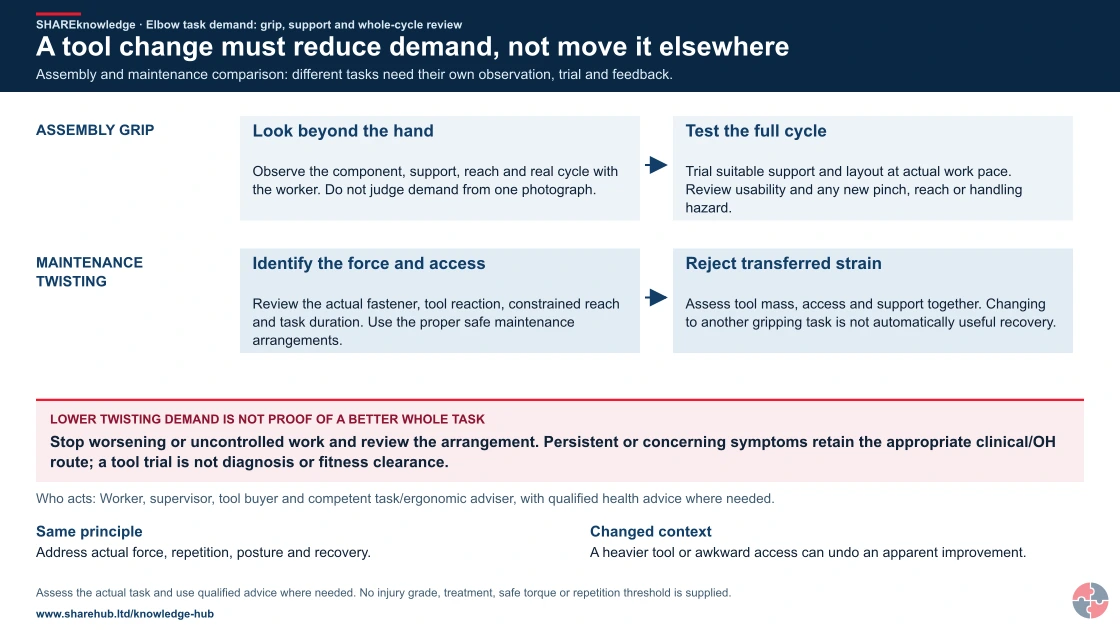
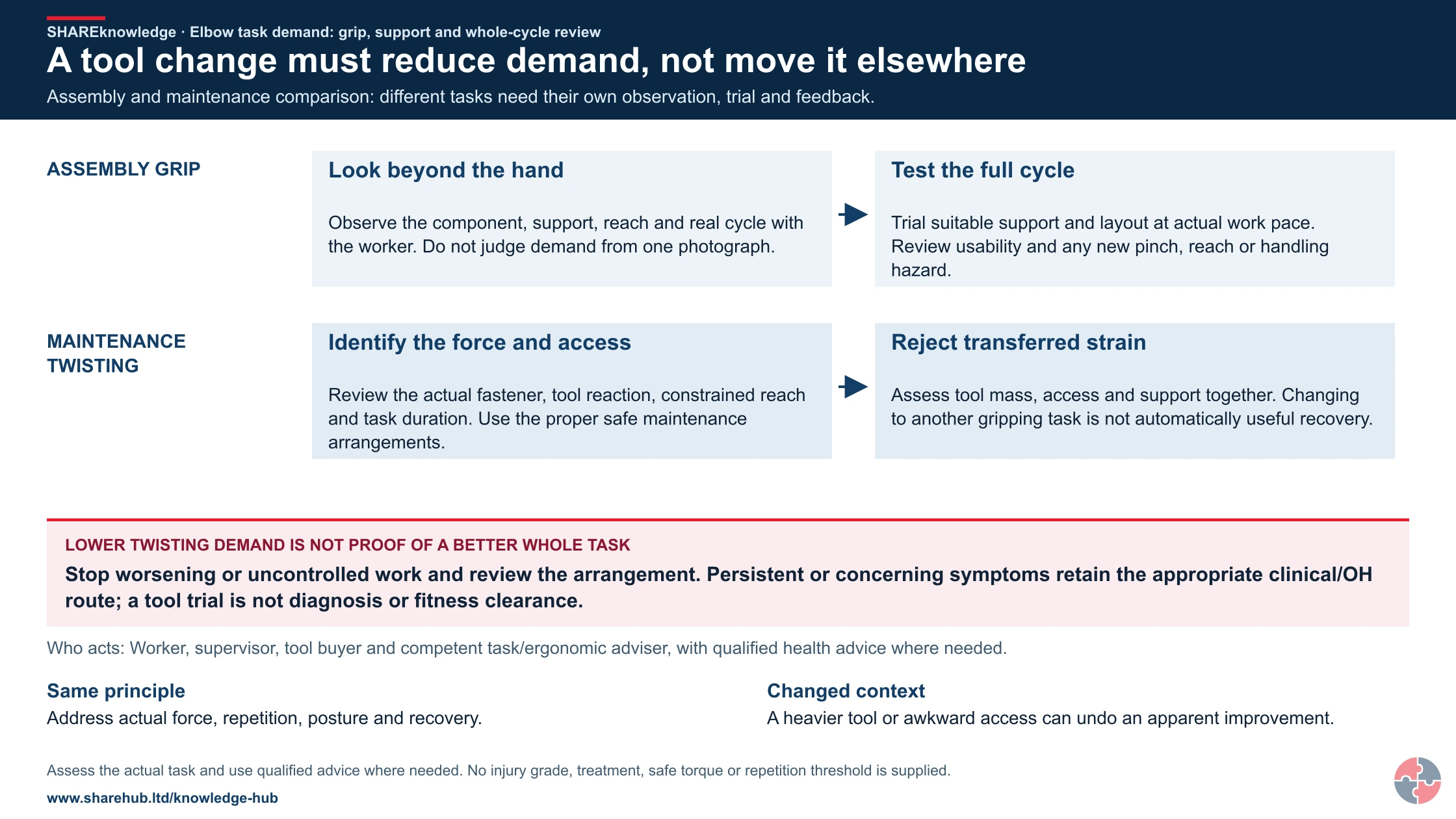
A tool change must reduce demand, not move it elsewhere
Full written explanation
Two parallel task-review lanes compare assembly gripping with forceful maintenance twisting. Each links observation to a real task-change trial. A shared band rejects a change that moves load elsewhere or leaves work uncontrolled; clinical or occupational-health support remains a separate route. The diagram does not prescribe treatment, safe repetition, torque, posture limits or an automatic return to work.
Assembly and maintenance comparison: different tasks need their own observation, trial and feedback.
- Look beyond the hand. Observe the component, support, reach and real cycle with the worker. Do not judge demand from one photograph.
- Test the full cycle. Trial suitable support and layout at actual work pace. Review usability and any new pinch, reach or handling hazard.
- Identify the force and access. Review the actual fastener, tool reaction, constrained reach and task duration. Use the proper safe maintenance arrangements.
- Reject transferred strain. Assess tool mass, access and support together. Changing to another gripping task is not automatically useful recovery.
When the evidence does not fit: Stop worsening or uncontrolled work and review the arrangement. Persistent or concerning symptoms retain the appropriate clinical/OH route; a tool trial is not diagnosis or fitness clearance.
Who acts: Worker, supervisor, tool buyer and competent task/ergonomic adviser, with qualified health advice where needed.
Changed workplace
Same principle: Address actual force, repetition, posture and recovery.
Changed context: A heavier tool or awkward access can undo an apparent improvement.
Evidence check: Assess the actual task and use qualified advice where needed. No injury grade, treatment, safe torque or repetition threshold is supplied.
Reject a trial that transfers load; retain a separate clinical/OH route
Primary references: HSE: upper limb work demands and practical trials · NHS: tennis elbow information and qualified help
Open the complete HD image (new tab)Download image
Reject a trial that transfers load; retain a separate clinical/OH route
Primary references: HSE: upper limb work demands and practical trials · NHS: tennis elbow information and qualified help
A field decision from start to hand-back — part 1 of 3


Read the complete visual as text
- 1. Task and setting: Repeated screwdriving during a fit-out job.
- 2. People and prerequisites: Worker, supervisor, tool buyer and ergonomic assessor; confirm task, fixing, tool and reported work impact.
- 3. Before the task: Observe force, repetition, reach, posture and recovery; discuss symptoms privately and choose a safer trial.
A field decision from start to hand-back — part 2 of 3


Read the complete visual as text
- 1. Check during work: Pause the painful task; trial a supported powered tool, reachable work and varied task mix with the worker.
- 2. Stop, hold or refer: Stop a task that worsens symptoms or cannot be controlled; a heavier fixing or new target needs reassessment.
A field decision from start to hand-back — part 3 of 3


Read the complete visual as text
- 1. Completion and hand-back: Confirm the worker can use the changed method and agree a review and clinical or OH route where needed.
- 2. Retained evidence: Task assessment, tool trial, worker feedback, action owner and review date, without unnecessary diagnosis detail.
BuildOut Ltd (worked example). a construction and refurbishment contractor with trades, apprentices, subcontractors, fit-out works, plant, tools, manual handling, temporary work areas and changing site conditions.
BuildOut would start with its risk register and task inventory. Fit-out, joinery, drylining, M&E installation, decorating, cutting, fixing, sanding and material handling would be reviewed for repeated grip, wrist twisting, force, awkward access and tool vibration. The company would not wait for a formal injury claim; early reports of elbow or forearm pain would be treated as a useful signal that the task may need redesign.
Procurement would specify suitable ergonomic hand tools, low-vibration tools, sharp blades, mechanical aids, fixtures and materials that reduce repetitive force. Supervisors would check tool condition, access, bench height, work sequencing and task rotation during site walks. Where subcontractors carry out repetitive fixing or tool-heavy work, BuildOut's contractor rules would require suitable tools, worker briefings, early symptom reporting and cooperation with task reviews.
Learning would be built into normal assurance. If several workers report elbow pain after a new fixing method or accelerated programme, BuildOut would pause, observe the task, talk to workers, review tool choice and pace, record the findings, update the method statement and brief the change back to the team.
| Management element | How BuildOut would apply it | Evidence produced |
|---|---|---|
| Assess and analyse | Map repetitive grip, twisting, tool and handling tasks across trades and subcontractors. | MSD risk register and task observation notes. |
| Procure and design | Choose tools, fixings, jigs, work platforms and materials that reduce force and awkward posture. | Procurement standards and tool trials. |
| Implement controls | Use powered tools, fixtures, rotation, access planning, material staging and tool maintenance. | Method statements, toolbox talks and site inspection records. |
| Train | Brief workers on early symptoms, reporting, tool setup, grip force, posture and recovery. | Induction, toolbox talks and supervisor coaching records. |
| Oversee contractors | Check RAMS, tools, work pace, access and willingness to report symptoms. | Contractor review and site monitoring records. |
| Monitor | Use first-line supervisor checks, second-line HSSE inspections and trend review of symptom reports. | Checklists, action tracker and monthly review. |
| Learn and improve | Investigate clusters, post-change symptoms and repeated defects. | Updated task controls and shared lessons learned. |
A field decision from start to hand-back
Task, material and setting: Repeated screwdriving during a fit-out job.
People and prerequisites: Worker, supervisor, tool buyer and ergonomic assessor; confirm task, fixing, tool and reported work impact.
Before: Observe force, repetition, reach, posture and recovery; discuss symptoms privately and choose a safer trial.
During: Pause the painful task; trial a supported powered tool, reachable work and varied task mix with the worker.
Hold or stop: Stop a task that worsens symptoms or cannot be controlled; a heavier fixing or new target needs reassessment.
Completion and hand back: Confirm the worker can use the changed method and agree a review and clinical or OH route where needed.
Evidence: Task assessment, tool trial, worker feedback, action owner and review date, without unnecessary diagnosis detail.
What training helps prevent epicondylitis and upper limb disorders?
Training should match the role, from general awareness to task-specific practical coaching and management-level assessment competence.
General awareness should explain symptoms, early reporting and the main work factors: repetition, force, posture, vibration, duration and recovery. Task-specific training should show how to set up tools, use aids, maintain neutral wrist posture, vary work and avoid unnecessary force.
Supervisors and managers need deeper competence because they control planning, pace, tool standards, job rotation, overtime, procurement and response to reported symptoms.
| Role | Learning | Demonstration | Assessor | Record | Reassess when |
|---|---|---|---|---|---|
| Workers | Report symptoms and demonstrate task load | Show the painful work movement | Supervisor | Private work-impact note | Task or symptom change |
| Supervisors | Pause unsafe work and trial task redesign | Observe force, reach and repetition | Safety lead | Task action | Complaint |
| Tool buyers | Specify usable tools and fixtures | Trial with varied users | Operations lead | Selection record | New product |
| Ergonomic assessors | Use ART with its limits | Observe the real task and worker feedback | Competent lead | Assessment | Work change |
| Occupational health | Advise on function when needed | Scope referral and restrictions | Clinical lead | Confidential advice | Persistent symptoms |
| Leaders | Resource controls and review clusters | Sample closure evidence | Independent lead | Review record | Cluster |
How does epicondylitis support NEBOSH-style study?
Epicondylitis supports study by showing how occupational health outcomes connect to risk assessment, ergonomics, law, worker involvement and evidence.
For National General Certificate and Construction Certificate learners, the key exam value is practical: identify repeated or forceful work, explain likely harm, apply hierarchy of control, use worker consultation and recommend realistic controls. For Diploma learners, the expectation is deeper: consider work organisation, psychosocial factors, legal duties, assessment tools, adjustment management and evidence of control effectiveness.
A scenario may describe construction workers using hand tools for long periods, production workers doing repetitive assembly or office workers with mouse-heavy tasks. A strong answer identifies the task exposure, the body structures affected, early symptoms, immediate controls, longer-term redesign, training, supervision and review.
| Study angle | What to know | Scenario application |
|---|---|---|
| Hazard recognition | Repetition, force, posture, vibration and low recovery. | Spot the task factors that may cause ULDs. |
| Health outcome | Tendon overload around the elbow can reduce grip and function. | Explain why the task affects work capability. |
| Controls | Redesign first, then rotation, training and monitoring. | Recommend practical HSE control hierarchy controls. |
| Legal duties | HSWA, Management Regulations, manual handling, DSE and vibration where relevant. | Link evidence to legal compliance. |
| Management review | Use symptom reports and worker feedback to improve controls. | Explain why clusters need investigation. |
How can management arrangements support this topic?
The voluntary standard can structure ownership and review; it is not itself a legal duty or proof that this work is controlled.
Official management guidance: HSE Managing for health and safety (HSG65)
What are the warning signs that epicondylitis risk is not controlled?
Warning signs include symptom clusters, repeated pain during the same task, poor tool condition, excessive force, weak reporting and controls that depend on people tolerating discomfort.
These signs should prompt a task review. If a worker repeatedly reports pain after the same movement, the task is giving the organisation information. If several workers report similar symptoms, the issue is unlikely to be solved by individual advice alone.
Warning signs can turn into harm when they are normalised: workers hide symptoms, grip harder because tools are blunt, work through pain because production is tight, or rotate between tasks that load the same tendon in slightly different ways.
| Warning sign | How harm can manifest | Response |
|---|---|---|
| Pain reports after the same task | Continued tendon overload may prolong symptoms. | Observe and redesign the task. |
| Several similar reports in one team | Shared exposure may be affecting multiple workers. | Investigate as a task or process issue. |
| Blunt or poorly maintained tools | More grip force is needed to do the same work. | Repair, replace and set maintenance checks. |
| High pace with few breaks | Tendons have limited recovery time. | Review staffing, targets and rotation. |
| Workers use braces but tasks do not change | Symptoms are managed while exposure continues. | Address force, repetition and posture. |
| Managers dismiss early symptoms | Workers may stop reporting until absence or restriction occurs. | Coach managers and strengthen reporting culture. |
What do the acronyms and key terms mean?
Acronyms and clinical terms should be explained because not every reader will know MSD, ULD, DSE or tendinopathy language.
| Term | Full expansion | Meaning here |
|---|---|---|
| ART | Assessment of Repetitive Tasks | Assessment of Repetitive Tasks, an HSE tool approach for repetitive upper limb work. |
| DSE | Display screen equipment | Display Screen Equipment. |
| Epicondyle | Epicondyle | Bony prominence at the elbow where forearm tendons attach. |
| Lateral epicondylitis | Lateral epicondylitis | Tennis elbow; pain usually on the outside of the elbow. |
| Medial epicondylitis | Medial epicondylitis | Golfer's elbow; pain usually on the inside of the elbow. |
| MSD | Musculoskeletal disorder | Musculoskeletal Disorder. |
| OH | Occupational health | Occupational Health. |
| Tendinopathy | Tendinopathy | Painful tendon condition, often linked to overload and tendon change. |
| ULD | Upper limb disorder | Upper Limb Disorder. |
| WRULD | WRULD | Work-related Upper Limb Disorder. |