SHARE Knowledge Hub
Duty Holder
A duty holder is a person, organisation or role that has legal responsibility for controlling health and safety risks created by work, premises, products, services or undertakings. In UK health and safety practice the term is broad: employers, employees, self-employed people, directors, landlords, contractors, designers, manufacturers, suppliers, clients, principal contractors and people in control of premises may all hold duties depending on what they control. The practical point is not simply naming a duty holder; it is proving that the right people understand their duties, have authority and resources, assess risks, consult workers, appoint competent support, control contractors, maintain premises and equipment, monitor performance and act when evidence shows controls are weak.
Understanding Duty Holder
A duty holder is a person, organisation or role that has legal responsibility for controlling health and safety risks created by work, premises, products, services or undertakings. In UK health and safety practice the term is broad: employers, employees, self-employed people, directors, landlords, contractors, designers, manufacturers, suppliers, clients, principal contractors and people in control of premises may all hold duties depending on what they control. The practical point is not simply naming a duty holder; it is proving that the right people understand their duties, have authority and resources, assess risks, consult workers, appoint competent support, control contractors, maintain premises and equipment, monitor performance and act when evidence shows controls are weak.
Why this matters at work
Dutyholders need assurance that controls work in practice. HSG65 distinguishes active monitoring, such as inspections, observations, preventive-maintenance completion, exposure monitoring, drills and worker feedback, from reactive learning after incidents, ill health, complaints, enforcement or damage. Both are needed. A low accident rate may indicate good control, but it can also result from under-reporting, low exposure time or luck; it is not enough on its own.
Regulations 10, 11 and 13 address information for employees, cooperation and coordination where workplaces are shared, and capability and training. A sound system links these duties: risk information reaches the person doing the work, changing conditions are reported back, contractors receive the information they need, workers understand their limits, and managers can intervene before a control failure becomes harm.
How organisations manage this in practice
Regulation 5 requires effective arrangements for planning, organisation, control, monitoring and review. A named health and safety manager alone is rarely enough. Arrangements need decision rights, financial and time resources, procurement requirements, design/change review, maintenance, training, contractor control, emergency management, consultation and performance reporting. HSG65's Plan Do Check Act model gives a useful structure: policy and leadership; planning; delivery; performance assessment; and learning/action.
MHSWR regulation 3 requires every employer and a self-employed person within the applicable legal scope to make a suitable and sufficient assessment of the risks to workers and others arising from their undertaking. It should identify significant hazards, people exposed, existing precautions, additional controls, owners and review triggers. Regulation 4 requires application of the principles of prevention, including avoiding risks, evaluating unavoidable risks, combating them at source, adapting work to the individual, keeping up with technical progress, replacing dangerous with less dangerous, developing an overall prevention policy and giving collective protective measures priority over individual ones. These numbered references concern GB Management 1999. NI Management 2000 provides its own assessment, prevention, arrangements and assistance duties. Written significant findings are required for employers with five or more employees; review is triggered by suspected invalidity or significant change, rather than a universal annual assessment rule.
Assurance should be independent enough to surface weak news. A supervisor can check a routine control; a competent technical person may need to examine specialised plant; a senior review may challenge resource priorities; a worker representative may expose usability issues; external expertise may be required after a major event or where internal independence is limited. Define findings, risk rating, owner, due date, escalation, completion evidence and effectiveness review.
Identify duties through the law and actual control
A statutory role and a delegated operational task are different. In shared premises, establish which requirements apply and what each party controls before assigning responsibilities.

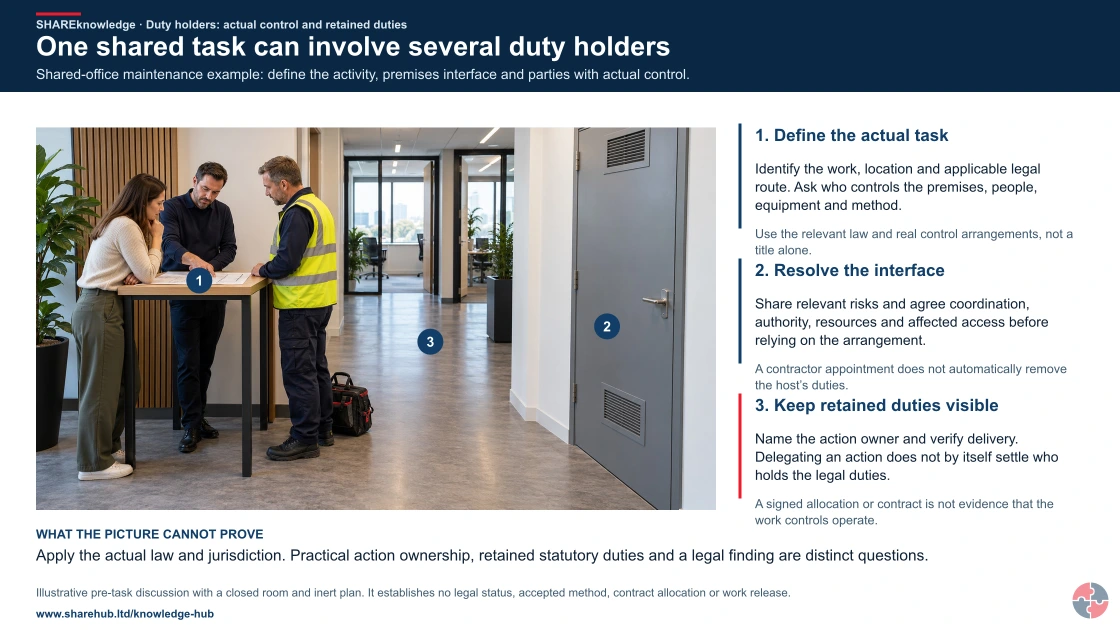
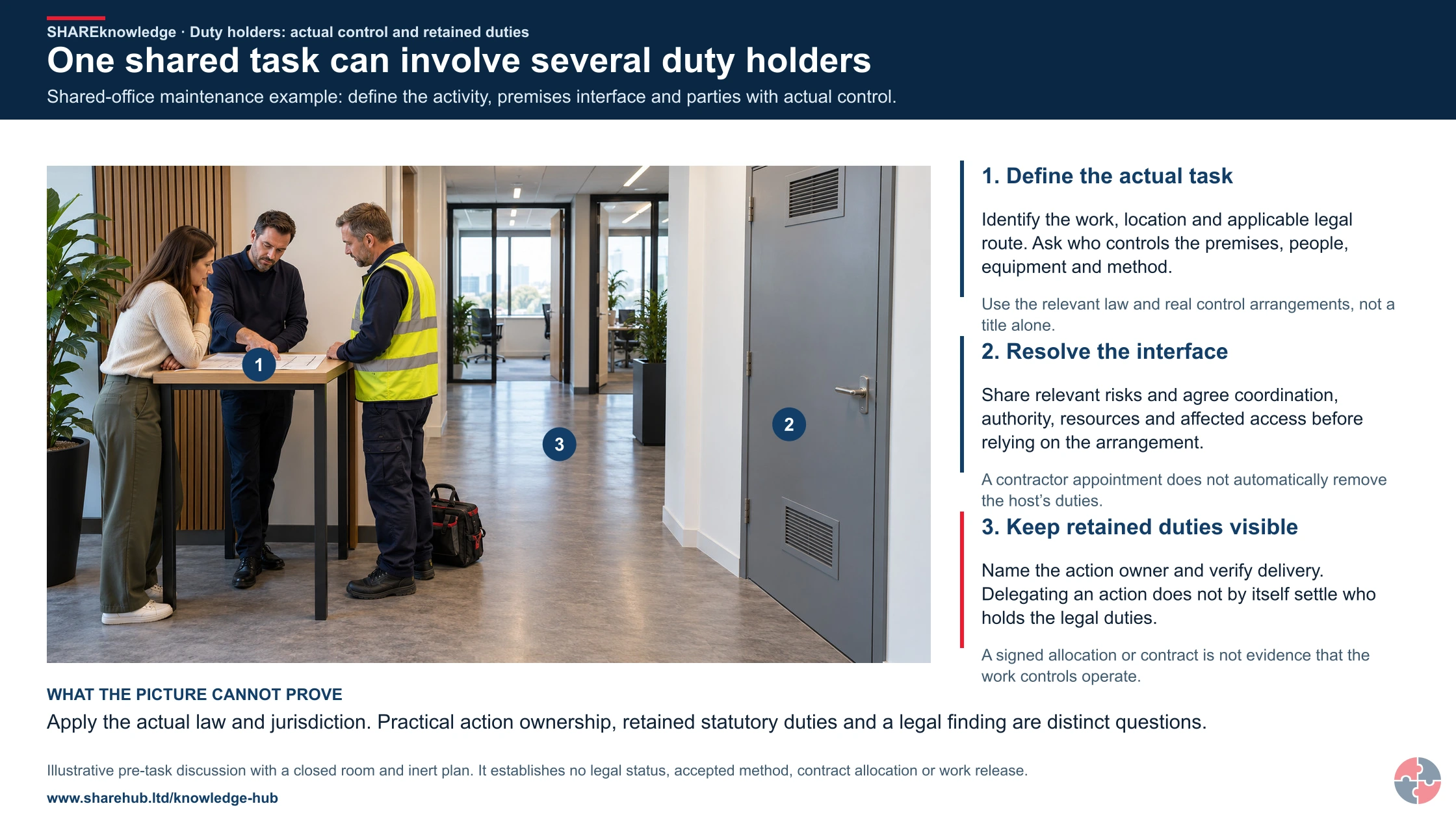
One shared task can involve several duty holders
Full written explanation
Shared-office maintenance example: define the activity, premises interface and parties with actual control.
- Define the actual task. Identify the work, location and applicable legal route. Ask who controls the premises, people, equipment and method.
- Resolve the interface. Share relevant risks and agree coordination, authority, resources and affected access before relying on the arrangement.
- Keep retained duties visible. Name the action owner and verify delivery. Delegating an action does not by itself settle who holds the legal duties.
Change the pathway
- Start from facts. Use the relevant law and real control arrangements, not a title alone.
- Different parties may overlap. A contractor appointment does not automatically remove the host’s duties.
- Review the actual performance. A signed allocation or contract is not evidence that the work controls operate.
Evidence check: Apply the actual law and jurisdiction. Practical action ownership, retained statutory duties and a legal finding are distinct questions.
Actual control, concurrent duties, delegation and jurisdiction
Primary references: HSE: cooperation, coordination and information at shared workplaces (GB)
Open the complete HD image (new tab)Download image
Actual control, concurrent duties, delegation and jurisdiction
Primary references: HSE: cooperation, coordination and information at shared workplaces (GB)
Best-practice guide: Duty Holder

Identify duties through the law and actual control
A statutory role and a delegated operational task are different. In shared premises, establish which requirements apply and what each party controls before assigning responsibilities. A duty holder is a person, organisation or role that has legal responsibility for controlling health and safety risks created by work, premises, products, services or undertakings.
Turn duty holder knowledge into a decision
A duty holder is a person, organisation or role that has legal responsibility for controlling health and safety risks created by work, premises, products, services or undertakings. In UK health and safety practice the term is broad: employers, employees, self-employed people, directors, landlords, contractors, designers, manufacturers, suppliers, clients, principal contractors and people in control of premises may all hold duties depending on what they control. Board minutes and action decisions.
the leisure operator duty holder controls
Governance: Board receives meaningful reports on significant risks, resources and overdue actions. Evidence / response: Board minutes and action decisions. Responsibility mapping: Roles are mapped for centres, activities, premises, contractors and public users. Evidence / response: Responsibility matrix and risk register.
Warning signs and consequences
No responsibility matrix: Roles are assumed rather than assigned. Generic legal register: Duties are not linked to real activities. Contractors self-manage entirely: Host duty holder coordination is weak.
Choose controls for duty holder
Elimination: Complete fabrication and inspection from ground level where that removes the roof task. Engineering controls: Choose a design or installation method that reduces the need for exposed roof-edge work. Engineering controls: Provide suitable collective edge protection and protect openings; segregate people below the work. Engineering controls: Have competent people check the protection design, substrate, fixings, access and changes to the roof layout. Administrative controls: Plan installation and removal so workers remain protected; define wind and weather limits for the actual system. Read the full control table for qualifications, ownership and verification. Use the actual task and applicable jurisdiction; existing technical approval remains unchanged.
Use the full duty holder lesson
Use the full topic for the decision points, practical examples, detailed control tables and source scope. HSE guidance applies to Great Britain; use HSENI for the Northern Ireland route and the source’s stated jurisdiction. A simplified guide does not change the page’s technical-review or approval status.

Read all six steps as text
1. Identify duties through the law and actual control
A statutory role and a delegated operational task are different.
- Avoid / redesign: Complete fabrication and inspection from ground level where that removes the roof task.
- Control the task: Provide suitable collective edge protection and protect openings; segregate people below the work.
- Verify before release: If the hazardous step remains, keep it within the task assessment and select the stronger feasible remaining controls.
A statutory role and a delegated operational task are different. In shared premises, establish which requirements apply and what each party controls before assigning responsibilities. A duty holder is a person, organisation or role that has legal responsibility for controlling health and safety risks created by work, premises, products, services or undertakings.
Apply it: Which part of this plan would you check at the workface before authorising the task?
2. Turn duty holder knowledge into a decision
Use the evidence to improve the actual work arrangement.
- Change at source: Complete fabrication and inspection from ground level where that removes the roof task.
- Make it observable: If the hazardous step remains, keep it within the task assessment and select the stronger feasible remaining controls.
- Keep useful evidence: Board minutes and action decisions.
A duty holder is a person, organisation or role that has legal responsibility for controlling health and safety risks created by work, premises, products, services or undertakings. In UK health and safety practice the term is broad: employers, employees, self-employed people, directors, landlords, contractors, designers, manufacturers, suppliers, clients, principal contractors and people in control of premises may all hold duties depending on what they control. Board minutes and action decisions.
Apply it: What evidence would show that the change improves this task, rather than only completing a record?
3. the leisure operator duty holder controls
Example: a practical application of the existing topic lesson.
- Governance: Board receives meaningful reports on significant risks, resources and overdue actions.
- Responsibility mapping: Roles are mapped for centres, activities, premises, contractors and public users.
- Contractors: Pre-qualifies, inducts, supervises and reviews contractors.
Governance: Board receives meaningful reports on significant risks, resources and overdue actions. Evidence / response: Board minutes and action decisions. Responsibility mapping: Roles are mapped for centres, activities, premises, contractors and public users. Evidence / response: Responsibility matrix and risk register.
Apply it: At which point would you hold this example, and what evidence would allow it to proceed?
4. Warning signs and consequences
Connect the task, the route to the person and the control that can fail.
- No responsibility matrix: Roles are assumed rather than assigned.
- Generic legal register: Duties are not linked to real activities.
- Contractors self-manage entirely: Host duty holder coordination is weak.
No responsibility matrix: Roles are assumed rather than assigned. Generic legal register: Duties are not linked to real activities. Contractors self-manage entirely: Host duty holder coordination is weak.
Apply it: Who could be exposed, including other trades, cleaners, maintainers and people nearby?
5. Choose controls for duty holder
Start with the stronger practicable options and verify their effect.
- Elimination: Complete fabrication and inspection from ground level where that removes the roof task.
- Engineering controls: Choose a design or installation method that reduces the need for exposed roof-edge work.
- Engineering controls: Provide suitable collective edge protection and protect openings; segregate people below the work.
- Engineering controls: Have competent people check the protection design, substrate, fixings, access and changes to the roof layout.
- Administrative controls: Plan installation and removal so workers remain protected; define wind and weather limits for the actual system.
Elimination: Complete fabrication and inspection from ground level where that removes the roof task. Engineering controls: Choose a design or installation method that reduces the need for exposed roof-edge work. Engineering controls: Provide suitable collective edge protection and protect openings; segregate people below the work. Engineering controls: Have competent people check the protection design, substrate, fixings, access and changes to the roof layout. Administrative controls: Plan installation and removal so workers remain protected; define wind and weather limits for the actual system. Read the full control table for qualifications, ownership and verification. Use the actual task and applicable jurisdiction; existing technical approval remains unchanged.
Apply it: Which stronger option can be used here, and who will verify it before accepting the remaining risk?
6. Use the full duty holder lesson
Follow the official sources below and retain the task-specific evidence.
- Official guidance: Health and Safety at Work etc. Act 1974
- Official guidance: Health and Safety at Work (Northern Ireland) Order 1978
- Task decision: Board minutes and action decisions.
Use the full topic for the decision points, practical examples, detailed control tables and source scope. HSE guidance applies to Great Britain; use HSENI for the Northern Ireland route and the source’s stated jurisdiction. A simplified guide does not change the page’s technical-review or approval status.
Apply it: Which official source and full-topic section will you use to resolve the next decision?
A leisure premises upgrade has several owners
Illustrative example. Landlord, operator, client and contractor each control part of the work.
Decision. Map the activity and interfaces, then refer to the specific fire, asbestos or CDM duties as appropriate.
Evidence to check. Applicable role, actual authority, information exchange and agreed task responsibilities.
Hold or escalation point. A title, purchase order or appointment alone does not transfer the organisation’s duty.
Follow-up. Review the interfaces when the scope, contractor or premises arrangements change.
Separate legal duties from delegated tasks
More than one party can have duties around the same maintenance job. Delegating a task does not automatically remove the organisation’s retained duties.
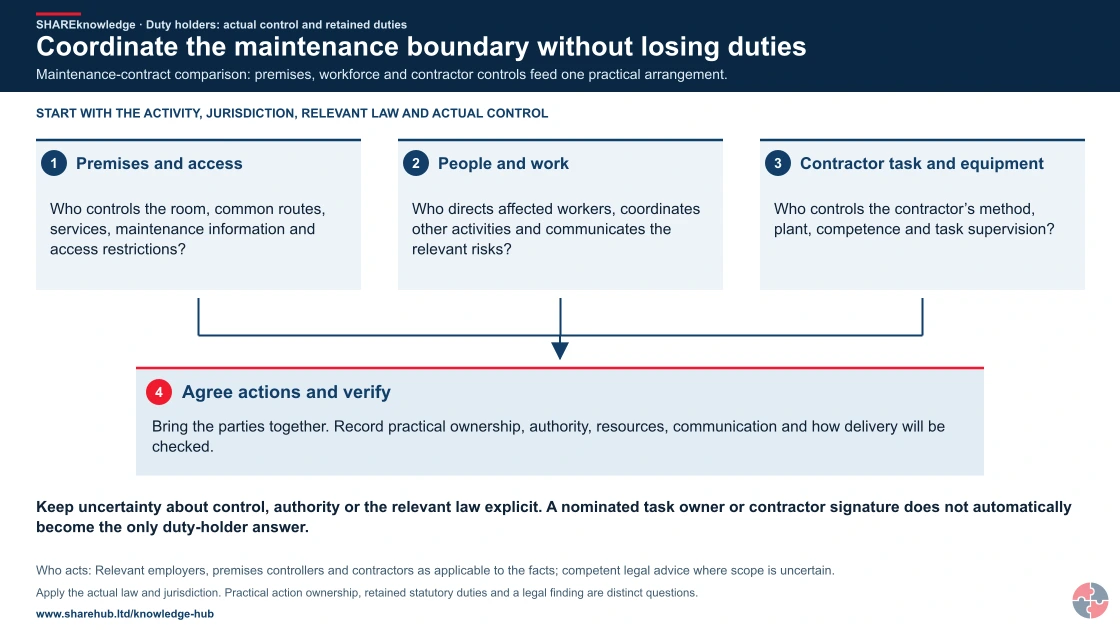
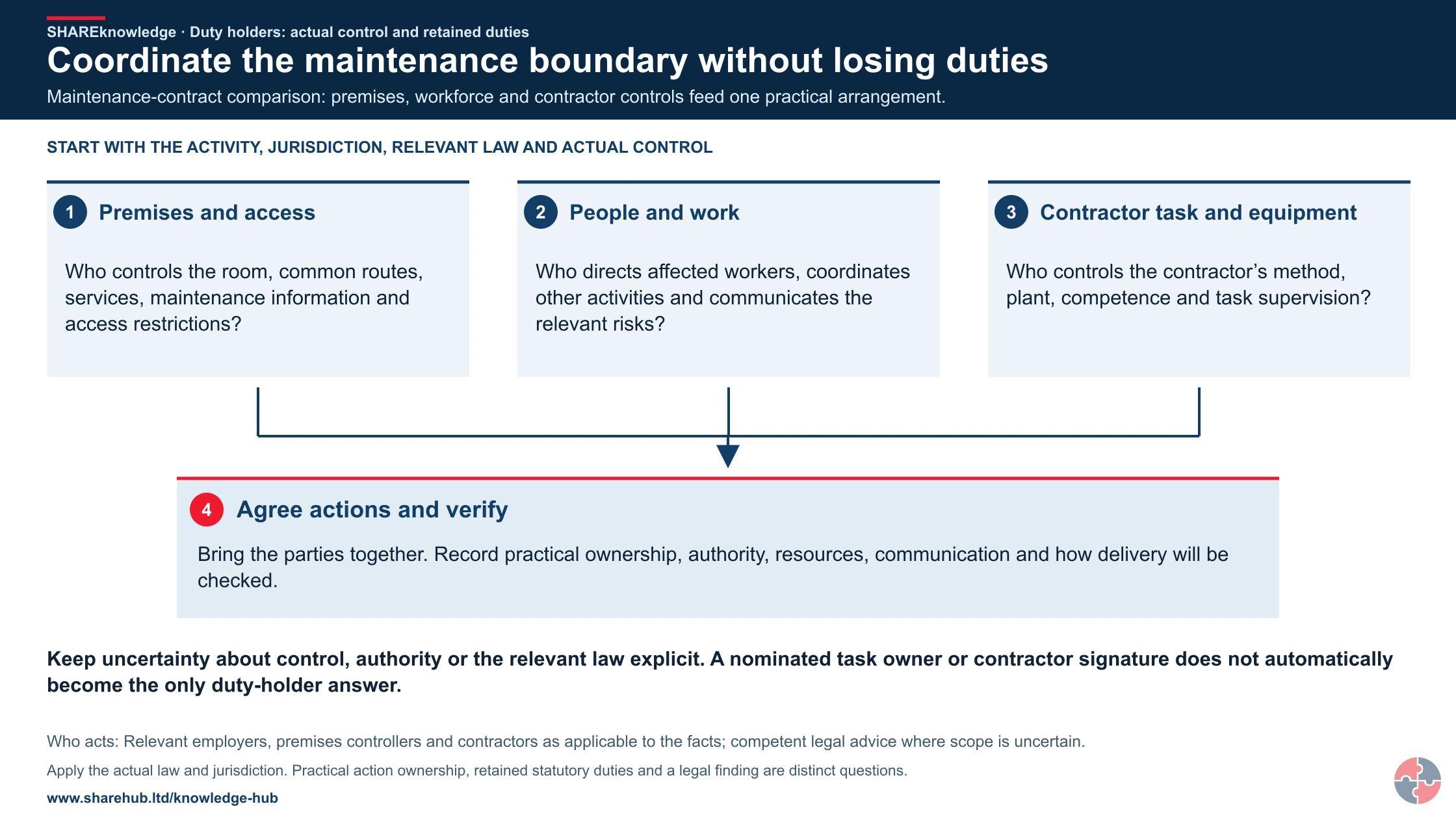
Coordinate the maintenance boundary without losing duties
Full written explanation
Three parallel enquiries ask who controls premises/access, employees/other affected people, and contractor equipment/method. They feed a coordinated task arrangement with named actions, authority, resources and verification. The chart preserves the separate question of retained legal duties; it cannot determine status from job titles, allocate statutory duties by contract, or substitute one UK jurisdiction for another.
Maintenance-contract comparison: premises, workforce and contractor controls feed one practical arrangement.
- Premises and access. Who controls the room, common routes, services, maintenance information and access restrictions?
- People and work. Who directs affected workers, coordinates other activities and communicates the relevant risks?
- Contractor task and equipment. Who controls the contractor’s method, plant, competence and task supervision?
- Agree actions and verify. Bring the parties together. Record practical ownership, authority, resources, communication and how delivery will be checked.
When the evidence does not fit: Keep uncertainty about control, authority or the relevant law explicit. A nominated task owner or contractor signature does not automatically become the only duty-holder answer.
Who acts: Relevant employers, premises controllers and contractors as applicable to the facts; competent legal advice where scope is uncertain.
Changed workplace
Shared-office premises: Coordinate the common route and services-room interface.
Maintenance contract: Check each party’s actual control and the evidence that agreed actions were delivered.
Evidence check: Apply the actual law and jurisdiction. Practical action ownership, retained statutory duties and a legal finding are distinct questions.
Actual control, concurrent duties, delegation and jurisdiction
Primary references: HSE: cooperation, coordination and information at shared workplaces (GB)
Open the complete HD image (new tab)Download image
Actual control, concurrent duties, delegation and jurisdiction
Primary references: HSE: cooperation, coordination and information at shared workplaces (GB)

Scope
Identify the applicable law, jurisdiction, activity and parties with actual control; obtain advice where scope is uncertain.
Concurrent duties
Map the relevant employer, site-controller, contractor and designer responsibilities as applicable to the facts.
Delegation and assurance
Give the task owner suitable authority/resources and verify performance while keeping the retained-duty questions visible.
This role map does not decide legal status or transfer a duty by contract wording alone.
What are the key points about duty holders?
The key points are that duties follow control, several duty holders may exist at once and evidence matters.
Duties follow control
The more control a person or organisation has over work, premises, equipment, products or people, the more likely they are to hold duties.
Employer duties are central
Employers must protect employees and others affected by the undertaking so far as is reasonably practicable.
Workers also have duties
Workers must take reasonable care and cooperate with arrangements designed to protect health and safety.
Delegation does not remove accountability
A director, client or employer can appoint competent people, but must still check that arrangements are suitable.
Shared duties require coordination
Clients, contractors, landlords, designers and occupiers may all need to exchange information and cooperate.
This is general guidance
This page supports learning and workplace understanding; it is not legal advice for a specific dispute or prosecution.
The scope of these introductory points is set out in HSE - Introduction to managing health and safety: the law.
What does duty holder mean in health and safety?
A duty holder is the person, organisation or role that the law expects to do, control or ensure something.
Health and safety law uses different wording depending on the regulation: employer, self-employed person, employee, person in control of premises, responsible person, client, designer, principal contractor, manufacturer, supplier, landlord, owner or occupier. The common idea is responsibility linked to control. If you create the risk, control the work, own the plant, manage the premises, design the project, supply the equipment or direct the people, you may hold duties.
The duty holder concept prevents organisations treating safety as someone else's problem. A contractor must manage its own work, but the client may still need to select a competent contractor, exchange information and coordinate activities. A landlord may not carry out the work, but may control common parts, asbestos information or building services. A worker may not write the policy, but must still follow training, use equipment correctly and report danger.
The legal title depends on the actual instrument and jurisdiction. In GB, HSWA and the Management Regulations are the general foundation; Northern Ireland uses its own 1978 Order and 2000 Management Regulations. A contract or delegation can assign tasks, but it does not by itself erase a statutory duty held by an employer, client or person in control.
The practical question is: who has the power to prevent harm? That includes power over money, time, design, procurement, instructions, supervision, maintenance, access, information and stopping work.
| Question | Why it matters | Example |
|---|---|---|
| Who creates the risk? | The creator of the risk usually has duties to control it. | A contractor generating dust must control exposure and protect others. Sources: HSE - Introduction to managing health and safety: the law; Health and Safety at Work (Northern Ireland) Order 1978. |
| Who controls the place? | Premises control can create maintenance, asbestos, fire or access duties. | A landlord controls a shared plant room and common staircase. Sources: HSE - Introduction to managing health and safety: the law; Health and Safety at Work (Northern Ireland) Order 1978. |
| Who controls the work? | Planning and supervision create duty holder responsibilities. | A supervisor authorises high-risk work. Sources: HSE - Introduction to managing health and safety: the law; Health and Safety at Work (Northern Ireland) Order 1978. |
| Who supplies the equipment or substance? | Upstream information affects downstream safety. | A supplier provides instructions, warnings and safety data. Sources: HSE - Introduction to managing health and safety: the law; Health and Safety at Work (Northern Ireland) Order 1978. |
| Who is affected? | Duties may extend beyond employees to visitors, contractors and the public. | A leisure centre must protect members and contractors as well as staff. Sources: HSE - Introduction to managing health and safety: the law; Health and Safety at Work (Northern Ireland) Order 1978. |
What are the core health and safety duties?
Core duties are to identify risk, control it, provide safe systems, maintain equipment, train people, consult workers and monitor performance.
The employer's duty under the Health and Safety at Work etc. Act is deliberately broad. It covers safe plant and systems of work, safe use, handling, storage and transport of articles and substances, information, instruction, training and supervision, a safe workplace and safe access and egress, and a working environment with adequate welfare.
The Management Regulations then turn that broad duty into management arrangements: risk assessment, preventive and protective measures, competent assistance, procedures for serious and imminent danger, information for workers, cooperation and coordination where employers share a workplace, and capabilities and training.
A duty holder should therefore be able to show both a system and its operation. A written policy is not enough if risk assessments are stale, training is missing, plant is poorly maintained or supervisors cannot explain how controls are checked.
| Activity | What it means | Evidence |
|---|---|---|
| Risk assessment | Identify hazards, who may be harmed, existing controls and further action. | Risk assessments, method statements and review records. Sources: Health and Safety at Work etc. Act 1974; Health and Safety at Work (Northern Ireland) Order 1978. |
| Safe systems of work | Define how work is planned, authorised, supervised and stopped. | Procedures, permits, briefings and field checks. Sources: Health and Safety at Work etc. Act 1974; Health and Safety at Work (Northern Ireland) Order 1978. |
| Information and training | Give people understandable information and practical training for their role. | Inductions, training matrix and competence checks. Sources: Health and Safety at Work etc. Act 1974; Health and Safety at Work (Northern Ireland) Order 1978. |
| Maintenance | Keep plant, equipment and premises safe. | Inspection, servicing and defect records. Sources: Health and Safety at Work etc. Act 1974; Health and Safety at Work (Northern Ireland) Order 1978. |
| Consultation | Involve workers or representatives in health and safety matters. | Meeting notes, consultation records and worker feedback. Sources: Health and Safety at Work etc. Act 1974; Health and Safety at Work (Northern Ireland) Order 1978. |
| Monitoring and review | Check controls, investigate incidents and improve arrangements. | Audits, inspections, investigations and action close-out. Sources: Health and Safety at Work etc. Act 1974; Health and Safety at Work (Northern Ireland) Order 1978. |
How can the hierarchy of controls assign and verify effective roof-edge controls before access?
A legal role is identified from the relevant instrument and actual control, while the control hierarchy addresses the underlying hazard. For the leisure plant-room job, the operator, landlord and contractor each act within their control; a responsibility matrix supports, but cannot transfer away, statutory duties.
The same interface appears in a construction refurbishment: the client, designer, principal contractor and trade contractor need the applicable CDM route and coordinated decisions. In a logistics depot, the host and visiting maintenance contractor must agree isolation and vehicle segregation before work.
How can the ERICPD hierarchy of controls assign and verify effective roof-edge controls before access?

| Control level | Control for this activity | Owner and verification | Stop / restart decision |
|---|---|---|---|
| Eliminate | Complete fabrication and inspection from ground level where that removes the roof task. | Task owner verifies that the proposed change removes the named hazardous step, including foreseeable cleaning, maintenance and work transferred elsewhere. | If the hazardous step remains, keep it within the task assessment and select the stronger feasible remaining controls. |
| Reduce, including substitution | Choose a design or installation method that reduces the need for exposed roof-edge work. | Competent task/process owner validates suitability, compatibility and new hazards against the actual operating requirements before the alternative is adopted. | Reject an alternative if its performance is unproved or its new hazards are unresolved. |
| Isolate | Provide suitable collective edge protection and protect openings; segregate people below the work. | Supervisor checks the actual boundary, affected people and connected work; verify separation or isolation before allowing access. | Hold or stop for missing rail, unprotected opening, loose fixing or weather outside the approved limits. |
| Control: physical safeguards | Have competent people check the protection design, substrate, fixings, access and changes to the roof layout. | Competent equipment/process owner checks edge-protection design, fixings, access and any required rescue provision. | Hold or stop for missing rail, unprotected opening, loose fixing or weather outside the approved limits. |
| Control: work method and response | Plan installation and removal so workers remain protected; define wind and weather limits for the actual system. | Supervisor confirms the work limits, competent cover, communication and stop/restart authority with the people doing this activity. | Hold work when the agreed limits, competent cover or effective communication cannot be maintained. |
| PPE | Use assessed fall protection only where needed, with compatible anchors and a workable rescue plan; it does not replace feasible edge protection. | Assessor confirms whether personal protection is needed and checks suitability, condition, compatibility and any required fit evidence. | Do not use unsuitable protection or rely on PPE to continue after an essential source control fails. |
| Discipline | Inspect after changes, impacts or adverse conditions and prohibit use when protection is incomplete. | Release only after competent inspection accepts the complete protection before roof access. Retain verification and unresolved restrictions at handover. | Keep the task on hold until required reinstatement evidence and unresolved defects are accepted by the responsible owner. |
How can the ISO 45001 hierarchy of controls assign and verify effective roof-edge controls before access?

| Control level | Control for this activity | Owner and verification | Stop / restart decision |
|---|---|---|---|
| Elimination | Complete fabrication and inspection from ground level where that removes the roof task. | Task owner verifies that the proposed change removes the named hazardous step, including foreseeable cleaning, maintenance and work transferred elsewhere. | If the hazardous step remains, keep it within the task assessment and select the stronger feasible remaining controls. |
| Engineering controls | Choose a design or installation method that reduces the need for exposed roof-edge work. | Competent task/process owner validates suitability, compatibility and new hazards against the actual operating requirements before the alternative is adopted. | Reject an alternative if its performance is unproved or its new hazards are unresolved. |
| Engineering controls | Provide suitable collective edge protection and protect openings; segregate people below the work. | Supervisor checks the actual boundary, affected people and connected work; verify separation or isolation before allowing access. | Hold or stop for missing rail, unprotected opening, loose fixing or weather outside the approved limits. |
| Engineering controls | Have competent people check the protection design, substrate, fixings, access and changes to the roof layout. | Competent equipment/process owner checks edge-protection design, fixings, access and any required rescue provision. | Hold or stop for missing rail, unprotected opening, loose fixing or weather outside the approved limits. |
| Administrative controls | Plan installation and removal so workers remain protected; define wind and weather limits for the actual system. | Supervisor confirms the work limits, competent cover, communication and stop/restart authority with the people doing this activity. | Hold work when the agreed limits, competent cover or effective communication cannot be maintained. |
| PPE | Use assessed fall protection only where needed, with compatible anchors and a workable rescue plan; it does not replace feasible edge protection. | Assessor confirms whether personal protection is needed and checks suitability, condition, compatibility and any required fit evidence. | Do not use unsuitable protection or rely on PPE to continue after an essential source control fails. |
| Administrative controls | Inspect after changes, impacts or adverse conditions and prohibit use when protection is incomplete. | Release only after competent inspection accepts the complete protection before roof access. Retain verification and unresolved restrictions at handover. | Keep the task on hold until required reinstatement evidence and unresolved defects are accepted by the responsible owner. |
Which duty holder roles commonly appear in workplaces?
Common duty holder roles include employers, employees, self-employed people, directors, contractors, clients, landlords and suppliers.
Different regulations use different role titles because different activities need different duty structures. Construction law has clients, designers, principal designers, contractors and principal contractors. Fire safety has responsible persons or duty holders depending on the jurisdiction. Asbestos law places a duty to manage on people responsible for maintenance or repair of non-domestic premises. Product and machinery law places duties upstream in the supply chain.
The table below is a practical guide, not an exhaustive legal opinion. Real responsibility depends on the facts: who employs whom, who controls the premises, who appoints the contractor, who owns or maintains the equipment, who designs the work and who can stop unsafe activity.
Self-employment does not create one universal duty answer. In Great Britain, HSE says general health and safety law applies if a self-employed person employs anyone, creates risk to others, or works in specified high-risk activities. Apply the exact legal and task route; do not copy this GB rule into Northern Ireland without checking its own law.
| Duty holder | Typical duty | Practical example |
|---|---|---|
| Employer | Protect employees and others affected by the undertaking. | A manufacturer manages machinery, substances, traffic and contractors. Sources: Health and Safety at Work etc. Act 1974; Health and Safety at Work (Northern Ireland) Order 1978. |
| Employee or worker | Take reasonable care and cooperate with safety arrangements. | A worker uses guarding correctly and reports a dangerous defect. Sources: Health and Safety at Work etc. Act 1974; Health and Safety at Work (Northern Ireland) Order 1978. |
| Self-employed person | Control risks from their work where the law applies. | A tradesperson controls dust, electricity or work at height at a client's premises. Sources: HSE - Self-employed workers: when health and safety law applies. |
| Director or senior leader | Lead, resource and monitor health and safety governance. | A board reviews significant risks and acts on audit findings. Sources: Health and Safety at Work etc. Act 1974; Health and Safety at Work (Northern Ireland) Order 1978. |
| Contractor | Plan and carry out its work safely and cooperate with others. | A maintenance contractor follows site rules and controls its task risk. Sources: Health and Safety at Work etc. Act 1974; Health and Safety at Work (Northern Ireland) Order 1978. |
| Client | Make suitable arrangements when commissioning work, especially construction. | A client appoints competent CDM duty holders and provides information. Sources: Health and Safety at Work etc. Act 1974; Health and Safety at Work (Northern Ireland) Order 1978. |
| Landlord or premises controller | Manage risks from premises, common areas or services they control. | A landlord manages asbestos information in common parts. Sources: Health and Safety at Work etc. Act 1974; Health and Safety at Work (Northern Ireland) Order 1978. |
| Manufacturer or supplier of work articles and substances | Design and supply articles or substances safely for intended and foreseeable work use, with suitable information. | A machine supplier provides suitable safety information and, where the actual product regime requires it, conformity evidence. Sources: HSWA 1974 section 6: articles and substances; NI 1978 Order Article 7: articles and substances; UK law on design and supply of products. |
| Construction designer | Eliminate or reduce foreseeable construction risks through design and communicate residual risks. | A designer changes a plant-room layout to allow safe maintenance access. Sources: Construction (Design and Management) Regulations 2015; Construction (Design and Management) Regulations (Northern Ireland) 2016. |
Why does control matter when deciding who the duty holder is?
Control matters because legal responsibility often follows the ability to prevent or reduce risk.
A person does not need to control every part of an activity to hold a duty. They may control one important part: access, design, selection of contractors, maintenance budget, work scheduling, safe operating limits, information, supervision or emergency response. The more they can influence the risk, the more they need to show reasonable arrangements.
Control can also be shared. On a live site, a landlord may control the building fabric, an employer may control workers, a contractor may control its equipment, and a facilities manager may control maintenance access. If they do not cooperate, gaps appear at the boundaries.
| Type of control | What it looks like | Duty holder question |
|---|---|---|
| Work control | Planning, sequencing, permits, supervision and stop-work authority. | Who decides whether the job starts or stops? Sources: Health and Safety at Work etc. Act 1974; Health and Safety at Work (Northern Ireland) Order 1978. |
| Premises control | Access, common areas, plant rooms, fire routes, services and maintenance. | Who can repair, restrict access or provide information? Sources: Health and Safety at Work etc. Act 1974; Health and Safety at Work (Northern Ireland) Order 1978. |
| People control | Employment, instruction, competence, supervision and discipline. | Who tells people what to do and checks they can do it safely? Sources: Health and Safety at Work etc. Act 1974; Health and Safety at Work (Northern Ireland) Order 1978. |
| Design control | Layout, specification, method, plant selection and buildability. | Who can remove risk before work starts? Sources: Health and Safety at Work etc. Act 1974; Health and Safety at Work (Northern Ireland) Order 1978. |
| Information control | Surveys, risk data, instructions, SDS, drawings and handover records. | Who holds information that others need to work safely? Sources: Health and Safety at Work etc. Act 1974; Health and Safety at Work (Northern Ireland) Order 1978. |
| Resource control | Budget, staffing, equipment and time allocation. | Who can provide the resources needed to control the risk? Sources: Health and Safety at Work etc. Act 1974; Health and Safety at Work (Northern Ireland) Order 1978. |
What does so far as is reasonably practicable mean?
Reasonably practicable means balancing the risk against the sacrifice needed to control it, with serious risks requiring strong justification for inaction.
In UK health and safety law, many duties are qualified by 'so far as is reasonably practicable'. This does not mean 'do what is convenient'. It means the duty holder must weigh the magnitude of risk against the time, trouble and cost of further precautions. Where the risk is serious and the control is known and proportionate, failing to act is difficult to justify.
Duty holders should record significant decisions. If a control is rejected, deferred or substituted, the record should explain the risk, options considered, reason for the decision, interim controls, review date and authorisation. This is especially important where the potential consequence is severe.
| Decision area | Weak evidence | Stronger evidence |
|---|---|---|
| Risk assessment | A generic risk rating with no control options. | Clear hazard, consequence, options, residual risk and owner. Sources: Health and Safety at Work etc. Act 1974; Health and Safety at Work (Northern Ireland) Order 1978. |
| Control selection | We chose PPE because it was cheaper. | Hierarchy review showing why higher controls were not reasonably practicable. Sources: Health and Safety at Work etc. Act 1974; Health and Safety at Work (Northern Ireland) Order 1978. |
| Deferral | Action deferred due to workload. | Risk-ranked deferral with interim controls and senior authorisation. Sources: Health and Safety at Work etc. Act 1974; Health and Safety at Work (Northern Ireland) Order 1978. |
| Contractor selection | Lowest price chosen. | Competence, resources, method and supervision considered before appointment. Sources: Health and Safety at Work etc. Act 1974; Health and Safety at Work (Northern Ireland) Order 1978. |
| Training | Attendance sheet only. | Training need, content, understanding check and refresher trigger. Sources: Health and Safety at Work etc. Act 1974; Health and Safety at Work (Northern Ireland) Order 1978. |
How should duty holders consult workers?
Duty holders should consult workers in good time on health and safety matters that affect them.
Consultation is not the same as telling people after a decision has been made. Workers often understand the real work, shortcuts, failing equipment and unintended effects of procedures better than anyone else. Consultation helps duty holders find out whether controls are practical, whether training has landed and whether risk assessments match the job.
Consultation can happen through safety representatives, employee representatives, committees, toolbox talks, briefings, surveys, hazard reporting and involvement in risk assessments. The important test is whether worker views are sought, considered and acted on.
Recognised-trade-union safety representatives and employees without that representation use different consultation routes in GB and NI. A toolbox talk can share a task change and collect concerns, but it does not by itself replace the applicable statutory consultation arrangements.
| Method | Best use | Evidence |
|---|---|---|
| Safety representatives | Unionised workplaces or formal representation. | Meeting minutes, action logs and consultation records. Sources: Safety Representatives and Safety Committees Regulations 1977; Safety Representatives and Safety Committees Regulations (Northern Ireland) 1979. |
| Employee representatives | Non-union consultation under consultation regulations. | Election/appointment records and meeting notes. Sources: Health and Safety (Consultation with Employees) Regulations 1996; Health and Safety (Consultation with Employees) Regulations (Northern Ireland) 1996. |
| Toolbox talks | Short task or change communication. | Briefing record and feedback captured. Sources: HSE - Consulting workers on health and safety L146; Consultation with employees: NI guidance. |
| Risk assessment involvement | Understanding real task risk. | Names, comments and changes made after worker input. Sources: HSE - Consulting workers on health and safety L146; Consultation with employees: NI guidance. |
| Surveys and reporting | Finding themes across locations or shifts. | Trend reports and management response. Sources: HSE - Consulting workers on health and safety L146; Consultation with employees: NI guidance. |
How should duty holders manage competence and training?
Duty holders should identify what people need to know, train them appropriately and check that they can apply it.
Competence is more than attending a course. It combines skills, knowledge, experience and behaviour. A person may know the theory but still be unfamiliar with local plant, vulnerable workers, emergency arrangements or contractor rules. Duty holders should therefore define competence for roles that affect risk, not just keep certificates.
Training should be risk-based. Everyone may need induction and general awareness. People exposed to specific hazards need task training. Supervisors and managers need deeper training on planning, monitoring, intervention, contractor control and legal duties. High-risk technical roles may need formal qualification and reassessment.
| Layer | Who it applies to | What good looks like |
|---|---|---|
| General awareness | All workers and relevant contractors. | Plain understanding of policy, reporting, emergencies and basic duties. Sources: HSE - Health and safety training INDG345; Management of Health and Safety at Work Regulations (Northern Ireland) 2000. |
| Task-specific training | People carrying out work with specific hazards. | Practical instruction, demonstration and local controls. Sources: HSE - Health and safety training INDG345; Management of Health and Safety at Work Regulations (Northern Ireland) 2000. |
| Supervisor competence | Supervisors and line managers. | Ability to plan, brief, check, intervene and escalate. Sources: HSE - Health and safety training INDG345; Management of Health and Safety at Work Regulations (Northern Ireland) 2000. |
| Manager competence | Managers and responsible persons. | Understanding of legal duties, resources, monitoring and assurance. Sources: HSE - Health and safety training INDG345; Management of Health and Safety at Work Regulations (Northern Ireland) 2000. |
| Specialist competence | Technical advisers, engineers, fire risk assessors or occupational hygienists. | Appropriate qualification, experience, independence and review. Sources: HSE - Health and safety training INDG345; Management of Health and Safety at Work Regulations (Northern Ireland) 2000. |
How should duty holders manage contractors and shared duties?
Contractor management should make responsibilities, hazards, standards and supervision clear before work starts.
Contracting out work does not remove the need to manage risk. The client or host employer should select competent contractors, provide relevant information, coordinate work, check method statements, agree site rules, manage permits where needed, monitor work and review performance. The contractor must manage its own people, equipment, competence and task controls.
The boundary between organisations is often where incidents happen. A contractor may not know the site hazards; the host may not understand the contractor's task hazards. Good duty holder management closes that gap through pre-qualification, induction, RAMS review, permits, supervision, communication and post-job review.
In GB, Management Regulations 1999 regulation 11 addresses employers sharing a workplace, including temporary sharing. It requires necessary cooperation and reasonable steps to coordinate compliance measures and inform the other employers about risks from the undertaking to their employees; it also extends the arrangements to the stated self-employed sharing situations. For example, a host running production while a maintenance contractor works nearby should exchange the production and maintenance hazards and coordinate the affected access, isolation and restart arrangements. Agree who will communicate changes during the job. This example illustrates cooperation; signing a contractor form alone does not demonstrate that the measures were coordinated. It is not a complete CDM appointment analysis or a transfer of statutory duties. Use the separate NI workplace regulations and jurisdiction-specific fire duties where applicable.
| Stage | Duty holder focus | Evidence |
|---|---|---|
| Pre-qualification | Check competence, experience, resources, insurance and safety performance. | Approved contractor record. Sources: HSE - Managing for health and safety HSG65; Management of Health and Safety at Work Regulations (Northern Ireland) 2000. |
| Pre-start information | Exchange site hazards, task hazards, drawings, asbestos, services and emergency arrangements. | Information pack and RAMS review. Sources: HSE - Managing for health and safety HSG65; Management of Health and Safety at Work Regulations (Northern Ireland) 2000. |
| Induction | Explain site rules, reporting, permits, welfare, emergency and stop-work authority. | Induction record and understanding check. Sources: HSE - Managing for health and safety HSG65; Management of Health and Safety at Work Regulations (Northern Ireland) 2000. |
| Work control | Coordinate permits, isolation, access, SIMOPS and supervision. | Permit, daily briefing and site inspection. Sources: HSE - Managing for health and safety HSG65; Management of Health and Safety at Work Regulations (Northern Ireland) 2000. |
| Assurance | Check work quality, behaviour, controls and close-out. | Inspection reports and contractor review. Sources: HSE - Managing for health and safety HSG65; Management of Health and Safety at Work Regulations (Northern Ireland) 2000. |
| Learning | Review incidents, near misses, defects and performance trends. | Lessons learned and procurement decisions. Sources: HSE - Managing for health and safety HSG65; Management of Health and Safety at Work Regulations (Northern Ireland) 2000. |
What premises and property duty holder issues should be considered?
Premises duties arise where someone controls buildings, services, common areas, access, maintenance or statutory information.
Match each premises issue to the law for that hazard and the person with actual control. A landlord, operator and contractor may hold different duties on the same site; the asbestos route does not establish the fire, water, electrical or welfare route.
Asbestos duty to manage is a useful example. The duty sits with those who have responsibility for maintenance or repair of non-domestic premises, whether through contract or tenancy, and may fall to more than one person. The same practical logic applies across other premises risks: identify who controls what, share information and keep evidence current.
| Risk area | Possible duty holder | Evidence |
|---|---|---|
| Fire safety | Responsible person, employer, occupier, owner or premises controller depending on law and control. | Fire risk assessment and action plan. Sources: Regulatory Reform (Fire Safety) Order 2005; Fire (Scotland) Act 2005; Fire and Rescue Services (Northern Ireland) Order 2006; Fire Safety Regulations (Northern Ireland) 2010. |
| Asbestos | Person responsible for maintenance or repair of non-domestic premises. | Asbestos register, management plan and surveys. Sources: Control of Asbestos Regulations 2012; Control of Asbestos Regulations (Northern Ireland) 2012. |
| Legionella | Employer, landlord or person in control of water systems. | Risk assessment, monitoring and maintenance records. Sources: Managing the legionella risk; Legionella in Northern Ireland. |
| Electrical systems | Employer, landlord or facilities manager controlling installation/maintenance. | Inspection reports and remedial actions. Sources: Introduction to electrical safety; Electrical safety in Northern Ireland. |
| Workplace welfare | Employer or person controlling workplace conditions. | Workplace checks and defect close-out. Sources: The law on workplace safety and welfare; Welfare facilities in Northern Ireland. |
How do designers, manufacturers and suppliers act as duty holders?
Upstream duty holders reduce risk by designing safe products, providing information and ensuring supplied items are suitable.
Many incidents are shaped before the end user touches the equipment. Poor design, missing guarding, unclear instructions, inadequate warnings, unsuitable materials or incomplete safety data can transfer risk down the chain. Designers and suppliers should therefore think about installation, use, cleaning, maintenance, foreseeable misuse, residual risks and disposal.
End users still need to select, install, inspect and use equipment safely, but they depend on good upstream information. A duty holder should challenge missing instructions, vague warnings or equipment that does not match the intended environment.
| Role | Duty holder contribution | Evidence |
|---|---|---|
| Designer of a work article | Considers foreseeable use and reduces risks in the design of an article for work. | Design-risk and safe-use handover information. Sources: HSWA 1974 section 6: articles and substances; NI 1978 Order Article 7: articles and substances. |
| Manufacturer of a work article | Designs and builds the article for safe intended and foreseeable work use, with suitable safety information. | Instructions and relevant test or conformity evidence where a specific product regime requires it. Sources: HSWA 1974 section 6: articles and substances; NI 1978 Order Article 7: articles and substances; UK law on design and supply of products. |
| Supplier of a work article or substance | Provides suitable articles or substances and the safety information needed for their work use. | Instructions and relevant safety data; an SDS is needed where the substance and applicable law require one. Sources: HSWA 1974 section 6: articles and substances; NI 1978 Order Article 7: articles and substances. |
| Installer | Installs equipment safely and confirms it works as intended. | Commissioning and handover records. Sources: Health and Safety at Work etc. Act 1974; Health and Safety at Work (Northern Ireland) Order 1978. |
| User organisation | Checks suitability, trains users and maintains equipment. | Selection record, training and maintenance. Sources: Health and Safety at Work etc. Act 1974; Health and Safety at Work (Northern Ireland) Order 1978. |
Which UK legal duties apply to duty holders?
General duties sit mainly in HSWA and management regulations, with specific regulations creating role-based duties in particular sectors.
The legal framework is layered. HSWA creates broad general duties for employers, self-employed people, employees and people controlling premises or articles/substances. The Management Regulations require risk assessment and arrangements. Sector and hazard-specific regulations then create more detailed duty holder roles, such as CDM duty holders in construction or asbestos duty to manage in premises.
This page is general guidance, not legal advice. Actual duty holder status depends on facts, contracts, statutory wording, control and the specific activity.
The Corporate Manslaughter and Corporate Homicide Act is a UK-wide offence framework, not a new day-to-day preventive duty. Prevention still depends on the applicable workplace and hazard-specific duties.
A duty holder is defined by the particular law and the control actually held. GB HSWA and NI’s 1978 Order are separate foundations, with distinct management, construction, consultation, asbestos and premises-fire instruments. Assigning an operational task does not automatically transfer the organisation’s legal duty.
| Duty or regulation | Jurisdiction | Application to this decision | Practical evidence |
|---|---|---|---|
| Health and Safety at Work etc. Act 1974 | Great Britain | General duties for employers, self-employed people, employees, premises controllers and those involved with articles/substances. | Policy, risk assessments, training, supervision, maintenance and monitoring. |
| Management of Health and Safety at Work Regulations 1999 | Great Britain | Risk assessment, arrangements, competent assistance, information, cooperation and training. | Management system, competent appointments and review records. |
| Construction (Design and Management) Regulations 2015 | Great Britain | Role-based duties for construction clients, designers, principal designers, contractors and principal contractors. | Appointments, construction phase plan, pre-construction information and coordination records. |
| Health and Safety (Consultation with Employees) Regulations 1996 | Great Britain | Consultation duties where employees are not covered by recognised trade-union safety representatives. | Consultation arrangements and employee representative records. |
| Safety Representatives and Safety Committees Regulations 1977 | Great Britain | Consultation with safety representatives appointed by recognised trade unions. | Safety committee notes and representative consultation records. |
| Corporate Manslaughter and Corporate Homicide Act 2007 | United Kingdom | UK-wide corporate offence framework for gross management failure causing death; it does not replace preventive HSWA/NI duties. | Leadership, governance, resource and management review evidence. |
| Regulatory Reform (Fire Safety) Order 2005 | England and Wales | Fire safety duties for relevant premises in England and Wales. | Fire risk assessment and premises controls. |
| Control of Asbestos Regulations 2012 | Great Britain | Includes the duty to manage asbestos in non-domestic premises. | Asbestos register, management plan and communication records. |
| Health and Safety at Work (Northern Ireland) Order 1978 | Northern Ireland | NI general employer, worker and premises duties. | Risk ownership and action evidence. |
| Management of Health and Safety at Work Regulations (Northern Ireland) 2000 | Northern Ireland | NI risk assessment, arrangements and competence. | Assessment, coordination and training records. |
| Construction (Design and Management) Regulations (Northern Ireland) 2016 | Northern Ireland | NI construction role duties where construction work applies. | Appointments, pre-construction information and plan. |
| Health and Safety (Consultation with Employees) Regulations (Northern Ireland) 1996 | Northern Ireland | NI employee consultation where trade-union safety representatives do not cover employees. | Direct or elected consultation evidence. |
| Safety Representatives and Safety Committees Regulations (Northern Ireland) 1979 | Northern Ireland | NI consultation where recognised-union safety representatives apply. | Representative and committee consultation evidence. |
| Control of Asbestos Regulations (Northern Ireland) 2012 | Northern Ireland | NI non-domestic asbestos duty to manage. | NI asbestos register, plan and communication. |
| Fire (Scotland) Act 2005 | Scotland | Scottish relevant-premises fire framework. | Fire assessment and arrangements. |
| Fire and Rescue Services (Northern Ireland) Order 2006 | Northern Ireland | NI relevant-premises fire Order. | Fire assessment and arrangements. |
| Fire Safety Regulations (Northern Ireland) 2010 | Northern Ireland | NI fire-safety regulatory detail. | Fire assessment and arrangements. |
What evidence shows that a duty holder is managing responsibilities?
Evidence should show that duties are understood, assigned, resourced, implemented, monitored and improved.
Duty holder evidence should be practical and current. It should show who owns each significant risk, what controls are required, who is competent to manage them, how workers are consulted, what inspections and audits show, what incidents reveal and how leaders act on weak performance.
A responsibility matrix is useful, but only if it is linked to real evidence. The named owner should have authority, time, budget, training, information and a route to escalate concerns.
| Evidence | What it proves | Weakness to challenge |
|---|---|---|
| Responsibility matrix | Roles and accountabilities are clear. | Names listed without authority or resources. Sources: HSE - Managing for health and safety HSG65. |
| Legal register | Relevant law is identified and reviewed. | Generic list not linked to site activities. Sources: HSE - Managing for health and safety HSG65. |
| Risk register | Significant risks have owners and controls. | Old risks with no action status. Sources: HSE - Managing for health and safety HSG65. |
| Training matrix | People are trained for their role. | Attendance recorded without competence check. Sources: HSE - Managing for health and safety HSG65. |
| Consultation records | Workers are involved before decisions are final. | One-way communication only. Sources: HSE - Managing for health and safety HSG65. |
| Inspection and audit | Controls are checked in practice. | Findings closed without evidence. Sources: HSE - Managing for health and safety HSG65. |
| Management review | Leaders review performance and resources. | Focus only on injury numbers, not risk control. Sources: HSE - Managing for health and safety HSG65. |
How should duty holder responsibilities appear in the risk register?
The risk register should name owners for hazards, controls, actions, review and escalation.
A risk register that only lists hazards is incomplete. It should show who owns the risk, who owns the control, who checks the evidence, when review is due and what happens if the control fails. This matters where risks cross boundaries, such as contractor work, leased premises, shared access, supply chain equipment or CDM projects.
The register should also record escalation routes. If a supervisor cannot obtain maintenance resource, or a landlord has not provided asbestos information, the organisation needs a route to make that unresolved duty holder gap visible.
| Field | Purpose | Example |
|---|---|---|
| Risk owner | Owns the overall risk and decision-making. | Operations manager owns workplace transport risk. Sources: HSE - Managing for health and safety HSG65. |
| Control owner | Owns a specific control. | Facilities manager owns fire door maintenance. Sources: HSE - Managing for health and safety HSG65. |
| Evidence owner | Provides inspection or performance evidence. | Supervisor submits weekly checks. Sources: HSE - Managing for health and safety HSG65. |
| External duty holder | Identifies contractor, landlord, supplier or client responsibilities. | Landlord provides asbestos register. Sources: HSE - Managing for health and safety HSG65. |
| Escalation route | Shows what happens when duties are unclear or controls fail. | Issue escalated to director review. Sources: HSE - Managing for health and safety HSG65. |
| Review trigger | Defines when responsibilities must be revisited. | New contractor, lease change, incident or legislation update. Sources: HSE - Managing for health and safety HSG65. |
How could Riverside Leisure Ltd manage duty holder responsibilities?

Riverside Leisure Ltd would manage duty holder responsibilities by mapping who controls each significant risk across leisure operations, premises, contractors, public users and landlords.
Riverside Leisure Ltd
Riverside Leisure Ltd is used here as a leisure operator running indoor leisure centres, outdoor activity sites, hospitality areas, swimming facilities and contractor-managed maintenance.
Riverside starts by building a responsibility map. The managing director owns governance and resources. Centre managers own day-to-day risk control. Facilities managers own premises inspections, plant rooms, fire checks and maintenance contractors. Activity leaders own session safety. HR owns training records. Contractors own their task risks, but Riverside retains host-employer duties for selection, induction, coordination and monitoring.
The legal register is linked to the risk register. Fire safety, pool plant chemicals, asbestos in older buildings, electrical maintenance, food areas, lifting equipment, public access, safeguarding interfaces, driving at work and contractors each have named owners, inspection evidence and review dates. Where Riverside leases a building, lease responsibilities are checked so landlord duties and tenant duties are not assumed.
Training is tiered. All staff receive induction on reporting, emergency arrangements and basic duties. Supervisors receive training on risk assessment, incident reporting, contractor control and consultation. Centre managers receive deeper training on legal duties, governance, assurance, premises accountability and escalation. Directors review dashboards showing overdue actions, incidents, audit themes, contractor findings and high-risk maintenance.
Continuous improvement is built into routine governance. Riverside analyses incidents, complaints, near misses, audit findings and worker feedback. If a repeated problem appears, such as contractors bypassing sign-in or delayed repair of fire doors, the issue is treated as a duty holder control failure and reviewed through procurement, supervision, training and resource decisions.
| Area | How Riverside manages it | Evidence |
|---|---|---|
| Governance | Board receives meaningful reports on significant risks, resources and overdue actions. | Board minutes and action decisions. Sources: HSE - Managing for health and safety HSG65. |
| Responsibility mapping | Roles are mapped for centres, activities, premises, contractors and public users. | Responsibility matrix and risk register. Sources: HSE - Managing for health and safety HSG65. |
| Contractors | Pre-qualifies, inducts, supervises and reviews contractors. | Approved contractor list and permit/inspection records. Sources: HSE - Managing for health and safety HSG65. |
| Premises | Checks fire, asbestos, plant, electrical, access and maintenance duties. | Premises compliance calendar and defect logs. Sources: HSE - Managing for health and safety HSG65. |
| Training | Provides role-based training for staff, supervisors and managers. | Training matrix and competence checks. Sources: HSE - Managing for health and safety HSG65. |
| Learning | Reviews incidents and weak signals for accountability gaps. | Investigation reports and management review. Sources: HSE - Managing for health and safety HSG65. |
Worked decision from warning to hand-back
A leisure centre landlord, operator and maintenance contractor plan work in a plant room beside public changing facilities. This is an illustrative decision; the actual material, people, premises control and applicable law must be checked.
| Decision stage | Worked decision |
|---|---|
| Task and people | A failing pump and temporary maintenance access can expose contractor staff, centre workers and customers to electrical, slip and restricted-access risks. |
| Before work | Operator and landlord check lease/control boundaries, identify plant owner and defect, agree isolation, public segregation, information and contractor competence. |
| Decision owner | Centre manager owns public access and operating decision; landlord or facilities owner funds and arranges plant repair within its control; contractor controls its work method. |
| During work | Permit issuer verifies isolation and boundary; contractor follows approved method; supervisor checks customers cannot enter and defect reports reach all parties. |
| Hold or stop | Stop the affected work or close the area if ownership is disputed, isolation fails, water reaches electrical equipment, or the public boundary cannot be maintained. |
| Hand-back | Competent maintainer proves pump and isolation restored; centre manager checks dry access, receives records and authorises reopening. |
| Evidence and change | Keep lease/control map, assessment, contractor information, permit, checks, defect repair and hand-back; review after a tenancy or plant change. |
What training is needed for duty holder responsibilities?
Training should explain duties at the right level for the person's authority, work and decisions.
General awareness should explain basic employer and worker duties, reporting, cooperation, risk assessment and emergency arrangements. This is suitable for most workers and new starters.
Managers and supervisors need more than awareness. They need practical training on planning work, briefing teams, checking controls, consulting workers, managing contractors, investigating incidents and escalating unresolved risk.
Senior leaders and directors need governance-level training. They should understand legal exposure, risk profiling, resource decisions, assurance, competent advice, management review and how culture is shaped by leadership choices.
| Training level | Audience | Content | Observed demonstration | Record and reassessment | Who assesses |
|---|---|---|---|---|---|
| General awareness | All workers and regular contractors. | Basic duties, reporting, cooperation, emergency arrangements and safe behaviour. Sources: HSE - Health and safety training INDG345. | Explain own duties, hazard reporting and how to cooperate without accepting a manager’s legal role. | Induction scenario; supervisor checks understanding. | Line supervisor |
| Role-specific | Workers with specific risk roles. | Task duties, local controls, equipment, procedures and stop-work triggers. Sources: HSE - Health and safety training INDG345. | Show safe task method, control of own work and escalation when another party’s control fails. | Observed task and interface briefing; recheck on site change. | Competent task supervisor |
| Supervisor and manager | Line managers and supervisors. | Risk assessment, consultation, contractor control, monitoring and incident response. Sources: HSE - Health and safety training INDG345. | Map client/host/contractor roles for the plant-room example and decide who can stop and release work. | Supervisor scenario, responsibility map and hand-back record. | Senior manager or safety adviser |
| Director and senior leader | Directors, trustees, governors and senior managers. | Governance, legal duties, resources, assurance and leadership review. Sources: HSE - Health and safety training INDG345. | Fund a significant corrective action and challenge overdue shared-duty actions. | Board or manager review of live risk and action evidence. | Board chair or nominated governance lead |
| Specialist | HSE advisers, fire risk assessors, CDM leads, premises managers. | Specific legal regimes, competence standards and technical controls. Sources: HSE - Health and safety training INDG345. | Interpret the applicable GB or NI regime, scope of control and consultation requirements. | Competent source review and audit sample; recheck on legal/contract change. | Competent legal/technical reviewer |
How should the controls be managed and reviewed?
Assign owners to the significant risks, put the chosen controls into the work plan, check that they work in practice and change them when conditions or evidence change.
HSE describes this as a continuing plan, do, check and act process. For duty holder, record who checks the controls, what evidence shows they are working, and which failure stops the work or triggers review. A formal management system is a choice, not a substitute for the applicable legal duties. Read HSE management guidance.
What are the warning signs that duty holder responsibilities are weak?
Warning signs appear when responsibilities are unclear, evidence is missing or people assume someone else is managing the risk.
Duty holder weakness often appears at boundaries: between landlord and tenant, client and contractor, manager and supervisor, designer and builder, or head office and site. If no one can explain who owns a control, the control may not be owned in practice.
The harm can manifest as delayed maintenance, unsafe contractor work, workers not consulted, duplicated or missing risk assessments, poor incident response, unmanaged premises defects, legal notices, prosecution, civil claims and loss of trust.
| Warning sign | What it reveals | Possible consequence |
|---|---|---|
| No responsibility matrix | Roles are assumed rather than assigned. | Controls missed or duplicated. Sources: HSE - Managing for health and safety HSG65. |
| Generic legal register | Duties are not linked to real activities. | Important specific duties overlooked. Sources: HSE - Managing for health and safety HSG65. |
| Contractors self-manage entirely | Host duty holder coordination is weak. | Interface incidents and poor supervision. Sources: HSE - Managing for health and safety HSG65. |
| Workers not consulted | Practical knowledge is not used. | Controls that fail in real work. Sources: HSE - Managing for health and safety HSG65. |
| Training attendance only | Competence is not demonstrated. | People unable to apply controls. Sources: HSE - Managing for health and safety HSG65. |
| Overdue actions normalised | Leadership review and resources are weak. | Repeat failures and enforcement risk. Sources: HSE - Managing for health and safety HSG65. |
What do the acronyms and key terms mean?
Acronyms should be clear before they are used in training, procedures or legal registers.
| Acronym or term | Meaning | Meaning in this context |
|---|---|---|
| HSWA | Health and Safety at Work etc. Act 1974. | GB general workplace Act; NI has its separate 1978 Order. |
| MHSWR | Management of Health and Safety at Work Regulations 1999. | GB management regulations; NI has its separate 2000 regulations. |
| CDM | Construction (Design and Management) Regulations. | Construction roles differ by GB 2015 and NI 2016 instruments. |
| HSE | Health and Safety Executive. | GB regulator; use HSENI for NI regulation and guidance. |
| RAMS | Risk Assessments and Method Statements. | Assessment and work method record; neither replaces field control. |
| RIDDOR | Reporting of Injuries, Diseases and Dangerous Occurrences Regulations. | Incident reporting law and criteria differ between GB and NI. |
| HSG65 | HSE managing for health and safety guidance using Plan, Do, Check, Act. | HSE management guidance, not a statute or certification. |
| PDCA | Plan, Do, Check, Act management cycle. | Plan, Do, Check, Act management cycle. |
| Duty holder | Person, organisation or role with legal responsibility for a health and safety duty. | A legal role depends on the actual instrument and control held. |