
SHARE Knowledge Hub
What are civil law liability, negligence and damages?
A workplace injury does not itself prove negligence. A civil claim tests the applicable duty, breach, causation and loss; criminal health and safety enforcement is a separate route. Preserve honest evidence, protect the person, notify the insurer and obtain jurisdiction-specific legal advice on a live claim.
Understanding What are civil law liability, negligence and damages?
A workplace injury does not itself prove negligence. A civil claim tests the applicable duty, breach, causation and loss; criminal health and safety enforcement is a separate route. Preserve honest evidence, protect the person, notify the insurer and obtain jurisdiction-specific legal advice on a live claim.
Why this matters at work
Identifying a breach or unsafe condition is not the whole negligence analysis. Factual causation usually asks what would probably have happened if reasonable care had been taken. Separate the cause of the event, the medical outcome and background disease. Reliable chronology, exposure or physical evidence, witnesses and appropriate expert opinion may be needed. Do not assume that a temporal sequence alone proves an occupational cause or that uncertainty means no investigation is warranted.
Limitation can restrict when proceedings may be brought, and the analysis depends on the jurisdiction, cause of action, dates and claimant circumstances. Disease may involve a disputed statutory date of knowledge. Children, disability, fatal claims, contribution and other features can alter the rules. Do not calculate a live deadline from this general guide or assume that treatment, an internal grievance or insurer discussions preserve time.
How organisations manage this in practice
Legal causation then considers the scope of responsibility, remoteness and any later intervening event under the applicable law. These are legal questions as well as technical ones. Multiple exposures or disease claims can require specialist doctrines and should not be reduced to one generic test from a checklist. Preserve evidence, state assumptions and seek qualified advice for the actual facts. Avoid recording an unqualified manager's causal opinion as diagnosis. Prevention can still improve on credible hazard evidence while a claim remains unresolved; a civil outcome is not the only basis for correcting unsafe work.
Relevant evidence can include the source and duration of wetness, inspection and cleaning arrangements, flooring, footwear where relevant, lighting, access, warnings, staff knowledge, witnesses and CCTV. Keep observation, assumption and later opinion distinct. Do not recreate the hazard or delay urgent safety measures to preserve a scene; record why changes were necessary. Obtain appropriate insurer and legal advice for the jurisdiction and facts. Regulatory reporting and a civil claim are separate routes, and either may require attention. This example explains reasoning and evidence; it does not determine a real claim or award compensation.
Evidence may concern pain, suffering and loss of amenity, earnings and pension, treatment, care, equipment, travel, accommodation and future needs, subject to causation and reasonableness. Costs, interest and statutory recoveries have their own rules and should not be merged casually with compensation. Appropriate medical, employment and financial evidence can be needed, with uncertainty about prognosis clearly stated. Keep records accurate and support reasonable rehabilitation through proper arrangements without pressuring a person into settlement or treating support as an admission. Insurers and qualified advisers should assess a real claim's heads of loss and any jurisdiction-specific requirements.
Keep the legal questions and the factual evidence separate
Use an incident to organise questions, not to determine liability on the page. After a visitor falls near refurbishment work, distinguish who owed a relevant duty, what precautions existed, whether a failure is alleged to have contributed, and what loss is claimed. A defect or injury alone does not answer every question.
Separate legal questions from the factual evidence
Full written explanation
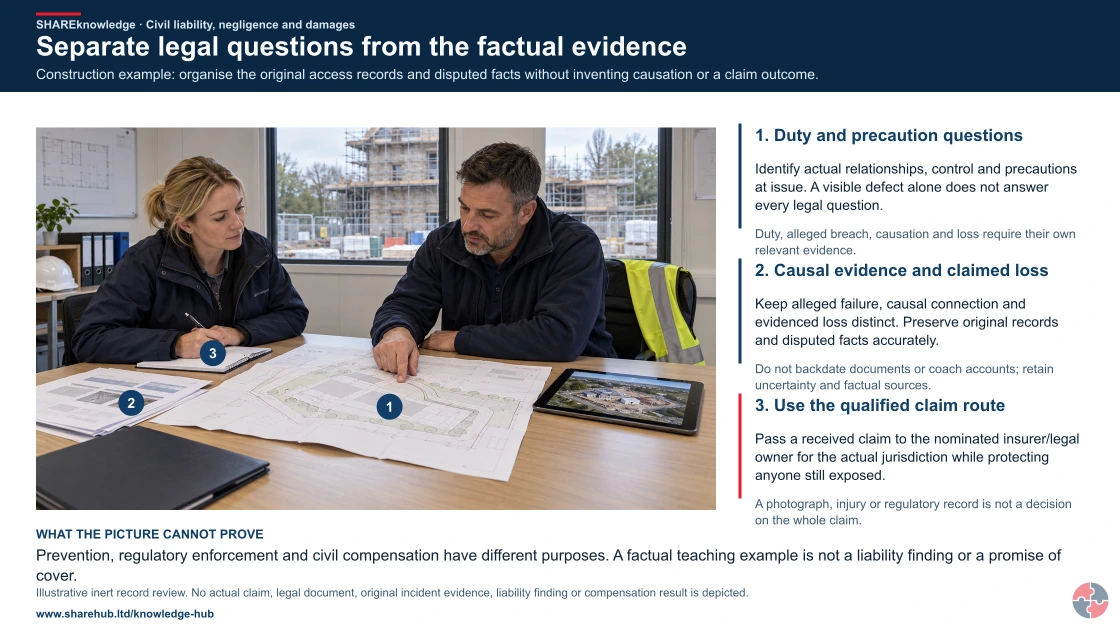
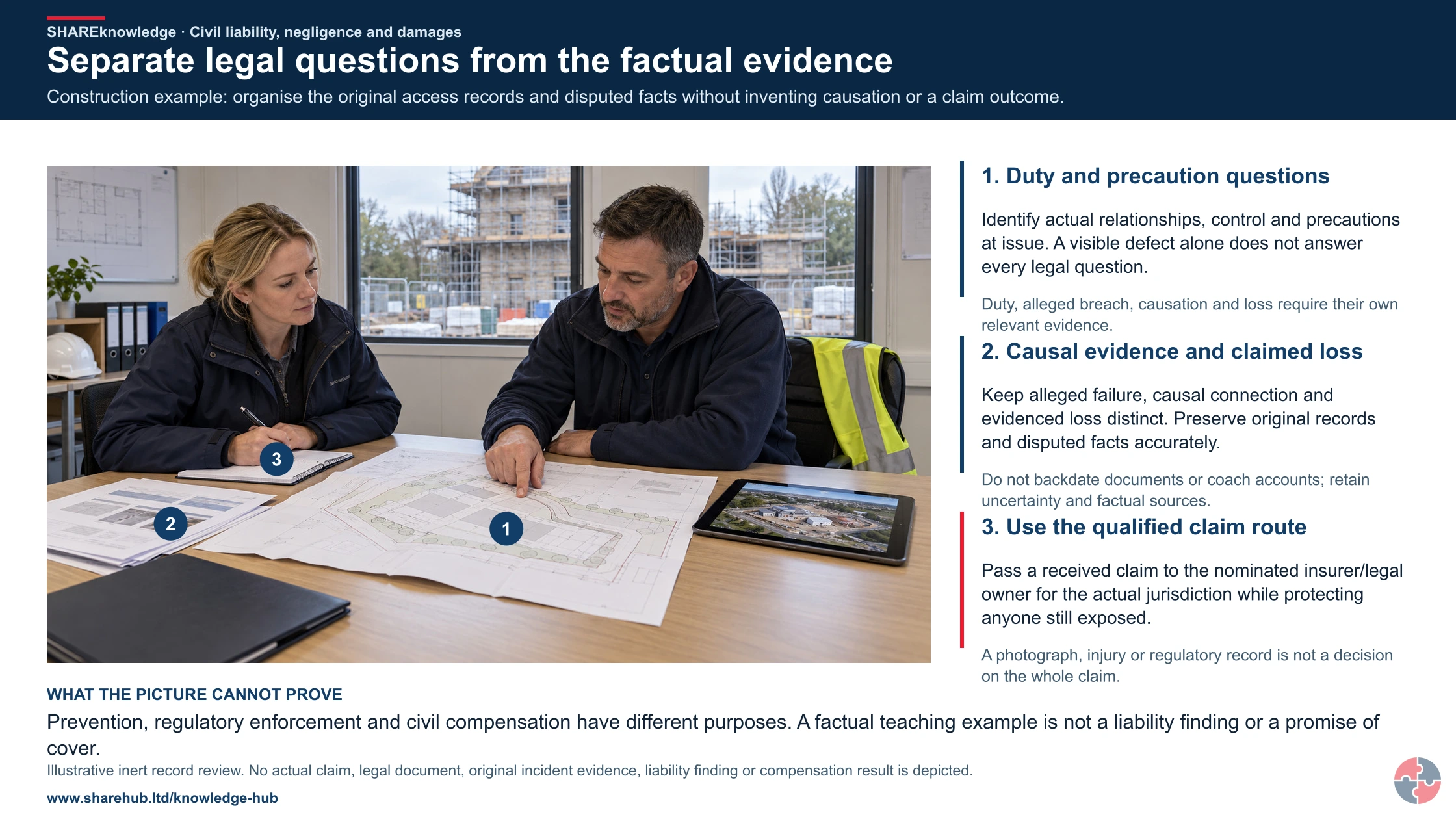
Construction example: organise the original access records and disputed facts without inventing causation or a claim outcome.
- Duty and precaution questions. Identify actual relationships, control and precautions at issue. A visible defect alone does not answer every legal question.
- Causal evidence and claimed loss. Keep alleged failure, causal connection and evidenced loss distinct. Preserve original records and disputed facts accurately.
- Use the qualified claim route. Pass a received claim to the nominated insurer/legal owner for the actual jurisdiction while protecting anyone still exposed.
Change the pathway
- Keep facts separate from findings. Duty, alleged breach, causation and loss require their own relevant evidence.
- Preserve original material. Do not backdate documents or coach accounts; retain uncertainty and factual sources.
- No automatic legal result. A photograph, injury or regulatory record is not a decision on the whole claim.
Evidence check: Prevention, regulatory enforcement and civil compensation have different purposes. A factual teaching example is not a liability finding or a promise of cover.
Full jurisdiction, statutory-breach and procedure distinctions; no automatic UK-wide rule
Primary references: HSE: civil compensation and criminal enforcement (GB) · HSENI: insurance categories and claim context (NI)
Open the complete HD image (new tab)Download image
Full jurisdiction, statutory-breach and procedure distinctions; no automatic UK-wide rule
Primary references: HSE: civil compensation and criminal enforcement (GB) · HSENI: insurance categories and claim context (NI)
Keep original access plans, inspections, photographs, messages and witness evidence factual. Protect anyone still exposed and pass a received claim promptly to the insurer or legal owner using Civil Proceedings and Health and Safety Claims. The legal and procedural route depends on jurisdiction and case facts; negligence, statutory breach, compensation and criminal enforcement must not be collapsed into one result.
BuildOut: a visitor falls beside temporary access
Illustrative example. A visitor reports an injury at an occupied refurbishment site.
Decision. The site team makes the remaining hazard safe, preserves factual evidence and passes the claim to the nominated owner.
Evidence to check. Original access arrangements, inspections, conditions, independent recollections and records of the reported harm.
Hold or escalation point. Do not backdate documents, promise a legal outcome or infer causation solely from the presence of a defect.
Follow-up. Investigate prevention while the qualified legal and insurance route separately addresses the claim.
Separate the facts from each legal question
A spill scene may prompt questions about duty, breach, causation and loss. Each needs evidence and jurisdiction-specific legal interpretation; a hazard photograph is not a liability finding.
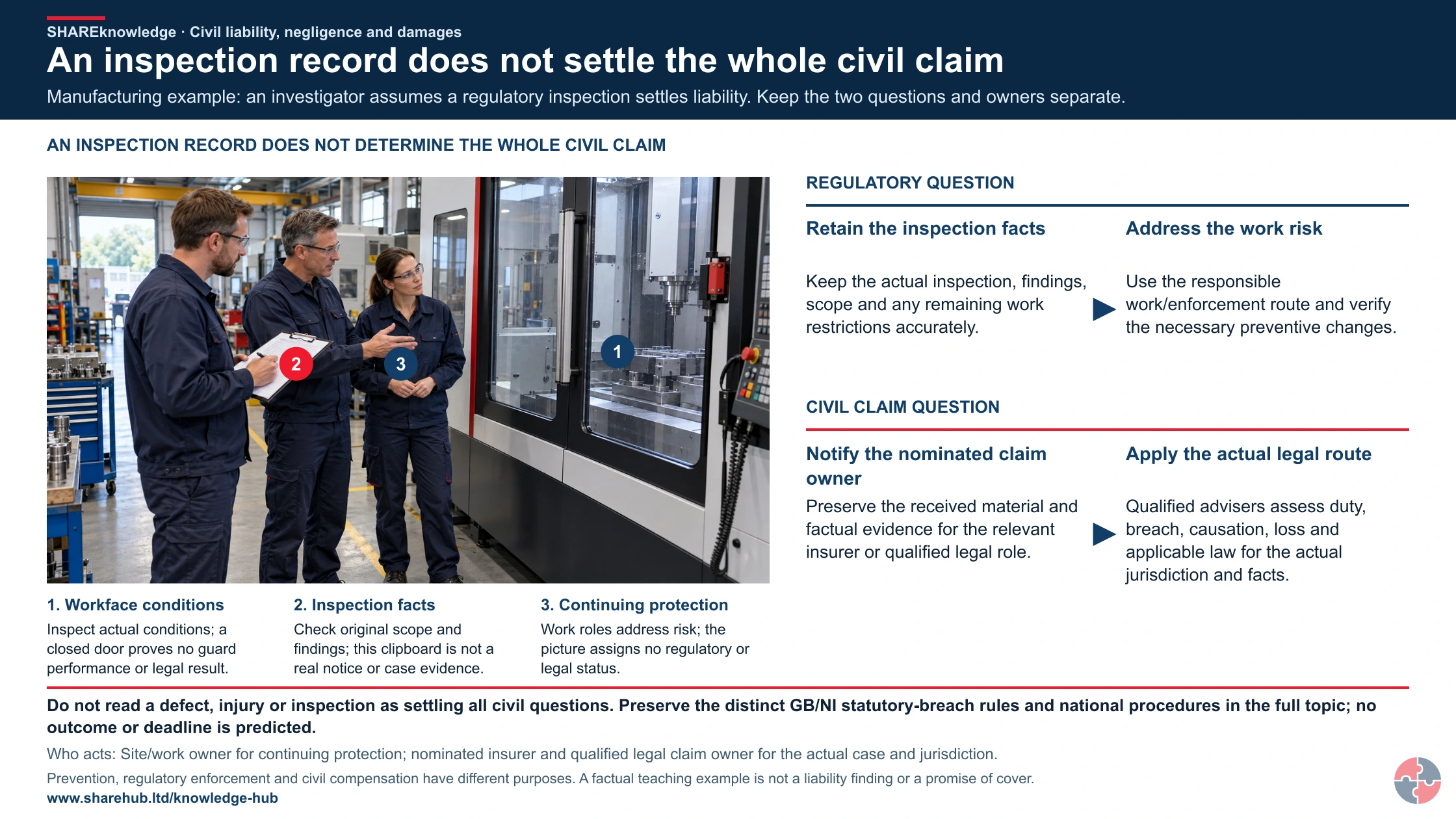
An inspection record does not settle the whole civil claim
Full written explanation
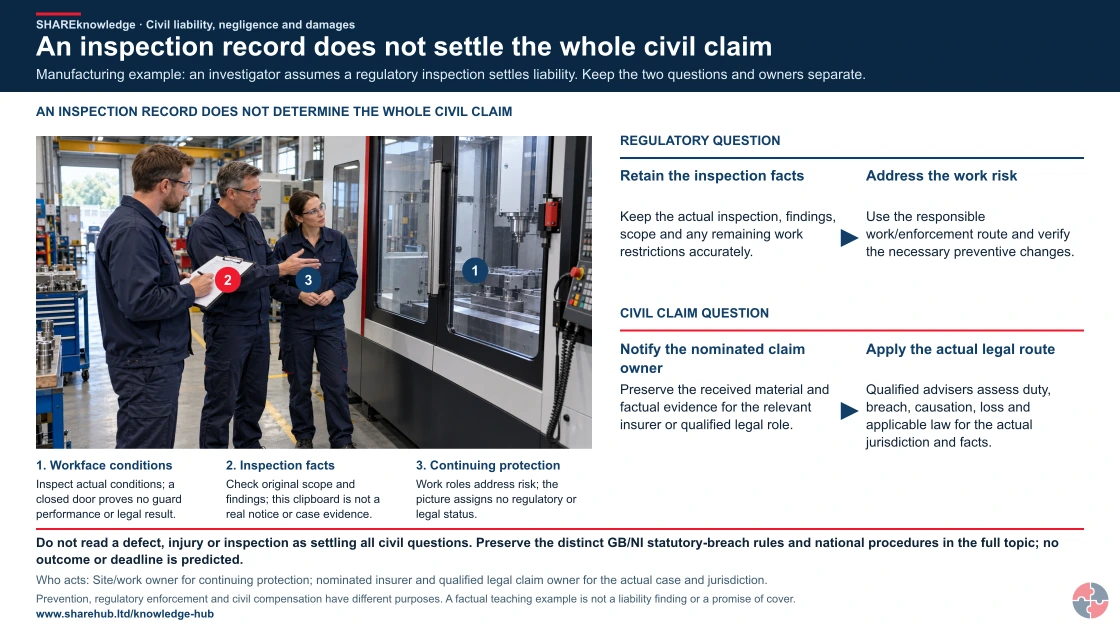
A manufacturing workface review shows a closed machining enclosure, normal colleagues and an inert clipboard. Picture key: 1 identifies workface conditions; 2 identifies inspection facts; 3 identifies continuing protection. The image supplies factual questions about the actual work and the scope of records. It identifies no regulator, inspector, lawyer, insurer or claimant, and depicts no actual inspection notice, claim, case evidence, admission or verdict. The regulatory-question lane links accurate inspection facts with addressing the continuing work risk. The civil-claim-question lane links the nominated claim owner with qualified assessment of the actual jurisdiction and facts. Each lane has unnumbered headings and its own order; no arrow or gate turns a regulatory inspection into a civil finding. A closed machine door,clipboard or workface discussion establishes no guard performance, causal account, liability, damages, insurance cover or permission. Continuing prevention and factual evidence remain separate from the legal questions and their qualified owners. Use the complete topic for GB/NI statutory-breach and national procedure qualifications; no new legal test, case attribution, outcome, deadline or universal UK rule is supplied.
Manufacturing example: an investigator assumes a regulatory inspection settles liability. Keep the two questions and owners separate.
- Retain the inspection facts. Keep the actual inspection, findings, scope and any remaining work restrictions accurately.
- Address the work risk. Use the responsible work/enforcement route and verify the necessary preventive changes.
- Notify the nominated claim owner. Preserve the received material and factual evidence for the relevant insurer or qualified legal role.
- Apply the actual legal route. Qualified advisers assess duty, breach, causation, loss and applicable law for the actual jurisdiction and facts.
When the evidence does not fit: Do not read a defect, injury or inspection as settling all civil questions. Preserve the distinct GB/NI statutory-breach rules and national procedures in the full topic; no outcome or deadline is predicted.
Who acts: Site/work owner for continuing protection; nominated insurer and qualified legal claim owner for the actual case and jurisdiction.
Changed workplace
Construction access: Preserve actual access plans, inspections, conditions and original recollections; qualified advice assesses the claim.
Manufacturing inspection: Use the real inspection scope as evidence; continue prevention while the separate claim route addresses the legal questions.
Evidence check: Prevention, regulatory enforcement and civil compensation have different purposes. A factual teaching example is not a liability finding or a promise of cover.
Full jurisdiction, statutory-breach and procedure distinctions; no automatic UK-wide rule
Primary references: HSE: civil compensation and criminal enforcement (GB) · HSENI: insurance categories and claim context (NI)
Open the complete HD image (new tab)Download image
Full jurisdiction, statutory-breach and procedure distinctions; no automatic UK-wide rule
Primary references: HSE: civil compensation and criminal enforcement (GB) · HSENI: insurance categories and claim context (NI)

Duty and precaution
Identify who may have owed a duty and the precautions at issue, with facts about actual control and circumstances.
Causation and loss
Keep the alleged breach, causal connection and evidenced loss distinct. Record disputed facts and uncertainty rather than supply an automatic score.
Advice and prevention
Obtain qualified advice for the applicable jurisdiction while protecting people and addressing the ongoing hazard.
The teaching map does not predict a claim outcome or replace legal advice.
What are the key facts about civil law liability?
The key facts are that civil liability is about compensation, proof, negligence, causation, damages and the quality of evidence.
Civil law is not enforcement
HSE and local authorities do not enforce civil claims; they enforce criminal health and safety law.
Negligence has building blocks
A claimant usually needs to show duty, breach, causation and loss.
Evidence is created before claims
Risk assessments, training and maintenance records have most value when they are accurate, current and used.
Insurance is compulsory for most employers
Employers' liability insurance helps meet compensation costs for employees injured or made ill through work.
Records must be honest
Overstating controls, backfilling paperwork or speculating can damage credibility.
Learning still matters
Defending a claim and improving controls are different tasks, but both depend on good investigation and action tracking.
What is civil law liability in workplace health and safety?
Civil law liability is the possibility of paying compensation because work-related negligence caused injury, illness or loss.
Civil liability is usually discussed after something has gone wrong: a fall, manual-handling injury, chemical exposure, occupational disease, equipment defect, vehicle incident or visitor injury. The injured person may allege that the organisation failed to take reasonable care and that the failure caused their harm.
For health and safety professionals, the value of understanding civil liability is practical. It explains why risk assessments must describe the real work, why training needs evidence, why inspections need action close-out and why incident investigations should identify root causes rather than blame individuals.
Civil law also affects commercial behaviour. Insurers may inspect premises, require evidence, impose conditions or increase premiums where controls are weak. A business that manages risk well is usually better placed to protect people and respond to claims.
| Element | Plain-English meaning | Workplace significance |
|---|---|---|
| Duty of care | A legal responsibility to take reasonable care for people who may be affected. | Employers, occupiers and contractors may owe duties depending on the situation. |
| Breach | A failure to meet the required standard of care. | Often tested through risk assessment, guidance, custom, training and foreseeable risk. |
| Causation | A link between the breach and the injury or loss. | Evidence must show what caused the harm, not just that harm occurred. |
| Damages | Financial compensation for legally recognised loss. | May include pain, suffering, earnings loss, care and expenses. |
| Insurance | A policy that helps meet civil compensation costs. | Most employers must hold employers' liability insurance. |
How do civil and criminal routes differ?
A regulator may enforce criminal health and safety law; an injured person may seek civil compensation. The tests, parties and outcomes differ.
HSE explains that it does not enforce civil law. A criminal investigation or RIDDOR report does not by itself decide a compensation claim, and a compensation claim does not replace the duty to prevent harm. Use the same accurate contemporaneous records to support both learning and a fair account, but let lawyers and insurers manage legal positions.
What must usually be shown for negligence?
A claimant generally has to establish an applicable duty of care, breach, causation and legally recoverable loss; the facts and jurisdiction decide the outcome.
The question is what reasonable care required for the actual risk and person, and whether the alleged failing caused the harm. An incident alone does not prove breach. A written policy alone does not prove effective control: the work method, competence, supervision, maintenance and response to warnings matter. Multiple causes or employers can make occupational disease claims especially fact-sensitive.
On a small screen, scroll this table sideways to read all columns.
| Element | Question | Relevant records |
|---|---|---|
| Duty | Who controlled the task, premises or person’s exposure? | Contracts, roles and work instructions |
| Breach | What precautions were reasonable and actually used? | Assessments, inspections, training and maintenance |
| Causation | Did the alleged failure contribute to the particular harm? | Exposure history, incident facts and clinical evidence |
| Loss | What injury and financial loss is evidenced? | Clinician and financial records under controlled access |
Who may owe a duty of care?
A duty of care may be owed by employers, occupiers, contractors, designers, suppliers, professionals and others whose work could foreseeably affect people.
Employers owe duties to employees and may also be liable for negligent acts by employees in the course of employment. Organisations may owe duties to visitors, contractors, tenants, customers, residents or members of the public depending on control and foreseeability.
In multi-employer workplaces, duty can become complex. A client, principal contractor, facilities manager, subcontractor and labour supplier may each control different parts of the risk. This is why contract boundaries, coordination, induction and shared evidence matter.
| Party | Potential duty issue | Practical control |
|---|---|---|
| Employer | Protect workers from injury or illness arising from work. | Risk assessment, safe systems, training, supervision and maintenance. |
| Occupier or premises controller | Protect lawful visitors from foreseeable premises hazards. | Inspection, defect repair, housekeeping and signage. |
| Contractor | Protect own workers and others affected by contractor activity. | RAMS, competence, coordination and supervision. |
| Client or principal contractor | Coordinate risks where several parties work together. | Pre-construction information, appointments and monitoring. |
| Designer or supplier | Avoid foreseeable harm from unsafe design or product information. | Design risk review, instructions and technical standards. |
How is breach of duty assessed?
Breach is assessed by comparing what was done with what reasonable care required in the circumstances.
The required standard depends on risk, knowledge, guidance, industry practice, legal duties, available controls and the people affected. A higher-risk task normally needs stronger planning, competence and evidence. Vulnerable workers, young workers, new starters and contractors may need additional instruction or supervision.
Evidence of breach often comes from gaps: risk assessment missing the real task, training not completed, known defect not fixed, inspections not acted on, control measures not maintained, or managers tolerating unsafe practice.
| Prompt | What to examine | Why it matters |
|---|---|---|
| Foreseeability | Was the risk known or should it have been known? | Known risks require proportionate control. |
| Guidance and standards | Was relevant HSE guidance or industry practice considered? | Shows what reasonable control may look like. |
| Control implementation | Were controls actually in place at the point of work? | Paper controls are weak if not used. |
| Supervision | Was work checked and corrected? | Unsafe drift can become normal without supervision. |
| Maintenance | Were equipment and premises defects controlled? | Defects often create claim evidence. |
| Review | Were incidents, complaints and audits acted on? | Failure to learn can show weak management. |
How do causation and contribution affect a claim?
Causation links an alleged breach to harm; any contributory negligence is a separate, fact-specific question for the court or settlement advice.
In a fall, contemporaneous photographs and witnesses may clarify the event. In a long-latency disease, the timeline, several employers, exposure records and medical evidence may be central. Do not presume a worker’s mistake removes the employer’s duty. Equally, do not record a legal conclusion in an incident note; record what each person saw and what controls operated.
On a small screen, scroll this table sideways to read all columns.
| Issue | Practical question | Avoid |
|---|---|---|
| Incident mechanism | What happened, when and where? | Reconstructing facts from memory as if contemporaneous |
| Exposure history | What materials, levels, durations and employers are evidenced? | Assuming one employer caused all exposure |
| Contribution | What did the person know and what system existed? | Blaming a worker before reviewing the work system |
What are damages in a workplace civil claim?
Damages are compensation intended to reflect injury, suffering, loss of earnings, care, expenses and other legally recognised loss.
Damages are not a fine. They are compensation awarded or agreed in a civil claim. In personal injury and occupational disease matters, the amount may consider pain, suffering, loss of amenity, loss of earnings, treatment costs, care needs, travel expenses, equipment and future losses.
From a management perspective, damages show why prevention is cheaper and more humane than claims response. The visible cost of a claim may be only part of the total impact. There may also be absence, overtime cover, reputational harm, increased premiums, management time and loss of trust.
| Type of loss | What it may include | Management lesson |
|---|---|---|
| Pain, suffering and loss of amenity | Impact of injury on daily life and enjoyment. | Prevent harm rather than treating claims as only financial events. |
| Loss of earnings | Past and future income loss. | Return-to-work planning and rehabilitation matter. |
| Care and assistance | Help needed from family or paid carers. | Serious injuries can affect whole households. |
| Medical and rehabilitation costs | Treatment, therapy, aids or adaptations. | Early support can reduce long-term impact. |
| Expenses | Travel, equipment or other costs linked to injury. | Incident consequences extend beyond the workplace. |
How can the hierarchy of controls guide reasonable precautions against foreseeable workplace harm?
Useful evidence shows that risks were assessed, controls were implemented, people were competent, defects were acted on and learning was completed.
Evidence should be created as part of genuine control, not as a claims exercise. A clean, honest record made at the time is usually more credible than paperwork created after an incident. Good evidence is specific, dated, owned and connected to the real task.
Avoid defensive fiction. HSE warns businesses not to overstate measures they have or plan to put in place. If a risk assessment says a control exists but it does not, the document may become damaging evidence.
| Evidence type | What good looks like | Why it matters |
|---|---|---|
| Risk assessment | Specific to task, people, controls and review. | Shows foreseeable risks were considered. |
| Training records | Role-specific, current and checked for understanding. | Shows competence was managed. |
| Inspection records | Defects, actions, owners and close-out. | Shows monitoring and correction. |
| Maintenance records | Planned checks, defects, repairs and statutory inspections. | Shows equipment and premises were controlled. |
| Incident investigation | Facts, immediate causes, root causes and actions. | Shows learning and improvement. |
| Supervision evidence | Briefings, observations, correction and escalation. | Shows controls were actively managed. |
For prevention, use HSE’s five-level hierarchy and ERICPD as a complementary mnemonic. The floor-contamination scenario below illustrates how physical task changes, checks and records connect. It does not decide negligence, causation or damages; those still require the facts and applicable law. Administrative instructions depend on people following them, while engineering controls change the physical pathway.
Worked example: floor contamination, controls and honest evidence
How can the ERICPD hierarchy of controls guide reasonable precautions against foreseeable workplace harm?

| Hierarchy / ERICPD | Physical or organisational task change | Owner, checks and failure/restart evidence |
|---|---|---|
| Elimination / Eliminate | Redesign the transfer so containers are not carried open across a pedestrian route. | Operations owner observes the complete revised task and confirms the spill pathway is removed. A return to open carrying triggers a hold and redesign review. |
| Substitution / Reduce | Trial a compatible sealed container or less spill-prone delivery form, checking its handling and other hazards. | Buyer and assessor verify compatibility, grip, leakage and frequency in use. A new hazard or failed closure triggers reassessment before further use. |
| Engineering / Isolate and Control | Provide designed containment and a separated transfer route where the hazard remains. | Facilities owner commissions the arrangement for the actual volume and traffic; users check condition before work and maintenance is recorded. Leakage or failed separation stops the exposed task until repair and verification. |
| Administrative / Control and Discipline | Define spill detection, isolation, cleaning and handover with an achievable response. | Supervisor observes practice and checks that the surface is safe before reopening. Signs alone do not remove contamination; incomplete cleaning keeps the route closed and is escalated. |
| PPE / PPE | Select suitable footwear for the residual task and other assessed protection where needed. | Assessor records selection; users check wear and contamination. Failed protection requires replacement and a control review; footwear does not justify a leaking process or unsafe reopening. |
How can the ISO 45001 hierarchy of controls guide reasonable precautions against foreseeable workplace harm?

| Hierarchy / ERICPD | Physical or organisational task change | Owner, checks and failure/restart evidence |
|---|---|---|
| Elimination / Eliminate | Redesign the transfer so containers are not carried open across a pedestrian route. | Operations owner observes the complete revised task and confirms the spill pathway is removed. A return to open carrying triggers a hold and redesign review. |
| Substitution / Reduce | Trial a compatible sealed container or less spill-prone delivery form, checking its handling and other hazards. | Buyer and assessor verify compatibility, grip, leakage and frequency in use. A new hazard or failed closure triggers reassessment before further use. |
| Engineering / Isolate and Control | Provide designed containment and a separated transfer route where the hazard remains. | Facilities owner commissions the arrangement for the actual volume and traffic; users check condition before work and maintenance is recorded. Leakage or failed separation stops the exposed task until repair and verification. |
| Administrative / Control and Discipline | Define spill detection, isolation, cleaning and handover with an achievable response. | Supervisor observes practice and checks that the surface is safe before reopening. Signs alone do not remove contamination; incomplete cleaning keeps the route closed and is escalated. |
| PPE / PPE | Select suitable footwear for the residual task and other assessed protection where needed. | Assessor records selection; users check wear and contamination. Failed protection requires replacement and a control review; footwear does not justify a leaking process or unsafe reopening. |
How does employers’ liability insurance fit?
Most employers must hold employers’ liability cover, subject to exemptions; cover funds qualifying compensation and does not replace prevention.
Check the correct policy, employer entity, period and claims-notification condition. Refer a claim promptly to the insurer or broker. The GB employers’ liability insurance law and guide does not extend to NI. NI uses the Employer’s Liability (Defective Equipment and Compulsory Insurance) (NI) Order 1972 and HSENI guidance. Public liability is a different product for non-employee claims. A live insurer or solicitor should decide coverage and conduct.
On a small screen, scroll this table sideways to read all columns.
| Check | Owner | Evidence |
|---|---|---|
| Current cover and exemptions | Finance or broker | Policy and certificate |
| Historic cover for disease | Insurer and legal lead | Period-specific policies and employment history |
| Claim notice | Claims lead | Date received and notice sent |
| Risk reduction | Operations | Implemented controls and review |
What should a business do when a civil claim is received?
A business should notify its insurer, preserve evidence, avoid speculation, protect confidentiality and continue learning from the incident.
Claims handling should be calm and controlled. The business should follow its insurer's instructions, preserve relevant documents, identify witnesses, secure photographs or CCTV where lawful, and keep internal discussion factual. Do not admit liability, blame people in casual emails or create speculative notes.
Learning should still happen. Even where liability is disputed, the business should investigate what happened and fix defects. Corrective action is about preventing recurrence; claims handling is about legal and insurance process. Both need good records.
| Step | What to do | Why it matters |
|---|---|---|
| Notify | Send the claim to the insurer or broker as required. | Protects policy position and gets specialist handling. |
| Preserve | Secure records, photos, CCTV, equipment, permits and witness details. | Prevents loss of evidence. |
| Control communication | Keep comments factual and route legal questions correctly. | Avoids speculation and inconsistent accounts. |
| Investigate | Find immediate and root causes using a competent process. | Supports learning and evidence quality. |
| Act | Close corrective actions and review similar risks elsewhere. | Prevents recurrence and shows management control. |
| Review | Feed claims lessons into risk registers and leadership review. | Improves systems and reduces future exposure. |
Which legal sources set the boundaries?
Civil negligence and statutory-breach claims are distinct. GB and NI use materially different rules for whether a breach of health and safety regulations can itself found a civil action.
In Great Britain, HSWA 1974 section 47 as amended by section 69 of the Enterprise and Regulatory Reform Act 2013 generally prevents a standalone civil action for breach of health and safety regulations, subject to exceptions. In Northern Ireland, NI Order article 43(2) of the Health and Safety at Work (NI) Order 1978 says breach of a duty imposed by health and safety regulations is actionable so far as it causes damage, unless the regulations provide otherwise. In either place, a regulatory breach may also be relevant evidence in a negligence case. The specific regulation, date, territory and any exception need legal review. Procedure differs across England and Wales, Scotland and Northern Ireland. The applicable pre-action protocol, limitation issue and court route must be selected by a legal professional for the actual claim.
On a small screen, scroll this table sideways to read all columns.
| Location | Starting point | Do not assume |
|---|---|---|
| England and Wales | Civil Procedure Rules and the appropriate personal-injury or disease protocol | One protocol or deadline fits all injury and disease claims |
| Scotland | Scottish Courts rules and applicable personal-injury pre-action protocol | England and Wales CPR governs Scottish actions |
| Northern Ireland | NI Order article 43, court rules and personal-injury protocol | GB section 47 rule applies to a NI regulatory-duty claim |
How should civil liability appear in the risk register?
Civil liability should appear through credible harm scenarios, vulnerable evidence points, claim triggers and controls that prove risks are managed.
The risk register should not simply say 'civil claim'. It should describe the underlying scenario: fall on poorly maintained stairs, occupational dermatitis from unmanaged chemical exposure, manual-handling injury after ignored reports, visitor trip, contractor injury or vehicle collision.
The assurance question is whether the business could show reasonable care before the incident. That means evidence of assessment, control, training, supervision, inspection, maintenance, reporting and learning.
| Scenario | Civil exposure route | Controls | Evidence |
|---|---|---|---|
| Visitor slips on wet floor | Premises condition alleged to be unsafe. | Cleaning, signage, matting and inspection. | Cleaning logs, inspection records and CCTV if available. |
| Worker injured lifting | Manual-handling risk alleged to be uncontrolled. | Handling aids, assessment, training and workload design. | Manual-handling assessment and training records. |
| Contractor injured by plant | Coordination and isolation alleged to be weak. | Permit, isolation, contractor induction and supervision. | Permit records, RAMS review and handover. |
| Occupational disease claim | Exposure alleged to have caused illness. | COSHH, monitoring, health surveillance and PPE. | Exposure records and surveillance records. |
| Known defect not repaired | Failure to act after reports alleged. | Defect reporting, prioritisation and escalation. | Defect log and action close-out. |
How could BuildOut Ltd manage civil liability risk?

BuildOut Ltd would manage civil liability risk by building honest, task-specific evidence into its daily construction and property services controls.
BuildOut Ltd
A construction and property services business managing projects, subcontractors, site workers, designers, maintenance teams and members of the public near works.
BuildOut maps civil liability to real scenarios: manual-handling injuries during materials delivery, falls from temporary access, contractor injuries during isolation, visitor trips near occupied refurbishment works and occupational ill health from dust or vibration. Each scenario sits in the risk register with controls, owners and evidence standards.
The business is clear that paperwork only helps if it reflects reality. Supervisors complete short frontline checks on access, housekeeping, exclusion zones, permits, lifting aids and subcontractor controls. The H&S adviser samples RAMS, induction, training, inspection and maintenance evidence. Senior managers review incidents, claims trends, insurer feedback and overdue actions.
If a claim arrives, BuildOut notifies its insurer, preserves evidence, avoids speculative email commentary and still investigates the event for learning. Corrective actions are assigned, ranked and verified, then fed back into procurement, design reviews, supervisor training and contractor management.
| Management area | How BuildOut applies the control | Evidence and improvement |
|---|---|---|
| Assess and plan | Defines credible civil-claim scenarios in the risk register and links them to task controls. | Risk register, CPP, RAMS and design risk reviews. |
| Implement controls | Uses access controls, housekeeping, permits, lifting aids, dust controls and contractor supervision. | Inspection records, permits, plant checks and photos. |
| Train and supervise | Trains supervisors on evidence, briefings, defect escalation and avoiding speculative records. | Training matrix, supervisor observations and toolbox talks. |
| Check and audit | Samples high-risk activities, action close-out and whether controls match paperwork. | Audit reports, ranked findings and close-out verification. |
| Insurer interface | Keeps EL certificate, notifies claims promptly and uses insurer surveys as improvement input. | Insurance records, claim notifications and survey action tracker. |
| Learn and improve | Reviews incidents and claims themes in management meetings. | Trend reports, revised standards and leadership minutes. |
What should each role learn and demonstrate?
Learning must match the decisions people make, from recognising danger to checking that controls work.
Briefings should tell people how to act, but attendance alone does not show competence. Assess the real decision or task, record who assessed it and revisit after a material change, failed control or incident. A local authorisation is task-specific; no universal external certificate is implied.
On a small screen, scroll this table sideways to read all columns.
| Role and learning | Demonstration and assessor | Record and reassessment trigger |
|---|---|---|
| Managers: separate facts from legal conclusions. | Use a simulated incident to record the evidence of duty, controls and events without attributing fault. | Signed exercise and reviewed incident notes. |
| Claims lead: route and preserve. | Identify insurer, jurisdiction, relevant pre-action route and evidence hold. | Practice claim log and annual test. |
| Risk owner: verify controls. | Observe a live task against assessment, training and maintenance records. | Corrective action closure. |
How does civil liability support NEBOSH study and professional development?
Civil liability supports study by linking legal concepts to practical safety management, evidence, insurance and incident learning.
For advanced safety study, learners can practise how to explain civil liability, negligence, duty of care and damages in a health and safety context. The value is not memorising legal terms; it is understanding how the law influences risk assessment, evidence, investigation and management control.
Scenario questions may describe an injured worker, poor training record, repeated defect, contractor incident or occupational disease claim. Strong answers explain the civil-law issues and then identify the practical records and controls that would show reasonable management.
| Learning area | What to understand | How to apply it |
|---|---|---|
| Civil vs criminal law | Different parties, purposes, outcomes and standards. | Explain compensation vs enforcement. |
| Negligence | Duty, breach, causation and damage. | Apply to a workplace incident scenario. |
| Evidence | Records created before and after an event. | Identify what would support or weaken a defence. |
| Insurance | Employers' liability and claims notification. | Explain why insurance does not replace prevention. |
| Management systems | How Plan, Do, Check, Act supports defensibility. | Link audits, inspections and actions to legal risk reduction. |
How can a management system sustain effective decisions?
Give each hazard or support route an owner, a control, a check and a response to failure.
The free GB regulator guide HSE Managing for health and safety (HSG65) explains a plan–do–check–act approach: assign controls and owners, involve workers, check work as done, and correct failures. For Northern Ireland, use HSENI risk assessment guidance for the local duty. A certificate alone does not demonstrate that a control works.
The free GB regulator guide HSE Managing for health and safety (HSG65) explains a plan–do–check–act approach: assign controls and owners, involve workers, check work as done, and correct failures. For Northern Ireland, use HSENI risk assessment guidance for the local duty. A certificate alone does not demonstrate that a control works.
What warning signs show civil liability risk is not controlled?
Warning signs include generic assessments, repeated defects, poor records, weak supervision, insurer actions ignored and incident learning not closed.
Civil liability warning signs usually appear before the claim. If inspections repeatedly find the same defect, if risk assessments do not match the task, if training records are missing or if managers tolerate shortcuts, the business is creating both harm risk and weak evidence.
The response should not be to create more paperwork. It should be to fix the underlying control problem, assign ownership and verify improvement.
| Warning sign | How it can harm people or claims defence | What to do |
|---|---|---|
| Generic risk assessments | Controls may not match real tasks or foreseeable harm. | Rewrite around real work and check at site. |
| Repeated defects | Known hazards show failure to act. | Escalate, prioritise and verify close-out. |
| Training records missing | Competence cannot be demonstrated. | Rebuild role-based training evidence. |
| Incident reports blame workers only | Root causes and system failures are missed. | Improve investigation method. |
| Insurer survey actions ignored | Known improvement opportunities remain open. | Track actions in management review. |
| Managers speculate in emails | Inconsistent or unfair comments can damage credibility. | Train managers on factual records. |
What acronyms are used on this civil liability page?
Acronyms should be explained so legal and safety terms remain accessible.
| Acronym | Meaning | Why it matters |
|---|---|---|
| EL | Employers' liability | Insurance and civil liability relating to employee injury or illness. |
| PLI | Public liability insurance | Insurance relating to members of the public or third parties. |
| HSE | Health and Safety Executive | Great Britain regulator for many work-related health and safety duties. |
| RAMS | Risk assessment and method statement | Task document often used to evidence planning and control. |
| CPR | Civil Procedure Rules | Rules for civil court procedure in England and Wales. |
| PDCA | Plan, Do, Check, Act | Management cycle used in HSG65 and many systems. |
| ISO | International Organization for Standardization | Publisher of ISO 45001 management-system standard. |